Battery Overvoltage

41 comments started 2024-05-09 last 2024-06-17
GivEnergy Products
#1 Watcher

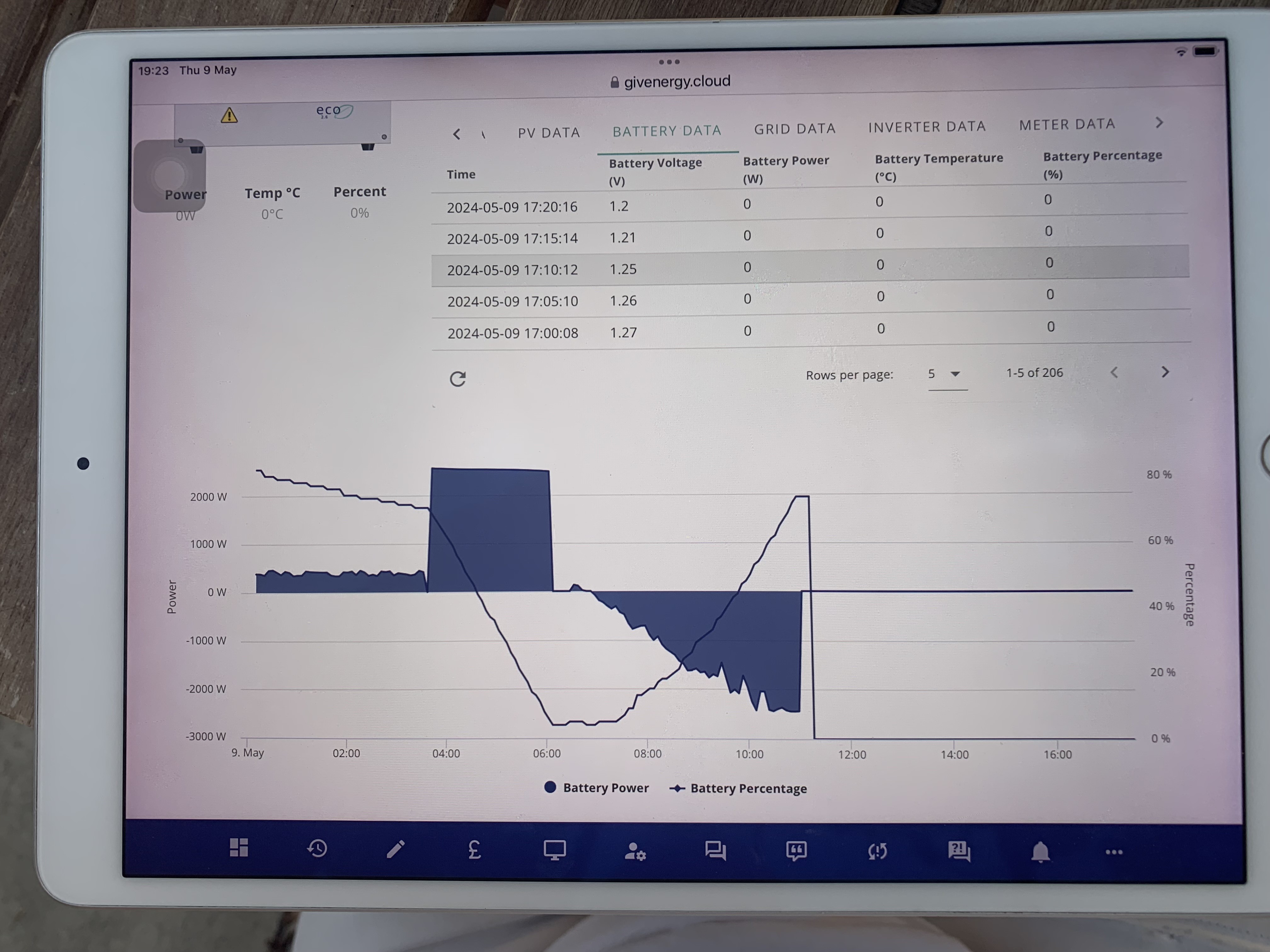
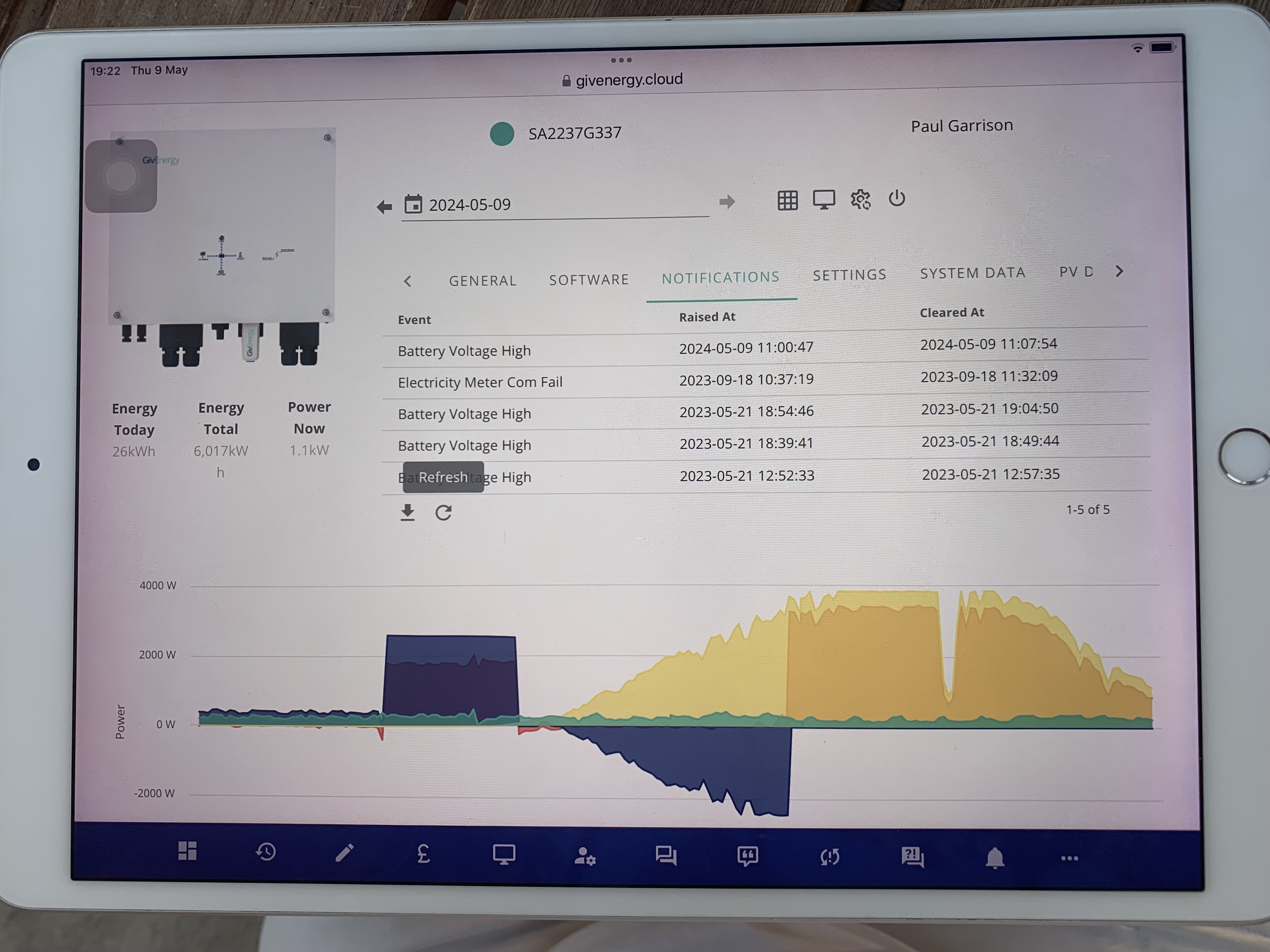
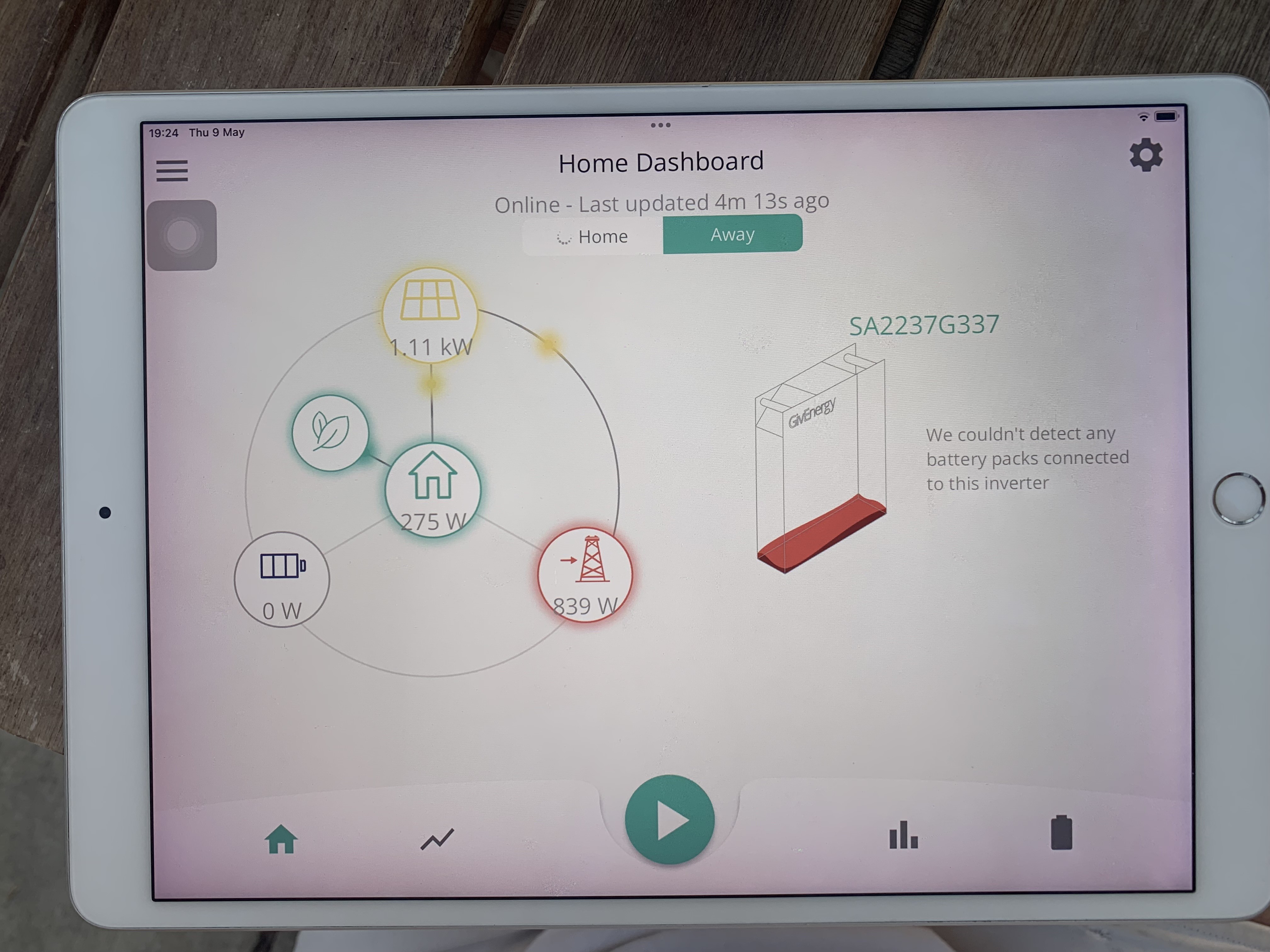
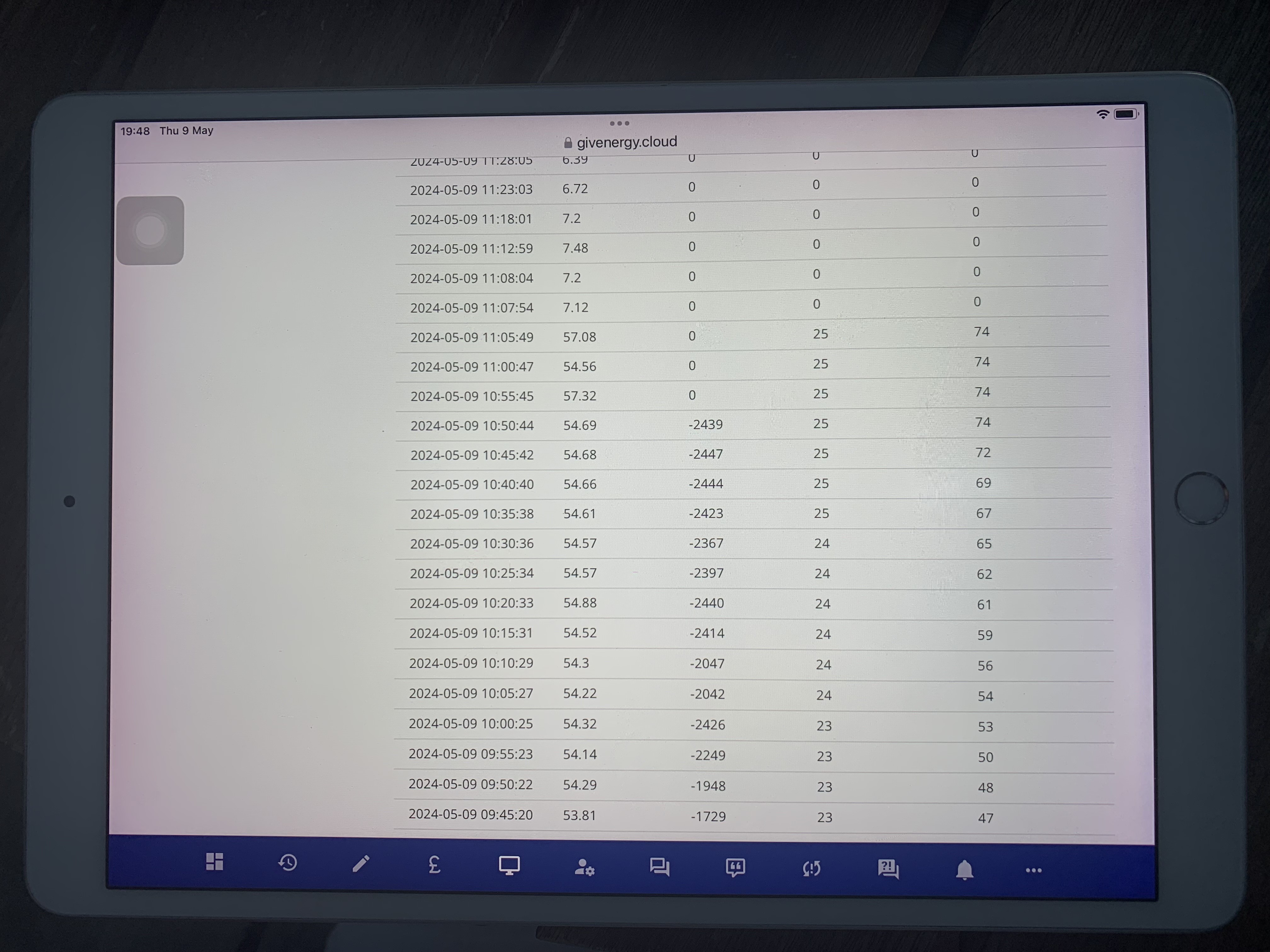
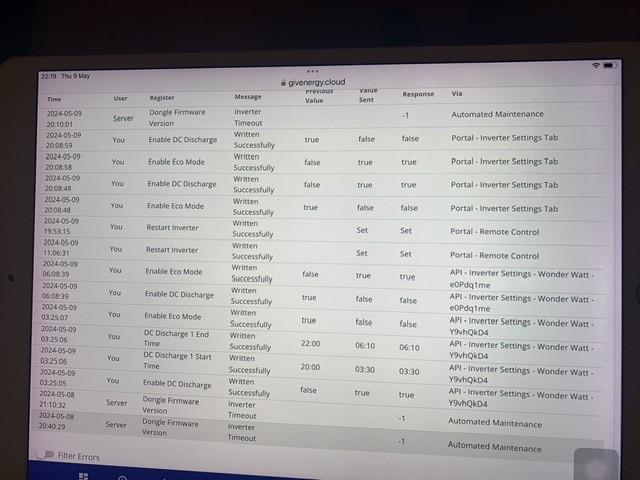
Have read the battery overvoltage issues here did not think it would apply to me as running D0.450-A0.451 and 3012 with no issues. However emptied my batts this morning to refill from solar,aok until 11:00 then Overvoltage warning with the below following.
To complicate I aim out of the country for 3 weeks so can’t easily reboot batts without sending a child round home!
Help please, any advise welcome.

I have 4 picture to follow but having to add to thread one by one, sorry!

#2 Watcher

#3 Watcher

#4 Watcher

G
#5 geoffreycoan

You could try rebooting the inverter from the portal, but that doesn’t look good if it is saying it can’t see any batteries connected. Normally a few minutes after the OV it returns to operation

#6 Watcher

geoffreycoan

Thanks Geoffrey, my first thought & just tried again with no success.

#7 Watcher

@TheDragon (GivEnergy)
Any ideas? BTW my dongle firmware has been interfered with 2 days running?
SA2237G337

O
#8 Omission

I've just had exactly the same issue, battery dropped to 0 and "Battery Voltage High" Warnings in the notifications.
I've switched the battery off, left for a minute then back on and its showing 100% now and powering the house.

WG2302G177 if anyone from GE wants to have a look at whats going on

#9 Watcher

EDIT
Just found I am getting ‘dongle firmware maintenance’ every evening??

V
#10 Vestas

"Battery Voltage High" isn't the same as overvoltage, I've only ever seen it once when I was power-cycling the inverter.

V
#11 Vestas

Watcher We all are. I asked GE about it a while back and got the following response when I queried why I had (at the time) 34 instances of "Dongle Firmware Version Inverter Timeout" -

"This is due to an ongoing project for updating dongles, please do not be concerned. We will reach out if needed, thank you."

D
#12 DD

Watcher not related, but looks like you're getting some clipping? You could reduce charging rate in the morning so that you start exporting earlier, but still have space in the battery come noon.

E
#13 Elaine

I have the exact same thing this morning - Battery was 100% and then immediately dropped to 0%. Just checked my notifications and I got the battery overvoltage warning too. First time this has happened. Coincidence that it happened to you to??

#14 Watcher

For completion and future sufferers….got my son to drop in and the circuit breaker for batts had tripped, switched on - nothing, switched off & switched off AC to reboot, left for a couple of minutes, reversed process and after 10/15 minutes the batts reappeared on the app and are charging.

#15 Watcher

Elaine

See above! Good luck!!

Hopefully GE might spot this?

G
#16 geoffreycoan

Watcher that’s good news, I did think it might be circuit breakers on the battery.
If this keeps happening then something to raise with your installer

E
#17 Elaine

Watcher Thanks for this. Yes, spoke with a helpful guy in GivEnergy this morning, Alexander was his name. He advised that it tripped and power off and on again. He did say that he would contact my installer if I had any concerns. Happy that it’s resolved now and I’ll monitor it closely.

#18 TheDragon (GivEnergy)

Watcher

I dont see any server commands in your log for Dongle Maint.

You have an older dongle so wouldnt be getting any Maint activities

#19 Watcher

TheDragon (GivEnergy)

Since my post above my house mains has tripped, son visiting later.
Thanks for looking/checking.

V
#20 Vestas

TheDragon (GivEnergy) Its the portal polling all the installs every night since 8 April.....

#21 TheDragon (GivEnergy)

Watcher argh missed them down the bottom.

Yes each night the server goes and reads ALL dongles in case any new one are updateable and stores them in a database.

Your dongle cant be updated, just ignore

#22 Watcher

TheDragon (GivEnergy)
OK, any idea why my system crashed with the batteries voltage warning?

A
#23 alphabeta77

I've had exactly the same thing happen to mine - although mine recovered, but lost my battery settings, so it thinks I've got a 5kwh battery, not 2 x 9.5kwh.... never seen such daft software that it'd 'forget' the basics...

#24 Watcher

DD

Hi @DD

The clipping you mentioned above is becoming more obvious to me as the sun has come out round here at last!
Can you explain in idiot terms what I need to do to slow the battery charge?
Thanks.

T
#25 TimHutchings

Watcher Morning. Simple way is to use the app. Cog top tight, Battery Options, then change the charge power to a figure that will allow you to export up to your max ac. If you have a 5kw hybrid inverter, it can deal with 7.5k. 5kw of ac power and 2.5kw of dc power on top. So if you drop your charge rate down, at peak times you can be charging the battery at 2.5kw and exporting up to 5kw, so more of the sun that's available.
Obviously you need enough space in your battery when clipping would normally start, till clipping would normally finish. Depending on your pv array size, you may need to pause your battery till the clipping is about to begin. Hope this helps.

#26 Watcher

TimHutchings

Perfect, thanks very much!

D
#27 DD

Watcher Sure.

Short answer - adjust the max charging power is in the 'battery options' on the app or on the web portal.

Longer answer:
I'm guessing you have a 3/6kW gen-1 hybrid inverter. I believe that can accept up to 6.2kW from the solar panels, but the max it can send to the battery is 2.6kW, and the max it can send on AC is 3.6kW. So to accept more than 3.6kW of solar (after losses), it has to be able to distribute that power between AC and battery. Once the battery fills up, the power is limited to what it can output on AC.

So the trick is to ensure that there will be space in the battery to accept excess solar power whenever it might exceed the max AC generation capacity of your inverter.
The complication is that the inverter firmware doesn't seem to make it terribly easy to tell it to prioritise AC generation, and only send power to the battery if there's more (for you) 3.6kW. It tends to want to charge the battery first, and then only send excess to the grid. So limiting how much it can send to the battery is the key. One of the parameters you can set is the max charging power. So if you set it to 1kW, for example, the inverter will send only the first 1kW of solar to the battery, then the rest to the grid. (Well, to be pedantic, it will use the first X W to AC to cover consumption, then send 1kW to the battery, then the rest to the grid.)

Looks like it took a little over 2 hours to drop battery from 75% to 5% at 2.6kW. So I'm guessing 9.5kWh battery ? What's the max power of your solar array? Times of day also depend on orientation - if it's SE, clipping will peak before noon, but SW it will be after noon.

One simple strategy is to simply not allow the battery to charge at all until, say, 11am, by setting max charging power to 0. (It might still charge a bit - up to 250W.) Then from 11am, allow the battery to charge by increasing the power. One option is to simply increase it up to the maximum - it will take a little under 4 hours to fully charge the battery at that rate, and that should get you over the solar peak.

Or if clipping might last longer than 4 hours, only increase power to 1kW at 10.30am, and 2kW at 11:30am, and full power only around noon.

You have to consider also your requirements for power after the sun has gone down. I'm lucky that 30% of battery is easily enough to cover evening, and the remaining 70% of the battery is enough to absorb clipping surplus, so I don't even have to worry about having to forecast how much solar there will be. I just start the day on 30%, assuming that even on dullest day, solar will at least cover daytime usage. If you need at least 50% charge by the end of the day, for example, you do need to take some steps to ensure you will have at least that much.

Having to do it manually is a bit of a pest. If you have a computer that's on during the day anyway, I have python scripts you're welcome to share that can make that easy. (Well, easy on linux ; windows has a task scheduler that can probably do something, but you'll have to get someone else to help you set that up.)


#29 Watcher

DD

Amazing info, thank you.

Gen1 3.6 GE - D0.450-A0.451 , 2 x 5.2 GE Batteries 4.75 solar panels.

Mac running constantly (fairly pc literate) but currently using Wonderwatt for scheduling, I have a Raspberry Pi which I loaded HA onto but could not be bothered with the depth of learning needed to get it set up and running easily.
I know zero of python! How easy are the scripts??
Cheers.

D
#30 DD

Watcher Mac running constantly (fairly pc literate) but currently using Wonderwatt for scheduling, I have a Raspberry Pi which I loaded HA onto but could not be bothered with the depth of learning needed to get it set up and running easily.
I know zero of python! How easy are the scripts??

I think they're fairly straightforward - haven't done anything very fancy with them. You may not need to edit them at all, and just pass parameters to the script givenergy.py to tweak charging power at different times of day via crontab (or whatever the mac uses instead for scheduling)

See https://github.com/divenal/givenergy-scripts

K
#31 killythebid

TimHutchings Another simple way to get some generation when the inverter capacity has been reached is to plug in an EV (if you have one) and charge it. I can get an additional 2kw above the clip rate often if the sun is shining enough. It's a charge that can go in the car that would otherwise be lost.

A hot water diverter like the Eddi will have a similar effect if it is used in the PM.

T
#32 TimHutchings

killythebid Not sure an Eddi would help as it requires AC I would have thought. Obviously, if you have a 3.6 or a 5kw inverter, those are the max AC the inverter can output, whether that's to the grid, home use or whatever. You may be right about an EV if they take DC, but I don't have one so if you say so, I'll go along with that.

D
#33 DD

I guess it could work if the AC generation is limited by an export constraint, rather than the inverter limit. Eg if you have have a 5kW inverter, but DNO will not allow export more than 3.6kW. So increasing consumption allows generation to increase without increasing export ?

K
#34 killythebid

TimHutchings

All I can say is that it does make a difference I have seen it happen. Both the Eddi and an EV home charger is AC current.

Before plugging in the car the clipping will be at about 5.2kw generation give or take and after plugging in the car I can get up to 2kw more generation depending on the strength of the sunlight.

K
#35 killythebid

DD The thing is I am not guessing I can see it happen in my system and is repeatable. I do not have an export limit as the limiting factor in this context.

T
#36 TimHutchings

killythebid What size inverter have you got? I thought with GE inverters, the size of the inverter denoted the max AC output, but if yours does something different, you either have a magic inverter or my knowledge is way out of touch (which may be the case) or I'm missing something obvious. 😁

K
#37 killythebid

TimHutchings

It is Hybrid 5 gen 2

I can show how the system reacts to charging the EV while the house battery is full. Whether you belive it or not it happens.

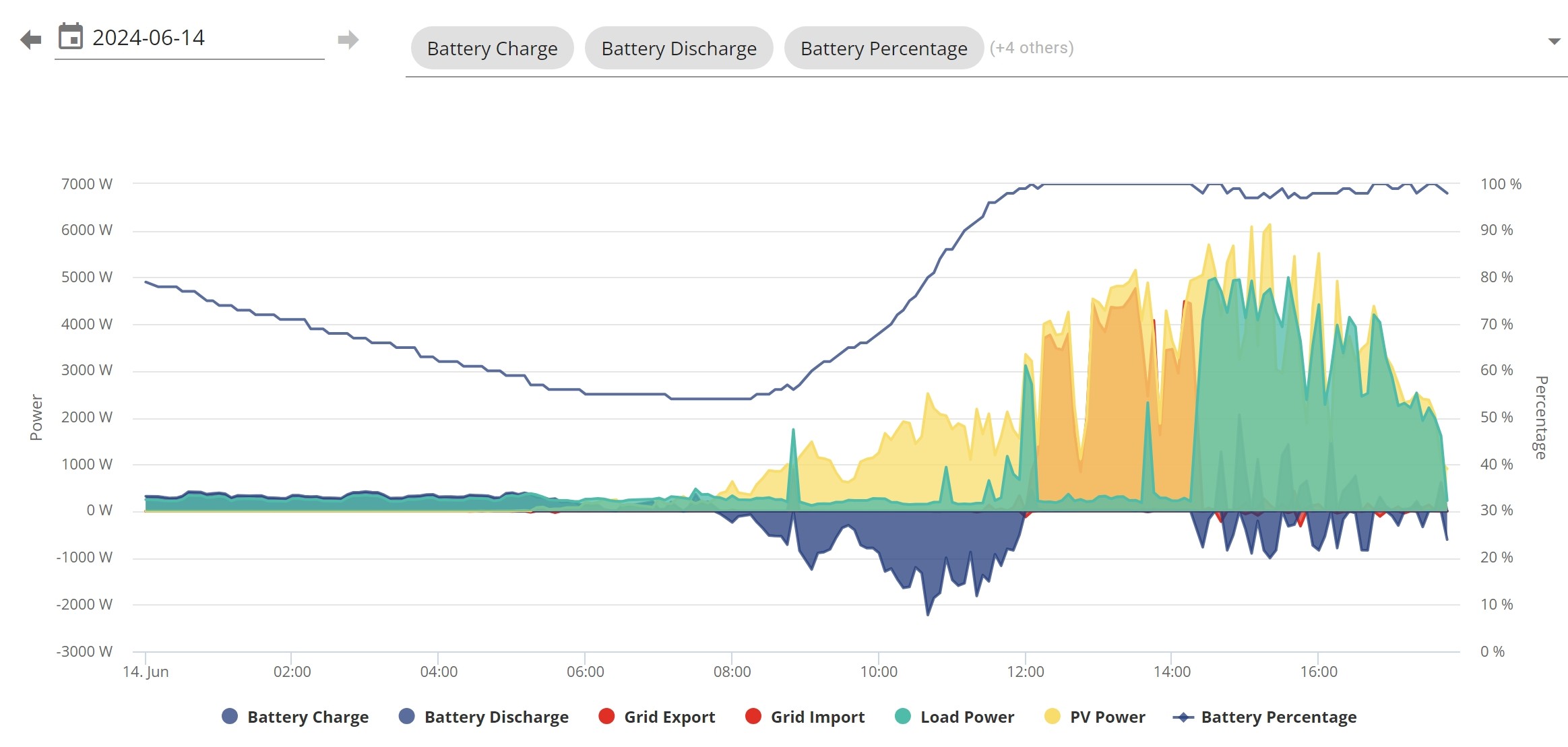
This is the generation on a sunny day with the car plugged in so no clipping while charging.

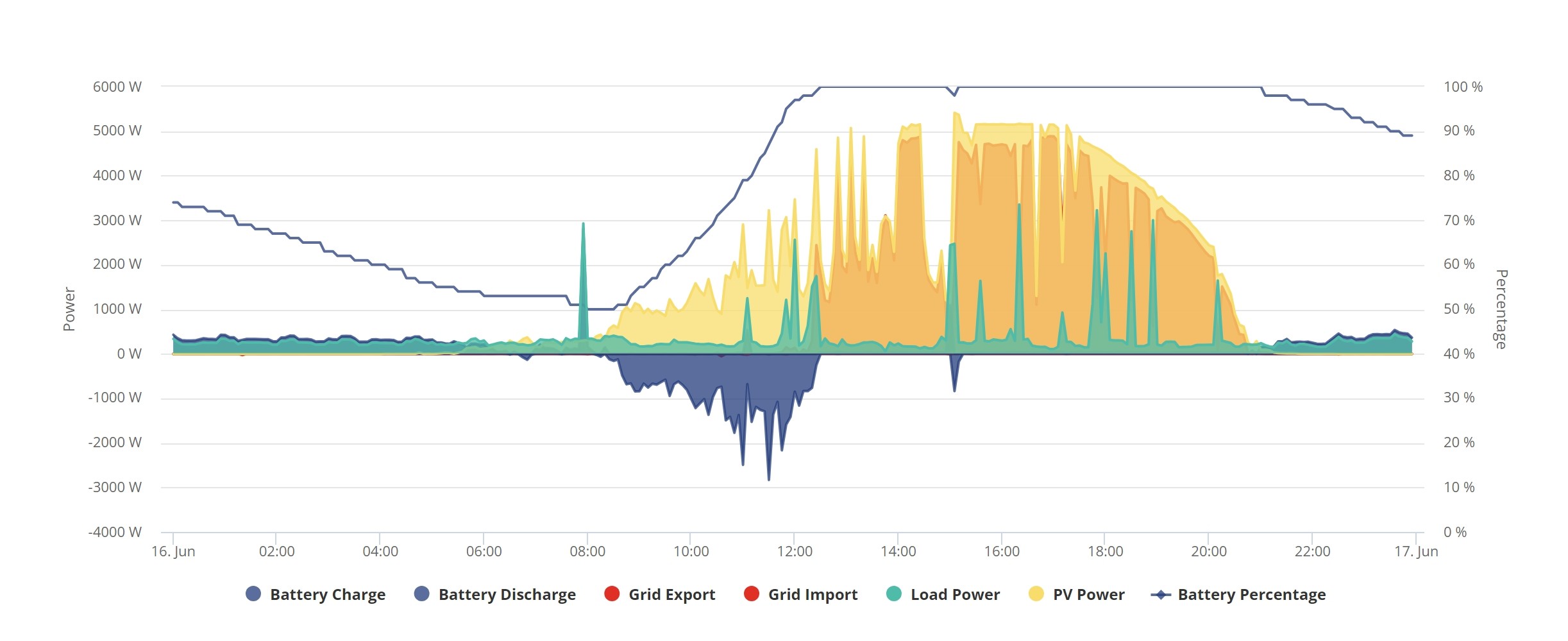
and this is from a sunny day without car charging that has clipping.

You can see that with the car charging it goes up to around 6-6.5kw generation but when the Ev is not charging the generation is being clipped for a spell.

T
#38 TimHutchings

killythebid Interesting! It looks like the inverter AC output never goes over 5kw, but when the AC demand reaches 5k, the battery starts charging to take up spare solar, therefore indicating it's not full. If the battery is being used to charge the car which it appears it is, it gets to a point when it starts then being recharged by the sun. Looks like that's why the PV is spiking as the battery charges and discharges. As I said I don't have an Ev so not too sure how they work, but someone like DD with more knowledge will probably have an explanation.

D
#39 DD

killythebid I think the more important difference is that on the upper chart, the battery is accepting power, whereas on the lower chart, it is not.
Not sure why the battery suddenly changed its mind about being full. Perhaps there was a small kick (discharge) when EV charging started, and that woke it up. Quite strange, anyway.

To the inverter, the EVSE is just a large AC load.

(sorry, duplicate - I need to remember to reload the page before starting a reply.)

K
#40 killythebid

A simple apology in accepting what I stated was correct would have been sufficient.

The point is that the generation from the panel increases it is not that the battery is deciding it is not full. What is happening is that the fluctuations in sunlight (ie clouds coming over) and other house loads are affecting what spare generation is available. While the Givenergy and Myenergi devices are working out what is going on and adjusting, the battery is filling in for extra demand from the Zappi.

The battery charge fluctuates like this as it is be drained and recharged during the time the EV is being charged. I usually see the battery drain down to a minimum of 95% and charge back up again. It has nothing to do with the battery BMS deciding it is not fully charged when it previously thought it was. It supplies charge to the demand when the solar has decreased and recharges when high solar is available again. Part of how this happens is likely because the zappi does not really know the battery exists as the hybrid is hiding them. But the system bumps along OK despite this.

Either way, my point was that plugging in an EV will stop clipping and provide extra generation from the panels is correct no matter why that is happening. Without the EV plugged in and charging I get a max generation of about 5.2kw (when the battery is full) and with the EV charging I get a max generation of around 6.5kw which is around my max for the panel capacity I have.

T
#41 TimHutchings

killythebid As you say, by using your car charger during the clipping period, you are gaining some of the clipped solar each time your battery charges the 5% it's lost to help offset the load. However, the basic principle is true that the 5kw inverter can only generate 5kw of AC electric, and any extra solar over 5kw, (up to 2.5kw) can be taken into the battery as DC.
Looks like your clipping happens between 1-5.30pm, so it might be to your advantage, if you wanted to gain all excess solar from clipping, to hold/pause your battery till 1pm (not filling it first thing) and set your charge level at around 1.5kw till 5.30pm. That way you can get your 5kw of AC from solar, and cream off the clipped solar into your battery.
That may or may not suit your running or usage schedule, but would make use of everything avaliable from your 6.5kw PV array.
Anyhow, best of luck with it all!