Record generation

66 comments started 2024-06-03 last 2024-06-30
GivEnergy ProductsHybrid
D
#1 dragos.balaban

Hello all

I've had the system for bit under a year now but just had a solar record yesterday and was wondering if there are people out there that managed better.
Inverter is a Gen 3 5.0kW Hybrid coupled with 2 x 9.5 batteries and a 10.4kW array
Yesterday headline figures:
Generation 60.44kWh
Import 23.53kWh
Export 59.62kWh

T
#2 TimHutchings

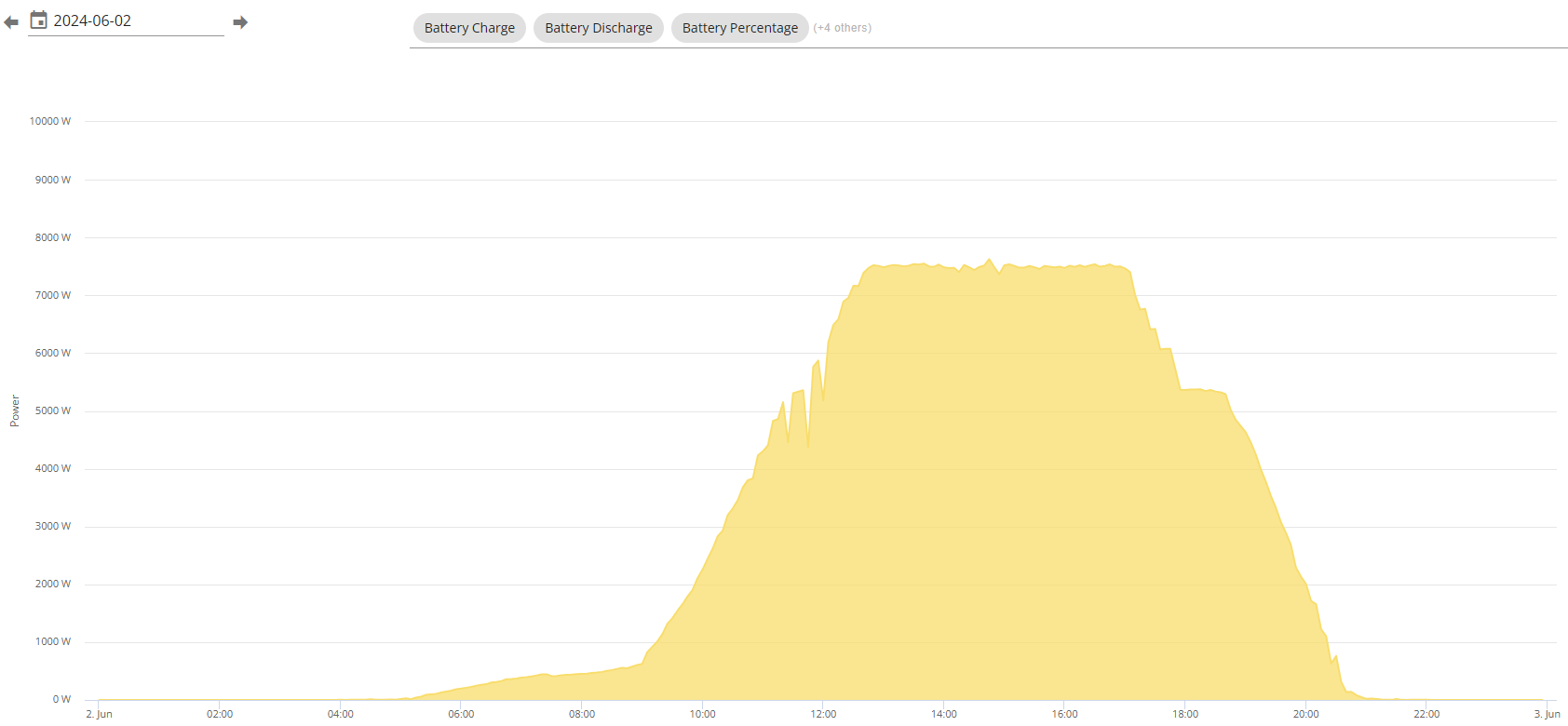
dragos.balaban Looks like you've got some serious clipping going on between 12.30pm and 5pm ish, although it looks like you've been charging the batteries through the clipping period as the clipping starts at around 7500w. Not sure you could improve much with the equipment you have, though having 2 inverters would allow more ac and dc production. But of course there's a cost involved and you'd have have to work out how often it happens and whether the return on investment is worthwhile.

S
#3 SteveCook

dragos.balaban
Do you do any exporting, especially at those peak times

D
#4 dragos.balaban

@TimHutchings 7500w is the inverter's max DC power, so there is nothing to be done about that.
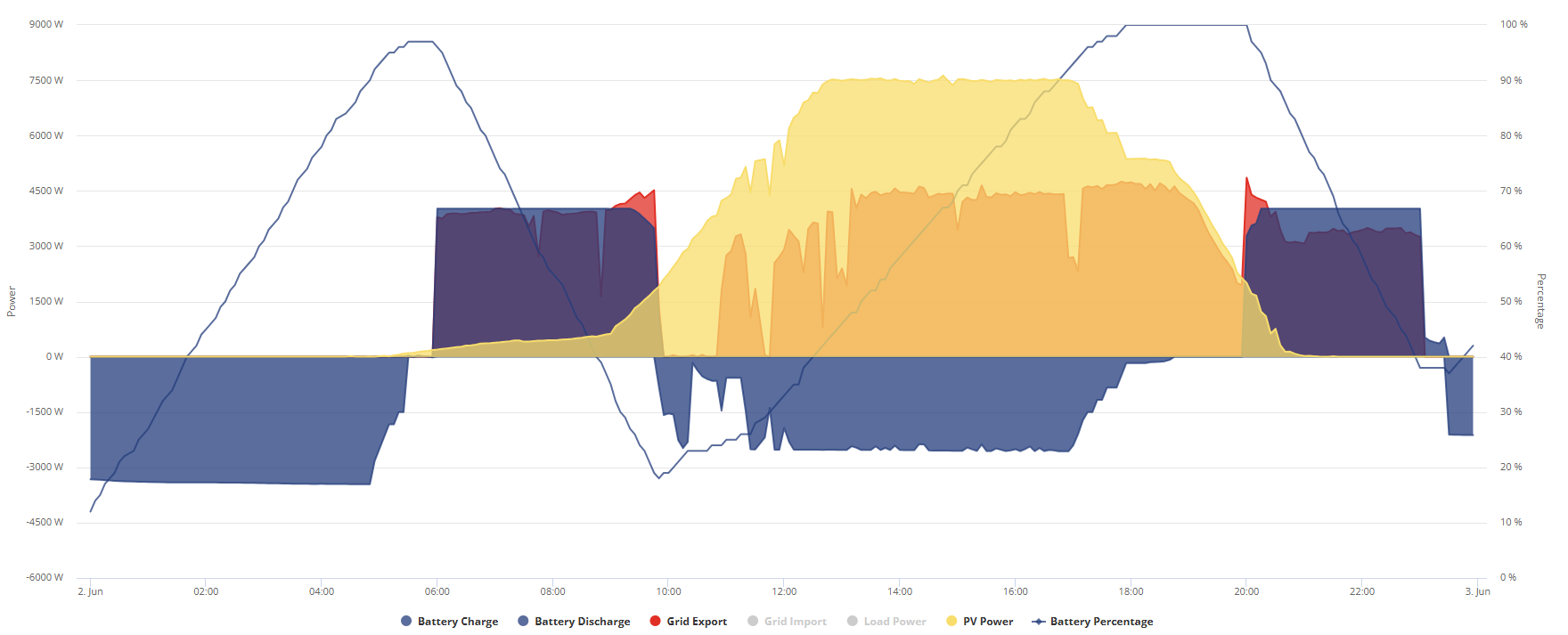
The chink missing between 5pm and 7pm is because the batteries got full so then I've hit the inverter 5000w maximum DC-AC

D
#5 DD

TimHutchings like you've been charging the batteries through the clipping period as the clipping starts at around 7500w.

Perhaps the batteries filled up around 6pm, giving the second plateu at around 5400W

D
#6 dragos.balaban

@SteveCook yes, most of the "7500w period" is split between 2500w to charge batteries and 5000w to satisfy house load + export
I realise I should have posted the entire graph:

D
#7 DD

dragos.balaban pausing the battery charging until around 11am might have let you squeeze out a little more generation at the end of the day.

T
#8 TX200

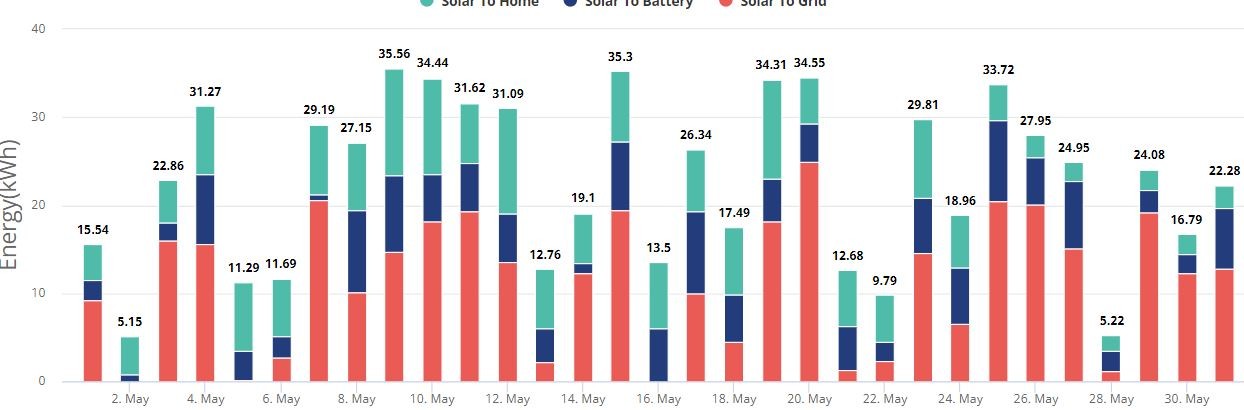
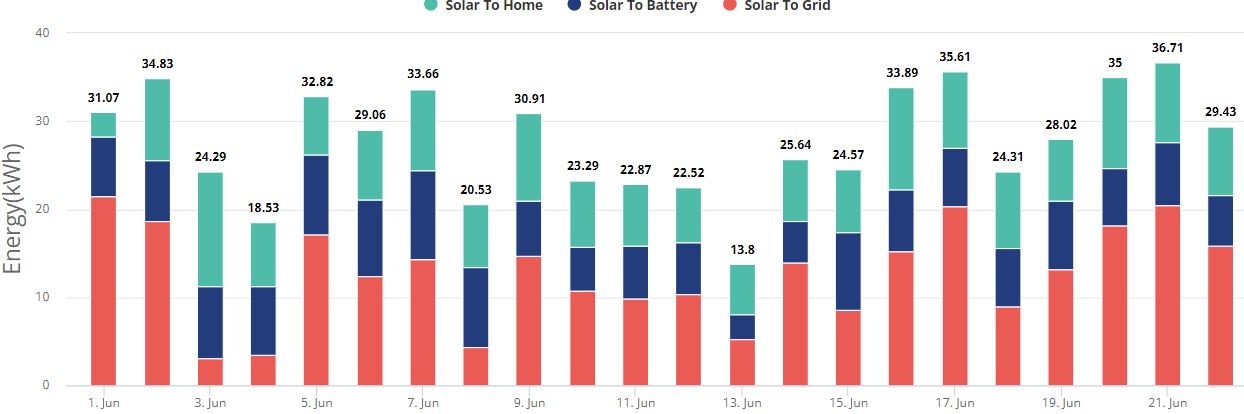
Yesterday was a good day for me too. Didn't beat my record for generation (April), but not far off.

Today appears to be better than the weather forecast... It looked quite dull, but have just about generated enough to break even in terms of import Vs export. Maybe some more sun to come if lucky!

G
#9 geoffreycoan

dragos.balaban Yesterday headline figures:
Generation 60.44kWh
Import 23.53kWh
Export 59.62kWh

2x Gen 1 5kW hybrid inverters, 4kW Growatt AC FIT, 14.4kW panels in total

2nd June :
Generation 69.5kWh
Import 4kWh
Export 55.8kWh

Total cost ex VAT and standing charge, -£7.87

Marginally beating 12th May which was 69.4kWh generated, 12.9 imported, 59 exported but lower electricity bill at -£8.25

D
#10 dragos.balaban

@DD indeed, lesson learnt
however manually managing the entire thing requires paying attention to the system every 5 minutes or so and a lot of page refreshes 🙂

J
#11 Jellybaby

Wish I could get a nice cloud free day whilst weather is still cool so I can see how my panels perform

DAMN CLOUDS

#12 Windy Miller

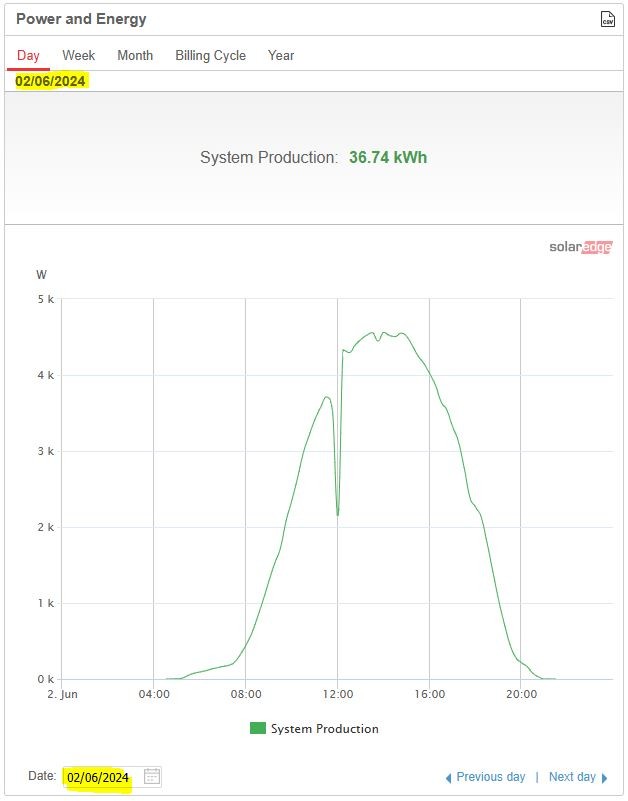
My record was yesterday too. Managed 43KWh from a 6.7KWp array and a 6KW Solaredge inverter which just beat last years record of 41KWh last June. Interesting in that my peak was just over 5KWh in the best hour. We had full sun all day and I know I've seen my array reach the 6KW limit of the inverter so I guess it was the higher temperatures that reduced the array's efficiency a bit. That means I could do even better but haven't yet - even in the cooler month of April. Was charging the car some of the time but still managed to export 24KWh.

#13 PianSom

Windy Miller Managed 43KWh from a 6.7KWp array and a 6KW Solaredge inverter which just beat last years record of 41KWh last June.

Interesting comparison - I have a 6kW Growatt inverter fed from an (oversized) array of 8.8kW. So I may have gained from the “shoulders”. I got to 44.9kWh.

I got so many panels because the incremental cost was relatively small. On the basis of 1 days data it looks like a long payback period!

T
#14 TimI

Oh for a bigger roof... 🙂

#15 Windy Miller

PianSom More panels are worth it for the extra you can get when the sun isn't shining that much. I am surprised I get 1KW when it is quite overcast. My house background load is usually around 300W so it has only been the November to January period when I got less than 7KWHr every day and didn't really put anything in the battery (December average was around 3KWHr). By the end of February I was back in double figures most days and charging the batteries to cover some of the night period.

C
#16 CGoode

Yesterday my system generated just over 35kWh from a 10 panel 4.1kWp ESE + 5 Panel 2.125kWp NW array & a Gen 2 3.6kW HY inverter.
After charging the batteries (2 x 9.5kWh Gen 2) overnight between 11.30pm & 5.30am
9.18kWh went to the house &
26.71kWh went to the grid which includes a forced export / discharge between 6pm & 10.30pm.
EV didn't get get charged overnight or during the day.
The system was exporting for most of the day / evening up to 10.30pm.
I'm on Octopus Intel Go.
Happy with that.

K
#17 kram

6.8kWp E/W array with an SE inverter produced 44kWh.

Despite almost giving up and huge problems, I’m so glad we finally got it installed as the generation is better than I expected.

I can’t believe solar panels in any S/E/W roof is not mandatory in build regs for new builds.

#18 Icarus

An almost perfect day from a 5.6kWp SolarEdge, not quite south facing (azimuth ~ 190°)

D
#19 dragos.balaban

@Icarus you've never even hit 5000w, what size array do you have?

G
#21 geoffreycoan

kram I can’t believe solar panels in any S/E/W roof is not mandatory in build regs for new builds.

I don’t think its mandatory but I have seen some panels on new build estates to get the EPC down. Trouble is they do the bare minimum, arrays of 3 or 4 panels which although something, isn’t the best they could do.
Improving the regulations around solar installs, designing houses to minimise dormers and small pitched roof areas to get more solar on, things like this would make a difference. Easy to say of course but harder to codify in building rules.

V
#22 Vestas

geoffreycoan There are knock-on consequences if you put PV on every house in a development - the local grid (off the development) probably won't be able to cope if they're all exporting at the same time and the developers would have to pay for that.

Also, and I don't know if its coincidental, every EPC I've seen in the last few years recommends a maximum of 2.5kW of PV as one of their "changes you can make" suggestions. Not sure where that figure comes from but that equates to 6 or 7 panels which is the max I've seen on a new-build estate.

The regs are changing/have changed though so more new-builds will have PV panels - not sure about batteries.

K
#23 kram

From a new build perspective add a solar diverter (gets EPC point I think) and offer the homeowner the option to add a battery.

Export set to zero and an application is made by the house owners. That or even better get house builders are mandated to upgrade the grid & run 3 phases.

C
#24 CGoode

kram Since switching to IOG I hardly use my Eddi now because it's more financially viable to export as much generation as possible. Charge the batts up over night & start exporting as soon as the sun comes up - well that's the theory anyway. I've still got a gas boiler so I use that to do the HW which also heats the towels rails in the bathrooms which has been nice during this recent spell of Baltic weather we've be having of late.

K
#25 kram

CGoode

We have not fitted an eddi exactly for that reason, but it would get us an extra SAP point. That keeps builders happy and it works well if you can’t export. I guess if you fitted every house with panels, and had EV & hot water diverters then it solves sone of the no export issues.

G
#26 geoffreycoan

kram My heat pump is only using 1-2kWh a day to heat my hot water. In the summer I just run it off the solar generation so an Eddi wouldn’t benefit me either

Another record solar generation day today, 72.8kWh despite getting a lot of repeated inverter shutoffs due to high grid voltage ☹️ https://community.givenergy.cloud/d/3696-first-night-live-on-predbat/1300

K
#27 kram

72.8…. That’s impressive

Out of interest, how much power is used in the winter per day by the ASHP?

G
#28 geoffreycoan

kram Out of interest, how much power is used in the winter per day by the ASHP?

Typically the heat pump uses around 22-25kWh on a winters day with very cold days being up to 70-80kWh. The actual averse from start November through to end February was 27.8kWh/day. The heat pump does consume a lot in winter but very little in summer when we’re generating loads so I try to think of it as aiming for overall zero bill in the year - we’re on track for that.

#29 Hook

geoffreycoan you mentioned your cop was 2.5. Is there anything you can do to improve that?

G
#30 geoffreycoan

Hook geoffreycoan you mentioned your cop was 2.5. Is there anything you can do to improve that?

I don’t know what my actual COP is unfortunately. I have two LG Therma V 9kW ASHP’s and the control panel is awful. It doesn’t as far as I can tell record how much energy goes in to the water from which I could calculate a COP. I only have measurement of energy consumed by taking monthly meter readings and with a Shelly CT clamp.

There seem to be various projects I have found connecting the ASHP to Home Assistant by modbus which might enable me to measure energy out and flow temperature in real time, but so far haven’t investigated these in detail.
The only other option I am aware of to monitor COP is the openheatpump solution which requires plumbing in a flow meter into the system - it’s expensive and TBH not something I fancy DIYing!

But having said that, the COP 2.5 I mentioned earlier was the design temperature based on 55 degrees flow temperature. I know I am achieving much better than that as I’ve turned on weather compensation, turned the flow temperature down to 34/52 degrees (lower/upper weather comp temperatures) and tweaked loads of settings like hysteresis, changed the hot water to ASHP only instead of ASHP+immersion, turned the hot water temp down, etc.
Over the last year I have reduced kW consumed by 20-25%. I just don’t know what the COP is I am achieving now!

#31 Windy Miller

Being the Solstice today and virtually cloudless I was hoping for another record. Where I got 42.9KWHr on 2/6 I got 42.2KWHr today. Almost beat my record but I guess my panels were slightly warmer today or there was more moisture in the air (haziness). Even so still very pleased with performance.

G
#32 geoffreycoan

Windy Miller 73.34kWh generated today which in fact was my best generation so far this year (2/6 was 69.5 and I’ve had just under 73 on 6th and 17th).

The last two days we have been 100% self sufficient with 0.01 and 0.06kWh imported.

On track for circa £100 of profit this month

K
#33 kram

geoffreycoan

What size is your array? 10kWp I guess but be interesting to know.

G
#34 geoffreycoan

kram Good guess

I actually have 3 arrays giving 14.9kW with 44 panels in total:

  • A 4kW FIT array with a Growatt AC inverter
  • Two GivEnergy 5kW Gen 1 hybrid inverters totalling 10.9kW

Surprisingly no export limit from the DNO although when its sunny the voltage gets pushed up to around 260V and one of the GivEnergy inverters keeps shutting off as a result so I don’t get as much out of that array as perhaps I should.

R
#35 Robgy

geoffreycoan very interesting, what is the orientation of your panels for these systems?

P
#36 Pete UK

46.1 kWh generated was my record so far on 17th June this year. Export got messed up that day when one battery got stuck at 100% and was 53.1kWh. Record export was 7th June at 64.4kWh.

11.34kW array: 2x Gen3 5.0 hybrids, 4x 9.5kW batteries.

5 panels South facing, 14 East, 8 North.

14 panel East array(s) generated: 27kWh
13 panel South and north array: 19.2kWh

All this is vanity of course but entertaining all the same and gets bragging rights for sure.

Full sunny day’s generation: Vanity.
The other 95% of cloudy days generation: Sanity 😂

Interestingly enough, I’m finding that on these overcast days (ie 6 months of the year) my panels all seem to be generating about the same: ie 20-25% of their rated peak power, just from the daylight ~ whichever orientation they face. So all added up I reckon the North facing panels are adding their fair share, Albeit in a very discrete fashion, just chugging along but always contributing.

It’s a shame I can’t extract exact figures for each string to get a true ratio but I do roughly think the North panels are generating about 45% of the South facing ones.

Totals generated for almost a year:

8+6 East: 2,706 kWh
8x North + 5x South: 2725 kWh
Imported: 14.1 MWh (99.4% off-peak)
Exported (10 months): 6MWh

Hoping to be cost neutral come sept when it’s a full year with the export tariff in place.

G
#37 geoffreycoan

Robgy The roof is alighted almost perfectly East/West which gives us a great long solar day:

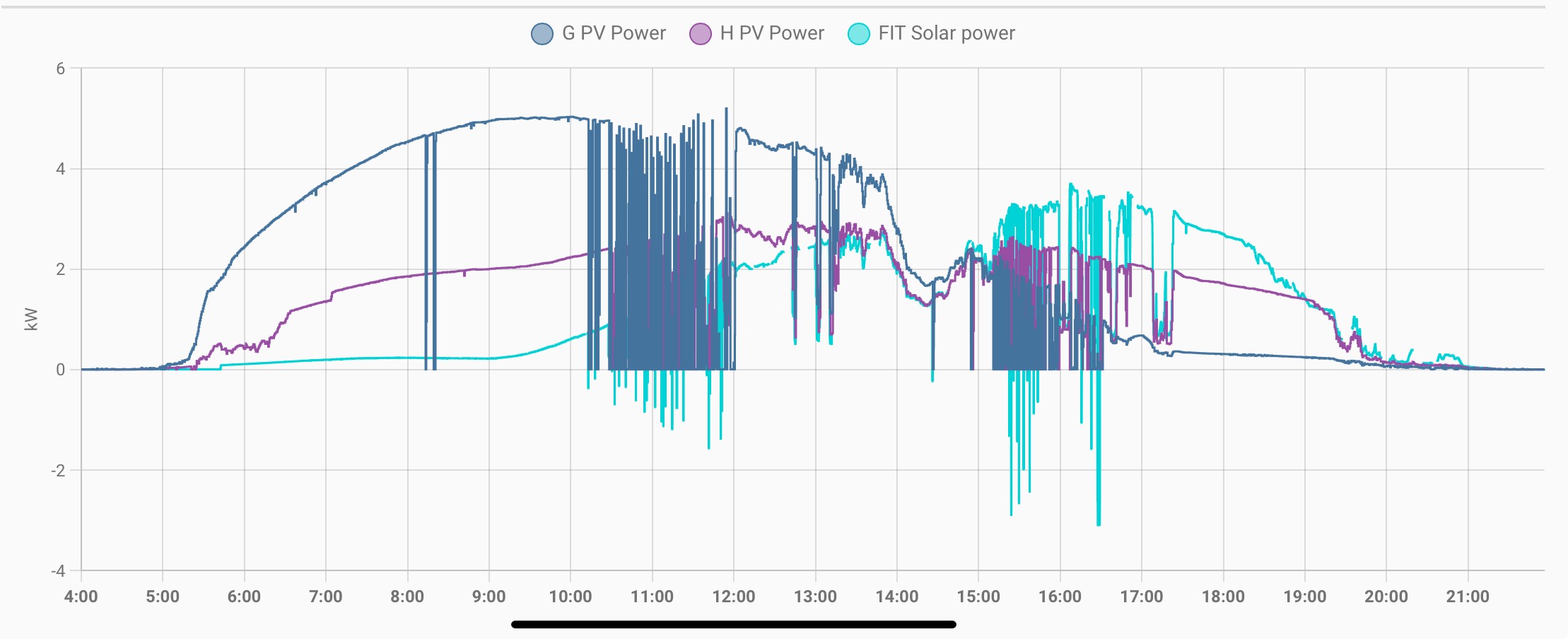
Inverter G is 2 strings, 16 panels on the East front of the house totalling 6.24kW
Inverter H is 2 strings, 6 panels 2.34kw on the East front garage roof and 6 panels on the West rear for another 2.34kW
FIT inverter is 2 strings, 16 panels 4kW on the rear West

You can see inverter G repeatedly shutting off and back on again during the peak period due to high grid voltage. No idea why I am getting negative power reported on the FIT array, started doing this on 17th June and hasn’t got any batteries connected so makes no sense to me.

Anyway it is a good illustration of the benefits of East/West, how the sun tracks across the three arrays

Pete UK there’s a YouTube channel called ‘upside down fork’, he has North facing panels and in a recent video he analysed the relative performance of those vs his others. The conclusion was I think that the North panels were generating and making more contribution than predicted.

I too am aiming for cost-neutral over the year. We have an ASHP so do consume a lot in winter, balanced by the large solar generation. 🤞we’re on track

S
#38 SJB

Pete UK It’s a shame I can’t extract exact figures for each string to get a true ratio

You could sum the values in Home Assistant to create a reading for each string.

My system has north facing panels as well. According to Tigo they are generating, on average, about 77% of the South facing panels this month. In the winter the North facing panels are generating about 40% of the South.
Some days the North facing panels generate more that the South because of cloud cover and the fact that North facing panels are in sunlight all day at this time of year where as the South facing aren't.
As my system experiences clipping and the north facing string is clipped more than the South facing string I suspect the North facing panels could generate a little more.

P
#39 Pete UK

SJB

I could do that but I don’t use home assistant. Tried installing it on an old Mac-mini but there was a file missing and I couldn’t find it anywhere on the internet, so gave up after many frustrating hours.
And thought I’d put the money towards the CEMS instead. Also I’m on the GE Beta balancer software which is constantly sending API commands to balance the pair of inverters to minimise cross charging. So don’t want to interfere with that. I guess I could use HA to just monitor but seems like a fair bit of hassle just to get a number out of the other end which I can’t change anyway.

You must have a much shallower roof than mine. Mine is 45 degrees. So quite steep to be facing north. What angle is your roof?
Mine isn’t really ideal but I’m glad I added them with the original instal.

Interesting numbers you have there.

P
#40 Pete UK

geoffreycoan Pete UK there’s a YouTube channel called ‘upside down fork’, he has North facing panels and in a recent video he analysed the relative performance of those vs his others. The conclusion was I think that the North panels were generating and making more contribution than predicted.

I too am aiming for cost-neutral over the year. We have an ASHP so do consume a lot in winter, balanced by the large solar generation. 🤞we’re on track

  • yeah, I’ve seen that guy. Very interesting. It’s cheating a bit because his array is ENE or not directly north like mine and he has quite a low pitch roof but it gets the point over. It’s not exactly cheating but mine face directly north. I’d say mine are no more than 45% of the South ones BUT in low light/ cloud cover they generate the same as the south facing (23% of rated kWP) so 8 panels out of 27 that’s like 25-30% of the days total generation when cloudy. And as it’s like that a lot here in the UK, I think the yearly contribution is probably reasonably significant. I mean how much of the time are the panels in direct sunlight over the whole year in the UK? That’d be interesting to know. Most of the time they are just ticking over at 20-25%.

You’ve got a massive array there sir. Good luck for breaking even. I’m thinking of a heat pump for the heating and hot water but not sure it stacks up for us. Interesting watching “heat geeks” on you tube as well. Their mini-hot water tank thingys for the home look interesting.

I’m still spending a fair bit on gas - mostly the hot water I reckon. Seem to be using about 30kW a day and that’s in the summer when the heating is off. (I’m sure that can’t be right!) probably next door have tapped into it ! Seems far too high to me.

I’ve got an old solid wall Victorian house so need to have a chat to someone about that. May be a go-er for a heat pump or may not. Think I’m going to break even on the electricity though. And that’s a nice thought. Free EV fuel and all house load. Sweet. If you can break even being all electric with a heat pump that’s some achievement. Lucky you have no export limit 👍🏻

G
#41 geoffreycoan

Pete UK You’ve got a massive array there sir. Good luck for breaking even. I’m thinking of a heat pump for the heating and hot water but not sure it stacks up for us.

The FIT array was first, then the heat pump which was 2 and a half years ago. We don’t have mains gas in our village so had an oil boiler which was only about 8 years old and worked fine, but I decided to clean the oil tank prior to repainting it and found that it was probably only the rust holding it together - oil started spurting out of several holes!
Replacing the tank would have been simplest but the regulations have tightened up and we couldn’t put a new tank where the old one was so decided to go to a heat pump. It’s a large house so we ended up with two 9kW heat pumps as there wasn’t a 15kW MCS approved one which is what the heat loss design indicated we needed.
Then a year ago we had the extra solar panels and batteries. I decided to get the most on the roof I could whilst the scaffolding was up it was more cost effective. And the DNO didn’t object.

I wouldn’t recommend changing to a heat pump until your existing boiler needs replacing. There’s new products like the heat geeks water tanks coming to market all the time and they are getting more efficient and controllable as well.
Insulate the best you can and fit larger radiators and most houses are OK with a heat pump.

I’m still spending a fair bit on gas - mostly the hot water I reckon. Seem to be using about 30kW a day and that’s in the summer when the heating is off.

Ouch that’s an immense amount. We use between 1 and 2kWh for the heat pump to heat the water every day. The cooker is maybe another 2 kWh.

S
#42 SJB

Pete UK My roof angle isn't too different - 42 degrees.

#43 PianSom

Pete UK I’m still spending a fair bit on gas - mostly the hot water I reckon. Seem to be using about 30kW a day and that’s in the summer when the heating is off. (I’m sure that can’t be right!) probably next door have tapped into it ! Seems far too high to me.

Does seem high. I am using 20kW of gas on hot water (and hob cooking) these days. But I have

  • a partner who insists on excessively hot water being available on demand all the time
  • a continuous circulation pump from the tank to around the house
  • a Nest controller which allows water heating to come on only in chunks of 30 minutes. (It's running an hour morning and evening.)

In case you are not - the best tip I got from this forum was to move to Octopus Tracks for gas.

#44 Windy Miller

Pete UK House of 2 adults uses around 5Kw of gas a day for hot water. If you have children that would easily double or even triple with daily baths etc. The hob might use 5Kw for cooking so I can see 20Kw a day is quite easy to reach.

One of the things to see is if your boiler is not a combi (probably the case if you have a tank) and is on continuously keeping the tank hot it will use quite a lot of gas short cycling (coming on for 30 seconds every 3 minutes say) as it controls on its internal thermostat. This can happen if you don't have a tankstat or if the boiler temperature setting is lower than the tankstat.

P
#45 Pete UK

Windy Miller

Hi, I don’t want to hijack the thread but…. It’s the previous owners set up. Big pressurised tank. I’m on gas tracker. It’s not a combi, and I think I’m heating it continuously and probably pumping hot water round in a loop. I’ve got a NEST but that only seems to do the gas central heating.

To be honest there are loads of pipes and bits and a pump. I’m not sure if the gas is mostly heating it and/ or the immersion. No timer controls, except a (temperature?) dial on the tank, and a dial on the boiler downstairs but no idea if that’s for the hot water or heating 🤷🏼‍♂️

How should I set it up correctly? Or just get a plumber round to wire it up/ re-plumb it to make it more efficient?

#46 PianSom

Pete UK
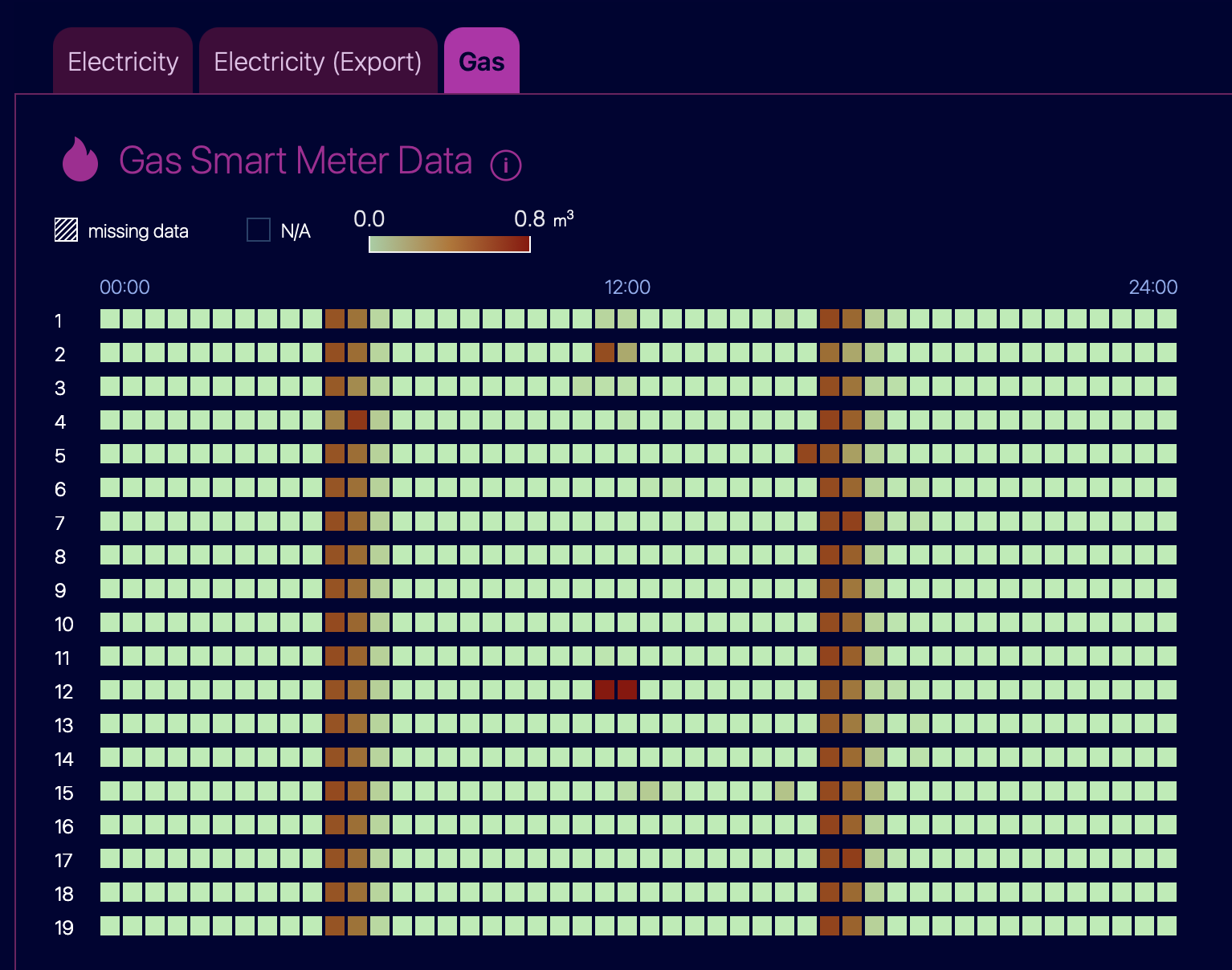
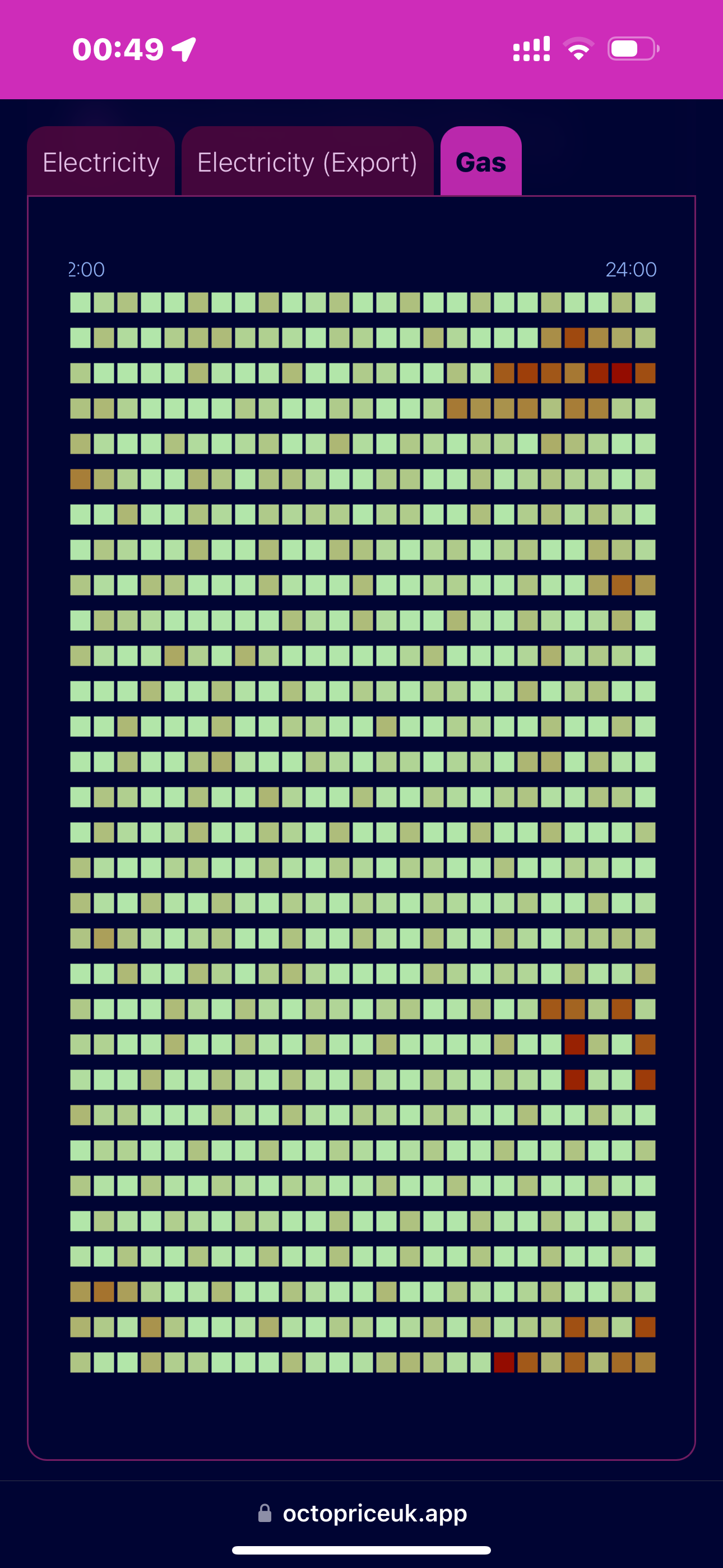
Quick and easy way to see when you are using gas - fill in your Octopus dets here (you will need your account number and API key, which you can find here)

Here's what mine looks like -

If your boiler is going non-stop then you will see usage throughout the day

G
#47 geoffreycoan

Pete UK No timer controls, except a (temperature?) dial on the tank, and a dial on the boiler downstairs but no idea if that’s for the hot water or heating 🤷🏼‍♂️

The tank temperature will be what temp the gas boiler turns on to heat the tank up to, you may well find its set to 60+ degrees. Have a look at the heat geek video website article on legionnaires and tank temperature, but in short unless you have vulnerable people in the house or use very little hot water each day you can usually safely turn this down to 55 or even 50 degrees.

The temperature on the boiler will be usually the temperature of the radiator heating. Again you can turn this down, the lower it is in general the less gas you will consume. Something to try for the winter but you could get down to 40 or 50 degrees if you radiators are large enough,

Back to the solar generation, new record for the year again today, 78.6kWh 😀

P
#48 Pete UK

PianSom

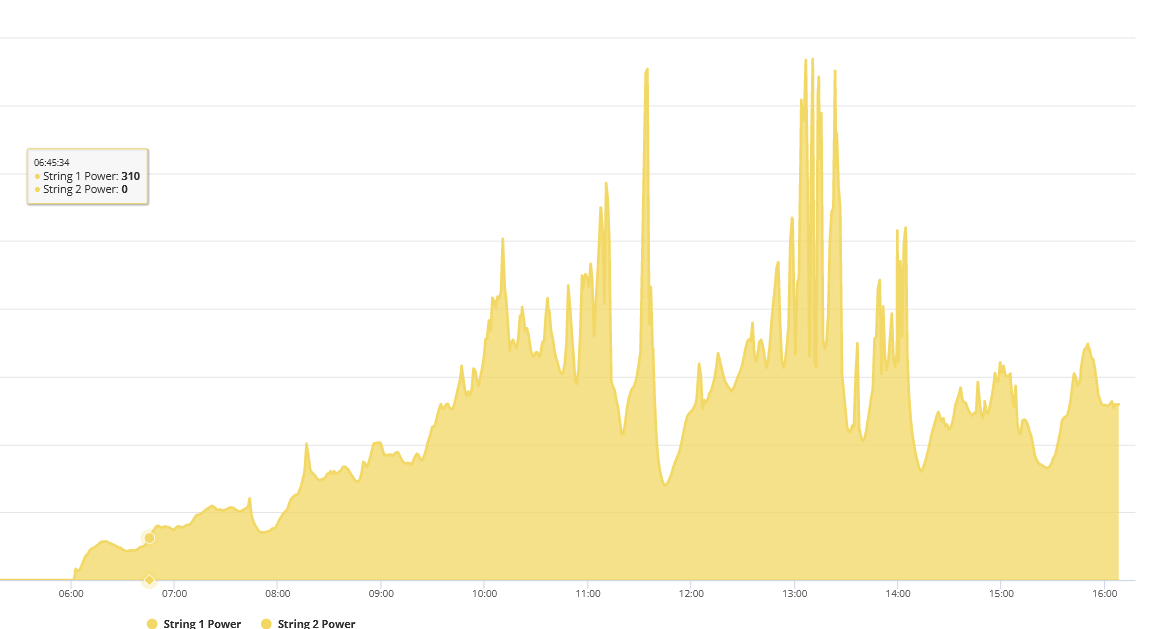
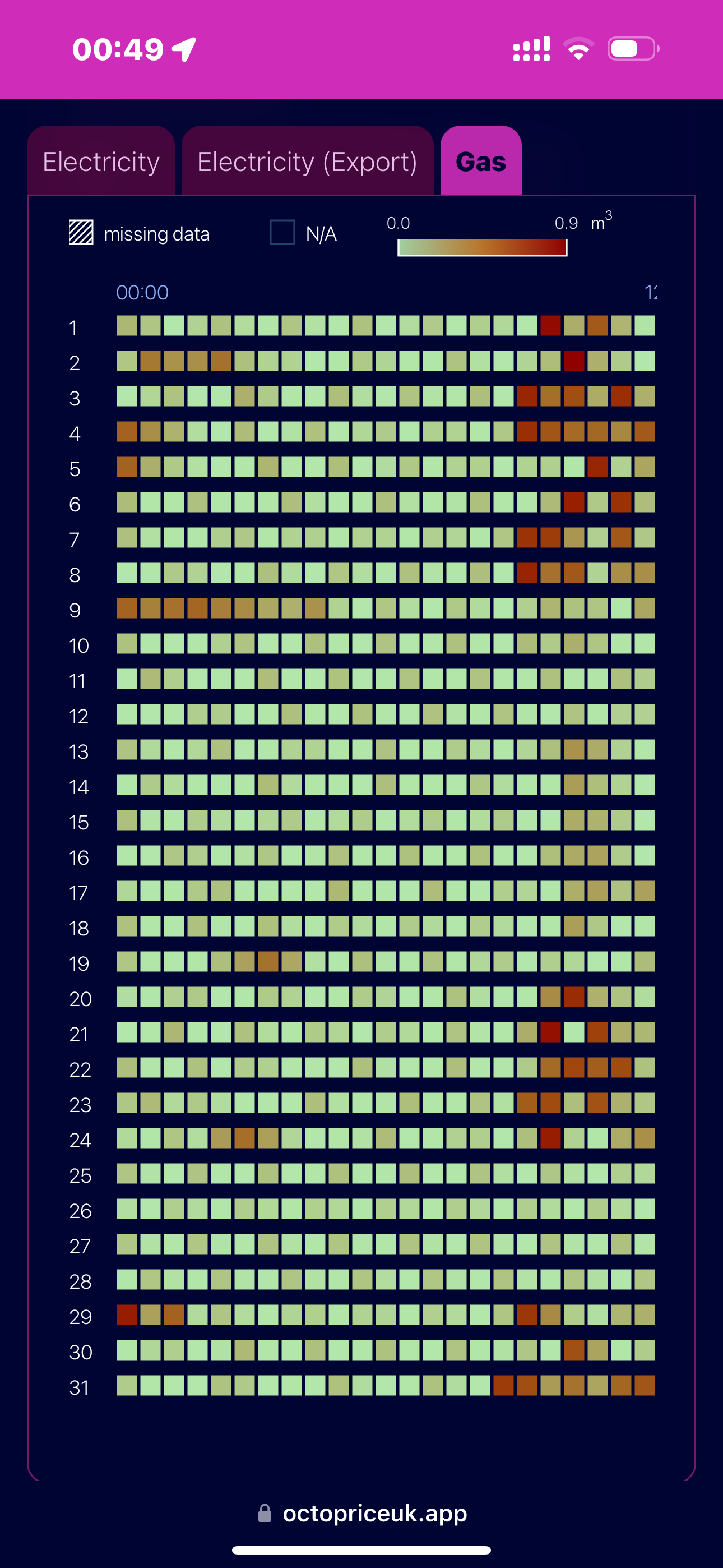
Mine looks like this (from my mobile, so split in two halves, morning/ afternoon);

Seems it’s ticking over all day a bit, on and off by the looks of it.

Looks reasonable - or not?


P
#49 Pete UK

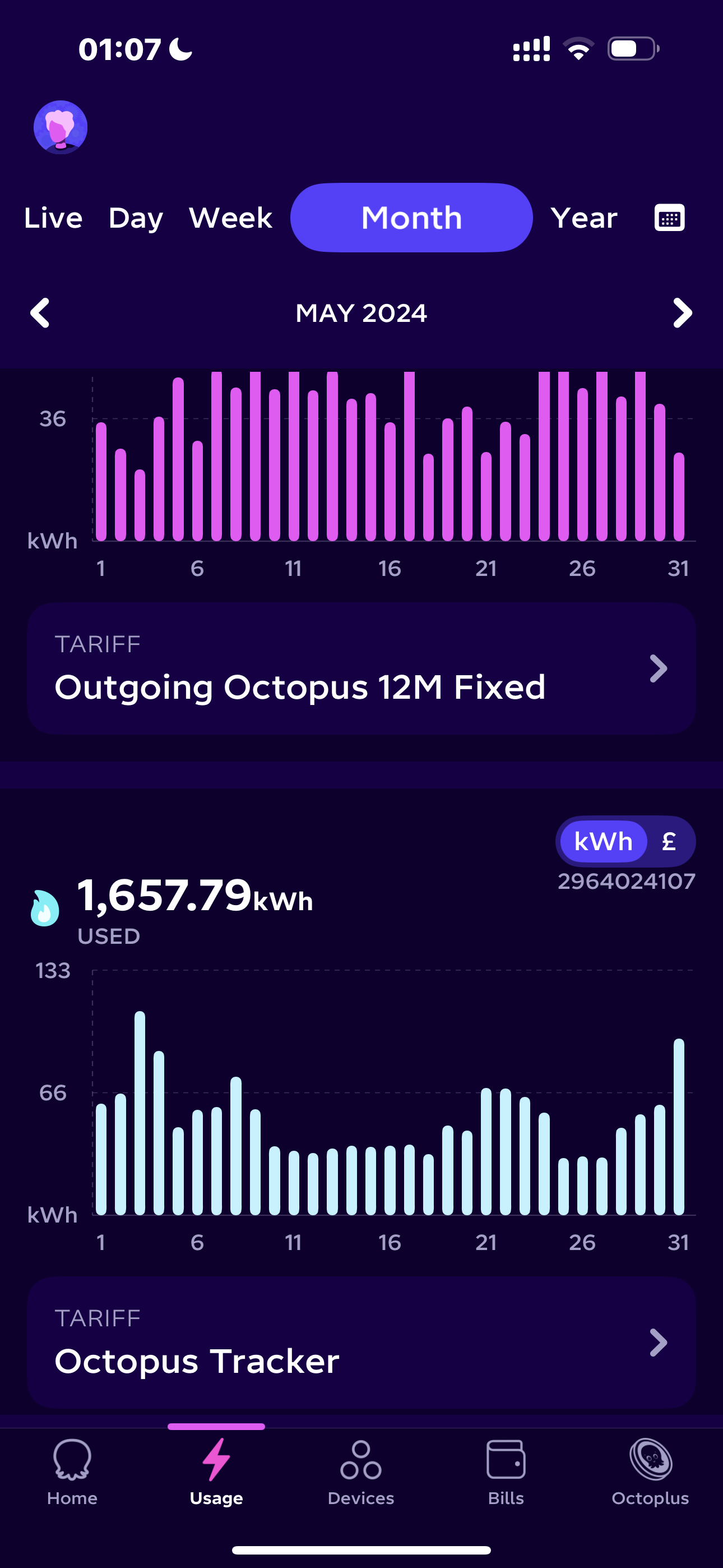
And the usage from Octopus;

Some may be heating but looks really high just for hot water in May

C
#50 CGoode

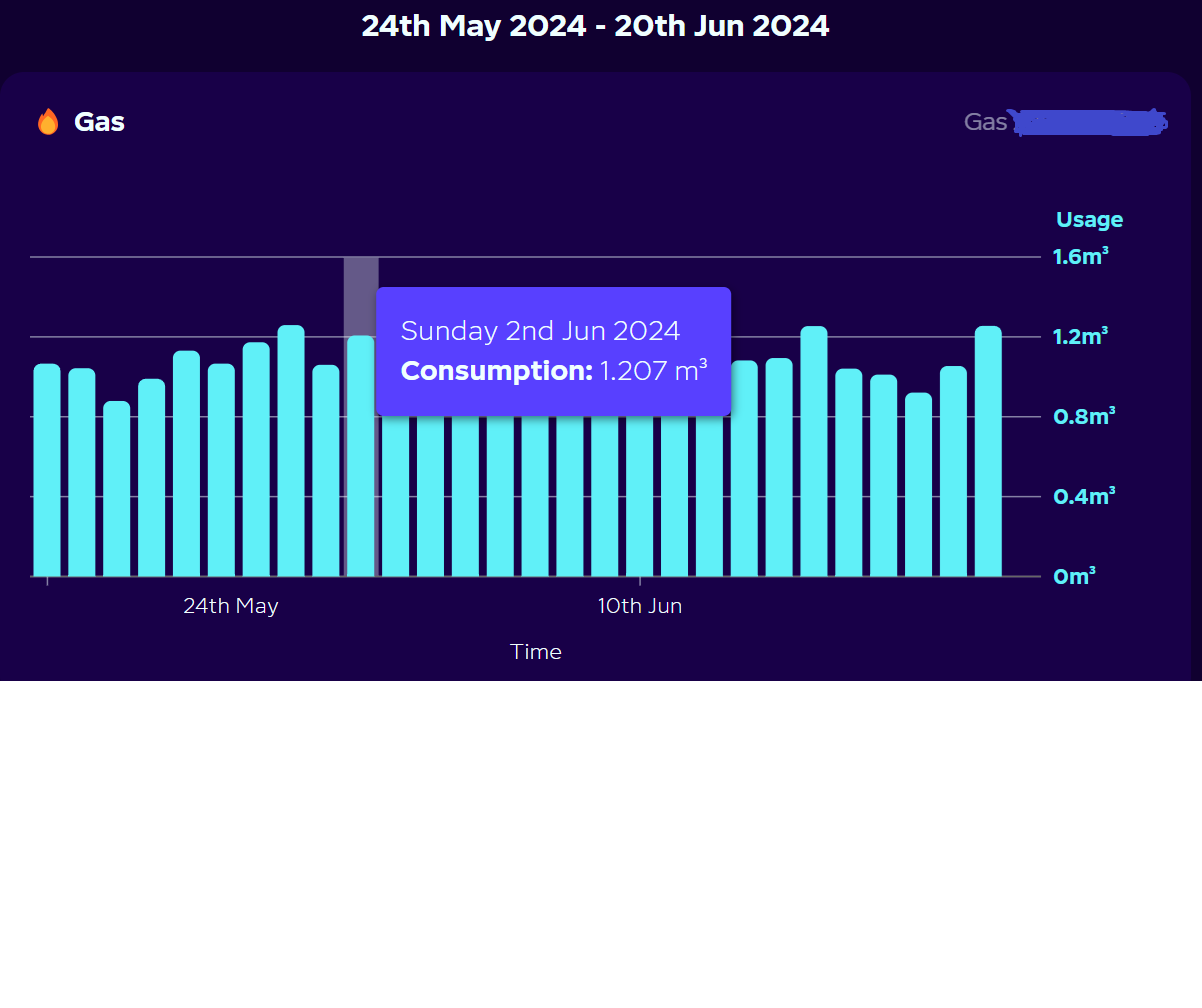
For comparison purposes here's our gas consumption for hot water which is set to heat a SS vented 120L tank to 50c twice a day. Looks like we use an average of 1m3 of gas per day which equates to around 11kWh. Admittedly it is quite a small tank & there's only two of us (mostly showers) but some of the above gas numbers look pretty large by comparison.

M
#51 mrand31

I got a record of 30.7kWh today out of 5.46kWp of panels on my 12° ENE and WSW facing sloped workshop roof, an 8.2kWh battery and a 3.6kW Gen1 inverter (just too early for the rapid response firmware 🙁 ). It was clipping from 12:00 to 14:00 because the battery was filled by 10:45. I've turned the boiler controls off and am heating the water entirely via the diverter.

I'll see what the numbers look like by the end of the year to decide if there is any sensible ROI on another battery and/or an upgrade to a 5kW Mk3 inverter

I've got the boiler set at 45°C output temperature because I fitted 'oversize' radiators when I rebuilt the system in the mid '80s and that's also enough for HW. Two years ago I fitted a new three-period+three period controller and added timer relays so that there is a 5 minute over-run on the pump and valves after the thermostats stop calling for heat (Modern boilers have this, to some extent). This has improved the system efficiency noticeably

G
#52 geoffreycoan

mrand31 I put together a spreadsheet to calculate ROI from adding more battery storage, looking at strategies like overnight charge and peak export, summer solar to use overnight, etc. Batteries have reduced in price a little but I was getting ROI’s of between 6 and 22 years depending on strategies and energy prices. So not good.

To reduce your clipping, turn the inverter charge rate down. I have mine on 500W so it trickle charges during the day rather than fills up by 10am which was what was happening to me beforehand.

M
#53 mrand31

geoffreycoan Yes, the ROI on additional batteries is pretty poor after the first one if you aren't using all of its capacity through most of the year. You definitely get the biggest hit from the first installation if it's properly sized. If/when we get a heat pump, the calculation will change, but the numbers don't support that until I can no longer maintain the boiler. When I rebuild the kitchen, the gas hob will be replaced with an induction hob just because it's got the benefits of gas responsiveness and electric 'greenness'

K
#54 kram

Second battery RoI for us is in the region of 6 years due to delta on EV tariff and utilising a good chunk of the capacity.

Some none monetary RoI however are:

  • not having have the conversation about not turning lots of high draw things on at the same time
  • Not having to have the can that wait a few hours until off peak conversation in winter
  • The backup reserve being sufficient to run the home base load from typical generation stop to generation start in winter

It’s not just pure cost savings, but obviously they’re up there in making it pay for itself.

#55 Windy Miller

Pete UK Off thread topic but I would say...

Big pressurised tank is good - possibly a Megaflo? It should store enough hot water to only need to be heated once or twice a day (morning before you get up and evening before the washing up needs doing). Use the time clock for this if you can but don't worry if you can't as it should be controlled by the tankstat - see below.

Hot water should be hot enough to do the washing up but not so hot as to waste energy or be a hazard. Personally I have mine set so that I can just put my hands under the hot tap. Legionella is really only an issue in open water tanks (yours is pressurised and likely on the mains water and thus sealed from the air) at below 55oC as above that the bacteria is killed eventually. Also remember that very young children can be scolded by hot water you might find comfortable.

It could be that your boiler uses the same temperature for both radiators and hot water (mine does) so you need the boiler to be hot enough to switch the boiler off when the tank is up to temperature and not to short cycle as you suspect it is doing.

  1. Before you adjust anything mark the dials so that you can return them if you can't make any improvement. Also turn off the immersion heater. (The tank may actually have 2 dials - one for gas and one for immersion.)

  2. Ignore the temperature setting on the tankstat. These are often mounted low down on the tank where the temperature is lower than at the top of the tank. If you set it to 60oC it will likely be 70oC at the top which is too hot.

  3. Turn the tankstat down until it clicks (as its setting goes below the current temperature of the water). Leave it a day and see if your hot water is hot enough at the tap furthest from the tank.

  4. If it isn't hot enough adjust the tankstat up a tiny bit and repeat this each day until you have your preferred temperature.

  5. If the tankstat doesn't click or your hot water isn't hot enough turn up the boiler temperature. If this is marked with the actual temperature you probably need to set it to 70oC or above to avoid short cycling.

  6. If, by following this, you can't make any improvement in gas usage or get the hot water temperature right, then it's time to call in the plumber. He should check the tankstat, valve and boiler stats are all working correctly and use a temperature probe to set things up correctly. He should also check the pressurised tank doesn't need to have its airgap reset if it is a Megaflo.

P
#56 Pete UK

Windy Miller

Perfect. Thanks so much, I’ll give that all a try. Cheers 👍🏻

#57 Windy Miller

Windy Miller very young children can be scolded

Scalded!

M
#58 mrand31

The air buffer re-charging on a Megaflow tank is a simple user/owner operation. It usually needs doing once or twice a year.

I have no short cycling problems with the boiler 'stat set to 45°C, the Megaflow cylinders seem to have a very good heat exchanger coil in them.

Edit to add:- scolded as well, but usually only gently. 😃

#59 EricIoW

Windy Miller My all time peak was on 21st. Not far behind was 9th May !

#60 Windy Miller

EricIoW 9th May was 38.9KWh for me with 41.3KWh on 19th May which is my 3rd best day. Interesting how the results vary across the country. I'm in Bedfordshire.

A
#61 Arg0t

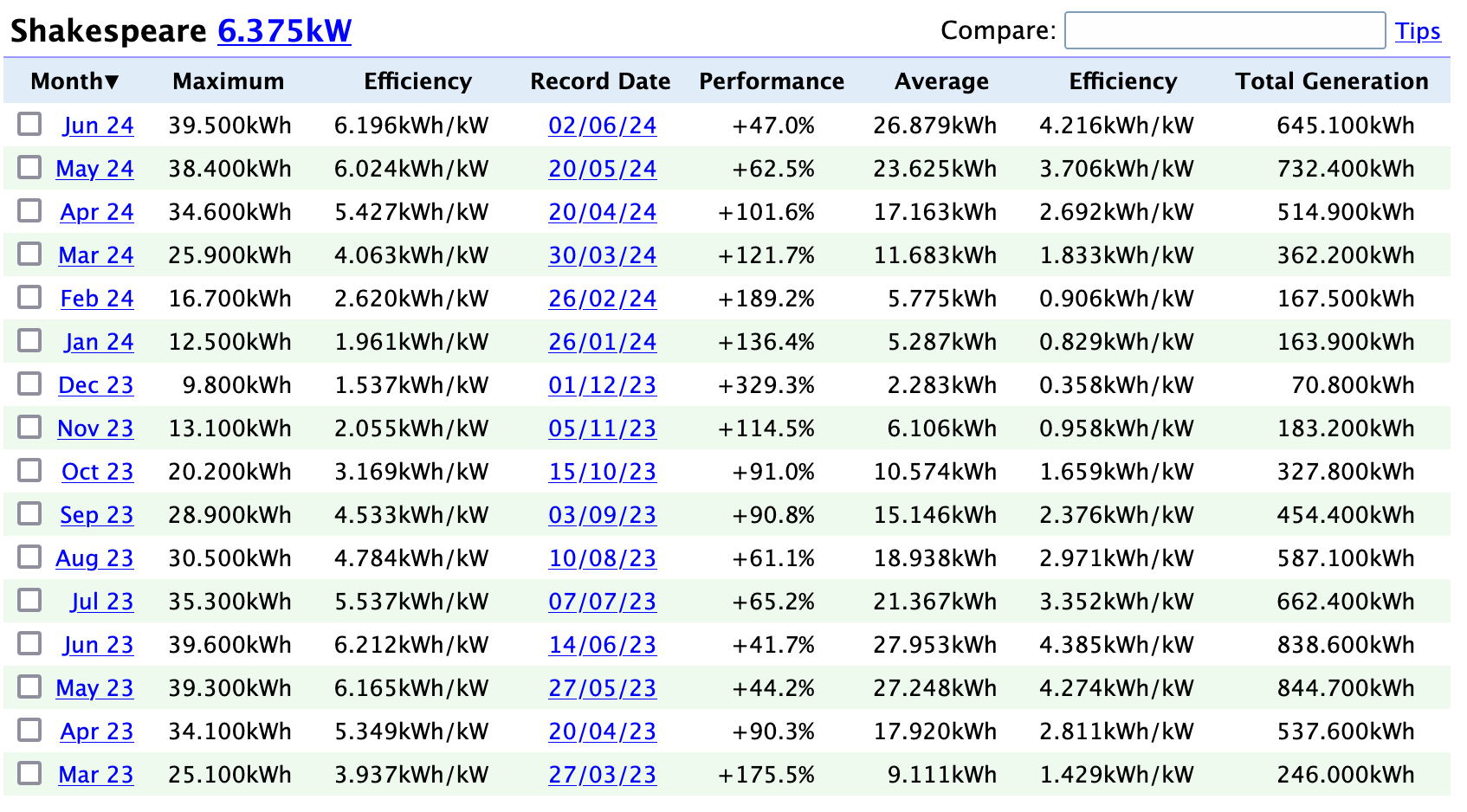
39.5kWh on June 2nd. Just under 6.2kWh per kW of panel with a SE/NW split array.

#62 Windy Miller

Arg0t Great presentation of data. Is that automatic or from spreadsheets?

A
#63 Arg0t

Windy Miller record monthly generation is one of the free features of pvoutput.org. Many of us run a script to push Home Assistant captured energy data to pvoutput every few minutes. Nice way to compare your generation with others in your area and have some longer term stats stored outside homeassistant.

There is a givenergy team https://pvoutput.org/team.jsp?sid=97331

G
#64 geoffreycoan

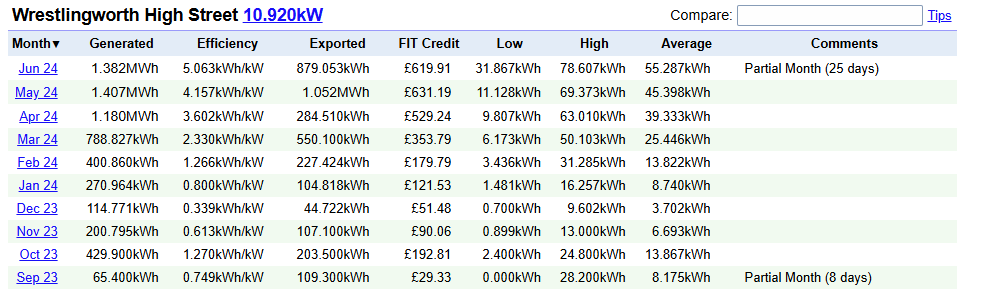
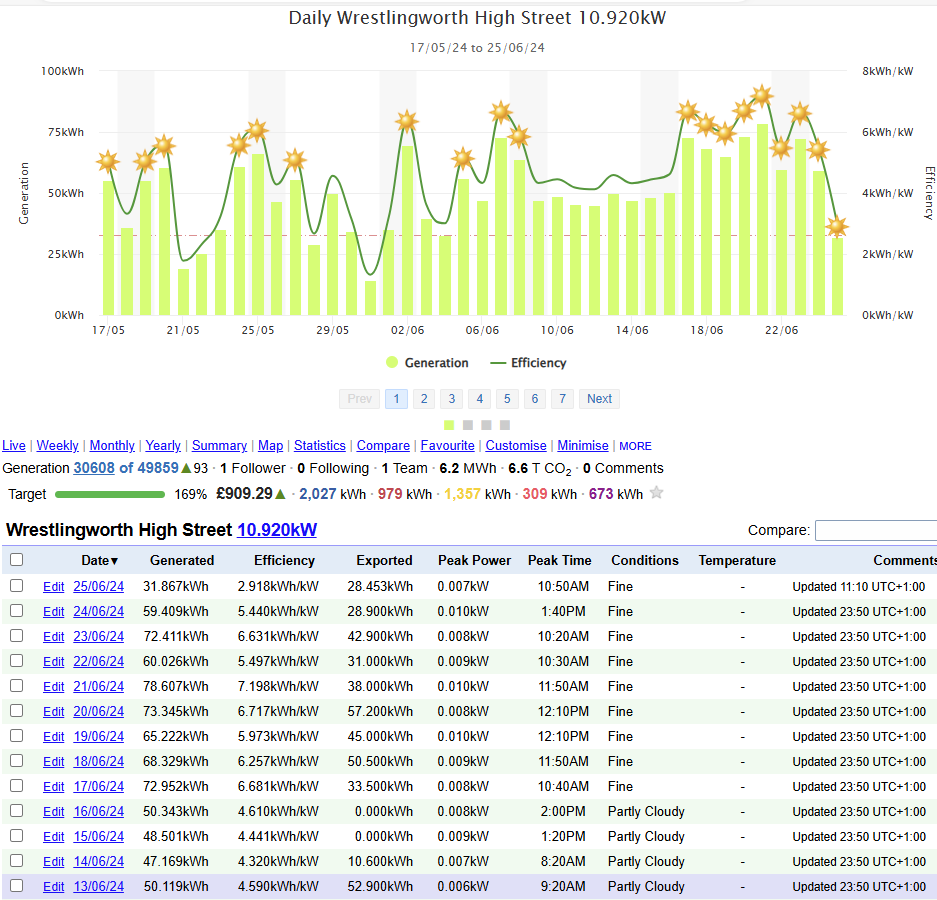
Windy Miller Its from pvoutput.org, a site to share your PV output and compare to others nearby

Here's my own data although the FIT credit is wrong, have to work out how to stop that

If you search the forum, there's scripts for Home Assistant that feed it

D
#65 DD

Or you can get the data from the API if you don't use HA. (I just push it daily rather than every few minutes.)

P
#66 Pete UK

48.2kW yesterday for me. A new record.