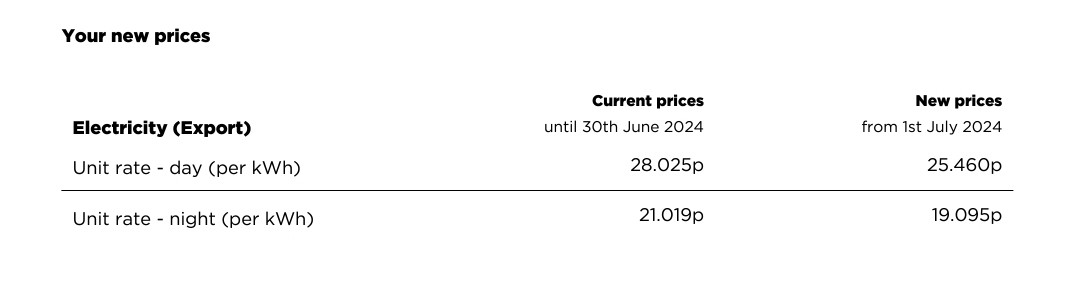
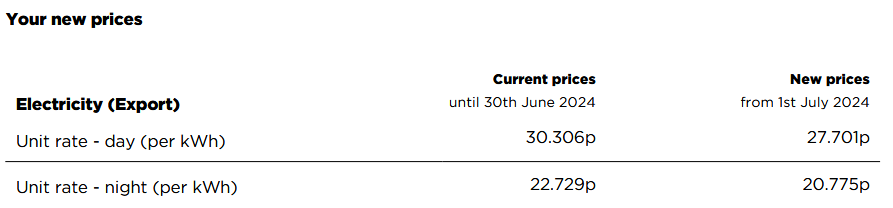
The gap between Flux daytime export and peak export from 1st July is now only going to be 8.115p in my area. It's 'almost' getting to the stage where taking battery losses into account in and out, it would be almost as good not bothering to charge the battery in the day for export 4-7, and just export all the solar instead, saving wear and tear on the battery.
Anyone able to post the new IOF rates?
T
#3TX200
Not had my IOF rates through yet. Guess as it's a reduction, no urgency for them.
T
#4TX200
And the email has now arrived! West Mids region
IOF import and export, July 2024:
Peak rate 28.606p drops to 26.024p
Off peak rate 21.454p drops to 19.518p
SC remains at 60.659ppd
#5hoggy
Yorkshire much the same:
W
#6wrighar
Norfolk is a little better, and still 47.85p standing.
#7Maxwell
In their email they say "..Unfortunately, mainly because of regulated costs imposed on every meter, standing charges remain high..." Yet they vary so much by region. Whilst you can see the argument in local variations in unit charge based on user numbers etc i'm not sure i understand why the standing charge should vary so much. Or is it down to regions having different meter data collection companies and variations in their pricing to the lecky companies ? Or this just BS from Octopus to cover their high standing charges ?
S
#8sponev
TimHutchings Exactly why I've not bothered with Flux this year and opted to stick with IOG and 15p fixed export. I reckon I'll be about £100 ish down vs Flux over the year but at that it's not worth bothering with the export hassle and hammering the batteries. I should hopefully still be net neutral for power bills over the year, including running an EV and a couple of ASHP, so mustn't grumble.
V
#9Vestas
Maxwell Octopus actually have the lowest standing charges out of the major suppliers. For me in East Mids its 75p/day for electricity and gas. EON - which the neighbours have & we had prior to Octopus is £1.15/day. That's 53% higher....
Don't get me wrong, standing charges are ridiculous but they're worse with other suppliers.
T
#10TimHutchings
Maybe Octopus are trying to persuade people on Flux to move over to IOF, as it gives them a ready source of power whenever they want.
I will remain on Flux for the summer and probably move to Cosy again in October, though I may look more closely at Agile this year for overwintering, maybe using Wonderwatt. I also expect next February or March I'll give IOF a whirl, but as always, I'll look at the prices at the time and see what this very knowledgeable community are suggesting. Thanks all!
A
#11Avenir
TimHutchings It's 'almost' getting to the stage where taking battery losses into account in and out, it would be almost as good not bothering to charge the battery in the day for export 4-7, and just export all the solar instead
What would the threshold be, do you think?
T
#12TimHutchings
Avenir I guess that depends on the individual. Personally I was losing around 20% in losses (battery in and out and inverter) with the old firmware. It may be different with the new firmware I'm now on 191/193, but I haven't got round to testing as I don't import from the grid in the summer.
At just over 23p peak Flux from July, that's a loss of around 4.5p per kwh, so I'm only looking at a 4p odd profit for maybe 6kwh per day which is 24p. Probably worth having, but the effort involved and wear and tear on the battery, makes me wonder whether saving £1.68 a week for say 16 weeks is worthwhile.
I'll continue this year as I have it all set up, but I'll reassess next year.
DD Interesting. There must be logic in the way the rates are priced, but it’s not obvious.
I’m in East of England which is the second cheapest standing charge, I thought that might be due to all the offshore wind farms coming ashore and there being plenty of green electricity, but Scotland has loads of wind and the standing charge is higher (more rural I guess so grid more expensive?). East Anglia is pretty flat so the engineering of grid transmission must be cheaper than areas like Scotland, but London has the cheapest standing charge but grid transmission is almost all underground which must be expensive - population density makes it cheaper though?
Whilst East Anglia and London have the cheapest standing charges they are at the top end of the import rates 🤷♂️
The latest rates reinforce that there’s no benefit to importing overnight to speed up when you export during the day, the rates are just too close together. As TimHutchings after 10-20% battery losses is the peak export actually worth it? Certainly not if you have to run at least partially off grid overnight or refill the battery for breakfast consumption.
A
#15Avenir
TimHutchings I see what you mean. In my region they have reduced the peak time export rate but held the day rate. I only export half my 9.5kwh battery, (the other half runs the house overnight), so with 20% losses the maximum benefit of doing a timed export is only 16p per day – down from 25p per day.
A
#16Avenir
Avenir I'm not sure what the cost of a battery cycle is, but the tightening rates unfortunately reduce the value proposition of a service like Wonder Watt, if they plan to make it paid-for.
V
#17Vestas
geoffreycoan In general the closer you get to London the less new generator connections to the grid cost. Totally backwards of course as we all know London only consumes but that's England/UK for you, everything revolves around London.
In theory (and this is increasingly tenuous now) the standing charge is supposed to reflect the actual cost of providing an energy supply to you in your region. Were that true then places like Scotland would have negative charges due to the huge surplus in energy generated relative to consumption.
In short the standing charges system is broken by design. There's plenty of reading online if you have a search. "Trebles all round" sums it up nicely 😉
#18Maxwell
Vestas I've not long finsihed with EDF after a fixed term ended. And when we were looking for a another supplier we ended up with Octopus. And in our comparions with a number of other suppliers we found that Octopus offered us the biggest savings compared to what we had with EDF. Might have to re-visit that and see how the new rates change our projected saving. Of couirse no doubt all the comapnes we compared against will have new offers. And this was with their big stabding charge. Their standing charge was the biggest of the suppliers i looked at in our comapriosn. There would have been some suppliers that we missed just becuase when we went to do the online checker a number of them didn't recognise that our address had a smart meter.
M
#19mrand31
Vestas In theory (and this is increasingly tenuous now) the standing charge is supposed to reflect the actual cost of providing an energy supply to you in your region. Were that true then places like Scotland would have negative charges due to the huge surplus in energy generated relative to consumption.
I'd suggest that the cost of providing a connection has little or no relation to the ratio of generation to consumption in an area. In London and the East, the very high population density means that the average cable length and number of substations per connection is far lower than in, say, Scotland, the North East or South West.