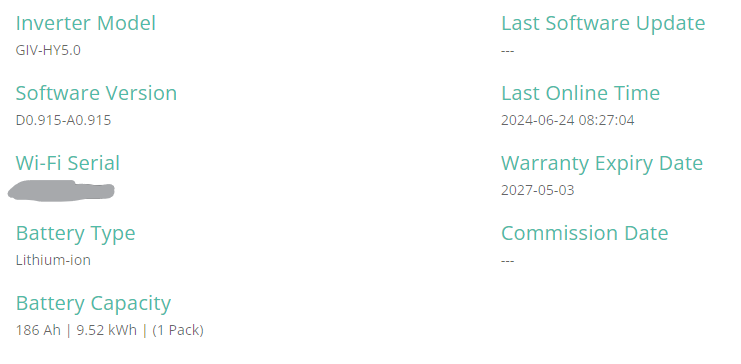
I'm looking for some advice about my 2-year old battery pack. I was sold a 8.2kWh pack, but some time ago, when I had a problem with the inverter, GivE engineer carried warranty work on it. Since then the battery is recognised as 9.5kWh on the portal:
I haven't noticed any issues until recently:
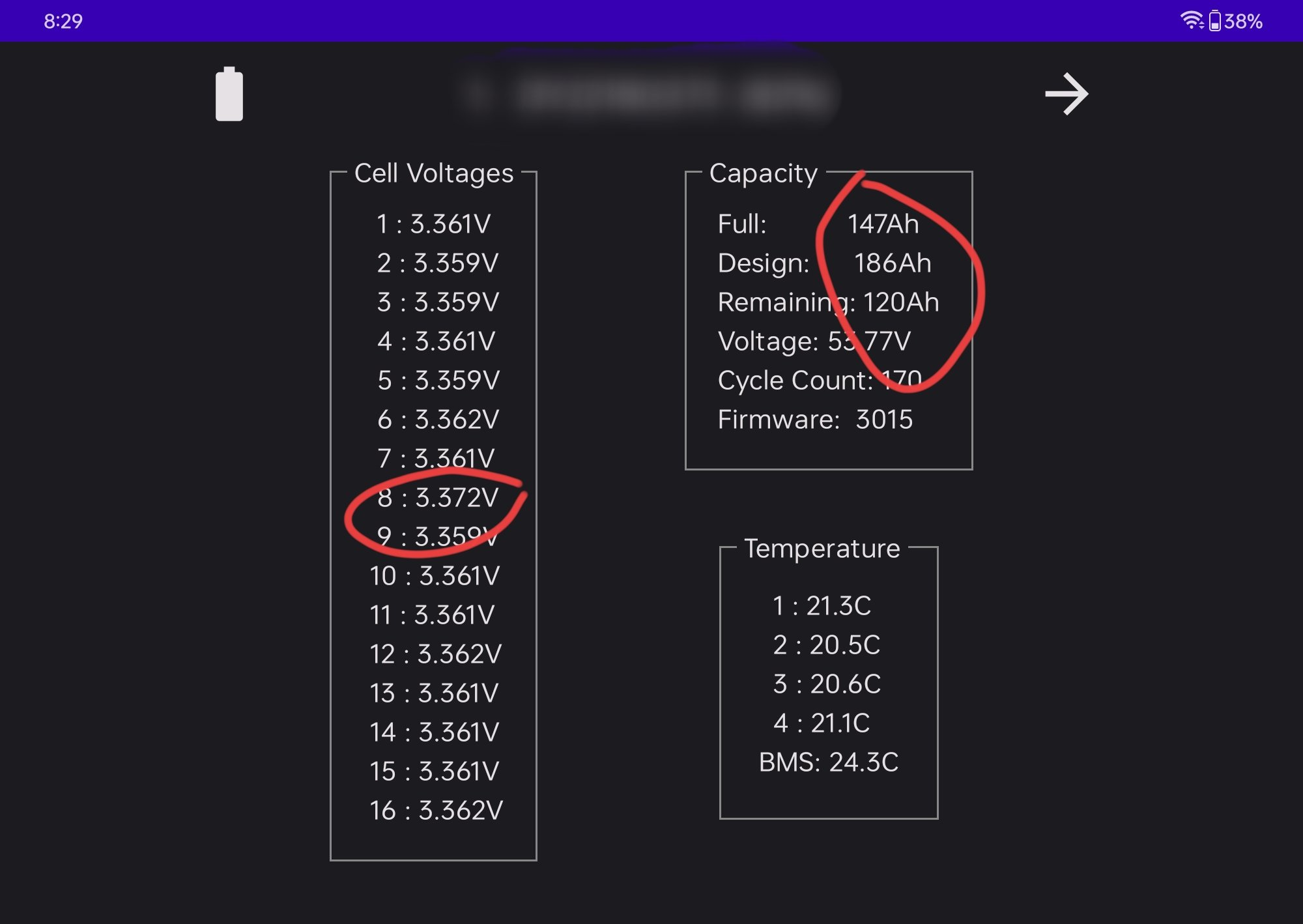
There is now, what I would consider substantial voltage difference. I know that I can't run a calibration manually, but I can approximate something.... Will there be any benefits?
The other option is ask GivE support to run a proper calibration cycle. That will be my next step if you guys think this is necessary.
Thanks
D
#2DD
rio911 I'm looking for some advice about my 2-year old battery pack. I was sold a 8.2kWh pack, but some time ago, when I had a problem with the inverter, GivE engineer carried warranty work on it. Since then the battery is recognised as 9.5kWh on the portal:
Did they swap it out for a 9,5kWh battery, or is it an 8.2kWh battery which the inverter is now managing as if it was 9.5kWh ? Latter sounds potentially bad since, AFAIK, the 9.5kWh can be run 100% to 4%, whereas the 8.2kW has a much more limited usable range. That said, I assume it comes down to cell voltages, and the voltage range when operating the 8.2kWh over its permitted range is the same voltage range when operating the 9.5kWh over its valid range. But I could be very wrong about this.
What is the reported SoC at the time of this snapshot. Perhaps 'full' is what the calibration measured (consistent with 8.2kWh) and design is because it thinks it's 9.5kWh.
Was the battery under load when you took that snapshot of voltages, or idle ? Which cell(s) were you worried about - I'm not immediately seeing anything outside of about 3.65 +/- 0.06.
Is that something to worry about - mine's not much different (though it's under load at the moment).
Was the warranty work involved changing the BMS board in the battery by any chance?
I have a feeling they've swapped it for a 9.5 BMS / configured it as a 9.5 even though the cells have the capacity of an 8.2.
Probably not the end of the world as it tends to use voltages to set the end stops HOWEVER we can see it thinks full capacity is 147AH from its last calibration, which puts it at 7.5kWh, which is either about right for a 2+year old 80%DOD 8.2 or pretty poor for a 100% DOD 8.2.
What does it say on the sticker on the side of the battery?
K
#4killythebid
DD The 8.2 kWh battery has the same 100% DoD rating as the 9.5 kWh. The original 8.2 was 80% though.
It is worth noting that the Givenergy batteries are all the same technology the 80% or 100% DoD is just because of how Givenergy has decided to state a particular model's capacity. 5.2kWh (80% DoD) batteries could be marketed as 4.2kWH with 100% Dod without a change of technology H/W to S/W. A 9.5kWh battery if one used the same max capacity value (i.e the max capacity) as in the 5.2 kWH would be stated as a 11.2kWh or thereabouts.
It would be better of Givenergy used just one method to state the battery size rather than the mix we have. I see though that a new mk2 5.2kWh is coming out that is 100% DoD but this will have been achieved be upping the max capacity of the unit.
R
#5rio911
DD
It is 8.2kWh battery. I don't think they swapped it (I wish).
To answer the other post as well: my understanding is that they changed a failed board in the inverter. I don't think anything was changed in the battery.
The battery was probably charging from solar at that point in the morning, at around 80%SOC, if I remember correctly.
I was concerned about the max V variation, 3.359 vs 3.372, which is a variation of 13mV. The range that you have given with a nominal of 3.65V, is that correct?
K
#6killythebid
rio911 The one cell (No.8) is a bit high but the others are reasonably balanced. A straight calibration may not do much to change things as that will calibrate the BMS for a zero to 100% charge overall. I do not know if the calibration sequence also does cell balancing. However, even if it does there will always be a varience in cells it's just the nature of the battery construction.
It may be worth calling Givenergy but I suspect they will not be concerened at your results.
P
#7PaDav6
When I had a new BMS in my 9.5kWh battery the engineer typed in 168Ah instead of 186Ah when configuring it for the design capacity. They needed to come back to correct it as it is not remote accessible - quick call to support and they sent an engineer when one was available. That said the BMS seems to work on the "full" capacity from the calibration not the design one so it didn't affect the operation anyway.
I've heard that the BMS does cell balancing when the battery is idle at a low state of charge. I try to run my battery down regularly. (Having a good export tariff helps, of course.)
R
#9rio911
DD What do you mean low SOC?
My battery gets discharged to 40%SOC regularly overnight, because at the same time my EV is charging. I can easily lower it to 20%, so by the time the PV starts generating, it will be at or about 10%SOC.
D
#10DD
rio911 Probably the lower the better. I go down to around 10%, then let it idle for an hour (pause discharge) before starting the charge. (I'm on IOG so I get 6 hours overnight.)
If you don't charge overnight, allowing the battery to idle for 3 hours during the cheap rate is probably good. (May as well power the house from the grid while it's cheap.)