P
#1 Phil89a
I have just noticed I am having differences reported for SOC across my two batteries; with one showing 63% and one 70%
Is this normal or a sign something is not right ?
Thanks

I have just noticed I am having differences reported for SOC across my two batteries; with one showing 63% and one 70%
Is this normal or a sign something is not right ?
Thanks
It happens, keep an eye on it and check when your system says 100%.
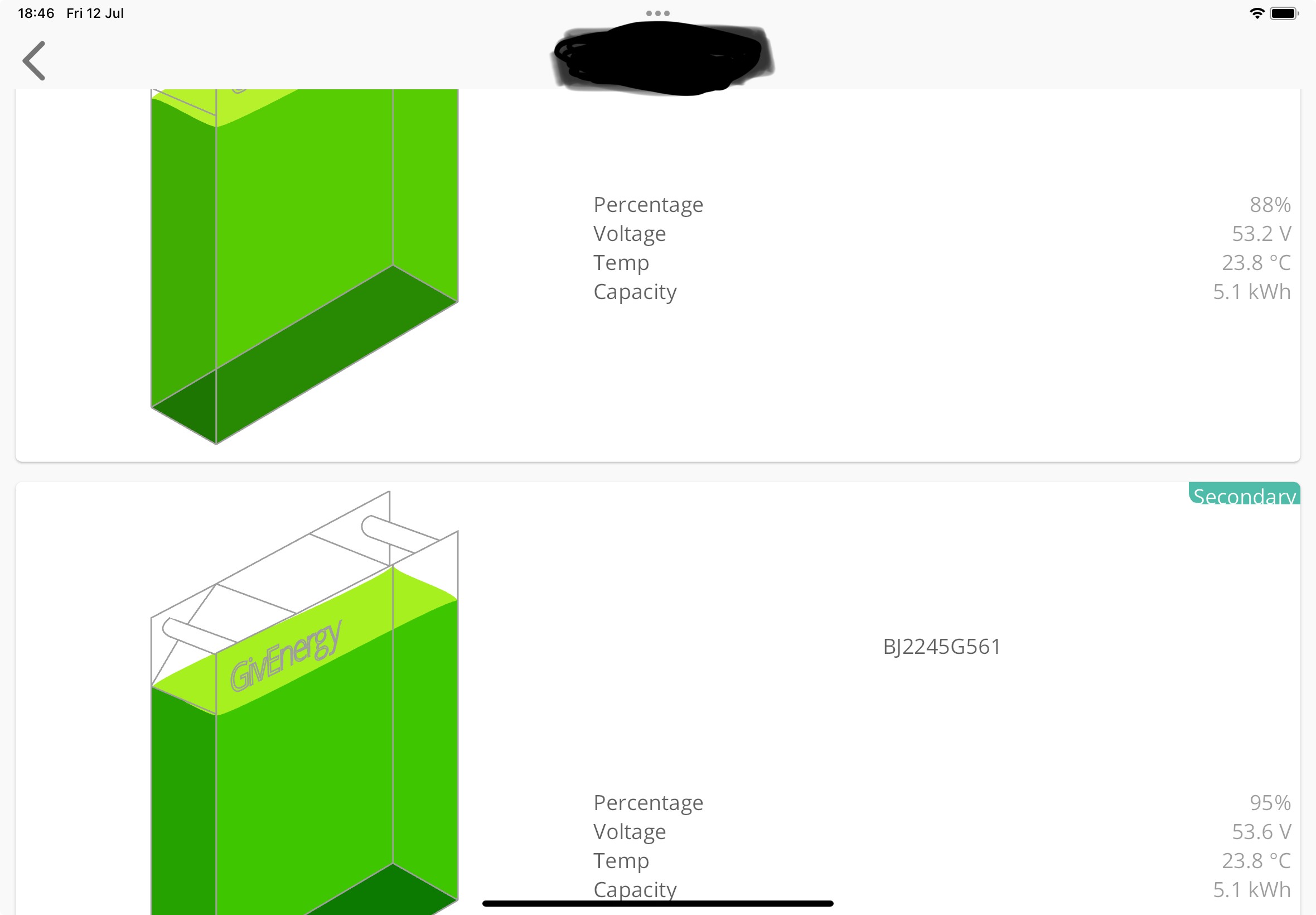
Mistype - the difference is actually 55% to 70%
If you look on the forum there are plenty of other people with twin batteries reporting the same problem. Various things have been tried to resolve it, from re-calibrating the batteries to a slow re-calibration which apparently has some effect.
But it still seems to happen regardless.
This wouldn't be an issue except others have reported that when one of the batteries reaches full or empty (100% or 4%), both batteries stop charging or discharging, so the extent of the soc divergence can really affect the usable capacity. Seemingly no permanent fix
Thanks all - I will pass to my installer to raise with GivEnergy.
I have 2 batteries and they consistently show a 10% difference when the Primary battery reports 100% charge. If recalibrated the batteries will show an eqaul state of charge but after a couple of days it goes back to a 10% differnce.
I am at the point where I just shrug my shoulders and say it's just the way the system works.
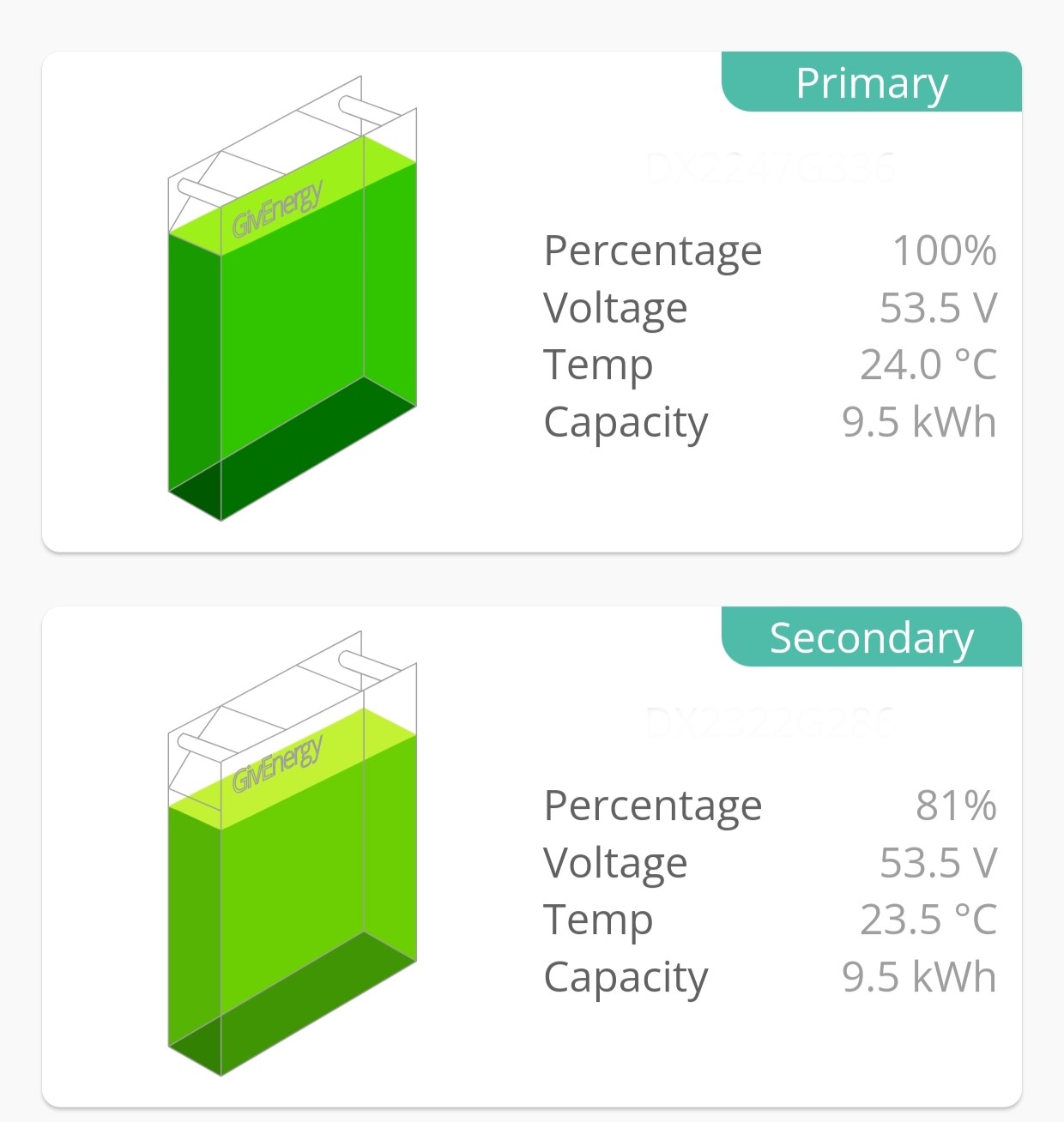
As I type my two 9.5Kw batteries have a 19% variance in SOC. Despite having done several discharge and calibrations over the past four months. After a calibration the SOC is usually within 2%, however in the following weeks the SOC of the secondary battery goes lower and is currently. 81%. When discharging the primary battery gets a lower SOC than the secondary. The voltage readings are usually within 0.2v which I think is good. The only thing I can think of is the age of the batteries, the primary is 14 months from commissioning and the secondary is 5 months.
Ortwin I think you are missing one possibility rather than the actual battery set being at fault it could be the BMS. It would help explain why the primary loses SOC faster than the secondary despite being at a reported lower SOC.
We should view the reported SOC by the BMS with suspicion.

Owing to the flat voltage profile of LFP, 0.2V between the two packs can mean a 5-10% SOC difference, particularly in the 40-60% SOC range.
I suspect, as I've mentioned before, it's more likely the daisy chain of the packs being the root cause (the further away from the inverter the pack is, the less voltage it receives.)
If your installer is in any shape or form interested (unlikely but you never know) an experiment would be to switch them around and see if the problem moves or not (the 9.5 packs are well suited to this, owing to them being plug to plug.) Thereby debunking or confirming my theory. (or some half way house whereby the aged battery being moved to secondary position means they run in lockstep)
Both BMS's have been replaced and the issue continues.
I've just had this from GE technical which concerns me!
I can see in the logs that you are changing charge and discharge times regularly. This can sometimes cause the disparity in battery SOCs to get larger and increase their distance.
I'm on intelligent flux and have noticed the daily charge can be broken into 1, 2 or even 3 sessions. If the variance in charge/discharge frequencies is causing the SOC drift, there is something wrong with the system management?
Ortwin A BMS box is a specialised computer running specialised software. Changing them and expecting a difference in how they calculate SOC is like changing a desktop computer and expecting the software that runs upon it to run differently/better.
If the BMS HW is faulty, changing it will help, but if it is not, it won't but it does not necessarily mean the BMS is still not a cause of the issue.
killythebid I do not change charging times much I generally just let the system run on defaults most of the time and only really change how the system is managed between winter and summer running. Yet the reported SOC is normally 10% different between my two batteries when the primary is showing 100%.
I am not that bothered and just let the system be.
Ortwin I'm on IOF and although yes it does charge in a stop start way it's not really much different to just having it in eco on a variably cloudy day, so that sounds a bit of an odd comeback if the system can't handle non continuous charging.
I have two batteries on 1 inverter, they track within 1% of each other, but they are wired as a ring / bus, not as a daisy chain so not a fair comparison.
Until recently I was on FW 3012 and the SOC % of my 2 9.5 batteries was always within 2 or 3%.
GE 'improved' my system by moving me to 3015. SOC difference is now usually about 12% and sometimes upto 30%
Flattening both batteries bought them into line for a while and switched which battery was highest SOC.
I can see that they are drifting apart again now with Primary higher than Secondary again
Let's hope that 3017 will be the miracle cure :