Winter Strategies

36 comments started 2024-09-03 last 2024-09-27
GivEnergy ProductsHybridBattery
E
#1 EasyTiger

This is going to be our first winter with solar and battery. I've noticed that the battery will not reach full charge during cloudy days. I was wondering what others do as the days get shorter and potentially cloudier?
I setup (using WonderWatt) a nightime schedule that charges the battery from 11:30pm to 6:30am to a maximum of 50%. Using cheaper overnight electricity for the following day (I work at home) and the solar then tops up given the cloudy conditions.

Anyone have any other ideas?

Also has anyone investigated a blanket for their battery for over winter to keep it's temperature up?

TIA.

S
#2 SteveCook

I have Gen1 Hy5.0 and 9.5kwh battery.
Currently on Flux as plenty of sun.
I will go to Eco7 for import in Oct as that is a 7hr charge slot and as I still have my gas boiler the battery plus a bit of sun can get me through 24hrs.
Where is your battery

S
#3 SimonClarke

Same gen 1 5kw and 9.5 on IOG. Currently charge to 100% 23.30 to 5.30 then export if sunny and timed export anyway 18.30 to 20.30. Very rarely run out and then only late evening which seems to reset the SOC anyway. Currently having a heatpump fitted but I don’t think that will affect the battery. Might stop the timed export soon as there is less sun but it is still ok now. Obviously IOG depends on having a car

T
#4 TimHutchings

From mid to end of October, till the end of February, you can pretty much forget the solar generation and if you get some, take it as a bonus and maybe export it. What you will need in that period is a cheap import price. Obviously Octopus have many great tariffs to suit those with EVs, heat pumps, solar and battery etc but it really depends how much lecky you use. What you want to avoid is drawing from the grid at expensive times, so if you have a battery to load shift, that's very helpful.
Many people find that the overnight charging period isn't enough to allow their battery to see them through the whole day, so some have decided to use Agile where you get cheaper periods through the day to top up the battery and if you already use Wonderwatt, I believe that works quite well. Personally, as I have an A2A heat pump, last winter I used Cosy, which worked really well, as I was able to see how much sun came to fill the battery in the morning, then topped up the battery with cheaper grid between 1-4 in the pm, which helped me through the evening.
There's no one tariff to be on that suits everyone, you just need to find one that suits you and your lifestyle.
As for a blanket for the battery, you haven't said where its positioned, but generally speaking, as long as you're using the battery a lot through the winter, it'll generate enough heat in itself to stop it from coming to harm.

S
#5 SimonClarke

Ovo seems to have a deal that would suit me car, house and export about the same as Octopus but with 15p for the heat pump but I tried ringing them and got absolutely nowhere. Basically want me to sign up then they will tell what I can have! Probably stick with IOG at least for a while as if the new ASHP works as expected even on IOG we should break even with the oil boiler. We’ll see…

#6 nophead

I simply always charge our battery to full from 2-5AM on Octopus Flex. If it is sunny then we export during the day. When the sun runs out we use the battery. If at 3PM it looks like we haven't enough to last until 7 we charge until 4PM.

Since the export rate is slightly more than the import rate we don't lose much if it is sunny enough to not need a full charge.

#7 Midlands_Solar

My 1st winter here too, I'll continue to charge the battery at the off-peak rate with EON Drive V2 from 00:00 - 07:00 and hopefully, I get some generation to run the house (as I work from home 4 days a week) and the battery to see me through the day & evening, fingers crossed

I looked as a 2nd battery, but couldn't get the economics to stack up

K
#8 killythebid

EasyTiger Once that starts happening I set our set our system in winter mode which means that I set the Batteries to charge to 100% overnight on cheap night rate tariff. The battery then keeps us going through the day until the next nights charge. Thus at least we avoid the more expensive daytime tariff. If we get a sunny winter day we might even export a bit.

We also try and put the washing machine and dishwasher on overnight during cheap rate times plus charge the EV overnight.

K
#9 Karen

My battery is outside. I do't use a blanket, but have constructed a three sided box of 5cm polystyrene that can be pushed over the battery. But as others have said - if you keep using the battery by charging overnight and discharging during the day it pretty much heats itself. Last year I stayed on Flux through the winter, but the year before I used Economy 7 and agile export - will probably go that route again this year

#10 Judith

Like Karen we have a box, missing one side made of 80mm insulation which is pushed over a taped in place. The thickness was due to what we had lying around from a building project.
You can check the battery temperature on the portal so you know when your tea cosy is needed. Then set the charge rate to last the full length of your cheap rte period since charging (and discharging) currents help to keep your battery warm.

G
#11 geoffreycoan

Judith makes a key point, if you are charging overnight, set the battery charge rate to a lower value than maximum so you gently fill the battery. This will keep the battery at temperature for longer and it’ll be kinder to your battery than a full rate charge then idle until you start using the load.

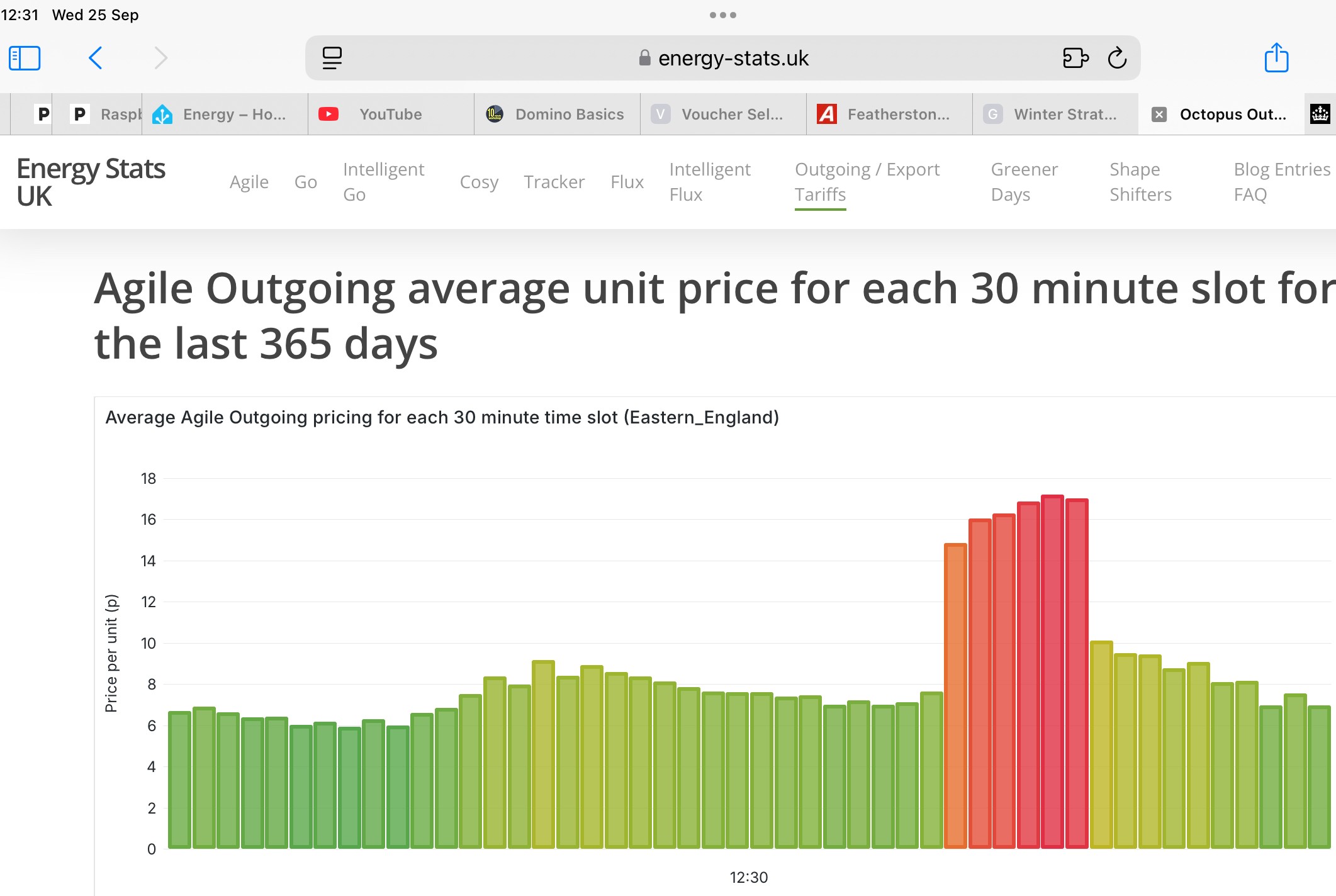
@Karen I personally wouldn’t go with Agile Export as the rates are almost always worse than the 15p fixed export rate. Only if you have spare electricity and can export it in the peak do you get slightly higher rates - see https://energy-stats.uk/octopus-agile-outgoing-export-eastern-england/

We have an ASHP and 14kWh of usable battery space, it’s not enough to run our heat pump and the rest of the house for the day. In winter we can use 20-30kWh a day just for the heat pump so we went with Agile last year and was very pleased with it. I’ll run the figures again but likely will do the same this year. The 3 period Cosy looks interesting but I doubt it’ll be enough to avoid peak import.

R
#12 Roy124

nophead

If it is sunny then we export during the day (from Solar?)
When the sun runs out we use the battery. (Is that automatic?)
If at 3PM it looks like we haven't enough to last until 7 we charge until 4PM. (Is that pre-set or do you have to select it?)

#13 nophead

Roy124 We normally have the mode set to ECO, so once the battery is full we export automatically if solar is generating more than the house uses and if there is not enough sun to run the house we use the battery automatically.

If it looks like we will run out before 7 I use the app to force a charge from grid just before 4 to cover 3 hours of use. So that is manual.

T
#14 TRBob

geoffreycoan I charge my 5.2kWh and also turn up the ASHP (to bank some heat) during the 1pm - 4pm cheap Cosy period and in most cases I avoid using anything in the following peak period, except for the coldest days when it's sub zero. But we cook with gas atm, when the new kitchen gets done we'll be gas free and I'll consider more battery storage. The new third Cosy period will make things a lot better this time around.

R
#15 Roy124

nophead That I think both answered and persuades.

I have now got the Fixed tariff working properly. Give it a few days and then I shall get the Flux.

Thank you

K
#16 Karen

geoffreycoan Hi Geoff, I think you might be right about agile export. When I used it the first time I forced export for an hour in the evening to help cover the costs of charging over night, but this year it doesn't look as though there is such a big differential between eco 7 charging rate and what is paid for export at peak times with agile (and rates during the day seem "pants"). Last year I used flux because it gave the option of forced export at a good rate at peak times, but 3hrs isn't enough to get the battery fully charged over night to see me through the day if the weather is bad. I reckon I need 10p difference between export price and import price to make forced export really worth while, and I'm not sure I will get it this year with agile export.

W
#17 wrighar

Currently on Intelligent Flux,
Planning a move to Either Cosy (if I can get it), or Agile for the winter in the next 3-4 weeks.

Will be using the new Beta smart tariff card.

I probably need to get Predbat up and running (and Givtcp update from v2.4.9 to v3.0.x)

W
#18 Weasel

As a heavy user of electricity (22 kWh per day), I decided to go with Cozy Octopus to enable me to keep my 13.5kWh AIO charged. I am in the process of enrolling in Octopus Outgoing Agile so I can export during the peak periods at better than 15p. All my import needs can be met at the cheapest rate, this halving my consumption costs compare to standard rates.

During the summer my PV array generates upto 205kWh per day, so I could potentially be grid-free for many months

I have HomeAssistant with GivTCP and predbat

#19 PianSom

Weasel During the summer my PV array generates upto 205kWh per day

😮

G
#20 geoffreycoan

Weasel During the summer my PV array generates upto 205kWh per day

I thought my arrays generating 70-80kWh in summer was a biggie, do you have a ground based array ?

Cosy Octopus is definitely more attractive than it was last year as it offers 3 recharge periods, vs 2 last year. I need to re-run my numbers and see if this makes it worthwhile enough. I suspect not as I will still be importing in the Cosy higher price periods. I have 13kWh of batteries and used assumptions last year of 16.7kWh a day base load, 25.5kWh for the ASHP, total 42.2kWh.
Since I ran Home Assistant since last September I will have better data to re-run the calculations but I think it likely I’ll stay on Agile import, fixed export.

V
#21 Vestas

Weasel I am in the process of enrolling in Octopus Outgoing Agile so I can export during the peak periods at better than 15p.

I suggest you look VERY closely at this because unless you have unlimited export ability (which you don't) its very unlikely there will be sufficient 30 minute slots over 15p/kWh to make it worthwhile compared to Outgoing Fixed.

I haven't done the maths this year but last winter Outgoing Agile was over 15p for less than 8% of the time in East Mids.

W
#23 Weasel

Indeed, but I don't expect to export too much anyway

geoffreycoan

You are right, but I don't expect to export that much anyway

V
#24 Vestas

Weasel You'd still be better off on fixed. I had the same mindset as you last year but Agile Outgoing is a tariff which doesn't really work for anyone other than Octopus IMHO.

I switched to fixed after a couple of months on Agile Outgoing as it doesn't make sense even IF you don't use any high wattage devices between 1600-1900.

G
#25 geoffreycoan

Weasel I agree with Vestas I’m sure you will be better off on Outgoing fixed.

You say you can generate up to 200kWh a day in summer. My worst month is December, about 6% of my best month June. Assuming roughly the same ratio and excluding days that the panels are covered by snow, that suggests you could be generating 12kWh a day in winter which is enough to fill your AIO each day. So once your AIO is full from either overnight cheap charge or solar charging, you’ll only be getting circa 8p export rate for the excess solar you generate vs 15p on the fixed outgoing rate.

The only upside of the Outgoing Agile rate is the few pence uplift above 15p you get in the peak periods if you do a forced export

P
#26 Pete UK

Weasel

Are you sure you generate a max of 205kW a day in summer…? 205kW ? 😳

That’s massive. That’s 183kW over what you say you use as a “heavy user”; 22kW a day (that’s not a massive daily use BTW IMHO). And you have one AIO to store it in. I assume you maybe own a farm and must be on three phase to get such a large DNO export limit. 30kW? 10kW per phase?

Assuming you have an inverter capable to export all that at 15p/kW over the 16 hours of sunny summer solar generation that’s an average of 11.44kW exported per hour for 16 hours and probably much more required at peak midday (maybe 25-30 kW/hr inverter(s) for export needed?). You’d get £27.45 in export per day at the 15p fixed export rate. On agile export you’ve only got 2.5 hours where it’s over 15p and then it looks like only just over (max 18p) according to the chart @geoffreycoan posted above. For the other 13.5 hours of each day (including your highest export time at midday) you’d be getting an average of about 8p max. So you’d make far less on agile export compared to fixed at 15p, maybe £12 ish a day in export because the vast majority of your export you’d only get 8p for and when your export is much lower in the evening peak (when the rate goes above 15p) you’d be exporting far less per hour. Even if you exported your AIO at the max 6kW/hr rate.

Assuming your AIO lasts you from sun down till a good few hours after sun up, even in winter if you only generated 20kW in a day, you’d only need to buy 2kW a day in winter. And would that really matter what import tariff you’re on then if 2kW cost you 14p or 48p?

I’d suggest you don’t really need to worry about what import rate you’re on, that’s negligible but you need to be on a fixed export at the highest rate you can get. Which would seem to be 15p fixed (unless you can get higher elsewhere).

All this is assuming that your 22kW/ day usage is similar over summer and winter (which it probably isn’t) and that the 205kW generation a day isn’t a typo.
If it isn’t then you’re in a nice position and have plenty of choices you can make to maximise your yearly profit from export. 👏

P
#27 Pete UK

EasyTiger

(kit: 2x 5.0 gen3 hybrids, 4x 9.5kW batteries, with 7kW max import and 8kW max export rates, 11.34kW array over 4 not ideal orientation strings; South, East, North. 10kW DNO export limit.)

To answer the OP;

I’m on IOG. Like most others on this tariff, I charge the batteries to 100% (and I charge car to 80%) every night 23:30-05:30 all year round.
In the summer all solar generation then gets exported at 15p/kW when the batteries are at 100% and I also discharge (timed export) my batteries at 8kW/hr from 19:00-23:29 at 15p/kW. During the timed export period all house load is deducted from what goes to the grid, so the export to the grid varies but the battery output is constant, so it’s easy to work out how much to adjust the start time and never run out.
As the days get shorter, I start the timed export later and later but always time it to finish at 23:29 so I don’t run out of juice and have to buy any at peak rate. (Right now it’s 19:15–>23:29). Also I guess that helps the grid a bit but helps me more.
There are a few days in winter where I may not export anything at all and a couple of days where I may have to import a couple of kW.

I’m averaging 99-100% off peak usage. and due to all the export my yearly elec bill was -£100 (negative) despite my system being crippled for the last 3 months over the summer due to an ongoing issue. I’d say this result is all down to the batteries and having more capacity than I need on paper that saved the day by creating more money from extra export. Despite thinking at the time 38kWh wasn’t enough to cover me in winter.

Result is 7p/kW average elec price all year (free house power and fuel for elec car.) still on gas for heating/ water though. The average unit price isn’t the be all and end all, as it depends on how much you’re buying at that price at the end of the day; Assuming you’re aiming for lowest bills of course. You could have a much higher average import unit cost but still have a lower bill than me for example.

I’m still on gas but switching to gas tracker has helped a lot, although still expensive gas bills and I still quite fancy a heat pump at some point.


C
#28 CGoode

EasyTiger 3.6kW Gen 2 Hybrid & 2 x 9.5kWh Gen 2 batts here. This will be our 2nd winter on solar & batteries. Last winter we had just the 1 x 9.5kWh battery which got charged over night but with little or no solar top up during the day in winter ran out around 1-2pm. Earlier this year I added another 9.5kWh battery & switched to IOGo when our car & charger got approved.
Now we charge / use as many appliances as possible every night from 11.30pm to 5.30am @7p & export any excess solar back to the grid @15p during the day. Now approaching winter with little or no solar top up during the day the 2 x 9.5kWh batts should last pretty much all day. We are still on gas CH & have an A2A HP in our conservatory & we are at home all day. Upgraded loft insulation & replacements for 25 year old DG windows are to be done shortly to help with heat losses. Still thinking about an A2W heat pump but our boiler is fairly new & we have space issues for a heat pump outdoor unit so not sure if we will get to make that switch any time soon. Fingers crossed the extra battery does the job for use this winter. Just need to manage daytime use of power hungry appliances during the day a bit better.

R
#29 Roy124

CGoode we have space issues for a heat pump outdoor unit so not sure if we will get to make that switch any time soon.

We will have an ASHP installed in November. You are spot on about space issues, better described as siting issues. We have an ideal spot, minimal groundwork needed but the noise is 1dB above the permitted level. To insist on this position will need planning permission. To site it at the front of the house, there is only a private court, we will need planning permission.

Our neighbour, also in a house designed for ASHP, has minimal space.

C
#30 CGoode

Roy124 1dB over is a pain. Maybe look for a quieter outdoor unit to compensate? Some makes / models are quieter than others. From memory the noise limit is around 40 or 41dBA at the nearest neighbours opening (bedroom?) window so anything you can put in the path of the HP & that window will have an attenuating effect & lessen the noise level e.g. a wall, evergreen shrubs, fence etc. There are attenuated enclosures available for heat pumps but they are expensive & increase the footprint required even more. That said, some metal enclosures can be colour coded or even wrapped to match their surroundings - more cost though.
I have an 4kW A2A (aircon) heat outdoor unit serving our conservatory down the side of my house in a 1m wide walkway. Not ideal for airflow because there is a 6ft fence right in front of the HP fan discharge. However, it works fine & the nearest neighbour window is over 30m away so no noise issues at all. This is where I would like to site an A2W HP if we got one but due to the MCS regs, manufacturer airflow restrictions, larger unit size & installer warrantees they wouldn't allow it. Only other options are in the back garden facing our patio (not an option for me) or, in the front garden (planning probably needed) next to a bay window. That latter could be doable with a bit a strategically placed shrubbery but would extend the pipe run into the house.
My son has just had Octopus install a 9kW HP in his place to replace a Calor gas tank in the garden & old Baxi Bermuda back boiler in a fireplace (40+ years old). It turned into a bit of a nightmare with floor boards up in every room. It took over a week to install & they were without HW for at least 3 days plus numerous return visits to fix piping issues & replace the HW cylinder in the loft (on his 3rd cylinder now). It works OK now but it's not that pretty. It's a good job it's "doer-upper" house which needs every room to be decorated or modified so he can make good all the exposed pipework & ugly bits but it will take time.
I'm just not sure I want that level of upheaval in our place &, we have microbore pipework!

S
#31 sunnyjoe

Pete UK I have a similar setup (1x AC3 inverter, 1x 8.2kWh battery, 10.8kW array over 3 strings south, east and west via 9.7kW of PV inverters, 10kW export limit) and I have settled on an almost identical strategy. During the summer I start discherging at full power at 10:30 and if nearly full it finishes around 00:30. I charge 00:45-05:30 at reduced power. Like you I have started to push pack the discharge time as PV starts to run out earlier and the battery supports the house more in the evening

R
#32 Roy124

CGoode Quite. It is Octopus that is installing my system. I am lucky in the all the existing plumbing is in my garage for our UFH and the ASHP is almost as close as we can get. Plenty of room for the water tank in the garage; we don't have a tank at the moment.
As for an alternative pump, not really an option as Octopus gave us an irresistible quote. Mind you, the tank and pump could be sourced for 2/3 the total price. I guess the other 3rd is reasonable for 4 days work and risk. Quite how they can give a quote sight unseen I don't know.

V
#33 Vestas

Roy124 Quite how they can give a quote sight unseen I don't know.

Economies of scale. Basically they're doing so many that if they lose a little money on an install which proves trickier than expected it'll balance out with one that's easier than expected.

The question I'd be asking is how can they specify/design a system sight unseen. EPC's are very often a work of fiction at worst and usually inaccurate at best so if they're going by that then best of luck really....

R
#34 Roy124

Vestas The question I'd be asking is how can they specify/design a system sight unseen. EPC's are very often a work of fiction at worst and usually inaccurate at best so if they're going by that then best of luck really....

No, only the fixed price quote is blind. After a fully refundable deposit they send a surveyor. He took rather longer than a building surveyor when we bought the house. Every room was measured, including the height, and the loft was inspected, and the outside space inspected and measured. It took about 4 hours. Based on the survey the design team then designed the system including the ASHP and Hot Water System based on the volume of the home and its total occupancy.

The survey was on the 8th August and we got the design proposal on the 23rd of September. They are both busy and thorough.

The system proposed is about 25% greater capacity than the base value and the hot water cylinder might even be large enough for our grandson, a clean freak.

C
#35 CGoode

Roy124 My son's Octopus quote was equally "irresistible". At one point there were 6 vans & 12 guys working on the system & I think some of them were "in-training". New rads everywhere, pipework mods, bigger cylinder (3rd one) re-located to the loft (no space anywhere else) with floor strengthening, return visits & remedial works etc. My son had a surveyor visit & he still missed the fact that the cylinder specified would not A. fit through the loft hatch or B. fit under the roof height.
My Son now has a horizontal HW cylinder & had to have the loft hatch enlarged with a new trap door as well - all FOC.
Can't see how they made a profit on his install. They probably put the whole thing through the accounts as a "training installation". I'm now looking at making a combined outdoor HP unit & bin store enclosure for him down the side of his house out of spare pallet wood.

R
#36 Roy124

Many years ago we had that with British Gas (luv 'em). Gas Fire "Fitted and working". Easy, connect new copper pipe to meter in garage, feed up in to garage roof, into Bed 3 wardrobe, into loft, run to front of the house avoiding hot air ducts, run across from of the house, run back the same way as they did the other side, out of the rook, down the outside of the chimney, into the living room. Installed a new flue pipe, installed fire.

Only problem is there left a couple of dozen gas pipes littering may garage floor.

Our local plumber removed them for us when he raised our header tank including extending all the pipe, installed a show and only charged us for the shower.

BG advert was changed shortly after for "fitted and working to a gas supply in the room."