Octopus intelligent flux - random and nonsensical battery charging

27 comments started 2024-09-11 last 2024-09-12
Home AutomationGivEnergy ProductsHybridBattery
#1 norse

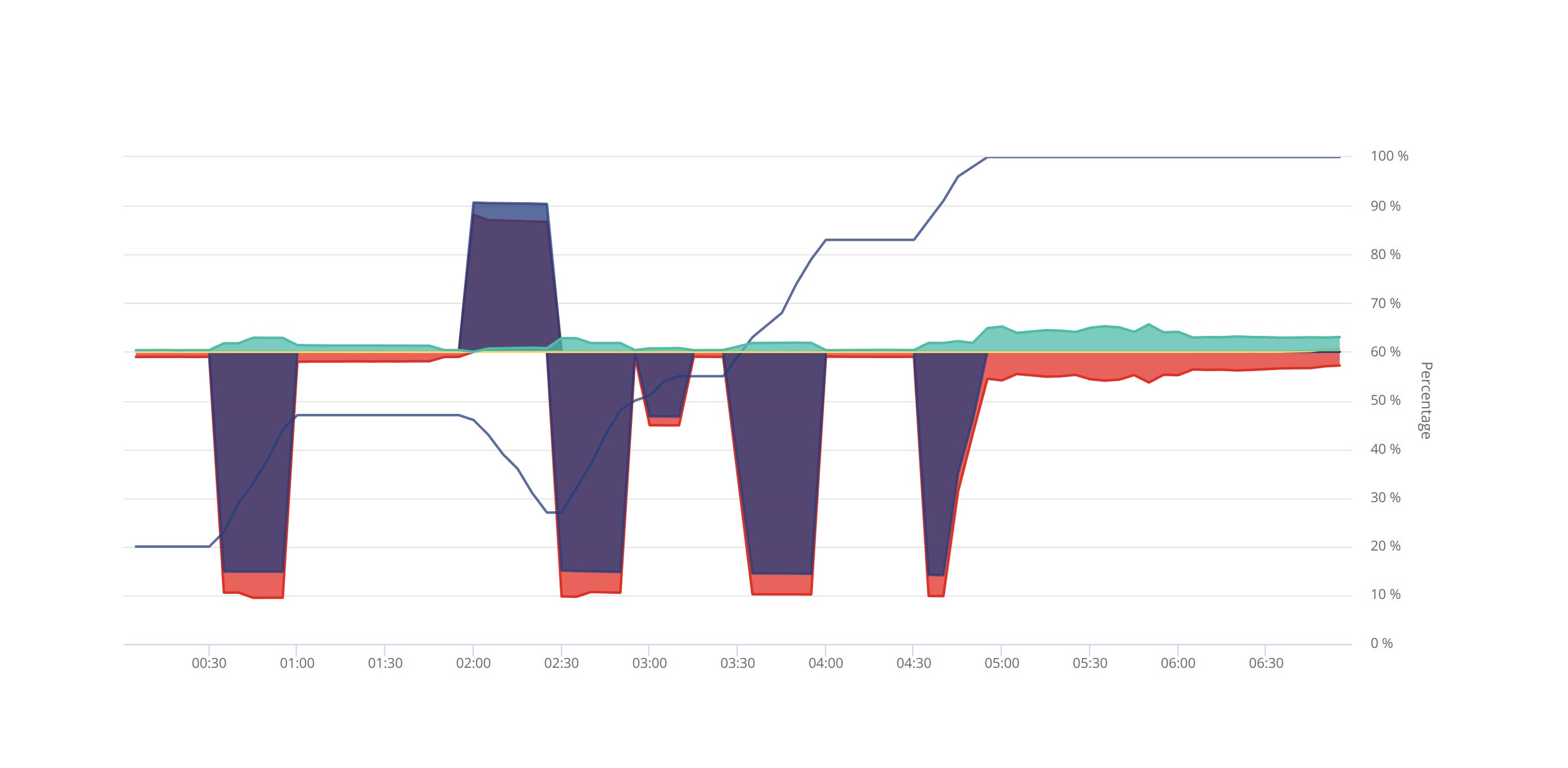
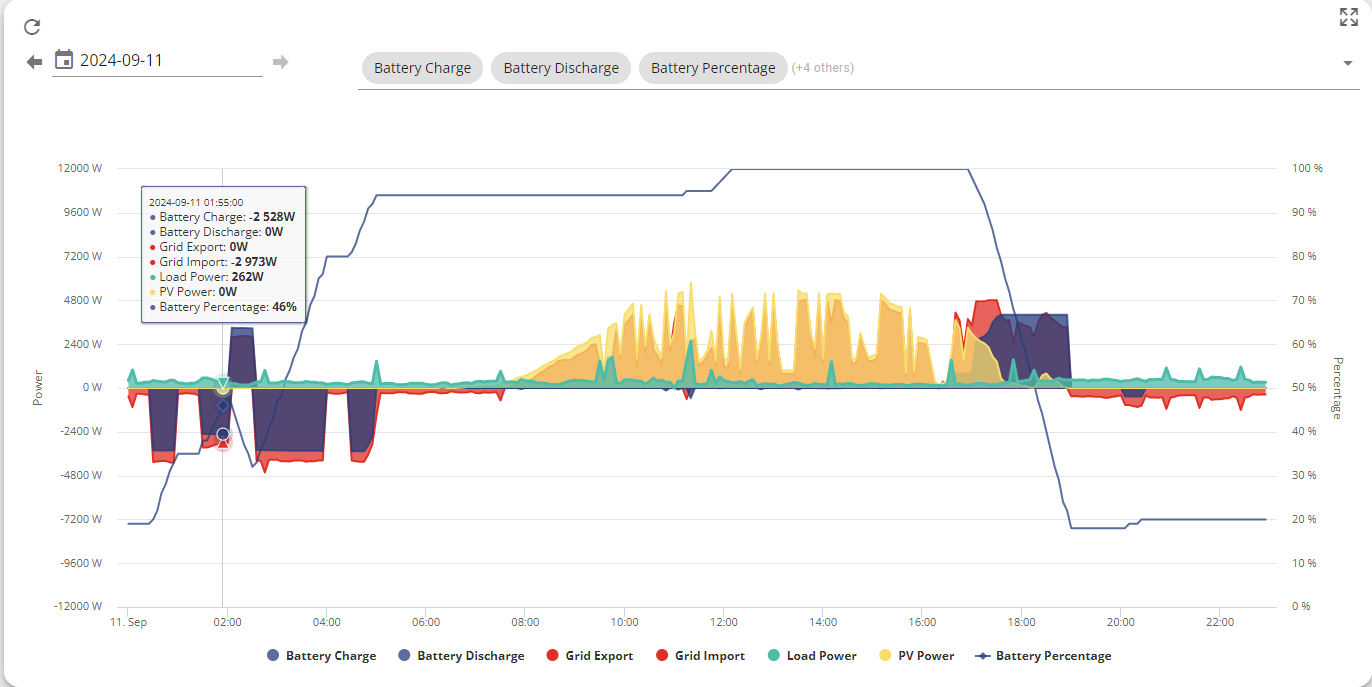
During the night, Octopus decided to begin charging my battery a few hours earlier than expected until it hit 47%, it waited an hour then it began discharging to 27% directly before charging up to 100% at the time that I would expect it to.

Why would it do this? I have only gone across to this tariff, and am worried that if this is a regular theme with random charge/discharges that it is going to wear the battery at a faster rate.

T
#2 TX200

You give control to octopus, they will do what they want in reason.

It might have been they needed the extra energy overnight during that time period so they exported a load of batteries to help the grid.

They say they usually charge batteries up when energy is cheap and discharge them when the price is high. Usually.

And is it our prices or their prices they're talking about.

At the end of the day if you want simplicity and to make some good money (if you export more than you import / generate more than 1.4x your usage) then it's a good tariff.

If not, change tariff.

I'm tempted to change to agile for the winter and go back to IOF in the spring.

Some months I've generated more than twice my usage, possibly almost three times, so it does seem to be the best option for me (no EV or heat pump here).

T
#3 TimHutchings

norse I'm afraid that using Intelligent Octopus Flux, you have signed over full control of your system to Octopus. They give a better rate than most other companies on that tariff, but will use your battery as they see fit to maximise their own profit from the grid by supplying energy when it's needed for which they get paid handsomely.
If you want control, you'll need to pick another tariff!

R
#4 Rogerbu

Don't get hung up with letting IOF control the battery. There are good returns.

I have been on IOF since March and made a net gain (Export less import) of £768 Apr through August.

I have just switched back to IOG + Fixed Export for the winter months.
For me. Being on either IOF or IOG for the whole year saves about £300 over Oct Variable + Fixed export.
Switching to IOF for the summer & IOG for the winter is worth an additional £250

R
#5 Roy124

Roger, IOG and IOF? Can you explain?

I only just learnt the difference between F and IF 🙂

T
#6 TX200

Roy124 the I is for intelligent.

The O is for octopus

Then it is F for flux - battery control

Or G for Go - car charging.

D
#7 DD

Rogerbu Switching to IOF for the summer & IOG for the winter is worth an additional £250

I'd be very interested in details... I decided to stick with IOG since I wasn't convinced IOF would use the battery quite as actively as I might choose to myself. Obviously depends on part on how much import is needed for EV.

T
#8 TX200

YouTube, Tim and Kat's Green walk. They've done a few videos on how to compare the tariffs and a Google spreadsheet you can grab a copy of.

D
#9 DD

TX200 yes, I've seen those. But those are based on assuming, eg, 60% of the generation is export is at the higher rate. I'm interested in knowing whether it actually achieved that in practise. I haven't (yet) seen a full breakdown.

W
#10 wrighar

If they need to balance their buy/sell prices they will..

don't sweat it, you get premium prices and a national grid battery in return.

#11 norse

Aren't any of you worried about potentially voiding the warranty on your batteries by putting them through over 1 discharge/recharge cycle a day with IOF?

I get it, you make 30p a day or whatever on a 5kwh battery with the 6p price difference on a kwh between peak and non peak times, but does that £100 a year justify it?

Added to that are the power losses that you have to absorb and pay for with the charge/discharges on multiple cycles. I make it about 7-8% power losses on 1 cycle - 0.35-0.4 kwh losses on a 5kwh battery, so your 30p a day for one cycle now is about 22p gain per cycle. That's if you're lucky enough to have had your battery discharged at peak hours.

I think that there needs to be a limit to one cycle that cannot be over ridden.

G
#12 geoffreycoan

Most of the benefit on IOF is on the better export rate you get compared to Flux so its a good tariff if you have high generation compared to consumption (Tim & Kat’s 1.4 rule of thumb). There is a benefit on import/export rate arbitrage but as you’ve said, its not that great.

I tried to sign up for IOF for the export benefit but after about 2 months of trying it was confirmed by Octopus that they don’t support multiple inverters on the same account.

W
#13 wrighar

Cycle counts are normally 1 a day...

I'm 142 days into having a battery,, and I'm on 146 cycles, which includes 4 or 5 calibrations in the first 2 weeks due to a battery issue.

I would have been charging and discharging once a day regardless.

#14 PianSom

norse Aren't any of you worried about potentially voiding the warranty on your batteries by putting them through over 1 discharge/recharge cycle a day with IOF?

According to https://kb.givenergy.cloud/article.php?id=135 (which may or may not reflect your actual warranty terms)

3.The Supplier guarantees that each GivEnergy Product will retain 70% of its 
useable capacity for the Warranty Period.

provided (among other things) you don't exceed the Maximum Consumption Usage, which is

Maximum Consumption Usage”
i) Unlimited cycles when used for self consumption of renewable generation or 
energy charged from the grid; or
ii) When controlled by a 3rd party or used for grid trading*, a fair use allowance of 
10MWh/1kWh stored capacity applies.

*Grid trading refers to the system being used to offer services to the grid whether or 
not for financial gain.

or as 
notified by the Supplier to the Customer from time to time

I personally would read using IOF as being "grid trading".

10MWh/1kWh of battery is a high limit. By my man-maths, one cycle per day for 12 years would be approx 4.4MWh/kWh. So you could go to something like 2.25 cycles/day.

R
#15 Roy124

norse In addition, I believe you pay 5% VAT on your import compared to your export, so importing to replace your export attracts a 5% levy. It is definitely not a zero sum game.

C
#16 CW

PianSom 10MWh/1kWh of battery is a high limit. By my man-maths, one cycle per day for 12 years would be approx 4.4MWh/kWh. So you could go to something like 2.25 cycles/day.

It took me a while to work this out, but effectively if looks like you have 1000 days of use under the guarantee. So 1000 days is around 27 years at a cycle per day

D
#17 DD

Roy124 I believe you pay 5% VAT on your import compared to your export,

Isn't the export price-matched to the vat-inclusive import price?

R
#18 Roy124

DD not sure

T
#19 TimHutchings

Roy124 yes, it's matched to include VAT. However there are still losses on the in and out of AC to the battery. On my system it's 15-20% with inverter and battery losses.

T
#20 TX200

Yeah the import price is shown including VAT, so it is definitely the same "price" for import and export.

Probably one of the few suppliers that quote rates including VAT I guess.

W
#21 wrighar

CW

I believe they count KWh in and kWh out, so a full cycle is 19kWh.

So around 5012 Full 100% cycles
Or ~ 13.75 years

R
#22 Rogerbu

DD Start by looking at Octoprice - Tariff hopping https://octopriceuk.vercel.app/tariffHopping

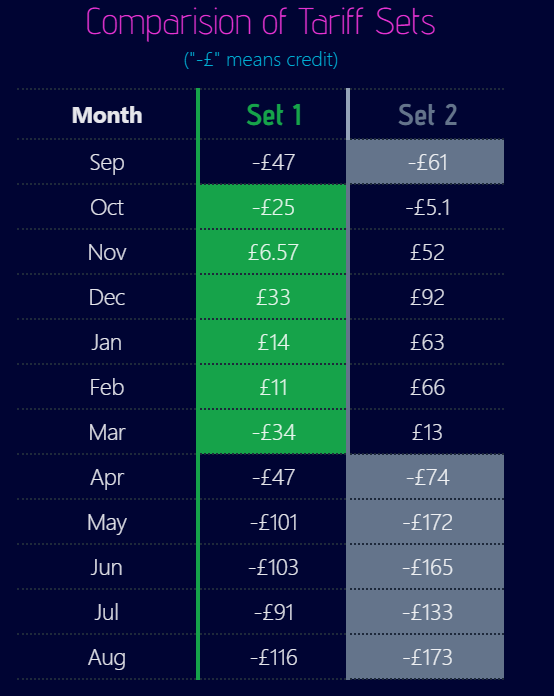
Then calculate best options. For me March to Sept import IOF - Export IOF, October to Feb Import IOG Export Fixed 15p
Export Tracker might work but too much hassle for smaller gains

Set IOG/Fixed, SET 2 IOF/IOF

R
#23 Rogerbu

TimHutchings Correct, Input and Export are the same rate including VAT, but losses must be allowed for - I assume 20%

For this reason I limited the Reserve to 50% (via App settings). Octopus normally charged to 80%, so 30% is available to export = about 6kWh.

Octopus normally set up the export to 16:000 to 20:00 but the the peak tariff is 16:00 to 19:00.
From 80% at 16:00, the 50% reserve was normally reached at about 19:00. As a result, I only exported in the peak period having imported outside of peak.

V
#24 Vestas

CW Dream on for those 27 years 😉

Our battery was installed late June 23 and is showing 8.8MWh throughput.

Note that "throughput" as defined by GE is Battery Charge Energy Total + Battery Discharge Energy Total. Both are recorded on the inverter.

We have a small PV array (3kW) and I don't run predbat. We don't have a ASHP. During winter we charge the battery at cheap times on Agile and also in summer if the rates are very low.

We very rarely export directly from the battery - only happens when there's lots of morning sun and low/negative agile rates or during saving sessions. We have exported less than 200kWh from the battery.

So to summarise, we're pretty much the "average" in terms of PV install (I think its creeping nearer to 4kW/array now due to better panels) and we use 7MWh "throughput" on the battery each year. That gives 13.5 years lifespan (in theory) for a 9.5kWh battery.

In practice I'd be very surprised if any of these low voltage batteries make it that far but from memory (we're on the 10 year warranty) you get very little in compo for the battery dropping to 70% original capacity after the first couple of years anyway. There's also the aspect that LiFePO4 cells shouldn't be operated once they drop to 70% of original capacity as they're liable to fail catastrophically (but usually safely). Most cell manufacturers (including one GE have used) have something in their datasheet saying that the user must ensure that the cells aren't used past that point.


D
#25 DD

Rogerbu It's only offering me a saving of £30, if I had switched to IOF for May and June only. (July was £1 cheaper on IOG, and August were exactly the same.)

But that presuambly has the usual problem that my actual data is biased towards my current tariff - with fixed export, I just exported all day, rather than trying to save up to export during peak rate. And of course assumes that Octopus' usage on IOF would have matched my own, which is pretty unlikely.

#26 PianSom

Vestas There's also the aspect that LiFePO4 cells shouldn't be operated once they drop to 70% of original capacity as they're liable to fail catastrophically (but usually safely).

Interesting. I wonder if that’s why GE require periodic inspections to keep their 12y warranty live for the AIO etc

V
#27 Vestas

PianSom There's a link somewhere in one of my posts to the manufacturer datasheet for some of the cells GE have used in low voltage batteries (ie not the AIO). If you look through it you'll see that they require their customer to disable operation of cells once they reach 70% of original capacity or a certain resistance. Its also (IIRC) a requirement for their customer to have a verified test method of tracking cell aging which I've seen mention of in G3 hybrid firmware.