Overheating restriction?

32 comments started 2024-09-13 last 2024-10-12
GivEnergy ProductsBattery
B
#1 Booth15859

If I nearly fully discharge my 9.5 kW battery with my 5kW inverter at the end of the day to maximise export and then fully charge the battery overnight on the cheap rates does that impact the life of the inverter/battery?
The inverter seemed to stop charging when I carry out both activities consecutively (assuming because to inverter temperature?)
Is it ok to discharge/charge at full 3.5kWh?

D
#2 DD

Booth15859 how much are you typically exporting at the end of the day? I have the same kit, but rather than filling the battery from solar during the day, then exporting it from there (which incurs round-trip losses) I just pause battery charging during the day, allowing solar to get exported directly. Then I have around 30% at the end of the day to export (which I do at reduced power).

It's probably kinder to the battery to operate at lower power, but I don't suppose you'd actually harm it. (All usage is harmful to some extent...)

B
#3 Booth15859

DD that sounds a better solution šŸ‘

G
#4 geoffreycoan

Booth15859 The kit is there to be used, you paid for it after all!

But directly exporting rather than charging the battery and then discharging to export will mean you export more as you won’t suffer the power conversion losses of AC to DC and back to AC again going in and out of the battery - some 10-20% round trip loss.

However, its also best to not leave the battery ā€˜stuck’ on a small range of charge for weeks on end, the inverter can then loose track of SoC and suddenly ā€œloseā€ a load of charge it thought it had that it really didn’t. Cycling the battery from full to empty and back again helps prolong the battery SoC tracking. But just do it periodically rather than unnecessarily doing it every day

B
#5 Booth15859

DD how do you pause battery charging? I’m struggling to see that option

V
#6 Vestas

There's not a lot of point in "saving" the battery frankly.

Two reasons really -

1) Given the way battery technology has changed in the last 10 years you have to ask yourself whether you're going to be all that bothered if your battery doesn't quite make the 10/12 year warranty. I suspect many of us will secretly be hoping for a mid-life failure in order to "upgrade" šŸ™‚

2) We're currently in a situation where electricity import rates fluctuate significantly each day which makes tariffs like Agile very attractive for recouping the capital costs of the battery. This isn't going to last - as a simple example, overnight low pricing is going to be a thing of the past once EV takeup passes a certain point. There's a lot more factors in play but none of them will be to the advantage of battery owners looking to recoup costs. Fill your boots now is my advice.

As an aside we have a small PV array (3kW) with a 9.5kWh battery. Load shifting on the battery using Agile rates actually saves/recoups more money than the PV generation. There's not much in it, maybe 55% Agile, 45% PV.

#7 PianSom

Vestas
Thanks - an exceptionally succinct, thought provoking post.

Makes me wonder again about whether to be an early adopter of V2G when it goes mainstream. I've been moving away from EV adoption, but you make me wonder if there may be a window in a year or two if EV prices (and V2G hardware) come down more and overnight import pricing is still low. Being pre-positioned for that could swing the economics significantly.

It also makes me want to think again about my medium term plan for expanding my AIO battery capacity.

J
#8 JasonF

I bought the second AIO, mostly because one AIO wasn’t enough for our air conditioning in the summer. But also because of the fill your boots mentality. Right now I can buy electricity for 7p overnight and sell it for 15p. I have tons of extra capacity in the second AIO and am basically getting free electricity now.

Getting the EV, moving to the IOG tarrif and then with the batteries has taken us from approx £5 a day electricity (including standing charge) to almost nothing.

V
#9 Vestas

PianSom Who knows really? In ten years time the driver for battery installs might be basically as UPS systems if certain areas of the grid are overloaded with EVs and grid upgrades are slow(er). Could be for brownouts due to aircon/high temps....

What is sure is that EVs and heat pumps are going to eat up a lot of that "spare" capacity on the grid in the coming years so cheap overnight/negative rates (Agile is negative tomorrow) will disappear.

D
#10 DD

Booth15859 you can't do it from the app, but in the remote-control part of the portal, there are settings for pause start and end times, and pause-type, which can be pause-charge, pause-discharge or both.
Cruder way is to reduce charging power.
Turning off eco mode also does it, but of course also turns off discharge.

C
#11 CW

Vestas 1) Given the way battery technology has changed in the last 10 years you have to ask yourself whether you're going to be all that bothered if your battery doesn't quite make the 10/12 year warranty. I suspect many of us will secretly be hoping for a mid-life failure in order to "upgrade"

Thank you for an interesting post. The portion I highlighted above is a concern for me, because I do wonder what compatability issues there might be in 10-12 years time with the (then) latest battery technology and software working with gateways/inverters etc.

#12 Windy Miller

CW I think that you would have to consider the inverter battery combination for any lifetime issues eg when the batteries give up you change the inverter too. The DC side from the solar panels will likely be the same in 10-20 years times unless the technology to convert photons to electricity changes (unlikely). Similarly the grid side is very unlikely to change from 230v AC. So if you consider the solar inverter as one piece of equipment and the battery inverter and battery combination as another they will always have to work on the premise that they connect to 230v AC. Might not be Givenergy by then but there will be some suitable equipment available. My money is on V2G becoming dominant perhaps with smaller batteries to power the house when you're using the car.
My son's Kia EV6 has a 77.4KWHr battery. He only really needs that capacity when he needs to do the 220 mile trip home every couple of months or for the occasional long work trip or holiday. Otherwise why not use it to power the house and help smooth out the peaks on the grid?

#13 Midlands_Solar

DD Interesting how do you pause the battery in this way? Is this via automation, or configuration on the inverter page?

D
#14 DD

Midlands_Solar I use an automation, but it basically chooses between one of two regimes:

  1. using the pause timer is simplest - just configure pause-type = pause-charging from 5:30am to 9pm
  2. turning off eco mode

1 is the default, since it still allows the battery to discharge to cover increase in demand. Unfortunately, if the solar exceeds 5kW (the max AC output of the inverter) solar is clipped since it's not allowed to go into the battery.

2 has the advantage that if solar exceeds 5kW, it will send the excess to the battery automatically. However, it won't discharge the battery to cover house load if solar drops.

So my automation switches over to (2) if/when the solar gets close to 5kW, and back to (1) when it drops. (The automation uses modbus for local communication, but I think you could get away with using the API since solar doesn't tend to change all that quickly.)

[A slight additional complication is that IOG might give me late car-charging slots, so the automation also has to avoid pausing the battery until that's all done.]

Another way to do it is, rather than fully pausing the battery, to limit charging power to the maximum that might be needed to avoid clipping. Eg if solar should never exceed 6kW, and your inverter can do 5kW of AC, then leaving charging power at a max of 500W all day should avoid clipping. (I see about 500W of losses when solar is 6kW.)


D
#15 DreadorUK

PianSom

Yeah I was in the boat of going out to get second AIO going all in on solar and running A2A - but V2H (I dont care so much about V2G) is making me pause.

I have two EV's on lease one ends next year other the following and Im going to hold out now and just see if its got any closer to reality or not v buying used EV's now prices have got better (or not who knows eh)

If it is then Im happy to have one AIO for when both cars are out and just get A2A then and run through car at 7p

Anyone got a Time Machine?

#16 Tenkaykev

DreadorUK
We're a no car household with an AIO. I was pondering the idea of purchasing the equivalent of an " Old Banger " EV as they become more plentiful in the market, park it on the drive and SORN it to use as a house battery. For that to happen V2G would be essential and I expect the price of used EV's to reflect that specific use case.
We're still on gas as it doesn't make economic sense to move to a heat pump at the moment. I do like the idea of A2A despite there being no subsidy.

#17 AlanWells

Booth15859
I have a similar setup with 2 x 9.5kWh batteries and a 5kW inverter. Can I ask if when you discharge you get the full 3.6kW discharge from the battery? I set it to export and it starts at 3.6kW but drops to 2kW after a few minutes then continues down to 1.5kW over the next couple of hours, so starting with 100% SOC I'm still at about 60% after a few hours of discharge.

Octopus said this;
"Yeah, that’s how the battery works to be honest. You can think of it as a mobile phone battery and it’s to protect the battery. That’s how all the batteries work. If not, the battery will charge and discharge continuously and that will affect the battery life. Hope that makes sense."

I'm not really happy with that so would love to know if it's what I should expect?

G
#18 geoffreycoan

AlanWells No that’s not correct. There is a degradation of charge and discharge rate as you get to the extremities of power, but not from 100%. I can discharge my Gen 1 hybrids at full (2.8kW) discharge rate and it only tails off in the last 5 to 10% or so.

Suggests something is wrong with the batteries, might be worth doing a recalibration on them

D
#19 DD

AlanWells Octopus said this;
"Yeah, that’s how the battery works to be honest. You can think of it as a mobile phone battery and it’s to protect the battery. That’s how all the batteries work.

Octopus is your installer ?
Not sure all batteries behave this way. Certainly wouldn't expect an EV to lose the ability to keep up on a motorway once the charge level drops to 60%.

I can't say this is behaviour I've seen, but then I tend to discharge at a lower rate anyway when forced-exporting, just to try to be a bit kinder to the battery. (But you wouldn't need to worry about that - 3.6kW is only 1.8kW from each of your two batteries.)

I probably was exporting at full power during the savings sessions, and I don't recall the power dropping off. I could go back to check if I can remember the dates.

P
#20 Pete UK

AlanWells

I’ve got this set up (assuming you have a 5kW hybrid inverter). Actually, I’ve got 2x 5.0 hybrid inverters and 4x 9.5’s (2 on each.)
I had the same problem as you on one pair just recently (and a different problem with the other pair as well), 3 months ago after two previous replacements!

I assume you’re seeing a reduced and reducing charging rate as well when charging at ā€˜full’ rate.

With two 9.5 batteries on a 5kW hybrid inverter and working normally; they will (should) discharge to house or grid at max 4.0kW and charge at between 3.3 -3.5kW, (increases as it fills up); Only reducing in output power near the very bottom or very top end of its capacity.

There is definitely a problem with one of your batteries. This is exactly the problem I had 3 months ago. (Finally got them replaced a week ago!)

You’re probably looking at a month+ or so to get replacements. Good luck with support.

#21 AlanWells

Thanks for the replies, I thought as much. Just need to get past first line of Octopus support I think and not be fobbed off.

#22 AlanWells

Pete UK Yes I do see an initial discharge export at 4kW but this only lasts a few minutes and drops to 2 initially then falls further from there.

P
#24 Pete UK

AlanWells

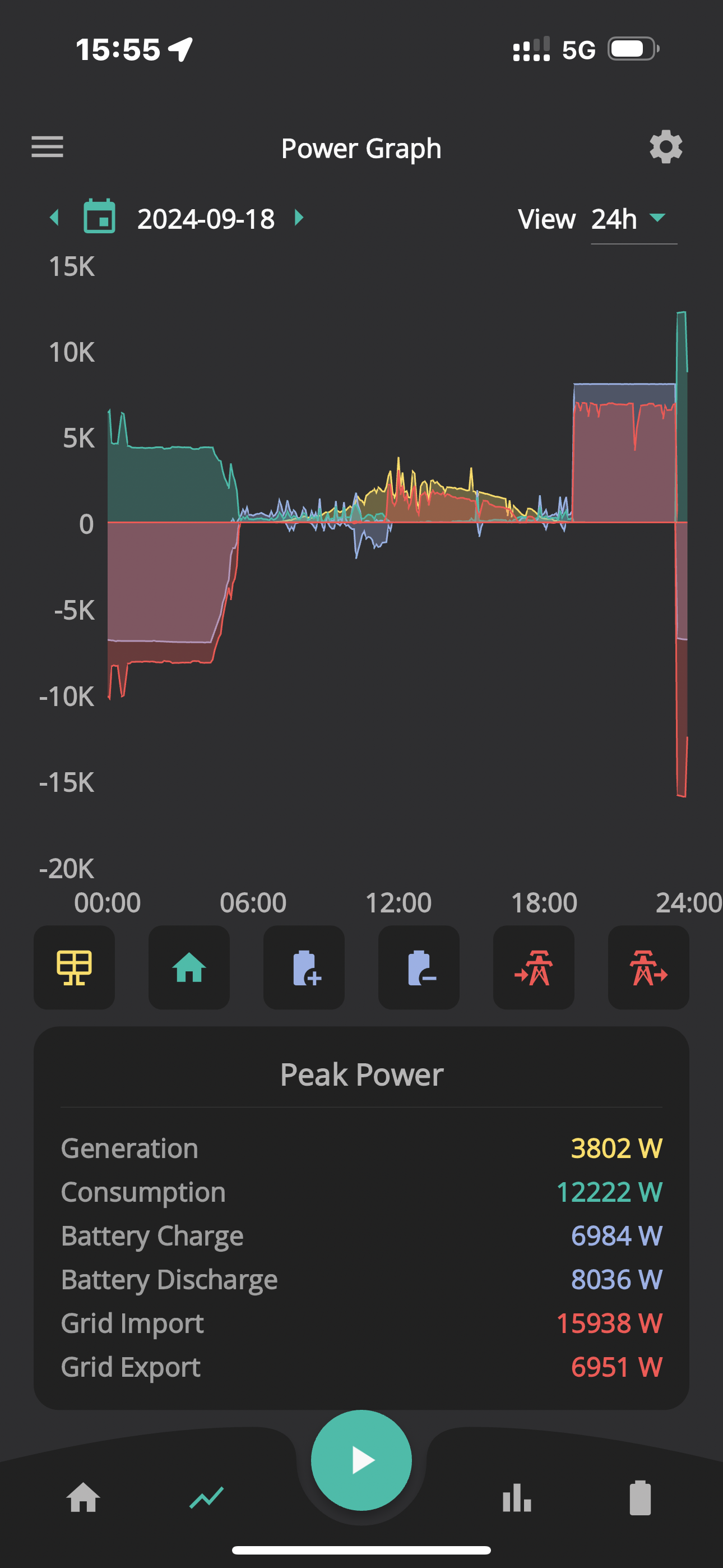
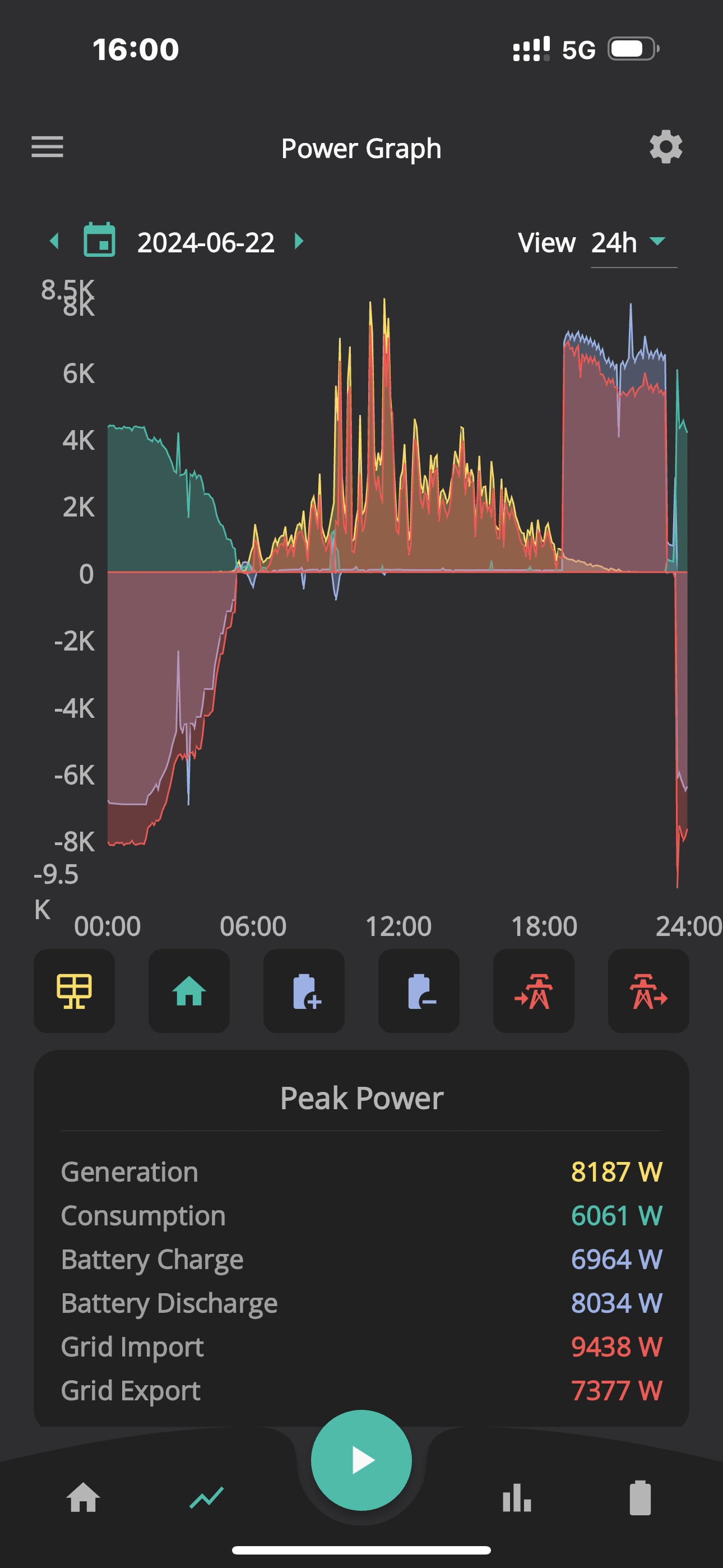
Yeah should look like this first one below and NOT like the second one below !


#25 AlanWells

Pete UK

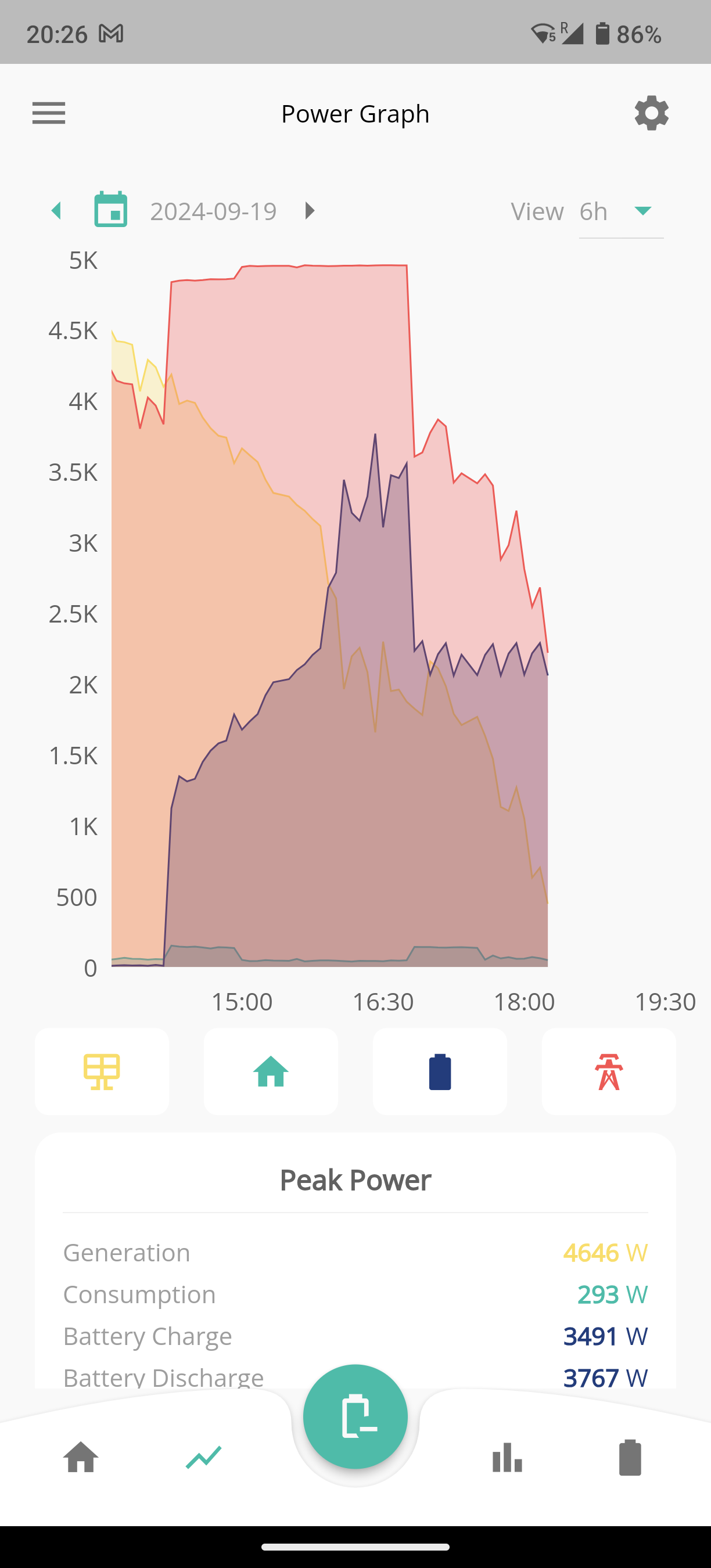
Here's mine from today, you can see the battery output creep up as the solar drops but once it hits about 3.5kW it gives up and drops to 2kW. SOC was about 75% when it dropped.

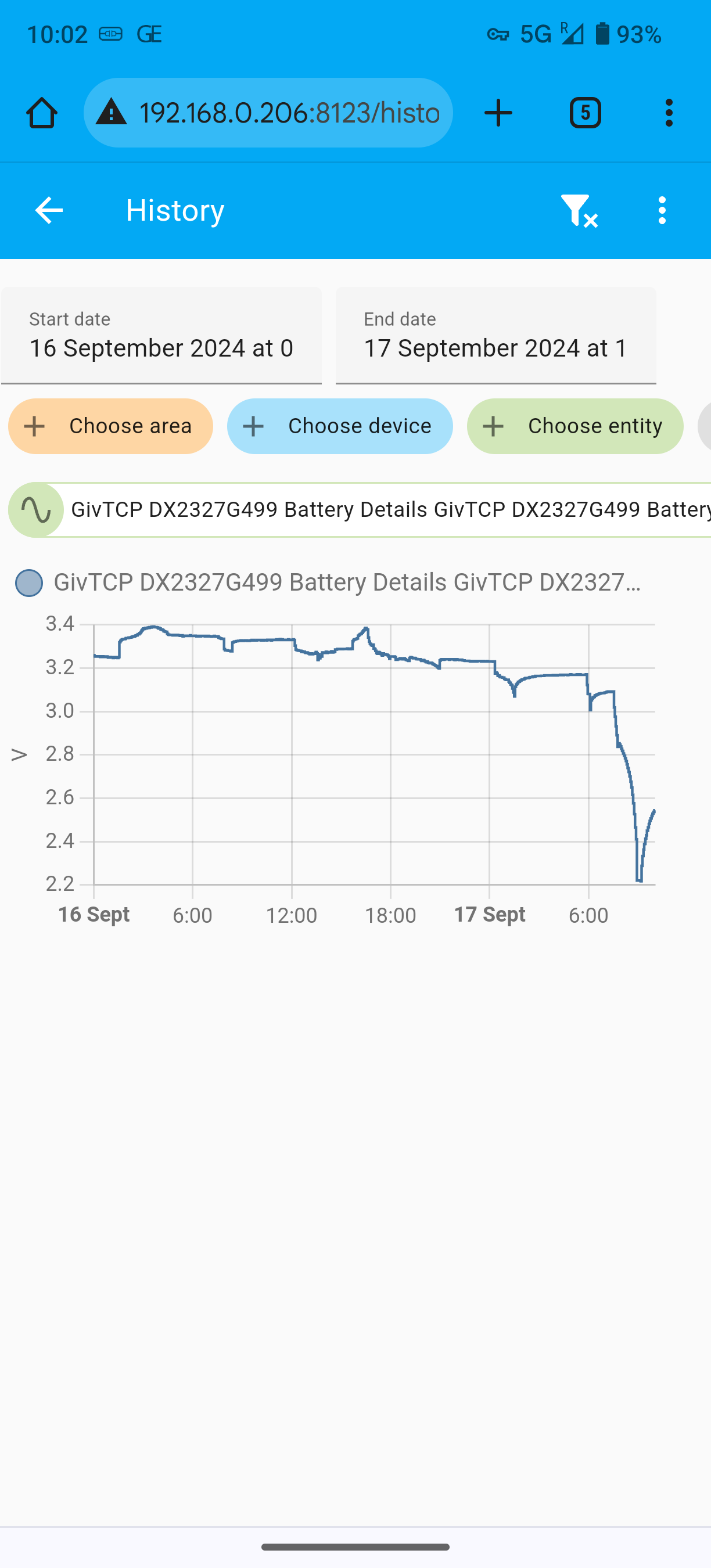
I tried a calibration to see if it would help but there wasn't any difference. I also have the below on my email to Octopus and GE as one of the cells dropped to 2.2v during calibration, that's bad as far as I understand it.

#26 Windy Miller

AlanWells Can you see the battery and inverter temperatures at the point it starts to throttle back? Might give an indication of what is wrong. (You can see the individual batteries in the Givenergy App under the battery tab if you hit "More Information"). In the graph it seems to hunt around the 2KW level by a few hundred watts not setting itself to one discharge current implying it isn't a hard limit like the export limit might be but something that is affected by the discharge level (like temperature).

Other possibility is that one of the batteries gives up so you are no longer discharging from both batteries (I had this when one got stuck at 100%). A single battery can provide 50A or roughly 2.5KW. Two batteries can each provide 50A which would be 5KW but limited to 3.6KW by your inverter. However I can see your limit is actually a bit below 2.5KW when it goes wrong so it may not be this.

#27 hoggy

AlanWells what's your cell voltages around the time your battery output drops down. The BMS will limit if one cell drifts away from the rest of the pack in either direction.

#28 AlanWells

Windy Miller

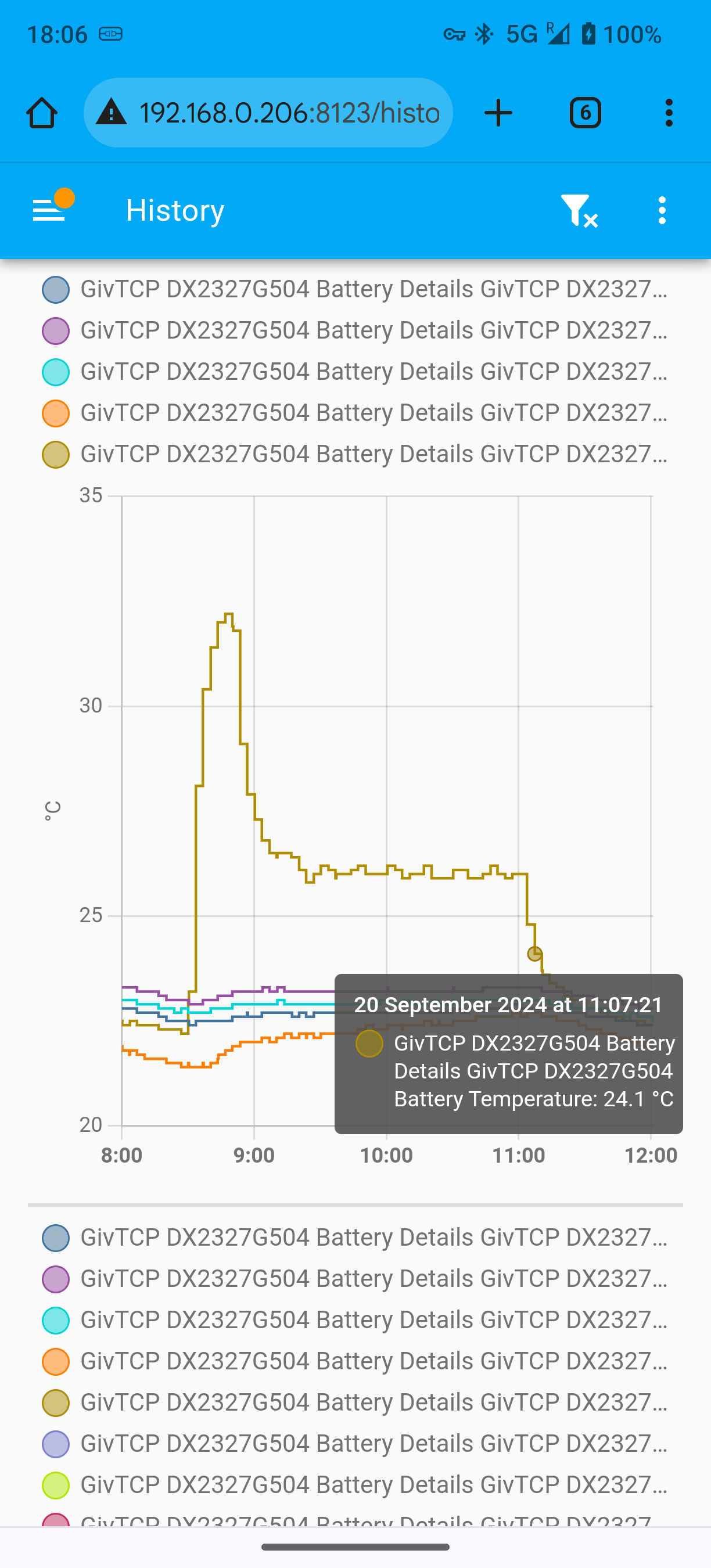
Temperatures look ok AFAIU;

This was the primary battery, in gold is the main pack temp and the others are the 4 cell level temps. The secondary battery was much the same. What's more worrying is my next reply below.

#29 AlanWells

hoggy

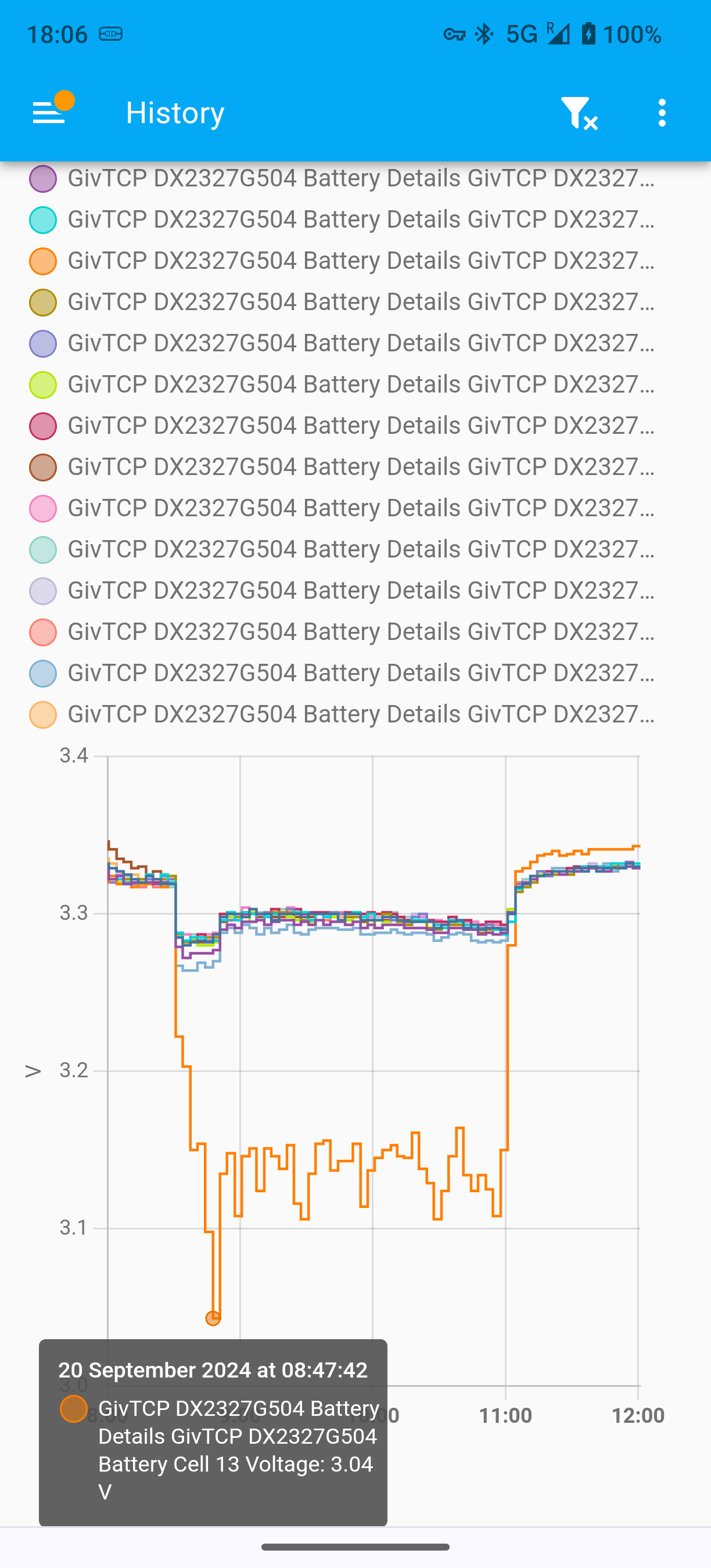
I think you're right as this shows;

Unlucky cell no. 13 seems to be way lower (0.175v) than the others and as it hits the lowest point the throttling begins.

With this and the 2.2v I had on a cell on the secondary battery I might have more than one fault/problem. Do I just bombard GE support with screenshots? Any recommendations on how to proceed with them, I had read the you need to get this sort of thing sorted within 30 days of install.

W
#30 wrighar

AlanWells

Loose bus bar between Pack 3 and pack 4 (cell 12 to 13) maybe.

#31 AlanWells

GE have responded and booked an engineer visit, although they don't have a date yet as they are busy.

#32 AlanWells

Update (also posted elsewhere as this overlaps with issues other have had):

Engineer visit this week, I think it was a loose connection in the primary battery, he hinted that this was the case when asked. The primary battery looks flawless now with all cells really close in voltage throughout most of the cycle and I can export at a constant 4kW so I feel a lot better.

Secondary still has a cell that wonders around 200mV low during discharge and was a still a whole volt lower at the bottom of the calibration he performed, I'll see what they say as he said someone would be monitoring it remotely. This one is also always at least 5% lower in SOC than the primary both before and after the engineer visit.

Also, still no response from Octopus, I had to sort this all out myself.