
Cell voltages - when to intervene?

7 comments started 2024-10-02 last 2024-10-02
GivEnergy ProductsHybridBattery
S
#1 sponev

Given the uncertain performance of 3.17 and having had a couple of failed updates before, I'm currently running 3.15 and waiting for the 3.18 or whatever comes next. However, I still see occasional high cell voltages pushing over 3.6v at which point I intervene with a manual discharge. I'm also setting max charge rate of 95% to try to.mitigate this. None of this should be necessary of course but we are where we are.

With regard to cell voltage, is 3.6v the "critical" point or should I be intervening earlier please? I don't see the over voltage notifications any more although I'm aware that GE have suppressed this. Thanks for any guidance, including whether I should just bite the bullet and do the 3.17 update. Cheers.

V
#2 Vestas

I had an automation which stopped charge when the battery hit 54.4V or any 3 cells hit 3.5V.

I found that was usually quick enough to prevent overvoltage notifications (as was).

Trying to do this via SoC simply doesn't work if the SoC is inaccurate (as it usually is), you have to use voltages.

Edit - final version of that automation was just any cell over 3.45V or battery over 55V. Hasn't triggered since the G1 inverter f/w was updated.

S
#3 sponev

Vestas Thanks, I am cross referencing cell voltages in Rubik's app. What's the upper "safe" limit I should be looking for please?

#4 Windy Miller

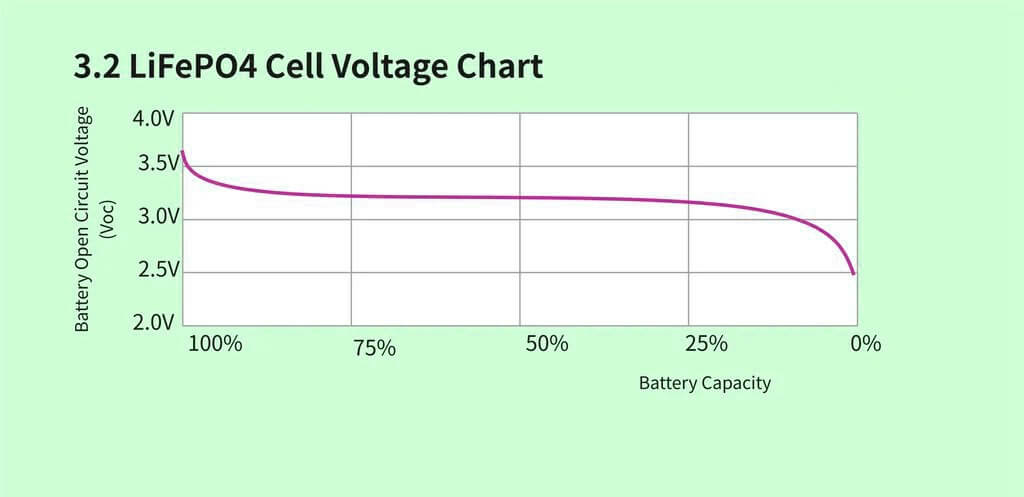
sponev Based on this curve (I can't remember where I got this) I would suggest 3.5v or even 3.45v as Vestas has implemented. You can see that the cell is pretty much at 100% at these voltages.

It is the flatness of this curve between the 10% and 90% points that makes the SOC so difficult to measure by voltage alone. It appears that GE do this by calculation of charge and discharge energy which gets increasingly wrong over time unless it gets a reset at 100% or 4% hence requiring a full to empty (or empty to full) transition every few days.

S
#5 sponev

Windy Miller thanks for this I will start to intervene when I see cell voltages approach 3.45v. A complete pain that we either have to do this manually or implement third party automations. It feels like GE will never properly get on top of this, but I live in hope. In the interim, how much damage have we done to our batteries?

#6 Windy Miller

sponev The voltages shown in Rubik's app will be affected by the charge current. The curve shows the open circuit voltage and under charge conditions you may see higher voltages. Really you need to implement a pause for a few minutes when at your limit voltage and recommence the charge if it settles below your limit voltage but if you're doing that manually that is impractical. This is why GE are reducing the charge current near to 100% to put in as much charge as possible without causing over-voltage damage. But have they got it right? Take comfort in the 10 (12) year guarantee and that several people on the forum have successfully had their batteries replaced (and some haven't).

S
#7 sponev

Windy Miller Understood. This does look increasingly painful, particularly as I'm busy at the moment and little time to implement potentially tricky 3rd party automations. Looks like I'll try 3.17 and see how it works for me. The GE roller coaster continues.