Grid not battery being used for morning kettle boiling

19 comments started 2024-10-07 last 2024-10-22
GivEnergy ProductsHybridBattery
C
#1 CazT

Hi, last week I had a new installation of Solar panels plus 9.5 KWH battery on 3017 and GIV-HY5.0 inverter.
I'm on Octopus Go due to the charger and car models. So we have been charging the battery to 35% during the overnight cheap rate (12:30 to 5:30) on the basis that we can pretty much cover daytime use with that with a small top up from solar. But at around 7am when we get up for work the inverter has sometimes taken charge from the grid not the battery when the kettle is switched on. By 7am it's a higher import tariff so not exactly desirable.

Is it because of the relatively low battery level (around 33% at 7am), a strange effect of it being dawn so there's a very low solar output, or something else?

I'm still getting my head round all of the ways to configure the inverter, but running the kettle off the grid at peak rate is annoying when it's not necessary. Any suggestions on how to prevent this issue?

Thanks
D
#2 DD

CazT Is it because of the relatively low battery level (around 33% at 7am), a strange effect of it being dawn so there's a very low solar output, or something else?

Low temperature might be a factor ? Note that while inverter is 5kW, max battery output is 3.6kW (or maybe 4kW, depending on firmware). Possibly less at lower temperature ?

Is it just the initial few seconds that are coming from the grid ? The inverter does take a short time to react to the change.

Any suggestions on how to prevent this issue?

We use a low power (travel) kettle. Slower to boil, but reduces chances of having to draw from grid (esp. when other devices are also on).

C
#3 cluelesscris

You will almost always see grid import when you switch on any high energy appliance that doesn't ramp (ease current up slowly). Kettles demand the full 3 or 4kw as soon as you switch it on. The inverter cannot respond to large changes in demand instantaneously. In your senario above I suspect that most of the kettle power was probably supplied by the inverter/battery but as dashboard graphs are only a series of point measurments you might see a grid import peak - but it's misleading.

C
#4 CazT

cluelesscris

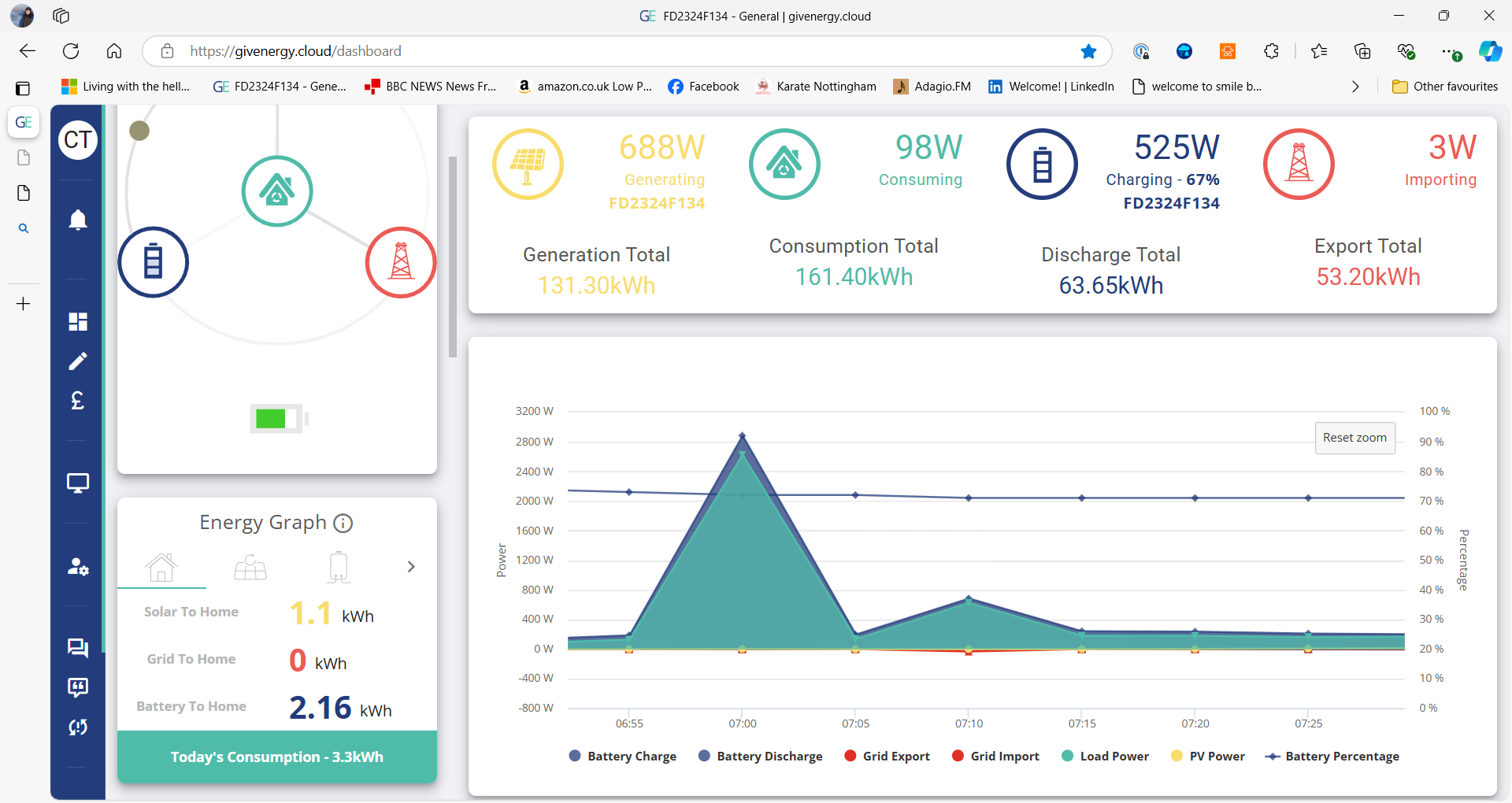
Thanks for that - this is what I saw from Friday morning when we boiled the kettle just after 6:30 am:

So it looks from this like the battery continued to maintain the tickover demand from the house, but drew on the grid for the whole demand of the kettle. But on other occasions I can see that the kettle has successfully taken from the battery only.

According to Octopus 0.23 kWh were taken from the grid so it does look like pretty much the whole kettle boil was from grid power.

I take the point about kettles demanding high power immediately, but I don't understand why sometimes the kettle is not causing a draw from the grid. could it just be that it's not an issue if there is solar power available too?

C
#5 CW

CazT but I don't understand why sometimes the kettle is not causing a draw from the grid

Remember, those time slots are 5 minutes apart so it could well be that the import spike occured just after the previous 5 minute capture and so wouldn't appear on the graph.

You could get the Inverter App by Andrew Miller which can go down to a 5 second sampling rate, or if you are on Octupus you can get their monitor which can give you live results (and show the past 30 mins of import) if you would like something more granualar the the GE output

D
#6 DD

CW Remember, those time slots are 5 minutes apart so it could well be that the import spike occured just after the previous 5 minute capture and so wouldn't appear on the graph.

I think that while the (official) app is running, the portal data may get updated every 10 seconds.

But on the portal, looking at the 'meter' data should be able to pin down energy imported over 5 minutes, which is probably precise enough. (Cumulative for the day, to 1dp)

P
#7 pwdst

I would definitely trust the supplier data over the portal here, partly because that is what you are actually being billed on, and partly because the sample rate is much higher which means it will be much more accurate for a short lived load like a kettle being boiled once.
If your smart meter is set to half hourly data then normally you can see your usage the next day in the supplier's app. Since you are with Octopus then you can ask for a free Octopus Home Mini which connects to your meter and wifi and sends near real time updates to Octopus and shows it live in the Octopus app.
The good news if you have a later Gen 1 inverter is that there is a faster response firmware in the works and as a beta tester it has taken kettle load response time from 20-30 seconds to well under ten.
I do find it odd that you are effectively seeing a four or so minutes worth of load at 3kW from the grid, it should at most be a quarter of that. Are you also making toast or using the microwave to make porridge or something? Not only can you rapidly exceed the battery's capacity to respond if you do run multiple loads at the same time, you will also have the "ramp up" delay each time you start a new significant load as the batteries will have idled again when the previous load stopped. So kettle, a round of toast and some porridge in the microwave could explain the amount taken from the grid if you aren't on the fast response firmware. There are also electric showers and/or heaters to consider in an Autumn morning routine. Not easy with half hourly usage to be super specific on what the actual cause was.

D
#8 DD

pwdst The good news if you have a later Gen 1 inverter is that there is a faster response firmware in the works

It's a newly installed system, so I'd hope it's not gen-1...

Not easy with half hourly usage to be super specific on what the actual cause was.

That was why I was suggesting looking at the meter data - while not as accurate as the smartmeter data, it should narrow usage down to 5-minute intervals.

Or of course the smartmeter IHD would confirm import, if OP still has it. But I'm not sure the question is whether, but why. There are at least 4 samples on the graph showing grid import, so it doesn't seem like a transitory thing.

P
#9 pwdst

DD Our inverter and batteries were only installed last year and are Gen 1, in part because everyone and their dog wanted solar during the worst of the energy crisis, and in part because I think some batteries and inverters do not have Gen 3 counterparts. If it's Gen 1 then it will likely have a WiFi dongle, I believe that the later models have it built in.
I don't think there is much Gen 1 stock left out there now though, Midsummer Wholesale are largely just listing Gen 3 for inverters with the exception of AC coupled.

C
#10 CazT

pwdst Thanks - no toast or microwave at the same time. I make the tea while hubby is in the shower which is supplied by a hot water tank so no electric shower either.

How can I tell what Gen my inverter is?

D
#11 DD

CazT one way is the firmware version, which is shown on the inverter page. Either post it here and someone will translate, or look in the knowledge base release notes to see which generations use which numbers.
I'm sure there are better ways, but this seems fairly reliable.

D
#12 DD

CazT But at around 7am when we get up for work the inverter has sometimes taken charge from the grid not the battery when the kettle is switched on.

Is it only in the morning when you see this misbehaviour? Does it behave as you expect in the evening, after the sun has gone down? Or on a dull day when solar does not always meet consumption.

C
#13 CazT

The inverter firmware is D0.309-A0.309 and the accompanying datasheet says Gen 3.
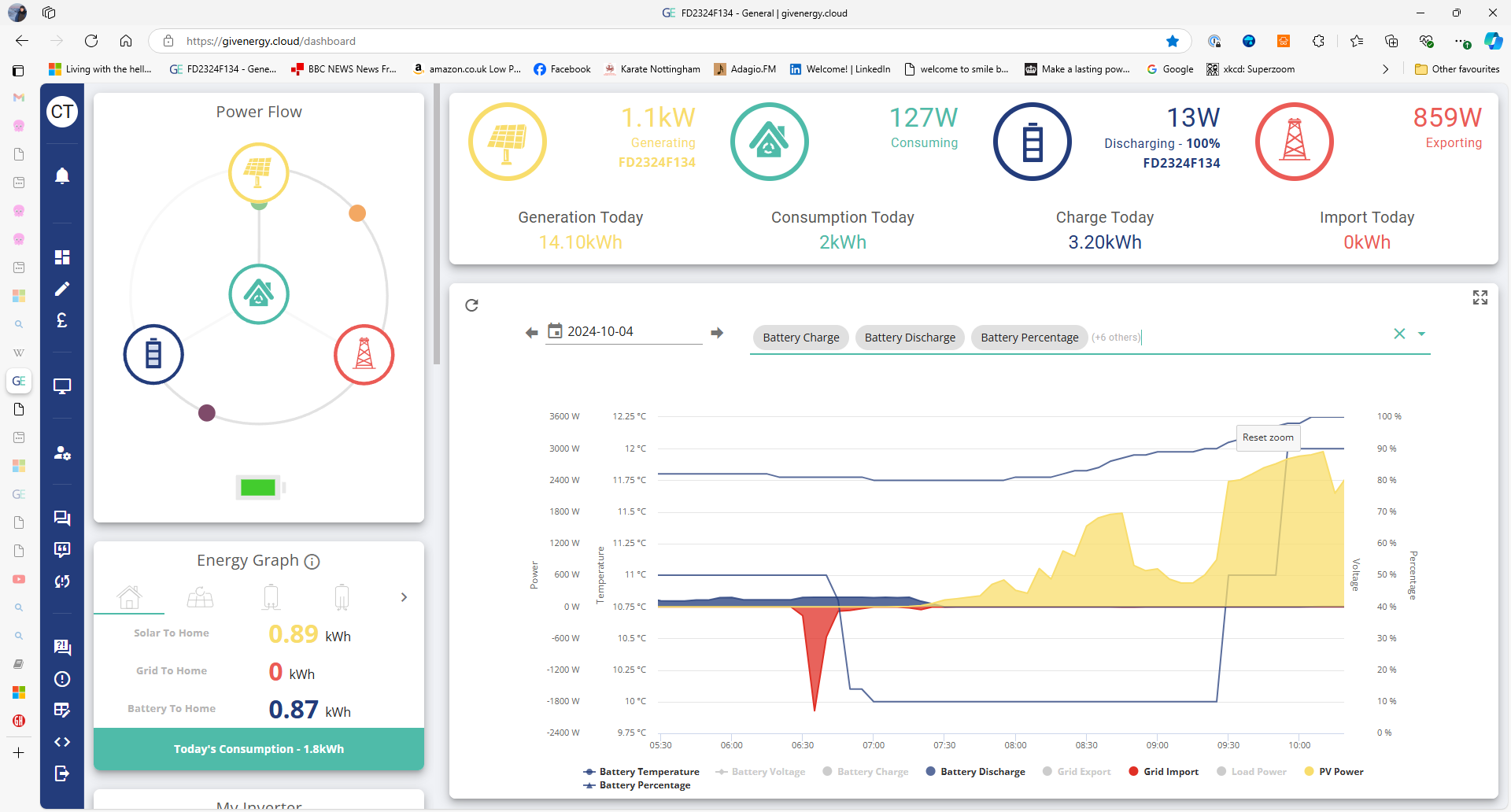
It's early days - we've not boiled the kettle after dark in the evening yet. And it's not every morning that we see the issue. For example yesterday you can clearly see that the battery fed the kettle, and on this occasion the subsequent toaster use without any grid import.

G
#14 geoffreycoan

CazT To me it sounds like you’re seeing the normal inverter lag that you get when switching on an appliance, that the portal only shows snapshots every 5 minutes and interpolates the data in between, and that when your battery temperature is low (as it was in the early graph), the battery charge/discharge capacity is reduced so it probably can’t supply the full house load.

A kettle typically draws 3kW, your inverter is max 3.6kW so take off background house and it doesn’t take much for you to be above the inverter limit.

The fact you are not seeing a consistent pattern of import suggests that your system is all setup and working fine. You will always get a small amount of import with the batteries due to ramp up time and at this time of year, temperature

C
#15 CazT

geoffreycoan Thank you - you've all been very helpful. There's a lot to learn!

D
#16 DD

geoffreycoan To me it sounds like you’re seeing the normal inverter lag that you get when switching on an appliance, that the portal only shows snapshots every 5 minutes and interpolates the data in between

It does sound like it. Except that there seems to be 3 samples shown on the graph, which suggests either the kettle was very slow to heat, or perhaps the app was running so that samples were more frequent ?

Also

According to Octopus 0.23 kWh were taken from the grid

which, by my calculation, is about what you need to raise 2l of water from 10 degrees to 100 degrees. And at 2kW that would take about 6 minutes ? (Do kettles usually take that long? Seems rather slow ?)

We've just boiled the kettle, and Octopus Mini confirms pretty much zero import. (2Wh in the last 30 minutes.) We have the same model of inverter running on the same firmware, BTW.

One observation - the first graph was from 6:30am whereas the second was at 7am. You haven't configured anything to limit discharge before 7am or anything like that? Or could inverter be set to the wrong time so that it still thinks its in the cheap period at 6:30 ?

C
#17 CazT

DD I didn't set any tariff in the settings until Monday this week. We're on Octopus Go. Would that have made a difference on the decisions made by the inverter? It's set now so the inverter knows when our cheap rate is?
Yes, I have been looking at the app during a kettle boil so that would indeed explain the extra samples.

D
#18 DD

CazT any more observations on this? Have you enough instances to look for patterns?

C
#19 CazT

DD yes, definitely seeing far less grid use during the morning kettle boil, so the inverter is behaving differently now the tariff has been inputted.