Inverter firmware update caused battery depletion

32 comments started 2024-12-31 last 2025-01-10
GivEnergy ProductsBattery
P
#1 Purk

Hi folks, I’m still fairly green so excuse the ignorance…
Octopus tech support advised I update inverter firmware (from 3009 to latest, 3017) as I couldn’t add my battery to their ‘devices’ tab in the octopus app, kept failing (octopus 404 page) after, successfully, authorizing GivEnergy api (have migrated to sso).

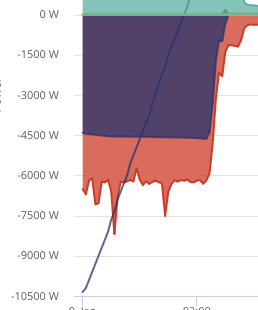
Anyway, my question is after updating the firmware my battery went from 80% (pre update) to 1% (post) and is now charging from the grid despite having timed charge set during octopus off peak period, which is not right now.

Anyone had this issue? Is it just user error? I think doing this on NYE was a mistake 😳
D
#2 DreadorUK

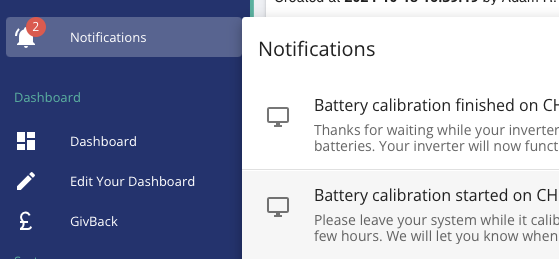
If you look at your notifications you should hopefully see the that upgrade triggered a battery calibration.

So it dumps all the battery power and charges up as part of this process.

I tend to only do upgrades around 11pm so the charge time coincides with cheap electric.

P
#3 Purk

DreadorUK
Doing it during the off peak would have been smart, thank you. Next time I will.
Incidentally, I did check notifications and nothing since the ‘firmware update starting’ and ‘firmware update complete’ notifications.
Worryingly, my total export for today shows close to zero despite emptying the battery????
Do you think I should do a calibration now? Will that empty it again?
Thank you again for sharing your insights. It’s much appreciated.

D
#4 DreadorUK

Odd that it's not showing in notifications that it’s doing a recalibration, but no, I wouldn't schedule another; just leave it to recharge back up and carry on as normal.

One cautionary note on doing it late in the future is that you won’t have any support to call on till the next morning, but I find it amounts to money-wise as a loss for me as the same thing so matters not and is less likely.

G
#5 geoffreycoan

Purk Under normal operation you should never really need to do a calibration. By normal operation this means reasonably regularly emptying and filling the battery totally. If the battery doesn’t get used much and stays in the fairly full or fairly empty range then it can lose track of what the battery % level is and a calibration can help fix that.

Since you have just done a calibration after your firmware upgrade, it’s not necessary to do another one.

And to add to your woes of doing a calibration in the peak period, the advice from Octopus of doing a calibration probably wasn’t necessary. The batteries get added via the inverter so just upgrading the battery firmware I don’t think is going to make much difference.
Having said that, being on the latest firmware does mean the latest bug fixes and improvements to the battery management.

Can I ask, what was your intent of adding the battery to the Octopus devices tab, was it to go onto Octopus Intelligent Flux? The general advice is that whilst OIF is a good tariff for summer because of the better export rates, in winter where you generate little solar it not really the best tariff to be on. Ordinary Flux, Economy 7 or one of the EV tariffs is better if you want cheap overnight charging of your battery.

D
#6 DD

DreadorUK One cautionary note on doing it late in the future is that you won’t have any support to call on till the next morning,

One trick is to reduce discharge power during the calibration so that the discharge phase lasts until the start of cheap rate.

P
#7 Purk

DreadorUK
Noted. Thank you. It’s the first update I’ve done and hope not to need another for a while.

P
#8 Purk

geoffreycoan
Hi Geoffrey, thanks for your input. Your advice on when to calibrate actually helps given we rarely discharge beyond 60% (unless I charge my car, which I only do during off peak) but we do fill up to 100% every night.
I will do some more reading, here, about calibration before I decide to or not.
To answer your question about why I did any of this…
I was hoping it would be a moron-friendly way of better managing our solar/battery setup. That is to say, perhaps export excess during peak time then refill during off peak.
Wait! Before you start typing….. I’ve looked into predbat and realized halfway down the GitHub page that it’s too advanced for me (as yet) and I’d more likely cause a negative outcome.
I know I could just schedule an export in the cloud portal but it felt like there’d be no significant gain without intelligent timings etc.
The Octopus flux tariff seems like a lot of work especially as I feel I have “just enough understanding to be dangerous”.
I currently have the go tariff, they booted me off the intelligent ev tariff as my wife and I both have teslas and they no longer support more than one vehicle. Frankly the octopus charge scheduling was awful anyway.
Gratitude for reading that whole shpeel if you got this far.
Input always genuinely appreciated.

C
#9 CW

DD I tend to empty the battery daily so have less need for a re-cal, but I did wonder how you would go about setting the start time of the recal. From your note does the system discharge at your set discharge rate, or does it just use the max available, and then same question re the charge cycle

C
#10 CW

Purk Wait! Before you start typing….. I’ve looked into predbat and realized halfway down the GitHub page that it’s too advanced for me (as yet) and I’d more likely cause a negative outcome.

There are other control options. There are free controllers such as Octopus labs(?) or I use Inverter Monitor by @Rubikcube . If you have a spare tablet available (Andriod or IOS) then you can use this to control discharge dependant on SOC (there is a one-off fee to access these features but that is it and the software runs locally so you are not dependant on the cloud). I use this to always empty the battery just before the cheap over-night rate and then run a GE standard charge cycle.
This also has the benefit of reducing the need for a recalibration.
So I have my GE AIO set to charge daily between midnight and 7 AM (and I adjust the charge rate so that the battery is charging over the whole time in order to keep the batteries a little warmer). I use the Inverter Monitor to discharge the battery by calculating SOC by various times and dumping back to the grid if I can so it is just about empty by midnight.
On my current tariff, I export at 16.5p/kWh and import at 6.7p/kWh so it ticks a lot of boxes.

G
#11 geoffreycoan

Purk Predbat isn’t for everyone, it is quite “rich” and takes a bit of getting used to….

If you can periodically empty your battery from 60%, say once a week, then you shouldn’t need to do a recalibration regularly. I haven’t done one since about February when I had a new battery fitted, but I can see signs on the battery cell voltages that a recalibration would be worthwhile and mine stops discharging at 5 or 6% now not 4%, so again its worth doing it. Just waiting for some cheap agile rates - tonight would be ideal really with all the wind.

If you’re using 40% a day then maybe just not charge the battery one night a week? You could do an export of excess power but you’d need to make sure you start the export at the right time so it doesn’t run out whilst you are still in day rates.

Another option is to use the Android app from @Rubikcube , the pro version £10 one off fee, will enable you to schedule charging and discharging better than you can in the givenergy app.

Flux is a bit of a faff with 3 different tariff rates.

If I were you I would stick to Go (or move to Eon Drive which offers better export rate and a longer cheap rate period) and use the Rubikcube app to do a forced export every few days.

P
#12 Purk

CW
Inverter Monitor seems like decent value.
I might play with the scheduled export settings and empty the battery just before my timed recharge.
If that doesn’t pan out then @Rubikcube can expect my tenner promptly.
Many thanks

P
#13 Purk

geoffreycoan
Ahhh. Ok so look out for discharge stopping before the 4% default as a sign calibration might be required. Noted.
Sticking with go for sure. At least until I get over the hump of this learning curve and find the bravery for agile or the likes.
Will do further investigation on inverter monitor as I have an old iPad floating around.
Cheers for the insights.

D
#14 DD

CW does the system discharge at your set discharge rate, or does it just use the max available, and then same question re the charge cycle

it's been a while since I've done a calibration, but last time, yes, it honoured the max discharge and charge rates, rather than using the max.

D
#15 DD

Purk our advice on when to calibrate actually helps given we rarely discharge beyond 60% (unless I charge my car, which I only do during off peak) but we do fill up to 100% every night.
I will do some more reading, here, about calibration before I decide to or not.

I think calibration discharges beyond the normal reserve, and then charges beyond the normal max - it's trying to find the true range of the battery. I have no idea if this is harmful, but it's probably better to limit the number of actual calibrations and just discharge to the min (4%) and charge to 100% from time to time. Perhaps slowly rather than at full power, and perhaps allow it to idle at low charge to allow cell rebalancing. (In the summer, I'd been discharging then sitting idle for an hour before recharging, since 6 hours off-peak is more than I need to fully recharge at a gentle rate. In winter, battery doesn't last all day, so it's idle by the end of the day anyway.)

I currently have the go tariff, they booted me off the intelligent ev tariff as my wife and I both have teslas and they no longer support more than one vehicle. Frankly the octopus charge scheduling was awful anyway.

Just FYI you can get better-than-IOG rates without extra hoops from EON. Possibly also new company Tomato Energy, though they don't currently do export. Though I'm sticking with IOG, for now, at least.

I don't use predbat, but fairly simple python scripts using the API to control summer export in a reasonably managed way (just enough discharge power to empty the battery by 23:30.)

P
#16 Purk

DD
Thanks for that. I’m gonna stick with octopus as (despite the customer support lady currently helping clearly knowing less than nothing about my in app issue) their support has been great. I’ve had a poor experience with eon years ago.
Helpfully, I think I’ve learnt today, that it’s wise to fully charge and fully deplete my battery periodically. I’m gonna experiment with charging more slowly during off peak and perhaps discharging to the grid (fairly slowly) an hour or three just before the off peak period.
Thanks to all for the guidance.

B
#17 bRhFDKtjRMK9

Purk I currently have the go tariff, they booted me off the intelligent ev tariff as my wife and I both have teslas and they no longer support more than one vehicle.

May I ask, how did they found out about two vehicles in your household?

D
#18 DreadorUK

bRhFDKtjRMK9 Yeah seems odd I was running two cars with one on OI API for well over a year (and main car wasn't the one on API)

If it was a slip up in email or chat Id just tell them second was sold and back to just the one 😉

Not sure why Octopus keep with a system with so many hoops and controls especially with GO being so uncompetitive if you dont want to do any jumping, I moved off last month but understand for many the export keeps you locked in for now.

C
#19 CW

DreadorUK the export keeps you locked in for now.

You should check out EON Next Drive - 7 hours of overnight cheap power and a healthy export rate. The only thing I can see (moved over just over a month ago) is that you currently have to manually provide export readings to them via email (a photo of the meter with the export figure and meter serial showing)

G
#20 geoffreycoan

DreadorUK Not sure why Octopus keep with a system with so many hoops and controls especially with GO being so uncompetitive if you dont want to do any jumping, I moved off last month but understand for many the export keeps you locked in for now.

Number of people are moving to Eon Drive, better export rate (16.5p) and none of the IOG hoops at all.

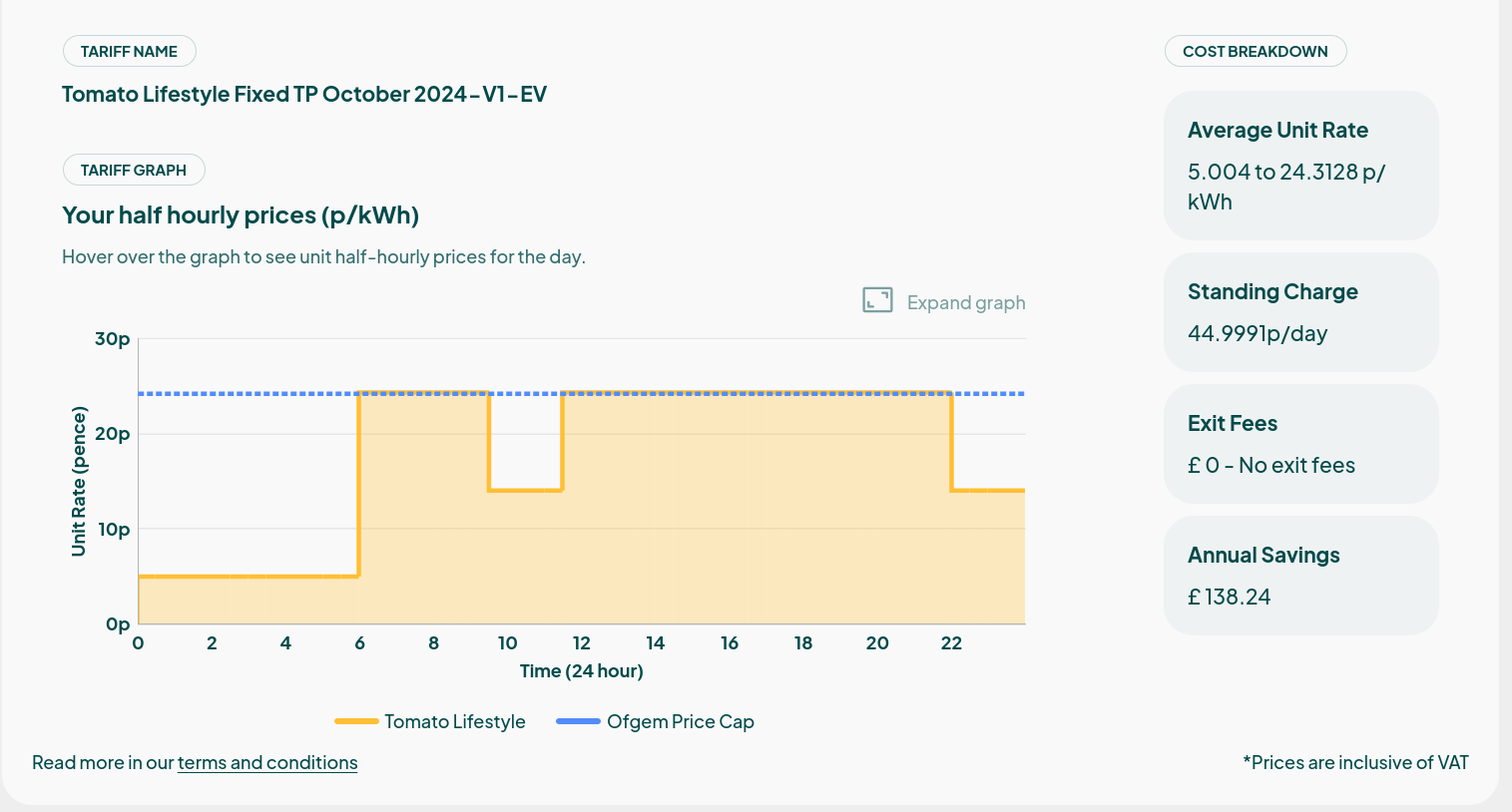
Or Tomato who are 4.5p? overnight EV charge rate but no export tariff at present

C
#21 CW

geoffreycoan better export rate (16.5p)

And if you have your solar/battery installed by them, this goes to 21p (for 2 years!!)

D
#22 DreadorUK

geoffreycoan

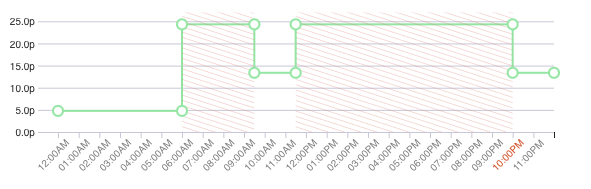
Yeah I went Tomato its 12-6am 5p and a few periods at 14p standing charge 45p

14p rate has helped me out when battery depletes early doors.

No Solar so export not a issue for me.

G
#23 geoffreycoan

DreadorUK I do export a lot to Tomato not right for me at the moment (and about 10-15% of my import is on the Octopus Powerup events so loosing this would be another issue for me).

I looked at their website when posting the above, put my postcode in and said I had an EV but couldn’t find what appeared to be the EV tariff.

They have an Agile-like tariff which had interested me before but no details of what say today’s rates are and how they vary over time to compare to Octopus Agile.

B
#24 bRhFDKtjRMK9

geoffreycoan I looked at their website when posting the above, put my postcode in and said I had an EV but couldn’t find what appeared to be the EV tariff.

You should see this one among other things:

Click that you have battery storage to get this hourly configuration. Also check if website recognized that you have smart meter.

I signed up to this tariff (with slightly better rates, for a year) couple of months ago, my nightly import is below 5p, excellent. Just like @DreadorUK, I don't export, so it's suitable for me.
Tomato Energy don't care if I have EV or not, they just give this rate. PHEV is on Zappi charger, Zappi scheduled only to charge during night tariff. No need for any Octopus API or approvals, rate is less than 5p for all night use, no brainer for me.

P
#26 Purk

bRhFDKtjRMK9

Sorry for delayed response.
Apparently the way Tesla does their 3rd party integration stuff (api sharing with octopus) changed recently so now octopus knows how many vehicles are connected to my Tesla app.
The response from octopus was vague and confusing but essentially they suggested it wasn’t that they didn’t want me charging two vehicles it was that their system couldn’t currently do it.
Prior to the Tesla security change I charged both vehicles without issue but the octopus app only scheduled my wife’s charge and I let the Tesla app schedule mine.
To be blunt, the octopus app only made things worse (less reliable) I’m happier now to just let our cars schedule themselves to charge during the off peak period.

B
#27 bRhFDKtjRMK9

Purk Thanks for your reply, that explains it. It seems they just want to save money and not give you a lot of preferential cheap kWhs, by artificially limiting use to one car per household?? Illogical.
That being said, I prefer "dumb smart" tariff, where I connect what I want without them knowing.

P
#28 Purk

DreadorUK

Thanks for the heads up about tomato energy. I have signed up!! I should have asked if anyone wanted to share a referral code (like octopus does) but I did it at midnight during a hissy fit. Octopus kicked me off their go tariff, still unclear why.

I have kept my export and gas with them.

One last, related, question for anyone who could point me towards clues… since doing my firmware update my battery seems to be emptying quicker than usual.
I typically ended the day with 40-60% battery remaining. Since the new firmware I’m lucky to end the day with 4-15% left.
Anyone else experienced this?

G
#29 geoffreycoan

Purk I have kept my export and gas with them.

Be aware that Octopus will move you onto their SEG export tariff at 4.1p as you’re not taking import electricity from them https://octopus.energy/smart/smart-export-guarantee/

Of course they probably won’t realise for months and then backdate the change

One last, related, question for anyone who could point me towards clues… since doing my firmware update my battery seems to be emptying quicker than usual.
I typically ended the day with 40-60% battery remaining. Since the new firmware I’m lucky to end the day with 4-15% left.

Have a look in the givenergy portal at what your daily house load was before and after the upgrade. Has it changed significantly that accounts for the difference?

Other answer could be that the battery was recalibrated as part of the firmware upgrade and its now more accurately tracking SoC than it was. You might not have had 40-60% SoC but the battery thought it was. Its now been recalibrated and giving correct SoC values for the battery voltage

D
#30 DreadorUK

Purk Depends what you updated

https://community.givenergy.cloud/d/5378-aio-d0613-a0613-inverter-firmware-wobble

I have had data differences since my inverter upgrade with figures looking lower but actual charge and HA reporting same levels - and I like you saw some odd low figures over a few days but it did settle.

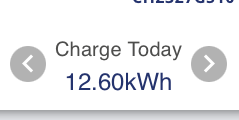
For instance today I was told Id only charged 12.6

Yet my charge starter at 12 and finished 3:15 @4.55 kWh which is more 14.7 kWh

Prior to the update it would match near enough.

Yesterday I did a total shut down and recalibration no difference.

P
#32 Purk

DreadorUK I have had data differences since my inverter upgrade with figures looking lower but actual charge and HA reporting same levels - and I like you saw some odd low figures over a few days but it did settle.

I see. I’ll give it a few more days to settle and look at the charts to see if like geoffreycoan suggests, it might just be more accurate now 🙁

D
#33 DreadorUK

Purk I guess this time of year its not going to matter that much so better now than mid summer 🙂