Adding Batteries to Hybrid Gen 3

18 comments started 2025-01-02 last 2025-01-03
GivEnergy ProductsHybrid
J
#1 JamieA

Hi all,
I've had my system for about 4 months now, details below:
GE Gen3 Hybrid Inverter
21 x 435w JA Solar Panels (9.135Kw)
2 Strings - 15 & 6 (adding more soon)
AIO & GW

I'm looking to add more battery but only have space for 1 more All In One. Been looking at the FogStar rack mount ones too. Research says they work with the Gen3 Hybris Inverter, Currently my Hybrid is configured as a string inverter in another account then another account for the GW & AIO. I want ideally to add 30kwh of Fogstar at £6k which is alot cheaper than an AIO onto the Hybrid and manage them separately. I appreciate this would turn my system to an unsupported configuration and I'll have to manage them separately or via HAOS. I wanted to see if there is anyone else out there with a similar setup to discuss with.

R
#2 Robgy

JamieA the fogstar batteries do appear to be very competitive (cheap)
The 15.5 kWh fogstar at £2,499 looks like it would sit nicely with my 9.5 Givenergy

R
#3 Rubikcube

Current wholesale price of LFP cells is around $59/kWh. This is less than £50/kWh. Paying £6k for a box containing £1,500 of batteries might not be a good investment.

Of course wholesale and retail are not the same. Predicting the future is never certain, but suppose you can buy 30kWh of storage in Jan 2025 for £6k, and in Jan 2026 you will be able to buy the same for £3k. Can you save £3k on your energy bill in the next year?

#4 Hook

JamieA That's interesting that they work with giv inverters.

Do you have a link?

J
#6 JamieA

Hook Can't find the link but it's on their website.

J
#7 JamieA

Rubikcube Yes but.... paying £6k for 30kwh vs £6k for 13.5kwh when you want to add more battery anyway makes sense.
Whist I do love a tinker, buying VS building I tend to go down the buy now as not got the time to tinker.

#9 hoggy

All warranty aside, being someone who has actually connected a genuine Pylontech pack up to one of these inverters (albeit Gen 1) and it not liking nor talking to it even after forcing its hand at register level into modes not normally part of commissioning, I'd maybe enquire for some imagery / proof that it does actually work and isn't just being run blind / voltage only - which I have a feeling is perhaps what they've actually experienced.
There's that many inverter Gens, Inverter Firmwares, 3 BMS generations and near dozen BMS firmwares to attempt to unravel support for.

You'd also have to get your installer to recomission it with this non GE pack attached, for which I really don't know if there is any risk to their accreditation if they get caught doing something like that - it may well prove easier to ditch the GE Hybrid and fit a known one that plays nicer with 3rd party batteries.

G
#10 geoffreycoan

Good advice from @hoggy I too would be asking to see proof that this configuration will work and reassurance that it can be supported. You need someone to turn to if the inverter doesn’t talk to the batteries.

Regardless of whether you get this configuration to work or put in a different inverter, be aware that you are highly likely (I think its a racing cert) that you will experience cross charging between the AIO and the inverter+Fogstar batteries as they both seek to minimise grid import.

Have a look at the speak to the geek video where he setup his AIO and AC3+8.2 battery, it needed balancing software running in HA to stop the cross charging. Then a month or so ago his more recent video on highlighting that the cross charging balancing software was writing thousands of inverter commands, risking killing the inverter.

#11 hoggy

I have just asked them, still not entirely sure they are actually talking to the inverter directly but this was the response:

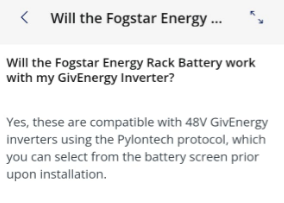
We have a number of customers who use Givenergy inverters with no problems, so I assume it works with no problems.

G
#12 geoffreycoan

hoggy Doesn’t sound like they know, and if there is any issues their answer will be 🤷‍♂️

#13 hoggy

geoffreycoan they may well be installed behind (parallel) with an official pack. The inverter would be none the wiser, and the fogstar would just follow the Giv pack up and down between 15% and 95% - only thing that would look weird (but not really matter) is that the Giv pack would just last longer than expected.

G
#14 geoffreycoan

hoggy I assume there is intelligence in the control signal cables from the inverter to the battery BMS, telling it when to charge and discharge?

If you just connected battery packs up to the GivEnergy battery out +/-, without the control signals, would it work, or would you need to open up the Giv battery pack and wire the extra battery cells in parallel so the Giv BMS controls them as one bigger battery pack.
This is interesting speculation and going well beyond “our batteries are compatible with givenergy inverters”. Don’t think the warranty would survive any of these scenarios …

J
#15 JamieA

The more i read then the more i'm pushed to switch out the inverter for a Sunsynk ECCO or a Growatt. Even adding a full GiveEnergy 20.4 stack would suffice but the GE system seems not tied together to prevent cross charging. Thought there was a BMS on the horizon too.

J
#16 JamieA

geoffreycoan Think the batteries have a CAN Bus to send signals to and from the inverter.

G
#17 geoffreycoan

JamieA geoffreycoan Think the batteries have a CAN Bus to send signals to and from the inverter.

Exactly. So mixing and matching GivEnergy inverter with a 3rd party Fogstar battery doesn’t sound good. If the inverter/battery worked to a defined protocol standard and each party certified their compliance and ongoing support to that standard, then maybe, but it seems like a high risk to me.

JamieA The more i read then the more i'm pushed to switch out the inverter for a Sunsynk ECCO or a Growatt. Even adding a full GiveEnergy 20.4 stack would suffice but the GE system seems not tied together to prevent cross charging.

An inverter certified connection to the battery would reduce the potential failure points but you are still going to get cross charging issues between the AIO and any other inverter/battery system because they will both try to minimise grid import and export.

Thought there was a BMS on the horizon too.

It’s the EMS you’re probably thinking of, and it is supposedly nearly ready but the first product is for multiple AC coupled plant systems. Where multi-hybrid inverter setups and AIO/non-AIO setups and whether AIO/3rd party product are on the roadmap, sorry IDK

AIO looks to be more strategic to GivEnergy than the older hybrid and AC-coupled systems, so (cost aside), expanding to multiple AIO’s would be the way to go. You mentioned at the beginning you only have room for one more AIO, but could you mount additional outside or a distance away from the gateway (there is a cable length limit)?

The other question is, what do you need more battery storage for? Of course it’s good to be self sufficient and run off cheap rate electricity but the payback on extra battery storage is awful (easily 10-20 years depending on the assumptions you make). You’d get a better payback (or more for your money) by adding more solar panels, an additional inverter if necessary and exporting as much as you can in the summer, build up a big electricity credit and use that for the winter.
That’s basically what I do. I have 14.4kW of panels and 13.4kWh of batteries which is nowhere near enough to run the house and ASHP in the winter. I exported over £1100 this summer and then use that credit in the winter.

#18 hoggy

geoffreycoan when I hooked the Pylontech up it did charge and discharge fine with no comms between the two but had to be forced to lead acid mode to get an SOC reading, which was wildly inaccurate due to the fact it wasn’t a lead acid battery.

If you chained one of the fogstars on to a real one it should probably still work - the BMS sits further back than the battery parallel terminals anyway, so what it’s doing would be of no consequence to be fair.