Been wanting this for l-o-n-g time. I have off-peak energy overnight and usually try to squeeze charging of my EV, heating the hot water tank with the immersion, and the charging of my two 9.5 batteries. First problem is that the battery gets drained by the other devices when it's supposed to be charging. I usually fix this by firstly staggering the various charging times if possible and secondly by raising the battery reserve level to that of the intended charge, to prevent the batteries being depleted. The second problem is when the off-peak ends the house is unable to use the battery power because of the raised battery minimum, requiring me to quickly change it, whatever I'm doing. The better solution would be to expand the battery reserve function into two settings, one for the discharging period as currently done and a new one in the "Timed Charge" function just for the charging period. I would have thought this was relatively easy, so question is, "Could it happen please?"
Idea for extra feature in app
You could just turn off eco for the duration of your cheap rate period. This has the same effect as raising the battery reserve.
I use the scheduler in my app to turn off eco at the start of the cheap rate period and back on at the end.
https://play.google.com/store/apps/details?id=uk.rubikcube.invertermonitor
The scheduler can also adjust the reserve if you prefer that method.
JeffBelringer What inverter do you have, in remote control settings on the portal website you can set a scheduled time to pause discharging like you can charging on some of the inverters.
Saying that if you set a charge time period for your cheap rate even if it fills it shouldn't deplete anything til the charge period is over.
Jellybaby What inverter do you have ...
The OP has been waiting a "l-o-n-g" time, and joined the forum in 2022, so I guess it's a gen1. The pause setting isn't available on gen1 systems.
Rubikcube The pause setting isn't available on gen1 systems.
it is but you need the updated firmware that is still not on general release
geoffreycoan... and never will be.
JeffBelringer are you saying that even within the timed interval when the batteries are charging, they discharge to cover other load? That's not how my system behaves.
Yes, if charge EV (at 7kw) while charging batteries (@ 3kw) the EV sucks the batteries dry, or until they reach the reserve. And if the EV charge was a big one it may take most of the off-peak time to do, leaving no cheap rate power for the house batteries.
I suggest searching on here as many people have had the EV emptying the battery problem and there are various solutions. Personally my EV charger has nothing to do with the house battery or system as the ct clamp is placed so the Givenergy system doesn’t know it exists which has suited me fine. Battery charges to 100% every night, various appliances run on the IOG cheap juice, and the car charges just fine.
JeffBelringer Is yours the GE chargepoint ? I guess that could do stupid things if it's integrated.
SimonClarke That sounds like a good idea - is there info, preferably images or drawings, that show how to do that? It might not be the whole answer for me, but it might solve the biggest problem.
DD No, a charger by a company called Simpson & Partners. Does an OK job, apart from stealing battery power!
JeffBelringer the inverter shouldn't be able distinguish a third-party EV charger from any other load - does the battery discharge during the charging period to cover other consumption, or does it somehow treat EV differently?
DD I guess it just sees it as a load. If I do a 7kw car charge then it draws about 3kw from house batteries and the rest from grid.
JeffBelringer Yes, but my question was more about other loads - the inference is that there's nothing special about the EV, so any load in the house would prevent the battery from charging. Which would in turn mean that charging from grid wouldn't work at all.
JeffBelringer you want something like this:
grid meter ——-EV charger——-GivEnergy CT Clamp———House fusebox, solar panels, inverter connection, etc
The EV charger is connected before the GivEnergy CT clamp that measures grid import/export so the EV charger can draw from the grid without the inverter seeing it as house load.
Gets a bit more complex with solar diverters and if your EV charger has the ability to trickle feed from solar, but the above is my understanding of how to stop the car charging draining your batteries
Your installer should be able to make these changes
DD I see your point, but the batteries do successfully charge most nights, provided I keep the big discharge loads away from them. Having said that, every night the immersion heater also operates for a period during the battery charge, and it too depletes them, so i have learned to do that in the middle of the charging period with time to recharge afterwards and before the end of the off-peak.

Something very wrong because when the battery is charging from the grid the rest of the house load should be from the grid as well, even when the battery gets to 100%. That is what my system does. I charge for 3 hours and it usually gets to 100% about half way through. There is no discharge from the battery for three full three hours. The house load is provided by the grid all of that time.
I can't see why a big load would discharge the battery when it is supposed to be charging. Seems like a fault in the invertor.
Surely if the batteries are charging they are not discharging? I run all sorts of stuff while the battery charges between 2330 and 0530 on IOG. As soon as I get to 0530 the battery stops charging and takes over the house load and the car is unaffected.
geoffreycoan Thanks, that's really useful. The charger was installed a while ago and is fed by a way in the distribution board, which explains why it's treated like any other load. If it were to be connected before the dis board presumably it would require its own switch/fuse box? How is it connected in to the cabling between grid and dis board? - some sort of high amperage junction box?
JeffBelringer If it were to be connected before the dis board presumably it would require its own switch/fuse box? How is it connected in to the cabling between grid and dis board? - some sort of high amperage junction box?
I think it's quite common for chargepoints to have their own mini-CU : I've assumed that the installer doesn't really want to touch the main CU since they then have to take responsibility for it. (I guess it depends on whether your installer is a fully trained electrician, or just a chargepoint fitter.)
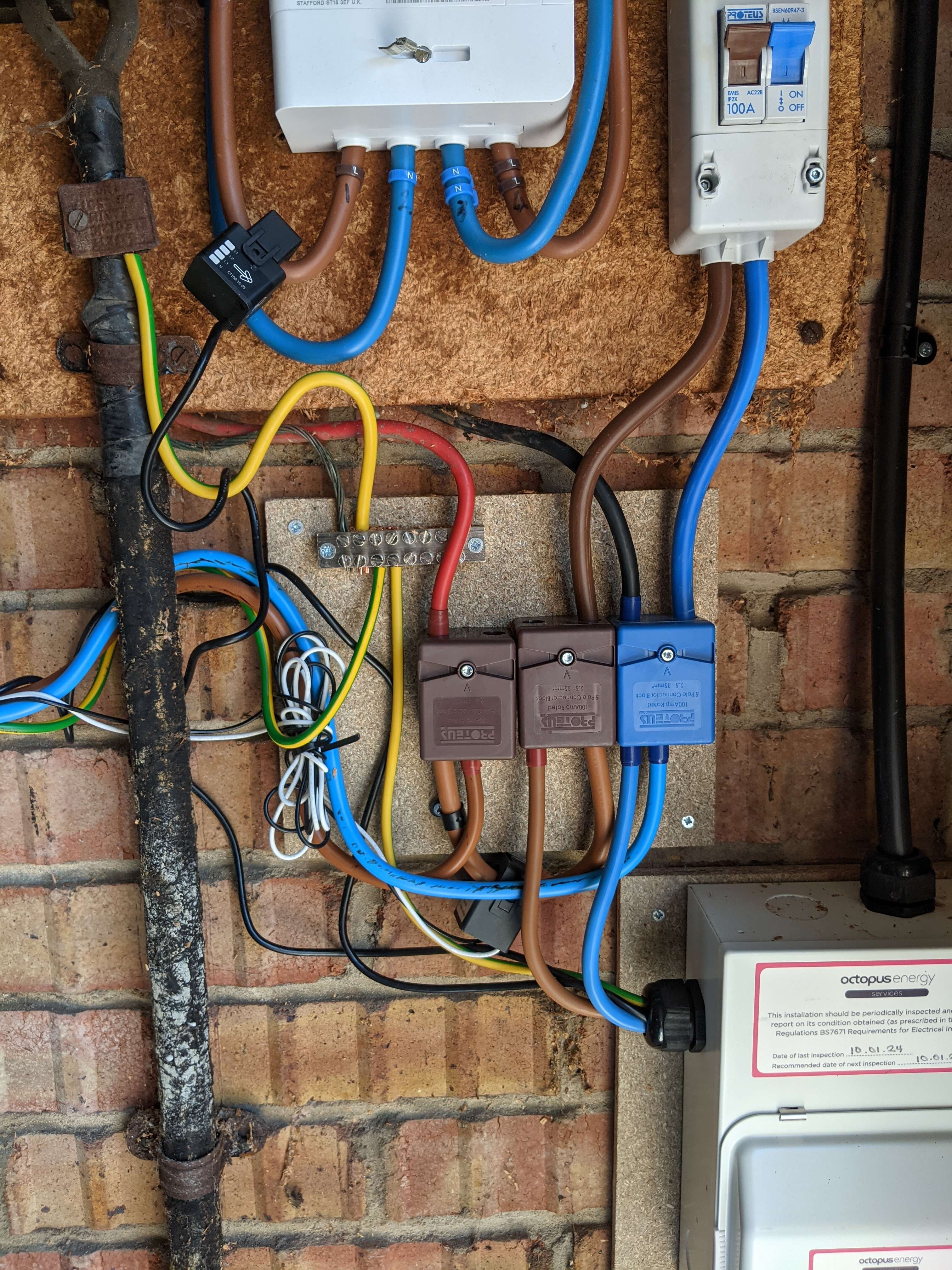
My system:

where the second brown "Henley block" was added to make the chargepoint (lower-right) invisible to the GE (off to the left). The Zappi's CT clamp is up at the top; the GE CT clamp is at the bottom, between the two blocks.
JeffBelringer The only story I can invent for all this is that the GE thinks there's some sort of import limit, and when it sees the high consumption, believes it has to step in to reduce import.
If you were to reduce the max battery discharge limit, does it honour it in these circumstances ?
DD yes, there is a grid limit and one of the recent firmware updates can cause it to become corrupted.
Giv can reset that, although I guess you have to go via your installer now.

TX200 A grid limit in the inverter, why would that be? I can take as much load as I want from the grid while the battery is charging. When there is free electricity I take as much as I can and charge the battery.

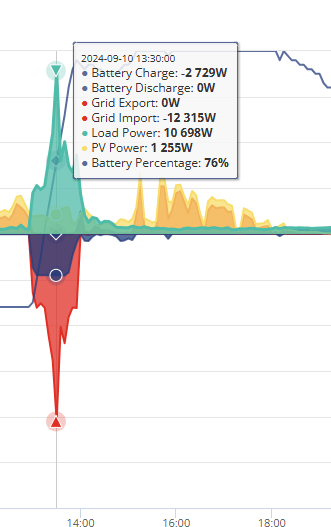
Here the house load was 10.6kW and the battery was still charging at its maximum rate. The house load is directly connected to the grid, it doesn't pass through the invertor, it can only contribute to it. In this case it was adding 1.255kW of solar to reduce the grid import.
nophead A grid limit in the inverter, why would that be?
It would seem very logical to me to have the capability in the inverter to limit the maximum grid draw IF that was required by the local regulations or electrical supplier.
In the UK, its quite possible for your cabling to be less than the standard electrical regulations for modern houses, if you are in a rural area there could be an overhead line feeding half a dozen houses and thus there will be some form of shared grid draw limit across those properties.
You can also get situations where a property has been split in two (houses split into flats for example), a single supply into the building and then split out to the sub-properties, and you can get daisy-chain situations where house A receives the electricity and house B is connected to A. A and B both have meters but house A’s consumption has to be measured as A-B.
And I know for a fact that in France you buy a specific max kW grid draw and the standing charge relates to that limit. e.g. a 9kW max draw.
So maybe @JeffBelringer ’s inverter has been misconfigured with a grid import limit or the register in the inverter has got corrupted as TX200 suggested
This could all be complete rubbish conjecture, but the stuff about the craziness of UK grid connections is true.
Same applies to Water supplies. Probably Gas but I’m not so familiar with those arrangements.

There is (in some new firmwares) an import limit (see here) primarily used to help keep those with Gateways below the 85A max limit they have (the gateway trips out if you try and pull anymore through it despite the fact you may have a 100A supply)
It is in essence the opposite of an export limit - the inverter will back off its charge rate to keep under this limit. It can't however have any impact on any other device.
I don't think this is what is happening in this case - the inverter should ignore demand when charging so something weird is going on (either the system is in some obscure state it shouldn't normally be in or there's some odd placement of CTs causing it to think back to front I've never seen before)
I had the problem after a firmware upgrade.
The register may have been previously used for something else and therefore contained an unexpected value.
My system would therefore not charge from the grid. It thought it wasnt allowed to.
I could see the charge following the solar generation, so charging ramped up when sunny and stopped when the sun went in.

TX200 yes, this I think is the first case of a register re-use we've seen. So this causes a fork in the road for local control - as you can no longer assume that the register lists are guaranteed. (On other FW this is along the lines of "GRID_R_VOLTAGE_ADJUST" - I assume this value is 0 - which sounds like very much something you don't want to be writing the wrong value to)

geoffreycoan But my house is wired directly to the meter tails so I can take as much power as I want up to the 100A fuse limit. The inverter could try to mitigate it but it is only 5kW and my battery can only deliver 2.6kW, so good luck with that.
nophead ut my house is wired directly to the meter tails so I can take as much power as I want up to the 100A fuse limit.
Arguably you could go beyond that - 100A fuse will tolerate quite a lot more for several hours.
OTOH, I believe that just because you have a 100A fuse doesn't mean you're actually entitled to draw 100A - its job is to protect the cables, not define your allowance. I think I heard somewhere that the DFS obligation is typically something around 16kW (64A), though obviously because they have to be notifed about high-draw equipment you install, I guess that's tacit permission to go beyond that ?
DD and I have heard that the DNOs are replacing 100A fuses with 80A if they come round

DNO has never been here. They were notified when we got solar. I wasn't aware they had to informed about high loads though. Our supply seems to be low impedance because nothing we do affects the voltage much. The voltage does fluctuate sharply in the mornings so somebody or some company on the same substation must have very high loads. When it is free we put on a 2kW fan heater, a 20 kW shower, 800W dehumidifier, the washing machine, dishwasher that can take 2.4kW, the air fryer and the microwave and then charge the battery.
nophead Installer usually takes care of notifying.
https://www.gov.uk/government/publications/register-energy-devices-in-homes-or-small-businesses-guidance-for-device-owners-and-installation-contractors/register-energy-devices-in-homes-or-small-businesses-guidance-for-device-owners-and-installation-contractors
DD The main difference between your installation and mine is space. The lunatic who built our house decided in his wisdom to put all the electrics on a wall behind a base unit in the corner of the kitchen so there's absolutely no space to put another CU box, not even a connection box. So I'm stuck with what there is.
nophead The cutout/service head (ie the fuse carrier) may well have 100A stamped on it, but that's the rating of the service head itself, and does not necessarily mean you have a 100A fuse inside, unless you know for certain otherwise. Most likely a 60A or 80A. If you are lucky enough to have a 100A fuse, keep schtum about it as DNOs are now standardising on 80A so if they ever visit you may well get downgraded to 80A.

I don't have enough high power devices to take more than 80A anyway. I had always assumed every house had a 100A fuse. In Spain it is different. The amount you pay is determined by your main breaker. We only get 25A in out apartment in Tenerife but that is enough because we don't have any form of room heating or cooling. We could reduce it and pay less standing charge or increase it and pay more but then I think they need to inspect the wiring.
nophead When I had my smart meters installed, I made a point of noting the fuse value at the time was 60A, and the meter installer actually made a point of saying "You may want to ask the DNO to get that uprated to 80A mate!". I promptly forgot all about it until about a week before I was due to have my 6kW AIO installed, which, with a 10.8kW electric shower meant I would be pulling about 74A plus at full stretch! Thankfully, National Grid was able to uprate it to 80A the day before my AIO install.

Our house was built in 1990. When did they start using smaller fuses?
nophead somebody found the DNO news article on another thread, I think the change to 80A as standard instead of 100A is fairly new, last couple of years
nophead My Wimpey built 3 Bed Semi was built in 1971 and I moved in in 1987. Quite a few rooms had only a single unswitched 13A socket in them, so a 60A cutout fuse probably seemed OK at the time. Uprating them to double switched 13A sockets and adding extra ones was one of the first things I did (no Part P in those days).
geoffreycoan Here is one such article