Is it expected that the inverter "plateau's"

6 comments started 2022-06-10 last 2022-06-11
GivEnergy ProductsHybrid
G
#1 garycatt

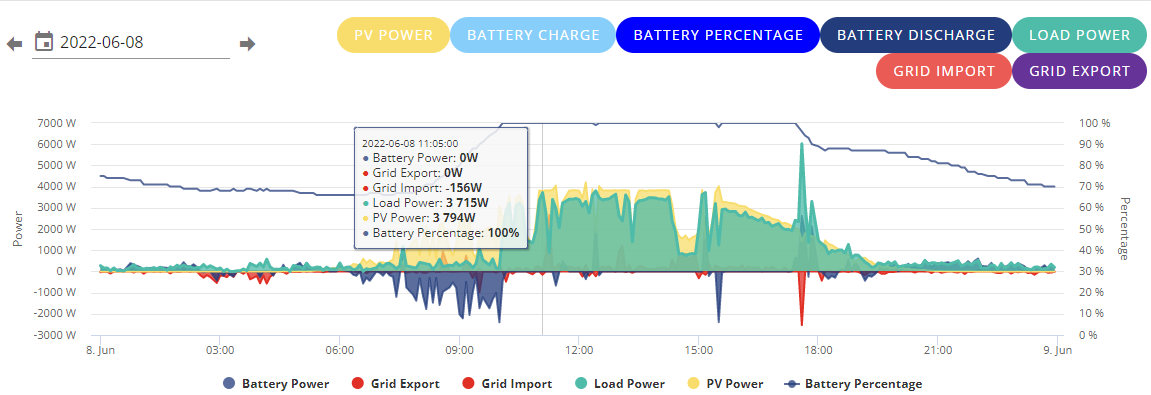
I notice that my generation reaches about 3.8kW but then shows a plateau until later in the day. The attached image shows a steady 3.8kW from 11am to 4pm (when not shaded by cloud) charging my EV but I have 4.3kW of panels and occasionally see peaks over 4kW.

A
#2 anglefire

Basically the inverter is hitting max capacity and is clipping. In theory you have "lost" some production - Not sure if you have an AC or Hybrid inverter - but if its hybrid it and a 3.6kW one, it will push upto 2.6kW into the battery (DC) and 3.6kW in to the house (AC) - but it looks like your battery was full so, it can only do the 3.6kW AC so will be clipped.
Only solution is more batteries or a solar diverter - The diverter will only work until the hot water is already hot! Or an EV of course.

G
#3 garycatt

Hybrid inverter. I have an EV, and it was plugged in and charging, hence the large green area from 11am to about 6pm. It is connected via a Zappi so should be able to demand up to 7kW.

A
#4 anglefire

garycatt Yeah but if the inverter can only pull 3.6kW off the panels that is all it can do whatever the capacity of the panels is and the battery is full. If the battery isn't full then you will get upto 2.6kW into the battery - but that isn't available to the Zappi

T
#5 Tim

garycatt I think the only thing you could do is limit the charge rate for the Givenergy battery, which means that there would be excess sooner for your EV. Of course that would only work on days when there was plenty of solar.

#6 Simon_C

Assuming your EV was plugged in earlier in the morning (with capacity to take charge), your GE inverter could have been set to discharge the GE battery at full rate for say 1 to 1.5 hours. The Zappi would automatically transfer what would otherwise be grid export in to the car for that period.
Your GE battery would then be discharged to more like 25-30%, rather than the 70% starting point seen at 07:00, leaving more headroom for PV charging of the GE battery during the day at higher than the 3.6 kW limit of the inverter a/c/ output.
It does involve micro-management of the inverter on a predicted high solar PV day, so would not be fully automatic.