Long story short........ And I should say that Support are investigating and there is a dialogue with them. But I wanted to tap in to the wider knowledge of other users here.
After over two years of problem free with a Gen 1 8.2 kWh battery and 2.6kWh inverter the system was discharging to a reported 26% SOC and then importing from the grid. When support first became involved they suggested a recalibration as I had expected. Following this the battery would charge to 100% and discharge to 4% but it still didn't seem right. I didn't have full figures but based on the Energy Graph it looked like 100% was somewhere between 6kWh and 7kWh. The firmware was down graded to 3015 from 3017 incase my Gen 1 setup something!
Still the battery wasn't getting to the desirable 8.2. A battery swap was arranged and the replacement battery was calibrated, though I later learned that that had actually failed - although the notifications showed a start and a completion. So a calibration was done again. But I still don't think that it is right based on my basic maths and what is being reported in the Energy Graph. My example for yesterday by 22:00 the SOC was at 9% so in round figures and based on a 8.2kWh battery that would be 0.75kWh. After 22:00 there was only the overnight load so pretty low. According to the Energy Graph from 23:30 to 00:00 1KwH was added and then 00:00 to 01:30 a further 4.9kWh was added, nothing further was added even though the Timed Charge is set from :23:30 to 05:30. The charge reported therefore is 5.9kWh added to the minimal amount from yesterday so I think that is in the region of 6kWh.
As the battery has been swapped I wonder what the Inverter is doing. I am not really educated on this system or electrics more widely but I assume that it is the inverter that has the control of this process?
Like I said I have an open ticket with support and I have sent an update message to my contact there, but anyone here had something similar or could give some educated theory?
Thanks
S
#2SimonClarke
Somebody intelligent will be along soon but I don’t think the 8.2 has 8.2 of useable juice unlike a 9.5 that has 9.5 useable.
T
#3TX200
The gen 1 8.2 is advertised as 100% depth of discharge, on multiple supplier websites. So unless the marketing materials were wrong ...
It does sound like either a firmware bug (there certainly were some in beta that had issues, but not sure if 3017 was one of them). 3015 was fine for me in terms of SoC tracking.
Plus calibration after a software change is probably a good idea if it didn't happen automatically.
Not sure what else to say, unless it's another dodgy battery.
R
#4Rbor
GrahamShaul I have had two 8.2 kWh batteries for 2+ years. They both have 100% DOD so you should be able to get 8.2 kWh into each.
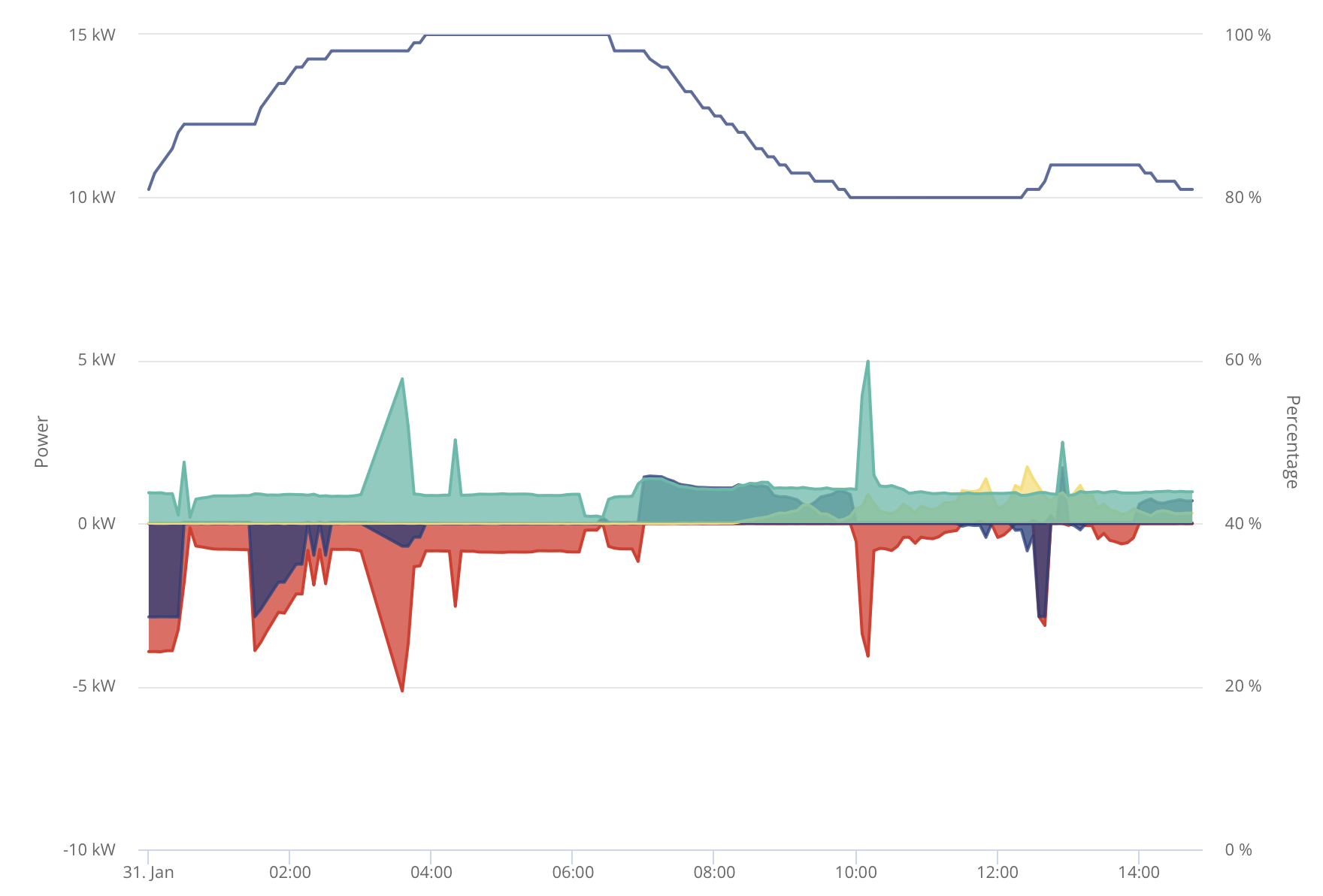
This is my PV Power from the dashboard today. I am on Agile.
Rob
#5GrahamShaul
Rbor I used to! But when the battery says that it is at % SOC there is nowhere that I can find on the app or portal that actually states the kWh that is being stored in the battery at that point or the designed capacity vs the actual capacity when it is reported as 100%
S
#6SimonClarke
TX200 like I said someone intelligent……just ignore me!
A
#7anthonypar
The battery plus and battery minus icons in the energy graph will tell you how many kWh has been added/taken from your battery. When my 8.2kwh battery is depleted to 4% I can add 8kwh for it to reach 100%.
#8GrahamShaul
anthonypar That maths seems to prove that my battery is not getting to 8.2 but it still reports at 100%
G
#9geoffreycoan
GrahamShaul the early 8.2's were 80% depth of discharge. Might you have one of those, does the maths work?
#10GrahamShaul
geoffreycoan How could I tell? It is what GivEnergy installed last week.
S
#11SimonClarke
geoffreycoan so I’m not cracking up! If they replaced it maybe they replace like with like as they did with my inverter?
G
#12geoffreycoan
GrahamShaul I was wondering if you measure the kWh in and out and see whether that corresponds to 80% of 8.2?
#13GrahamShaul
SimonClarke My experience with the replacement battery is the same as the battery that they replaced. But they decided to replace my battery as it wasn't performing as expected by them.
T
#14TX200
If it is 80% DoD, that would be 6.56 kWh usable.
Does that sound about right from what you've been seeing.
It's strange that it's listed as 100% DoD and even says Gen1 on various supplier websites, but mistakes have been made in the past so who knows! (Was it EON that got the 5.2kWh wrong?)
Yes I think so. This was in the year I was waiting for my install and I had to sign a replacement contract with the 80% DOD for the 2x 5.2KWh batteries before they would install as the original contract said 100% DOD. The delay was waiting for SolarEdge optimisers I think.
#16GrahamShaul
All that I can add is that I have been used to a 100% DOD (except the 4% so 96% DOD) so I am going to have to see what GivEnergy support advise next week.
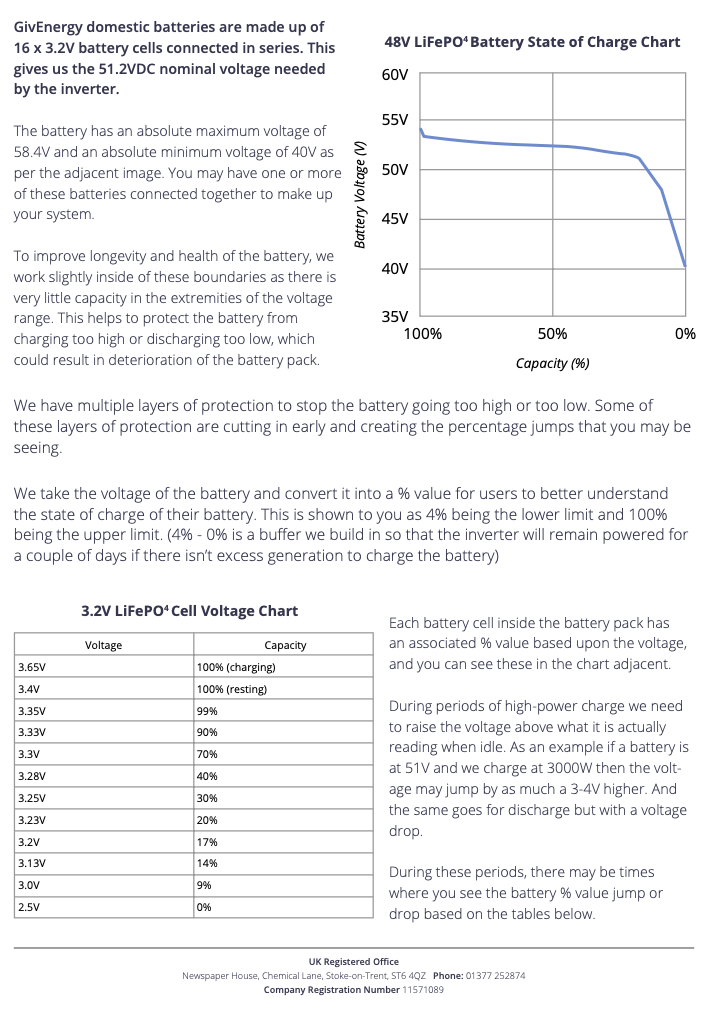
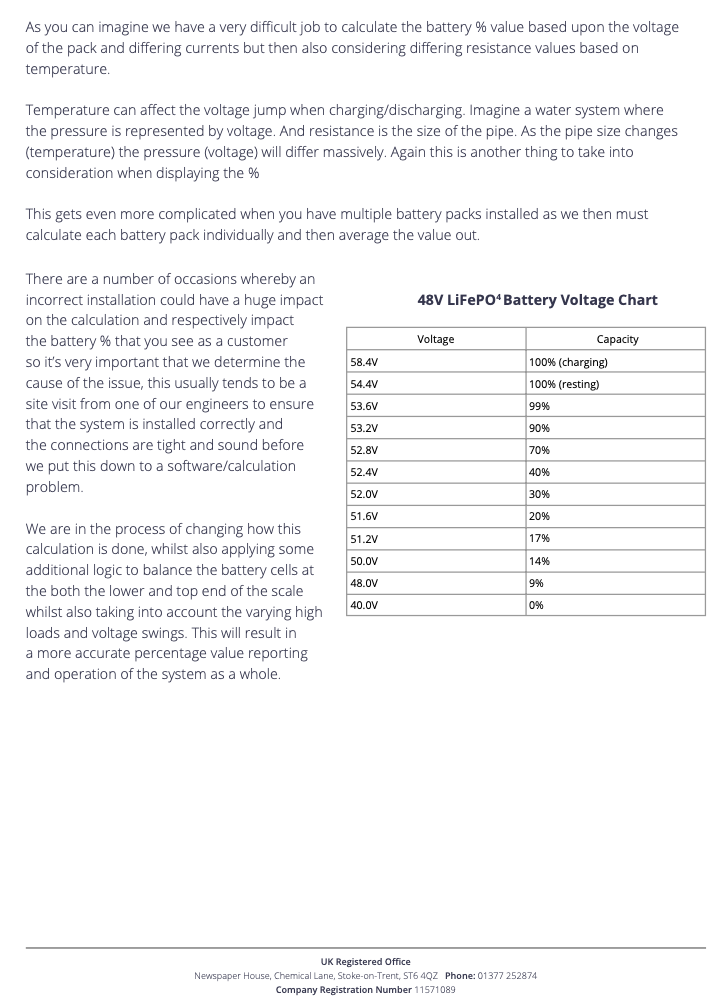
I have attached 2 pages from a document that givenergy made available in 2022.
These explain the difficulties in providing accurate SOC %s for LFP battery chemistry.
It appears that much is being worked out from battery voltage which does not change much across most of the SOC % range.
You can see historical battery voltages on the portal.
I notice that you have a 2.6 kWh inverter which must be a very early Gen 1 battery.
I have an AC3.0 from week 18 of 2022 and inverters after week 10 have been able to receive firmware updates. I am on Inverter Firmware D0.205-A0.205 and Battery Firmware 3017.
You quoted that you saw 9% SOC which would equate to 0.75 kWh.
The table on the 2nd page above equates 9% SOC with 48.0 V.
Last night my battery fell to 11% SOC and the recorded voltage from the portal was 51.37 V – hardly the best correlation from the GE graph!
The other question is one of temperature (you can also get this from the portal).
My battery and inverter are in an indoor porch. The temperature matching my readings above was 17C.
I know from other posts that battery temperature has a big effect on battery performance, especially for kit sited outside.
This may not help you directly with your frustrating problem but it may help to explain why you are experiencing issues.
Rob
R
#18Rubikcube
The simple answer to the title question is ... YES.
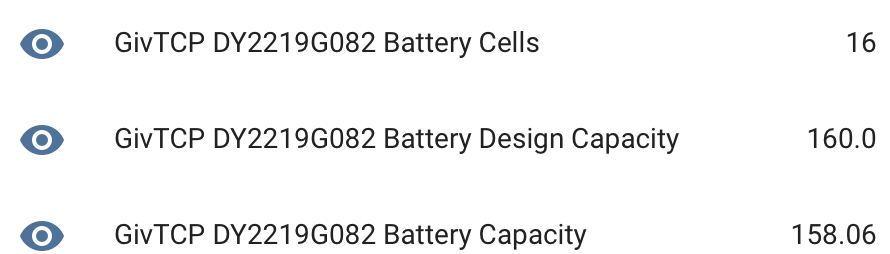
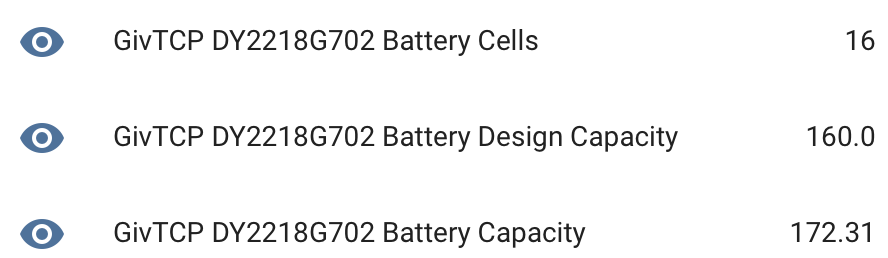
There are many possibilities, but the inverter has to be configured (usually at install) with the total battery capacity (a single figure representing all the batteries connected). For a single 9.5 the value is 186. For a single 8.2 I guess it's about 160. Check the battery capacity and voltage limits first.
Rubikcube My two 8.2 kWh batteries are both 160 design.
One has more capacity though.
Rob
V
#20Vestas
Rbor Primary will get more wear than the secondary. 172.31 sounds about right for new cells.
V
#21Vestas
Rubikcube For a single 9.5 the value is 186. For a single 8.2 I guess it's about 160.
For the 9.5 the "new cell" capacity will be 200Ah so there's 7.5% "overprovisioning" over the "design" value.
Assuming the same for the 100% DoD 8.2 battery then 172(ish) Ah looks like "new cell" capacity.
#22GrahamShaul
My final note for today. The battery was reporting 100% SOC first thing this morning. At 18:34 it was reporting a 4% SOC and the Energy Graph shows that todays Battery out was 5.7kWh. This from a 8.2kWh battery.
T
#23TX200
What does it say on the label of the battery? Does it have a DoD percentage?
V
#24Vestas
GrahamShaul Get GE back is probably the best advice. Sounds like there's an issue with a cell pack or a busbar.
#25GrahamShaul
TX200 Thanks for the prompt. The label on the battery does state 100% DOD with a Rated Capacity of 160Ah and a Nominal Voltage of 51.2Vd.c. which equates to 8.192 according to an online conversation calculator.
Something very wrong!
R
#26Rubikcube
Rbor So presumably your inverter is set to 320 then?
It's called Battery Nominal Capacity in GivTCP.
R
#27Rubikcube
Vestas Yes, but I'm not talking about batteries, I mean the inverter. Mine is set to 186.
R
#28Rubikcube
Vestas The fact that GE have swapped out what may be a perfectly functioning battery, suggests GE technical staff may have limited knowledge of their own products.
R
#29Rbor
Rubikcube It's called Battery Nominal Capacity in GivTCP.
The nearest I have shown for my inverter is:
givtcp_ce2218XXXX_battery_capacity_kwh 16.38 kWh
Which (nearly) equates to two 8.2 batteries.
Rob
P
#30Pete UK
You should be able to tell the date the battery was manufactured by the NUMBERS in its “serial number”.
Might provide a clue as to whether it’s really 100% DOD or an earlier 80% DOD one. Although it should be 100% DOD if it says so on the side of it !
“XX2401G001”
= —YYMM-001
ie in above example: Year: 2024, Month: 01, battery number: 001 of the day.
#31hoggy
The 80% ones are clearly marked as 80% DOD. They are marked wrong as the design cap is 158AH but still...
Serial BA...
GrahamShaul it just my inverter number in side of inverter with XX over some of the ID.
Mine starts CE2218 with G and 3 digits afterwards.
2218 means week 18 in year 2022
I think CE indicates the type of inverter. Mine is a Gen 1 AC3.0, although there was a previous Gen 1 up to week 10.
I am sure that Hoggy can fill in any gaps and correct me if my limited knowledge is flawed.
Rob
T
#34TX200
Rbor yep, that's correct, type of hardware, year and week of production.
R
#35Robgy
TX200
So does DF2234GXXX mean the battery was made 2022 week 34
if so, my install was Dec 2023 so it had been hanging around somewhere for well over a year.
T
#36TX200
Robgy yes and I suspect some are still being sold from that year elsewhere 🤣
As long as they give it a dust before it leaves the warehouse.
I guess it depends how good their stock control is. Should be first in first out, but they're heavy to move around. 🤣
V
#37Vestas
Robgy Remember that it'll probably take at least 12 weeks for a battery to get from the Chinese factory to the UK wholesaler & the delays were a LOT longer during the last Chinese covid-19 lockdown in 2022.
I assume the BMS board is disconnected during transit but I dunno really.
#38Windy Miller
Robgy Mine is 2230 installed in May 2023. However ordered in April 2022. I always thought mine had been put aside awaiting all the components for my install - the optimisers took ages from Solaredge.
Oh yes, I feel foolish now but I bought the GE system on the rather naive premise that it was a British company and built in the UK
V
#40Vestas
Windy Miller Mine is a 2243 installed in July 2023. The installer didn't have to connect a 50V PSU to bring the battery back to life but it was a close run thing.
My assumption is that the BMS is disconnected at the factory for shipping and reconnected once its in the UK so when it hits the wholesaler then its going to be losing charge a bit more rapidly. I may well be wrong.
R
#41Robgy
TX200 As long as they give it a dust before it leaves the warehouse.
And disinfect it for COVID.... 🤪
Had forgotten about that by the time mine was installed!
T
#42TX200
[unknown] I believe they're building a UK factory, but yes, historically it's a British company using factories in China.
G
#43geoffreycoan
TX200 I believe they're building a UK factory, but yes, historically it's a British company using factories in China.
There was a YouTube video on the factory opening. I think they are using it for assembling the larger industrial battery and solar systems to start off with.
My inverters are wk 37 of 2022 and the 5.2 battery is wk 38 of 2022, installed at the start of January 2023, so quite a short delay for me. I did end up with Gen 1 inverters because of the Chinese supply problems for Gen 2 though.
R
#44Rubikcube
Rbor You have 2 batteries correctly configured at 8.2kWh, and your inverter is configured to 16.38kWh. Every thing is correct and working as good as GE kit ever does.
What do you think might happen if I was evil and hacked into your inverter and changed the battery_capacity_kwh to 6.66kWh? Might it only partially charge the batteries? Might it exhibit the same symptoms as @GrahamShaul is experiencing?
I don't know, and I'm not messing with my system to find out. If @GrahamShaul can tell us what his inverter is set to, maybe it will help (or maybe it won't!).
R
#45Rbor
Rubikcube What do you think might happen if I was evil and hacked into your inverter ....
Ah, but I know (or hope that I know) that you 😇 are not evil .....
So I will decline your 'kind' offer to hack into my inverter, especially if my inverter and batteries are...... "working as good as GE kit ever does"
So I will stick
Rob
R
#46Rbor
TX200 [unknown] I believe they're building a UK factory,
I hope that are building some support staff to go along with their new factory.
I would presume that the 'new factory' assembles parts manufactured in China and does not make the parts – more an assembly unit.
Heard from a new voice at GE who brought a new mind to the issue. Now on battery firmware 3019 and the calibration imported 8.1kWh to my battery - MUCH BETTER!! That was the calibration rather than the regular nightly timed charge but I hope that it is a positive sign that the charge is back to the historical norm.
The power of firmware!
#51Tenkaykev
Rbor
This reminds me of when a colleague's daughter got a job as a waitress in a well regarded local pub/restaurant.
Their much lauded " Home Made " pies were actually bought in as two separate frozen components, the body of the pie being one, the lid the other. The " making " of the pie consisted of putting the lid on the pie, a quick dab with egg wash and chuck it in the commercial oven.