Expanding an existing installation - help needed!

19 comments started 2025-02-10 last 2025-02-11
GivEnergy ProductsAC CoupledHybridBattery
A
#1 Arron

Hello GE community, need some input/thoughts and hopefully some examples from people's own installs for the best way to expand our setup. Sorry for the long post but here goes:

We have a 5kw Hybrid inverter (gen 2) hooked up to 2x9.5 batteries (gen 2) and a 5kw ground mounted PV array taking up the 2 strings of the inverter. Installed coming up to 2 years ago, all working as intended and generally we're happy with it. We're looking to move to a heat pump in the next couple of years and always planned to expand this install before we go 'all electric'. We also want to address the maximum power output of our system, limited to 3.6kw of battery power by the current inverter.

What I'm not sure about is the best way to go about it, when we put our order in we were advised that the EWS was right around the corner and we'd be able to just 'pop another inverter in' and away we'd go with more solar and more power from the batteries if we wanted. Skip forward to today and the EWS has just launched but for AC coupled inverters only.

So, what are our options? Routes I can think of:

  1. Throw another string inverter into the mix for the new solar, but my concern is that it won't play nice with the hybrid already installed?
  2. Switch to 2 AC coupled inverters on the batteries with an EWS (to give 6kw output from batteries?) and then 2 string inverters for PV?? so 4 inverters total?!
  3. Swap the Hybrid inverter for a 'bigger' one with 4 strings and a higher output (8-10kw), but from what I can see no such product exists from GE. They have new 8 and 10kw hybrid inverters but they're not compatible with our LV batteries and I think they still only have 2 strings??

Would love to hear from anyone with a multi-inverter setup how they're managing it? I'm guessing it involves copious amounts of Home Assistant and words like 'cross-charging'.

G
#2 geoffreycoan

Arron Couple of other options for your list:

  1. Leave your existing hybrid inverter in place connected to your solar array, add another string inverter if you need more solar, and add the AC inverters with EWS/EMS/CEMS/HEMS (or whatever it is called) and move the batteries to the AC inverters. Basically a variant of option 2 but keeping your existing hybrid inverter as a PV inverter

  2. Leave the hybrid inverter as a PV inverter and add an AIO (or two) for the battery storage. This will give you a better charge/discharge rate than the hybrid inverter and the AIO is more strategic than the AC coupled inverters which are effectively end of life, no ongoing product development

  3. As 5 with an AIO but leave the battery storage on the hybrid. This will create cross charging issues but there are some ways around this - see a separate thread on this

I have a multi-inverter setup with two gen 1 hybrid inverters, one with a 5.2 and one with a 9.5 battery. When in Eco/Idle mode they do cross charge but not that fast, it’s more of a gentle cross charge and I have a Home Assistant automation that stops this occasionally. There are ways to prevent the cross charging but I need to have the feature implemented as a Predbat enhancement (it’s in the list!)

For me the multi-inverter setup gives me a better discharge rate and means I can support the ASHP and cooking/kettle etc most of the time. There are times the ASHP exceeds my 4.8kWh discharge rate and I end up grid importing. It’s not ideal but it’s liveable.

Adding more battery storage and more inverter capacity will better support your increased demand but the economics of doing so are not great. It might be better to just accept the extra grid importing in the winter.
I’ve recently moved to Octopus Cosy and am finding this works well with a lot of my heat pump consumption covered by battery storage and 13p import rate. Its not everything, so today has been cold and the heat pump has consumed 45kWh (on top of the 16kWh home consumption), but my import bill has been £9.68 so far today which I can live with.

My strategy is to export as much as I can in the summer, build up a healthy credit balance (it was £1100 in October) and this rides me out for the winter leaving an annual bill of £10.

A
#3 Arron

geoffreycoan thanks for the reply. Some food for thought there, you've hit my main concern on the head about the AC inverters being end of life...

Surely they must have plans for a gen 2 AC inverter?? Feels like they're leaving their existing battery customers in the cold. Just ship the inverter from the AIO as a stand alone!

We're on biomass, which since the invasion of Ukraine has been eye wateringly expensive to run, so interesting to see your numbers on running a ASHP.

G
#4 geoffreycoan

Arron Surely they must have plans for a gen 2 AC inverter?? Feels like they're leaving their existing battery customers in the cold. Just ship the inverter from the AIO as a stand alone!

I suspect the AIO is the replacement for the AC inverter, it’s an AC inverter with battery in one unit. The high voltage batteries seem to be the way the products are going, the AIO was first to use them, there is an AIO2 coming apparently, the 3 phase hybrid and now the 8kW and 10kW hybrid’s both use the high voltage batteries.
Unfortunately this leaves those of us on the low voltage (2.6 to 9.5 batteries) at end of life. The CEMS at least provides a route to extend the usability of AC coupled, but whether this will extend to hybrid batteries and AIO’s/hybrids and AC, not clear.

We're on biomass, which since the invasion of Ukraine has been eye wateringly expensive to run, so interesting to see your numbers on running a ASHP.

My annual heat pump running costs from Jan 24 to Jan 25 were £687. This is based on the actual heat pump kWh consumption and the average monthly kWh price I paid on Octopus Agile.
The previous two years the bill was £1400 and £1500 respectively but I’ve made a number of configuration changes to the heat pump settings and it’s now running more efficiently. Its a large house that had an oil boiler before which cost about £1200 a year so (prior to this year’s figures) I was working on the basis that the heating was about the same to run as the oil, now its cheaper.

A
#5 Arron

Those are some encouraging numbers, I can't wait to get off the biomass!

A
#6 Arron

geoffreycoan out of interest, how do the two inverters show up in the app? Do you have 2 array icons? or does it merge their output?

G
#7 geoffreycoan

Arron TLDR: the app is rubbish with two inverters

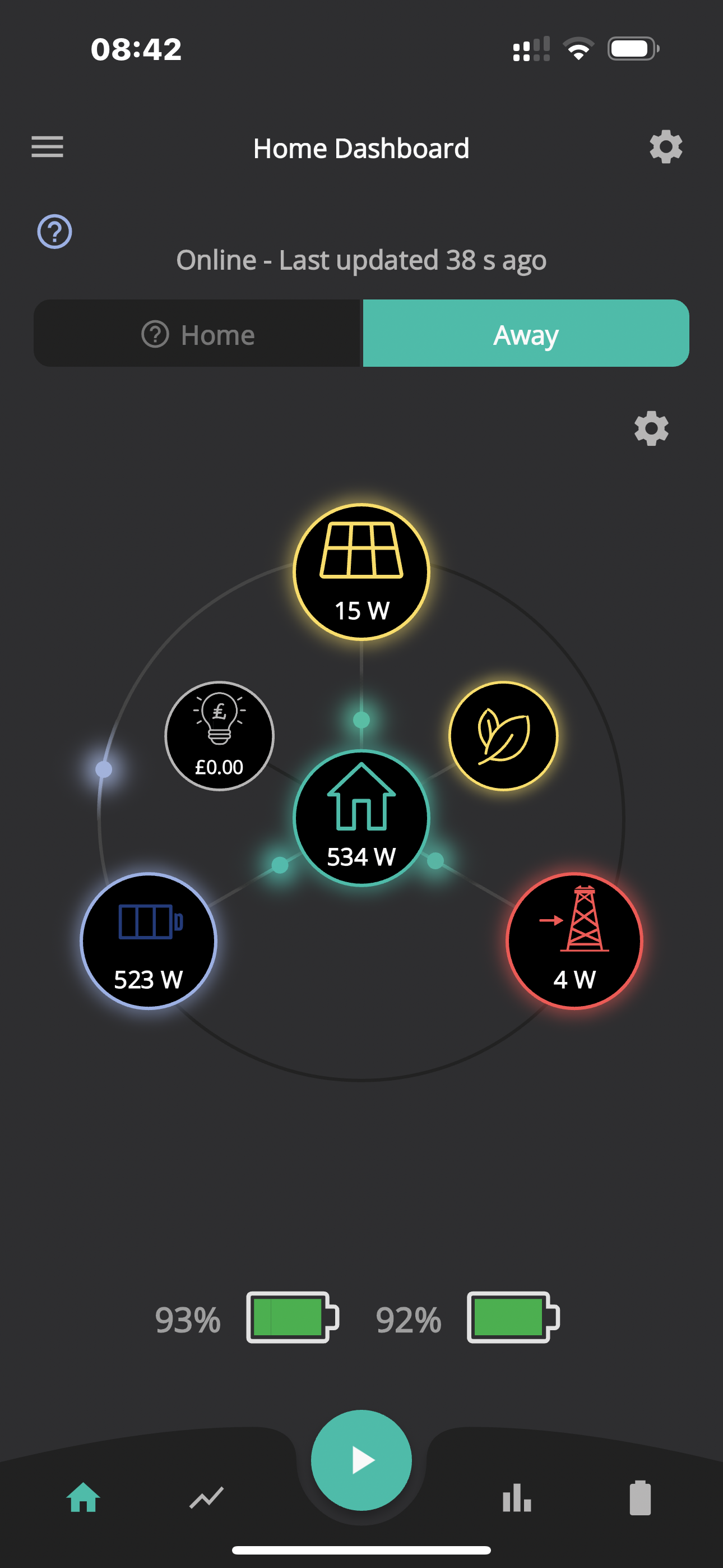
To expand, the home screen is reasonable, you get total solar generation, total home demand, total battery charge/discharge and import/export from one of the inverters (not sure how it works this out).
If the screen is in landscape you can see one battery’s data, if in portrait you can see both and have the ability to drill down into each inverter/battery details. Can’t drill down into individual solar generation or anything on a per inverter basis.

Programming the inverters to charge/discharge etc is all done on a per inverter basis.

The battery graphs (last tab) are shown on a per inverter basis.

That’s the end of the good news. The power graphs and energy graphs where you see generation, consumption, import, export, battery in/out, these are useless. They are particularly bad with solar generation and home consumption; frequently displaying negative numbers for things like home consumption or even solar generation!

I think the app can’t cope with their being multiple inverters especially understanding the concept of the house load being shared across the two inverters/batteries. Mind, if I look in the portal each inverter’s idea of what the house load is isn’t right either, again I think this is due to the expectation that there only is one inverter, not a second supplying power.

TBH I gave up with the portal and app data fairly early on and this was one of the key drivers for me setting up Home Assistant so I could get a proper handle on just how much I was generating and using in the home.

P
#8 Pete UK

Arron Would love to hear from anyone with a multi-inverter setup how they're managing it? I'm guessing it involves copious amounts of Home Assistant and words like 'cross-charging'.

Hi Arron

I’ve got a dual inverter ‘plant’ set up. Similar to @geoffreycoan but installed a bit later, so later generation kit.

2x gen3 5.0 hybrid inverters and 4x gen2 9.5 batteries.

The Gen3’s hybrids cross charge like mad if unmanaged. Right up to one discharging at 3.7kW and the other charging at 3.7kW ! Then they flip over when one is almost empty. (or used to !)

Mine are managed by the GE ‘software balancer’. It’s a beta trial I’m on. (No home assistant). It’s pretty good at keeping the pair from fighting. Like you I’m waiting for the EMS for hybrids to become available. As I think it’ll do a much better job and would work stand alone. This is a beta trial though so you’d have to make sure you could get on it. Being on this trial I can only utilise one discharging and one charging slot (that’s how it’s set up right now).

On the dual inverter set up you see two aggregated battery SOC’s below the main screen instead of one. Then when you click on each battery symbol you see the two batteries on that inverter and you can swipe right to see the other two on the second inverter.

P
#9 Pete UK

I get a max discharge rate to home of: 7.2kW
Timed export discharge rate of 8.0kW
and charge rate of 6.6kW–> 7.0kW (empty—>full)

I don’t have a heat pump, and I’m on IOG. Charge fully overnight all year round and discharge what’s left over at the end of the day. And export all solar. 99.4% of my import is off peak. So close to 7.1p/ kWh average import cost
Slightly negative annual electricity bill (-£30 currently). I’ve still got gas CH though.

A
#10 Arron

Pete UK those kind of charge/discharge figures would be fantastic and it's good to hear they have a software solution in the works. 2 inverters 4 batteries would be a perfect setup for our plans I think.

When I spoke with customer support at Christmas they said there were 3 different EMS' in development, but no commitment to release dates or even if they would release. Fingers crossed they don't forget their hybrid inverter customers!

R
#11 Rbor

I am also considering enhancing by current system.
I have one GE AC3 inverter (Week 18 2022) connected to two 8.2 kWh batteries (Aug 2022 and Apr 2023).
I have a 9.75 kWp PV array on E/S/W roof and extension orientations, connected to SolarEdge 5 kW HomeWave inverter. SolarEdge Optimisers are on all panels. Installed Aug 2022.
This part of my setup has worked faultlessly since installation (so far).
I have an ASHP with no gas.

Overall, my System works well, any glitches being from the GE inverter/battery setup. The main limitation if energy throughput which could be increased with a 2nd inverter.
I am considering a 2nd GE AC3 inverter with each inverter serving 1 battery.
GE have just released an EMS which should ensure that the batteries work together with no cross-charging, with throughput being doubled. (Currently, I get 2.8 kWh max when charging shared between the 2 batteries. Discharge is higher close to 3.2 kWh max.)

This upgrade looks an 'easier' upgrade than those suggested so far.
As my system is 'low voltage' and bound to be phased out as high voltage systems take grip, this would involve minimum expenditure to improve my system (the alternative being to start again!)

  1. Does this seem sensible?
  2. Would the EMS now control everything rather than the inverters?
  3. Does Predbat work with the EMS?
  4. How does an EPS fit in with all this.
    I have found some videos that have help me to learn what is involved.

I am now 2.5 years into my current setup. With the investment, I need to make full use of what I have.
My long term aim would be to see what happen and I may then need to 'start again' with high voltage kit. SolarEdge have some interesting high voltage ideas. Apparently Powerwall 3 does not work with inverters.
But several years down the track, things may have all changed. We may all be part of a virtual power plant with batteries becoming history.

Thanks for any advice.

Rob

A
#12 Arron

Rbor hi, I would have thought the EMS would be a no-brainer in your situation.

My understanding is it's a hardware solution to managing cross charging in a multi-inverter setup, rather than relying on 3rd party software (Home Assistant) or GE software (in beta), rather than controlling everything, it just makes the inverters play nicely together.

I've no experience of Predbat.

I would have thought with 2 inverters you have the potential for 2 EPS circuits, 1 from each inverter served by 1 of your batteries.

C
#14 CW

PianSom Interesting.

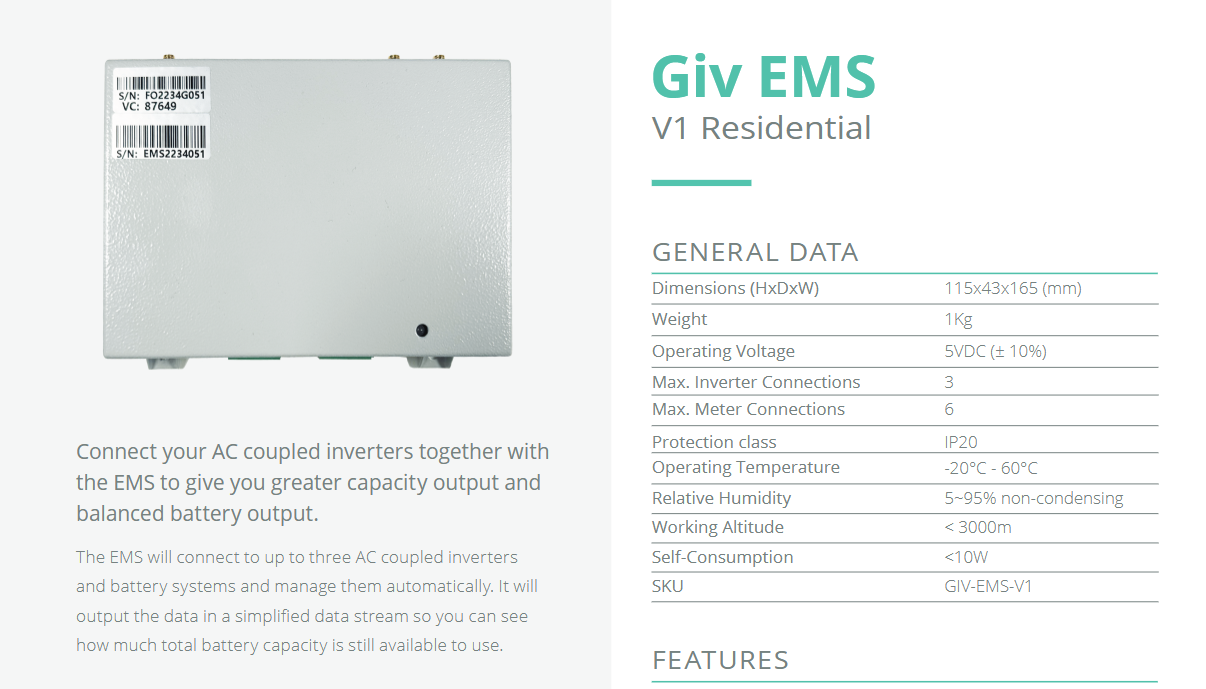
The description on the site says "Using this allows you to parallel two 3kW AC coupled Givenergy systems on a single site."

The datasheet from GE suggests 3. I wonder which is correct

R
#15 Rbor

PianSom Yes, I found the GE EMS on midsummer.
There is a CEMS (I think the C is for 'commercial'. No idea what the other one is.)

We all want something 'better' but part of me thinks:
'My system is working just fine. It does largely what I want it to do.
So do I just stick for now and see what happens in the future.'
The dividing line between 'I want' and 'I need'.

Rob

G
#17 geoffreycoan

PianSom Good to see it is finally starting to appear as a product that you can buy. Minus installer discount plus installer fees it should come in around the £600-900 mark I’d guess.

Whether it’s worth paying that kind of money for the benefits it brings, personal choice as ever.

I doubt I will get the hybrid version when/if it comes out because bluntly I can live with the cross charging I get. My gen 1 inverters don’t cross charge all that aggressively so the energy loss is liveable-with. Also the cross charging is only ever from inverter 1 to inverter 2, they don’t flip flop back and forth etc.

And to answer Rbor Predbat should work with the EMS using the GE-Cloud integration that gets all data and sends all commands via the GivEnergy Cloud. There’s a loss of data granularity in Home Assistant (5 minute snapshots only) but I have tested it and it works fine.
Having said that it does depend on the GivEnergy Cloud controlling the EMS in the same way as it does other inverters, so that would be a bit of FOAK.

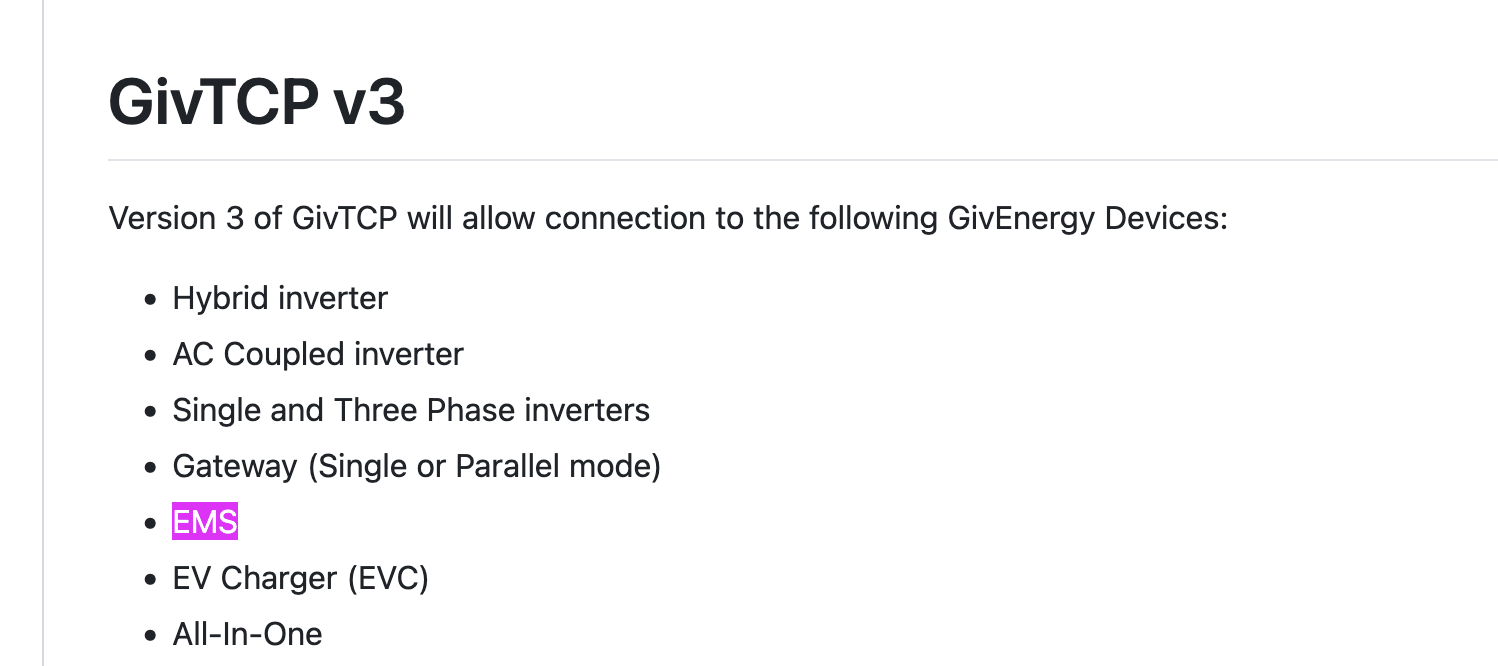
As for GivTCP, unknown whether it presents a modbus interface and whether that interface operates anything like the inverters. My guess is that it’ll require some tweaking to work.

#18 PianSom

geoffreycoan As for GivTCP, unknown whether it presents a modbus interface and whether that interface operates anything like the inverters. My guess is that it’ll require some tweaking to work.

From the GivTCP GitHub page -

A
#19 Arron

[unknown] some interesting videos, now I know why I only get 1 charging slot (gen 2 hybrid) if nothing else. They do talk about a hybrid EMS so I'm not giving up hope.