Best ways to do multiple inverters?

12 comments started 2025-03-11 last 2025-04-05
GivEnergy ProductsHybridBattery
M
#1 mrand31

I've currently got a gen1 3.6 kW hybrid with 2 7 panel strings and an 8.2kWh battery in/on my workshop. The inverter has fried its RS485 interface and no longer talks to the EM115 meter. In the time I've been waiting for GE to help, I've had a heat pump fitted and chucked our the gas hob and replaced it with an induction hob.

I've worked out that I can just get a 5 panel SSE string and a 6 panel WSW string on the house roof. My thoughts are 5kW gen3 hybrid and 9.5kWh battery for the house and replace the workshop's clapped out 3.6 with another gen3 5kW inverter or a 3.6 or 5kW string inverter for the house and a 6kW AIO with gateway, plus upgrading the workshop's inverter.

I know that the EMS is only available for the AC inverters at the moment, tha AIO gen2 isn't there yet and I don't think the gateway has any energy management capabilities. With all of that in mind has anyone got any suggestions as to which way to jump? Especially with regard to controlling cross charging.

S
#2 SurreyMuso

I have two hybrid inverters and am suffering the cross charging problem. Just had a battery die and the attached inverter give up on me. Related? I don't know. My supplier says the beta program for hybrid EMS is taking limited numbers of people but, despite applying, I'm not on it (yet).

Can't even get any sensible feedback on when. Some folk have managed to use Home Assistant to control it but I don't want any system that I can't leave to my other half, who is not a programmer and expects solar to work as easily as mains does. A reasonable request, methinks...

G
#3 geoffreycoan

I have two gen 1 hybrids. On the original firmware they operated independently and I had no real cross charging issues.

The newer (beta) firmware adds AC coupled charging capability and they do now cross charge, although on the Gen 1 its not particularly aggressive, but is annoying and wasteful of energy. Happens mainly after dark when both inverters and batteries are in Eco mode and one starts responding to load that the other hasn't quite picked up. Overnight one will drain the battery into the other. Its always one way round, the first inverter to the second.

You can avoid most of the cross charging by putting the batteries into pause charge mode when the sun has gone down, and back to not paused when the sun comes up. Home assistant is probably the best way to automate this.
You can be more aggressive about spotting cross charging and stopping it with Home Assistant but it'll be a continual process that in turn will end up with lots of register writes to the inverter which isn't good idea.

Another coping strategy is to put one inverter into slow discharge mode and let the first respond to any extra demand on top. This works but means you can't maximise battery capacity.

In your circumstance mrand31 I would try to avoid a setup that risks cross charging. Either get an AIO or an inverter that can handle all your panels, and if you are worried about the effect of different panel orientations, use solar optimisers so you can connect them all to a single inverter.

#4 hoggy

I'd be inclined to get to the root cause of your rs485 meltdowns before I went with the same brand again (if I recall this isn't the first time? Do you weld in the workshop or something that's perhaps trying to use its wiring as an earth path?)
Roasting an aio / gateway in the same way would start getting expensive quickly.

H
#5 Hopeful

Another option: I have 2 Solis PV inverters that are then combined into the 1 AC PV feed into the AIO. I had hoped the AIO had 2 PV feeds but that was just a portal red herring so other than having to use the solis app/portal to see each inverters performance the system works as expected. Should you need more battery you can add a second AIO.

Otherwise ebay might be your friend until AIO2 comes along?

M
#6 mrand31

Root cause of the RS485 meltdowns is the lack of protection on the GE gen1 RS485 interfaces. I'm using direct connected RS485, since LORAs can't get a good signal between the meter and the inverter. It's a bit frustrating, since I've used multi-drop, multi-hundred metre RS485 busses around a 22 acre factory site with no problems. I've got some overvoltage protection units on the way to make up for the vulnerability.

If you ever have to disconnect/connect the meter or battery comm connections, ensure that every device on the connection is powered down first. I think the latest incident happened when I re-connected the inverters RS485 port with the meter still powered up after some local re-wiring/trunking work in the workshop.

geoffreycoan In your circumstance mrand31 I would try to avoid a setup that risks cross charging. Either get an AIO or an inverter that can handle all your panels, and if you are worried about the effect of different panel orientations, use solar optimisers so you can connect them all to a single inverter.

I would have four strings with different orientation:- 5, 6, 7 & 7 panels each in two locations about 40m apart optimisers wouldn't benefit in this case. Part of the reason to upgrade the gen1 inverter is to get more power to/from the existing 8.2kWh battery as well as the current issues I've got with it.

I have the feeling that the best solution is going to be to have string inverters on the house (Polar-ESS???? ๐Ÿ™‚ ) and an All-in-One, with the existing/upgraded workshop inverter+battery and the string inverters wired into a gateway. Then manage it all with a bit more work on my HA setup.

A slight alternative to this would be to use the (repaired) gen1 as a 'string inverter' but I'd have to calculate whether it would clip at 3.6kW with the two strings for the house and no battery.

Any more Ideas/help/guidance/insults would be welcome ๐Ÿ˜ƒ

T
#7 Trumper

I have been waiting for a reply from GivEnergy on this issue for over 3 years. I purchased a 5kw hybrid inverter 2 9.3 batteries and sufficient panels. I was not told that the battery max output would only be 2.6 I was under the illusion that the inverter was the controller to all output not the batteries. I went with the 5.6 inverter as my average requirement is approx 5 ( pool being heated) during the winter the idea was to keep batteries topped up at night etc. so when the pool needs heat it splits between mains and battery when the intention was for the batteries to do the job.

Very frustrated with GivEnergy for not replying and helping on this issue.

G
#8 geoffreycoan

Trumper Very frustrated with GivEnergy for not replying and helping on this issue.

I hear your frustration but did you buy the panels, inverter and batteries directly from GivEnergy?

More likely you bought via an installer so your questions should be with them as the kit they specified and installed.

A 5kW inverter has a max output of 5kW, but unless your installer seriously over-specified your panels, youโ€™re unlikely to get to that peak all of the time. I have 6.24kW on one of my 5kW inverters and if I look at June 2024โ€™s data (June is generally recognised to be the best month for solar), I achieved 5kW on only about a third of the days in the month, and even then it was only for a few hours at most.

D
#9 DD

Trumper Very frustrated with GivEnergy for not replying and helping on this issue.

Not quite sure what it is you want: 2.6kW is indeed the maximum battery power on the original inverters. So your installer probably mis-sold you a solution, but 3 years seems a long time after the event to make a claim.

18kWh storage discharged at 5kW would only last about 3.5 hours - so if 5kW is your average power draw, then 2.6kW for 7 hours still sounds like it would make a useful contribution.

C
#10 CW

geoffreycoan Unfortunately, the hybrid inverters as far as I know effectively have 2 different power outputs. 5kW (or 3.6) when coming from the PV and battery, but the battery can only discharge at a maximum 3.6kW so when you are running off battery only you are throttled back to the maximum battery output.
This has possibly been further "tweaked" with the various firmware upgrade which I think have restricted battery output to the figures you are seeing - I am not fully sure about this as I have an AIO, but I'm sure I have seen threads on here where this was discussed

M
#11 mrand31

CW As @DD says, The Gen1 inverters can only discharge at 2.6kW from the battery. The Gen2 upped this to 3.6kW. They can reach full output power with solar or solar+battery. If @Trumper 's inverter is more than 3 years old, it'll be a gen1 (same as mine).

Unfortunately, one should never put all one's faith in what the installers say. The very best make mistakes and the rest speak with forked tongues IMHO. It pay's to independently check the specifications of what is proposed and see if it's what is actually wanted.

M
#12 mrand31

Update to this thread. I've now got the controller board from an ex-EBay inverter in my one and it's working fine, even if not completely configured (merrily works with the battery, but the portal doesn't admit that it's got one). This will save me from having to drive the charge/discharge, export/import settings by hand until GE can either do a repair or configure the controller board that I put in.
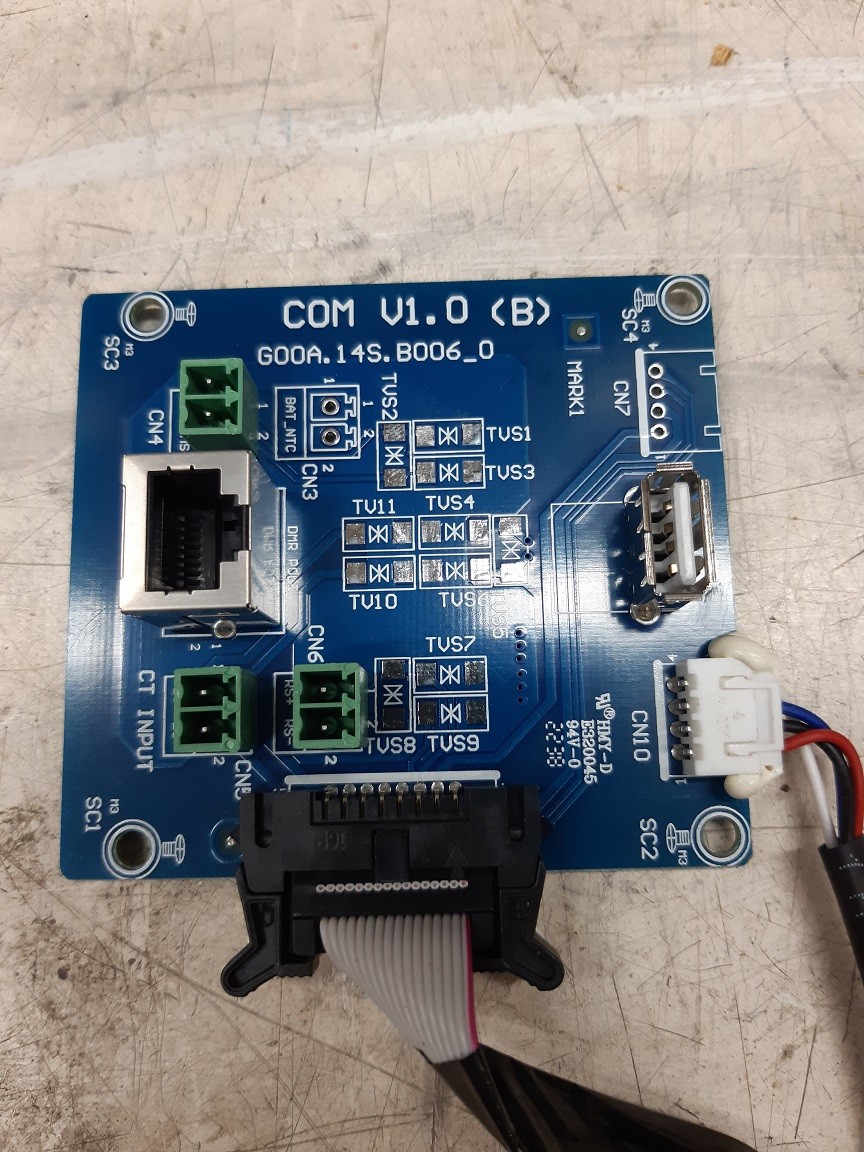
I have installed a voltage limiter/surge suppressor on the RS485 line from the EM115 meter. On inspection, that only had a lightning suppressor and 30V Transient Voltage Suppressor device in it, so I modified it with three 6.8V Zener diodes to act as a clamp to protect the inverter's interface.

Coincidentally, here's a photo of the interface connection board of the Gen1 inverters:-

Note the never-installed transient voltage suppressors.