
Latest Firmwares & RealTime Control Release Notes

26 comments started 2025-03-31 last 2025-05-29
GivEnergy ProductsAC CoupledHybrid
#1 hoggy

So I pulled these from a post over on Facebook & posted in a thread but there's several now, so for clarity (until the KB article catches up) here are the release notes (these are from a Giv Employee(s) - of which I am not - so although I don't doubt they are correct, don't shoot the messenger if they turn out to be not the polished ones that appear on the KB)

Gen 1 - TBA - Still in test from what I gather (& i've no idea if it is all the Gen1's or just the ones that support the faster firmware)

Gen 2 -
A920-D920 - 09 Feb 2024

Correct Reserve & CutOff register mapping
A919-D919 24 Dec 2024 -- Beta Testers Only

Add new Register control logic, some frequently used, are stored in RAM; Function is switchable and default is flash. For future use with Grid Services.
Default Import limit is set as 100A and disabled, if no value set already. Valid values now 40-200A.
Add improved no battery present detection and control logic
Fix incorrect inverter status when no battery fitted and String Mode selected. It is intentional to have no battery, its not a WARNING, its NORMAL
A918-D918 - 01 Oct 2024 - Internal

BMS 3018 Support
A917-D917 - 23 Aug 2024 - Internal & Beta users
1.Off-grid discharge cutoff fixed

Import limitation added 0-200A configurable
Fixed the relay issue for rare grid conditions causing incorrect EPS operation
Add the BMS reset command

Gen 3 -
A315-D315 - 09 Feb 2024

Correct Reserve & CutOff register mapping
A314-D314 27 Dec 2024 - Beta users Only

Add addition registers for Grid Services
Optimise No Battery operation functions
Optimise the front Inverter display
A313-D313 - 09 Dec 2024 - Internal

Adds BMS 3018 support. Mini calibration on each full charge if required.
Add Real Time Registers. Allow "Safe Registers" to be held only in RAM.
If transitioning from RAM to EEPROM mode, 2s delay will be added, "Safe Registers" will be written to EEPROM.
Import Limitation default value is 100A and Disabled. Allowable range changed to 40-200A
A312-D312 - 01 Oct 2024 - Internal

Added BMS 3018 Support
A311-D311 - 23 Aug 2024 - Internal & beta users

Off-grid discharge cutoff fixed
Import limitation added 0-200A configurable
Fixed the relay issue for rare grid conditions causing incorrect EPS operation
Add the BMS reset command

AC Coupled (AC3) -
A210-D210 - 09 Feb 2025 (Public Release Mar 2025)

Correct Reserve & CutOff register mapping
A209-D209 - 27 Dec 2024 - Internal & Beta Tester Release

Add additional SafeMode registers for Grid Services
Optimise Inverter front display for battery
A208-D208 - 09 Dec 2024 - Not Published externally.

Adds BMS 3018 support. Mini calibration on each full charge if required.
Add Real Time Registers. Allow "Safe Registers" to be held only in RAM.
If transitioning from RAM to EEPROM mode, 2s delay will be added, "Safe Registers" will be written to EEPROM.
Import Limitation default value is 100A and Disabled. Allowable range 40-200A
A207-D207 - 23 Aug 2024 - Internal Use

Fixed Sporadic EPS relay issue with certain rare grid conditions
Meter Info sent to portal (Meter serial No)
G100/2 Import Limitation function added
Restart battery function added

#2 hoggy

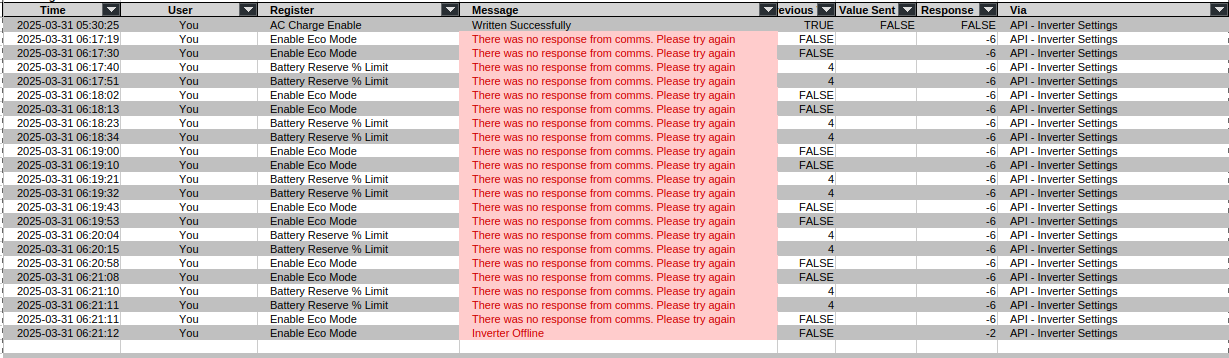
Much of the fanfare for the above is the addition of RealTime Control (moves commonly changed registers (useful for PredBat users) into RAM to save on chip flash memory wear from writing commands over and over and over) - Obviously it's a good idea to know which registers this works with so...

Real-Time Control Update for Inverter Users
We’re introducing Real-Time Control, designed to optimize your inverter’s performance under high-demand conditions. Here’s what you need to know:
🔹 When to Enable Real-Time Control:
Only enable Real-Time Control if your inverter is expected to receive a higher-than-normal volume of write commands. This feature helps extend the longevity of your device memory but comes with a risk of losing settings in the event of a power loss.
🔹 What is Considered a Normal Volume?
A normal write volume is defined as one write command every seven minutes. Writing to any other register at a higher frequency may invalidate your warranty under the fair usage clause.
🔹 Firmware Versions & Compatibility:
The following inverter firmware versions support Real-Time Control. (Note: Gen1 is currently in beta testing.)
Device Type Code Model DSP Version
0x3001AC3 210
0x2003 Gen1 3.6kW (Beta) —
0x2002 Gen1 4.6kW (Beta) —
0x2001 Gen1 5kW (Beta) —
0x2003 Gen2 3.6kW 920
0x2002 Gen2 4.6kW 920
0x2001 Gen2 5kW 920
0x2003 Gen3 3.6kW 315
0x2002 Gen3 4.6kW 315
0x2001 Gen3 5kW 315
0x8001 AIO 6kW 616
🔹 Safe Registers for Real-Time Control:
The following registers are considered safe for use when Real-Time Control is enabled:
API Giv TCP Register Name
17 20 Enable AC Charge Upper Limit (Winter Mode)
24 27 Enable Eco Mode (Battery Power Mode)
47 50 Inverter Active Power Rate
53 56 Battery Discharge 1 Start Time
54 57 Battery Discharge 1 End Time
56 59 Battery Discharge Enable Switch
64 94 AC Charge 1 Start Time
65 95 AC Charge 1 End Time
66 96 AC Charge Enable Switch
71 110 Battery Reserve % Limit
72 111 Battery Charge Power
73 112 Battery Discharge Power
75 116 Winter Mode Cut SOC
96 318 Battery Pause
155 319 Battery Pause Start (Unavailable in AC3)
156 320 Battery Pause Stop (Unavailable in AC3)
⚡ Reminder: Misuse of Real-Time Control settings may lead to warranty issues.

You will generally have to wait for the Firmware update to appear, and you will see in your remote control settings enable RTCL click it to set it on or off.

#3 hoggy

Finally BMS 2020 -
Honestly no idea, if anyone happens to have release notes for that then feel free to post.
I can say from getting my grubby mitts on it, it doesn't change any fundamental alarm or voltage setpoints on the BMS parts that I can actually talk to, so presumably is more algorithmic / background inverter > BMS comms changes going on.

W
#4 wrighar

hoggy well from the previous 3017 public release, it fixes:

The low 0.25C charge rate below 20c has been moved back to the 'correct 0.333C rate
Has mini SOC calibrate built in when fully charged
Has much tighter cell voltage balancing

G
#5 geoffreycoan

hoggy I’m running A0.187/D0.187 beta firmware on my Gen 1 hybrid’s. As far as I know it contains:

  • support for BMS 3018+
  • real time registers
  • ‘Flux mode’

Compared to the stock 450/451 firmware this also includes the following that were added in 191/193:

  • Fast response (switch between modes quicker)
  • Battery pause mode (but not start and end times for battery pause, insufficient registers for that)
  • AC coupled feature (charge from excess exported AC - useful for those with FIT arrays or multiple inverters)

Paul described Flux logic to me as
“allows you to have ECO enabled and both Charge & discharge enabled at the same time. Then activate as needed based only on time slot.
Before if you enabled one or the other but not in the slot it didnt do eco.
Likewise if eco was on, you couldnt force export.

Now you can do all 3.
Charge, HomeLoad & Export”

G
#6 geoffreycoan

hoggy We’re introducing Real-Time Control, designed to optimize your inverter’s performance under high-demand conditions. Here’s what you need to know:

🔹 What is Considered a Normal Volume?
A normal write volume is defined as one write command every seven minutes. Writing to any other register at a higher frequency may invalidate your warranty under the fair usage clause.

⚡ Reminder: Misuse of Real-Time Control settings may lead to warranty issues.

The definition of normal write volume is interesting. Its mentioned that its principally for high volume users, those where the inverter is controlled dynamically by the power grid (some form of super-smart DFS), or where active load balancing across multiple inverters is happening.

One write every 7 minutes doesn’t sound that much, but if you are on Octopus Agile and actively manage your inverter (Wonder Watt, Predbat, My Energy Optimiser, your own scripts, etc) to swap between charging and discharging across 30 minute time slots. Changing from Eco to Charging requires setting charge start time, charge end time, AC charge enable and potentially battery pause mode and charge rate depending on your automation - between 4 to 6 writes to swap, and you’re at the one write every 7 minute limit.

Add in plunge or negative pricing where you might swap between charging and discharging in the same slot and it’s obviously even more writes.

Of course such Agile pricing doesn’t happen every hour, so averaged over a day the number of writes come down.

I had a look at my own daily inverter writes from mid December when predbat started tracking them, its has been typically around 50 writes a day on Agile, 25 on Cosy, but sometimes as low as 20 and as high as 100. The write every 7 minutes gives 205 writes a day so I’m well within that.

Interesting suggesting that inverter register writes is subject to fair use policy in the warranty. I doubt that would stick if it came to it, but I’m no lawyer

J
#7 jonhd

IOF & the '7-minute rule' :-) ...

#8 hoggy

wrighar hmm, from what I can see that must be more inverter driven to force the pack above the threshold for balancing over and over then rather than a change to the balancing regime - the >3.4V for balancing with a target of 30mV difference seems to have remained the same across 3015 through 3020.

#9 hoggy

geoffreycoan ah ok so that sounds like it may only be for the Fast FW ones then.
Yeah the writes do add up over time - however it shouldn’t just implode at 10k+1 writes so whether anyone would truly fall foul of that from Agile use long term before warranty expiry I’ve no idea.
Given they couldn’t track writes at all until recently (via the portal) many inverters have several years of head start for warranty claims I’d imagine.

#10 positor1

hoggy Fixed Sporadic EPS relay issue with certain rare grid conditions

Is that the problem where when the zero second EPS delay is set to TRUE the power occasionally cycles on and off? If so can zero second be used again?

#11 hoggy

positor1 I think it fixes that yes (I've not suffered it so don't really know)
I have seen instances where someone has their lights on EPS circuit and they starting blinking a lot even while on grid & a mystery fw update makes it stop so I'm assuming it is that which it's talking about/fixes.

G
#12 geoffreycoan

hoggy I have my house ring main and lights on my inverter EPS circuit.

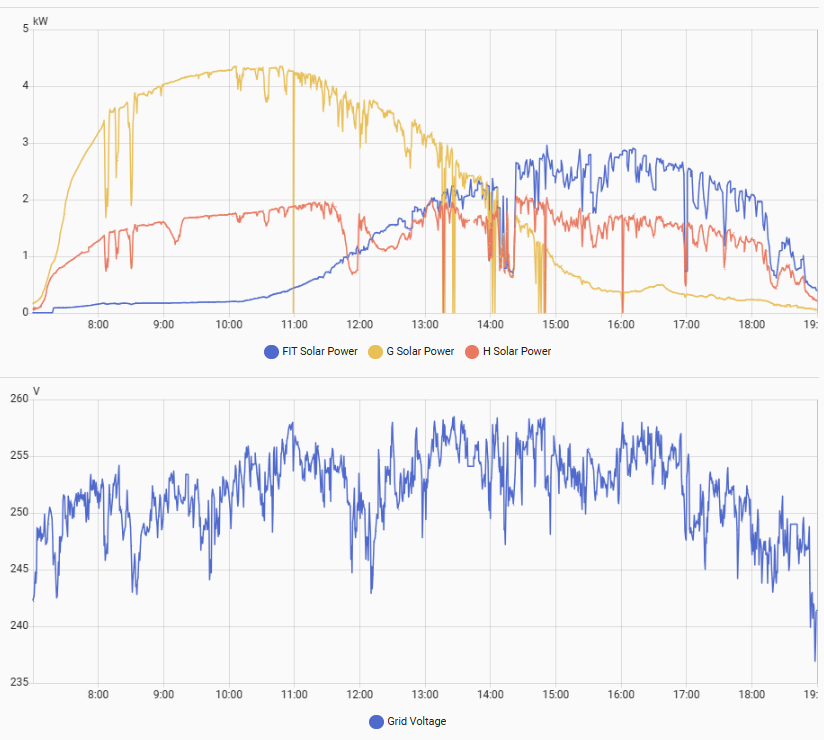
Have noticed a couple of times when the grid voltage goes too high and the inverter stops generating PV as a result, my UPS will click over and occasionally beep as if a power cut. But there is no power cut occurring, not even momentarily

Not done extensive testing on this because it only happens occasionally and now that I have stopped charging the battery overnight and am trickle feeding it during the day to reduce clipping, its even less frequent

V
#13 Vestas

geoffreycoan The UPS will switch over if the mains goes above 253V. Better ones allow for some adjustment.

G
#14 geoffreycoan

Vestas Thanks, I didn’t know that, makes sense if the voltage is out of range upwards as well as downwards.

I don’t think my UPS has any chance of a let-up, I’m above 253V for most of the solar day, and that’s despite trickle charging the battery to reduce grid export

V
#15 Vestas

geoffreycoan A couple of assumptions here -

1) Its a lead-acid battery on the UPS
2) You can't adjust the UPS trigger voltage up to 260V or so

If that's true then I'd be inclined to disconnect/bypass the UPS during "summer" (or now) as you're going to be aging the UPS battery unnecessarily. Unless you do an occasional discharge test* UPS lead-acid batteries look fine until they drop dead just when you need them.

*not the "test" the cheapo UPS have, which lasts 30 seconds.....

#16 PianSom

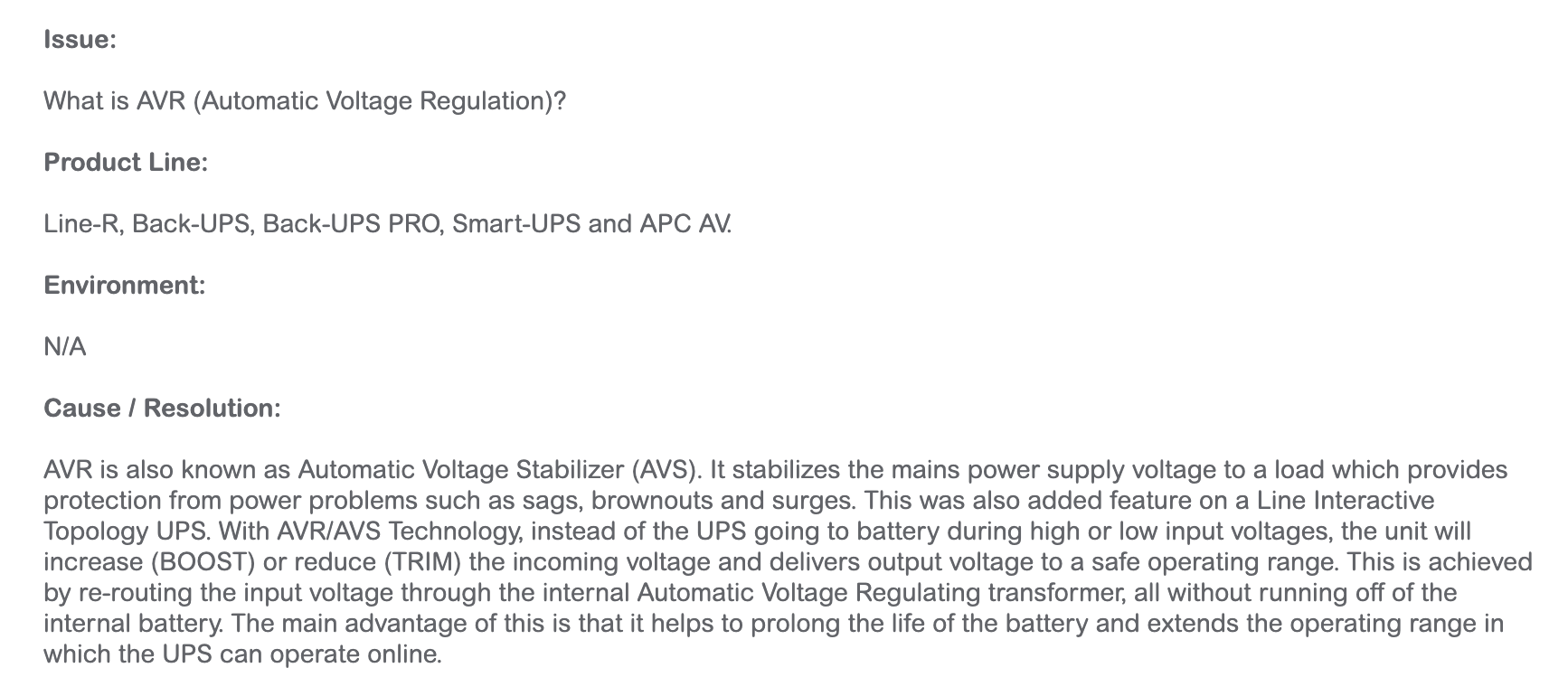
I have APC UPSs (lead acid) and they call the voltage regulation AVR

This is what APC (https://www.apc.com/us/en/faqs/FA158913/ ) say

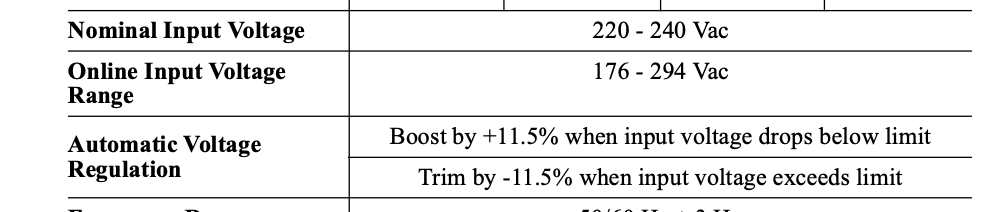
And this is what my specific model manual says (rather unclearly) -

G
#17 geoffreycoan

PianSom thanks, I had to go and look at mine to work out what it is, its a Cyberpower UT850EIG https://www.cyberpower.com/eu/en/product/sku/ut850eig#specification which has AVR “to offer stabilized AC power output”

The datasheet says similar to yours, nominal input voltage 230 +/- 10% but then input voltage range 165 - 290V.

The most I see it peaking at today was 259.1V, other days its been 258V. Definitely I can see when the batteries are charging the grid voltage isn’t pushed up as much so I’ll have to start programming some forced discharges of the batteries overnight to ensure they are completely empty for the start of the next solar day.

I’m thinking this AVR should protect me from untoward issues with the battery. It did beep briefly today for a second or so, but that was all.

#18 positor1

hoggy
Thank you Sir.

C
#19 CGoode

[unknown] Thanks. I don't do FB & the GE website has no info on this update that I can find so not sure how I'm supposed to read up on this before I decide to update or not. Why don't GE put relevant update notes (or a link to the notes) next to the update buttons on the Portal or, is that too logical? Either way I think I'll hold off updating for now because every update seems to fix one or two things & breaks half a dozen more. Call me cynical but that's been my experience so far.

C
#20 CGoode

hoggy Thanks. I don't do FB & the GE website has no info on this update that I can find so not sure how I'm supposed to read up on this before I decide to update or not. Why don't GE put relevant update notes (or a link to the notes) next to the update buttons on the Portal or, is that too logical? Either way I think I'll hold off updating for now because every update seems to fix one or two things & breaks half a dozen more. Call me cynical but that's been my experience so far.

#21 TheDragon (GivEnergy)

@hoggy
BMS Changes since 3017
inc 3018,3019 & 3020
18 and 19 were never released in the wild for general consumption

3020 BMS2.0 05 Mar 2025 - For Public Release

  1. Fix rare bug where Full capacity reset to 0 on battery restart
  2. Optimise internal resistance abnormal detection logic. Fix dynamic lower self calibration error
  3. Upper calibration logic optimisation above 80%. Where OCV was abnormally adjusting SOC downwards
  4. Add modified cell maps, to take into account higher charge currents at lower temps.
  5. Fix short Circuit detection logic, causes rare BMS Short-Circuit Error, when there was no actual fault present on battery restart.
  6. Pre-Charge Policy change, in conjunction with 5.

3019 BMS 2.0 03 Jan 2025 - Beta & Internal Issue Only

  1. Shutdown and start-up optimisation. Battery hibernate on reboot issue (Very rare).
  2. Battery Hibernation protection logic below 0C and SoC very low, if left for long time, it will hibernate to prevent self discharge; Can be woke back up at 1℃ to charge.
  3. Optimise internal code floating point operations
  4. Modify charge profile vs temperature, allow full rate down to 10℃. Below 10℃ its reduced to 2/3 normal. At 0℃ or lower, no charging is allowed.
  5. SOC display optimisation
  6. Parallel battery optimisation
  7. Add internal resistance check

3018 BMS 2.0 (29 Sept 2024) - Internal Use only

  1. Improve cell balance from line losses in the charging and discharging process
  2. Added protection and recovery conditions for cell overvoltage and undervoltage alarms
  3. Add a mandatory charge register indicating that the SOC is not full, signal inverter to continue charging
  4. Improve top end calibration, if the cells are not full when SOC read 99%, continue charge at reduce rate (1/3C). Ensuring battery is full
  5. Improve cell voltage sampling.
  6. Current limit add condition, for continuation charge, as per item 4
  7. Current limit optimization, temperature variations.
  8. Change overcurrent from shutdown to restart
  9. Increase conditional judgment, improves tolerance of parallel battery connection criteria
  10. OCV optimization: adjust the SOC speed according to the current; Update the dynamic OCV table of charge and discharge;
  11. Charging optimization
  12. Optimize the shutdown detection.
  13. Parallel optimization:
#22 hoggy

TheDragon (GivEnergy) that's brilliant thanks for that. Full House now.
Before I forget, the old tickety tick noises you hear when you first fire a battery up - mosfets doing a precharge into the innverter caps?
Never really paid attention to it until someone brought up relay ticking noises - which atleast on mine is odd, as it doesn't have any relays on it (unless I'm being blind!)

#23 TheDragon (GivEnergy)

hoggy thats precharge yes, tries to prevent the sudden surge causing issues.

#24 hoggy

Seems there's a new firmware changelog page now:
https://givenergy.co.uk/firmware-revisions/

Scroll down and there's a menu item "Firmware Revisions" which opens out and takes you to different kits firmware.

No idea what AI heating is in FW 3021. Any meaningful ai on an STM32 chip will be a challenge, but I guess you've got to put AI on marketing stuff these days...

R
#25 Roy124

hoggy I guess you've got to put AI on marketing stuff these days...

You could describe a current limiter (aka Fuse) as AI. I guess real AI would reduce loads before a fuse blew.

V
#26 Vestas

hoggy Any meaningful ai on an STM32 chip will be a challenge

Master of understatement 😃