Smart meter v GE

33 comments started 2022-06-26 last 2024-07-26
GivEnergy ProductsHybridBattery
D
#1 derekfairweather
Morning,

I have just had a smart meter installed and the readings seem to be completely different from the GE system?. Before the smart meter was installed I could be confident the two would be pretty accurate, as I have taken meter reads daily for the last year and compare in a spreadsheet (worst for accuracy was March 176kw to 170kw). I also checked differences between my provider website/meter readings and GE (anyone else go mad the first year of battery and solar?)
This month is a relatively low usage month of around 50-60kw but will likely be approx 20kw difference in reporting between the two.
I am using readings from the indoor monitoring gadget rather than manual reads at the box since the install.
I know the CT readings wont be perfect but it's such a big difference and now I'm wondering if I should even bother looking at the GE data as I will be paying what the meter says.
Is it the indoor monitor or something else that I'm missing?
Thank you


Smart Meter kw GE kw
20th 0.47 0.58
21st 1.16 0.27
22nd 0.64 0.18
23rd 0.89 0.03
24th 2.18 1.21
25th 4.64 3.62
Total 9.98 5.89

T
#2 Tim

derekfairweather I think that you're right to go with the SMART Meter readings as the correct ones for the reason you give.

As it's a recent install, your data will be posted to the Data Communications Company's database from where all electricity suppliers can extract your readings for them to bill you. You can also extract your data using the Bright App (iOS and Android) at no cost, and if you ask, they will enable MQTT and API access to your data as well. If you're interested, you can also buy one of their dongles and get meter data every 5 seconds or so. I still have to take manual readings of my meter for export because that's out of scope for the Bright App currently and an export MPAN was backfitted to my connection when I applied for the Octopus SEG tariff. I haven't been able to work out how to get my meter to post the export MPAN data to DCC, so if anyone knows, I'd be glad of that little nugget.

As for the accuracy of the Givenergy metrics, they do seem to give a reasonable indication of historic information, but (at least for our plant), the web portal isn't handling all the data. With two HY5s, we can have 10kW+ of PV being pushed to the house load showing 2.5kW and an export of 2kW, both on the portal with the rest disappearing into the ether. I know the sum of PV to ac is sound and the export is sound but the portal isn't summing everything to show a house load of 8kW. At these times, I can see 7.3kW going to the EV on the myEnergi app, but not the Givenergy portal. For this reason, I don't take the Givenergy portal data as anything other than an indicator of what is really happening.

#3 Woodstock

Your figures tally with what I see from my smart meter versus GE figures. The lower the readings, the bigger the percentage difference between the two. In summer I import between 1 and 2 kWh per week and the smart meter import total is typically about ten times that shown by GE.

D
#4 derekfairweather

Tim Thanks Tim, trying the Bright app now 🙂 I'm not technical enough for the API stuff although I managed to get myenergi data on HA albeit not showing correctly lol
Shame about the GE data accuracy, as it seemed alot closer for some reason before I had the smart meter and took maual readings.

N
#5 NigelB

My PV was installed at the end of March, but only have data from British Gas from 07 May. I will have to have a look at the Bright app.
On the basis that that the British Gas monitor broke after 2 days (and at that point the British gas app was not working), I had no idea what my consumption was I decided to write something using the using the GivEnergy API. Also wanted to include unit & day rate costs when things changed... anyway.
I have a Hybrid 3.6 invertor and think the data from that is accurate using the API, using the data "Today.grid.import" (with some tweaks), however I just checked and I am not sure it matches the grid to home on the portal , so maybe I am doing something wrong, but it does appear that you are right and it is reading low ?
For me my process matches (closely) the British Gas app, so meets my needs.
I did report an issue where my API data apepars to be GMT, not BST, which I reported, with no reply. Might be a timing, but even seems high variance, 5% low ?

Data
07 May -> 31 May
(BGas android app) = 135kw = £49.12
(My process) 133.50kw = £48.83
(Portal - monthly Grid in, Grid to home) = 126.59kw
01 -> 23 Jun
(BG android app) = 113kw -> £42.24
(My process) = 112.4kw -> £41.96
(Portal - monthly Grid in, Grid to home) = 106.17kw
Not sure if that helps ?

#6 Simon_C

@derekfairweather.
Are you separately reading the import, export and net values from the smart meter?
Do you have the GivEnergy EM115 meter with a dedicated CT to monitor your grid import and export energy with a Modbus network cable back to the inverter, or just a simple CT wired back to the inverter?
GivEnergy do also have an option to use an EM418 meter which is direct connected inline with the main utility meter, so provides more accurate readings than the CT based metering. This also utilises a Modbus network cable to the inverter.
With the EM115 meter, the display will auto-cycle between energy import, export and net values, or you can short press the one button to cycle round the available values.
One possible reason for the discrepancies is the time used in the smart meter and the GE inverter for the start/finish of each day. If one is using 00:00 GMT, and the other is using 00:00 BST, then depending on your household load in this 1 hour window, you will have different energy values for each day.

Assuming both meters are using the same 00:00 time, the accuracy depends on what method GivEnergy use to calculate the accumulated energy values, as there are a number of methods available to them.

1/ Read the EM115 energy values at midnight via the Modbus network link, and calculate the difference from the values read for the previous midnight.
2/ Read the EM115 power values live, with a sample time of possibly 10 seconds depending on the Modbus network poll time, then integrate the values over each 24 hour period. The EM115 calculates the power value based on the measured voltage, current and power factor.
3/ Calculate power values live in the inverter, based on measured voltage, current and power factor, then integrate the values over each 24 hour period. GivEnergy will know the sample time used.

D
#7 derekfairweather

Simon_C
Hi Simon,
I am only reading the import via the smart meter dongle indoors and its a EM115 meter which appears to have a CT cable (black and white cable) from the direct inline live going to the EM115 meters base, I can see an orange/white cable that twist together after coming from the top of the EM115 meter, which heads off to the fuse box and I cant see where it goes from there but I'm sure it's not going to the inverter as it doesnt follow the trunking below the fuse box.
I will have to check the time settings as GE almost matched the dumb meter reads I took daily sime last August and only seems to have changed this last week since the smart meter install.
I'm not technically minded when it comes to these matters and there is also an EML M21 meter which is next to the EM115 to confuse the matter.

#8 Simon_C

@derekfairweather , it is most likely that the EM115 meter is wired back to your inverter, the orange/white twisted pair are probably 2 of 8 cores in a CAT5 network cable, so will have a different colour overall cable sheath before the final connection of the orange/white cores at the inverter end.
The EML M21 meter is most likely the PV generation meter.

It would be interesting to know the daily energy values directly read from the displays on the EM115 and the new smart meter to see how closely they correlate.

The use of a CT for current monitoring becomes less accurate as the current value reduces towards the bottom end of the measurement range, which is just what the GE inverter is trying to achieve to minimise your grid import.

H
#9 Heilghast

I have the same issue with a non-smart meter, the lower the grid import, the more inaccurate the GE reporting becomes.
I had posted before someone highlighted this post.
I have a energy monitor which uses an optical receiver to monitor the LED impulses given off by my standard electric meter. This then transmits to the display.
So it got me wondering whether there was a way to feed an optical input which monitors the LED impulses from the electric meter into the inverter as a secondary input

#10 Simon_C

I am still waiting for my GE install, hopefully September according to the latest update, so cannot check the figures.

A good starting point would be to compare physical meter readings, say 24 hours apart, meaning the main utility grid meter and the EM15 GE grid meter. Then a better understanding of how GE measure and calculate the grid energy values.

With the EM115 meter, the display will auto-cycle between energy import, export and net values, or you can short press the one button to cycle round the available values.

R
#11 Rubikcube

Restating the original issue in general terms:

First an MCS-registered solar expert* installs a solar system which (likely) involves fitting a CT clamp to one of the wires attached to the meter.

Some time later, a meter fitter (who likely has little knowledge of solar) replaces the meter. This requires as a minimum disconnecting the wires and may require disturbing/moving/removing/refitting the CT clamp.

After the meter change the system does not perform as well as it did previously.

Whose responsibility is it to fix this? From a technical perspective it must be the installers responsibility because the meter fitter does not have the skills to put it right. The installer could have avoided the situation by advising the customer to have a smart meter installed before the solar installation.

If the system is not performing to specification, the OP should refer issues to the installer. IMHO Installers should no longer be installing hybrid solar/battery systems for customers without smart meters.

*Level of expertise may vary.

B
#12 Brookydave

I had similar issues. I replaced the supplied split CT with a "OB-WCT-T10-M Current Transformer 100A/0.333v 0,5%" which Owen Brothers (OEM of the EM115) recommends for the EM115. This is a solid CT - not split, so you have to remove a meter tail. I was lucky, the Supply installer fitted a 4 pole 100A switched isolator between incomer fuses and my 3ph supply. You can pick the CTs up on ebay from Owen Brothers direct for £10 inc post every now and then. I also replaced the un-shielded cat 5 cable with industrial screened twin core (expensive). The CT made a large difference, the cable less so.

R
#13 Rubikcube

Well done, but probably best not to encourage people to mess with their meter tails. I suspect there are quite a few badly fitted and inaccurate CT clamps out there. As for the eia485 cable, yes unshielded cat5 should not be used. Shielded twisted pair is the correct cable and the shield should be connected at one end only (to pin 10 of the EM115 but not connected at the inverter end) so that no current can flow in the shield.

E
#14 Edward

What's the advantage to changing the CT clamp to the "OB-WCT-T10-M Current Transformer 100A/0.333v 0,5%"?

Does is it just improve the accuracy of the statistics or does it also improve the accuracy of the system matching battery output to load?

Thanks

#15 Simon_C

According to Owen Brothers, their OM115 meter (which looks remarkably similar to the GE EM115) is 0.5% accurate when matched with the solid core CT, and 1% accurate when matched with the split core CT. This will be at a specific load current (say 10.0 Amps), so does not indicate how much more accurate the solid core CT is at low load currents (less than 1.0 Amps).

With regards to the Modbus network cable, a specific screened twisted pair cable would in theory provide better signal integrity but on the Gen2 inverters the Modbus connection is made using a crimp on RJ45 plug which does not suit a proper Modbus cable, only a CAT5 type UTP cable.

It is terminal 8 on the EM115 that is the ground connection, to be used for the cable screen.
T10=+ve, T9=-ve, T8 = Gnd.

R
#16 Rubikcube

Simon_C Thank you Simon, yes terminal 8 is gnd. My mistake.

R
#17 Rubikcube

Edward Yes both may be improved. If the inverter has more accurate information it will probably function better.

B
#18 Brookydave

Rubikcube @Simon_C Thanks for that clarification of the earthing details - I earthed my shield to incomer earth - I will move it.

M
#19 MikeReynolds

Hi. Not sure if this is the right thread.
I had GE hybrid battery fitted Nov'21 to work with PV panels fitted in '12.
Then last Jan had Das Smart Meter installed.

Since then the EM115 has lagged the Smart jobbie by some 30%. So which meter is right??

I see mention of exchanging the EM115, but how can you be sure that is the faulty one?

There is a lot online about how modern electrics can fool Smart meters and a very informative piece of work done on Tesla Powerwall, by Phil Steele for Octopus Ebergy. And also by University of Twente in Holland. Go, read it.

Let me know what you think. I have more to say on the subject.

W
#20 wrefordj

MikeReynolds I don't have a Powerwall but thanks for posting - it's a very interesting article. I like the comment that perhaps houses should soon be running partially on DC circuits...

#23 Maxwell

Just had our smart meter installed and so far the figures between both are very close. Although GE is always showing less than the smart meter.


#24 Hook

I tend to wait until the next day to compare. Sometimes the Givenergy figures can be delayed. But they seem pretty close.

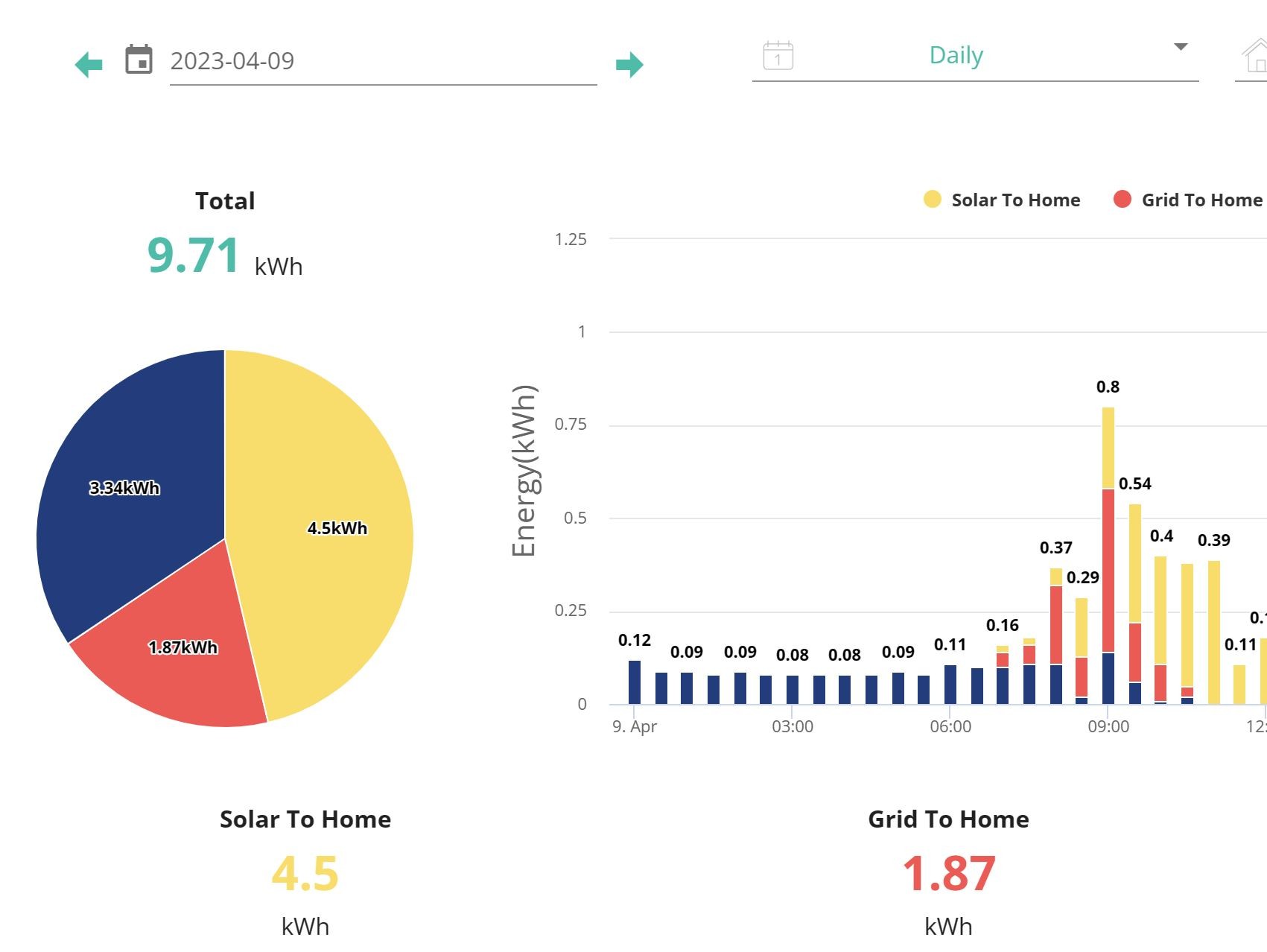
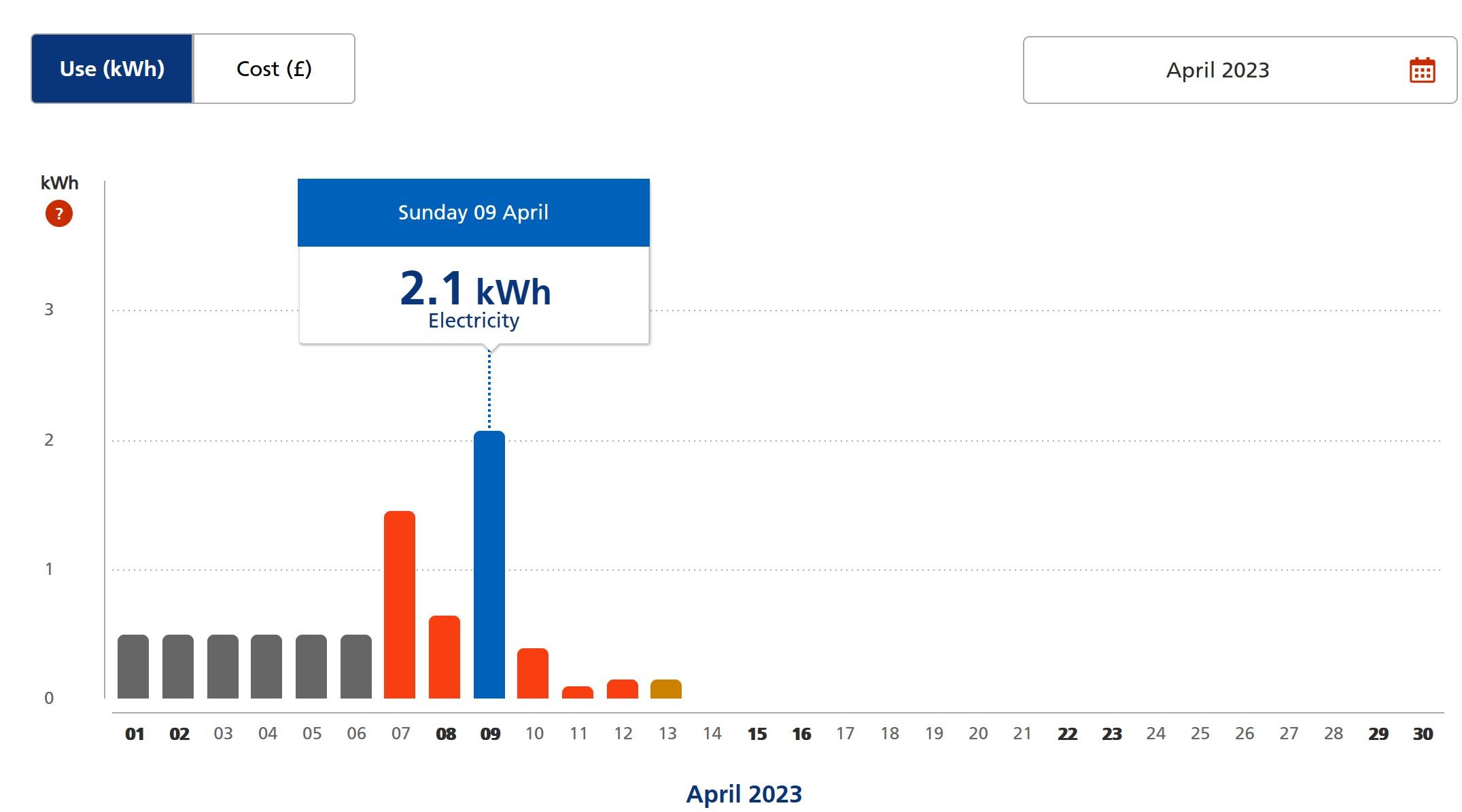
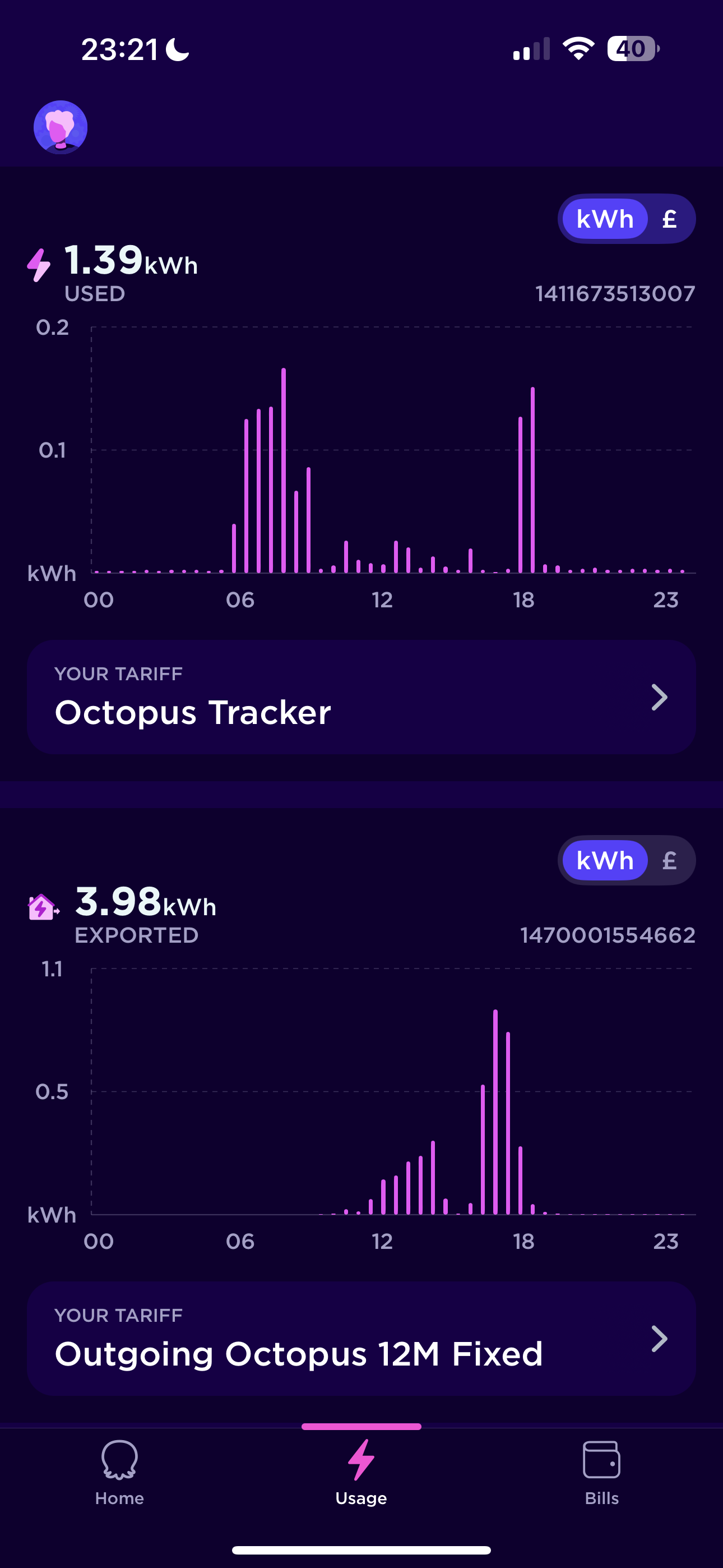
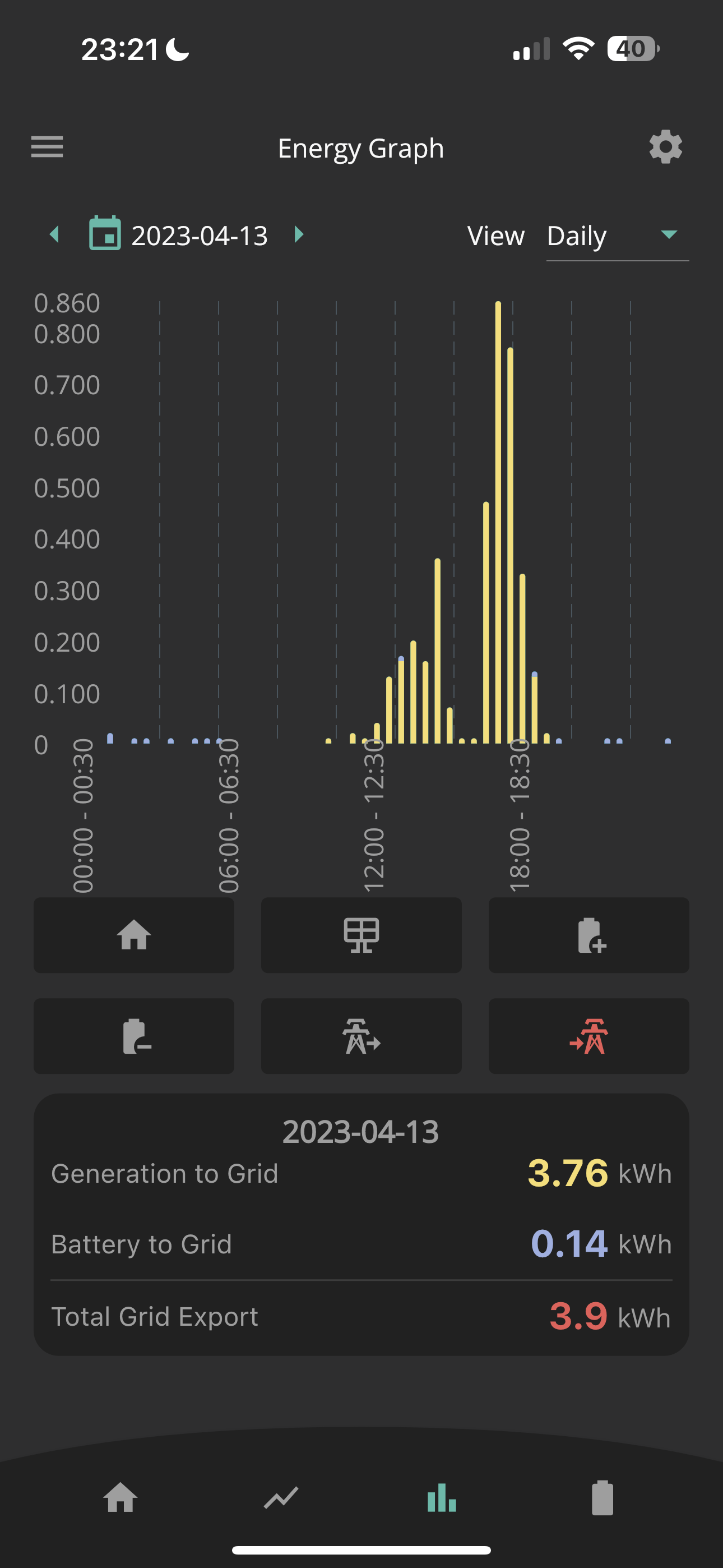
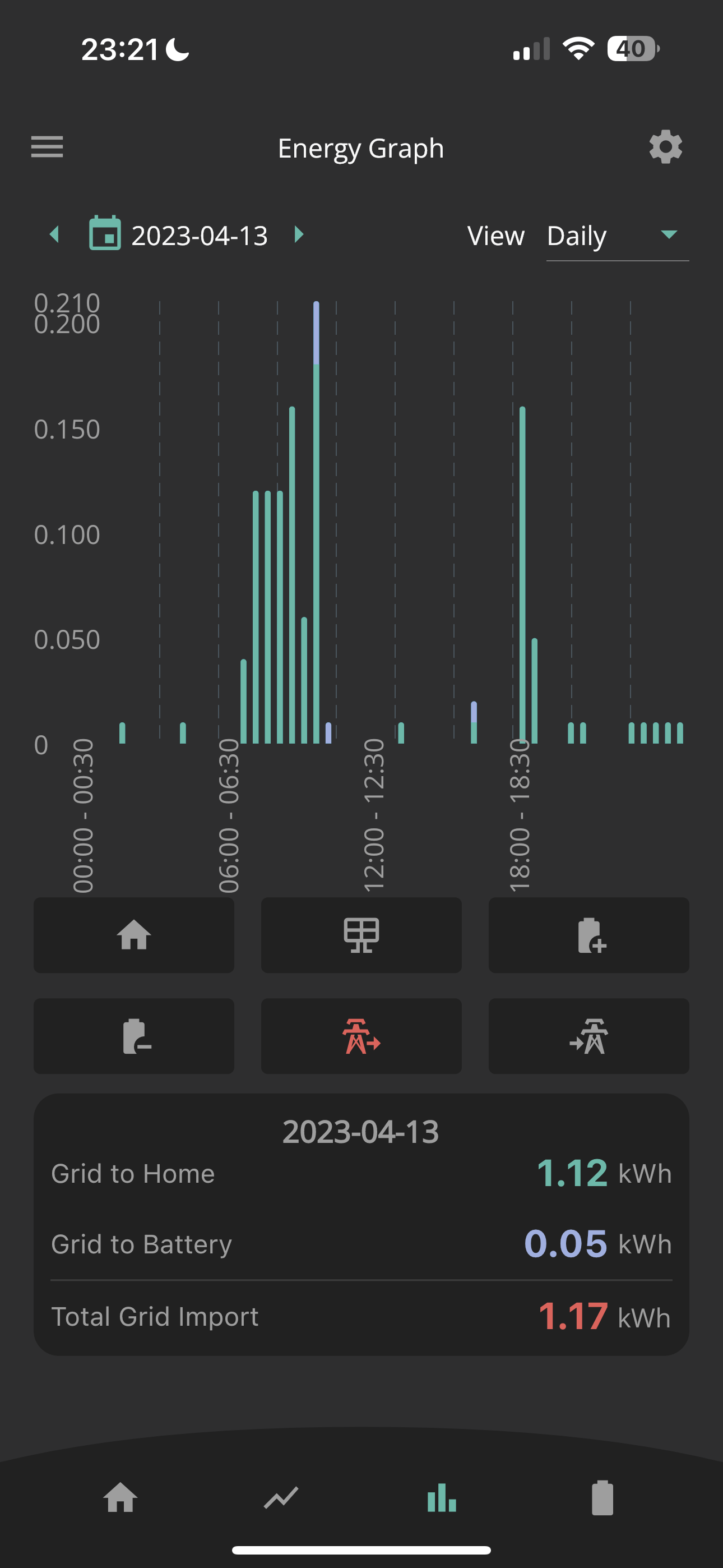
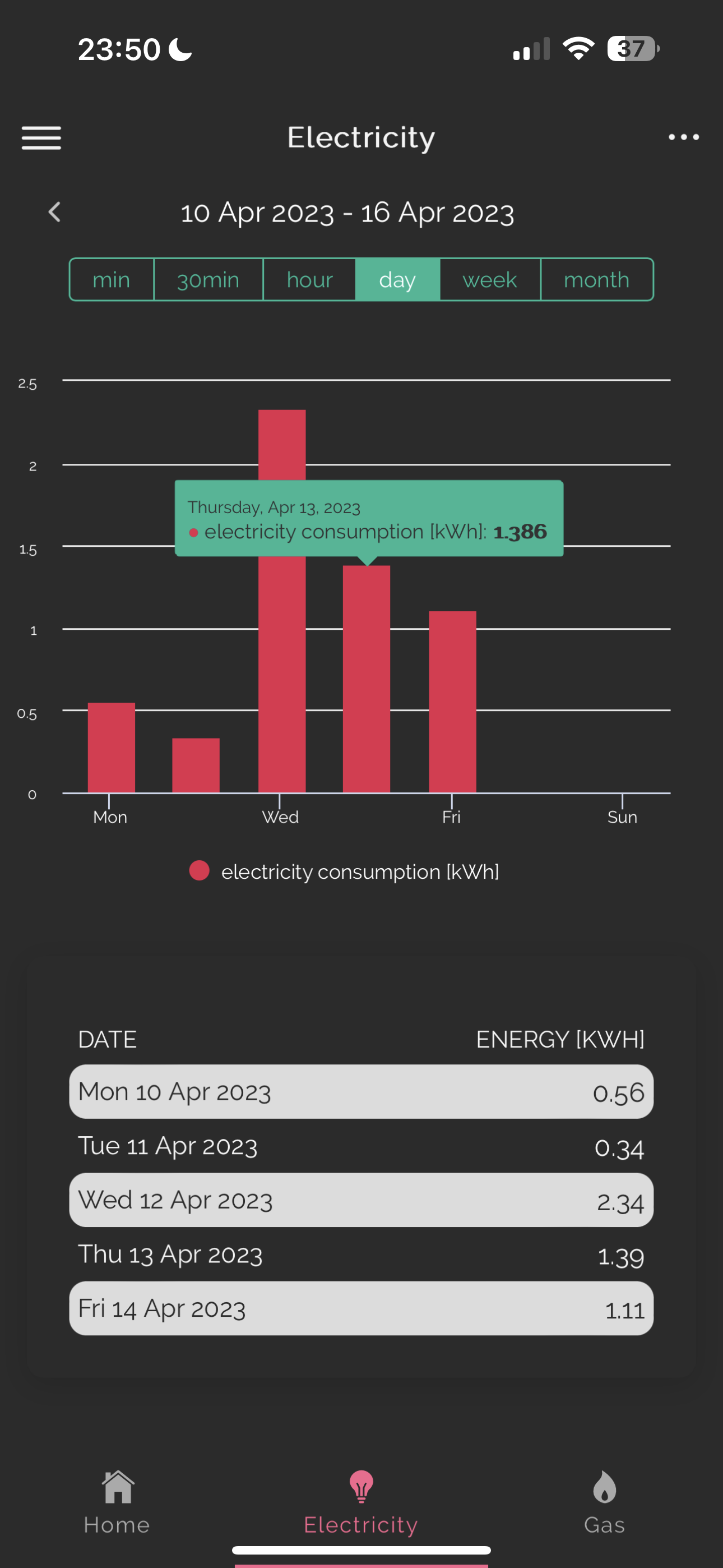
Yesterday’s figures:


Edit added Bright as well.

#25 Simon_C

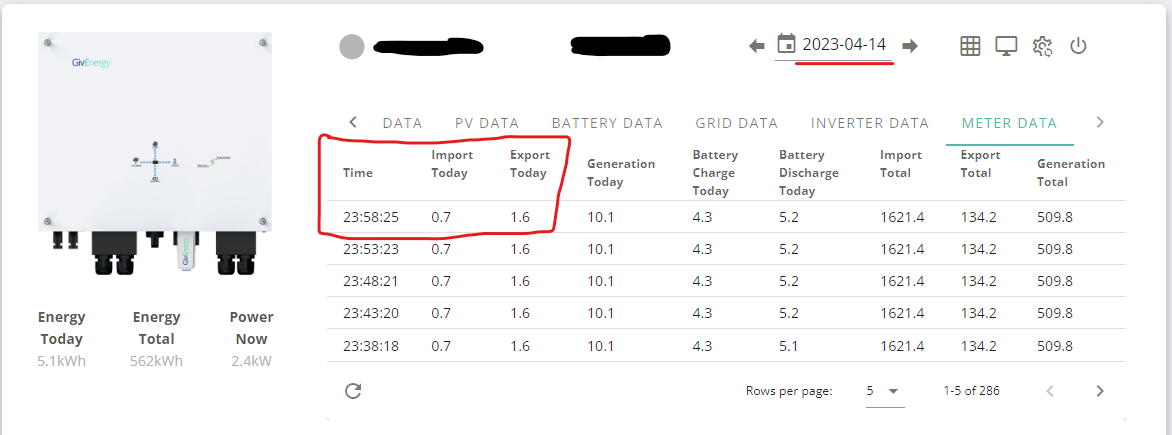
Hook, I don't find the GE Energy Graphs with 30 minute data very accurate compared with the Octopus smart meter data.

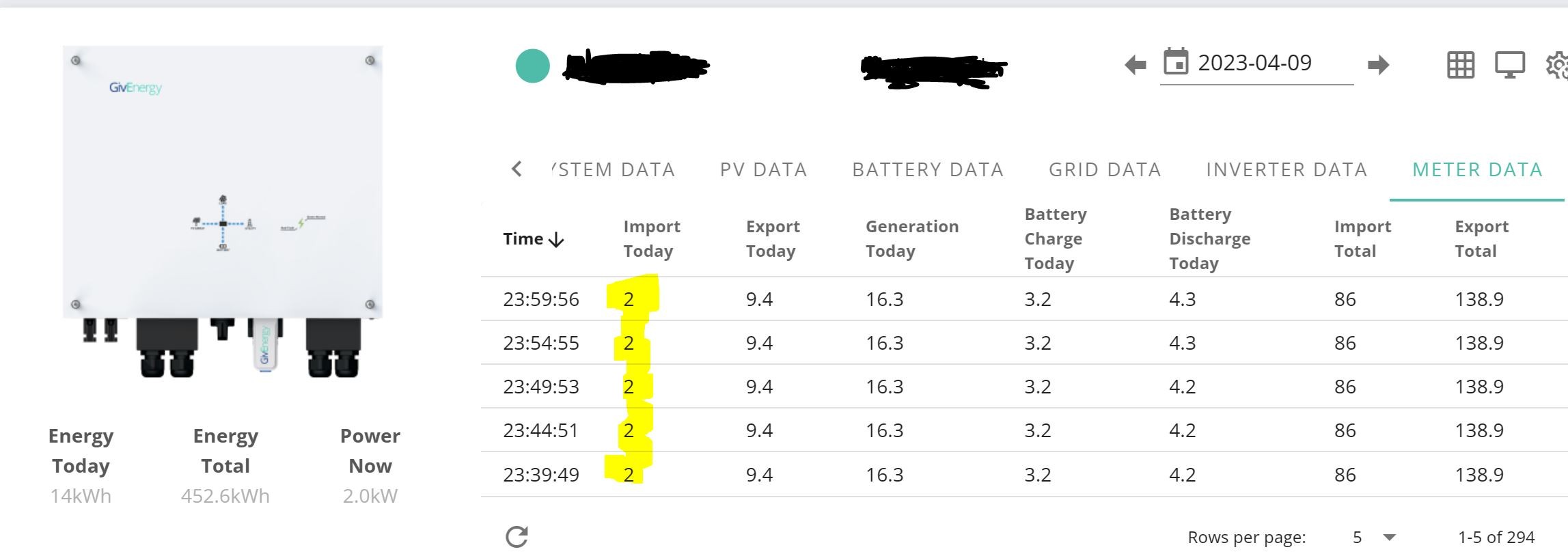
I use the raw data from the My Inverter - Meter Data list for a whole days operation, and find the grid import and export more closely match the values from the smart meter. Sort the list by time in reverse order, so the last log entry of the day appears at the top of the list.

I
#26 ispookie666

For the month of march
EM115 shows Import as 369 kWh
Electricity meter Import is 391 kWh

Solar generation
AC 3 shows 318kWh
Enphase is 319 kWh

I have always had 20-25kWh difference.

#27 Maxwell

Simon_C Thanks for the tip. On mine for the same day i previously posted the data for it shows 2 which is only 0.1kWh different from my smart meter.

K
#28 KBoyden

We had our system installed November 2021. We only had an electronic meter fitted in January 2023(!) In the quarter March to May the reading from the meter supplied was within 0.15 units of the inverter reading. A fortnight ago we had a smart meter installed, having had to change supplier to achieve this, and the closest it has been to the inverter is 0.39 OVER on a daily basis. This means that we have, allegedly, consumed at least 5 units more than is normal. Does anyone have any idea what has caused this and/or how to overcome it please?

T
#29 Tim

KBoyden If your Givenergy portal meter readings are so close to your energy supply meter readings, you are fortunate. Lots of other installations have quite large differences, to the extent that it's not worth trying to reconcile the two. My suggestion is to use the Givenergy portal to monitor performance of your installation; use the energy supply meter to pay your supplier and get paid for SEG, and ignore whether they are the same or different to the portal.

Our two inverters each has an EM115 meter and over the past 12 months, their import registers differ by 5.6% and the export registers differ by 0.5%. This is ironic since the import average for the two meters is 1911kWh and the export is 4462kWh; both being quite large numbers. The same CTs and circuitry producing significantly different errors on import versus export. The energy supply meter has 2141kWh for import for the same period and the export is 4669; errors of 10% on import and 4.4% on export (Givenergy portal vs energy supply meter). The Givenergy portal is interesting but the energy supply meter is always correct.

K
#30 KBoyden

Tim,
Thanks for your reply. My primary concern was that this discrepancy only started after the smart meter was fitted. With the previous unsmart but electronic meter the readings were much closer. Prior to that we had an electromechanical meter so I have no idea about readings.

R
#31 richardkirk

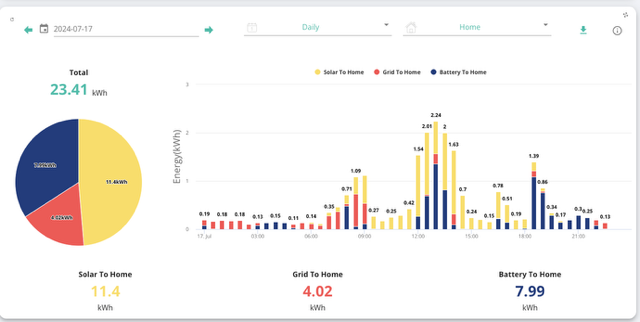
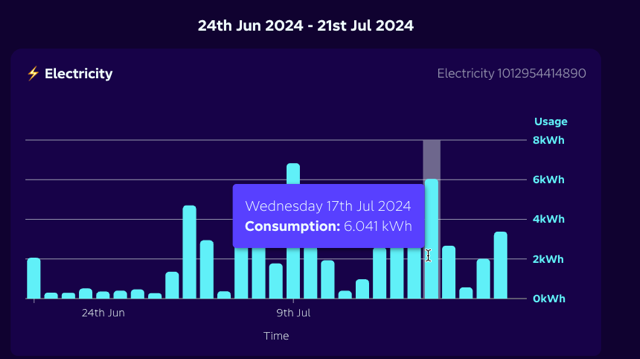
H, I've followed this thread but can't seem to see anyone with a 50% daily difference between GE and Octopus grid imports. See attached - I have my GE app reporting approx 4kwh on 17th July and Octopus charging me for approx 6Kwh on the same day. That's way beyond what I'd expect a reasonable margin of error to be.

Does anyone have any thoughts on why the difference may be so bg ie 50%?

thanks
Richard


P
#32 Phil_H

richardkirk The GE screenshot you have there is only covering what goes into the house load. So if the battery charged from the grid at any point then it wouldn't be shown there. Where it says 'Home' in the right hand dropdown at the top, change it to 'Grid in' and see if the numbers are any closer.

M
#33 MikeReynolds

Hi Richard
Things have progressed since I made this post.
Although I blamed GE for returning inaccurate figures we identified that our Smart Meter was overreading. Mind you, it took a lot of work getting there. Our Provider eventually installed a check meter, which returned figures very close to the GE readings.
Now our consumption figures are around 650kWh per year.