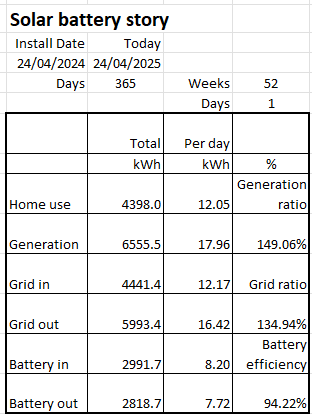
@Hopeful @Roy124
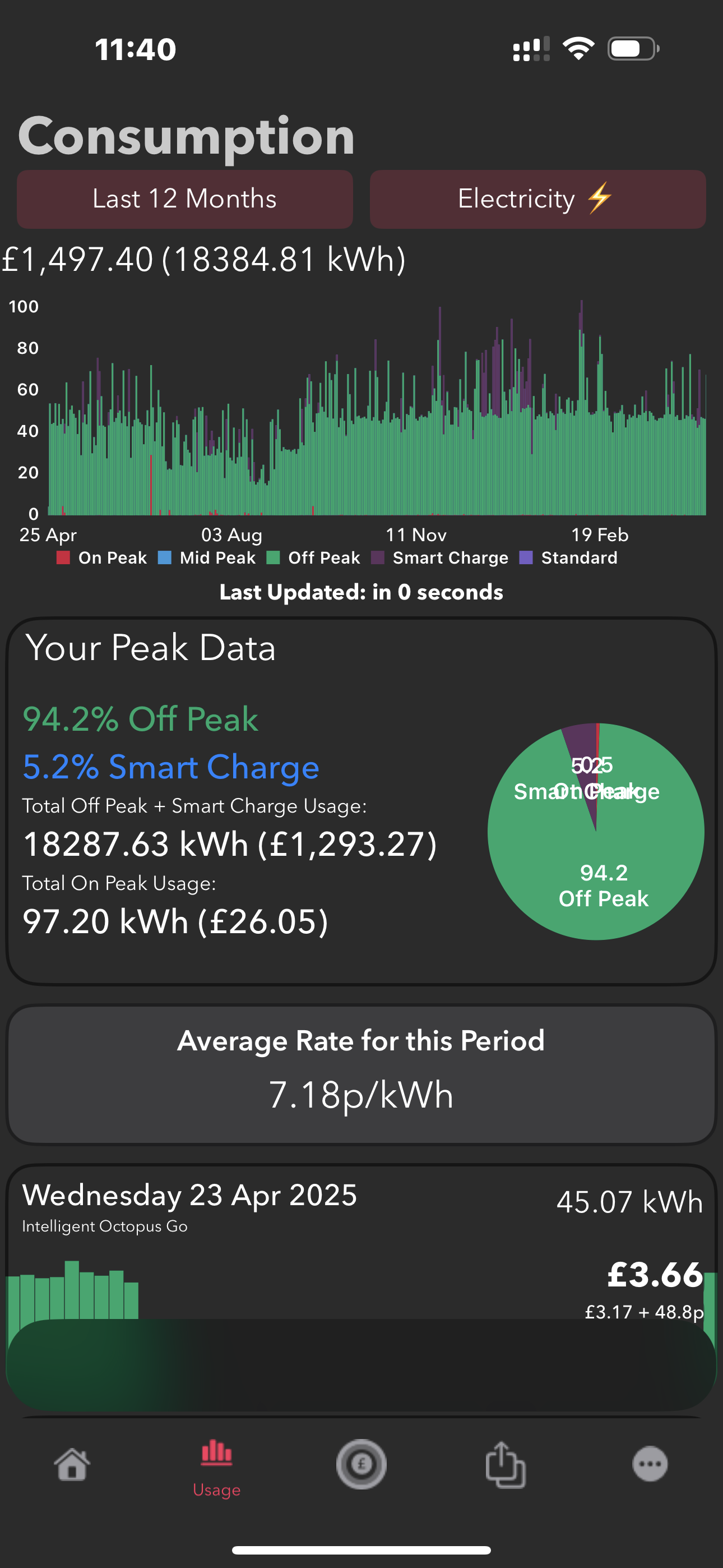
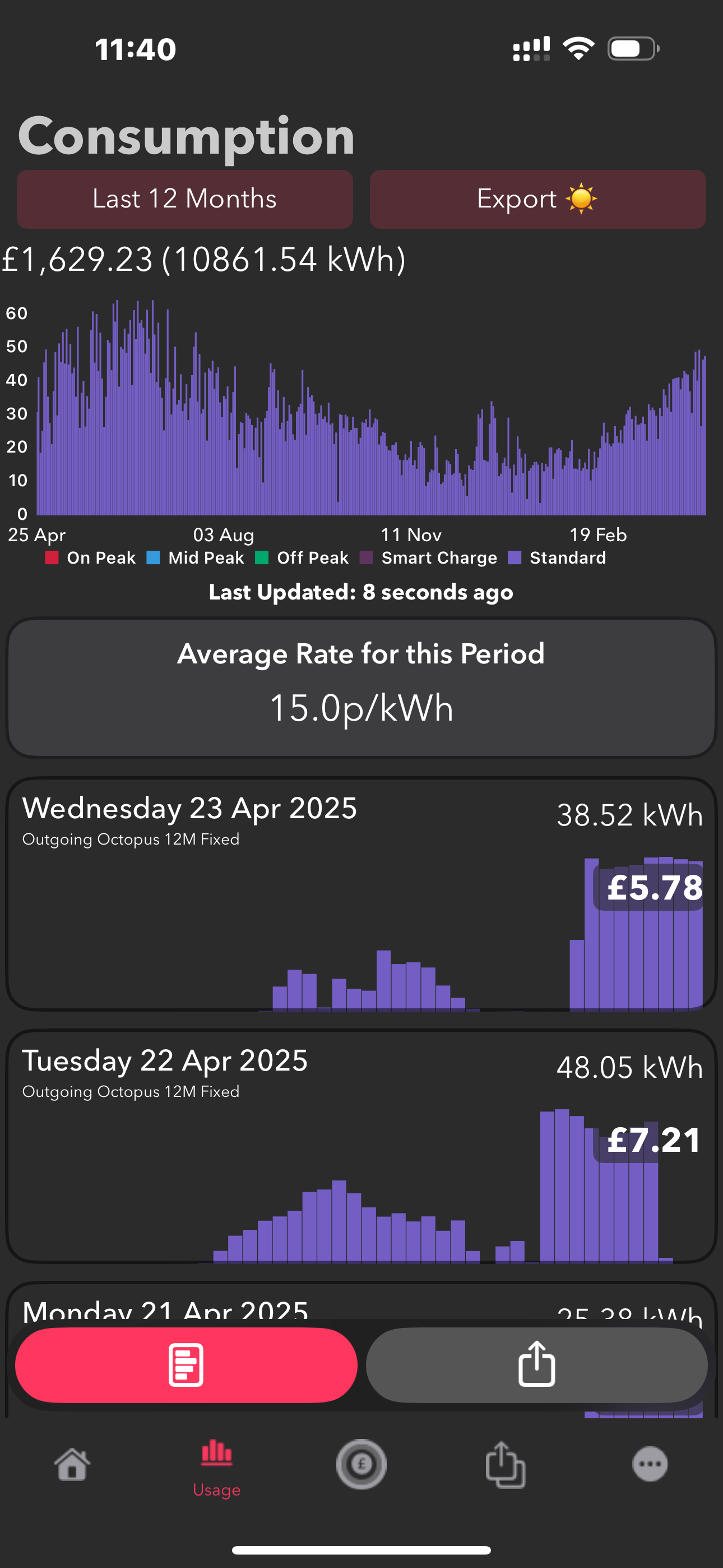
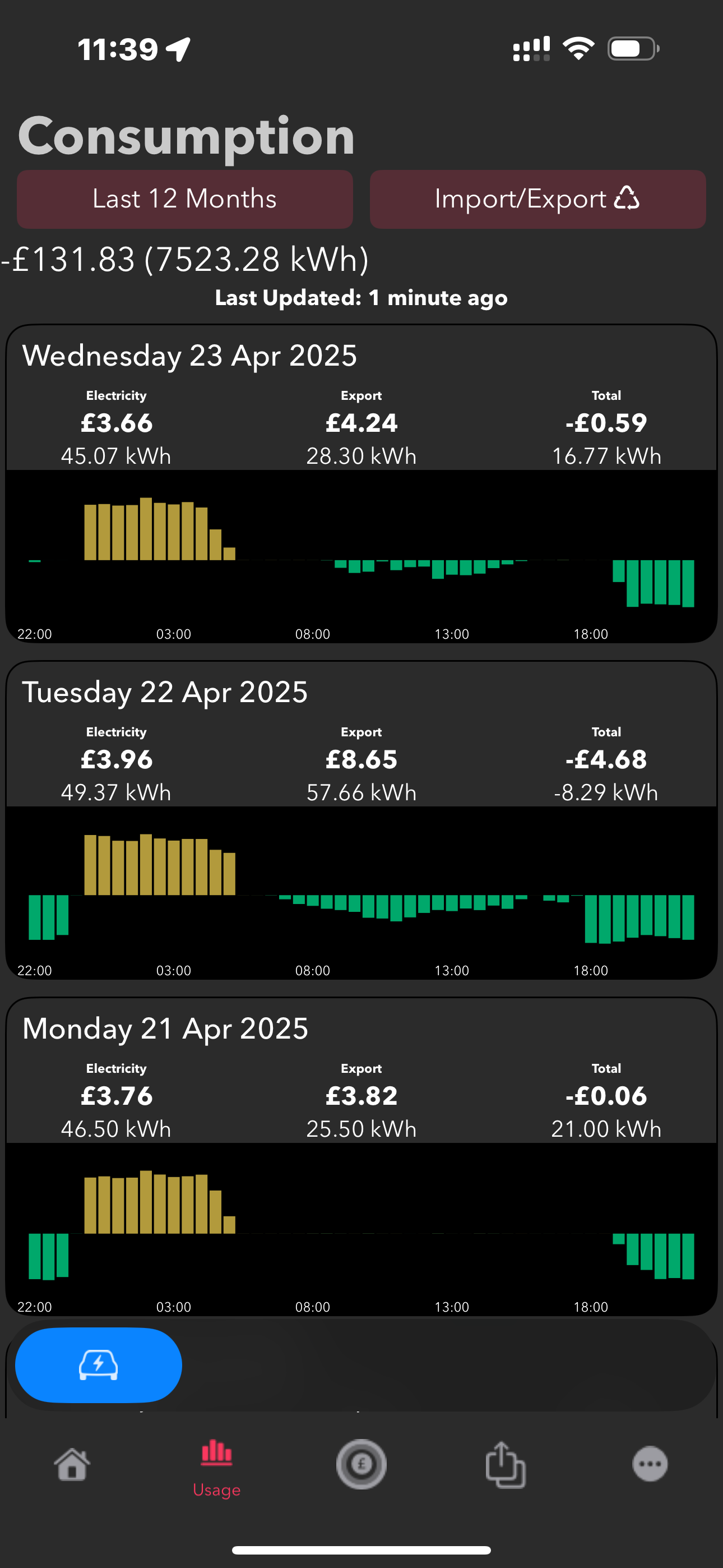
Solar:
Imported: 18,385kWh @7.18p (av.) = £1,497
Exported: 10,861kWh @15p = -£1,629
Minus savings sessions = -£20
Old bill: 18,000kWh x 0.29p (SVR) = £5,220
New bill = -£150 (April 24–> April 25)
Savings = £5,370
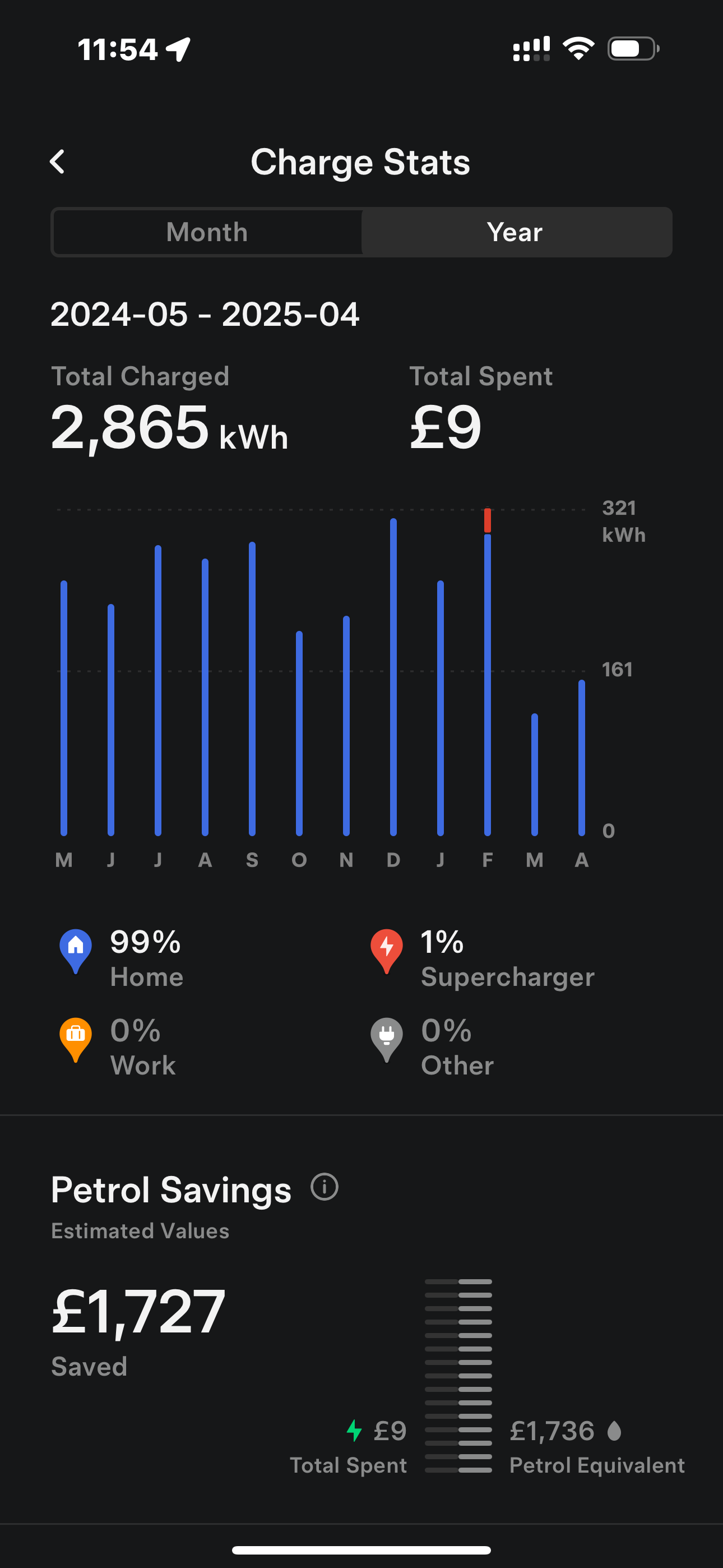
Car fuel savings:
Old petrol bill: £2,000 pa
New bill: £0 pa
Savings = £2,000
I have also tweaked my electric underfloor heating schedules a fair bit since getting the EV so reduced my overall import a bit there as well. And this is purely looking at the SVR comparison. Which I was on pre EV/ solar. Without the solar, I possibly wouldn’t have swapped to Octopus and without the EV I wouldn’t be able to get on IOG.
I can’t fit any more panels on my roof, so that’s not an option. I’ve got 27. It’s full and they aren’t all in the best orientation as it is but I just filled the roof, as incremental cost isn’t that much extra at initial install time, as the scaffolding is there already. Put as many panels up as you can. 100% agree with that.
In my case, having lots of battery storage is really what enabled me to get onto IOG and that has hence given me a net negative bill at present. It may not always be that way as tariffs change. But it enabled me to run all day, all year on 7p electricity. Plus I’ve got flexibility to operate my system differently if things reverse.
@geoffreycoan
Yes, when planning my system, I designed it so that I could fill all 4x 9.5kW batteries in the 6hr window, so chose 2x 5.0 gen3 hybrid inverters. (Actually it was the gen2 initially but the gen3 came out during the installation quote time, so upgraded to that.)
Charge rate on the Gen3 is about 3.3–>3.5kW, so about 1.7kW going into each one of the 4 at the same time while charging, 7kW at max towards the end of charging. The inverter output seems to be the limiting factor in most cases, (also the battery output power) which I think gets missed quite a lot at the design stage, as it isn’t really on anyone’s radar.
From this dual inverter set up my export rate is max 8kW from the batteries during my evening discharge period and 7.2kW normal max draw during the day. I have a 10kW DNO export limit. So it can be higher if I’m generating solar as well. I don’t load shift (except car) and 7.2kW covers the max load during the day. (Don’t draw from the grid when kettles etc are turned on).
At initial design time, export rate was only 4p, so I also wanted the ability to charge the car from my solar generation in the summer or from the stored solar in the batteries when I got home or if I was at home. Rather than let it export at 4p. That changed later though.
At the time I was using a lot of electricity and at 38p on the OVO SVR I had bills of £6,500pa just for my electricity!
At the time I thought 38kW storage wouldn’t be enough to last a winters day and I’d probably be importing 20kWh extra at peak on the coldest days !
Turns out, I mis-calculated that, as I hadn’t allowed for the fact that I’d be using electricity during the off peak period already. I can actually last the whole day in winter on battery power only.
Doing a simple calculation of adding one battery and seeing what extra export you’ll get just from that one extra battery at your current average rate isn’t that simple for a proper payback comparison. Sometimes you have to compare apples with oranges, because we’ll now be dealing with the cost of oranges not the cost of apples any more, which is counter intuitive. 😂
I’ll explain why….
The key thinking (and calcs) should be this: If I add an extra battery, will I be able to get onto the absolute cheapest import tariff, (Intelligent Octopus go for example), last the whole day on battery and get almost all my electricity at 7p on average? If it does then you’re looking at ALL your import cost decreasing from whatever it is now, 15p, 12p, whatever, down to 7p. So whatever you paid for your total import over the last 12 months. Say £2,000 at 14p average cost, just as an example; That now becomes £1,000 for ALL of your import costs. Half ! Batteries, home, car, everything. So adding just that one battery may open up huge savings - 50%, maybe more for some! Then there is the extra export opportunities you mentioned and did your calcs on. So on the face of it payback may not look great initially. But if it unlocks IOG for you then it changes everything quite significantly.
Of course, as we know lots of things change and there are a lot of moving parts and it may work extremely well for some saving thousands but for others it doesn’t look as amazing or work out that way due to existing limitations. So adding a battery and using a simple calculation it may look like it’s £200 a year saving from import/export. In reality it might be £1,200 or more a year in savings. Plus you likely have cut out all those times you had to import at peak time in the past in winter or whenever. They add up but maybe now they have all gone away.
I think round trip should be about 10% for import then export and 5% for solar generation to export for a hybrid, no? 5% for each conversion?
I’ve still got a gas bill, house isn’t suitable for a HP. But I’m really happy with my system and it’s savings.