I have a 3.6kW Gen1 inverter, originally installed with one 5.6kWh battery & now with two. All is well except a) on sunny days the inverter can't process all the solar I get, & b) the batteries can only provide up to 3.6kW so at times of peak usage I'm using grid power to meet demand. I could get a 5kW Gen1 to replace it, but:
would it be technically simple for an installer to swap the two (I guess keeping the same dongle)?
would there be any regulatory issues? I seem to recall I have a certificate which covers me for 3.6kW, would it be difficult to get it uprated?
would there be any benefit in going for a Gen3 one - and would the complexity & hence cost outweigh the benefit?
P
#2pwdst
You would very likely need to seek permission from your DNO to move from a 3.6kW maximum output to a higher one (G99) - depending on the state of your local grid this might not be granted.
If it is a hybrid inverter and you have enough space in the batteries it may be possible for the excess energy to go into the batteries, the rating usually refers to the maximum AC output. The key would be not to fill batteries overnight when you are expecting lots of sun - something like PredBat could manage this for you automatically.
That doesn't help you with your output to cover usage of course.
G
#3geoffreycoan
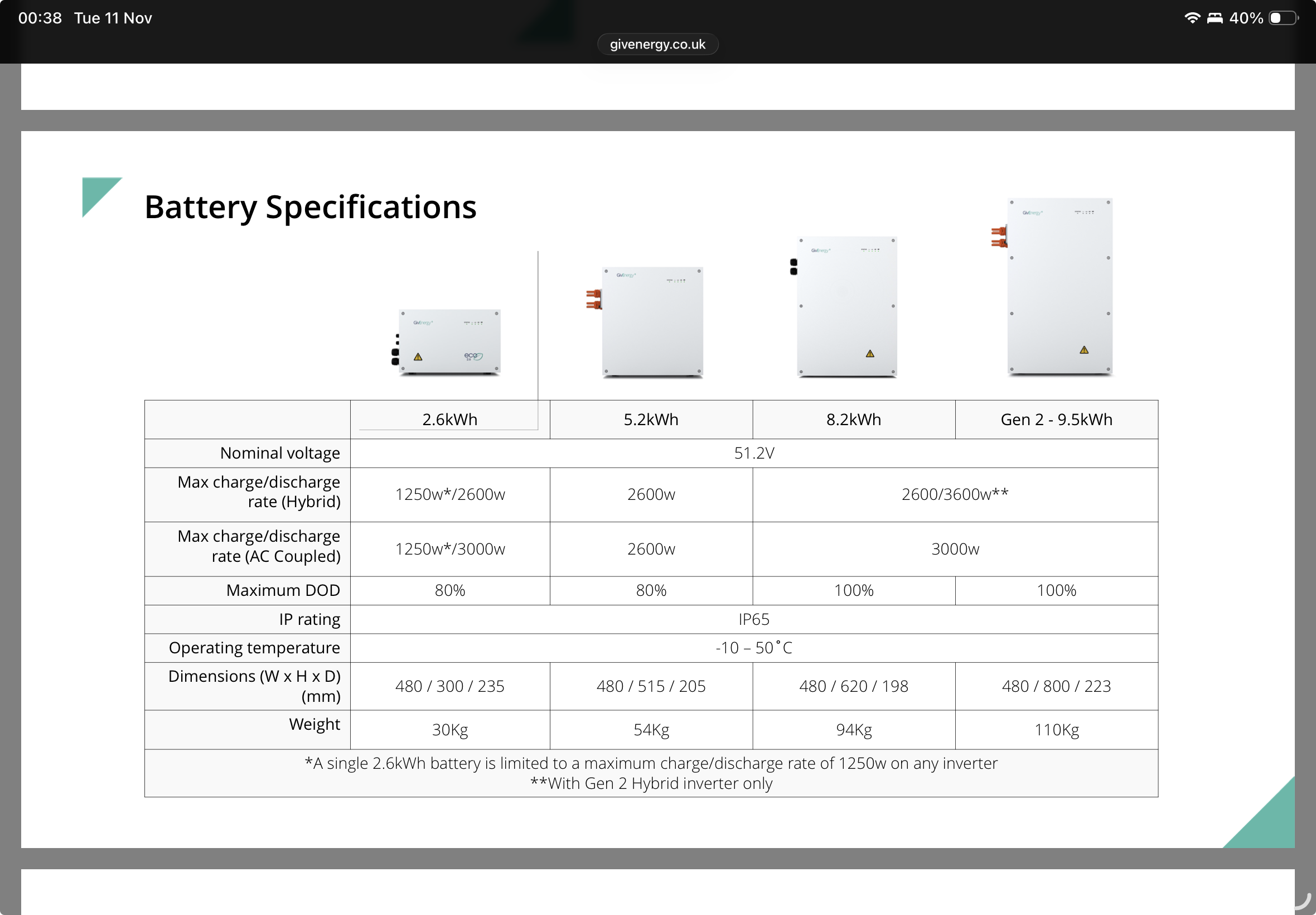
Andrew the 5kW gen 1 hybrid inverter will only give you better solar generation, so on sunny days you’ll get more DC converted to AC to meet your home demand or export. The battery charge rate remains the same at 2.6kW, or more like 2.4kW in reality.
The Gen 3 inverter can charge at 3.6kW but if you have 5.2kWh batteries then they are still your limiting factor and can only charge at 2.6kWh:
D
#4DD
geoffreycoan The Gen 3 inverter can charge at 3.6kW but if you have 5.2kWh batteries then they are still your limiting factor and can only charge at 2.6kWh:
Wouldn't a pair of batteries charge at the full 3.6kW? They'd only be doing 1.8kW each.
G
#5geoffreycoan
DD Wouldn't a pair of batteries charge at the full 3.6kW? They'd only be doing 1.8kW each.
the way I read the above from the installation manual is that the 5.2’s are limited to 2.6kWh. Take your point about whether chained batteries the charge rate is per battery or per chain, but in a chain the batteries are in series not parallel, so I think that since everything goes through the master battery you’re still limited to the master battery rate.
Either way, not sure you’d see much benefit of changing the inverter. You’d get more benefit from adding a second inverter and splitting the PV and batteries one on each inverter
#6Windy Miller
geoffreycoan I can confirm that a chain of 5.2kWh batteries are in parallel not series and will charge at the full 3kW on my inverter even though each battery is limited to 2.6kW so both a 3.6kW inverter and a 5kW inverter will be able to work at their limits charging 2 or more batteries. The current is shared between the batteries.
Having a primary and secondary battery with the chain passing through the primary to get to the secondary doesn't put them in series electrically. They are both joined to the same plus and minus cables. You can verify this by measuring the resistance (with the batteries and inverter shut down) between the positive in connector and positive out connector in the primary battery. I think it has been done this way to avoid the primary having to switch or control high currents to the secondary (through a relay or FETs) and it also means a single battery fault (or it being switched off) doesn't bring the whole chain down.
One benefit for me of the inverter having a limit of 3kW is that each of my batteries only ever charges and exports at 1.5kW and are thus treated a little more gently over their lifetime. My son has a single 9.5kWh battery on his system and is therefore limited to the battery limit of 2.6kW and is always charging and exporting at this limit unless he chooses to drop the current in the app (which he doesn't). This is treating the battery more harshly although whether it really makes much difference over the battery life is yet to be seen.
#7hoggy
Can confirm the tap off points inside the batteries are before the BMS so it only has to deal with its own load not the rest of them.
Inverter output is intrinsically linked to the factory Ah value the BMS reports to the inverter and self scales at 0.5C of that value (which is why if I force the Ah to say 95Ah instead of 102Ah (a normal 5.2kWh pack) it’ll only let the slider move to 2432W instead of 2611W.
Note that in battery chains the inverter adds up each battery factory capacity (AH) to get one final value to use for this power calculation.
G
#8geoffreycoan
thanks guys for the clarification and confirmation. So a Gen 2 or 3 inverter would give a better battery charge/discharge rate for @Andrew, and if it were a 5kW inverter then he'd reduce inverter solar clipping, but would need a new G99 from the DNO
Likely to be about £1000 for the inverter and re-commissioning, so whether that makes financial sense, different question
M
#9mrand31
geoffreycoan Would he need a G99 if the inverter's export limit was set to 3.6kW?
V
#10Vestas
mrand31 Technically no he wouldn't. Anecdotally DNOs aren't happy with firmware export power restrictions which can be (and are) bypassed. This doesn't apply to just GE.