Anyone else seeing unexplained notifications?

10 comments started 2025-11-11 last 2025-11-24
Cloud Portal
B
#1 BobB

Hi Folks,
Every morning I wake up to a notification bubble against My Inverter in my portal.
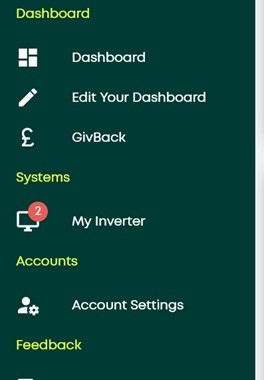
Every morning (except yesterday, so the notification count is two today!) I go looking for what my system is trying to tell me.
There are no new notifications.
There is nothing new in the notifications tab under the My Inverter page.
There is nothing untoward in the logs section... I mean there are many commands and responses logged, but no errors except for the usual Dongle Firmware Version Inverter Timeout issue that I believe affects every every Gen 1 inverter.

I suppose this could be it. It is an error, after all. That would mean every Gen 1 user will see these notifications. Do you all see them?? If not, anyone got any idea what my inverter is trying to tell me?

#2 Windy Miller

BobB One possibility is the low and high voltage notifications. GE had a lot of these at one time and chose to hide the notification rather than change the thresholds or fix the battery problem. But I found that the notification icon was still showing a red number. They went after I did a calibration on later firmware which found new limits and I don't get spurious notifications any more.

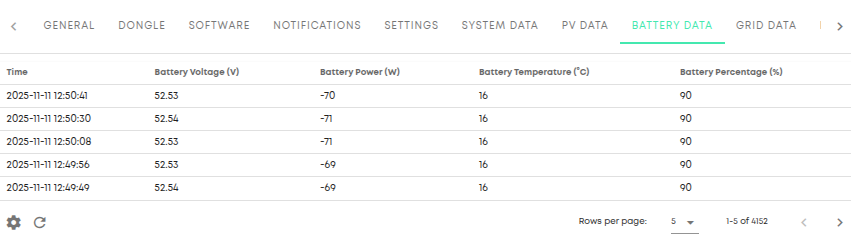
Check your battery voltages at each end of the charge/discharge to see if they look very high or low (the portal should be logging these to make it easier).

https://community.givenergy.cloud/d/4819-notifications
https://community.givenergy.cloud/d/4827-hybrid-gen-1-battery-several-overvolt-notifications-disappeared

W
#3 wrighar

I've had this now and then on mine since April 2024 when installed.
I always assumed it was a cookie issue.

O
#4 Ortwin

I have also seen this randomly with no actual notices or explanations.

V
#5 Vestas

Windy Miller That's exactly what it is - overvoltage warnings. GE hid the warnings rather than fix the issue - they claim there's no problem but I saw >57V on a 9.5kWh battery more than once, which is clearly going to cause damage/reduce lifespan.

The portal doesn't record the actual battery voltage either - it records the inverter's idea of the battery voltage.

I have automations which stop that but those require GivTCP/HA.

M
#6 M_J

If you get the free inverter app you get to see the messages.

I think the free version shows them. I have the paid version for scheduling but worth loading it up for free.

You have to run it at home to catch the messages as they get sent. So if running on a phone and you are away I don't think they will be captured, could be wrong?

R
#7 Rubikcube

If you have an android device, you can use the Inverter Monitor app to see the error messages. Most likely it is battery over-voltage which only happens when full charge is reached. If you charge overnight, then it's likely to happen around 5am. The app needs to be running at the time the fault occurs. Turn on collect stats in settings, and make sure the device is plugged in (to a charger). There is an exclamation mark icon to see the fault messages.

https://play.google.com/store/apps/details?id=uk.rubikcube.invertermonitor

If the messages are over-voltage, a calibration usually fixes the problem. You may want to record the calibration capacity of each battery before and after running a calibration. This capacity is shown on the battery screen.

B
#8 BobB

@Windy Miller Thanks Wendy. I recalibrated and found some more capacity!

Vestas
Hmmmm. Your reply got me looking further into my system... And I found this:

I peak almost every day at 57v (this is after the recalibration). You were very confident that this is bad. In your view, does a graph like this have you running and ducking for cover, or is a short spike like this just an inevitable maximum that shouldn't concern anyone?

B
#9 BobB

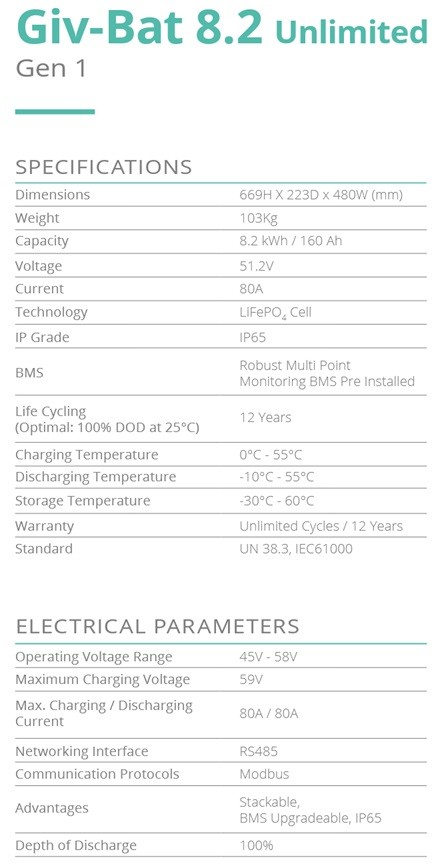
Looking at the spec sheet, GE seems happy with a voltage peak of 58V and max charge voltage of 59V:

I might slow down my research of explosion damage insurance, unless anyone is about to advise otherwise!

V
#10 Vestas

BobB Basically it depends on the age/usage of the cells - and in some cases how well the cell packs are connected.

There will always be a few cells which become outliers during usage and while >57V charging might be OK for most of the cells, there are likely to be a couple which hit >3.65V which isn't good.

Ideally the battery charge voltage should peak at 54.4V (3.4V/cell), at which point the charge current is reduced. Various combinations of inverter/battery firmware have had varying effectiveness in how/if this works. Ultimately they all depend on the BMS "SoC" figure to track what charge level is actually in the battery & if that's wrong....

Lots of threads/megathreads on the effectiveness of SoC tracking which have more info.

Edit - its not a safety issue, its more a case of reducing battery capacity/lifespan.