Car charging drains house battery

24 comments started 2025-12-30 last 2025-12-31
Cloud PortalGivEnergy ProductsEV Charger
A
#1 Ann_Hudson

Whenever I charge the car overnight (from grid) the system drains the AIO battery in the process. Is there a way to stop this? I've checked the settings on the web portal for both EV and Inverter and can't see anything obvious which controls this.

Thanks in advance.

P
#2 pwdst

If you set your car to charge within a fixed window then the easiest way to avoid this will be to set your battery to charge in the same period.
Once it is full it should effectively pause for the rest of the configured charge period and resume discharging after it has ended.
If you don't want to charge at this time, for example your tariff has cheap metered electricity just for the car, then a timed pause might be more appropriate.
If you have dynamic charging periods then either moving the CT clamp so that the battery doesn't "see" the EV charger load (likely requires an electrician, may require wiring changes) or an automation solution like PredBat may be required.

A
#3 Ann_Hudson

The last time we tried to charge both battery and car at the same time (over a year ago), the system failed - I presumed it was some form of overload, so we always avoid charging them simultaneously.

I'm fairly sure the guys who installed the system said they were setting it up in such a way as to prevent battery discharge to the car, as they considered that a pointless exercise - using one battery to fill another.

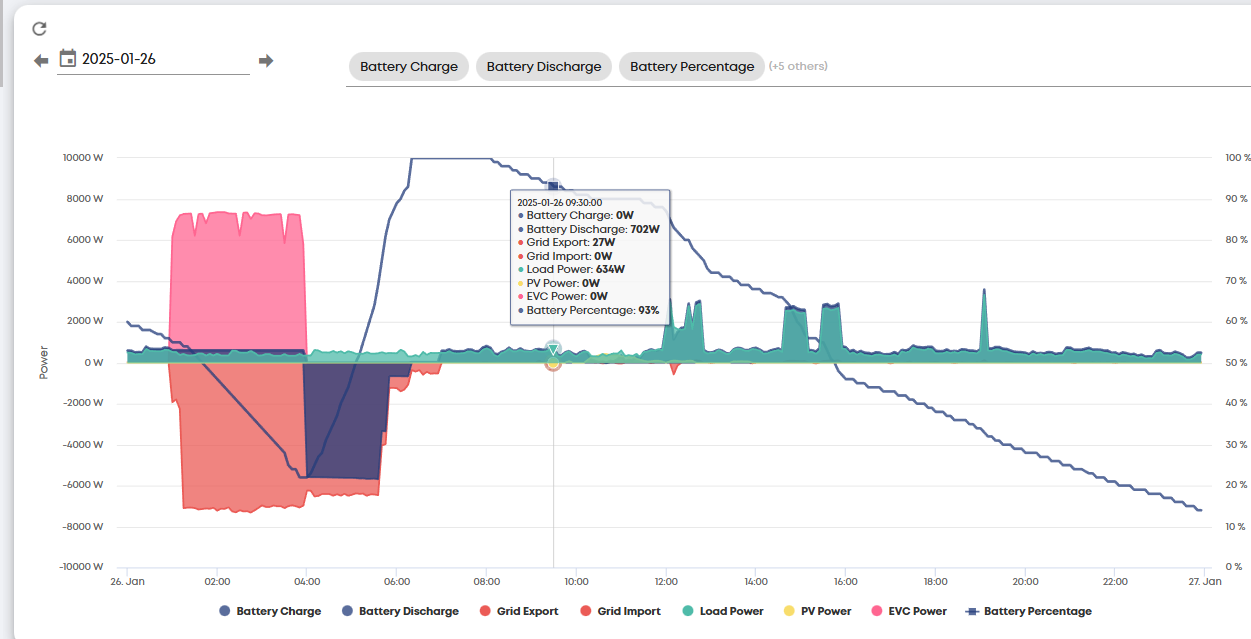
We didn't have this problem previously - I've just checked the system from earlier this year (Jan) and can see from the graph (below) the battery didn't drain, so wonder if something has been tweaked on the Giv Energy side of things, possibly a hidden option somewhere within the system. The only thing that we might be doing differently now, compared to previously, is charging for a given period of time, rather than to a particular percentage level, though that tends to be just the AIO battery side of things, which I would set to charge to, say, 90%. Now I just set it to, for example, 2 hours.

D
#4 DD

Ann_Hudson looks like the battery was discharging, but at a relatively low constant power. Yet the SoC seemed to fall much faster than might be expected - about 30% in two hours?

A
#5 Ann_Hudson

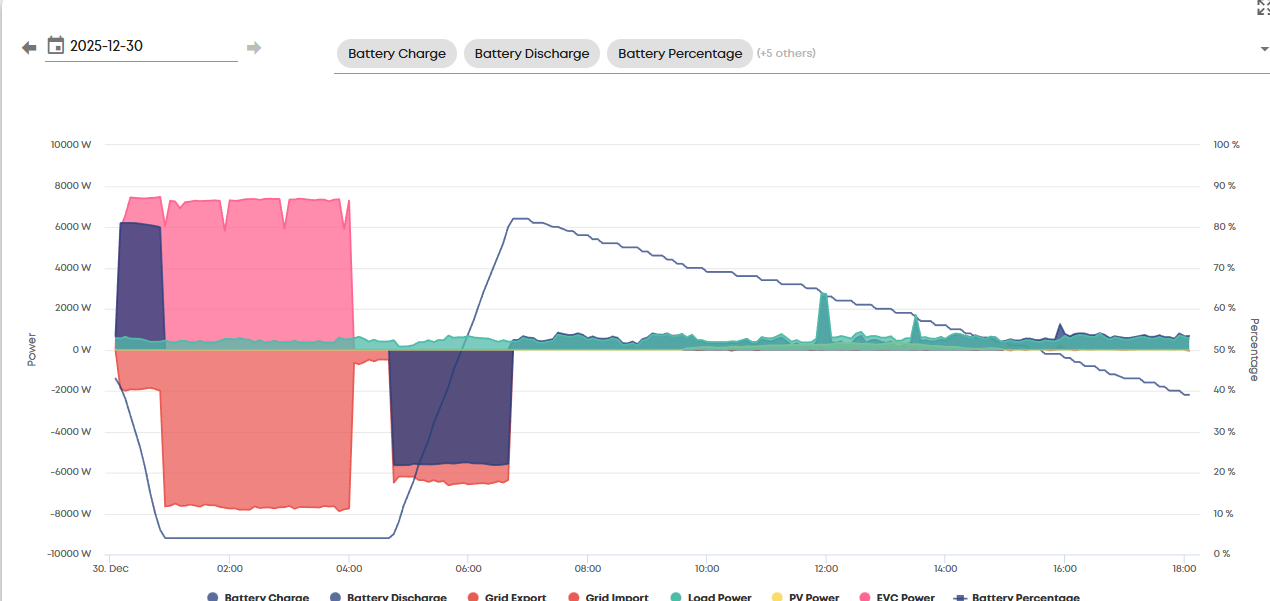
To compare, this is the graph from last night/this morning, which clearly shows the battery discharging (deep blue overlaying the pink car charging) with battery charge dropping from 43% to 4% (minimum) in less than an hour, and the grid import for the first part of the EV charging period is far less than it is once the battery has depleted.

In the graph from January (previous one) there is very little battery discharge shown overlaying the pink, which suggests to me the battery was discharing normally, powering usual background appliances (fridge/freezer, alarm, etc).

#6 Simon_C

Has anyone worked on your smart meter, or wiring in the meter box?

They may have inadvertently moved the clamp on current sensor for the GE grid meter, so it is now measuring current for the true grid in/out rather than just for the household load. This would explain the change in operation.

C
#7 CurlyDownes

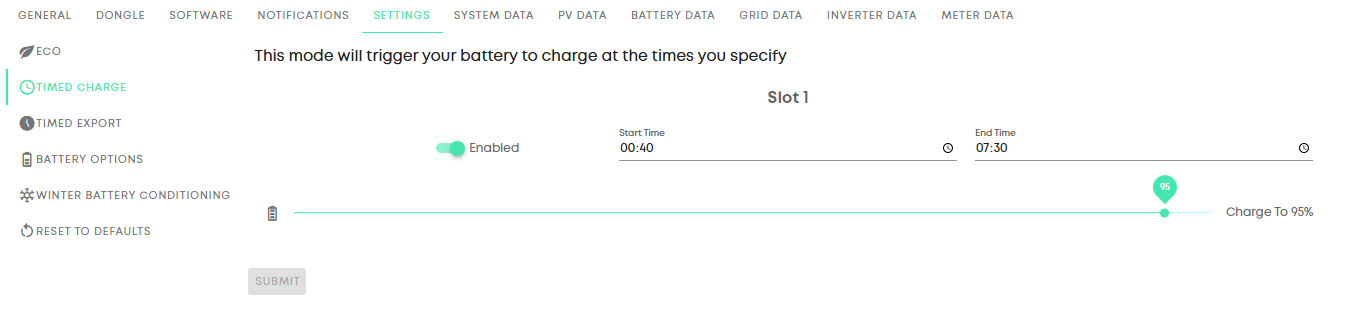
Have you set a 'Timed Charge' within settings?

As it's winter with very little solar PV I've got my batteries to charge to 95% during my cheap overnight power slot, see screenshot below.....

D
#8 DD

Ann_Hudson which suggests to me the battery was discharing normally, powering usual background appliances (fridge/freezer, alarm, etc).

I interpret it slightly differently... During the day on the previous graph, battery power (dark blue) and consumption (light blue) fluctuate in tandem. But overnight, dark blue is flat, ignoring the light blue wiggles.

D
#9 DD

Ann_Hudson The only thing that we might be doing differently now, compared to previously, is charging for a given period of time, rather than to a particular percentage level, though that tends to be just the AIO battery side of things, which I would set to charge to, say, 90%. Now I just set it to, for example, 2 hours.
You would generally set both a time limit and a percentage target, and it will charge until either the end of the time window, or the percentage is reached, whichever happens first.

D
#10 DD

Ann_Hudson The last time we tried to charge both battery and car at the same time (over a year ago), the system failed - I presumed it was some form of overload, so we always avoid charging them simultaneously.

Could possibly charged at reduced power? Not sure how the AIO works, but on my hybrid, there are two settings that control charging power: one is always in force, and limits both solar and grid charging ; the other seems to affect only grid charging, so I generally leave that at 50% since that's enough to get me to 100% overnight.

We didn't have this problem previously - I've just checked the system from earlier this year (Jan) and can see from the graph (below) the battery didn't drain, so wonder if something has been tweaked on the Giv Energy side of things, possibly a hidden option somewhere within the system.

Is it a GivEnergy charger ? If so, it's entirely possible that GE have changed some software and broken something. But if it's a third-party charger, there isn't really any software change that could explain the change in behaviour. Moving CT clamp, as mentioned, could do it.

  • oh, unless you've enabled Smart Tariff support on the portal - that is something that they could have changed. Though because you charge battery after charging the car, I don't think that's something the Smart Tariff support would attempt to do.
D
#11 DreadorUK

My AIO is fine at full charge along with charging car and running a few heavy internal loads like dishwasher, tumble dryer etc so shouldn't be tripping as such.

However as mentioned if you have 6 hours of cheap electric your looking to 4% to 100% needing around 2.75 kWh to fill the battery in those 6 hours so just reduce the charge rate on the battery to say 3 kWh.

P
#12 pwdst

Assuming you have a 60 Amp house fuse, which would surprise me if a DNO gave permission for both an All In One and car charger, then 15kW is pushing it at the grid maximum of 253 volts - which would be your car charger, plus battery and maybe a dishwasher with nothing else running. As I understand it the house fuse would probably tolerate multiple hours of abuse if you exceeded this before actually failing though.
If you have an 80A fuse then you could probably add a kettle and washing machine to the mix at the same time.
If you have a 100A house fuse then you should be able to pull 25kW within limits, although I would feel more comfortable doing that in the winter than the summer if you wanted to do so for long periods.
In any case with an All In One I believe you are going to have issues above 80A going through the gateway so it does partly depend how everything is wired with your EV how much of a problem that would be.
In any case backing off on the AIO charge rate it should be perfectly possible to charge the All In One and car at the same time, whilst even allowing some relatively energy intensive appliances.

M
#13 mikes01666

I've an AIO.
On IOG I have a timed charge slot( to100%) of 23.30 - 05.30 and a timed discharge slot (to 5%) of 05.30 - 23.30.
The car controls a granny charger to charge during the 23.30 - 05.30 slot.
The car never discharges the battery.

D
#14 DD

mikes01666 Shouldn't need the additional timed discharge - the timed charge should be enough to inhibit discharge during that time.

C
#15 CW

I'm on an AIO with Gateway - my EV charger (Zappi) is wired to the incoming grid breaker so the AIO doesn't see the draw ever. See this post

A
#16 Ann_Hudson

Simon_C
The meter has been read by a representative of the energy company, but, as I was with him the whole time, I'm fairly sure he didn't move any clamps or anything else, so I think we can rule out this possibility.

A
#17 Ann_Hudson

CurlyDownes

Yes, we use Timed Charge. We leave the limit set to 100% and adjust the time slots as required, to a maximum of 2 hours, 45 minutes - the time needed to take the battery from 4% to 100%. If we expect reasonable levels of sun, notice the battery still has a reasonable level of charge or are unlikely to need full charge the next day, we adjust the time period to suit.

A
#18 Ann_Hudson

DD

Yes, I did wonder about the possibility of adjusting the power levels of one or both charge sessions, but felt it safer to simply avoid the overlap. It's rare we need to charge the car fully - planned trips away for example.

It is a Giv Energy car charger, installed at the same time as the AIO, and nothing has changed on that set-up (to my knowledge).

We DO have tariff values set up in the Smart Tariff section, to provide rough estimates of costs of electricity. I can't imagine why they would affect this, but am happy to hear anything you might know about how this could impact the charging. We only have import rates set, basically just the overnight and daytime electricity costs.

A
#19 Ann_Hudson

pwdst

Sorry, I have no idea what size fuse we have, or how to find out (without getting an electrician in).

The car charger seems to max out at around 7 KwH - not sure if this is a limitation of the installation as a whole, the car charger, or the car itself (most likely the latter).

We charge overnight, with no kettle or washing machine or similar "high energy" appliances, just regular background devices and a few items on standby.

My partner has just suggested an option we can try next time - adjusting the AIO battery's minimum level from the default 4% to close to the level it has at the point we go to bed. So, for example, if the battery is at 40% at 10pm, setting the minimum value to 30%. Would this prevent it discharging down to 4%?

A
#20 Ann_Hudson

mikes01666

I have no idea what a "granny charger" is... unless you're referring to me. 🙂

A
#21 Ann_Hudson

CW

Hmm, I'm starting to wonder if the wiring might be the problem, though that wouldn't explain why it seemed to work properly earlier this year - see Jan graph above.

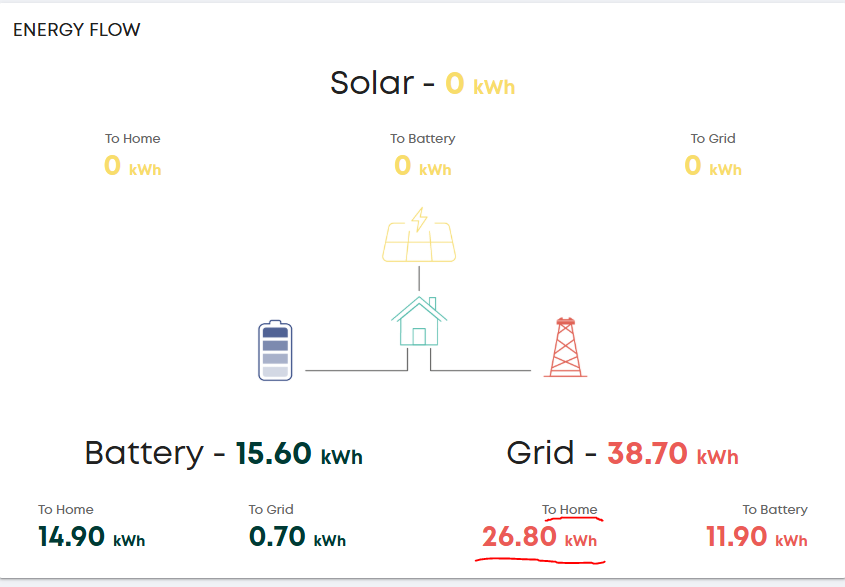
If I view the Daily Report from yesterday, it shows considerable grid import to "Home", most of which was actually going into the EV:

To my knowledge, it's always done this. I assumed the GE reports didn't report EV charging, as nothing on our reports shows anything EV related.

Besides the GE AIO and EV charger, we have an EV Gateway. All were installed by supposedly qualified engineers, though I did get the impression they weren't overly familiar with the minutiae of GE's system/wiring requirements, and our PV installation certainly caused them headaches, so it wouldn't surprise me if there was some form of issue with the installation. I don't know how easy it is to check... for a very much unqualified person like me.

M
#22 mikes01666

DD Correct as you shouldn't be able to charge and discharge at the same time. However as the system is working without problem I'm loath to change it.

M
#23 mikes01666

Ann_Hudson A three pin 13A charger (usually supplied with the vehicle) that plugs into an EV three pin charge socket. The vehicle limits the maximum charge to 10A presumably for safety purposes. Slow, but sufficient for my needs.

D
#24 DD

Ann_Hudson We DO have tariff values set up in the Smart Tariff section, to provide rough estimates of costs of electricity. I can't imagine why they would affect this, but am happy to hear anything you might know about how this could impact the charging.

I don't use the smart tariff cards myself, but I believe they can adjust your inverter settings to follow cheap periods according to your tariff.

Ann_Hudson The car charger seems to max out at around 7 KwH - not sure if this is a limitation of the installation as a whole, the car charger, or the car itself (most likely the latter).

Probably charger and car - 7kW is a typical upper limit (for a single phase).

Ann_Hudson My partner has just suggested an option we can try next time - adjusting the AIO battery's minimum level from the default 4% to close to the level it has at the point we go to bed. So, for example, if the battery is at 40% at 10pm, setting the minimum value to 30%. Would this prevent it discharging down to 4%?

Yes, that would work. But I'd recommend one of the early suggestions instead - a timed pause. The app makes it available as a timed discharge, so as above you'd configure it to allow discharge from 6am to 1am (and it will actually configure a pause from 1am to 6am.)
Its fine for it to overlap the charging period, so you don't need to adjust it when you adjust the start of the charging period.