I have a system that I am installing with 22 panels on three different orientations of the roof. I wanted to use 4 strings so decided to go with 2 inverters each with a battery attached to them. However I am being told by GivEnergy that they do not support this configuration as the batteries may charge and discharge into each other. Does anyone have experience with this and can anyone offer a potential solution?
Dual Inverter

I assume you have used the givenergy hybrid inverters? Sadly I do not know a fix. However, if there is an option to change the inverter to other brands, then you could get the AC3 (or a couple) to charge the batteries. I have 2 seperate solar arrays, 2 inverters that feed an AC3 and a 8.2 battery.
I still have time to change the design and was thinking of using the AC coupled for the batteries and another inverter for the 22 panel array but would need 4 mppts.
peter-docherty We have 32 panels on four strings connected to two Givenergy HY5s, each with its own 8.2kWh battery. These play together very nicely connected to the same "solar" consumer unit. As the panels are all mounted on a south facing roof, with exactly the same orientation and angle, the inverters are provided with the same PV at the same time and the batteries charge at pretty much the same rate. They also discharge at the same rate, sharing load 50-50. I know other people have reported problems and it may be that different orientations are what causes the problem. All I can say is that our plant rocks!
Wow that is interesting Tim. I wanted to run 2 hybrid inverters and a battery off each but GivEnergy have said they don't currently support dual hybrid inverters into the same consumer unit. I will need to phone them again to get them to clarify what the limitation is. It certainly would be cleaner than my current alternative which is 2 third party inverters and 2 AC coupled inverters for the batteries.
peter-docherty I'm confused as to what the issue is. In ECO mode, the inverters take all of the PV and push it to house load as needed and battery if it needs charge. If house load exceeds PV, the inverter draws from battery to supply. The inverter does not draw from grid at all in ECO mode, unless the battery is below 4%.
I get that AC-coupled can fight another AC-coupled but the hybrids in ECO mode just don't draw from AC at all. It shouldn't matter what orientation your PV is. With four strings, each inverter will make best use of whatever PV is available at any point in time and either supply house load or charge its own battery. It won't pull from AC whatever the other inverter is doing as long as it's in ECO mode.
Mine is due for install soon, 9 panels east and 9 panels west - each on on separate inverters and batteries so will see if it runs as well as yours
Thanks Tim - you’ve managed to help convince me on the direction I should go.
I have 4 panels west facing 4 panels East Facing and 15 panels South facing. Current set up is the East and West facing panels feed in to 1 MPPT and the South facing array into the other. I also have 2 x 9.5 kWh batteries.
My options have been
- Dual 5.0 Hybrids with a 9.5 on each inverter
- Other brand inverter and an AC couples
- Optimisers on the East West panels.
How does the Dual hybrids appear on the dashboard / app?
Thanks, Rob
rob1980 How does the Dual hybrids appear on the dashboard / app?
They appear individually in the My Inverter tab but you can toggle between the two to see individual settings/values for each. The summary at the top sums the values except the house load only shows data for one inverter. I believe this is a known issue that is being worked on, along with the report data not summing corectly.
Another question if you please, I've just had a response from DNO that after all this time only 3.68kW export without further works.
Western Power, but feel it's a bit of a cop out because they are inundated.
However, if there is no way round this, can I still run two inverters for the benefits of charge and discharge, but limit the export with software - just wondering if it's more complicated with two inverters involved.
94jdh I believe they are obliged to allow you 3.68kW for SEG purposes. If the local infrastructure would benefit from additional export from your plant they would allow it, but only after you'd paid them for a survey. In fairness, the distribution network was always designed "top down" so that it was fed from large generators feeding the grid transmission system (pylons at more than 132,000V typically). This was then connected to the local distribution network (hence Distribution Network Operator such as Western Power) and sent around the area in 33,000V or 11,000V overhead or underground cables. These then fed local transformers (in the corner of the housing development or mounted on a pole in rural areas or in underground substations in cities) and came out to the home as a 415V 3-Phase supply on "telegraph poles" or underground more recently with single phases being fed to each supply point (DNO fuse and meter). From an electrical design point of view, this was quite easy to model to ensure that if a fault caused a disruption to supply, it would be limited to a small area, unless it was at the 11/33kV or transmission levels. With micro-generation feeding into the local distribution network (especially when there is no contract for supply) and no control over the time or volume of generation, the DNOs do struggle to ensure that the network maintains stability and security. Had they known about microgeneration when the systems were originally designed, they might have done things differently. I suspect that if they weren't required to accept 3.68kW of supply from individual households, they wouldn't allow any export at all because (since they don't sell or buy any electricity) there is absolutely no benefit to them having it, only potential headaches.
The inverters can be set to any export limit and your installer should set yours to 3.68kW as part of commissioning. Each inverter has an EM115 meter looking at import/export and sending the instantaneous value over Modbus to the associated inverter. The inverters will both reduce output to limit export to the set value. Just as the inverters take a few seconds to ramp up when the kettle goes on, causing energy to be imported, the export can exceed 3.68kW for a few seconds while they ramp down. That can't be helped and as long as you are exporting no more than 3.68kWh each hour, you should be OK.
Tim
Thanks for your in-depth reply, most interesting - I take it because of this export limit this way it won't affect dual charging rates for batteries or discharge to house at max 7.2kW approx?

A dual inverter limited to 3.68kW would fall under G99 wouldn't it not? As the instantaneous export could be 7kw.
This still needs accounting for, to limit voltage spikes causing damage, to yours or other peoples kit.
TheDragon (GivEnergy)
That's what the original application is for G99 with the installer but Western Power are only allowing 3.68kW export.
TheDragon (GivEnergy) as I understand it, any installation in excess of 3.68kW needs a G99. If you are happy to restrict your export to 3.68kW, you can apply for a Fasttrack application which recognises you have capacity in excess of the limit but that you will limit it. The fasttrack should go through within a couple of days. We took the full G99 route and paid for a survey but are limited to 3.68kW anyway. Had we known we could have saved a couple of weeks and £300.
94jdh the 7.2kW output of the inverters isn’t affected by the export limit and there’s no practical import limit (other than the DNO fuse), it’s just a software limit to reduce the export once the house load and battery charge are satisfied. I think I’m right in saying your (G2) inverters each have a limit of 3.6kW PV to battery charge, concurrent with 5kW of PV to house load/grid export. That means that if you have sufficient PV, each inverter could be charging it’s battery at 3.6kW while supplying 5kW to house load/EV/export. For charging from AC, the limit for the G2 is 3.6kW per inverter.
Tim thanks for taking the time to explain, not too worried know, thought that my install will be borked!! As I've an East/West PV with trying to consume what I'm generating it probably would have only met an export of 3.68 or more on few occasions only.
Tim Hi just received the schematics for my install, if you don't mind casting your eye over it to see if anything stands out as incorrect?
94jdh 9 panels east and 9 panels west - each on on separate inverters and batteries
Your schematic does show the two strings. With that many panels, you could just have one inverter with two batteries connected to it. If your driver for the project is to time-shift your energy consumption by charging each battery from PV when available and from off-peak electricity when the PV is insufficient to meet your domestic needs for a 24 hour period (ie winter), then it looks fine. You would be able to fully charge the batteries at 3.6kW which would take (9.5/3.6) 2 hours 30 minutes or so. If you had an off-peak tariff lasting 5 hours then a single 5kW (Gen 2) inverter should be sufficient to fully charge both batteries (5 x 3.6 =18kWh excluding losses). If the window was only 4 hours, then as long as your domestic load was less than 14kWh until the next window opened, you could still manage with the one inverter.
If you do go with two inverters, the installer could connect them both to a "solar" consumer unit via an MCB for each inverter and then connect the "incoming" isolator on the consumer unit through the MCS meter to the house main consumer unit MCB. They may have this in mind anyway as most meters only have room for one set of tails on each side. Putting an MCB close to the inverter will also help to electrically protect the cables.
It is also be worth considering if/how the EPS connection on each inverter should be made available for you to use.
Should have clarified that the hybrid inverters have two MPPT inputs, so can handle two completely separate strings and make best use of the energy available from each string, whatever the difference.
Tim thanks again for your response.
Yes, shifting demand for Winter was the drive for two inverters as well as potential discharge rates if needed.
I'm on Go so this will cover that period. I'm having a new consumer unit in the garage ( bottom of the garden) before everything runs back to the house.

Just thinking about 2 hybrid inverters, 1 with an East PV string, and the other with a West PV string, operating in ECO mode.
As GE only appear to have a plant system for multiple AC-coupled inverters, and not the hybrid inverters, there will only be automatic synchronisation of battery SOC with the AC-coulped plant system.
During a day, the East string will provide more charge in the morning, so the attached battery will go to a higher SOC, followed by an about face in the afternoon.
In terms of discharge, both will have their own dedicated EM115 meter to monitor the grid import/export, which subject to calibration differences should read the same.
Depending on how often each inverter polls its own modbus network to its EM115 meter, an instantaneous load change like a kettle switching on is likely to be detected and responded to by one inverter faster than the other. Unless it is 1 large load that then runs constantly for a long period, there should be some randomisation of which inverter responds to an increase in load, so evening out of the battery SOC levels.
Of course if 1 battery runs flat, then any subsequent loads will automatically be provided by the other inverter/battery so the SOC will begin to equalise as well.
94jdh before everything runs back to the house
Don't forget to install enough Ethernet between garage and house for a wifi AP down there if needed and the EM115s. If you want to make use of EPS, install extra cable(s) for that purpose too while the work is in progress.
Tim
My schematics only show the one EM115 meter, is this correct.
Hopefully won't have the issue of one battery charging the other!
94jdh I believe that the "Import meter" is the one that you already have. ie it's the one used to work out how much electricity you've consumed.
Each inverter will have to have a dedicated EM115 or equivalent to enable the inverter to respond to load changes. Ironically, each EM115 also needs a 240V power supply but the installers will sort you with that.
94jdh won't have the issue of one battery charging the other
This would only happen during a calibration. The last time firmware was updated on our two batteries about three days apart, we didn't have any grid import due to the timing of the upgrades. One discharged to the EV and then started the charge from PV, finishing off from discharge from the other battery. By the time the calibration had finished, the other battery had discharged down to about 16% and they both then discharged until that battery hit 4% when the recently-calibrated one supported house load until PV was available. Fortunately, it was a very sunny day and both fully recharged quite quickly. I called Givenergy that morning to ask them to initiate the calibration of the other battery while it was less than 20% SoC but despite the call, nothing happened for a couple of days. When the second one started to calibrate, it did so by exporting from early in the morning and another sunny day (and a bit from the other battery) saw both recharged to 100% before the end of the day. All in all, I was very happy that the routine calibration caused some export, but more importantly, no import.
Tim
Again thanks for the understanding - its all new and certainly a nice learning curve.
Quick question about G99. If you have a 5kW solar inverter and a 2.6kW Gen1 battery inverter should your G99 application be for 5kW or 5 + 2.6kW i.e. 7.6kW?
As far as I'm aware the DNO will ignore any export limiting - an export limited 5kW inverter is counted as 5kW. So are multiple inverters allowed without G99?
Slartibartfast AFAIK the DNO is only interested in your capability to generate energy which could be exported. You could have 3kWp PV and 10 AC3s with 9.5kWh batteries. Your capability would be 36kW and they'd be very interested in that. They just want to know what your plant is. If it has a capability of < 3.68kW, I think it's a G98. More than 3.68kW and it's a fast track G99 if you commit to limit output to 3.68kW or a full G99 with survey (at your cost) if you don't, but they may limit you to 3.68kW anyway.
Hi Tim,
Had this back today from the installer:
"I can confirm GivEnergys current guidance is to daisy chain the rs485 together on the inverter and use a single EM115. They did used to do it as separate systems entirely but this causes monitoring issues."
Do you see any potential issues with this and not having a second EM115 ID2 ?
Sorry again for the questions and thanks in advance.
94jdh second EM115 ID2 ?
I saw another quote from Givenergy the other day about dual inverters and them not recommending installing them as a plant because of control issues. I commented at the time that I believed the comment had been mistakenly made by someone at Givenergy who was only aware of problems with AC-coupled inverters, not knowing that there is no evidence of problems with Hybrids.
If anyone on the community knows of any problems (other than battery SoC) with Hybrids working together, please post to let us know. I've been on this forum since late last year and I don't recall anyone commenting negatively about how hybrids work together as a plant. There are issue with the portal and there have been battery isolator issues but nothing reported about one inverter grabbing load or discharging, to charge another battery (unless it was an AC-couple doing the pulling).
@Adam-Reynolds @Mickey (GivEnergy) Sorry to flag you, but IS there an issue with dual hybrids or is your team (maybe new starters?) blind to their existence as a plant, seeing only AC-coupled?
If Givenergy has changed their installation recommendations regarding dual hybrid plant, then their knowledge base doesn't reflect this. @94jdh I think between your installer and Givenergy, the quote you have received relates to AC-coupled installation as a plant not hybrids. I'm happy to be told I'm not up to date with current recommendations, but I'm working on the information made available by Givenergy to customers, not suppliers and also experience of the 8.3MWh generated by our plant since commissioning in January. It just works. Maybe there's an installer on here who can bring me up to date if Givenergy can't?
Tim aren't Givenergy imminently releasing an Energy Management device to tackle this problem of dual hybrids? I'm confused too!
alphabeta77
Yes it's supposed to be out before the end of the year
94jdh Yes it's supposed to be out before the end of the year
And that's what I was told when I spoke to them in November 2021 before my PV/inverters/batteries order was placed, but they were talking about the end of 2021 for the Energy Management System. Will it go the way of the hot water diverter? Will the EV charger be put on the back burner to get the wifi plugs and EMS released?
Yes that maybe the case, over promise and under supply - a bit like my installer but that's another story........

alphabeta77 For dual AC's too :-)
Tim
Thanks for your feedback - installer today confirmed it will now be set up as two systems, you were correct about the AC set up! They've also mentioned about the new box in the future, so looks likely they went back to Givenergy.
Tim
I have problems with my 2 hybrids and 2 batteries not working correctly. Typically I’m exporting to the grid through the night and waking in the morning to drained batteries.
The max charge of 2.6kw from the inverters also mean that on a sunny morning I’m exporting at levels above that when I have spare capacity. Panels on East and West side of roof. I would not have chosen GE and this config had I been made aware of these limitations at the start.
GE have said that this config is not recommended and supported.
I think part of my problems are only one EM115 has been fitted, installer coming back next week.
DT42 Oh dear, exporting to grid at night sounds like your inverters aren't set to the right mode. Reset them to defaults (Portal - Inverter Tab - Settings - Reset to Defaults). Then, refresh the Inverter card (little round arrow at top left of the card below Generation Today). Check that ECO mode is enabled and that all Timed period settings are disabled. Check that Battery Settings are max charge and discharge and the reserve is 4% (unless you want it higher).
That should result in the inverters supplying house load from PV if available, supplemented by battery. Any PV in excess of house load will go to battery until fully charged, then the inverters will send any surplus PV to grid. If there is no PV, only house load will be supplied from battery; export from battery should be limited to only the excess when an appliance switches off, until the inverters ramp down (maybe 10-15 seconds max).
One EM115 will cause confusion. Either both inverters are connected to the same EM115, resulting in a single Modbus with two master devices, so a call for data from either inverter will get a response from both batteries and the EM115. Or, only one inverter is connected to an EM115, in which case, the other will have no means of knowing whether to discharge or not. I can't think how this would work at all, so can only assume that both are connected to one EM115 (as per an AC-Coupled plant). Yes you really do need an EM115 for each inverter for them to work as designed.
When your installer does come, ask them to check the inverter export threshold. If your G99 application to the DNO brought back a response that you had to limit export to 3.68kW, then ask them to set both inverters to that value. If the DNO export threshold was different, the inverters need to be set to whatever the DNO specified.
Hopefully, between the inverter settings and correcting the installation error, your plant should behave really well.

Tim great advice as usual - hopefully this will be me next week
What do we think about a 2 Hybrid inverter setup with batteries off a single unit? As like the original poster, I need 3 solar strings, East, South and West roof faces. Would this work ok? Obviously not the ideal position in terms of inverter capacity from the battery bank. But I hope that as Givenergy fix their issues of parallel hybrid systems, we can modify the installation to match the available features.
badgeraudio issues of parallel hybrid systems
There is no issue with multiple hybrids per se, it's the AC-coupled that don't play nicely together. You can't do anything about your roof but each orientation on its' own string would seem to be the best solution. If you have excess panels on one orientation then splitting to two strings to separate inverters would seem to be a good way of maximising PV to inverters/battery.
Wouldn't it be better to have say half of South on one inverter with half of North. And the other two on the other inverter?
Saves any issues with clipping should it be near that?
Tim Hi Tim,
Install now commissioned and just getting to grips with everything - thanks for your support and input through this process. I've set up the Octopus Go charge period and also Solcast for two aspects East and West for monitoring and tweaking battery charge levels to ensure I benefit from solar as much as possible.
TX200 Depends on how many panels you have as you need enough to reach the minimum voltage to consume PV, and you also need enough voltage on the other face to prevent the panels from pulling the string voltage down. AFAIK, broadly speaking, having all PV from a particular orientation on a string gives the best chance to maximising output from those panels, especially as the inverter can readily manage different input from different strings.
Tim My team advises as per below
AC coupled - not advised due to data anomalies, but is a very common query and many people do it, you will see some irregularities, this will be fixed down the line with the EMS which your installer can come back to retrofit if you wish.
Hybrids - We don't suggest this at this time as we have no dual inverter logic for hybrids
Hybrid + AC coupled - We don't suggest this at this time as we have no dual inverter logic for hybrid + AC coupled.
The EMS is right around the corner, we have this in live testing situations at customer sites right now but its original function was for AC coupled, and its early stage development will be surrounding AC coupled plants, we have this working now with the EMS and are just finalising before release.
Adam-Reynolds thanks Adam
So for absolute clarity - hybrids are not going to be able to be dual-run? And if so, is this permanent or just that you're focusing on fixing the AC problems first?
Thanks
We plan to have any combination available, but early development is AC coupled as this is most common - 2x inverters is working well, 3x inverters is working but needs a few minor changes, dual hybrid will follow. Again - although we advise against it... it will still work, you may just again see data anomalies/cross charging issues. If you can live with it, you can do it with the mindset we have later down the line to resolve this with the EMS, but we cant officially suggest it based on this. Official standpoint as of right now if you want to avoid any issues go with a single inverter, but having dual inverter setups will not affect warranty in anyway - only issues you may have as others in this forum have shared their experiences.
Adam-Reynolds
I've just had the dual hybrid installation, although very early days it seems to be working well ( touch of death!!). All the information is there for both inverters and batteries individually and totals but I am using the portal via Android not the App ( which as previously mentioned only provides total details for the inverters etc).
Happy so far.
Thanks Adam - helpful- good to know, I've got dual hybrids on order, so gone that way already thanks to Tim (who appears to be one of your best sales/service officers albeit without pay...! 😉 )
Look forward to the EMS and thanks for your reply/clarification, much appreciated!
Adam-Reynolds Do you have a timeline for when you hope EMS to be released- is it still on target to be available before the end of the year?
Also do you actually have stock of these in the country so they can be sent out immediately or do you only have the test units in?
Tim
Hi
I have a Gen1 Hy5.0 and 9.5kWhr battery.
I would really like to double my storage to take advantage of Flux 3hr charging slot. (I don't want to try switching to Eco7 and Octo broke my smart meter 1st July when new Flux rates went out and still not fixed so no export credits!!)
Should I get a 9.5kWhr battery and another Gen1 Hy5.0 and will there be any problems
OR
9.5 plus AC 3000w
OR
9.5kWhr battery plugged into existing Gen1 Hy and buy another whilst cheap and wait for EMS and then move battery over.
GE have said there will be issues with 2 inverters and do not have a date for EMS.
SteveCook there are some people balancing multiple inverters using logic in home assistant - if you're tech minded might be something to look at. There's topics elsewhere on here about this subject and also speak to the geek's YouTube site for videos on how to setup Home Assistant.
TX200
Thanks.
I have HA running for a dashboard and Flux charging/discharging.
If anyone has dual inverters, please point me in a suitable direction. Thanks
Steve
SteveCook https://www.facebook.com/groups/615579009972782/?ref=share
Willy Reckitt Balance inverters v5.5 in file download for HA
94jdh
Thanks. Looks good
SteveCook Our dual gen1 HY5s have been in service since January 2022 and haven't missed a beat. Gen 1s don't cross charge (as later gens are said to). I can't see why either another HY5 or AC-connected would cause problems. I believe the issue from Givenergy is that they are unable to integrate the web portal on a single account (except @geoffreycoan and I have this), but others have two accounts; one for each inverter.
The portal data doesn't add up correctly for us, but I'm happier having the extra capacity than compromising on reduced PV/battery, simply for "cosmetic" reasons.
SteveCook as Tim says, I too have two gen 1 hybrid 5kW inverters, one with an attached 9.5kW battery and one with a 5.2kW. Installed in January this year and works very nicely.
The two inverters both ramp up to support house load, and down when the load drops off and I am able to charge and discharge at up to 5.2kW (2x 2.6). I've seen no issues with cross charging that I believe can occur with multiple AC inverters. I had an issue with repeated over voltage errors when the system was first installed, due to both batteries being on one inverter and none on the other. When the batteries were moved to one per inverter the errors stopped.
Only issue I have is with the portal and app data being wrong. Battery % is ok but most of the rest of the data is very confused. It's just the givenergy reporting that's wrong, the BBC basic ios app shows better data and home assistant that I'm using now is fine.
I can see both my inverters in the same portal account, as Tim says, for some reason other people can't.
When I had both gen1 inverters ( through Gen2 and now Gen3) they were and are still on a single account.
I, like you both, didn't have any cross charging with the Gen1's because there apparently wasn't any AC monitoring.
I didn't have any issues with the generation data though, the only slight issue being the reports being off.
If I install another Gen1 Hy5.0 and battery so I can get the off peak charging and storage I need, but do not connect any PVs to it (leave them on the existing inverter), will it work OK.
I suspect an hybrid might be more cost than an AC but Gen1s seem cheap at the moment and it does leave me the option to add more panels in future, or relocate some existing panels onto the new inverter.
Big question though is will Hy be fine without any panels on it?
SteveCook Big question though is will Hy be fine without any panels on it?
AFAIK Gen1 HY5 will be fine without panels but you'll need some form of automation to divert any excess generation to battery. Timed charge won't be an issue.
Tim
Thanks. I guess the easiest thing will just to be to disconnect one of the PV inputs on the existing inverter and put it in the new one as they will be next to each other.
SteveCook Putting some of your existing panels on the new hybrid inverter would give you more flexibility. One of my inverters has the main array on the front (East) of the house, the other has the front garage (East) panels on one string and 6 panels on the rear (West) of the house. So as the sun tracks round I sometimes see the inverters doing different things. One discharging to meet house load and one still charging with the late afternoon sun
Adam-Reynolds -Has the dual inverter logic been developed yet for hybrids? I have 12 panels with a 3.6 kW Hybrid inverter and wish to add another 12 panels plus further 9.5 kWh battery. Installer is suggesting replacing the 3.6 by a 5.0 hybrid (trying to sell former on e-Bay, not a year old and with extended 10 year guarantee). Reading through this forum a dual system would be less wasteful and more productive. It is a shared AC output I can’t get my head around. Also input to charge both 9.5 kWh batteries overnight.
Adam-Reynolds Has the dual inverter logic been developed yet for hybrids? I have 12 panels with a 3.6 kW Hybrid inverter and wish to add another 12 panels plus further 9.5 kWh battery. Installer is suggesting replacing the 3.6 by a 5.0 hybrid (trying to sell former on e-Bay, not a year old and with extended 10 year guarantee). Reading through this forum a dual system would be less wasteful and more productive. It is a shared AC output I can’t get my head around. Also input to charge both 9.5 kWh batteries overnight.
Chevaline as far as I know Givenergy have focussed development of the energy management system on all-in-one's and AC inverters first. The product has been seen for these and is in test, but not release yet.
Hybrid further down the line. Who knows when that'll be.
I have two gen 1 hybrids and they work absolutely fine together apart from messed up graphs in the app. I understand there are some issues with gen 2 and 3's working together though and at the moment you'd need to use something external like home assistant to keep the inverters balanced and stop them fighting each other.
The key advantage of multiple inverters is improved charge/discharge rate, which to some extent the later gen 2 and gen 3 inverters do address. But my two gen 1 hybrids can together run at 5.2kW which is better than any single inverter (apart from the AIO).
The 5kW is only really good if you have a lot of panels that would exceed the PV limit of the 3.6 on a sunny day. We have 5kW hybrids, one with 14 and the other with 12 and we rarely get above 3kW on either.
geoffreycoan Thank you and helpful. I have just bought a HA Green so need to develop adding in, quite a learning curve but have followed Speak to the Geek in the past with my own basic system (no solar). From what you say it may be advisable just adding another 3.6 kW hybrid (instead of 5.0) for the additional 12 panels (slightly higher 420W output). As also an additional 9.5 kWh battery is it recommended kept separate or connected in parallel? Off the gas grid so oil boiler for heating and water which needs to be weaned off, water easier with an Eddi.
I'm in a similar position - dual A/C inverters. It looks like the EMS is in the long grass so I'm looking at the HA Green as well.
Learning curve a bit steep - but the basic question is what actually causes the false 'demand' cycle that the other inverter sees. Secondly what is the best way to stop it - put one inverter in a pause (ECO off) state and then wait for a few minutes before re-enabling ECO?
I thought it was something to do with the slave inverter seeing 'false' PV data - but a couple of days ago the Master battery stole 4kWh from the slave - at night.
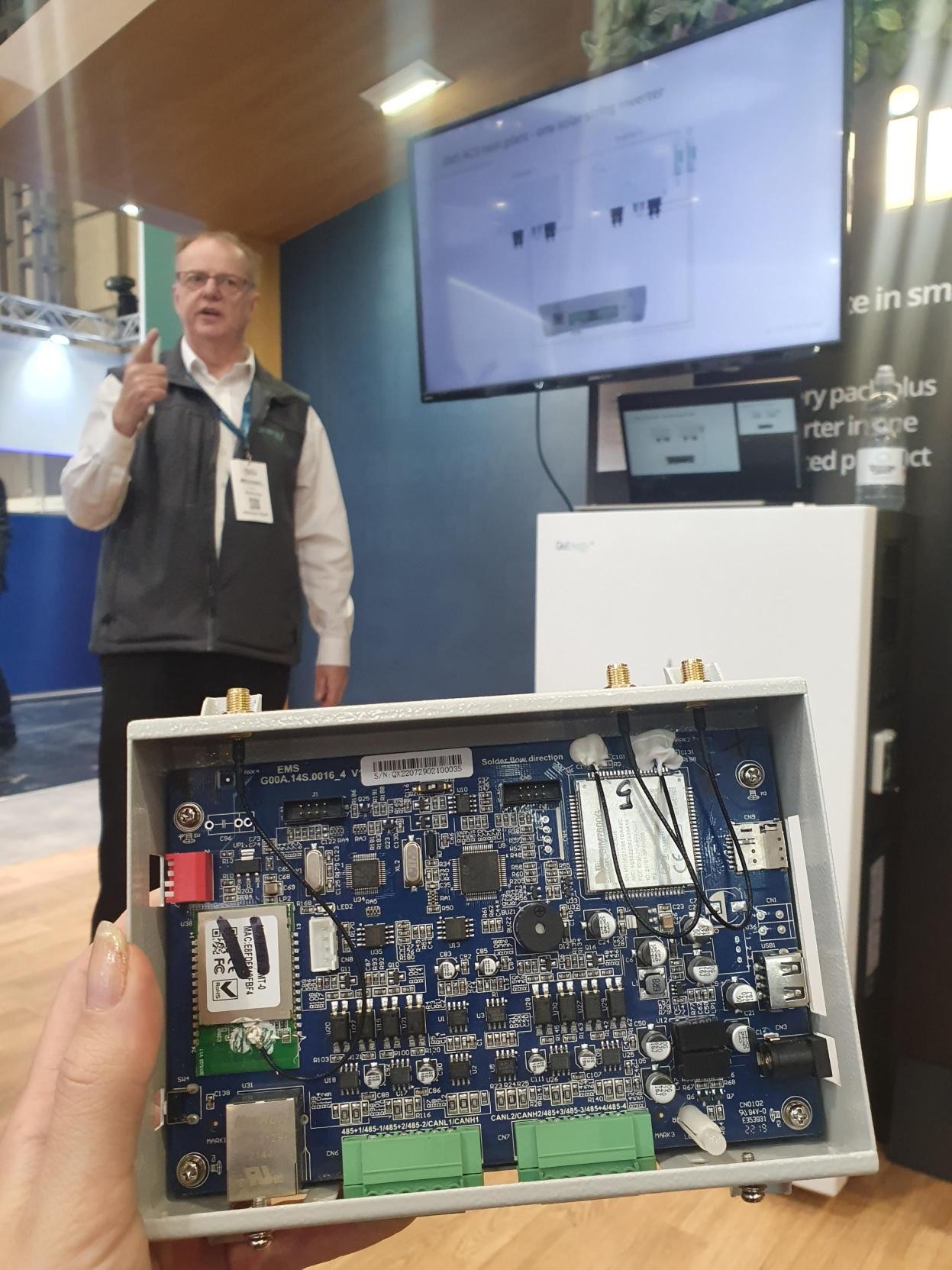
Slartibartfast ems was mentioned in their solar and storage stand. There is a presentation on the GE website blog. Hopefully Jan/feb next year
If you have multiple inverters there is no concept of "master" and "slave", they are just parallel inverters, both with their own EM115 energy monitors and both with their own solar panels and potentially batteries.
[I believe it is possible to slave more than one inverter off the same EM115 but that's not what my installer did and it could complicate the setup]
With my Gen 1 hybrids, if you are in Eco mode and turn on a load, both inverters see that load and start ramping up discharge to meet that load. Sometimes one inverter will be ahead of the other, but basically they share the load. The data in the portal about house load and consumption is garbage but the system otherwise works OK.
One place I have seen issues is if you are doing things like a partial forced charge of the battery from the grid, e.g. to 70%. If both batteries are below 70% then no issues, both inverters will charge their batteries. If however one inverter's battery is above 70% and the other is below, then the upper inverter will discharge to meet the import requirement of the lower inverter. The inverters cross charge each other and you need to turn discharging off in charging periods to stop this.
If you find the two inverters are fighting each other to discharge unnecessarily then maybe setting the discharge rate to zero is the way to stop it? I think that's the basis of scripts that others have written to resolve multi inverter issues.
@Chevaline If you have multiple inverters and batteries then I would definitely recommend spreading the batteries across the inverters. When I had my second battery installed the company put it daisy chained onto the first battery so I had 14kW on one inverter and nothing on the other. On sunny days when the inverter that had no batteries was pushing it all out to the grid I found it kept on pushing the grid voltage over the limit and the other inverter (with the batteries) kept disconnecting itself with "grid fault". When the batteries were moved to one on each inverter this problem occurred much less frequently. Also if you have a battery on each inverter then the inverters can store generated PV in the batteries for later use. Inverters with no battery can only send it to the house to meet load or the grid as export.
Smk82 Thank you, do you have a link to their website blog as cannot find it?
My dual inverters - two EM115s, one for solar the other for the Grid. Both inverters and meters on the same Modbus. One meter is ID1, the other ID2. Both inverters are potential bus Masters i.e. they can issue read/write commands over the bus. When your installer sets up the system as a 'plant' one inverter is set to Master the other as Slave. Modbus is a half-duplex bus, only the Master can issue a read/write command to a slave.
This is where the confusion come in - as far as Modbus is concerned only one device can be Master. In a Givenergy plant there are at least two true slaves - the meters. Both inverters can be bus Masters and logically both can be slaves. It may be that each inverter has an ID register so it can respond as a slave to the other inverter.
This potential bus problem caused by having two Masters may be the reason that the EMS exists or is required. Looks like a Givenergy cock-up to me.
Slartibartfast ah so your dual AC inverters are wired up quite differently in a plant setup sharing a modbus, compared to my dual hybrids that are very much in a parallel side by side setup
I have two EM115's but they are one for each inverter and each connected to measure the grid. Don't need a solar EM115 as the panels are directly connected to the hybrid inverter.
I wonder why the dual AC's are wired up the way they are and don't follow a design more like my dual hybrids? If each AC had its own grid EM115 and its own solar EM115 then they'd both be making decisions whether to charge their or discharge their batteries based on house load and spare PV. No risk of modbus clashes.
Would this work better than the plant config?
Chevaline https://givenergy.co.uk/blog/
It’s dated October 23, in the solar and storage blog entry. Click on that then scroll down. It’s there
geoffreycoan this is how my dual AC3 were originally wired. Installers changed it a couple of months into the installation after a conversation with GE. If I knew then what I know now. I would have let them change it, I could then have had the faster FW whilst waiting for EmS🤦♂️
I've looked at the blog - the EMS bit. No mention of comms i.e. are both inverter dongles still required. The unit itself does have on-board wiFi.
One troubling statement 'if we decide to release it'.
Slartibartfast that would make sense as it’s primarily designed for AC3, and there hasn’t been a version of that released with integral wifi unlike later hybrids..

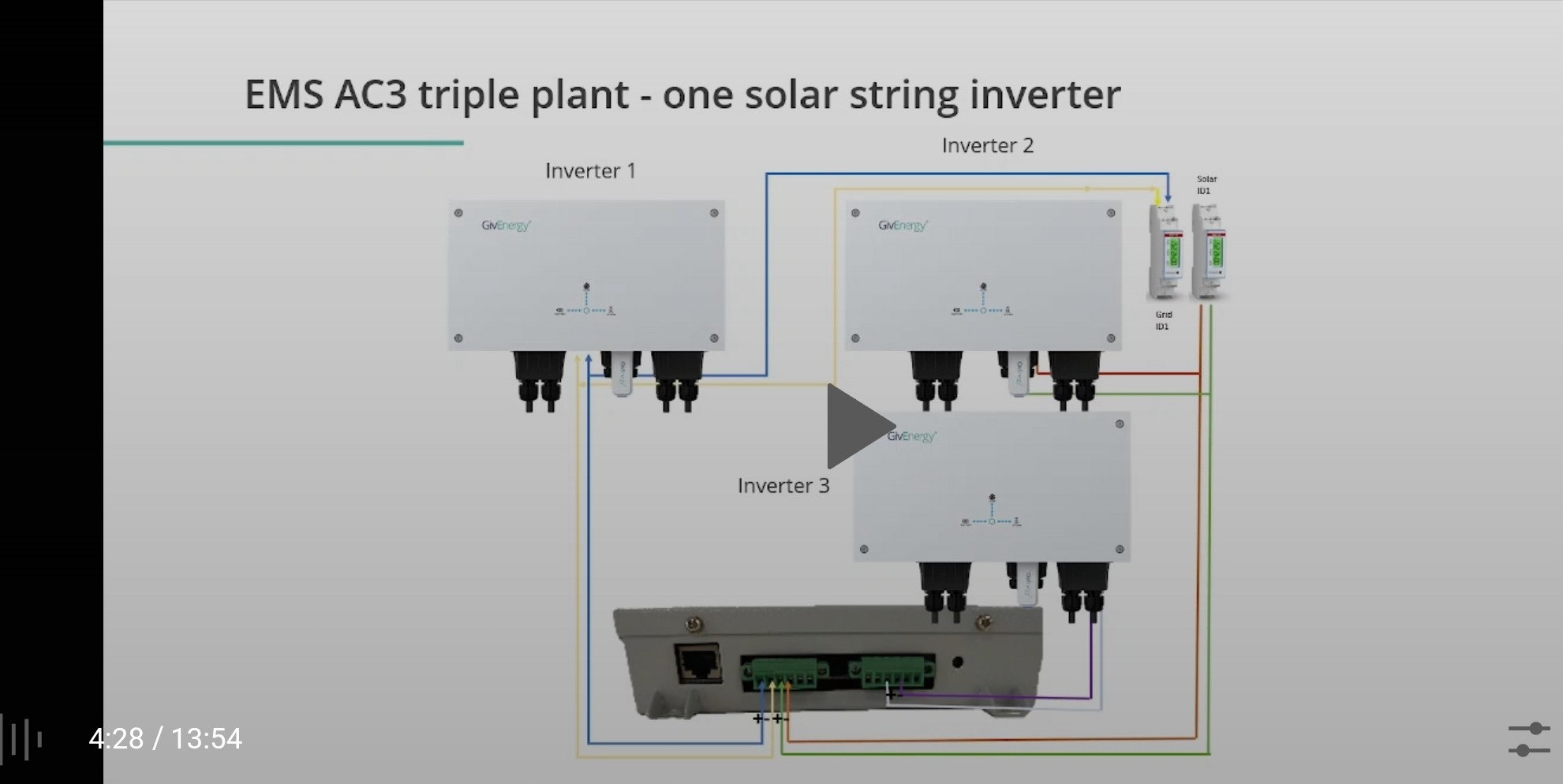
I asked when it was shown at the Solar Show thing, as i understand it, the dongle and the EM115 metering is removed and instead the RS485 that was used for metering go to the EMS. The ems has 1 single metering/EM115 of true house demand & dishes out what it wants the inverters to do (presumably by spoofing a CT value to it which is 1/2, 1/3, 1/4 of the true house load depending on how many inverters it's controlling)
You then ask the EMS for status which it also pushes to the portals (it can read SOC and everything else from each inverter, I guess over the same RS485, which is interesting - as that would suggest a route to make a Gen 1 hardwired LAN even if you only had 1 inverter!) rather than each inverter. It's supposed to work with GivTCP at some point but apparently works with the API right now.


How much do you think installers will charge to fit an EMS? They will have to change the Modbus wiring (of course using the wrong cable and ignoring the drain wire), remove two dongles and change the ID of the solar EM115 back to one. They will replace the solar meter rather than changing its ID (far too much work for them). They also have to supply power to the EMS - a minimum of two hours ...
Sorry to be a bit negative about 'installers' - it comes from experience.
Modbus monitor hardware/software available for about £50 - you can change the ID in a couple of minutes.