
Force PV export rather than charge battery, but...?

23 comments started 2026-06-03 last 2026-06-05
GivEnergy Products
M
#1 madbilly

Hi all,

Now we're well into summer and we definitely don't need the heating we basically have a battery that hardly gets used. Even when it does get used, in Eco mode it just gets charged again whenever the PV array picks up some rays. So, I decided I would prefer to export PV rather than charge the battery and I turned off Eco mode and set a Timed Discharge period for 05:00-00:00. This does appear to have succeeded in not charging the battery during 05:00-00:00, BUT when there is no PV generation, e.g. late evening, instead of using the battery the system instead draws from the grid, which is not what I want or expected.

I expect I'm not the first person to try and do this, and I did try and search the forum for a solution but for some reason have not found it. Could someone please point me to the settings to get it to work how I want it to?

For info we have an AIO2 with the hybrid inverter, extra battery and gateway 2.

Cheers 🙂
D
#2 DD

madbilly Yes, I do this. I use two schemes:

  1. when solar is low-ish, I use the timed pause feature to pause battery charging
  2. when solar is high, I turn off eco and pause.

The reason I need two strategies is because I have a hybrid inverter with PV capacity exceeding the 5kW AC limit of the inverter. So if I simply pause charging, the solar will get clipped at (just over) 5kW. Mode 2 gets around that by sending the first 5kW to AC, and the rest goes to the battery. But as you say, that mode is no good for later in the day, since if I put the kettle on, it has to import rather than use the battery to make up the shortfall.

(I have the pause timer window set for all day, and my monitoring script just manipulates the pause type as required.)

The slightly tricky part is when to transition from 2 to 1 - I don't want to do too many writes by swapping back and forth too quickly, though the "real-time-register" support would presumably fix that.

M
#3 madbilly

Thanks DD, that's a useful idea. It's odd that there's no way to put the load priority as 1. Solar, 2. Battery and 3. Grid, I had believed that was one of the reasons for the gateway in the first place, or at least, one of the benefits of the AIO2+GW2 vs the AIO1+GW1.

It seems like this is probably a firmware limitation so we're stuck with it, apart from externally-automated workarounds as you suggest. I could imagine having a routine running which checks if total load exceeds PV generation and if so switching the battery to Eco mode until load drops below PV generation again. However, I can see issues with pulsed loads like microwaves, induction hobs, things like that, which can switch on and off several times a minute.

D
#4 DD

madbilly It's odd that there's no way to put the load priority as 1. Solar, 2. Battery and 3. Grid, I had believed that was one of the reasons for the gateway in the first place, or at least, one of the benefits of the AIO2+GW2 vs the AIO1+GW1.

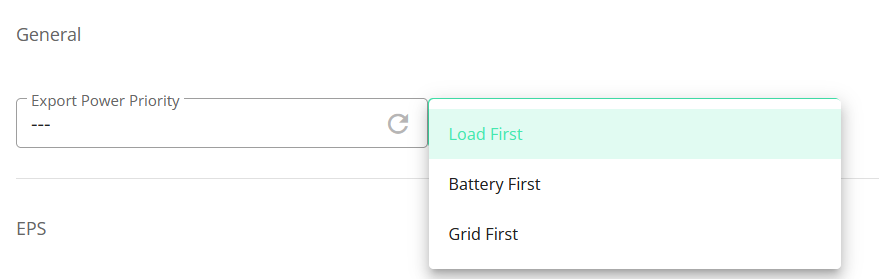
There is actually a register 'export grid priority' which allows grid-first, battery-first, or load-first, but unfortunately, it has no effect for me.

C
#5 CW

madbilly I don;t have an AIO2 just the original version, but in the inverter remote control section on the portal there is an option for export power

I have never used this, and not sure if this is accessible if you don't subscribe to premium, but would this be an option?

D
#6 DD

madbilly However, I can see issues with pulsed loads like microwaves, induction hobs, things like that, which can switch on and off several times a minute.

Yes, that's one the challenges in deciding when to switch back. Fortunately my induction hob seems to modulate well, rather than pulsing, and we use a low power travel kettle. My script probably hard-codes that it wants to be in mode 1 by 5pm, well before meal preparation.

(I think I've finally managed to train OH to try to use hob / halogen oven / kettle / microwave sequentially, rather than turning them all on at the same time.)

Oh - one other thing to note: my script is trying to maintain SoC at a certain level. If it has crept up on a sunny day, it turns on forced export. And it is able to do that with eco off, automatically exporting just enough to max the AC whenever solar drops a little. ie it will both charge and discharge the battery as the solar and AC limit allow.

B
#7 BobB

madbilly Are you using any form of automation? I set my battery charge rate to 0 in the morning and enough to charge the battery in the time cheap rate slot in the evening. I reckon that would address your requirements.

V
#8 Vestas

CW It doesn't work AFAIK. "For future use" was the last I heard, so if its not in the current production firmware then it never will be.

C
#9 CW

Vestas Ah, doesn't surprise me - fortunately having an IT background I am rather loath to try options which move away from the core design so never tried this!

D
#10 DD

BobB I set my battery charge rate to 0 in the morning

I find that setting charge power to 0 actually reports charging of about 180W. Using pause-charge gets down to 28W. (Turning eco off reports 0, but that obviously also takes away the option to discharge battery to cover consumption.)

V
#11 Vestas

CW It appears on the portal for all systems (and in GivTCP) but I don't think firmware was ever released which used it. Probably just playing catch-up with other manufacturers before they went bust?

V
#12 Vestas

DD Pause Both (charge & discharge) is the only way to get battery power to zero as it powers down the connection from inverter to battery. Turning off Eco effectively does the same but differently.

K
#13 Keithwright

I use the android inverter app (paid version) there you can set tasks based on battery percentage to charge or discharge. If you look at the tutorial it shows you how to build a ladder to control the system at various loads and battery states.

R
#14 Rubikcube

madbilly So, I decided I would prefer to export PV rather than charge the battery

There are some good reasons to do this, for example to avoid clipping, but it is generally not a good idea.

If your battery does not spend sufficient time at 100% charge, it will rapidly deteriorate, possibly failing in under 2 years.

B
#15 BobB

Rubikcube Wow. Is this a thing? It's the first I've heard of it. I do recall that it's useful to hit 100% and 4% to ensure the BMS keeps a better tally on full and empty.
But spend sufficient time at 100%? That feels at odds with all other battery lore i know - apart from ye olde worlde NiCad batteries.
You're a legend, Rubikcube, I'm automatically on shaky ground doubting you so, with apologies, do you have a source for this statement? How long is "sufficient"?

R
#16 Rubikcube

BobB I would recommend the battery is at 100% for at least 10% of the time (i.e. 3 hours per day). Remember 100% is not the same as full. I will post a separate thread shortly.

M
#18 madbilly

@CW Thanks for pointing me to that export priority register, I'm experimenting with it but so far I've not found that it does anything.
@Vestas I'm using production firmware and the register is there.
@BobB no I'm not using external automation yet, I was seeing what I could do with the built-in controls. Unfortunately it doesn't actually do what I thought it would do when I bought it! I have HA connected now so will look into setting some automation up there.
@Vestas you've just made me think of adding pause charge during the peak tariff hours 5:00-0:00, I'll see if that does what I want it to.
@Rubikcube It gets to 100% charged every night 00:00-05:00 on off-peak rate and at this time of year it's at 100% for a large proportion of that off-peak period. What I've not set up yet are scheduled calibration discharges.
Cheers 🙂

M
#19 madbilly

I tried "pause charge" and it didn't appear to achieve what I want, but I'll try again.
The export priority register seems to have no effect, although I've not tried "grid first" yet main because because I assume it would favour taking power from the grid.

Looking at the charts today I saw that we had a big spike in power consumption, I'm not sure what caused it, but it made me realise that I do still want the battery to be available during the daytime to provide power when PV by itself is not sufficient.

D
#20 DD

madbilly I tried "pause charge" and it didn't appear to achieve what I want, but I'll try again.

You also need to set the pause time window during which it applies - first time I tried it, I didn't realise that.

M
#21 mikes01666

I've an AIO 1 and Gateway. Eco on 24/7. I'm on IOG.
Set charge 23.30 - 05.30. Set discharge 05.30 - 23.30.
Battery at 100% then exports. Runs down during day. Set Export between 20.00 and 22.00 with a floor of 10%.
Only failed once when I inadvertently turned off Eco.

D
#22 DD

mikes01666 Set Export between 20.00 and 22.00 with a floor of 10%

Setting a floor does run the risk that if it reaches it, battery will be paused until 22:00, and you will run from grid.

M
#23 mikes01666

Yes, for 90 minutes at worst. However stopping export at 22.00 is very conservative. In reality it reaches 15-20 %. If it's too high I'll do a 30-60 minute export in HA. You get to know your system and what it can/can't do and how long it takes to discharge.