O
#1 Ortwin
In the past few days I've been getting the following faults show up. Just wondering if this could be due to the OE battery automation?
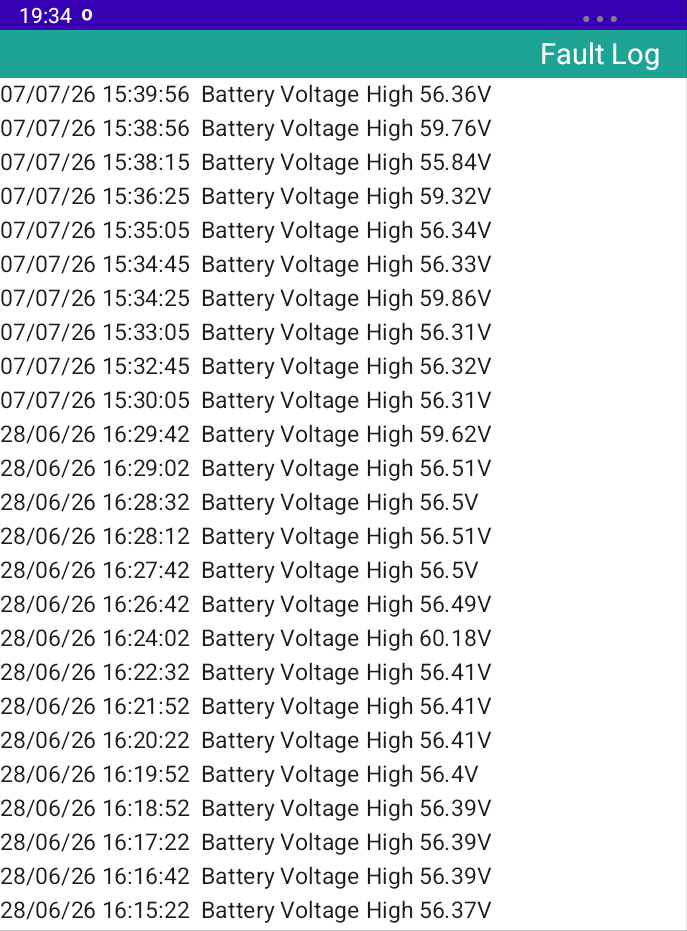

In the past few days I've been getting the following faults show up. Just wondering if this could be due to the OE battery automation?
Ortwin I think someone suggested a calibration might be required.
I occasionally get High Voltage alerts, which I only know about because of the Rubikcube app. I think it may be because in the summer, the battery tends to cycle between 50-100%. In 5 years of operation, I have never done anything about it. In winter, using the full 4-100% range is usually able to to sort things out. I have never forced a calibration and I suspect (although I don't know) that it may calibrate itself if it becomes necessary. So my maxim is: don't touch anything...
Battery Voltage High is very different from BMS Voltage High. Battery Voltage High is detected by the inverter and in theory should never happen because the BMS should detect high voltage first.
It would suggest there could be too high a resistance in the wiring between the battery and the inverter.
Another possibility is that auto detect is on and the data cabling to the battery is dodgy, and so the battery is being auto detected as lead acid.
Also the BMS should never charge the cells above 3.5V each.
3.5 * 16 = 56
so any voltage over 56 is concerning.
The maximum recommended voltage for LFP is 3.65
3.65 * 16 = 58.4
The fact the some readings are above 58.4 is VERY concerning.
Although it could just be that GE voltage measurements are inaccurate.
Rubikcube For comparison to Ortwin, my max BVH readings were always in the 58 -58.2V range with only very occasionals reports up to 58.3V
Hi I have been getting bms over voltage error messages every day for the past 20 days. I have now noticed the when the battery hits 100% there is a small discharge of around 100-200 watts then it goes into idle. The volts start to increase very slowly until the battery starts to discharge again for a very short period from 56.6 down to 56.2 then it start again to increase the discharge again. I have carried out 2 calibrations over the past few weeks and even got a low bms voltage and high bms voltage on the last calibration. High voltages are around 57.9-57.79 I have a gen 3 5kw inverter and a gen 2 9.5 battery. Is this anything to be worried about any thoughts or ideas would be welcome. Thanks

@Rubikcube Which register do you read the battery voltage high warnings ? They don't show any in the GE app, bms or inverter. But in givtcp i can see they have a bms over and short current registers but no bms over voltage. Although i can see the batteries have a warning1 & warning2 reg. And i can see warning 1 spikes to a value of 4 when my battery voltage briefly reaches it's maximum value. Is this where you cue your high voltage warning from ?
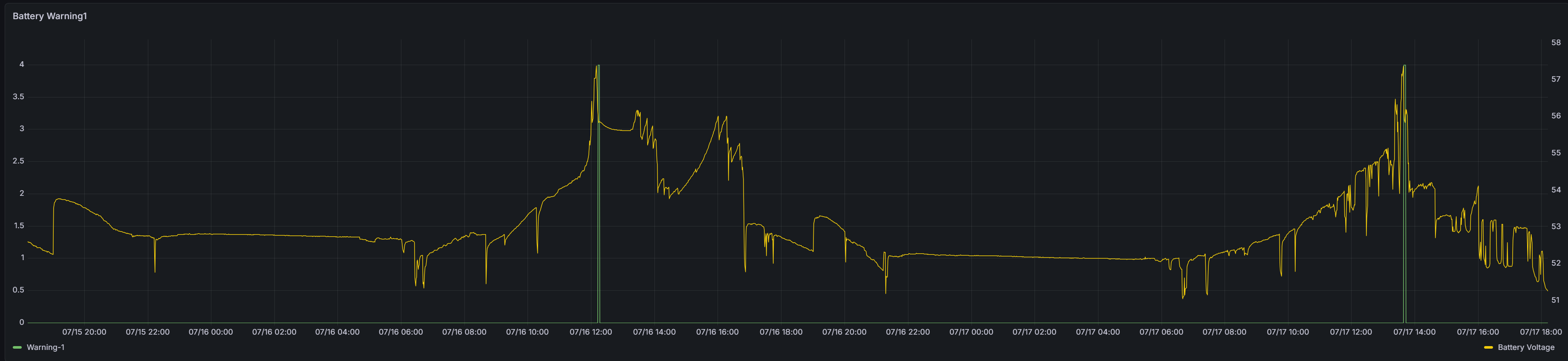
Maxwell The battery fault codes appear in Register 57. The bitwise decode (LSB to MSB) is as follows:
            "Grid Meter",
            "Battery Voltage High " + batteryVoltage.toFloat() / 100 + "V",
            "Battery Voltage Low " + batteryVoltage.toFloat() / 100 + "V",
            "Battery Soft Start",
            "Battery Connection",
            "Battery Management Communication",
            "Battery Temperature",
            "Charge/Discharge Module Temperature",
            "Battery Current High",
            "Battery Short Circuit; Inverter Fail",
            "BMS Voltage High " + Balanced.batteryVoltage[ipIndex].toFloat() / 100 + "V",
            "BMS Voltage Low " + Balanced.batteryVoltage[ipIndex].toFloat() / 100 + "V",
            "BMS Discharge Over Temperature",
            "BMS Charge Over Temperature",
            "BMS Discharge Under Temperature",
"BMS Charge Under Temperature"Rubikcube Thanks. I haven’t dug down to the modbus register numbers. Will need to re-visit and look for those.