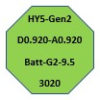
Hello. My system was build recently. It is HY3.6 gen1 + 5.2AH gen1 battery and 10x390W panels west/east array. 5 east connected to 1 mppt and 5 west connected to 2nd mppt. All panels on east array have Tigo optimiser due to chimney can block sun so don't want that all panels drop its performance.
Before installation start i ask to try to fit 6 panels on each side but was decline as it will not fit.
Now all panels are in place but i notice and measure that 1 panel on each side can fit. So extra 780W on my roof can be squeeze. Now as on inverter datasheet say that max DC PV array input power can be 4500W. But my new array will be 4680W. Is there is any problem with this beside if it reach limits will clipping. Possibly newer in west east configuration.
Also 2nd to this if i install panels my self and connect to existing string will it void inverter warranty?
Extra panels on existing array.
HipHopAst You've identified the fact that clipping could occur, so you are aware that the PV can exceed the inverter capacity without damage. An extra few panels would be useful when the sun is weaker as you can harvest more energy.
As regards a DIY installation; I consider myself a competent electrical person, having been trained and qualified to work on electrical systems in the electrical power industry. While employed, I also learned about industrial safety and working at height. Personally, I would pay for a contractor to do the job as they are aware (or should be) of best practice to achieve safety and comply with both electrical and working at height regulations. There are lots of things I'm happy to tinker with and believe I can work safely with electricity but I wouldn't do that job.
If your two arrays are pointing in different directions, I think it is unlikely that you would ever reach the theoretic maximum power of 4.68kW, because they would never both be in strong, direct sunlight at the same time.
Thats what i thought and there is a chimney at peek so performance drop as well.
I have go through PV generation tab and max what I achieve was 3.7 in 22 Jun.
What about DIY install panels. Some people like DIY projects some dont. I for example like repair cars/electronic and now interested in solar panels. Any way Panels are rated for 34v and 11.5A so it will be ok for inverter as it can handle max 16A and DC input 580V and max on single MPPT is 550V so if I add 1 extra panel on each MPPT it will be well below limits.
Interesting point is warranty. Will it void or not. What Giv would say.
HipHopAst where did 34V come from? You need to look at the highest open circuit voltage at the lowest temperature the panels will see. That can be over 40V per panel.
OP, please do not attempt to install panels on your own and without a proper planning. There are legal regulations in place that govern how, where to install and even what margins need to be maintained when installing roof PV.
rio911 That's why I ask on forum. What are this regulations. As far as I know only thing is that solar pv can not be over roof ridge. That's it. I would like to put hands on this regulations.
rio911 Yes you are correct. Open circuit voltage is 40.8V. So 12 panels would be 490V Still below 580V that inverter can handle it.
HipHopAst I understand that this is "hearsay" but eveyrthing I've been told is that there needs to be 300mm between the panel and the roof edge (ie the roofing tile edge). This means that the PV array cannot be nearer to the ridge, edge or bottom of the lowest tile than 300mm. The roof structure usually extends beyond the wall by about this much so, apart form the ridge, it means that the array has to be within the footprint of the walls underneath, or a bit less.
Local authority Planning Regulations may not hold up the installation of PV on the roof as a permitted development, but Building Regulations, which still apply, may well limit the number of panels simply by restricting the distance from the edge of the panel to the edge of the roof tile. It's not for aesthetics, it's for the safety of the structure. The Building Regs may be a pain but they are for the benefit of the people wanting to make the development and also for anyone wanting to buy the property in the future.
Tim Thanks again.
Your answer make mi thinking what you have said and have dig in to it little dipper and only what i have found its this:
All the following conditions must be observed:
- Equipment on a building should be sited, so far as is practicable, to minimise the effect on the external appearance of the building and the amenity of the area.
- When no longer needed equipment should be removed as soon as reasonably practicable.
All the following limits must be met: - Panels should not be installed above the highest part of the roof (excluding the chimney) and should project no more than 200mm from the roof slope or wall surface.
- The panels must not be installed on a building that is within the grounds of a listed building or on a site designated as a scheduled monument.
- If your property is in a conservation area, or in a World Heritage Site, panels must not be fitted to a wall which fronts a highway.
All taken from planing portal so in my opinion accurate and latest information.
Can you revile source about this 300mm as I can not find it anywhere.
Its only say what i mention before that panels can not be over ridge.
Thanks again.
HipHopAst source about this 300mm as I can not find it anywhere
No I heard what the installer said and he said the panels had to be at least 300mm from every edge. I didn't challenge this as he is a "competent contractor" which means I don't have to go through Building Control. If there's any issue with the installation, I look to the competent contractor to make it right. If you choose not to use a competent contractor for your work, you should consult the local authority Building Control and submit your plans to them.
Tim Ahh OK no worries thanks. I know all engineers ar very competent and if I ask question is this inverter have 2 MPPT he answer that he didn't know what it is. But hej we live in a country where you asking yourself questions who is more competent yourself or engineer. Any way thanks for your input.

There is common misuse in the English language of the term 'engineer'.
A true engineer is someone who has gone through formal and practical training and has proved competence with a professional body, along the same lines as a doctor or lawyer.
Someone who bolts together a number of components, and swaps out what they think may be faulty is not an engineer so should be deemed a technician or a competent installer. They also have not provided any input to the underlying design of any of the component parts.
A quote from:-
Chartered Engineers (CEng) develop solutions to engineering problems using new or existing technologies, through innovation, creativity and change and/or they may have technical accountability for complex systems with significant levels of risk.
Simon_C Can I have your babies please? Always a bugbear of mine 🙂
Although on the flip side I have known some Chartered Engineers who couldn't re-wire a 3-pin plug 😃
Ra re-wire a 3-pin plug
And some who don't know what a relay is! In fairness, as long as they know that this knowledge and these tasks are outside their competence, there's nothing wrong with that. I couldn't work out what size of bolt to use to fix a lifting point onto a structure, but I know people who could. I also know that when it comes to installing solar panels, inverters and batteries, the chaps who did mine are very much more competent than I am; they do it every day.