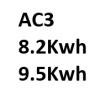
I am considering adding a second battery to my existing 5kW hybrid inverter and 8.2kWh battery as it doesn't last all day and would like to be able to run a whole day from the battery (I know the economics will nit add up, but sometimes saving the world has a cost).
One question I have about a second battery is will it increase the maximum power output from the batteries or would I need a second inverter as well? I currently exceed the 2.5kW limit when I boil a kettle or use appliances, so if it increases the limit to 5kW it will reduce my import at peak rates.
#2simon_swinburne
An additional battery would increase your capacity so you would last longer during the day before running out. Note, you can mix battery sizes as the system manages them as a whole so I suggest your look at your actual use to see what size may be best for you. ( Grid to home in the on the energy chart card in beta portal would be a good place to look, but you need to apply your own circumstances too as that doesnt account for load shifting which you may be using already and would not want to run from the battery )
To get to 5kW output you would need to add a second inverter. Your inverter will output 5kW but only when PV is present too. Output via just the battery is less, and dependent on the inverter.
The specs for the inveters are here : https://www.givenergy.co.uk/images/GE-A5-V1.4%20PF.pdf
F
#3feidhlim
simon_swinburne Follow on question to that. I have the Giv-HY-5.0 inverter and a 5.2 kW battery. As I understand, the charge/discharge limit on the battery is 2.6kW. The same limits on the 8.2 kW battery is 4.1kW.
So my question is:
With my current inverter, if I was to get a second battery of size 8.2kW and I had excess PV power of lets say 4.0kW, would all the 3.0kW go towards charging the batteries? For example 2.6kW to one and 1.4kW to the other.
Or would the charge rate for both batteries combined still be capped at 2.6kW? Cheers.
#4simon_swinburne
J
#5JJB
I was building a system from scratch so had the opportunity to spec it close to what I wanted, which was relatively high power output. We've gone for a separate brand inverter (6kW) and have that feeding two Giv-AC 3.0 and two Giv-Bat 5.2. I'm able to charge and discharge the batteries simultaneously at 2.6kW each, giving me about the power I need, plus the charging capacity from my 5,9kW PV system...on those rare sunny days!
P
#6pinpointzero1973
Hi Martyn, fiedhlim, JJB, and Simon,
I had a secondary GE8.2kw battery installed last Friday. I still only have one inverter (GE3.0AC). So I'm still shackled to 2.8kW.
As the secondary battery was daisy-chained, the inverter just reports one big 16.4kW battery.
It's a good idea, as the inverter likely "see's" differently, but reports accordingly.
We use about 24/25kW per day, so the secondary is helping immensely. We can't be grid free I'm afraid as the draw during busy periods from the house (washing machine/cooker/tumble dryer, etc.) means unless we are getting the full 6.4kW from the PV, we use the grid.
Either way, I'm enjoying the idea that the system can grow and morph as we need it to.
I'd certainly recommend a secondary battery, or, as many as you need/can afford. 🙂
S
#7Sykes
Hi Folks
Great to have a forum at last, and to see some like-minded GE owners! Martyn - I wonder whether it's worth you considering upgrading to a 'Multi plant' i.e. yes - adding another battery, but also adding another AC3.0 Coupled? I say this, as the controllers are really relatively cheap, when compared to the batteries (particularly the 8.2s) and this will then allow you to draw a lot more power simultaneously from your ESS, before the house begins to draw from the grid.
Such a system isn't completely snagless yet (in my experience, anyway) but it might just suite your needs.
feidhlim I don't think so. The max battery charge/discharge of that HY-5 is 2600watt, so both combined would be 2.6kw.
S
#9SomeHeadhunter
Just waiting for my second 8.2 battery to arrive. 😀
Main concern I have is charging them...
I have the HY3.6 inverter so am limited to the 2.6kw charging. So for 16kw of battery I'm looking at 6 hours ish to charge to 100%. I'm on Octopus Go so have 4 hours of cheap rate but my deal ends in Jan so looking to move to Go Faster for 5 hours so 13 kw of cheap charge. Intelligent Octopus would be preferable at 6 hours off-peak but my EV and EV charger are currently not compatible with that schemes API.
My solar array is 3.2 kw but is shaded in the winter months so produces next to nothing so wont really contribute to battery charge till Feb onwards.
Anyone else having this conundrum with charging?
#10THALL
SomeHeadhunter Not yet, but I will when I can find an installer to quote me for a second battery! I have the AC3 so my limit is 3kw per hour. However my solar is not shaded so I should be ok. Is Go Faster still by invite only?
A
#11anabanet
HI,
I added a 8.2 to my 5.2.
I did notice that my input and output increased!
So the power of charge and discharge increased due to the larger battery capacity. I could drive 3.3kw when before I could only drive 2.8kw.
One battery and the battery is the limiting factor. Two batteries and the inverter becomes the limiting factor.
This is logical because the more battery you have the more throughput you can get from the battery within the limitations of the battery draw.
Bottom line - Adding a 8.2 battery increased both the power and time of the system.
Well worth it.
( a second 5.2 battery would also work and make the inverter work at 100% capacity )
S
#12Sparta
THALL HI, Go Faster is not invite only. I have just switched to Go Faster 21:30-01:30. You need to apply and agree to export tariff being downgraded to SEG only (I was previously on Agile Outgoing). Personally speaking, I want to have my generation capacity and battery storage being balanced rather than having too large battery which will not be charged by the PV array due to either the array capacity or inverter throughput. You should aim for the battery capacity to cycled as much as possible to avoid downgrading. Plus there is the round trip efficiency that needs to be considered. The inverter throughput will present bottleneck on both charging and discharging.
Looking at some of the other comments, am I correct in thinking that the newer version of the 8.2 battery charges and discharges at 4.1kW? If that is the case, I could increase my discharge rate to 4.1kW which would cover my highest demand (due to having a caravan and only having a 10 amp supply at some sites we are used to only using one high power device at any one time).
The maximum discharge rate seems to be dependent on the inverter, hopefully my 5kW hybrid would allow a 4.1kW charge and discharge.
Thanks
Martyn
#14simon_swinburne
Martyn
I know the catalogue is being republished very soon ( its under review now ). The definitive specs will be in there so I will defer answering until thats out.
What is fair to say is that every generation of inverter or battery is better than the one it superceeds
Watch this space.....
B
#15bignelly
simon_swinburne if new batteries are coming out will any reduction happen on existing?
Also will new work with existing batteries?
#16simon_swinburne
bignelly
I can only comment on the technology, backward compatability is retained, and mix and match fully supported.
Like now, its perfectly fine to have a system with say 1 inverter and 3 batteries all of different sizes. The system manages those effectivly as one large battery doing all the internal balencing etc that is required. The solution is designed to support incremental expansion
#17THALL
Sparta I have done the switch to Go and downgraded to SEG only but Go Faster did not come up. Not a massive issue for me but the option would of been nice.
#18simon_swinburne
THALL
Can you submit a bug request inside the portal please. That will allow me to get the devs to look whats happening on you account
#19THALL
simon_swinburne My Go issue is with Octopus 😄 Though I have reopened the other feedback/bug report I left.....
M
#20Martyn
bignelly
As I understand it, the new batteries have been available for a while, and Simon is referring to a new brochure.
Thanks
Martyn
#21THALL
Martyn Does that mean just new reversions of the same batteries? No new capacities etc?
B
#22bignelly
Whats the best place to pick up a second 8.2kwh battery? all seem to be about 2600UKP?
#23THALL
bignelly I have not seen it cheaper. But might be able to get it on 0% finance from EON. But I think stock is also an issue!
M
#24Martyn
THALL I do not have any specific information. My 8.2kWh battery was installed in December 20, which only allows about 6.5kWh to be used in order to prevent a full discharge and charge damaging the battery. I believe that earlier this year the batteries were updated with a larger battery which then allowed a full 8.2kWh usable capacity. Unless there is going to be another revision to the range I have assumed that these are the batteries that will be covered by the new catalogue.
All this is only my opinion as I have no specific information.
Martyn
#25THALL
Martyn Check out the old dashboard, go to system, actions, view, BAT Cell. That shows the total CAP of the battery on the right. My first battery was 195.6ah my new battery is 189.1ah with a design cap of 160 which is 8.2kw. Also which battery firmware are you on?
Actually @givenergy that BAT Cell was useful when tracking down a fault I had with my first battery. Could this data be added to the new dashboard?
M
#26Martyn
THALL My full capacity is 176.06 with a design cap of 160. Don't know the battery software version.
Thanks for pointing me in the right direction to find that information.
Martyn
#27THALL
Martyn Battery software, new beta dashboard click the inverter card then software tab. But I believe you should be getting 100% DOD so the full 8.2kw. Have you raised this with support? I expect with your permission they might run a fresh calibration cycle to check the capacity. But it is rated for 8.2kw for 10 years!
#28hoggy
I think there's 3? (Happy to be proven wrong but as i see it🙂
Gen1 (<100% DOD) - the original (mine) "8.2KWh" (160AH x 51.2V) with buffers (mines currently 152AH so 7.7KWh)
60A Limit both Directions
Gen 2 (100% DOD) - 2021 version (March?) which is buffered >160AH but presumably software locked to 8.2KWh - 60A Limit Both direction
Gen 3* - Seen a datasheet somewhere but can't find it now but from memory same as Gen 2 but with 80A/4KW discharge?
*2 things -
1 - Not sure if these are out in the field or not
2 I thought the limit was more on the Inverter side - i.e the same 8.2 Battery can do 3KW on a 3KW inverter but only 2.6 on the 5KW one. (Although that was over a year ago when i had mine so this may no longer be true)
Yes inverter limited which is why I am wondering if new inverters are coming? To handle the 4.1kw output from the battery and maybe even bigger batteries?
#30hoggy
THALL Yes there have been physical changes in regards to cell capacity which for some time now allows a true 100% DOD as opposed to when I bought mine which was 8.2 with 80% DOD -
Although mine does seem to have been tweaked with firmware as it has crept up in capacity since install along with a slight boost to power output - mine does 2600W no bother when it used to do 2500W. I'll never see a true 8.2 however unless I buy another.
Can't comment on a new inverter (not in a can't tell you way - I genuinely don't know!) but power output being a bit below that of competitors does get banded about a fair bit so would be a fairly logical place to focus on.
#31THALL
I wonder if there is a reversion number somewhere? I just had my battery replaced under warranty and I have a firmware newer than those listed. Not that it matters I still have a AC3 which is limited to 3000w output though the new spec sheet shows higher bursts are possible and I have seen it going at 3300 for a 5 minute cycle......... I want to know now :-)