
Second battery install options to increase max charge power.

11 comments started 2022-09-12 last 2022-09-13
GivEnergy ProductsHybrid
G
#1 GordonH

Hi.
I have a 5kW PV array with a GivEnergy Hybrid 5.0kw Inverter and Giv-Bat Hybrid 8.2kWh battery. The battery is limited to 2.5kW charge/discharge.
I want to find the best way to increase my battery storage and also be able to absorb the full 5kW from the PV. I can't find any information on how to do this in my search of the GivEnergy site. Electricians also seem unable to advise.
Is it possible to put just another DC coupled battery in parallel or is it more complicated than that?
Any advice would be gratefully received.
Thanks. Gordon
R
#2 Ra

GordonH Pretty sure you're limited by the inverter, regardless of how many batteries you have.

#3 THALL

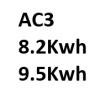
The limiting factor is the inverter. Gen 1 was limited to 2.6kw the new Gen 2 can do 3.6kw. The battery could technically charge at 5kw. Could add a AC3 and second battery? I dunno. I have not kept up with all the tech.

#4 Stevef1964

Ra

Not sure if that is correct.

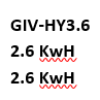
I have a GE 3.6kWH Gen2 inverter with two 2.6kwh ECO batteries and my inverter will fill both, but at the maximum of 2.6Kwh at any one time. It just takes longer to fill them than a single one.
Also discharge is limited to a max of 2.6Kwh.

But I could be wrong!!

G
#5 GordonH

Will the solar fill the batteries at 5kW?

Z
#6 Zakalwe

You are actually asking two questions:
1- How to increase your battery storage,
2- How to be able to feed 5kW into the batteries.

The answer to Q1 is to add a second battery to your existing inverter. That will give more storage but will be limited by the inverters throughput.
The answer to Q2 would be to add a second inverter with a second battery. I think that you'd also have to move one of the PV panels strings to the second inverter in order to feed the PV generated power into the second battery (someone more knowledgeable than me will confirm that last bit).
Then the question will be if two hybrid inverters will operate together?

A
#7 adski

I have dual 5kw gen1 hybrids for this reason as I was disappointed with the spec when the sun goes down.
Turns out despite the vendor being happy to sell it, it's not a recommended configuration by GivEnergy...but mine's been okay.

There will undoubtedly be odd issues with cross-charging/discharging and for this reason GE apparently have something coming "soon" that will bridge the two systems in a supported way. I'm not sure what this is and how involved the process to change my configuration would be.

For similar reasons there's probably also compatibility issues with adding a cheaper 3kw AC-coupled inverter to your config, but I don't know anything more about that.

T
#8 Tim

adski not a recommended configuration by GivEnergy

Hybrids work together as a single plant just fine as they take all the PV connected to each and support house load as demand varies, from PV or battery as required. The issue with ACs is that they are constantly trying to balance house AC load/import/export. The idea of one master inverter leading the response is fine, but evidently, there's problems with response times and constant "me to you, you to me". The hybrids just don't charge from AC unless it's a timed/manual charge, so if there's demand, they ramp up and if the demand falls, they ramp down to balance. The only time they export is when house load is satisfied, batteries are being charged and there's still surplus PV.

A
#9 adski

Tim thanks for the info!
I have this in an email from support so based my comments off of that.
I've not seen any real world issue, but having oversized everything any impact is likely too low for me to have noticed.

"...having dual hybrid inverters is not something we recommend doing from a manufacturers stand point, as we don't actually have a way of the two systems communicating with one and other yet. Because of this, you might see your readings go a little all of over the place. We are currently testing the piece of equipment needed for making them work, but that's not expected to be released until the end of the year at the earliest."

"The problem lies in how the two systems view each other and the subsequent charging/discharging of each other. When one system is discharging and your load stops, it takes a few seconds for the system to react, and as a result it exports back the energy. The second inverter then picks up on that export, and starts to take it to charge, whilst the initial system sees that as load which needs to be fulfilled."

T
#10 Tim

adski second inverter then picks up on that export, and starts to take it to charge

Someone at Givenergy is getting AC-coupled behaviour mixed up with hybrid. The hybrids do not use ac to charge at all, unless a timed charge is set.

T
#11 Tim

Stevef1964 Not sure if that is correct.

I think you are right that being limited by the inverter isn't always the case. You need to look at the maximum charge current from the inverter to the battery, but you also need to look at the maximum charge current of the battery. The HY3.6 (gen2) can charge a battery at 65A but the batteries are limited to 30A (2.6kWh), 60A (5.2kWh) and 85A (8.2kWh). There is always a bottleneck; sometimes it's the inverter, sometimes it's the battery.

From this I would expect your HY3.6 to be able to charge your two 2.6kWh batteries at a maximum of 60A, being 30A to each battery. If the battery voltage was 50V, it would indicate (50x60)=3,000W (ish) charge rate. As the voltage increased, the apparent charge rate would increase but the BMS would reduce the charge rate anyway as it approached 100% SoC.