MPPT not finding global maximum in V-I curve

45 comments started 2022-10-21 last 2024-04-10
GivEnergy ProductsHybrid
M
#1 MinsterView

My recently installed Gen1 5kW hybrid inverter is not finding the global maximum point within the mppt.
As the sun rises the sun sweeps across the strings gradually exposing pv panels in turn.
The mppt is focussing on a local maximum caused by the shaded panel(s) and only jumps to the global maximum when all panels have equal irradiance.
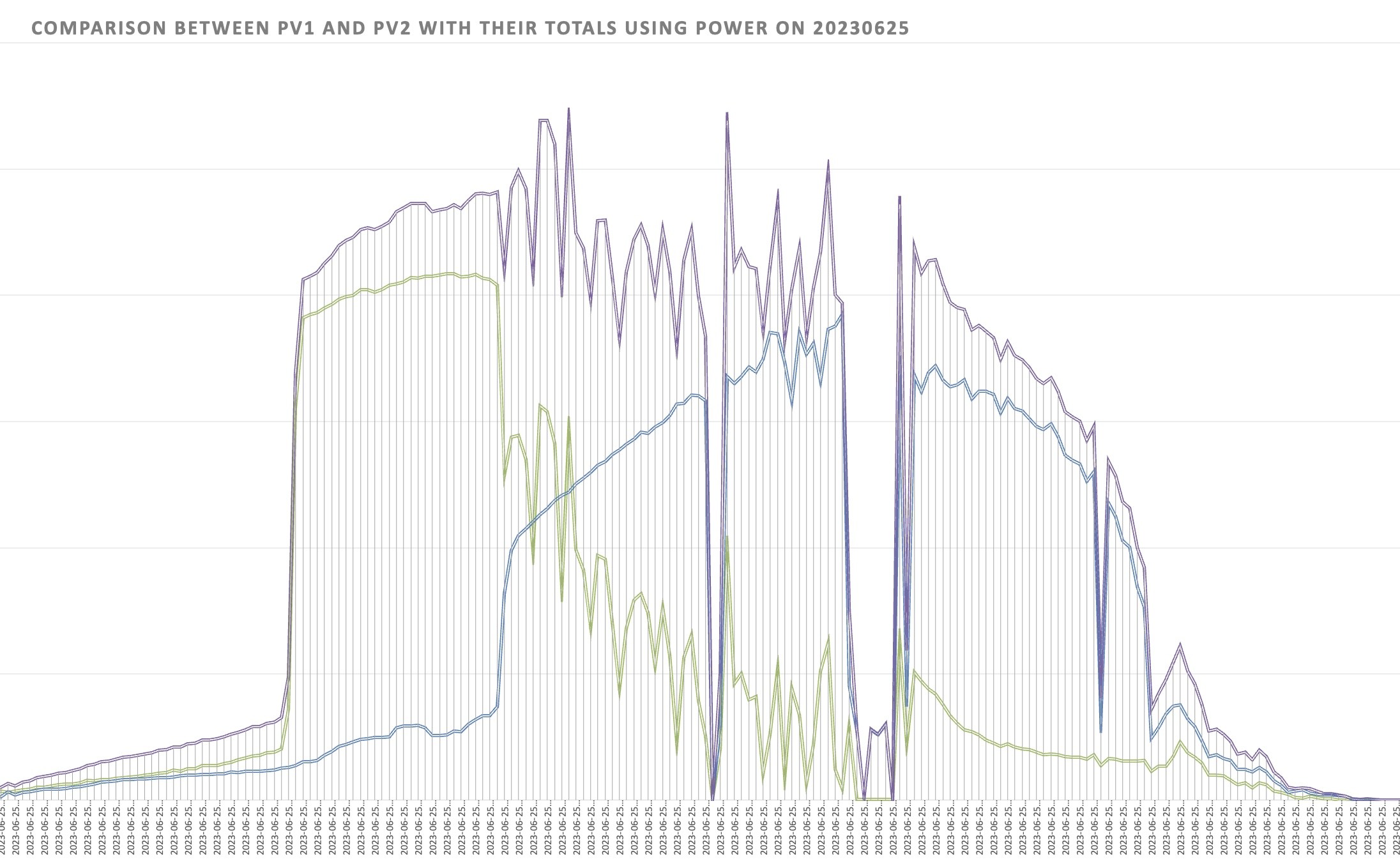
Output from two strings.
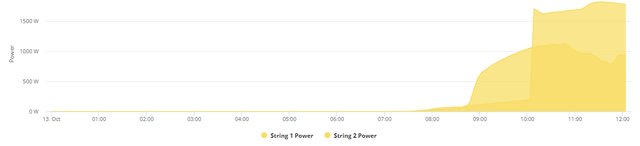
At about 10:10 the last panel in string one comes into full sun and the local maximum in the v-i curve disappears and the MPPT correctly moves from about 0.8A to about 6.5A
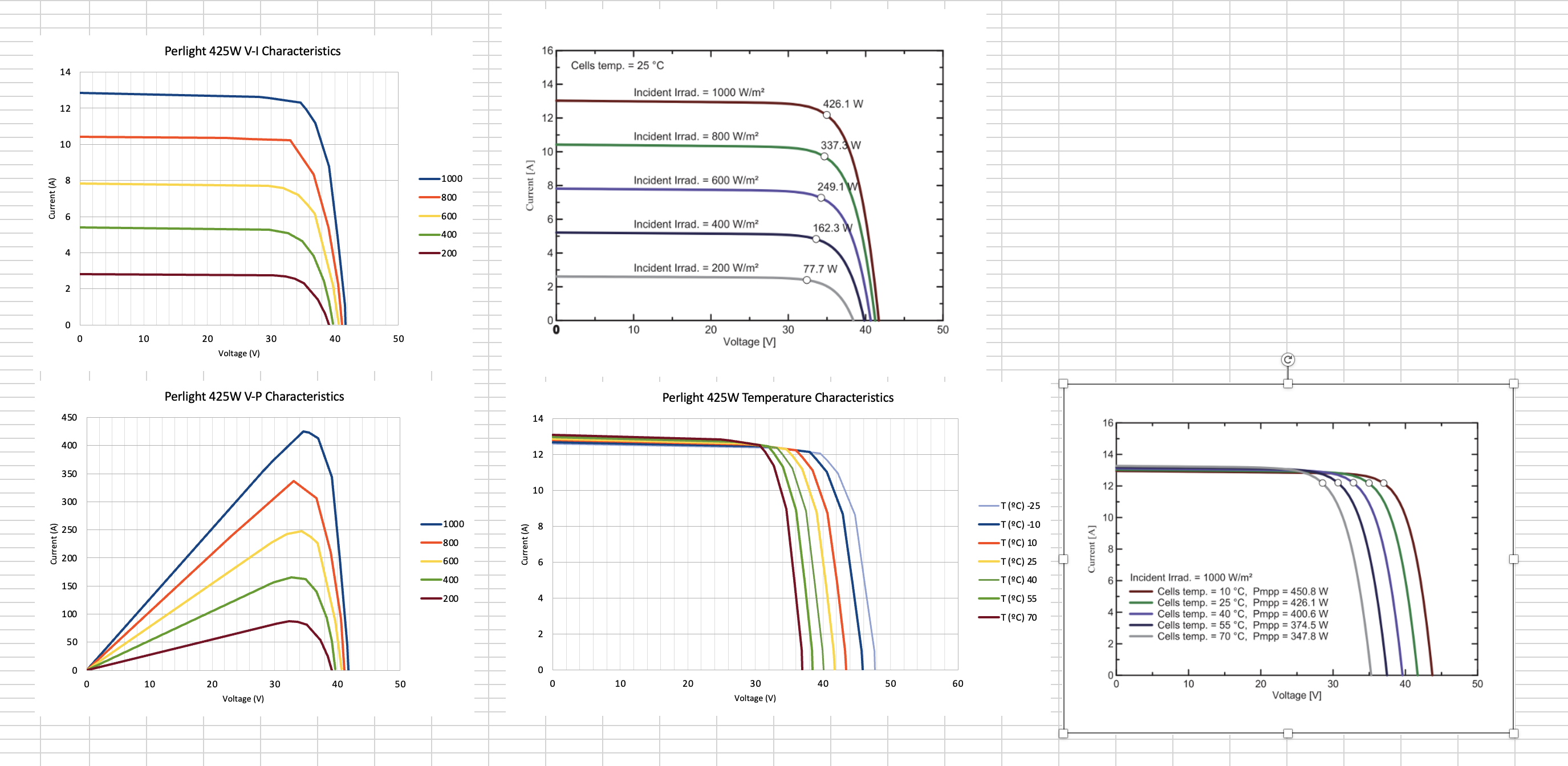
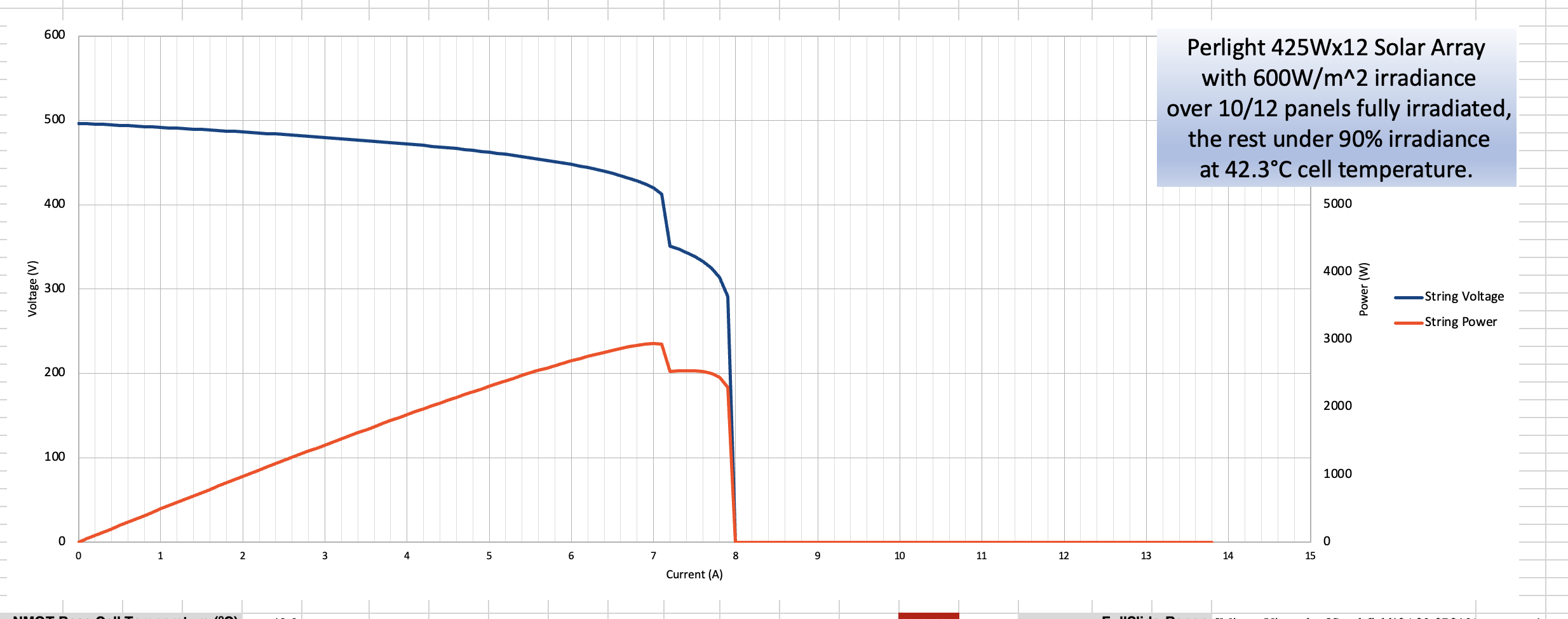
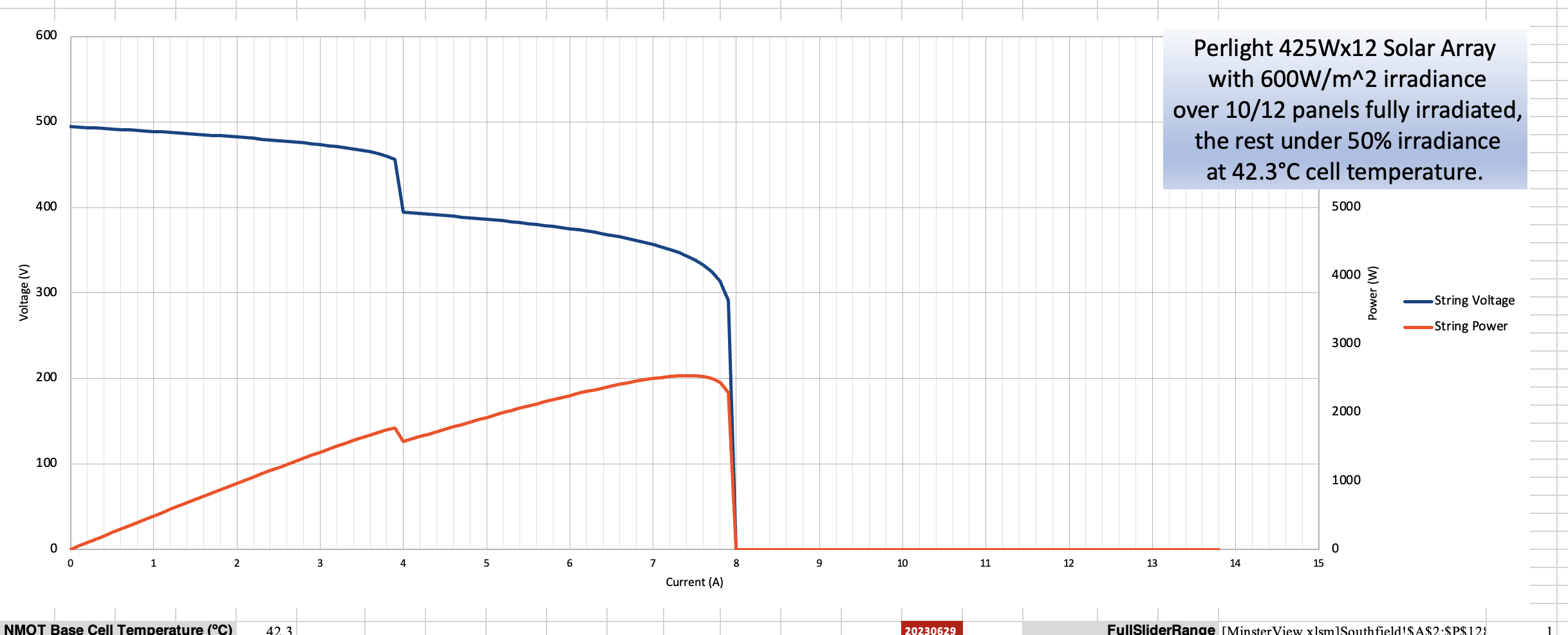
I have modeled the v-i curves for my 8 panels (string 1) and there is indeed a local maximum at about 0.9A when 3 panels have a low irradiance.
Model output
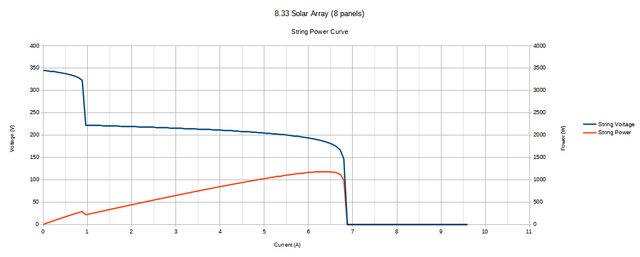
Tech support do not seem to understand the problem
Has anybody else seen this?

FWIW my old Fronius periodically did a "large step" when tracking to see if there were other v-i maxima but I don't know if Givenergy MPPTs are that sophisticated...

T
#2 ThePud

This is very neat and it would be interesting to know how you did it if you don’t mind sharing. My system is new and I am trying to diagnose some of its behaviour, which may also be related to some panels being shaded. Your discovery of a bogus local maximum is potentially very significant for these systems if the MPPT gets stuck on it. Bit like generic algorithms getting stuck on false maxima. Thank you.

J
#3 justpassing

ThePud
Hi , please see justpassing , update on my findings, and links that might let you do your own modelling.

T
#4 ThePud

Thank you. Beggars belief if GE are not implementing global scanning to avoid the false maximum. I have a Gen 3 5Hyb and there doesn’t seem to be anything in the specs to say whether it does or not. It says its “MPPT Efficiency” is 99.9% but measured how? MPPT range is stated as 120V - 550V but it throttles at 500V and takes both strings down with it.

M
#5 MinsterView

ThePud

how you did it

I took the V-I curves of the panels and derived a formula for them using a spreadsheet (regression analysis).
I then adjusted the irradiance of each panel and summed the total for the arrays. Have a play...

833-solar-400w-model.zip
135kB

Not entirely rigorous but matches my experience...
Others have used spice to model panel arrays.
I contacted GE for clarification and asked why they didn't use a "perturb and observe" (P&O) MPPT and just got a bland "our inverters don't work that way" and just pointed me to other manufacturers panel optimisers without explaining how their inverters worked out the MPP.
It's so obvious that the inverter is getting "stuck" on a local maximum as I can watch the shade diminish as the sunrises and the output flip when the last panel is (almost) completely exposed.
I'm used to "proper" inverters which use P&O (like Fronius) where you can see it periodically sweep the string current for a power maximum.
On a side note I've found the GE inverter seriously throttling the battery when it gets hot (5kW from the panels on a warm day reduces the battery max. discharge rate to about 1.5kW ). Needs a fan or more efficient electronics imho.

#6 hoggy

Interesting information. I don't have any shading bar an ill placed soil pipe that only really hits 1/8 of a panel when the sun is at it's very lowest in winter (& I have an external MPPT tracker type thing in the middle on that string anyway that hides/deals with it)
I mean no disservice to UK GE but given all the firmware is done out of China, UK support may not have any idea of the algorithm in use barring a few actual engineers. There may also be nuances across Gen 1 - 3 in how they implement.

They are however fairly amiable to suggestions so it may be one they take up - given it's something that moves product forward & that looks nice on the brochure (the current SOC firmware focus probably isn't something that would want to be highlighted too much in those!)

T
#7 ThePud

MinsterView That’s fantastic, and so very kind of you. It will take a while to make the adjustments, but I can already see the pattern. I have 13 East-facing 425W Perlights and as a result of your work and these conversations I can see that the massive increase in power “when the sun rises above the trees” is almost certainly due to the final panel (Northernmost) coming out of shade, and that the increase should be much steadier (graph from yesterday below). I’d imagined that the vertical increase at about 8:30 was normal; I now see that it isn’t. We’ve only had the system three weeks so I am very much a newbie on this, but it’s very helpful to have all this modelling available. More anon.

M
#8 MinsterView

ThePud I’d imagined that the vertical increase at about 8:30 was normal

Unfortunately it will be unless GE change their MPPT algorithm :-(.
You're 'losing' a triangular shaped chunk of output just like I am.

hoggy but given all the firmware is done out of China

I guess so but GE present themselves as a UK company "GivEnergy are a British Owned Battery Storage Manufacturer with manufacturing/Research and Development facilities in the UK, Ireland, Australia and Shenzhen China"
I certainly thought I was "buying british"...

T
#9 ThePud

MinsterView
Yes I thought that might be the case, and it's odd that GE don't seem to see this as an issue, or not as a priority issue, even on a Gen 3 inverter which shouldn't be exhibiting this behaviour.
How does the MPPT algorithm take control of the bypass diodes in each cell?
There seem to me to be at least three (possibly-related) things going on in my plot: the triangular loss you mention; the drastic ramping down once PV2 kicks in which similarly costs a lot of production on PV1; and the weird shutting down of the whole system periodically in response to - well, what? If it's overvoltage, then why both strings, and the MPPT rating is 120V-550V, and we're nowhere near the top limit.

M
#10 MinsterView

ThePud How does the MPPT algorithm take control of the bypass diodes in each cell?

It doesn't. There are several types of MPPT algorithms out there (try Google).
All the inverter "sees" is the string's total voltage. The inverter applies a load to the string (ie draws current) and the algorithm is meant to determine the maximum power (from the total string voltage and applied current) by adjusting the current.
If a panel is shaded it will not be able to provide current to the string but the others can.
It's like having a flat cell in a battery but the diodes in the panel will stop the other panels reverse biasing the shaded panel.
Under these conditions the inverter will still apply load (current) and the shaded panel will go to 0v (ish) and it can cause a "local" peak in the string v-i curve.
One way out of this is for the inverter to think "what happens if I increase or decrease the current (by a major step)?". If it finds an increase in current (say by 2A) actually provides more power it can iterate either side of the "new" current to find the max ppt.
This is a "perturb and observe" MPPT algorithm.
All algorithms have pros and cons (e.g. P&O can be slow to react to irradiance changes)
Hope this helps

J
#11 justpassing

hoggy What's the best route to getting the mppt algorithm considered for development?

#12 hoggy

justpassing officially: via submitting it as a suggestion via the app/portal.
Unofficially: it’s probably worth bringing it to Paul/the dragons attention given he’s in constant contact with China Fw team.
May be able to get them to explain what method they are using (or why it was chosen)

M
#13 MinsterView

I'm sure GE are implementing an MPPT algorithm - just one which does not work well with partial shading

hoggy officially: via submitting it as a suggestion via the app/portal.
Unofficially: it’s probably worth bringing it to Paul/the dragons attention

I raised it via the portal as a bug with all the data proving the inverter misses the global peak in Oct 22 and got a brush off:

Our trackers are maximum power point trackers and do not work as you believe, for what you're after you will need to look at optimisers on the panels such as Tigo as a brand that people commonly install with our systems.

Kind Regards

Adam Reynolds
Office Manager

Not sure "a brand that people commonly install with our systems" is a good quote...
How do we contact Paul/the dragons?

T
#15 ThePud

MinsterView Well, I've been having fun! It isn't quite right yet but it's getting there. I wouldn't have got anywhere without MinsterView 's spreadsheets but I've managed to adapt most of them and they're not too far off. Thank you again! (All mistakes are mine.)

QUESTION: When the Perlight datasheet quotes the NMOT temperature as 42.3ºC, is that the cell temperature, and therefore the base level to be used in calculations, or should we start from 25ºC? My graphs here use 42.3, because it's not clear to me what the NMOT quoted figure means if not cell temperature, and then the question becomes what the air temperature is at which we should start to worry about cold days and high net voltages because at -25ºC mine hit 575V. Not that I expect to see that any time soon.

J
#16 justpassing

@TheDragon (GivEnergy) Hi Paul, could you have a quick look through this thread and comment please ? Be great to know if the MPPT Global behaviour was on the radar, or if its "never going to happen". I covered the same issue in justpassing

Thanks

#17 TheDragon (GivEnergy)

justpassing

I can ask the question, but its way over my head, to understand, probably could if i had time to study them.

If you can provide me a comparison of our inverter, vs another which behaves as you wish, we can maybe try to find a reason for the loss of power.
We support Tigo, maybe these will help your shading issue

J
#18 justpassing

TheDragon (GivEnergy) Thanks for the quick reply. Tigo optimisers would indeed be a workaround, but some string inverters can achieve most of the benefits without the optimisers, relying on the string MPPT and the bypass diodes in the panels.

The core of the issue is that because of the MPPT implementation is not looking for the global maximum power, it never causes the bypass diodes to cut in.

So its the old fashioned " lowest common denominator" for the whole string. Basically without optimisers, the givenergy string performance collapses with even small amounts of near shadow. ( unless the shadow is complete, like a opaque barrier on the panels surface )

By comparison any inverter that offers Global MPPT or Shadow Tracking will potentially maximize power by forcing the bypass diodes to conduct.
https://help.aurorasolar.com/hc/en-us/articles/115001339907-Global-MPPT-and-Bypass-Diodes

Fronius and Huawei and others have this feature.

T
#19 ThePud

TheDragon (GivEnergy) I am a newbie on this, but if you look at the graphic I posted earlier in this thread you will see a precipitous rise in power at about 8:30, which shows that the gradual irradiation of the array of cells generates no power until the last cell is irradiated, a clear sign of the shadowing effect. The curve should be smooth, gradually increasing as new panels come into full light. I don't understand the technical details, but essentially a great triangle of power is lost while we wait for the last panel to come out of shadow.
This can be fixed by software, I am told, and so it should be fixed.
Thanks.
The Pud

T
#20 ThePud

I used @MinsterView's excellent model to create an equivalent for my two Perlight arrays, added a temperature-specific feature, and explored the behaviour over various levels of shading. I discovered that the MPPT issue depends on where it begins its optimising search, which was perhaps obvious to everyone but me. The local maximum is only discovered if it starts low rather than from the theoretical MPP; if it doesn't start low, there is only a problem when the shading is lower, the irradiance of the under-illuminated panels higher, which rather surprised me, because then the bogus local maximum is not found and the optimal power is generated.
Problems start if the MPPT selects the theoretical optimal MPP but the shading is relatively low, which means that the maximum power is not generated at the theoretical MPP. I created an animation, which I think/hope illustrates the point, but this platform won't upload it; it's probably too large a file. So here are some stills: the second illustrates the case where the local maximum exists but is below the MPP power, so only matters if the MPPT selects it; the first is the case where the local maximum is higher than the MPP, so only matters if the MPPT is so fixated on the theoretical MPP that it fails to find it.

Here the local maximum is below the MPP so only comes into play if the MPPT selects it:

In the absence of more information about how the MPPT actually operates, it's hard to move forward.
The Pud

K
#22 kram

And people used to accuse Huawei of looking at what others did and doing it themselves 😂😂😂

The Huawei hardware is excellent quality hardware.

#23 Maxwell

So, over the typical year how much is this costing GE customers in terms of lost/reduced electricty generaton and does it have a bigger effect in cloudy/lower solar days where say ytou are loosing charge to the battery ?

K
#24 kram

Maxwell

It’s not just GE as different manufacturers pick different algorithms with different advantages and disadvantages.

Optimisers or microinverters are even better than the MPPT described because they do it on each panel. That huawei document says as much, but they have other disadvantages on cost and potentially maintenance.

Nothing to stop people putting tigo optimisers on the GE inverters as far as I’m aware for example.

#25 Maxwell

kram Appreciate that vendors may have different approaches. But, to be a solar panel customer you shouldn't have to be a deep techy specialist. And whilst its great that there are folks here who are really into the techie stuff the question for the those that aren't is does this really impact me ? Does it foreshorten the life of equipment, how much money are we loosing or whatever the real life user impact is. Or is it simply a bit of accademic fun with no real customer impact ?

J
#26 justpassing

Maxwell

Tldr: if you don't have any near or far shading on your string, it doesn't matter. If you do it does.

Can only speak for myself, and my specific set up.

With this simple mppt, then you lose nothing at all if you panels are never shaded, neither dappled or solid shade.

If it's a cloudy day, most of the power comes from light bouncing around, and simple mppt will have much less affect, as you get a more uniform low level on all panels.

If you have a nice sunny day but even a small area of reduced light on 1 or more panels on your string, it's seriously bad news. The contrast between direct sun, and the scattered light unaffected by the pole/chimney/neighbours house , is huge say 10x. Your string will be limited to the current supported by the darkest cell, so drop by 10x.
In some cases, if you have half cut panels, you can see them as two parallel strings ( they are not, but the analogy works) as long as only one of the half strings is shaded, you continue to get half the power, plus the reduced power from the other half. As soon as both halves of any panel see shading, you are back to very little.

So worst case is 1 string, where you see even a little shade all day sweeping over the array. One of the other posts saw this . Then you will basically get power something like the cloudy day scenario every day :-(

In terms of the classic experiment you see on the Internet, of placing a leaf on the panel, if that is dark enough, then the substring will pass so little current that the bypass diodes save you. That part of the panel is bypassed and you get the power from all the others.

Global mppt can give a similar effect for near or far shading. The inverter can "choose" whether bypassing the affected panels is better or worse for the power output.

#27 Maxwell

justpassing Thanks for explaning. I guess it's again down to your installer explaining individual cases and which solution/vendor is best for their situation. Puts a big onus on them getting it right or the customer ends up getting lower performance (longer to rocoup your investment). A quick look on the web (thi is a US sites) shows some of the arguments around MPPT vs microinverters, even there it isn't clear cut. Other sites may have different views. If you were in a sight with known sdae issues would you recoup the extra cost of microinvertes (over the system lifetime) or are u better off with the lower install price of a MPPT solution with the known lower output issues ?
https://www.solarreviews.com/blog/pros-and-cons-of-string-inverter-vs-microinverter

J
#28 justpassing

Maxwell
I prefer the microinverter idea, of all the panels being completely independent, but didn't even consider it, so didn't have quotes.

What I did consider, was adding optimisers to the potentially shaded panels. Having done my own research, and with vague assurances from my installer, I didn't see any significant benefit. Now fitted and rn my own tests, I know that the Givenergy inverters haven't implemented any Global MPPT ( very disappointing) .

I would urge anyone with shading to either fit optimisers or choose another inverter.

In my specific case I lose between winter 0 and summer 1.5 hrs of evening generation ( peak hours) , because of my specific shading/panel orientation. Might have been worth paying £300 + fitting for 6 optimisers. Probably never pay back, and certainly wouldn't if I had to pay for retrofitting. However frustrating to know that it could be fixed by the right inverter firmware.

If I had seen some shading that affected my string throughout the day, it would have been a disaster.

For a more balanced view of how this is all supposed to work ( not from a manufacturer ) these two sources are good.
https://www.youtube.com/watch?v=I4czBPobtg0 (GaryDoesSolar)
and
https://www.youtube.com/watch?v=E9NVLB_OYSU&t=926s (Andreas Spies)

They both come to the conclusion that "Modern string inverters" give you most of the benefits of optimisers without the costs and reliability risks of added optimisers.

But to be very clear, their conclusions do not apply to the current Givenergy Inverters / current firmware. As effectively the Givenergyy inverters dont use the bypass diodes in real life conditions.

J
#29 Josie

ThePud Is that 500 / 500v maximum per string (ie not the total for the inverter across both strings)?

N
#30 NickK

TheDragon (GivEnergy) Hi Paul - I've got significant tree shading from October to March but my research had led me to believe that optimisers are not necessary with half cell panels with bypass diodes and modern inverters with global mppt tracking. Apart from the cost of optimisers, they introduce a permanent 2.5% loss, add electronics in an unfriendly environment and are expensive to replace if they do fail.

Unfortunately it appears that GE inverters are not modern by the above definition. Is developing global mppt tracking on the radar in the next 12 months (and available as a firmware upgrade)? Whilst complicated, this issue is getting more visibility - its got to be worth your while.

My panels are due to be installed in a few days and I need to decide whether to stick with GE? (which I really want to do - British company (sort of), user community, ability to integrate with home assistant, etc).

Yes I could bite the bullet and add 12 Tigos but as indicated above, I don't really want to go down that route.

Thanks, Nick

#31 TheDragon (GivEnergy)

NickK I have passed the above documents to the MPTP DSP firmware team to look over. See if they can implement this, if its not already in there

D
#32 dragon2905

Sort of related but rather than potentially recommending using Optimisers of any flavour (which are in general a BAD idea = cost as/nearly as much as a PV panel, use aprx 10% power to "optimise" and have a failure rate of 10-15%).

Better to perpetuate the reality that installers should be using Shingled PV Panels which only add a minor cost increase and a disproportionate benefit if you have shading to consider.

Obviously too later after the fact but the more it's talked about the better.

There are a number of manufacturers that offer Shingled Panels but 8.33 seem fairly decent price and have excellent performance / panel warranties.

https://www.solartradesales.co.uk/8-33-solar-430w-full-black-30mm-mono-shingled-cell-solar-panel?cat=9698

T
#33 ThePud

Josie Yes, 500V per string.
What seems to be happening is that when the battery is fully charged the inverter can only ship 5kW, and two 12 x 425W panel strings often exceed that, so they get throttled. One workaround would be never to charge the battery until the power generated exceeds 5kW because then the inverter can use a further 3600W DC to charge the battery and the power generated can rise to 8600W if possible, and I've data supporting the idea from when the SOC was 80% and PPV was allowed to go up to 7600W. Unfortunately nothing seems to allow the solar charging to be timed, only the grid charging. Does anyone know differently? Can GivTCP achieve this? An alternative is to reduce the battery maximum charge rate well below 3600W because then it won't charge up so quickly in the morning and at least some otherwise wasted capacity can be used in peak generation hours.

J
#34 justpassing

This is way off topic, but there is a timed battery pause function now on the Givenergy remote control for Gen2 909. You could use it as it is, ( it does completely stop charging, unlike setting charge rate to 0 on gen2 ). Or add it to an automation once its available through givTCP etc.

T
#35 Tim

ThePud An alternative is to reduce the battery maximum charge rate

This is what we do from April until October when PV can be relied upon. Our battery charge rate is set to 900W. It's still usually at 100% by lunchtime but it does mean clipping is reduced and export starts earlier.

T
#36 ThePud

Tim Yes, I understand. Good idea.
It surprises me that the system doesn't have an option to set the time of solar-sourced battery-charging as well as grid-sourced. If the hardware can do one, you'd think it could do the other. But I don't think it is possible at the moment, is it?
Better still would be a threshold setting independent of time where battery charging from solar only kicked in once total PPV was around, say, 4900W, or some level that the user can set, and then automatically set the maximum charge level to "Total current PPV minus threshold". I've been looking at the givTCP source-code to see if it can be hacked, but there doesn't appear to be an endpoint that can be used to trigger timed solar charging. But I'm still coming to terms with it so it may emerge later.

T
#37 ThePud

justpassing It would be bang on topic if it were possible to have the battery charge mode set to "Solar only" as well as having either a timed charge or a timed pause. Then once it came back it would effectively be a timed solar charge. But if it is possible, I can't see where or how. Can you?

T
#38 Tim

ThePud You can use Home Assistant to set charge rate to zero until your export hits your G99 limit, then increase the charge rate as you like. The only issue with this would be if the weather forecast was wrong and your automation prevented any charge. If you're interested in customising your system to behave in exactly the way you want, you'll almost inevitably end up with Home Assistant or another tool.

#39 TheDragon (GivEnergy)

Tim There is a very good automation that modulates battery charge, creating a constant export value, and a modulated battery charge, following that of the PV. Very neat.
So you have a yellow curve above, and a blue curve below

T
#40 Tim

TheDragon (GivEnergy) a very good automation

Sounds very interesting. Where would we find it?

T
#41 ThePud

TheDragon (GivEnergy) Yes that would be very interesting. I tried to find it but failed. Please let us know where it is. Thank you.
It would be a very useful and sensible thing to build into the firmware, too.

T
#42 ThePud

TheDragon (GivEnergy)
I continue to be interested in this automation.
Given the unpredictable weather at the moment there is a need for the rate of battery charge to be lower in the mornings when the day promises to remain unclouded so that the most can be gleaned during the afternoon, and there is a correspondingly opposite need for the battery to charge up during good mornings if the afternoon is likely to be cloudy.
Today, for example (20230721), the battery had unnecessarily fully charged by noon while the total generation was below 5000Wh, but it could perfectly well have been delayed until the afternoon to benefit everyone from larger export. So any programmable and therefore intelligent control of this would be very welcome.
Thanks.

T
#43 Trinnet

Resurrecting this thread to ask whether the MPPT algorithm got updated to allow it to find the global maximum, or whether this is still an ongoing issue.

The February firmware updates for gen2 & 3 contain the rather cryptic line:

"Optimise PV MPPT Logic "

Which might mean the inverters now do Global MPPT, but might just cover more minor tweaks.

Asking because the final thing on my checklist before committing to the install was checking that GivEnergy had a modern MPPT algorithm, and it looks like I'm maybe falling at the final hurdle here!

T
#44 Trinnet

@TheDragon (GivEnergy) Hi Paul, do you know whether this was included in the latest firmware update and/or is in development please?