MPPT, Bypass Diodes and shade.

5 comments started 2023-06-21 last 2023-06-25
GivEnergy ProductsHybrid
J
#1 justpassing

666tim666 Came back on an earlier question, and describes the issue better than I can :-)
and MinsterView

I wondered if this was an acknowledged MPPT limitation , a panel issue or bad luck.

I have 6 Jinko half cut panels westerly aspect. Around 5:30pm they start to be shaded by a neighbours house. I didn't go for optimisers, as I had wrongly assumed from research that the bypass diodes would cut in, and therefore the "hard shading" I was seeing would result in progressive "loss" of panel segments. The voltage of the string should drop, but the current of the unshaded columns should be maintained. That way you lose the power of the proportion of the array that is shaded.

What I actually see is the worst case scenario of the MPPT lifting the voltage of the string, dropping the current to the lowest common denominator, so a sliver of shade leads to 2kW dropping to either 1kW where the shade touches top or bottom of a panel, or to 300 watts when any panel/ column group of cells is shaded. This looks as if the MPPT is only moving to a local maximum at a similar voltage ( or not doing anything) rather than searching for th eglobal maximum, using the bypass diodes.

However if I do the experiment @"666tim666" did , of placing a cardboard barrier directly over the panel, then the MPPT actually does what it should, it sacrifices the voltage of the shaded columns, but maintains current for the rest of the string.

Is this an acknowledged weakness of the MPPT, with a hope of future improvement ? The costs of retrofitting optimisers don't stack up, but it is annoying to lose power just when when we cook dinner !

A picture of power/current /voltage same day same time clear skys
mppt.pdf
53kB
S
#2 SilverArt

Is there something else in play or to consider? If you cardboard shade the panel in the same way that the building shades the panel and leave it there until the real shading is well and truly established, what results do you get then?

J
#3 justpassing

SilverArt Excellent question. Combination of wind and ladders stopped me testing this properly, yesterday 😳. I will report back .

J
#4 justpassing

TLDR: Disappointing to find the MPPT on my Gen2 does not seem to do global tracking. If you have shading, look to optimisers, or another inverter that advertises global MPPT or Shadow management.

A combination of blustery wind and grey afternoons ...But I have enough historic data to model whats happening. I used the modelling work provided by Andreas Spiess
[(https://www.youtube.com/watch?v=E9NVLB_OYSU)]

His conclusions are all based on the fact that "MOST" modern Inverters have Global MPPT or Shadow management. This allows the inverter MPPT to bypass shadowed parts of the Panels by setting the voltage such that the bypass diodes conduct. During shadowing there are usually at least 2 possible maximums. Ones where the diodes are bypassing the shaded areas ( lower string voltage) and ones where the bypass diodes are not active, and the current still travels through all of the serial connected cells.

I adapted his files to match my 6 panel system, the panels are half cut, so the testing looked at shading of one half of the panel , or both halves.
The results are displayed differently from MinsterView
as Power against Voltage.

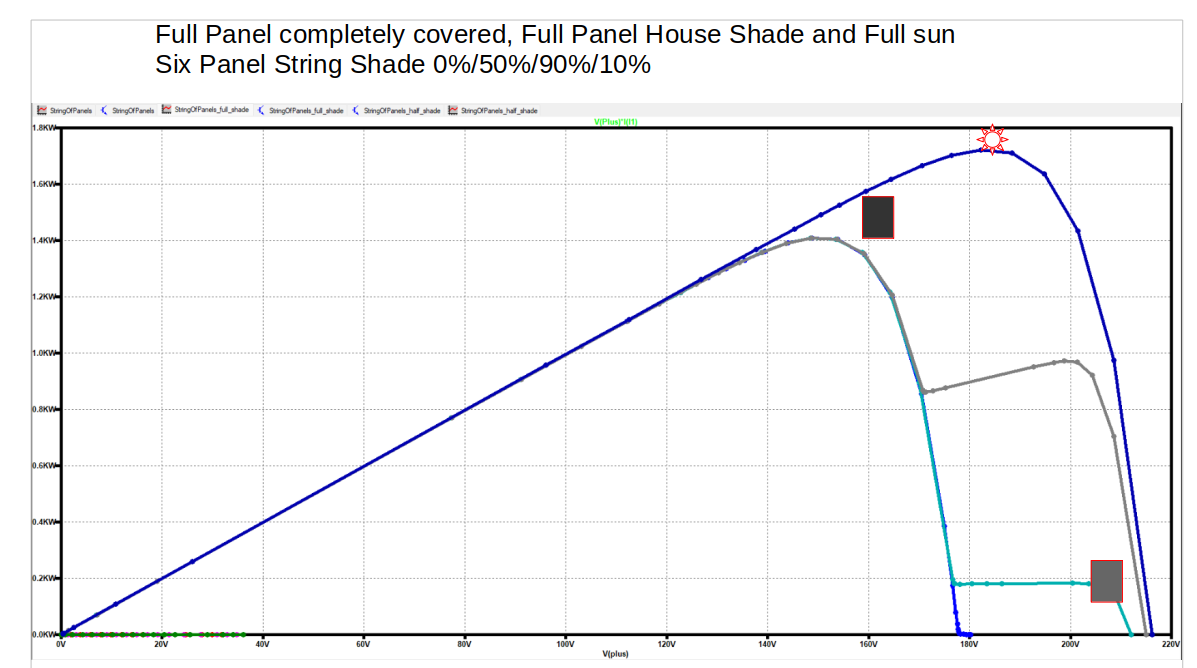
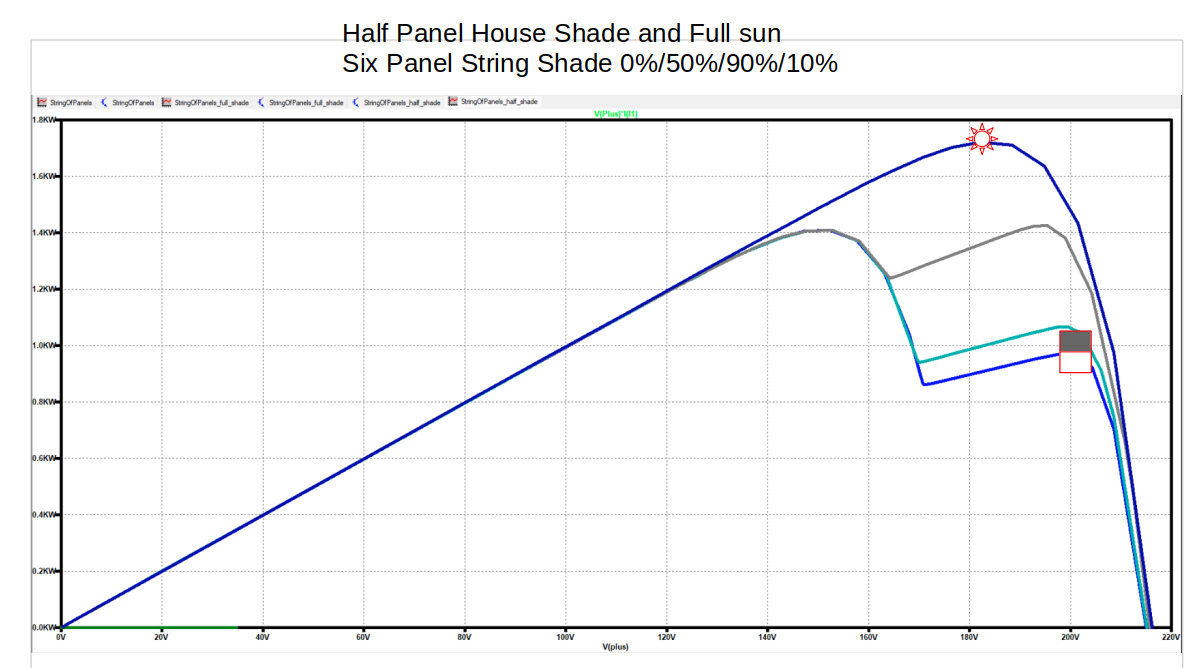
So what the model shows is what the performance of my system would be, assuming the MPPT chose any voltage between 0 and the Voc. There are traces with increased shading of a whole panel, or half a panel, for different light levels. 100% being unshaded, 50% 10% and 0 ( artificially covered).

I have then shown on the two predicted traces the actual results of two sets of experiments.
1) The real life shade, which reduces the illumination of the shaded area. but still allows diffuse light to hit the cells. From observation that reduces the illumination to about 10% of the full sun value.
2) Where the shade is 100%, provided by something directly covering the panel surface.

Where half a panel is shaded, the MPPT seems to find the local maximum, which tends towards 5 amps, halving the power of the whole string. It does not matter if the shading is complete ( artificial) or from the nearby building.
This makes sense as there is little difference between the two in terms of Voltage/Power graphs, and the MPPT is grabbing the local maximum by raising the string Voltage. The other half of the panel still carries half the current ( half cut cells), so the power halves. Again the string would have produced much more power if the bypass diodes on the half shaded call had been activated, giving roughly 5/6th of the power rather than 1/2 where the bypass diodes remain inactive.

Where a full panel is shaded, there are two outcomes. If it is the building shading ( 10% of illumination in direct sunshine), then the MPPT still finds the local maximum, dragging the whole string down. The voltage increases, and the current drops to 10% for the whole string.
If the panel is totally shaded, artificially, then there is no local maximum, and the correct maximum is found. The bypass diodes cut in, as the MPTT drops the voltage to find the maximum.

A more sophisticated MPPT would occasionally scan for global maximums, and thereby make use of the bypass diodes , improving production.

J
#5 justpassing

SilverArt to directly answer your question, the mppt stays around its local maximum.

My 6 panels are portrait, 3 rows of 2. At this time of year, the shadow starts at the bottom of the panels and works up. If I completely block off both lower panels, then the bypass diodes kick in, and I get about 4/6 th of the power, at a lower voltage as above.

If I then remove the covering, the mppt keeps to the same voltage, and does not increase the voltage again. So the lower panels remain bypassed, even though the shade is now partial.

It's local maximum is now the " right" one. Then as the shade creeps up to the next layer of panels, then as soon as a cell on a new panel is impacted , the current drops, and the voltage shoots up again, power down.

It would be good to know if the improvement of global mppt is something that is even being considered for a future firmware upgrade.