In the evening, I check and set the "Target SoC" (using GivTCP) or "AC Charge Upper % Limit" (GE Remote Control). I understand that the two names refer to the same control - two views to the same gauge.
If, for example, I set the "Target SoC" to 50% (all other settings remain as per the state after "Reset to Default"). The following morning, that setting reports 100%. Why?
It matters not, which tool I use to set the "Target SoC" (I use this term as its shorter than writing "AC Charge Upper % Limit"!).
Regards, Martin
R
#2Roberto
I only use the portal and the "wheel-thing" to change my settings. Anything else ends in tears.
M
#3mprowe
Wheel-Thing? Is this what you mean:
!
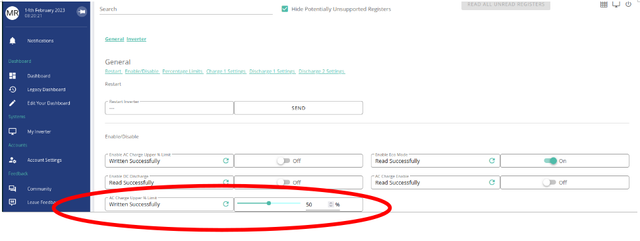
If so, yes. This is the tool I was referencing with the name "GE Remote Control".
And have you achieved an overnight AC Charge to anything other than 100%?
Regards, M.
C
#4chris_p
I don't bother with setting the required limit, I just use the timed window as that is the only reliable way I've found that works.
#5judgepd
mprowe Your answer is in your screenshot. If you want to charge to anything other than 100% you need to also set "Enable AC Charge Upper % Limit" to 'On'. If this isn't on then the charge will always go to 100%.
When you change the slider on the inverter settings page it does this automatically but when you use direct control of the inverter registers it's not automatic.
#6Cdent
mprowe check you've not got SmartTarget enabled in GivTCP - I did and someone on here mentioned this to me, disabled it and it's worked fine since
M
#7mprowe
Cdent check you've not got SmartTarget enabled in GivTCP
Tell me more. I have not seen a "SmartTarget" control. Even so, I was having the overnight charge problems before I installed GivTCP (which I did to get a wider view of my problem).
So, is everyone suggesting that it is possible to charge to only 50% (for example) if only I set the controls correctly?
Sorry for the confusion, I was just focusing (red highlight) on the "AC Charge Upper % Limit" control in that screenshot.
Not saying that was how I had set my system.
Regards, M.
#9judgepd
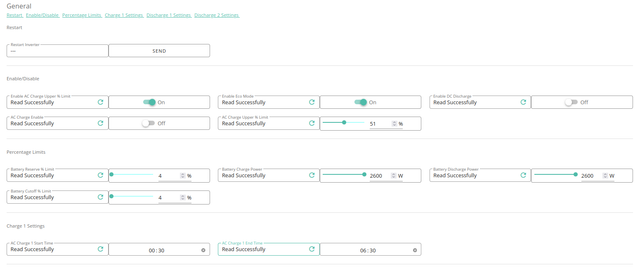
mprowe No, 2 settings above your red circle there is "Enable AC Charge Upper % Limit" you need to set this for it to actually use the percentage in "AC Charge Upper % Limit"
A
#10Annaka
SmartTarget is set in the Config area of GivTCP, you need GE API key and also Solcast info. if you want to use this.
I set the SOC from a NodeRed routine based upon forecast and time of year and a fudge factor (I have some trees providing shade) then sends the output to Home assistant at 00:25. everyday.... I found if I done it any earlier the charge would always go back to 100% but doing it at this time of the morning before OffPeak kicks in at 00:30 it seems to work fine.
M
#11mprowe
Okay. Thank you.
Is is not proof, but it is helpful to me to know I'm not far off the track... This is the screenshot I logged two days ago (20:101 2/2/23):
! infiniti q70 3.7 awd 0 60
... and still it charged to 100%!
Regards, M.
#12judgepd
Do you have an automation set for Octopus Go on the portal? If you do this overrides any charge limits and always charges to 100%.
M
#13mprowe
Annaka SmartTarget is set in the Config area of GivTCP,
Ahhhh....... You may have solved it 😀
Testing now. Will report back tomorrow (too much sun right now).
Regards, M.
#14Cdent
mprowe as @Annaka says above, in the config there is a toggle. Try that, hopefully that should sort it.
4
#154monks
mprowe This is the answer. Also make sure discharge time is disabled.
M
#16mprowe
That worked! Thank you all very much.
Before I wrap-up the issue at my end, can anyone offer any suggestions on what may have been going on in GE's collective mind while talking to me in many telephone calls over the previous 3 months?
While I was telling them (probably not very well) about this problem, they (multiple first-line tech support) where advising me that it was a known problem that was affecting everyone and the Development Team were "working on it".
Any suggestions on what the problem GE thought, I may have had? Or was it just a "brush off" technique?
Regards and many thanks M.
C
#17cluelesscris
There's a big problem with some systems where the SOC jumps from some figure to 100% and therefore stops charging and reducing capacity. This issue also sees large drops in SOC. The algorithm responsible for agreeing SOC with the battery seems to have been flawed and has required a rewrite using a completely different methodology. It's been going through beta testing for months and is very close to release. My guess is that the 100% SOC you refer to has been confused with the big issue and they missed the, quite common, mismatch of settings in your case.
It's fair to say the big issue has been somewhat of a nightmare for GE and threatened a mass warranty return from those affected. Everyone at GE, especially in support and development have probably been heavily distracted and prone to assumptions.
T
#18Tim
mprowe There is a problem with AC3s not respecting a user-set battery reserve greater than 4%, which is reported to be one of the bugs fixed in the beta about to be rolled out as production firmware.
@Britkat is doing a sterling job of developing and maintaining GivTCP and while he and his collaborators understand what the issues are and what they are fixing, IMHO it's a tall order for Givenergy staff to also be on top of those issues as well as the ones which fall within their responsibility.
Had you done the old Reset to defaults, it should have put the inverter back into a state where the ECO/Timed charge modes should work as designed by Givenergy and you would have been able to identify something in the GivTCP automation as the culprit.
I'm not intending to criticise what you did, rather summarise for the benefit of others, what might have been a short-cut to identifying the cause of unexpected behaviour. Thanks to the collective knowledge on this forum regarding the intricacies of GivTCP when being used to control the inverters, the issue was resolved in the end.
R
#19RetSparky
cluelesscris what is SOC and how does it affect the maximum charge level i set to top up battery overnight when minimal solar generation is expected
"State of Charge" - how full the battery is. Usually as a % of full capacity.
R
#22RetSparky
Daveb01 Thanks. Dave. Might take a bit to get my head round it.
Am I right to set a charge to level for overnight I need to set an SOC value and turn off AC charge % upper limit.
D
#23DD
RetSparky They're the same thing - the AC charge % upper limit is the SoC you want the AC charging to stop at. (In the app it's the 'charge up to' setting.)
R
#24RetSparky
Thanks. It does annoy me when there’s no consistency with naming between app, portal and remote control. Also seems strange that after reaching SOC during the timed period the battery goes into idle and load is supplied by grid until end of timed period. I would expect achieving SOC would override timed period and load would be supplied from the battery
Also seems strange that after reaching SOC during the timed period the battery goes into idle and load is supplied by grid until end of timed period.
I think that's a design decision. Some people may want their battery to be at the target SOC by the end of the AC charge window and it not having been used for house load, which seems reasonable.
It's swings and roundabouts though, whether you use the grid for house load to keep the battery at the target SOC or whether you start discharging the battery but will have to charge from the grid sooner once your battery is empty.
We tend to calculate the target SOC and adjust the charge rate dynamically to reach the target SOC just around or before the end of your charge window.
D
#26DD
RetSparky I think it's reasonable to assume that if you are charging the battery from grid, then the grid must be at a cheap rate, and therefore it makes sense to use it, and hang onto the battery until the grid is more expensive later in the day.
Perhaps more questionable is that if the battery is higher than the requested SoC at the start of the charging window, it discharges down to that level before pausing: I'd prefer that it maintained whatever it had, rather than using it while the grid is cheap.