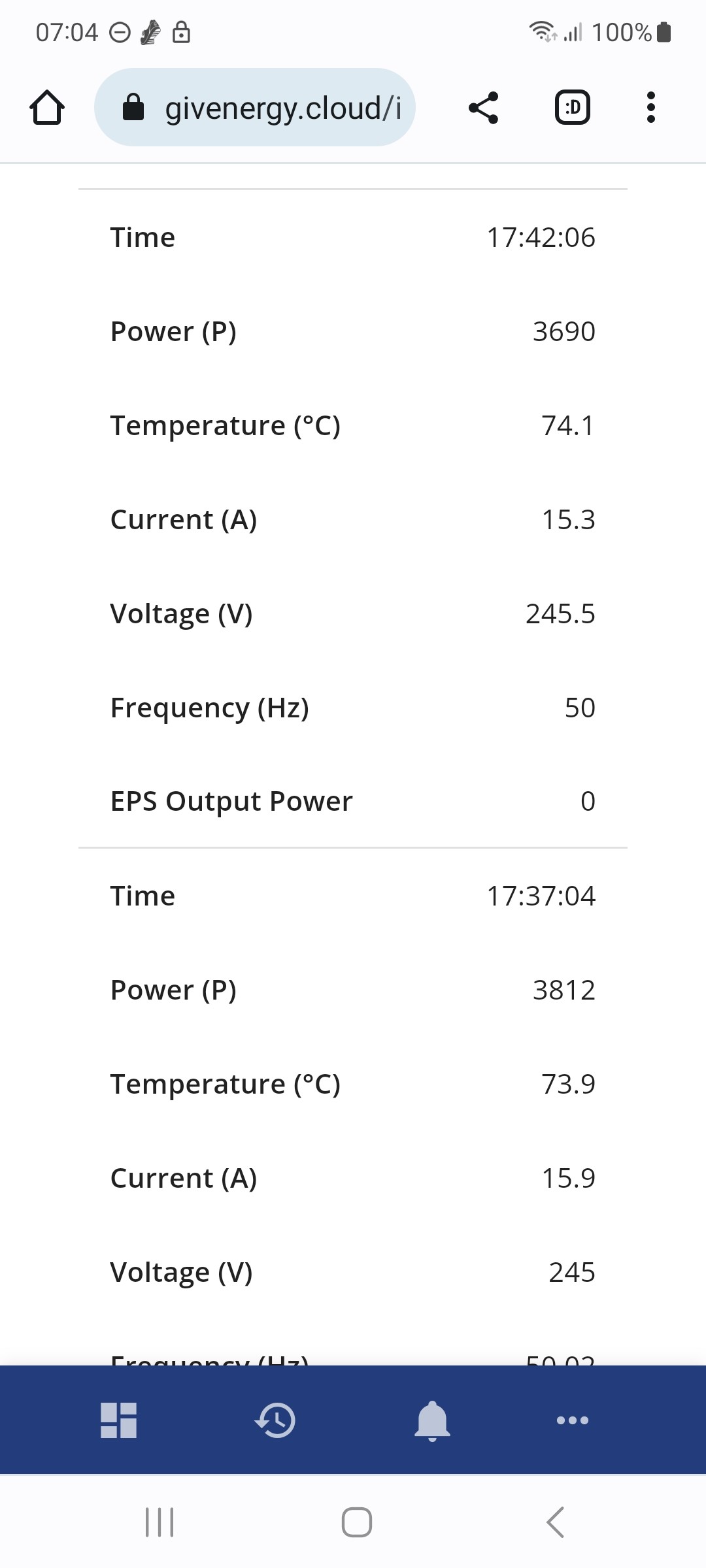
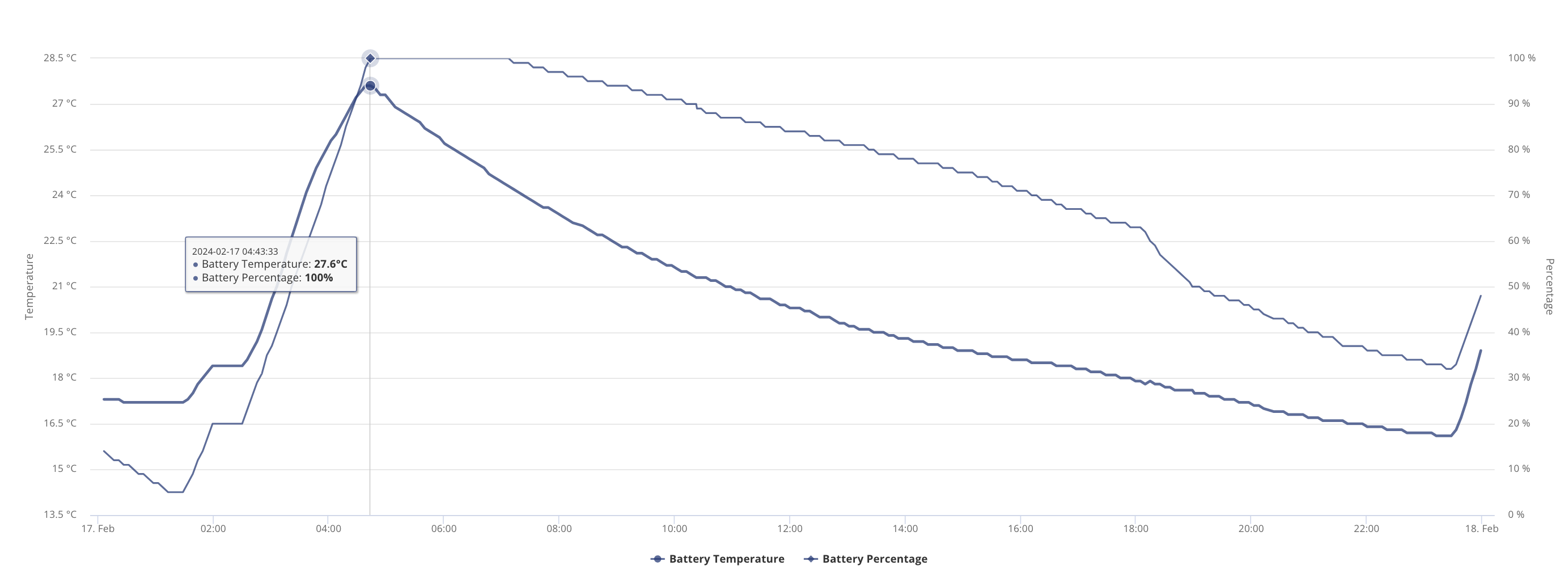
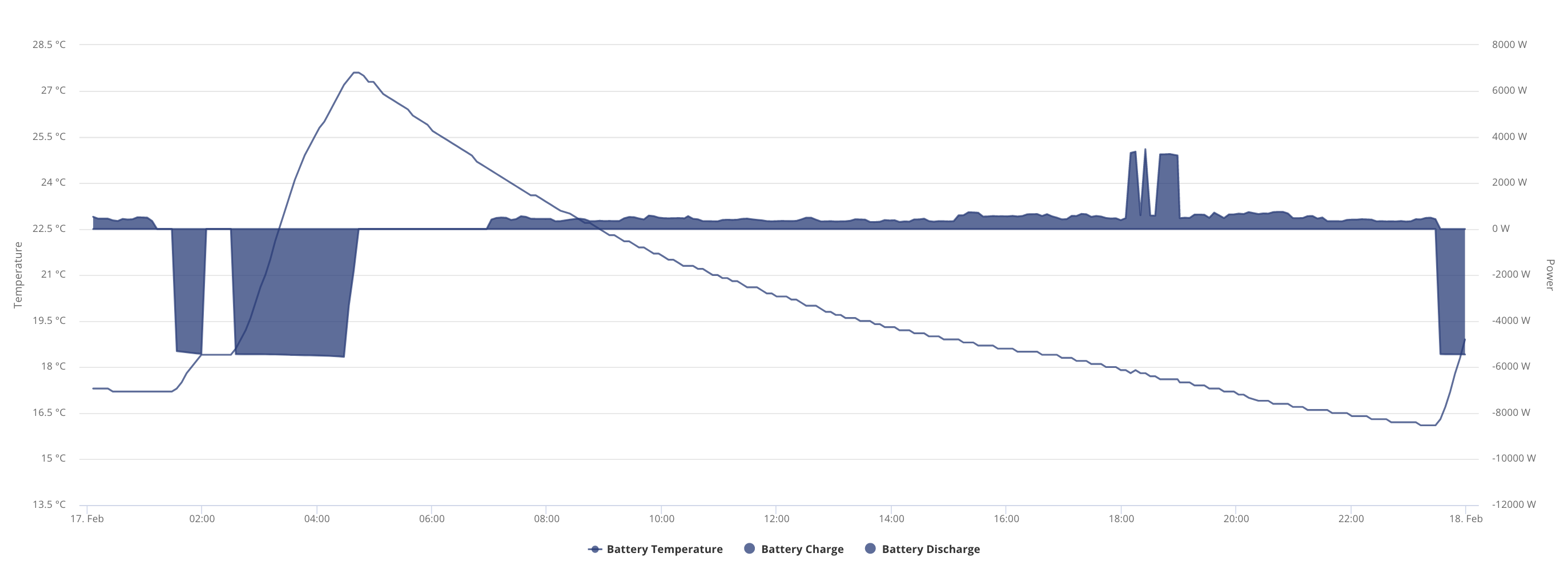
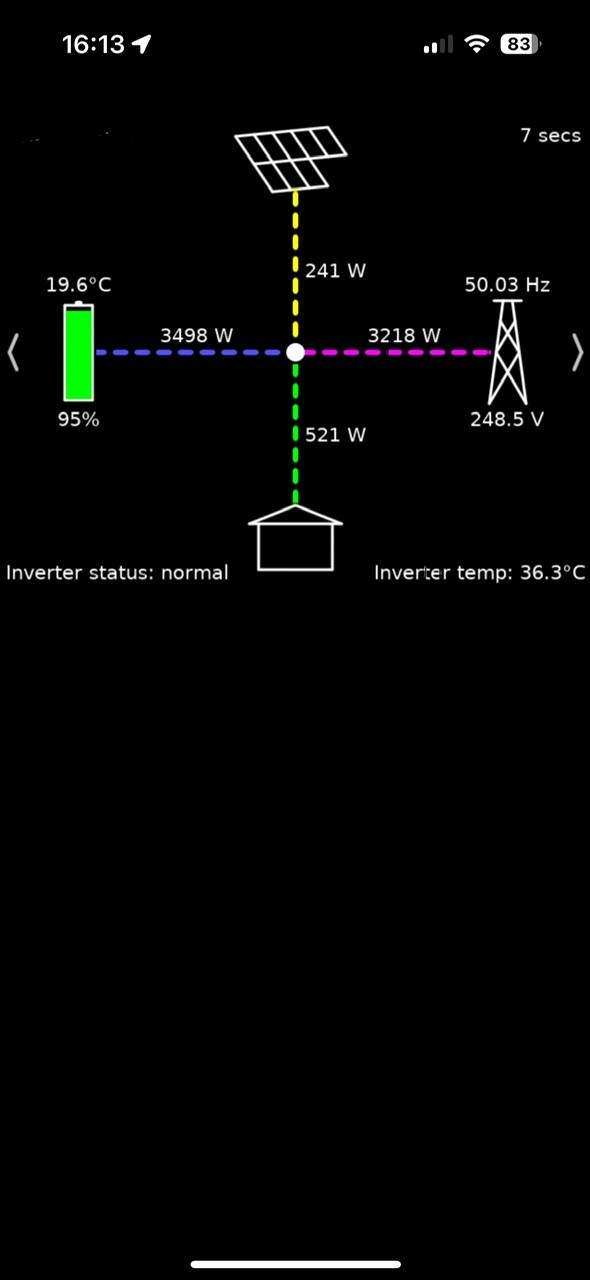
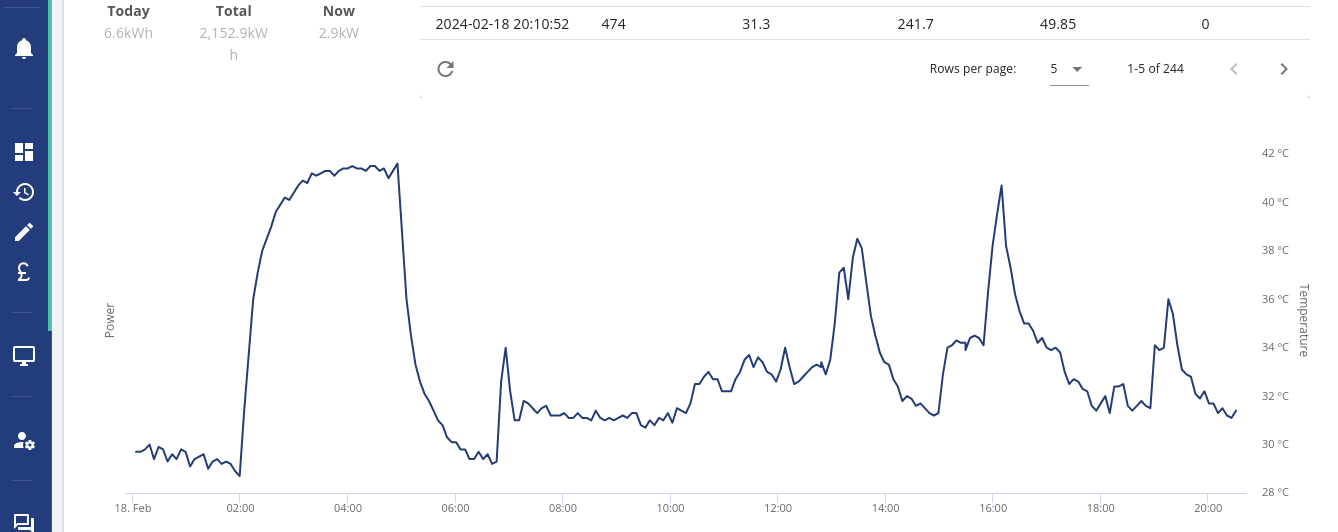
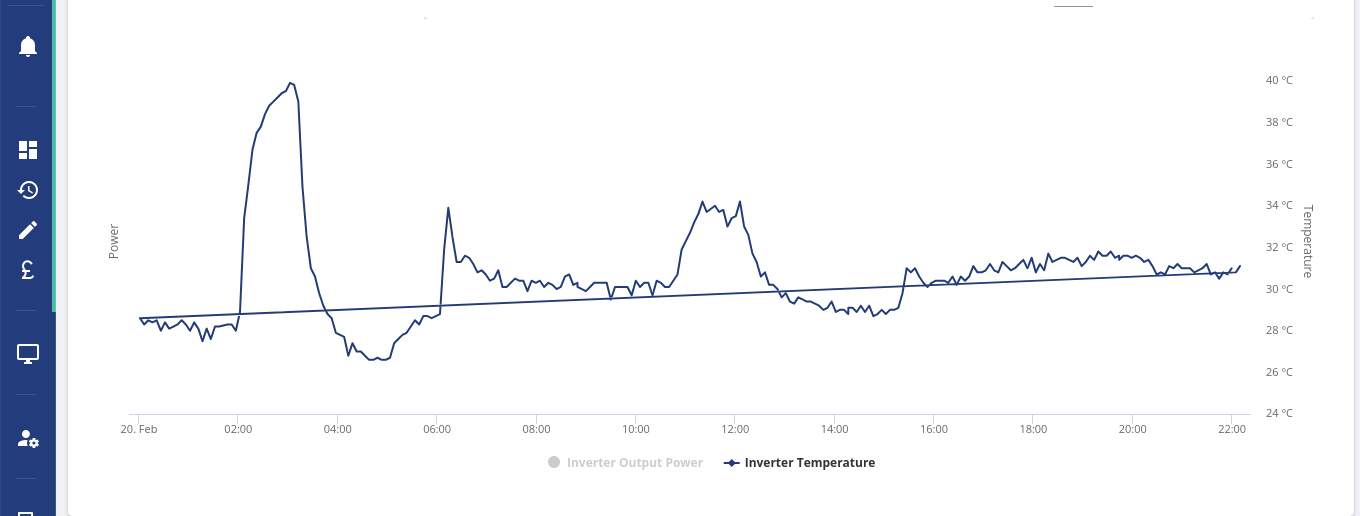
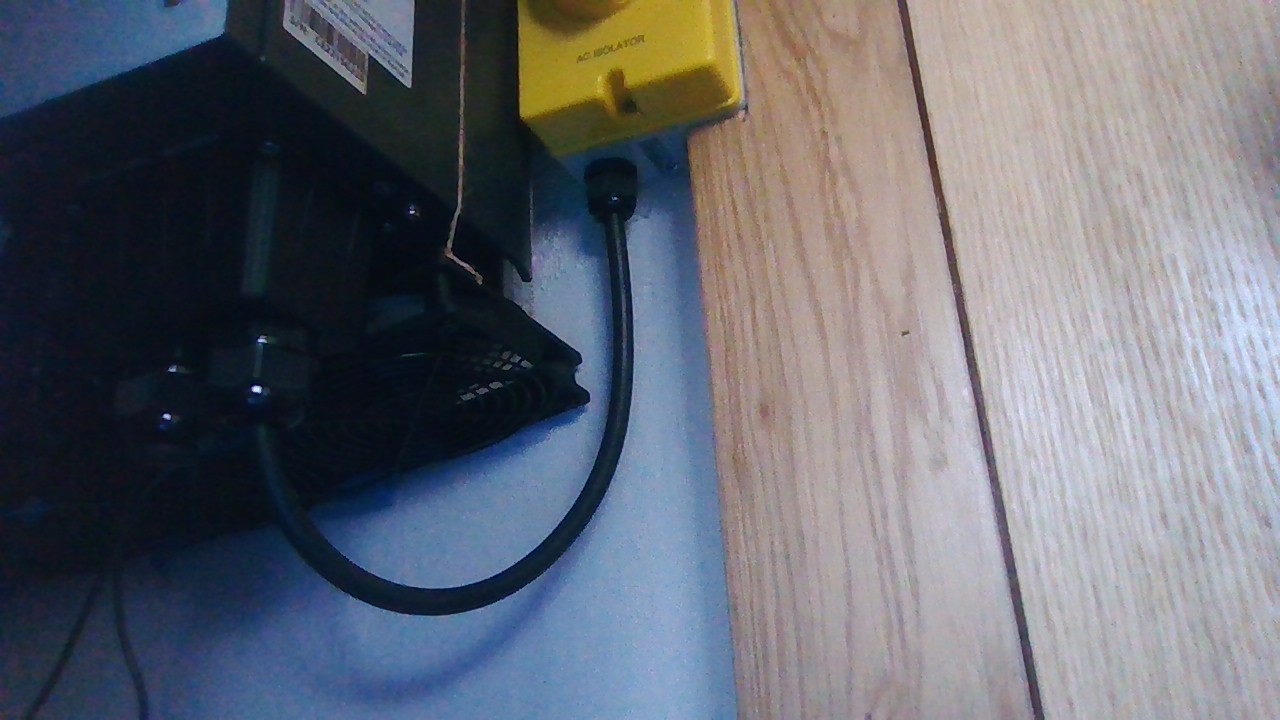
Need some guidance regarding the inverter temps I'm seeing please. Gen 2, 5kw hybrid.
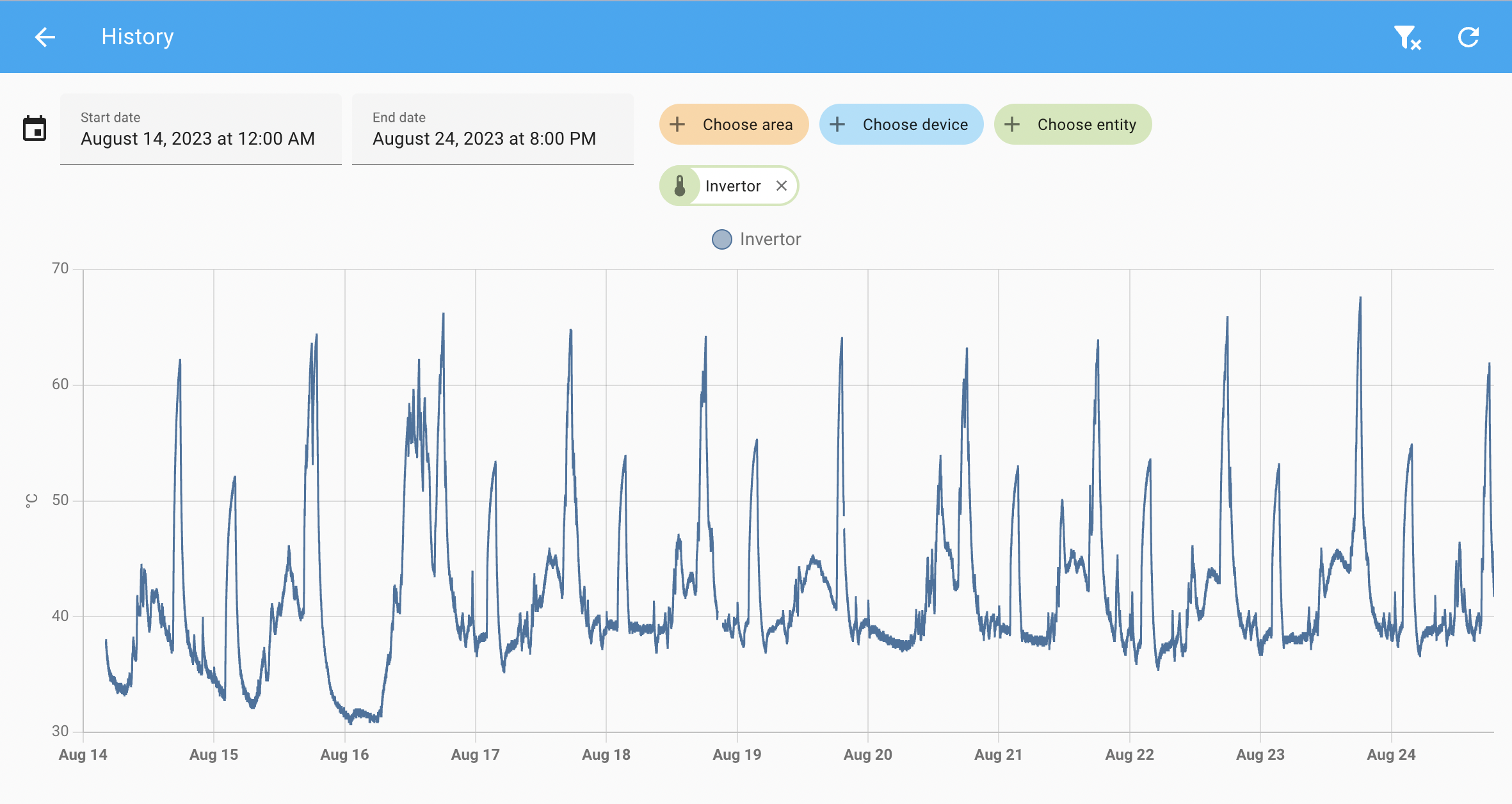
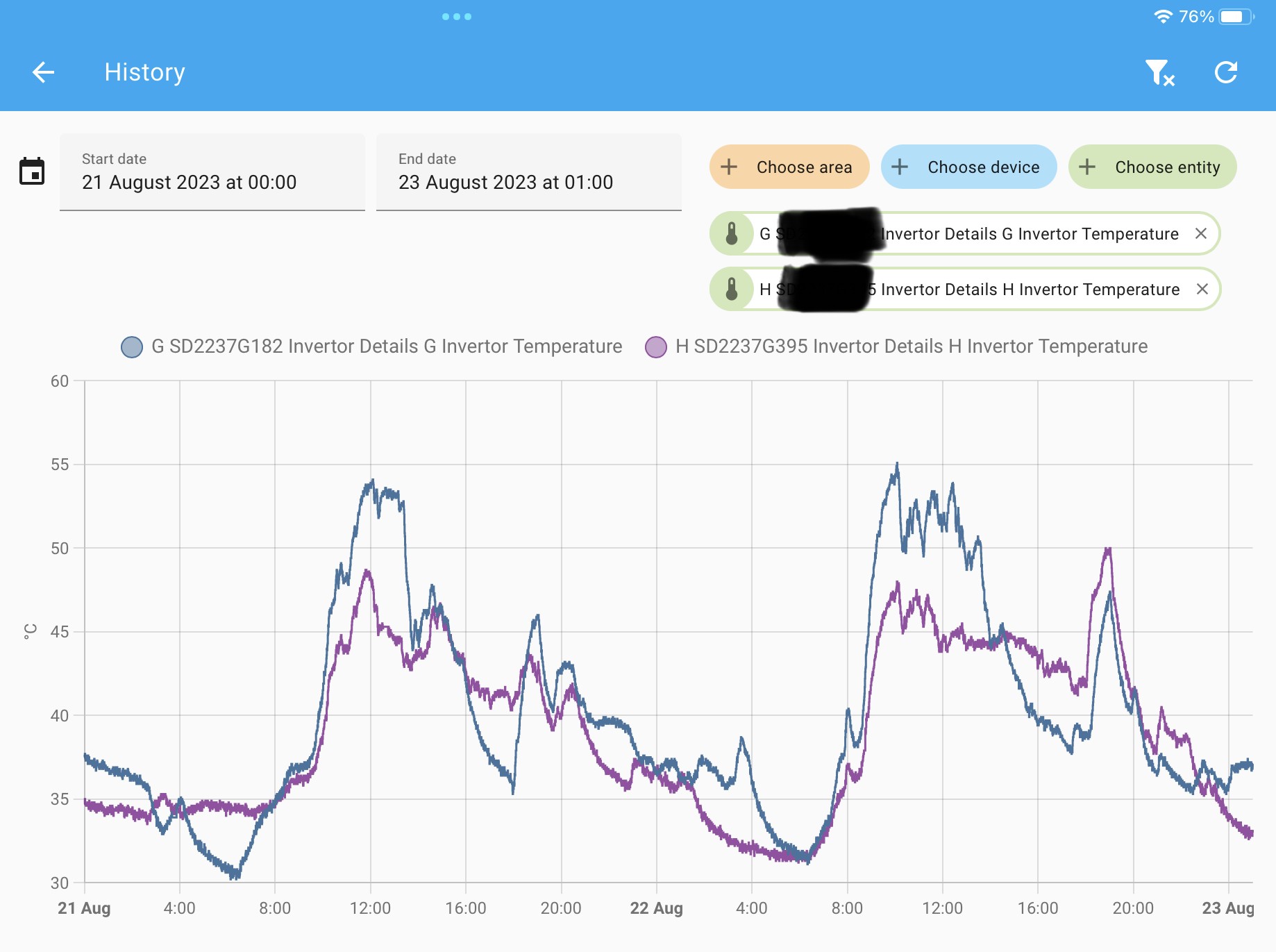
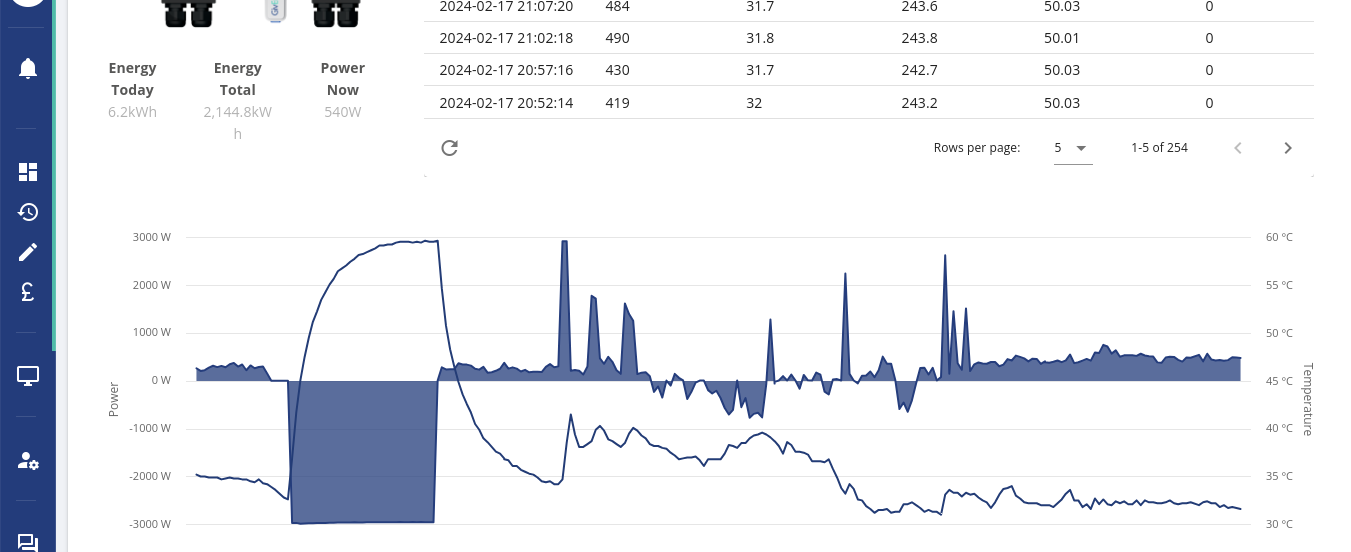
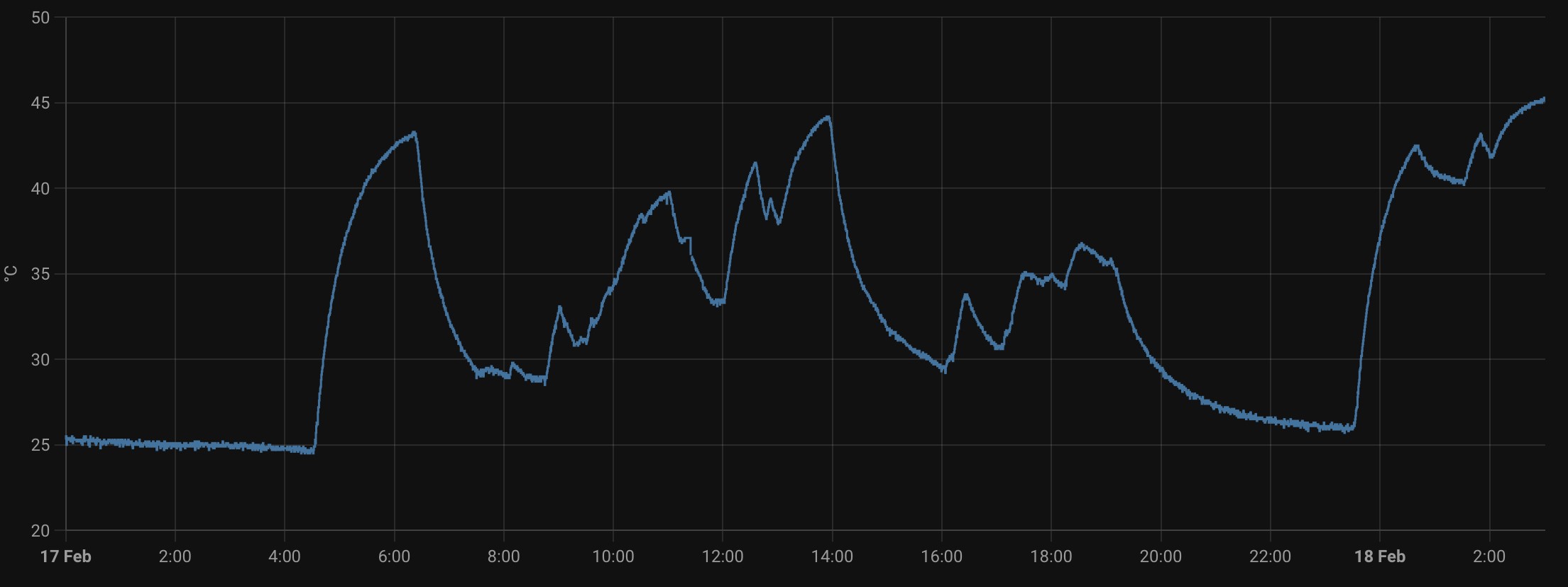
On max Flux export (we see just over 4kw) the temp as shown in the portal inverter data tab rises to around 45 deg C on a warm day. I'm comfortable with that and it doesn't get much higher with two PC fans sucking air up through the heat sink fins. The unit is in a well-ventilated garage.
However, at that temp, the android app shows around 54 deg C. The surface of the unit also gets hot, particularly a couple of inches below and to the right of the Giv logo. An infrared thermometer suggests 62 deg C on the surface, so it's hotter internally I guess.
What parameter is the portal temp showing please and is this different (it appears to be) to the android app temp figure? Anyone else running with those fairly high temps and also seeing a range of different values please? What's acceptable/safe? Thanks.
C
#2chickengeorge
Max recently recorded on portal 55°C, not running fans.
Gen1 - Operating Temperature Range -25°C > 55°C (Ambient)
Gen2 - Operational Temperature -20°C ~ +60°C (derating at 50°C)
Unless your garage is above 50°C then I'm sure it'll be fine.
S
#3sponev
chickengeorge Thanks for that. I guess the confusing thing in what I'm seeing is the difference in the readings and what's actually being measured. Is your casing very hot to touch when you hit 55 in the portal? Max I see in the portal (fans on) is around 45-46, but at that the casing is really quite hot, a good 10 deg higher.
#4hoggy
Didn’t know the app give an inverter temp, the only one I can see is battery temps although I’m on Gen1 so maybe it different.
For Gen1 there’s one temp probe on the heat sink, one on the battery charger.
S
#5sponev
hoggy Sorry I meant the 3rd party monitoring app built by one of the guys on here. There is a temp reading in there which doesn't correlate with the portal readings, although I think he said it's the heatsink temp he's monitoring as well. I believe there is also a BMS temp available but I think you need GivTCP to access it. Anyway, there appears to be a mismatch somewhere.
H
#6hamilton
Fans are terrible at pulling air, you would get more effective air movement with the fans blowing down from the top but preferably blowing up from underneath.
#7hoggy
sponev Yeah so there's 7 I think in total:
[Inverter]
Heat Sink Temp
Battery Charger Temp
[Battery]
BMS Temp
Cell Temps x4
I know the portal averages the battery ones so it may be doing similar to the inverter 2.
S
#8sponev
hoggy Thanks for this, useful to know. I think I'll rely on the portal temp as the main guide and also consider adding a third fan for when ambient temps pick up.
C
#9chickengeorge
Just checked my inverter temp physically with a Fluke IR Thermometer, 50°C at the top of the heatsink.
Home Assistant/portal reports 53°C.
Garage ambient temp 30°C, 42% Humidity.
Been exporting all day at 3.6kW (6 hours-ish).
S
#10sponev
chickengeorge Any chance you could sew if it feels very hot on the front panel just below and to the right of the logo please. I was getting 60 + on the face when the portal was recording around 45 and the heat sink just over 50. About the temp where you can just about hold your hand in it - I used an IR but the reflective surface may have distorted that reading. I'm possibly being a bit paranoid but just want to check as it was rather toasty!
#11hoggy
I can’t think of anything beyond the cables that link the PV side to the battery side being anywhere near the front to be honest.
C
#12chickengeorge
sponev I'll check tomorrow. It's cooled of a fair bit.
C
#13chickengeorge
40°C was the hottest the front got all day.
S
#14sponev
chickengeorge Thanks for that. I'm running a bit hotter during max Flux export which I'll need to keep an eye on.
#15dbt85
It will wind itself back if it's getting too hot anyway. There's no risk involved, just potential loss of energy because its derated.
J
#16Josie
My inverter temp right now and overnight is around 44. It rises during the day and gets very hot during Flux exporting - 77 yesterday! Gen 1 5KW running D.195-A.195 pre-release firmware. @TheDragon (GivEnergy) should I be worried about this? It's outside on a wall protected by a wooden enclosure and with insulation on the doors which is supposed to keep the heat in during winter and out during summer (we have the same inside the conservatory roof).
#17TheDragon (GivEnergy)
Josie I would not be comfortable if my own got this hot.
Is this enclosure ventilation well? If not it needs to be.
T
#18Tim
Josie I think there's nothing wrong with insulating the enclosure, but it'd make sense to have a flap or something that you can open during the summer to allow air to be drawn in below the inverter and vent out above. If that's not practical, then could an extractor fan be fitted to force a flow of air. We have two inverters in an old airing cupboard. We have fans that blow air up over the inverters heat sink when temperature reaches 40°C and an extract fan that exhaust air from the cupboard if the inverter temperature reaches 45°C.
S
#19SimonClarke
Gen 1 5kw and gen 2 9.5kw in the same cupboard (where the fuse box was) battery 27c pretty constant and probably the cupboard’s ambient temperature inverter 44c overnight now about 62c. East/west panels producing 4kw and all being exported. No battery export. Only been running since April but I have seen 62c before when the house was cooler when charging the battery from low with lots of sun. Was thinking of getting some sort of 2 way fan with a stat to extract heat in the summer and pump in cold to be heated in the winter. No vents but reasonable gap under the door. Ceiling mounted would be easier. When it was installed I pointed out it was pretty hot to touch but was told it was normal. Keeps my hoover and spare shoes warm!
S
#20sponev
SimonClarke Thanks for the data points, gives me a bit more confidence that I'm running well within acceptable limits. The fans I installed are definitely helping, maybe 10 deg delta.
R
#21rjp
Josie An inverter enclosure isn't like a conservatory, so beware the "cool in summer, warm in winter" thing.
Insulation just stops the transfer of heat. An inverter generates heats, and needs to be in a well-ventilated space to allow the heat to 'transfer' out of the enclosure. Insulation just traps that heat around the inverter.
J
#22Josie
rjp and @TheDragon (GivEnergy) Thank you for this. We've now opened the enclosure door and I think we'll leave it open now and take down the insulation as well. It's helped a bit but the inverter is still at 62.5. Once we build our extension it will move indoors (don't know if that will be any better) but that's some way off yet as we've only just got planning permission this week.
The inverter is out of the sun so we thought this would be a good place for it!
J
#23Josie
@TheDragon (GivEnergy) We have looked back over the inverter data for May and June and we've noticed it only started going above 55 degrees when discharging from the day you put the new software on (1 June). So I think you may want to look at this. The new software has increased our discharge rate to 2.88KWH which we're delighted with, but I wonder if this is why it's overheating as it's not meant to get that high? I realise we've also had some very hot weather but given the timing it would be worth checking if other Gen 1 users have noticed the same thing after upgrading to D.195-A.195.
S
#24SimonClarke
My point was that the battery is showing 27c, the room 33c and the inverter 55c. This is right now. The house is about 25c. The inverter is the hot thing not the room (cupboard). The room temperature was measured 6” in front of the inverter. Most of the heat from the inverter is from the top. So I think if I cool the room it won’t make much difference unless I refrigerate it!
Can I have 2.88 discharge? That would help make up for my installer being very unhelpful about the original supply of gen 1 when we really wanted gen 2
#25hoggy
Josie I'm quite surprised about that. It has long since been said that the busbar is utterly tapped out at 2600W so it might not be an intentional feature of the firmware. One for GE to decide.
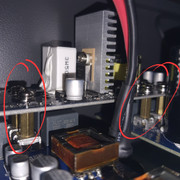
(It's not the biggest bridge to bring power over (and done in a weird way through the PCB standoffs) but also this all runs (physically) pretty close to the temp sensors.)
That’s a bit “weird” as essentially the screws are the contacts and you appear to have a brass stand off and zinc plated or chromed screws.
I’m hoping I have the wrong end of the stick
#27hoggy
kram no its how I see it, I could see no other route to pull the DC bus across from the main board. Not worked my way up that far to see if that is 100% really how it does it (I have no spare battery to use so the battery side circuits appear to stay dead until you hook one up)
It's part of the teardown I'm in the middle of: https://wiki.terravolt.co.uk/docs/givenergy-gen-1-teardown/
Gen2 > this arrangement looks to have gone.
S
#28SimonClarke
Josie
Hi how did you get extra discharge from the gen 1 ?
J
#29Josie
SimonClarke@TheDragon (GivEnergy) installed the Gen1 pre-release firmware on my inverter and that changed the discharge rate. I'm not sure it's an intended improvement though.
#30TheDragon (GivEnergy)
Josie there are still some sampling tweaks to be made.
S
#31SimonClarke
Will that become widely available hopefully?
S
#32sponev
We discharge at 4.02 kw on a gen 2 versus the spec of 3.6 - came with the 3.12 firmware. I've also seen this reported elsewhere.
K
#33kram
Wouldn't discharging at circa 4kW be a problem if you're reliant on the g98 compliance that it can't go above 3.68kW (16A per phase)?
Is this just bad data and the power is still 3.68kW, is the power higher but the export cap at 3.68 still working or something else?
If it's discharging/powering at 4, then surely the equipment shouldn't be connected to the grid if you're on a 16A per phase limit?
So eventually it will hit someone on G98.
Question then comes back to is it invalid data, correct but export is limited correctly or Ooops?
S
#37sponev
kram Our limit is 4.6 which I believe is set correctly. This looks to be either spurious data (although my various meters correlate nicely) or it's pushing a bit more than spec.
S
#38SimonClarke
Is it worth attempting to cool gen 1 when it is 44c in the middle of the night doing virtually nothing and 68c when presumably working on a hot day? The battery in the same room/ cupboard is between 25 and 29 so all the heat is produced internally from the inverter and the ambient temperature makes little difference. Why don’t they have cooling fans?
Definitely only seeing 2.6 discharge too
K
#39kram
I'm no expert on the inverters, but 44 degrees C seems a bit warm for electronics at idle and nearly 70 at the top end.
I assume the room/cupboard is well ventilated (Although it doesn't sound like it).
Perhaps before you spend the money, step one would be that now the weather is cooler, ventilate the cupboard until the temperatures are substantially lower and then monitor it over a couple of days. If the idle temperature goes up over those days, then I would ventilate the cupboard again and if the same happens it suggests the cupboard needs ventilation and air flow.
At that point a temperature controlled extractor fan and a way to get fresh cooler air in is probably what you need to do rather than just moving the ever more warm air around.
S
#40SimonClarke
kram
I was seeing 62c when it was much cooler in April but the cupboard is indoors so the temperature is probably 18c minimum with the maximum being whatever ambient gets to.
It is currently 50c, outside temp 20, indoors 22, battery 25c, 27 in the cupboard. Its cloudy with about 1.5kw coming in mostly going to the iBoost. If I pump in outside air I can’t see it will make much difference, probably only a couple of degrees.
You used to be able to fry an egg on my old Amstrad amp! Ran for years…..
T
#41Tim
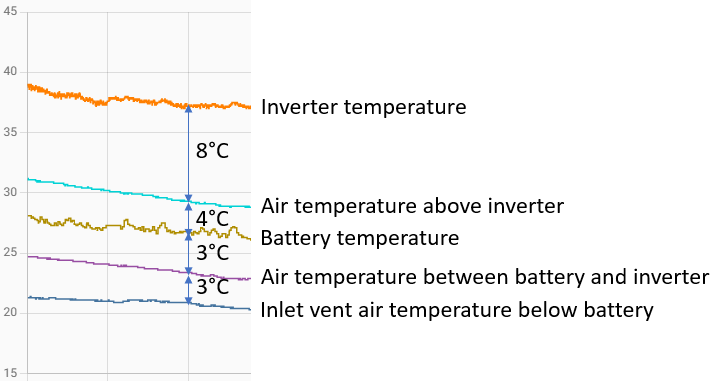
SimonClarke We've got two inverters in an old airing cupboard with thermocouples measuring air temperature on the inlet vent, between the batteries and inverters and above the inverters. The temperature difference between the internal inverter temperature, the battery internal (BMS) temperature and the air temperatures is fairly constant, irrespective of load.
When the inverter temperature reaches 40°C, fans on the underside of the inverters start and force ventilation over the passive cooling fins. If inverter temperature reaches 45°C, an extractor fan above the inverters exhausts air from the cupboard, allowing (slightly) cooler air to come in through the inlet vent, until the temperature drops below 40°C again. The inverter fans stop when temperature falls below 39°C.
S
#42SimonClarke
Tim
As my inverter doesn’t drop below 42.7c I think the fan might be running a lot! The difference between the batteries and inverter has been 30c! The cupboard air isn’t that hot its just the inverter. It’s a gen 1 5kw what are yours? If it needs extra ventilation - forced or just circulating - surely it should have been done/mentioned/ allowed for by the installer? As far as I can tell it is all working fine so I am inclined not to touch
T
#43Tim
SimonClarke Ours are both gen1 HY5s. In fairness, if the cupboard was bigger (or it was in the garage), the volume of air that can circulate would be much greater and so the heat could dissipate better. With a smaller volume of air, the temperature is going to be higher, hence my use of fans. I can't do anything about the temperature that the BMS reaches, other than to limit charge/discharge rate. The batteries are set to charge at about 900W this time of year because, even if it takes all day, they are going to get to 100% and anyway, it reduces clipping. The inverters do run quite heavily loaded at times when there is plenty of sun as that's when we charge the EV. We have harvested at a rate in excess of 11kW between the two feeding the EV, house, export and sometimes, a little battery charge. That's when the extract fan really helps to keep temperatures reasonable.
S
#44SimonClarke
Tim
So are these high - 60c+ - temperatures actually a problem or is it just that it doesn’t feel right?
W
#45wilfleek
I could not be definitive, but intrinsically I dislike the combination of high temperatures and electronics. It cannot hurt to add additional cooling, as I have done on both my solar and battery inverters.
T
#46Tim
SimonClarke the data sheet for gen1 says it’s ok at ambient up to 55C. The temperature reported by the inverter is the internal temp so you’d have to measure ambient to decide. However I do agree with @wilfleek that the lower the better
S
#47SimonClarke
Currently in discussions with the installer after talking to Givenergy. When I know what is happening I will report back
S
#48SimonClarke
Tim
Forgot to say that the highest ambient temperature I’ve seen in the cupboard is 36c so well inside the 55c max
K
#49kram
Personally I would want an ambient around 25, but definitely in the 20s.
It isn’t the spec sheet, just the fact that there is plenty of cooling.
S
#50SimonClarke
kram
Normally mid to high 20’s. Got to 36 once next to the inverter when the house temperature was high 20’s. Battery was never over 29 in the same space but lower down obviously. I think the battery is showing the real room temperature.
Hot air rises, so the inverter is sat in warm air.
S
#52SimonClarke
kram
And possibly incorrectly fitted but I will come back to that…..
S
#53SimonClarke
I’m still unsure how it’s supposed to cope with an ambient temperature of 55c !
K
#54kram
Up to temperature X is different to always running in temperature X
It will last the warranty period, but life will likely be shorter.
C
#55CharlieSays
Started with a GIV-HY5.0 Gen1 but the unit burnt out, temperature regularly spiking over 50, fortunatly still under warranty and now have the Gen2 that appears to have a bit more heat tolerance in the spec.
Ive also turned off the battery drain export and will just rely on just exporting solar excess and see if this keeps the system cooler.
Could be unrelated to the temperature and Flux export, but I dont need the headaches and risk the same thing happening.
D
#56danerf
I had an issue with my old inverter, the temperature was always the surface temperature of Venus. It still worked but had monthly errors that required a full power off and on. The engineer turned up and replaced it.
S
#57SimonClarke
SimonClarke
Now been moved to give it the correct spacing. Today’s max 63c according to the portal, battery 29c at the same time in the same cupboard. Thermometer on top of the inverter reading 39.5. I’ve started another thread asking what others get….
M
#58michaelmcgoldrick
SimonClarke seems hot to me. Mine never goes above 40, I've usb fans which kick in at 38 and cut out at 35..it d rates above 50?
Has anyone ever found a reversible ducted/in line fan? I’m struggling to
M
#61michaelmcgoldrick
SimonClarke i use the internal temp from the portal, using automation in home assistant using givetcp to turn on/off fan based on inverter internal temp.. have a temp sensor in the space as well and it never goes above 28/29 c on the hottest days
#62TheDragon (GivEnergy)
Inverters should begin to derate once too hot.
If you are seeing temps pushing 65+ i would be considering why
S
#63SimonClarke
TheDragon (GivEnergy) Saw 63c on the portal yesterday. This is after it was moved at the request of Adam in support to get more clearance. The ambient temperature is about 25-30 with the highest being 36c. With the thermometer on top of the inverter it has been 41. So well inside the-25 to+55c in the specs. The heat is all the inverter.
M
#64michaelmcgoldrick
SimonClarke i find the temp generally goes up when the battery is charging at full rate or discharging for long periods at full rate.. something seems weird there if the ambient temp is 25 and you are seeing internal temps of 60+
S
#65SimonClarke
Coming back to this the inverter was moved to conform with the fitting instructions which made little difference to the temperatures so I added an extractor fan operating of a plug in thermostat with the sensor on top of the inverter at the place that felt hottest to my fingers. Helped a little. Bought a 5.99 fan off amazon plugged into the same thermostat and that seems to have helped. So now the fan blows up the back of the inverter and the extractor is directly above it. Seeing 40c at night and about 50c when charging the battery from solar. All working fine. The cupboard ambient temperature has gone up a little presumably due to more circulation. I don’t understand why charging from solar should make it heat up particularly. Would have thought it was working hardest when converting to ac?
D
#66deepanshus
i see temperature reaching 65 when its exporting, i already have fans on both top and bottom to facilitate air flow. not sure if there is anything more i can do? the inverter is in a garage.
A
#67alan1977
got me worried, mine did a full dump the other night and hit 76 in the loft.....
no way i'll be pulling 3.6 kw for that amount of time in the future, so i guess if i set mine to export id like to be bale to throttle it
G
#68geoffreycoan
Just had a look at my inverter temp graphs, one inverter peaks at around 53-54 degrees when charging the battery in the morning, then drops down when exporting excess solar and rises back up to 46-47 when force exporting in the flux peak period. The other inverter runs noticeably cooler all the time.
No fans or anything, just on the wall of the garage but with cupboards above so there isn’t a big gap around the inverters but compared to other people they seem to be running at a lower temperature.
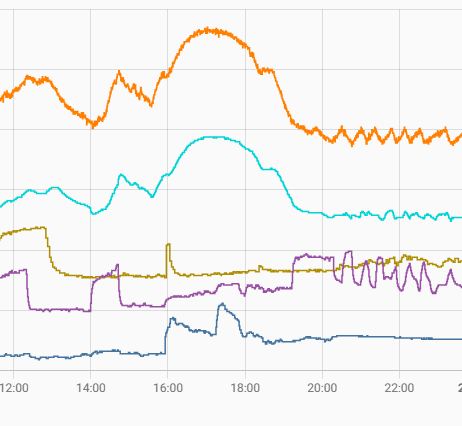
I had planned on putting fans on my inverter as a “do before summer” project, but looking at your graph, peaking at 60 degrees, got me worried
My own graph shows temperatures in the range 23-46 at most over a week, so its not running as hot as yours fortunately
K
#75KevinB
My AIO is in my basement, where the ambient sits fairly stable at around 15°C (+/- 3°C). The inverter temperature seems to gain around 10°C after 2 hours of charging at roughly 5kW, although it's clearly still climbing at this point so I'm not sure where it would plateau.
(also, great choice of graph colours GivEnergy, well done)
D
#76Daveb01
If you install the bbc app it shows you Inverter and battery temp every 10 seconds.
L
#77lifco
Never hit over 42c, huge difference, i will see how it goes, and maybe add even more fans
The location is not the best, as its under the stairs and to small air flow
L
#78lifco
Just a quick update fans right under the inverter now
Around 30c now
G
#79geoffreycoan
lifco I think other people who have fitted fans on the inverter have fitted them at the top to pull the air through them
Yes when i first got the fans the other day, i fitted them on the top, as it was easier to do that, but using my thermal camera, it seems adding them under gets you a extra -3c delta
Its not a huge difference, but cooler the better, and the temps on the inverter stats look alot better, don't seem to be jumping around as much
When summer comes if the temps do start to go up a bit i will add some more fans to the top of the inverter also
G
#81geoffreycoan
lifco That’s interesting to know, makes quite a difference. How did you secure them to the bottom?
V
#82Vestas
geoffreycoan Its significantly "easier" for fans to blow rather than suck - any obstructions on the input of the fan will reduce airflow a lot more than the same obstructions on the output.
L
#83lifco
geoffreycoan I used elec tie cords to join the 4 fans together in to a line, then to mount under the inverter i just used two bits of string going over the inverter, simple but does the job
G
#84geoffreycoan
lifco Very simple and effective! I was thinking of Velcro or something and was wondering how to stop them falling off. Thanks
#85Tenkaykev
My AIO sits on feet and has mounting brackets bolted to the wall. I'm not sure if there's sufficient clearance betwwn the base of the unit and the floor to allow sufficient airflow. I'll have a poke around and a measure once it gets light.
L
#86lifco
Adding fans, its well worth the small investment to make the inverter run cool, this must extend the life of the inverter
Plus i feel happy knowing that it's not like it once was 50C+
W
#87wilfleek
lifco I have fans on both my Ge inverter and my solar inverter. Precisely because electronics are happier when cooler.