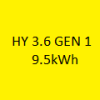
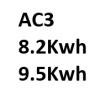
Hi. My system is a 5.1kwp array, Hybrid 5kw inverter (gen 2) and a 9.5kwh battery.
I'm looking at EPS for the (admittedly rare) cases of power cut.
Ideally, I'd have the lights and key sockets in garage (broadband, cameras and boiler) and possibly TV sockets, available on a manual switch over. Definitely no high load things like oven etc. Those circuits are all currently on the same consumer unit (the only one).
I understand that to do this I would need put those circuits on a separate consumer unit, hook that up to the EPS with a manual switch over, and also possibly install a new earth.
Do I need to use a GE approved electrician for this (for all or just the EPS part)? If so, any ideas what the likely cost will be. I'll get a couple of quotes but looking for baseline suggestions.
Thanks in advance.
#2positor1
As the eps output is supplied from the grid until a power cut and is then supplied from the battery- AND as you are planning a separate "essentials" consumer unit it makes more sense to power the essentials Cu from the eps constantly, A changeover switch is still advised so that should the inverter die you can switch the supply to the essentials CU from the eps to the grid.
Steve cook I think has posted very useful diagrams so search the forum for similar threads.
any qualified electrician could do the work but would need to research the documentation from ge and perhaps read the posts here, you could correlate lots of the information for the sparky.
J
#3justpassing
positor1 I only briefly looked at quotes, the bit that really hiked the cost is the need for a TT earth ( local earth rod). I have a newish build urban house, so no TT. At least with the people I spoke to that seemed to add many hundreds, due to the faff. Your mileage may vary :-)
#4positor1
justpassing
I cant understand why it should be so expensive, I just added an earth rod, parts less than 25.
I only needed one 1200mm rod and got a ze of 14 ohms ,( below 200 is acceptable, lower the better ) if your ground is very rocky you may need rod extensions but we are not talking great value.
Oh and add 10mm² cable, 25m at £35
#5Hook
I think sparky's price it high, because they don't want to do it.
I looked at this last month, I contacted a Givenergy gold installer and they told me they could physically do the work, and the eps system would work fine with nothing further done, however that it would invalidate my warranty with Givenergy unless the unit was recommissioned and the eps checkbox checked to show it was in use (the eps checkbox cannot be changed without a recommission). In order to recommission it they would have to take the system over and move it to their platform (their words), which they were not happy to do due to the system not originally being installed by them. They suggested I contacted Givenergy, who confirmed this and said they could move my system to the installer with a note saying the reason why. I contacted my installer (EON) who haven't replied.
#8positor1
L182075 I contacted Givenergy, who confirmed this and said they could move my system to the installer with a note saying the reason why
do you mean list the new person as the registered installer?
#9THALL
I got a quote for the EPS back in March. £840. I decided not to bother.
L
#10L182075
I'm not entirely sure (I'm sure there's others on here who can confirm), from what I can tell your Givenergy install is linked to an installer (and only 1), that installer can view the system remotely, commission it etc. however only the linked installer can do that. Givenergy told me they themselves do not have access to recommission/enable the eps checkbox and only the linked installer can. So for the other company to recommission the system they would have to move that link from EON and over to themselves, at which point (I assume) they have to look after it/monitor it etc.
J
#11justpassing
positor1 Agree if you DIY, but you should not these days (?). Also the earth rods need to be 10 Metres from other services etc. ( My old earth rod in my previous victorian house was 2 cm from the front door :-)
Edit:- Scratch that. Just scanned some IET documents. Not sure where I saw the 10Metre requirement, might have been for the test equipment. Must read some more :-)
E
#12Edward
positor1 Seems to be confusion over double pole RCD / RCBO's
My understanding:
Most that say double pole are in fact 1 pole + switched neutral (i.e. they only detect a fault on the live - but disconnect both live & neutral)
Some are "true" double pole in that they will detect a fault on either the live or the neutral.
I'm not sure which of the above GivEnergy specify.
If you need a true double pole but can't find one with the correct ampage you could always use a higher ampage RCD along with a correctlty rated MCB.
It's worth rembering that wire fuses and MCB / RCD / RCBO's will carry a lot more current that specified for a reasonble preiod of time before tripping so they're not a reliable method of preventing overloading the invertor.
#13positor1
justpassing
this will be a simplistic answer as otherwise it could be a book.
where a house has a supplied earth, a secondary earth rod could be effectively connected ( not physically ) to that earth resulting in a non TT (earth rod) property.
It is assumed that 10 metres would give enough resistance to be effectively disconnected .
#14positor1
Edward If you need a true double pole but can't find one with the correct ampage you could always use a higher ampage RCD along with a correctlty rated MCB.
indeed that is a potential solution. I would prefer a single module solution though. such as the item i posted a link to.
thank you for your suggestion.
J
#15justpassing
positor1 I'm interested in understanding this, so thanks. I wasn't sure if you were qualified and did it yourself, ( or not :-) and did ), or you were making the point that the component cost is negligible, so any cost is mark up or labour.
So in the case of an modern house with TN-C-S (?), then is the 10 metres from the substation, where i assume the DNO earth is ...., rather than from the house and any of its potentially physically earthed services ?
So I guess the practical question is, can you be sure that you don't bang the rod through anything under the ground, How close to the house or anything else can the spike be. How do you get the earth resistance measured without all the proper testers. And finally you would need an EICR from someone qualified even if you DIY.
The big price tags were "justified" by my installer based on needing all sorts of ground probing/testing etc.
K
#16kram
Lesson appears to always get EPS enabled as a changeover switch and a plug if you’re not sure.
Yes my point was that the equipment to provide a TT earth is not expensive. for a complete EPS system with my proffered method of a second essentials consumer unit you would of course need other equipment, CU enclosure and switch /rcbo's / mcb's (though you may be able to move them from CU1)
rcd for the inverter output. Changeover switch to power second CU if inverter fails. and cables.
Of course all that will add up.
justpassing TN-C-S (?), then is the 10 metres from the substation, where i assume the DNO earth is
It is more likely that your supplied earth is at multiple point along the path from the substation. read about PME and watch that video.
my situation is unusual in that whilst I am qualified to BS7671 the EPS work is being done by the solar installer as part of the original quote. As I am fussy about positioning of items ( not that he isn't good) I have done what I can in preparation including fitting the earth rod. As a sparky I have a suitable meter to measure the "ZE" (earth rod resistance) and indeed measure it as i inserted it to get an idea if it was going to be low enough before being so deep as to be irretrievable . you of course will not have such a meter and need it signed off for peace of mind alone so DIY is not an option.
Also I have lived in my house since 1990, I know where all supplies and drainage are making the decision of its position a lot easier. though I am not 10 metres away from a copper water supply pipe -that connects to the plastic mains so I consider that to be disconnected. I also know that my mains supply does not have any pme points within my property.
Again watch the video and be bemused at how difficult a true TT system is to achieve. ask questions if anything is unclear.
A
#18alan_johnston
I had a local electrician install a manual EPS system and TT earth on my Gen1 HY3.6. The local GE installer was happy for the electrician to do the work. The electrician also took the online GE installers course so he could connect to the inverter EPS sockets without voiding the GE warranty. Once done, GE said the original installer had to recommission the system and say that there was an EPS sytem. The original installers have said this will be done at the annual service. In the meantime, the EPS works but isn't registered on the GE system.
M
#19michaelhoskins
Hi.
I had a quote of £1400 (Inc Vat) for the following:
"Supply & fit new EPS board via a 16amp RCBO. Rewire 3 existing lighting circuits, Givenergy meter & socket
circuit into new board. Chase approximately 6m of new earth cable & install earth rod within conduit including
making good. Estimated timeframe to complete works - 2 days."
I think it's the earth work that adds the most.
Would be interested in thoughts?
Michael
A
#20alan_johnston
michaelhoskins Yes, the TT earth point was the bulk of my costs too. They had to sink 2 rods in the back garden (1 wasn't quite enough) then run an earth wire to the EPS consumer unit. Took them a morning to do.