Type A and type AC RCCB/RCD experience

45 comments started 2023-11-16 last 2024-01-29
GivEnergy Products
S
#1 SteveCook

I have had Hy5.0 Gen1 and 9.5kWhr battery for just over a year.
Mains feed to inverter is from it's own MCB on the consumer unit.
All other circuits are on their own MCBs
All the ways of the consumer unit are fed via a single type AC (AC electric) RCCB and all has been good.
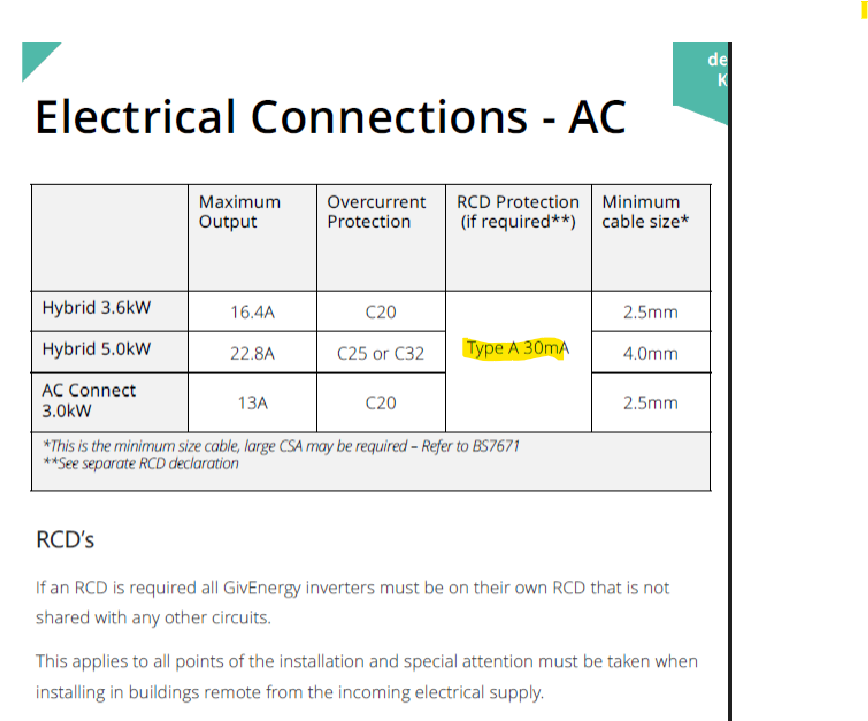
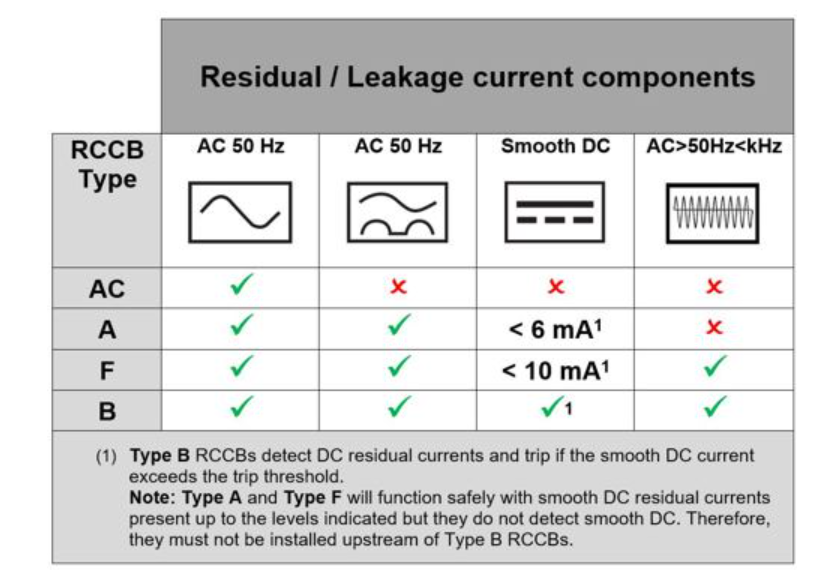
Thinking I should change the RCCB to sense any possible DC from the inverter, I removed the type AC and fitted a type A (AC and DC sensitive).
After 3 trips in 3 minutes I have gone back to type AC.
Either something is wrong with my inverter or installation, or the inverter just gives off DC "pulses"? which cause problems if the RCCB is over sensitive.

R
#2 Rubikcube

That is the correct and expected behaviour. The current leakage is due to the capacitance between the panels and earth. If you were to repeat the experiment with the panels isolated (safely during the hours of darkness), you should find the inverter and battery are fine with a type A device.

S
#3 SteveCook

So if you fit a type A RCD as the GivEnergy installation instructions it will repeatedly trip?!

S
#4 SteveCook

We had a lot of rain today and the main RCCB/RCD in the consumer unit kept tripping.
This consumer unit feeds all the house circuits plus the inverter each with individual MCBs.
Obviously when the RCCB/RCD trips, everything goes dead until I reset the RCCB/RCD.

None of the MCBs trip.
The RCCB/RCD always resets, so not a permanent fault like bare wires, fried components etc.

I turned off the MCB to the inverter for a few hours and ran on grid - no trips.
I have now gone and turned off the PV panel circuit isolators - east and west.
I have now turned the inverter isolator back on and am running on battery in Eco made (15:16)
No trips so far.

Everything in the roof is bone dry, no signs of water, drips or anything.

How do I cure this capacitance issue between panels and earth?
Do the panels and their support frames have any sort of earth bond tags I could connect up?

I dont get this on my SolarEdge panels that are fed from a consumer unit with RCD in the garage

S
#5 stevelewis

SteveCook you don't cure the leakage due to stray capacitance, a Competent Person needs to move the PV to a dedicated RCD / RCBO in your Consumer Unit. It's also possible that you have high earth leakage on another circut that's connected through the same RCD, contributing to the fault current.

S
#6 SteveCook

stevelewis
Thanks but over the last 3 months I have progressively shut down all the other circuits to the point that the only time I get a trip is when the inverter is in circuit.
I have also run it all afternoon with the PV string isolators off and had no trips.
I am pretty much concluding it is something to do with the PV strings.
I have now put one back in circuit so I will see if that causes a trip and then try the other until I know which string and then repeat by disconnecting MPPT strings until I know which MPPT string is the problem.
When I have done that the installer can come back and make sure everything is waterproof.

If I put the inverter on a dedicated RCD it does not identify or fix the problem, it just means the inverter will go off when it rains.

Interesting text from an engineering post
"Putting the panels on their own RCBO would solve the problem of them tripping out the whole house, but they should not have a problem caused by rain in the first place.

If switching off the panels at the DC switch stops the tripping, then the 'fault' must be on the DC side - i.e. the panels and their connections before the inverter.

There could be a simple fault that is caused by one of the many connectors behind the panels shorting out to the roof or the metal frame of the panels when it gets wet. The connectors should be weatherproof - perhaps one has not been fitted together properly. Also, it is good practice to suspend the connectors away from the roof tiles and the frame using tie-wraps or similar.

Another possibility - a bit of a long shot - is that the framework on which the panels are mounted is not earthed and the rain causes intermittent connections of the frame to earth. It has been noted on the other forums that a voltage can build up on the frame (a minute leakage from the panels or just pure static electricity). Whilst not having the frame earthed is nothing unusual, an intermittent connection between the frame and earth could cause pulses of power to flow which could, theoretically, cause the RCBO to trip"

#7 hoggy

You can chase it down with an earth leakage clamp meter, although not super expensive it will be a tool that is rarely used so upto you. (You'll atleast know what your inverter is contributing)
My Gen 1s run at 12mA leakage so wouldn't take a lot of other items in the house to throw the main RCD - it's worse when it's rained.
They do however reside on their own CUs so don't take the house out with it in my case.

FYI the negative side of the MPPT is physically joined before the PV isolators to both inputs. So you will need to pull both + and - for each string for a fair test, not just the one side.

S
#8 stevelewis

SteveCook have you disconnected onnected both line and neutral on the other circuits or just used the MCB?

I have an old PV system with an SMA inverter, my panels have always had some leakage, especially when wet, and are on a separate 100mA for this reason.

S
#9 SteveCook

Both external circuits have double pole fuse switches as they pass through the external walls. Both have been off for about 6 weeks.
Prior to inverter install I never had any RCD trips..
If leakage is cumulative, it looks like the panels push things over the top when it rains, so I want to find and fix it

S
#10 stevelewis

SteveCook PV systems always have leakage - the panels have a lot of capacitsbce to earth. A 30mA RCD is designed to trip at less than 30mA. I doubt you have a fault, move the PV to a separate RCD/RCBO to resolve.

S
#11 SteveCook

stevelewis
Thanks. I have looked at this, but not too easy with a Crabtree Starbreaker board as the busbar is pre-punched for the live connectors and I am not sure I can get a take off point separate from the main RCCB

S
#12 SteveCook

stevelewis
I could put it on its own RCBO on the busbar, but not sure if the RCCB and the RCBO would discriminate correctly

S
#13 stevelewis

SteveCook it should be doable, but you may need to swap out (or maybe rotate) the busbar. Do you have a main switch, a bank of unprotected MCBs and then a bank of RCD-protected MCBs?

S
#14 SteveCook

Hi. It is a single busbar. Mainswitch, RCCB then MCBs.
2 neutral bars with connector fitted.
I think I am going to get the installer to comeback and fit some sort of enclosure/switch next to the consumer unit just for the inverter feed connection.

S
#15 stevelewis

SteveCook plenty of options, you could even upgrade the RCD and MCBs to all Starbreaker RCBOs, but not worth it if it's an older plastic CU.

#16 positor1

Crabtree Starbreaker is quite old now and for quite a while i was replacing them due to nuisance tripping.
perhaps consider a complete new board fully populated with rcbo;s?

S
#17 SteveCook

positor1
Xmas is coming and my wallets empty, ho ho ho!
It is a metal CU with dual rows, circa 25 outgoing ways
Don't think the wife would be happy me spending all that

#18 positor1

SteveCook
starbreaker in metal, that's a new one to me.
I think I have some starbreaker push in mcb's kept for emergencies if you need spares? (would have to check)

S
#19 SteveCook

positor1
You had me worried there so I just checked it all over with a magnet. Unless it is some kind of new plastic, it is definitely metal.
Thanks for offer of mcbs, but I have plenty and TBH the postage is probably more than the cost

S
#20 SteveCook

I have now bought a small metal garage consumer unit with Type A RCD and 2 outgoing ways of which one is now blanked off and the other feeds the inverter.
This new consumer unit is dedicated to feeding the inverter so there should not be any cumulative earth leakage tripping the main house consumer unit in the event of an RCD fault.

I
#21 Ivan

SteveCook Is the new consumer unit wired in parallel or series with the house consumer unit?

I ask as I have an 'garage consumer unit' installed in a shed in the garden which is wired is series from the house consumer unit - so two RCDs in the circuit. It's never tripped due to a fault but I have a socket tester which will force a trip and when I test the garage circuits it is the RCD in the house which trips - not the one in the garage. The RCD in the house must have a lower sensitivity despite being both rated at 30mA.

S
#22 SteveCook

Ivan
It is wired in parallel to the house consumer unit so that there are no RCDs in line potentially causing discrimination issues.

S
#23 SteveCook

A week of lots and lots of rain, lots of wind and zero trips. Sucess

6
#24 666tim666

I have an Aurora PV system - nothing to do with my inverter/battery system which is an AC3.0. The Aurora system would occasionally trip the 30mA type AC RCD in the garage board, and I read, in later instructions related to the inverter installation, that it should not be installed with an RCD. So I split the board and put the inverter before the RCD, and the problem went away, of course.

As the RCD only tripped when the roof was wet, and only when it started up, first thing, I deduced that it was capacitance that caused the fault.

D
#26 deanjesper

26Left out of curiosity (and maybe on your next power cut or test), will the RCD go back up if you pull down the Grid breaker in the Gateway? I have a Hager RCD Type AC which I’ve been told today “isn’t supported by the AIO”.

#27 26Left

deanjesper will add it to the list of things to test when we puzzle through getting that side of the CU to behave in island mode.

D
#28 deanjesper

26Left when mine trips, if I pull the Grid breaker down, I can then reset the RCD and it doesn’t trip again. But that’s then manual intervention with tripping, not auto switchover which is why I bought the AIO. Mine are both type AC. 100A doesn’t trip but 63A does.

I wonder if your other side of the CU works when the Grid breaker is down?

I’m not sure what the installer will say when they come back out to look at it as GivEnergy have said today that Hager RCDs don’t play well with the AIO. If my CU is Hager and all the MCBs and RCDs are Hager then…?

D
#29 deanjesper

@Ivan what brand of CU/RCD do you have?

I
#30 Ivan

deanjesper MK. Not sure I believe Hager devices not being compatible.

D
#31 deanjesper

Ivan this is what I’ve had from GivEnergy today:

Hi Dean,

Just had a further dive into this one and discovered that the system does not quite agree with Hager RCDS, it may be worth to check if this RCD is protected and if it is it may have to be swapped

Kind Regards

Jordan Jennings
Second Line Service Desk Engineer
Newspaper House, Chemical Lane,
Stoke On Trent, ST6 4QZ

M
#32 mrand31

Ivan

Not Hager being incompatible, but probably A or B type to be preferred to AC type. Having said that, the GivEnergy inverters should not inject or consume DC currents into/from the mains, so an AC type ought to be ok, unless the input rectifier or output IGBTs suffer a partial failure... At that point, I'd hope the inverter would notice and shut itself down.

It might also be residual current or time differences between different RCBs.

D
#33 deanjesper

Just spoke to GivEnergy again and they're now saying they recommend Type A RCD for the All in One which conflicts with the advice given originally that Hager isn't compatible. Also some on here have Type A RCDs which trip.

#34 26Left

deanjesper thanks for sharing

I asked my trusted local electrician why he’d replaced the AC type for A on his last visit, this was his reply:

Type A is the current standard RCD, Type AC should only be installed when an assessment has been made of the loads to confirm everything is a resistive load (no electronic component devices are present). Virtually all equipment now has electronic control circuits so Type AC are not suitable as they can fail to trip.

I suspect that the reason the RCD would not reset even when all the individual circuits were off is that there is a fault short-circuiting between neutral and earth and when you are on inverter (battery) supply there is a small voltage on the neutral side that is enough to cause an RCD trip. The individual MCBs only isolate the live, the neutral remains connected; so a neutral-earth fault is not isolated by the MCB.

I’ve read elsewhere that the AIO in island mode produces 120v live to -120v neutral, so wonder if that’s the issue?

https://community.givenergy.cloud/d/3362-smoke-coming-out-of-gateway-after-power-cut/41

#35 26Left

Some further input from my very helpful local electrician (not my installer) after I explained that the AIO goes into split phase in island mode:

Neutral at 120v will significantly increase the likelihood of a trip related to a N-E fault.

With a long cable run on a 6A lighting circuit you could have 2 ohms of resistance on the neutral cable from the bulb back to the CU, so the neutral voltage at the bulb if the circuit was pulling 4A would be 8V above the neutral voltage at the CU (ie close to Earth potential).

A fault giving a resistance to earth of 270 ohms at the neutral side of the bulb would give a leakage current of 30mA and the RCD will trip

At 120v on the neutral at the bulb the fault only has to be less than 4000 ohms for the RCD to trip.

So the RCD may not be the issue here, instead the use of split-phase on the AIO is bringing attention to a N-E fault somewhere at home. This part of my board feeds the garage including some external lights so I suspect the culprit will be in that part of out setup.

D
#36 deanjesper

26Left so if you flip your garage MCB down, would the RCD still trip?

#37 26Left

deanjesper It was tripping with ALL of the MCBs off in the house. I think because MCBs only close live, not neutral. So the neutral to earth fault persists, exacerbated by the AIO being split phase.

V
#38 Vestas

26Left You've probably got L&N swapped somewhere on a lighting circuit.

D
#39 deanjesper

Vestas wouldn’t that trip regardless?

R
#41 Rodmac76

SteveCook I have just experienced my first RCD trip and believe it may also be down to the heavy rain. Gen 2 3.6kw inverter Horrendous weather last night and it started to trip at about 20:30 and a reset only lasted about 5 mins. Turning off everything else trying to diagnose but still tripping. Today as the weather was slightly better the trips have been hours apart, and again really heavy shower and it tripped. Unsure where to go from here? Do I see if it can be put on its own RCD so no other circuits are affected?

S
#42 SteveCook

Rodmac76
I am not an electrical expert but after getting nuisance trips that I could not get rid of, I installed a dedicated consumer unit as method 2 in the GivEnergy guide.
I have MCB on the grid feed to the inverter and RCD on the EPS output from the inverter.
I have TT earth rod.
EPS circuit is permanently live as it feeds fridge, freezer, boiler, router socket, lounge power and lounge lights, smoke detectors, burglar alarm and Sky box. If there is grid failure we can sit in warm lounge and watch TV.
Lots of wind and rain yesterday. No trips.

R
#43 Rodmac76

SteveCook Thanks for your feedback. This is my first issue in 18month so am hoping it is one off. The weather was as I said horrendous so far 24hrs without another trip. I think isolating it to another circuit may be something I need to look at and see if I can find out the root cause, it is tripping an 80A RCD so a big load. I am also not an Electrical expert so will get it looked at.

S
#44 SteveCook

Rodmac76
Is it tripping the 80A on overload, I doubt it it.
It will probably be the 30mA earth leakage trip which is what RCDs are design to "look for".
Dont forget if there are any other circuits on that RCD they may/will also be adding to any cumulative earth leakage.

R
#45 Rodmac76

SteveCook

SteveCook My issue was not related to load or weather it was a faulty RCD. Electrician replaced and his tests before and after confirmed.