Use battery power for home while it is exporting

32 comments started 2024-02-12 last 2024-02-13
GivEnergy ProductsBattery
P
#1 Pete Thomas

Is it possible to power the home from the battery at the same time as it is exporting?

For example at 17:00 the battery is at 100% (it was charged the previous night on a cheap rate tariff)

So I want to export what is the battery so it is empty by the time it starts to recharge at 11:30. However during that time I want the house to take what electricity it needs from the battery while it is exporting instead of from the grid .

Is this possible?

Thanks

M
#2 mbrennen

Pete Thomas my set up when exporting house gets used first and whatever is spare in the maximum discharge rate goes to the grid.

P
#3 Pete Thomas

Is the the default? If so I will have to check again because it looked like I was still importing from grid while discharging battery.

#4 Cdent

Pete Thomas electricity can't move two directions in the same cable, so if you're exporting you can't be importing as well.

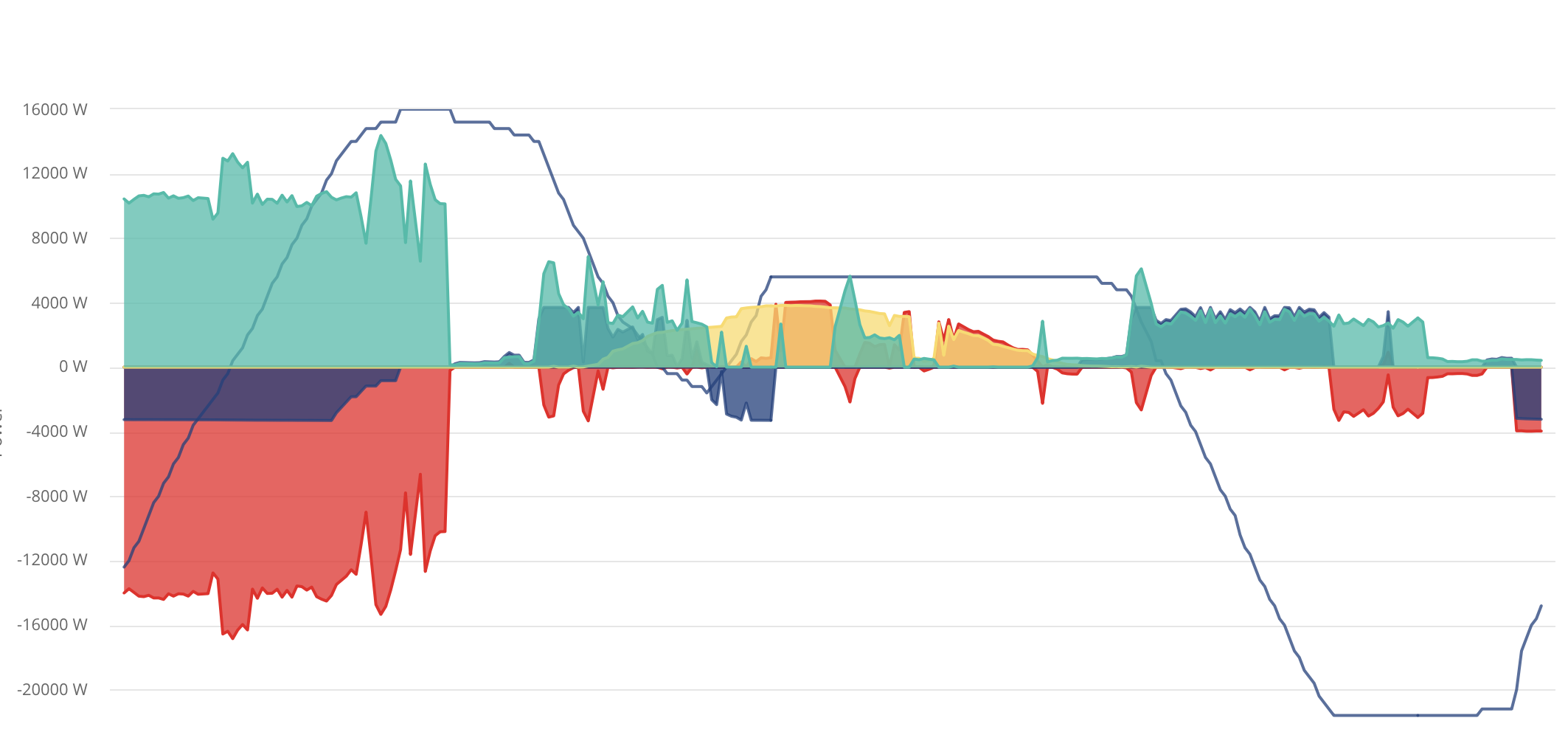
Post a picture of your power graph showing load, grid and battery power during the time mentioned and we can let you know if something appears amiss

G
#5 geoffreycoan

Pete Thomas think of the battery and grid supply as being two rivers that can flow in both directions, and the house as being a sink hole thats draining the water away

It all depends on the flow rate.

Open the taps and start draining the battery. The house can drain away all the water produced in the battery 'river'. If the house drain is taking a lot of water (e.g. turned on the cooker, electric shower, kettle) then there won't be enough water coming from the battery and the inverter will have to open the flood gate to let water flow in from the grid river (i.e. import).

Conversely, if you turn the battery river up to max discharge but don't have much draining away into the house, the excess water will flow out to the grid (grid export).

Whether you import or export during battery drain will depend on the house load and what the max discharge rate of your inverter and batteries are.

Bear in mind that what you see in the app and the portal are usually just 5 minute snapshots so may not be totally up to date

D
#6 DD

Pete Thomas All the inverter is doing is generating AC, which goes onto the house wiring. If that exceeds the house consumption, the excess goes to the grid. If that is not enough to cover the house consumption, it will have to import to make up the difference.

I consider it a missing feature that there isn't a mode where you discharge to the grid, but can increase the discharge if consumption goes up. Currently, you are either in eco, which tries to have 0 import/export, or you discharge at a fixed power, which may or may not be enough to cover house demand. So eg, if you are discharging at 1kW, but then put the kettle on, you'll probably have to start importing 2kW.

I suggested a way to add a bias to eco mode, so that it would try to discharge a minimum power. Eg rather than trying to keep grid usage at 0, it would try to keep it at 1kW export. Then if you put the kettle on, it will try to generate 4kW (or as much as it can) to cover increase consumption but still try to be exporting. But that was rejected.

P
#7 Pete Thomas

Cdent electricity can't move two directions in the same cable, so if you're exporting you can't be importing as well.

That makes sense. So for example if the max discharge rate is 3.7 kWh and I have set to export at 17:00 and the house needs .5kWh, then the house will be taking its .5kWh from the battery not the grid - and meanwhile the battery is exporting at 3.2kWh

Got it, thanks!

P
#8 Pete Thomas

So does it make sense to set a timed export (as opposed to timed discharge) at say 17:30 - 23:30 which gives it time to fully discharge 23:30 (it's 2 x 9.5kWh batteries) Or would it need longer if there is still some solar generation (unlikely it would be much)

D
#9 DD

Pete Thomas Rather depends on what it is you're trying to achieve. I'm guessing you want to export as much as you can before 11:30 so you can fill back up on cheap overnight power.

While the grid would benefit from export at 17:30, it does count against you in any future savings sessions at that time. Small moral dilemma...

The exact meanings of timed discharge and timed export seem to vary between different inverter models, and possibly firmwares. On my system, the only difference is whether it runs in eco mode outside of the timed window, and makes no difference to the behaviour within the timed window.

Running at higher power for shorter period will minimise impact of increases in consumption during the export; but discharging a lower power is possibly kinder to the battery (opinions vary).

P
#10 Pete Thomas

DD I'm guessing you want to export as much as you can before 11:30 so you can fill back up on cheap overnight power.

Yes exactly, we don't want a battery still at 40% at 23:30

DD While the grid would benefit from export at 17:30, it does count against you in any future savings sessions at that time. Small moral dilemma...

That makes sense. But it needn't be a moral dilemma, the more money we make the more we have to spend on more insulation 🙂

But I'm not sure what else, we don't want to start exporting earlier, only to find we need electricity after the battery is discharged and end up having sold electricity at 15p and then bought it back at 30p

D
#11 DD

Pete Thomas Or would it need longer if there is still some solar generation (unlikely it would be much)

Assuming you have a hybrid inverter, then yes, any solar will count towards the AC generation limit. (I'm not sure which gets priority if the battery discharge is max - it could choose to clip the solar, or it could choose to convert the solar and reduce the battery discharge rate. Latter seems more helpful.)

If you have AC-coupled battery and solar, then they can each generate AC independently (though DNO may have set an upper limit on total export).

Pete Thomas But I'm not sure what else, we don't want to start exporting earlier, only to find we need electricity after the battery is discharged and end up having sold electricity at 15p and then bought it back at 30p

Home Assistant and predbat are good at automating these sorts of decisions. But I'd have thought that you could make a reasonably safe assumption on upper-limit needed - eg that you don't need more than, say, 40% SoC by 4pm, unless there's a savings session. And 30% after 7pm.

P
#12 Pete Thomas

DD And 30% after 7pm.

Hard to say on a day like today as it may cool down a lot aft 19:00 and our heating is electric (ASHP)

M
#13 McStonnie

Can anyone explain why during a Scheduled Discharge period with Consumption Type set to home demand GivEnergy Tech Support tell me it's not possible to only discharge the battery at a level required to meet home consumption demands, discharge must be at a fixed rate with the excess going to grid? I consciously do not want to export to grid, I have disabled that option. This is the first ever battery powered solution I have encountered where the battery does not simply discharge at the rate of demand.

Conversely, the battery seems perfectly capable of allowing its discharge rate to fluctuate in support of weather variations affecting solar import.

There are so many parallels to dispute this explanation, perhaps the most obvious is a car battery that must provide peak power to start the engine but then discharges at a lower rate when the engine is turned off but the radio continues to play. It does not discharge to ground simply to ensure it discharges at a fixed rate.

I believe Tech Support are either lacking in understanding or are trying to avoid admitting that this is a flaw in the operation of the system.

#14 Cdent

McStonnie Eco Mode will do just that. Only discharge the battery to meet home demand. No need for a scheduled discharge unless you only want the battery to discharge between certain times of the day

D
#15 DD

Cdent Eco Mode will do just that. No need for a scheduled discharge unless you only want the battery to discharge between certain times of the day

But even if you do only want the battery to discharge at certain times of day, you wouldn't do it by configuring a scheduled charge. As Tech Support said, scheduled discharges are for dumping at a fixed rate.

(Actually, you can use scheduled discharges to inhibit discharging, but it would work backwards - you can trick the scheduled discharge mechanism into being a sheduled-pause.)

In the parlance of the app, it's 'dynamic' mode that's needed.

P
#16 Pete Thomas

DD But even if you do only want the battery to discharge at certain times of day, you wouldn't do it by configuring a scheduled charge.

Is that even possible? Do you mean schedule the charge for the time you don’t want the discharge? That wouldn’t work for me anyway I currently have a scheduled discharge 20:00 to 23:30 and scheduled charge for intelligent go at 23:30 to 05:30

M
#17 McStonnie

Cdent I want to ensure I have enough battery capacity to run as completely off-grid as possible from 4pm to 7pm when our tarriff is at peak rate. How can I do this with Eco mode please? Especially when the weather is really poor and solar isn't generating excess. Therefore, I've paid reduced rates to charge the batteries from 2am to 5am and want to hold back on using this charge until 4pm to maximise my savings.

#18 Cdent

McStonnie that won't be possible in that case; Eco mode would allow for the battery to be used in the day time to make up for what solar lacks.

You don't say what equipment you have, iirc Gen 1 inverters timed discharge doesn't work and just exports full tilt (mine does anyway). Not sure on the other inverters.

You may be able to get around it using some automation like WonderWatt or HomeAssistant though, or if you're with Octopus then their scheduler may work.

#19 Cdent

DD and herein lies the problem - I have 3 settings on my Gen 1 inverter:

Eco mode
Scheduled Discharge - Home Demand
Scheduled Export - Full Export

The latter two do the same thing, full tilt export (or up to my limit) which is not something GE are able(willing) to fix! Scheduled Discharge - Home Demand should be hold battery until a set time, then discharge to meet home demand, at least that's what the setting suggests it does. Only Full Export should provide more than home power and export the rest

M
#20 McStonnie

Cdent I have a G3 GIV-HY3.6 running software version D0.307-A0.307

D
#21 DD

Cdent I have 3 settings on my Gen 1 inverter:

Eco mode
Scheduled Discharge - Home Demand
Scheduled Export - Full Export

The latter two do the same thing, full tilt export (or up to my limit) which is not something GE are able(willing) to fix!

There is a very slight difference, though the behaviour seems to depend on the hardware/firmware revision being used. On my system (gen-3 hybrid), 'home demand' leaves eco mode turned on outside of the timed window, whereas 'full export' turns eco mode off outside the timed window.

I've described things in more detail here:
https://community.givenergy.cloud/d/3654-timed-discharge-behaviour-survey
(was hoping to get others to contribute how different systems behave, but...)

D
#22 DD

McStonnie I want to ensure I have enough battery capacity to run as completely off-grid as possible from 4pm to 7pm when our tarriff is at peak rate. How can I do this with Eco mode please? Especially when the weather is really poor and solar isn't generating excess. Therefore, I've paid reduced rates to charge the batteries from 2am to 5am and want to hold back on using this charge until 4pm to maximise my savings.

There's a couple of ways of achieving this. All effectively amount to leaving it in eco/dynamic mode, and using other mechanisms to inhibit discharge.

Simplest is to extend the charging window from 2am all the way through to 4pm. Once the battery has reached the required charge limit (which can be 100% if you want), it will hold the charge until the end of the timed charging period (4pm here). It won't import anything extra, this is just a ruse to prevent it discharging. [Well, it won't import as long as it was able to reach the required level within the timed window.]

Another way is to use the timed pause feature to pause discharge between 5am and 4pm. One advantage is that it will also save any additional solar during the day. With the previous method, if you set the charge limit to, say, 60% in anticipation of some solar during the day, the battery will discharge back down as far as 60%. But using a timed pause will prevent that, so that if it the battery does charge from solar, that power too will be saved.

D
#23 DD

Pete Thomas Is that even possible? Do you mean schedule the charge for the time you don’t want the discharge? That wouldn’t work for me anyway I currently have a scheduled discharge 20:00 to 23:30 and scheduled charge for intelligent go at 23:30 to 05:30

I'm not quite sure what you're asking... Some inverters offer more than one charging period, but no, adding another charging period means you'd probably just import more from the grid, which isn't what you want. (If the SoC is higher than the target SoC, then it will still allow the battery to discharge down to the target SoC level.)

Depending on the hardware/firmware, you may have a timed pause feature. Or see my last post in
https://community.givenergy.cloud/d/3902-discharge-settings-on-home-assistant
for another way to achieve a timed pause-discharge using a timed discharge slot.

D
#24 DD

Cdent Scheduled Discharge - Home Demand should be hold battery until a set time, then discharge to meet home demand, at least that's what the setting suggests it does. Only Full Export should provide more than home power and export the rest

(sorry, can't edit earlier reply)
I agree that the name implies that it would cover home demand during the timed period. The portal calls the two modes 'timed discharge' and 'timed export' which doesn't really imply any particular behaviour.

https://community.givenergy.cloud/d/3633-octopus-agile-ge-smart-tariff-unscheduled-export/10
implies that GE are aware that the behaviour is different in gen-3 from previous iterations, and possibly that it was supposed to only cover house demand. I've not yet seen anyone on here confirm that behaviour.

P
#25 Pete Thomas

I still a bit confused.

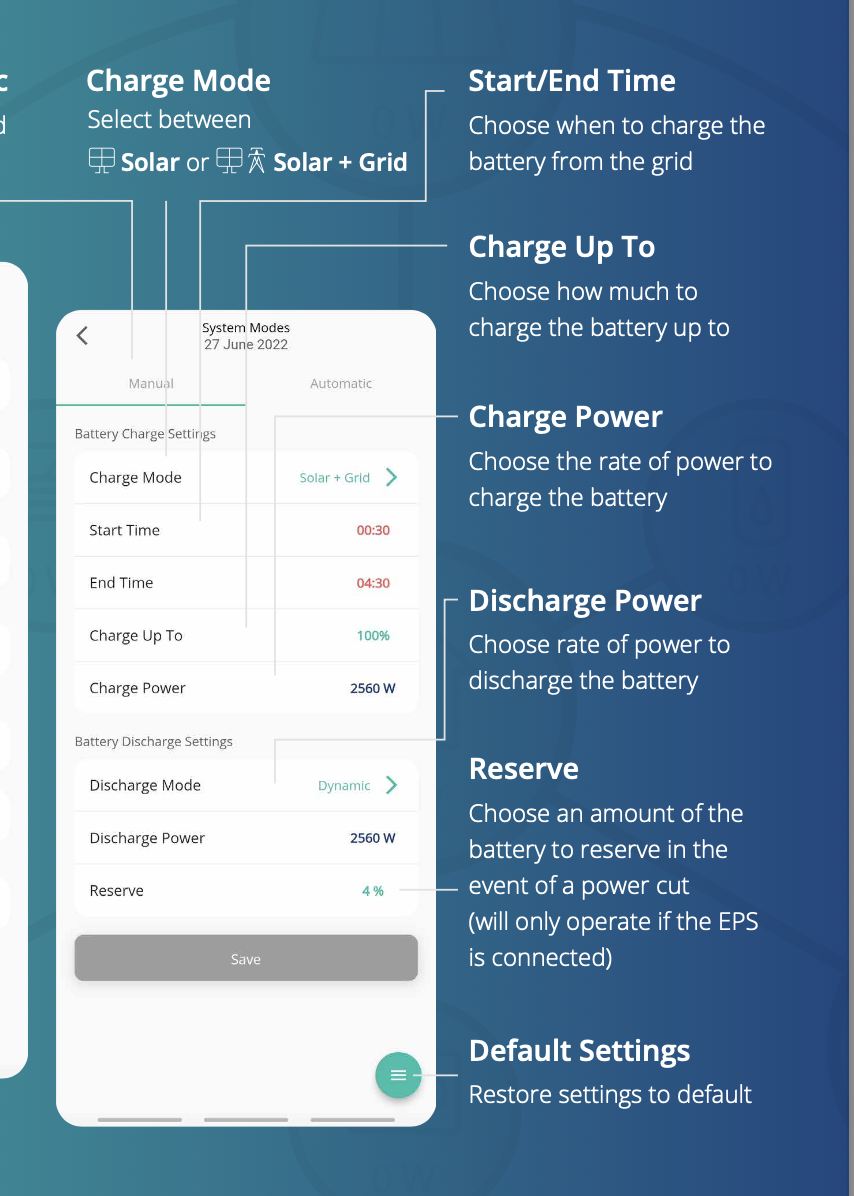
Timed discharge says This mode will discharge your batteries to your home during a period you define

That implies the battery will discharge at the time you set and it will discharge to your home.

However I just spoke to Givenergy support who told me it

1. Timed Discharge will discharge to home and grid at it's maximum rate but give your home preference over the grid.
2. Timed Export will discharge only to the grid (so don't use that one!)

However when you look at the app it does not have either Timed Discharge or Timed Export.

It just has
1) Discharge mode = Scheduled or Dynamic (but that maybe dynamic = Eco???)
2) Consumption type = Either
(a)Meet Home Demand (but will maybe export after home demand is met?)
or
(b)Full Export = only to the grid?

The manual says nothing. It just points to the section called Discharge mode and says "Choose rate of power to discharge the battery" even though there is apparently nowhere to do that.

D
#26 DD

Pete Thomas 2. Timed Export will discharge only to the grid (so don't use that one!)

That's utter nonsense. The inverter generates AC which goes onto the house wires. Any home demand will take first bite at it - no way to prevent that. If the generated power is sufficient to cover all the house demand, the excess will be exported to the grid. If it's insufficient, power will be imported from the grid to make up the difference.

The inverter has no direct control over where the power goes.

However when you look at the app it does not have either Timed Discharge or Timed Export.

Those are the portal names. As you say, the app gives them different names. See the post I linked earlier.

P
#27 Pete Thomas

Timed Export also stops your battery charging outside the period and turns off Eco mode.

P
#28 Pete Thomas

DD That's utter nonsense.

I'm not disputing that, just saying what Givenergy just told me.

So I'm now even more confused. What is meant in the app by the choice of either (a) home demand or (b) Full export. Only one can be ticked.

I'm even more confused now as what I am told here is different to what I am told by Givenergy support.

D
#29 DD

Pete Thomas I'm even more confused now as what I am told here is different to what I am told by Givenergy support.

Best thing is probably run experiments to discover how your system behaves. I'm pretty sure different versions of hardware/firmware behave differently, so I only know for sure how my system behaves.

On my system, those two behave identically during the timed period: they both discharge at fixed rate controlled by the 'discharge power' setting. Everything above house consumption will be exported.
Outside the timed window, exactly as you say, 'timed export' turns off the eco flag, pausing the battery discharge ; 'timed discharge' leaves it on, allowing the battery to cover home demand.

P
#30 Pete Thomas

DD Best thing is probably run experiments to discover how your system behaves

I will once it stops recalibratiing

DD Outside the timed window, exactly as you say, 'timed export' turns off the eco flag, pausing the battery discharge ;

It also stops the battery charging. Well it does on mine anyway.

D
#31 DD

Pete Thomas It also stops the battery charging. Well it does on mine anyway.

Oh... that's interesting. Not something I'd noticed. (But then I've never used timed-export in anger. I use timed-discharge on savings sessions, since it behaves exactly as I want.)

P
#32 Pete Thomas

DD Oh... that's interesting. Not something I'd noticed.

I was trying out the setting yesterday, but turned it off once I realised it had frozen the charge. (Bad day to do that)

In fact I spoke to the installer and he had also noticed it (rechecks all his customers' graphs daily)