Discharge Limited to about 300w

33 comments started 2024-02-14 last 2024-02-20
Home AutomationGivEnergy ProductsBatteryHome Assistant
J
#1 JK

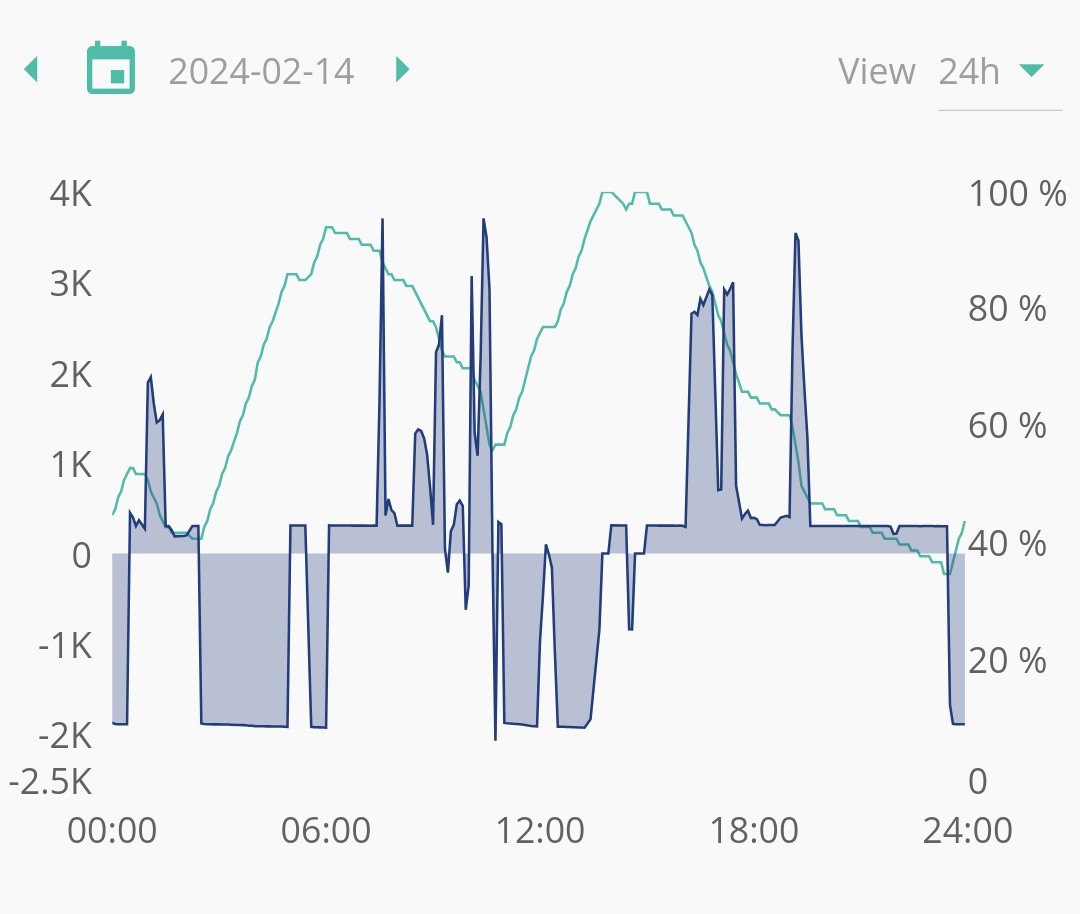
Irrespective of the load on the system, battery discharge is limited to just over 300w for the last 24 hours. I've tried resetting to defaults on the inverter settings, but that's made no difference.
I've recently installed home assistant and was trying out a discharge pause, but I've returned these settings to normal. I can't see any setting either in HomeAssistant or on the inverter Remote Control portal that would explain the limit.

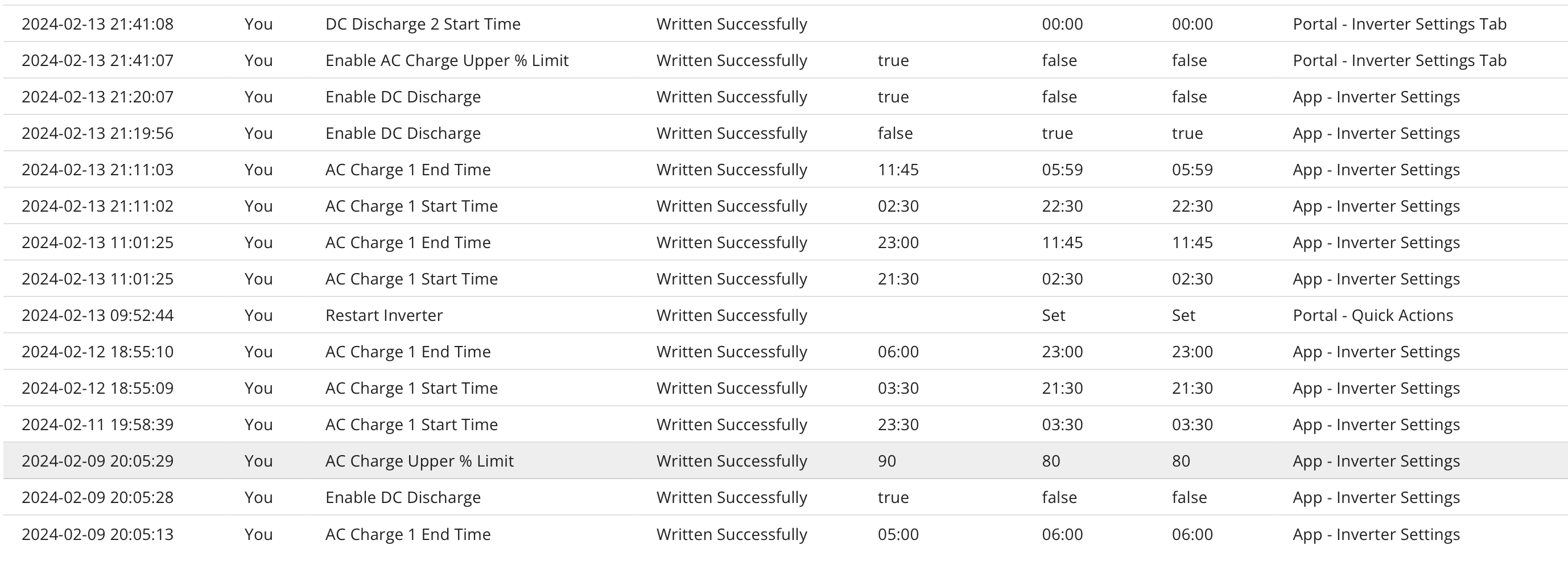
All software is up to date, I'm happy to do a factory reset, but can't find how to do that. I have attached an image of the commands set through home assistant, when the 300w limit appeared to start.
Does anyone have any ideas?


J
#2 JK

Giv-Hy5.0 plus battery.

D
#3 DD

JK on the app, pause is implemented by setting power to 0. But on recent inverters, that actually results in a power of around 300W.
HA plugins typically seem to write directly to the inverter, without using API, so the portal is unaware of those changes, and may present stale values.

I'd try changing discharge power to some random value, then change it again to max power. Without the first write, the portal might skip sending it if it thinks the value isn't changing. Alternatively, on the portal, each setting has a button to force the portal to read the value from the inverter, rather than just showing the last value it sent

If you use android, I'd recommend the free 3rd party monitor app which will show the values directly from the inverter, rather the portal's view of them. Or you can use the python scripts that are part of givtcp on GitHub to similarly dump all the registers directly.

S
#4 SJB

You can check the Inverter Max Output Power Percentage, I've inadvertently set that in Home Assistant before now.

D
#5 DD

JK I have attached an image of the commands set through home assistant, when the 300w limit appeared to start.

The rightmost column shows that these commands were sent from app or portal, not HA, which typically writes directly to the inverter (avoids reliance on cloud). HA might have its own logfile of what settings were changed. (I don't use HA myself.)

I see an inverter reset in the log, but not a restore-defaults. (Though since I don't think I've ever done that, I'm not sure if/how it would appear in the log.)

J
#6 JK

DD Thanks so much - you were absolutely spot on. I changed the battery discharge power in the GivEnergy web portal to a random value and back - it seems to have kicked it back into sync.

I'm finding the GivEnergy system to be very 'finicky' and not reliably informative or responsive - I feel my Home Assistant Journey is going to be a complicated one!

Thanks so much.

J
#8 Josephiah

I've been having a similar (arguably opposite) problem, where the battery is discharging at 300W at times when it is set to hold charge (i.e. discharge rate set to 0W). A clear example below:

DD from what you said further up the thread, were you implying that this is a "feature" rather than a bug...? Or should I be raising it with GE?

Thanks.

D
#9 DD

Just re-reading this thread... It's a bit disappointing that, apparently, resetting to defaults failed to reset the discharge power to max - that is often suggested to people to fix problems, and if it doesn't actually reset everything, that's not good. In the original case, it appears that the problem was the portal had a stale value, so wasn't sending updates.
Maybe reset-defaults only resets changes the portal knows about, making it useless to address anything screwed up by, eg, HA experiments.

D
#10 DD

Josephiah (while there are obviously parts of that chart where it's discharging at around 300W, it's not entirely clear why those parts were where you wanted to hold charge.)

Hard to know for sure whether it's a bug, a limitation of the hardware, a consequence of some other trade off. I guess you could report it to GE, but I'm less than impressed by (apparent) lack of response to several bugs I've reported so far.

The timed-pause feature (in remote control section) is able to actually get power down to 0. But not terribly convenient to access it from the app.
There might be another way to to do it... Haven't tested it fully, but if you don't otherwise used timed export feature, one of the "hidden" settings (ie only available on remote-control page) is a min SoC - the timed discharge will stop when battery gets to that level, and it will hold charge. So if you were to configure timed discharge to be 0000 to 2359 with a target SoC of 100%, then setting timed-discharge on the app will actually result in holding the charge instead. Well, that's the theory, as I said I haven't actually tested it.

(Not all inverters have this feature - older hybrids probably don't)

J
#11 Josephiah

DD yes, sorry, lots of missing context there. The reason for holding charge at certain points is that I'm using MyEO to select the cheapest Agile slots for charging in. We then check for which slots are worth discharging in by comparing the import price against a threshold based on the average price we paid to charge it up plus a percentage allowance for conversion losses. So if the current incoming price is high, we use our cheap stored energy, and if it's low/marginal compared to our threshold, we import from the grid. Really nice when it's all working, but phenomena like this unexpected 300W drain can throw things off a bit.

But in any case, an electrical appliance which won't switch off when I want it to is a bit on the alarming side...

D
#12 DD

Josephiah We then check for which slots are worth discharging in by comparing the import price against a threshold based on the average price we paid to charge it up

Nice! But... is there a case for considering also the cost to replace the power, rather than just what you paid for it. (Is this an example of "sunk cost fallacy" ? Not sure...)

Anyway... suppose you charged the battery at, say, 15p. You hold onto the power and use the grid anytime the grid is, say, 16p or less. But tonight it's going to be 10p. So there is a case for discharging when the grid is 14p, at an apparent loss, since you'll be able to fill back up at even less.

While there's only one timed-pause window, the inverter may have up to 10 timed-discharge slots. So in principle you can (ab)use those to program in 10 timed-hold windows per day. (Similarly, you may have 10 timed-charge slots.)

J
#13 Josephiah

DD Yes, I think there's an interesting case there. It was driven by an enquiry to the MyEO dev along the lines of "how do I stop my heat pump from just draining the battery again", which has got us into a discussion about how to assign a value to the stored energy, and trying out a few things, definitely in a beta-testing kind of way. So I'm sure there's room for improvement.

I can certainly see your point, but I'm not totally clear on whether looking ahead as you suggest would improve things much or not - if we have an upcoming day at 10p, well, just top-up then park the battery and enjoy the cheap import to cover current demand...?

My view (which he may not share, of course - he may have higher ambitions) is that MyEO can get us to a "setup-and-forget and it'll get you a decent chunk of the way towards optimal operation" kind of level. PredBat this is not! (Though I am eyeing up playing with that soon too when I find the time...) But it's very nearly there as a great solution for those who don't have the time/inclination for HA-level tinkering and just want to leave it to run.

D
#14 DD

Josephiah My view (which he may not share, of course - he may have higher ambitions) is that MyEO can get us to a "setup-and-forget and it'll get you a decent chunk of the way towards optimal operation" kind of level.

Yes. Can't help thinking that Intelligent Octopus Flux should perhaps have been a bit more like this.

J
#15 Josephiah

DD Yes, the GE portal and app have little hints towards that kind of thing too (like an "automations" dropdown with no options in it), as if the intent was there but they've dropped it, or just haven't got round to it yet.

There have been several instances, both with this and with our heat pump, where I've just thought "man, if I wasn't an engineer, how would I even begin to diagnose what's going on, let alone solve it...?". Still feels like early days in the smart revolution...

G
#16 geoffreycoan

Josephiah I agree, the smart tariff integrations in the GivEnergy portal were a great start and way ahead of what other inverter manufacturers did. It’s just not been taken forward. Which gives opportunity for solutions like MyEO or WonderWatt.

#17 nophead

Josephiah Since the latest firmware update I can't pause the battery in the app, which just sets the discharge power to zero as it never goes below 300W. Instead I have to do a timed pause in the portal.

D
#18 DD

nophead Hmm... that would seem to confirm it's a firmware bug, unless it's something they've had to put it to avoid some worse problem.

J
#19 Josephiah

nophead Hmm, this matches the response I got from GE just now (minus, of course, any admissions about firmware bugs). Not particularly helpful, as this isn't currently how MyEO (which I'm currently using) operates. Am going to push back a little on that response - to my mind, having a control which ostensibly sets something to zero, actually only go down to 300 is a fairly fundamental error that needs corrected.

#20 nophead

Yes it is bonkers. I think the portal rejects 0 and actually sets it to 1 but it is supposed to be a percentage so 1% would be 26W for me, not 300W. Before the inverter firmware upgrade 0 was 0 and the app pause worked.

The firmware upgrade did fix my issue of the battery always slowly discharging when it reached 100% down to 95% and then charge again. It now flat lines at 100% until it is needed.

J
#21 Josephiah

Some interesting findings from a little investigatory tinkering today - all of this is carried out while discharging in Dynamic mode, when there was a reasonable demand level from the house/heating:

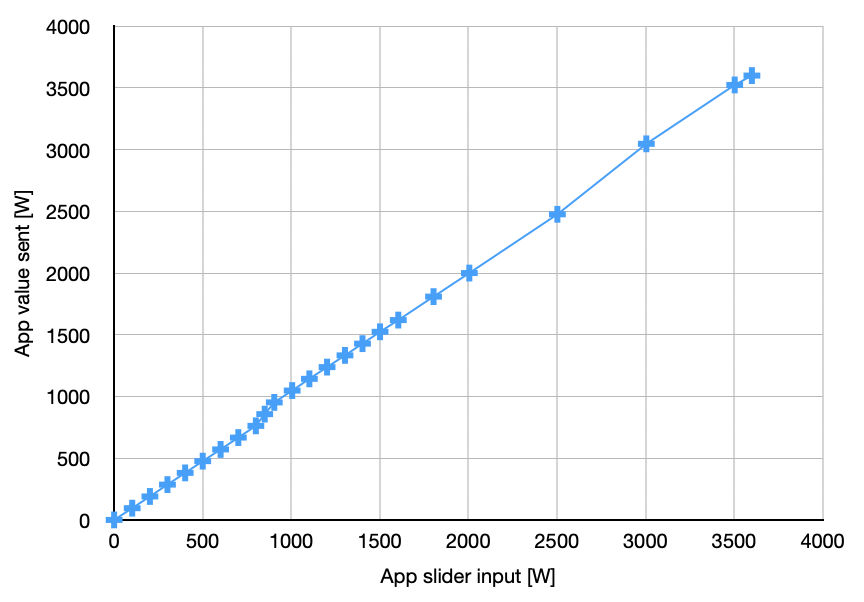
  1. As you've probably seen, the app doesn't send exactly the value you set on the slider; rather, it rounds it to the nearest of a series of discrete steps. More interesting, though, is the fact that this conversion doesn't seem to be quite linear, with a distinct step around 850W or so, and the hint of another between 2500-3000W. (Possibly something to do with the inverter switching circuits for different power levels or something? But I'm not sure this quite makes sense, as the actual values sent appear to have a linear gradient with the resulting output...)

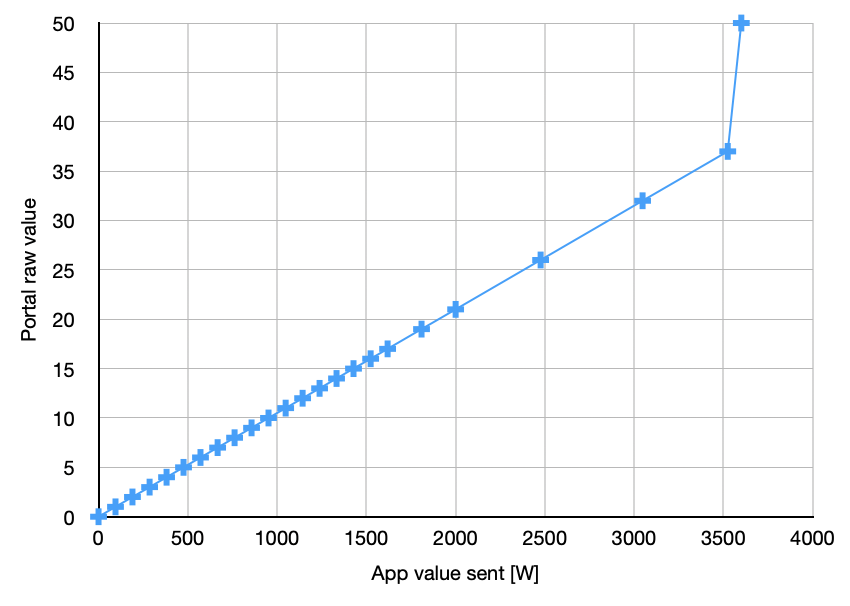
  2. Looking at the portal logs, what the app actually sends is a raw value, which appears to run linearly from 1-37, then a sudden jump to 50 at the top of the range. In the linear part, each raw value unit is about 95.2W.

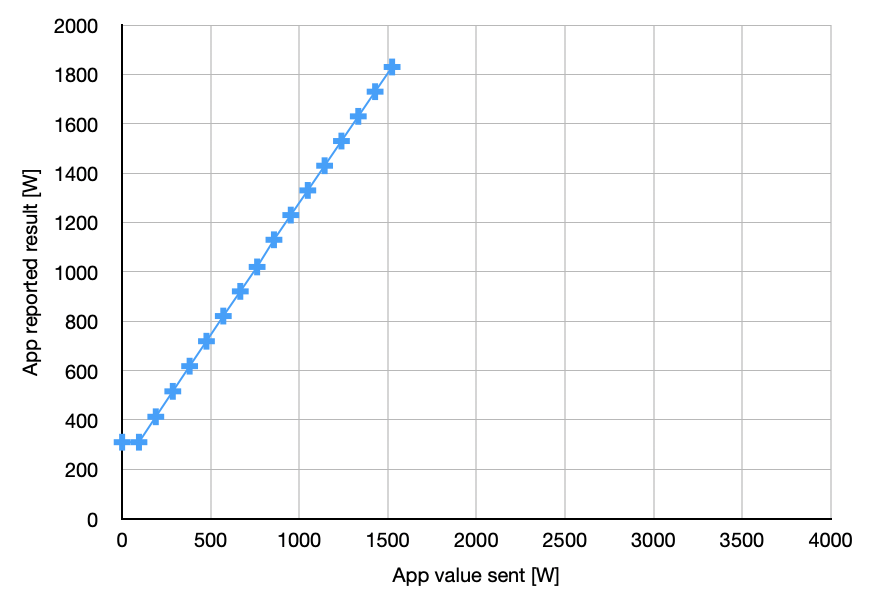
  3. We can then look at how the raw values received by the inverter translate to real life, by looking at the resulting power flows in the app dashboard. (Note that our house demand was topping out at just under 2kW during this time, so I don't (yet) have the full set of results - may revisit if I happen to be free during a higher demand period). Nice linear-looking trend, but we can see that ~ 310W lower limit clearly, and also that the gradient of the rest of the line wouldn't pass through zero either.

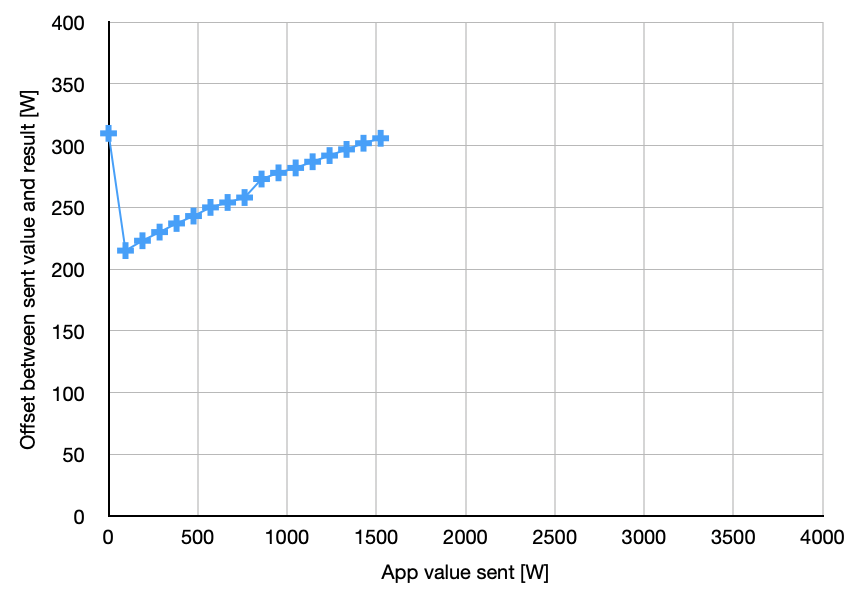
  1. Finally (for now), we can have a look at the offset between the demanded value sent by the app and the reported result:

So, working it through as an example:

  • Set the slider to 1000W;
  • App 'corrects' this value to 1048W, corresponding to a raw value of 11;
  • Battery then discharges at 1330W.

Not quite sure what to do with all that beyond "huh, weird", and maybe point out to GE again that having a UI that doesn't do what it says on the tin isn't really acceptable...

D
#22 DD

Josephiah when I investigated this, I concluded that the raw register stores a percentage of capacity, so on 9500Wh battery, 1 unit is 95W. (The literature often talks about charge rates in units of C where 1C fills or empties battery in 1h.)
So when you set a power, it is rounded to the nearest multiple of, in this case, 95W.
50 (or 0.5C) seems be nominally the max power. But that exceeds the inverter's max rate of 3600W, hence the jump from 37 to 50.
I guess the non-linear bump happens when it passes a threshold from rounding down to rounding up?

J
#24 Josephiah

DD ah yes, makes perfect sense. I didn't make the link because I was thinking in terms of the 3600W being 100%.

hoggy thanks, will take a look.

J
#25 Josephiah

And sorry to whinge, but why oh why has this been released in this state? It would be a very simple fix in the app to scale the sliders so that it at least matches what it will do in real life.

J
#26 Josephiah

Asked GE if this was intentional behaviour, or a bug which will be fixed, and they said it (I'm assuming they mean the 300W leakage rather than the app slider mismatch, though it's unclear in their 1-line response) was intentional, and to use the pause discharge function in the portal - which helpfully isn't available in the app as far as I can see...

R
#27 Rubikcube

Josephiah use the pause discharge function in the portal

Isn't pause discharge the same as turning eco off? Agile isn't easy but I think I would use eco to effectively select between using grid or battery power.

J
#28 Josephiah

Rubikcube the more I think about that one, the less I'm sure about what "eco" means with respect to the controls presented in either the app, or the deeper (cog) controls in the portal. I've been assuming it is tied to both the charge and discharge modes in the app, but maybe I need to go and experiment some more.

GE say the sliders in the app should be updated in future to match what they actually do, so that's... something...

D
#29 DD

Josephiah Someone reported on another thread recently that turning off eco mode also disables (solar?) charging. Unfortunately, can't test that right now since my battery has got to 100%. (I don't usually charge battery from solar, but because grid-first priority doesn't seem to work, I allow some gentle solar charging between noon and 2pm in case solar were to exceed inverter AC capacity and cause clipping.)

https://community.givenergy.cloud/d/3963-use-battery-power-for-home-while-it-is-exporting/30

... Sure enough, having tried it now, turning eco off does indeed also seem to prevent solar charging. (Hybrid 3rd-gen.)

It is rather poor design that one control turns off multiple what-should-be-independent features.

The advantage of using pause is (a) it can be timed, and (b) you can choose to pause charge and discharge independently. It's a pity there's only one timed window, but I think there's a trick to have multiple timed pause-discharges.

J
#30 Josephiah

DD I guess that should be possible via the API, not sure I can see how to do multiple times otherwise.

D
#31 DD

Josephiah yes, I'm currently using a simple python script to adjust things on the fly, since I want two pause-charge slots per day.
(Pause-discharge can be implemented by abusing the timed-discharge slots, of which some inverters have up to 10.)

#32 nophead

Why would it be intentional to make 300W the lowest value? It breaks their own app and confuses customers, what benefit does it have? What was the problem with the previous version where zero means zero?

J
#33 Josephiah

nophead quite!