J
#1 James-brown
Hi all
Does anyone know if I can get a report of the inverter and battery temperature over time ?
Mine are stored in a loft and I’m keen to see how it’s managing in the summer and winter.
Thank you

Hi all
Does anyone know if I can get a report of the inverter and battery temperature over time ?
Mine are stored in a loft and I’m keen to see how it’s managing in the summer and winter.
Thank you
You could download specific days data from the givenergy portal and then combine together in a spreadsheet.
Or there is an PC script on this forum for running a series of meter data downloads - this may include the temperature data, or you could extend it.
Best solution would be home assistant where this data is readily available for you to chart as you want
Thank you Geoffrey. I can’t see the report that shows this in the list of standard reports. Where is it ?

The battery and inverter temps are here
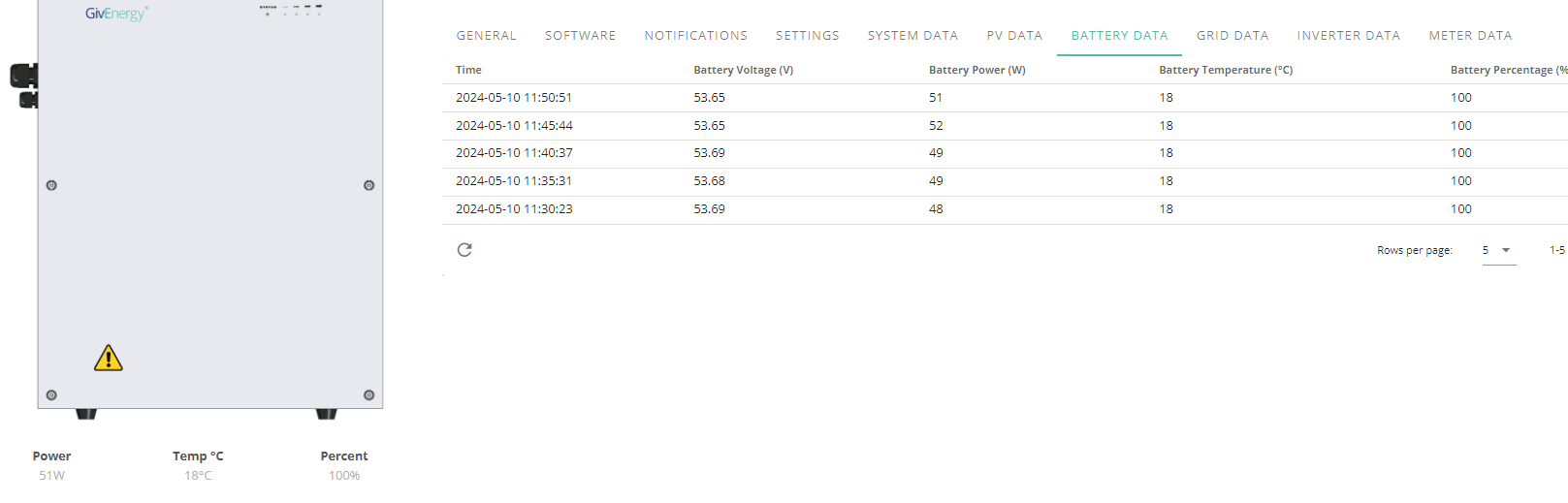
&
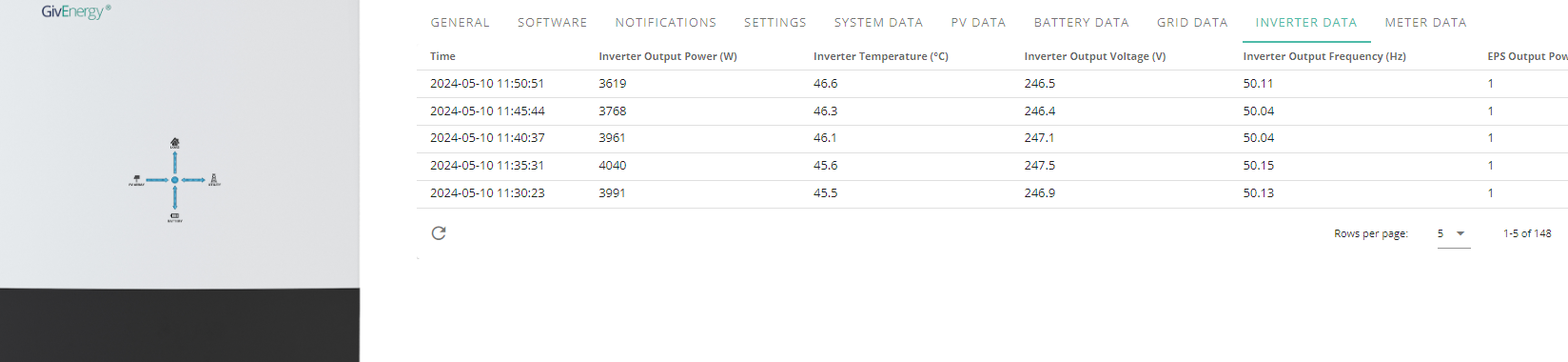
James-brown There isn’t a portal report as far as I know
I was referring to the tables of data in the portal. If you look at https://www.givenergy.cloud/inverter/<your inverter id>/data you can download the inverter data (that includes inverter and battery temperature) for a specific day
Thanks Geoffrey and Midlands-Solar
So I found the data and at 12.00 today (mid-day) , the battery was showing 24 degrees C and the inverter 54.9 degrees C.
At what temperature should I be concerned it’s getting too hot for either to operate and what should I actually be measuring? Ie the surrounding air temperature ? Or the device reporting temperature?
James-brown Here’s another couple of forum posts on inverter temperature and cooling https://community.givenergy.cloud/d/3970-inverter-cooling-sharing-my-solution and https://community.givenergy.cloud/d/267-extra-inverter-cooling
I have these to hand as I have added my own inverter cooling and am about to add some photos of what I did.
Advice seems to be to keep the inverter around about 40 degrees if you can. The battery seems to be less of an issue, no-one I have seen has talked about cooling the battery.
The inverter temperature is measured internally on the motherboard. The battery there’s actually probes for the battery motherboard and on each of the battery packs, but the portal just shows the motherboard temp.
The inverter does have a temperature rating on the datasheet, from memory its 60 degrees max, but electronics do prefer to be cooler so hence the advice for 40 degrees
I was told by Giv that over 60 was only a problem because the inverter starts to restrict. Often see low/mid 50s with fans and an extractor. Battery very occasionally gets to 30. All in the same cupboard.
Thanks Geoffrey and Simon
So 60 degrees for the inverter is not far from 54 degrees I am already getting on an early summers day. So I need to keep and eye out on this.
Geoffrey, I would be interested in hearing your cooling approach.
Me too.. batteries are "ok" I think with Tbat about 28C but TInv has hit a peak of 76C today! The air temp in the loft got to 35C (although at a different point than the inverter).
I have already got a large mains fan in the loft, but when the weather is this hot it doesn't really help, just blowing air around the place. As machines don't sweat(!) the airflow isn't helpful unless incoming air is cooler.
I already intend to install some under-rafter insulation in the form of 3mm heat reflective Aluminium "bubble wrap", and am contemplating whether some rock-wool or foam board may be a good addition to that (though I have concerns about flammability of foam board and hate the fibres of rock-wool).
I have other network-related kit in the loft as well, so this issue has been on my todo list for a while, but I have found the building trade difficult to deal with in this area -- of 4 different companies who have been asked, all have had a mindset of insulating the loft floor, with an assumption a hot loft isn't a problem, and when I explained in detail the reaction was often "we don't do that sort of thing" 🙁
One trader did suggest installing "wedges" - sorry don't know proper name - which hold flaps in the underlay apart so allowing more air to pass through the roof tiles. This sounds sensible and the parts are "cheap"ish but the amount of airflow would probably be quite small. I am I think going to get some more soffit vents installed, probably quite a few!
My own thought is to install a 6" or 8" duct just inside the ridge with a fan of some sort at the gable end and a few holes of about 6"x8" in the underside at about 2m intervals. The idea is the fan will pull air from the roof evenly, not just near the gable, and it will be pulling it preferentially from the top (where heat collects). I have been contemplating using the 140mm/160mm fans used for modern PC builds because they are a lot quieter than bog standard builders fans, but will have to be kept dry!
rivimey how about ducting from the eaves to underneath the inverters as that is what you want to cool?
Rather than trying to cool the whole loft which would be a huge air volume and the sun beating down on it.

rivimey
FWIW I have network kit and a PV inverter in my well-insulated (foil covered foam) eaves. So far this month the ambient has peaked at under 26.5degs. Though the internal inverter temperature regularly goes over 60 degs (indeed since early Feb), I regard that as pretty irrelevant.
I am more concerned about the network kit than the solar - it is spec'ed to a maximum ambient of 40 degs.
I've just put the first couple of sheets of alu bubble-wrap insulation up - hard to be sure but I think it's making a difference. More insulation to come, and I need to get some soffit vents done (in theory pulling air from the coolest/shaded area).
What I had hoped was that the solar panels, which are on top of the roof I'm insulating, would reduce the need for this, but I think the radiant heat from the underside of the panels makes up for the reduced amount of incident sunlight. I do so wish solar electric panels had some (even small) provision for built-in solar thermal heat exchangers! I could then use that heat to warm up an area of ground used for a ground source heat pump. 🙂
geoffreycoan the ducting would need to be above the inverter as in my plan it's pulling hot air out, but yes, that's a possibility. Sadly I believe I will need to cool the loft because there needs to be natural airflow anyway. And also my network kit is at the other end of the space!
PianSom I agree, the network rack kit is concerning me as it was not designed for the environment I'm using it in. So far nothing terrible has happened, but sometimes the peak Ts are quite high - 60..70C has been seen in there too.
BTW I agree 40C for your kit represents the ambient air around/outside the device, and it will be 40C with around 95deg RH. Pretty much all electronics these days has a design temperature range of around -10C up to 85C (and many parts are broader, such as -40C to +125C) and while I would never suggest getting that hot was a good idea, it shouldn't fry the components automatically. There may of course be non-electronics things which do react badly, such as rubber seals or plastic inserts, and there can be issues with heat cycling too.
Some advice please… as a newbie to this, I have discovered that my inverter when running on full discharge is at 79 degrees C, yep 79C. This seems crazy, am i alone? Is it me mismanaging?

Inverters do tend to run hot. See a previous post 'Cooling the inverter', where TheDragon (GivEnergy) says he's seen 80C on full discharge and says 'not ideal, but won't cause harm'. Probably depends on where your inverter is situated. Mine's outside in a corner where the sun never reaches and today is running at around 40C; others have them in the loft where - with the recent weather - it gets very hot. Swings and roundabouts - they probably don't have to worry about sub-zero temps in winter (but I do!), but I don't have to worry about overheating in the summer...
Thanks Chris, I appreciate your response, that’s helpful
I've have a Hybrid 5 G3 inverter for about 18 months and last summer it would get up to 80c, I emailed GE and they took a look and said it was fine, nothing to worry about. I tried a small fan for a while and it helped a bit but I had to remember to turn it on if I was discharging at 3600w during the Flux peak period.
However after some trials I did notice that if I turned the discharge power down to 3420w in the battery options of the app it reduced the max temperature to around 60c which I felt more comfortable with.
I no longer force export at peak times after the octopus flux rate changed, so now I just use the battery as I guess it was intended and it hovers around 40c

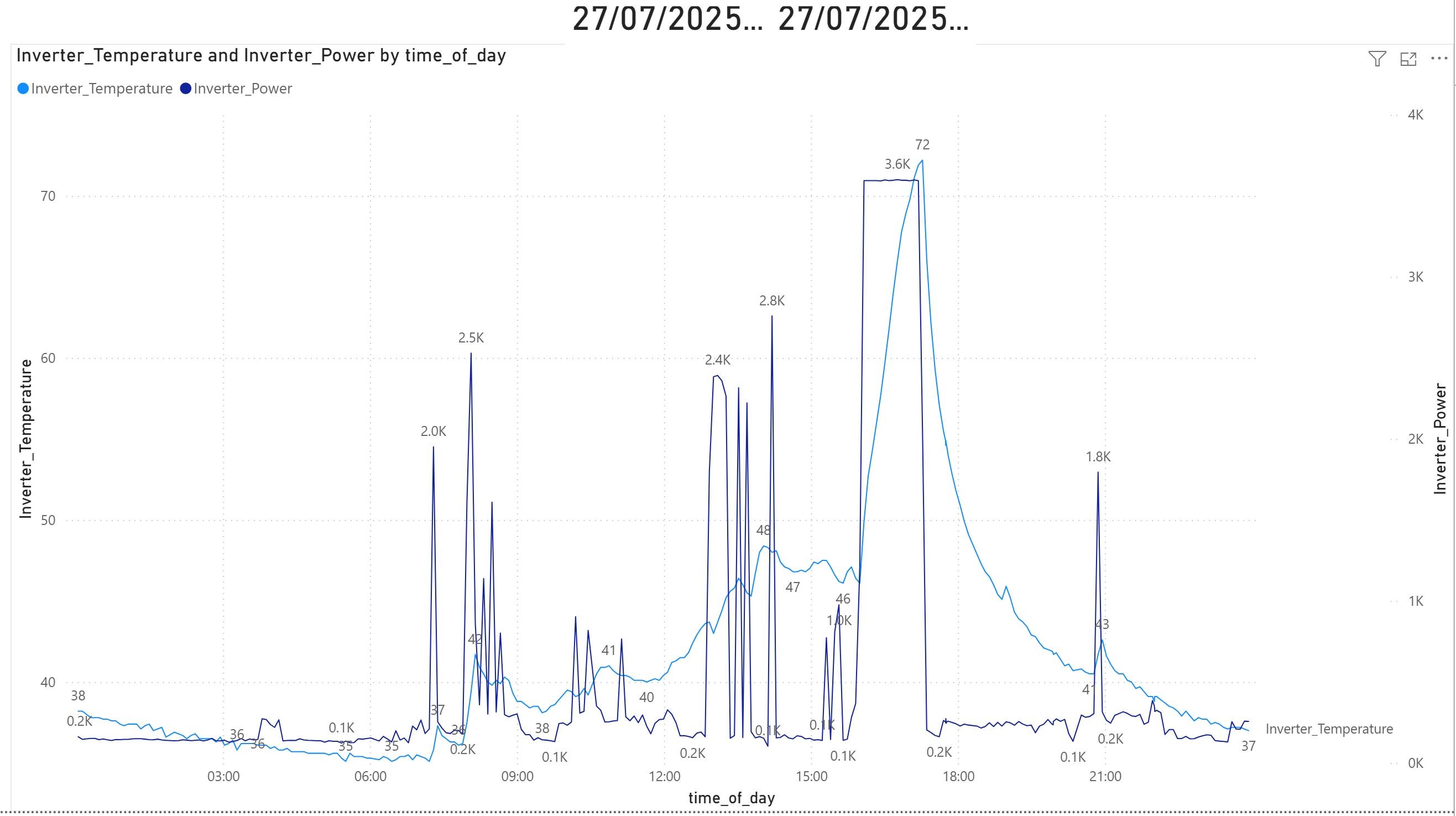
[unknown] Mine is in a small shed. I have seen my temp hit the 70s. Normally on a warmer day and when i have been dumping battery to the grid during peak octopus export periods. I have a fan system on the inverter. The air is not vented to the outside. In the first pic i switched the fan on about 15:00 and off about 19:30.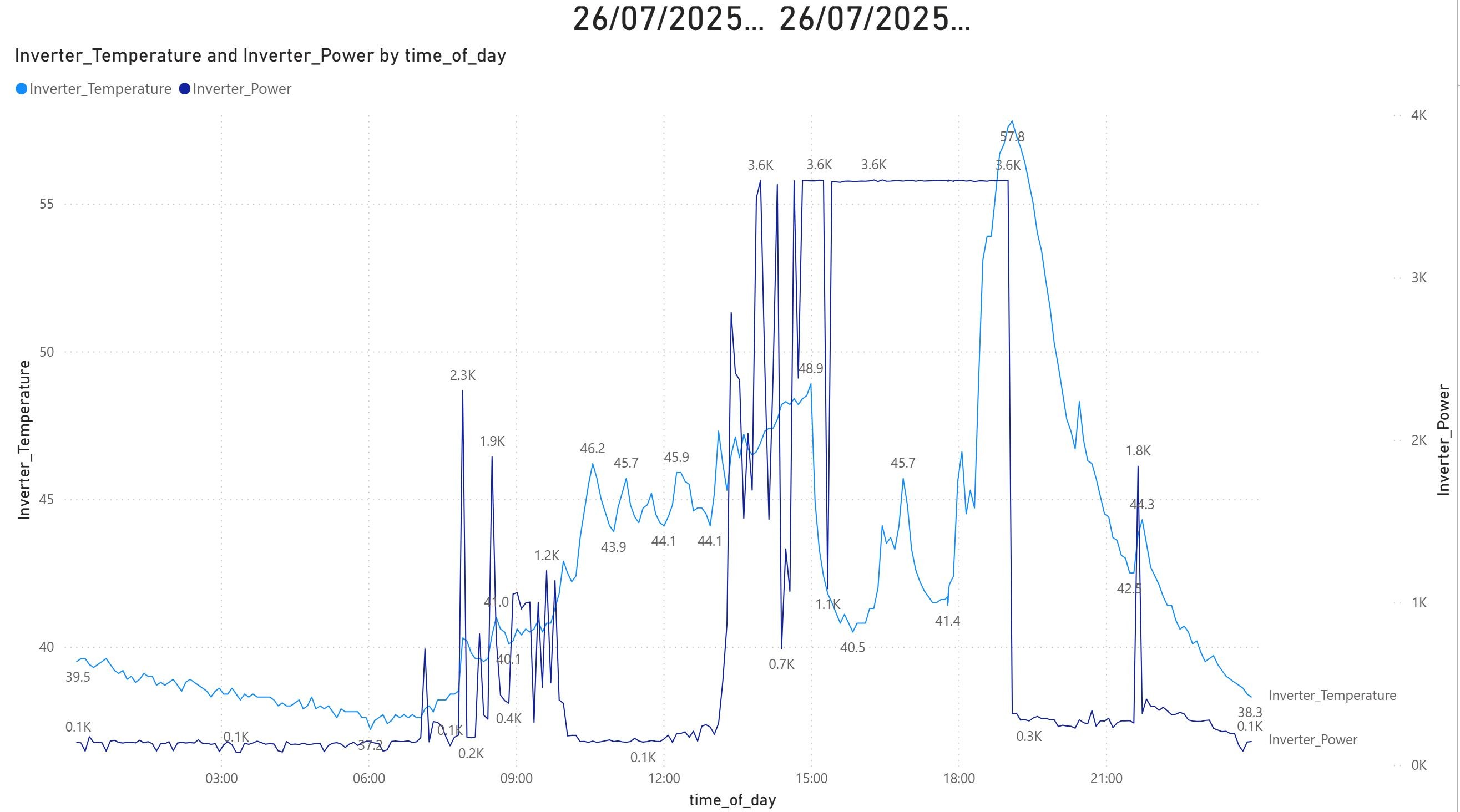
In this image i left the fan off all day. Now i know there are many variables here and i am not measuring everyone of them. So, it is difficult to prove cause/effect. But, when i use the fan i am seeing a lower inverter temp, especially at the end of the peak battery dump time. Not always as much as the 14deg difference shown here.
There are several threads here about cooling for inverters, for example look up "Thermal Solution for Indoor Inverters". I run four 80mm fans from a PC positioned at the bottom of my Gen3 5kW hybrid inverter. They provide extra cooling when the inverter is getting hot (they blow up past the built in heat sink).
Although I control the fans through Home Assistant, if you don't have Home Assistant then you could also control fans using a plug in thermal switch such as those sold for aquarium heaters - put the switch sensor on the heatsink at the back of the inverter and set the on-off temperature on the plug-switch unit. I did this for a while before moving to HA so I could keep a record of the temperatures.
Both control methods are covered in threads on this forum.