Battery FW 3017 - whats the verdict?

208 comments started 2024-09-24 last 2025-02-21
GivEnergy ProductsBattery
J
#1 Jon-boy

I have been hanging off from updating FW to 3017 from 3015 on my Gen2 9.5kwh battery in case it made things worse.
There must be a number of people who have experience now of 3017 FW, is it working out ok and worth updating?

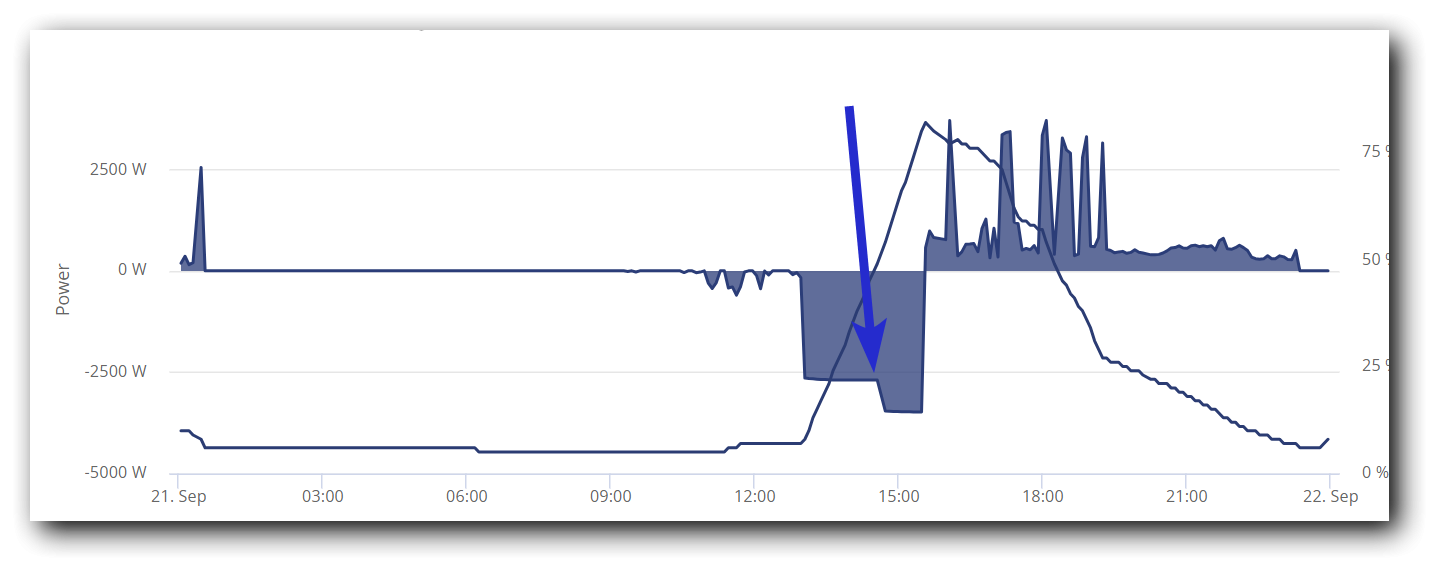
I am having SOC drops every 3-4 days when the battery gets to below 50% and sits idle for a while. It drops to say 20%.
Wondering if 3017 BMS keeps better alignment.

Thanks for any feedback.

C
#2 CGoode

Jon-boy I have 2 x 9.5kW Gen2 batteries & all is good since 3017 FW update. SOC seems to be far more stable & SOC deviation between the 2 batts is no more than 3-5% most of the time. This is probably helped a bit because I dump any remaining battery capacity back to the grid every day before the cheap rate period starts at 11.30pm (IOG tariff). This way the batteries get "exercised" with a complete charge & discharge cycle every day which I think helps keep the SOC more accurate than it was previously. So it's a thumbs up from me at least.

R
#3 Rogerbu

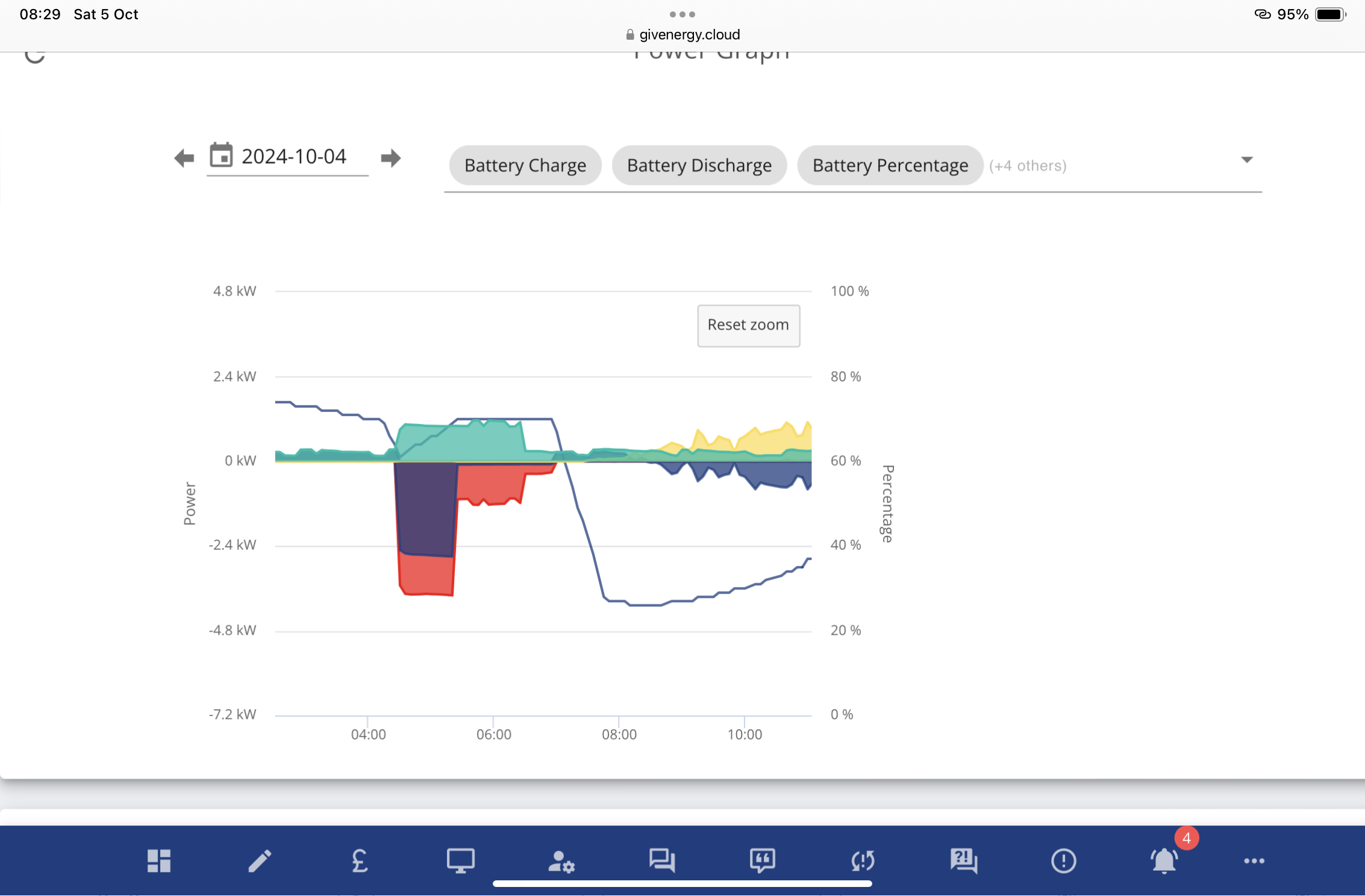
Install was okay.

The SOC % difference between my 2 9.% batteries is much bigger on 3017 than on 3015 or 3012.
They used to track about 3% different readings on 3012
On 3015, they tracked between 5% & 12%
on 3017, they track upto 30% difference, and average about 15% different.
Overnight charging to 1000% on Int Oct Go nearly aligns them, but by 50% SOC they are significantly different.

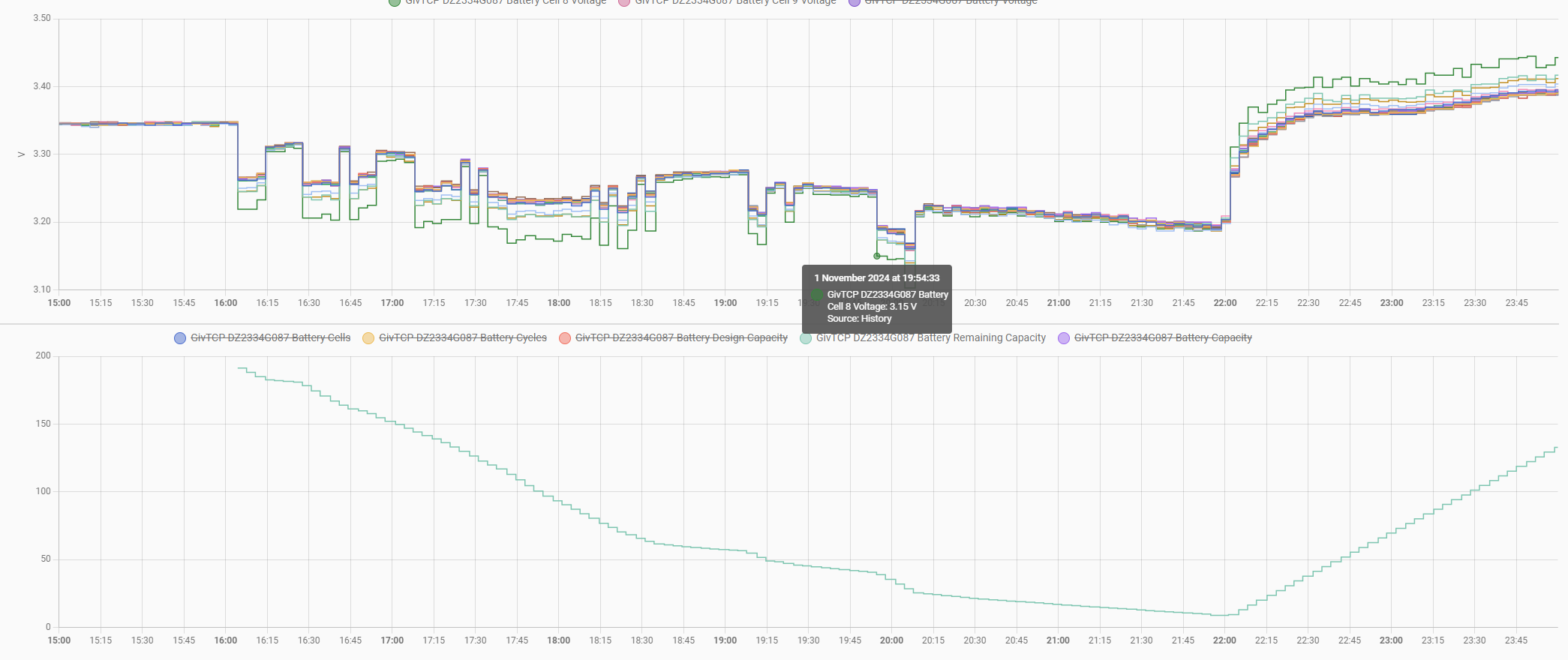
Other than this, I have seen no difference between 3012, 3015 & then 3017

AC 3.0 Inverter & 2 9.5 batteries

G
#4 geoffreycoan

Jon-boy I have two gen 1 inverters, one with a 9.5 and one with a 5.2 battery, both running BMS 3015 and inverter firmware 191/193.

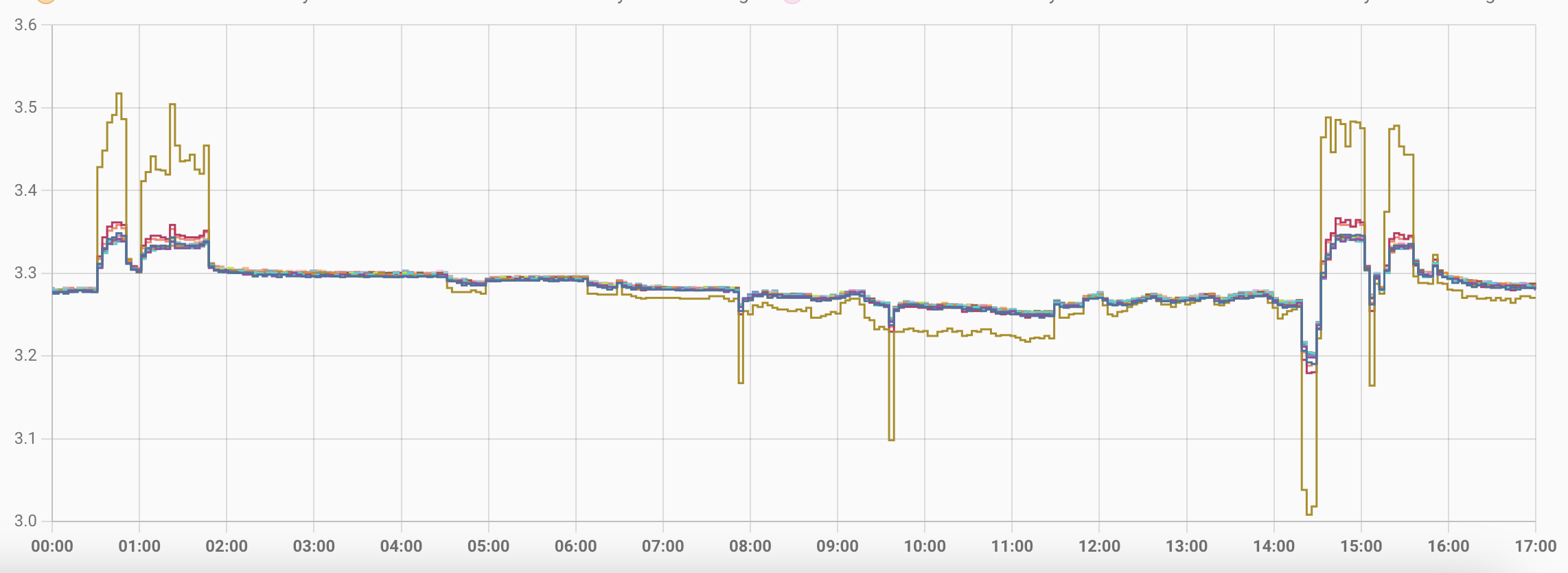
I too have held off upgrading, mainly because I don’t see any material benefit to upgrade. I don’t see any evidence of SoC drops ever, it tends to charge and discharge evenly although the 9.5 does sometimes stop draining at 7 or 8% so maybe it does need recalibrating to reset the lower % limit 🤷‍♂️

But on the ‘it ain’t broke, don’t change it’ I was staying on 3015. I think there’s a 3018 in the works ?

#5 hoggy

Mine lost a fair amount of capacity in the move from 3015 to 3017. This may or may not have been related to two factors:
1 - 3015 ran my pack much harder than expected (regularly going into the buffers) so gave a false sense that it was still performing at max capacity.
2 - my pack is getting on a bit, so will inevitablly suffer degradation (previously masked by 3015)

I'll put some graphs together in a bit.

B
#6 BobB

geoffreycoan Hi Geoffrey. It was this post from sponev that first mentioned 3018. Does anyone know any more about it? Are there any beta testers doing their thing?
I updated to 3012 last year. It was reasonably painless, but the stories of others having problems have put me off frequent upgrades.
Personally (to address, but not answer Jon-boy's question) I'll be sticking with the devil I know until a unanimously applauded version comes along.

W
#7 wrighar

No problems with 3017 for me.

V
#8 Vestas

hoggy Its a shame you didn't run a calibration on 3015 immediately prior to updating.

I'm sticking with 3015 as it seems to return to sane operation with the "fast response" f/w.

Only oddity really is that pausing battery discharge sometimes lets the battery drop below cutoff level (down to 45Vish) if left long enough so I don't do that now. In general the battery stays between 49.8V and 54.3V so not hammering the cells like 3015 and the production G1 f/w did.

#9 Watcher

wrighar
Me too!

Edit : 190/193

#10 hoggy

Vestas I did do a few calibrations under 3015, just not immediately prior. I was testing local modbus for my erm...personal dodgy version... its a drop from 144AH to mid 136AH on the latest calibration under 3017.

J
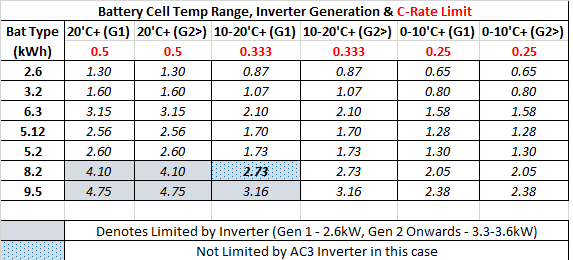
#11 Jon-boy

Thanks all for the responses. Bit of a mixed set of experiences, some working ok, others not so and some choosing not to upgrade and I think I will take this stand-off approach a little further and wait for 3018 or whatever comes next.

A
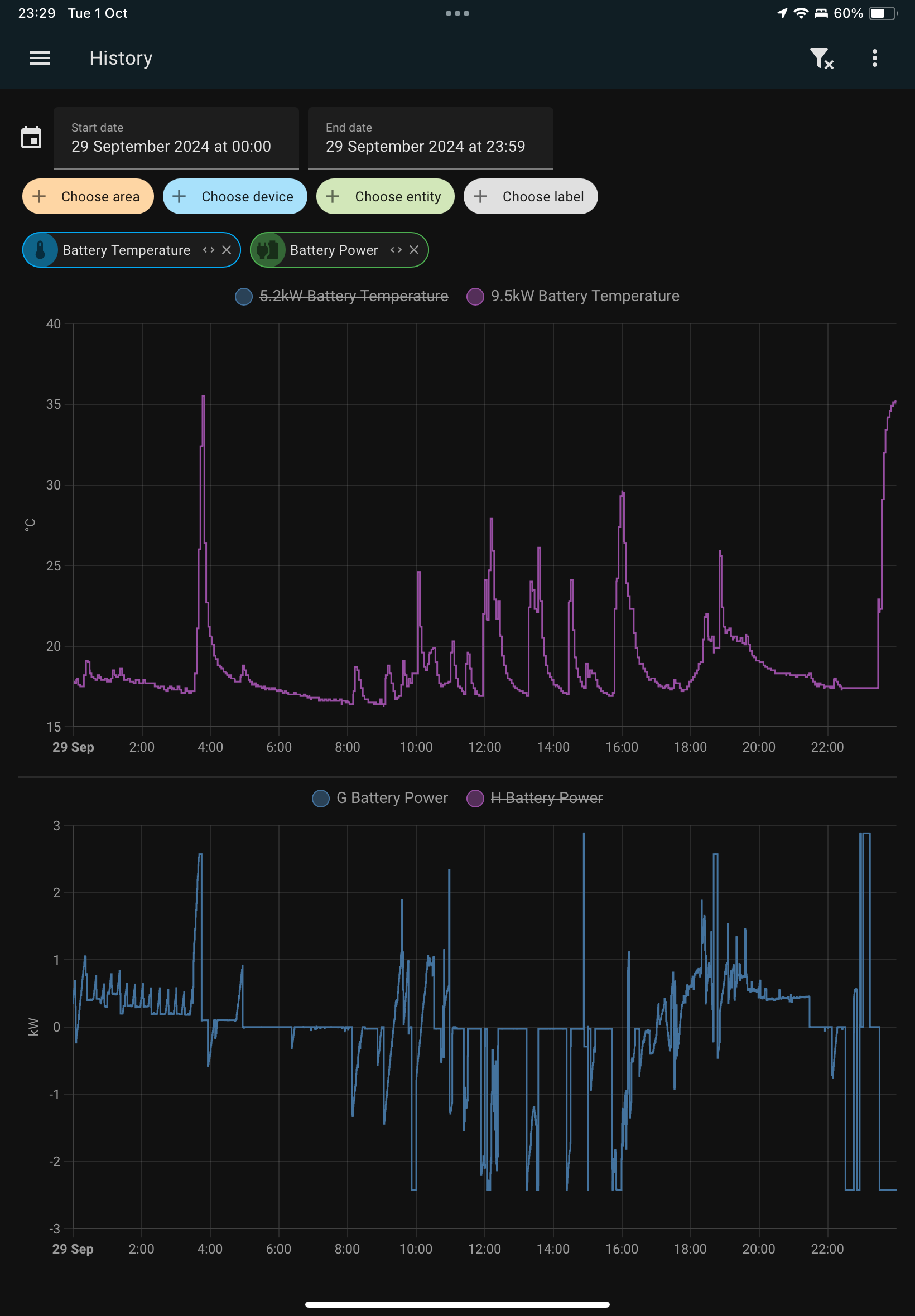
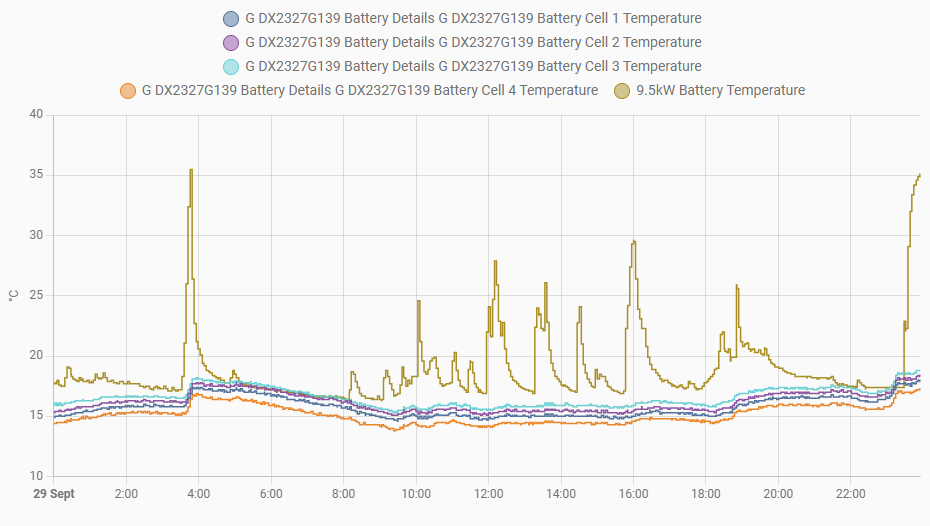
#12 Alfieri14

Seems to be working ok for me as I had BMS Over-voltage every time the batteries (9.5 and 5.2) went to 100% but I no longer get this on 3017 . I do get the odd notification but nothing on the page though.

B
#13 BobB

Jon-boy Cluck cluck me too Cluck! 🙂

T
#14 ThePalfs

Gen2 Hybrid 5.0 9.5kWh with 3017

I updated from 3015 to 3017 a couple of weeks ago with no issues so far.

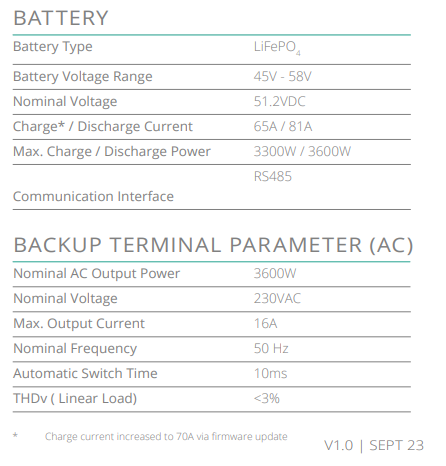
R
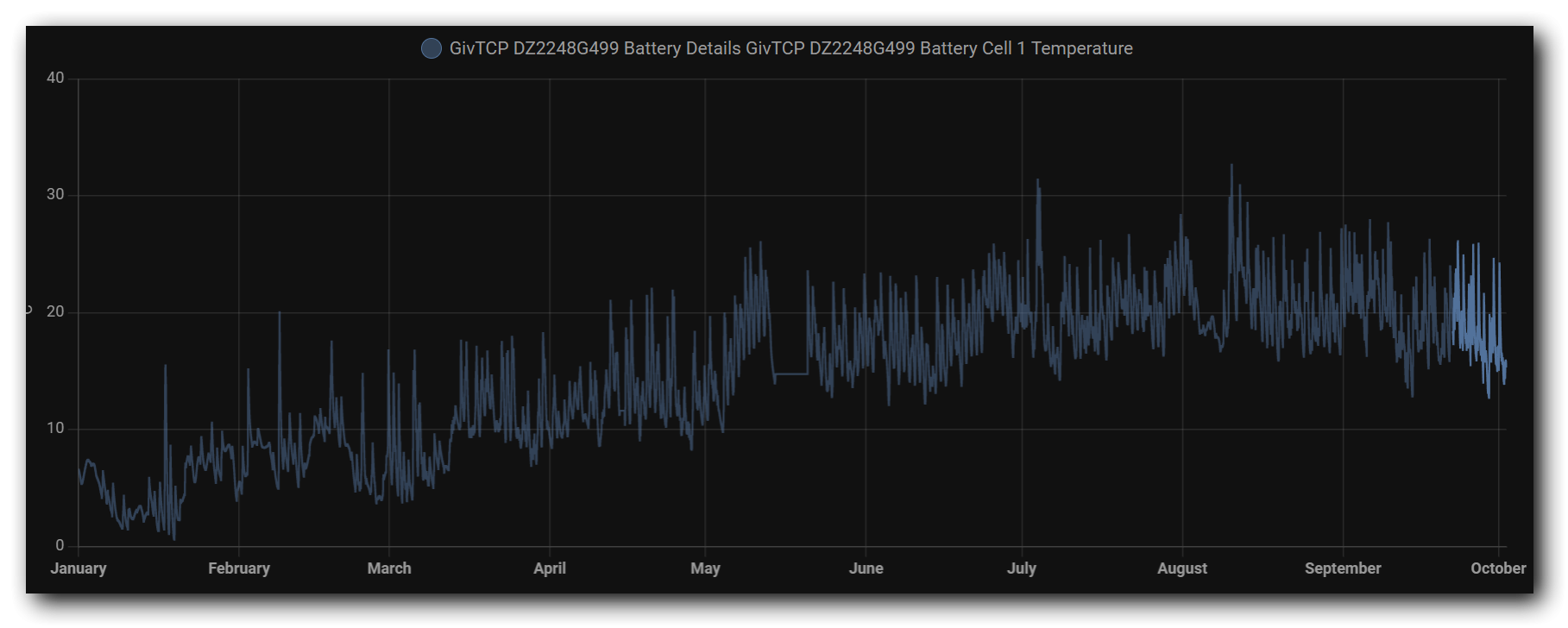
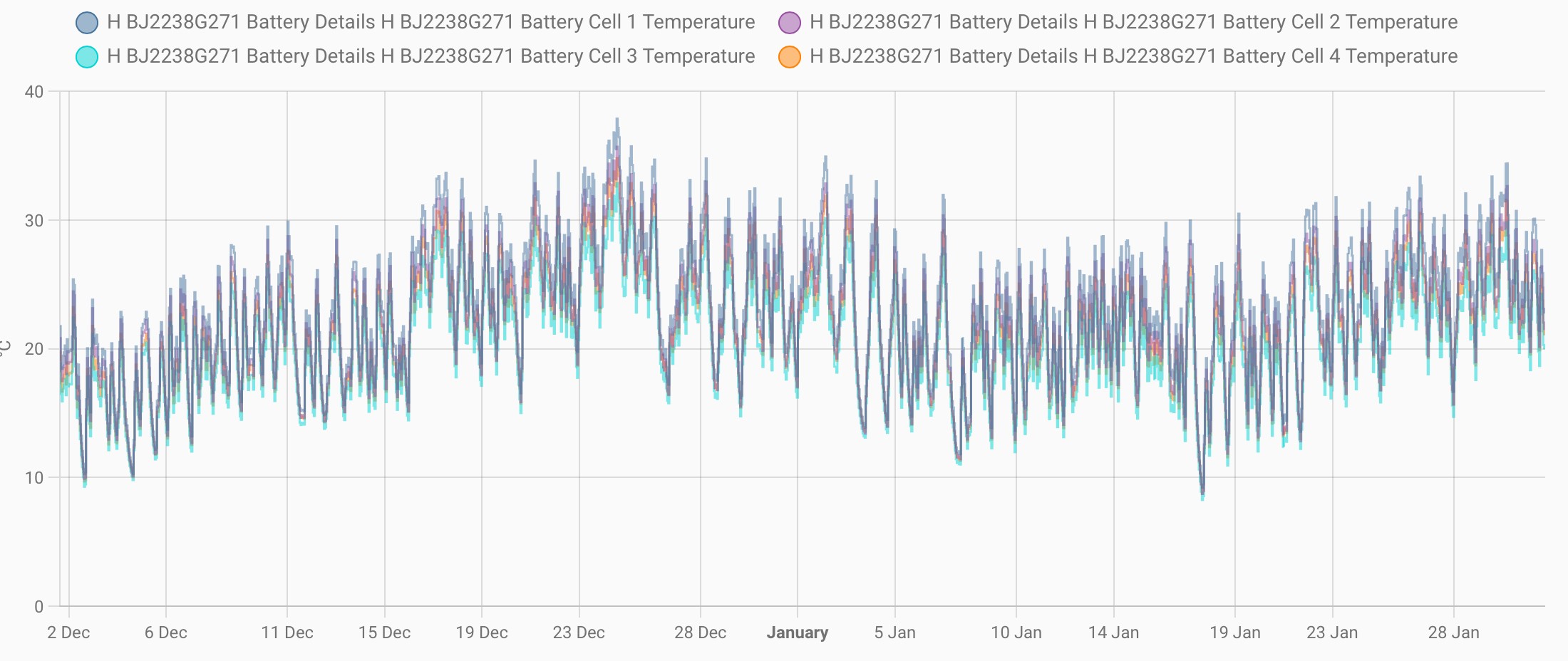
#15 rjp

I've just notice some odd behaviour, not sure if it's 3017 related though:

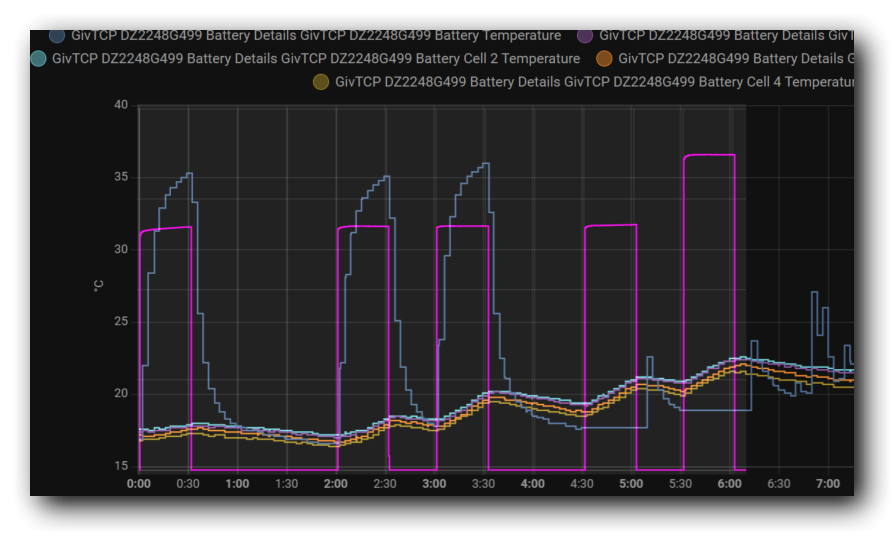
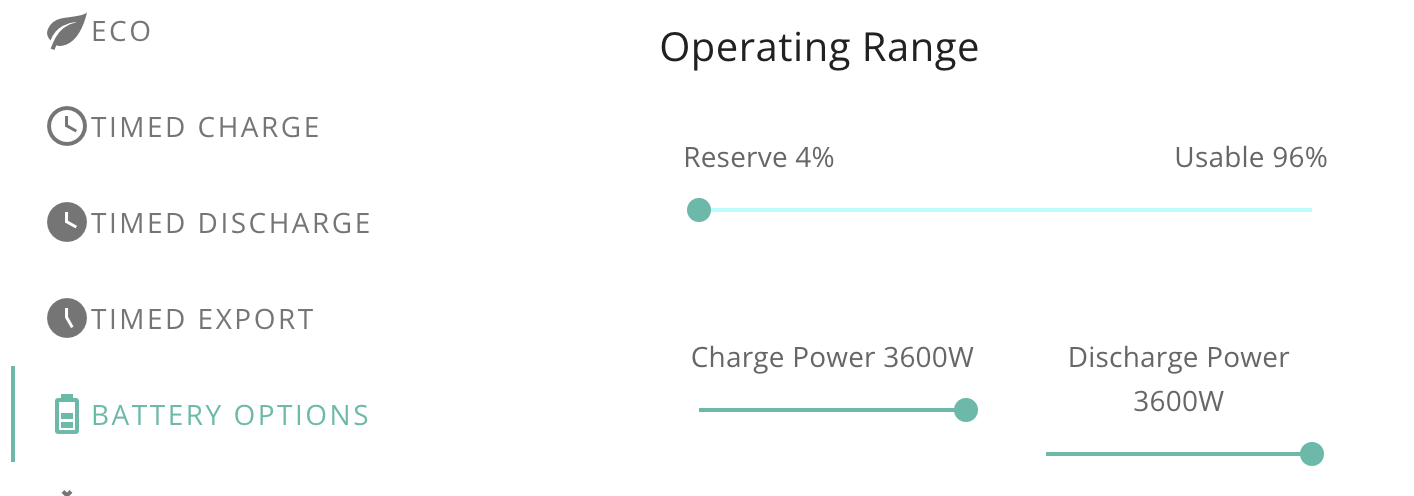
When my battery is charged from grid it should always be at the max 3600W charge rate. But looking at the data, it's only charging at 2700W for much of the time, and then jumps to 3600W. There's no remote commands sent to limit the charge rate and I see the same behaviour with timed charge from portal and Wonderwatt.

M
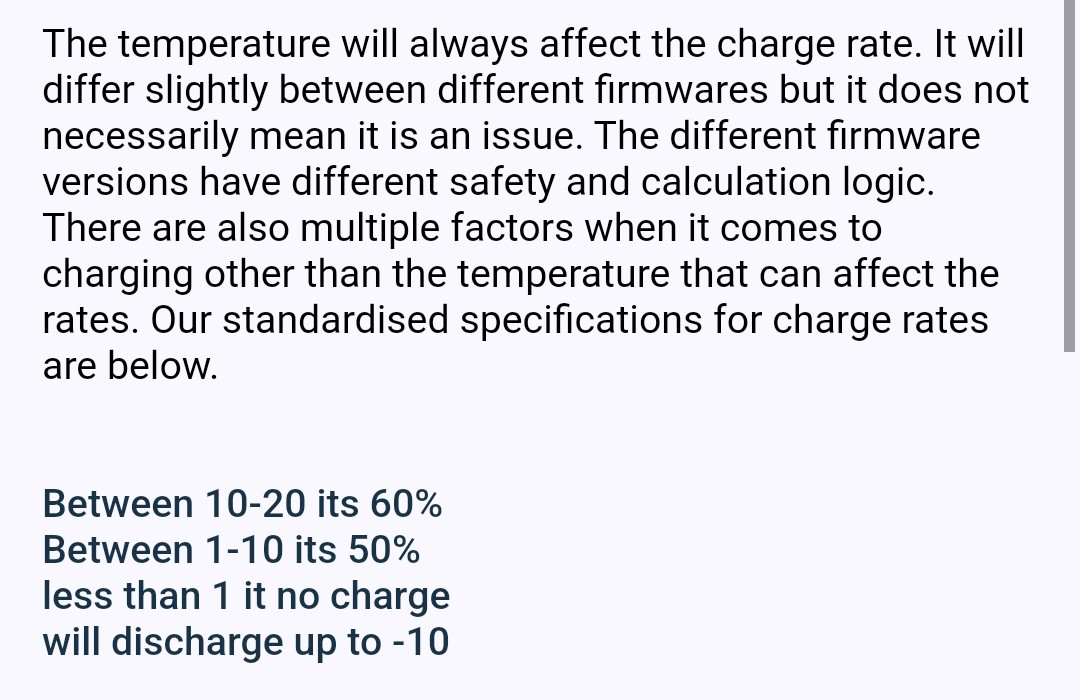
#16 matttheotter

rjp raise a ticket, this happened to me on Monday, I put an email over to GivEnergy and need a field visit, I have not been told the nature of the fault but its the same as you, max charge was 2700W.

What system are you running? I have a 5.0 Gen 3 inverter and a 9.5 Gen 2 batt.

P
#17 Phil_H

rjp I don't know if you can get to a battery cell temperature anywhere but I have noticed this is in line with the temperature being below 20. There has always been a reduced charge rate for low temperatures but before 3017 the rate for a 9.5kWh battery between 10 and 20 was 0.333C which equates to 3250W, I have not seen any information that suggests this change is intended or not, I haven't yet contacted GE about it so they may have some info.

R
#18 Ra

Wish I had stayed on 3012 not gonna lie. Didn't have any SOC drops, no BMS high/low voltage notifications etc 🙁

Does anyone know if you can roll back time?

Z
#19 Zakalwe

Ra
I had mine rolled back from 3015 to 3012.

Mind you, I've now upgraded to 3017 to see how that goes. My two 8.5s were getting further and further apart. A calibration last week didnt improve it and yesterday there was a 41% difference. I've also noticed the primary hitting 1%SoC whilst the other was sitting at >35%.

I'll try 3017 and see if it helps witht he wildly varying SoC. I work the batteries hard, charging to 100% every night and discharging to less than 20% every day.

R
#20 rjp

Phil_H Thanks, interesting.
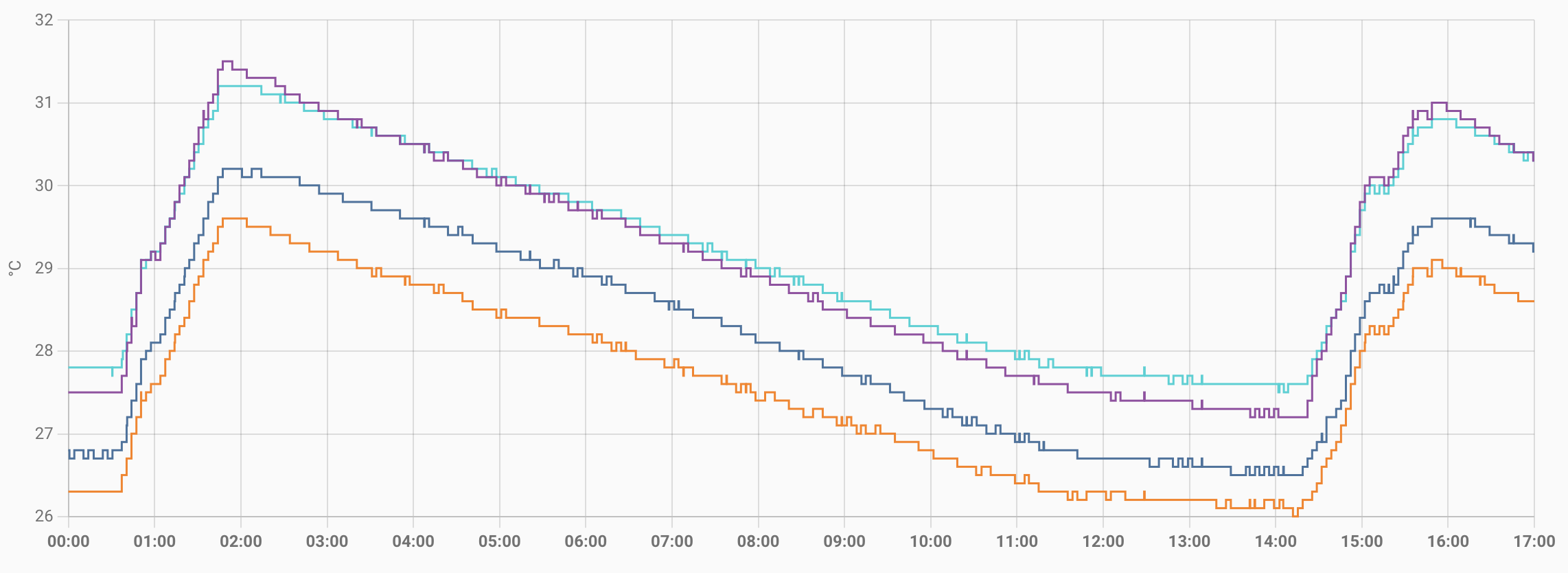
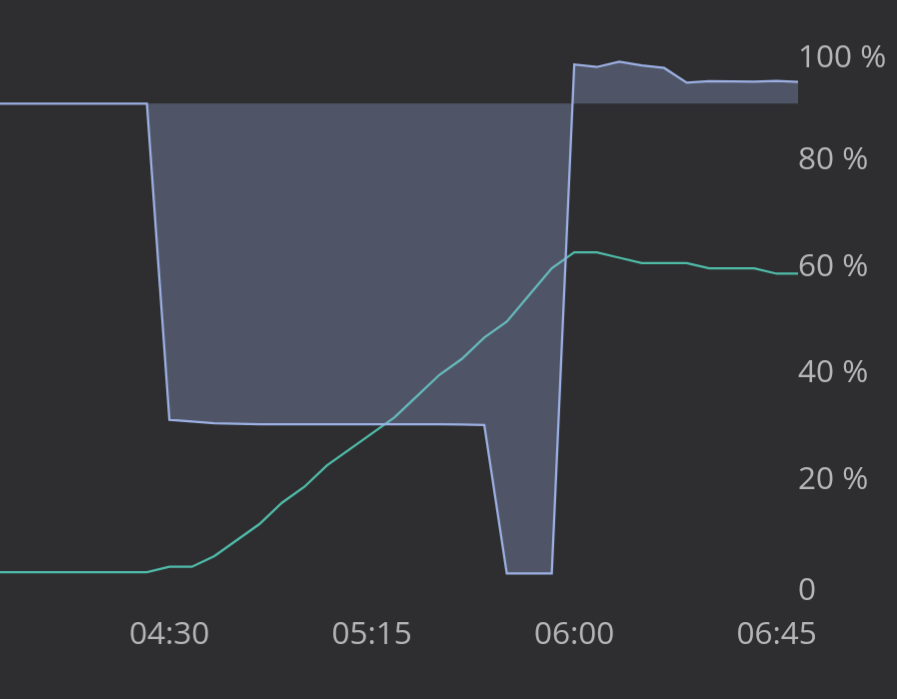
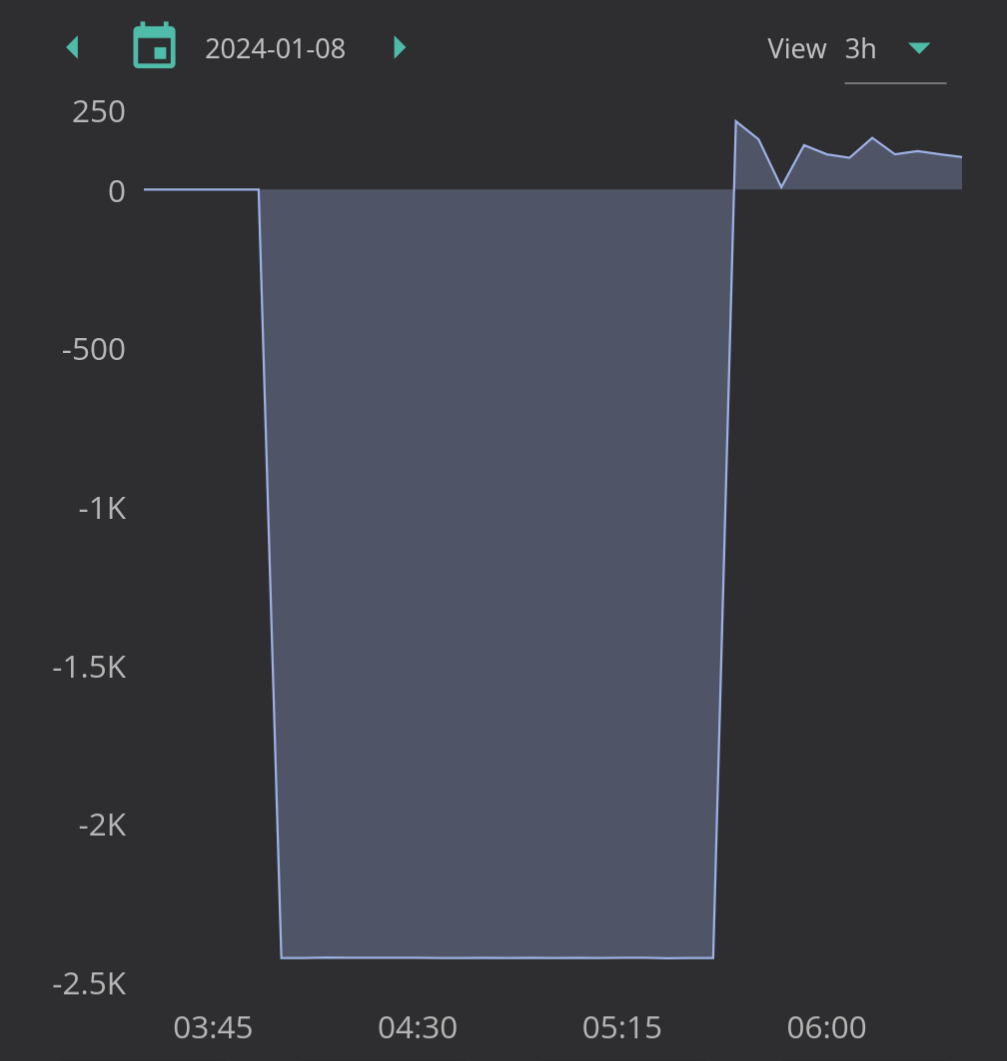
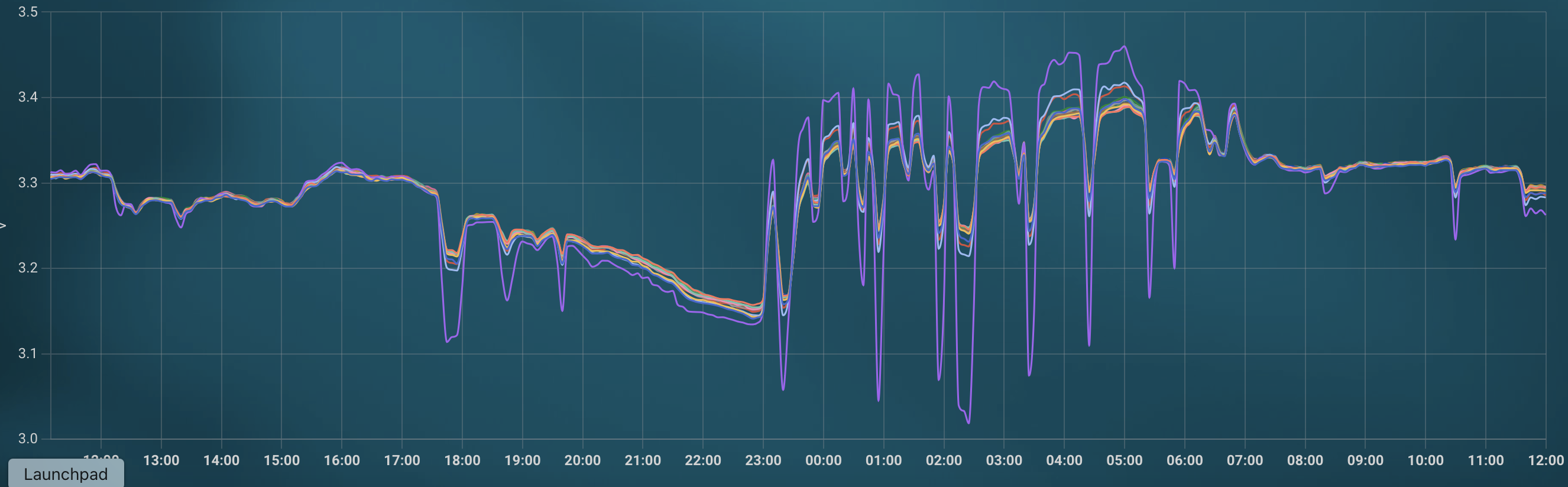
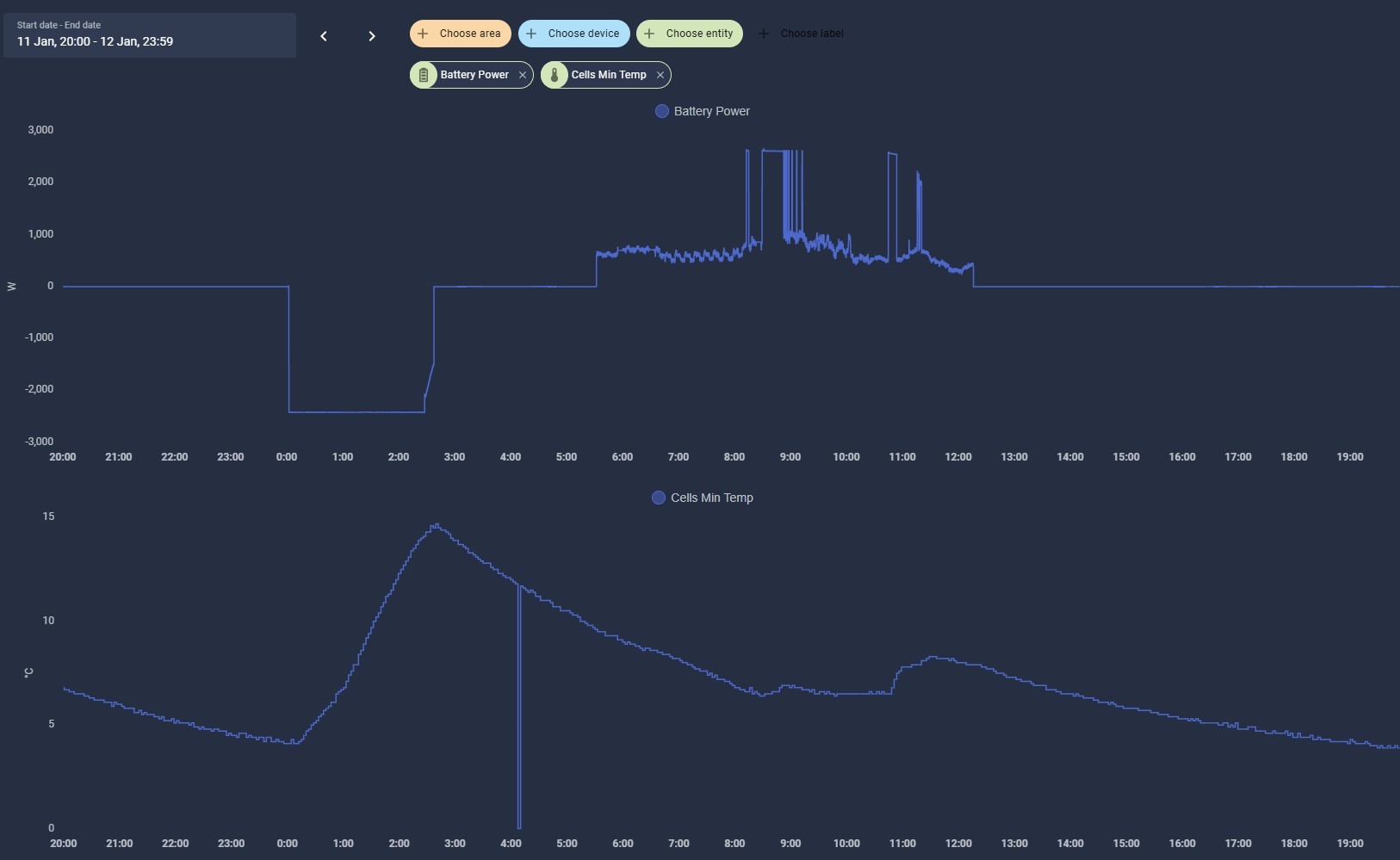
Battery and cell temps are here, with charge rate superimposed in purple (First four periods are at 2700, last is at 3600)

My first thought was that one of the four cells wasn't charging, but all cells warm up, and all cell voltages increase.

Oddly, the overall battery temperature value seems to stop updating during the final two charge periods. Seems like a bug?

M
#21 matttheotter

Phil_H my battery is largely between 20 and 30c, so its in a comfy zone.

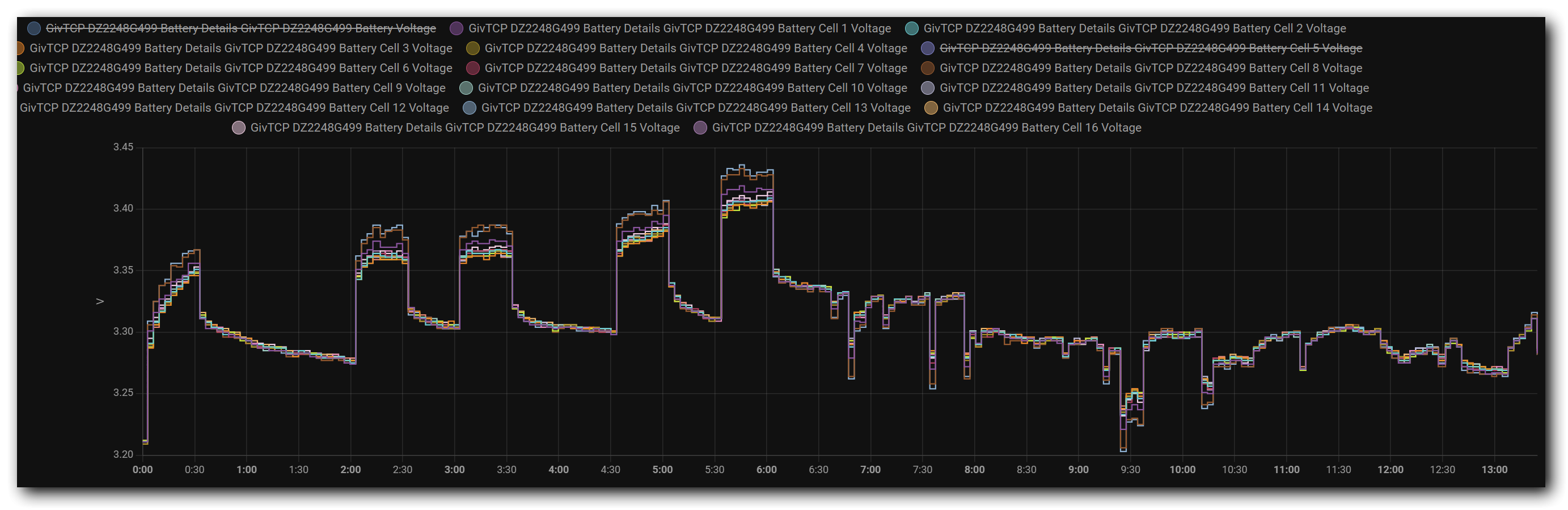
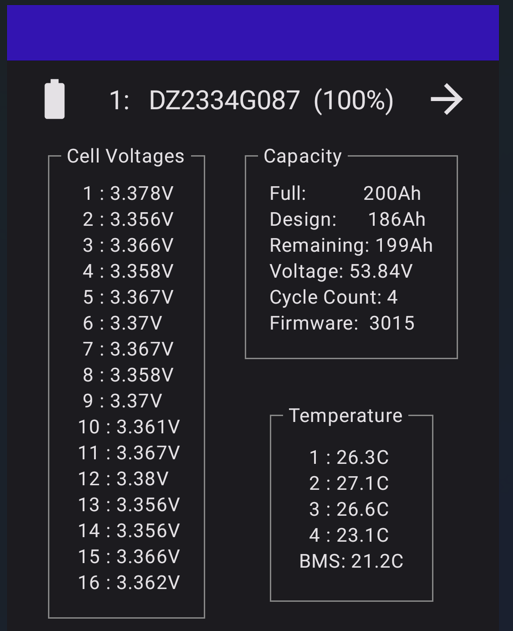
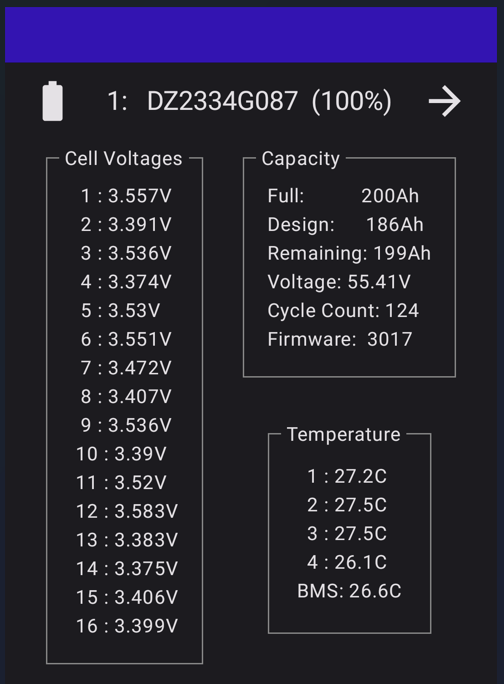
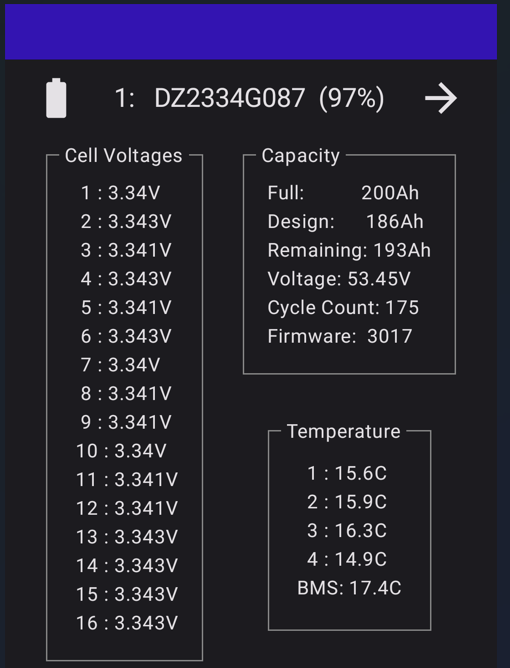
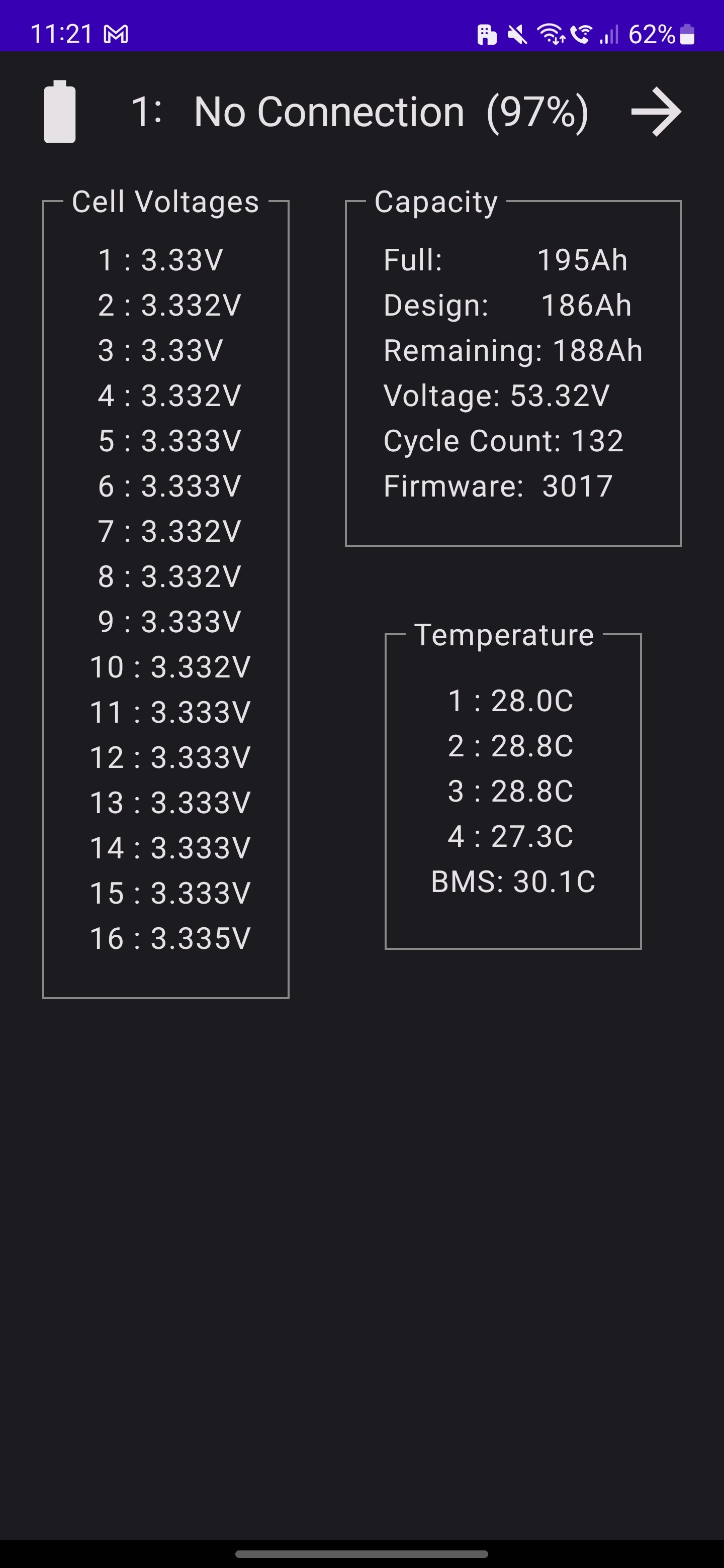
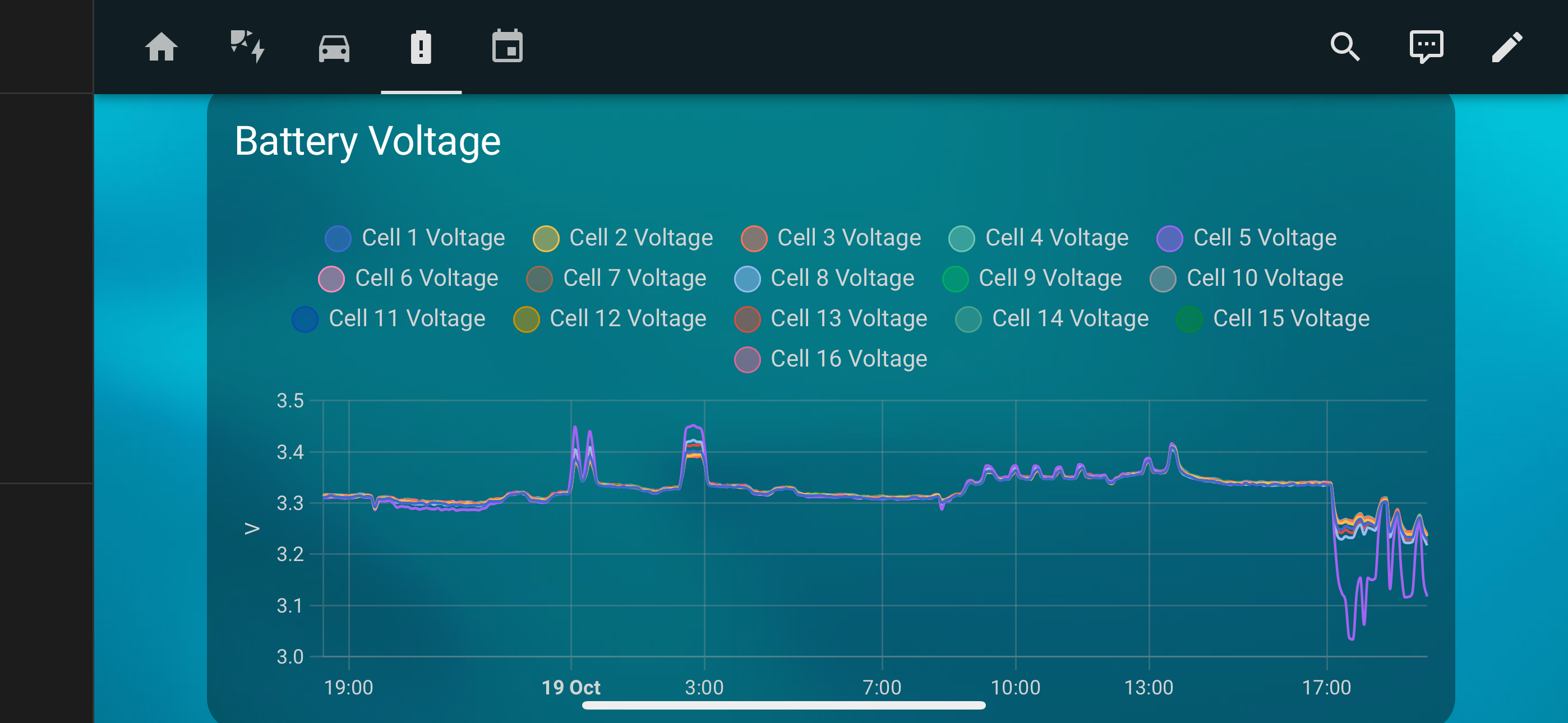
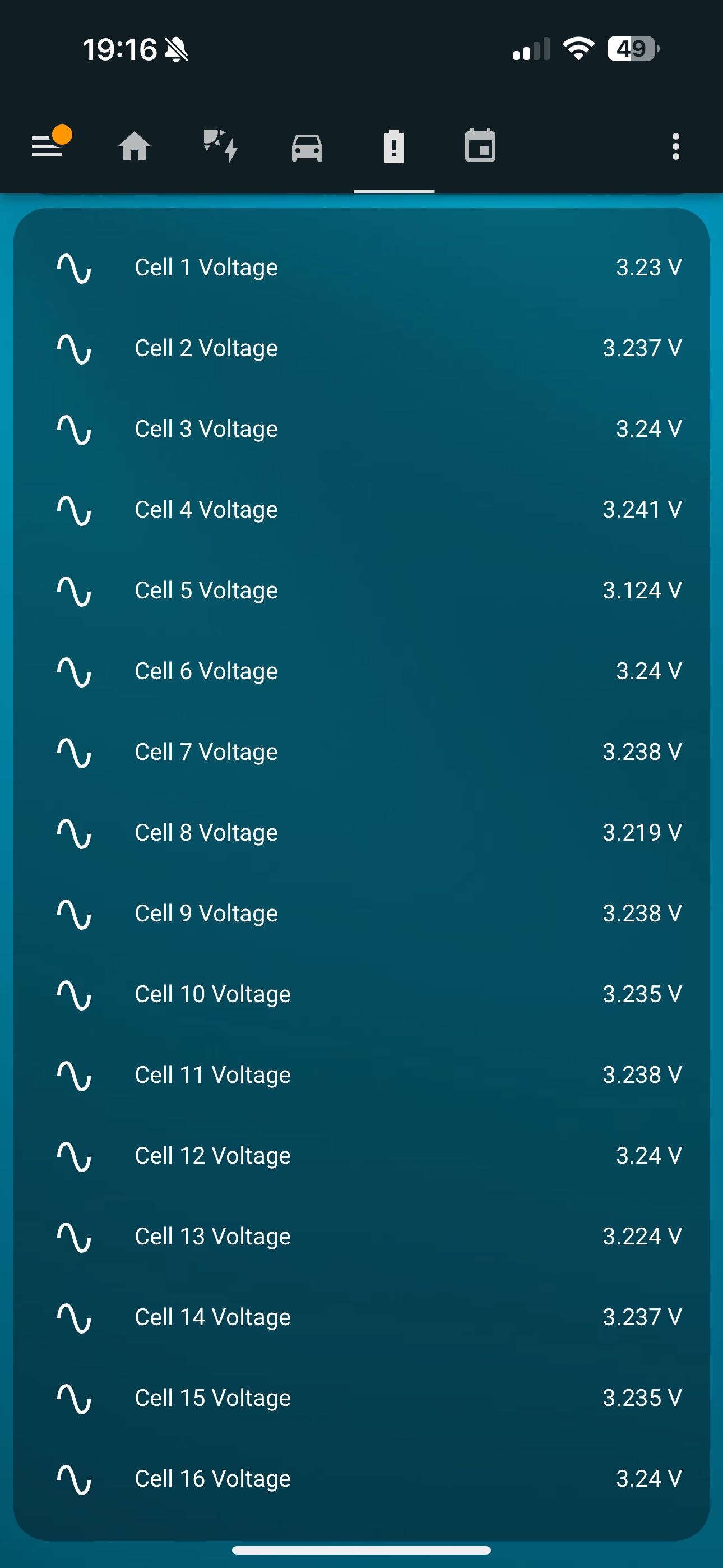
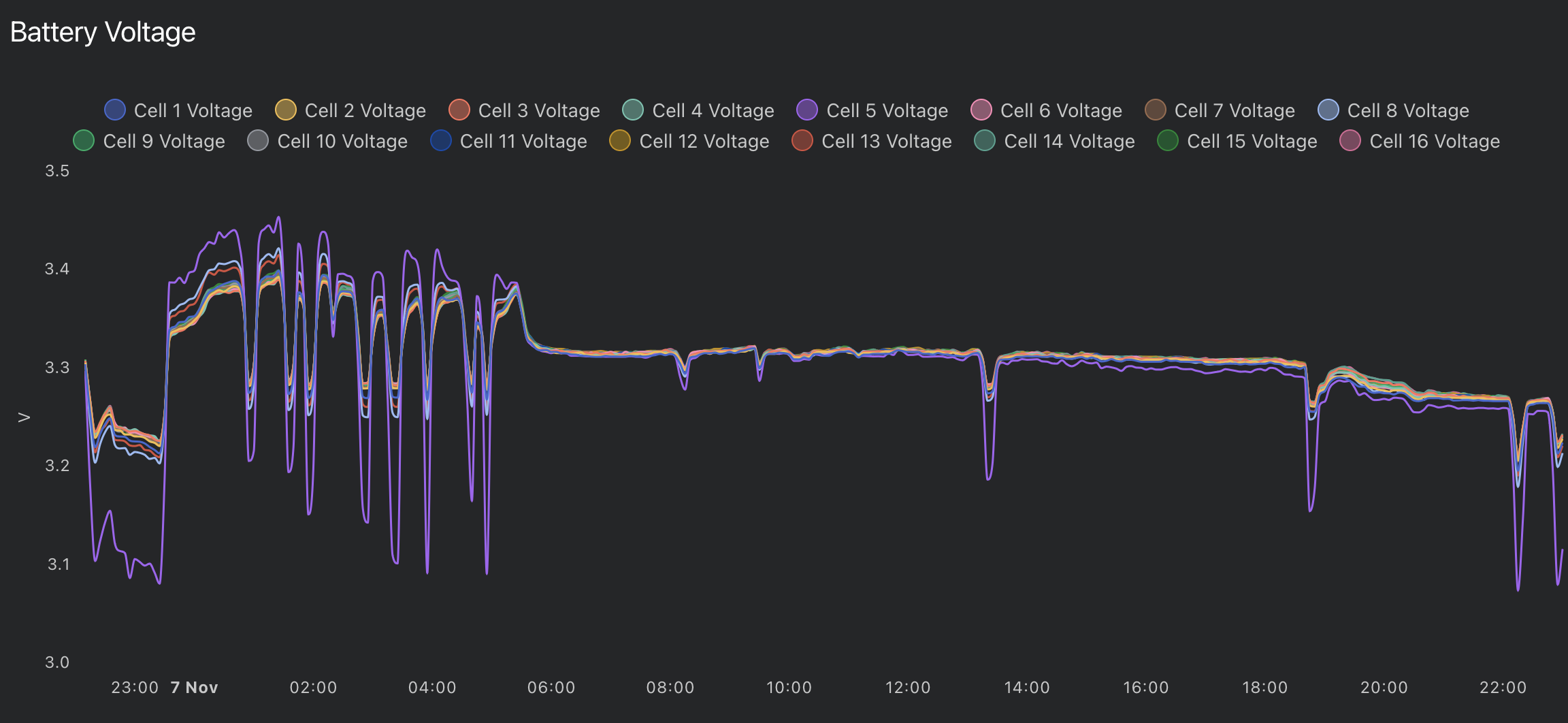
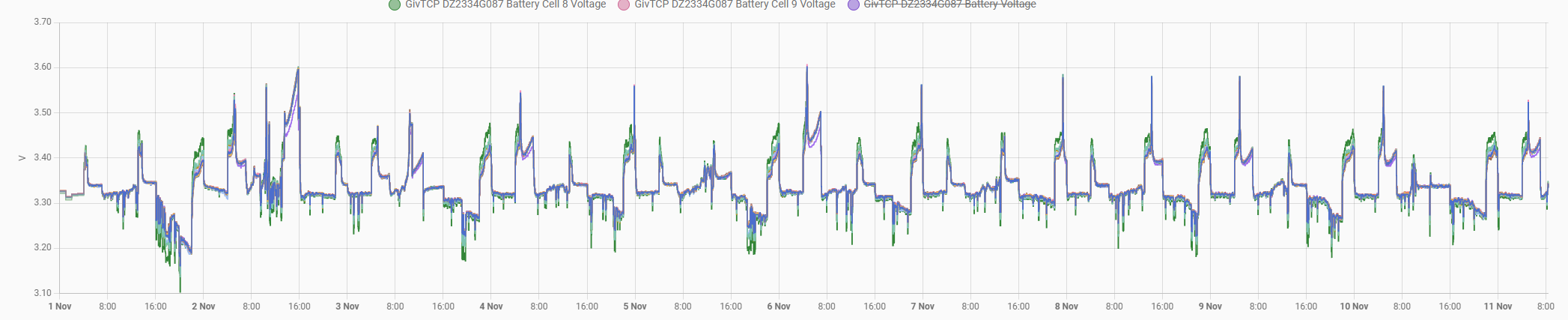
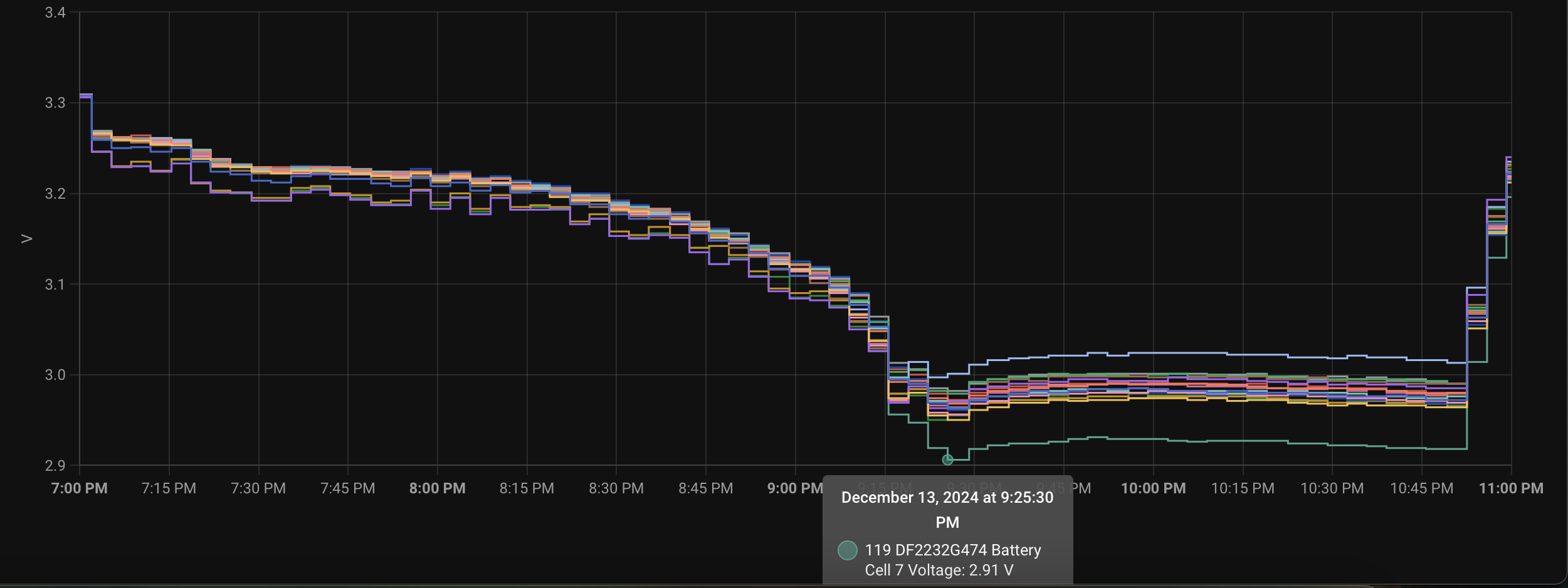
However..... have a look at the cell voltage, I believe I have a winner and why they need to come out, cell 5 is out of alignment by a wide margin.

V
#22 Vestas

matttheotter Yeah that'd cause reduced charge rates OK 🙂 Oh and discharge rates too.

They'll be hoping its just the busbar to that cell pack which is at fault rather than the pack itself. I think its probably the pack itself though....

M
#23 matttheotter

Vestas What is worrying is I have no date for a field service visit due to "circumstances"...so lets see how many months I will be waiting.... 😃

#24 hoggy

Cell 5 and 13 are the favourite for the busbar thing. Think the factory needs a new torque wrench...

D
#25 DD

hoggy Cell 5 and 13 are the favourite for the busbar thing.

Hmm... My cells 5 and 13 are always the "interesting" ones.

R
#26 rjp

Voltages all look OK, I think?

R
#27 rjp

rjp Oddly, the overall battery temperature value seems to stop updating during the final two charge periods. Seems like a bug?

Doubly odd. The missing temperature data's all there in the portal - but just not in HA.

G
#28 geoffreycoan

rjp Doubly odd. The missing temperature data's all there in the portal - but just not in HA.

What version of GivTCP are you running ? There is a problem when you upgrade from v2.4 to v3.0.0 that a few people (including me) have found that battery information doesn’t come through. I believe its fixed in 3.0.1 but I have reverted back to 2.4.9 and am going to wait for the dev to settle down a. bit on v3 as there seems to be a stream of niggles for different people

R
#29 rjp

geoffreycoan What version of GivTCP are you running ?

2.4.9

P
#30 Phil_H

rjp Yea, so it looks like the average cell temperature on the last charge period just gets over 20ish, and that's when the charge rate goes up, same as what I'm seeing. No idea about the overall BMS temperature not updating, it seems to jump shortly afterwards and start updating correctly again though.

V
#31 Vestas

rjp The voltages look borderline to me, hard to tell from the image size but looks to me like you've got a maximum variation between cells of 40mV under charge. That's maybe pushing it for a 3.6kW charge if the battery isn't in the 40-60% charge range.

Pretty sure if you ask GE about it then they'll try a calibration, then a slow calibration (900W) and then if that doesn't work you'll be waiting for a new battery.

I'd flag it up to them now were I you.

#32 Simon_C

I just updated my Hybrid 5 kW Gen 2 inverter from 912 to 915 along with the 9.5 kWh battery from 3014 to 3017.

In all it took about 20-25 minutes.
I did notice the progress bar stopped at 57% when the inverter restarted then no more progress was reported as the battery updated.
Also found that ECO mode was disabled on inverter restart so drawing from grid at expensive rate until I noticed and re-enabled ECO mode via the web portal.

I have previously been getting fairly regular battery over voltage conditions and occasional charging to a true 100% rather than the normal limit of 97% as reported by the battery.

Lets see how this goes now.

P
#33 Phil_H

So thanks to the rubbish weather I've not hit 100% for 5 days and instead have been between 10 and 70% which gives me a chance to see how well the tracking is going. Sunny today and I've hit a limited rate charge 500W at 87% due to cell voltages and then reset to 100% from 88% so it had lost 12% off the top. Not great since this pattern of usage will become more prevalent over winter with agile and predbat doing partial charges on 30 minute slots rather than a sustained charge to full that IOG or Eco7 might do.

R
#34 rjp

Phil_H Yea, so it looks like the average cell temperature on the last charge period just gets over 20ish, and that's when the charge rate goes up, same as what I'm seeing.

Giv support confirmed that's the issue. It's absolutely barking, though: I'm seeing this problem during daytime in a fairly mild September. As most battery charging will be overnight when electricity's cheap and the temperature's falling, I can't see it ever charging at the full rate in the winter months.

P
#35 Phil_H

rjp Did they confirm the charge rate has changed intentionally for those temperatures? Because it always used to be reduced, just never by this much.

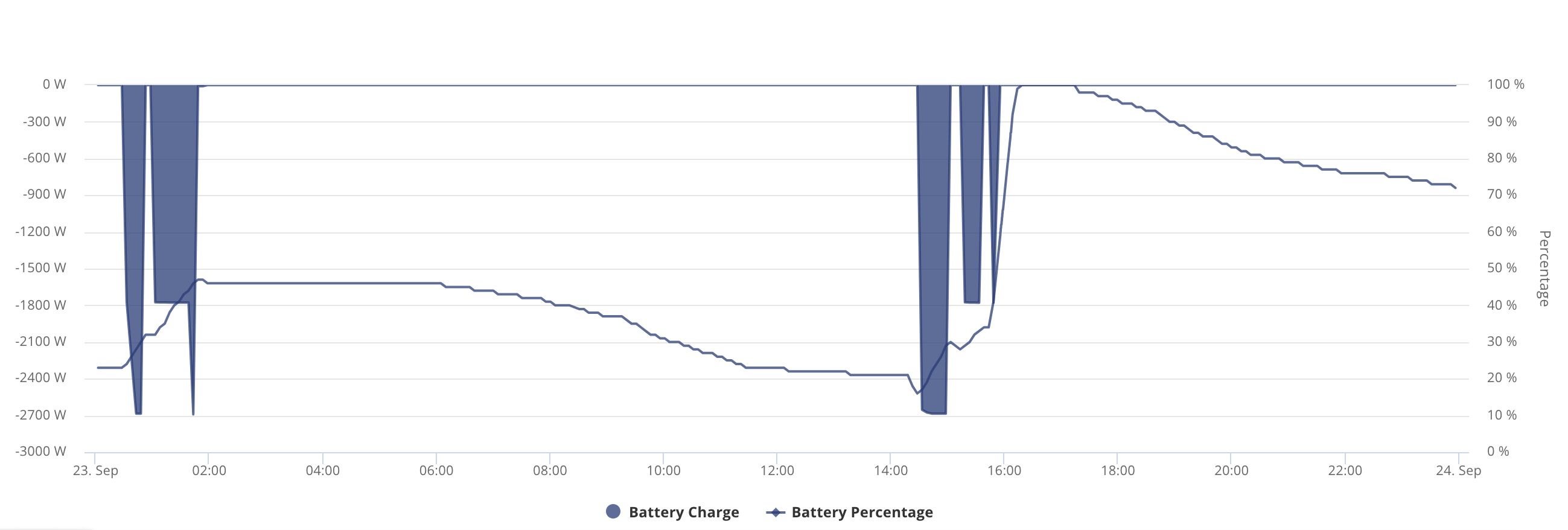
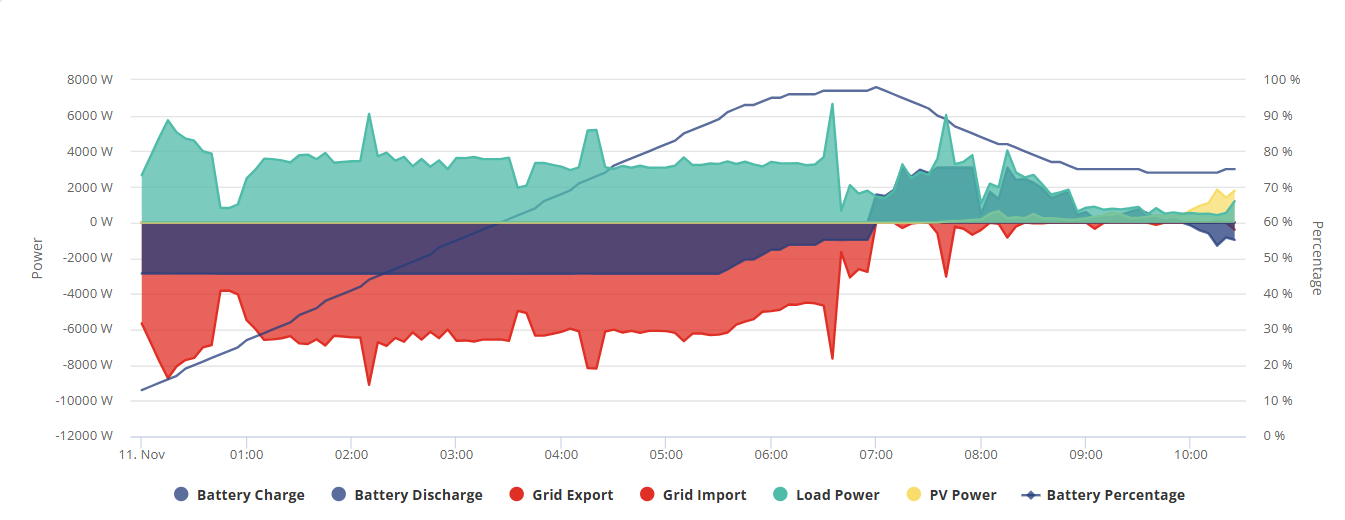
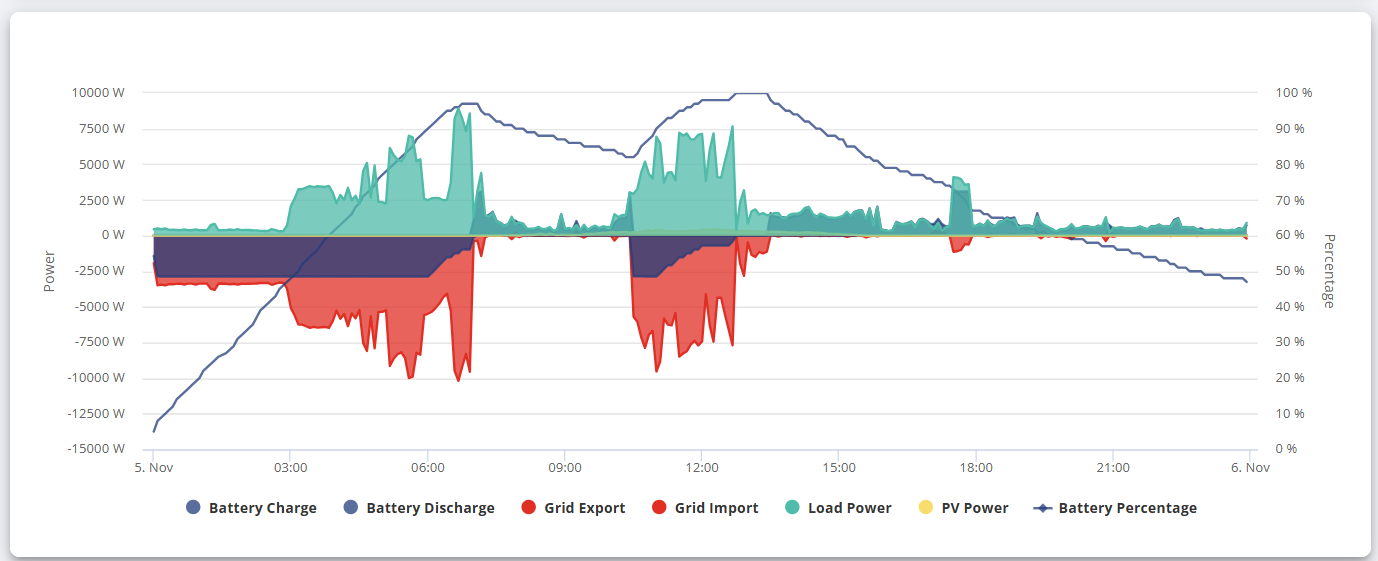
R
#36 rjp

Phil_H Did they confirm the charge rate has changed intentionally for those temperatures?

Didn't specifically confirm that it was reduced by 3017, but that's my assumption. My battery's in an unheated garage and even in August would occasionally limit at 2700W. Even last Feb it would charge at about 3400W without an issue.

#37 PianSom

Oops

M
#38 matttheotter

matttheotter slow charging today with solar and I got 7kW in without any weird SoC measurements, tempted to limit the charge rate to 2kW as anything greater than 2.4kW seems to cause the SoC to be wrong.

I really hope they can come out quickly and fix it.

N
#39 NormC

Hi, six weeks ago I had a system installed with a Giv-H5 gen 3 inverter and a 9.5 Giv battery. Recently I noticed that the battery was not charging at more than 1.77kW. I have checked back through the data and it seems that the only time that it charged anywhere near the 3.6kW it is set at, was when it was calibrated. The installer has checked the system and settings and confirmed everything is as it should be and has asked GiveEnergy to investigate. It's annoying when you can see it charging at 1.7kW and exporting 4 or 5kW at the same time. I tried an overnight charge from the grid and this only charged at 1.7kW also.
It is set to ECO. Does this stop it charging at full rate?

G
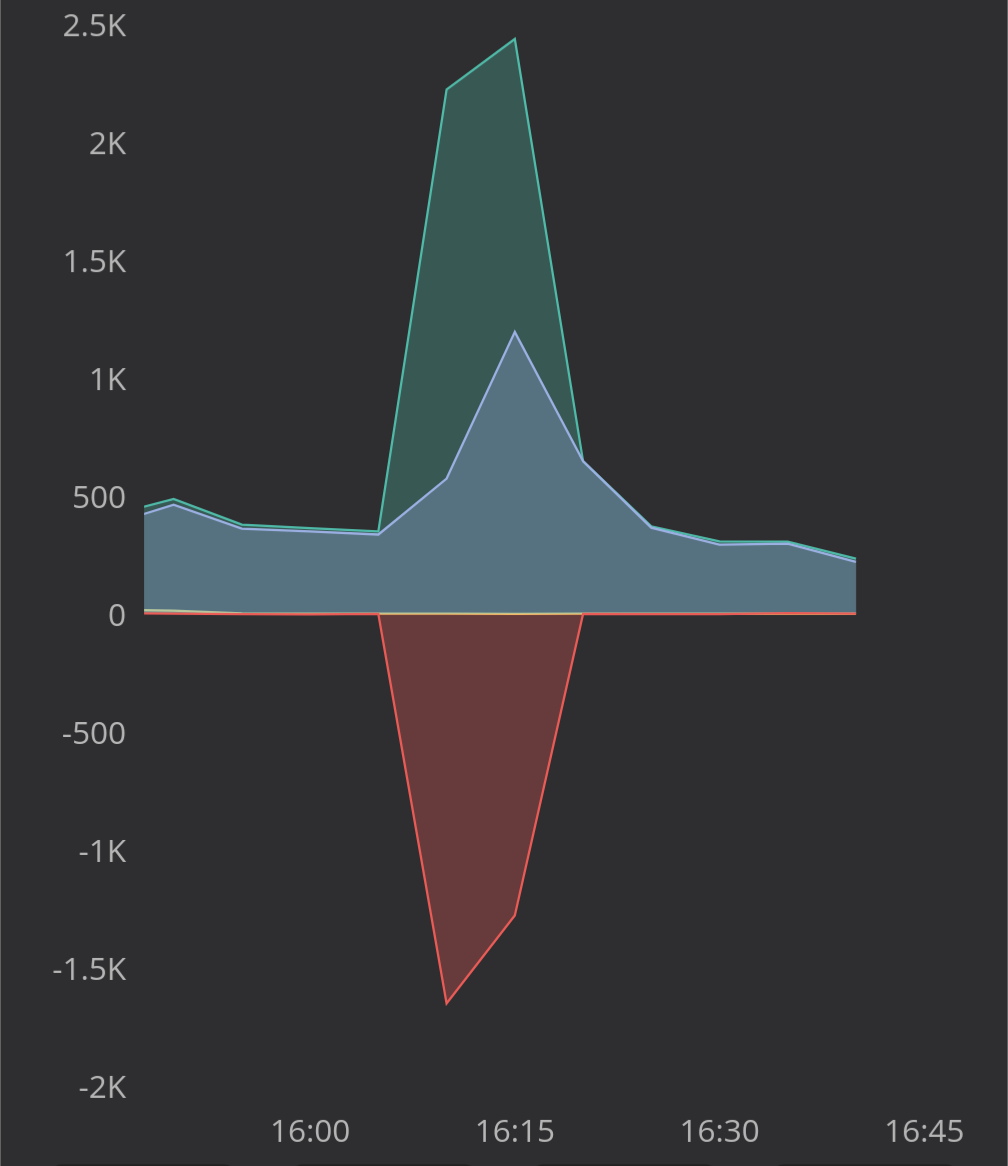
#40 geoffreycoan

NormC It is set to ECO. Does this stop it charging at full rate?

No Eco itself doesn’t limit the charge or discharge rate. In Eco mode you can discharge for house load up to the maximum for your inverter, and charge the batteries from solar at up to maximum.

Check in the portal and the app what the inverter charge rate is set to. Might be worth setting it to a random value and then setting it back to maximum just in case the portal has got the wrong idea what the inverter’s charge rate is.

P
#41 pwdst

rjp The reason for me visiting the community this evening was to see if anyone else had spotted this odd variation in charge rate before I contacted support, so thank you. I had a near identical charge rate chart charging overnight. Looking at the portal data the batteries were at 17 degrees when the scheduled charging started and the rate only increased when the average temperature passed 22 degrees.

I wonder if I should ask my wife to knit them a woolly jumper.

R
#42 Rogerbu

Which Inverters seem to be charging at a lower rate below 20 degrees on 3017?
I have a GE AC3.0 and 2 x 9.5 batteries.
From the portal the battery power is 2.91kW when charging overnight with a battery temperature of 15 degrees which is about right.

Just for interest.
When charging. The inverter output power at the same time is 2.99kW. ie an inverter loss to battery of 90 watts ie about 3% loss through the inverter.
When discharging. The battery output power was 2.933kw and at the same time, the inverter power was 2.781kW, a loss of 152 watts, about 5.2%
So a round trip loss is about 8%, not the 15-20% I thought it was.

P
#43 pwdst

Ours is a 3.6kW Gen 1 inverter with the fast response firmware. We have two 2.6kW Gen 1 batteries running firmware 3017 - which I imagine is obvious from the context of the thread. Our normal charging rate is 2600W but we were being restricted to 1600W.

N
#44 NormC

geoffreycoan Thanks for the info. Both the app and portal were showing it was set to 3.6. I have changed it to 2.6. I'll report back on what happens; when we get some sun.

G
#45 geoffreycoan

NormC Both the app and portal were showing it was set to 3.6.

Bear in mind that the way the app and portal work is that you see a copy of what the portal thinks the value was last set to. It doesn’t actually interrogate the inverter to check what the value is unless you click the little wheel icon next to the field in the portal (no such option in the app).
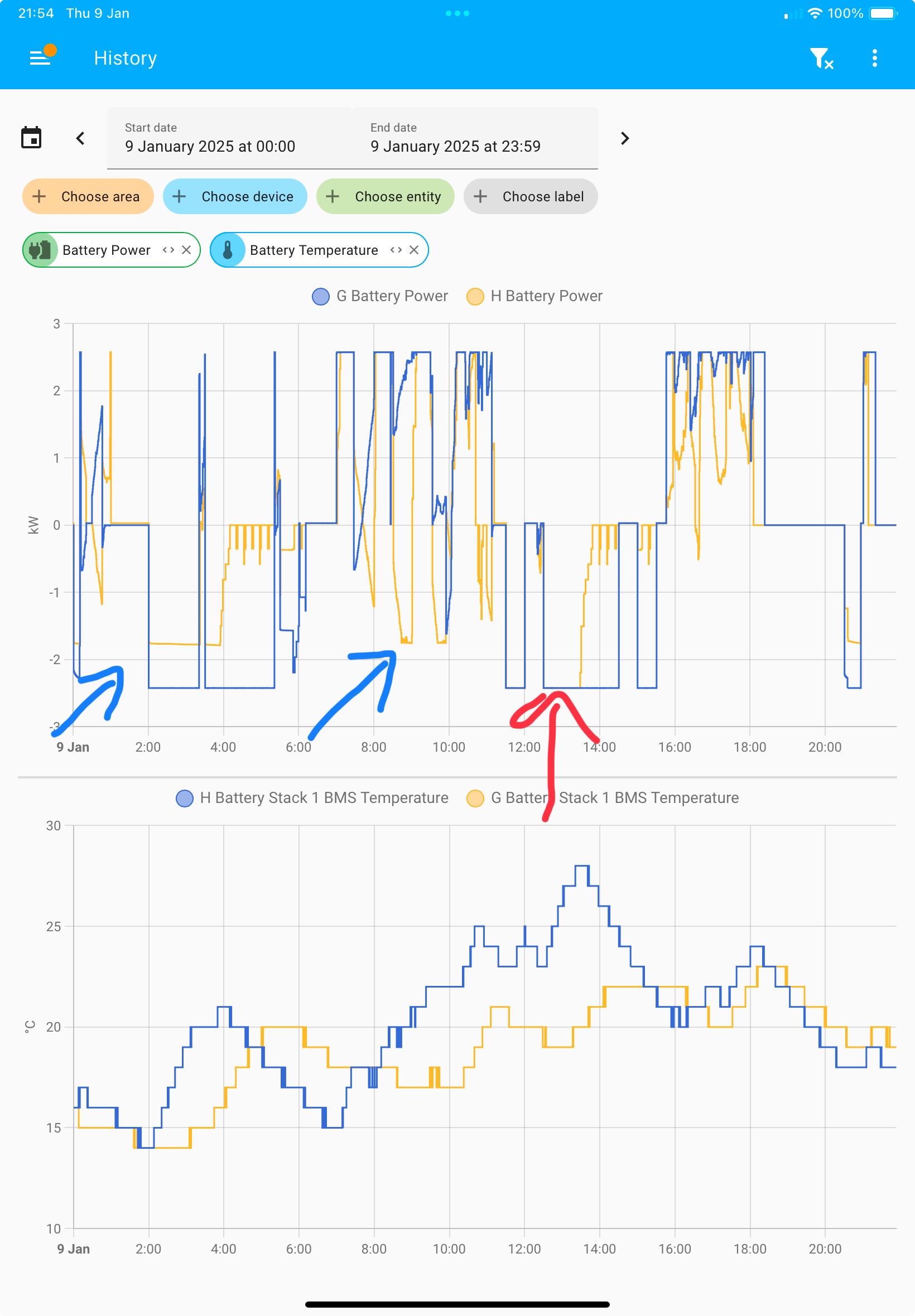
So if for some reason the inverter has a different value from what the portal thinks it has, it’s not immediately obvious.

Which is why I suggested setting it to a different value, to force a write of a new value, and then set it back to 3600 - to force the value you want to be written to the inverter

N
#46 NormC

NormC I have received an update from my installer. This is an extract of the email he sent to me.

'Here’s the update from Givenergy:
One of the cells in the battery is acting up due to a known bug in the firmware. They’ve already developed a firmware fix and have brought in a dedicated engineering team to send out an engineer to resolve the issue. If the firmware doesn’t fix it, they’ll replace the battery free of charge (FOC).'

I wonder how many other people are effected by this?

A
#47 anthonypar

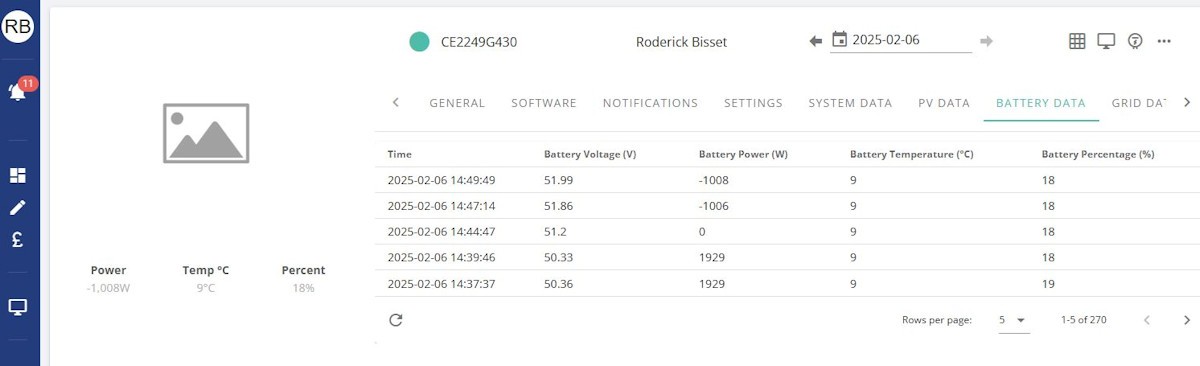
Just tried a forced charge on my Gen2 Hybrid. It is only charging at 2.6kw. Before the upgrade to 3017 it would always charge at 3.6kw. What have GE done?!

P
#48 pwdst

anthonypar What is the portal saying about your battery temperature when you were charging? Did it increase the rate later? The firmware seems to limit charge rate whilst the battery temperature is below twenty degrees Celsius.

Our battery is in our loft so is warmer than outside temperature but can definitely be on the cooler side in the winter.

A
#49 anthonypar

Battery is in garage and was 17 degrees when charge was restricted to 2.6kw. Have reported to GE and they tested remotely and have now seen issue for themselves. Waiting for further feedback.

P
#50 pwdst

anthonypar If you look at post #34 in this thread then a user has had a response from GE support to say that charging (and presumably discharging) are restricted below about 20⁰C - it is not entirely clear that this is intentional on their part, but this is how I interpret it.

I presume this is to protect long term battery health and/or increase efficiency.

Posts #15 and #41 show battery activity charts with a step up in charging rate as the battery warms itself (through the lower rate charging) sufficiently to achieve the higher rate.

If you set a charge time of over an hour you may see the same.

G
#51 geoffreycoan

pwdst I’m on BMS 3015 not 3017. On my 9.5 I see plenty of periods where the battery temperature is below 20 degrees, and maybe there is a correlation with that temperature and lower performance, but its hard to tell because very quickly the battery temperature rises and I see full discharge (2.8kWh) and charge (2.4kWh) from my gen 1 hybrid.

P
#52 Phil_H

geoffreycoan 3015 didn't limit the rate as much as 3017 is, that's why people are noticing it. Also you won't see it on a gen1 as even with the greater limiting it's still above the gen1 charge rate.

While it won't change what you see on your system the temperatures referred to in this thread are cell temperatures, I think your graph is showing bms temp which jumps around much more rapidly.

#53 hoggy

Note: This is from a post last week in the Givenergy Facebook group by an admin (but not Giv Employee - although they have presumably got this info from Giv) regarding the cold impact to Givenergy battery charge rate.

Battery rates! As we get closer to winter it's worth noting that colder temperatures will have an impact on charge rates as well! The colder the system is the lower it will charge and discharge to protect the cells.
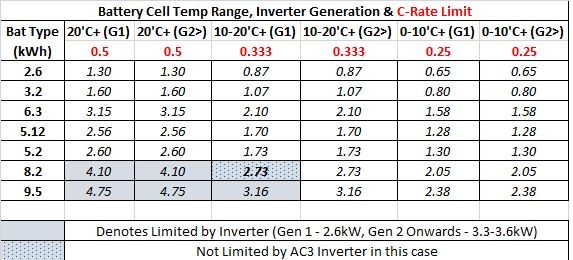
All Givenergy batteries are limited to a C rate of 0.5C, that means if you have a 5.2kWh battery, it's maximum rate is 2.6kW. If you have a 9.5kWh it is 4.75kW. If you have a 5.2 & 8.2kWh then it is 6.7kW.
But do remember you are also still stopped by whatever your inverters limit is, a gen1 will only do 2.6kW max if is not slowed down by the cold weather. You'll get 3.3/3.6kW on a gen2/3 and 6kW on an AIO. Having 5 9.5kWh batteries on a gen1 is possible but you will still only get 2.6kW through it!
If you have your battery cell temp above 20° you will get 0.5C.
Between 10-20° you will get 0.333C.
Between 0-10° it drops to around 0.25C!

So if you take your battery capacity, multiply it by the relevant C rate to the temperature you can get a rough guide to its max charge/discharge rate.
Having more batteries obviously helps here, I have a 5.2 & 8.2, so even under 10° with a C rate of 0.25 I can still charge at 3.3kW!
If you just have a single 5.2kWh and get it down to 5° then you will be limited to 1.3kW!
Now there are small variations through firmware versions so just use this as a guide 👍

P
#54 pwdst

Phil_H Also you won't see it on a gen1 as even with the greater limiting it's still above the gen1 charge rate

I am being limited to 1600W charge rate on a Gen 1 inverter and battery system. After it warms up it increases to 2400W which is still below the 2600W I was used to.

A
#55 anthonypar

I understand why it has been implemented, but this should not be retrospective. This is not the specification of the battery I purchased!

G
#56 geoffreycoan

Phil_H While it won't change what you see on your system the temperatures referred to in this thread are cell temperatures, I think your graph is showing bms temp which jumps around much more rapidly.

You are correct, I was pulling up the BMS temperatures above. If I add the cell temperatures, they jump around much less, but for the same day (29th Sept) they are consistently below 20 degrees all day:

If I look back through older data, August cell temperatures are much more around the 30 degrees mark, but the last couple of weeks in September they have been above and below 20 degrees as the temperatures have dropped.

Phil_H 3015 didn't limit the rate as much as 3017 is, that's why people are noticing it. Also you won't see it on a gen1 as even with the greater limiting it's still above the gen1 charge rate.

I've re-read the thread again. @pwdst reports his gen 1 3.6kW with fast response firmware (mine is a 5kW Gen 1 but otherwise the same) is being limited to 1600W charge rate so looks like 3017's charge limitation when cell temperatures are below 20 degrees affects the older inverters as well.
I had been staying with 3015 as I wasn't seeing any adverse issues that would encourage an upgrade, but this positively makes me not want to upgrade

The firmware revision document https://kb.givenergy.cloud/article.php?id=22&oid=29 makes no mention of temperature controlled limits changing

A
#57 anthonypar

GE need to be upfront about this new specification. The latest electrical regulations are advising that batteries are no longer fitted in the home, so this problem is only going to escalate. I can understand a limit being applied below 5 degrees, but this new specification seems excessively cautious.

G
#58 geoffreycoan

anthonypar The latest electrical regulations are advising that batteries are no longer fitted in the home,

I didn't think that this was actually the case yet. There have been some scare stories in YouTube videos but it was a consultation paper not the actual regulations that had more strict advice about battery placement, fire detection, fire proofing, etc. A number of battery manufacturers including Tesla were involved in the consultation from what I last saw so the actual reg change may end up being different.
TBH the idea is laudable but for our batteries the chemistry is such that they don't catch fire - the regs need to recognise different battery types and what the true risk is.

That was my understanding of where we currently are.

A
#59 anthonypar

The UK has a new fire safety standard for battery energy storage systems (BESS) in homes, PAS 63100:2024, which provides guidance on how to install and use BESS safely. The standard includes the following recommendations:

Location
Install BESS outside of living areas, or in non-living areas that are isolated from main living spaces and escape routes.

#60 hoggy

I do agree this (quite fundamental) change is not noted anywhere on firmware revisions or product datasheets (at best there is a mention of the inverter derating above 50'C but nothing about the batteries sliding scale.)
Should the post from Facebook be accurate the rates should map out roughly (depending on where they are measuring this - DC or AC) as:

I guess those on say Gen2 or 3 with a single 8.2 or 9.5 would show a most pronounced reduction now temps have dropped to the 10-20'C range?
Would have thought more people would have noticed though, so I'm not that confident the C-Rate thing is either correct or the boundaries are right - over to the community I guess...

P
#61 Phil_H

pwdst Yes but you're running 2x2.6kWh batteries which in effect is 1x5.2 for the purpose of this, even the old 'cold' charge rate was 0.333C which for your batteries would be about 1700W, you'd only see 2600W with a 0.5C rate (over 20 degrees). It's the BMS, not the inverter doing the limiting there.

My battery is 9.5kWh so 0.5C is 4.75kWh, 0.33C is about 3.2kWh (and what I used to see on 3015), but I'm down at about 0.28C now.

R
#62 rjp

hoggy Would have thought more people would have noticed though, so I'm not that confident the C-Rate thing is either correct or the boundaries are right - over to the community I guess...

It's clearly wrong. We have a Gen 2 with a 9.5kWH and it's limiting to 2700W when below 20 degrees. Table (and maths) says 3160W

(Also, the "Gen 2 onwards @ 3.3 - 3.6kW" comment is odd. Don't all gen 2's support 3.6?)

P
#63 pwdst

Phil_H In January 2024 our battery charge diagram shows a much more square (rectangular really) charge rate than the stepped rate I showed earlier in this thread. It may be that it always should have limited charge rates at lower temperatures but I have many many days worth of evidence to show that this was not the previous behaviour. I also assume that other people would not be querying if this was consistent with previous behaviour.
I was not assuming that it was the inverter change but wanted to mention it for completeness - I know it makes the Gen 1 behave much more like the Gen 2/3.

#64 hoggy

rjp depending on which way your pushing it's not symmetrical - charge is lower. (I'm pretty sure they changed the datasheet afterwards)
Gen 2 and 3 are both listed as:

R
#65 rjp

hoggy depending on which way your pushing it's not symmetrical

Ah. Note the bit at the bottom: "Charge current increased to 70A via firmware update" - 70A *51.2V= 3600W

My Gen 2 certainly allows 3600W charge. Or, it used to before this temperature nonsense.

R
#66 rjp

Here's a cell temperature plot for the year to date. 9.5KWH battery, in unheated detached garage. As you can see, it's rarely about 20 for much of the year.

Charging the battery is what heats the cells up, so restricting charge at low temperatures becomes a vicious circle. Charging at 2700W, my cells take 100 minutes to warm up 5 degrees (so, 15 to 20).

V
#67 Vestas

rjp I don't know about 3017 but I do know 3013 didn't rate limit to 0.33 between 10-20C as someone nearby has a G2 inverter and I went to have a look at his setup as he's fairly clueless in tech terms.

My personal opinion is that this is another attempt by GE to mask battery issues (dodgy cells, cells out of alignment) which are far more pronounced at higher charge/discharge rates and which will be worse below 25C.

I'm a cynical bastard though.

R
#68 Ra

Anyone seeing SOC drops on 3017?? When I was on 3012 for quite some time I didn't see one drop/jump, as soon as I upgraded to 3015 (Really wish I hadn't) I'm seeing SOC drops, BMS undervoltage notifications etc, and this is despite doing a battery calibration a little while ago.

3015 is like going back to when my system was first installed 2 1/2 years ago. Very poor.

W
#69 wrighar

Phil_H
Same for mine, the 0.333c for 10-20 is limiting me to 2700W, not 3175W

P
#70 Phil_H

GE response to me:

They've not confirmed it was changed in 3017 or not yet.

R
#71 rjp

Phil_H GE response to me:

60% of what, though?

2700W is 60% of 4500W, but where's that figure from?
I guess the good news is that it "only" falls to 2250W between 1 and 10 degrees

G
#72 geoffreycoan

Interesting to see the tables and rules of thumb for reduction in charge rate for lower temperatures

If I look at the cell temperatures for my 5.2 battery (in an uninsulated garage, on an outside wall) from December 23/January 24, its not that often been below 10 degrees C but there’s been quite a lot of the time between 10 and 20 degrees:

Is there any advice about improving the battery temperature? Should we be buying polystyrene insulation and making a box to surround the battery, or 😞 a (low power) heater of some form?
Or is it just lump-it?

P
#73 Phil_H

I assume 60% of 0.5C as that is what is on spec sheets. I'm assuming all numbers are fuzzy due to losses or numbers actually existing in stepped chunks so they may not be exact.

P
#74 Phil_H

Further from GE:

Doesn't really line up with what we're seeing

#75 hoggy

Single cell drifting can also cause throttling, so would be a good idea to check individual cell voltages are all bunched while the throttling is happening to see if that is a factor.

J
#76 joj

CGoode
I am just updating to software 3017 now. It has been verifying at 90% for over an hour now. Is this normal?

P
#77 Phil_H

hoggy I have 3 cells that run high (5,8,13) when charging but that's not changed and if the cell temperatures increase enough during the charge period then the rate will jump up so those cells are not what's holding it back.

D
#78 DD

Phil_H I assume 60% of 0.5C as that is what is on spec sheets.

Perhaps 60% means 0.6C and 50% means 0.5C ?

P
#79 Phil_H

DD No, because a 9.5 battery on gen 2/3 hybrid will saturate the 3.6kW inverter limit at about 0.38C so if that were true then it would basically never throttle it.

R
#80 rjp

Phil_H I don't see any mention of charge rate or this magic "0.5C" on a spec sheet - where should I find it?

#81 Judith

I hope this is both the best place to ask and that’s it’s not a duplicate

We have a strange SOC reduction of 4kWh over an hour yesterday, no battery discharge shown and no usage.

Is this typical for 3017?
We updated 4 weeks ago and for the first 2 weeks had regular both 100% and “0”% levels to help hold calibration.But this last 2 weeks with change of use since we are away it’s not gone below 50%.
Is this what happens with readjustment on 3017?
Has anyone seen this before?

V
#82 Vestas

Judith That's what I was expecting to happen and why I'm still on 3015.

Basically it'll behave like the old firmware (v3012 and earlier) - SoC crashes/spikes when battery isn't fully cycled every couple of days. See previous megathreads on this matter (there's a few)....

#83 Judith

@Vestas that what I feared!

C
#84 ChrisRowe

Vestas That hasn't happened with mine on 3017. I’ve been in it since June and haven’t had a single SOC spike or crash. That includes 2 weeks away from home when the battery didn’t drop below 70% because of the amount of solar. And when we returned from holiday and the washing machine drained it, SOC tracked down to 4% as it should.
Mind you, I’ve probably jinxed it now by adding a second battery this week!

V
#85 Vestas

ChrisRowe Hope it stays that way for you.

R
#86 Ra

Vestas I'm a firm believer that its not necessarily firmware version specific. I was on 3012 for ages and it performed flawlessly, no SOC drops/jumps, nothing just did it's job perfectly. I mistakenly updated to 3015 which was an absolute s**tshow in all honesty so have had to jump to 3017 in the hope it fixes whatever was wrong 🙁

Everyone has different experiences so nothing is certain...

M
#87 matttheotter

matttheotter update, they are coming on Friday to do whatever is needed 😃

W
#88 Will_J

I just noticed the limited charging today and came to ask about it - thanks all for posting your findings. Fortunately we're still getting a full battery every charging window so it's ok at the moment! What happens at 0 degrees, does it just... stop?

G
#89 geoffreycoan

Will_J I can’t see it immediately in this thread but I have a recollection that the battery won’t charge if below 0 degrees C, but it can discharge down to -10. Note that this is the internal battery cell temperature not the battery management system (BMS) temperature

#90 hoggy

I'll need to double check but this may also be inverter FW or Gen dependant throttling on 3017. Pretty sure I saw my pack at 8'C last night and it still charged at normal rate on a Gen 1 "slow" fw.

W
#91 wrighar

hoggy

I think it's now been said that there is a 0.3333C bug for 9.5kWh batteries where they are charging at 0.25C (2750W).
Also the table above while right for design capacity, doesn't account for the full (over capacity) of the actual unit.

So the 9.5kWh batteries has I believe 11.2kWh of cells

11200 above 20c @ 0.5C is 5600W inverter capped max 3600W
10c-20c @ 0.333C is 3733W (not the 2750W we are seeing)
below 10c @ 0.25C is 2800W

#92 hoggy

Has it? Have Giv admitted now (somewhere?) that they are limiting more than expected for temp ranges?
(The table was just based around 2nd hand knowledge that may or may not be the truth, hence the wish for clarity one way or another)

I'm not going to derail too much but I'm a little hesitant on quite what the truth on overcapacity charge rate - is or isn't counted in this scenario - does it use the original factory design value or actual/full capacity?
As an extra mystery, has anyone ever seen a brand new 9.5 pack report cells anywhere near 220Ah Full Capacity? - Could they be 200AH / 10.24kWh packs just run harder from what I've seen as reported from people on here (most seem to hover around the 200AH mark for Full Capacity - even relatively new ones from what I've seen on here.)

I was under the impression BMS code was the same across the board though so quite why it's just the 9.5s performing in this way is a bit of a head scratcher.

V
#93 Vestas

hoggy Never seen anyone post a figure higher than 200Ah. Ours was 197Ah new so nowhere near 11.2kWh.

I think its probably sized to allow for SEI (and other) initial losses in capacity rather than anything else.

W
#94 wrighar

Mine is 200Ah and has sat at 56.0V when slow charged (11200W) from excess solar.

Over 16 cells that would be 700W cells (200Ah * 3.5v)

I believe that are a little oversized to allow the 100% DoD named capacity rather than naming the size as the real capacity and only giving 80% DoD.

Pretty consistent, but not quite 6 months old.


V
#95 Vestas

wrighar No the cells are specced for 5000 full cycles to 80% initial capacity - that's 3.65V/cell down to 2.5V/cell at 0.2C. That's how the individual cells were tested for lifespan. I've got the datasheet for one of the brands used.

There's no real hardware overprovision other than 16 cells is 200Ah rather than 186Ah.

Software/firmware is different - the inverter will present a 100% charged level while the battery will present a 97% charge level. Add on the 4% "reserve/cutoff" and 93% of 100% SoC is "available". Assuming the SoC is correct but there's another rabbit hole to go down 🙂

W
#96 wrighar

Vestas

Yes, I was being somewhat simplistic.....

V
#97 Vestas

wrighar Indeed.

K
#98 Karcsi

NormC In the same situation. Discharging restricted to 1.6kw since update to 3017, although charging is up to 2.6kw. But in addition to this, the usable capacity is down to less than 1kwh (it is a 5.2kwh gen1). Engineer sent out to check on it, and 1 cell is playing up. Looks like replacement battery here as well, and waiting for appt to fit.

N
#99 NormC

Karcsi The GivEnergy engineer came today. He said that he didn’t know what the problem with the battery was and that his instructions were to just replace it. He then started a calibration of the new battery. This discharged at 4 kW. It then charged at 3.4 kW. So far it has been picking up the load well. Time will tell I suppose. I haven’t had a chance to charge it yet. I hope you get an engineer out quickly to resolve your issues.

M
#100 matttheotter

Spoke with Giv this morning following my engineering visit last week to fix the busbar issue on Cell 5 and Cell 13, unfortunately Cell 5 has not responded post calibration:

Giv are trying a slower calibration today (1600W) to see if they can bring it back into alignment.

V
#101 Vestas

matttheotter I wouldn't hold your breath on that one. Looks like the cell has had it to me.

H
#102 hazlad24

i got a new system and just noticed this. Came here to check. 9.6kw battery and was charging up at 2.6kw. Just noticed temp went up to 21 and up to 3.5kw. I know some people have these outside, don't they have internal heaters in, like some lifpo batteries? Glad mines in my garage.

G
#103 geoffreycoan

hazlad24 No, no internal heaters in GivEnergy batteries. I understand that the Tesla Powerwalls have internal heaters so don’t suffer these kind of issues, but of course the heater consumes electricity so less usable capacity after the ‘running costs’ are included.

Z
#104 Zakalwe

geoffreycoan
Not only heaters but full water-cooling thermal management which is very similar to their car battery packs.

M
#105 matttheotter

So ended up going back to Giv this morning, they limited the inverter to 30% so I could not understand why I was only seeing 1.5kW max from it.

I have also been offered fw 3018 which doesn't seem available yet.

Battery post slow calibration:

V
#106 Vestas

matttheotter What does it look like during max rate charge/discharge? That's when dodgy cells show up, not when the battery is idle/discharging slowly.

M
#107 matttheotter

Vestas shall let you know soon

L
#108 lell

NormC
Same problem here, my battery charge rate is now stuck at 1.77KW. Gen3 inverter and 9.5KW battery. It goes initially to full 3.3KW for a few minutes, and then drops to 1.77KW for the rest of charge window. This started happening a couple of weeks after 3017 firmware update.

Support triggered recalibration, but this did not help. It looks like replacement might be needed...

O
#109 Ortwin

Both our 9.5Kw batteries are on 3017 and located outside (within a cover). Last year the temperature got down to a minimum of 4° so will need to keep an eye on the charge/discharge rates over the winter.

A
#110 anthonypar

If the battery cell temperature is less than 20 Deg C the battery charging capacity will be restricted on 3017. This is not a problem for me at the moment as I only charge at 1.8kw, but further restrictions in frosty weather may cause a problem!

#111 hoggy

Have wondered what Intelligent Flux / Axle make of this. Much harder to make fleet decisions if you don't know how much you can cram in a battery in a time period.

M
#112 matttheotter

@Vestas not fixed, starts well but drops back to 2.7kW.


V
#113 Vestas

matttheotter Battery replacement time. Frankly I don't understand why the technician who replaced your other battery didn't do this one at the same time.

G
#114 geoffreycoan

For those using Home Assistant, thought I'd pass this on, I've added average battery cell temperature to my dashboard. I didn't want the clutter of 4 different cell temperatures and yes I could create a template sensor to average the existing sensors, and that would be useful for graphing, but it fills the database with a sensor I only want to look at occasionally so I added the template sensor directly to the dashboard.

Requires HACS template entity row https://github.com/thomasloven/lovelace-template-entity-row which is really useful for doing these kind of sensor manipulations live in a dashboard:

type: entities
entities:
  - entity: climate.inverter_1_fan
  - entity: sensor.inverter_1_fans_on_today
  - entity: sensor.g_XXXX_battery_temperature
  - type: custom:template-entity-row
    icon: mdi:thermometer-lines
    name: 9.5kW Cell Temperature
    state: >-
      {{
      average(states('sensor.g_XXXX_battery_cell_1_temperature')|float, 
         states('sensor.g_XXXX_battery_cell_2_temperature')|float,
         states('sensor.g_XXXX_battery_cell_3_temperature')|float,
         states('sensor.g_XXXX_battery_cell_4_temperature')|float )|round(1) }} °C
#115 PianSom

geoffreycoan
For this new firmware "feature" is it the average cell temperature that matters, or the minimum cell temperature?

Although I have an AIO and so (I think) not affected, I put just one cell temp on my dashboard - in anticipation.

G
#116 geoffreycoan

PianSom For this new firmware "feature" is it the average cell temperature that matters, or the minimum cell temperature?

Who knows. Feedback from GivEnergy was that they hadn't changed the charge/discharge rates in this release ....

I put the average to give me an idea of what the cell temperatures are doing. I leave working out the minimum, maximum, mode and mean temperatures as well as statistical deviation as exercise for the reader ...

M
#117 matttheotter

Vestas just heard back from GivEnergy, in the queue for another visit.

Well they thought it was the busbar, but its clear thats no longer the case.

The original engineer said it was hard to see the error as the battery was fully charged so I guess I’ll force a discharge prior to the next visit.

V
#118 Vestas

matttheotter Just put it on full rate discharge when he's there and show him the cell voltages.

It probably was the busbar but the cell is now damaged. Its not surprising really.

M
#119 matttheotter

Vestas so it will discharge at 4kW (oddly) until it drops below 80% ish and then it drops to 2.7kW but yeah that cell is bust now.

V
#120 Vestas

matttheotter Yes but what happens with the cell voltages immediately after you start a full-rate discharge?

ie - export or whatever.

It should be obvious one cell is well out of alignment pretty much immediately. It is from the graphs you posted.

If they've torqued the busbars properly then that cell isn't getting better any time soon.

L
#121 lell

lell
So, support updated my battery to 3018 (it seems to be a 'private' / early access build), this fixed the problem and charging is not stuck at 1.77KW any more, I am getting full 3.4KW or so, we shall see if this actually lasts or if there is actually some hardware problem here...

M
#122 matttheotter

Vestas sorry for the delayed reply, cell voltage on cell 5 is borked. Giv are now coming out again next Thursday but have all but confirmed there is an issue.

It is interesting to see that when the battery is fully charged it will discharge at 4kW but when it is midway through the cycle it will go down to 2.7kW.

W
#123 wrighar

matttheotter Not greatly different to my Cell8 which is always a little lower of discharge, and higher on charge....
Battery as a whole is working as it should though.

R
#124 Robgy

wrighar my cell 8 does the same, GE support said it's fine.

#125 hoggy

It'll probably be the cell number that will be ringing alarm bells - 5, 9, 13 are the ones that generally indicate a loose busbar, a reasonably common fault in the 9.5 packs.

V
#126 Vestas

hoggy They've already torqued them up on @matttheotter 's battery as 5, 8 and 13 all had huge variances. Cell 5 didn't survive the experience of loose busbars it appears.

D
#127 DD

hoggy Hmm - my 5 and 13 (and also 8) tend to be a little ahead of the others (both charging and discharging). If it is a busbar thing, is it actually worth calling GE out over it ? (ie are they likely to come and tighten it up ?)

eg while charging last night, I had

2024-11-08:0259 BATT: 3.366 3.362 3.359 3.359 3.374 3.359 3.359 3.374 3.361 3.361 3.359 3.358 3.380 3.361 3.364 3.361

V
#128 Vestas

wrighar Not really, his are 200mV out (they were more than that before the first GE visit) and yours are 50-80mV.

Mine (5, 8, 13) are out too by around 20-30mV. They weren't at the start but some time around the point that 191/193 f/w was put on the inverter they started to diverge, probably to do with the higher discharge current.

If you want to pull them back in cycle the battery a couple of times at a constant charge/discharge rate of 900W.

That usually does it for a few months - I found the battery isn't too keen on full rate charge when the cells diverge by more than 45-50mV, it'll usually drop the charge rate for 5-10 minutes when its charging through 40-50% SoC from cutoff SoC. Takes about 1.5 hours for it to happen and sometimes simply isn't apparent at all on the portal. Couple of cycles at 900W from 4% to 100%, ditto discharge a few months back and they've been OK since then.

That's on a G1 inverter so I'm not sure about higher charge rates - it's likely to be worse, especially at lower temperatures, which may be the reason GE are aggressively rate-limiting batteries from v3017 onwards (or it may not).

W
#129 wrighar

Vestas My 9.5kWh battery was tightened for cell 5 and cell 13, 10 days after installation back in early May.

Something going amiss when they are being assembled.

V
#131 Vestas

wrighar Something going amiss when they are being assembled.

No loctite or the wrong type is my bet so they loosen through vibration during the transit from China to the end user.

K
#132 Karcsi

lell
Have had the battery replacement. Solved the capacity issue. It has the 3018 firmware, but still has the charging limitation of 1.6kw when below 21 Celsius. Only goes above that if it has been charging for more than 30-45 minutes. Probably will never go above that once winter is here. Not happy. :/

G
#133 geoffreycoan

Karcsi
Have had the battery replacement. Solved the capacity issue. It has the 3018 firmware, but still has the charging limitation of 1.6kw when below 21 Celsius.

You could ask GivEnergy support to downgrade you to BMS 3015?

O
#134 Ortwin

That's weird on the limited charging. My 2 9.5Kw batteries are outside with temperatures below 15°c and still charge at 3.5Kw overnight.

P
#135 Pete UK

Ortwin

Yep - but don’t forget each of your batteries is (hopefully) charging at 1.75kW. So it’s half the max battery charging rate for a single battery already.

Who knows - might even help balance battery pairs on an inverter a bit better?

W
#136 wrighar

Ortwin Yes, but a battery is limited down to 2700W charge rate under 20c, but as you've 2 each can take that, so maxing the inverter and providing 1800W to each.

Even if the temp was over 20c (3600W charge rate), you'd still be at 1800W per battery.

O
#137 Ortwin

DOH, forgot that but did wonder if it would still limit as the batteries are in series.

S
#138 sponev

Should individual cells still be hitting 3.6v on 3.17? I've been charging at 2.5v up until last night when I needed the full 3.6 for the first time. Not seen cells at 3.6 for a while. The overall pack voltages were showing 56.2 and 56.7v respectively. I also noticed the "full" percentage step out more, 100% versus 90%, so quite a discrepancy. I thought this would tighten up, not getting worse as the packs filled and then sat idle for a short while. Not ideal.

V
#139 Vestas

sponev No idea with v3017 but on v3015 its only going to rebalance below 80% SoC and really it needs to be under 20% to rewrite the lookup tables.

I generally let it idle for at least a couple of hours at the cutoff value and it'll rebalance cells so there's a blip of 2-3% SoC. Let it discharge to cutoff again and then charge. You'll probably find it'll behave better at 90-100% SoC then.

Edit - its the same physical BMS and AFAICT they've tried everything they can think of to minimise SoC drift and they've failed. The reason is the hardware and that hasn't changed. Its simply not capable of tracking SoC accurately without regular excursions to minimum and maximum charge. It looks to me like v3017 is back to pre-3012 "ideas" on how to track SoC/prevent battery damage with a side-order of reduced charge rates below 20C. I may be wrong 🙂

S
#140 sponev

Vestas urrgh OK, thanks. Not great news and I tend to agree that they're continuing to struggle. I'll have a play with various charge/discharge cycles and see if I can get a bit more consistency back. Cheers.

V
#141 Vestas

sponev It's not "fixable" with the BMS hardware in the existing low-voltage battery range.

We'll see what the new 9.5kWh battery can do whenever it turns up in quantity.

Essentially all GE can do is tinker with the firmware and I think post v3013 the emphasis has been more conservative for obvious reasons mentioned on the forums this time last year.

If I had access to the firmware I'd probably mod myself a different version for summer and winter.

Then again that appears to have been the intent of rewriting the lookup tables but how many batteries idle below 20% for long enough?

V
#142 Vestas

sponev I'll have a play with various charge/discharge cycles

Let them both go idle for 3 hours when one cuts out and see what happens. The BMS should attempt to rebalance cells. Takes a while but is about the only way I know to get the SoC to a state where I just about trust it 😉

V
#143 Vestas

Vestas If I had access to the firmware I'd probably mod myself a different version for summer and winter.

This forum is wonderful for editing/adding stuff.

The reason for the above statement is that the ambient temp in the location our battery is in can vary from 28C to 12C. Its a fair amount of energy difference in terms of what the battery can actually store and where the over/undervoltage stuff is likely to happen on individual cells. Also summer = PV generation so batteries end up at a higher average SoC.

S
#144 sponev

Vestas Thanks for that. I'll run them low in the next couple of days and try what you suggest. They'd been running "reasonably" for me but per my earlier post, stepped out of kilter when for the first time for a while, we near emptied them and needed a charge at full rate. Happy days 🙁

O
#145 Ortwin

My 2 9.5Kw batteries have had close SOC since installing 3017 and discharging to 25% whilst on IOF. Not sure if the SOC will stay that close now I am on OF and only discharging to around 40%.Time will tell.

S
#146 sponev

Ortwin we've had mixed results to be honest and now entering a new phase where it looks like more intervention will be needed. I guess that's a feature of Giv kit unfortunately. On the plus side, it works well most of the time for us now, and a lot better than a couple of years back when we first had it installed. Hopefully we're not regressing again! Thing is the vast majority of folk expect fire-and-forget equipment and reasonably so, and hence I'd struggle to recommend Giv unfortunately. The system "idiosyncrasies" plus the slow support if/when something breaks would be a deal breaker at the moment. Shame as there are quite a lot of plus points too.

W
#147 wrighar

sponev
FW3017 since ages ago.
Mine mostly hit 3.58V each charge, except a couple of times when they've gone 3.60V, and once 3.61V

S
#148 sponev

wrighar looks like they're trying to keep the cells sub 3.6 but we're still getting some excursions. I'll drop them another email to see what they say (and for future reference if needed).

#149 EmmetBrown

I'm finding that my Gen 2 with 2 x 9.5kW batteries aren't charging from 4% to 100% between Midnight and 7am these days (definitely used to with maybe 10-20 mins to spare).

This is last night, even when starting from 13% at midnight it doesn't get there, the charge rate seems to slow from about 93%.

It can get to 100% - here's an example from Thursday showing not charging fully overnight, and then managing to get there during an Octopus Power-Up during the day.

I've only noticed this since 3017, but it might be something else. Anyone know what this might be?

V
#150 Vestas

EmmetBrown The inverter reduces charge rate in ten steps from 90-100% SoC. This came in with v3015 battery f/w so has been around since last year.

P
#151 Pete UK

EmmetBrown

Possibly temperature related? Are they somewhere cold?

From your graph (zooming in) looks like they are charging at about 2.7kW for the majority of the time. (And the max is 3.3kW? for your gen 2 inverter? Is it a 5kW inverter or 3kW inverter?)

People are reporting if the temp is below 20c the charging rate has been reduced to 2.7kW. So that looks like what is happening. (Unless a setting has changed for the charge rate in the remote control panel or this is the max rate for your inverter?).

#152 EmmetBrown

Vestas thank you both for your replies. You're right, the max charge I've seen is 2.8kW. it's the 3kW inverter though I've seen it charge and discharge at 3.4kW. Temps have been 15-189 in the last few days according to the dashboard.

A
#153 anthonypar

I've started exporting just before the charge period for 20 mins to warm the battery above 20 Deg C. Not ideal, but a temporary fix until GE get their act together.

#154 EmmetBrown

Vestas This is crazy, it took almost two hours to charge from 90-100% overnight. What's the point of having a battery and trying to make uses of the cheap(er) electricity if it wastes so much of that time?

S
#155 sponev

EmmetBrown yes, the change of spec after selling lots of batteries has messed lots of people about unfortunately. Kind of like buying a car that's supposed to accelerate at one rate only to have it throttled by software later on. I understand the wish to protect the cells but doing that post sale is highly questionable?

#156 EmmetBrown

sponev It must be worse for people on tariffs with shorter off peak times - I have to pick economy 7 knowing I'd likely need most of the time charging up in winter (when in fact I now need a couple more hours!).

S
#157 sponev

EmmetBrown we have a couple of 9.5s which used to charge fully in the 6 hour Octopus IG window. With the new throttling that's been introduced, that's looking less and less likely. Fortunately we have a large solar array so if we can get a few kWh on a poor day, we can just get by - just. However there will be days this winter where we run out. We're looking at Octopus Cosy as an alternative tariff.

S
#158 Slartibartfast

I changed from 100% to 95% - OK a loss of capacity but saves 45min to an hour of charge time.

M
#159 matttheotter

Battery replaced, came with 3018 on the battery.

S
#160 SimonClarke

Been on 3018 and so called fast response software on gen 1 5kw for about 3 weeks now with no issues. Also no sun so with the new heat pump we have run right out a couple of times and charge to 100% every night. 9.5 battery indoors so no real temperature variation.

K
#161 Karcsi

sponev With the 20/21C threshold, I may see full power charging less than half the time/kwh. If this forum, and my experience is anything to go by (over 3 years, new inverter, new BMS, new battery), they are doing this to manage their warranty claims and costs. Very poor.

I also notice that GE have recently launched a new gen of batteries, with huge improvements, it claims - in particular the BMS...

https://youtu.be/ScaNdGDgK_M?si=SoKKZHl8dKxtLCKL

K
#162 Karcsi

SimonClarke Mine replacement Gen 1 5.2 is on 3018, and still restricts power when below 21C.

S
#163 sponev

Karcsi I tend to agree. There's a growing level of resentment amongst lots of users which is understandable given that you really can't change the specification of a product after you've sold it. It would be interesting to see what would happen if you returned the item for refund as it's now not fit for purpose. Legally they'd struggle I suspect.

P
#164 pwdst

I couldn't charge fully last night in a two and a half hour slot, I used to be able to in a bit over an hour and a half.
To make matters worse, it took multiple minutes to meet demand during Agile peak this afternoon.

P
#165 pwdst

The demand was over a 15 minute period and never actually fully met from the battery. Peak consumption was 2437 watts with at that time 1279 watts coming from the grid.

P
#166 pwdst

As per usual the snapshots on the GivEnergy dashboard leave a lot to be desired, and the graph is even worse having definitely ""stretched out" the event with limited data points - but looking on the System Data tab the demand had still not been met at least three minutes after it started and the live data from the Octopus Home Mini suggests that there was significant import from the grid for at least five or six minutes.

The gaps between data points here are unhelpful to say the least.

Time 2024-11-21 16:21:24
Solar Generation (W) 1
Grid Power (W) -7
Inverter Output Power (W) 1126
Battery Power (W) 1167
Demanded Power (W) 1157
Battery Percentage (%) 62

Time 2024-11-21 16:16:22
Solar Generation (W) 0
Grid Power (W) -1091
Inverter Output Power (W) 1358
Battery Power (W) 1405
Demanded Power (W) 2448
Battery Percentage (%) 65

Time 2024-11-21 16:16:12
Solar Generation (W) 1
Grid Power (W) -1131
Inverter Output Power (W) 1305
Battery Power (W) 1345
Demanded Power (W) 2436
Battery Percentage (%) 65

Time 2024-11-21 16:15:18
Solar Generation (W) 0
Grid Power (W) -1444
Inverter Output Power (W) 1019
Battery Power (W) 1049
Demanded Power (W) 2462
Battery Percentage (%) 66

Time 2024-11-21 16:15:07
Solar Generation (W) 0
Grid Power (W) -1451
Inverter Output Power (W) 956
Battery Power (W) 980
Demanded Power (W) 2403
Battery Percentage (%) 66

Time 2024-11-21 16:14:56
Solar Generation (W) 1
Grid Power (W) -1516
Inverter Output Power (W) 901
Battery Power (W) 924
Demanded Power (W) 2412
Battery Percentage (%) 66

Time 2024-11-21 16:14:30
Solar Generation (W) 1
Grid Power (W) -1713
Inverter Output Power (W) 752
Battery Power (W) 766
Demanded Power (W) 2469
Battery Percentage (%) 66

Time 2024-11-21 16:14:19
Solar Generation (W) 7
Grid Power (W) -1800
Inverter Output Power (W) 698
Battery Power (W) 700
Demanded Power (W) 2498
Battery Percentage (%) 66

Time 2024-11-21 16:14:07
Solar Generation (W) 1
Grid Power (W) -1838
Inverter Output Power (W) 633
Battery Power (W) 634
Demanded Power (W) 2471
Battery Percentage (%) 66

Time 2024-11-21 16:13:53
Solar Generation (W) 1
Grid Power (W) -1931
Inverter Output Power (W) 557
Battery Power (W) 561
Demanded Power (W) 2488
Battery Percentage (%) 66

Time 2024-11-21 16:13:42
Solar Generation (W) 1
Grid Power (W) -2007
Inverter Output Power (W) 494
Battery Power (W) 495
Demanded Power (W) 2494
Battery Percentage (%) 66

Time 2024-11-21 16:13:31
Solar Generation (W) 1
Grid Power (W) -2046
Inverter Output Power (W) 438
Battery Power (W) 438
Demanded Power (W) 2486
Battery Percentage (%) 66

Time 2024-11-21 16:13:25
Solar Generation (W) 1
Grid Power (W) -2018
Inverter Output Power (W) 403
Battery Power (W) 398
Demanded Power (W) 2421
Battery Percentage (%) 66

Time 2024-11-21 16:11:20
Solar Generation (W) 1
Grid Power (W) 4
Inverter Output Power (W) 263
Battery Power (W) 243
Demanded Power (W) 269
Battery Percentage (%) 67


P
#167 pwdst
I have emailed support and we will see if I actually get a response. Presumably 3018 firmware has only been given out by Support so far?

P
#168 pwdst

Interestingly it appears that our batteries started an uncommanded 290W charge at around 03:30hrs this morning - possibly in response to battery temperatures falling to 10 degrees Celsius (or possibly cells recording even lower temperatures). This was roughly an hour before I had scheduled charging to begin - much later than usual - to best take advantage of Agile pricing.

D
#169 DD

pwdst 290W seems to be the power used when charging because SoC had dropped too low - either the global reserve, or a lower limit configured on a timed discharge window. SoC can drift below when it readjusts its estimates after resting, or as you say if temperature drops perhaps.

R
#170 Ryggwelter

I've just updated to 3017 on my Gen 2 9.5kWh battery and am seeing the reduced charging speed - It charges at 2.7kW overnight (Battery is in the garage sitting around 15 Deg C) until it self heats to 20 Deg C then the charging rate increases to 3.6kW. Prior to 3017 it charged at 3.6kW throughout.
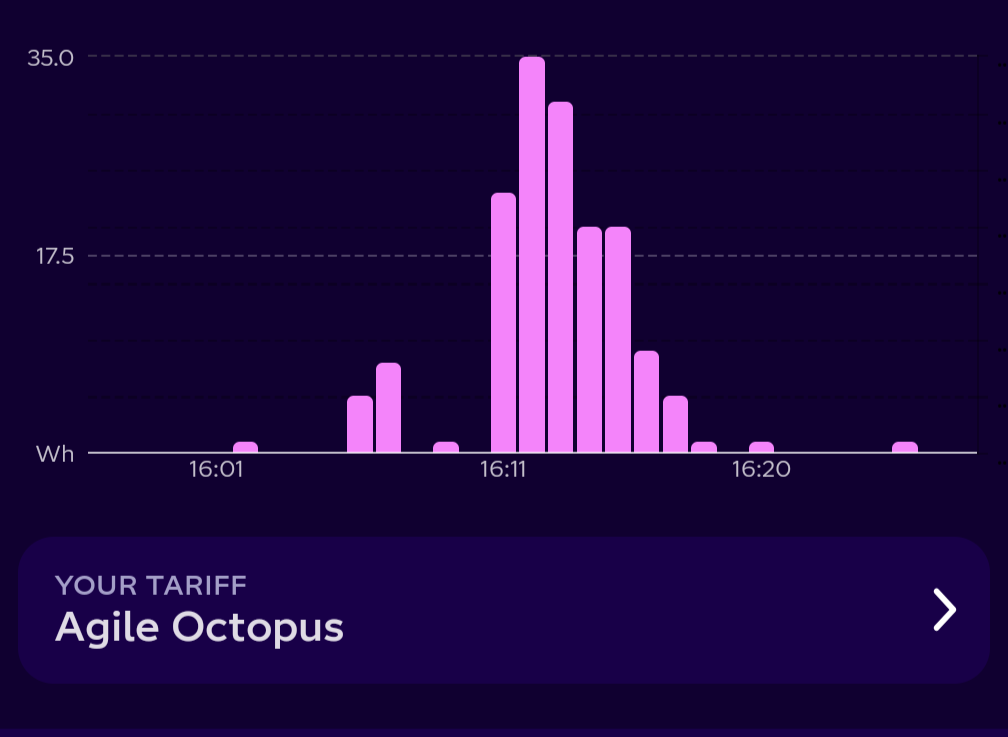
This is a bit annoying because now I can't completely charge the battery on the Flux 2am - 5am night rate, but if it is kinder to the battery then I can live with it.
I'm going to try to insulate the battery a bit to see if it can keep itself a bit warmer (being cautious not to over do it though)

EDIT: I've been reading back through this thread (15th Oct) and the reduction to 2.7kW may, or may not, be a bug. Fingers crossed it is and it gets resolved.

A
#171 Al E.Gator


Is the spread and voltages between those 2 outlying cells within normal bounds when the battery has been fully discharged? Seems odd that just those 2 cells are so different from the rest.

S
#172 SteveCook

Ryggwelter
Hi
In the winter i switch from Flux to ECO7 as like you I cant charge my 9.5 fast enough.
ECO7 gives me 7 hours of charge.
Export is fixed at 15p but TBH during the day any sun just goes back into the battery or house as there is not enough spere solar to export .

V
#173 Vestas

Ryggwelter I've been reading back through this thread (15th Oct) and the reduction to 2.7kW may, or may not, be a bug. Fingers crossed it is and it gets resolved.

Its not a bug so it won't be getting "resolved". Not sure where you got the idea it was?

R
#174 Ryggwelter

Vestas Not sure where you got the idea it was?

It has been mentioned, and disputed in this thread, hence my comment 'may, or may not be a bug' Also given a number of 9.5kWh battery owners are seeing temperature reductions significantly below 0.333C that GE appear to be citing (as a guide).
I'd like to see, as I'm sure would many others, a statement from GE as to whether the charge rate change was deliberate in 3017 (something this significant should be in the release notes). I can then make an informed decision whether this is for the health of the battery and I'll work with it, or whether to roll back to 3015 or wait for a 'fix' :-)

#175 EmmetBrown

Ryggwelter I read further up that it was in an earlier release? Did you jump from an older version rather than 3016?

V
#176 Vestas

Ryggwelter AIUI something was said on "social media" a couple of months ago by GE indicating the charge rate reduction is "by design". You'd have to ask someone else to link it or search yourself as I don't use Facebook or X.

I'm staying on v3015 as I understand how it works with my system so I've more or less got SoC tracking under control - which in turn means most other f/w "features" like the 10-step charge work properly.

R
#177 Ryggwelter

EmmetBrown
You're right - I hadn't updated for a while so didn't jump from 3016...but didn't make a note of the version I was running - doh!

R
#178 Ryggwelter

Vestas
Thanks - I'll take a look. I'd sort of like to roll back to 3015 but then if the change was made for good reason i.e. prolong cell life, then I'll live with the reduced cold charge rate. If I receive an answer from GE (or find it somewhere), I'll post back :-)

R
#180 Ryggwelter

EricIoW
Thanks, that's interesting, not only the data but the fact that they are the 'spec' for v3018 so not likely to be 'fixed'

I'm assuming the charging rate percentages relate to nominal charging rate i.e. 0.5C
So for a 9.5kWh battery with cell temperature between 10 deg C and 20 Deg C the charging rate would be 60% of 0.5 x 9.5kW = 2.85kW which is pretty much what I'm seeing (2.9kW AC Charge Rate, 2.7kW battery power for last night)

#182 hoggy

Vestas Unfortunately from other peoples & my own experience that one wasn't quite right.
The 9.5 seems to be particularly impacted and there's some sort of 0.29/0.3C thing going on with those in the 10-20'C range (perhaps down to it's Gen2 BMS being different?) but no hard evidence to back that up really so I gave up!

I will say that unless it's a "fast firmware" thing, the Gen 1 on old (400 series) firmware doesn't seem to care. My cell temps have been down at 3 or 4'C in various cold snaps and it still doesn't give a F.... and charges at full speed no bother making further mockery of my own table!

V
#183 Vestas

hoggy Its battery f/w driving this rather than anything on the inverter.

Can't remember who, but someone who is on 191/193 inverter f/w (fast response G1) went from 3015 to 3017 and back to 3015. 3017 limited the battery charge, 3015 behaved as "normal" - ie full charge rates regardless of temperature (above zero celsius anyway).

Edit - nice to see there's some benefit to being on G1 inverters 😃

R
#184 Ryggwelter

Vestas
Thanks. Yes I had recently found that table. The numbers are slightly different - 9.5kWh battery with Gen 2 Inverter is given as 3.16kW rather than the 2.85kW figure - but it all suggests charging backoff has been deliberately changed and it's not a bug. I'll stick with v3017 and accept that in winter I can't quite fully charge the battery on the 3 hours cheap rate....which is only pennies at the end of the day.

#185 hoggy

Vestas The BMS must tell the inverter to back off - I'm on 3017 & Inv 450/451 with no throttling, so can only assume that inverter firmware doesn't have the specific code in it to handle the BMS telling it to slow down and therefore BMS is just shouting into the void... inverter merrily charging at full whack.

Other than via PWM toggling the BMS Mosfets to achieve a reduction (which isn't happening as mine would still throttle if that were the case.) I can't see any other way it is achieved.

I did get someone to check while theirs was throttling if HA picked up any change to the power sliders (to see how it was being done) but they said no change (although whether they were looking at Power (W) or the % ones I don't know)
Would be intriguing for someone to do a FULL register dump during & post throttling to see what exactly it's meddling (if it's even exposed at all - would be nice to have a flag for throttling I guess for things like Predbat to take account of)

V
#186 Vestas

hoggy That would make sense as the 450/451 f/w didn't have the "10 step charge" from 90-100% whereas the 191/193 f/w does.

G
#187 geoffreycoan

Vestas Can't remember who, but someone who is on 191/193 inverter f/w (fast response G1) went from 3015 to 3017 and back to 3015. 3017 limited the battery charge, 3015 behaved as "normal" - ie full charge rates regardless of temperature (above zero celsius anyway).

I’m on 191/193 G1 fast response firmware and BMS 3015.

My 9.5 battery discharges at 2.9kWh, the 5.2 discharges at 2.7kWh, they both charge at 2.4kWh regardless of temperature so I’m not keen on upgrading further although from the table above it looks like it’ll only be the 5.2 that will be affected by temperature throttling.

S
#188 SimonClarke

Mine charges at 2425 and discharges to the house at 2575. Not forcing any export as the heat pump uses it all up by between 3 and 7pm which isn’t too bad as we only seem to use 7/800 watts until 23.30 comes around again. 5kw gen1 & 9.5 on 3018/191/193 but it is all in a cupboard indoors so pretty much always about 25c

K
#189 Karcsi

New replacement battery, or 'just' the BMS, now dead. Switched itself off after charging to 100% overnight and reporting discharge short current. Switched it back on, and now not responding and showing 5v. Reported and see what happens. Something similar happened when the BMS died on the old one. :/

S
#190 Squid

Okay - BMS errors have gone and weirdly since I have added 2 additional batteries (Gen 3 5.4Kwh) to the existing 2 Gen 2 9.5kwh batteries the charge info appears much more accurate than when I just had the 2 9.5 batteries. All good.

G
#191 geoffreycoan

geoffreycoan I’m on 191/193 G1 fast response firmware and BMS 3015.

My 9.5 battery discharges at 2.9kWh, the 5.2 discharges at 2.7kWh, they both charge at 2.4kWh regardless of temperature so I’m not keen on upgrading further although from the table above it looks like it’ll only be the 5.2 that will be affected by temperature throttling.

Update, still on G1 fast response 191/193 and BMS 3015 but I am definitely seeing temperature related slow-down on my 5.2 battery.

When the cell temperatures are below 20 degrees the 5.2 battery (inverter H) charges at ~ 1.7kWh (blue arrows), but once it gets above 20 degrees I get 2.4kWh (red arrows).

The 9.5 (inverter G) charges at 2.4kWh regardless.

This would suggest the temp limitation is in BMS 3015 as well as 3017, or in the fast response gen 1 firmware. As Hoggy notes, the original 450/451 firmware doesn’t seem to care about temperature

#192 hoggy

geoffreycoan indeed - Gen 1 on 450/451 for comparison on BMS 3017 no throttling:

G
#193 geoffreycoan

hoggy do you get charging at 2.4kWh or 2.6kWh? I’m only getting 2.4 even when the cells are above 20 degrees

#194 hoggy

geoffreycoan mines never charged above 2.4kW since day 1 - assumption being it's a DC value not AC. It discharges at 2.6 going the other way.

G
#195 geoffreycoan

hoggy thanks, sounds like mine then on 191/193 for charging but I get a better discharge rate of up to about 2750W. This definitely increased with the newer firmware

R
#196 Rubikcube

geoffreycoan do you get charging at 2.4kWh or 2.6kWh?

If you look at the figures during a (timed) charge, you will notice the battery voltage increases but the power stays about the same 2424W +/- a few. We all know power = voltage x current, so is the current reducing? NO. Battery charger designs are near constant current. The power shown is simply the current x 50.

So at 50V (about 20%) the charge power is 2424 as shown, but at 54V (about 70%), the charge power is 2424 * 54 / 50 = 2618W.

J
#197 Jason71

Hi.
I have a GivBat 9.5 and a Gen3 5kw inverter installed last June.
I don't use the portal often so only just noticed the 3017 firmware and installed it last week
like others I can see above I am seeing the max charge reduced to 2.7Kw
BUT
My main issue is that my max output has dropped from 3.6kw down to about 1.8kw most of the time.
This morning for instance it was briefly outputting 2.8 kw (15degrees 82% SoC) which was all that was required
but since then it has only output about 1.8kw even when the house demand was much higher.
at lunchtime it was only outputting 1.780kw (14 degrees, 59% Soc)

I have no idea what is going on or why. any help appreciate

H
#198 Henry3rd

Jason71 I'm on 3017 and exporting at 3600 which is the max I can set in the battery options tab.
Is there a possibility this is set at a lower value?

J
#199 Jason71

Henry3rd
Thanks for your reply but no I checked that. I have never changed it but just to be sure I updated it a couple of w and re-saved it in case the display was lying to me.
has not made a difference.

Just been going over the data and realised that it seems that the output is only throttled when the SoC is below about 80% above that I am getting higher outputs but not sure if its the full 3.6kw i used to get.

A
#200 Ange

Jason71 Hi Jason, I had exactly the same problem after updating to 3017. After several calls to Giv from my installer, and insistence on my part, they upgraded me to 3018 and I'm back to full capacity output. It's annoying that it's taken so long to fix as it means I've been paying more for the extra capacity being drawn from the grid when it was sitting in my battery!

R
#201 RBisset

I am still on 3017 for my two 9.5kW batteries, my max rate of charge at 9c is 1kW/hr - where did you find the firmware upgrade to 3018?

G
#202 geoffreycoan

RBisset 3018 and 3019 are still in test so can only be installed by givenergy support eg to fix an issue

#204 TheDragon (GivEnergy)

RBisset as I replied in your other thread.

Please test this tonight now I've upgraded you to the next revision. Which is waiting for approval.

R
#205 RBisset

TheDragon (GivEnergy) Firstly, - thank you.
Secondly, the batteries now charge at 2.89kW/hr which is super given the temperatures.
Thirdly, I read your comments a few times on how to solve this issue on the other thread, I am still none the wiser on how you fixed it?
Fnally, I want my battery to discharge to me only, I am not worried about export. I was trying to be a good citizen and make sure the battery still had power for the critical 4pm to 9pm slot. In the ideal world I would ask it to go into eco mode for only 8hrs a day during winter.

S
#206 SJB

Well I was avoiding this update because I had a firmware that was working perfectly. Then this afternoon I get an alarm because Predbat hadn't run for a while to find that Givenergy has applied the firmware update 🙁.
Here's hoping I won't become another unhappy customer.

M
#207 M_J

SJB

Hmmm that should not have happened unless you agreed to it?

What system do you have?

S
#208 SJB

M_J I agree that they should not have done it, the logs claim that it was an automatic update. I never agreed to it. I definitely didn't request it through the portal as we weren't home at the time.
I have a Gen 1 3.6 Hybrid inverter with 8.2 kWh Battery.

A
#209 Al E.Gator

Jason71 I find exactly the same thing. I did raise this with @TheDragon (GivEnergy) but he stated that there is no restriction to the output on 3017 with temperature. I beg to differ as especially when the batteries are below 10 degrees I see a clearly stepped reduction from 50% then to 25% of the maximum output. I’m on an EMS but am to the point where I’d rather go back to GivTCP management of the system if I can’t be quickly updated to a different firmware as I just sit importing the difference from the grid most days which is infuriating considering I paid all the extra to have multiple inverters and a large output! I’m hoping Paul or Mick will move me either back to 3015 or onto 3019 ASAP