heat pumps

599 comments started 2024-10-10 last 2025-04-20
Forums/Meta
D
#1 DD

Roy124 Pending a specific thread

A discussion on heat pumps hijacked another thread, so here's a dedicated on to continue the discussion, which starts around https://community.givenergy.cloud/d/5014-winter-strategy/89 or so

Note that one way to reply to a message in the other thread is press the reply / quote button, then copy the text, come to this thread, start a reply, and paste the text in.

S
#2 Slartibartfast

Sorry about the thread hijack ...
Winter strategy changes when you include a Heat Pump. So far I've got as far as 'do I need another battery'. Asd a quick aside - can I just call MCS and ask for an inspection ...

R
#3 Roy124

geoffreycoan no radiators. We have UFH upstairs and down. The new cylinder will have an immersion heater. We have a fan heater in the living room.

I have used IF and Flux, it certainly seemed odd with 100% battery taking feed from the grid with the battery being dumped in the 1600-1900. I dropped IF and am happy with Flux.

The next issue will be trying Cosy and its tariffs.

S
#4 SimonClarke

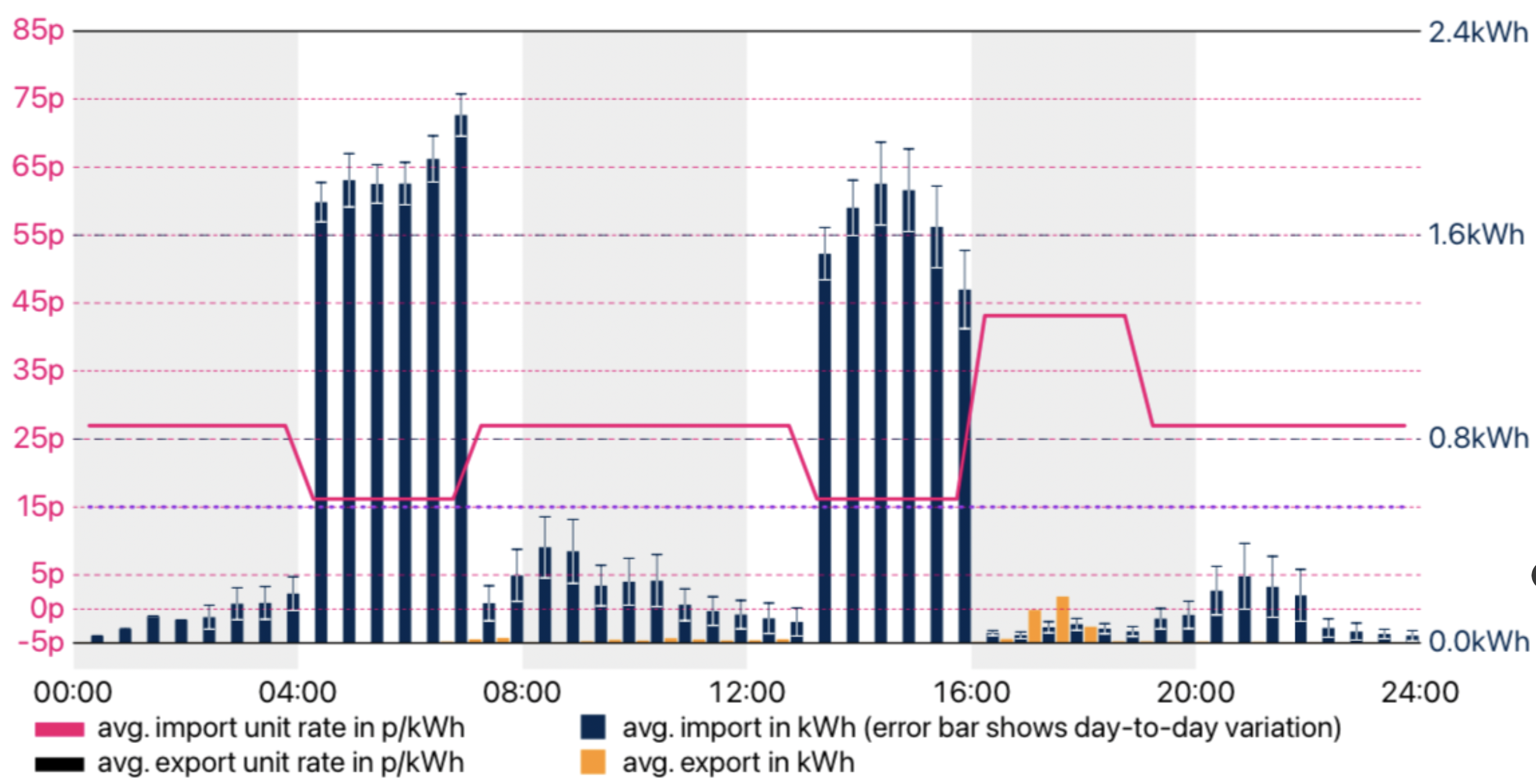
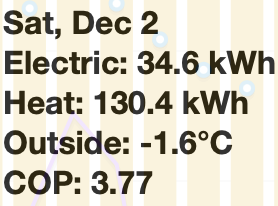
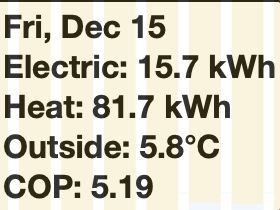
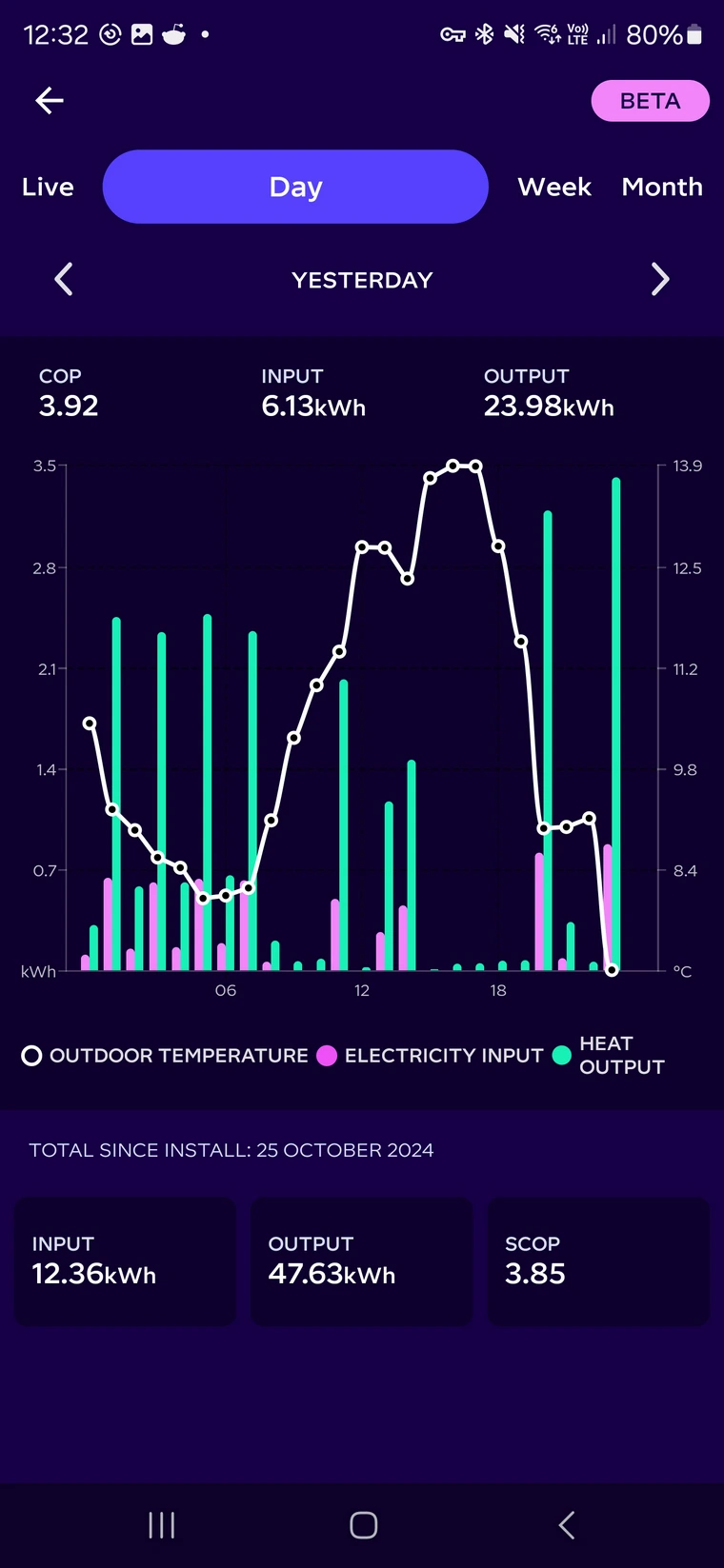
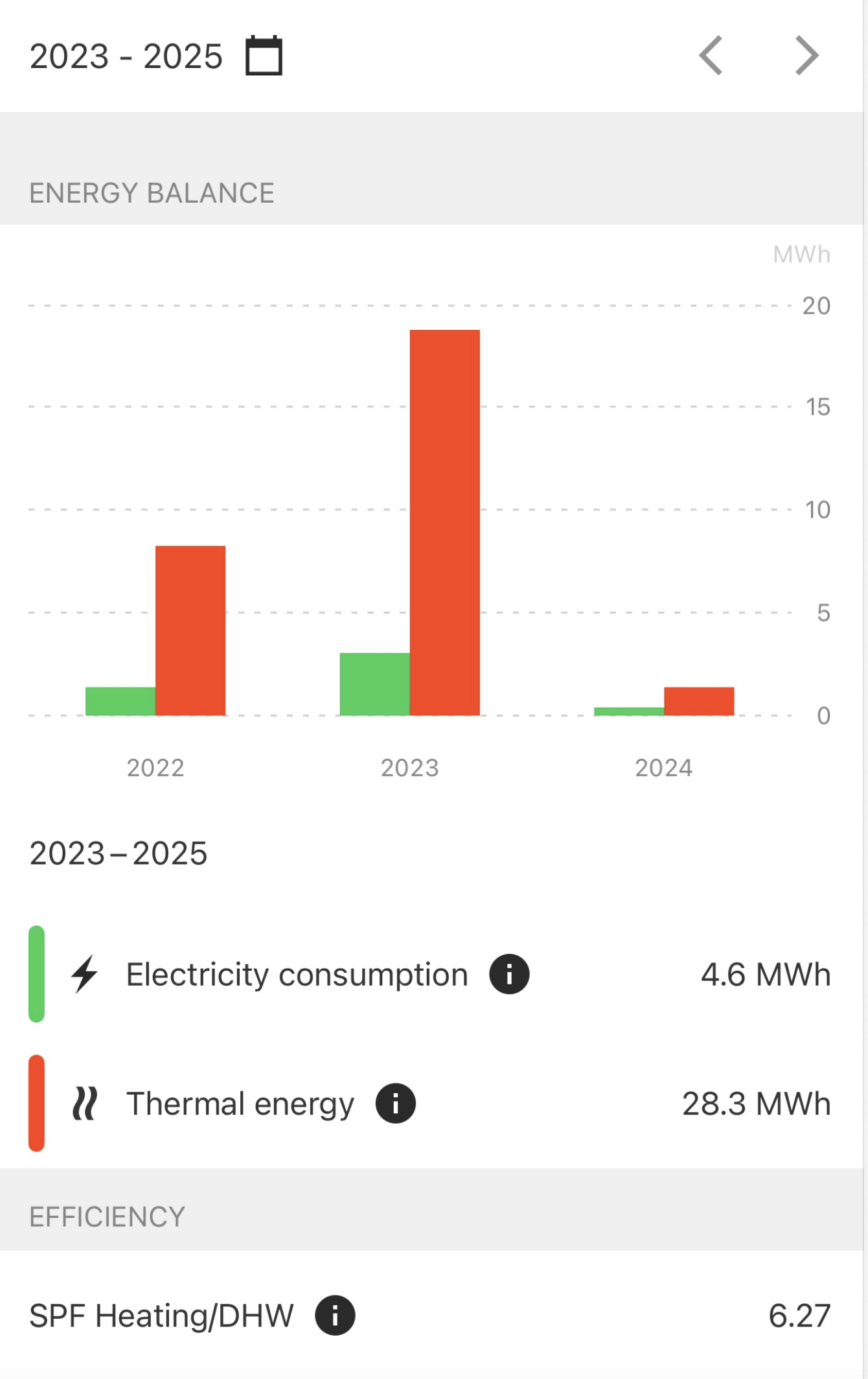
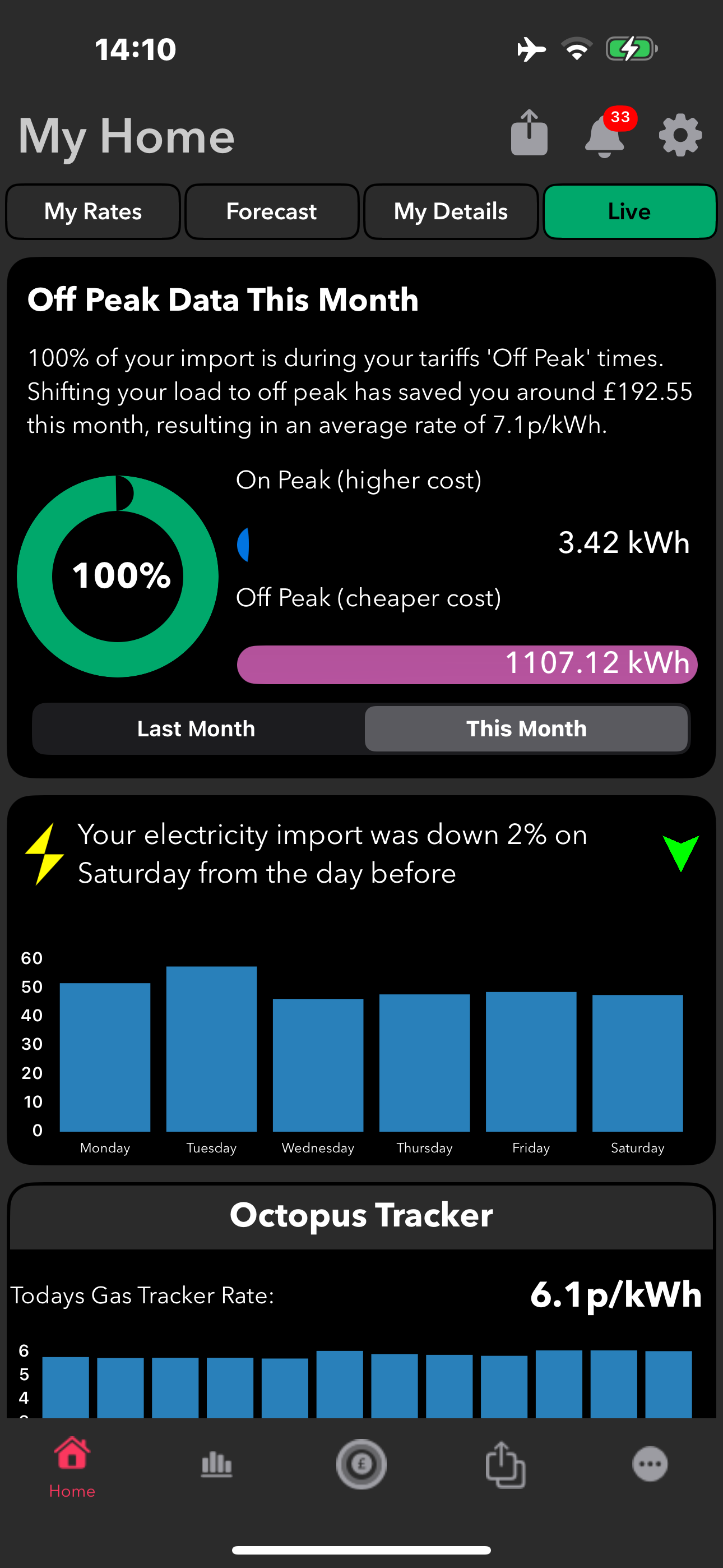
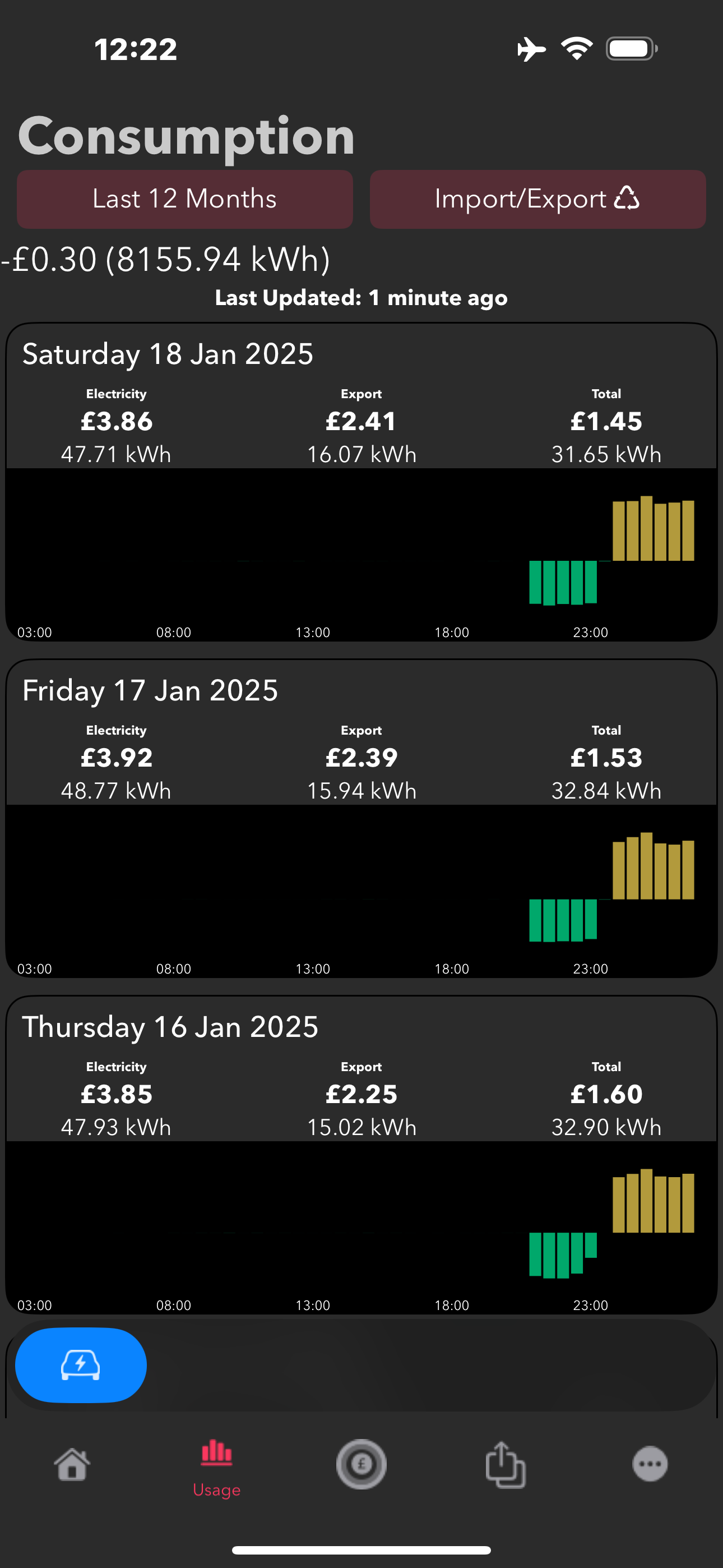
Found myself hoping it stays cold for the next few days so I can check that the new heat pump works! Going to run on IOG this winter and see how it goes. Used 50kw yesterday but that’s charging the car (Octopus greener day 36kw) rest was ashp, battery and odds. Almost all at the 7p rate. House is warm and so is the water. Cop seems to be over 4. I worked out it needed to be about 3.5 to break even with oil. Time will tell…

#5 Tenkaykev

It was a year ago that Octopus came to do a Solar / Battery survey. The chap who came to do the survey was also the Octopus heat pump surveyor so I asked him a few questions. I got the distinct impression that they just wanted to do standard installs wherever possible. The existing hot water tank is in a floor to ceiling cupboard in the main bedroom. The existing tank is in the bottom and there's a few slatted shelvel above for bedding. The internal dimensions are about 800x800 and he said it would be too small for the tank. Our standard loft hatch was also apparently too small. When I queried alternate tank sizes he said they didn't do those.
I noticed recently that the Octopus Q&A page now mentions that there may be other options coming soon.
After much consideration I decided to stick with our existing 20 year old GlowWorm boiler, it may not be the most efficient but it makes economic sense. I think that the £7,500 grant is distorting the market and attracting a few " cowboys ". Best for me to wait until the market matures.

D
#7 DD

Tenkaykev After much consideration I decided to stick with our existing 20 year old GlowWorm boiler, it may not be the most efficient but it makes economic sense. I think that the £7,500 grant is distorting the market and attracting a few " cowboys ". Best for me to wait until the market matures.

It's interesting that there was a grant for installing ev chargepoints, which people felt was distorting the market, and £1000+ installs couldn't be justified. But the grant went away, and the price has remained much the same :-(

R
#8 Rbor

SimonClarke When I got a heat pump, my house was just such more comfortable in every room.
I run the HP using weather compensation with all TRVs open (supported by my heating curve settings). No control from internal thermostats other than the temperature I set with the Heat Pump settings.
I use 20C 6 am-9 pm and 17C setback overnight.
But all houses are different.

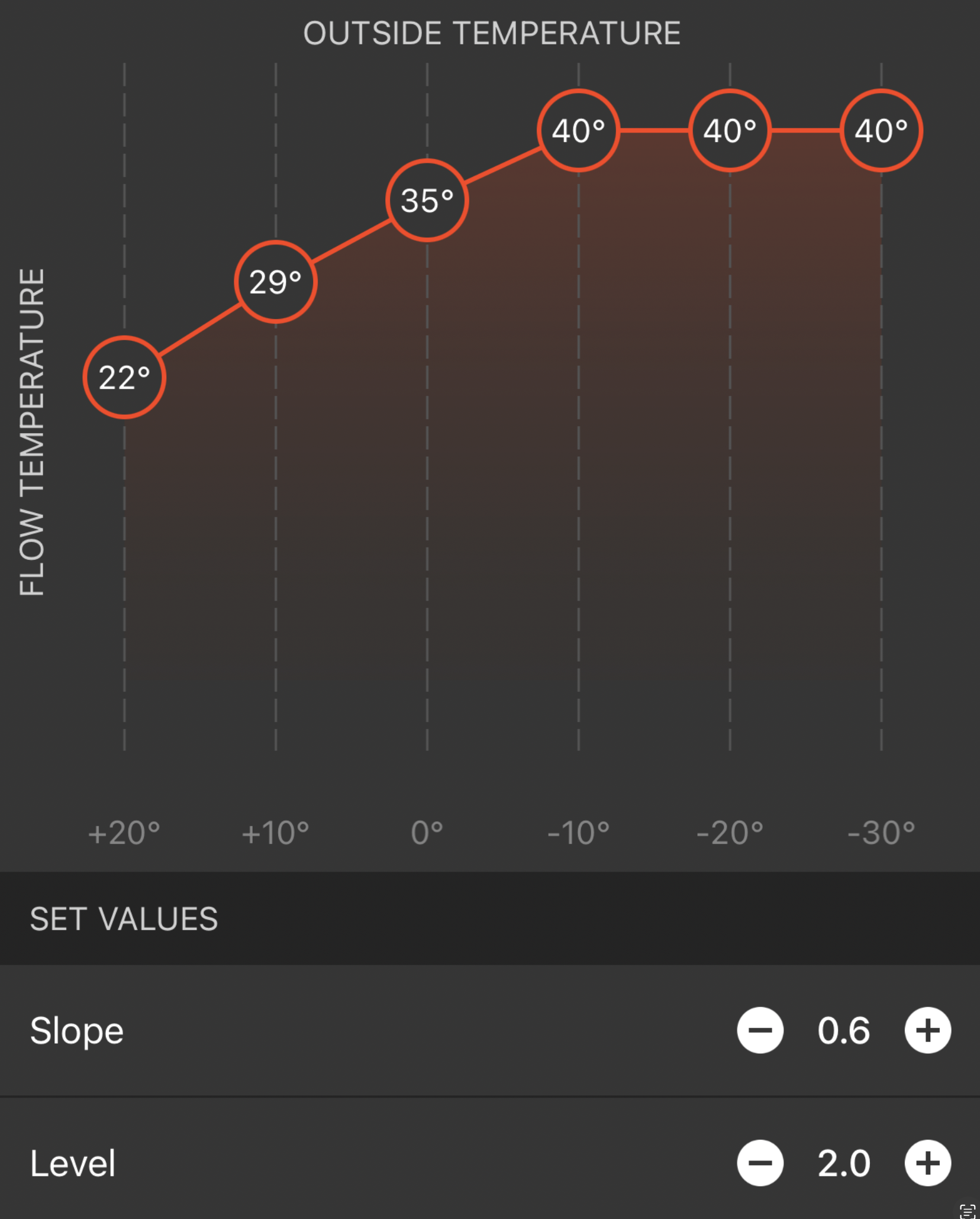
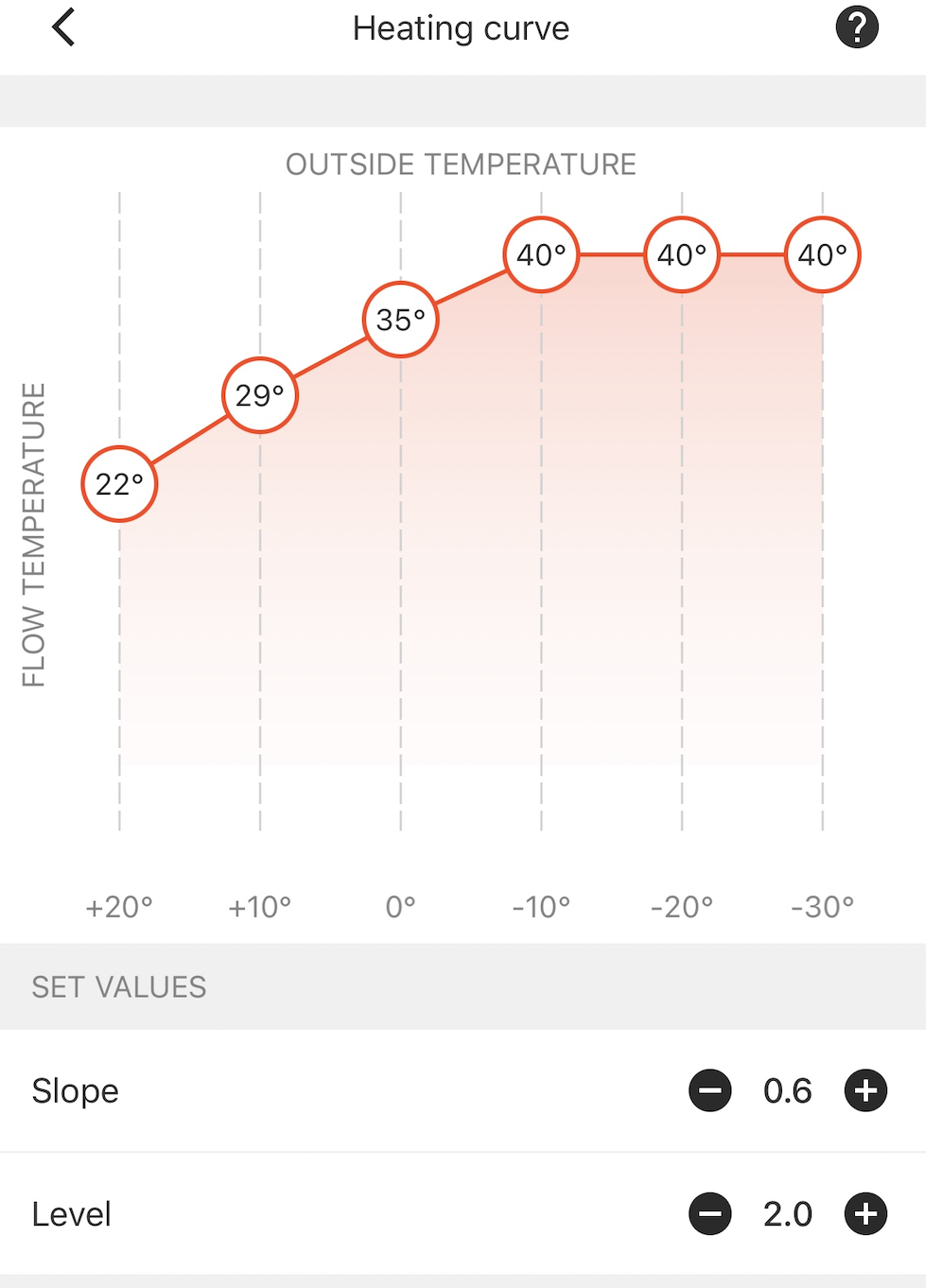
Do pay attention to your heating curve. Mine is set at 0.6.
I have experienced, lowering the value, but 0.6 seems a good setting for my house.
I think that many installers set the heating curve far too high, possibly above 1. The higher the curve, the higher the flow temperature, efficiency reduces and cost increases. Your house may need higher settings (or lower) – depends on your house.
During a survey, a good question would be to ask about the heating curve. Does the surveyor know what you're talking about or have any idea about heating curves?

It will be interesting for you to see your electricity use against heat output, especially when you get into December and January.

Rob

R
#9 Roy124

Rbor During a survey, a good question would be to ask about the heating curve. Does the surveyor know what you're talking about or have any idea about heating curves?

Well I don't think I do 😀

The only graph supplied was kW consumption against flow temperature.

Last night I worked out my average consumptions over the last 3 years. I applied October SoC and my value was just 80kW above their's.

My calculations using their F3.48 shows an annual increase in cost of £55. If I get 4.0 it moves into positive territory.

What I have not been able to factor in is the 3 periods per day of electricity at half price.

R
#10 Rbor

Roy124 Try this for a primer on heating curves:
https://energy-stats.uk/vaillant-arotherm-weather-curve-information/

You must have a setting somewhere whether of your control or within an app.
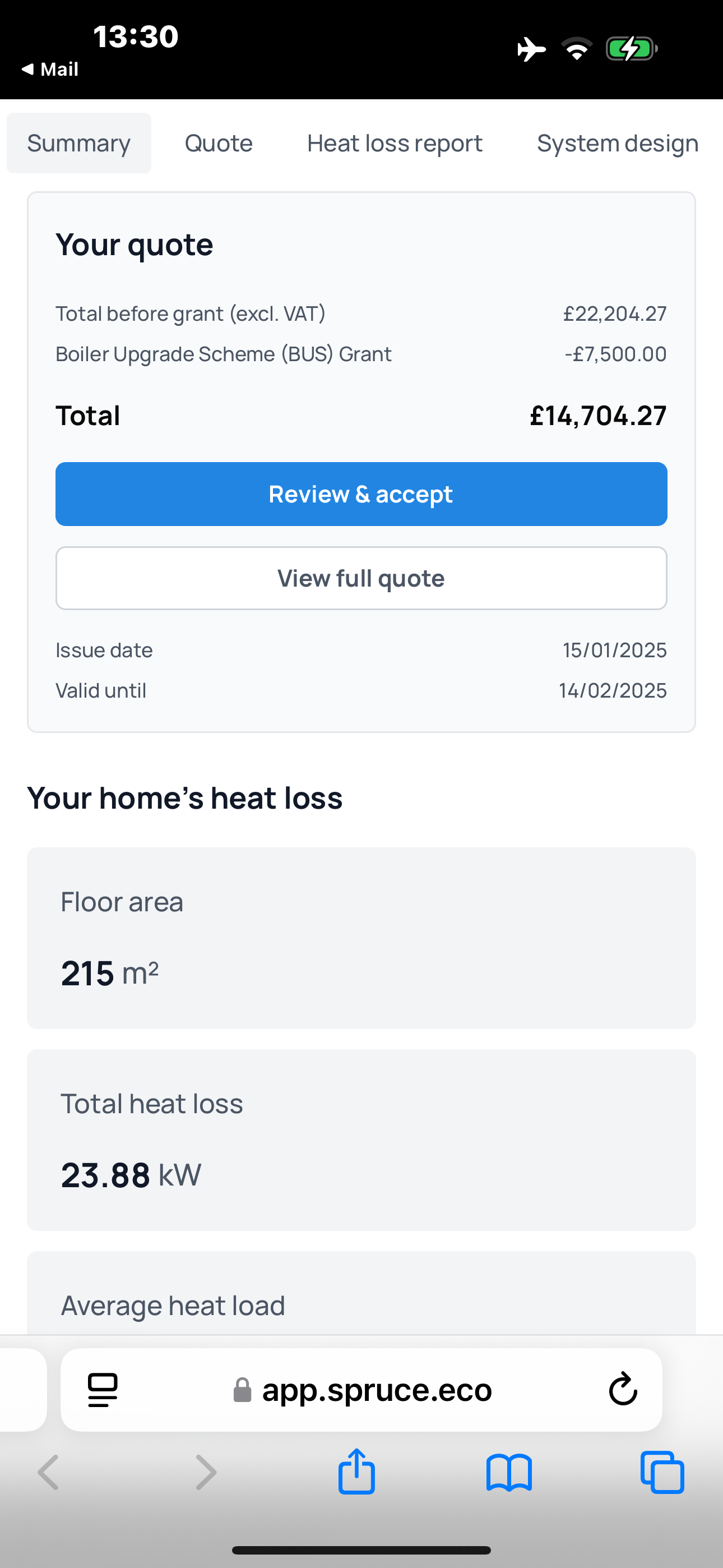
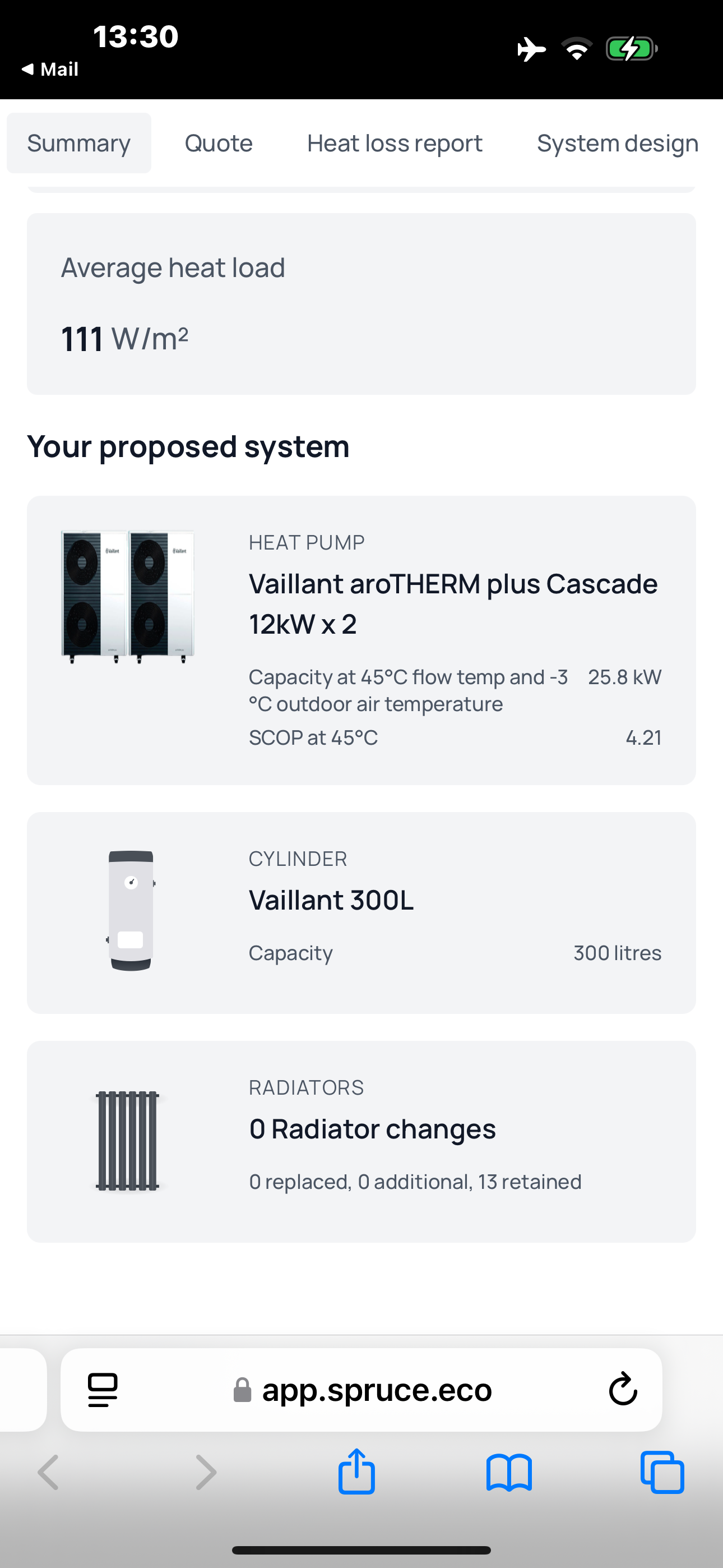
This is from my Viessmann app:

I think you said that yours was an Octopus installation for a Daikin. Heat Geek has a good video on Daikin settings.
See https://www.youtube.com/watch?v=-EUeqDSv5ag

An installer should take the customer through the settings at the end of the installation.

Rob

S
#11 SimonClarke

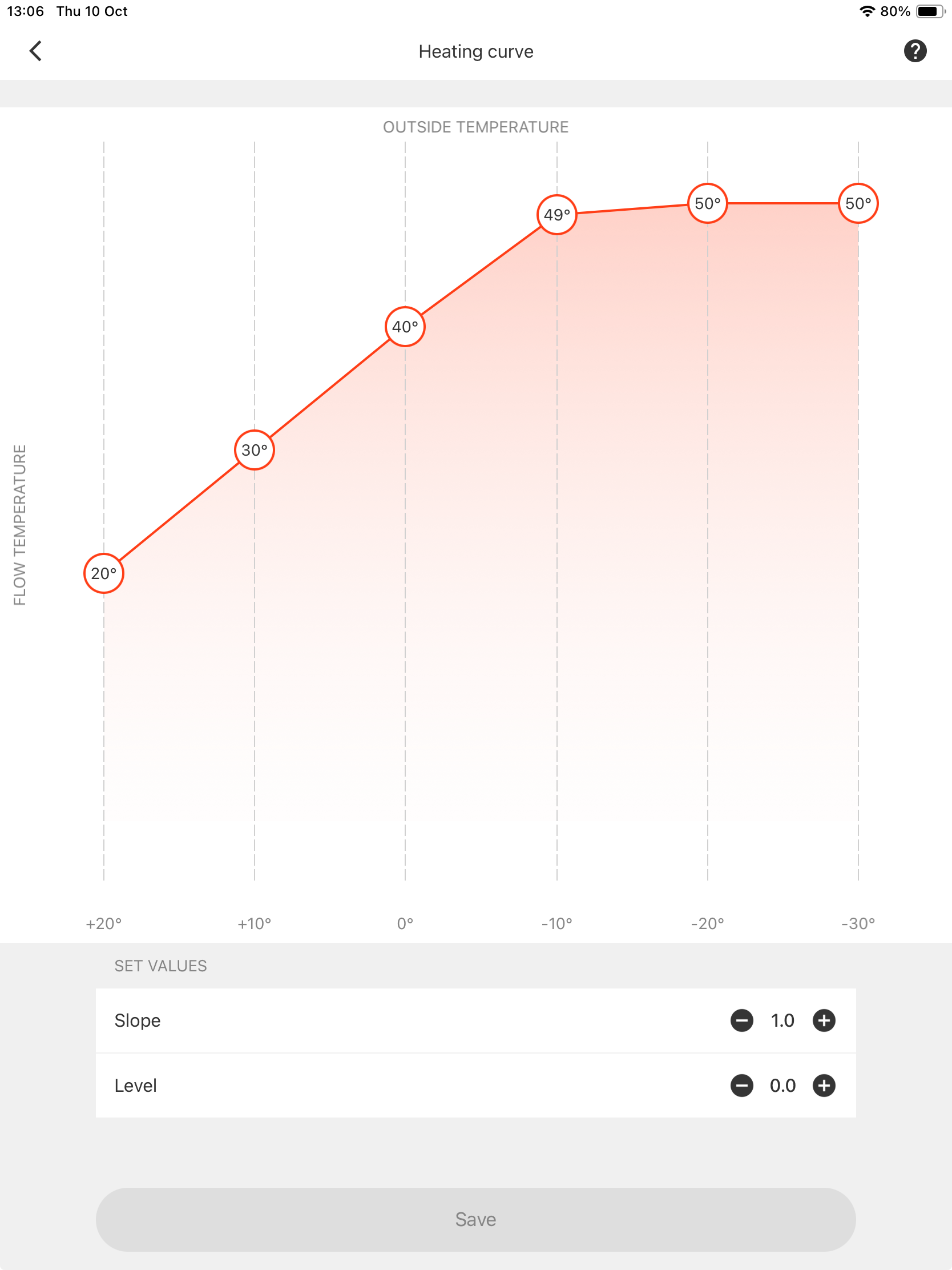
Rbor this is mine. I haven’t touched it.

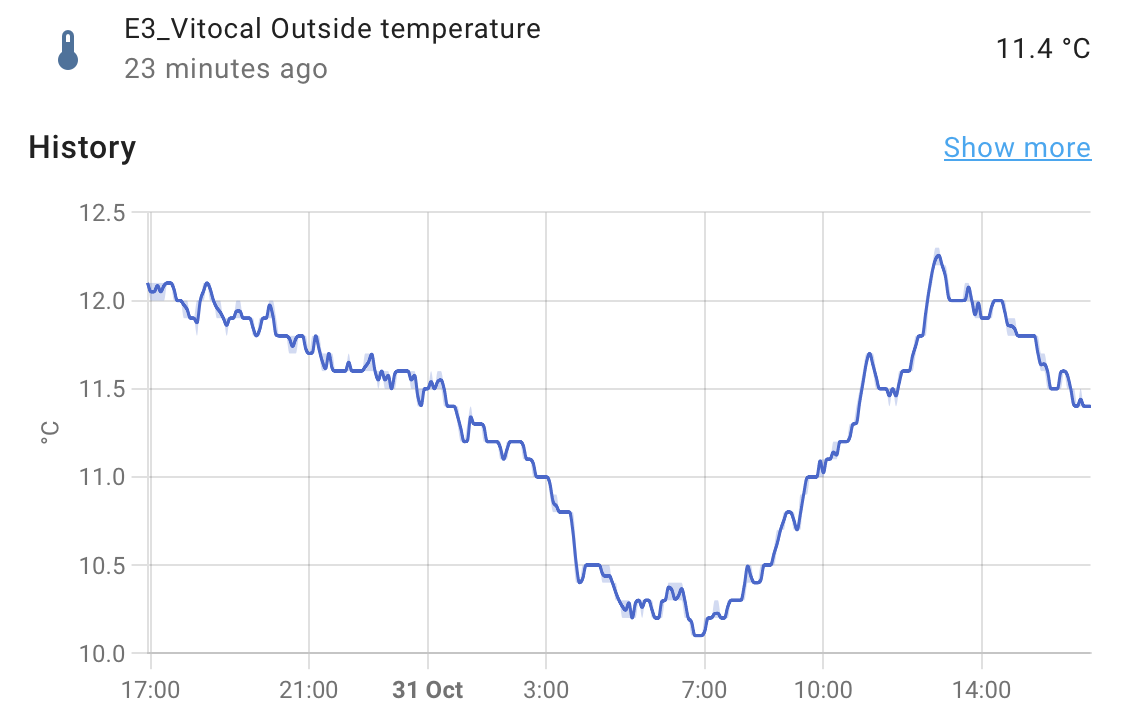
Using 19c 5am to 9am and 17.00 to 22.30 and 18c the rest of the time. Was on 20c but it got too warm. Haven’t seen the flow temperature go over high 30s. Currently 26.3 with 11ish outside 21 inside. Got some trvs but apart from the bathrooms they are wide open.

R
#12 Roy124

Rob, thanks, installation due in a month. Just trying to learn what I can. I will have a look at your links.

Continuous flow is what they recommended which contrasts with my UFH which has 10 individual thermostats at about 3ft 6" level. They are all manually controlled timers which is tedious changing 10 stats for multiple setting options for each day of the week. When we go away I tend to put a lot of them on frost and leave the doors open. We are away for a week in a fortnight and I will probably leave more on. Looking forward to a constant heat input.

S
#13 SteveCook

Being a consulting building services engineer for 40 years before my retirement, the 1st rule for heat pumps is -plug the holes before pouring more energy into the bucket -. Insulate, insulate and insulate again. Double glazed at least. Make sure all air leakage paths (draughts) are sealed. Then run heating temperature as low as possible to make the HP cycle more efficient.
I think HG Gov grant is all a bit of a Red Herring as it does nothing to stop the waste of energy by improving the building stock and does nothing to help the National Grid in distributing far more power to the grid which is not designed for all the potential boiler to heat pump (gas to electricity) loads. Dont get me on to when everyone wants a decent size car charger. All common sense and what anyone should do with a gas boiler. Lower temperatures help with condensing.
I think the grant also distorts the market. The (dodgy) installer works out a price, adds £7.5k on and then presents it with a £7.5 grant. Customer thinks he/she is getting a great deal. Installer has a nice little earner, Customer pays over the odds and the taxpayer gets "done" again.
Remember the whole PV debacle and then "buy Diesel" cars

R
#15 Roy124

SteveCook Agree. We had a couple of quotes, one was £7500 (ish) plus grant. Fischer, who do not offer a grant compatible system, came in at £14000.

Getting a heat pump now is no different from early adopters of solar panels. If you were rich enough to buy them you get the grant. The kit that Octopus provides is around £4500-£5000, add in survey, design, fitting (2xmen x4days), the price starts to be reasonable.

V
#16 Vestas

SteveCook I can't help wondering when they'll pull the plug on the grant.

There's 30 million postal addresses in the UK (or thereabouts). Assume 70% will require individual ASHP and that's 21 million premises.

21million x £7500 = £157.5bn

That's just not going to happen......

#17 Tenkaykev

Hook
Thanks for the link. I have the flow temperature on our boiler set down at the minimum, TRV's on all the rads apart from the one on the water heating loop. I use the immersion when the prices go to zero or negative, with my Solar panels and AIO a large portion of my energy bills are the Standing Charges.

S
#18 SteveCook

Yes electricity is too expensive because HMGov have a fixation on Carbon reduction and heat pumps is a sticking plaster fix.
It looks good on paper but does nothing to address the problem of poorly built housing stock, and just needs more power stations and pylons to be built. I am sure UK carbon commitments will be met but we will all be paying a lot more for electricity that is generated from expensive renewable sources including nuclear. Cut the consumption and the energy bill will be less, no matter the source
If your water bill is too high because your taps are broken/leaking, you dont get a new/bigger/plastic supply pipe, you fix the taps.

R
#19 Roy124

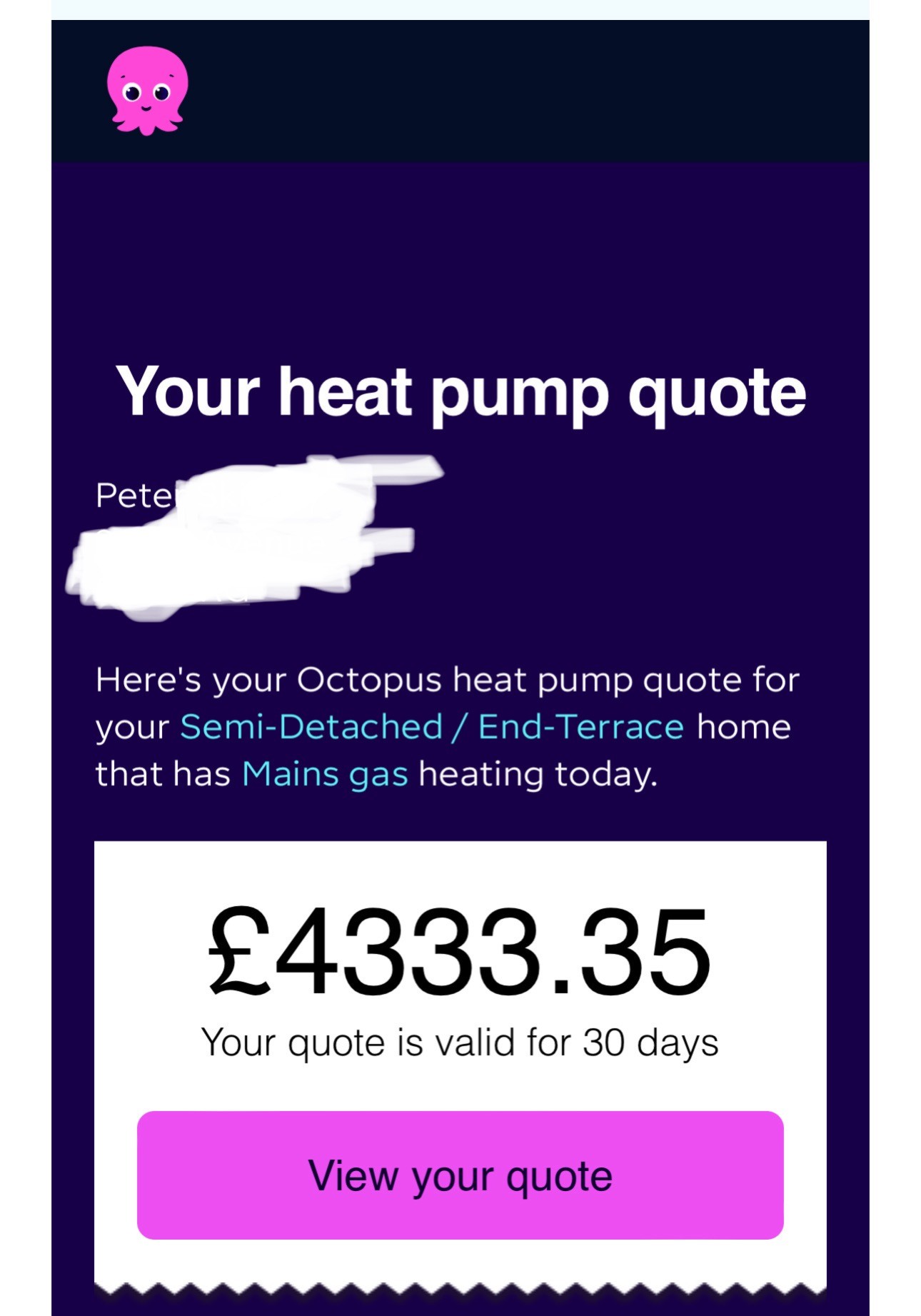
Hook when I got my quote I did not see the 'valid for 30 days'. When we ordered the price had risen by 20%. Then I got an offer about 28% below the revised price and 14% below the original. They didn't even blink when I asked for the lowest price.

What ASHP and Water tank did you get? I expect Daikin 8kW and 250ltr tank. It should be a minimal installation as the ASHP will be on the same wall as the boiler and the tank inside where the boiler is.

S
#21 SteveCook

Vestas Plus numerous power stations Sizewell C on way to £30 billion. Plus upgrade to National Grid distribution network.
If the houses were insulated properly a lot of this would be mitigated.
It would help if UK industry made heat pumps and employed UK people and the money stayed in UK economy, but we don't and the money and employment all goes to other countries

R
#22 Roy124

Hook In the UK it’s only cost effective if you don’t have mains gas

Agree, at the moment. In case the grant is reduced or removed then that is one factor, though I agree with Steve that prices vary to absorb the grant. However there has been talk about varying the standing charges, which pay for wind turbines, by increasing the unit costs.

In terms of green energy, it made little sense in selling gas (bad) at lower prices than electricity (good). Re-balancing the standing charges and adjusting the unit price may well make ASHP more attractive; that will improve the economics.

S
#23 SteveCook

Vestas
Pimlico and Vitoria used to be heated with the waste heat form Battersea Power Station. That has all been abandoned as it was easier the get individual households to put in gas boilers than deal with Battersea power station (sell it to developers) and to maintain the pipe network.

V
#24 Vestas

SteveCook Indeed and the beating heart of global capitalism (Wall St) has a district heating system. Given how batshit crazy the yanks are these days I'm suprised they haven't shut it down because its "socialist/commie" 😉

S
#25 SimonClarke

I don’t think the personal economics are that straightforward. My rads were about 27 years old, as was the rest of the water system, boiler about 16 years old so I figure I was replacing/repairing lots in the near future - some rads were getting rusty. We’ve gained a cupboard (tank gone in the loft in place of old cold tanks), about 10sqm of garden now the tank is gone, no more ordering oil, no more occasional smell, hopefully no more wildly fluctuating oil price, mains pressure hot water, silence, and we can look our grandchildren in the eye as we have at least tried!
The sooner electricity is decoupled from gas the better. Forget nuclear and start to look seriously at tidal- Bristol Channel?

S
#26 SimonClarke

Oh yes definitely insulate!

J
#27 JonB

Afternoon all,

I don't participate much, but I read a lot about what's going on across various threads, with interest.

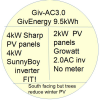
About my GivEnergy setup: I've got a version 1 5kW hybrid inverter paired with a 5.2kWh battery installed in March 2023. The battery can charge and discharge at a max rate of 2.6kW. It's a G99 configuration, so I can export the full 5kW—especially handy in summer with 16 south-southwest facing panels (6.5kW peak). I've owned two EVs; currently, I drive a VW ID.4 77kWh, utilising Intelligent Octopus Go.

We had a heat pump installed by Octopus a month ago. Our 4-bed detached house, built in 2007, uses 10mm plastic microbore pipework. The old cylinder space was 655x750mm—too small for a standard cylinder but fit a tall slimline 210L. Our previous cylinder was 175L. Due to the 10mm pipework (15mm on main runs), a buffer was employed, placed in the loft. We swapped out three radiators for higher wattage ones. The design temp is 48 degrees at -2.6c, with a heat loss survey concluding 3.8kW. We installed a Daikin 4kW (EDLA04EV3) unit. I had already insulated the loft to around 400mm with boarding and shelving. Primary pipework runs from the heat pump up the gable end, through the loft, and into the airing cupboard. We lost some shelving space for bedding and towels.

I had the survey completed last October! The delay was my doing as I clued myself up as much as I could. The total cost to me was £1,950.

The WD curve has been set and is working well. I tweaked it slightly to keep the heat pump running almost continuously. The Madoka control is set to 20°C 24/7 but usually reads 20.5 or 21.0°C. Hot water heats to 48°C at 4 AM, taking advantage of the IOG 7p/kWh rate. Every Monday at 4 AM, it heats to 60°C for disinfection. The Daikin Onecta app works well and is easy to use.

Our boiler was removed, and the flue hole bricked up, now, you can't tell where the flue was. The gas meter was capped and removed on the third day of installation. The entire process took five days from start to finish. The house maintains an even and pleasant temperature.

Overall, the Octopus install team did a great job. The lead plumber took his time during the handover to answer all my questions. The quality of the pipework and lagging is top-notch, as was the electrician's work. I averaged making around 12 cups of tea or coffee a day! Ha.

So far a positive experience. On the days we've hit 3°C or 4°C the heat pump has been pulling 800-1000w after it settles from a start up. Today is 9°C and its pulling 350-400w

From the 18th September heating has run at a COP of 4.4 whilst DHW has run at a cop of 3.13. This will obviously reduce as average temperatures fall but looking good so far.

We were starting to need a new cylinder anyway and the boiler was looking a bit suspect on its last service so this made sense for us.

Its early days still but did a huge amount of learning prior to committing to install. If anyone has any questions fire away.

Cheers,
Jon.

R
#28 Rbor

SimonClarke Yours looks like a Viessmann as well. Mine is 10 kW with 8.3 kW heat loss
Very similar flow temps between our systems.
Each notch up on level moves flow temp up across the board, and the slope moves it down.
It sounds like you have yours tweaked nicely for your house although you could experiment with deceased slope, increasing level to compensate.
With mine, I think slope of 0.7 and level of 0.0 gave same curve as 0.6/2

Not all heat pump brands have level. I know that Vaillant slope can be tweaked in 0.5 increments.

Looks like you can run your system colder than mine. I like how you set back during the day. I may experiment. Mine is a 1920s detached, insulated as much as I can but with negligible cavity in walls. But keep me comfortably warm. Currently 7C outside (800' up on edge of Pennines).
I get SCOP of 5 so am running very efficiently and saving over gas.
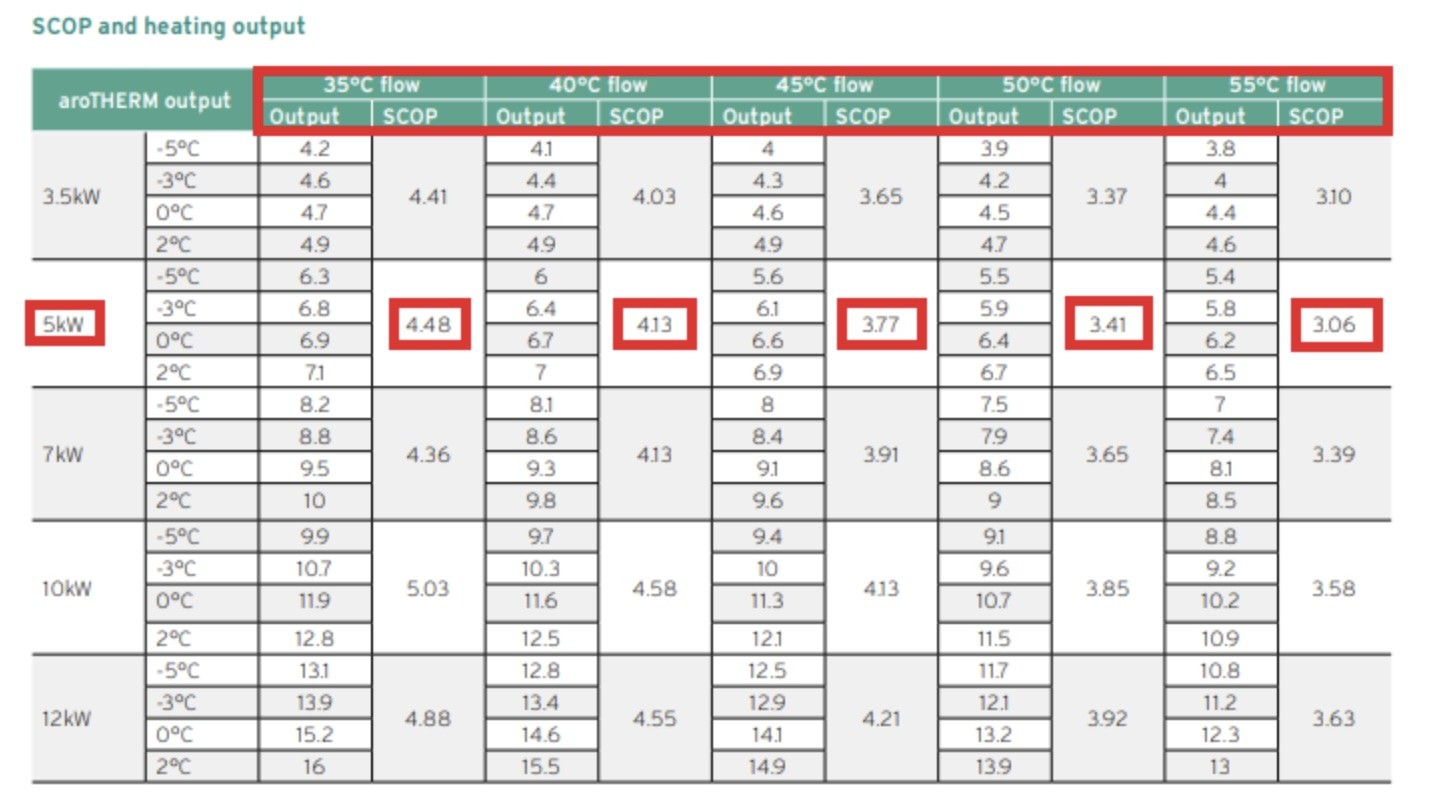
I reckon an installer heat pump nowadays should be looking at a COP of 4, unless if operates at higher temperatures.

Rob

R
#29 Rbor

If you haven't seen the thread, there are many heat pump contributions in this thread starting from about comment 60.
https://community.givenergy.cloud/d/5014-winter-strategy
Heat pump discussions had hijacked 'winter strategy' so we split this off to start a 'heat pump' specific thread.

I'm glad that we split the thread – there have been many great contributions here and it only started 6 hours ago.

Rob

J
#30 JonB

Rbor Sounds like a great set up. And so does being 800' up in the Pennines. South Yorkshire for us.

S
#31 SimonClarke

Rbor yes it’s a Viessmann 8kw with loss just over 6. Installer was going with a 6kw but didn’t want to risk it especially as they are the same at low output. Probably will put ours on the same temperature all day as that’s what we are used to on oil. Used to just switch it on and gradually lower the stat as the house warmed up. Done this in 3 different houses now with very little if any extra consumption but a more stable/comfortable home.
Upgraded the insulation on our 1997 bungalow for a new EPC of B before the rules changed. Seemed to cut oil usage by nearly a third so now the heat pump has to at least match the cost. Only been in a month so guessing really but it is showing above 4 so fingers crossed.
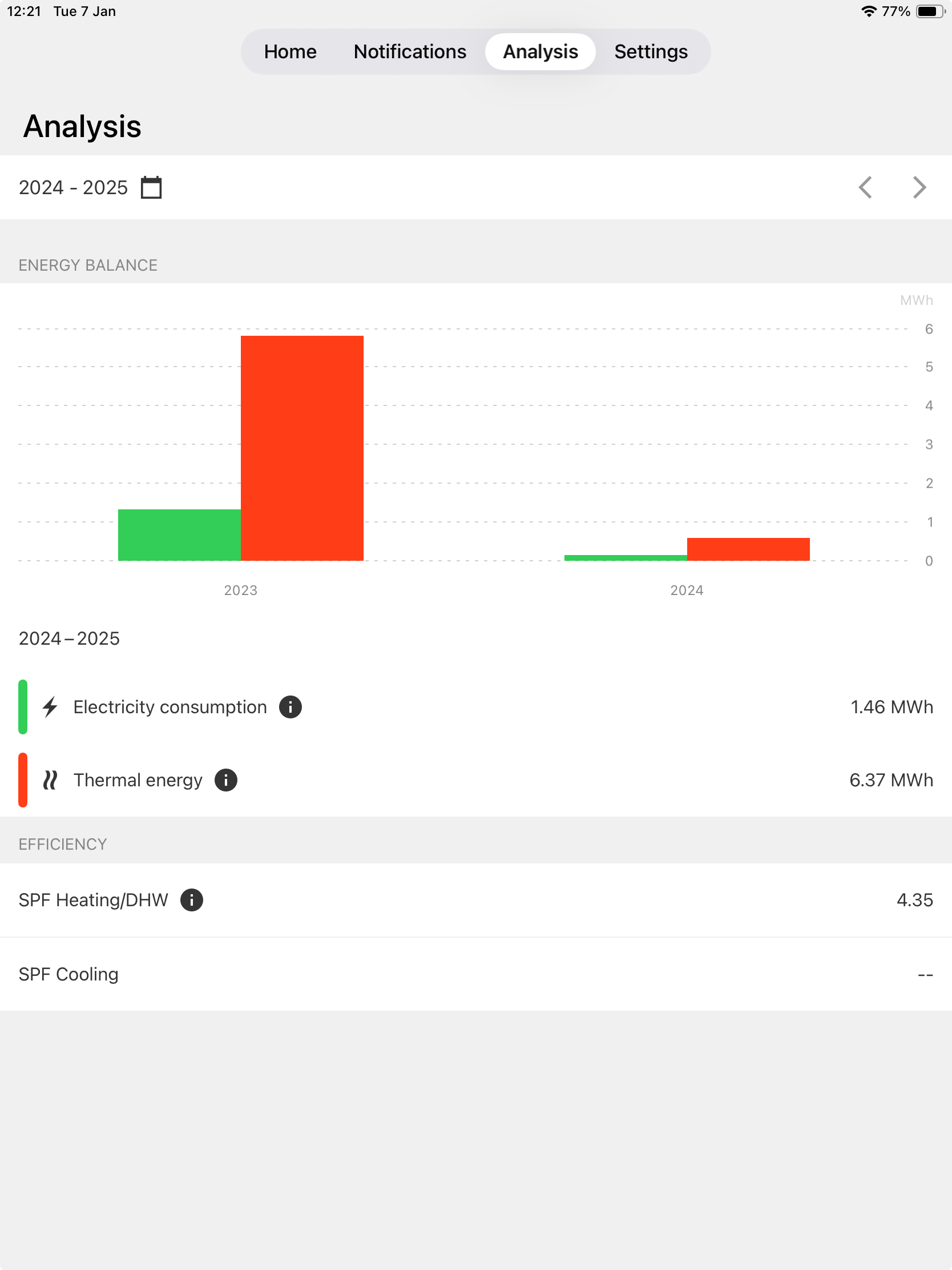
Not really anything to do with this but the Vicare app played up on my iPad (ok on android) so I deleted it and Analysis disappeared! Any ideas?

#32 Hook

JonB

This is a useful post to me, and also helps me try and extrapolate running costs. I have the dreaded microbore too.

"On the days we've hit 3°C or 4°C the heat pump has been pulling 800-1000w after it settles from a start up"

Can I clarify that you're puling 800-1000w continuously or just at start up? On these days what does your electricity consumption look like?

I'm on IOG and have a 9.5kwh battery that can more or less run the house all day during winter, but I know it it would be emptied if I got an ASHP.

S
#33 SimonClarke

Hook we’re on microbore too. Currently it is about 20c in my kitchen and 10.5 outside. House consumption is 274w. It goes up to about 700w when the heat pump is running. Supposed to be colder tonight so another useful test. We also have a 9.5 battery with 6.24 east/west currently back to 100% and I have been a good house husband and done 2 loads of washing and hoovered the entire house - brownie points for me! Patchy sun and rain today. We seem to be using about 5kw extra a day but sometimes 10kw? Maybe used all the hot water?

V
#34 Vestas

SimonClarke I don’t think the personal economics are that straightforward.

That's why they're "personal" 🙂

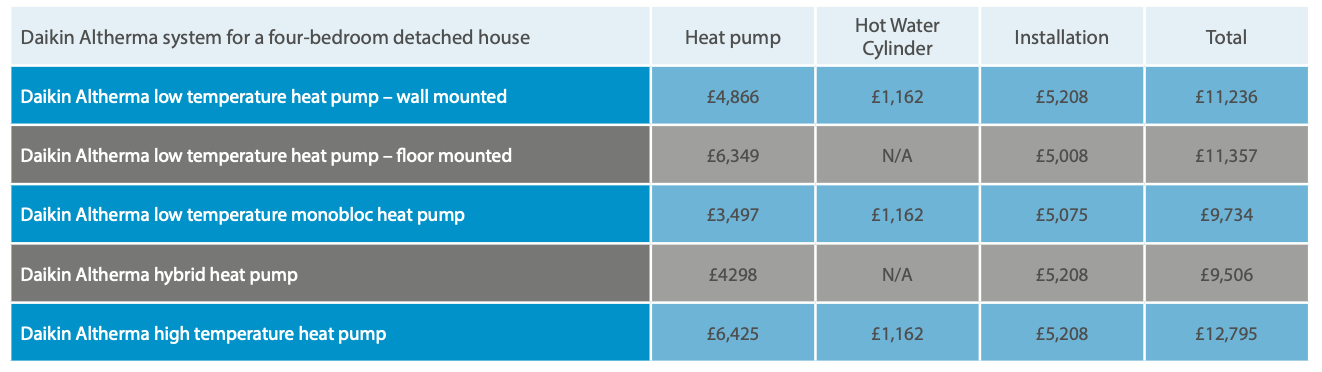
Bottom line though is that an average install without grant is going to be £10k or so. Now it rather depends how that got spent as to whether it was worthwhile. If its one-time upgrades like rads/piping/insulation then fair enough its a long-term investment.

If not then you have £10k to recover before you "save" any money. Its going to be hard to sell that given you'll probably have recurring costs of £5k or so every 10-15 years to replace the heat pump. Then you can look at what you're spending on space/water heating and its not going to be a pretty picture if you have the option of mains gas.

FWIW my understanding is that ASHPs in Scandinavian countries are mainly air to air for space heating as heating water for space heating via rads isn't the norm except in urban areas/public buildings where there may be building/district heating. I really do think that might be a better "hybrid" option if we want to decarbonise quickly rather than retrofitting water-based space heating systems to every house. Obviously you get aircon (of a sort) in summer which is a bonus.

R
#35 Rbor

SimonClarke
Your system looks really good for microbore. I think that some installers refuse if they spot microbore.

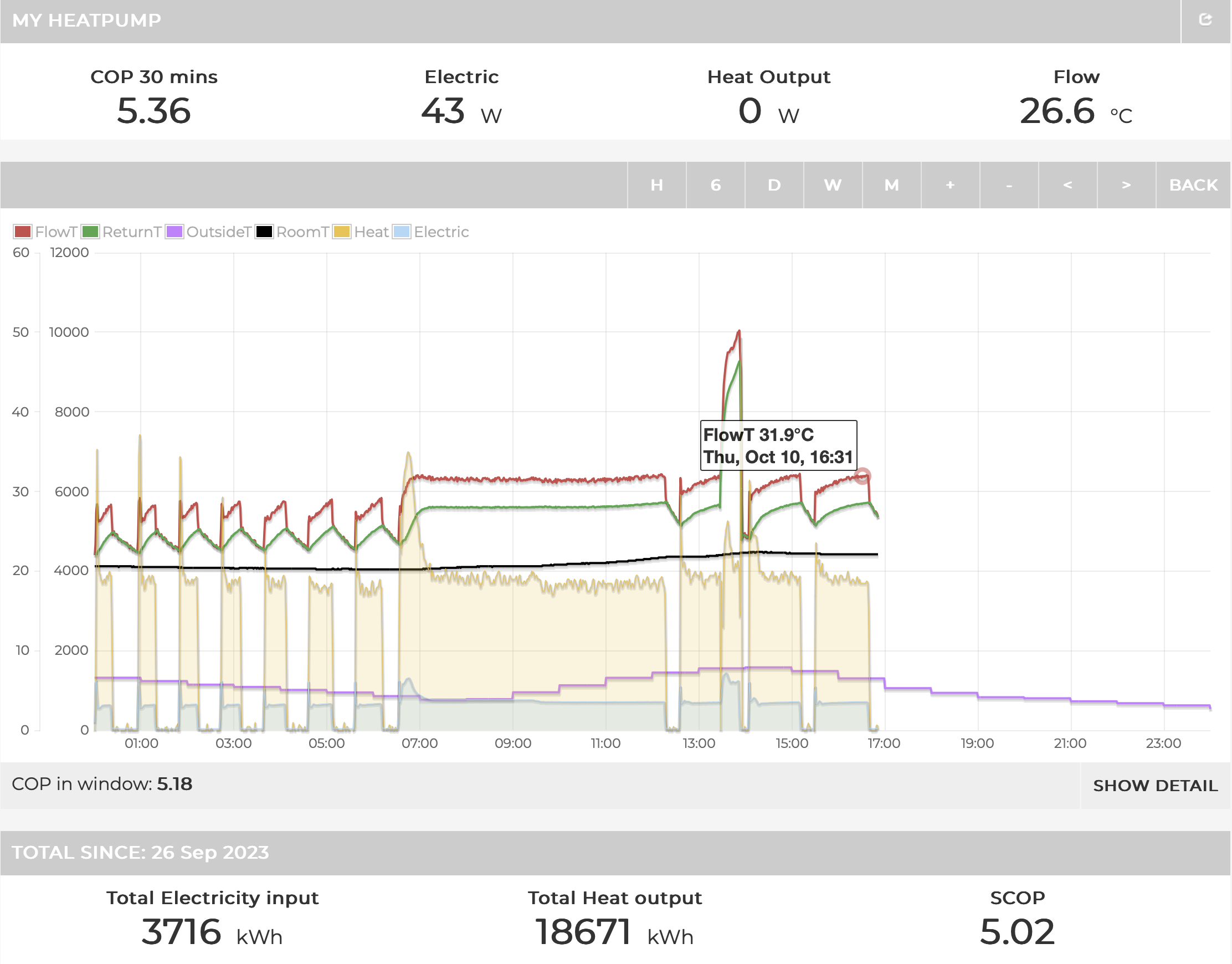
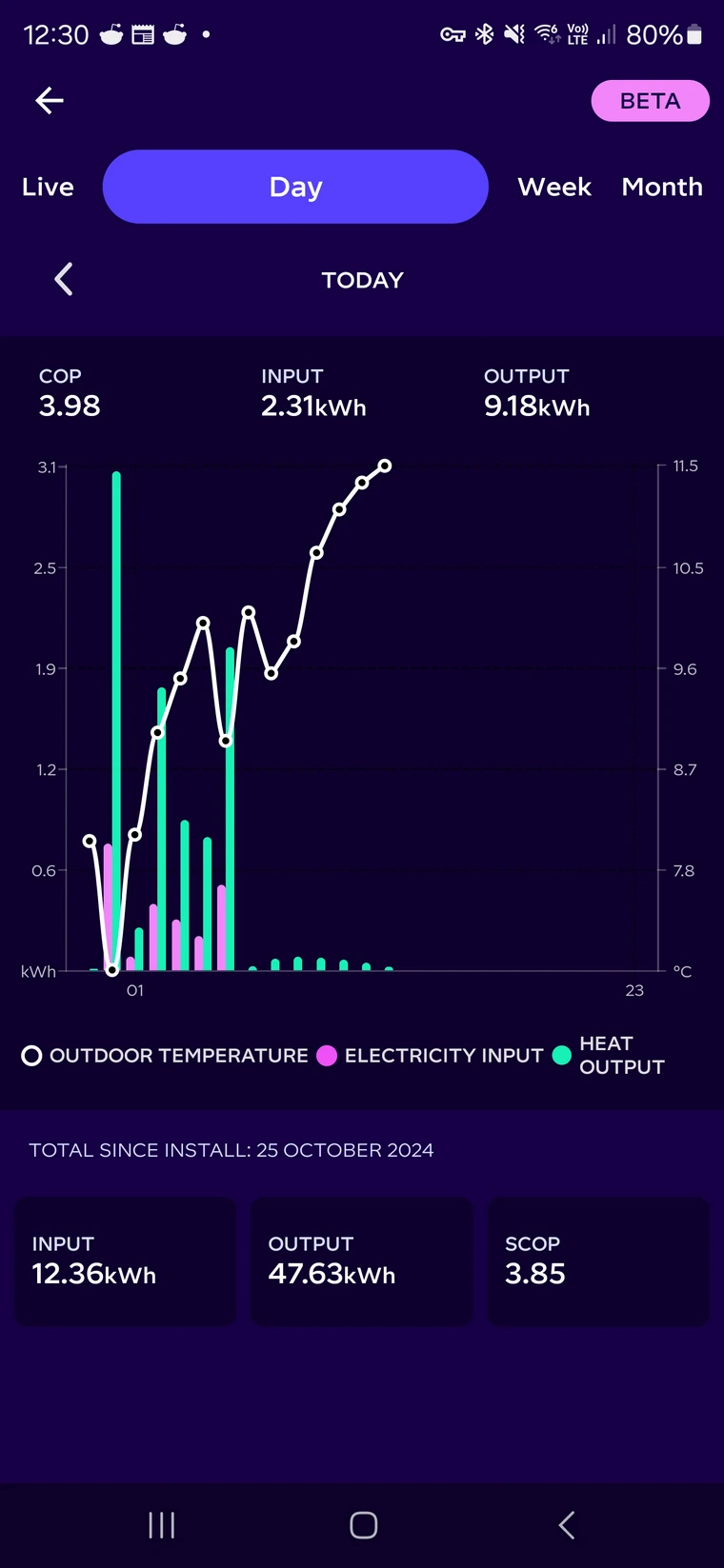
This is mine for today, with flow temp highlighted. Kitchen temp 22C but was a steady 20C before sun warmed back of the house. (Black line). Outside, it is 6.5C.

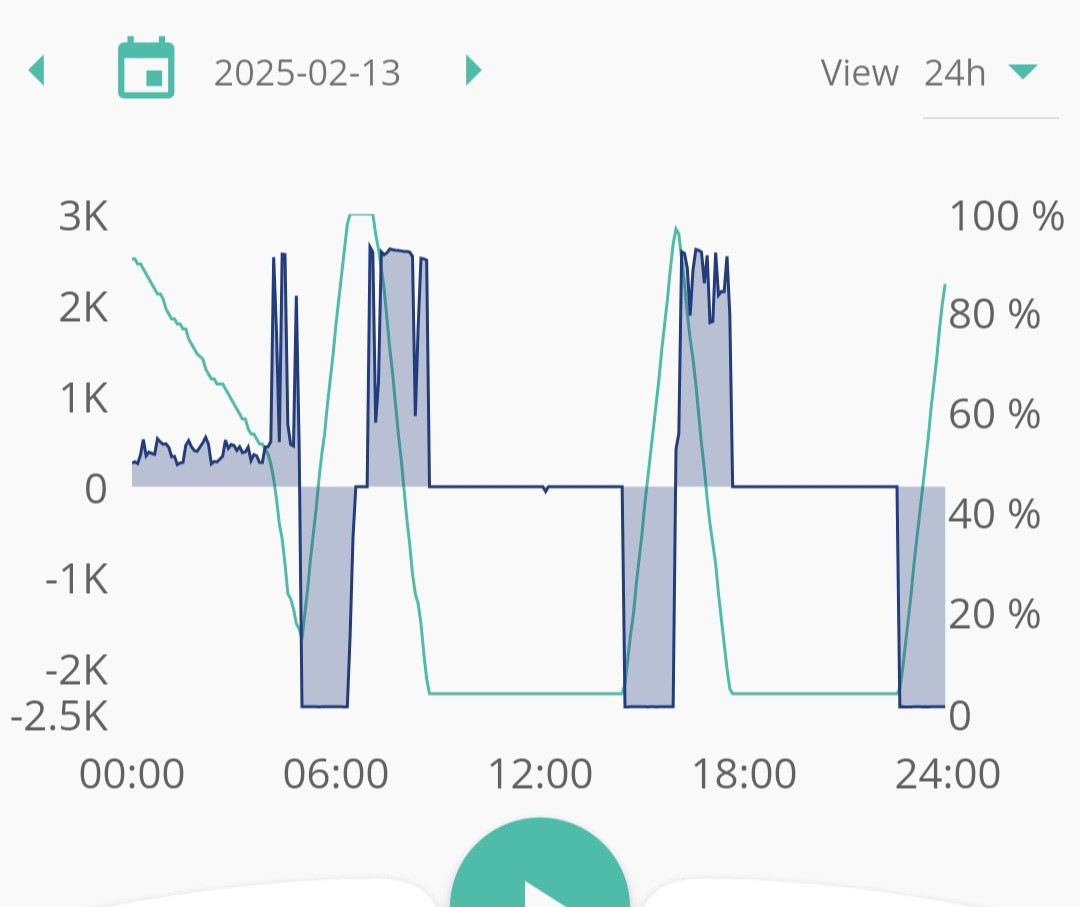
I am using about 720 W (blue) of electricity when pump is on which is providing about 3.7 kW of heat (yellow). So this is being pulled almost continuously. The peak for about 30 min is my HW heating and the electrical power then rose to about 1.3 kW. Not as efficient as heating but I will have only used about 650 W for my HW!
Similar house load to yours. This month (Oct) I am typically using 7–9 kWh daily. Gas was disconnected a year ago.

My coldest day last winter is shown below. Temp dropped to –3.5C overnight and rose to –0.8C. On Agile, this cost me about £4. I am please that I was still getting a reasonable COP. House was at 20C.

Over the last year, my total 'energy cost' is £15 profit to me (on Agile import with 15p outgoing).
I credit my system well-matched to heat loss and an ultra knowledgable installer (Sole trader and Heat Geek Elite).

I have two 8.2 kWh batteries connected to a GE AC3 coupled inverter. Panels on E, S and W with 5kW pv Solar edge inverter.

Rob

R
#36 Rbor

SimonClarke I have checked Vicare, I can see analysis on my iPad but not on iPhone.
Can you see all the settings, including 'Communication module' which includes your heat pump's Serial Number?

Rob

S
#37 SimonClarke

Rbor everything else seems fine just analysis that’s completely missing. I did ask Viessmann yesterday but haven’t heard anything

S
#38 SimonClarke

Vestas hopefully there won’t be an option of mains gas at least on new buildings. Lots of people don’t have gas now and the cost of replacing oil boilers and tanks is not cheap. I agree that if you are sitting in a 5 year old mains gas supplied house the desire to swap will be unlikely with current prices/grant but that may change who knows

C
#39 CW

Vestas If not then you have £10k to recover before you "save" any money. Its going to be hard to sell that given you'll probably have recurring costs of £5k or so every 10-15 years to replace the heat pump. Then you can look at what you're spending on space/water heating and its not going to be a pretty picture if you have the option of mains gas.

Good points, and I might add, when considering the economics, you need to assume the cheap electric rates will not always be there, especially if overnight rates increase as more EV's are charging so it is no longer spare capacity. I suspect that pushes the payback further back.

It would be very interesting to see some comparisons of heat pumps vs modern condensing boilers which although are not 100% efficient and well into the 90's

#40 Windy Miller

I installed my gas condensing boiler in 1997. It's still going strong (new heat exchanger in 2017). 4 bed detached house with an annual gas bill of £700. Even without considering the electricity price it will still be many years before the installation of a heat pump is a sensible economic decision. Two things will change this; complete failure of the boiler and/or the ratio of gas to electric reducing from 4 to parity. I have many spare parts to keep it going and can do my own servicing so hopefully the first option isn't too near. The second is perhaps a decade away?

D
#41 DD

CW It would be very interesting to see some comparisons of heat pumps vs modern condensing boilers which although are not 100% efficient and well into the 90's

Is it the case that, in order to actually get into the 90's, a gas boiler has to be running with a sufficiently low flow temperature that it can actually condense? Which implies that the radiators are larger than usual, and that in turn should make it less of an ordeal to switch over to a heat pump ?

Windy Miller I installed my gas condensing boiler in 1997. It's still going strong (new heat exchanger in 2017). 4 bed detached house with an annual gas bill of £700. Even without considering the electricity price it will still be many years before the installation of a heat pump is a sensible economic decision.

I had a non-condensing boiler from about the same time. It wasn't obviously in danger of dying, but some of the other bits were past their best (pump, valves, radiators...) Annual gas bill was over £1000. For me, it's not entirely economic - getting rid of gas was a good feeling. (Switch to induction hob went well - had heard some bad stories about the perils of cooking with gas...)

#42 Windy Miller

DD I agree about the good feeling about being gas free. The reality though is still that fossil fuels are being used to generate electricity so becoming gas free before the grid does is not top priority for me. Even with panels I'm not carbon neutral on the electric side so changing to a heat pump would still indirectly be using gas.

C
#43 CW

DD I'm not sure TBH, but my understanding is that if you can run your boiler at a low enough temperature that you get the condensing part working, then you get the efficiency.

In my case unfortunately, I cannot reduce flow temperature without affecting HW temperature....

#44 Windy Miller

CW I have a switch** that alters the flow temperature when heating the water. I allow the boiler to run at a flow of 80oC max for up to 1 hour each morning to heat the water (stored in a 150l Megaflo). The rest of the day the flow is 60oC max (return of 45oC which keeps the boiler in condensing mode). Radiators are all oversized so plenty of heat available except when below freezing outside when again it switches the flow up to 80oC and loses some of the efficiency. 99% of the winter I heat the house with the boiler in condensing mode with plenty of water vapour visible from the flue.

** Non modulating boiler with 2 selectable flow temperatures

V
#45 Vestas

Weather compensators* take care of running rads at a low temperature so you do get the efficiency from a gas boiler. Just like a heat pump the efficiency degrades with colder temperatures.

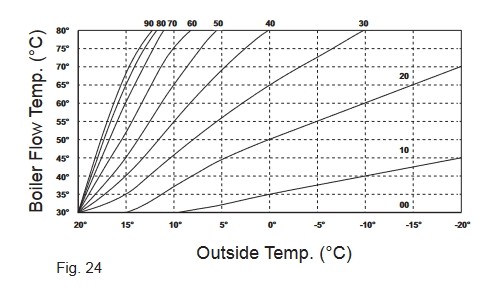
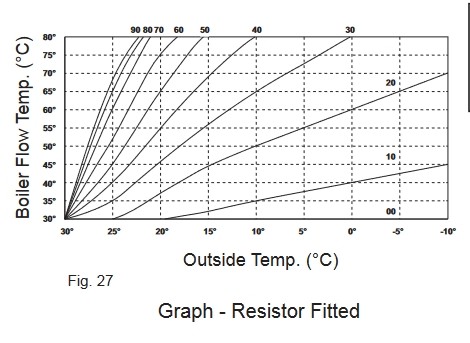
That's the graph for our system boiler and as you can see if its 20C outside then you won't get more than 30C through the rads. For people who need it warmer a resistor can be fitted to modify the curves as below:

It doesn't imply that rads are as large as they'd need to be for optimal ASHP operation and it also doesn't mean microbore isn't present.

*fitted as standard with new boilers for 15 years or so (assuming the plumber was competent).

C
#46 CW

Windy Miller Is that switch part of the boiler, or is this something that you (had) added to the system? My boiler only has the one dial which is marked as radiator temperature, but this also sets the hot water temperature so I try to keep it at around 60 going out (the run from the boiler to the water tank is only about 3 meters away so I would guess the hot water temp is around that). Ideally I would prefer a set-up where I could set the water temp seperately.

C
#47 CW

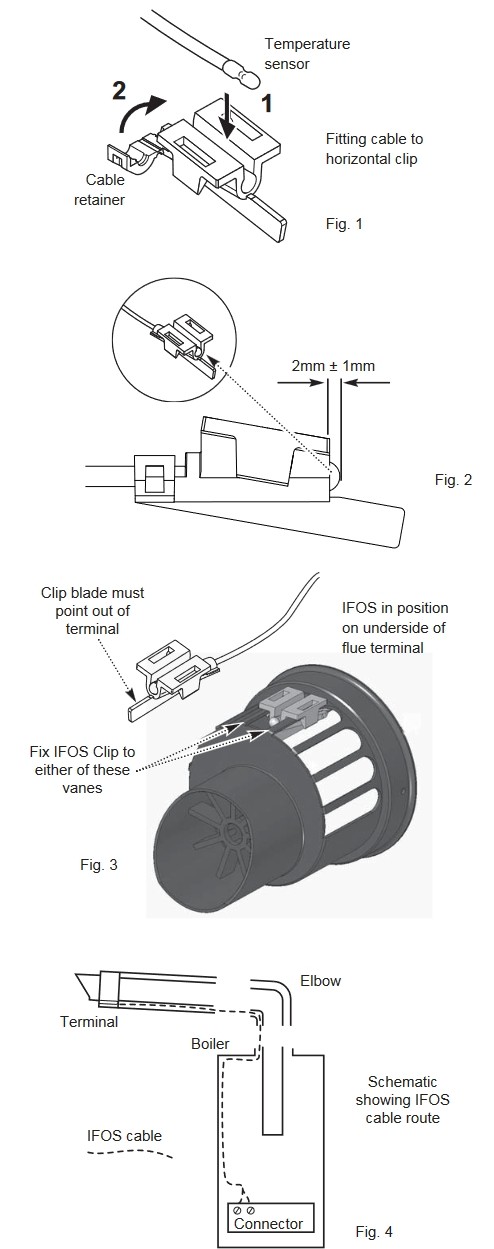
Vestas How can you tell if you have a compensatoer fitted? My boiler (Worcester) was only fitted about 10 years ago

V
#48 Vestas

CW It'll be attached to the flue - see below:

#49 Judith

Roy124
On the other thread you said you needed just under 8kW, which seems very high for a house with ufh. UFH implies a modern well insulated house, designed for ufh. I think you used heat punk to calculate this which is an excellent tool.
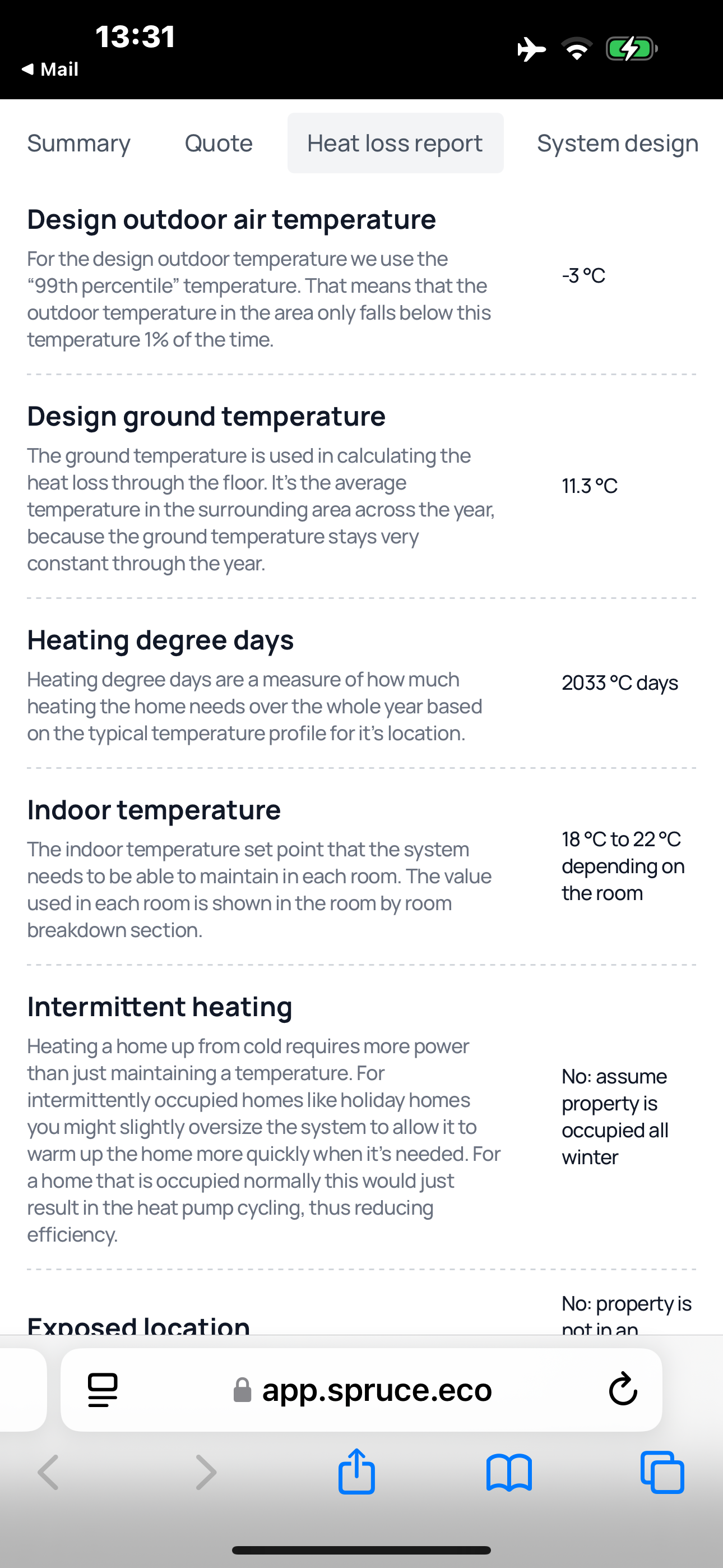
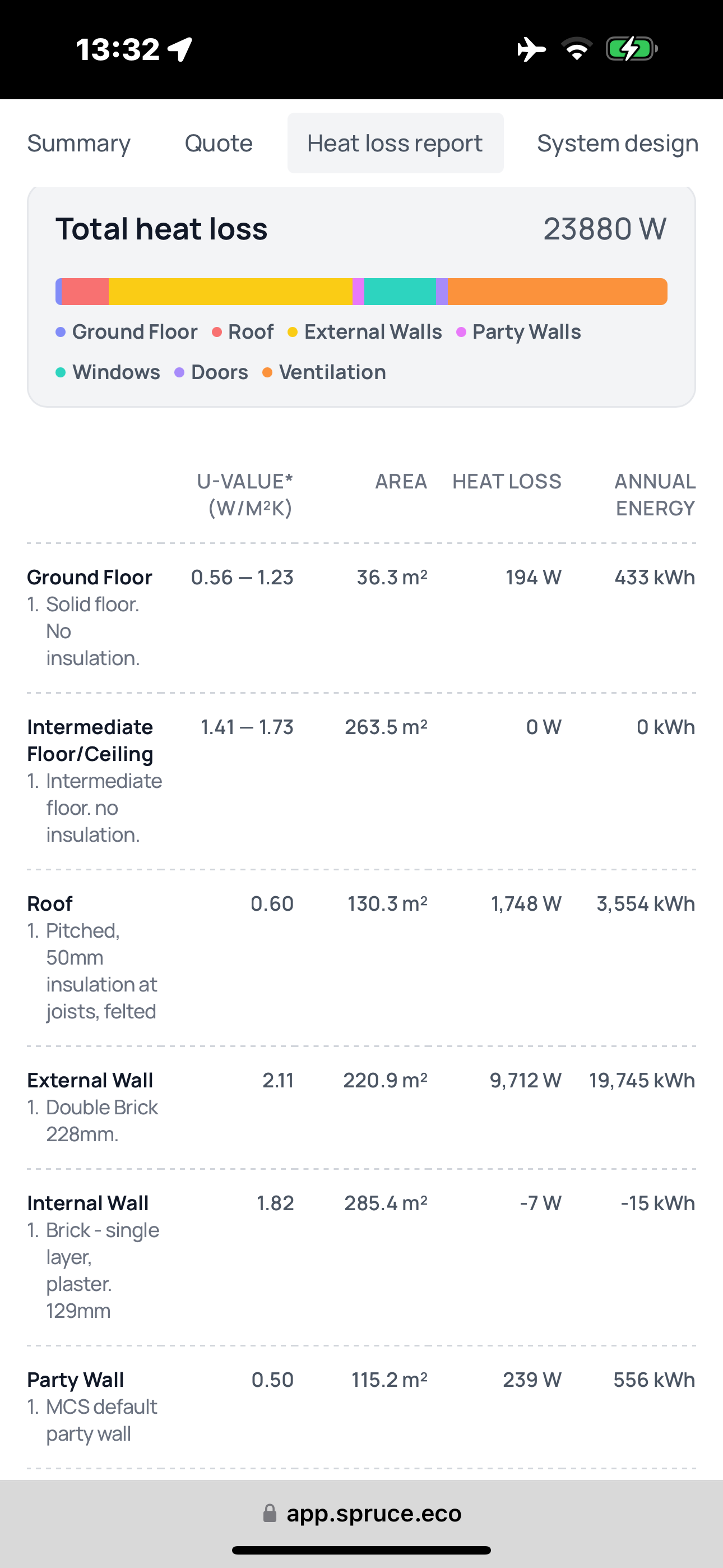
Did you spot the default air leakage which is on the heat pump tab. The defaults are very high and in our case gave 30% more heat loss.
It’s worth a lot of personal effort to get the 8kW Daikin not the 9kW if your house heat loss is truly lower. The 9 is a software downgraded 16kW model (just as the 4 is a downgraded 8kW) and the lowest power any HP can give out continuously is 30% of max after which they switch off. This is known as short cycling and is inefficient (see utube and John Cantor video for great explanation)

C
#50 CW

Vestas Thanks. I'll take a look - can't remember seeing anything like that though 😥

D
#51 DD

Judith Did you spot the default air leakage which is on the heat pump tab. The defaults are very high and in our case gave 30% more heat loss.

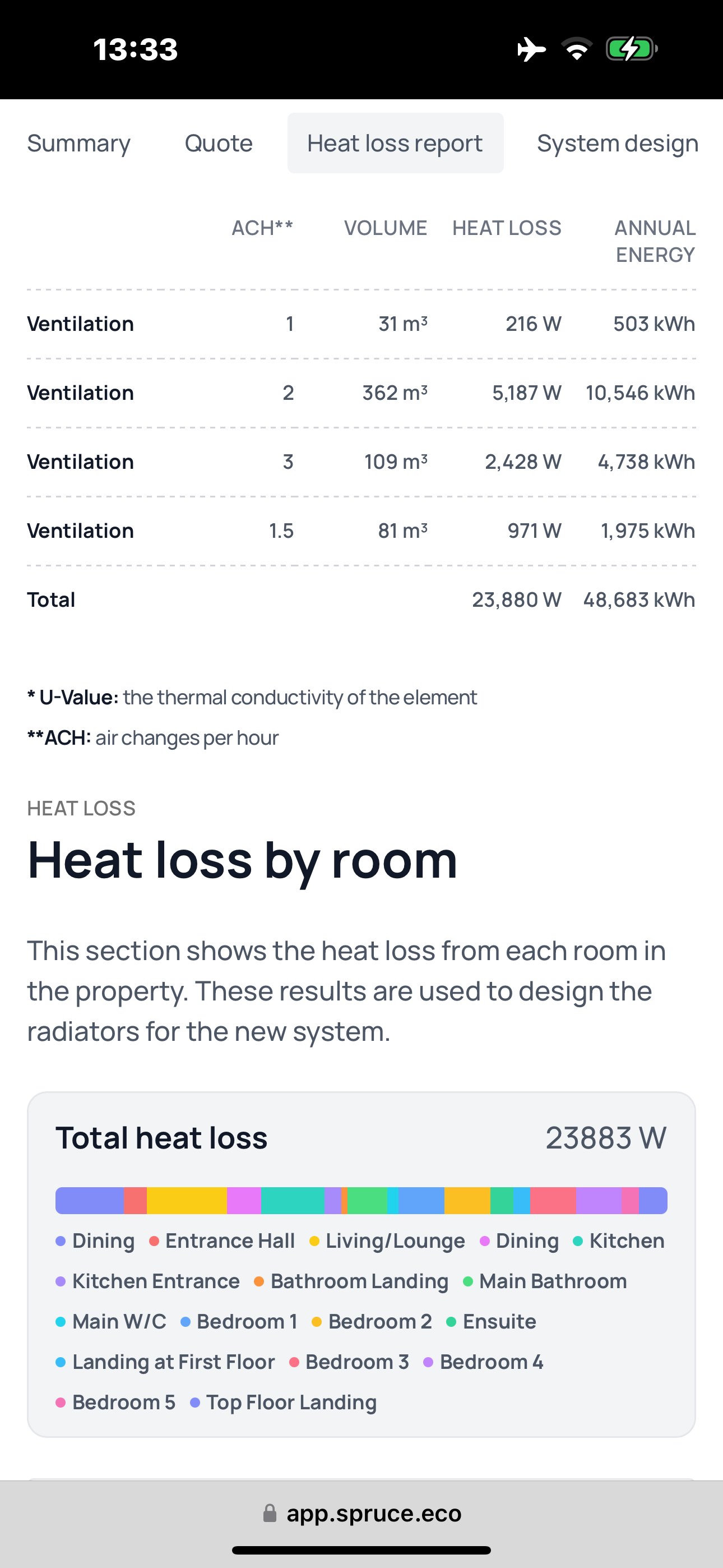
AFAIK the MCS have guidelines based on the age/type of property, and certainly for older houses they are crazy - I think mine are 1.5 air changes per hour. I think all the surveys I had done stuck with those defaults, whereas (I have heard) heat geeks use more sensible values (0.5, perhaps?). One suggestion was to get a blower test done to prove that lower values could be used. I did hear an interview with some octopus people acknowledging that the air changes they were using tended to give unrealistic heat losses, and perhaps they should do blower tests as standard.

I did try to push octopus to give me an 8kW unit rather than 9, but they wouldn't budge. But they were so much cheaper than the others that I figured the difference would pay for a lot of wasted electricity.

V
#52 Vestas

DD One suggestion was to get a blower test done to prove that lower values could be used.

I think you'll find that a leak test will show MUCH higher actual losses compared to estimated/assumed losses.

For example passivhaus standards require 0.6 air changes per hour so the idea that an average house is less than that is risible.

Brand new houses in the UK will have 1.5 air changes per hour by design - which equates to about 5m³/h.m² - and to achieve that figure for the EPC test they tape over vents/sockets/you name it.

R
#53 Roy124

Judith thanks, I have yet to study Heat Geeks. The surveyor has postponed his second visit from today till the 25th which gives me more time to look. I may be mixing apples and pears. My current gas consumption is 11000 kW give or take (they estimated 10654 - 8344 heat and 2309 water). The EPC values they have come up with are 7677 kW for heat and 2125 kW for water giving 9802 kW. They then

The electricity consumption they estimate with an ASHP is 2207 kW and 923 kW, a total of 3130 kW.

I may be confusing myself. The ASHP they will install is 8 kW and I was comparing that with the 9802/10654 figure.

Is the 8 kW ASHP matched to the present gas energy required?

V
#54 Vestas

Roy124 This is actually a good example of the economics of heatpumps in the UK.

Assuming 22p/unit for electricity and 6p/unit for gas....

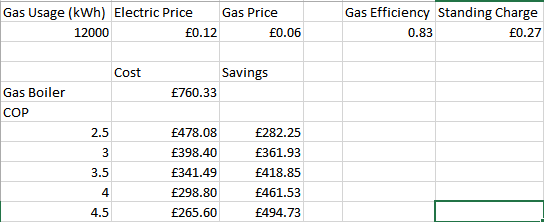
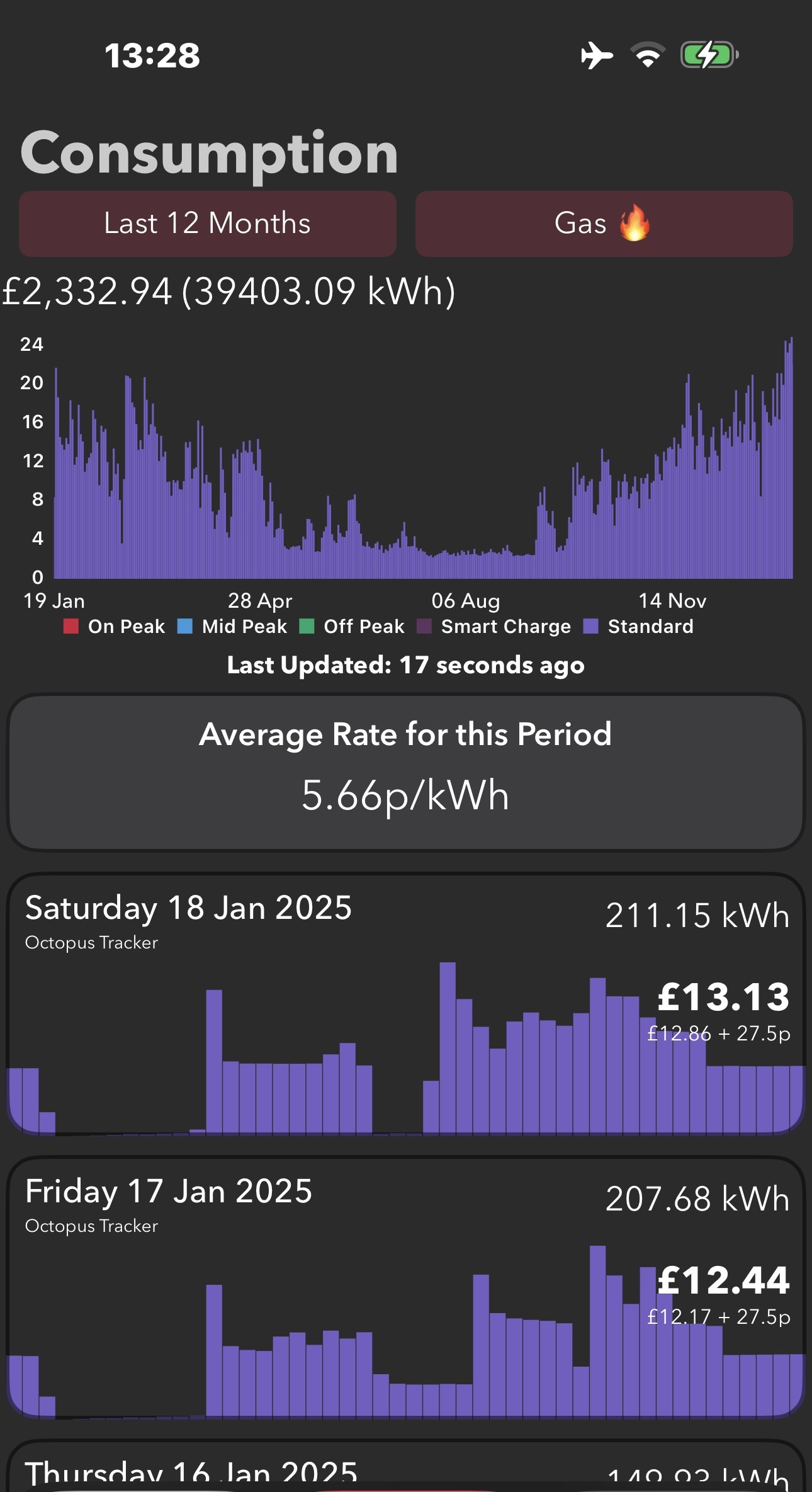
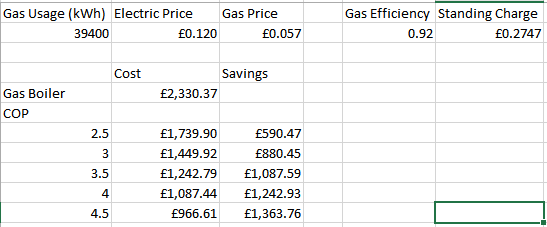
11000 x 0.06 = £660 to heat house/water per year using gas.

3130 x 0.22 = £688.60 to heat house/water per year using heatpump.

Obviously if a battery/PV is present then you can get that electricity figure down somewhat but the capital cost of PV/battery/ASHP is going to be over £20k without grants so you're never going to recover the capital cost.

Makes financial sense if you have no mains gas, doesn't make any financial sense if you do.

Bumping gas prices to the same level as electricity prices is politically unacceptable as it guarantees the incumbent govt will lose the next election.

Edit - apparently the difference between gas price and electricity price is called the "spark gap" and the UK has the second (or maybe third) highest spark gap amongst first world countries.....

R
#55 Roy124

Vestas I agree with your assumptions and acknowledge economics. I have also factored in the loss off the capital. The nub is that spark gap you mention. It really depends on how green the Government choses to go.

V
#56 Vestas

Roy124 It really depends on how green the Government choses to go.

You can forget that, they've been captured by the fossil fuel lobby already.

£22bn on CCS (carbon capture & storage) tells you all you need to know.

This is an amusing - and accurate - video regarding CCS. Note that the language is not "work-friendly":

https://www.youtube.com/watch?v=MSZgoFyuHC8

R
#57 Rbor

Vestas

Weather compensators* take care of running rads at a low temperature so you do get the efficiency from a gas boiler. Just like a heat pump the efficiency degrades with colder temperatures.
*fitted as standard with new boilers for 15 years or so (assuming the plumber was competent).

And this is the crunch. What proportion of gas boilers are connected to an outside weather compensation monitor?
Some seem to claim weather compensation using data from local weather stations.
Reading around, it seems that a weather comp monitor and necessary connectors to gas boiler are additions at cost of £250 for materials + installation. My old gas boiler was a Vaillant ecotec pro 28 from 2015. I still have the manuals and there is nothing about weather compensation (although that may have changed now).

Rob

#58 Windy Miller

CW The boiler, a Potterton Envoy 30, has a high/low switch to change the flow temperature. As this was a switch I wired it to a Heatmiser Wifi thermostat. This gave me networked time and temperature control on the switch. I set the time to coincide with the Hot Water time (6-7am) and the temperature to below 7oC ('OR'ed together). The thermostat is in the loft next to the boiler and 7oC inside the loft meant about -1oC outside. This all works without manual intervention. Our hot water is stored at between 55 and 60oC (higher when I use the immersion heater on cheap Agile slots) but the radiators sit usually around 46oC average temperature (flow 52oC, return 41oC) which, whilst having a longer warm up time, hold the temperature in each room very well. Each radiator (8 off) has its own Heatmiser smart thermostat to bring on the heat in advance of when required which self adjusts for the changing room characteristics (losses) through the winter. All in all it works brilliantly with a £700 bill each year for gas. Getting a heat pump to work as efficiently could be a challenge without major expense so I'm trying to keep it going until Gas prices become exorbitant.

R
#59 Rbor

Vestas
Well said.
CCS sounds great as a policy especially if used to generate hydrogen for use as heat.
Just react together gas and steam to produce hydrogen and CO2. Then remove the CO2 using CCS and distribute H2 along the existing gas pipes. How costly is this? You can guess the companies promoting this (and why).

Rob

#60 Windy Miller

CW Some boilers have separate heat and hot water temperatures which might require a separate sensor. I thought the Worcester Bosch unit could be set to separate temperatures - we had one at the Church but it failed 2 years ago and was decommissioned in favour of electric warm air blowers on time switches.

S
#61 SteveCook

Vestas 11000 x 0.06 = £660 to heat house/water per year using gas.

3130 x 0.22 = £688.60 to heat house/water per year using heatpump.

Obviously if a battery/PV is present then you can get that electricity figure down somewhat but the capital cost of PV/battery/ASHP is going to be over £20k without grants so you're never going to recover the capital cost.

Makes financial sense if you have no mains gas, doesn't make any financial sense if you do.

A heat pump only really helps HMGov carbon emissions by getting home owners to fund the Capex.
A heatpump will cut your carbon emissions but not your energy bills unless you have a source of "cheap" electricity. More Capex by the home owner for PVs and/or battery that HMGov dont fund

R
#62 Rbor

Windy Miller Sounds like you have a neat system with a water cylinder.
Most gas boilers are combis and the old water cylinder went a long time ago, the space occupied being used for other things. But combis are very convenient.

Before getting a heat pump, I had a gas combi boiler (Vaillant ecotec pro 28). I experimented with the flow temperature and got it down to 50C (and just got away with it) from Vaillant default of 75C. I may have been more successful but from my heat loss survey many rooms had inadequate rads.
Perhaps 50C would have worked with my gas boiler in all rooms if a heat loss survey were to be carried out with rads then upgraded. I would then be 'heat pump ready'.
The manuals for my old gas boiler which was 10 years old, said nothing about weather compensation. It looks as if it can be purchased as an add-on. Cost, say £250 + installation using a plumber who knows what they are doing.
It is very difficult to (impossible?) to save on instant hot water from a combi as cold water is blasted with heat over a short length of time.

As mentioned before, a heat pump needs a water cylinder. Where does it go?

Rob

S
#63 SimonClarke

Lot of talk about the cost and very little about saving the planet. Latest hurricanes, central european floods, French and Portuguese flooding etc probably best not ignored.

D
#64 DD

Roy124 I may be confusing myself. The ASHP they will install is 8 kW and I was comparing that with the 9802/10654 figure.

Is the 8 kW ASHP matched to the present gas energy required?

Be careful of units - annual consumption is in kWh, not kW.

There is a very simple heuristic for turning annual consumption into heat loss, based on degree-days. There's lots of theory behind it, but the simple takeaway is that dividing annual consumtpion by a constant (depending on where you are) gives approx size of heat pump required.
https://tinyeco.com/what-size-air-source-heat-pump-calculator

Roy124 Pending a specific thread, I see my heat requirement is marginally below 8kW with hot water bringing it near 10kW. The Daikin unit is only 8kW. I will speak with the surveyor tomorrow.

Bear in mind that the heat loss is calculated for the coldest likely day, which will only be a few days per year. My inclination would be to size the heat pump to cover room heating, and if there's not sufficient capacity to also do the water a few days a year, using the immersion heater will be perfectly fine. COP of heat pump on cold days will be pretty low anyway, so you're not losing much.

R
#65 Rbor

Germany are going full speed towards hydrogen. There's a great podcast from 'Cleaning up'.
https://www.youtube.com/watch?v=R1GCzEuCQcI&t=11s
It's long but very informative.

The fossil fuel industry is doing a good job in Germany to maintain gas and I worry about Germany's future economy and energy resilience if really does throw most of its eggs into the hydrogen basket.
Remember, they closed down all their nuclear sites.

Rob

#66 Windy Miller

Rbor Thanks for that. System designed and fitted by myself in 1997 after doing my own heat-loss analysis using an old DOS program on the work computer. Replaced the thermostatic valves with electric valves about 8 years ago. I had the Megaflo professionally installed in our airing cupboard in 2021 (but I specified it). All controlled by a Heatmiser UH1-W multi-channel wireless receiver.

It's not eco-friendly as I don't believe gas systems could ever be eco-friendly but it is better than most and certainly, whilst the electric energy mix is still using about 60% non-renewables, is currently not too bad.

http://grid.iamkate.com

V
#67 Vestas

SimonClarke You aren't "saving the planet" by getting a heatpump.

R
#68 Rbor

Many folk are interested in getting Octopus for HP installation. They have mainly used Daikin.
There's an interesting thread in the OpenEnergyMonitor forums outlining experiences with Octopus and Daikin:
https://community.openenergymonitor.org/t/octopus-survey-outcome-with-11kwh-daikin-hp/26765/1

Form your own opinions from the comments, some snapshots below (but there are complimentary comments also) but the whole thread is worth investigating:

  • The 9,11 & 14kW Daikin units are just software derated 16kW units

  • Personally, I would avoid Daikin. I don’t have personal experience with them, I’ve just been following threads on this forum. It’s also very early days for the Octopus Cosy heat pump, the data I’ve seen so far does not look very promising, but I would like to see some more data before forming an opinion.

  • Personally I would be looking at the newer vaillant units arotherm+ as they are easily configured for cooling aas well and seems to have a better range of sizes. Octopus do not offer them though and if you are price sensitive the octopus installs are ok and they do seem to care about the aftercare and support. Just be sure to check your radiator schedule as they have a habit of not sizing all rooms correctly.

There are many threads on all aspects of heat pumps and surveys of different brands. Just type the brand into the search field on https://community.openenergymonitor.org Loads on Vaillant which tends to be the commonest installed (but not installed by Octopus).

Rob

V
#69 Vestas

Some rough calculations based on Roy124 's numbers.

The carbon cost of a heatpump installation is in the order of 1500kg of CO2.

That's roughly 6000kWh or so to "recover the CO2 cost", assuming 100% renewables (using GE portal figures here for PV generation so could be nonsense).

However the grid is only 40% renewables so the true cost of recovery is 6000/0.4 = 15000kWh.

Roy is forecast to use 3130kWh per year so to recover the carbon cost of the heatpump takes 4.8 years. That's a significant portion of the heatpump's projected lifespan and then its rinse/repeat time on the next install.

So the tl;dr is that you won't save any money over gas and it'll take multiple years to simply recover the CO2 produced to manufacture/install the heatpump.

Frankly it sounds like complete lunacy to me at this time (in the UK anyway) if you have mains gas.

S
#70 SimonClarke

2nd quarter this year was 51.6% renewable generation. Octopus claim 100% renewable and I know the system is cheated by the REGO certificates but presumably it is still better than some others. Various numbers for carbon saving from 1400kg to 2900kg per year for replacing an old gas boiler.

A
#71 Avenir

Vestas what’s the carbon cost of a new boiler installation? Shouldn’t that be deducted from the HP carbon cost? Assuming the HP is being installed to replace an ageing gas boiler approaching end of life.

It’s not just carbon. Domestic boilers contribute a significant proportion of NOx emissions.

#72 Windy Miller

Vestas I'm with you here. Your numbers reinforce my view that the correct time to install a heat pump is when your mains gas system is failing or the spark gap (electric/gas cost ratio) reduces significantly which may coincide with the grid becoming mostly renewables. I would guess around 2030 (but I wouldn't bet on it) so, if your mains gas system is still working properly, is replacing it with a heat pump really the right thing to do? I will wait a bit more. (Tin Hat On!)

D
#73 DD

Vestas
11000 x 0.06 = £660 to heat house/water per year using gas.
3130 x 0.22 = £688.60 to heat house/water per year using heatpump.

Though you probably save more than £28 if you get rid of the gas standing charge. But once you consider the size of the error bars, it's hard to actually pick which one wins.

Makes financial sense if you have no mains gas, doesn't make any financial sense if you do.

Hypothetically, what about the case where gas boiler needs replacing anyway? How far apart are the capital costs (for the end user, ie including BUS grant) for heat pump vs gas boiler ? Would modern standards for gas require upsizing radiators to cope with lower flow temperatures ?)

(In practise, if your gas boiler breaks, you don't really want to be starting the process of getting heat loss calculations, etc...)

R
#74 Roy124

Windy Miller I wired it to a Heatmiser Wifi thermostat. This gave me networked time and temperature control on the switch. I set the time to coincide with the Hot Water time (6-7am) and the temperature to below 7oC ('OR'ed together)

This is another driver for change. I have a Heatmiser wired system that requires each room thermostat to be adjusted for time and temperature. Using the Holiday or Froststat settings when we go away is not ideal and leaving the settings with our normal routine is a waste of energy.

We have a household alarm system where I can monitor room temperatures and outside temperatures. I did look at converting the HM system to WiFi but could not get any information from HM on upgrading our system.

V
#75 Vestas

SimonClarke ...and third/fourth quarter will be lower.

Although I'm on Agile I'm not a fan of Octopus but one of the things they're doing right is vertical integration - ie building and running their own windfarms/PV arrays. Doesn't change the mix that much yet.

I was talking about recovering the actual carbon cost of the heatpump install with those figures, not potential CO2 emission savings compared to a system you had removed and which are directly related to usage 🙂

Govt policy is nonsensical (ASHP grants) and incoherent regarding climate change and decarbonisation. Just like the last lot.

V
#76 Vestas

DD Hypothetically, what about the case where gas boiler needs replacing anyway?

Gas boiler for a 4/5 bed house costs about £3k for install here, a lot of that is labour/profit. Wholesale its about £1500 for the boiler itself.

#77 Windy Miller

Roy124 Yes that was one of the downsides of my system was putting it all into holiday mode when we went away. (8 rads plus 6 that call for heat). I solved this by putting a networked heatmiser switch into the feed to the boiler. I simply turn the boiler off above 10oC when we go away (frost protection). I'm using the Neos for the radiators and the older Wifi stats for the call to heat.

V
#78 Vestas

DD Would modern standards for gas require upsizing radiators to cope with lower flow temperatures ?)

Not really. What you'll find on new-builds is that there's more rads fitted and they'll mainly be single-panel rather than double. That way the boiler can be set to run at a lower flow rate temperature, more (smaller) single-panel rads heat up the house quicker and that way they get the SAP approval.

S
#79 SimonClarke

Vestas presumably the percentage of renewable generation is rising all the time?
Where does the 1500kg carbon number come from? Not disputing it just couldn’t find anything

V
#80 Vestas

Rbor Reading around, it seems that a weather comp monitor and necessary connectors to gas boiler are additions at cost of £250

Seems somewhat expensive if fitted at the same time as the boiler. If retrofit then fair enough given the flue will have to come out.

In terms of number of boilers with weather comp - no idea but its the only way to get the SAP rating on new-builds and has been that way since probably 2016 or so. I know we got it "as standard" when we changed the boiler in the last house which would have been 2018 or so.

There generally isn't anything in the boiler manual about weather compensation as its usually optional so there's a separate sheet/manual for that - although there wasn't for ours because the builder ordered the boiler with the sensor. Caused a little confusion for me but at least the install guide was downloadable and more importantly the graphs I posted earlier in the thread were there.

V
#81 Vestas

SimonClarke I'll see if I can dig it out. Its from a report a couple of years ago but the link is now invalid so I'll have to search the site/chase up someone later. A lot of the cost is (unsurprisingly) transportation as we are apparently incapable of making them 😉

1500kg of CO2 isn't that much really. Sounds like it is but if you drive then that's probably 6 months emissions from a small petrol car driven mainly in urban areas.

Don't get me wrong, heatpumps work and they work well.

However with the UK energy mix now (and for most of the next decade while the grid gets expanded) they aren't the magic bullet that the govt/media would have you believe. For countries like Norway they absolutely are that magic bullet because of hydro power forming the backbone of their grid. Here not so much as decades of mediocre/appallingly bad govt policy comes home to roost....

S
#82 SimonClarke

Vestas just wondering if it was like the one Volvo put out saying ev’s needed mega mileage before they were better than ice which they admitted was wrong.
No idea why we seem incapable of making batteries, wind turbines, heat pumps etc. At least we were slightly less short sighted than some of our eurozone neighbours….Whether the current mob do a better job than the last muppets who knows but I think their heart is in a better place.

S
#83 SimonClarke

Rbor Analysis just reappeared!

V
#84 Vestas

SimonClarke Pretty certain it comes from a reference in this but I haven't checked yet:

https://commonweal.scot/policies/the-common-home-plan/#contents

Its a fairly detailed plan in terms of what Scotland needs to do to become carbon neutral. Much of it (land etc) is very specific to Scotland and the organisation who wrote it probably look very left-wing to some of you but its worth a perusal if only for the sheer number of changes people are going to have to be persuaded to make.

Pretty sure the ebook download is free, or you can pay if you choose to.

Oh I know what you mean re Volvo etc but if we're going down the "saving the world" route (and I'm not making fun of you) then it all counts. The carbon cost of the installer driving to you (120g/km minimum), cost of the heatpump coming from wherever and that's before you count the actual manufacturing cost which is contentious to say the least.

V
#85 Vestas

SimonClarke No idea why we seem incapable of making batteries, wind turbines, heat pumps etc.

Its simple. The UK has had a rentier economy for 50 years plus. By that I mean its easier for a company to make a return on investment by investing in property/financial products than it is to actually do R&D and with a fraction of the risk.

Apologies to those who read much the same comment on El Reg 😉

And apologies for derailing the thread....

R
#86 Rbor

SimonClarke I can see Analysis details in iPad but not on iPhone.
I have just deleted Vicare from iPhone and re-downloaded.
I now don't even get an analysis button!
I can see my settings and am communicating to the Viessmann control.

Did you email Viessmann with this issue and, if so, what is the email address?

Thanks

Rob

S
#87 SimonClarke

Rbor just went on the contact us biton the website. Never heard from them it just reappeared. Maybe a time thing? Just needed a while to get going again. Seems fine now. The reason I deleted it was because it kept just whirling around for ages and never did anything. When reinstalled the button just disappeared. Back now.

A
#88 Avenir

Windy Miller

Your numbers reinforce my view that the correct time to install a heat pump is when your mains gas system is failing or the spark gap (electric/gas cost ratio) reduces significantly

At this point there would presumably be no need for a grant at the current level, since consumers would be incentivised to make the capital investment of HP install by cheaper running costs. By that logic it would be better to get the heat pump now to benefit from the grant and potentially also a reduced spark gap in future.

I guess the way the spark gap would be reduced is that if the price of gas is increased and the price of electricity decreased proportionately, bills for the average-consumption dual fuel home would remain the same, whilst the consumer would be incentivised to ditch the gas. However, the consumer might also be disincentivised to install solar and batteries, because electricity is now cheap.

which may coincide with the grid becoming mostly renewables. I would guess around 2030

The government have a manifesto commitment for a zero-carbon grid by 2030… conveniently, 2030 is not in the current parliament 🙂

#89 Windy Miller

Avenir Over the last few years I have been responsible for 4 gas boilers and 2 heat pumps in various locations. When the first gas boiler failed 2 years ago I decided to put in standard hot air blowers as the space they heat is only used a few hours a week. The other gas boilers are still going strong. When they need replacing the one which heats three adjacent 50 seat halls I would replace with 3 small air to air heat pumps. The last 2 gas boilers are used in tandem to heat a 500 seat hall - two give a reasonable heat up time but in fact one could cope on its own. If one failed I would supplement the remaining boiler with an air to water heat pump system with underfloor pipework. But this entails relaying the floor which may be tricky. The 2 heat pumps were installed in 2011 and each heat 100 seat halls. They are 6KW units with a COP between 2 and 3 so generate about 15KW of heat. Due to poor efficiencies in the original gas heated pipework the heat pumps running costs are about half of the original price for the same level of heating except when the outside is below freezing when they struggle. I would need to be persuaded to replace like with like if any of these gas boilers failed even though that is the easy option in public spaces.

With mine at home I would likely use an air to water heat pump as I don't think I need to uprate my radiators.

#90 Judith

Vestas
Your assumption of measurement of air leakage always being higher than the default values doesn’t always fit.
Our 1950s house (concrete block render outside and wet plaster inside) has an air leakage of less than 1ACH (air change per hour an intuitive unit) when measured withe the door test at 50pA.
Actual leakage is less again by a factor of 10/20 depending on how exposed your house position is. The default for our bathroom and kitchen was 3ACH.
We have adequate ventilation by use of a MVHR (mechanical ventilation with heat recovery) ducting system that we had put in when we refurbished the house 14 years ago.
The impact on heat loss is significant down from an additional 30% to 2%.
The cost of the measurement was about £300 with the option of going around your house finding out where the leaks were coming from, which helped us find some holes into the loft that we inadequately blocked and reassured us on loft hatch and bathroom pipe leakage being minimal. The incremental cost on annual bills of having an oversized pump is difficult to estimate but might be £100 per year.
We had to to done ‘significant leaning’ on heat loss assessors to get them to use actual values not defaults but they did eventually.

S
#91 sponev

Heat pumps have definitely worked for us but in the A2A configuration and as part of an integrated scheme with a fairly large solar array and batteries. We also run an EV. We have 10.1 kwp E/W solar, 19kwh of battery storage and a (little used) Eddi diverter for hot water. We run two Daikin external ASHP with 5 internal "blower" units - heating and cooling which work very well. We use these as required and they do not need to run all the time like A2W systems - so the batteries keep them going over 95% of the time without peak rate grid draw. Our net annual energy bill is effectively zero but I acknowledge this may change if export rates decrease.

We also retained the gas boiler for hot water and to supplement the ASHP on the very coldest, sub-zero days, maybe 4 or 5 days per year. It's not that ASHP wouldn't keep us warm on those days, more that decreased COP means that gas is actually cheaper to use for heating. It's possibly also worth mentioning that the house is 'A' energy rated.

Total capital cost, solar, batteries, ASHP, Eddi, car charger etc was around £27k, so not trivial. However we save at least £2.5k per year on energy usage plus a good amount through cheap energy for the EV. I guess I should do the sums carefully but I'm happy in the knowledge that the payback is sub 10 years for all of it. We had other reasons for the project as well, not just financial.

Whether heat pumps are justified outside of an integrated scheme like this, particularly the A2W variety, is still debatable in my opinion. However as part of a fully integrated scheme and using the more flexible A2A configuration, I think they do make sense. One of ours is ticking away drawing about 700w at the moment - it's 7deg outside and the inside of the house is between 20 and 21 deg throughout. We lost about 1.5 deg overnight but then there wasn't any heating on and it was quite chilly outside.

This is just our experience, YMMV of course.

R
#92 Roy124

sponev nothing like your extensive array but the 8-9% return is comparable with our own calculations and monitoring. Set against this however is the loss of dividend on capital which is currently also 8% (so no loss) but the system is a wasting asset. At the end of X-years we would still have our principal but would have an asset worth much less. Over X-years the whole system could be written off. OTOH we hope the home saleability would be greater even if the value increase is minimal.

We did consider buying an attractive house about 6 years ago. It had two contrary factors. The garden was not large but terraced which was not ideal with advancing years, but the killer was the PV system. It benefitted from FIT and would have cost IRO £20k but the vendors had priced their home at £20k above similar properties on the estate - cheeky.

S
#93 sponev

Roy124 Very valid points for a rigorous assessment, however I personally wouldn't go that far for one of my own domestic projects - as long as it "sorta makes sense" and delivers on some of the other intangibles is usually good enough for me these days. We recently got both of the kids into their own houses and refurbished our own, so cash we'll never see back but still very rewarding in lots of other ways. If I was younger and in the days where I had to evaluate every pound spent, I'd likely take a slightly different approach!

R
#94 Roy124

sponev quite agree. At least I didn't have to fund my children's houses. I got my maiden aunt to thank for that.

D
#95 DD

Judith pump

Judith The incremental cost on annual bills of having an oversized pump is difficult to estimate but might be £100 per year.

I went with octopus because, even though pump is probably oversized, was over £2k cheaper than next best offer. Which pays for a lot of extra electricity.

S
#96 SimonClarke

I originally wanted a 6kw and have ended up with a 8w. Yesterday was cold - car covered in frost at 8am - house warm (possibly too warm) and dhw hot , ashp showing it used 16.9kw to produce 70.3. 1/3 for dhw rest heating. Octopus showing we only used 7p juice on IOG none at peak but it was a sunny day. So so far I guess my installer was right

V
#97 Vestas

SimonClarke If the weather is calm then the heatloss is dramatically reduced in most houses - wait until its 0C and 20mph+ windspeed for 24 hours and I'm pretty sure you'll be glad you didn't get a 6kW heatpump 🙂

V
#98 Vestas

Judith Our 1950s house (concrete block render outside and wet plaster inside) has an air leakage of less than 1ACH (air change per hour an intuitive unit) when measured withe the door test at 50pA.

I'm not entirely surprised by that - those sort of houses were often either poorly ventilated or gaps everywhere. Plaster on block inside helps a lot because its very very rare that dot & dab plasterboard is done properly.

Judith We have adequate ventilation by use of a MVHR (mechanical ventilation with heat recovery) ducting system that we had put in when we refurbished the house 14 years ago.

Well as part of that they would have looked at controlled airflow and plugged the major gaps so your house isn't really "average".

One of the "small gains" I can make in this new-build is replace the trickle/boost fans with MVHR but at present the through wall units (110mm retrofit) are simply too expensive to justify. We have four trickle/boost fans and that'd be like a grand or so which is silly money compared to savings.

S
#99 SimonClarke

Vestas one whole month in I’m guessing we have lots of discoveries coming up! But so far so good.

V
#100 Vestas

SimonClarke Low and slow appears to be the advice/greeting to the newbie heatpump owner 😉

R
#102 Roy124

There is certainly a case for outlining the real requirements for boiler replacement. No matter how much it is stressed that your home must be well insulated there must be thousands that can never be improved to a sufficiently high level for effective ASHP installation. There will be many Victorian terrace houses that even lack the space for a heat pump or even the associated HW storage.

Our home in Scotland, built in 1972, was sound with concrete and harled external walls and thermalite inner walls. It had some loft fibre glass to which I added more and I also had cavity foam fitted. The floor was suspended wood with no insulation except carpet. Modern certainly but still woefully substandard by today's measures.

S
#103 SimonClarke

Funny he’s recommending something he makes!

P
#104 Pete UK

Has anyone here got a Victorian property with a heat pump? Any feedback?

Ours is a 5 bed halls adjoining Victorian semi, over three floors in the main part. Approx 2,500-3,000 sq ft. It’s L shaped and has 3 roofs. The longer part of the L being the bit that’s joined to next door and the smaller part of the L being the front. One roof on the main 3 story part at the front, one over the first part of the rear (two floors) and a lower one stepping down again at the rear (single floor but high ceiling).

The external walls and some internal walls are about 18” or 24” thick solid brick and obviously no cavity wall.

We have 3 lofts which need insulating. 2 Boarded with likely 100mm of insulation underneath. One at the back is inaccessible. So who knows if it’s insulated at all. Currently getting quotes to stick in a decent depth of insulation. 500mm? Is that decent enough? Or is more better? Is it just the more the merrier?

We have electric underfloor heating mats in the kitchen which is at the back of the property, about 30’ by 12’ with a high ceiling (bathroom covers half of the kitchen roof above). Also 4 other smaller heating mats in en-suites and in the garden studio (where the rear garage used to be). These aren’t used as much.
The kitchen floor can be pretty hungry in winter but we can just about last all day in winter on all off peak 7p electricity with our 38kW of battery storage.

Anyway, last year we used about 40,000kWh of gas for heating and hot water - £2,600. Assuming the insulation reduces our heating by 30% to approx 30,000kWh (No idea how much of that 40,000 is HW). I guess we’d need a pretty big heat pump. Perhaps 11kW+ ?

If we had a couple of rads put in the kitchen for the HP and didn’t use the electric underfloor mats. I recon we’d save a fair amount there. Easily enough probably to run an Air to Water heat pump instead all day at the 7p rate stored in the batteries.

On the face of it, it looks like I could potentially have a £500 a year extra electric bill for running the heat pump compared to £2,000 gas bill after the insulation (assuming a yearly average of 6.5p per kW on Octopus gas tracker and assuming a SCOP of 4.0.
I’m currently exporting all solar and the excess in the batteries to the grid for 15p at the end of the day, so I’d likely lose 15kW a day on average (?) of that export in the shoulder seasons and in winter maybe more). I just don’t know how things would pan out if I switched to a HP; Thats my main unknown.

There are a lot of uncertainties and variables. I believe being on IOG and having large enough battery storage to feed the HP all day including in winter could be what swings it for me. 7p vs 24p or even 12p or whatever average makes a massive difference!

Do my numbers seem about right?

Has anyone with a similar Victorian property had a heat pump fitted and what is the result? Does it work/ save money or not really?

R
#105 Rbor

This is from Viessmann:
Generally, 270 mm is the recommended depth. More will help but you will get diminishing returns.
100 mm isn't enough!
There a good article here but prices are 2020. If you can insulate the loft yourself, it won't cost you much.
https://www.viessmann.co.uk/en/heating-advice/boilers/how-much-loft-insulation-do-you-need.html#:~:text=We'd%20recommend%20everything%20in,sticking%20with%20the%20lesser%20amount.

This is a key section:

Can you over insulate a house?

Above, we’ve provided the minimum thickness that your insulation should be to ensure that your home stays nice and toasty in winter. But is it possible to over insulate?

We’d recommend everything in moderation. While some people argue that an over-insulated house could cause damp, mould and other issues. Typically, upping your loft insulation from 270 mm to 400 mm isn’t really going to make a big difference, and so it’s probably worth sticking with the lesser amount. Once you’ve insulated your loft, you should have a look at other areas where your house could be losing heat, including the windows, doors, walls and floors. Rather than over insulating one part of the house, it’s best to spread a moderate amount all over. If you have worries about this then you should contact an insulation expert.

You really need to get some idea of total heat loss from your house. There is a good 'do-it-yourself' piece of interactive software here (basic: free): https://heatpunk.co.uk/home
I think that I sourced the software originally from https://midsummerwholesale.co.uk which is a good source for finding out what is available and prices.
When I had a proper heat loss assessment carried out by a a heat geek installer, my 'heat punk' estimate was actually pretty close to the installers.

On running costs, I always go back to the adage: "It depends on the installation".

This is also useful, concentration on current (2024) building regulations:
https://www.greenmatch.co.uk/loft-conversion/rules-regulations

Hope that helps to give you some levers.

Rob

R
#106 Roy124

Rbor not sure about my next, but got it from my Son in Law:

"If the whole loft cannot be insulated to the same level you can compensate by increasing insulation where you can"

I can see some logic here by evening out the heat loss. Easy enough if the cold spot is the loft hatch and 50 mm additional insulation over the rest compensates.

R
#107 Rbor

Pete UK Roy124
Yes, the dreaded loft hatch.
This is a useful Youtube video here: https://www.youtube.com/watch?v=WXJ-8LXmghs
There are good clips on insulating the loft hatch (7:22 and 12:34) and the loft itself (10:02) + plenty of other hints. All useful, not just for heat pumps, but for combatting heat losses from any space heating.

Thermal cameras are great but expensive for a good one.

Rob

R
#108 Roy124

Rbor We originally had a push up hatch with 150 mm polystyrene foam. When I converted it to a drop down and installed a ladder it had to go. There was a benefit with the additional heat loss as we had raised the cold water tank onto a platform so it no longer had the benefit from heat transferred from the ceiling below. In 30 years we never had a freeze problem.

At least with an ASHP and new insulated boiler that problem should go away.

#109 nophead

Many years ago I added 200mm fibre glass insulation over the top of the 100mm insulation we inherited. That caused the house to be warmer and the loft space cooler. The underside of the roof is now cold in the winter and we started getting condensation forming on it dripping down. To combat that I got a couple of ridge vents installed and the eaves have vents in the soffits so there is enough airflow to prevent the condensation but I expect that reduces some of the effect of the insulation.

P
#110 Pete UK

Rbor

Hi Rob,

Thanks for the reply.

Yeah, I possibly could do it myself.
It’s not always so simple and easy with these older properties though.
As new insulation is going in I’m planning to put the maximum in that makes sense. Question is how deep? May as well put as much as possible, considering how much heat I’m probably losing. Isn’t 400mm the new recommended amount?

I plan to get a heat loss survey done after that. Perhaps maybe after a year when I know how much gas (energy) I’m using for heating post insulation.
How many kW a day is your heat pump using on the worst winter day? Looks like it’s pretty efficient.

Time is my problem and plumbing and down lighters and carpentry. In one loft it has huge solid floor boards with 6 inch Victorian nails solidly whacked in. And I’ve got copper water pipes all over, some in use, a few capped off sticking out 4 foot horizontally, a few plastic water pipes diagonally across the space, a shower pump bolted to the loft floor boarding with copper pipes connected, and electric wires and 3x extractor fans. It’s a bit of a mess up there, with all the old additions etc.
Last lot of builders just cut boards, pulled out insulation, threw it in the corner and left the downlights and other areas uninsuated UNDER the whole length of those floor boards. 🤔
I had a Quick Look whilst I emptied that loft and removed a massive disused old UPVC water tank and I think they might be the newer LED fireproof ones but not 100% sure. I could just chuck in new insulation on top of the boards and make a ‘tent’ with ventilation over the shower pump but… probably just throwing new insulation over the top is a bit dodgy as tempting as that is.

The main loft is boarded just with chipboard (not nailed in) and probably quite easily done after removing the chipboard? It’s full of loads of ‘useful’ crap at the moment. Adding loft legs is the way I’m thinking on that one. Other two lofts won’t be used for storage.

My kitchen loft is currently inaccessible. Only a tiny tiny hatch that a Victorian chimney boy could fit through or possibly you could just get your head through, which is currently sealed up to prevent draughts. That’ll need to be cut into and a new hatch installed for access to install insulation.

I’m getting a quote from ‘The Loft Boys’, which I expect to be fairly large considering all the work required. But needs must and all that.

Anyone used these guys?

I’m still struggling to justify the cost of a heat pump install (as mine won’t be a standard simple one) but surely on 7p electricity if you can wrangle that with battery storage (1/4 of the standard rate most people seem to quote when comparing running costs) and a using a fairly reasonable SCOP of 4 it would make a lot of sense financially (for running costs). That’s basically almost a quarter of the standard cost of electricity and on top of that using 1/4 of the kW in to get 1kW of heat out.
Surely in theory that makes it 1/4th of the cost of running a gas boiler when using 7p/kW electricity as opposed to the standard rate where running costs would be similar to gas perhaps? I think that’s a big part of the equation.

It’s just the install cost. I’m sure I’d need a bigger heat pump than octopus offer and at least 2 new rads installed and possibly many more upgraded. I like the idea of using Heat Geeks (although maybe not the cheapest, you do however get what you pay for usually). So better to get it right upfront.

First things first though. Insulation!

P
#111 Pete UK

@Rbor

I’ll check out the heat punk software.

Thanks for that. 👍🏻

S
#112 sponev

nophead we did very similar, an extra 250mm in the loft which really made a difference. However, like you we also got condensation dripping a little and also resolved it with 3 or 4 simple plastic vents where the felt overlaps. It gets a little bit damp up there in winter but not enough to create mould or damage anything, plus it drys up very quickly when the weather changes. We also stuck 150mm of old polystyrene packing material over the loft hatch. Another cheap but effective addition was an over jacket for the hot water tank. That plus prudent tweaking of the heating schedule has reduced our hot water heating energy by over 40%.

The additional loft insulation plus having the cavity walls done has made a big difference. At the start of our insulation journey we invested in a thermal camera, a few hundred quid off EBay. Not cheap but really handy to show where you still need to work on heat loss issues.

R
#113 Rbor

nophead I don't have this problem. There are loads of air bricks below the soffits. Any wind caused a gale to blow through my loft! So, for me. insulation should be the way to go. One benefit is that my 1928 house still has the original (well-ventilated) roof. When I moved in 15 years ago, my first improvement was to roll out 300 mm B&Q insulation rolls on top of my compressed 100 mm 'insulation'. I have some spare rolls which I added further in places!

I am envious of the way that new roofs are insulated now. I think ventilation is provided through vents below the soffits.

Back on topic, my Heat Pump is getting a good run in these days and is nicely 'drip feeding' warmth continuously into my house with a high COP.

Rob

V
#114 Vestas

Pete UK surely on 7p electricity

You can't depend on that. As more EVs are bought then those overnight tariffs are going to start to disappear. I've noticed a change in Agile over the last 3-4 months where the overnight rates just don't fall as much as they did last year (with similar weather).

R
#115 Rbor

Pete UK

How many kW a day is your heat pump using on the worst winter day? Looks like it’s pretty efficient.

Take a look at details of my installation (all public access):
https://emoncms.org/app/view?name=viessmann_combined&readkey=d9fa0b89bb710d76148a53d979624a2f
If you hover over any line or dot, you can see all details in a box for any day over last year. If you then click anyway within the day bars, you can see running details throughout the day.

Over the last year, I have spent nothing on my energy at all with my solar installation, batteries and Heat Pump (a small profit of £30 to me). I build up a nice profit in the summer which finances the winter. This year, I have yet to have a month where I haven't made a profit. October 21st is the date when this starts to change. So I reckon this October will just topple me over into my first red month this year since February.

On batteries, it is doubtful that they alone will get you through the coldest days. I am on Octopus Agile and this has worked very well. My average import rate has been 12p. Last night, I way mainly being paid with negative rates. Don't be afraid of exploiting low rates from the grid. If you can export excess solar at 15p, you may be able to get cheaper energy from the grid.

But Agile rates can be volatile as my rates for the next day show.

I also run Predbat which controls my inverter, hunts out low slots, and avoids high slots, all to minimise my costs. Predbat takes a bit to set it up but I now just leave Predbat to control my energy (with weather compensation to modulate my heat pump so that any heat lost is replaced).

Don't be afraid of radiator replacements. Radiators are not expensive and you may be able to change them yourself. It won't take long anyway for an installer to swap a radiator if it fits in the same place as an old radiator. I have several K3s. With 3 fins, they are really good from drip-feeding in the warmth.

I’m getting a quote from ‘The Loft Boys’, which I expect to be fairly large considering all the work required. But needs must and all that.
Anyone used these guys?

From your description, there is no way I could tackle the task of sorting out your loft. In truth, mine also needs sorting and it is much more straightforward than yours (providing I don't actually need a new roof – it does keep the rain out though, its principal role).
I'd be interested in your quote from 'The Loft Boys' and any reviews.

I prefer living in an old house to the new, especially the large gardens that they often share. But I would like modern insulation and a cavities > 1 inch in the walls. I have a low cellar and got someone in to under insulate the floor (A horrible job).

From your description, Octopus wouldn't touch your house but might pass it on through Heat Geek anyway:
https://octopus.energy/press/Octopus-Energy-heat-pump-installer-programme/
https://www.youtube.com/watch?v=ZlvDKiSrvW4

I learnt a lot from Heat Geek Youtube videos.

Rob

V
#116 Vestas

Rbor cavities > 1 inch in the walls

Ours are 200mm, when we moved I had to buy longer drill bits to get through 400mm (100mm brick, 200mm cavity, 100mm block)....

R
#117 Rbor

Vestas This is a really good point. I can see things changing significantly in the next few years. I think that too many of us assume that current rates will continue forever.

I predict that we will all be moved onto a Demand Flexibility Service (DFS) with changes coming in from November.
https://www.neso.energy/industry-information/balancing-services/demand-flexibility-service-dfs

I have wondered about supplying houses with a small battery so that we all become part of a Virtual Power Network with a 'VPN tariff'. I can see this happening for those of us with batteries and it doesn't require Solar. Might reduce the number of large batteries that will be required and mean that our current grid infrastructure lasts a bit longer.

After all, that is what tariffs such as Intelligent Octopus Go and, in a bigger way, what Intelligent Octopus Flux are doing anyway.

Rob

P
#118 Pete UK

Rbor

Yes I’ve been watching a load of the heat geeks videos. Very good info.

R
#119 Roy124

sponev we invested in a thermal camera, a few hundred quid off EBay. Not cheap but really handy to show where you still need to work on heat loss issues.

These expensive 'one-use' items can then be passed on via EBay. Son in Law built his own house, bought in and sold on all his tools as the need passes - a nail gun for one, saw benches etc etc.

R
#120 Roy124

In a typical loft insulation the depth of insulation you can lay into the edges is naturally limited by access and might be no more than 150mm before the insulation is in contact with the roof, is sealing any gap between sofits and loft space. As you approach the centre so you can deepen the layer.

We had a cold West wall with attached garage. I suspected it did not have the same cavity foam as the other walls. On the garage wall I fitted foil backed foam insulation board. In the adjoining bedroom, North West aspect, I fitted insulated plasterboard inside the floor to ceiling wardrobes. In total, over the majority of the bedroom wall, I guess about 150mm extra.

P
#121 Pete UK

Vestas

Of course. Nothing is certain price wise. Same for gas as well. I certainly won’t be relying on prices staying the same. They do tend to both go up together though so perhaps the relative gap won’t drift too far? Impossible to tell though as you say.

This is one thing holding me back for now. That and my home isn’t quite ready yet until it’s fully insulated properly. I might find that despite loft insulation it’s still just very leaky with solid walls and well… that’s a tricky one to tackle. Insulate them on the outside and it’s ugly, probably not even allowed as I’m in a conservation area. Insulate them on the inside and the thermal gradient changes, then the bricks get frozen water in them in the winter on the outside and can blow, so meh ! Very tricky.

S
#122 sponev

Roy124 Good shout. Our cavity wall insulation isn't very old so I'll be monitoring that in the coming months. Then likely it'll get passed on to my son/daughter to work on their places. My son's nicked most of my other stuff already 🙂

C
#123 CW

Vestas That is my feeling as well. The overnight rates are cheap because I suspect supply is greater than demand, but the demand is likely to increase as more people get EV chargers and/or batteries (which seem to be a growth area now).

I also saw a very interesting video from Gary Does Solar where he talks about what is going on in California (I think) and the consumption "Duck" curve, so that now, they have so much daytime energy the utility companies are starting to charge households if they export energy!

The same consumption curve appears to be forming in the UK - we live in interesting times 😃

V
#124 Vestas

Roy124 In a typical loft insulation the depth of insulation you can lay into the edges is naturally limited by access and might be no more than 150mm before the insulation is in contact with the roof, is sealing any gap between sofits and loft space.

There's a corrugated plastic insert used these days which goes over the eaves just under the breathable membrane and that allows you to pack insulation right to the edge of the outside wall and still maintain airflow. Stops the (often excessive) airflow in windy locations from sucking out the cavity wall insulation.

The ones we have are fitted on top of the rafters, just underneath the membrane but there's probably a retrofit option for between the rafters. Can't cost that much its just a couple of mm thick.

#125 Judith

We had one wall externally insulated recently and the builders had these lovely plastic “array of pipes” all moulded in handy lengths which ventilated the loft and allowed all the space to be back-filled with fibre insulation.
There is no such thing as an over insulated house when it comes to damp, mould and condensation but there very definitely is an under-ventilated one.
Howling gales through loft spaces reduce the effectiveness of insulation if it blows through the wadding so there really is a case of too much ventilation. Look up ‘wind washing’ and for an analogy consider wearing a think woolly jumper on a windy day, it doesn’t keep you warm with a windbreaker.

As you’re doing a refurb look up MVHRs since they will give you all the household ventilation you need with significant heat loss, 2% of your total. They are too disruptive to add later with 100-150mm piping to each room.

R
#126 Roy124

Judith MVHRs since they will give you all the household ventilation

I remember it well. It was from Wickes, weighed a ton, and I helped SiL and daughter to get it in to the loft. They didn't have any stairs, just ladder tied off. They pulled as I pushed. Pushing while climbing a ladder is not easy. I used my head. I had a stiff neck for days after.

P
#127 Pete UK

Rbor From your description, Octopus wouldn't touch your house but might pass it on through Heat Geek anyway:

Interesting. I didn’t realise they pass on jobs to Heat Geek. Might be worth a look to get in that way.

Just had a look at your public heat pump data. It’s really impressive.
From what I quickly gleaned after a lot of pressing “back a day” (there isn’t an option to select a particular day on there!) looks like you’re using between 30-35kW on only the very coldest days below 0c down to -5c. Over the year about 10.3kW a day on average.

Thats really good I reckon for a 10kW heat pump.
I think I could handle that with my batteries on IOG! As 6 hours of that would be overnight at 7p. Not sure my heat loss would be 8kW like yours though ! Maybe a tad higher and a bigger heat pump required.

Does yours always modulate like that? Is that because you’re on Agile? Or is that normal operation?
I was kind of under the (maybe false?) impression it might be on all the time on the slow and low. Maybe just the way you’ve tuned it to benefit from agile? Or is it because it’s a larger HP and doesn’t have a lower setting? Amazing SCOP though.

Thanks very much for sharing your data and the helpful info Rob. It seems not only is there a learning curve pre-installation but also a bit of another post installation learning curve also. Operation wise and tariff wise.

Guess after I get one installed I’ll have to do the maths again on Agile vs IOG vs whatever else is on offer. Seems very possible I could manage on IOG with 38kW of battery storage. Assuming my heat loss isn’t horrendous.

D
#128 DD

sponev At the start of our insulation journey we invested in a thermal camera,

If you have a "library of things" nearby, they seem to do them for £15 per day. (We are supposed to have one of these opening near us soon :-) )

R
#129 Rbor

Pete UK

From what I quickly gleaned after a lot of pressing “back a day” (there isn’t an option to select a particular day on there!) looks like you’re using between 30-35kW on only the very coldest days below 0c down to -5c. Over the year about 10.3kW a day on average.

Yes, you can select ranges of days in the main window. I mainly use the month view and navigate to specific days by going 'Back', then clicking on the day.
You can magnify within a day by clicking on + (vice versa with -). You can also use the < > arrows to pan back and forth in time.
The 3 month view is interesting at the moment. You can see that my Heat Pump really kicked in for heating from about 10th September. The COP drops when the HP is just heating water and ticking over internally and you can see this clearly.
Note that the actual 'heat' shows as yellow. You can see at a glance how reduced COP is a reflection of more electrical energy being needed for the heat. If you go to the main public site, you can see the same performance charts by selecting the far right grey icon with bars. So you can see how other systems perform.
Link: https://heatpumpmonitor.org

Does yours always modulate like that?

Most modern heat pumps modulate. So the fans may rotate really slowly when temp is say 13C. As the temp drops, fan speed increases. If temp rises enough, the fans stop.
Mine is a 10 kW HP and you are right that the average daily electrical requirement its about 10 kW (this is coincidence). If a 10 kW HP were to supply 10 kW all the time, that gives a daily load of 240 kW !! But 10 kW over the day equates to 0.42 kW or 420 W. Think about your house's background load which might be 200-300 W.
If I am using an average of 10 kWh, with a grid average of 12 p/kWh, the daily cost is £1.20 and annual cost is £438. This includes all space heating and hot water (my gas was disconnected last year on 1st Sept). Over the year, I have exported a lot of solar at 15 p a unit and have earned £980 export. With other house electrical needs and standing charges everything balances out so my annual energy bill is near to zero.
You do have to watch Agile and use battery 4pm-7pm. Tomorrow is horrendous and highest 4-7pm that I have seen!

Lots of folk swear by IOG and, if I used an EV regularly, I would be on IOG myself.

Just learn as much as possible at this stage. Suffice to say, I know far more now after a year with the HP than I did before and when my HP was installed.

Rob


R
#130 Rbor

DD You can get free-standing units and ones that plug into a mobile phone (£168). I did have one of these but the images were relatively low resolution and the charge didn't last long. https://www.amazon.co.uk/s?k=thermal+camera&crid=V50SW2MXQSVR&sprefix=thermal+camera%2Caps%2C90&ref=nb_sb_noss_1

If I were to get another, I would pay more and get a better thermal camera. This is a lot to pay for something likely to be used rarely. 'Rent-a-Thing' sounds useful.
Octopus have a supply for mobiles which they would 'share for free' Might be worth investigating if you are with Octopus. See: https://octopus.energy/blog/flir-thermal-cameras/

Rob

D
#131 DD

Rbor Octopus have a supply for mobiles which they would 'share for free' Might be worth investigating if you are with Octopus.

Yes, I've had one of those. You only get one go, and they're trying to concentrate on those that really need it. I got it in March or April - a little late to be very useful, but confirmed a few things I had suspected, so I was happy.

P
#132 Pete UK

Rbor Lots of folk swear by IOG and, if I used an EV regularly, I would be on IOG myself.

Not sure how big your batteries are (and a lot depends on that) but If you can get on IOG, would that not work out much cheaper for you?
Even if you’re not charging the car much you’d still benefit from the cheaper 6 hour off peak rate for filling the batteries overnight. And 6 hours of overnight house and heat pump power At 7p.

Or are you saying you don’t have an EV?

D
#133 DD

Pete UK Not sure how big your batteries are (and a lot depends on that) but If you can get on IOG, would that not work out much cheaper for you?

I'm on IOG with a 9.5kWh battery. Looks like today might be the first day the battery runs out. (Though perhaps I'm not doing as much as I could to maintain/boost temperature during the 6 hours.) Considering Cosy, which would allow a mid-day recharge.

There's also EON Next Drive, which is similar rates to IOG, but works for any car/chargepoint or solar/battery.

R
#134 Rbor

Pete UK I have two 8.2 kWh batteries daisy-chained to an AC3.0 coupled inverter with max charge/discharge of 3 kWh. In practice, I get 2.8kWh charge.
6 hours should be just enough to fully charge both batteries when empty. In depths of a cold spell in winter, this wouldn't get me through the day (but at least this doesn't happen often). To guarantee this, I would probably need another battery (cost?) and I couldn't charge 3 batteries in 6 hours from an AC3 coupled inverter. I would probably need a second inverter and potential issues of one battery charging the other battery.

I do have an EV but very low mileage and use.
I have thought about IOG but I do like Agile overall (although not 4-7pm today! but great 2 nights ago with plunge pricing).
Agile has worked marvellously for me since mid January 2024.

Last autumn/winter, I was initially on Flux. It was clear that one 3 hour slot was insufficient to get a day's charge into my batteries with heat pump. With Flux, I needed some charging later in day from standard rates and little solar in depths of winter.
I then tried Cosy when it had two 3 hour slots. The gap between the pm slot and the following morning was too long. Cosy now has 3 slots and might work. Three spaced out slots giving 9 hours in total is good for HP.

I also think that, long-term, tariffs are going to change and more will appear. The influence of DFS! I posted this only yesterday:

I predict that we will all be moved onto a Demand Flexibility Service (DFS) with changes coming in from November.
https://www.neso.energy/industry-information/balancing-services/demand-flexibility-service-dfs

So a quandary for me also.

Rob

D
#135 DD

Rbor I have thought about IOG but I do like Agile overall (although not 4-7pm today! but great 2 nights ago with plunge pricing).

Obviously every case is different, but for my usage pattern, the Octopus Compare app consistently reports that Agile would have been more expensive. Over the last month, IOG = £42, Agile = £67. That does include one day where a visitor plugged in EV during the afternoon, which obviously penalised Agile - that day was £9 on agile vs £7 on IOG. Otherwise all my import is during the 6 off-peak hours.

But obviously if I was on Agile I may have shifted usage around to take advantage of plunges and things. My EV usage is also fairly minimal. But from what I've seen, Agile rarely gets as low as 7p overnight.

R
#136 Rbor

DD I have looked at my actual stats over last month and last winter.
There is a lot here!

I use Octopus Watch (subscribed version) which can provide detailed stats for any period.
Highly recommended.

These are my Agile stats 14th Sept-13th Oct.

  • I have imported 400 kWh, about 13 kWh per day in total.

  • I imported 400 kWh, which cost me £39.03 (about 13 kWh per day)

  • The average cost of each imported unit was 9.76p

  • Nearly all my solar is exported @ 15p a unit.

  • I exported 375.6 kWh, worth £56.33

Octopus Compare also showed 400 kWh imported but seems to have averaged this on the average daily Agile slots rates. This gives an Agile total of £55.21.
Their IOG total was £63.75.
On Octopus Compare, Agile and IOG were close on many days, sometimes Agile edged it and at other times IOG edged it. This may change as we head more into winter.

So the variable Agile rates through the day makes a big difference.

With standing charge added, I finished up with a profit of £1 !

Some of us must spend hours trying to decide on the best tariff.

Looking back at last Winter,
From Dec 2023 to mid March 2024, my average heat pump electricity load as about 18 kWh.

From Octopus Watch, my total import 1st Dec 2023 to 15th Mar 2024 (3.5 months) was 3021 kWh HP + DHW and all electrical use. (average about 28 kWh). I have no gas.

I was on 2 slot (6 hr) Cosy from 1st Dec-17th Jan

  • I imported 1239 kWh which cost me £228 (I exported only 30 kWh and earned £4.45!)
  • Average import cost = 18.4 kWh. Nearly all the import was in the cheaper Cosy slots.

I was on Agile from 18th Jan-15th Mar

  • I imported 1782 kWh which cost me £187 (I exported 719 kWh and earned £108)
  • Average import cost = 10.52 kWh.
    The chart is much more random but most import at night

Octopus Watch can predict the import cost of different tariffs over the past year based on my actual import using OG instead of IOG (but will be similar).

I get

  • Agile £966
  • Cosy £1591
  • OG £1572

My conclusion is

  • Agile outperforms 2 slot Cosy but 3 slot Cosy should do better. BUT if you look at my chart above, nearly all of my Cosy import was within the 2 slots.
  • I think that IOG and Agile would be closer.

Hope the stats at least provide some food for thought.

Rob

P
#137 Pete UK

Yep it’s extremely difficult to compare. Everyone has different kit and import/export patterns which will also change on a new tariff! Agile varies all the time as well.

Does the ‘octopus compare app’ take into account a change of usage pattern on the proposed new tariff? or just looks at your past pattern and compares average costs for that? Cos that won’t work very well if you’re planning to swap tariff and change your usage times (ie battery storage). For me if I compare IOG it just gives an average daily rate for usage and compares it to an average agile (or other tariff) daily rate. Not really any option to say “I’m using or WILL BE using 75% off peak” or “100% off peak. So I just get, yep it’d be cheaper (or not) on agile. It has no way to know I use 100% off-peak energy on IOG or that I’d be using predbat on agile for example. Also how would it tackle export? Thats a pretty tricky one to get a proper comparison because your import might be slightly higher on one tariff because you are 100% (or more or less) filling your batteries with cheap to export later, as in my case and many others, so I don’t see how you can ever get a proper comparison. Only after you’ve actually used the tariff and optimised your usage on your new usage pattern will you truly know.

I’ve not used that app. But used a few others, which didn’t help much. In my case I’m pretty sure I won’t beat 7p/kW average (100% off peak usage) on a different tariff (unless I swap to another provider, but then it’s not so easy to retain a similar 15p export rate. And will prices remain after they’ve attracted new users? There is always some catch !

I use Octo-Aid. Thats pretty good for tracking elec and gas. (also it has a compare tariff option).

In retrospect, I think I may have possibly spent too much on battery storage for my current usage after thinking initially it wouldn’t be enough. But it does cover me all year round for off peak only import (with possibly a couple of days that I might have to buy a few kW of peak and also I can re-export what’s left most days of the rest of the year and all the solar, so that all adds up (at the moment!). And I’ve currently got a zero annual electricity bill. - The gas bill is another matter - that’s about £2,600pa. For a future heat pump install I reckon I’d probably have enough battery storage as well.

The kitchen electric underfloor heating mats I’ve got are pretty thirsty in winter; probably use almost as much electricity as a heat pump would for the whole house. Hence my tentative venture into going down that route. Of course then many of my other variables will change, which they likely will in the future anyway. If I could reduce my gas bill to sub £1,000 of electricity with a HP, then I think it makes a lot of sense for me to go that route, even if my installation costs a fair bit. I’d probably lose about £500 a year off my current export as well but there is no guarantee that export rates will stay that high anyway. I recon I’m in the cusp.

P
#138 Pete UK

Rbor Octopus Compare also showed 400 kWh imported but seems to have averaged this on the average daily Agile slots rates. This gives an Agile total of £55.21.
Their IOG total was £63.75.

Yep this is the problem here exactly.

It’s used a 50:50 average of the daily rates.

400kW on IOG at 7p is £28. (They’ve used 16p as an average of 7p and 24p for all the 400kW !)

So they assume half import is at 7p and half is at 24p on IOG. Which is never going to give a good comparison.

R
#139 Rbor

Octopus Watch really is good.
It can be downloaded for £1-£2 (I think it was 85p when I first downloaded it) from app stores.
Subscription not essential but opens up much more statistical analysis.

This gives a good breakdown of what it can do.
https://wiki.smarthound.uk/octopus-watch/?campaign=app

My total energy cost for last full year (15th Oct 2023 - 14th Oct 2024) is -£173.61 (i.e. profit to me)
Unfortunately, I also had to pay standing charge of £197.46, so my total cost is £23.85.
This is all my energy use: house load, cooking, HP, DHW, EV.
My import cost was £808 and export gain £981.
I have no gas to add on.

Your £2600 for gas is huge and there is probably another £100 to add on for standing charge.
Remember also that nearly all my import is from the grid.

We each have our own use cases. Provided you can get a COP at least up to 4, you should start saving.
The government really has to do something about the price differential of gas vs electricity if it serious about weaning people onto electricity. It is scared silly because that would lead to anyone relying on gas (80%?) having to pay more. But there needs to be a proper incentive to get people off gas and onto electricity.

I have learnt that grid import can be cheap and perhaps I didn't need 2 batteries (same thought as you).
And ..... expect big changes in how we pay in coming years. When I got my solar in 2022, export paid 4 p/unit and the sensible thing to do was do use all your solar rather than export it.

With tariffs, why does anyone use the Standard Flexible Tariff? (about 24p/unit for me)

... hard to believe that we only started this thread 4 days ago and we are up to 137 posts ....

Rob

D
#140 DD

Rbor These are my Agile stats 14th Sept-13th Oct.

According to Octopus Compare, for that same period, I have imported 498kWh for £42.101 = average of 8.5p/kWh. That one day I mentioned imported 39kW for £7.76 = 20p/kWh - if I remove it from the month's total, I get 7.5p/kWh. (Which is still higher than expected - I was expecting more or less exactly 7p since I usually have virtually no daytime import.)
Ah - I think that might be "bonus" IOG charging slots - I often get an extra charging slot 10am-11am on a Saturday morning, but Octopus Compare presuambly priced that at day rate, rather than cheap rate.

Looking at the usage on the octopus app, for (just) October so far, 219.63kWh for £15.88 = 7.2p/kWh, which is closer to what I expected.

But now that I have a HP, I'm almost certainly going to start consuming daytime power, so I'll need to start taking more careful watch on tariff comparisons.

D
#141 DD

Pete UK 400kW on IOG at 7p is £28. (They’ve used 16p as an average of 7p and 24p for all the 400kW !)

So they assume half import is at 7p and half is at 24p on IOG. Which is never going to give a good comparison.

Or is that, because you had no reason to strictly limit yourself to the IOG cheap hours, you actually imported half the power at IOG's daytime rates ?

#142 PianSom

Just to throw in to the mix - historic usage patterns (in my case, at least) are also heavily skewed by "special deals" - Power-ups and DFS sessions. These make it even harder to decide which tariff might be best, for a given expected base load profile.

I could not work out why my peak import month this year was May, so I checked my historic data on the excellent Octoprice page. Turns out there were lots of Power-ups that month, so I was busy importing for free and exporting at 15p.

#143 Jase1703

We are electric only household, been on ASHP since 2013 14kw EcoDan. Struggled for many years until last February when flooding forced a significant ground floor rebuild and the introduction of solid floors with underfloor heating. Switched to Agile April 24 and have completely changed heating strategy to a ‘low slow bake’. Whole ground floor set to 22deg set back to 21 and completely off from 4pm to 7pm to avoid the Agile peak. Single AIO plus PV and EV on low miles. Using Agile and PredBat feels significantly cheaper than IOG using a strategy of constantly warm home. Will know for sure come April but going to be pretty close to a zero annual bill. Unfortunately my old heat pump doesn’t have such smart controls and interface. Coasting through that Agile peak pricing on battery power makes a huge difference as does smashing to price plunges for charging EV and AIO.

S
#144 sponev

It's a moving target with tariffs and other variables changing regularly. For example, the latest Givenergy throttled charging may now stop me filling our 19kwh of batteries in the cheap IOG slot. Just a few kwh of solar on poor, cold days plus full batteries would get us though with the heat pumps (A2A) 95% of the time, but it might be a bit trickier this winter. We could look at Cosy or Eon's longer cheap charge session but I'll reserve that as a last resort. As our house is well-insulated and we only lose maybe 2 degrees overnight even when it's cold, I may schedule the heat pumps to come on for 90 minutes at say 4am. This will boost the core temp of the house back up and hopefully mean we won't need to run them again until after lunch. The batteries should then hopefully get us through until the 11.30 cheap slot arrives again. Fun and games but interesting at the same time.

P
#145 Pete UK

DD

That wasn’t my data. That was from @Rbor using the comparison tool.

This is mine…. (You can see where the calibrations messed it up !)


R
#146 Rbor

DD And a direct comparison. for Oct so far from Octopus app, my import is 215 kWh for £19.84 with Agile = 10.8p/kWh.

We will have to compare through October. Looks a good and easy way of comparing.
IOG wins here.

Do you still have gas and if so, what is usage?

Rob

D
#147 DD

Rbor Do you still have gas and if so, what is usage?

Nope, just got taken away a few weeks ago, with HP installation. So my energy usage is a bit up-in-the-air at the moment.

R
#148 Rbor

Jase1703 Interesting. My HP is set at 20C 6am-9pm with setback at 17C (although temp rarely drops below 19C.
I like the idea of stopping HP 4pm-7pm. I used to do this during saving sessions last year but I did sense that temp in house was sliding down without the steady dripfeed of heat into the rads.

More scope for experiments.

Rob

R
#149 Rbor

DD Do check that you are not still being charged for gas standing charge.
That is a nice saver of about £100 a year.

Rob

P
#150 Pete UK

Online quote from Octopus; £4,333.

Likely for a Daikin unit. Whats the consensus on these units?

S
#151 sponev

Pete UK Our two pumps are Daikin although they are A2A type. They are quiet, efficient and no issues in just over a year of use. Our installer uses either Daikin or Mitsubishi Heavy Industries - however he's mainly an AC guy. Several on our estate are running Daikin, but again A2A single or multi-split units, not A2W. From what I've read elsewhere, Daikin is still seen as one of the better brands although, like central heating boilers, it's hard to get a clear picture as installers all have a preference, a lot of it likely based on the kick-backs they get. It's worth joining the heat pump Facebook group and asking there, albeit watch out for the biased installer bullshit you'll no doubt encounter!

P
#152 Pete UK

Ah ok thanks for that. I don’t do Facebook anymore.

What sort of SCOP do you get and do yours do the hot water as well ?

  • I’ve got a feeling Octopus will turn up and say that doesn’t look like a standard install but we’ll see. Maybe they’ll pass me onto heat geeks instead 🤷🏼‍♂️

It says their quote is based on our online EPC certificate. I guess that’s how they do it. That and they know my gas usage I suppose. Interesting… 🤔

R
#153 Rbor

Pete UK You will find this YouTube video informative from Speak to the Geek all about his installation of a Daikin Heat Pump by Octopus.
https://www.youtube.com/watch?v=-av3Xe0Yk5A

There are 3 videos, Parts 1-3, so you have plenty to watch!
There are many comments about different people's experience of Daikin and Octopus.

He also has many videos about heat pumps.

What size heat pump are Octopus recommending?
Have they sent you details of their Heat Loss survey?

Rob

S
#154 sponev

Pete UK I know what you mean about Facebook, it's a bit of a cess pit at times. Ours is air-to-air and so doesn't do hot water although I think Daikin have one that does which is due for release in the UK. It may already be available. We looked at a heat pump water cylinder but at over 2k the payback was silly, so sticking to gas for now. We use around 7kwh of gas per day for hot water and a heat pump cylinder would probably drop that to 3 ish, but with gas currently at 5p per kwh on Tracker, it doesn't make sense.

I also can't give you a COP unfortunately as this is very difficult to evaluate for A2A systems. I'm guessing it's actually very good as we only use in the region of 5 - 15kwh per day running the things. However they don't need to run continuously - this is in a 4 bed detached with 'A' energy rating. So we get by quite nicely without using much juice. Each unit will plod along at about 700w and we don't use both of them at the same time that often.

On all but the 4 or 5 very coldest days of the year, our 19kwh of batteries get us through. However as I mentioned in another post, the recent charge rate throttling introduced by Givenergy may cause us a few issues when topping up on IOG, so that's the next bridge to cross. Fortunately the batteries are in warmish integrated garage so hopefully we won't be affected too badly, but if we are, there are a couple of other tariffs to investigate. If you have a complex install and want to go the A2W route, then a Heat Geek is probably worthwhile, however I've also read stories of weighty fees for their services. I'm a chemical engineer by training so easy enough to check myself, but not something to be taken lightly.

D
#155 DD

Pete UK Likely for a Daikin unit. Whats the consensus on these units?

I have the 9kW from Octopus. Too early to give any feedback on performance. Rather disappointed by the level of reporting - rounds to whole kWh in 2-hour chunks - but there are various back doors for getting more info: espaltherma is a small diy board that can plug into the main unit and report stats; or there's another option of tapping into the internal bus that links main unit, control unit and thermostat.

Quite a lot of chat on https://community.openenergymonitor.org/c/hardware/heatpump/47
The 9kW is considered a bit of a monster - it's at the low end of the 9-11-13-16kW family, and so is really a 16kW unit that's software-limited, so it doesn't modulate down as far as one might like.

P
#156 Pete UK

Thabks all - will have a read up…

S
#157 Slartibartfast

Bit off topic however:
To disconnect the Eddi and just use the HP?
After monitoring the HP and cylinder I've noticed that as soon as the HP starts its hot water cyle the pump starts and drops the water temperature of the cylinder by about ten degrees. It has to heat up the water in the pipework and in my case the 50L volumiser tank to about 60degrees before the HW cylinder starts to warm up to its target temperature. With the Eddi/immersion heater it just has to raise the temperature of the water in the tank. OK it's only 100% efficient but at least it's only heating what it needs to. Same goes for any 'indirect system'. Does it matter? Yes. Perhaps it would be better to let the HP do what its good at - space heating.
Think what it means - no need for an expensive HP ready cylinder with a huge coil.

R
#158 Roy124

Pete UK we are expecting our Daikin next month together with a 250ltr water cylinder, no radiators. Our initial quote was £2050 but with their £250 voucher down to £1790.

What is different with your quote?

D
#159 DD

Slartibartfast It has to heat up the water in the pipework and in my case the 50L volumiser tank to about 60degrees before the HW cylinder starts to warm up to its target temperature.

Oh... I don't think my volumiser is in the hot-water circuit, only the radiator circuit.

R
#160 Rbor

SimonClarke I contacted Viessmann at end of last week. I received an email saying that my issue had been passed on to Viessmann technical.
Not heard anything more but the Analysis button in ViCare mysteriously reappeared in my iPhone.

So I should now be sorted.

Rob

P
#161 Pete UK

Roy124

No idea. I guess maybe the house size or gas usage and my online EPC? (I guess it’s not very good!).
No size of water tank indicated though. This is just the initial online quote.

No idea how they guestimate it 🤷🏼‍♂️

S
#162 SimonClarke

Rbor I never heard from them at all. Been working fine since it reappeared. Slightly concerned that the first time I try to contact them they don’t answer….

R
#163 Roy124

Pete UK may well be. It is amazing what 'surveys' the do online. Our solar panel quote and installation plan was online.
The ASHP quote, as you say, may include EPC in the calculations though a thorough survey was done after the quote was given. OurvL EPC before the PV installation was one point shy of A.

B
#164 Blasteh

Pete UK how does it compare with heat geeks? https://upgrades.heatgeek.com

My octopus quote was just under £1k after the £250 discount
Heat geeks gives me a quote about £5k more than that.

4 bed detached new build

R
#165 Rbor

Blasteh Roy124 DD
You are right about online quotes. I can believe a PV quote and installers use Google maps to work out roof size and orientation. Presumably ASHP quotes are based on info that you provide on line.

A heat loss survey is bound to modify an initial quote and would show any rads that will need to be upgraded. After my HP installation, all my rads are K2 or K3.

Final cost of any system will depend on what needs to be done.
The exact details of heat pump size and radiator replacements will not be possible until a heat loss survey has been carried out. I downloaded a daikin price list from daikin site but ASHP size not mentioned.

I reckon (my opinion),

  • Terrace should be 5kW max, possible 3 kW
  • Semi, I reckon 5 kW
  • Detached, I reckon 7 kW

House extensions may increase requirements.
When heat loss calc is done, the total floor area is quoted.

4 bed detached new build, if it has been insulated properly to current building regs, could be 5 kW (or even less?)
This is the type of installation that Octopus are looking for. At that price, they are difficult to turn down.

One question for everyone: 'Where is the water cylinder going?'
Do you have micro-bore pipes to rads?

Rob

B
#166 Blasteh

Rbor
heat geeks thinks my heat loss would be 3.7kW from the online quote
I did a rough heat loss survey myself using https://heatpunk.co.uk and that comes to 3.5kW

I guess it's 95% going to be under 4kW for me.
I have plastic 10mm microbore pipes going to the rads, no idea what's inside the walls...

As for space for the cylinder, I think my only option is the loft. I can't imagine putting it anywhere else and giving up space.

P
#167 Pete UK

Blasteh

Online insta-quote;
When I plug in my postcode, Heat Geeks say they aren’t ready for me.
“Looks like your heat loss is 20.5 kW”.

No idea how they’d know that already 🤷🏼‍♂️

V
#169 Vestas

Rbor 5 grand on insulation? Why is it that much, are they digging up the floors to install insulation or what?

Oops it says installation, not insulation 😃

R
#170 Rbor

Pete UK 20.5 kW heat loss means that you would need a heat pump > 20.5
This is a huge number and would need to be served by more than 1 heat pump (a 'cascade' system).
I have looked back at my heat loss survey. It came out at 8.09 kW heat loss and I have a 10 kW ASHP.

20.5 kW just looks wrong to me, unless you live in a small castle!

Rob

R
#171 Rbor

Blasteh Some installers won't install to microbore and may insist on replacing. Would come out, I guess during heat loss survey, along with analysis of rad sizes.

But there are some videos for ASHP systems that use microbore. Might be worth hunting one out.
I think microbore is 10 mm. Standard piping to rads in 15 mm. 28 mm is taken direct from heat pump before being split off for rooms and rads.

Rob

R
#172 Roy124

Blasteh I was asked about pipe size, but as I don't have radiators I don't know.

The minimum pipe size mentioned was 10mm. I believe standard copper or upvc is 15mm.
My UFH is I think 15mm. My HW is upvc. My tank will be 250 ltr in the garage by the UFH Manifold and where the boiler is.

R
#173 Rbor

Blasteh Heat Geek has a mine of information and hints.
Using your heat geek link, my 1928 detached house falls into the 40-65 W/m2 bracket.
140 m2 floor area and taking mid point of the range gives 7.35 kW heat loss. My actual heat loss from survey was 8.09 kW include DHW.

So not a bad match from a rough 'rule of thumb'..

Rob

S
#174 SimonClarke

Rbor we have 10mm microbore that is in the walls so wasn't getting changed. Been running for just over a month averaging about 4.5 but it hasn't really been cold yet. I've turned it down a bit as we were too warm

R
#175 Rbor

SimonClarke Sounds good and reassuring.

Rob

P
#176 Pete UK

Rbor

Not quite a small castle ! It’s a 5 bed Victorian semi-detached over 3 floors. I guess about 2,500- 3,000 sq feet. Solid thick walls and 100mm roof insulation (which will be upgraded to 400-500mm soon hopefully). 15 rads and will need another two in the kitchen to replace the electric UFH. Used about 40,000kW of gas last year for heating and hot water (a lot of that, I think is pumping the hot water around on a loop all the time). And a lot of the rest is probably going out of the poorly insulated roofs. 😦

Hopefully proper roof insulation may get that down to 28,000kW and maybe sorting out the hot water loop will save a bit more.

Yep 20.5kW does seem a high heat loss guesstimate.
I’ve just paid £200 to octopus already, so I guess I’ll at least get a heat loss survey out of them and know about the radiator requirements even if they don’t want the job.

D
#177 DD

Pete UK I’ve just paid £200 to octopus already, so I guess I’ll at least get a heat loss survey out of them and know about the radiator requirements even if they don’t want the job.

You probably want to update the loft insulation before the survey - no point getting a heat loss calculation when you know you're going to improve things. That said, they may be prepared to incorporate planned changes - I had a gas fireplace which would have vastly increased the loss calculated for that room, so the survey was conditional on getting that removed and blocked up. (And they kept reminding me to get that done...)

D
#178 DD

Rbor Did you see the reference earlier to another heuristic you can use, based on degree-days (turning annual gas usage into heat loss) ?

D
#179 DD

Pete UK I’ve just paid £200 to octopus already

Oh - don't forget to get a referral code so that you and referrer get a bonus. You're most welcome to use mine (if I can find it).

D
#180 downfield

Jase1703 We also have an 14kW Mitsubishi and are doing well on Agile. I leave the ASHP on during the peak though as our 19kWh batteries carry us through OK. Use MyEO to manage the batteries and it works well. We've used about 11,000kWh since changing to Agile last December at an average cost of 14p/kWh.
Last night charged the car and batteries on the low and negative Agile rates - 62kWh cost £1.50.

D
#181 downfield

We also have a Mixergy cylinder and hidden in the Mixergy app is the option to have it re-heat based on low Agile pricing. I didn't discover this for a while but it's works well provided your HW demand is reasonable relative to the tank size. If the HW level goes too low (c 40% in our case) it will of course reheat irrespective of the Agile price.

R
#182 Rbor

Pete UK I had a look way back to see my gas consumption.
In 2021, I consumed 16,440 kW over the year.
If you consumed 40,000 kW gas, that is 2.5 times my consumption.
So perhaps a 20.5 kW heat pump (against by 10 kW HP for 8 kW heat loss is about right).
If you can get this down to 28,000 kW from roof insulation, you should be in 16 kW HP territory.
You also suggest that your current system might be 'wasting' energy by pumping hot water around in a loop.
How old is your current gas boiler and what size?

Your system doesn't look at a typical Octopus installation and they might think of passing it on to a Heat Geek.
See what Octopus produces for you from heat loss. They must be interested as they haven't just rejected you. And for the size of your properly, the provisional quote looks attractive.

Rob

P
#183 Pete UK

DD

Yep that’s the plan subject to the ‘insulators’ availability.

What referal code? Didn’t realise there was one for a HP install. I’ve already used a referal code when I joined Octopus last year. Is that the one you’re talking about?

P
#184 Pete UK

Rbor

Probably the boiler is over 10 years old. Not sure on the size of it. Hot water tank is a pressurised “megaflo”. We’ve got a nest set up for the CH but it doesn’t control the water tank. To be honest I don’t know what does.

In July and August I used about 1,000 kW of gas each month. I’ve had new meters fitted (several times). So that must be just HW heating and pumping hot water around in a loop all day, as there was no CH on. Two gas fire pilot lights and the boiler pilot lights were on but that shouldn’t be that much. Otherwise it seems like a lot for 2-3 people ! It’s about 30kW a day !

#185 PianSom

Pete UK In July and August I used about 1,000 kW of gas each month. I’ve had new meters fitted (several times). So that must be just HW heating and pumping hot water around in a loop all day, as there was no CH on. Two gas fire pilot lights and the boiler pilot lights were on but that shouldn’t be that much. Otherwise it seems like a lot for 2-3 people ! It’s about 30kW a day !

Just for comparison, I have a Megaflo 210l tank, two people (one of whom is addicted to baths), hw circulation pump, gas hob, one 15yo boiler (do they even have pilots these days??). I used around 22-23kW of gas a day in the summer, which I thought ridiculous.

P
#186 Pete UK

PianSom

Seems similar - although not lots of baths. Teenage daughter likes a good long shower though !

Ours used to be a B+B way before we moved in and the previous owner was an electrician and plumber allegedly (?), so I guess they just went for the “continuous instant” hot water option but turns out that costs a fortune these days!

Looks like I’ve got a bit of work to do ahead of me.
Maybe I’ll get a plumber round to come and tune up my system in the meantime. Getting rid of the hot water loop looks like a start. Looking at June/ July this year. I have a 0.6kW gas draw in every half hour octopus slot ! So thats 1.2kW per hour of gas over 24 hours. Which makes 29kW a day. So that’s my problem right there I guess.

R
#187 Rbor

Pete UK Could well be.

I have checked back to my stats last winter. This was my coldest day:

My maximum flow temperature on 2nd Dec was 36C.

My system was designed at external temp of -3C at flow temp of 40C.
Your minimum external temp for the design may be higher. I live 800' up in foothills of Pennines, Yorkshire.

And a more typical winter's day is like this:

Max flow temp on 15th Dec was 31.5C

Bear in mind that the 'Electric' is my total energy use, heating, DHW, house load and very low EV use as I have no gas.
Since I got the open energy monitoring gubbins with stats for my ASHP:
.

Full details:
https://emoncms.org/app/view?name=viessmann_combined&readkey=d9fa0b89bb710d76148a53d979624a2f

So get your plumbing sorted by a good plumber, although, how much of this would be done during your HP installers?

The only way for your future energy use in down, down, down: 😀
It will be amazing to hear from you about your energy reduction after your installation.

Rob

#188 PianSom

Pete UK turns out that costs a fortune these days!

Well … although my 22kW summer hot water&cooking consumption is stupid (I have the boiler on for an hour at 6am and an hour at 4.30pm), it’s only £1 a day.

While it lasts.

R
#189 Rbor

Pete UK When I had gas, I discovered a constant gas draw through the day in summer when I wasn't using any gas. The cause was a single gas fire pilot light which was chewing up a similar amount of energy to your gas draw. I switched the pilot off until gas fire was needed.

Rob

S
#190 SimonClarke

We used to leave our oil heating on twice a day in summer to heat two towels rails plus the hot water. We used about 100 litres between May and September, with a total of about 1600 litres for the year before we got an iBoost and more insulation where it went down to 1000 litres. Some of these figures above are a bit scary! There are about 10kw in a litre of oil. So far the heat pump has used 253kwh since start of September.

P
#191 Pete UK

Rbor down: 😀
It will be amazing to hear from you about your energy reduction after your installation.

I’ve got the guys coming round for an initial insulation quote but they can’t make it till 23rd Dec !

D
#192 DD

Pete UK What referal code? Didn’t realise there was one for a HP install. I’ve already used a referal code when I joined Octopus last year. Is that the one you’re talking about?

No - I seem to have received a different referral code for recommending smart tech: 31596601

https://octopus.energy/smart-home-tech/lct-referral/

(Needs to be used before signing final agreement ?)

R
#193 Rbor

SimonClarke Interesting, my ASHP has used 260 kWh from start of Sept and I reckon there is another 130 kWh to come for rest of October. So we are in the same ball park.
The great thing about a heat pump is that 260 kWh equates to 1,050 kWh of heat (COP 4), whether to space heating or to DHW. If you have an iBoost, some of your DHW will be from grid or solar. All my DHW comes from heat pump.

At 10 kWh per litre burnt, combustion of 1,000 litres of oil provides about 10,000 kWh of heat.
A web source claims that a typical home consumes about 26,000 kWh (2,600 litres) of oil for heating.
So your use was quite a bit below this (or is the web source correct?)

It looks like you have done a great job with your insulation. 😀

Rob

#194 PianSom

Pete UK I have a 0.6kW gas draw in every half hour octopus slot ! So thats 1.2kW per hour of gas over 24 hours. Which makes 29kW a day. So that’s my problem right there I guess.

Is your hot water on "heat" permanently, do you think?

(The octoprice web page, Missing Data Checker is what I use to look at timings of use btw.)

V
#195 Vestas

PianSom If it is then his hot water tank has a broken thermostat and its probably well above 70C. Or he's got a fairly major water leak on the hot water.

Edit - tank should have a thermal cutout which will activate at 80-85C. Unlikely that's broken as well.

S
#196 SimonClarke

Rbor problem with working out oil usage is that there is no accurate metering so yo just go by tank fill ups but those figures were averaged over 5 years and are in line with previous houses over the last 40 years! No gas here on the east Norfolk coast 10 miles from Bacton! 2600 litres sounds a lot. One of our houses was a very leaky thatched cottage which just about got to that before we did a lot of work.
IBoost is switched off so not affecting anything. Got my installer to keep it connected just in case tariffs change etc.
The output from the heat pump was 1.1Mwh so we’re pretty happy so far. Roll on some snow!

R
#197 Rbor

Pete UK PianSom Vestas

29 kWh per day for hot water is a lot. That's 870 kWh per month or 10,585 kWh a year!

If the house was B&B with access to hot water for everyone, that is going to eat up energy.
It could be worth getting in a friendly plumber to look at your DHW system and perhaps turn off from rooms where not needed. At least have a thermostat on cylinder.
How big is your current cylinder?

The you get the Octopus guys in, I recommend that you tackle them about your DHW system.

Best of luck.

Rob

V
#198 Vestas

Rbor I'm pretty sure someone else on these forums was having similar problems except the water was heated by an element. They were pulling 20kW/day+ and turned out the thermostat was broken. Maybe early this year - it was someone who had just had a battery system put in.

Heat loss at (for example) 85C is going to be a LOT more than at 55-60C but depends largely on the age of the cylinder. Ones from the 90s/00s leak heat a lot more than current "new-build standard".

If this is the case then the water will be hot enough to cause serious burns within about 3 seconds....

S
#199 sponev

Pete UK For context, we still use gas for hot water and cooking alongside our A2A for room heating. We have a 180 litre tank which takes about 5.5kwh in summer and 7.5kwh in winter. We very rarely run out of hot water and there are a couple of power showers per day minimum. We used to be up near double this but I realised that our water heating schedule was way OTT and I cranked this right back, but still keeping one legionella nobbling cycle per week. We also added a second task insulation jacket. I'd dearly love to install a heat pump cylinder but the payback just doesn't add up at the moment and particularly while gas tracker is still sub 5p per unit for us. It's well worth tweaking, we saved a lot without any real impact on hot water availability.

#200 PianSom

Rbor
Don’t forget - he (and I!) has a circulating hot water pump. So hot water is continually taken from the top of the tank, sent around the house, and back in the bottom.

Even with reasonable insulation, it’s a bit like having a small radiator permanently on.

My last house had this too.

R
#201 Rbor

Vestas I remember reading about temperatures for hot water and I set mine to 45C for my gas boiler. The water still came out hotter but it just means that less cold water has to be added to cool the water so that it can be used without scalding.
With my heat pump, I set water heating on once a day to 43C.

Heating water is less efficient than space heating. If you need to heat up a lot, it will affect COP and costs more.

One issue with combis is that default temperatures are far higher than they need to be. In fact so high that a condensing boiler won't condense any water, losing efficiency! This is when you see plumes of 'steam' emitted from the flue.
The combis are also massively oversized for space heating (mine was 28 kW). TRVs were first fitted to reduce the temperature of the rads. Heat pumps are so different in this respect.

Rob

R
#202 Rbor

Pete UK sponev Electric showers are expensive, being charged when used.

A 9 kW electric shower for 15 min = 2.25 kWh = about 54p on standard electric rates.

Heat pump, immersion or iboost can be used to heat water cylinder during low rates.
(A combi uses gas when shower is taken but lower rates anyway)

Pete, you can a lot to think about and consider.

Rob

S
#203 sponev

Rbor Our power shower is off the main hot water tank, the guest shower is a 9.5kw electric and fortunately very rarely used. It will be replaced when the bathroom is refurbished next year. Electric showers are evil things, expensive, crap showering and unreliable. Never again! We also have an Eddi for hot water heating but rarely used given current export rates.

V
#204 Vestas

PianSom Ohhh I remember that - massive water tank probably with the central heating header tank built into the top of it, couple of pumps attached.

We had one in the last house for a couple of years back in the 90s before putting in a combi.

Never really worked that well in terms of "instant hot water at the tap" and the general consensus at the time was "it never does unless you use all the outlets regularly".

That'd certainly do it. Frankly I'd just get a plumber in to stop this and then have a look at heat pumps. Losing 20kWh+ load a day is likely to change things.

R
#205 Robgy

We've had a regular copper cylinder for 35 years with no problems and it's still fine but I've been told a new stainless steel cylinder will need servicing annually, when I asked why I was told because of rust and issues with insulation.
So I started to look around and found this
https://mcdonaldwaterstorage.com/copper-vs-stainless-steel-cylinders-the-truth-exposed/

An interesting read about efficiency and anti bacterial properties of copper Vs stainless steel.

From their site
Copper provides fantastic benefits including;
Ability to kill 99% of bacteria including Ecoli and legionella
One of the most efficient conductors of heat
Significantly more flexible for manufacturing than other materials
Long lifespan due to its amazing resistance to corrosion

I wonder how it would affect the disinfection routine that heat pump manufacturers want to do.

#206 Hook

@JonB what brand is your slimline water cylinder? Is 210l the biggest slimline they do?

P
#207 Pete UK

PianSom Don’t forget - he (and I!) has a circulating hot water pump. So hot water is continually taken from the top of the tank, sent around the house, and back in the bottom.

Even with reasonable insulation, it’s a bit like having a small radiator permanently on.

Yes I think this is the problem looking at June, July, Aug and sept. July and August heating was not used. And I’ve got this usage for gas….

R
#208 Rbor

Pete UK Yes, get it sorted by a plumber. Disconnect everything you don't need.

You will have paid an average over June-Sep of about £80 per month, just for hot water heated by gas.

I have looked back at my old charges for gas June-Sept 2021.
Average cost per month about £15 (about 250 kWh) using same tracker price as now.

So my gas DHW bill for 4 summer months was about £60.
Yours for 4 months Jun-Sept 2014 was about £320.

And there is still question about water cylinder.

Rob

R
#209 Rbor

Hook Just searching on Google, the maximum slimine capacity I could find was 210l.
Do check that the height as a slimline means that it may not fit vertically.

Rob

D
#210 DD

Hook what brand is your slimline water cylinder?

Mine is "stelflow, manufactured by Joule'

https://jouleuk.co.uk/products/stelflow-slimline-direct/

though the connections don't look quite the same (eg immersion heater is 90 degrees round from the pressure release, which made fitting it into the narrow cupboard rather awkward)

S
#211 Slartibartfast

It's Irish - lucky they fitted one ...

#212 Hook

I’ve requested a quote from Octopus now. So will have a chat with them on Tuesday.

I had a gas engineer here on Weds to discuss my issues, and for what I’d spend to maybe fix my 21 yr old system with no guarantees I may as well price up a complete replacement.

I’ve also been cheeky and paid the deposit on the quote from Jan, so not sure what will happen there 😂

P
#213 Pete UK

Looks like I need to get a new EPC done post insulation to improve it. Found the last one from 2008 - gives us an F rating with potential for E. But since then we’ve got PV, batteries, all LED lights, TRV’s and a Nest heating controller. Which were all recommendations that we didn’t do, as we were leaving the country and it was rented out !
The other recommendation was internally dry lining the external solid walls. Says we had 75mm of insulation in the loft back then.
I wonder what it may increase to with all those upgrades and proper insulation?

Just got this text from Octopus;

“Hi Peter,

This is M for the Octopus Energy heat pump team. Just getting in touch regarding the deposit payment you've made. Unfortunately, I have had a look at your energy performance certificate and your property is too big for the current size of our largest heat pump. I will refund your £200 deposit and if you have any questions just let me know.

Kind regards,
M”

  • so I’m not sure if they’d even touch it due to the size or if it’s the EPC or both that put them off. Idk.
R
#214 Rbor

Pete UK Yikes!
To qualify for the government grant, you need an EPC valid within last 10 years.
The reply from Octopus quotes:

I have had a look at your energy performance certificate and your property is too big for the current size of our largest heat pump.

I think this answers your query about

'the size or if it’s the EPC or both that put them off'

but it is worth asking them the same.

From your description of your house, there is some low hanging fruit that you can go for: your loft insulation that 75 mm needs to get up to 290 mm minimum.
And your DHW needs sorting (good reliable plumber). Insulation to solid walls is a big job.

PV and batteries are good measures. LEDs are but smaller effect (unless you leave lights on a lot).
Personally, I think you need to tackle something before getting a fresh EPC.

I think that Octopus are going for easier installation and are not dealing with properties as large as yours.

Rob

P
#215 Pete UK

Rbor

Yeah, agree with all of that. Thats my plan.

1) 500mm roof Insulation
2) Pluming / kill the hot water loop
3) Analyse the results
4) New EPC
5) Assess options

S
#216 SimonClarke

Didn’t think you need a new EPC anymore?

#217 Hook

I don’t have an EPC. 🤔

Just checked everyone around me has a rating of C.

I’m the only one with solar and battery so not sure what difference that makes.

R
#218 Rbor

I found this but don't know if rules have changed. I had to get a new EPC a year ago to qualify.
Needs checking.

Rob

V
#219 Vestas

Pete UK Looks like I need to get a new EPC done post insulation to improve it

Or just use one of the many assessors who market themselves to landlords 😉

V
#220 Vestas

Pete UK 1) 500mm roof Insulation

Bear in mind that if you do it properly you can combine rockwool and PIR board.

Rough rule of thumb conversion is 100mm PIR = 200mm rockwool.

Its actually 110mm PIR = 200mm rockwool but that's for "virgin" rockwool (fully expanded) and no gaps. Try doing that with one layer of rockwool - you can't, not with rafters and the lower chords of the trusses.

"Properly" does however mean using a vapour barrier for the PIR - or making sure that whatever you lay it on isn't subject to interstitial condensation.

Helps with the eaves sections on certain roof structures and obviously helps with casual/ diy flooring around the hatch for xmas decorations etc.

R
#221 Roy124

downfield

Hook EPC upgrade for solar etc may depend on the point score within the band. We are one point off A. I rang the assessor whose answer was 'maybe, it depends, you would need a new assessment'.

The latter probably meant before we could claim an A.

Your solar upgrade may also depend on number of panels.

R
#222 Rbor

Roy124 Sounds like the assessor fancies carrying out a new assessment and charging you for the privilege. Could it be that you could pay to get an A!

I never had much faith in the meaning behind an EPC ........

Rob

S
#223 SteveCook

I was a Partner at Cundall and ran the London office for 20 years. We had a team of sustainability engineers who did EPCs correctly by "building" a 3d thermal model of the building, inputting all the correct thermal properties of the construction materials used and the electrical/lighting/heating systems. To do it all would take a few days and a some pretty big computer power. They would typically charge £750 for the report and to file it on HMGov website.
A few years ago we stopped bothering, because people would do an EPC for about £250 for a commercial property.
We know one guy who did the EPC by looking at photos of the restaurant that we had designed by looking at Google street view to get the details , as he could not figure how the balcony above was providing the summer solar shading. He never even saw what was there!

You get what you pay for. !

S
#224 SteveCook

This what should be done.
Some "assessors" do a drive by and charge £44.
How can the stuff below be done for £44 ?

_The Domestic EPC Assessment Process
When your domestic EPC assessor visits the property, they will look at a number of factors in order to determine the energy-efficiency of the property – and give it an ‘energy rating’. The assessor will need to have access to every part of the property to be able to carry out the assessment properly.

Some of the factors that they will look at include:

The size of the property
What and how much insulation there is
The property construction type
The lighting which you have
The heating systems in the house and how they are controlled
The property’s ventilation
From this information they will then be able to rate the energy-efficiency of the property from A to G – with ‘A’ being the most efficient, and ‘G’ being the least.

Lighting
The assessor will look at the number of fixed light fittings in the house as well as the number of low energy lightbulbs (CFT, LED or normal fluorescent tube types) that are fitted.

Loft
The inspector will have a look in the loft. Although they don’t necessarily need to go inside the loft, they will need to be able to see it to determine how much insulation (if any) is in there and where it is. Currently, the recommendation is to have 270mm at the joists.

The assessor will also look into the loft to try to determine the type of wall that divides your property from your neighbours.

Windows
The assessor will then look at the windows of the property to ascertain whether it is single, double, or triple glazed. This can have a big impact on the energy-efficiency of the property. They will check when the glazing was done. If you have BFRC data or a FENSA certificate, this will help them and can be used as evidence.

Heating
The inspector will then look at the heating system in the property. It can be useful to have the boiler documentation to hand if you can. They will have a look at some aspects such as the heat controls and time of the boiler, any thermostats, thermostatic radiator valves, and any other heating sources in the house (such as coal, gas coal-effect fires or log fires).

Photos and Measurements
The EPC assessor will take a series of photographs and measurements of the house. The photographs could be of elements of the inside or the outside of the house. This is because the assessors are regularly audited to make sure that they are consistently producing top quality EPC assessments.

They will also take measurements of the dimensions of the property and draw a sketch of the plan of the house showing these measurements.

The assessor is also likely to ask you questions about the construction of the property – including when it was built, details of any additional construction work that has been done, whether the property has had cavity wall insulation, whether you have heat recovery technology or whether you are on a single or double electricity meter.

After the Assessment
After the assessment you will be provided with the Energy Performance Certificate. The certificate will be split into four sections:

Information about the property, the date of the assessment, a reference number and the average energy costs for a property of that house type.
The A-G energy-efficiency rating, as well as an Environmental Impact CO2 rating.
Actions and recommendations which the assessor suggests so that you can improve the energy-efficiency of the building and whether you might be eligible for help through the Green Deal.
A summary of the property’s features and their energy rating based on u-values.
The amount of time that the assessor will spend at your property depends on the size of your property as well as the access that they are able to get to all of the areas of the house.

Although the process of getting an EPC is thorough, as long as you have relatively easy access to all parts of your property, it is not a disruptive process. In addition to being a legal requirement when you sell or rent a property, it can also be a useful tool to improve its energy-efficiency._


S
#225 Slartibartfast

The Guy who did my EPC recommended a wind turbine. Trouble is - lack of wind. I think he was from Uranus.

R
#226 Roy124

In our previous home the assessor was the son of the Estate Agent. He certainly visited but based on the home build date,1974, and lack of cavity wall insulation holes, he assessed that there was no cavity wall insulation.

We had had new larger windows fitted front and back and seen cavity foam. No dice. No evidence, no insulation.

R
#227 Robgy

I had an EPC assessor to a domestic property 8 years ago, he went through all the details outlined above. The property had double glazed uPVC windows but the front and back doors were single glazed timber. I asked if I should replace the doors to increase the rating but he said it doesn't matter because doors were not in the tick boxes!

S
#228 sponev

Our assessor came as a result of an application for subsidised cavity wall insulation which we (surprisingly) got. Surprising as the house is a 4 bed detached and we have a decent income. Anyway we managed to get it done very cheaply and following the correct surveys. As well as all of the elements above, he also checked all the trickle vents worked and things like gaps under doors, also lots of photos to show we didn't have damp. I think this was for future assurance in case the cavity wall insulation (Thermabead) caused any issues. We got an A rating but only on the basis that we'd maintained our gas central heating alongside our ASHPs. He acknowledged that it was daft but his "system" currently didn't allow him to classify ASHP as an efficient heating source although this was due to be updated. We didn't argue as he implied we'd get an A based on what he'd seen, however it does indicate that there are inconsistencies in the system, even when a full inspection is done.

R
#229 Robgy

sponev I had the same comment from an assessor for a small commercial property only last year, I upgraded the insulation for our new tenant and I asked how I could improve the EPC perhaps with a heat pump but he said a heat pump would negatively affect the commercial EPC.

V
#230 Vestas

As I mentioned above - use one of the companies who market to landlords and they'll give you any rating you want for £250. Ditto electrical inspection certs, usually offered by the same (maintenance) company.

I've seen properties (when looking at houses my daughter was interested in) where there's no loft insulation worth speaking of, holes in roofing filled with expanding foam and electrical cabling under water, yet these had certs done in the previous 3 months which bore no relationship to the property I viewed. All empty rentals.

Nobody enforces anything in the UK so it appears only idiots follow the rules 🙁

D
#231 DD

Vestas You can get a free EPC if you have a savings account with Skipton.

Probably worth about as much as you pay for it - assessor was probably in our house for 15 minutes tops. But if you just want an EPC to tick a box...

(That said, I was somewhat surprised that several heat pump surveys, after doing a proper heat loss calculation, just seemed to use the estimated heating costs from the epc rather than using their more accurate numbers. MCS requirement ?)

R
#232 Robgy

Vestas only idiots follow the rules

I'm one of the idiots for everything ....apart from haylon fire extinguishers 😉

R
#233 Roy124

Robgy I heard that too

R
#234 Robgy

Roy124 Vestas
I may look like an idiot
I may talk like an idiot
But don't let that fool you, I really am an idiot. 🙂

J
#235 JonB

DD and Hook Yes, this is the one we had fitted.

V
#236 Vestas

Robgy But don't let that fool you, I really am an idiot. 🙂

As long as you're sure about that or did you get it wrong because you're an idiot? In which case you're not, or are you? 😃

The EPC situation is ridiculous really but "New Labour" get the blame for that. Loads of people trained up (and paid) to become assessors and then it became clear that SAP was (and is) just a tick box exercise. Tick the right boxes, software issues result. No experience necessary.

About the only EPCs which are worth anything at all are new builds since 2014 or so IIRC because that's when they started leak-testing them. That's an actual result rather than an as built or assumed result. The rest of the EPC for new builds can be as questionable as anything else but the leak test result happened - even if they did tape over everything 😉

R
#237 Rbor

Vestas I moved into my house in 2010 when HIPs were all the rage.
The EPC was a C, with 'potential for increasing to a B'.
I had to get a new EPC for my heat pump 2 years ago. I had done a lot of improvements to the house (with some good EPC ticks) such as LEDs throughout, loft insulation from about 50 mm up to about 400 mm (done myself using rolls of B&Q rocksil). think it cost me £30), solar and batteries.

The new 'survey' was a 20 minute £50 job for which I was awarded an A for my 1920s detached house.
I wouldn't have awarded myself an A. He took one look at the small loft hatch and said that he 'believed me'.

Collectively, we have done a pretty good job of slagging off any usefulness for an EPC in properly ascertaining the energy performance of a building.

Rob

R
#238 Roy124

Rbor Collectively, we have done a pretty good job of slagging off any usefulness for an EPC in properly ascertaining the energy performance of a building.

Not so much the EPC as the Assessors.

A 1960s bungalow adjacent to our house has an EPC of F. I believe it. It's a shan't, built on a solid base, uses bottled gas and a log burner. If the recommended works are done it could get a D. The most expensive is installation of underground floor insulation. Realistically it would be more cost effective to use a JCB and Skip.

S
#239 Slartibartfast

News for all you EPC assessors - pay £150 a year for the Heat Engineer software. Read a couple of books, watch a couple of vids and then call youself a 'Heat Loss Surveyor'. Keep a straight face and charge £300. Our last heat loss survey was done by one such person (ex social worker). He sent me three versions - numerous phone calls. Still didn't get the 'materials' right. The installers were paying ...

R
#240 Roy124

Slartibartfast probably anything none standard comes under the heading of TFD:

Cladding the garage wall with 75mm of foil backed foam sheet (66% of the house wall), lining the adjacent internal house walk with 25mm foam backed plasterboard (he could not see it) and the brick/thermalight walls cavity filled (he could not see it) all counted for nought.

We also had a house brick, 5 feet up the garage wall, that had its date of manufacture, ie the house had to be completed after that- didn't feature.

P
#241 Pete UK

Well a bit of a mixed EPC bag there then 😂

Some of the stuff in the EPC makes little odds but you get a lot of points for it. Other Stuff that makes a big difference such as a heat pump doesn’t seem to count for as much. If anything. Or has that changed recently? And stuff “assessors” can’t see on an initial glance they don’t count!

I was having a look online trying to work out how many points or not you get for what. Particularly regarding thick solid walls on a Victorian property But there doesn’t seem to be actual figures for each improvement. Not that I could find anyway.

Just stuff like “up to 40 points for an efficient condensing boiler”, doesn’t matter if it’s set to 75c flow temp and isn’t condensing! And “up to” how’s that calculated?
“5 points for an insulating jacket on a hot water tank”. What if it’s hard foam and super insulated already? What if you have a combi boiler? Do you miss out on those 5 points because you don’t have a hot water tank? Or does a combi get more points? If so how many?
“Assessors look for drafts” etc. how do you count that in actual points?

Loft insulation: points for the depth? Yes. What about area of coverage etc.. how many points? What if it’s a tall terraced house compared to a wide bungalow? No idea.

In reality I’m interested in reducing heat loss and in all honesty mainly reducing my energy bill. Whether I get a piece of paper with a letter A-G on it doesn’t really interest me; it’s making the home more energy efficient, more comfortable and cheaper to run that’s the goal.

When buying (or renting) a house you really want to be seeing what their actual bills were for the last year to get a proper idea, probably you’d get a strange look though but then again what if the owners had an electric car? How do you separate the energy used for that? I think we’ll probably see more photos of yearly energy bills in the estate agents sales blurb in the future. At least that would be far more useful.

Bit of a mine field currently.

D
#242 DD

Pete UK Loft insulation: points for the depth? Yes. What about area of coverage etc..

Yeah, I wondered about that. Our loft is mostly >300mm, but a room-sized area in the middle is boarded, with fairly minimal insulation underneath. (We've chucked several layers of old carpets down on top to try to help with that.)
Assessor was focused only on depth of the rockwool around the periphery.

P
#243 Pete UK

DD

I’ve just been reading the pre-survey docs sent to me from “The Loft Boys”. The bit about condensation forming in a loft if the insulation wasn’t installed correctly with proper ventilation was quite alarming.
Totally put me off my idea of a quick fix by just chucking some extra rockwool over the existing boarding !

Z
#244 Zakalwe

Pete UK
I wonder why documents from a company that supplies and installs loft insulation would possibly fill a have-a-go DIYer with fear. It's almost as if they don't want you to do the work instead of contracting and paying them....

It's a puzzle.....

R
#245 Roy124

Pete UK When buying (or renting) a house you really want to be seeing what their actual bills were for the last year to get a proper idea,

To a point, yes, but what about little old lady who wraps in blanket and hot water bottle? Or the OOAP who have super heat? A few years ago our bills averaged £200 summer or winter. I had dismantled the heated pool when we marketed the house.

R
#246 Roy124

DD Did you buy our house?

Seriously, EPA Assessors should allow for the average depth.

Regarding the Loft Boys, of course their quote will involve fitting fireproof heat cowels over down lighters, lifting all electrical cables and laying insulation under them. Fitting ventilation and not blocking sofits. Lagging any water pipes including overflow and also any header tanks. Ensuring walk ways are clearly marked. They will also move any stowed stuff from the floor to shelving.

Or am I dreaming?

PS, our new home had all cable runs on top of the internal walls, below ceiling plasterboard and behind wall plasterboard in the 3 inch gaps.

R
#247 Roy124

Found this about Heat Pumps and EPC:

A heat pump can lower a property's EPC rating if it's installed in place of a gas boiler:

Cost of electricity: The cost of electricity can make it more expensive to heat a home with a heat pump than with a gas boiler.

EPC rating methodology: The EPC rating is based on the cost of heating and powering a home, rather than the carbon emissions it generates.

https://www.greenservicesdirect.co.uk/how-installing-low-carbon-heat-pump-can-downgrade-your-epc-rating#:~:text=This%20means%20the%20more%20expensive,could%20reduce%20your%20EPC%20score.

P
#248 Pete UK

Roy124

Looks like that article was written pre-2022. Does the EPC still not give you credit for a decent heat pump instead of a gas boiler? If so then thats nuts. I mean if you’ve say got a SCOP of 4.0 then surely it’s about the same price as if you use gas (both on a standard day rate). But if you can get super cheap electricity at say 7p. Then it’s WAY cheaper with a heat pump. Like 1/4 of the price.

I guess I’ll get my EPC done post loft insulation,
post £15 hot water cylinder jacket but before they rip the boiler out then 😂 - Gives them 10 years to update how the EPC is calculated.

R
#249 Roy124

Pete UK we had a copper tank, in 30 years we were on our 3rd as they developed pin hole leaks. As they were untagged I added a jacket and also packed polystyrene behind and to the sides.

Over time the jacket would compress so I simply added an extra jacket.

R
#250 Robgy

Roy124 that article confirms what my assessor told me.

S
#251 SteveCook

Heat pump.
UK Gov way of getting UK carbon emissions down without paying the Capex.
No cheaper on running costs for consumer while spark gap so big.
Only cheaper if consumer gets cheap electricity from battery/solar after consumer has dished up more Capex for the equipment

R
#252 Roy124

SteveCook and all those who can't afford or don't want subsidising those who can.

S
#253 SteveCook

Roy124 Roy. Sorry I dont understand your comment. Regards Steve

EDIT . If it is referring to the HMGov grant, then I think the only people benefitting from that are installers over
pricing the job and then offering a discount/grant that the home owner then thinks the price is right

R
#254 Roy124

SteveCook Steve, true, but I was implying that these Government grants are subsidised by those that cannot afford to buy solar panels or now, heat pumps.

I don't have quotes for the £5000 grant phase to compare with the £7500 grant but I guess the difference is not £2500.

#255 Hook

Had my initial chat with Octopus and have a surveyor booked in for Friday.

They’ve also sent a link to an EPC provider who do them for £60 which they will take off the bill.

#256 Judith

Pete UK
If you just chuck insulation over loft boards that are not insulated underneath you are wasting your time. Since any air flow between them removes heat from the ceiling-boarding gap and extra insulation on top doesn’t work.
Think of it as insulation of your garden wall!

Being serious-You need to ensure the loft insulation joins the cavity wall insulation without blocking ventilation from the eaves. And as listed above the care points on electrical stuff.

P
#257 Pete UK

Judith

Yep. Thanks for that. I realise that wouldn’t really work properly. I don’t have cavity walls either but that’s a very good point.
Due to it being 3 loft areas and a few complications involved I’ve decided I’m not going to just do a quick bodge; I’m going to get a company to come in and sort it all out properly; make sure it’s properly installed and ventilated etc. Probably cost a small fortune which I’ll never make back but I like the sound of reducing my long term gas usage by a potential 30%. And also the possibility of perhaps making it suitable for a heat pump. In a lot of cases it’s maybe an easy DIY job. Just roll out extra insulation! But I’d like to have at least one of the loft areas boarded out over the new insulation and that’s a lot more time consuming. Time which I don’t have.

I’ve got a HP guy coming round today to do a heat loss calculation and he said he can plug in the “proposed new insulation depth” to see what the heat loss would be and what it then recommends regarding heat pump size.

Over the phone yesterday he said he put 2x 12kW units into a similar sized property 😧 said he recons it would be about £16k AFTER the grant for a pair going off that previous install they did Yikes !
He did say they use quality HP’s (Valiant etc) and sounded like he knew what he was talking about. He was saying all the right things; mentioning weather compensation, larger radiators, low temp flow rates, low and slow, and curves etc.
He also said that if a heat pump wasn’t viable cost wise he could help tune up our existing condensing boiler with weather compensation and lower the flow rates etc. to get better performance out of it.

I think I have sufficient extra battery capacity to make a heat pump work mostly from off peak electricity. Maybe not in the coldest times in winter though. And if I need two 12kW units. Hmmmm….

I think in our case, it’s these thick old Victorian solid walls that are the biggest stumbling block to be honest. Seems like a HP is “do-able” - just at what price and what running costs though.

Whats the verdict on insulation depth? Is it just diminishing returns the deeper you go? ie is 300mm enough? Would 500mm do not much extra? Is the extra depth pointless?

It’ll be interesting to find out what the Heat loss calculation results are anyway. I’ll report back.

P
#258 Pete UK

DD We've chucked several layers of old carpets down on top to try to help with that.

I saw posted somewhere that someone used old duvets !

#259 Tenkaykev

Pete UK
That's a good idea, finest duck down loft insulation 😎

R
#260 Roy124

Where I had a part boarded loft I push micafil (?) between the joists, expensive but easy to do.
Elsewhere, to board a small area of garage* loft I bought tongue and grove chipboard backed with 100mm polystyrene from B&Q. This was an easier option than fitting plastic risers to the joists.
*I had built a utility room off the kitchen into part of the garage. It contained the boiler room but was otherwise unheated and served as stop-heatloss from the garage.

B
#261 Blasteh

My heatpump quote being under £1k and my gas usage being around 12,000 kWh means I would get a payback period of 3-4 years even at an inefficient 2.5 SCOP. 2.5 years payback is most likely at 3.5 SCOP.

This means that the high quotes of 6k+ would take 15+ years for payback. This wouldn't make sense for me.

I've had my survey done by Octopus and their heatloss calculation agrees with the 3.5kW loss I calculated myself as well.

D
#262 DD

Blasteh My heatpump quote being under £1k and my gas usage being around 12,000 kWh means I would get a payback period of 3-4 years even at an inefficient 2.5 SCOP. 2.5 years payback is most likely at 3.5 SCOP.

This means that the high quotes of 6k+ would take 15+ years for payback. This wouldn't make sense for me.

What electric tariff are you basing your numbers on? You're assuming you can run entirely on cheap-rate power? (I see from other posts that you have an all-on-one which would certainly help...)

You're assuming that the entire capital cost of the heat pump needs to be made up for in savings... but if the gas boiler needed to be replaced anyway, then you're looking at at least £3k (?) to replace with another gas boiler. So it's only really any additional capital cost that the heat pump "owes" you.

(How do you get £760 for gas ? 12000 * 0.06 = £720. And the standing charge is another £100 which you could add to the savings column)

R
#263 Roy124

Blasteh you don't appear to have allowed for 365×0.27 or £98 standing charge unless you are retaining a gas supply. Also 12 000kW at 6p kW is £720.

Then factor annual Gas boiler service with ASHP service. In my case the Gas annual gas boiler service is £60 not including parts that may be required and a further £60 plus parts for a fallout.

Crossed with DD

B
#264 Blasteh

DD
I'm on cosy octopus which runs at 11.6p, I can hit this rate 100% of the time with the battery.

The boiler is brand new (new build) I'm literally throwing away a brand new boiler.

There's a rounding issue on the display, I'm on gas tracker which is usually below 5p, I've set it at £0.055 but it displays as £0.06, 12000*0.055 = 660
standing charge is 0.2747 * 365.25 = 100.334175 (also display issue not showing enough after the decimal)

This brings us to 760.334175 for gas per year

Roy124 Fair point about boiler service, I didn't include that, but just rounding display issues as I wrote above for the other parts

R
#265 Roy124

Blasteh I opted for the Octopus inclusive service which extends the Warrantee from 2 years on cylinder and other components to 5 years at a cost of £9 per month which included the annual service (£108/yr). Before opting for this I got a local agent who would charge more than £200 including an additional inspection of a new installation notwithstanding it being brand new. Our present heating engineer does not cover ASHP as he is gas not electric.

V
#266 Vestas

How much is there to check on a heat pump on an annual service? Cylinder/expansion vessels/limescale filter/CH filter checks would be required, I'd assume all moving parts are sealed and don't require regular maintenance.

Sounds pretty much the same as a gas-fired system boiler except no flue gases check and no burner to clean so maybe a saving of 10-15 minutes max.

I don't see a lot of scope for actual savings on service given that much of the labour costs are incurred via travel time.

#267 Judith

Pete UK
Given the potentially high price to you I would get a heat loss survey from a Heat geek elite (see Heatgeek web site). Even if you have to pay £300 for the survey and you decide to go with another installer it might save you money overall.
https://protonsforbreakfast.wordpress.com/2022/04/05/what-size-heat-pump-do-i-need-a-rule-of-thumb/ Michael has done a great analysis of the general case using your present bills, and has an example of a neighbour being quoted for a huge double pump he didn’t need.

Another great comparison can be found on heat pump One of the issues with installations is too large a pump specified leading to poor performance.

https://energy-stats.uk/what-size-heat-pump/

V
#268 Vestas

Interestingly after Judith 's post I put the figures from the EPC in for our 2022 new build into the formula and was left wondering how we were using so much gas on heating/water.

Turns out we're not.

The Octopus figures on the My Energy tab suggest we'll hit about 5500kWh of annual gas consumption for heat/water rather than the 8666kWh Octopus estimate and the 7900kWh the EPC estimates.

NB - the house is occupied during the day so heating is on, minimum 18C during the day but mainly 19-20C.

Edit - and in "carbon" terms with a SCOP of 4 then that might just about get the heat/water consumption down below 1500kWh/year. That's manageable with batteries. Interesting.

#270 Judith

Vestas
And you need a heat pump of size 5500/2900 of 2kW and since the smallest in the Vaillant range is 3.5kW for example.
That’s certainly not 11kW, if you were the poster who stated that

V
#271 Vestas

Judith No I wasn't that poster. I just had a look at the link you posted & did the maths.

R
#273 Roy124

Heat Pump costs - or rather Octopus Cosy costs. Cosy has 3 tariff bands with 13 hours at standard, 8 hours at low and 3 hours at high cost. I did a check on the assumption of one hour at 1 kW for 24 hrs which gave an average of about 21p/kWhr. Assuming no demand at high tariff the average drops to about 19p/kWhr With a charged battery providing power during standard and high tariff periods the cost will drop further and that is ignoring any Solar input.

There is a further slight saving as the daily standing charge is reduced slightly.

#274 Hook

Roy124

Cosy is my fall back plan if I can’t make iog last the day when I get a heat pump.

I had my survey last Friday, so awaiting results, but all looking good.

Also cosy 6’s are starting to appear in the wild and are looking pretty efficient.

I’m hoping I can get one of those.

S
#275 SimonClarke

Still averaging cop 4.6 for October so pretty happy. Not really been cold yet so time will tell. Electric usage currently not being helped by having to use the granny charger on an extension lead - eats into the battery so we have run out two days in a row! New charger Thursday I hope…

R
#276 Rbor

Hook Last winter was my first with a heat pump. I tried nearly all the tariffs.
I started off with Flux in Sept 2023, which I was on during Summer 2023.
A single 3 hour cheaper slot was nowhere near enough and I was charging from normal rate for much of the day. My average Flux import rate was 20p/kWh

In mid Nov, I switched to 2 slot Cosy (3 wasn't then available). This was better but the stretch from late afternoon to very early morning was too long and I was again having to use the grid sometimes for charging. So 3 slot should be better. I was on Cosy mid Nov to mid Jan. My heat pump averaged 15-20kWh per day from mid November to mid March.
My average Cosy import rate was 18.5p/kWh.

Then in mid January, I switched to Agile just before I started my Predbat adventure.
From mid January to end of February, my average import rate was 10.4 p/kWh (credit to Agile and Predbat).

Certainly 3 slot Cosy is worth looking at but I found that Agile rates were on par with Cosy low rates.

Try things out, as I did.
Check out average Agile rates through the year here (change region for yours):
https://energy-stats.uk/octopus-agile-yorkshire/

I have stayed on Agile throughout and my average import rate since mid January to 26th October has been 9.2 p/kWh. With export starting to make an impression, I have been in profit from March to October.

Rob

B
#277 Blasteh

Hook I was told my heat loss is too low to get a cosy 6, I guess you probably need to be in the ~5-6kW range to get that.

P
#278 pwdst

SteveCook money and employment all goes to other countries

Vaillant are made in Derbyshire and Daikin hot water tanks at the very least are made in Manchester. Vaillant are also UK headquartered.

P
#279 pwdst

The Octopus Cosy heat pumps are aldo made in Northern Ireland.

#280 Judith

Blasteh So you get offered the 2kW Daikin instead? and since that is really a 8kW version with software limitations you have poor efficiency.

A
#281 Avenir

pwdst you’ll never guess where Newark Cylinders are made…

R
#282 Roy124

Cosy 6 is expected to suit smaller and middle size homes.

R
#283 Roy124

How would I expect to use Cosy tariff (ignoring the heat pump) rather than Flux that we use at the moment?

Cosy is .25p more expensive on standard rate and 1.71p on high rate. Only on the cheap rate is it 2.14p lower (for 8 hours).

With Flux I top up my battery, run the washing machine and dishwasher in the 3 hr 0200-0500 window. I top up my battery around 1430 at standard if necessary and fall back to standard rate sometime in the evening.

With 3 Cosy slots I will simply shift my appliances to the 0400-0700 window and use the full 1300-1600 window to top up the battery, but also appliances including the tumble dryer. The final slot will be ideal for Mrs 124 to fill her hot water bottle. Cosy thus looks perfect for our current usage.

R
#284 Robgy

Avenir you’ll never guess where Newark Cylinders are made…

Telford 😜

R
#285 Roy124

Avenir please permit the deviation, but we used to have an untypical tank, the hot water came direct from its own boiler, there was no secondary coil in the tank.

The tanks came untagged and were prone to pin hole leaks. We were on our 3rd in 30 years. Probably came from there and had we gone direct could have bought a lagged one.

D
#286 DD

Roy124 Cosy is .25p more expensive on standard rate and 1.71p on high rate. Only on the cheap rate is it 2.14p lower (for 8 hours).

But that's surely the important detail: flux cheap rate is only 3 hours, whereas cosy is 8, with 3 of them being immediately before peak rate which means, ideally, you rarely need to import at peak rate. With a suitable battery might be able to run entirely at cheap rate. (I'm still on IOG, but battery has run out by evening on a couple of days. Need to do some sums to work out costs. Not sure if I can/should configure HP to work harder overnight to reduce daytime requirements.

P
#287 pwdst

Avenir So the conclusion is we indeed definitely don't make any heat pumps or associated items in this country and all of the money and employment does indeed go abroad then.

S
#288 SteveCook

My previous post a long way back

If the houses were insulated properly a lot of this would be mitigated.
It would help if UK industry made heat pumps and employed UK people and the money stayed in UK economy, but we don't and the money and employment all goes to other countries

B
#289 Blasteh

Judith they have specced me the 4kW Daikin, which appears to go up to 4.6kW
my heat loss survey was 3.5kW

They also apparently only design to 50 degrees flow temp, so efficiency is not their first priority.

S
#290 SteveCook

R
#291 Roy124

DD Not sure if I can/should configure HP to work harder overnight to reduce daytime requirements.

And this to me is a known unknown.

Intuitively we do not need extra heating in the 2200-0000, equally bring the heat up before 0700 will be very useful as we are home all day and from mid morning direct Solar may heat our Sun Room (not a conservatory but a large room with 3 aspect windows). The 1300 boost will certainly be ideal. It will enable a full battery and even the possibility of using our electric stove in the 1600-1900 period.

C
#292 CGoode

pwdst Yes we do.
Ideal Heat Pumps are made in Hull but owned by Groupe Atlantic France.
Mitsubishi have a factory in Livingston Scotland - been struggling lately.
But from memory that's about it, the rest are imported from EU factories or further afield & sold via distributors & / or wholesalers.
Many of the pre-plumbed HP HW water cylinders sold by the HP manufacturers in the UK are branded tanks from UK suppliers.

R
#293 Roy124

Heat Pumped stored HW? Our present system is a combi boiler, no storage tank, and water heated on demand. Our bathroom is more or less above the boiler but it takes a significant time for hot water to reach the shower.
Also, suppose someone has had hot water some minutes ago the shower will run warm before running cold. The shower will then heat up (relatively slowly) before running at the desired temperature.
Can I expect faster delivery of hot water from the tank, I expect it will be?

As an aside considering UK manufacture - we looked at an Electrolux system which only delivered water when at the right temperature. We were loaned a non working demo model and fitting would have been easy while our bathroom was being fitted. Great we said, we will have one. 'We don't stock them, they are made to order, 3 weeks'.
We didn't get one.

V
#294 Vestas

Roy124 Can I expect faster delivery of hot water from the tank, I expect it will be?

Depends on the piping layout. Unless you're having the bathroom piping redone then there's no reason to suppose it'll be any quicker. Edit - for example our main bathroom taps heat up slower than the kitchen, despite being a lot nearer to the tank.

S
#295 SteveCook

Vestas we live in a bungalow and the bathroom is the room furthest away form the boiler/hot tank. We used to run the basin tap/bath tap/shower for quite a while before hot water came through -wasteful of good quality clean water.
I put in a hot water return loop and insulated everything and fitted a grundfos comfort pump and a timer.
At 06:00 the pump will circulate hot water through the loop and when the return water temperature is nearly at the flow temperature the pump will stop. It does this all day until my timer cuts power say 20:00.
When I open a hot tap almost instant hot water and no waste of cold water going down the drain.
Very little heat loss through the 22mm plastic flow and return pipes insulated with 15mm armaflex

V
#296 Vestas

SteveCook That's fine if you're having the house renovated/ripped apart. Most people aren't going to be keen on having the flooring/walls taken up/replastered to put insulation on piping.

Ours is basically (in order of heating up) - Master ensuite, kitchen, main bathroom, utility room, downstairs toilet. The utility and downstairs toilet are the only ones with a long pipe run.

S
#297 SteveCook

Agreed, but for me it was easy in a bungalow. I just crawled around in the roof to put the return pipe (15mm) in following the route of the original flow pipe (22mm) and just cut in a couple of tees at each end

V
#298 Vestas

SteveCook I really do think bungalows are the ideal candidates for heat pumps/PV/etc.

Large floor space for fairly easy insulation upgrades, ditto loft, single story wall so less heat loss even if the wall insulation needs attention.

Underfloor heating, large area outside (usually) where heat pump can go. L-shaped house a bonus.

R
#299 Rubikcube

Vestas L-shaped house a bonus.

Pointing south like an arrow, so the panels are SE and SW.

C
#300 CGoode

Heat Pumps with Microbore CH pipework.

There are quite a few myths & conflicting information about the suitability of A2W HP's with existing microbore CH pipework systems. Mitsubishi have published a White Paper on the subject, a copy of which can be found here
https://www.coolingpost.com/uk-news/proving-heat-pump-viability-with-existing-systems/
or here
https://library.mitsubishielectric.co.uk/pdf/book/Mitsubishi_Electric_Microbore_Whitepaper#page-1

Apparently there are up to 5 million UK homes fitted with microbore pipework which is seen by many as a performance & installation extra cost barrier to installing heat pumps. I haven't read the paper yet but it should be of interest to anyone with microbore pipework pipework who are perhaps concerned about it's suitability with an A2W HP.
I have 10mm microbore pipework to all my 15 radiators in my house so this is of particular interest to me. However, I have a bigger problem in that I have nowhere that meets current regs or, that is aesthetically pleasing to my eye, to locate an outdoor unit, so for the time being I'm sticking with my gas boiler.

S
#301 SimonClarke

We have 10mm microbore in the walls to 7 of 10 rads. Heat pump been running for 2 months now with fairly variable temperatures (frost to 20c) at cop approximately 4.5 house temperature varies between 21-22 and lots of hot water so I don’t think microbore is much of an issue - at least so far. Early days

R
#303 Roy124

SimonClarke Octopus told me that their installation will work with 10mm microbore.

One thing puzzles me though, how do we get different temperatures in different rooms. We have UFH with a thermostat in each room that determines if a valve is open or shut. I am told these thermostats will be redundant and one controller will be fitted in the kitchen.

Any information?

D
#304 DD

Roy124 One thing puzzles me though, how do we get different temperatures in different rooms. We have UFH with a thermostat in each room that determines if a valve is open or shut. I am told these thermostats will be redundant and one controller will be fitted in the kitchen.

The heat geeks tend to encourage open loop systems where everything is on all the time, rather than using thermostats to turn zones off. One way you can do it is by balancing the flow very carefully - if you get the WD curve just right, and the zone balances just right, then it will naturally maintain slightly different temperatures.

It is okay to use thermostatic valves, but to think of them more as exceptional, rather than part of the standard control. (But if they are continously varying the flow over a range of temperatures, I guess they could be considered to be dynamic balancing anyway.)

P
#305 Pete UK

Roy124

I think they design the room temps to the room by re-sizing the rads if necessary. Ie bedroom 18c lounge 21c, etc…
I assume you just adjust the trv’s on the radiators a bit if absolutely necessary… idk 🤷🏼‍♂️

The idea is to not fiddle with the TRV’s though !

C
#306 CGoode

I think the issue with TRV's (when closed) & microbore in HP systems is that they restrict the overall system flow rate & increase the system pressure drop which is what kills the efficiency of a HP & causes it to short cycle. High system PD also means that some HP unit water pumps may not have enough head which forces installers to fit buffer tanks, volumizers & extra pumps which add to the cost & complexity & can be avoided with better system design.
I've fitted a Tado smart TRV system to my rads & my 21kw Ideal Heat boiler really struggles to modulate to a low enough capacity when only 1 or 2 rads are open / calling for heat. I have two rads in the shower room & bathroom permanently open to act as a bypass but even this doesn't prevent the boiler from locking out on low flow / overheat. Not helped because I have turned down the flow temp to 60c.
A fully open HP system with properly sized emitters with an accurate weather compensated control system is the preferred solution by Heat Geeks & others in the know. However, some variation in room temps is almost inevitable especially if you want widely different temps in different rooms.

C
#307 CGoode

Roy124 Are Octopus offering you one of their Cosy 6 outdoor units? If so these use R290 refrigerant & can produce water temps up to 75c which is why they say it can run on existing microbore pipe systems with little or no pipe or rad changes.
However, running any HP system with a high leaving water temps will kill it's efficiency &, the Cosy 6 isn't the most efficient unit out there. The lower the water temp the better the efficiency. Ask Octopus what flow temperature they have designed the system to use for heating (hot water will be higher). 55c for heating is high, 45c is better & 40c is better still unless you have UFH where 35c is more the norm. Getting a mix of 35c for UFH & 45c for rads will involve some extra complexity unless you already have this in situ with your existing system where hotter water will be blended with cooler to achieve the 35c for the UFH.

S
#308 SimonClarke

Roy124 just working on weather compensation. No thermostat

R
#309 Rbor

DD Pete UK

My system runs on weather compensation from an external sensor on an unsunny wall.

If your installer has carried an accurate heat loss assessment, then the radiator in each room is chosen so that the heat loss from the room is cancelled by the heat emitted by the radiator.
The idea is that any fitted TRVs are not needed and to run each radiator with the TRV open fully.

The fan speed of the heat pump is modulated by the external temperature – this is in effect your 'house thermostat' and the ASHP's output is then controlled by the heating curve (another thing to learn), which you can tweak.

With combi gas boilers, we have all got used to the temperature of each room with TRVs and we are often told to turn a TRV off if a room is not needed.
Heat pump treats the whole house as a room.

When I had my ASHP installed a year ago, half of my radiators were changed and I have a few K3s.
But half my radiators were just fine.

There's a great set of articles here, including some that delve into radiator size, heating curves, etc:
https://energy-stats.uk/blog-summary/

Rob

B
#310 Blasteh

CGoode octopus only design to run at 50 degrees with no options to run higher/lower
I've asked after my survey and they wouldn't budge

R
#311 Roy124

Thank you all, no radiators at all. The survey showed the different room temps that the system will meet. It will be a Daikin 8kW system. Although this is slightly larger than the predicted heating demand it assumes that the additional 2kW for water can be met as this is not a constant.

Provided the bedrooms are maintained at 18° and the living rooms at 21° that will be fine. If we turn up the wick to get 22°/23° I guess that will put up the bedroom temps too. Learning how to balance the system will be the thing. The only issue we have with the survey is the UFH layout as we do not have a plan. The surveyor took IR samples and had to assume the layout had been designed to provide similar heating as the ASHP would.

There will be a panel in our kitchen which will also monitor the system I assume. Any info what this might cover?

R
#312 Rbor

Blasteh The design temperature is based on the coldest day. In my case, this is –3C.
My system was designed to run with a flow rate of 40C on the coldest day.
When the external temperature is higher, the flow rate is lower. Current, my flow rate gets up to 31C maximum. Over the last year, I don't think my flow temperature has got higher that 35C.

If a system is designed to run at 50C, this will be the flow temperature on the coldest day and lower flow rates will operate at higher temperatures, controlled by weather compensation and heating curves.
A 50C designed system will be less efficient that 40C but 50C is not bad.
Well insulated houses with underfloor heating are often designed for 35C.

As far as I know, all ASHPs now modulate their output in this way.

Rob

R
#314 Rbor

Roy124 The survey is so important. Getting the rads correct for rooms is critical.

My installer (who was also the installer) worked out radiators sizes to maintain higher temperatures downstairs compared to bedrooms. I am unsure how they consider UFH,

Rob

R
#315 Roy124

Another question, given the advice to run all the time, how dies the Cosy tariff variation work?

Would I be right in assuming that 0400-0700 will enable me to run appliances and charge my battery. 0700-1300 battery provides the power to exhaustion. 1300-1600 recharge. 1600 to battery exhaustion. 2200-0000 battery charged and provides power to 0400?

In an ideal world I would be on low charge all the time. What is the Export tariff with Cosy?

R
#316 Roy124

DD thank you, that is most useful. When the surveyor came he asked where we wanted it. He was asking for the location of something that we had no idea of its purpose.

The location we accepted would be inconvenient as the whole wall is given over to kitchen units. We have little free, accessible wall space.

As it appears to be a set and forget control box would there be an issue installing it near the HW cylinder and HP in the garage? When I do need to change settings then I could access it in the garage.

Is there an App access too?

D
#317 DD

Roy124 Another question, given the advice to run all the time, how dies the Cosy tariff variation work?

Running all the time probably gives best energy efficiency. That may not necessarily be the same as best cost efficiency.

Would I be right in assuming that 0400-0700 will enable me to run appliances and charge my battery. 0700-1300 battery provides the power to exhaustion. 1300-1600 recharge. 1600 to battery exhaustion. 2200-0000 battery charged and provides power to 0400?

Yes, that sounds about right.

What is the Export tariff with Cosy?

You can choose - most would probably pick fixed at 15p/kWh, but agile is also available.

D
#318 DD

Roy124 As it appears to be a set and forget control box would there be an issue installing it near the HW cylinder and HP in the garage? When I do need to change settings then I could access it in the garage.

Is there an App access too?

Yes, my MMI is in the cupboard with the hot water tank. I also have a (wired) room thermostat linked to it which has limited functionality (basically turn on/off hot water boost, and adjust room temperature.

There is an app, but fairly limited in how much you can configure. You can control the heating / hot water schedule, and adjust target room temperature.
https://www.youtube.com/watch?v=-61SEW3Vl24

R
#319 Roy124

DD at my knowledge level right now that App looks perfect. I have the App but can't do much yet.

Putting the MMI in the garage will do for me. I probably have to go in the garage to adjust the gas boiler more often than I would use the MMI.

#320 Hook

I am having the Cosy 6 installed beginning the 11th of November.

They can adjust the flow rates and I've been asking questions of a couple of owners on reddit. My design flow temp is 50 degrees at -3.4 degrees.

The flow rate is based on weather compensation.

I've attached a couple of images from a current user who had his commissioned last week.


R
#321 Rbor

Hook Looks a good way of displaying key info.
Do you know if the app can display flow temp and return temp. Ideally there should be < 5C difference (∆T = 5C in Heat pump jargon).
On mine today, I have a flow temp of 31C and return temp of 27C.
My design flow temp is 40 degrees at -3C.

It's going to be interesting to see how the Cosy 6 performs, together with the other Cosy HPs as they come onstream.

Rob

R
#322 Rbor

Roy124 DD
Your general strategy looks sound.

I have my HP set to keep house at 20C 6 am-9 pm.
Then 'Setback' to 17C 9pm-4am.
I presume that Cosy allows such time slots to be chosen.

In practice my temp. during setback. rarely drops by much, perhaps 1C max, whenthe HP switches on sometimes just to keep temp.

One big benefit of the Cosy times (especially when it's dark 4-7am and 10pm-midnight) is being able to get some energy into your battery during the Cosy slots, together with using Dishwasher, Washing machine, etc. You may still be able to export excess solar during daylight hours when the sun emerges from behind the murk.

But experiment with Cosy.
Check out good comparison of tariffs at: https://energy-stats.uk

As @"DD" can said, you set up an export tariff separately from Cosy
I ran through the steps for Octopus in this thread:
https://community.givenergy.cloud/d/5157-selling-power-back/4

Rob

#323 Hook

Rbor

From a reddit owner:

I can change the flow rate to fixed or weather comp. Weather comp has a hot weather and a cold weather temp. I can't change what temp 'cold' or 'hot' weather is, I think the installers (or someone from Octopus) can though. But I can change the flow temps for both super quickly - all the way up to 70c.

Heating and hot water - I can set a schedule per day and each day can have different throughout different times of the day. I have hot water heating overnight - 6 days a week to 50c and the other day to 60c and it gets to them temps super quick and the water barely drops any temp even with 2/3 showers in a day.

R
#324 Roy124

Rbor I have my HP set to keep house at 20C 6 am-9 pm.
Then 'Setback' to 17C 9pm-4am.
I presume that Cosy allows such time slots to be chosen.

Not really but,

The first Cosy slot is 0400-0700
The last Cosy slot is 2200-0000.

If you have a battery you are probably going to be on Cosy from 0600-0700 and battery 0700-0900.

The 2100 setback might coincide with battery depletion after the 1600-1900 peak and before 2200.

It will be a question of balancing one against the other. In our case a 2100 setback would be too early. I tend to bed at 2200 but my wife goes later and would notice a drop off after 2100.

D
#325 DD

Roy124 1300-1600 recharge.

Could possibly also give a small boost to scheduled temperature - perhaps an extra 0.5 degrees, then back to preferred temperature at 1600. Outside temperatures are probably about their highest around here, and cost is a little lower.

R
#326 Rbor

Once you get a heat pump, you will be experimenting!

My weather comp sensor measures the temp accurately and this information is fed back to my HP. I also have a Heating curve which I can adjust. This is what I can see from Home Assistant for the sensor and my HP app for heating curve. With the heating curve, the greater the slope, the higher the flow temp.
From forums, many installers seem to set the curve to high, losing efficiency. But too low and you won't be warm enough. More experimenting .......
External temperature

Heating curve

I can't change the maximum flow temperature but my installer can.

I am on OpenEnergyMonitor and on the public site, you can see how different makes of heat pumps from different installers are working. https://heatpumpmonitor.org/?minDays=30
There a 4 Octopus installations there, all for Daikin 4 kW, 6 kW and 8 kW.
No Cosy (yet)
You can sort by installer and by selecting the 'bar chart icon' on the far right, you can investigate performance, flow temps, COPs etc. Hot water heating is not nearly as efficient as Space heating.

Rob

S
#327 SamM

This link will show many more Octopus installs: https://heatpumpmonitor.org/?minDays=24&period=last30&filter=daikin&hpint=1

As, up until now, Octopus have been installing Daikins a lot of systems over there are "Heatpump integration" (add from the left-hand menu "Show systems with"). These systems gather data from ESPAltherma rather than MID certified monitoring such as OpenEnergyMonitor's Heat Pump monitoring kit. The values from systems integrated with ESPAltherma should be taken with quite a pinch of salt, though they are in the ballpark. Systems from the "Full MID Metering" group have very precise data.

I won't imagine a Cosy system will be updating to HeatPumpMonitor.org, at least not until someone retro-fits a (pretty expensive) heat pump monitoring kit....hopefully somebody does do it for science! One thing to say, Heat Pump performance is very tightly linked to the quality of the install (i.e. did they do a proper heat-loss calculation and ensure your emitters can provide enough heat at a low-flow temperature) as well as the specifics of the building it is installed in.

R
#328 Rbor

Interesting. Thanks for this.

I hadn't picked up the significance of Full MID Metering.
It certainly looks as if Octopus aren't using MID Metering in many of their installations.

I couldn't agree with you more that the quality of the installation is all important built on from an accurate heat loss survey with radiators in each room specced correctly to balance the heat loss in each room.

Rob

N
#329 NormC

Roy124 We have UFH in all rooms downstairs. We have six separate zones (entrance hall, living / dining room, kitchen, utility, bedroom and bathroom) – all are controlled by separate thermostats. We have a manifold in a cupboard under the stairs which controls the valves for the loop in each zone. This works very well. There is no way that we would want to have the same temperature in all the rooms. The two bedrooms and bathroom upstairs all have radiators and are all on one zone - controlled by a separate thermostat. Our heat pump has no problem managing this setup. There are separate pumps for upstairs and downstairs. The only thing against the upstairs arrangement is that the bathroom is the same temperature as the bedrooms. To get over this a dual fuel radiator was installed in the bathroom. So it is possible to do it but whether Octopus will do it is the question. I would think that they want to keep their installations as simple as possible.

Norm.

R
#330 Roy124

NormC thank you for that. They seem vague on some details. Regardless of the system, the hot water is pumped to the manifolds and the valves opened or closed depending on the individual room thermostats.

As far as the ASHP (I speculate) it can pump heated water around the ground floor and upstairs loops. If a thermostat is opened then that circuit is added to the ASHP loop.

Is that logical and how you see it?

#331 Judith

Roy124
On the top of the mixing manifold in the simplest version are several manual flow controllers and these are probably replaced by actuators controlled by the thermostat in each zone.
The flows will be balanced so that the rooms which are to be warmer get more flow. It takes a while (day or so) with ufh for the slab to stabilise and the installer can only get it roughly right. You might be twiddling for a while but it’s do-able.
The installer can see how close your pipe work is to each coil with a thermal camera and he’ll have to estimate the length of each loop. That gives him the starting point to optimise flows.

#332 Hook

SamM I “think” the cosy 6 has apis that may turn out useful later.

None of the current users have HA, so I’ll be investigating once mine is live.

R
#333 Roy124

Judith that makes sense and the surveyor and the fitter who came on Friday both looked at the manifold. I must make sure I have a full discussion about what we want and what it can do.

Roy

R
#334 Rbor

NormC Roy124 Judith This is an interesting extension of our Heat Pumps discussion.

I am seeing my installer next week and I will ask him about his strategy for UFH. Reading through the comments, it seems likely (to me) that manifold adjustments are made to tune the UFH so that it balances the heat loss in the room in the same way as a radiator size does.

Rob

R
#335 Roy124

Rbor I sense something here. My Gas Safe engineer has shown he is an expert in UFH but does not cover ASHP. He might be the one I need to tune the system.

I do know the Heatmiser system has flow thermostats at the manifold to control the flow temperature. Off hand I can't remember the settings but I know they are below 50, I think mid-30s. Low and slow would seem to be the target.

N
#336 NormC

Roy124 That's how it was explained to me. We can have the six downstairs loops and the upstairs loop circulating individually or if the occassion arose all at the same time. The only thing that it can't do is DHW and Heating at the same time.

R
#337 Roy124

NormC do you know why it can't do HW at the same time?

N
#338 NormC

Roy124 I don't know but one reason could be the water temperature needs to be different for each. My system was designed so that if the outside temperature is -5 C then the water temperature for the heating would be 44 C, giving a SCOP 0f 3.45. The water temperature for heating is set between 35 C - 50 C depending on outside temperature. The DHW was designed to be 55 C with a SCOP of 3.1. My DHW is set to 48 C. Last year the HP used just under 3000 kWh for heating and DHW. So far this year we have used 2400 kWh for heating and DHW.

W
#339 wrefordj

We are in a 24yr old thatched cottage with underfloor heating. We have just replaced the ageing oil boiler with a heatpump. Previously, all rooms had independent, thermostatically controlled circuits. Our installer recommended removing all zone actuators downstairs, and those from 2 bathrooms and study and sewing rooms upstairs. Only the bedrooms maintained control. So the UFH is now effectively one big open circuit and this seems to be working well. No real test yet in this mild weather, though. Luckily, we have a propane "wood burner" in the lounge in case it should feel relatively chilly while seated. Previously, it was little used since even the low setting was too hot combined with the oil boiler.

R
#340 Roy124

wrefordj That is both reassuring and seems like a plan. Downstairs we have a sitting room, a long L corridor and the kitchen, they all have individual controls as does a study off. Setting the whole to one zone would certainly equalise the temperature through out. Upstairs we have controls on a landing, 4 bed, and one bathroom so that also makes sense.

My system is Heatmiser, I presume they will need access to the manifolds, what is your system?

R
#341 Rbor

I don't have UFH, just a conventional radiators.
As far as I know, there is a 3 way valve where the heat feed is directed either to the radiators, or to the water cylinder (but not to both concurrently).

Looking at my current running stats,

  • When space heating to the radiators, my flow temperature is about 31C with external temperature 10-11C.
  • When heating is diverted to the cylinder, the flow temperature is about 50C but the HW cycle only lasts for about 30 min for me. So there is only a short gap with no space heating.

I would guess that UFH works in s similar way.

I have a 200 litre cylinder which is set to heat to 43C. For showers, I don't have any cold water added to the mix. For many anticipated showers, the temp would need to be higher with mixing with cold for each shower.

Rob

R
#342 Roy124

Rbor I have a 200 litre cylinder which is set to heat to 43C. For showers, I don't have any cold water added to the mix. For many anticipated showers, the temp would need to be higher with mixing with cold for each shower.

I timed my shower run last night - a minute before it was warm enough to be comfortable. Hopefully that will no longer be the case come the ASHP install.

W
#343 wrefordj

Roy124 Yes, they will need to access the UFH manifolds, and in my case flushed the whole system through and recharged with fresh inhibitor fluid. I have Towerstat RS thermostats but they only switch the actuators on or off.
I think the main objective is to use the whole house as a thermal store and avoid the heat pump starting and stopping too frequently. But we need cooler bedrooms to sleep!

R
#344 Roy124

wrefordj thanks for that and others. I have had lots of contact with Octopus but they were all delightfully vague. One who visited last week will be on tge installation team which gave me a bit more confidence.

R

#345 Hook

My install is booked for 11th of November.

It's been a very quick process. I had my survey on the 25th of October.

I didn't have an EPC, and the assessor turned up the same day I booked it.

S
#346 SimonClarke

Just revisiting this. Heat pump has been up and running for 2.5 months now, house is 21c, plenty of hot water and we’ve only run out of battery juice a few times usually caused by cooking. Battery charges to 100% every night from IOG which is also when the water is heated. So far SPF is 4.4 so happy with that. It shows dhw and heating separately with dhw at 3.2 and heating 6.6! I know it hasn’t been very cold yet (next week might be a good test) but 6.6 seems very high. Octopus says we used £23 of juice this month so far - that’s everything including the car - in a very cloudy month so almost no sun. So we are pretty happy.
And the new patch of garden where the oil tank was looks good!

R
#347 Roy124

Just at the settings stage. The plumber suggests HW Eco mode 24/7. Given the low cost times are 22-00 and 04-07 I think Off from 00-04. Then during the day definitely Off 16-19. Anything else? What do others think?

S
#348 SimonClarke

Can’t really help as we are on IOG so 23.30-0530

D
#349 DD

Roy124 Is this a Daikin heatpump ? You can adjust the schedule yourself from the app. The settings which are installer-only are the temperatures corresponding to "comfort" and "eco", and whether reheat mode is on or off. (Though it's not hard to get into the installer settings and change those too.)

R
#350 Roy124

DD thank you but that was not the question I intended. I was asking for options on using just the 2200-0000 and 0400-0700. I will definitely ensure the 24/7 period is actually 1900-1600 thus avoiding the high tariff period.

I am minded to try 0400-0700 and 1300-1600 initially. It is just the two of us and I shower in the evening and my wife in the morning.

D
#351 DD

Roy124 Okay. My point was mostly that you want reheat turned off to ensure it doesn't heat during peak rate (though it's unlikely anyway).
Yeah, if you need a shower evening and morning, then heating 0400-0700 and 1300-1600 make sense. May be academic whether you use only Eco or only Comfort. (FWIW we heat to Comfort on days we use more hot water, and to Eco on days we use less.)

Bear in mind that when it's heating the water, it's not heating the house. Which might be a reason to heat water 2200-2400 rather than 0400-0700 ? Depends on whether you use a set-back overnight or not.

R
#352 Rbor

DD I have a 10 kW HP large PV array and two 8.2 kWh batteries.
I have the HP running continuously at 20C from 6 am to 9 pm and setback to 17C overnight.
I have DHW on for an hour a day, either during night, if energy rates are low or 1:30-2:30 when air temp will be warmer.
At the moment, my HP uses about 700 kW daytime and about 500 kW when on setback, although HP may switch off periodically at night.
Last winter on the very coldest days, my HP was using double but there aren't many very cold days and nights.
I reckon my batteries will pull me through peak times and I am not using grid.
Last winter, when there were saving sessions, I switched HP off but I could feel the house temperature dropping a bit. HPs work most efficiently when running all the time.

Also consider that when it does get cold, HP will periodically go into defrost cycles which use more energy. But no way of knowing when these kick in.

But, experiment and learn! Perhaps tweak down the heating curve and see when house temp starts to become uncomfortable.

Rob

S
#353 SimonClarke

Ours is set to do 50c water between 00.00&0400. Heat is 18c 0900 to 17.30 and 2200 to 0500 and 19c the rest. Means that the house stays between 20.5 and 21.5. But this is a Viessmann 8kw so maybe doesn’t behave the same.

R
#354 Roy124

Thanks all, I will compare your settings to see how it fits our needs.

Our system, at its simplest is the replacement of a gas boiler with a heat pump. The heat pump supplies warm water to the original UFH manifolds and all my previous settings will remain unchanged.

The hot water side is novel and it is that where I have to make settings to replace the previous instant HW system.

I can retune the UFH later.

R
#355 Rbor

SimonClarke My HP is also a Viessmann.

Rob

S
#356 SimonClarke

Rbor probably going to run out of battery juice tonight because the ovens been on for two hours and there was no sun today. I made a few minor changes but will leave it as is for a while as it seems pretty good. We only have one 9.5 so are expecting to run out regularly when it’s properly cold.

S
#357 SimonClarke

Rbor sorry for digging this up. Just a quick question for Rob or other Viessmann users. Have you noticed that the dates are wrong on the Analysis section of the app, both on android and iOS. Viessmann are supposedly looking into it but I haven’t heard anything. Deleting and reinstalling made no difference. Either a month or year behind. All working fine.

H
#358 Henry3rd

Vestas The installation of an air to air heatpump in the bedroom was the solution I came to. It would switch to cooling in the summer and could also act as a dehumidifier.
My plan was thwarted as it was considered to be an ugly addition to our recently decorated bedroom.

R
#359 Rbor

SimonClarke I have looked at the analysis section of the ViCare app.
Mine is also a day behind but looks as if January starts on Jan 1st –1.

This looks like the same problem as GE ran into going to the new year from a leap year.
Let's hope that Viessmann can sort this one out.
Apart from that, the app is working fine.

Rob

S
#360 SimonClarke

Rbor yes it appears to work fine but bearing in mind the heat pump was fitted at the end of August this year on the yearly display ends on the 11th month for 2024, and 2025 is marked 12. And Total shows

Which doesn’t make much sense. This is on iOS and android.

R
#361 Rbor

SimonClarke This is mine. My system was installed in July 2023.

S
#362 SimonClarke

Same problem then! Just mis-labelled hopefully. I think mine has been like it since the end of November. I just thought it was a bit slow to catch up until I saw the 2023 stuff.

P
#363 Pete UK

@Rbor,

Hi, so I have a lot of info back. Insulation quote from “The Loft Boys”. And HP quote/ heat loss survey.

Unlike my solar and battery install, installing a HP,
apart from being greener and possibly cheaper to run, seems like possibly a bit of a folly at the moment but I haven’t had a really deep dive into running costs yet.

TLDR;

£6,600 for two lofts insulated. (Ignoring inaccessible third loft area for now) Including removing the old boarding and disposal, Aspestos survey, cross bracing the old joists, installing new insulation to bring it up to 200mm total depth plus over boarding to make an equivalent insulation depth of 270mm (apparently deeper is a waste of money and diminishing returns), move all the shower pumps and bathroom extractor fans higher, move two water tanks higher up, plumbing etc, enlarge the top loft hatch and install two new tri-folding wooden loft ladders and new hatches.

HP: Primetime Boilers, £14,700 after grant. Heat loss calc: 24,000 kW. (He said that was lower than he initially suspected!)
Vaillant aroTHERM plus Cascade 12kW x 2.
New 300l tank.
Design temp -3c, flow temp 45c (lower than I expected). Keeping existing radiators !
SCOP: 4.21

Most of the heat loss seems to be out of the thick solid walls.
Calcs done assuming 50mm insulation depth currently (he says he can tweak for improved depth later on). Most of the radiators are coming out at 20-25% of what’s needed, so I don’t understand why they quoted on keeping them as is !

24,000kWh heat loss - does that mean an average usage of 15.6kW a day for heating with a SCOP of 4.21? (ie 24,000kW /365 days /4.21 SCOP) Plus some extra kWh a day for heating a 300l hot water tank? Am I understanding that correctly?

Some more in depth screen shots; current average elec unit cost (7p). 99.3% annual off peak usage last 12 months. Last 12 months elect bill -30p incl. standing charge but not savings sessions/ power ups etc. gas bill was £2,333 (39,400kWh) on Octopus tracker.


P
#364 Pete UK

Also the “Party walls” he has used an “other side temp” of 10c. That seems too low. I’m sure that the neighbours keep their house warmer than that and that seems to have a high heat loss value. Interestingly, the roof doesn’t currently seem to be much of the overall heat loss. Whereas the outside solid walls and party walls do !

Edit: Ah, messed up the units with the heat loss above, 24kWh per day I guess not 24,000kWh per year ! Whoops.
Unable to edit my above post now.

B
#365 Blasteh

Pete UK I would suggest spending some time to do your own calculation so you have a better idea of heat loss per room and what changes might be required. https://heatpunk.co.uk/ is great for this.

D
#366 DD

Pete UK Edit: Ah, messed up the units with the heat loss above, 24kWh per day

24kWh per day would be 1kW, which seems very low. Given the quote, I'm guessing a heat loss of 24kW ?

There's a heurstic to base it on annual gas consumption:
https://protonsforbreakfast.wordpress.com/2022/03/15/heating-degree-days4three-numbers-you-need-to-know-about-your-home/
for you, 39403 / 2900 = 13.5kW heat loss, which a little over half the quote.

See also https://tinyeco.com/what-size-air-source-heat-pump-calculator

P
#367 Pete UK

DD 24kWh per day would be 1kW, which seems very low. Given the quote, I'm guessing a heat loss of 24kW ?

Yes, the heat loss states just under 24kW. Thanks for the links, I’ve used them before. Quite good as a rule of thumb. I get anywhere from 13.8kW to 18.4kW HP size (using my current gas usage or using 48,000kW from my heat loss survey, which excludes or includes the kitchen). Or 16.8kW dividing 48,700kWh by 2,900.

Just seen it says 48,683kWh “annual energy” on the last screenshot. So I assume thats my heat output pa from the heat pump.

So that would be 48,683kWh of heat generated. Which is 8,600kW higher than my current gas usage. But then again I currently have electric underfloor heating and no rads in the kitchen which is quite a large volume of air.

Simplified, that therefore means that with a SCOP of 4.21 I’d be buying 11,564 kWh of electricity a year to generate 48,700kWh of heat from the heat pump. Or 31.7kWh a day (on average). Say 32kWh to make the maths easier. That sounds more like my current requirement !

I’d be using 6 hours (1/4) of that during the IOG cheap overnight period (maybe much more, as it’s generally colder at night and the COP would be lower). But assuming 18 hours daytime usage would be 24kW during the day. I have 38kW battery storage and I guess we use less than 10kW a day in the house (probably much less without the electric underfloor heating mats in the kitchen on).

I realise that the HP usage will be skewed heavily towards winter and it’s not just a simple “It’ll use the
Same every day”. Probably 4-5 times more on the coldest days? - that I don’t know but I assume it’s similar to my gas requirements. Some of the coldest days I’m using 200kWh of gas a day !

I’d definitely lose all the re-exported energy at 15p as well during the winter and maybe a good portion of the shoulder months (although those favourable rates may not exist in the future anyway). So there is that to take off maybe -£400. But if I can get the majority at 7p/kW still I could be looking at £810 a year running costs for the HP compared to my current £2,400 a year gas bill. But I’d be losing at least £400 in exports and very likely using a bit of peak grid energy in winter at 27p. So perhaps I’m looking at a new annual bill of £1,500 with the HP installation?

It’s a tough call. I really like the idea but It’s a massive expense - £17,600 AFTER the grant (quote didn’t include VAT) to save maybe £900 a year. The heat loss survey I received was extremely detailed and I think the incentive grants work much better for very well insulated properties with less heat loss and smaller HP systems where you’re only forking out a few grand after the grant but significantly reducing your bills. Needing a much bigger system with an older less efficient property like ours it’s pretty expensive. It’s do-able and I’d save money but at a huge upfront cost. I’m erring towards just continuing to pay £200 a month for my gas and maybe getting these guys to tune up my current system with weather compensation and a lower flow temp etc.

The majority of our heat loss seems to be through the thick solid Victorian walls and “ventilation”. Not as much due to our current loft insulation surprisingly.

I think I’ll get them to re-visit the heat loss calculation with some hypothetical improvements in the insulation and ventilation (if it’s possible to decrease the number of air changes per hour somehow (?)

The jury is out on this for now….

V
#368 Vestas

Pete UK It’s a tough call. I really like the idea but It’s a massive expense - £17,600 AFTER the grant (quote didn’t include VAT) to save maybe £900 a year.

You'll never recover the cost before having to replace the heatpump when it fails, so it'd be on the second HP that you'd end up breaking even. 25 years give or take? Depends on the cost of the HP in 15 years I guess.

That's the problem with heatpumps and the UK - the "spark gap" (price differential between electricity & gas) is simply too big to make heatpumps economical for anyone on mains gas. No doubt someone will be along (again) to claim it all works out if you have to change the gas boiler anyway. It doesn't in the vast majority of cases. Not even with £7.5k grants.

It is political suicide to increase the cost of gas by transferring the various subsidies/obligations currently applied to electricity but not gas. Catch22....

D
#369 DD

Pete UK if it’s possible to decrease the number of air changes per hour somehow

I think the MCS heat loss requirements significantly overstate the air changes - they were using 1.5 ACH for me, which is fairly unbelievable.

One suggestion is to get a blower test to actually measure air changes, rather than just making a guess.

S
#370 Slartibartfast

Use something like HeatPunk and do your own heat loss survey. Your rads should be upgraded - typical ACH is about 0.5. Nice thing about HeatPunk is you can fiddle with various factors and immediately see the result. I suspect that a 12kW HP would be adequate. Look at the 'Domestic heating design guide' - £35 well spent. Read it twice - and then discuss it with your installers. Ignore MCS guidlines.

P
#371 Pete UK

Slartibartfast

As much as I’d like to spend hours re-entering the same data that I’ve already paid someone else to do. I suspect that I’ll come up with very similar results !

  • I’ll just tell them to tweak it a few times to come up with the different scenarios !

  • The problem is that the installer said they can’t “ignore” the MCS guidelines otherwise it’s not MCS
    compliant and I won’t get the grant. That’s what they said anyway. Same thing for the 300l tank. He said it’s probably too big for just 3 people but as it’s a 5 bed house they have to install one that size to be MCS compliant ! He said it could backfire on them and risk their MCS certification if the system then didn’t perform and they had ignored the guidelines.

So I think we’ll still see oversizing of heat pumps whilst this is the case.

Catch-22 really. To qualify for the grant you’ll probably get a HP that’s too big.

M
#372 mrand31

Please, please, please try to use the correct units and multipliers. It's almost impossible to follow some of the posts because they just don't make any sense.
It ain't rocket surgery!

R
#373 Robgy

mrand31 It ain't rocket surgery!

I like the mixed metaphor 🤣

S
#374 SteveCook

Vestas
Heat Pumps will get UK CO2 emissions down, but as noted the increase in efficiency (CoP) at best will only ever get electrical energy running costs back towards that of gas, BUT at installation cost that is unlikely to ever be recovered over the life of the system.
Install costs also conveniently forget higher annual service costs, lower reliability, shorter life of HP v gas boiler and I doubt there will be any replacement grant at end of HP life

D
#375 DD

Slartibartfast Ignore MCS guidlines.

and miss out on the grant ..?

D
#376 DD

Pete UK Catch-22 really. To qualify for the grant you’ll probably get a HP that’s too big.

Since they are installing two heat pumps, I wonder if you can run just one of them most of the time ?

I think @geoffreycoan also has two heat pumps, and I posed the same observation, but IIRC he said it doesn't work like that.

S
#377 sponev

We run two A2A heat pumps but still drop back on the boiler maybe 6 or 7 days each year when it's really cold - gas is actually cheaper at that point. Our overall gas and electricity bill last year was minus £2 i.e. we made a tiny profit. That included all standing charges and charging the car (although limited mileage these days). BUT and it's a big but, we had to invest just north of £26k on some chunky battery storage, a couple of big solar arrays and the heat pumps, to make it all make sense. Overall payback currently is about 8.5 years but that could change if export rates reduce - so not stunning. Upside is the green credentials and a good degree of independence from daft utilities pricing. So it can work but it's a journey and substantial investment - lots of folk don't see it like that and chuck a heat pump in without understanding the implications. We'd do it again but only with solar and batteries and keeping the facility for hybrid heating with a (seldom used) gas boiler.

S
#378 Slartibartfast

DD Guidlines is the clue - they are a bit elastic ...

V
#379 Vestas

SteveCook At some point a UK govt is going to have to bite the bullet and move some of the "renewables/etc" additional costs currently loaded exclusively on electricity to gas. ie double the current price of gas charged to consumers.

That's the elephant in the room which nobody want to talk about. Hardly surprising as it'll destroy the political party which makes that decision. However we can't keep paying £7.5k of taxpayer cash per install to improve uptake. That's just complete insanity.

Catch22 for the politicians. I have no sympathy for them 😃

S
#380 SteveCook

HMGov should be pushing for the UK to be manufacturing heat pumps for all these millions of installs that they are pushing for.

K
#381 KevinH

SteveCook Totally agree, though I suggest that the same argument could / should be applied to solar panels, batteries and EVs.
In other words, apply subsidies at the manufacturer level rather than consumer in order to encourage UK industry, to make these things affordable and, over time, sustainable.
I am also reminded that solar and EVs have both been subsidised at consumer level to encourage the early adopters and both are becoming relatively mainstream, though little is actually manufactured in the UK.
BTW I have an ASHP on order and can barely contain my excitement…

S
#382 SteveCook

KevinH
Agree, but things we can make in UK we should, otherwise we will become deeper in debt and unemployment.
Panels and batteries we don't have the raw materials, but heat pumps, cars, ships etc we do and should

P
#383 Pete UK

mrand31 Please, please, please try to use the correct units and multipliers. It's almost impossible to follow some of the posts because they just don't make any sense.
It ain't rocket surgery!

If that was aimed at me, I did fairly quickly apologise that I messed the units up and couldn’t edit it. - Bit harsh. I do strive for correctness but on occasion fail miserably.

If it’s too impossible for you to understand, may I suggest adding an “h” or removing an “h” (as dictated by the context) and re-reading it. That should do it. Or just ask for clarification. Hope it didn’t cause you any permanent distress. I promise to try harder in future.

Not everyone is a Brain Scientist.

Personally I like accurate grammar. It’s the difference between ‘not knowing your shit’ and ‘not knowing you’re shit’.

B
#384 Blasteh

Pete UK on a purely financial PoV; at such a high install cost you might never make it back in your lifetime.
I got a quote of less than £1k from octopus for the whole install, running the calculations in a spreadsheet (remove gas standing charge, assume 90% boiler efficiency, assume tariff and battery usage, etc) I got a payback period of roughly 2.5 years depending on the scop.
I also got a quote from heatgeek which was so much higher that the same calculations gave a payback period of 50+ years.
I decided to sacrifice some scop by going with octopus (heetgeek would no doubt do a better install), but at least I will actually save over time.

If you are concerned about the financial side of it, it doesn't make sense for you.
If you want to have green credentials... it's a pricey one.

plugged your numbers in to the sheet and assuming 3.5 scop you might make it back in ~17 years assuming you're paying 12p/kWh for electric

P
#385 Pete UK

Blasteh

Very interesting. You’re absolutely correct.
Yep, on the face of this initial quote it doesn’t really make financial sense at all in my case at the moment. And that isn’t even including replacing 17 radiators and adding 2 more.

I’d of done exactly what you did I reckon for that cost. No brainer. You’ve now got all the infrastructure installed, so if many years down the line it needs replacing (hopefully it lasts multiple decades though), it’ll just be the main unit that’s the biggest replacement outlay. Technology may very well have dramatically improved in the future as well.

Maybe in the next house I move to….?

How are you getting on with yours?

B
#386 Blasteh

Pete UK I'm just about 6 days in, I've installed an esp32 with espaltherma to the heat pump, and also a shelly energy monitor. Graphing out all the stats I can see my heat loss in real time, which is roughly 2.5kW when it's about 2-4 degrees outside. pre-install calculation is 3.5kW heat loss at -3.4 outside.
With the available data, I've been adjusting the heat curves to see if I can get more efficiency out of it. The design temp was 50 at -3.4 outside, but I saw that I can actually drop it down a few degrees.

The installation was slightly messy and I'm going to have to figure out how to box off the area where the tank is.
I'm also having an electrician to come and move the electricity feed of the ashp so that my GE AIO can see and supply it. Octopus refused to connect it that way and insisted on taking a feed direct from the grid.

Overall a good experience, it's currently quite cold outside and the heat pump doesn't struggle to heat the house.
Only downside is that I have to get used to having a hot water tank instead of on-demand hot water.

M
#387 mrand31

Had an Octopus chap around this afternoon to do a survey. Seems to think I need every radiator replaced by a larger one, The 2 year old Megaflow hot water cylinder replaced by a new Octopus one 50% bigger (Megaflow is 50% bigger than the previous one and can absorb 10kW at 45°C) and a Cosy 9 heat pump. This is larger than the output of my 30 year old condensing boiler, which runs at 45°C and easily copes with the demand. I wanted a Daikin 4-6kW monobloc. Ghastly ideas about plumbing and wiring routes as well.

Our annual gas consumption is 8.3MWh, which the online calculators reckon needs just under 3kW of heat pump.

I kept reminding him that this is a house, not a sauna!

Somehow, I don't think we're going with Octopus...

I'm seriously considering giving up on 'Dry January' after this afternoon's performance. 😃

H
#388 Henry3rd

mrand31 I'm going to wait for hydrogen 🙂 or mini nuclear

#389 Tenkaykev

mrand31
I had a similar experience with the Octopus solar surveyor. As he said he was also the local Heatpump surveyor I asked for a quick opinion about possible siting and pipe runs. A profoundly negative experience. I ended up using a local company for Solar, I will give Octopus a chance when we do go ahead with our heat pump, I think they now do smaller HW tanks.

B
#390 Blasteh

Tenkaykev Just a note on "usable" hot water with the tanks, we have a 210L tank with actual capacity at 185L (displacement from all the stuff inside it I guess)
but actual usable is probably closer to 150L as the heating loop doesn't run all the way to the bottom of the tank, this means the water below the lowest part of the coil will not get heated.

In addition to this, the temperature sensor for the tank is not very useful due to stratification, the temp reading will stay at a near constant level while you're using the water and then suddenly drop by 30 degrees once the cold water starts making its way up.
This means that you go from "we have plenty of hot water" to "we're running out!" in the space of about 3 minutes.

Basically, have a bigger tank than you think you'll need just to be safe.

S
#391 SimonClarke

Blasteh have a similar temperature sensor issue. My other half went for a swim (she likes a very deep hot bath!) a while ago and I happened to check the water temperature which was showing 20c! I had a shower earlier. I sat waiting for the shout of anger but it never came as there was plenty of hot water. Even afterwards with it showing 15c it still ran fairly warm. I’ve learnt to ignore it!

#392 Tenkaykev

Blasteh
We had to replace our copper tank a couple of years ago. It had developed a pinhole leak after 20+ years. Replaced it with a foam covered 140 litre S/S tank. Just checked the label and it says the surface area of the heat exchanger is 0.78 m2. I think the internal coil is finned. There's a cut out in the foam for the stat which is quite close to the bottom of the tank.
We're hoping to replace our gas CH with a heat pump, my only concern is where to fit the tank. The existing one is in the airing cupboard to the right of the chimney breast. Space is tight diameter wise but not height wise. Existing tank is 1050x 427, not sure what the smallest diameter tank Octopus can supply.

B
#393 Blasteh

SimonClarke This is because the temp probe sits at 1/3rd the way up the tank which is pretty standard, so when the cold water reaches it, that's what you see. There's more hot water above it of course... but we're not able to see how much. Just an annoying quirk I guess.

Tenkaykev The slimline is what I got, they're usually same capacity but just taller. The height actually helps with stratification so it's more desirable.

S
#394 SimonClarke

Tenkaykev ours went from the airing cupboard into the loft to replace the old header tanks and gained a cupboard.

S
#395 SimonClarke

Blasteh in a ideal world I guess there would be three top middle and bottom

D
#396 DD

Tenkaykev Existing tank is 1050x 427, not sure what the smallest diameter tank Octopus can supply.

Ours is a slimline stelflow, 475mm diameter. Only just fit into the (formerly) airing cupboard, which is tall and wide, but 550mm deep.

#397 Tenkaykev

SimonClarke
And thereby hangs a tale. When the central heating was installed about 25 years ago the installers built a substantial wooden platform in the loft to take the header tank. They left the original square galvanised tank up there ( along with a large length of really heavy iron pipe ). I just measured the loft hatch and it's 60x60 cm. Might have to factor in the cost and feasibility of enlarging the opening.

S
#398 SimonClarke

[unknown] did the date ever get sorted on yours? Mine is still wrong and Viessmann say they can’t reproduce it.

S
#399 SimonClarke

Rbor did the date ever get sorted on yours? Mine is still wrong and Viessmann say they can’t reproduce it.

M
#400 mrand31

Finished an install of a Mitsubishi 6kW Ecodan today courtesy of Messrs Renewafuel. SWMBO also insisted that we change the radiators because she doesn't like the nice efficient ones I installed 30 years ago 😃
House has been warming up over the last few hours after being cold for a couple of days (one of the lads was obviously born in a barn and struggled with the concept of "Put t'wood in t'hole"!).
A Mitsubishi to MQTT interface is on order from Messrs F1p to allow me to monitor and drive the system with a bit more intelligence than the Mitsubishi offering.

Now I need to be thinking about:-
Octopus Cosy tonight.
An induction hob in the next few days and cancelling the gas supply.
More solar panels with, maybe, an AIO in the next month or so.

R
#401 Robgy

mrand31
How did the final install price compare to octopus?

R
#402 Robgy

mrand31 Mitsubishi to MQTT interface

What hardware is required for this?

V
#403 Vestas

mrand31 An induction hob

Buy the best you can afford. There's a universe of difference when cooking between the cheapo ones which just pulse max power on/off to control heat and more expensive models. Given they basically last forever (or 20 years+ anyway) then invest wisely 🙂

R
#404 Rbor

SimonClarke Sorry, I haven't been on this thread for a while.
I have just checked and the date is correct in vicare.

My system has worked really well through this long cold spell.
I have experienced a lot of damp drizzly cold weather over the last week and the frequency of defrosts then goes right up. Today was the 1st day with a dry atmosphere for a long time and the frequency of defrosts has gone right down (despite the temperatures being only just above 0C).
I have had enough of this now and just want some warmer weather and to see the sun again (not been sighted for 8 days now. My PV generation for Feb is likely to be lower than Jan!

Rob

M
#405 mrand31

Robgy
Install price was actually £7k rather than Octopus's £4k (both plus the grant), but I was far more impressed with their proposal compared with Octopus's. Aira did a £7k quote as well, but came across as very hard-sell and complete ignorance of the actual technical details (might work for some, makes me want to show them the door).
The mitsubishi to MQTT interface's are available from a couple of people. I've gone for one produced by Phil Thomson operating as 'F1p' here on Fleabay

I make no claims for functionality or ease of control, hasn't arrived yet...

It is very obvious that the installers are taking the piss with their pricing and doing very well out of the subsidised installs! But her indoors is happy and it was done in two days instead of the six months that I'd take.

S
#406 SimonClarke

Rbor mine is still not right - all time analysis is showing 23-24 when it was only fitted in August 24! Viessmann don’t seem to have any idea. No real problem as everything is working fine. Haven’t noticed that much defrosting. Cop still 4.2. We had a few sunny days at the start of the month and it was nice to heat the house for free but recently it has been very gloomy and cold. Our total electric bill (car, house and heating - everything) was £126 last month so pretty happy

R
#407 Rbor

SimonClarke I agree with performance of the heat pump – it has had a good testing this winter and has performed really well.
My system is on OpenEnergyMonitor (OEM). I don't use the vicare analysis much as I get better data from OEM. I use the app mainly for setting DHW and heating times by day of the week and for tweaking the heating curve.
My Viessmann is still getting a COP of close to 5.0 and that will rise when temperatures rise. You can see my stats from the open access site: https://heatpumpmonitor.org.
Mine is the Viessmann system with COP of 5.0.
This is a direct link to my system: https://emoncms.org/app/view?name=viessmann_combined&readkey=d9fa0b89bb710d76148a53d979624a2f
Feel free to compare my stats with yours. The spikes are defrosts. There is a big difference between yesterday (dull, drizzle, low temps) and today (dull, dry, low temps).

Rob

R
#408 Robgy

mrand31 mitsubishi to MQTT interface

Please do report back here how this setup goes and it's functionality over Melcloud

A
#409 Avenir

[unknown] my Miele induction hob lasted 4 years 🙃 I was in the habit of rapidly boiling a kettle on it using the boost function. This was a bad idea, since it fried some of the electrical components.

D
#411 DD

mrand31 An induction hob

Our AEG wasn't too expensive, and doesn't seem to suffer from the pulsing problem.

S
#412 SimonClarke

We’ve got a Stoves one with no issues

#413 Tenkaykev

We're having a new kitchen to replace our 25+ year old one. The gas cooker and hob are being replaced with a Bosch Electric Cooker and separate Bosch Induction Hob. This is in preparation for a planned heat pump installation sometime this year. I'm still researching and gathering all the information I can via forums such as this and various YouTube channels.

S
#414 SimonClarke

Rbor they are really good numbers. I must admit I like to switch things on and then leave them alone so no HA or energy monitors. I have made minor adjustments to times and slopes but have mostly just left it running as set up. Microbore piping probably restricts the efficiency but I (and definitely not swmbo) didn’t want any serious disruption so the only noticeable differences for the installation is a large grey box outside with attendant black pipes and an empty airing cupboard! I tend to monitor how much we spend and so far this is looking good.

#415 Watcher

We bought a Neff induction hob that is a plug in - mistake should have got the more powerful ‘plumb’ in version as ours clicks annoyingly when all 4 rings are working.

Edit
@Tenkaykev I didn’t do the research!!

R
#416 Roy124

Pete UK an equivalent insulation depth of 270mm (apparently deeper is a waste of money and diminishing returns),

For now. It is a continually variable cost/benefit analysis. I remember when one inch of insulation on top of lath and plaster ceiling was a game changer.

Same can be said or solar panels and battery storage. Change the costs of the one against the cost of energy. I see they are now talking of offering tariffs with higher unit cost and zero standing charge. Clearly more panels and battery storage can reduce the monthly running costs.

R
#417 Roy124

[unknown] Octopus Cosy tonight.
An induction hob in the next few days and cancelling the gas supply.
More solar panels with, maybe, an AIO in the next month or so.

We switched to induction many years ago, Zanussi originally (IIRC) and a Belling Range hob in our new home. Two factors: the original gas hob had 5 burners and 12 components that had to be removed before you could clean the hob top. With induction it is a simple wipe clean. The time saving alone make induction worthwhile. The other factor is your cookware must be suitable for induction hobs.

We got Tefal with an induction base - DON'T but Tefal. The non-stick coating scratches and the base separated. Aldi cookware has stood the test of time.

Getting solar after the ASHP is a good idea. The image below shows the battery power after each Cosy charge period and the point of exhaustion once the battery is depleted by the ASHP. This is a 5kW battery against a 10kW ASHP. A slightly larger, say 8kW, battery would extend that 1800 drop to nearer 1900 and take me through the high tariff period. That said, my low tariff consumption in January was 650kW and my high tariff consumption just 55kW and an overall cost per kW of 17.69p/kW. Would it be worth it having a larger battery? The larger battery would extend my cheap power further into the standard rate zone in the morning.

How about more panels? I have 8x414w panels. When the Sun shines in the winter I have been able to export a small quantity of power above my normal use. I think 8 panels will be less expensive than more panels excess generation in the Summer.

R
#418 Rbor

[unknown] My daily setting are:
06:00-21:00 20 C
21:00-06:00 17 C (Setback)
Heating curve: Slope 0.6, Level 2.

I am experimenting currently with 19C 06:00 - 13:00.
Also Heating curve level at 1 (although this is really a notch too low).
I heat DHW for 1 hour during the Cosy 13:00-16:00 afternoon cheaper slot.
I control all these from the app and the heat pump is left to just run .......

I am on Cosy currently, a recent refugee from Agile.
Cosy works well with all grid charging during the 3 Cosy lower slots.
Any PV generation has been a bonus, especially as my I have been lucky to generate more that 05 kWh daily for the last 10 days. Dreadful.

Rob

R
#419 Rbor

SimonClarke SimonClarke My daily setting are:
06:00-21:00 20 C
21:00-06:00 17 C (Setback)
Heating curve: Slope 0.6, Level 2.
My plumbing is all at least 15 mm copper.
Half of my rads were upgraded during installation and I have a mix of K3 and K2.
Flow rate barely reaches 35C, even on the coldest days.

I am experimenting currently with 19C 06:00 - 13:00.
Also Heating curve level at 1 (although this is really a notch too low).
I heat DHW for 1 hour during the Cosy 13:00-16:00 afternoon cheaper slot.
I control all these from the app and the heat pump is left to just run .......

I am on Cosy currently, a recent refugee from Agile.
Cosy works well with all grid charging during the 3 Cosy lower slots.
Any PV generation has been a bonus, especially as my I have been lucky to generate more that 05 kWh daily for the last 10 days. Dreadful.

Rob

R
#420 Roy124

Rbor 06:00-21:00 20 C
21:00-06:00 17 C (Setback)

Lucky you, given our ages and SWMBO insisting on more heat we have:
0400-2300 23°C
2300-0400 20°C
Room stats control the actually water flow from the manifolds.

HW OTOH is 0530-0830 set to 46°C. At 2200 when I have shower the temp is still into the 40°C range. We have little need for HW apart from showering.

R
#421 Rbor

Roy124 I set my DHW at 43C and it starts another heating cycle after 5C drop to 38C.
I find 40C fine for shower and down to 38C just about OK! The temp sensor is half way up the cylinder so I reckon its a bit of pot luck!

Heating is controlled by weather comp sensor. All TRVs are fully open with flow determined by rad size based on heat loss survey.

Rob

S
#422 SimonClarke

Got ours set to 18 and 19c which in practice means the house varies from 20 to 21c. Slope 0.7 level 5. Dhw 50c early morning. All on IOG. 10mm copper to the rads. All rads changed bar towel rails and one recent replacement but only k2’s. Still got some trv but they are wide open.

R
#423 Roy124

Rbor I am still tweaking the HW. One possibility I can try is a 30 minute period at 1500 and a second at 2300. That will give me boost in the evening and SWMBO one for the morning provided the Daikin app allows.

#424 Tenkaykev

[unknown]
We had one of their dishwashers. Parts of it were really flimsy, it died after a few years so we replaced it with a Bosch. One of our friends " washing machine Pete *" came to take the old one away and install the new one, he wasn't at all impressed with some of the construction / internals.

  • we had several Petes in our circle of friends, another was " Pete the postie " 😁
R
#425 Roy124

Tenkaykev whose dishwasher?
We had a SMEG Tumble dryer. The computer had a fault and needed to be rebooted frequently. Eventually is were off more than on. We got a Bosch.

#426 Tenkaykev

Roy124 NAFF Sorry, NEFF. It was a built in unit, perhaps the free standing versions are a bit more robust. A few years ago our built in Fridge / Freezer died. I took it out and put shelves in the space to create more storage. We got a freestanding Bosch Larder fridge and Larder Freezer and I got a bit of kitchen worktop and some support legs and put them in another part of the kitchen. Prior to this we had a Bosch Larder fridge that we purchased from " Apollo 200 " in 2003 for the sum of £229 ( My wife keeps the receipts and manuals organised in folders under various categories 😮 ) The vintage Bosch fridge has been living in the outhouse and seeing service as a beer fridge. The difference in quality between the old and new is quite striking, the 2003 model being of higher quality.
EDIT:
We are Having the new kitchen installed over the next couple of weeks and we are having a freestanding AEG fridge freezer. The newer Bosch fridge and freezer have been given away, we chose to keep the older fridge instead of the newer one.

R
#427 Roy124

We had an Electrolux Freezer (1974) I broke it but you are correct, solid steel.

Last home we had a Philips larder fridge. New home we have a Samsung fridge freezer. The larder fridge is smaller than the Philips. The freezer portion is smaller than the previous Indesit freezer. This is the last fridge freezer we buy.

We also have small Bush Freezer that has more capacity.

M
#428 mrand31

Robgy Please do report back here how this setup goes and it's functionality over Melcloud

Had it running on a spare Raspberry PI 4 with HA for a couple of days now. haven't done any setup, but the data is far more easy to access than with the Mitsubishi controller and far more is available than on MELCloud. I think it's going to take me at least another week to tune the system to the point that I'm somewhat satisfied with it!

Installation and initial setup were extremely simple and well documented.

Yet another Raspberry Pi 5 is on order to take over the duty and add in the various other things I'm trying to monitor,

R
#429 Roy124

I wonder how many people simply accept the ASHP setting as done by the 'experts' ie the installers?

The apprentice plumber on my install team set the HW to 24hr Eco + reheat (though possibly Comfort,) at 50°C. Contrast with our setting of 43°C for 30 minutes and one hour per day.

Same with the available tariffs, took me a while to decided between fixed, intelligent, and cosy, especially as I need an App to run various cycles during the day as our Gen 1 system only allows one.

S
#430 SteveCook

I see the refurbishment of the Houses of Parliament has canceled their heat pump install.

S
#431 SteveCook

Roy124
I see the refurbishment of the Houses of Parliament has canceled their heat pump install.

S
#432 SimonClarke

Looks like the usual cr*p. 60db? Mine is way quieter than the old oil boiler and definitely quieter than the neighbours!

S
#433 SteveCook

SimonClarke
They are probably the figures from the room terminal units. They are probably talking about a reverse cycle water energy loop system (used to be marketed as Versatemp). It is the compressors in the room terminal units that make the noise and the switch from heat to cool and vice versa that annoys people. Bigger concern though is the concerns over "thermal" performance

R
#434 Roy124

Our gas boiler was in the garage so noise was never apparent. Our heat pump is outside and I can hear it, though at times I confuse ambient noise for the pump. Our neighbour has not commented but then they are very polite and would not mention it.

Another neighbour just below use is far more intrusive as he fires up his 5ltr Ford Mustang every day.

R
#435 Roy124

I have just made a change to my HW heating schedule. I cancelled the scheduled heating period before midnight last night as the disinfection cycle will provide that boost. The tank temp was still high for the midday boost so it will not have heated anyway and the next time it might heat will be tomorrow PM.

H
#436 Henry3rd

Some advice please, ladies and gents.
I have just gone on-line and updated my quote for an Octopus heat-pump.
There are now two options.

  1. Eco install which means running at a lower temperature and increasing radiator sizes.
  2. Turbo install which runs at a higher temperature and negates the need to change radiators.
    Option 1 is more expensive, but the heat-pump is much more efficient and therefore cheaper running costs.

Would anybody know whether these are two different type heat pumps and also whether we could still run option 2 at a lower temperature in order to bring efficiency up? We are a two-person household and happily run our house thermostat at 18.5 deg with the occasional log fire on cold chilly nights..

A
#437 anthonypar

Same heat pump. Turbo installation is with no changes to radiators and pipework hence quick install. Eco install includes changes to radiators and pipework to get better SCOP. Without bigger radiator the flow temp will need to be higher to match heat loss and therefore the system will be less efficient.

R
#439 Rbor

Henry3rd When my heat pump system was installed, we worked on 40C flow temperature at –3C. I wanted efficiency and this meant that half my radiators were upgraded.
Rads are not that expensive if the same pipes can be used.

My system runs close to a COP of 5.
If run at 55C, I suspect the COP would be below 4.

It is up to you, spend more now and pay less later.
If I can find some stats, I will post them here.

Rob

S
#440 SimonClarke

Another thing to consider is how old/mangy are your rads? Ours were pushing 30 and a bit tatty so changed all bar one and one towel rail. Didn’t change the 10mm pipe. Except for the lounge they are the same size just double/k2. Cop 4.25. Not Octopus though- Viessmann.

S
#441 SimonClarke

Another thing to consider is how old/mangy are your rads? Ours were pushing 30 and a bit tatty so changed all bar one and one towel rail. Didn’t change the 10mm pipe. Except for the lounge they are the same size just double/k2. Cop 4.25. Not Octopus though- Viessmann.

S
#442 SimonClarke

Posts still playing up then…..

Z
#443 Zakalwe

Don't let perfecttion become the enemy of progress. Yes, a SCOP of 5 is wonderful, but a SCOP of 3.5 is better than a gas boiler!
This is the Octopus route- get as many HPs in as possible at a reasonable SCOP. I have just had mine installed and it ended up costing me under £900, which included replacing 2 rads. I could have gone down the British gas route- that would have needed all the rads replacing at a cost of £6K. Or I could have gone down the Heat Geek route, got a guaranteed SCOP of over 4 and a bill of over £10K (after the grant!).

My electricity bill (ignoring the standing charge) for the whole of last year was £94, including 17000 miles in me BEV. Paying extra to achieve a higher SCOP would simply be wasted money for me.

R
#444 Roy124

@Henry3rd in my case we don't have radiators to the issue did not arise. It seems your question is because Octopus has asked you to chose one option.

If the deal is the same as mine, ie pay a £500 fully refundable deposit to get the quote I would opt for the Eco option. You will then have a survey, essentially an EPC, and a recommendation for heat pump size and siting. At this point you could cancel.

You also have the opportunity to discuss the need for new radiators etc and ask to have a full install.

The heat pump is sized for the property.

R
#445 Rbor

Roy124 Most heat pumps now seem to be capable of running at different temperatures.
The flow temperature will determine the efficiency and COP.

If planned to run at a higher temperature (up to 70C), the heat pump may be smaller. If heat pump is much to big, this can also affect efficiency.

The survey will determine the heat loss.
Then you are on:

  • higher flow temp, same rads
  • lower flow temp, some replacement rads.

If no pipes need replacing, rads are not expensive. Some folk replace rads themselves prior to installation.
Replacements are usually K2 (2 fins) or K3 (3 fins).
For my HP install, most of my rads were already K3. My pipes were all 15 mm.
For Microbore, the jury is out!

This chart shows different performances of a Vaillant Arotherm Plus at different flow temperatures. The same pattern will apply to any heat pump:

As temperature increases, efficiency increases.

This is a great site giving all sorts of info about heat pumps, rad types and size, weather compensation, etc:
https://energy-stats.uk/what-size-heat-pump/

Rob

R
#446 Roy124

Rbor For Microbore, the jury is out!

I was told minimum pipe size for Octopus was 10mm

R
#448 Roy124

Rbor

Rbor Rumour suggests that Octopus are 'looking for easier installs'.

Makes good business sense as installations are guaranteed to meet specifications and they offer fixed quotes. Sometimes they save, sometimes they don't.

My installation cost me £1700 and took about 20 man days with a further 4 man days rectification.

I think there is a minimum EPC to qualify for
the grant.

#449 Hook

[unknown] I had an Octopus Heatpump with microbore.

They swapped 7 rads as well. Cost about £900 all in.

Z
#450 Zakalwe

Mine is on 10mm plastic microbore too. No problem for Octopus.
8mm microbore is a showstopper though.

J
#451 Jon-boy

I had an Octopus HP quote in Dec 2023 at £3k (after £5k Gov Grant). I didn't go ahead at that stage but they later contacted me in 2024 to say Gov grant increased by £2.5k to £7.5k and did I want to go ahead now. I eventually said yes this year and the surveyor is coming today but indication is that its now either £5.5k or £7.5k (after Gov Grant of £7.5k) depending upon the Turbo/Eco install method. I challenged them about the price increase and they said old quote had expired, new quotes are now done on different basis. Seems a big increase, maybe they have been losing money on installs.

R
#452 Roy124

Jon-boy I agree about changing quotes. Pricing is both dynamic and variable 🇦 .

It was a surprise to me when my initial quote of about £2100 in Jun 24 had expired after a month and the new quote in Sep 24 was about £2500. I moaned, to no effect, that the one month was never mentioned. Anyway I decided to go ahead. Now it got interesting.

They sent an email offering £250 off current prices. I pointed out I could cancel and get my £500 back and rebook at the lower price which included the £250 off. They agreed and gave me a new quote which was the original June price and £250 off.

The Turbo quote was never mentioned in June or September and I am guessing that is a money saving scheme.

As an aside, they provide there own heat pump. When I got mine I needed 10kW and their pump only delivered 6.5kW I believe. Apparently a larger pump was being developed. They also said that installation of their pump was easier.

I think their pump has a funky design and I prefer the more industrial rectangular style.

Z
#453 Zakalwe

My install only called to change two rads (weirdly, the kitchen rad was changed for a slightly smaller one!).

I may have bought a couple of larger rads for two rooms that I thought needed it (one for a north facing bedroom over the garage which was always cold) and might have bunged the lads a £100 to fit them as a "foreigner".......

#454 Tenkaykev

Mine went from £1900-ish to a tad under £4K. We don't have an EPC so I will get that sorted next week, then book a survey.

J
#455 Jon-boy

I forgot to mention that i had a recent EPC done for the Nov 2023 quote and that is an "A". I can see Octopus swallowing the extra £2.5k when the grant went up but to then increase the price by a further £2.5k as well seems very odd. I will see what the final quote is post survey today and take it from there. British Gas estimate pre survey is £5.5k and I think they fit Vaillant heat pumps.

#456 Tenkaykev

Jon-boy
Yes, that's going to be my strategy. I got a couple of " instant " quotes from BG at £6,299 and a local Heat Geek at £5,434.

#457 Tenkaykev

Tenkaykev
Meant to add, the BG quote is offering 24 months interest free credit so that must be factored into the quote.

R
#458 Rbor

Rbor Replying to myself to correct an error in my earlier post:

As temperature increases, efficiency increases.

Of course, this should have been:
As temperature increases, efficiency decreases.

Rob

A
#459 anthonypar

Prices went up a couple of weeks ago with new turbo and eco quotes. Sales rep phoned and said that if they had to requote price would increase from £1400 to £4400, so a quickly booked in a survey. Interesting that the £1400 quote was a fixed price before survey!

D
#460 DD

anthonypar o a quickly booked in a survey

don't forget to get yourself a referral code, if you haven't already.

Z
#461 Zakalwe

If anyone wants a code then please feel free to use this one: 2435201

R
#462 Roy124

Tenkaykev the only advantage of an EPC pre heat pump is in case the heat pump reduce the rating.

Octopus determine if your EPC is C or better but don't actually issue an EPC.

#463 Tenkaykev

[unknown]
Thank you. Perhaps I was naive in thinking a well insulated house would require fewer upgrades and hence perhaps a lower price.

R
#464 Roy124

[unknown] you are correct as a better insulated house does require less heat input to counter heat output. Assuming no heat loss at all your consumption would be limited to water heating. That in turn will depend on how you use hot water. In our house, 4 bedrooms, 2 OAP and relatively high heating requirements, and low hot water use, hot water takes 15% of our ASHP output.

The HP Survey assessed that out home demand, 4 bedrooms, younger family, lower heating demand would need about 10kW of power. Heating was assessed at 7.5kW and hot water 2.5kW (25% of HP capacity or one third of all HP output) The nearest HP size was 10kW.

Back to costings, this will depend on assessed difficulty of the work. In my case the only indoor work was removal of the two valve controllers on two manifolds. All other work was in the garage or immediately outside. Our house of 4 was designed for ASHP from the outset.

M
#466 mrand31

Installers and surveyors seem to nearly always over-estimate the heat demand of a house Look at your monthly heat demand in December to February. Assume that you want the heat pump running for about 12 hours per day during those periods. If the heat pump is specified at more than about 1.5 times that, they've got it wrong.

Sitting here with a 6kW heat pump that doesn't get above its lowest output 🙁

J
#468 Jon-boy

Octopus completed survey yesterday and sent me the report same day. Heat loss at -3.4degC comes out at 7.4kw. I used the Heatpunk tool to build my own survey as a check and that gives 7.3kw so I think that close enough. They are recommending a Daikin 9kw HP at a total install price of £7k after grant. Thats based on a 50deg flow temp and needing 4 radiator changes. Have asked if they can bring down flow temp to say 45deg to improve SCOP and they are checking the impact on radiators and price. Looks like the days of super cheap Octopus HP installs are gone, Will be getting comparison quotes.

R
#469 Rbor

Jon-boy
It makes me wonder whether the first HP systems that Octopus installed were loss leaders.
Recent posts on this forum suggest that Octopus are charging substantially more.

Does your quote include a hot water cylinder?
Also, are your pipes to radiators OK?

4 radiator replacements shouldn't add that much to cost if it is just a case of removing an old radiator and installing the replacement in the same position. It won't take installers very long to do this.

Reducing flow temperature is always good as the system will then run more efficiently.
Once installed, you may find that you can run the set up at a lower flow temperature anyway.

Rob

D
#470 DD

Jon-boy They are recommending a Daikin 9kw HP at a total install price of £7k after grant. Thats based on a 50deg flow temp

Don't forget that the 50 degrees is only on the coldest days. Mine is also a Daikin 9kW with 50 degree flow at -2, but most days it's below 40. (Daikins don't seem to like going lower than mid-30s anyway - seems to cycle a lot. I think I have it set at 45 for -2, but only had a few days of that this winter. And it spent so much time defrosting that I'm not sure how much time it spent at 45 anyway.

R
#471 Rbor

DD I agree with you about defrosting.
As soon as temperature gets <5C say, there can be a lot of defrost cycles, most apparent when there is high humidity.
When it gets sub zero, I often find that the frequency of defrosts reduces as really low temperatures = low humidity.

Good point abut 50C being aligned to the coldest temperature, usually close to –3C or –2C.
And any higher temperatures should mean lower flow temperatures.

Rob

R
#472 Roy124

Mine is currently 32 at 14 OAT. I think top is 42. I looked at the Daikin item cost and from what I could price was a good match for my total cost.

It was running at max when we were at -2 giving me about 45kW per day to give me 23 I side. The biggest change I have made over the last 2 months is to start the ground floor heating to 0430. This gives me over 21 degrees at 0700 from a night time low of 20.

Still early days but the saving from removing gas completely has made huge difference. Clearly, if you have a gas stove or pay to switch to electric, the initial saving or cost will be less.

J
#473 Jon-boy

[unknown] Yes, quote includes replacing the HW cylinder.
I got a reply back from Octopus to say they didn't need to correct the survey floor plan as it was close enough. Also they were not prepared to adjust quote to a sized system based on 45degC and that if i wished to run at this flow rate afterwards i could adjust controls myself. I asked if some rooms might be cold if I did this and they said well they think there is enough scope within the radiator sizing, whatever that means. So thats my Octopus experience so far.
I filled in the initial form on British Gas website 2 weeks ago and their initial estimate subject to survey was £5.5k and suggested a Vaillant HP. I didn't hear from them so filled in again yesterday with same parameters and its now estimating £7.8k and a Daikin 9kw HP (exact same model as Octopus quoted for.....coincidence?).

S
#474 SimonClarke

I think you should get some more quotes as that sounds expensive. We had a Viessmann 8kw, 8 rads, 1 towel rail, new tank put in the loft and quite a lot of digging outside in concrete for only slightly more last August.
Haven’t seen it go over 40c all winter, not really noticed any defrosting although it obviously does it. Whole house (109sqm bungalow) is 21 plus/minus 0.5, cop 4.25.

S
#475 SimonClarke

I think you should get some more quotes as that sounds expensive. We had a Viessmann 8kw, 8 rads, 1 towel rail, new tank put in the loft and quite a lot of digging outside in concrete for only slightly more last August.
Haven’t seen it go over 40c all winter, not really noticed any defrosting although it obviously does it. Whole house (109sqm bungalow) is 21 plus/minus 0.5, cop 4.25.

R
#476 Rbor

Jon-boy mmmmmm .......
A Heat Geek installed my system.
He originally devised a system based on 45C flow temperature to cover my 830 kW heat loss.
I asked him if he could get it down to 40C. He did this and the knock on was for larger rads and more rad replacements. I went with this. In practice, my system has really run at max 35/36C which I am more than happy with.
Octopus can suggest trying a lower running temperature but without, considering the radiator sizes, this doesn't sound right. If running at lower flow temp, you have less heat energy and need larger rads. Fact!

Once the system is running, the heating curve can make a big difference.
My installer worked out that I needed Slope 6 and Level 2.
I have experimented with using lower slope and level but I always come back to 6 and 2.
I have heard stories that many heating curves are set far too high, increasing flow temperatures and reducing efficiency.
... and stories that some installers will deliberately install a larger HP than needed to ensure that there are no complaints for the house being 'Too cold'.
'Head Heat Geek' suggests reducing slope and level until it is too cold! Then tweak it back up until the temperature is comfortable. And to use weather compensation and not internal temperature readings.

Sadly, when I had my HP system installed nearly 2 years ago, I knew nothing about heat pumps. I have learnt from youtube videos, my installer and forums such as this. I had an installer who knew what they were doing and took a pride in his work (a sole trader!)
I was very lucky ......

Rob

S
#477 SteveCook

Rbor
830kW heat loss must be wrong (not trying to show you up), but maybe 8300w or 8.3kW.

The installer knows that if the heat pump is oversized it may add a few hundred quid to the (customer) bill and being oversized will probably never be noticed, BUT if it is undersized and things dont work, it will be noticed and being sued and having to replace the heat pump with a new bigger one will cost them thousands of £

R
#478 Roy124

[unknown] not really noticed any defrosting although it obviously does it

Given my system had a very shaky start I was our all hours and saw just how iced up the pump can get. I did read that in the right conditions the defrost cycle was frequent and obviously power wasted.

In my case, where the system had shut down the ice was not going to melt. One mechanic suggested throwing water over it. It works.

R
#479 Rbor

SteveCook Arghhh!
Yes it is 8.3 kW heat loss. Hence my 10 kW Viessmann HP.

There are some interesting discussions on the Open Energy Monitoring forums about Octopus installations and Daikin heat pumps.:
https://community.openenergymonitor.org/c/hardware/heatpump/47

This is an extract from: https://community.openenergymonitor.org/t/octopus-daikin-altherma-9kw-to-8kw-swap/28179.

The basic issue around sizing these units seems to be that Daikin make two hardware versions; low capacity, used for 4, 6 & 8 kW models and high capacity which is the 9, 11 & 16kW units.
The 4-8kW units can modulate power consumption down to 250/300w or so with corresponding reduction in heat output and the 9-16kW’s manage about 950w. Get the sizing wrong and fit a 9-16 rather than 4-8, and you get the various issues we’ve all reported.

This one may be of interest, comparing Daikin 9 kW with Cosy 9 kW:
https://community.openenergymonitor.org/t/octopus-cosy-9-vs-9kw-daikin-vs-boiler/27981

Unfortunately, there is little if any information yet from users of the Cosy 9.

Rob

M
#480 mrand31

How does that calculated heat loss compare with your actual current heating consumption?

R
#481 Rbor

mrand31 My actual heat consumption is lower than calculated heat loss but that flow temperature of 40C at –3C. Also, after my installation, I have rocksil insulation installed underfloor which has helped to cut down heat loss downstairs (I have 'crawl through' cellar space below.)
The maximum flow temperature I have seen is 36C when outside temperature was –4C. The heat supplied was then just under 7 kW.
I am happy with this.
MCS want the heat pump size to be greater than heat loss and that will qualify you for the government grant of £7500.

Rob

R
#482 Rbor

Has anyone tried running an A2W heat pump for cooling in the summer (as an air conditioner).
Mine can be switched for this use although the option is off by default.

Its use is discouraged, I believe because of condensation.
Condensation on under-floor pipes could be bad news or water dripping off radiators.

Or is this just one of those tales that has grown up?

Something for me to ask my HP installer.

Rob

#483 Windy Miller

Dehumidifiers work by passing the air through cold coils allowing the water to condense into a tray so I expect that trying to use your system to cool the house in the summer might have the same effect but with no trays to catch the water. A2A systems catch the condensed water in the blower units which have a drain to outside (at least the ones in the Church do).

S
#484 SteveCook

I was an M&E chartered consulting engineer for close to 40 years before retiring. We frequently designed underfloor heating systems to big open spaces such as atria and very large reception spaces where use of radiators is unsightly and does not really heat in the center. Air systems tend to heat lots of air at high level - not where the people are. The warm floor is a very effective/efficient solution.
For summer we used to use chilled water from the building's cooling system to cool the floor which would make the space comfortable, but as pointed out condensation is a risk. When plastic pipes are cast into a screed with a tile on top in a reception space any condensation is unlikely to damage screed and tiles, but if water pipes start "sweating" and then dripping in a timber floor system, this is bad news as it could encourage rot.

S
#485 SteveCook

Pushing cold water through steel radiators will likely lead to condensation forming on the heating system pipework and then dripping in places where you can't see it. Condensation will probably drip off the radiators onto the carpet.
Unlikely to get much cooling from a radiator filled with cold water.
Radiators is a bit of a misnomer, they are mostly convective output - which is why they have lots of fins on the back. The warm are will rise and circulate around the room.
If the radiator is filled with cold water, there will be no buoyancy in the air to drive the circulation of the cold air around the room

M
#486 mrand31

I've wondered about it in the short time since getting the heat pump, but have no intention of experimenting until the weather is quite a bit warmer.
Strikes me that the way to manage it would be to use a pressure, temperature and humidity sensor tied in to Home Automation and control the minimum water temperature to be just above the ambient dew point.

R
#488 Roy124

I once trialled liquid cooled suit. No condensation though it did feel creepy

We have UFH on two floors, plastic pipes set in screed. I don't know the ground floor composition, probably suspended concrete beam. First floor beams are wooden plank with metal lattice.

Potentially a cooling system could work but there a other factors - each heating zone has its own thermostat and manifold valve. These are open when the room temperature is too low. To cool the desired temperature would need to be set very high to open the valves.

Then there is the system warranty. As it is set to off @SteveCook changing it to cool might void it. I am thinking particularly of Octopus who told me it can't be used to cool.

What else would need to be done to allow it to switch between the hot water heating cycle and central heating cooling system?

S
#489 SteveCook

We always designed in the underfloor circuit to have 2 water/water heat exchangers. One heat exchanger to "swap" heat between the underfloor circuit and the hot water (typically boiler heating system) and one to "swap" heat between the underfloor circuit and the chilled water. Heating and cooling systems kept hydraulic separate.
That way any leak in the underfloor circuit would not affect the other heating or underfloor systems (like one client who decided to bolt a big piece of sculpture to the floor and managed to drill though the plastic pipes embedded in the screed.
Set a decent dead band between heat and cool so no simultaneous heating and cooling fighting each other.
You can pre heat or pre cool the mass concrete slab and screed over night in advance of daytime occupancy

S
#490 SteveCook

We always designed in the underfloor circuit to have 2 water/water heat exchangers. One heat exchanger to "swap" heat between the underfloor circuit and the hot water (typically boiler heating system) and one to "swap" heat between the underfloor circuit and the chilled water. Heating and cooling systems kept hydraulically separate.
That way any leak in the underfloor circuit would not affect the other heating or cooling systems (like one client who decided to bolt a big piece of sculpture to the floor and managed to drill though the plastic pipes embedded in the screed.
Set a decent dead band between heat and cool so no simultaneous heating and cooling fighting each other.
You can pre heat or pre cool the mass concrete slab and screed over night in advance of daytime occupancy

R
#491 Rbor

Thanks for your collective comments on the question: 'Can I use an A2W HP for cooling'?
Interesting discussion.

I liked the Heat Geek video.

My overall conclusion is 'Don't go there'.

Rob

#492 Tenkaykev

I have just gone online and paid the refundable deposit for a survey. I was surprised to see the option for this coming Friday 28th. I have watched a fair few videos annd think I have some idea of the questions to ask the surveyor, though a ' cheat sheet " would come in useful as I tend to forget things 🤔
I'm really looking forward to seeing the process in the flesh as it where, and exploring options and alternatives as they arise, though I expect that any suggestions will be leaing toward making the install as straightforward and profitable for Octopus as opposed to the optimum solution for me.
I shall report back post survey with my observations.

R
#493 Roy124

Tenkaykev I expect that any suggestions will be leaing toward making the install as straightforward and profitable for Octopus as opposed to the optimum solution for me.

Actually I disagree. My preferred option was ruled out on account of the noise footprint. On speaking with my neighbours to confirm the surveyor's assumption about a bedroom was wrong I got my preferred location. It was easier for the installation too. You definitely need an idea where you want it. When it is working it blow cold air out. You need to decide where you want that cold air.

You need to consider how you want the heat delivered. If it is radiators then that should be straight forward. If you are offered a Daikin, in the house they will need to install the HCI (don't ask what that means). It is a small black box which displays room temperature, system temperature (I used an offset to make it read similar to the room temperature). You will need to have it located in some reasonably accessible place.

I use it only to show me what the system is doing - black no display everything is off - red it isn't working - blue it is working - and black with display it's on standby. If I want a quick look I use the App. If I want a more detailed browse I used the MMI (Man Machine Interface or similar). This should definitely be in an accessible place. Mine is in the garage, near the kit. It is marginally too high.

Do agree with the surveyor the space that will be needed during installation and for the fitting. I have a large garage and the whole was filled with cardboard boxes - the pump, the pump mounts, the water cylinder, the expansion vessel, a pressure vessel, various small boxes - temperature compensation, 3 junction boxes, the HCI., MMI, box of pipe lagging, yards of copper tubing, plinth frame, bags of gravel, bags of postcrete. And more if you need radiators. They will also spread out outside, maybe 20x10 feet.

The survey will take some time as he does a full measurement of every room, checks the loft installation etc. Make sure everything is accessible.

H
#494 Henry3rd

I had my Octopus survey today, an upgrade to about 6 radiators is required. I'm leaning towards the eco option rather than the turbo despite the initial extra outlay. I cant see the point of an inefficient installation, I'd rather stick with the gas boiler.
The Cosy 9 seems to me to be a better option than the Daikin but I welcome other views.

B
#495 Blasteh

Tenkaykev Discuss the location of the cylinder, the heat pump, where pipes will run on outside etc
Also get in writing how they're going to hook up the power. I had to pay an electrician to amend the connection afterwards because they wouldn't feed it off my AIO.

H
#496 Henry3rd

Blasteh In my case there was no discussion about running the heat pump off the solar feed despite the pump being on the same side of the house, which is on the opposite side to the incoming mains supply. My assumption was that a separate feed would have been installed as the solar / battery setup would need to be fully isolatable (if thats a word). I am going to insist that the supply runs through the loft rather than an unsightly cable run around the exterior.

#497 Judith

[unknown] Never, never never accept a 9kW Daikin This thread gives a lot more information https://community.openenergymonitor.org/t/performance-of-9kw-daikin/25243
The crux of the problem is the 9kW is a 16kW one with software constraints and has a minimum supply current no matter how much heat is putting out.
What is your annual gas usage as a heat loss sanity check?

Z
#499 Zakalwe

I specifically asked if the system would be wired so the batteries and inverter would power it. There was no issue at all with that.
Make sure that they agree to orope6make good where the flue is removed. They covered the hole in the wall with an extractor fan outlet on mine. I objected and they removed it and properly bricked up the exterior wall.

#500 Tenkaykev

Blasteh

Roy124
Thank you, really useful information.
We have an airing cupboard with hot water tank. Tight for space width wise but about 2.5 metres high so hopefully a narrow taller cylinder is an option. The loft contains the cold water tank which sits on a timber frame to give a bit more head for the gravity fed shower in the bathroom below. A second built in cupboard contains the gas boiler. The radiators upstairs are all type 11 plumbed in 15mm copper, downstairs are all type 22 with sufficient room on the wall to go larger. I suppose swapping the type 11 for type 22 would help with system volume which is something to discuss.
From reading Michael de Podesta's blog and looking at our gas usage it looks like a 5kW unit would be suitable. Not sure about the look of the Cosy, I will wait to see what's offered.

Z
#501 Zakalwe

Judith
If the heat loss needs >9kW then it would be the correct choice.
The problem is if a 9kW is installed and the heat loss is much lower. Then the 9kW unit cannot modulate low enough.
It's not that the 9kW units are bad units.

R
#502 Roy124

My 250ltr tank occupies a space 76cm wide and 70cm deep and 2.20m high. That includes pipework and the pressure vessel. There is another large tank and additional copper pipe but they could possibly be installed elsewhere.

If the loft hatch can accommodate the cylinder the loft might be the preferred location.

For the survey it will help if the airing cupboard and loft are cleared for easy access and visibility.

For heat pump size our house has an EPC of B and was assessed as a hot water requirement less than 2.5kW and heating at around 7.5kW. At first glance we need 10kW however the system supplies either heating at 7.5 or HW at 2.5 but not together. The HW limit is 4 bedroom house and CH based on heat loss. The system will supply the required heat in all rooms bar one. I am not sure they would have provided a larger pump or settle for additional heating. As we have an electric Dimplex stove - job done.

D
#504 DD

[unknown] If the heat loss needs >9kW then it would be the correct choice.

Except that heat loss is only for design temp, typically -2 or so. For most of the heating season, it might be 8 degrees or more, and so heat loss quite small.

That said, my 9kW is doing fine - yes, it cycles, but there aren't any crazy spikes at the start of each cycle, as some report

Except when it's defrosting - I think it handles that extremely badly.

S
#505 SimonClarke

Tenkaykev get quotes from other people

#506 Tenkaykev

I will get a few quotes. I had read that British Gas had set up a different team for heat pump installation due to the poor reputation of the gas service sales engineers. Again be grateful to hear of any first hand experience with companies such as E-ON ( also on my quote list ). I will look to more local installers too.

C
#507 CGoode

[unknown] As others have said, chilled water through un-insulated pipes with no vapour barrier creates condensation & sweating on pipework in very hard to get to places leading to fabric damage. Solution is to limit the temperature of the chilled water to prevent condensation but that sort of defeats the object of doing it in the first place. Some new builds in France use heat/cool underfloor systems & limit the underfloor cooling water to around 15c. Generally not recommended unless designed in from day 1 in which case you would be using underfloor & or fan coil units with drip trays & condensate drains instead of rads. Better off installing an air to air heat pump system with distributed refrigerant pipework to fan coil units in each room. Generally cheaper to install than A2W system but no MCS grant available. I don't think there's any MCS / BUS grant available for an A2W HP system either if you declare you are using the cooling function.
Alternatively just add some A2A indoor AC units to the rooms you need & use them for heating / cooling as required (normally just bedrooms for those hot sticky summer nights). I have a wall mounted A2A system in our conservatory for heating so we can use it all year round. Hardly use the cooling function at all. Our bedrooms are a different matter. seriously thinking about adding a Multi-split AC heat/cool system to serve 1,2 or 3 of the 4 bedrooms.

C
#508 CGoode

Rbor As others have said, chilled water through un-insulated pipes with no vapour barrier creates condensation & sweating on pipework in very hard to get to places leading to fabric damage. Solution is to limit the temperature of the chilled water to prevent condensation but that sort of defeats the object of doing it in the first place. Some new builds in France use heat/cool underfloor systems & limit the underfloor cooling water to around 15c. Generally not recommended unless designed in from day 1 in which case you would be using underfloor & or fan coil units with drip trays & condensate drains instead of rads. Better off installing an air to air heat pump system with distributed refrigerant pipework to fan coil units in each room. Generally cheaper to install than A2W system but no MCS grant available. I don't think there's any MCS / BUS grant available for an A2W HP system either if you declare you are using the cooling function.
Alternatively just add some A2A indoor AC units to the rooms you need & use them for heating / cooling as required (normally just bedrooms for those hot sticky summer nights). I have a wall mounted A2A system in our conservatory for heating so we can use it all year round. Hardly use the cooling function at all. Our bedrooms are a different matter. seriously thinking about adding a Multi-split AC heat/cool system to serve 1,2 or 3 of the 4 bedrooms.

C
#509 CGoode

What's with the double posts?

H
#510 Henry3rd

Zakalwe We need a system that is suitably sized in order to qualify for the grant, but we lie a cold house (16 - 18 deg). Am I right in thinking the cosy9 handles lower temperatures better than the Daikin?

R
#511 Roy124

CGoode quirky of the site. You post, it says there is an error, you post again, bingo

H
#512 Henry3rd

Also, I am slightly confused as to how our annual gas usage (7,500 kwh) relates to the required size of the heatpump. Surely its the instantaneous heat output during cold spells that's the critical factor? Our current gas boiler delivers at 7kwh max and delivers 100kwh on the coldest of days.

#513 Judith

Zakalwe @Jon-boy
Given your own calculations show 7.4kW then the 9kW is a sensible margin of capacity if it wasn’t really a 16kW machine. Have you reduced the default air leakage terms to something more realistic?, the default on heatpunk can mean 30% heat loss.
20% over-sizing is about right, to allow for defrosting. Using the Michael de Podesta methods from your gas bill what do you get? https://protonsforbreakfast.wordpress.com/2022/04/05/what-size-heat-pump-do-i-need-a-rule-of-thumb/
The coldest day of the winter method was the right match for our house, if you have daily gas usage information.
We have a wood burning stove so have a back-up heating method so we’re prepared to keep the heat pump to be a tight match.

H
#514 Henry3rd

Judith Thanks for the link, the simple method of calculating the required heat-pump size doesn't work for me. It gives me a required heat-pump of 3kw. I suspect its skewed by the fact we like a cold house but top up with the wood burning stove.

R
#515 Roy124

Just 2 steady months in, we had problems until January, I find it difficult to get a good COP calculation but here, in Jeremy Clarkson terminology, is what I think.

Gas in 2023 used 3643kW in Jan and 1677kW in Feb. These are not precise as the bills were no per month.
Octopus in Jan used 1136kW and 795kW in Feb (same caveats)
Daikin has 816kW in Jan and 590kW in Feb. Applying the Daikin figures to the Ovo Gas above gives 2.2 and 1.4.

However the house is perhaps 2 degrees warmer as we have got older. The house is pleasantly warm. subjectively more comfortable that before, but that is mot the end of the matter.

The bill in Jan 25 was £78 less than the gas/electric in Jan 23. In Feb it was £140 less.

I have made no adjustments for inflation or pricing. The difference is down to no gas standing charge and a lower unit rate with Cosy tariff which drives down the unit rate to below 20p/kW in Jan/Feb compared with a higher Ovo kW charge for Electricity in 2023.

The savings therefore are in price and not consumption. We don't regret switching to ASHP.

J
#516 Jon-boy

Judith Thanks for reply, I will take a look at the air leakage terms on Heatpunk.
I have run the Michael de Podesta method and I added 20% to my annual usage as there are two bedrooms and Study (sometimes) that we dont heat currently. This calculated 5.5kw. So this suggests that both heatpunk @ 7.3kw and Octopus @ 7.4kw are both oversizing.

R
#517 Roy124

Made this a separate post which was part of our justification for switching.

I might add that the gas system was unreliable. It would randomly lose pressure and shut down. The first we would realise was no hot water. During the day we might feel it getting colder. Worse case was when away for a fortnight in winter to come home to a freezing house where the gas had shut down.

The system was probably 12 years old having sat in the partly built house for 5 years (judging by the dates on the window frames. It had no smart features so cold not be monitored remotely. The best I could do was monitor my alarm system that has temperature sensors in each room.

We had also had to call out the Heating engineer to change a valve in the UFH system and change components in the Gas boiler a few times.

Finally, a direct Gas/ASHP cost comparison. Our neighbour who had similar problems with the political Net Zero football decided to press ahead and change his boiler. He paid £2800 against out £1800 (incl grant).

We had paid £900 in maintenance in 3 years. That would have been higher whereas the Octopus contract, included in year one, and lower in years 2-5 will offer a lower cost.

#518 Tenkaykev

[unknown]
If I could jump in on this, I used Michael de Podesta's method with the figures I pulled from a full year. This gave 8,600kWh of gas usage. As we have a battery and solar we occasionally use the Electric coal effect fire in the evenings, and when the electric price drops below the gas price ( we're on Agile tariff ) I use the immersion heater.
I've added the full year of electricity import from the Octopus bill plus 1000kW for solar in the three coldest months ( rounded up to 1000kWh for worst case ). This gives me 12,000kWh and a heat pump of 4.14kW.
I'll see what the survey recommends after Friday's visit.

R
#519 Roy124

Remember the survey is based on the house and not the home and user. A 4 bedroom house will suggest a larger heat pump to allow for all bedroom occupation. Regardless of whether you use a wood burner with the door open for whole house warmth or an electric stove, future occupiers may use the house quite differently from you.

M
#520 mrand31

Roy124 and this is where the whole system falls down. If one want's to install a system to suit a hypothetical future owner then that's what should be done. But if one want's to install a system that is suitable for the current owner and their heating requirements, then one shouldn't be given a system which is grossly oversized for no good reason.

For example:- We've lived in this house for 40 years and will live in it until we die. Why would we want a system that suits someone else and not us?

H
#521 Henry3rd

[unknown] I do agree, but it's the grant that requires future proofing. Otherwise public money could be wasted if the system needs a redesign once the current occupiers move on.

R
#522 Roy124

mrand31 as did we in our previous home. We had a gas powered warm air system. We liked it but never compared it with a wet system. In the 40 years we were there we got rid of the open fire - the warm air system was not compatible - the smoke was sucked in. We installed gas stoves before switching to wood burner. We improved the double glazing. Over time increased the loft insulation to about 300mm and insulated the garage party wall.

All changes that would have made a nonsense of ASHP calculation in year 1. Our EPC assessor also said no cavity wall insulation as the house, 1974, has no tell tale holes in the walls. We had had holes cut in the walls to fit patio doors etc so we knew the house had been built with insulation.

S
#523 SimonClarke

When on oil we were using 10000kw. Heat loss came out at 6-6500 depending who did it. Ended up with a 8kw Viessmann to play safe as the 8 and 6kw both modulated down to the same number. Originally the quote was for the 6 but it didn’t cost us any extra. So we are now totally electric, EV, heat pump, solar and battery. January’s bill was the highest so far since heat pump installed last August at £127 all in. We do about 9k a year in the car. Last years oil bill alone was £650 and that was a very low year. This months bill now there is some sun is under £20 so far. We used to run the oil pretty much the same as the heat pump and just leave it on as it made little cost difference. The house is currently constantly around 21c cop 4.25.
We are very happy so far.

S
#524 SimonClarke

When on oil we were using 10000kw. Heat loss came out at 6-6500 depending who did it. Ended up with a 8kw Viessmann to play safe as the 8 and 6kw both modulated down to the same number. Originally the quote was for the 6 but it didn’t cost us any extra. So we are now totally electric, EV, heat pump, solar and battery. January’s bill was the highest so far since heat pump installed last August at £127 all in. We do about 9k a year in the car. Last years oil bill alone was £650 and that was a very low year. This months bill now there is some sun is under £20 so far. We used to run the oil pretty much the same as the heat pump and just leave it on as it made little cost difference. The house is currently constantly around 21c cop 4.25.
We are very happy so far.

R
#525 Roy124

Henry3rd and note what I said above. We had made lots of changes which would have hypothetically reduced the required size of the heat pump.

By only authorising the grant for EPC C or higher they can fit the least expensive heat pump that will do the job, albeit oversized for the current usage.

It also highlights social inequality. Those living in better houses get benefits that others don't.

It was a similar story with PV, those that could afford it got an income from home generation.

S
#526 SimonClarke

Stupid posting

S
#527 SimonClarke

Stupid posting

#528 Tenkaykev

SimonClarke
That's quite a " Meta " post about the glitch that causes double posting 😁
I just click " Post Reply " and ignore the error box before quitting. I find it successfully posts the comment anyway ( at least id does if you're reading this...

S
#529 SimonClarke

I think it is just slow. Seems to work if you wait a bit

S
#530 SimonClarke

I think it is just slow. Seems to work if you wait a bit

S
#531 SimonClarke

Yep just disproved that!

R
#532 Roy124

Tenkaykev I copy my post to memory just in case.

M
#533 mrand31

And if the post shows as a reply to 'unknown' then just edit the correct name back in. The forum might have gone a bit clunky, but it can be coaxed into working. 🙂

C
#534 CGoode

[unknown] Thanks.

C
#535 CGoode

Roy124 Thanks.

H
#536 Henry3rd

Would anyone know if there is a benefit to using an immersion heater during low agile price slots as opposed to simply using the heat pump which will run at a low cost during these periods also?

S
#537 SimonClarke

Seems unlikely as immersion is only 100% efficient and heat pumps will be at least 200%

L
#538 LewisWatt

Henry3rd In an ideal world, an immersion heater would transfer 100% of the electrical energy into hot water. A heatpump in ideal conditions would be able to exceed 400%. In low temp conditions, it's likely that the ASHP percentage could get close to that of the immersion ( low COP and heater running to defrost ), but those are edge case conditions.

I have the option to either run ASHP or Immersion for hot water, and I'll always choose ASHP. The only thing I can think of is the immersion will take less time to heat up in really cold temps, and won't be subject to a sawtooth heating cycle while the ASHP defrosts.

K
#539 KevinH

I have been following this thread (and learning one heck of a lot...thank you all) for a while whilst awaiting my installation, and this week we welcomed a Cosy 9 in to our family.
So far I am very happy with the price (under £1k plus BUS), spec, and based on the first 24 hours, performance. It's early days, I know. We needed five replacement rads, all downstairs, and seven were left in situ.
One frustration however is the very limited range of interaction available through the Octopus app; on/off/schedule, room temp, DHW temp, boost, and three options for flow temp (fixed / cold weather 50-60 degrees / hot weather 30-40 degrees). The system is pretty much designed as a 'set and leave' product with minimal input, and the stats are limited to inputs / outputs / combined COP by day / month / year.
So, my question is whether it is possible to personalise the Cosy 9 beyond these parameters using a third party tool? I am obviously clutching at straws here, and now regret asking certain questions before signing up, but that is history now.
Any thoughts would be welcome.

#540 Judith

KevinH ]"#p79206 you should have a weather compensation option on your Cosy rather than just the flow temperature options. It might be that it is weather compensation but in operating bands, weight might extend the lower operating range. This would increase your efficiency in shoulder season. This is personal speculation not knowledge I must stress. Can you ask Octopus for a user guide or ask on their FB page?

#541 Judith

mrand31 At least your low normal temperature means if your supplier designs for 50C you can run a pump at lower flow temperatures to get your desired room temperature and get a higher SCOP.
As long as you don’t get palmed off with a much too high a power pump. 20-50% high seems to be OK from forums that I have read but 2-3x too big

S
#542 SimonClarke

[unknown] immersion may only heat part of the tank.

S
#543 SimonClarke

LewisWatt immersion may only heat part of the tank.

B
#544 Blasteh

Henry3rd Depending on your heat pump, it may only be able to heat up to a certain temperature unassisted. My Daikin seems to top out at about 53 degrees.
If you have super low agile rates and want to squeeze the most out of it (say if you won't be having low rates for a while), you can use the immersion to heat your tank a lot higher than the heat pump could on its own. This lets you store more energy so your hot water will last longer.
Some models will have a backup heater which I believe is inside the heat pump itself, which is used for this purpose.

SimonClarke the immersion will heat the water and the heated water will rise, pulling colder water up.

R
#545 Roy124

@KevinH worry not, I think you have more options than Daikin.

Octopus app; on/off/schedule, room temp, DHW temp, boost, and three options for flow temp (fixed / cold weather 50-60 degrees / hot weather 30-40 degrees). The system is pretty much designed as a 'set and leave' product with minimal input, and the stats are limited to inputs / outputs / combined COP by day / month / year.

The Daikin features are bolded. It also gives me Combined consumption and 2 hourly average for this period (day or week or year) and previous. It splits the heating and hot water .

What I can do with the App is set the schedule (heating is fine - hot water very limited).
I can switch the ASHP heating or hot water Off. I can see the heating control figure and the heating required. With Hot Water I can see the tank temperature. Then I can see if the Tank heating is on or off and I can switch it to Powerful which is the immersion heater (I think)

S
#546 SimonClarke

[unknown] eventually

S
#547 SimonClarke

Blasteh eventually

#548 Tenkaykev

Lady has arrived for Heat Pump survey. Good news in that the exisating cupboard is large enough for a new tank.
One of the oprtions for siting the heat pump would involve me arranging to have a trench dug 750 deep by 500 wide 😮

H
#549 Henry3rd

I had my survey on Wednesday and received my quote the same day. £7.5k for a cosy 9, 180L water cylinder and 6 replacement radiators.

S
#550 Slartibartfast

Tenkaykev 750m x 500m is a bit over the top...

S
#551 SimonClarke

Tenkaykev my supplier had to dig a trench about 900 deep x500 wide 3+m long under a concrete path. Part of the deal. It was something we found on the numerous quotes we got that what they were doing for the cash varied a lot. Often the cheapest ended up being the same as the second dearest ( not the first that was a lot!). Our final quote included everything - electrics, holes, base, disposal etc

V
#552 Vestas

Tenkaykev Presumably that's for water pipes?

#553 Tenkaykev

Vestas
Yes, for the one propsed location. It's not really an option as there is a foul water main which crosses the path of the proposed trench. Had a new radiator installed a couple of months ago as part of our new kitchen. The original was a 600 x 600 and woefully undersized to the size of the kitchen which is the coldest room in the house. I got our plumber to install a 900 x 700. apparently that's not going to be big enough and will need replacing with a 500 x 1800 🤔

V
#554 Vestas

Tenkaykev It's not really an option as there is a foul water main which crosses the path of the proposed trench.

If that drain serves more than one property then its owned & maintained by the water company - you'd need their approval to do any work in that area (and you'd need to submit plans) - so best avoided really.

R
#555 Roy124

[unknown] Interesting that you had the survey without a quote. Mind you, I always thought a £500 fully refundable deposit before the survey and a quote before survey was rather odd.

D
#556 DD

Roy124 I was confused about fully refundable deposits, but I think it's a sales tactic: because there's no risk, people are happy to pay it, but then that makes them invested, and they are more likely to proceed.

R
#558 Roy124

DD doesn't answer the change in quotes though. I got the quote before I paid the deposit and a survey some weeks later.

#559 Tenkaykev

[unknown]
Yes indeed. There's an inspection cover in the passageway between our house and next door. The concrete surround had started to crumble and i could see into the chamber. I messaged the water company and they said that as it was between two properties and we could walk down it to gain access to our respective back gardens, it was deemed to be a Public path. There was a team there within two hours. They worked late into the evening to build a new brick and concrete surround, fitted a new access cover and painted it. Before they left they said that they noticed that the water was slow to drain so they reported it to base. The following morning a crew turned up with cameras and rods, inspected the drain and jetted it before doing a flow test. As you said, with the drain serving more than one property it was the responsibility of the water company so there was nothing to pay. That's something worth checking before you call out Dyno Rod or similar, if you have drainage problems they my well be the responsibility of the water company.

#560 Tenkaykev

Survey completed. The surveyor remarked that we didn't have an EPC, but she would do one as she was doing the survey anyway. there was a query with water pressure, the outside tap is fed from the cold water tank in the loft ( in fact the main supply feeds the kitchen tap, washing machine and dishwasher before going into the loft to the cold water tank.) Disconnected the feed to the washing machine and all was well.

R
#561 Roy124

@[deleted] digressing slightly. Our last house had its own drain from the back to the road. It was up ground to the road. We had 3 sumps each deeper than previous. When we moved in free flow wasn't. I was not home then and Mrs W called in the Water people. They accessed the sump nearest the road and cleared the blockage, roots etc,

No charge as they did not know it the block was in our land or not.

V
#562 Vestas

Tenkaykev they my well be the responsibility of the water company

In England and Wales responsibility for shared drains was moved from individual property owners to water companies the best part of two decades ago.

Its the ONLY good thing to come out of privatisation.....

K
#563 KevinH

Judith I was advised by the installing technician that the system is weather compensated, and I am guessing this is linked to the two running temperature bands described as cold and hot weather (?). I have been promised a UG in the post ( I assume they mean email!) which will, I hope, help as you suggest, but having recently ditched FB that is a dead end for me. Cutting of my nose to spite my face, as my mother would have said.
Thanks for your guidance, much appreciated.

K
#564 KevinH

Roy124 Thanks for your reply, very interesting. I don't feel so deprived having read what you can do with the Daiken.
I reckon that, pending receipt of some sort of formal UG from Octopus, I will need to just tinker with the flow temps and schedules and see what works best for us. I really don't want to fall in to the trap of running the ASHP like a gas boiler, constantly blowing hot then turning off, repeat.
I assume that dropping the flow temperature might help with that?

K
#565 KevinH

Roy124 Thanks for your reply, very interesting. I don't feel so deprived having read what you can do with the Daiken.
I reckon that, pending receipt of some sort of formal UG from Octopus, I will need to just tinker with the flow temps and schedules and see what works best for us. I really don't want to fall in to the trap of running the ASHP like a gas boiler, constantly blowing hot then turning off, repeat.
I assume that dropping the flow temperature might help with that?

K
#566 KevinH

Roy124 Thanks for your reply, very interesting. I don't feel so deprived having read what you can do with the Daiken.
I reckon that, pending receipt of some sort of formal UG from Octopus, I will need to just tinker with the flow temps and schedules and see what works best for us. I really don't want to fall in to the trap of running the ASHP like a gas boiler, constantly blowing hot then turning off, repeat.
I assume that dropping the flow temperature might help with that?

Z
#567 Zakalwe

You are left with full control of the system. They will set it up at whatever the design flow is and show you how to set schedules.
After that, it's all yours. To access the advanced user section just input 1234 in the profile section. The installer menu is accessed by using 5678. Be warned though, you can really mess things up by using installer mode..

#568 Tenkaykev

Vestas
I'm in my 70's and worked in Electrical Engineering most of my working life. We used to do regular work for both the council when it was in charge of the Water Works, and Wessex Water when they took over so I've witnessed first hand the literal sh*t show that developed post privatisation. Borrowing billions to pay out as dividends to shareholders while letting the infrastructure gradually deteriorate until it's in the sorry condition that it is now, and then expecting the public to pick up the bill is corporate corruption.

R
#569 Roy124

KevinH it will take a little time tweaking the system. Heating wise the aim seems to work on a 24 hr cycle where with gas we simply had it off overnight. The ASHP I think people are suggesting 2 degrees difference between day and night.

For hot water we use Eco 6 days a week, 30 minutes lunch time and one hour before midnight. I would do it differently but Daikin limit the options.

R
#570 Roy124

[unknown] in addition to this I urge anyone to write down EXACTLY which option you select so you can track back or repeat your steps.

Also don't rush. Change only one parameter at a time.

However, when you screw up Octopus will sort you out. Either they can talk you through a process or send a fitter. In my case the fitter then phoned a friend.

Z
#572 Zakalwe

I've my DHW set to reheat (47C setpoint with 10C hysteresis). This means that it starts to heat the water if it drops to 37C. My thinking is that it is probably more efficient if the difference between coldest and desired is kept to a minimum

R
#573 Roy124

[unknown] it really depends on usage. I have ours at 42-38 on Eco. Once a week the disinfection cycle takes it to 50 on Monday night, the next heat schedule is midday Wednesday.

P
#575 Pete Thomas

KevinH I reckon that, pending receipt of some sort of formal UG from Octopus, I will need to just tinker with the flow temps and schedules and see what works best for us. I really don't want to fall in to the trap of running the ASHP like a gas boiler, constantly blowing hot then turning off, repeat.
I assume that dropping the flow temperature might help with that?

The absolute best situation is to set your room thermostat at least +2 degrees higher than you want the room to be. Then use the flow temp (ideally weather comp settings) to regulate the house temperature instead of the thermostat which is basically an on/off switch. So it's not on/off on/off all day, instead it's just on all the time but low.

Getting the best settings for all seasons can take days/weeks/months but worth it

See here: https://retrofitsouthampton.org/heat-pump-and-boiler-efficiency/

So you have this:

vs:

R
#576 Roy124

Pete Thomas well put. I have 10 room stats and I set them to Wake, Leave, Return, Sleep with the upstairs lower than the day living rooms. Downstairs is set to wake, sleep at 23°C. I set the ASHP to the highest Sleep temperature of the other stats plus one or two degrees, For daytime I set the ASHP to 23°C.

I have arrived at your plan by chance. What I then do is tweak the ASHP to below that room temperature. The valves will remain open with the water flowing through each UFH circuit.

One of the fitters had suggested keep one room valve fully open.

P
#577 Pete Thomas

Roy124

WE got them to install two zones via the manifold., one for upstairs and one for downstairs. With a large hallway, upstairs hardly ever comes on.

K
#578 KevinH

[unknown] Excellent advice.

K
#579 KevinH

Pete Thomas This the sort of issue that nobody mentions at the design / survey stage. Too late once the install is complete, of course, but a great idea all the same.

D
#580 downfield

Not sure whether anyone has mentioned it before, but the Renewable Heating Hub (RHH) forums are a mine of information on heat pumps - and much else. With detailed technical help and contributions from installers and others with deep experience.
https://renewableheatinghub.co.uk/forums

On the subject of cooling, we find it works well with our Mitsi 14kW unit BUT we have installed Jaga Strada fan-assisted rads which are designed for "light cooling". No condensation problems last summer provided we kept the flow temps at 16C, and running this all day reduced the house temperatures by a useful 5C or so on the hottest days. So bedrooms that would have been 28C were around 22 - 23C.

R
#581 Roy124

KevinH search engines return more Sales hits than Info hits. It's where the money is.

I had one question that Octopus never really answered. In the end I managed to contact Daikin who answered the question.

Has anyone seen about putting the ASHP under cover? If you have lots of snow you need to keep the ASHP clear of snow.

M
#582 mrand31

downfield Damnit, I wish I'd searched for something like those...

R
#583 Roy124

[unknown] When you don't know the market, where do you start looking? Anyway well please

R
#584 Roy124

mrand31 When you don't know the market, where do you start looking? Anyway well pleased. January was my most expensive moth with a unit rate of 20p. March is shaping up to be the cheapest at 15p. This is on Cosy, Daikin 10kW ASHP, 3.25kW PV, a modest battery, and appliances in off peak times. Monthly costs of much reduced too. Well pleased.

H
#585 Henry3rd

We have been recommended the new Cosy 9. Would we have absolute control over the temperature curves. It's not clear from the Octopus blurb.

R
#586 Roy124

[unknown] At least with Cosy you have a sporting chance of getting a manual in English. The Daikin instructions are the size of a telephone directory in most European languages. I spent ages pulling out the ones I didn't need.

R
#587 Roy124

[unknown] At least with Cosy you have a sporting chance of getting a manual in English. The Daikin instructions are the size of a telephone directory in most European languages. I spent ages pulling out the ones I didn't need.

K
#588 KevinH

Henry3rd I had a cosy 9 installed this week; see my posting of a couple of days ago for what you can and cannot control. With my limited understanding, I cannot see an actual curve, but can shift the flow temperature across limited range for both hot and cold conditions. I believe (?) this sets the 'setpoints' within which the curve operates...though I may have that wrong and await being corrected by somebody better informed than myself.

#589 Tenkaykev

Pottering in the garden this afternoon when I received a phone call from Octopus thanking me for my deposit and wanting to arrange an appointment for a survey. He was surprised to hear that the survey was done yesterday. He explained that it hadn't yet appeared on the system, and also asked me what my thoughts were on the the survey experience.

K
#590 KevinH

Pete Thomas Thanks for this; I have been trying to get my head around it and feel a bit out of my depth, to be honest.
The Cosy 9 settings allow me to adjust the WC hot weather flow temp between 30c and 40c and the WC cold weather flow temp between 50c and 60c. The default is 40c and 60c respectively, and with the primary room stat set at 21c the pump acts like a boiler...on/off/on etc.
So, if follow you, I should set the stat to circa 23c and reduce the flow temp...but which one and by how much?
I followed your link, got a few ideas, but also got a bit lost. The guy's typos didn't help!
Am I on track with my understanding?
Cheers.

H
#591 Henry3rd

KevinH I am interested in any reply to this. I wonder if the ranges 30/40 and 50/60 are sufficient in order to set the system to match desired temperature without triggering the room stat. On the assumption that heat losses have been correctly assessed by the surveyor.

P
#592 Pete Thomas

[unknown] So, if follow you, I should set the stat to circa 23c and reduce the flow temp...but which one and by how much?

I think it has to be trial and error. If the house is warm enough on a cold winter day but not warm enough on a spring day at e.g. 13 degrees ambient, you might turn up the warm day setpoint and either leave the cold setpoint as is or turn it up or down. It took me a long time to find the best setting that works for our pump, our system, our house for both autumn/spring and winter. Even then I’m still not sure it’s optimal yet.

P
#593 Pete Thomas

KevinH So, if follow you, I should set the stat to circa 23c and reduce the flow temp...but which one and by how much?

I think it has to be trial and error. If the house is warm enough on a cold winter day but not warm enough on a spring day at e.g. 13 degrees ambient, you might turn up the warm day setpoint and either leave the cold setpoint as is or turn it down. It took me a long time to find the best setting that works for our pump, our system, our house for both autumn/spring and winter. Even then I’m still not sure it’s optimal yet.

P
#594 Pete Thomas

mrand31 For example:- We've lived in this house for 40 years and will live in it until we die. Why would we want a system that suits someone else and not us?

Because the MCS says so?

K
#595 KevinH

[unknown] Thank you Pete.
I think I understand the principle now...I tried to explain it to my wife (whose eyes glazed over of course) and suddenly it clicked in my head.

K
#596 KevinH

Pete Thomas Thank you Pete.
I think I understand the principle now...I tried to explain it to my wife (whose eyes glazed over of course) and suddenly it clicked in my head.

M
#597 mrand31

Pete Thomas Because the MCS says so?

That isn't an excuse to specify oversized and inefficient systems.

P
#598 Pete Thomas

mrand31

mrand31 That isn't an excuse to specify oversized and inefficient systems.

No it’s not.

P
#599 Pete Thomas

Henry3rd On the assumption that heat losses have been correctly assessed by the surveyor.

That’s a huge assumption though. I think most heat pump surveys are a notch up from an EPC but still it’s measuring room dimensions, external walls, windows , radiator rating, assumptions about insulation.

When I confronted a heat pump installer with the possibility he’d got it wrong, he offered to get an independent survey done which would involve filling the house with heat to about 30 degrees and timing how long it took to get cold. Luckily we resolved the issues before it got to that. (It was a flat roof extension with old windows he hadn’t taken into account)

R
#600 Roy124

In our case we did not get the survey results for possibly two weeks, our sales contact kept pushing, pressure of work. The 10kW pump would work for all rooms except our main lining room, a 'proper' conservatory built on, roof (assumed insulation, 2x8ft window, and patio doors with windows in a room 225 sq ft. Said we would need additional heating which we already had.

S
#601 SteveCook

Before I retired we used to do "proper" EPCs for commercial buildings but it would take time to build a correct thermal model, with the correct fabric details and then run the software. It would typically cost about £750.
People will offer to do it for about £150.
One guy did one and his results were so far off what we had advised a long term client, that the client asked me to take a look.
The unit was a restaurant in a complex with a massive balcony/overhang above that blocked all the solar gain - the EPC that was done did not take this geometry shading into account and ignored all the summer sun requiring a lot more energy for cooling.
We think the guy did the EPC from google maps.
I guess you get what you pay for!!

R
#603 Roy124

I will put this here as the Heat Pump was the enabler.

The Heat pump was installed in November and this allowed me to switch to a Cosy Tariff. I was also able to remove the gas supply at an annual saving of about £100 and an annual service at £60.

My modest 5kW battery was too small to carry me through the high priced period between 1600 and 1900 in the dark and cold months but that changed with the clock change.

My even smaller PV array made some contribution to battery charge (I'll ignore the recent sunny period).

Then while gas heated hot water was about 2/3 the cost of cheap rate electricity, and stored hot water loses heat, it is it delivered 15 seconds faster than the gas system thus saving water too.

Overall there are significant savings in year one. There will be a package maintenance bill from year two which will probably work out less expensive than a gas service plus repairs.

In conclusion the heat pump enables a low tariff but an 8kW battery will means more lower tariff consumption. Over summer a PV array will reduce summer bills but its benefit is less than the battery.

Well pleased overall.

K
#604 KevinH

[unknown] I am about 5 months behind you, with a small battery, small PV array, brand new ASHP and cosy tariff and no gas.
One small point about the battery is that, prior to adopting the Cosy tariff I was seriously thinking of getting an additional battery. However, with 3 cheap charging periods, I find at present that I am not exhausting the batteries too much and, if I do, another charge period isn't too far away. The big BUT of course is that I haven't faced a winter with the ASHP yet!
Nice posting, nice to read a good news story.

K
#605 KevinH

Roy124 I am about 5 months behind you, with a small battery, small PV array, brand new ASHP and cosy tariff and no gas.
One small point about the battery is that, prior to adopting the Cosy tariff I was seriously thinking of getting an additional battery. However, with 3 cheap charging periods, I find at present that I am not exhausting the batteries too much and, if I do, another charge period isn't too far away. The big BUT of course is that I haven't faced a winter with the ASHP yet!
Nice posting, nice to read a good news story.

R
#606 Roy124

[unknown] Kevin that is pretty similar to mine 3.2kW PV (Max is around 2.75kW at the moment and 5.2kW battery. Like you I had considered an extra battery. However the battery generally covered 90 minutes to 2 hours winter use. With BST the evening demand is less and even without Solar it takes me through the high tariff period. With PV I can last through to the 2200 period.

If you can use your major appliances off-peak and minimise cooking in the high tariff period you may achieve much lower kW costs. From Dec 24 my monthly kW/hr costs were: 16p, 19p, 20, and 15p. The last in March and the exceptionally sunny period has contributed to that. The first 4 days of April is just 13p/kW. I have not factored in any export credit or benefit of PV input. Given a standard rate of 28p/kW 🇦

K
#607 KevinH

[unknown] That’s very reassuring. I am presently averaging low / mid teens per kWh which, if I can maintain it, I will be delighted with.

K
#608 KevinH

Roy124 That’s very reassuring. I am presently averaging low / mid teens per kWh which, if I can maintain it, I will be delighted with.

R
#609 Roy124

@[deleted] just 4 days this month over 10kW. Like the end of March exceptional but welcome never the less. I expect you will be able to adjust your usage pattern.