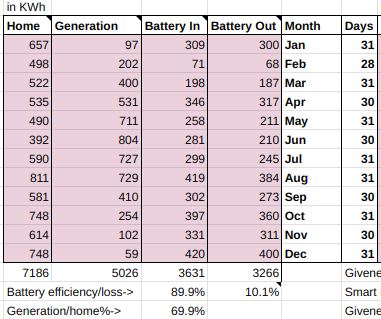
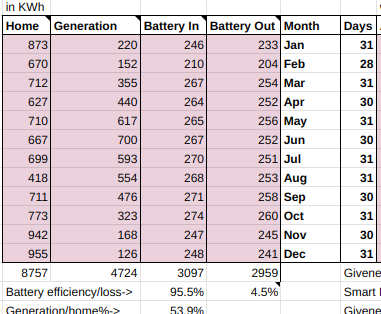
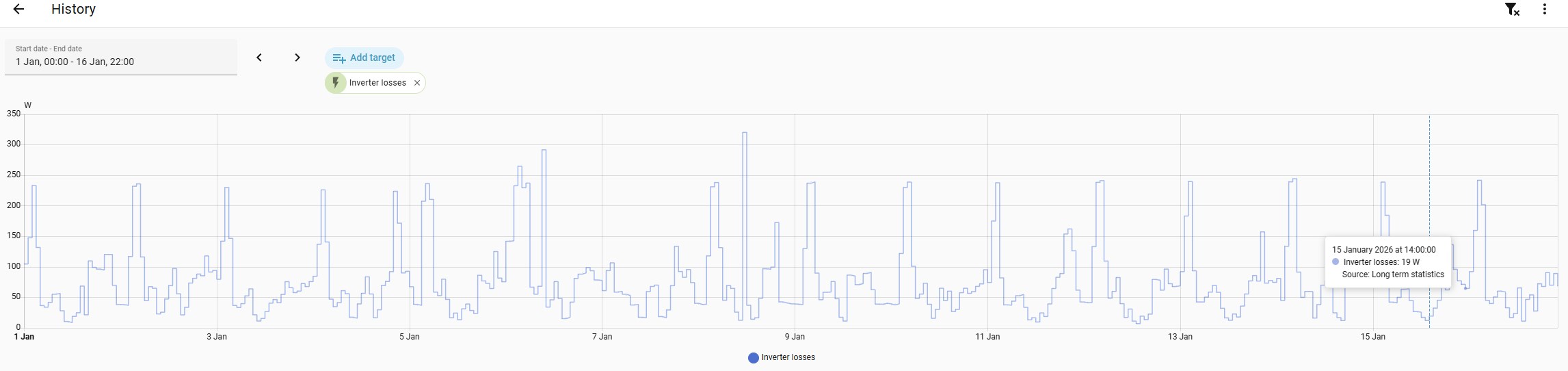
I am responsible for a 3.6Kw gen1 hybrid inverter system with a 9.5Kw battery, and have been looking into why the system appears to be losing approximately 24% of the energy on a battery charge discharge cycle. Charging the battery from the grid (at cheap rate) and the discharging into the house.
I believed that The AC - DC conversion efficiency should be in the region of 96% and the same for the DC - AC conversion, so I was expecting a round trip loss of around 8%.
I was just wondering if anyone has got any information on their system efficiencies, or the expected system efficiencies?
V
#2Vestas
heywoodstephen The battery is 95% efficient (chemical losses) then there's about another 10-15% losses on the AC-DC-AC conversion depending on charge/discharge rates. G1 hybrid inverters are a lot less efficient than later generations/AIO.
G
#3geoffreycoan
heywoodstephen People that have previously calculated round trip efficiency have come to the conclusion that its in the range 10-20% with 20% used as a rule of thumb just because its easy to calculate.
Efficiency is worse in cold weather so that could explain the 24% you are seeing.
H
#4heywoodstephen
Thanks for the info. If I had known it was this in-efficient I would never have brought it. anything above 15% round trip losses completely wipes out any saving made by importing at cheap rate and consuming during peak rate.
I am sure I was given a data sheet when I was considering the purchase that quoted conversion efficiencies of 96% I cant find the data sheet anywhere now.
G
#5geoffreycoan
[unknown] It all depends on what tariff you are on and what the cheap and peak rate are.
With some tariffs its better to hold the battery level and import from the grid rather than incurring the inverter and round trip losses. If its any consolation the losses on solar generation are less with a hybrid inverter, but not at this time of year
Octopus Flux in particular the rates are not great any more and you have to be quite careful with how you use it. The difference between overnight import rate and daytime export rate means its not usually worth charging up overnight, and similarly in the evening peak you don’t want to export so much that you import later in the evening which wipes out any profit from the export.
#6hoggy
There's never been a published efficiency graph for ANY of the range. I think at best I had something from the Lantrun days but that was just the PV to AC efficiency curve and not the battery side.
As far as I know the AIO doesn't even have an efficiency value at all.
I don't believe the IEC testing docs have seen the light of day publicly yet either so at best you've got anecdotal evidence to go from.
V
#7Vestas
hoggy There a is reference to "Battery Charge / Discharge 94% / 94%" efficiency figures on the G2/G3 Hybrid datasheets which suggests either round trip inverter losses of 6 or 12%. I'd be surprised if it was only 6% round trip from an AC charge/discharge.
Battery is 95/96% efficient at 25C so another 4% there.
So 10-17% losses for G2/G3 depending on what interpretation you take of the 94%/94% figures.
I'm assuming the AIO must be a bit better on AC-DC-AC given the battery voltage otherwise why bother? 🙂
#8Windy Miller
My data for the last 12 months suggests 90% efficiency.
I have an AC3.0 and 2x5.2KWh batteries. So this is the AC to DC and back to AC.
In my calculations I use 20% to make sure I'm not losing out so I assume a 20p unit through the batteries costs me 24p. I'm not allowing anything for wear and tear.
He has a hybrid and a 9.5KWHr battery so is just converting DC to AC on the way out.
#10hoggy
Vestas yeah the problem with not showing the curve is (as anyone would) you'll pick the highest value for marketing. What we don't know is at what power level that rating is derived between 0 & 100% power. Is it most efficient at full power discharge (probably not depending on its design, unless it was overspecified in the first place) or is it better between say 300-600W where it would spend most of its day covering baseload.
G
#11geoffreycoan
@hoggy is there also a question of how and where the different figures are calculated/captured in the inverter?
e.g. if you measure battery in or out on the AC side and the other on the DC side, or if you measure both on the DC side prior to AC conversion, that’ll give misleading figures.
Also where and how you measure inverter losses and include them in any calculation
Think its fair to say its not clear and losses are higher than we’d like, but they are what they are
Windy Miller I’ve always been suspicious of the home consumption figures (not least because they are just plain wrong with multiple inverters sharing the load). Its worth noting that home consumption isn’t measured, it’s calculated from the other data points.
Personally I work out my own home consumption from import-export+battery discharge-battery charge+solar generation but this then lumps all inverter losses under home consumption.
Oh and work out the monthly figures from the total at month end minus the total at prior month end. The inverter daily figures have problems of their own.
#12Windy Miller
geoffreycoan My data shows that GE are underestimating the import and export totals by 2% over a year with respect to the smart meter so I'm happy that over a long enough period they are not too far off. I also use an Emporia system to measure the load in the various circuits and this also comes out quite close.
SolarEdge suggested my panels produced 5.42MW where GE suggested 5.0MW but I think SolarEdge take their measurements from the optimisers which are before the DC to AC conversion.
Windy Miller I similarly get a quite small variation on the GE import and export vs the smart meter data. Over a month it usually amounts to less than a kW so I think mine is more accurate than yours. But have heard other people with some quite big variations.
I use a Shelly EM to monitor my heat pump consumption, and there are inline meters for the heat pump consumption (probably an MCS thing). Less accurate, usually 5-12% over reading over a month, but on some shorter periods I’ve seen it as high as 25% over-read. Its good enough for keeping an eye on it in Home Assistant but its not great when you consider how much these energy meters cost.
Hey ho
R
#14Rbor
Windy Miller SolarEdge suggested my panels produced 5.42MW where GE suggested 5.0MW but I think
Windy Miller That 95% is suspicious. My son generally charges the home batteries overnight as he dumps all the charge in the evening so he can't be using the DC from the solar for this. It must be grid AC to battery DC then to grid/house AC and I think 95% is too good for this. Perhaps, as others have suggested, GE loses units in other totals to make the battery throughput look better.
V
#16Vestas
hoggy Indeed, so the figures are best case which is why I work on 20% losses round-trip as a rule of thumb.
#17hoggy
geoffreycoan yes correct. From my rummaging in the guts of a Gen 1 I believe the majority of the readings are done in DC.
But even that's not clear cut as it runs several different DC bus voltages inside aswell (with each transition resulting in a bit more loss)
As far as I can tell, the battery to/from power is calculated via a hall effect CT (which sounds fine) but between it and the battery is a step down from 300+V to 51V that goes out to the pack.
Equally the BMS, although I think it can read amps in/out, there doesn't seem to be a register for it. Neither are there for energy throughput either. (There's some "not used" registers from the BMS in GivTCP, so thats not to say it doesn't and we just can't see them)
So, similar to Vestas I think the portal / GivTCP round trip values may omit losses from the inverter to cells and also the step down/up stage in DC.
W
#18wrighar
Also remember efficiency will vary by charging method on Hybrids.
AC to DC charge is less efficient (grid to battery) than
DC to DC charge (solar to battery).
I've found that a slower charge rate (2700W vs 3600W made an improvement.
Also, a much more leisurely discharge of 300W was far more efficient than a 3600/4000W forced discharge and excess to the grid.
V
#19Vestas
Rbor The graphs are pretty much what I'd expect from any decent PSU these days. Run at low output power and you have higher percentage losses because some losses are fixed, regardless of load, and some are proportional to load.
Eg 100W fixed losses when running at a load of 400W is a 25% hit. 100W fixed losses at 4000W is a 2.5% hit.
Had a rummage about the SolarEdge site and the round-trip efficiency for their 48V batteries is 94.7% peak. Note that is ONLY the battery losses, so simple chemical losses within the battery. That's what you'll see across the board on LFP batteries because its all the same chemistry so GE batteries will be much the same.
So based on G2/G3 Hybrid inverter datasheets it still looks like about 17% losses using AC to charge the dc battery at max rate and then discharging again to AC at max rate.
A
#20Al E.Gator
Windy Miller I studied this on my AC3's quite closely and created a separate live moving efficiency tracker. I would consistently get approximately 96% when charging and about 80% on the discharge. It worked out I was just about 75% round trip efficient. Not ideal when you buy 40kWh of batteries and actually you only have 30kWh that can be used!
#21Windy Miller
Al E.Gator My emporia system will measure the charge and discharge to and from the battery but unfortunately the software simply adds the two together when displaying the energy resulting in a figure that is simply the actual loss without saying how much energy was actually transferred to the battery so I can't work out the efficiency from the data. I've got to see if I can either get Emporia to display the positive and negative totals separately or find a way to do it manually. This might then reveal something that isn't dependant on the way GE measure the energy.
H
#22heywoodstephen
geoffreycoan The problem for me is this is a FIT installation where the old inverter has been replaced with a givenergy Hybrid inverter adding a battery to the system. The justification for this was that there is payment for all units generated regardless of if they are exported or consumed locally, so adding the battery allows for more local uses during the summer, and during the winter we could charge at low rate times and use that at peak rates, currently on octopus Go.
As this is a FIT instillation there is an actual bidirectional generation meter just prior to the inverter, this is used for the FIT payments at 75p per unit. Therefore losses consist of import unit price of approx 7p per Kwh + loss of FIT payment of 75p per Kwh (as the net reading will be lower).
H
#23heywoodstephen
hoggy This is really interesting I was wondering where the givenergy readings were actually measure, As we have an external generation meter I can see that when charging GivTCP reports AC charge total reports 5% less that is actually imported.
There appears to be a bigger difference on the export (GivTCP PV total change + battery discharge) report about 9% more than the actual export.
G
#24geoffreycoan
[unknown] As this is a FIT instillation there is an actual bidirectional generation meter just prior to the inverter, this is used for the FIT payments at 75p per unit. Therefore losses consist of import unit price of approx 7p per Kwh + loss of FIT payment of 75p per Kwh (as the net reading will be lower).
Yes I can see why that is a particular problem for you. I have a FIT array as well but still using the existing Growatt inverter with the FIT array, and separately added new panels and GivEnergy battery and inverter. The FIT array continues unchanged although I did have to give up the FIT deemed export payments when I moved to measured export. But as I was giving up £100 of deemed export a year to receive £1100 of measured export, it was a worthwhile loss.
In your case is it better to just never grid import to your battery? Doesn’t help you in winter but the losses on solar charging are less.
[unknown] As we have an external generation meter I can see that when charging GivTCP reports AC charge total reports 5% less that is actually imported.
I don’t look at AC charge specifically and compare that to the meter data, but as I mentioned earlier I believe my GivTCP total import/export data is pretty accurate. Looking yesterday for example GivTCP recorded 65.5kWh imported whereas Octopus says I imported 65.78kWh - a 0.4% discrepancy
H
#25heywoodstephen
geoffreycoan GivEnergy have said that the losses are as expected and that the installer should never have installed a hybrid inverter and battery on a FIT array.
I was somewhat surprised as several people I spoke to prior to the work were saying it's exactly what they have. It possible that there PV array is significantly bigger such that they don't notice the losses. My parent system is on a bungalow with high trees blocking a lot of winter sun, so only generates around 1Kwh per day for most of December, this was not covering the losses, causing the net reading to drop most days.
GivTCP reading (battery charge total, and battery discharge total) appear to indicate a 4% loss which sort of tie up with what @Vestas said about chemical losses, and @hoggy said about the reading being on the DC side of the inverter. So I would assume that the AC - DC or/and DC - AC inverter losses are totalling the remaining 20%. Strangely though the PV DC - AC loss appears to be very low, when the house is consuming all PV directly GivTCP PV generation total increases almost 1 to 1 with the generation export meter reading.
Our installer has agreed that although they disagree with GivEnergy analysis, they will remove the hybrid inverter, and recommission the old inverter.
V
#26Vestas
heywoodstephen Strangely though the PV DC - AC loss appears to be very low
Its basically how these inverters work - there's an internal DC bus well above 240Vdc in order to supply 240Vac to the home loads. If you're charging/supplying from PV then your PV voltage may be above that bus voltage so just needs reducing.
If you're charging from AC then it isn't above the bus voltage and needs boosting up to that voltage to then be reduced down to the battery voltage. More losses than PV usually.
That's one of the reasons LV batteries are on the way out.
My calculation was 6% (inverter charge losses) + 6% (inverter discharge losses) + 5% (chemical losses in battery) = 17%
That's for a G2/G3 inverter and 9.5kWh battery - figures from datasheets.
In retrospect 25% losses might have been a better rule of thumb for a G1 inverter 🙂
E
#27ectoplasmosis
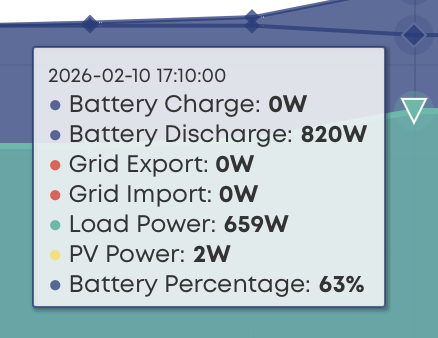
Apologies to resurrect this thread... but does 20% loss when discharging from the battery to house load look normal? Seems very high to me...
Difference between what the battery is supplying and what the house is consuming is just 9W. But this is all on the AC side so doesn't include the conversion efficiency of the Inverter.
In my calculations I assume 20% loss round trip but actually believe it to be more like 13%.
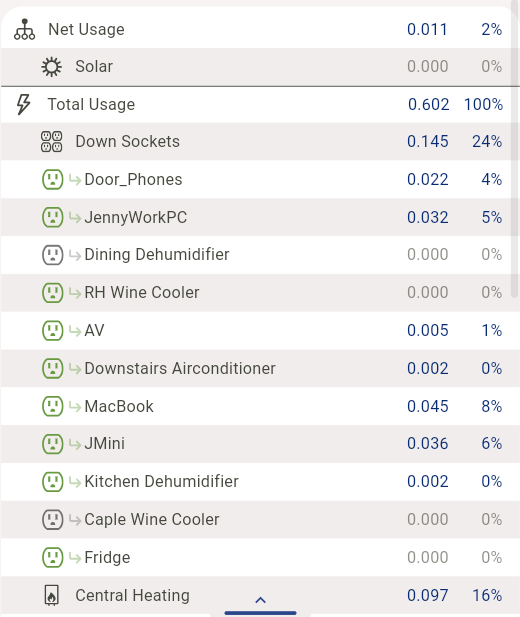
Windy Miller do you have a CT clamp around the cable of all these appliances?
#32Windy Miller
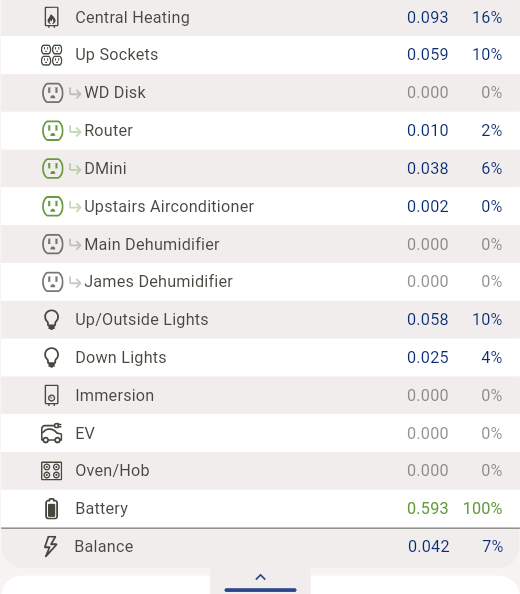
Robgy There are 11 clamps in the distribution board. All the others with the plug symbol are smart switches. Emporia's integration is good so the smart switches are nested under the correct circuit and the figure adjusted to avoid double counting. So the down sockets reading is everything not on a smart plug.
I make my own wine and store about 70 bottles in the 2 coolers.
I don't have 2 central heating though. That was a cut/paste error from my tablet screen. And there was a couple of seconds between the 2 screen grabs hence the different readings.