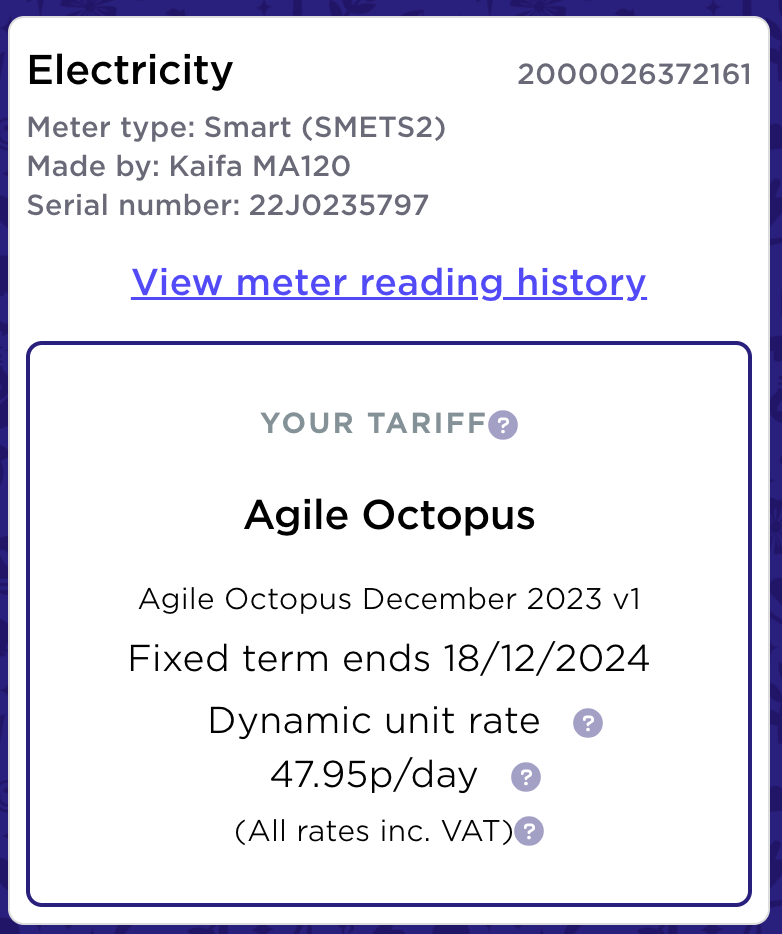
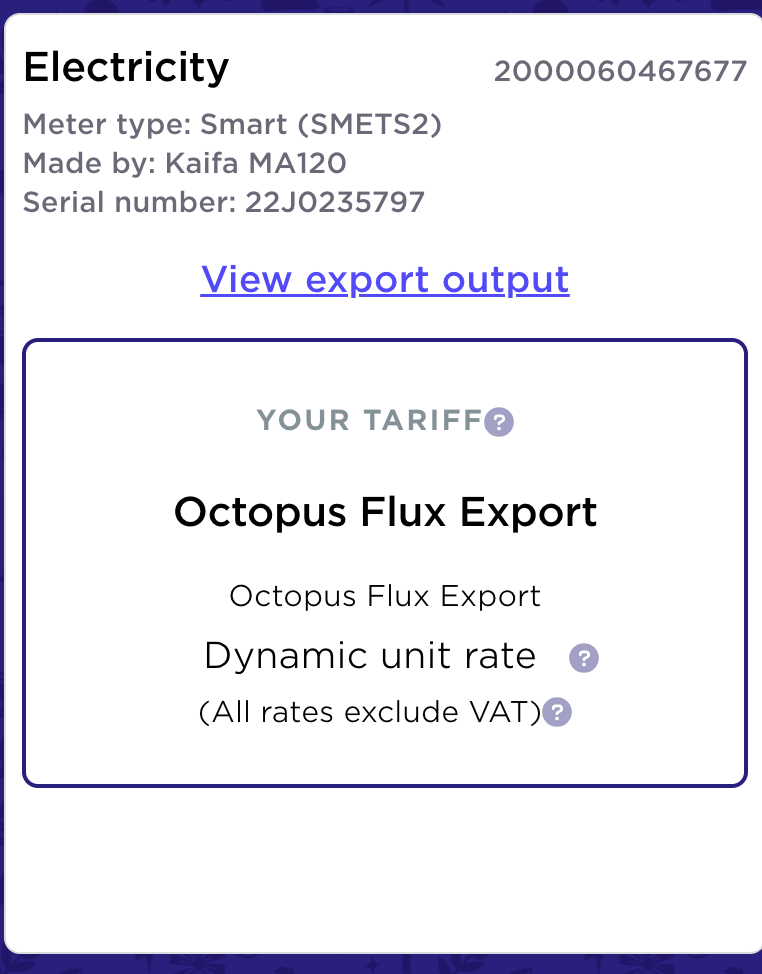
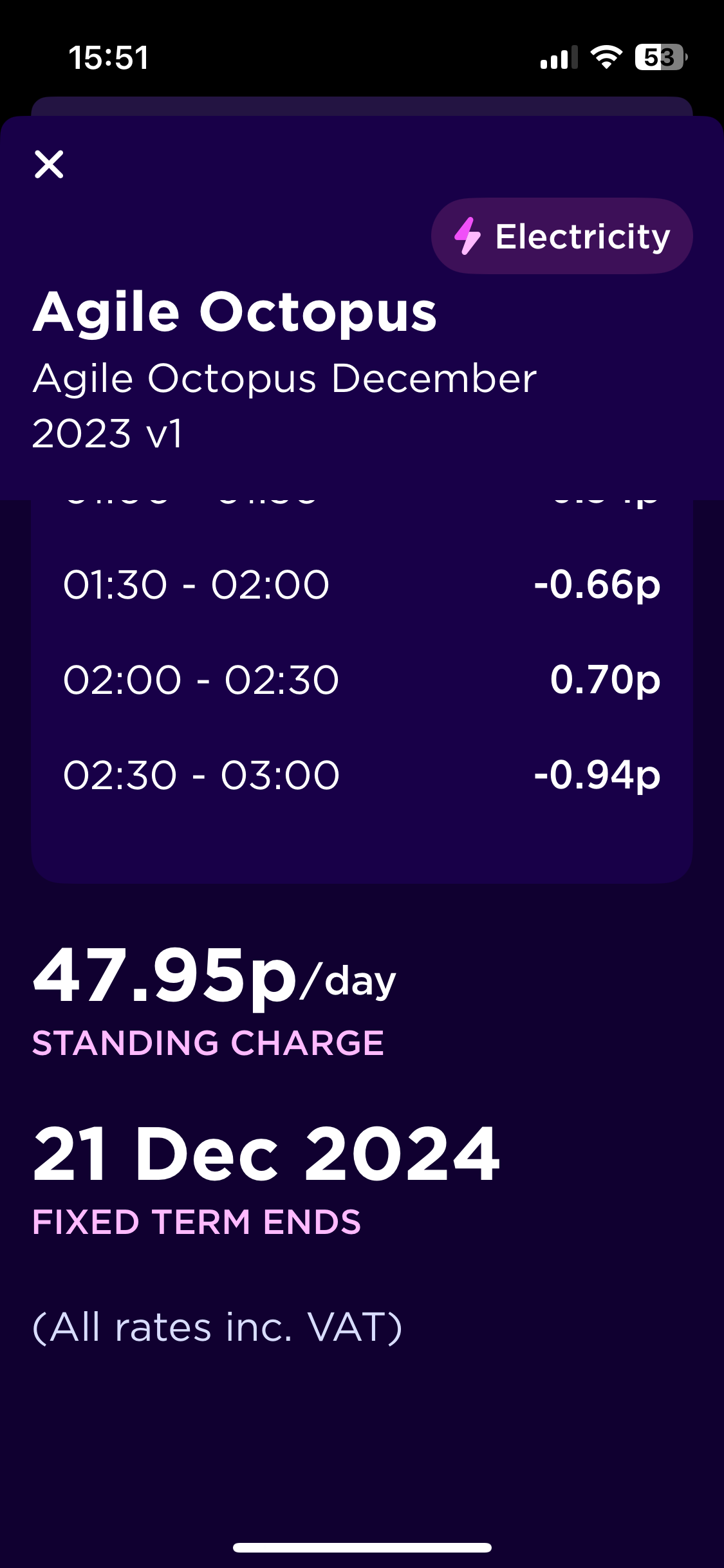
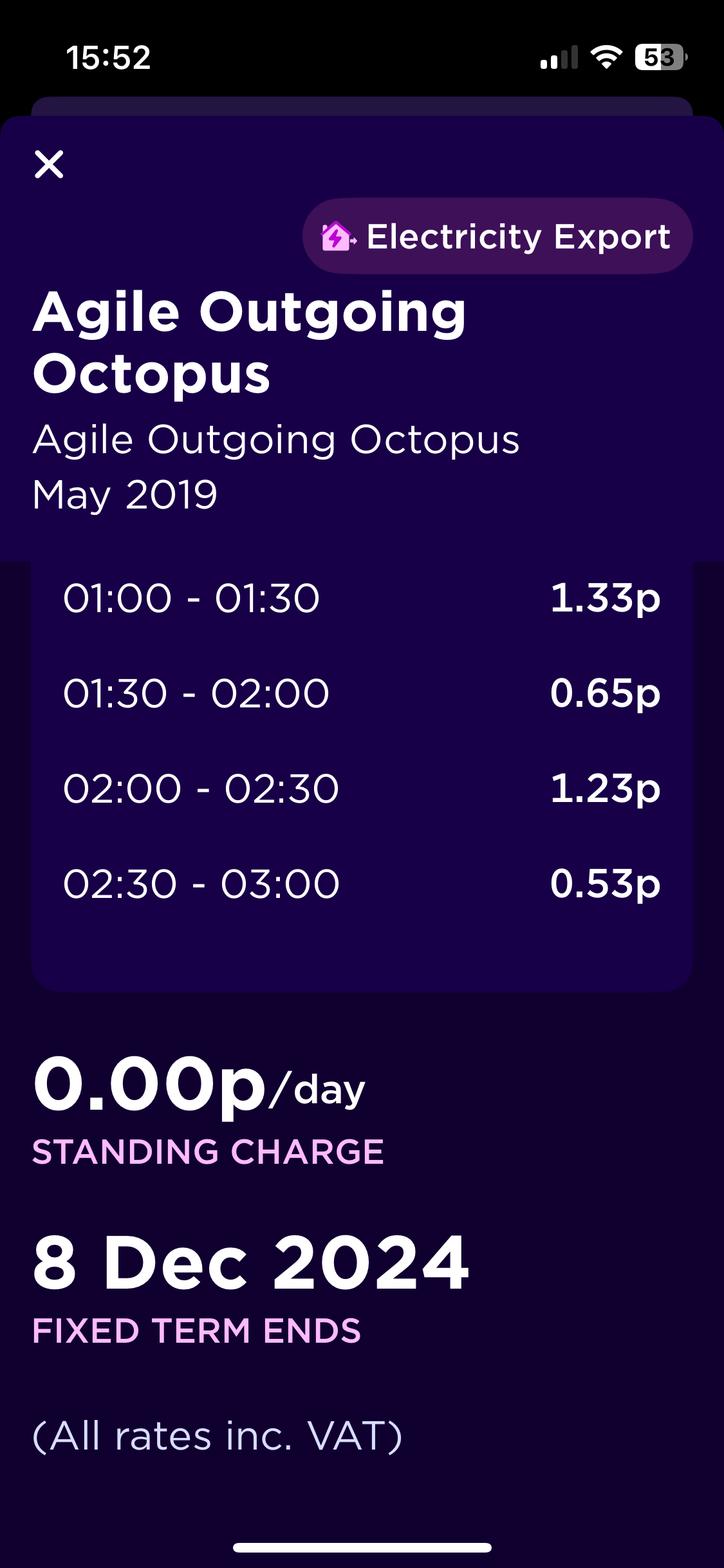
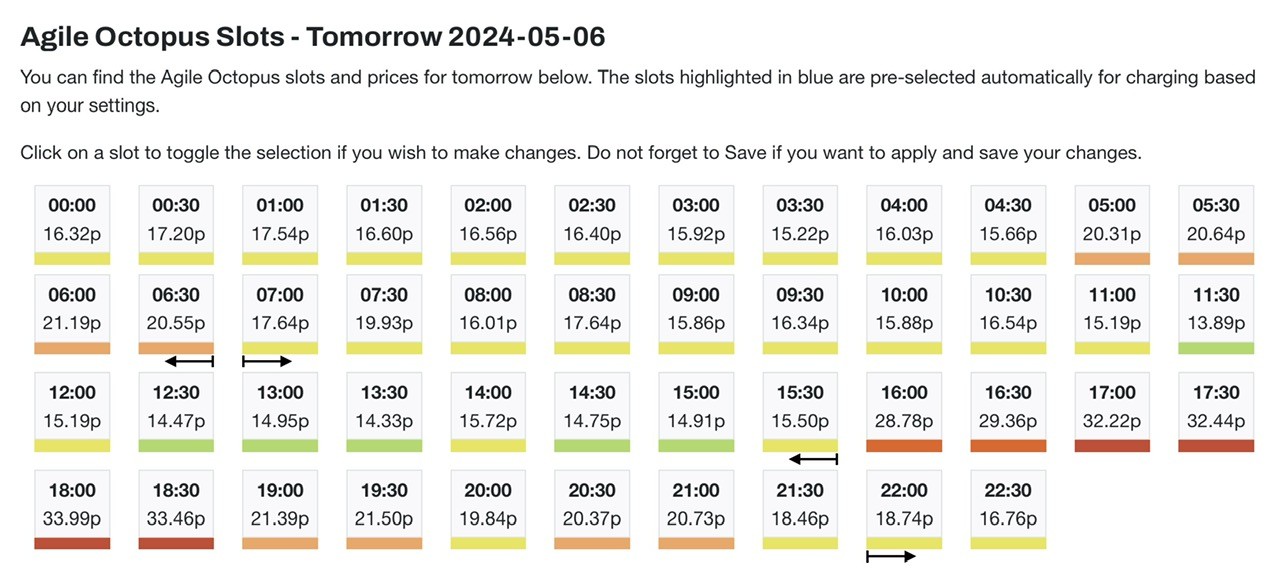
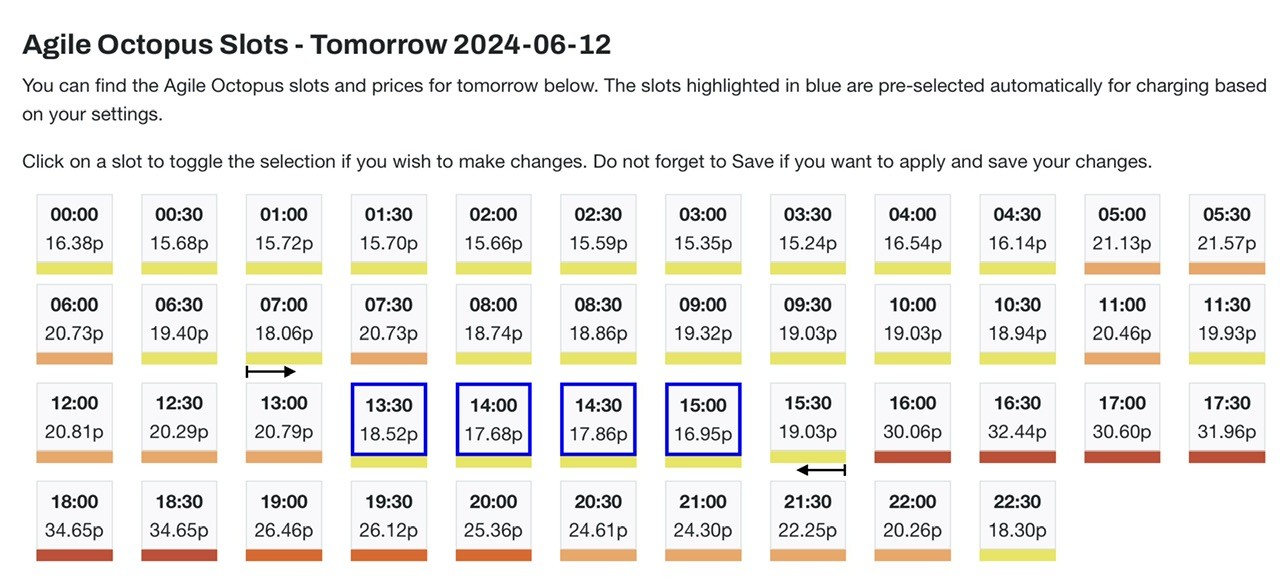
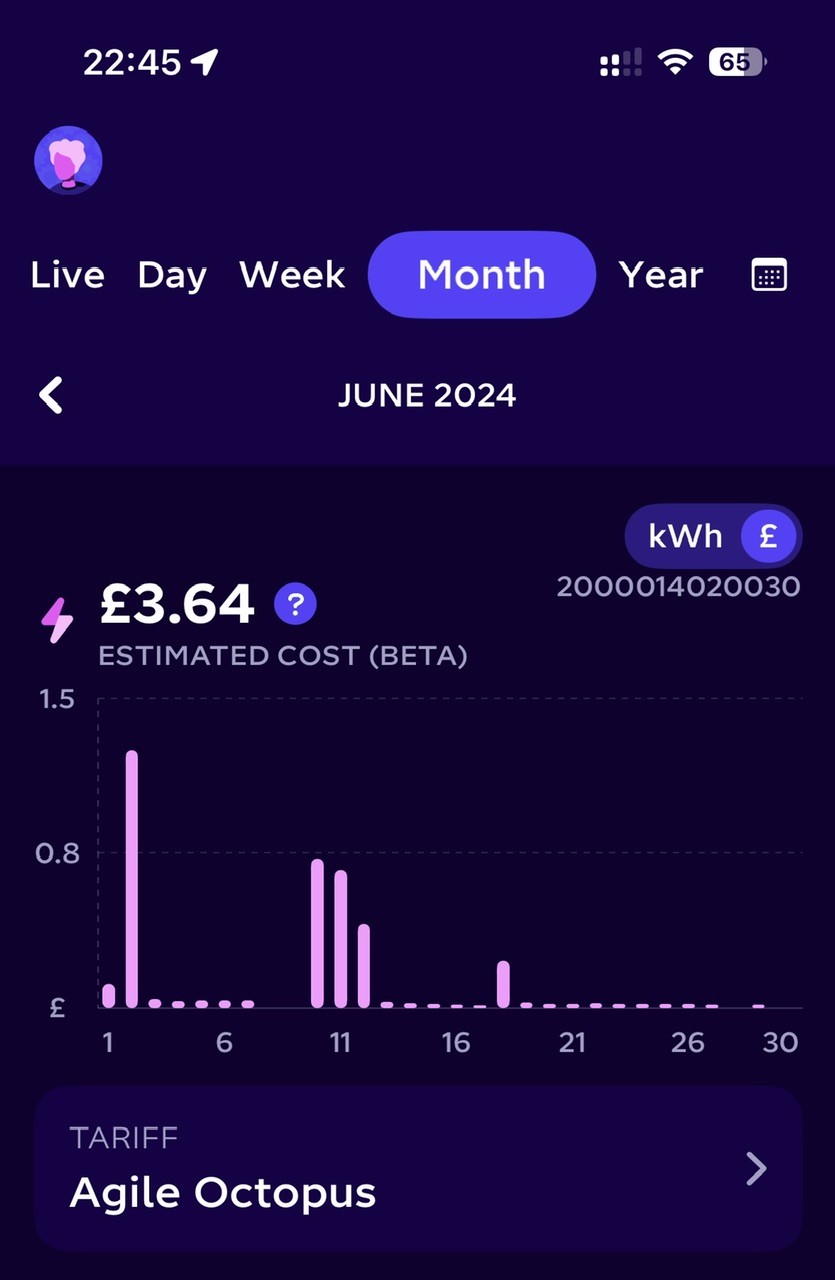
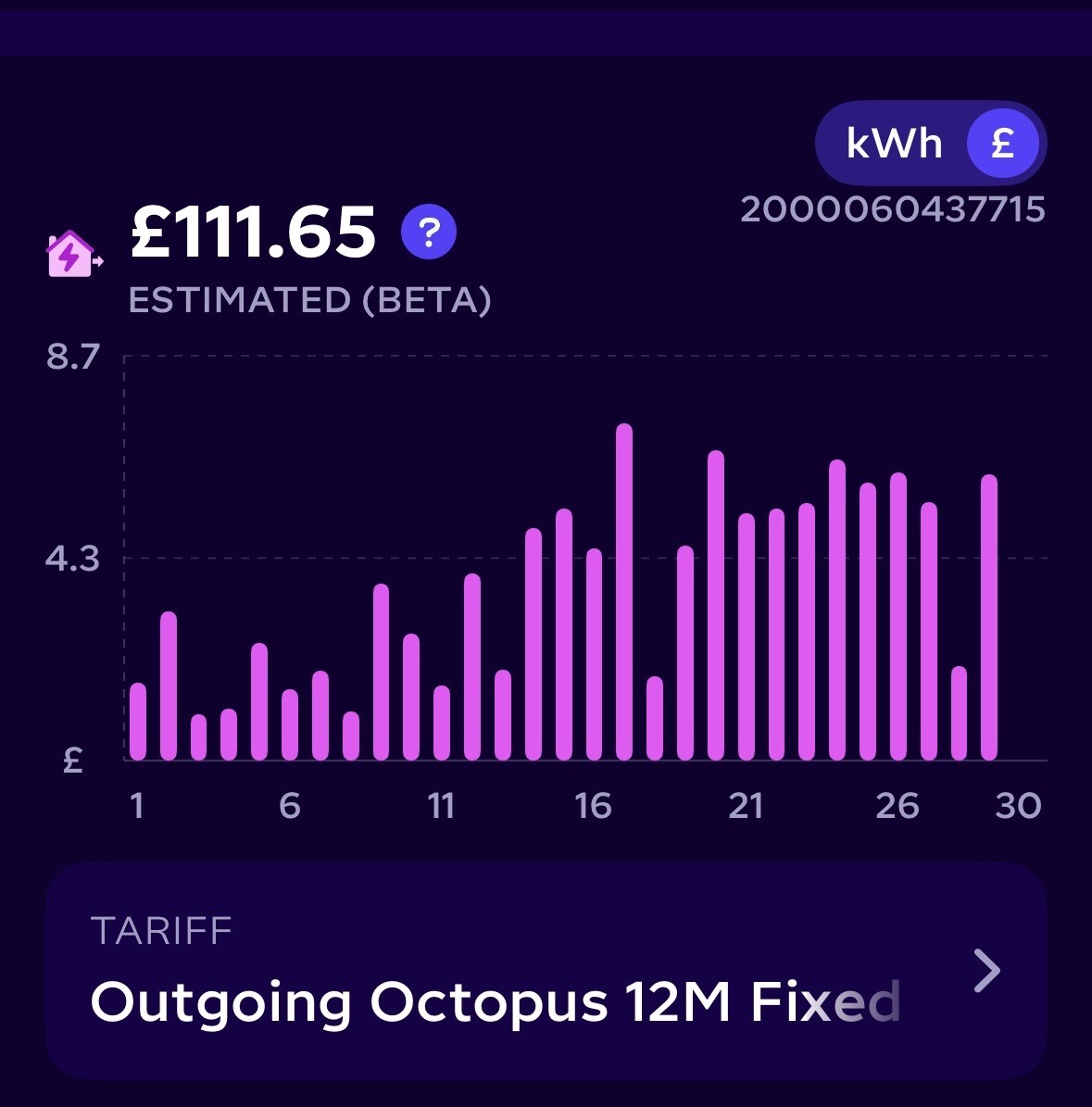
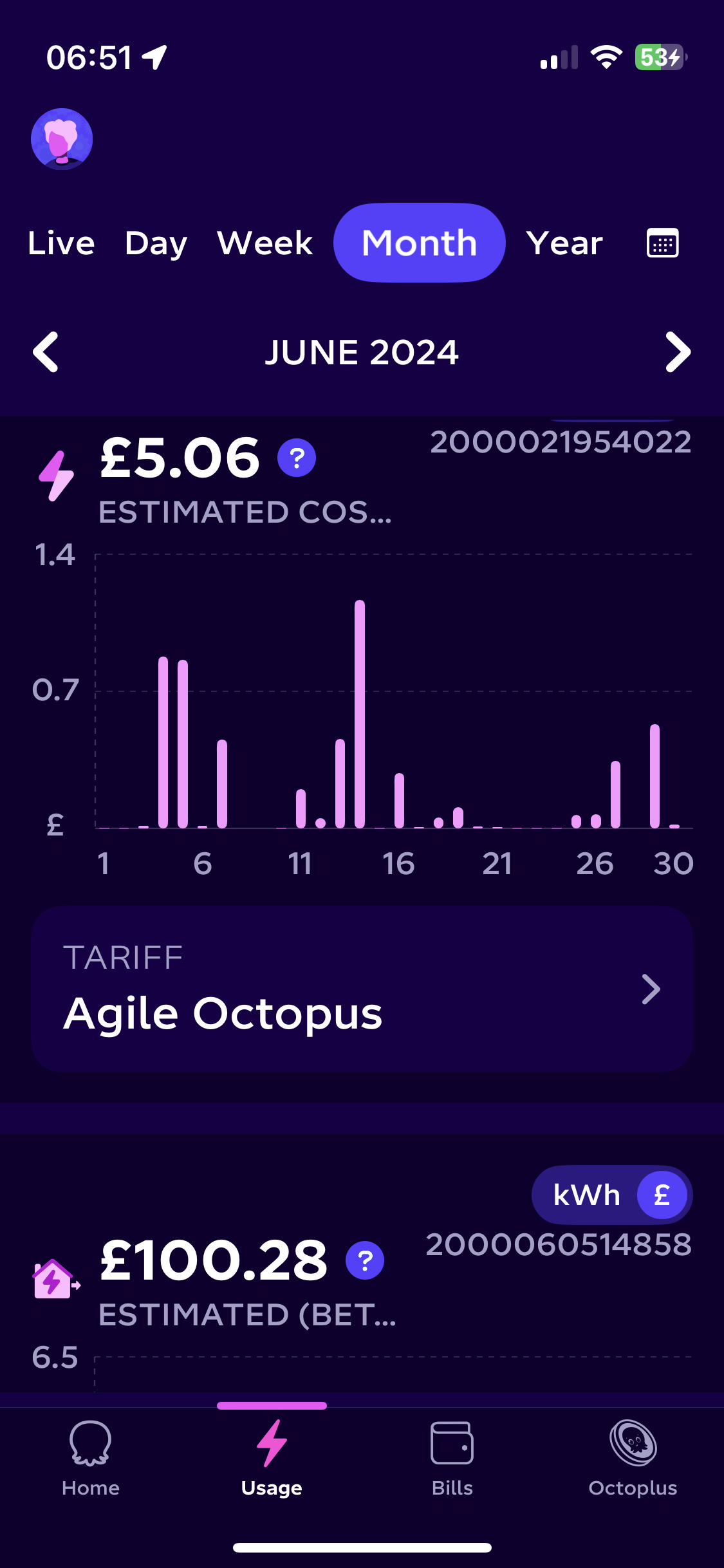
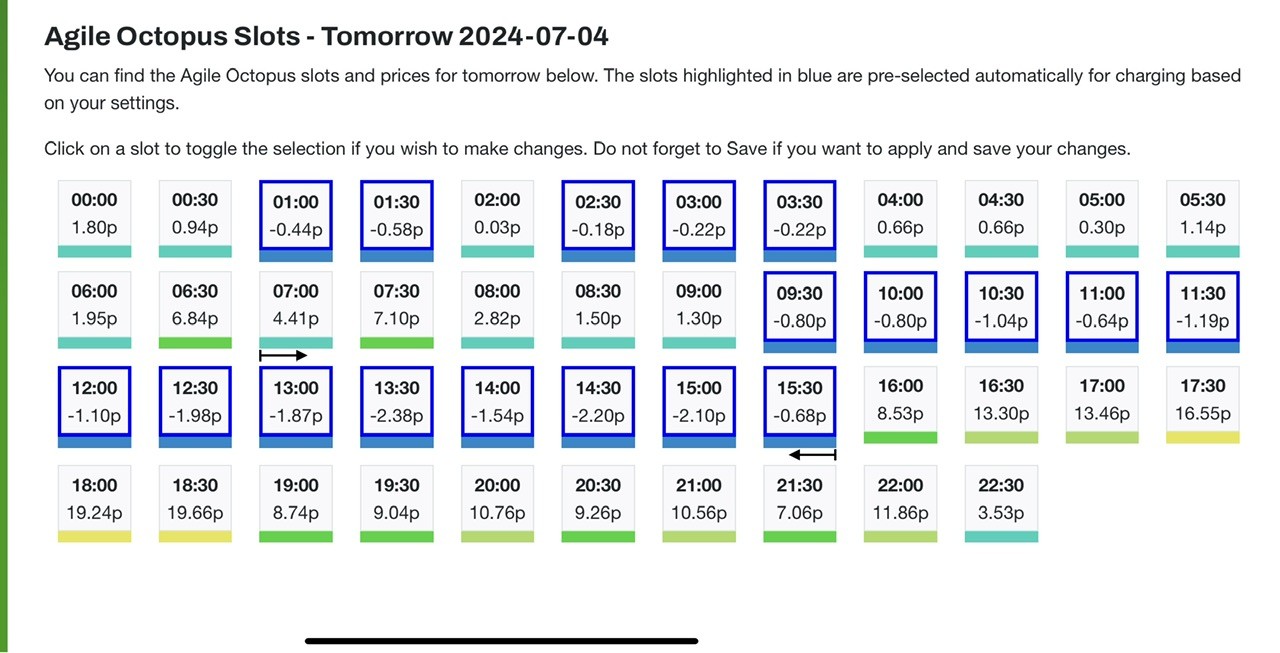
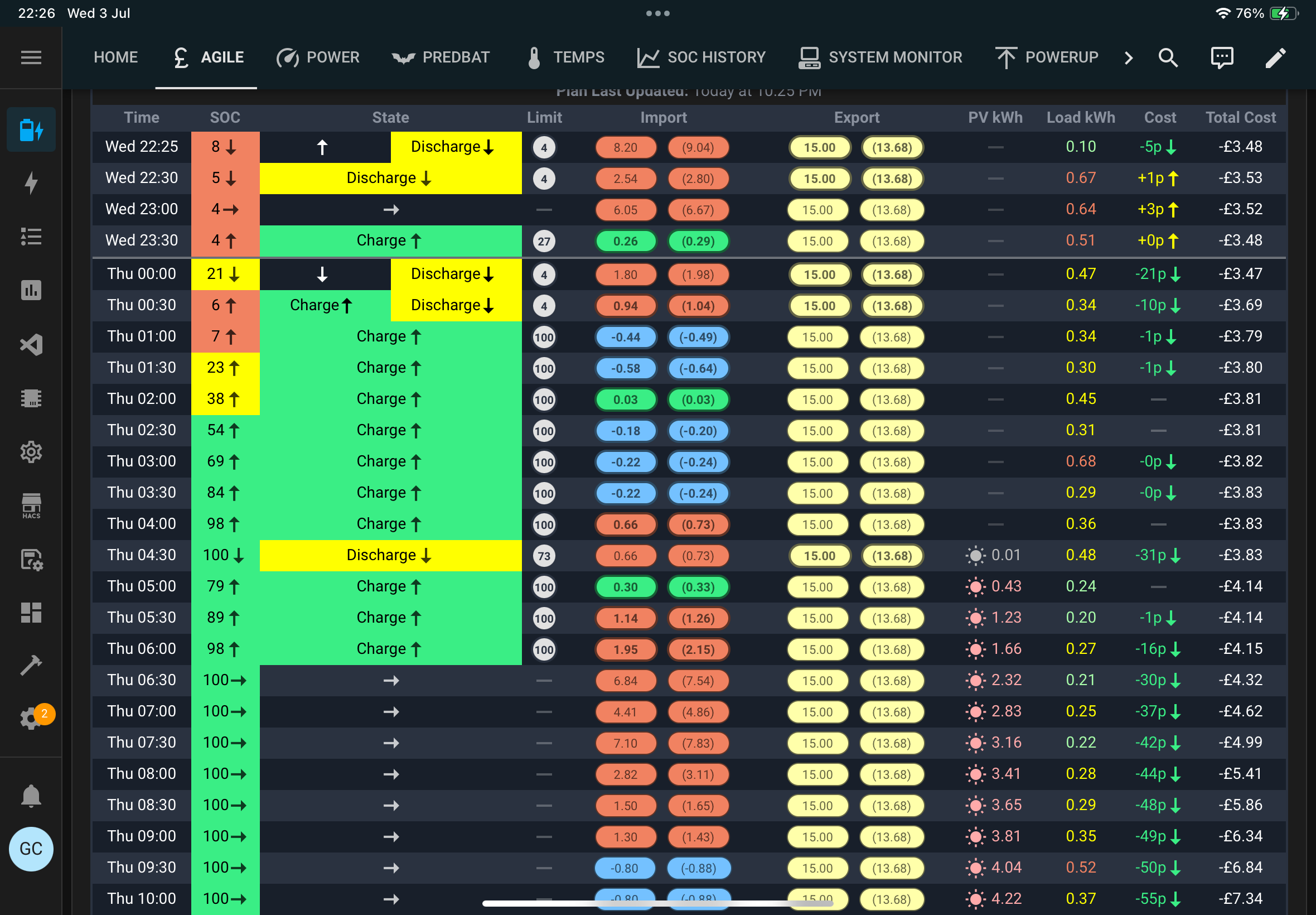
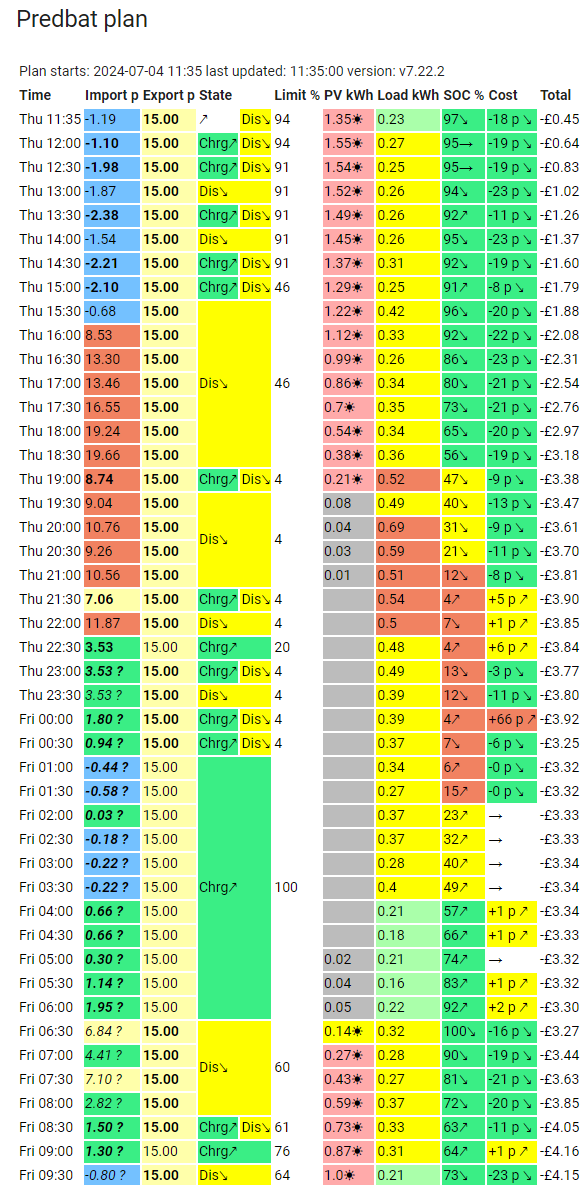
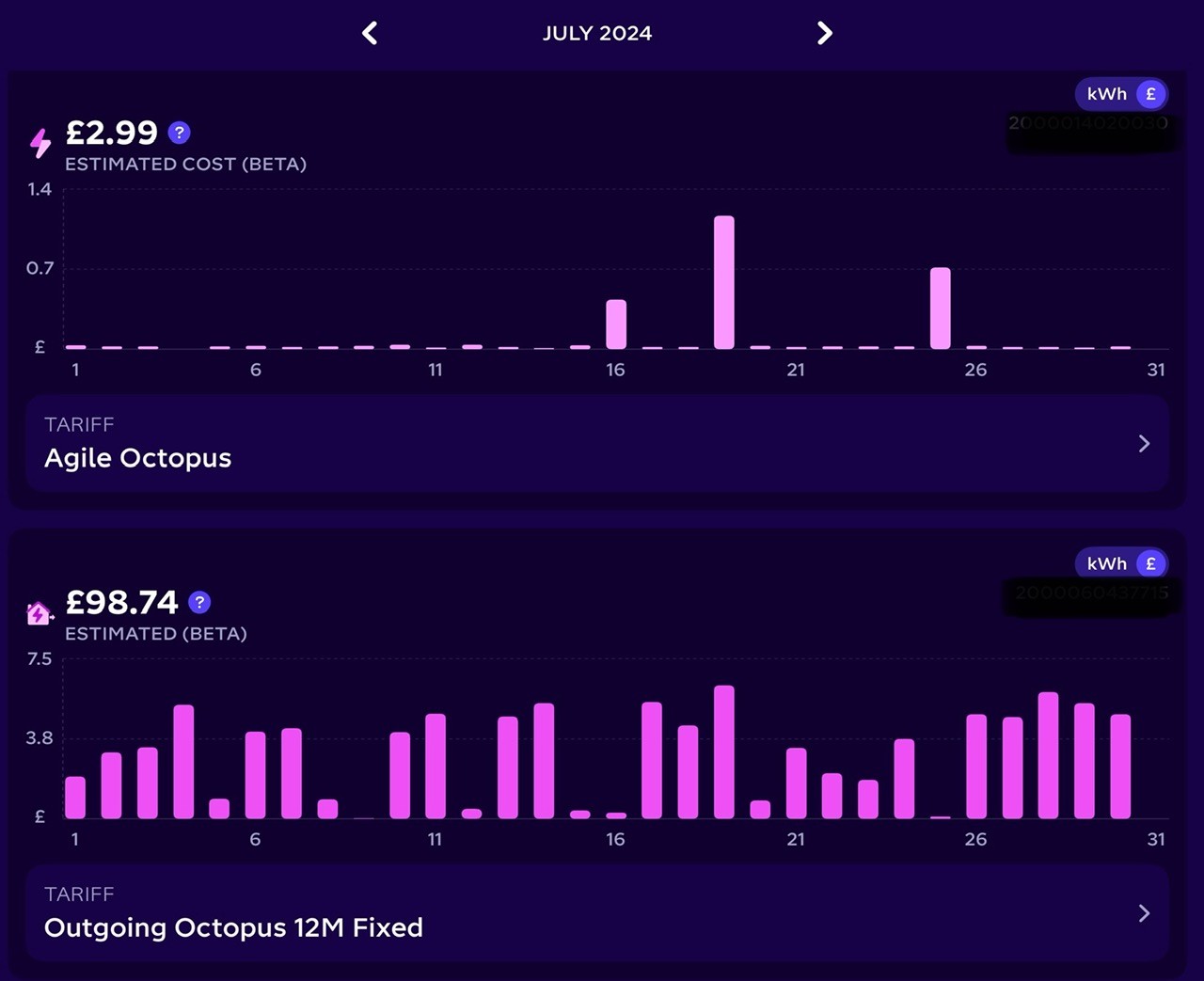
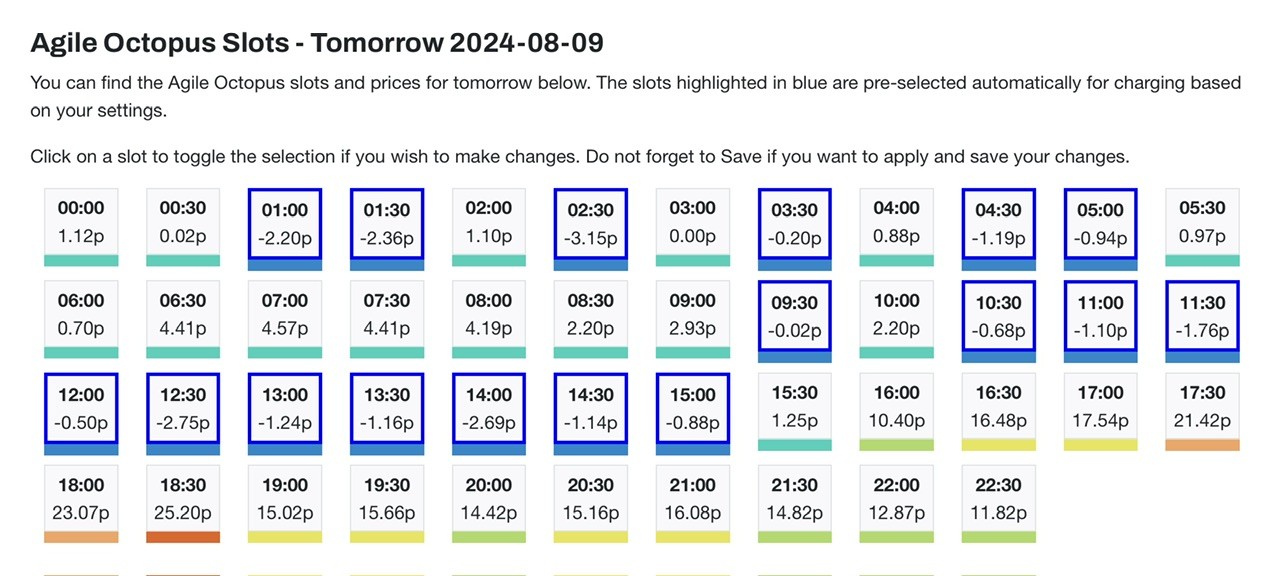
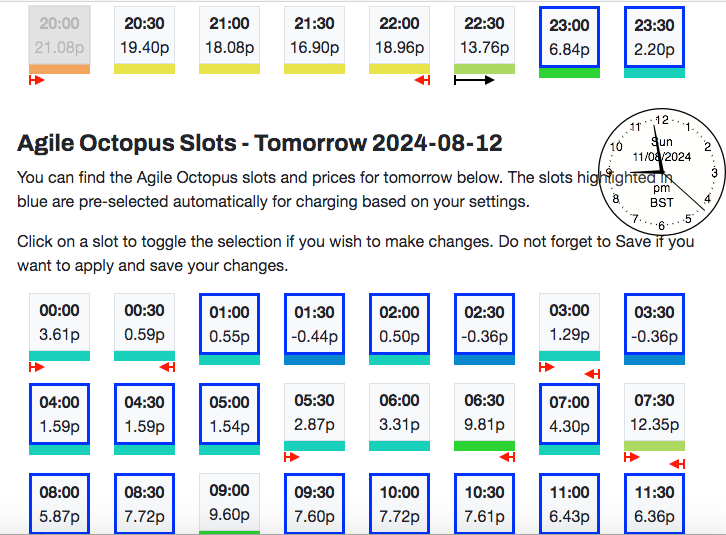
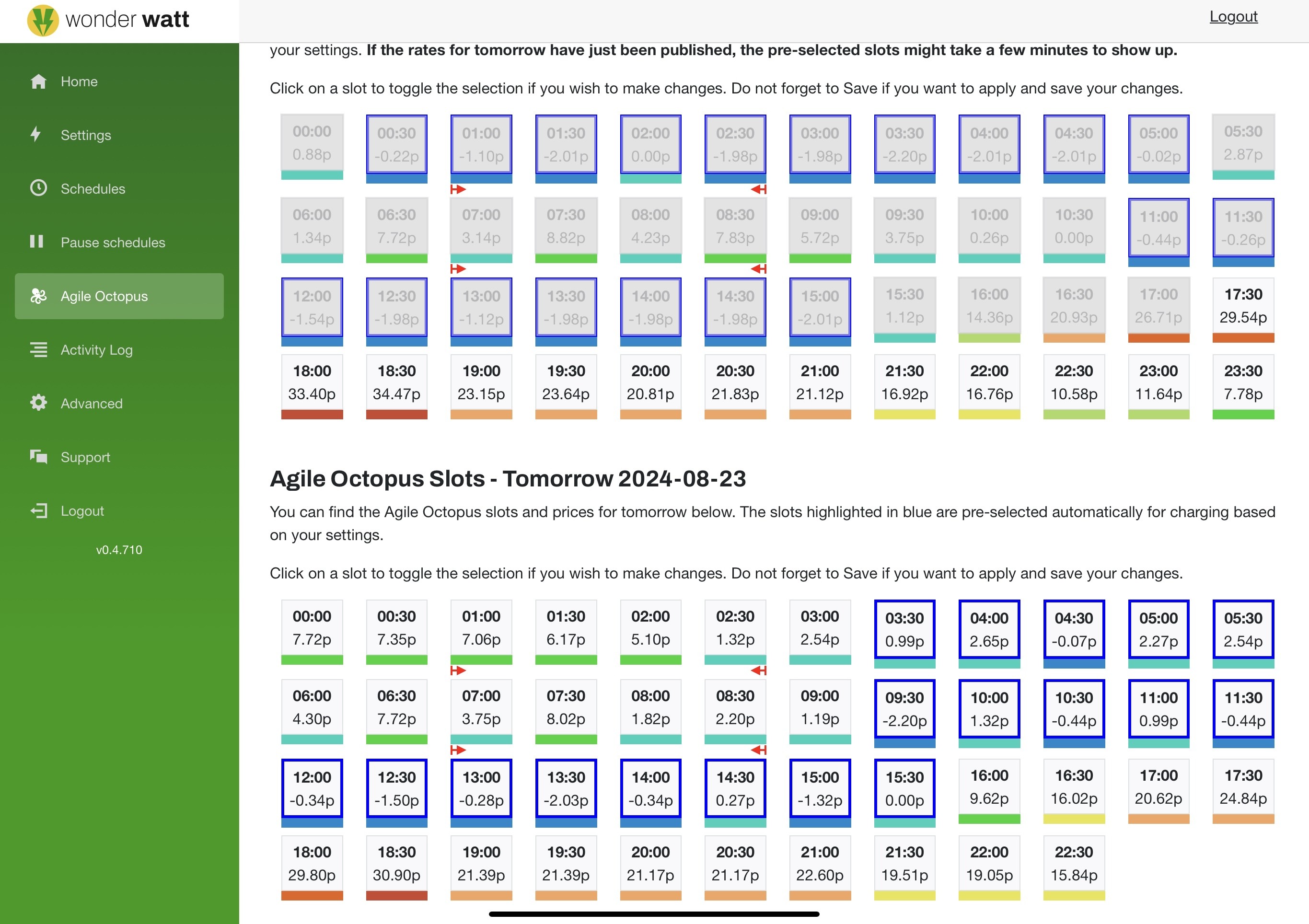
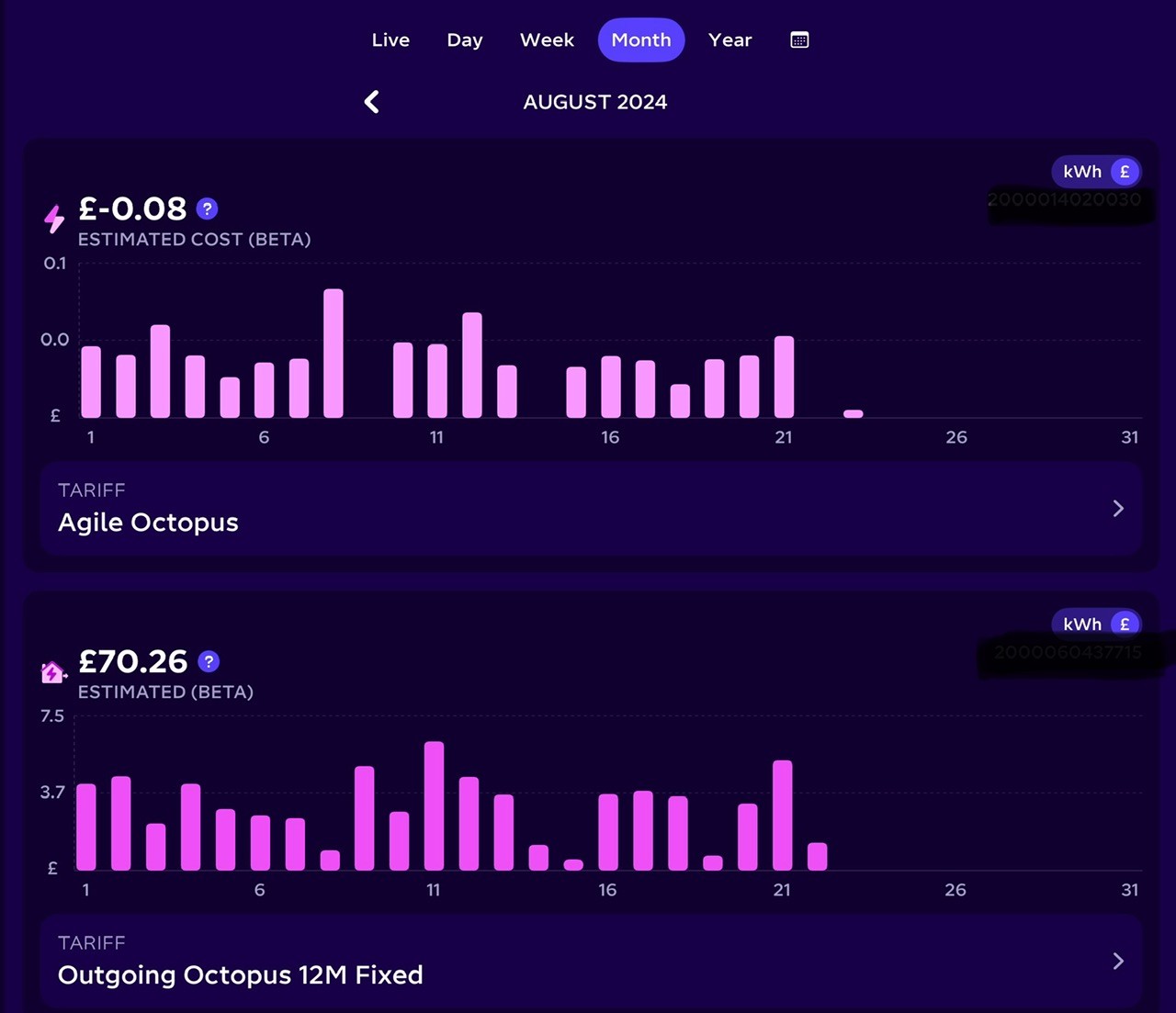
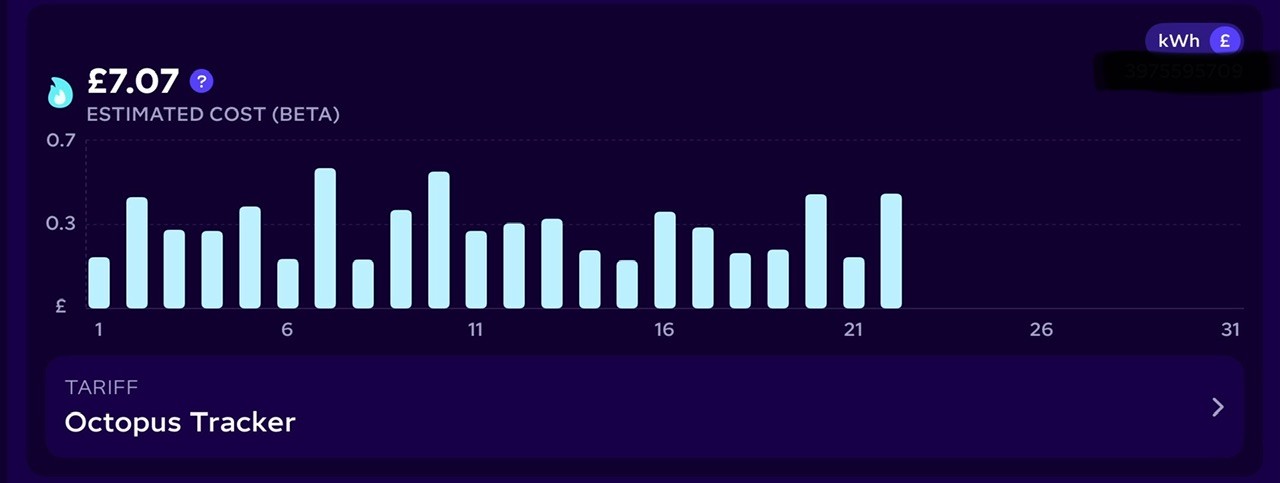
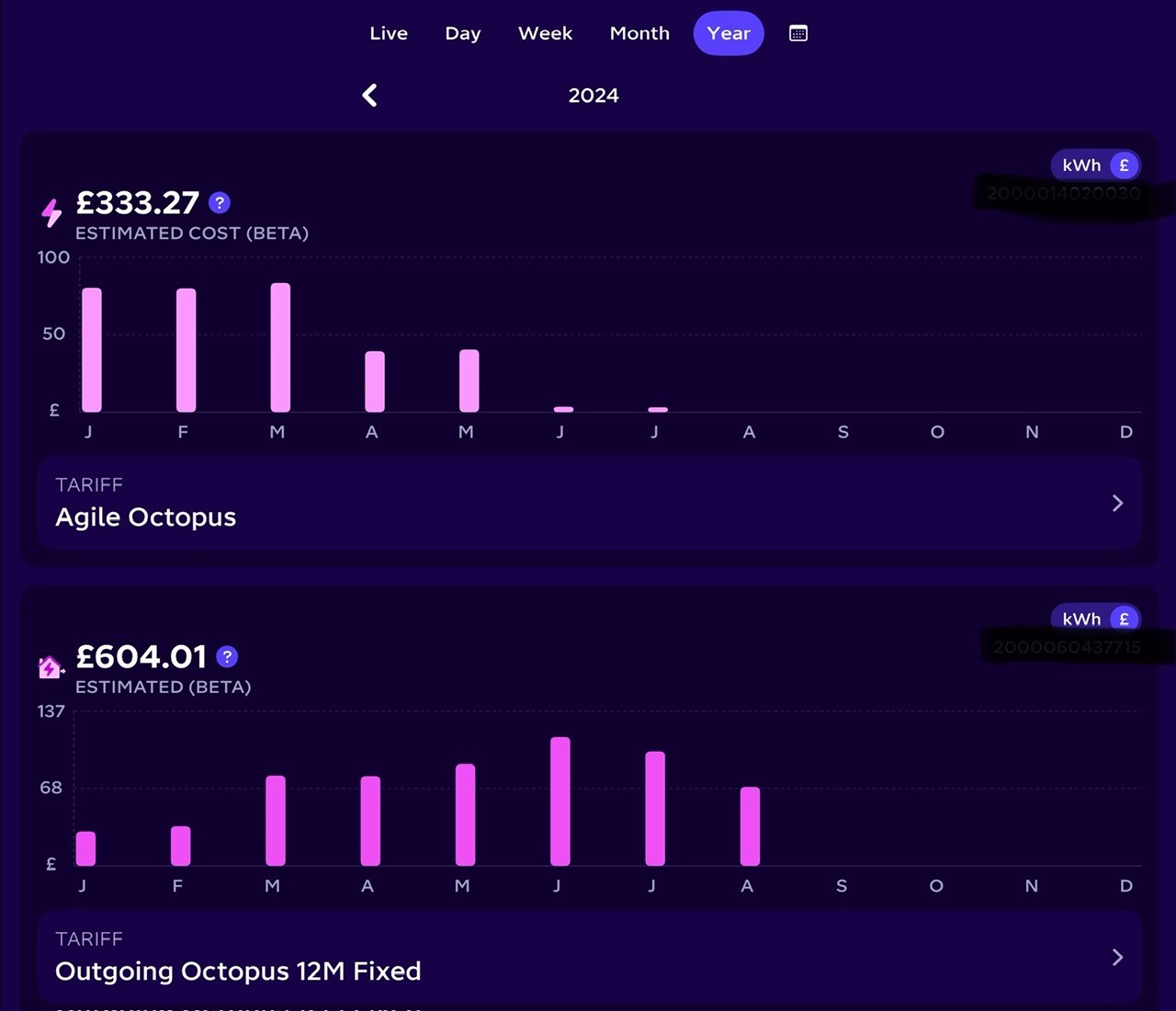
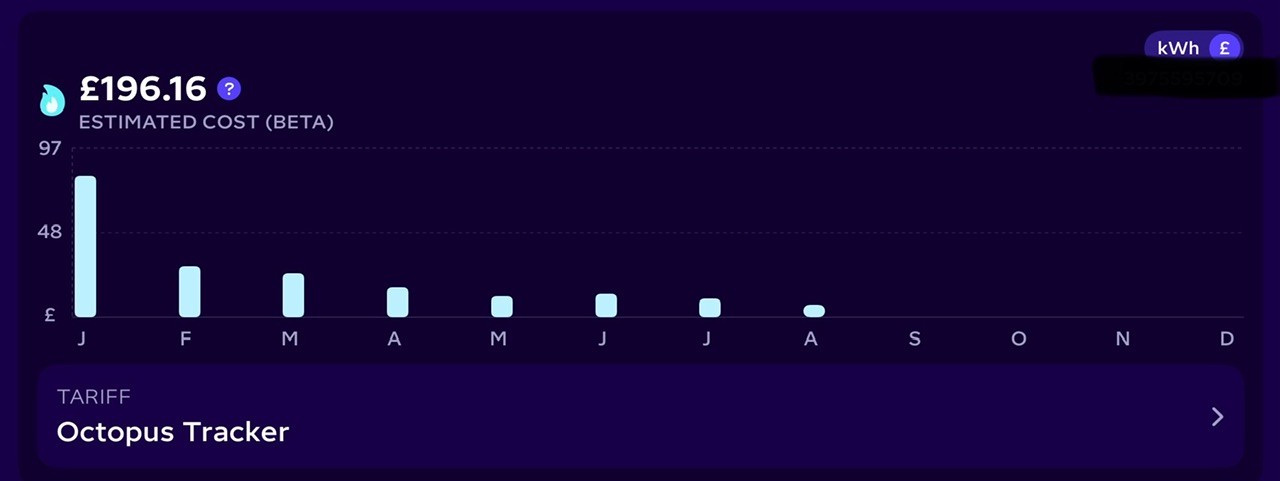
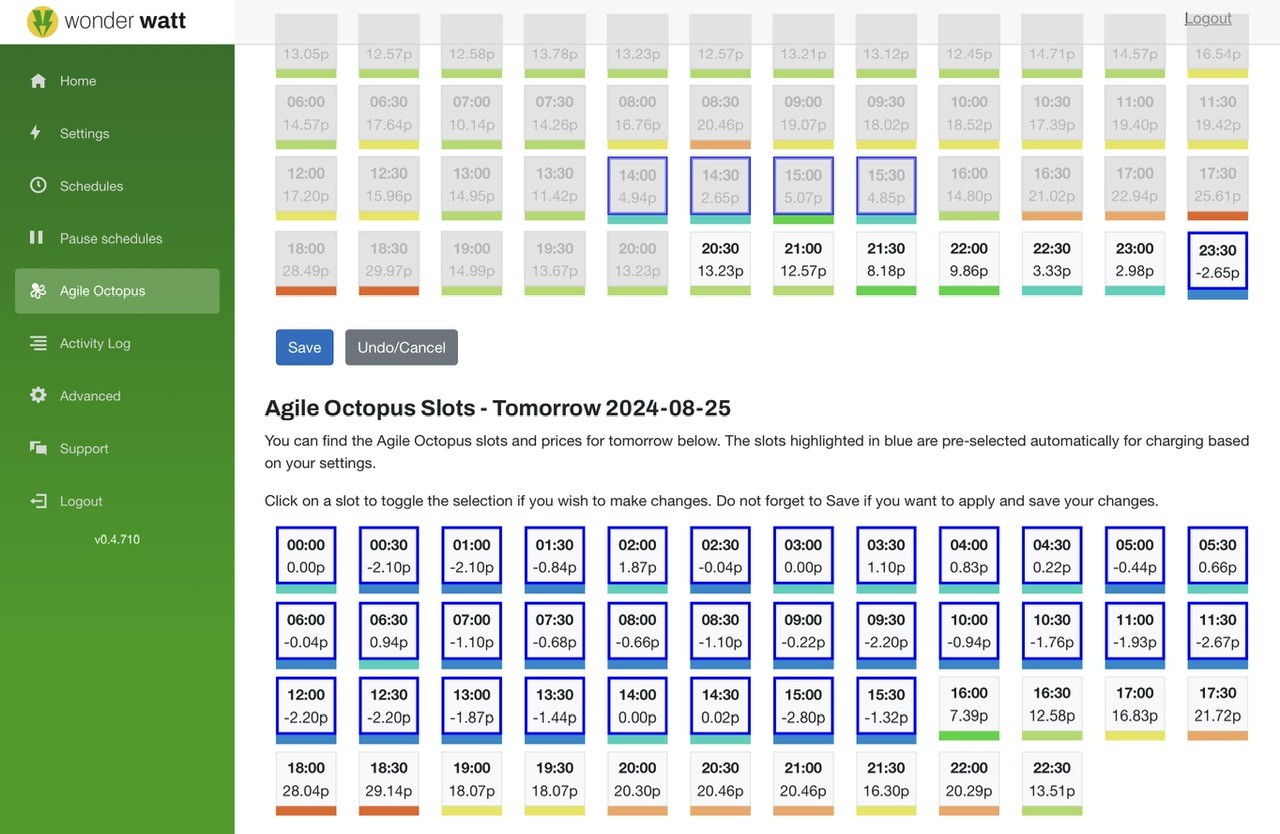
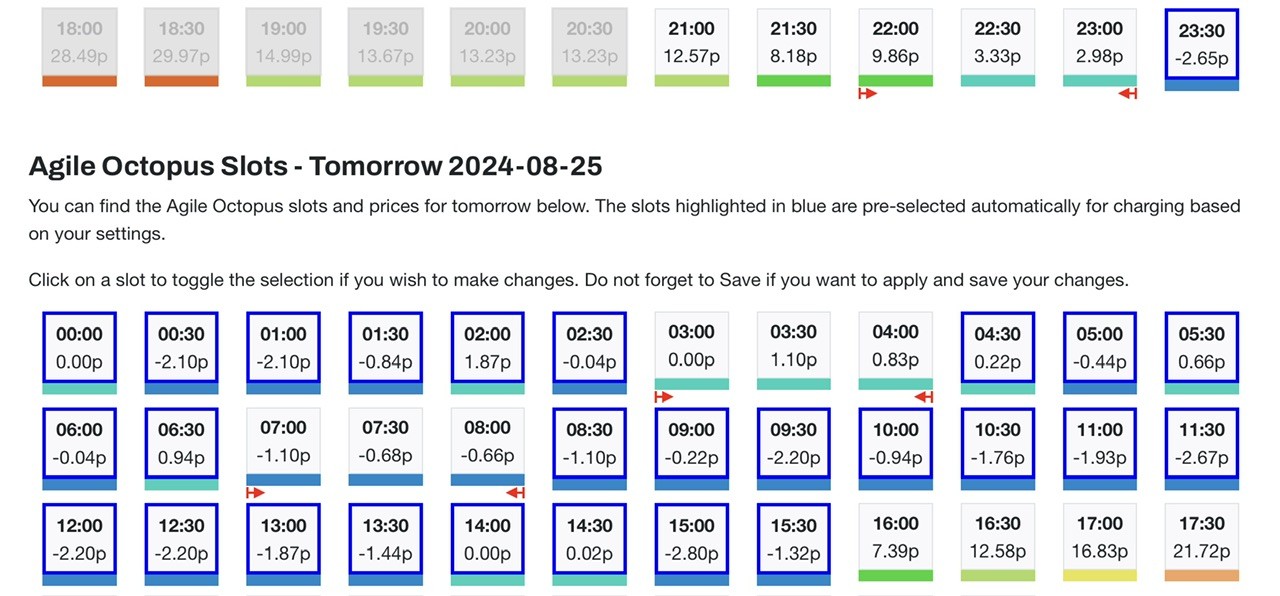
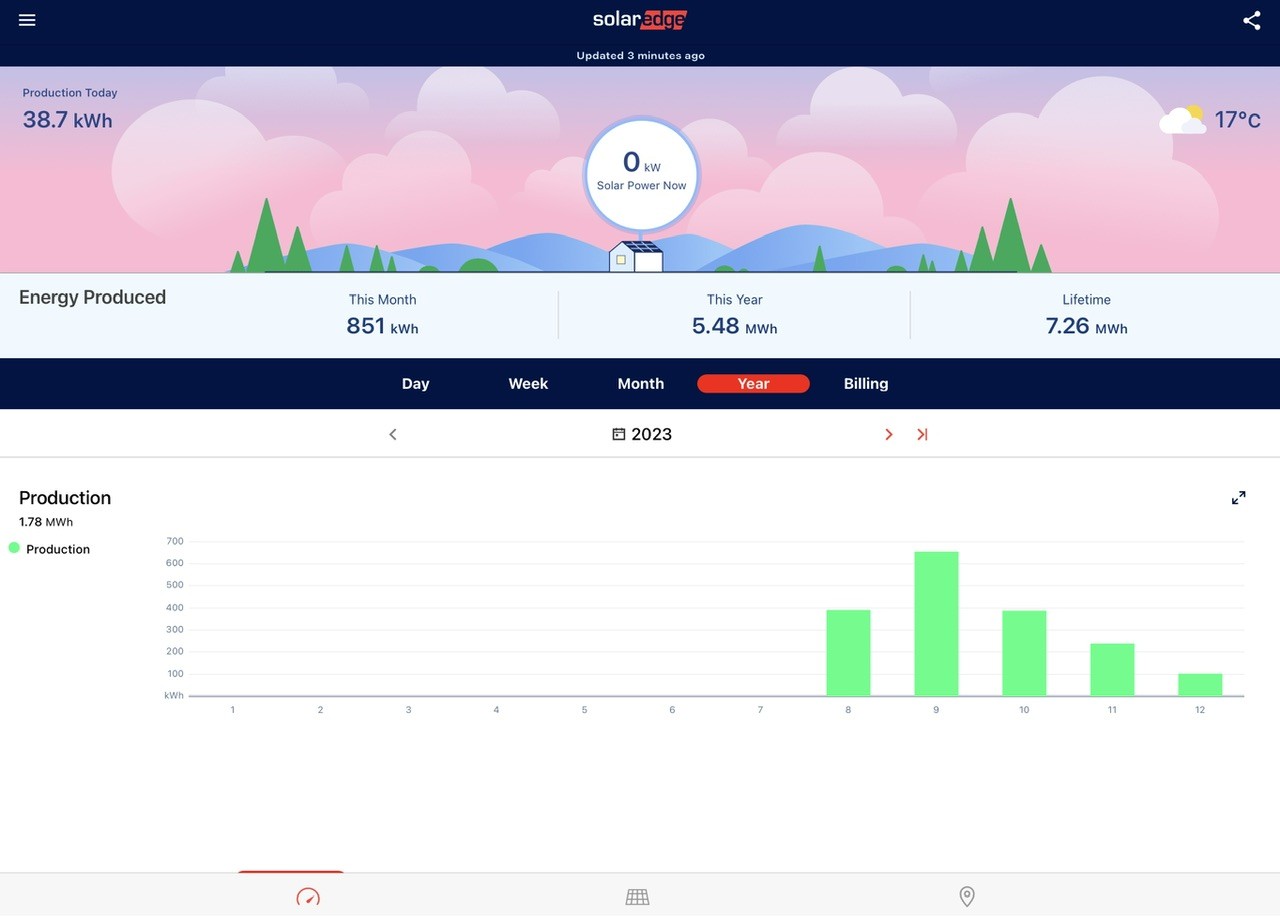
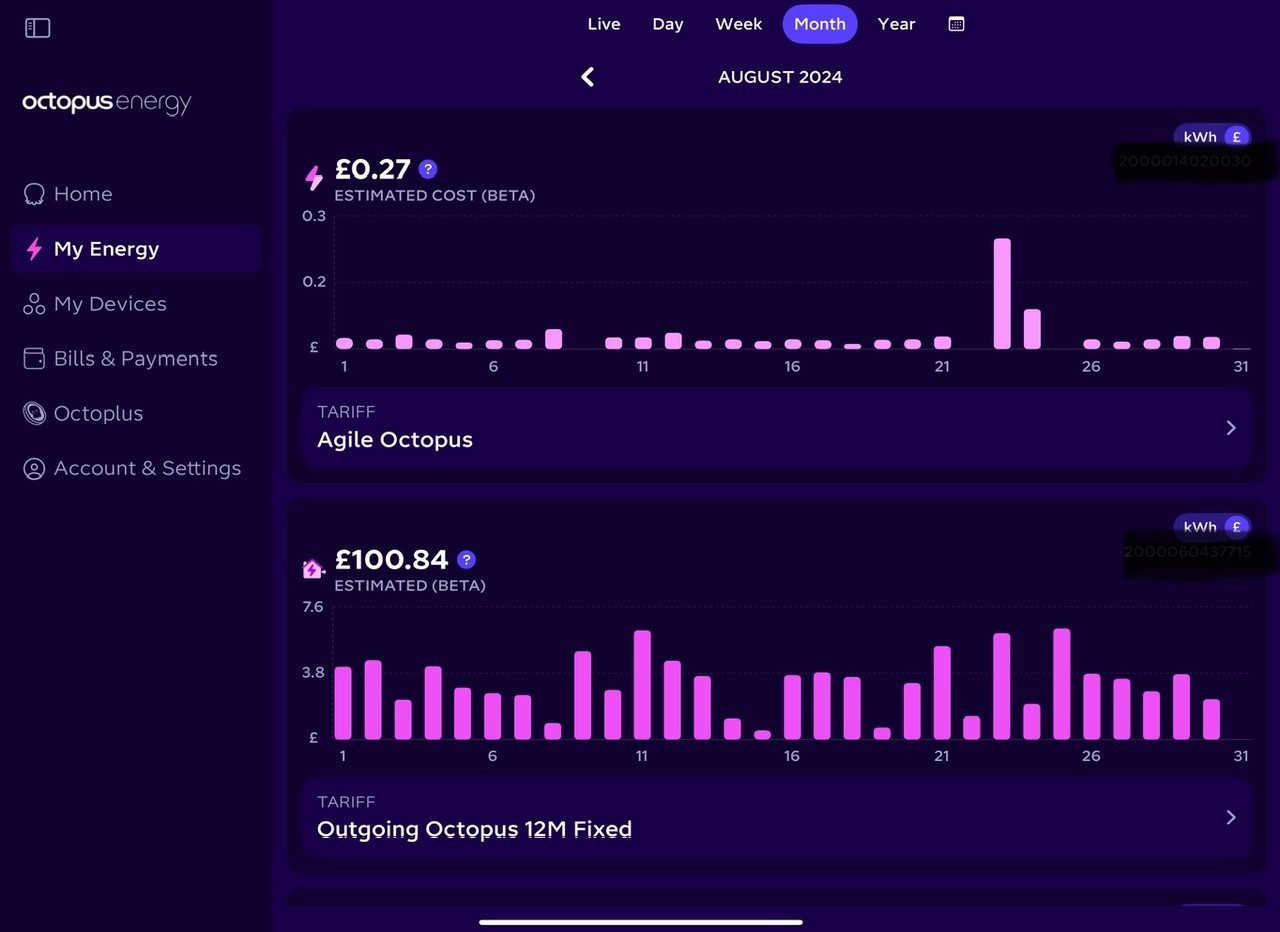
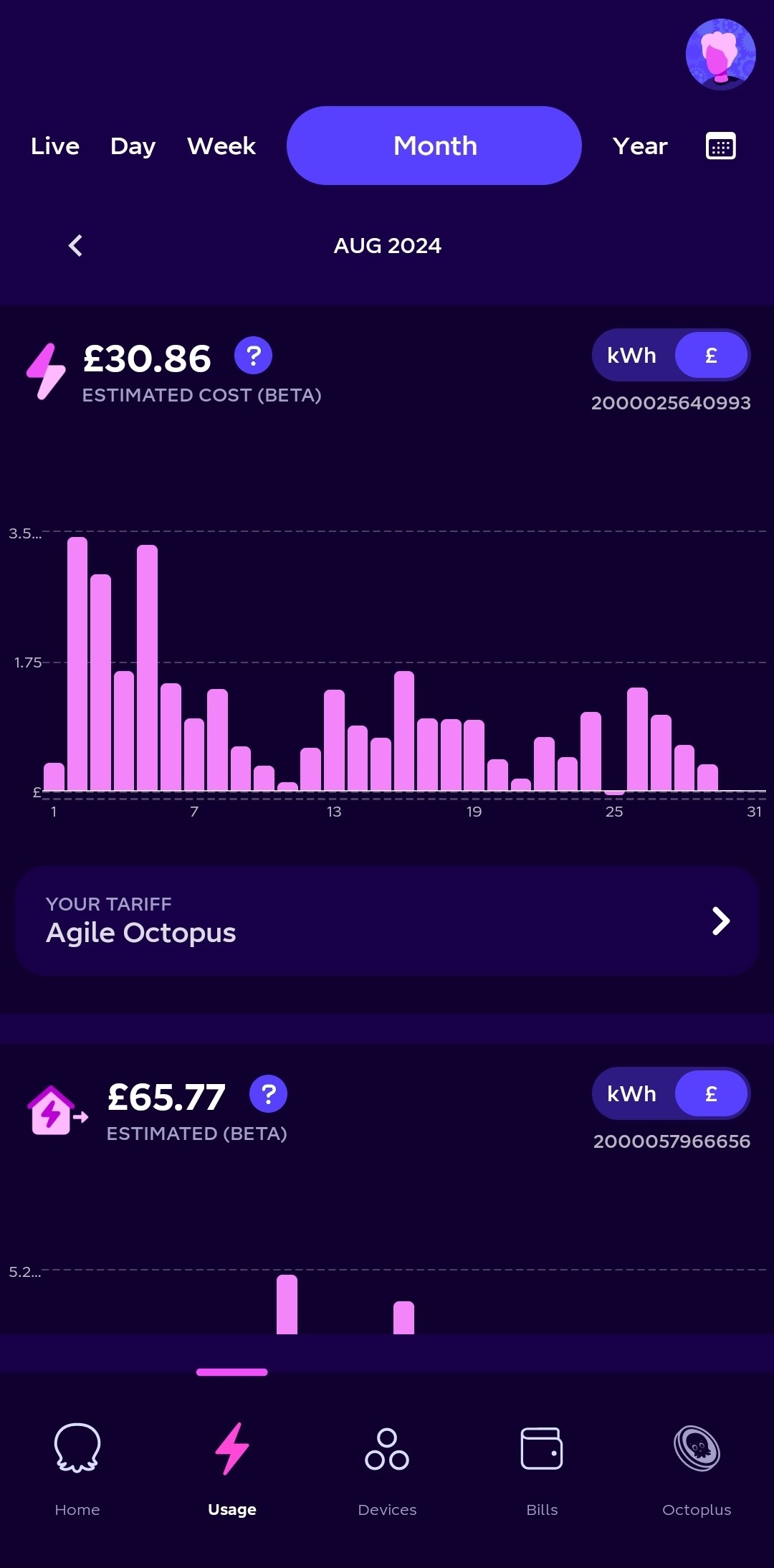
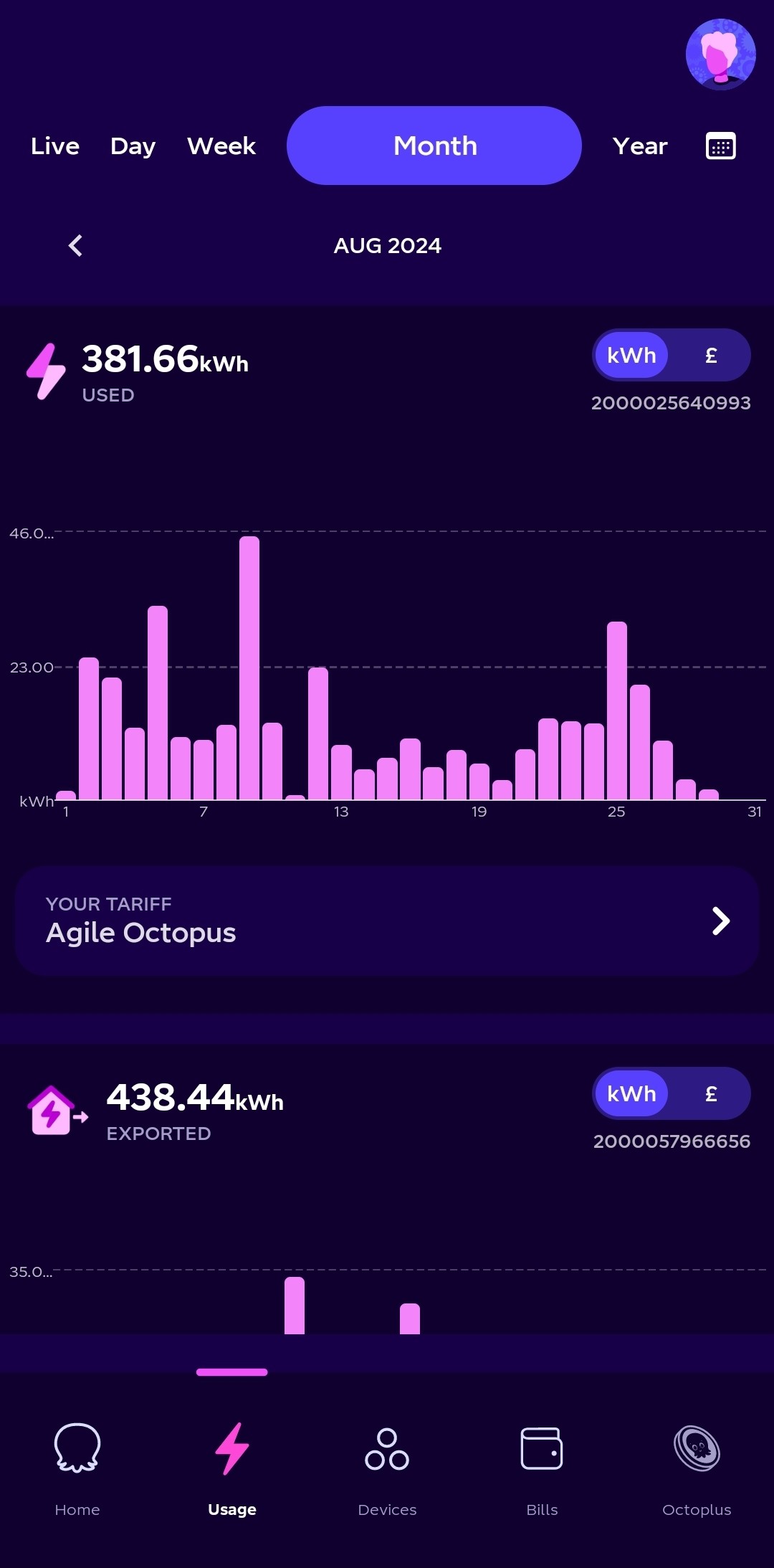
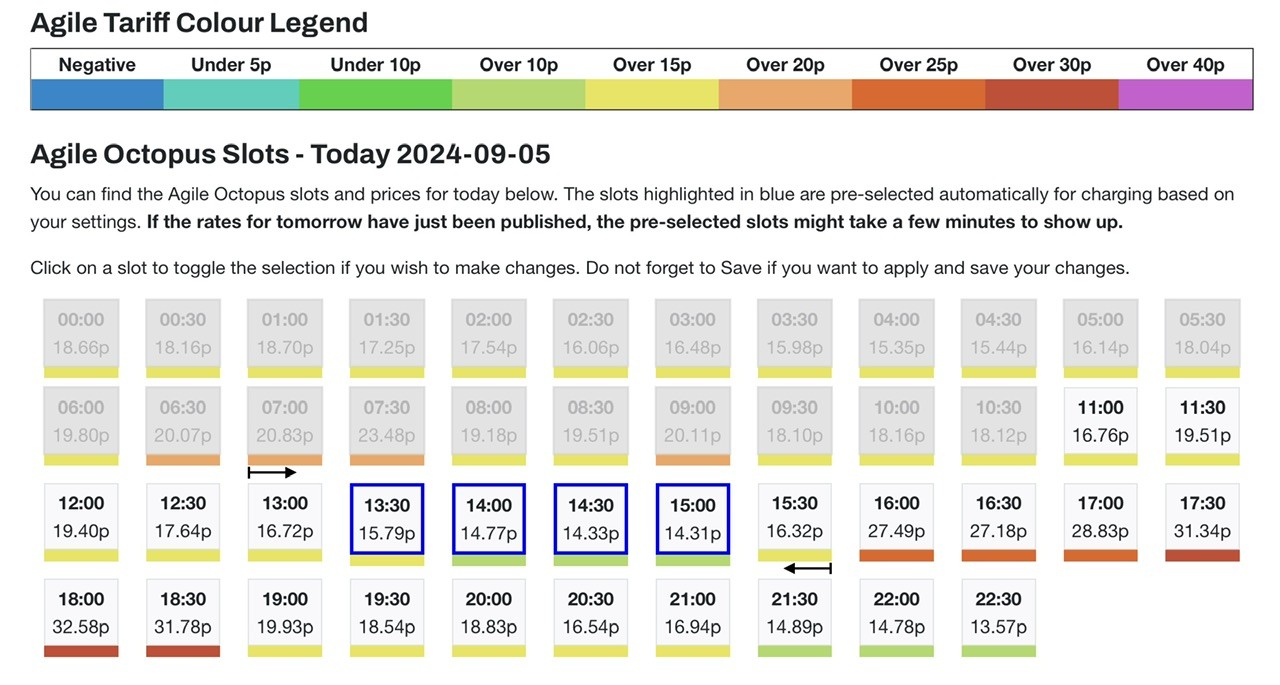
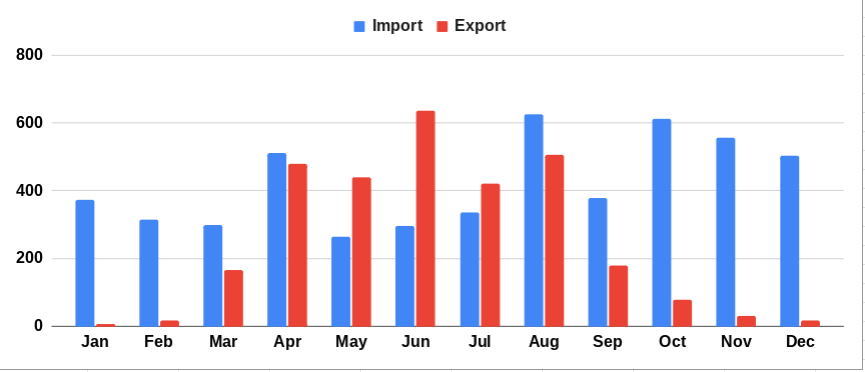
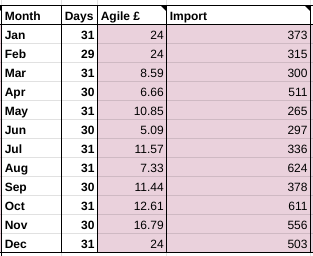
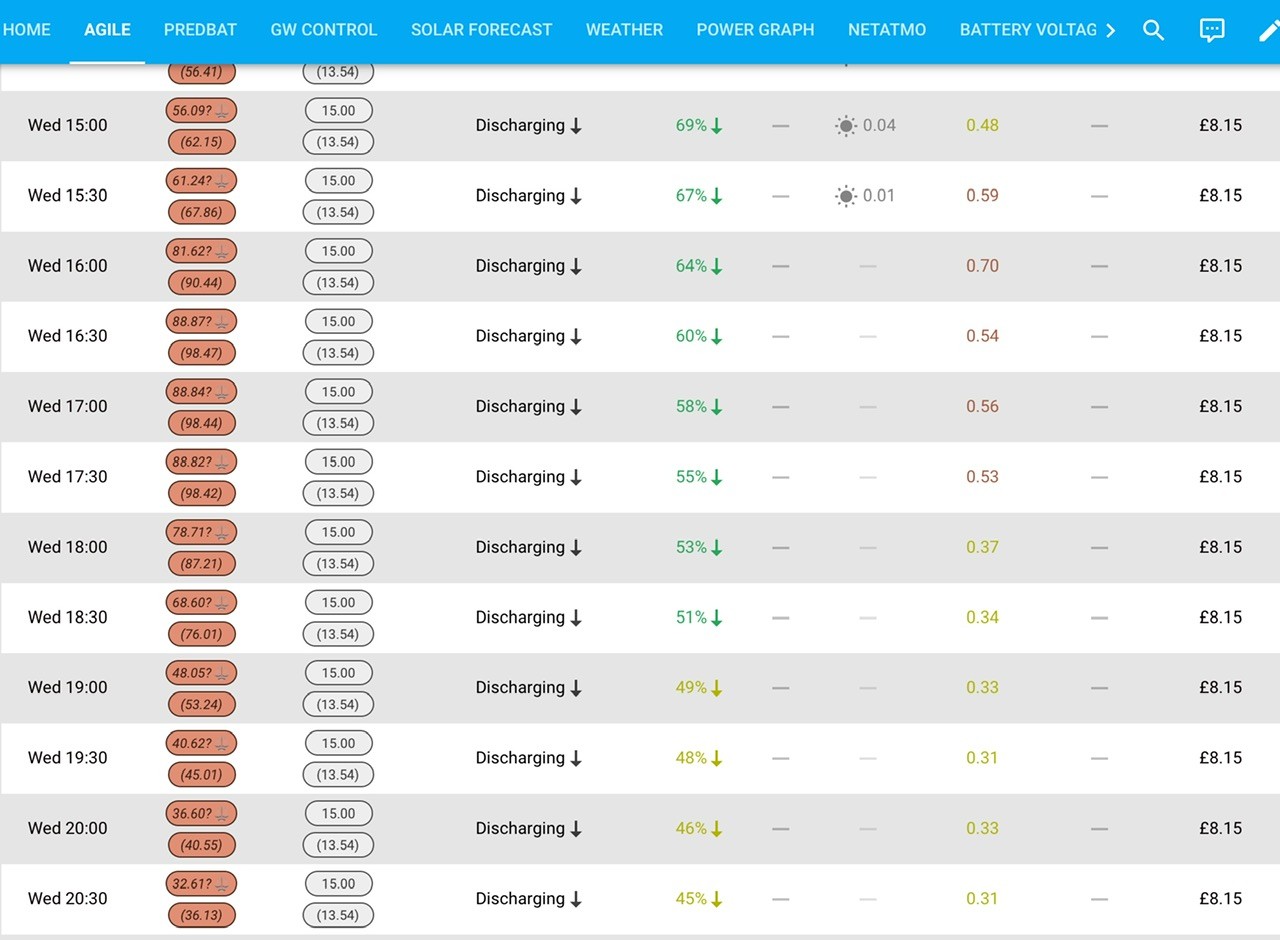
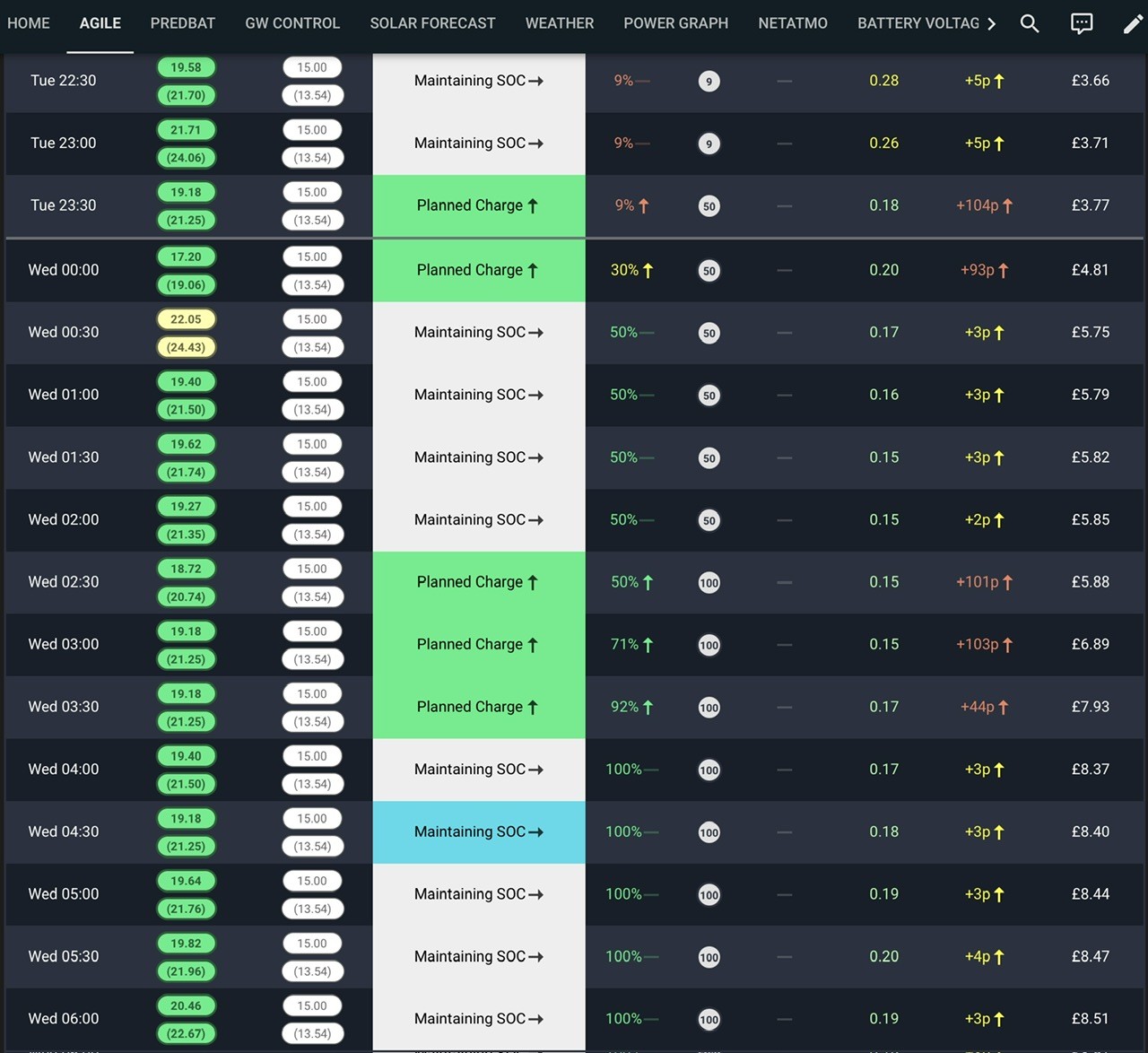
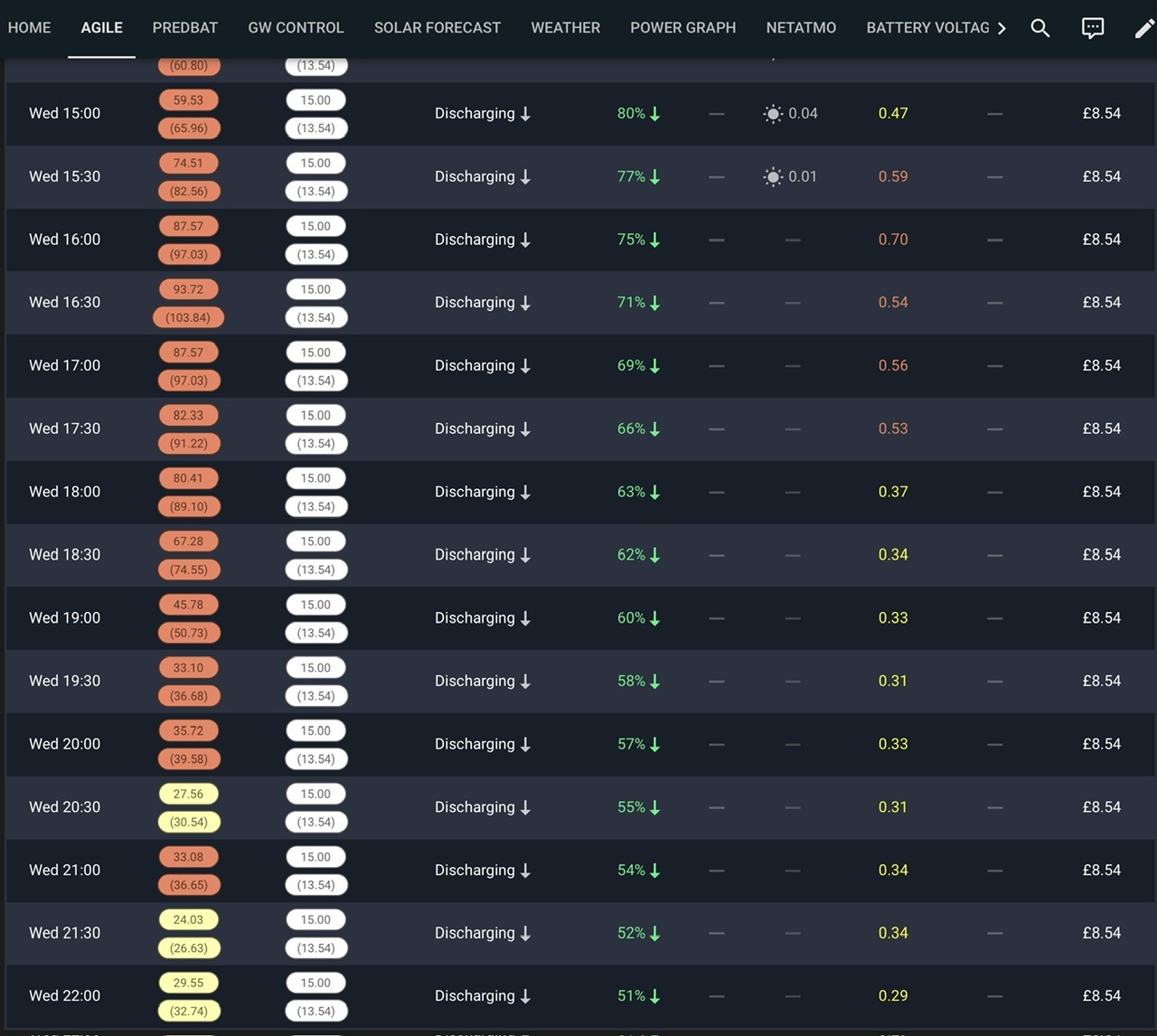
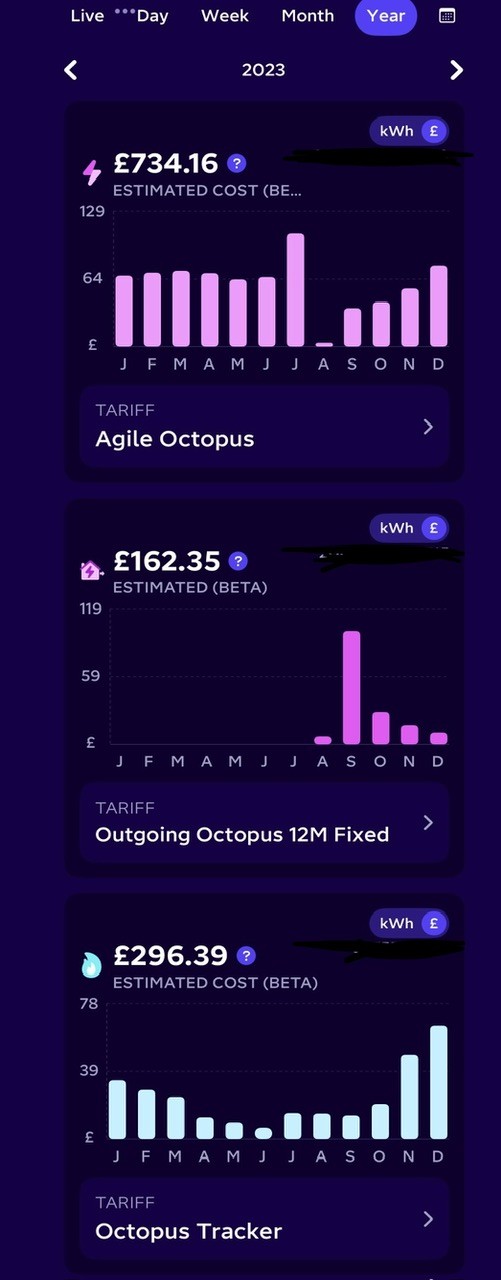
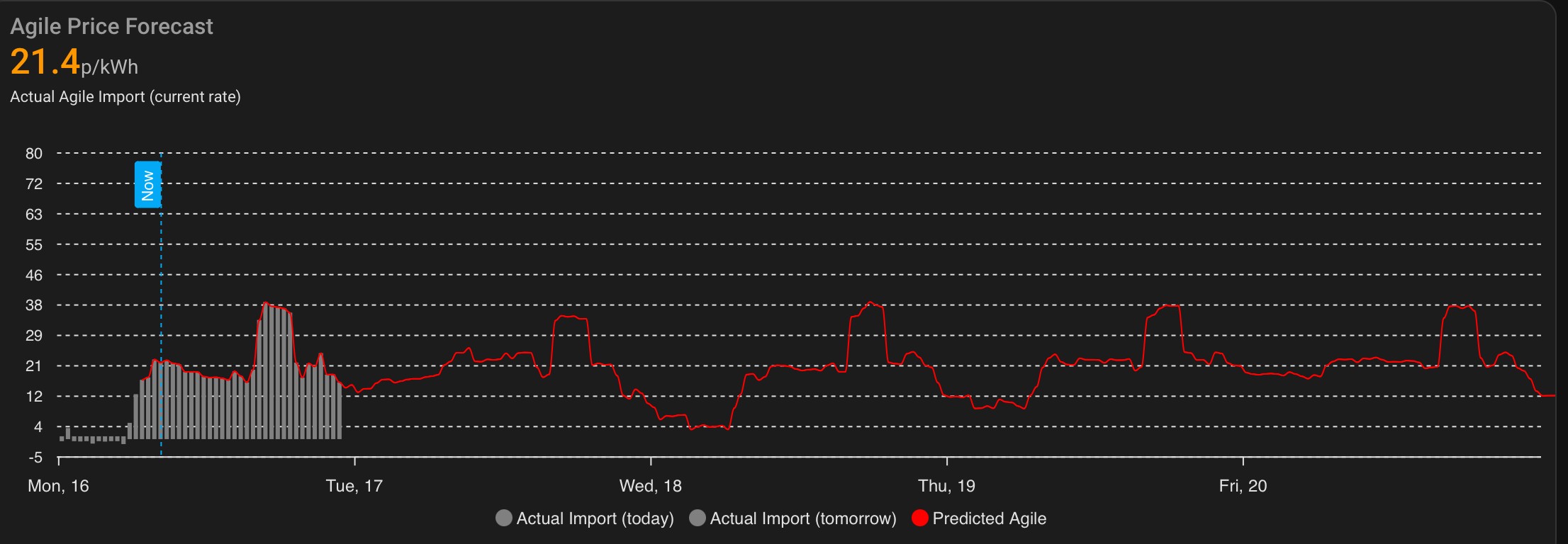
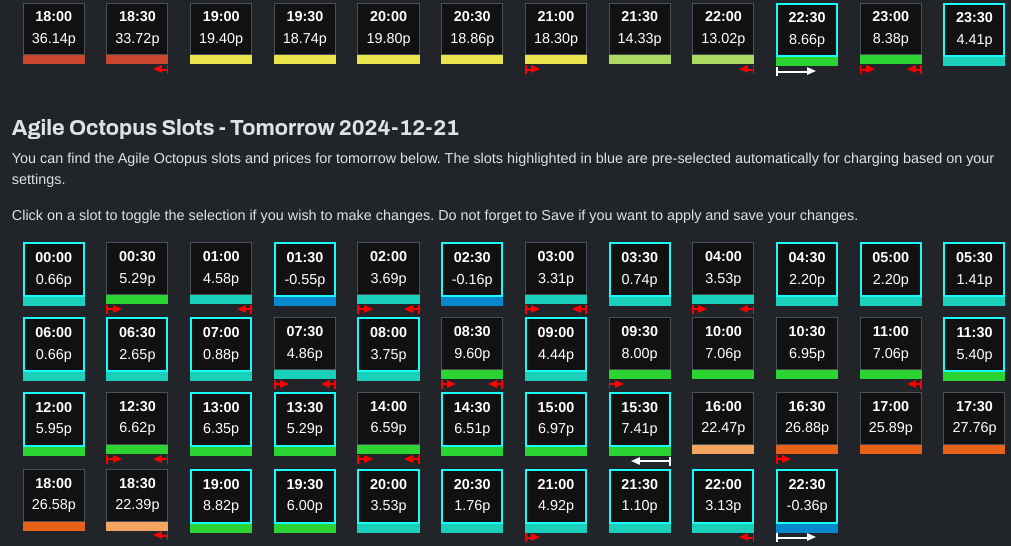
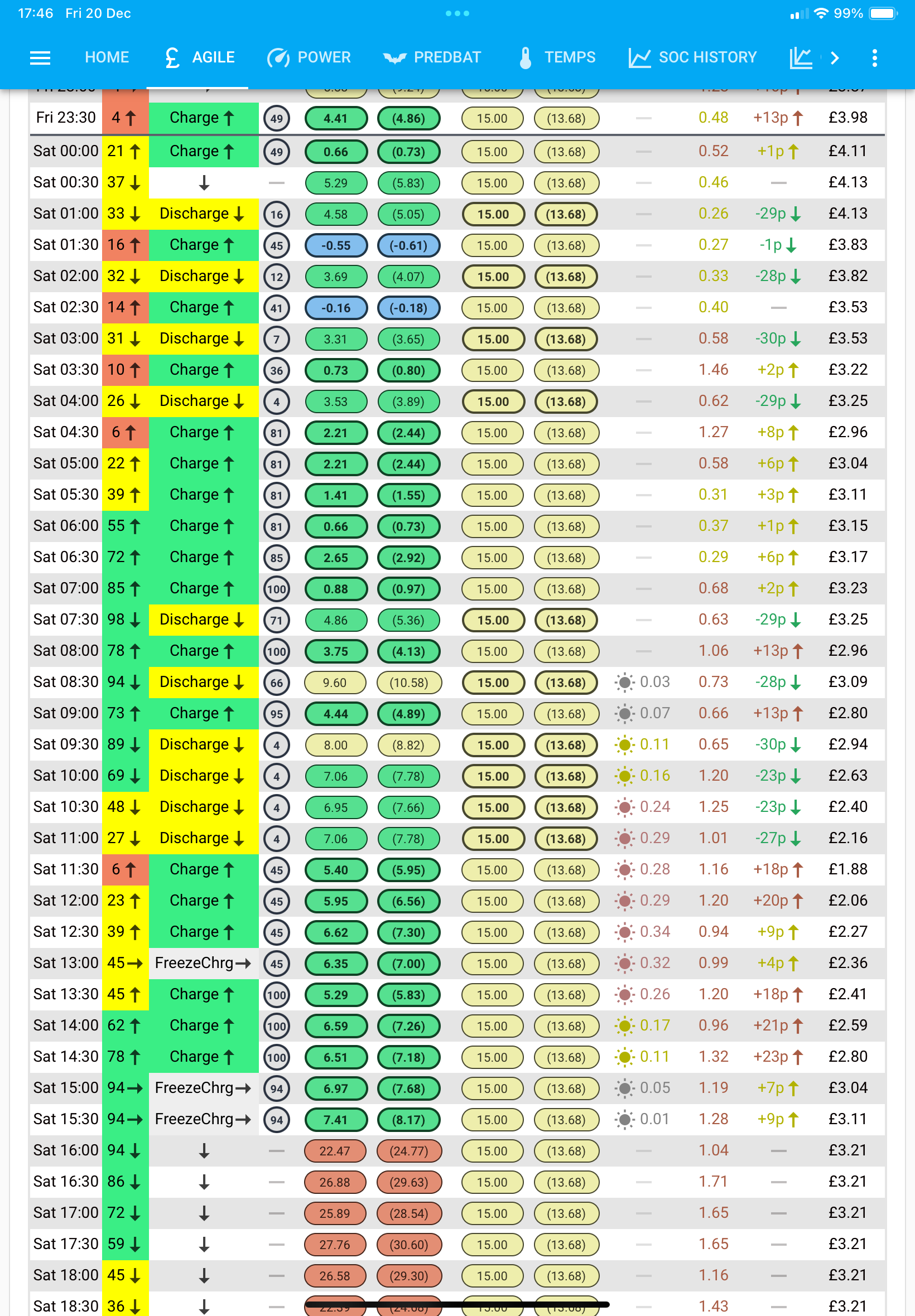
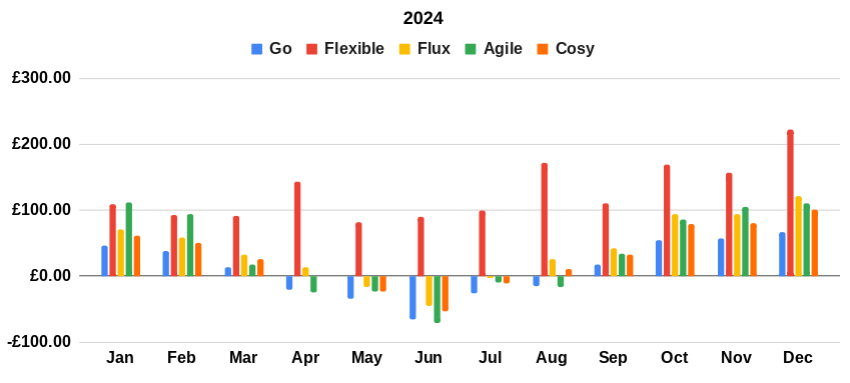
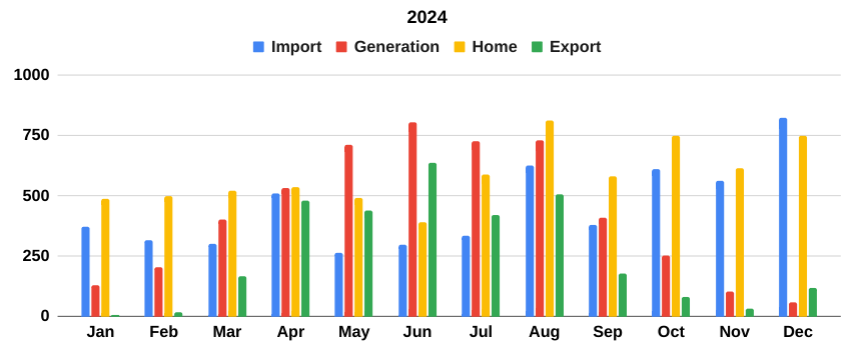
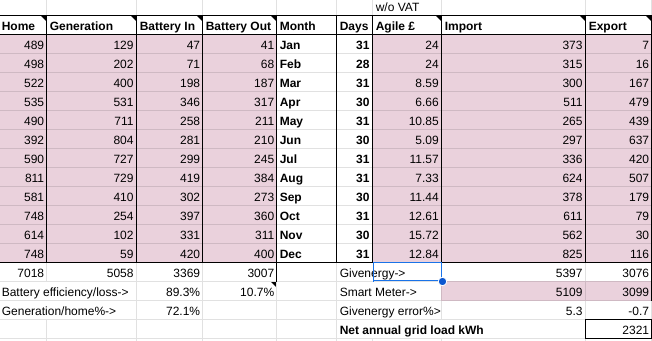
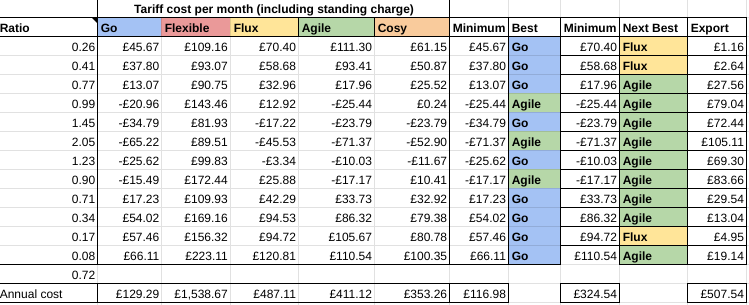
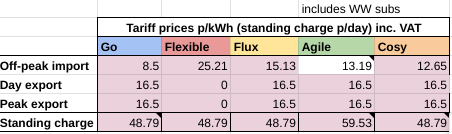
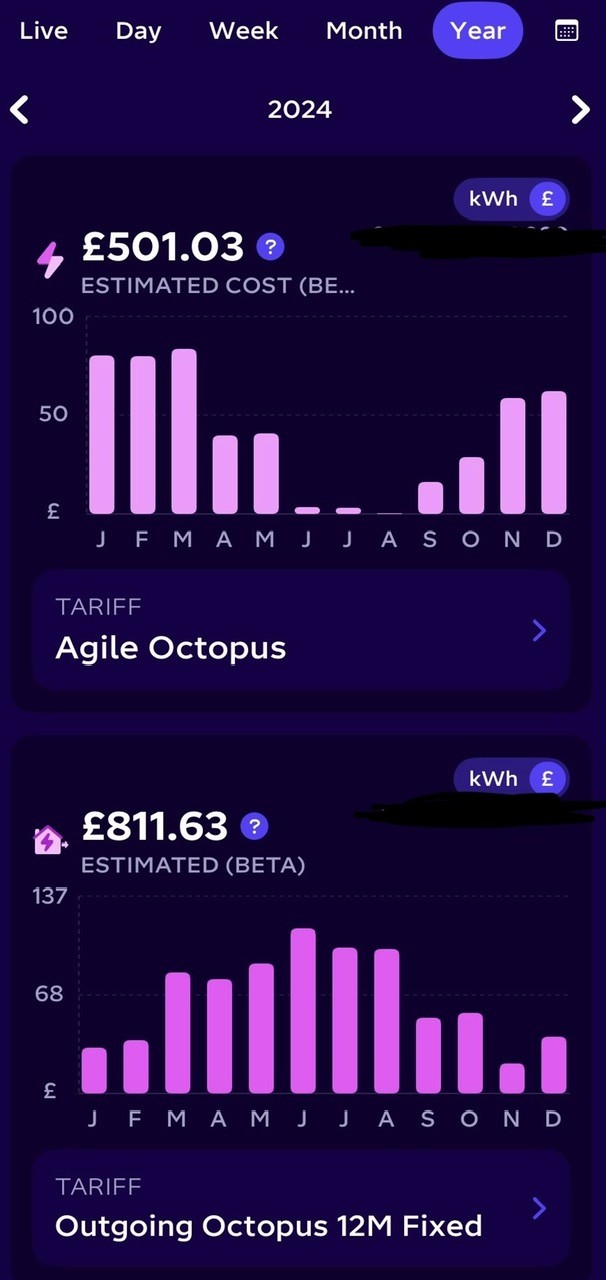
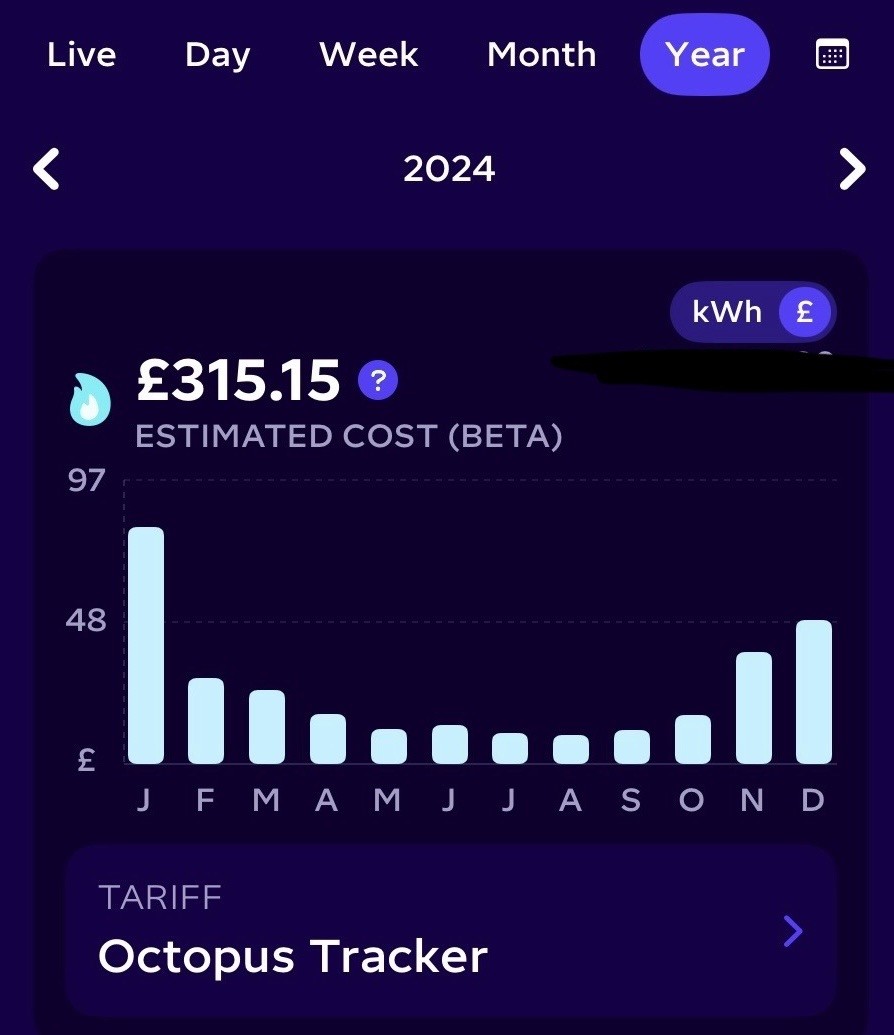
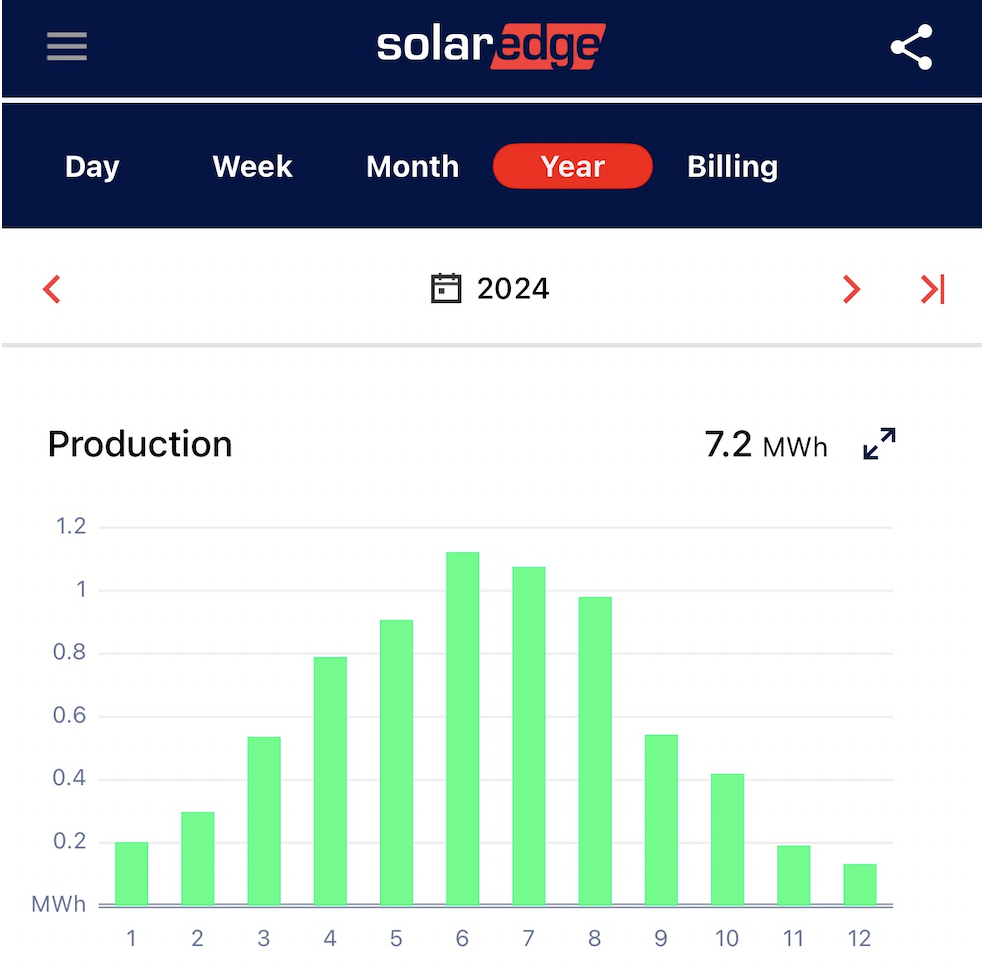
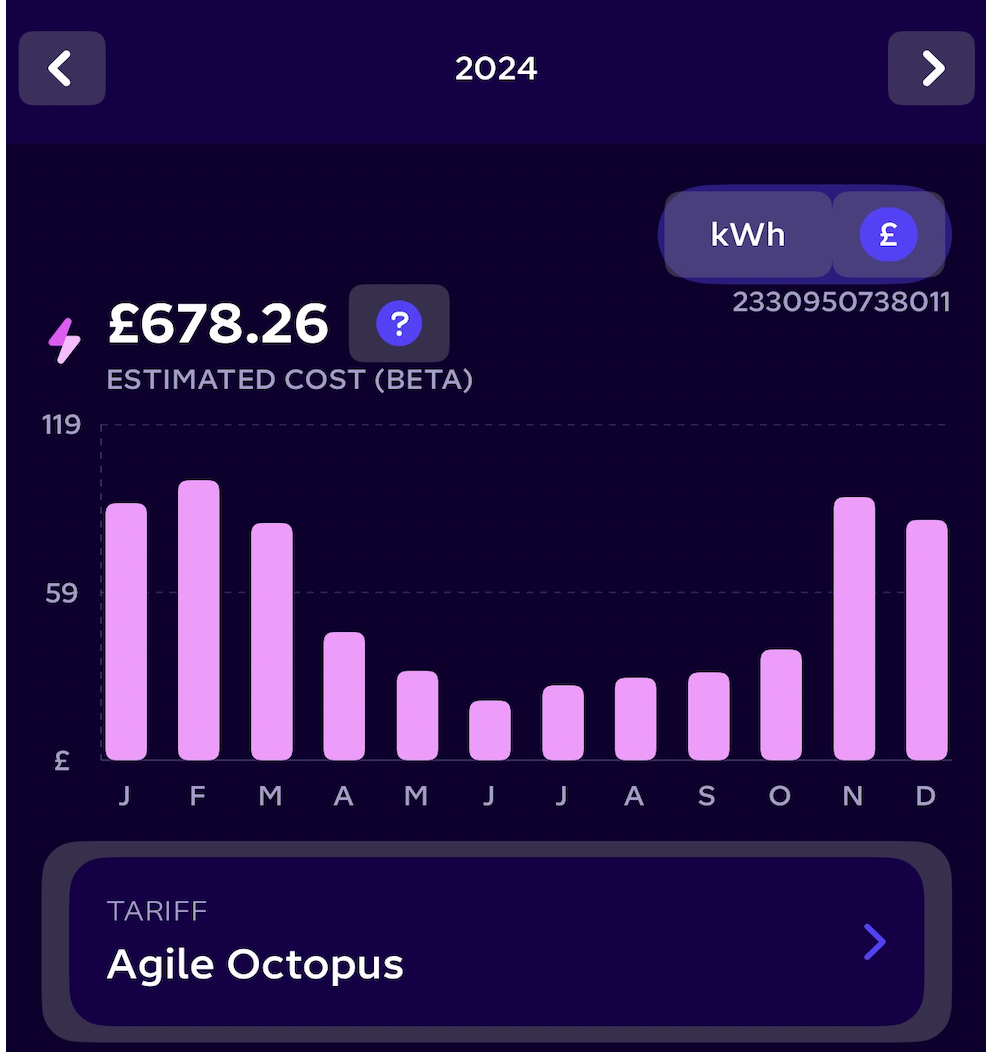
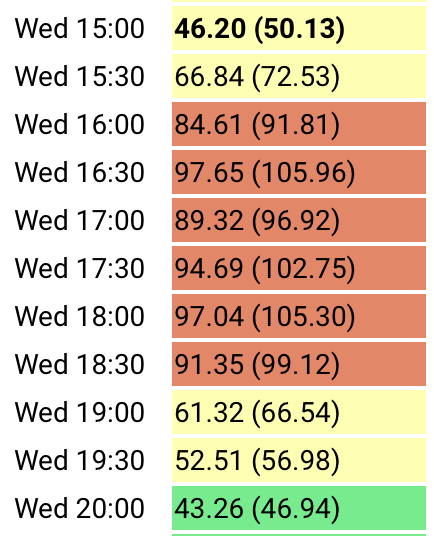
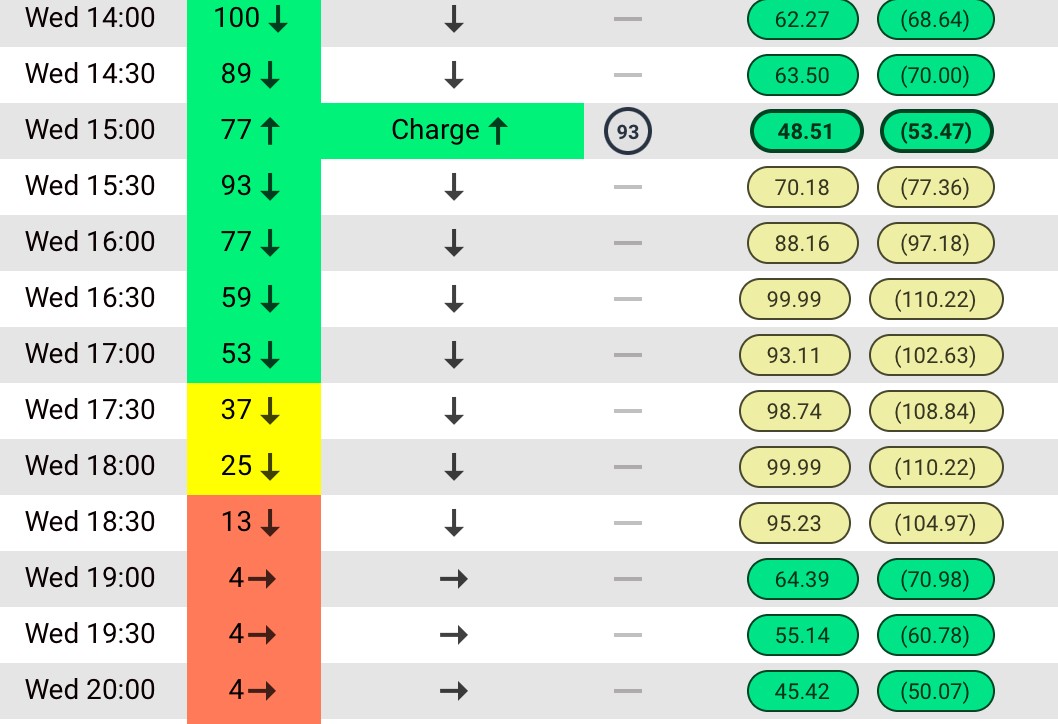
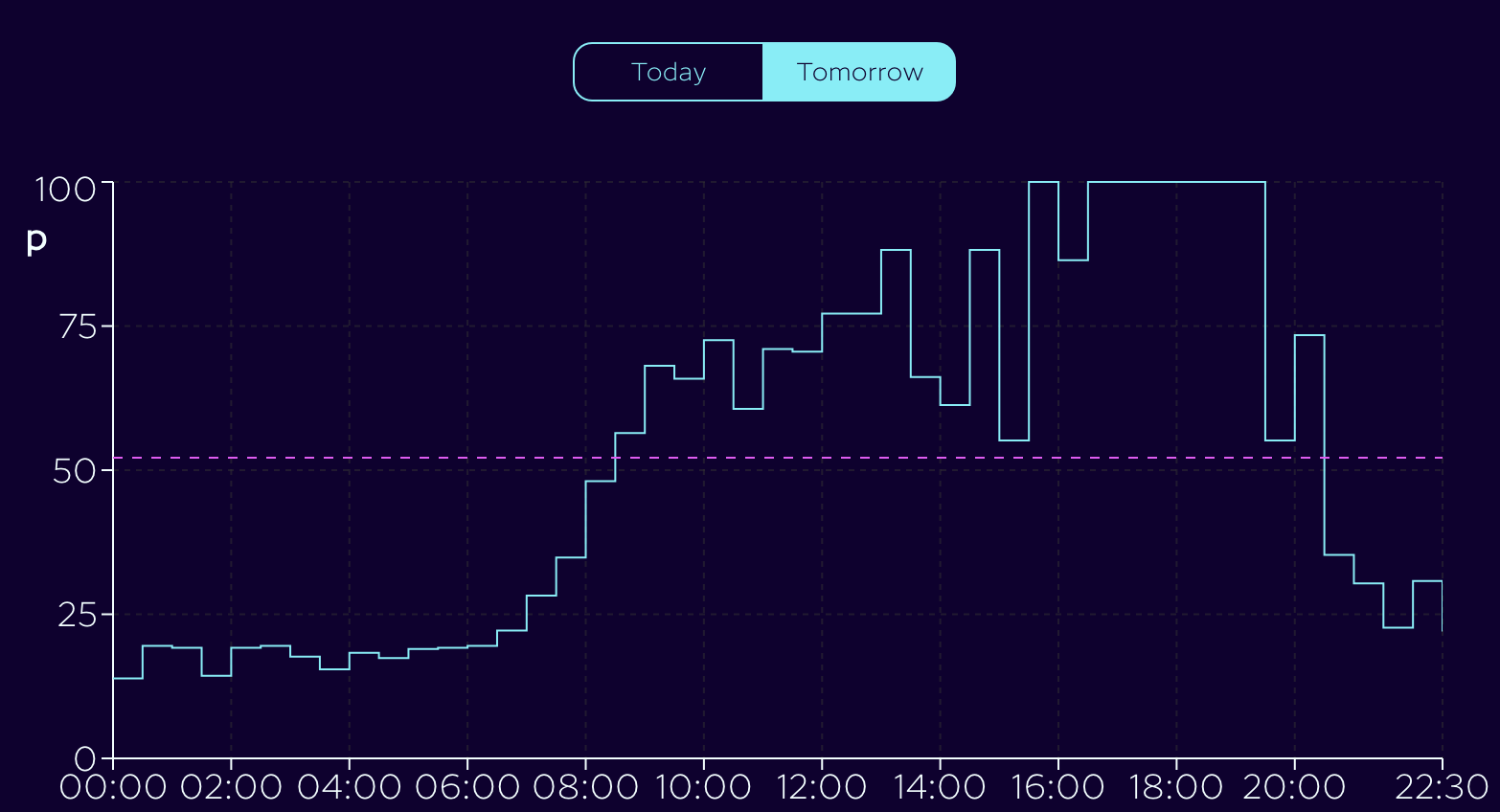
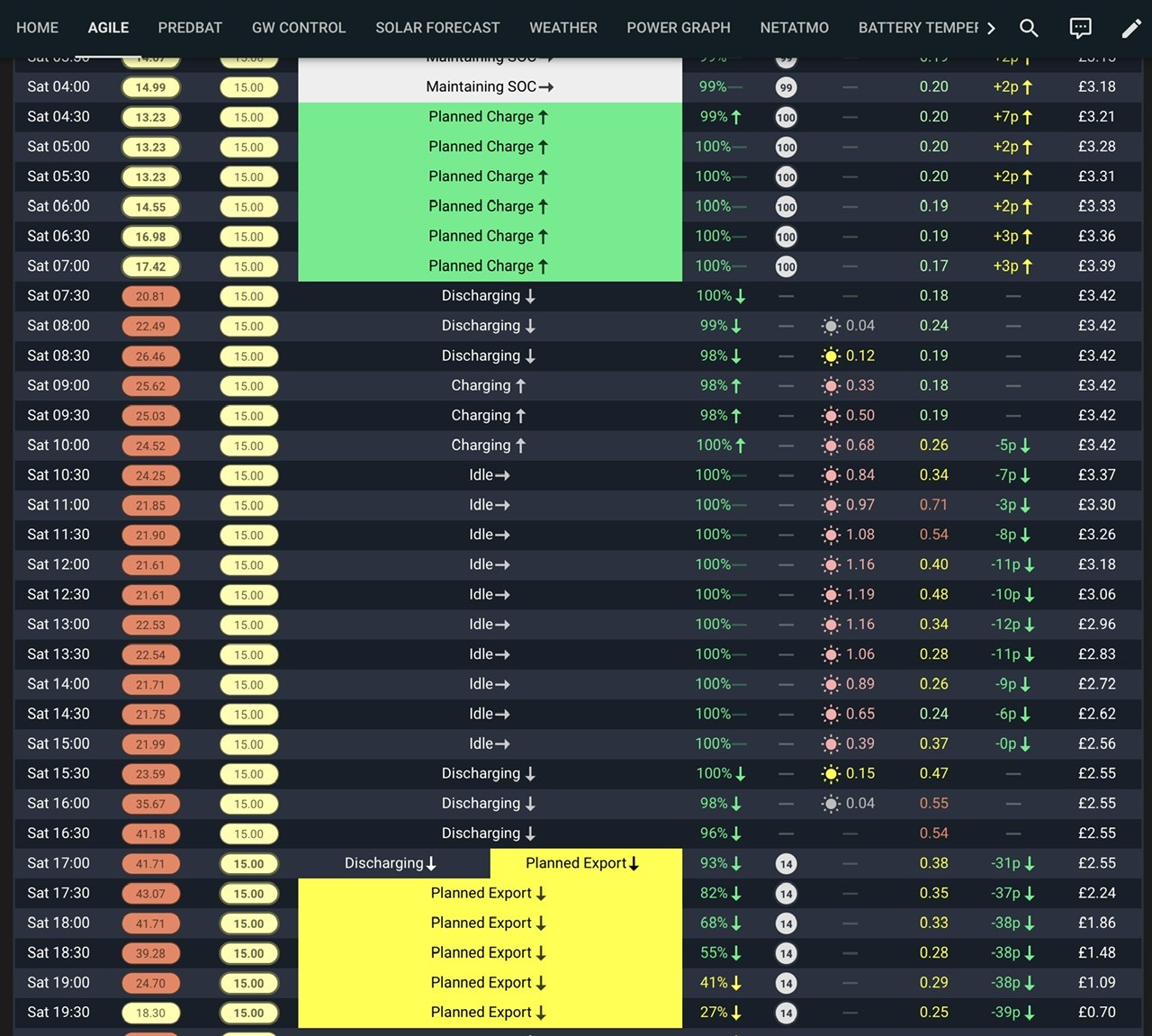
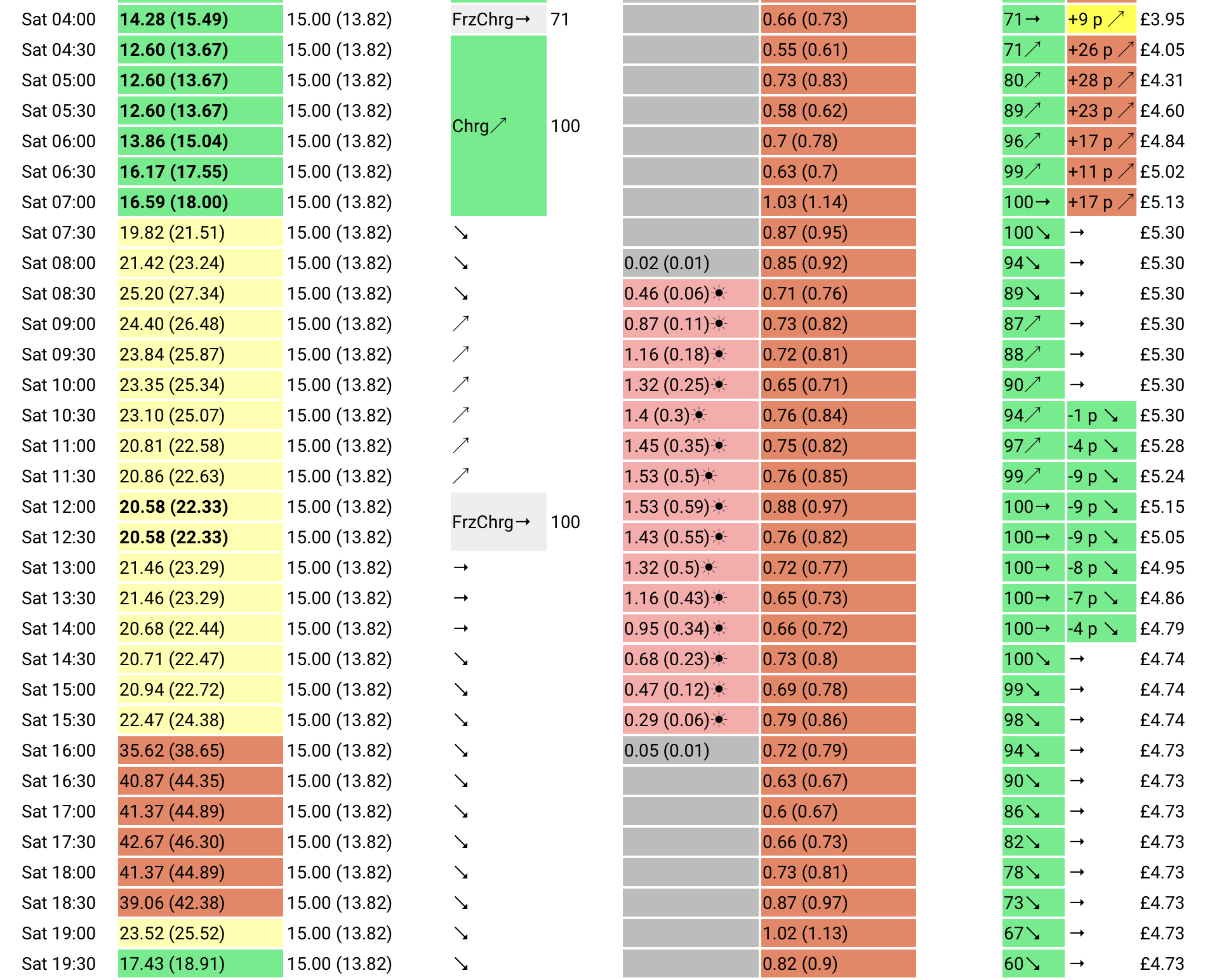
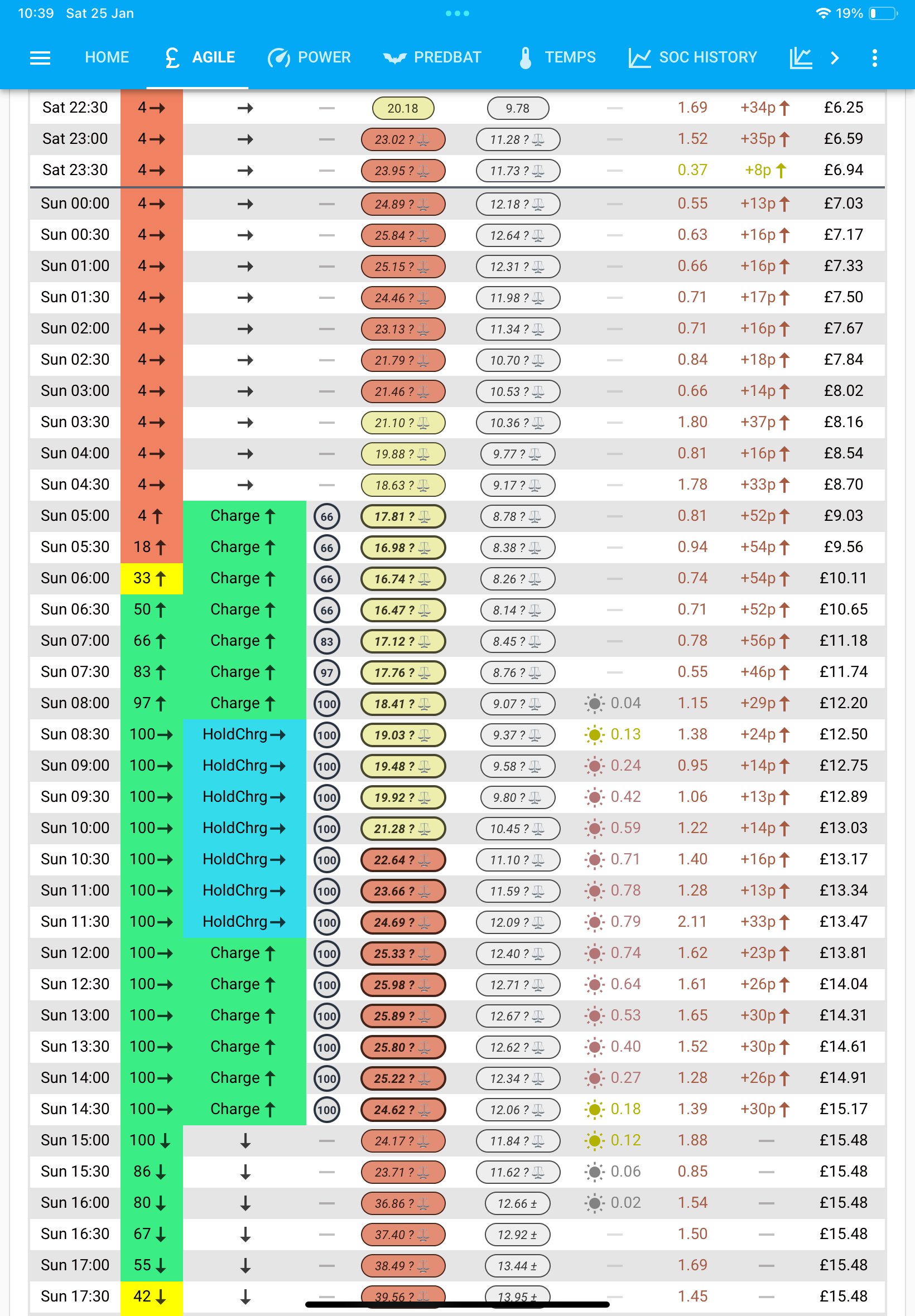
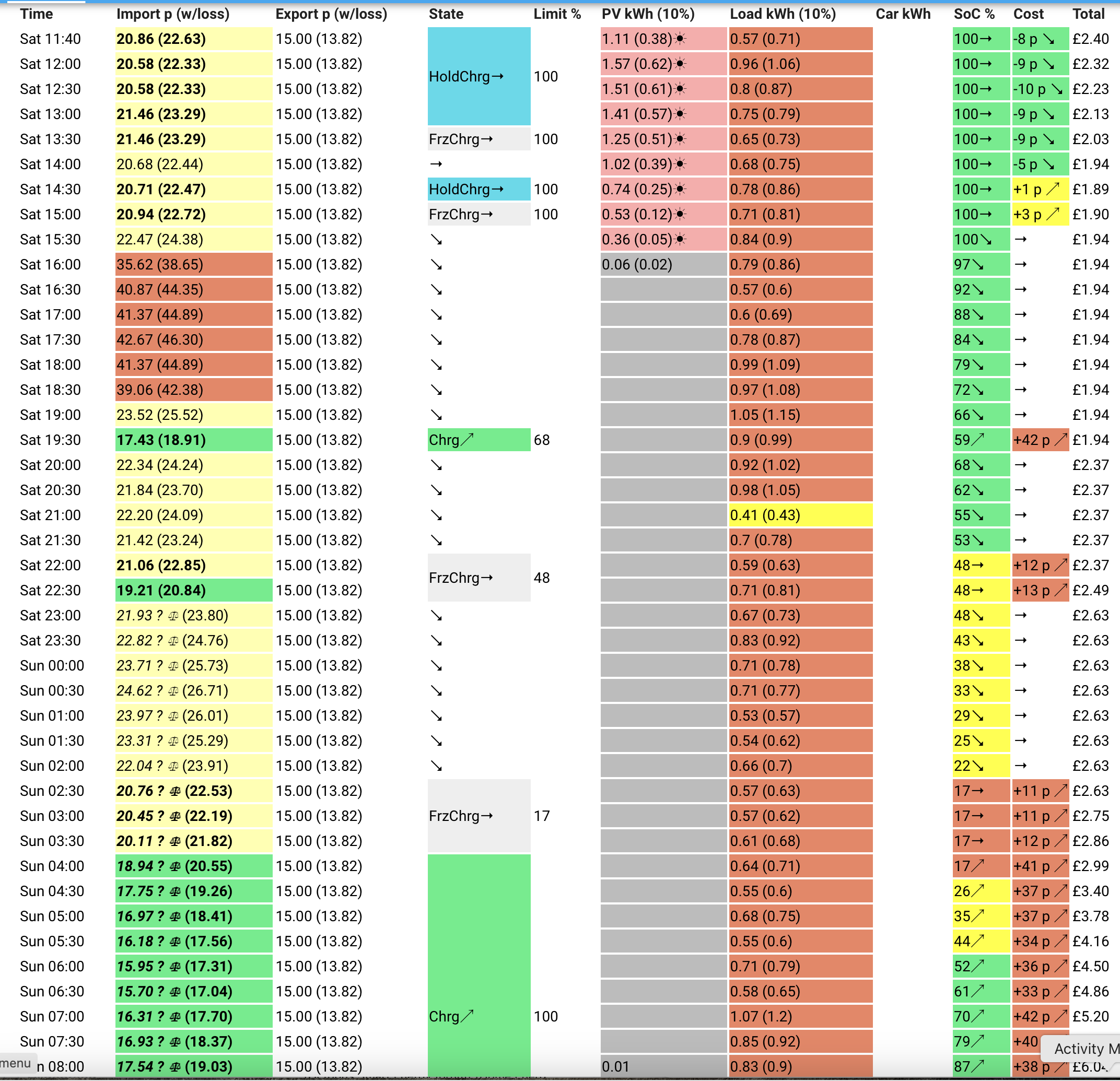
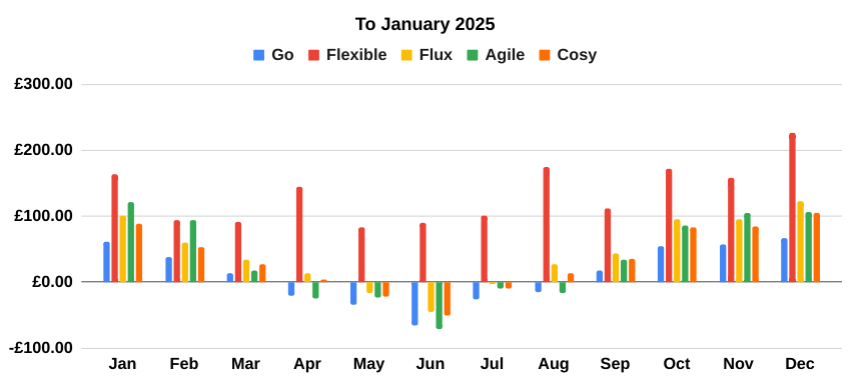
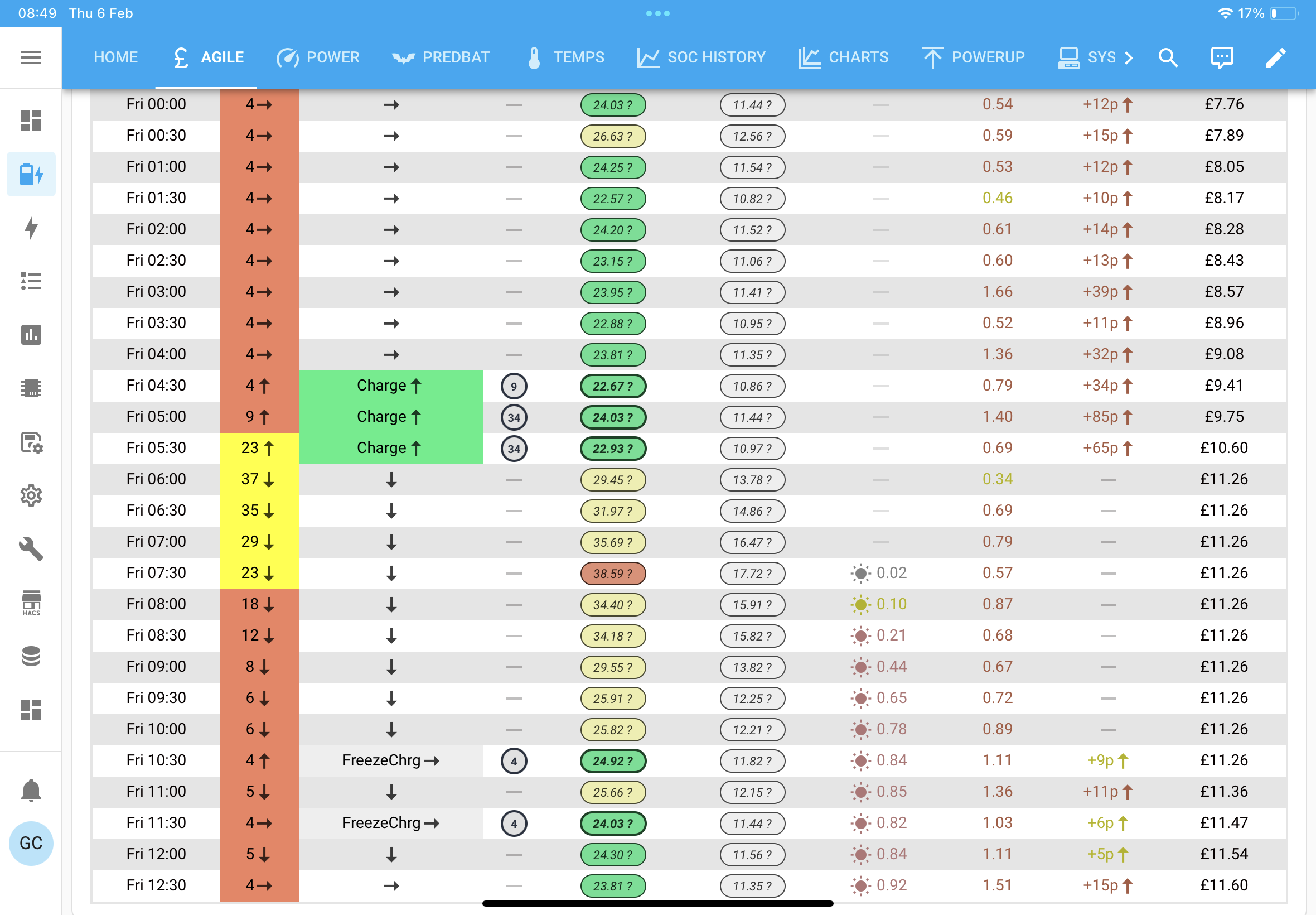
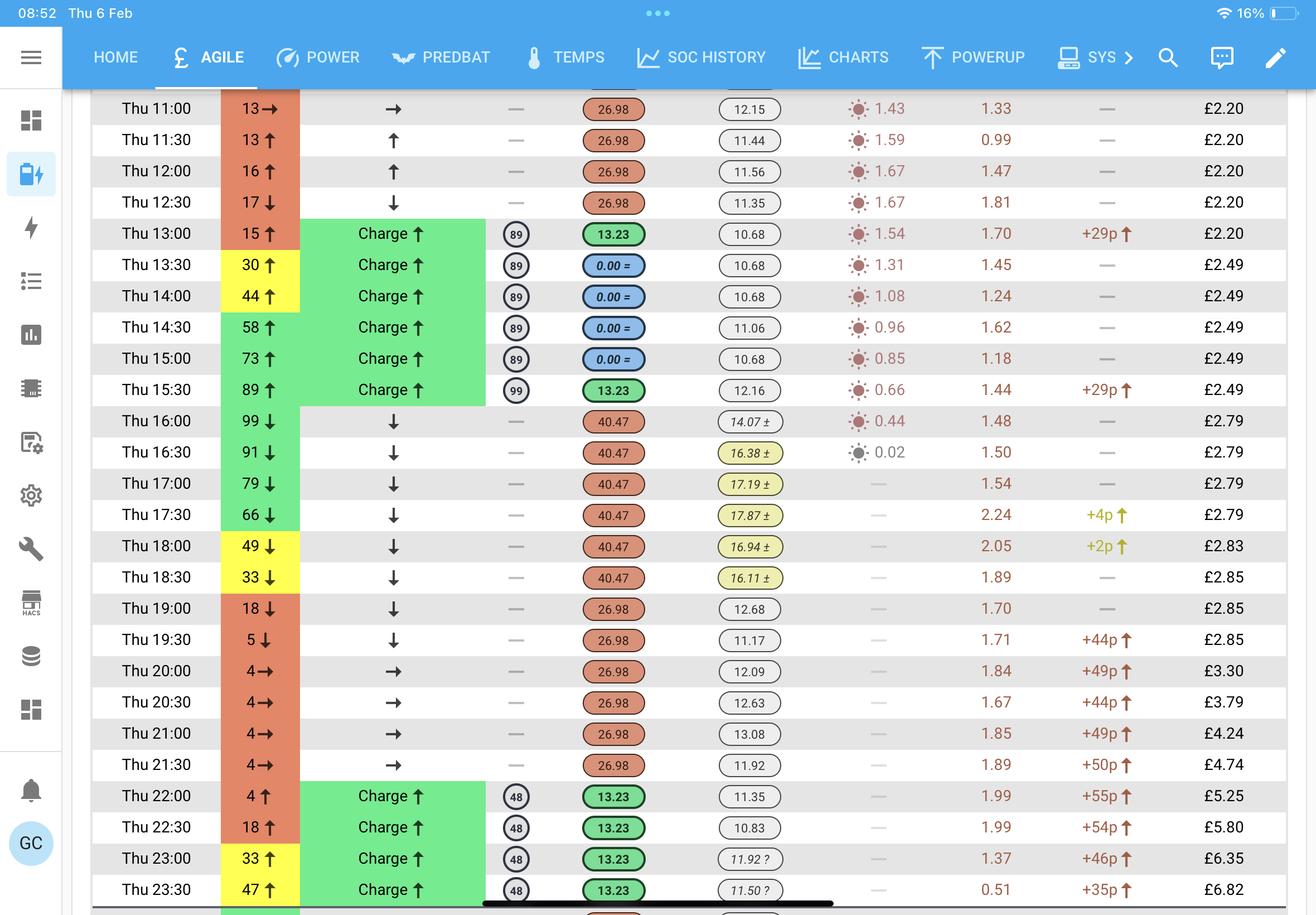
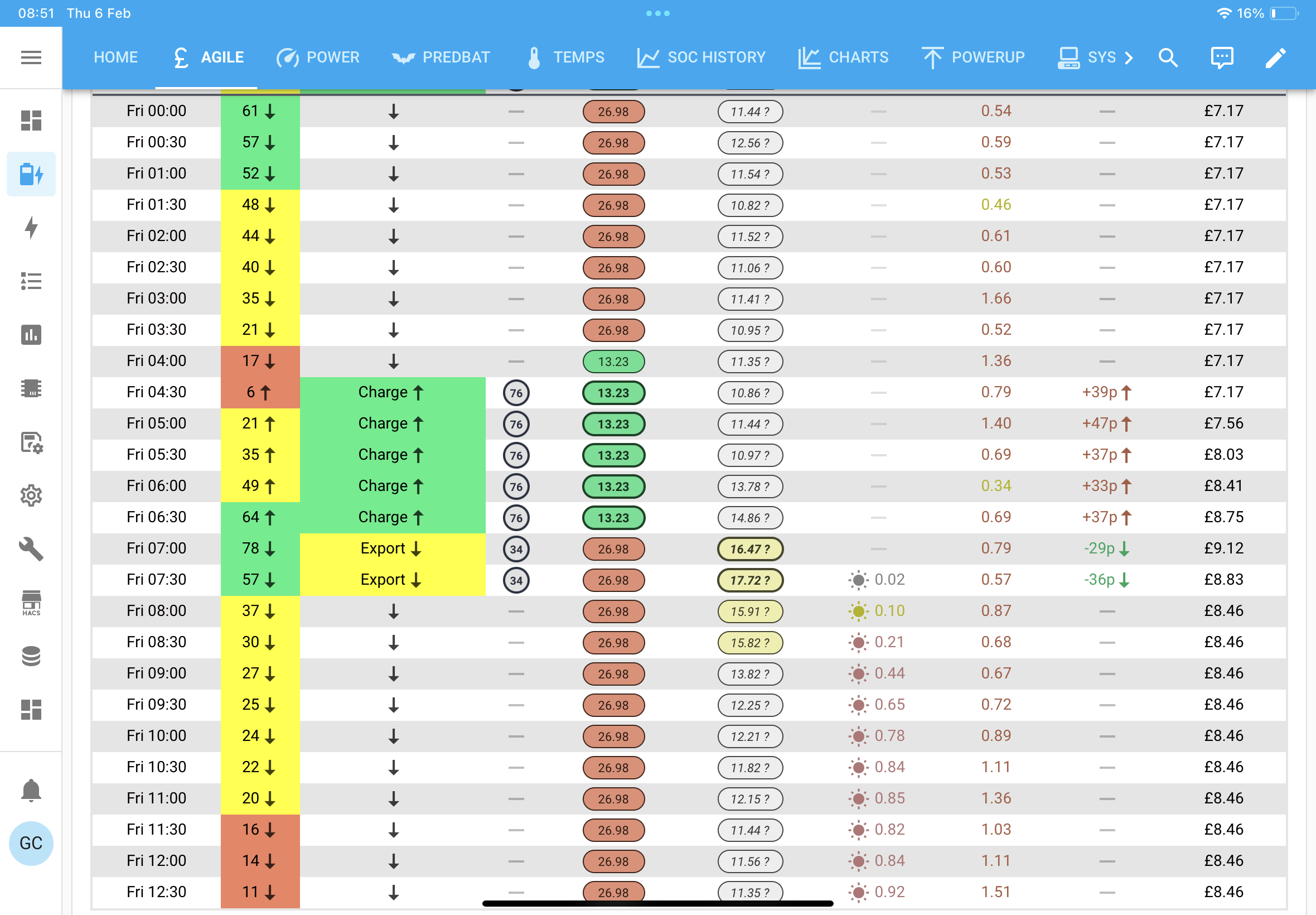
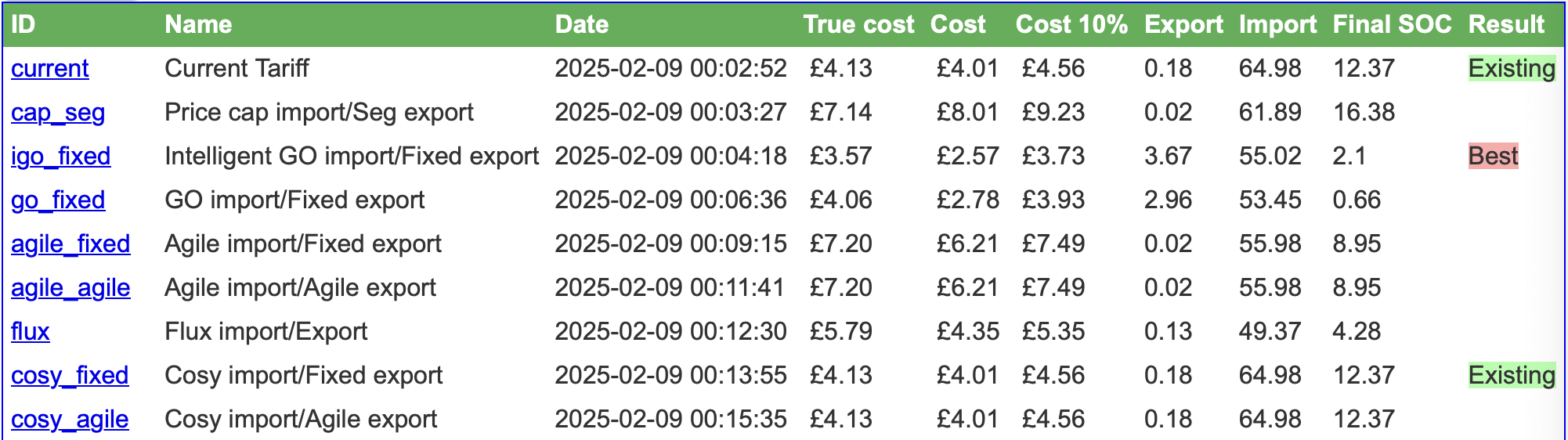
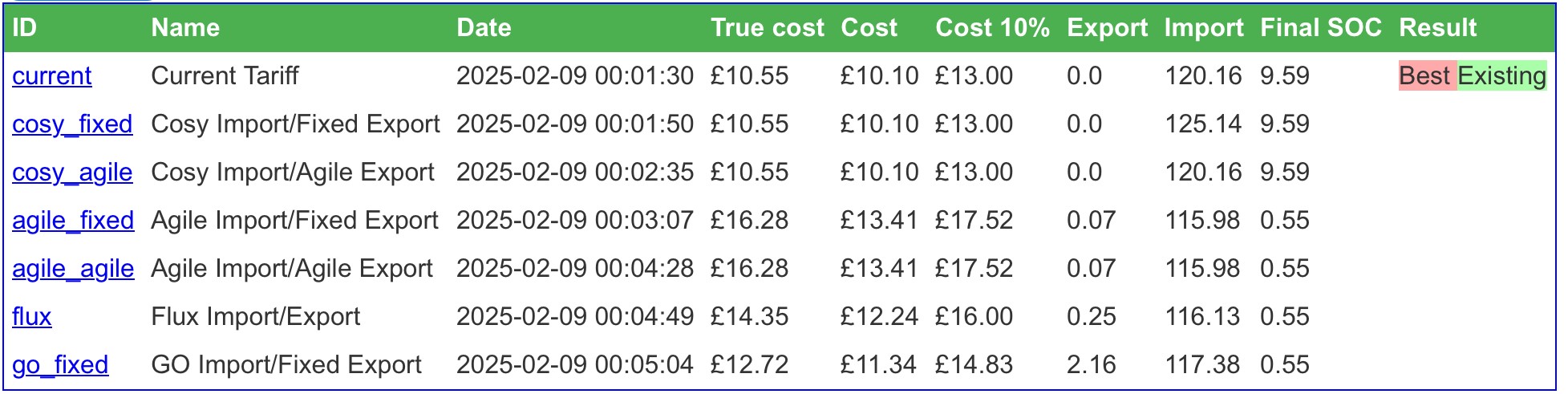
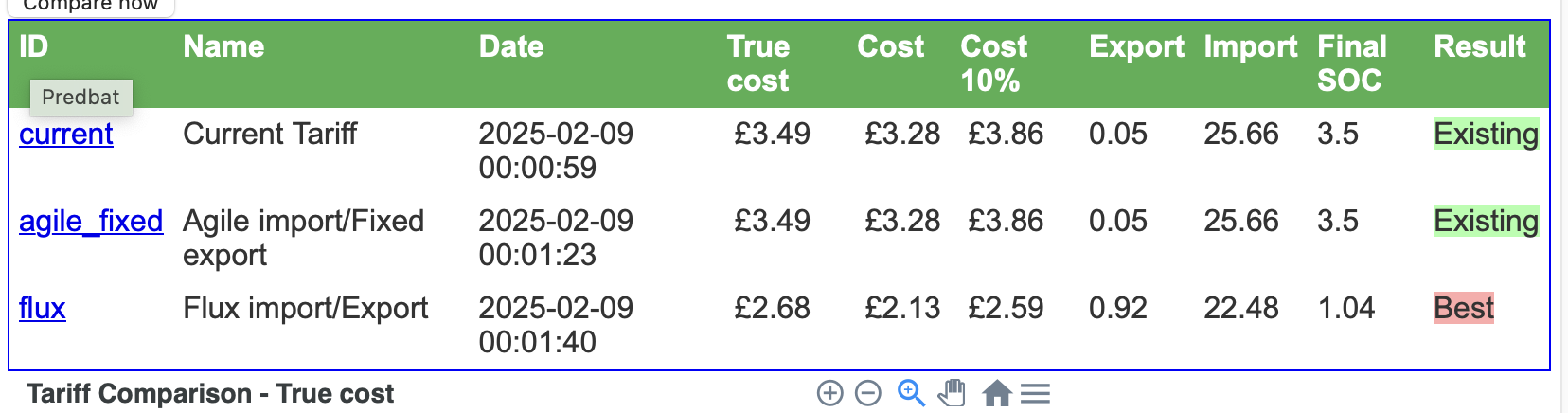
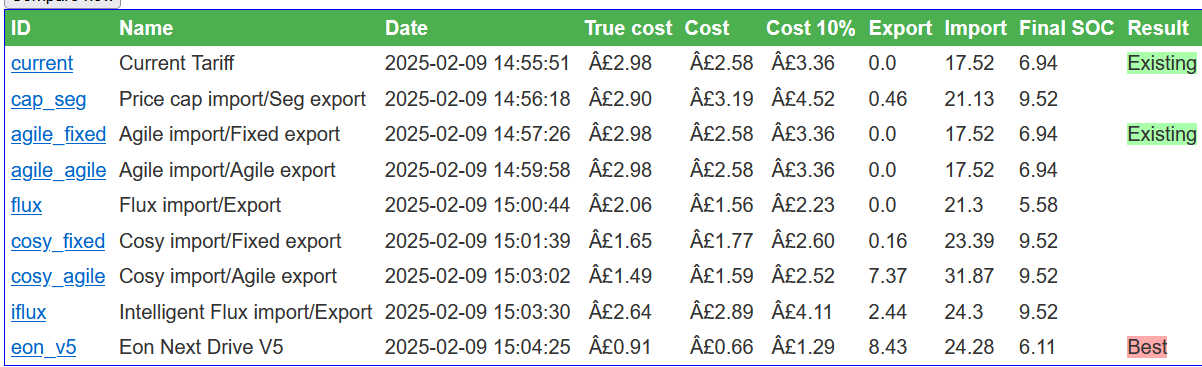
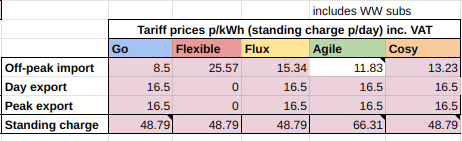
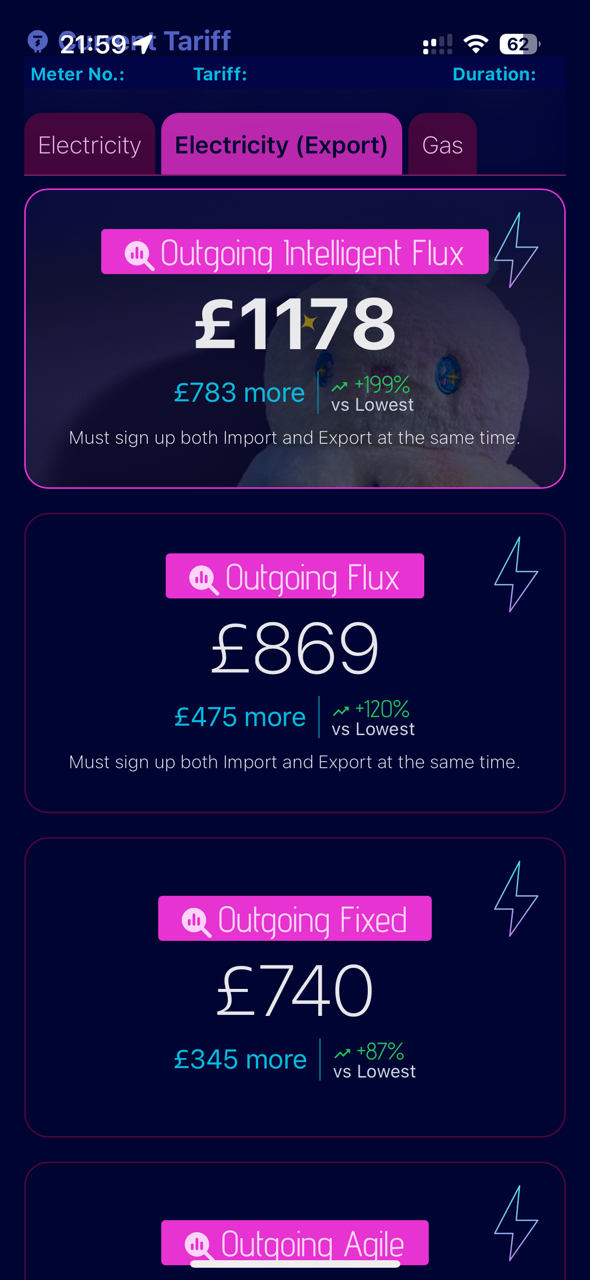
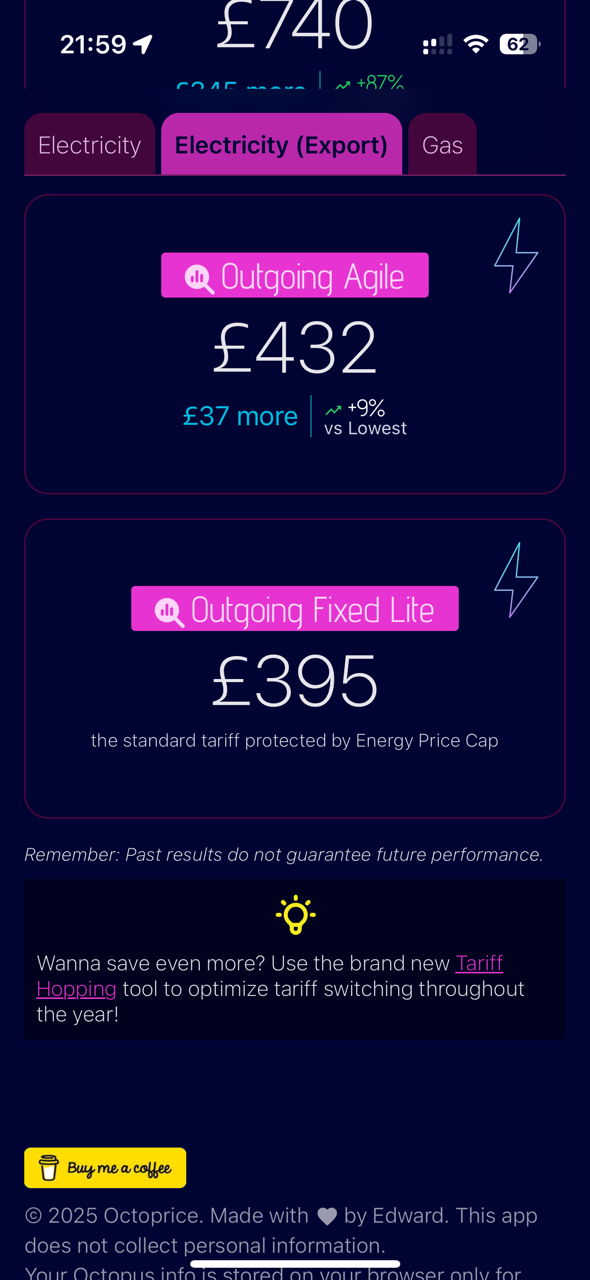
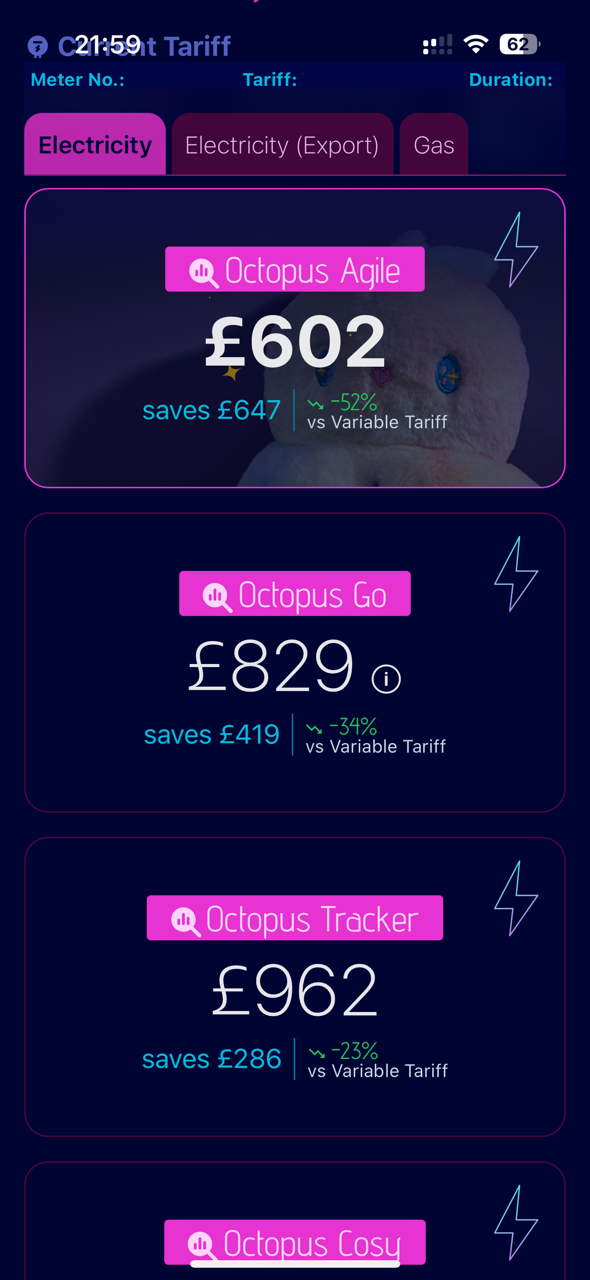
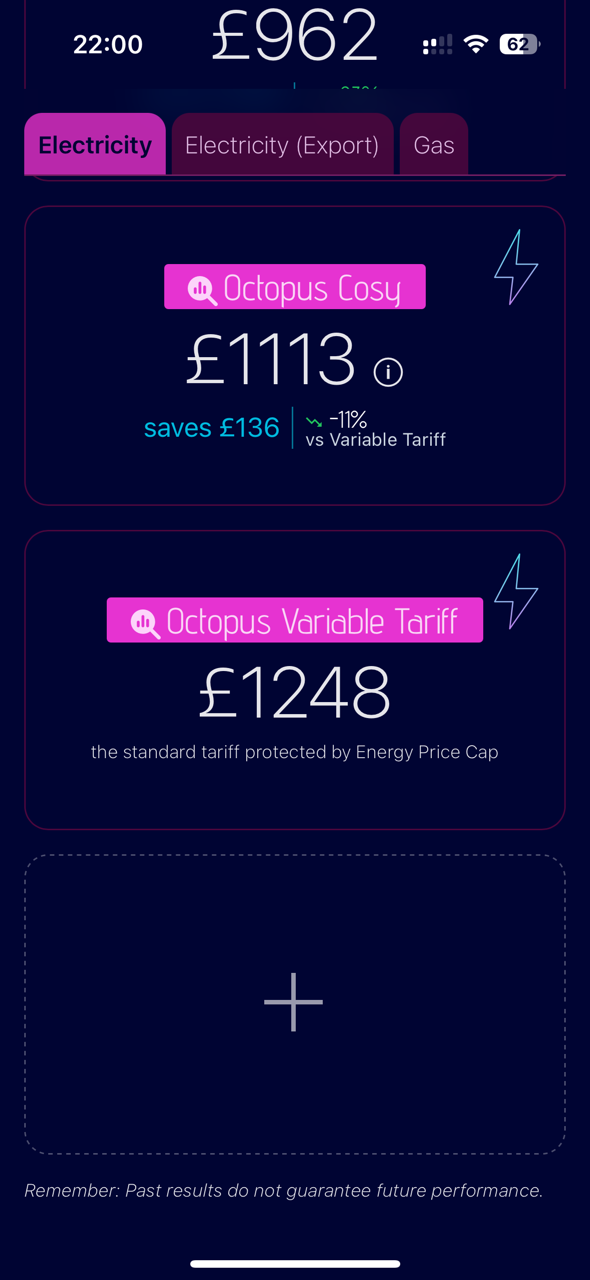
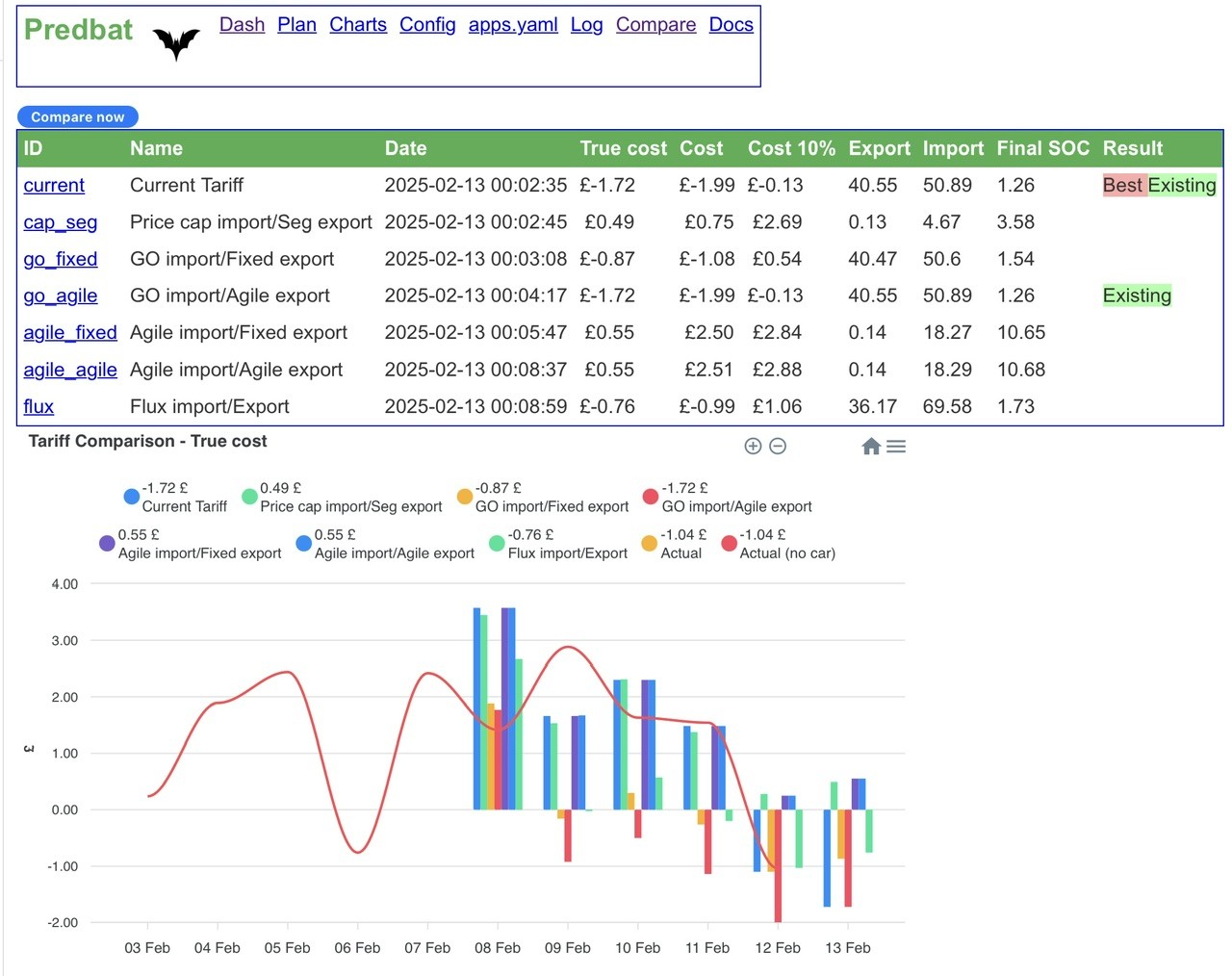
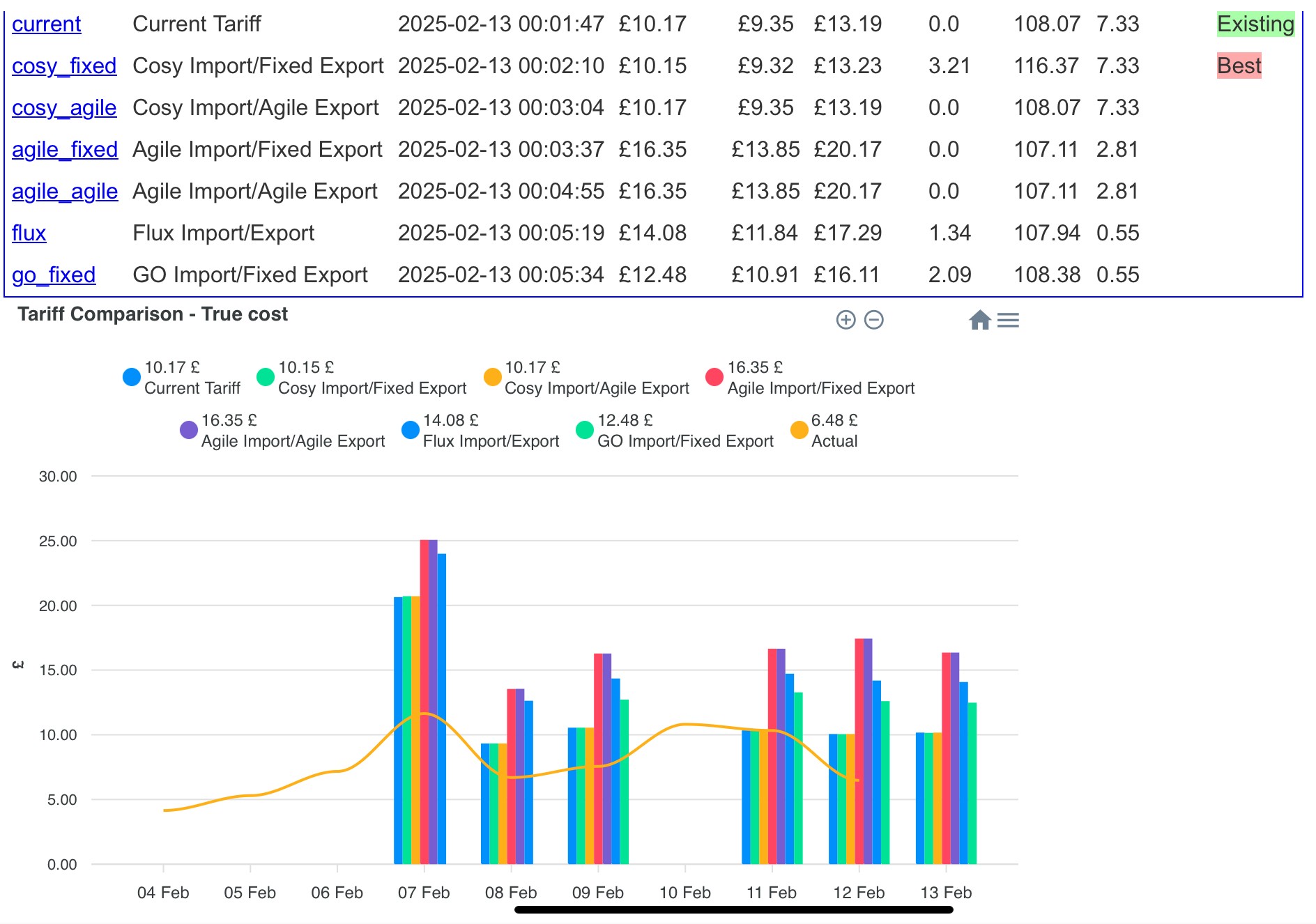
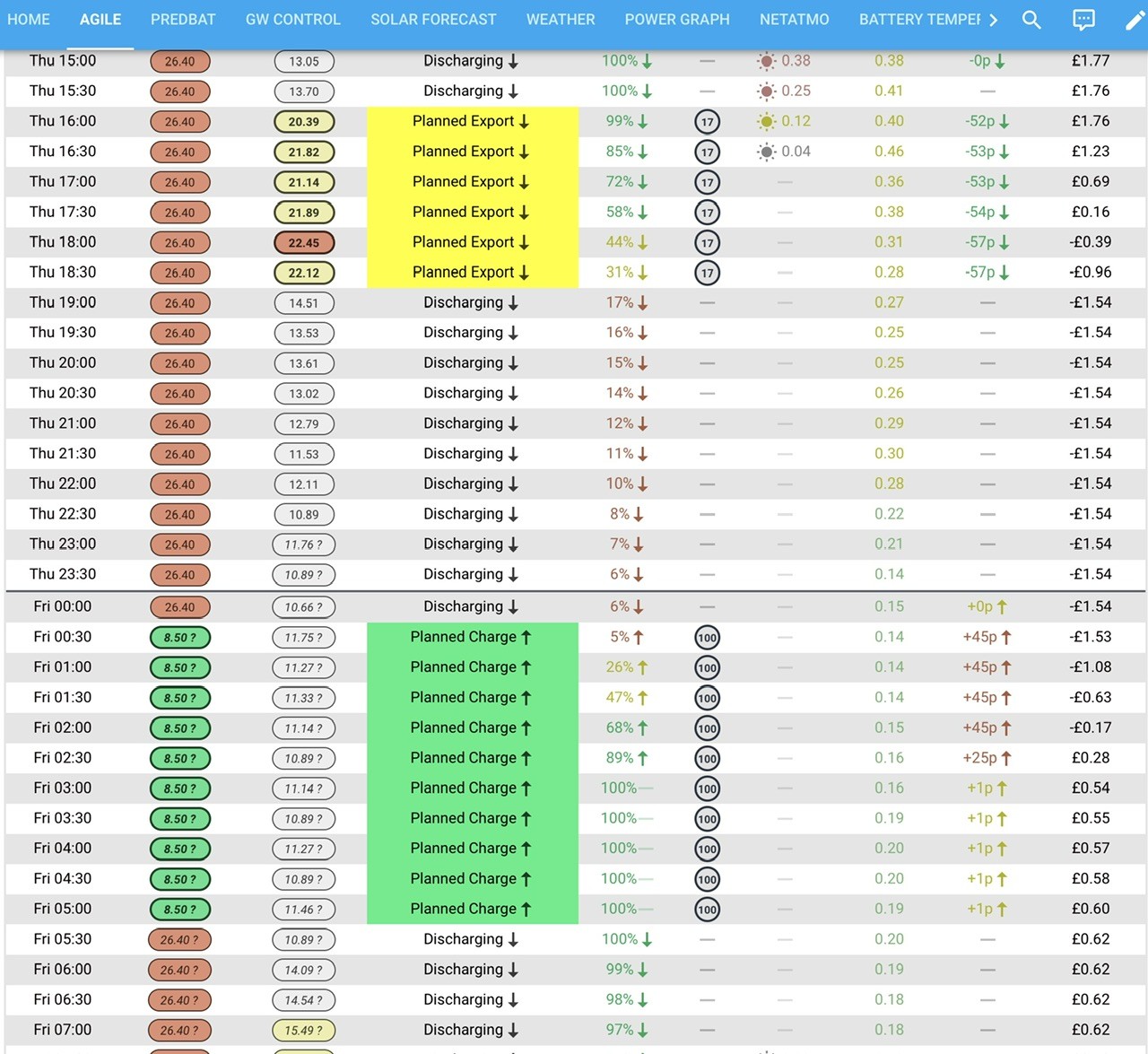
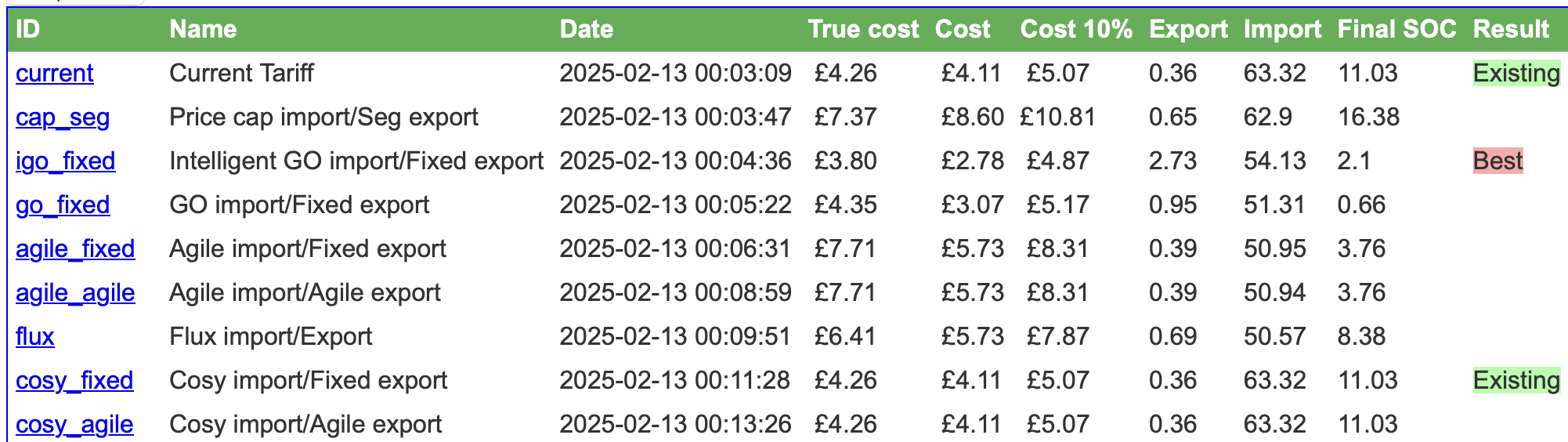
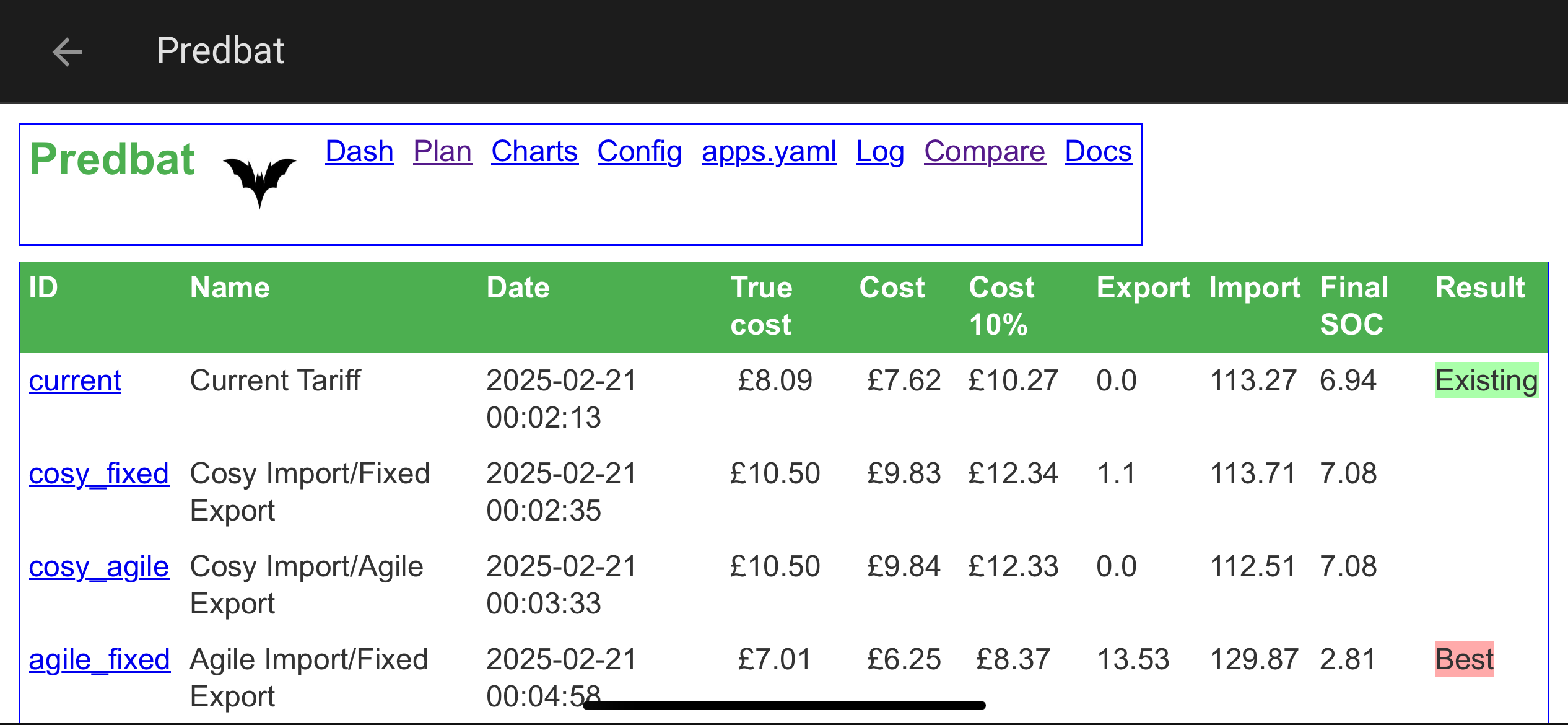
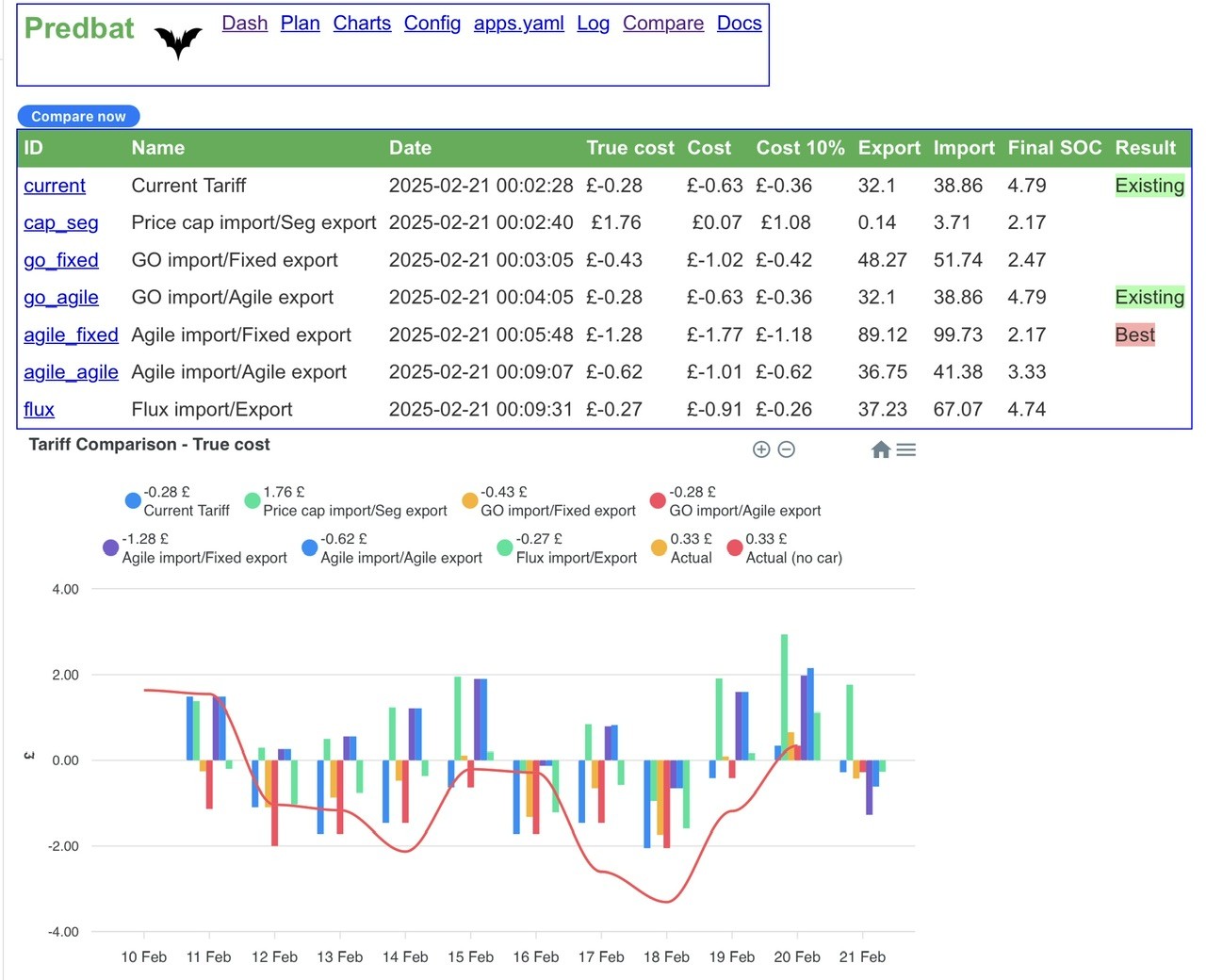
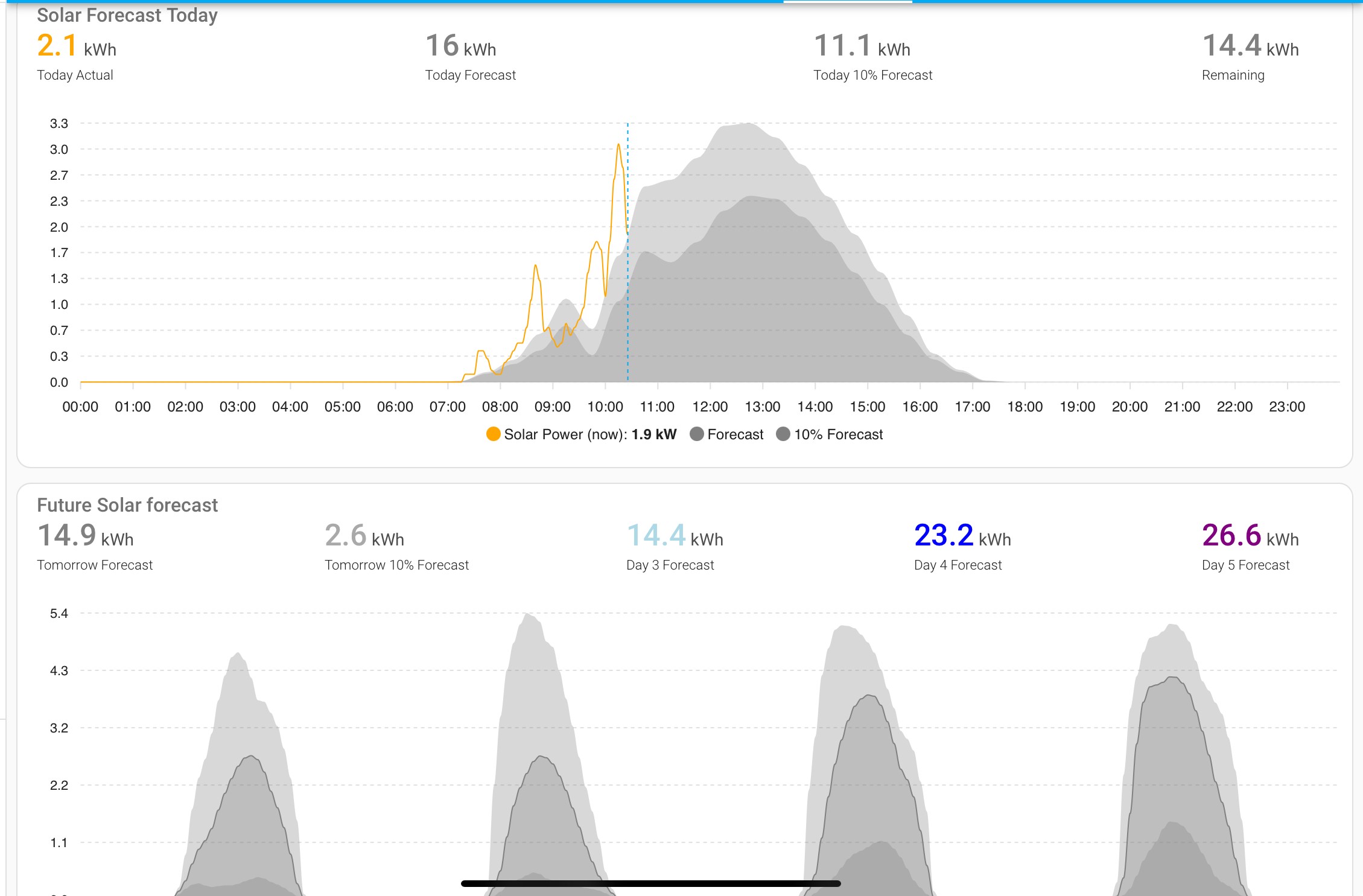
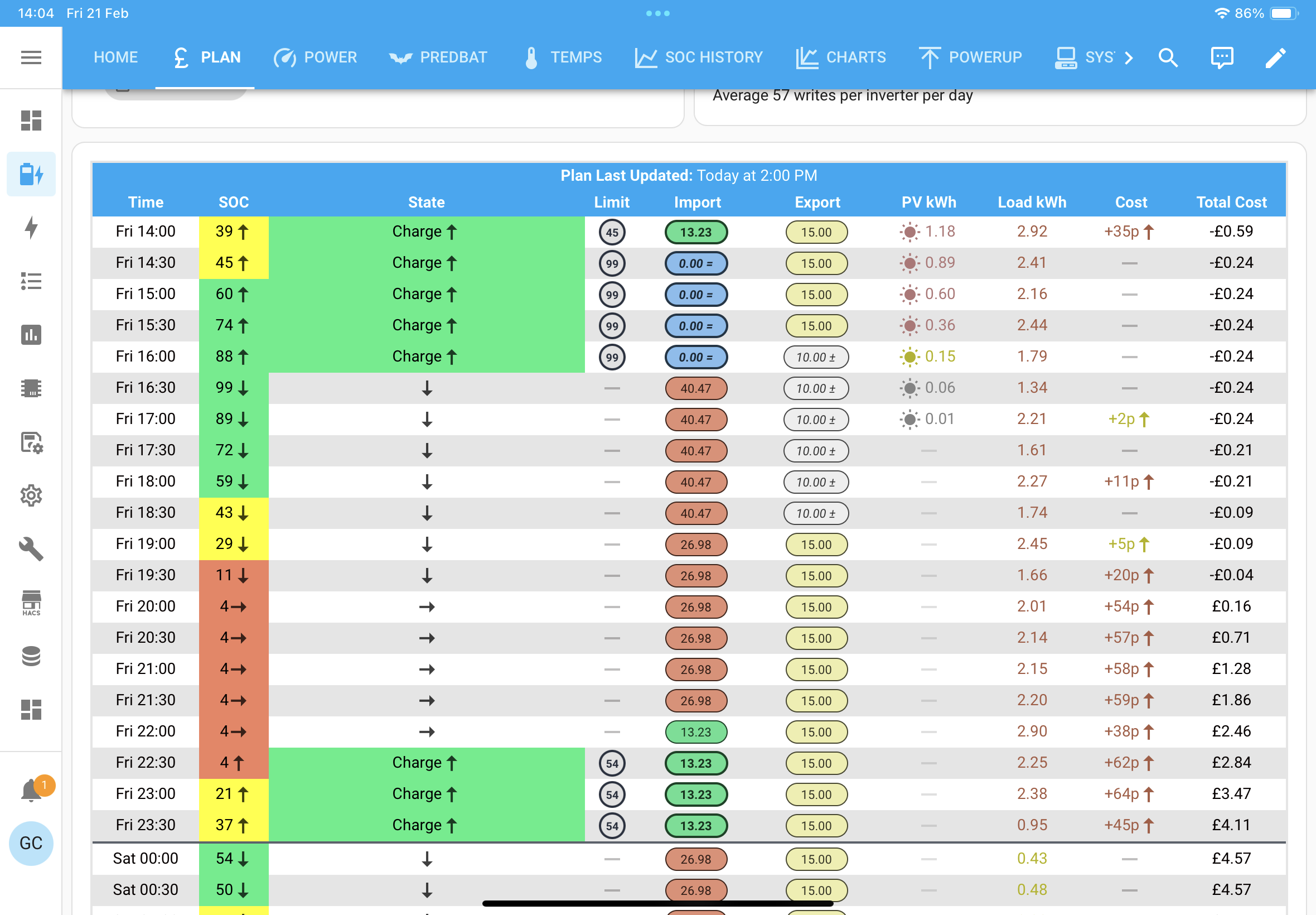
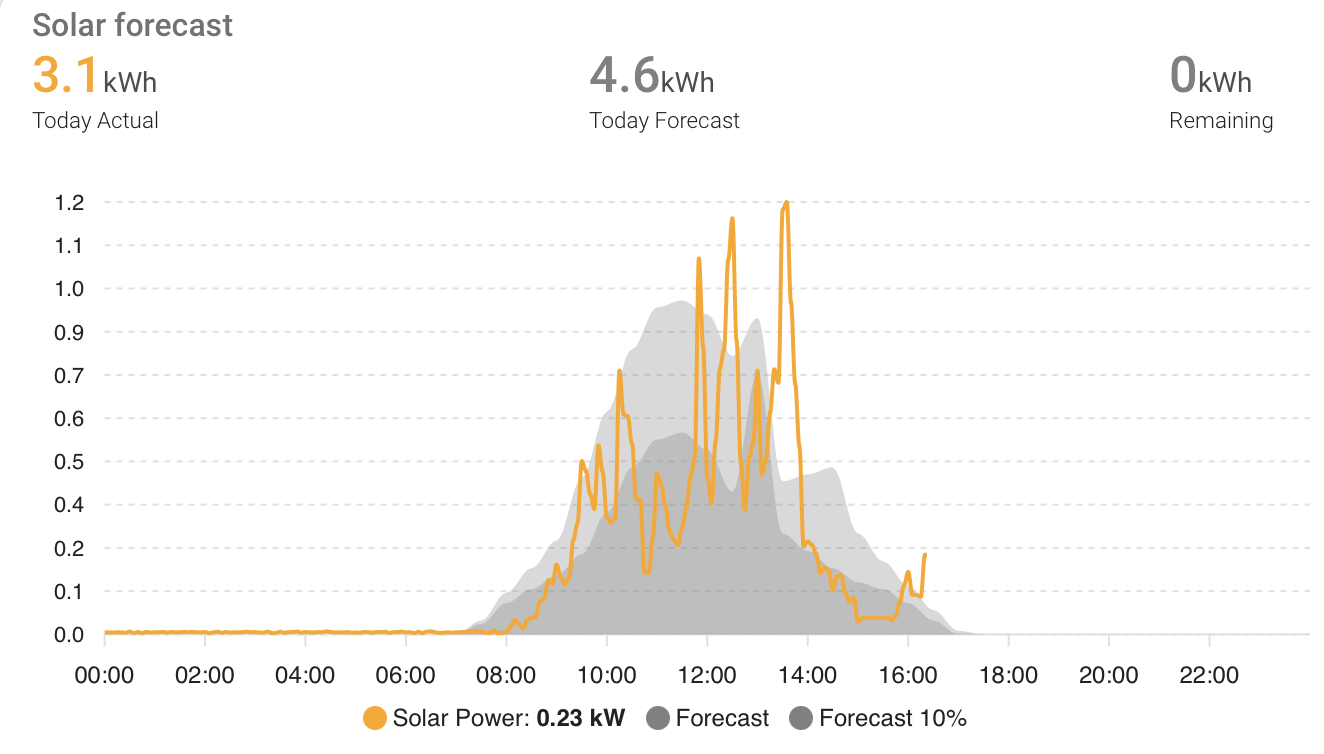
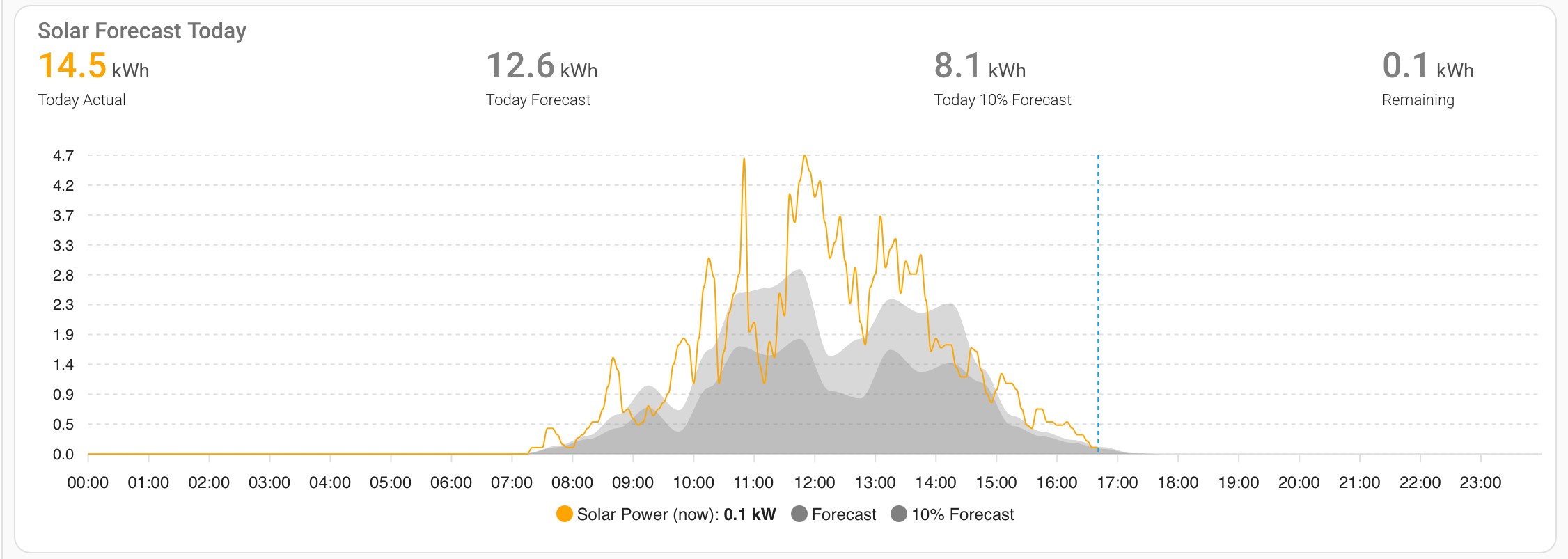
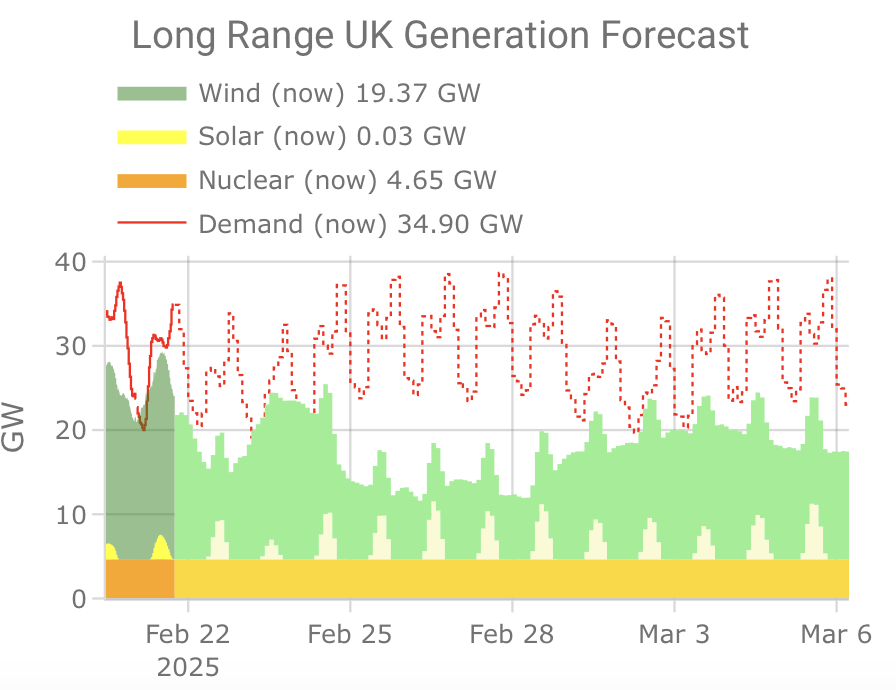
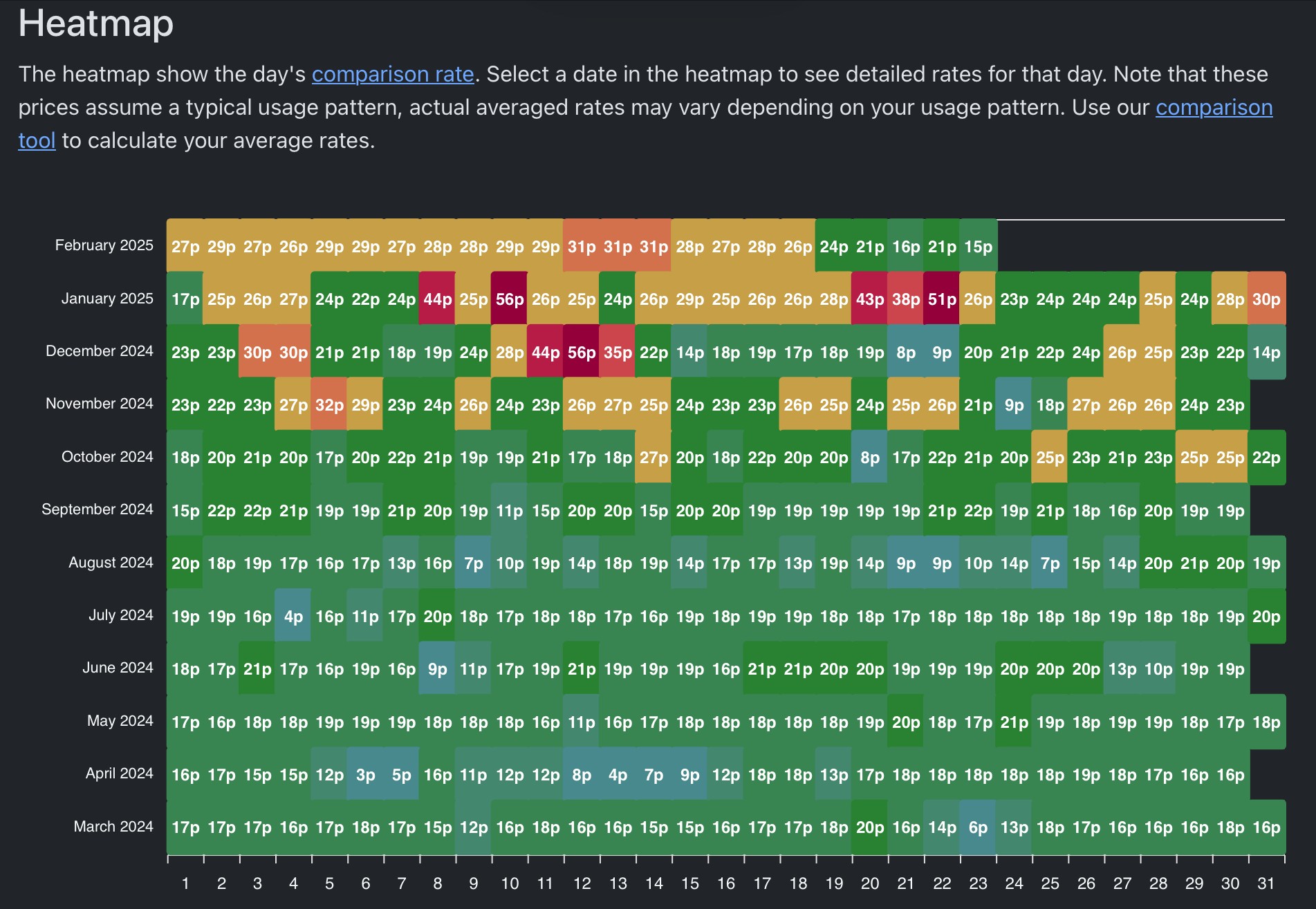
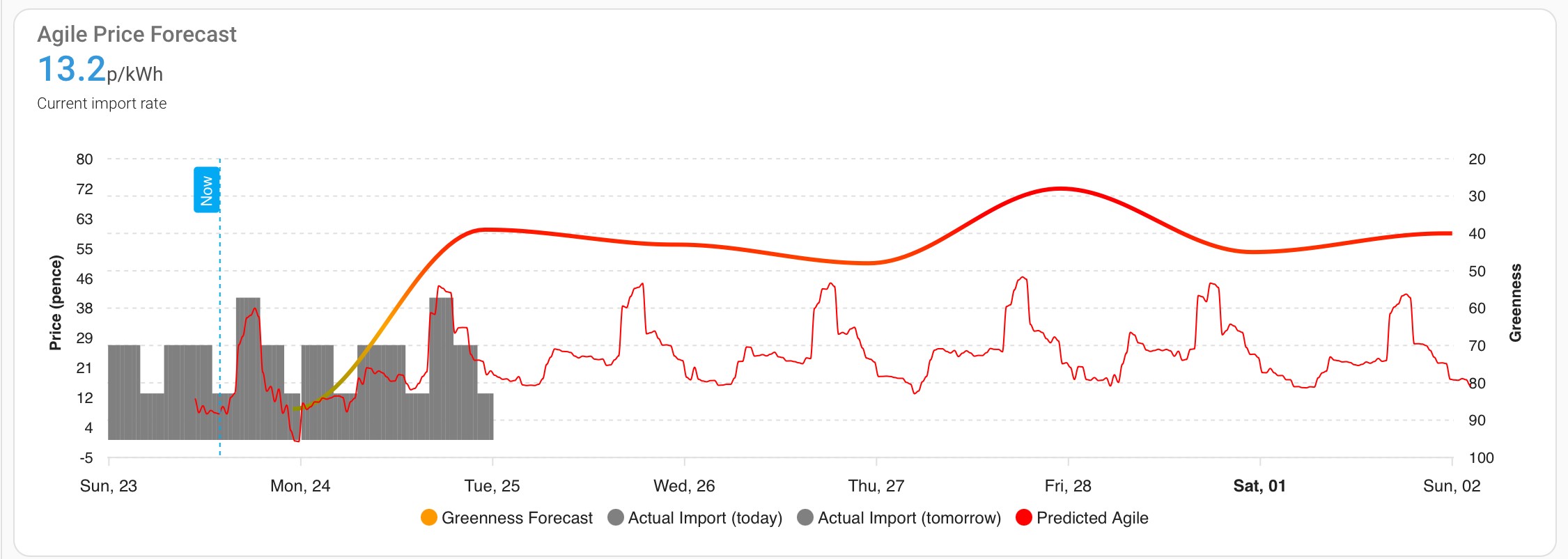
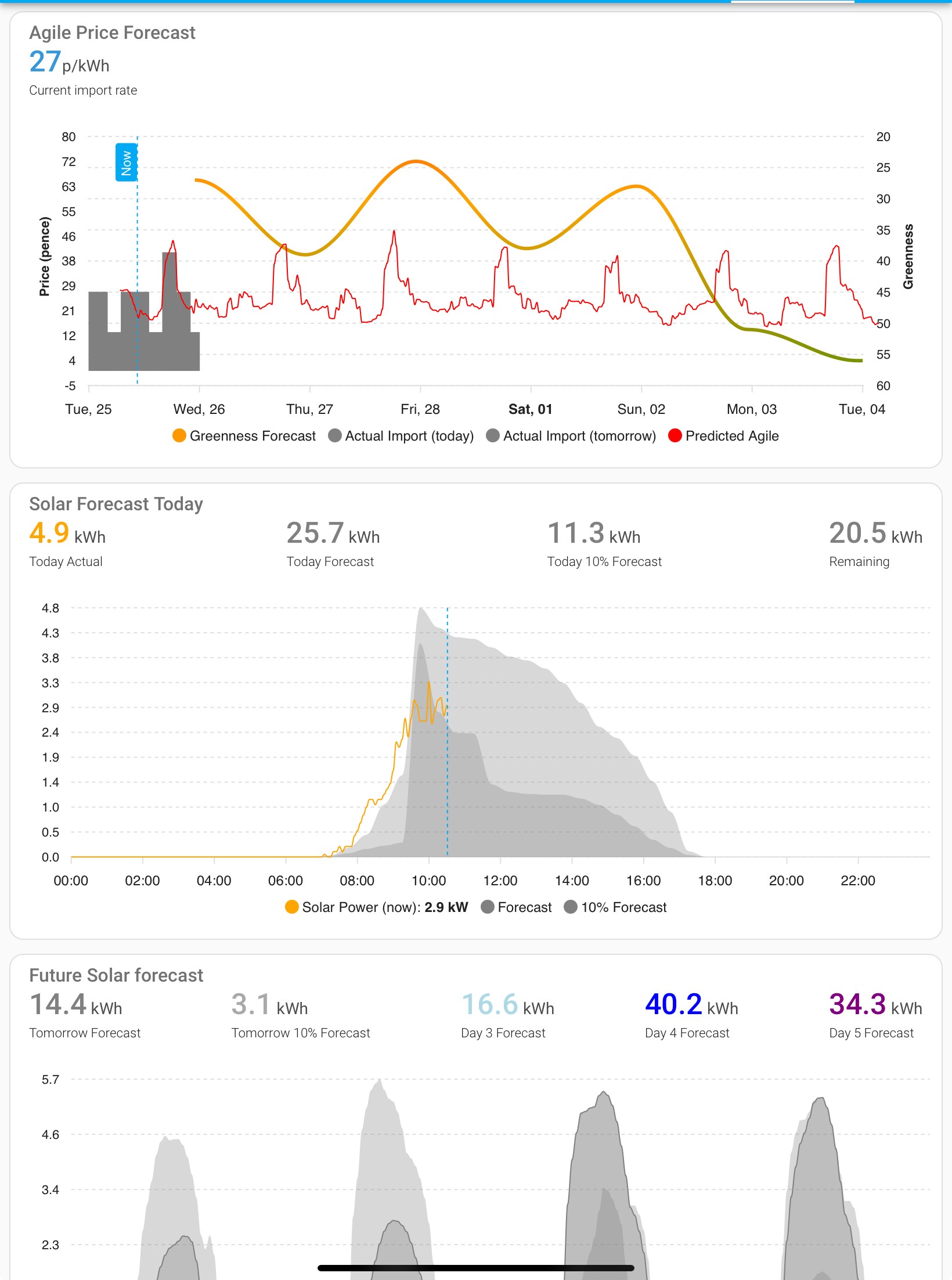
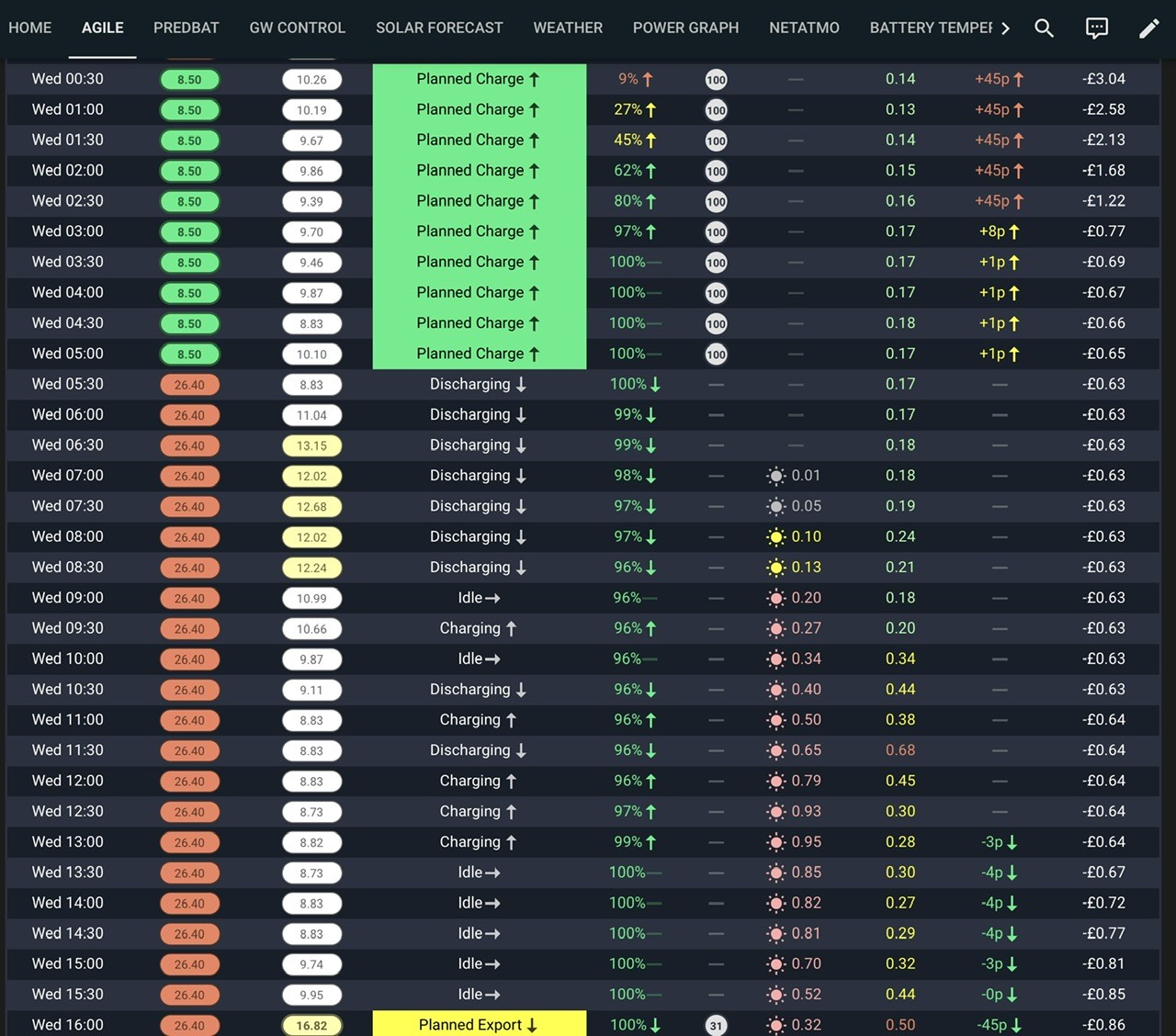
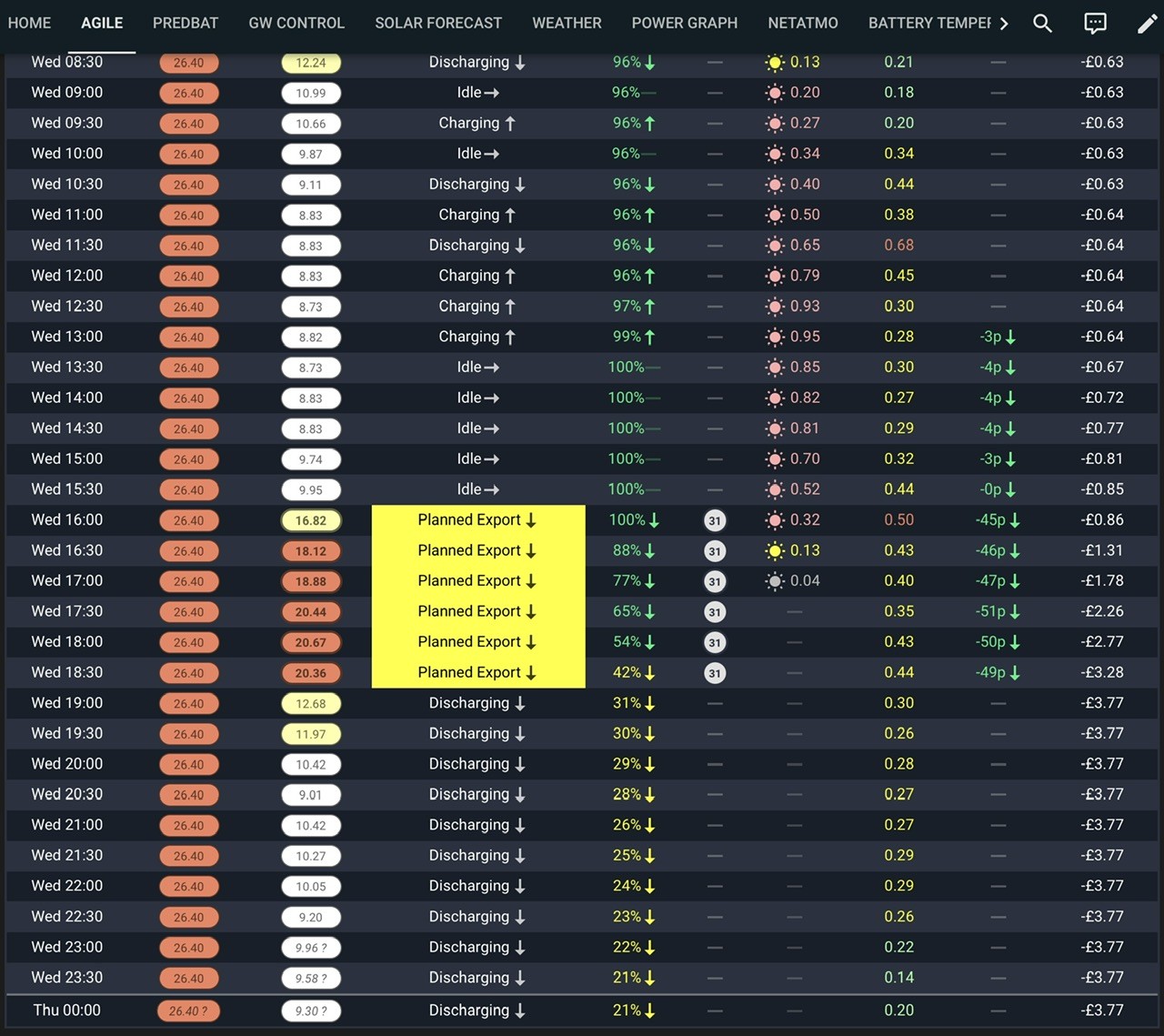
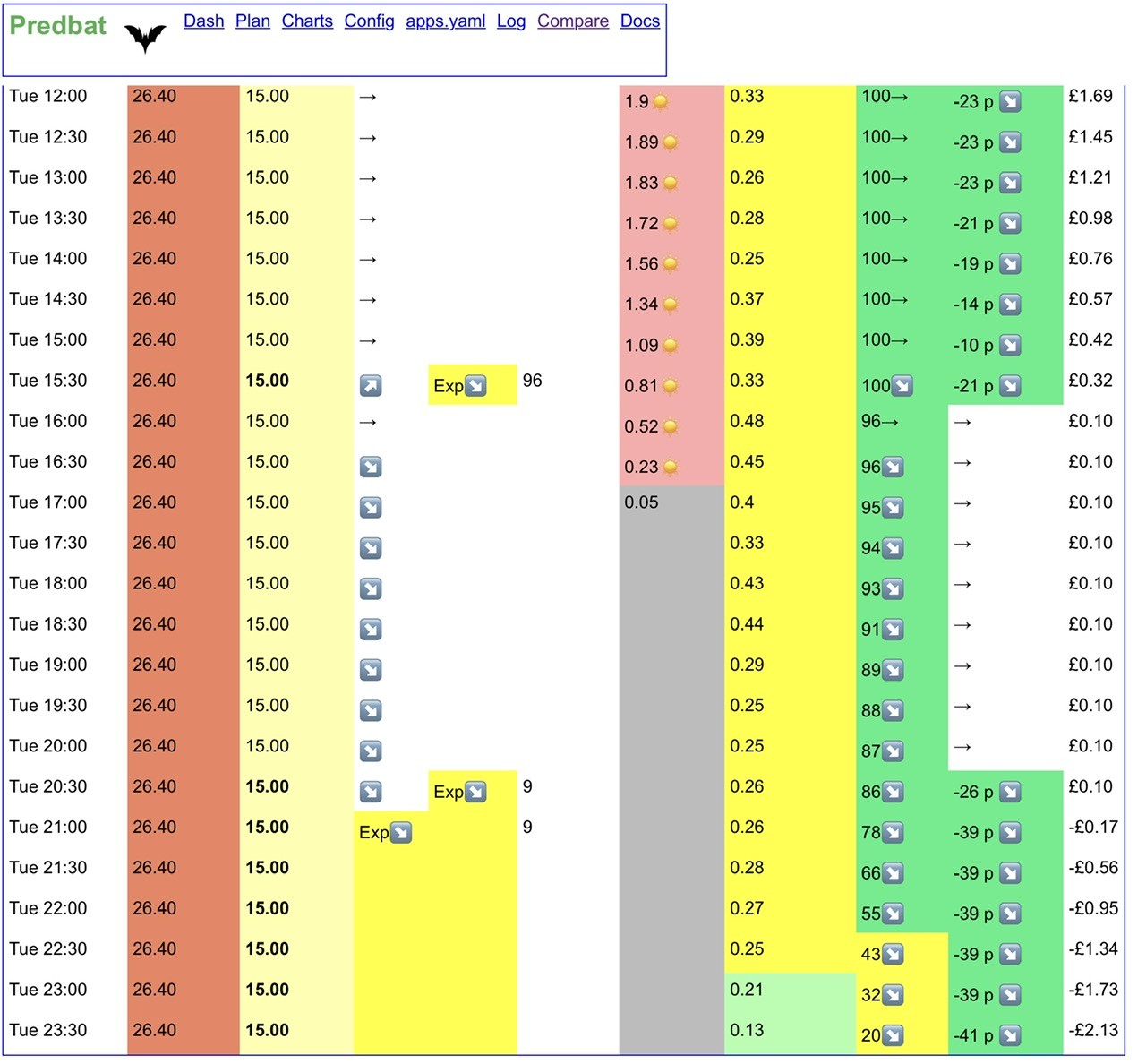
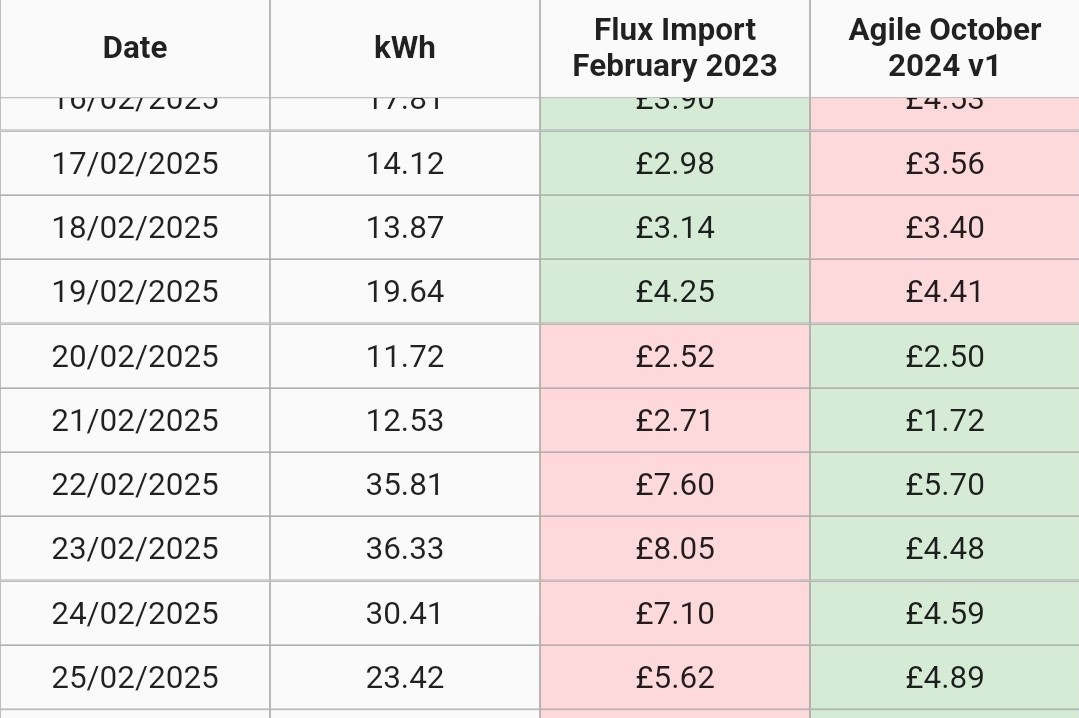
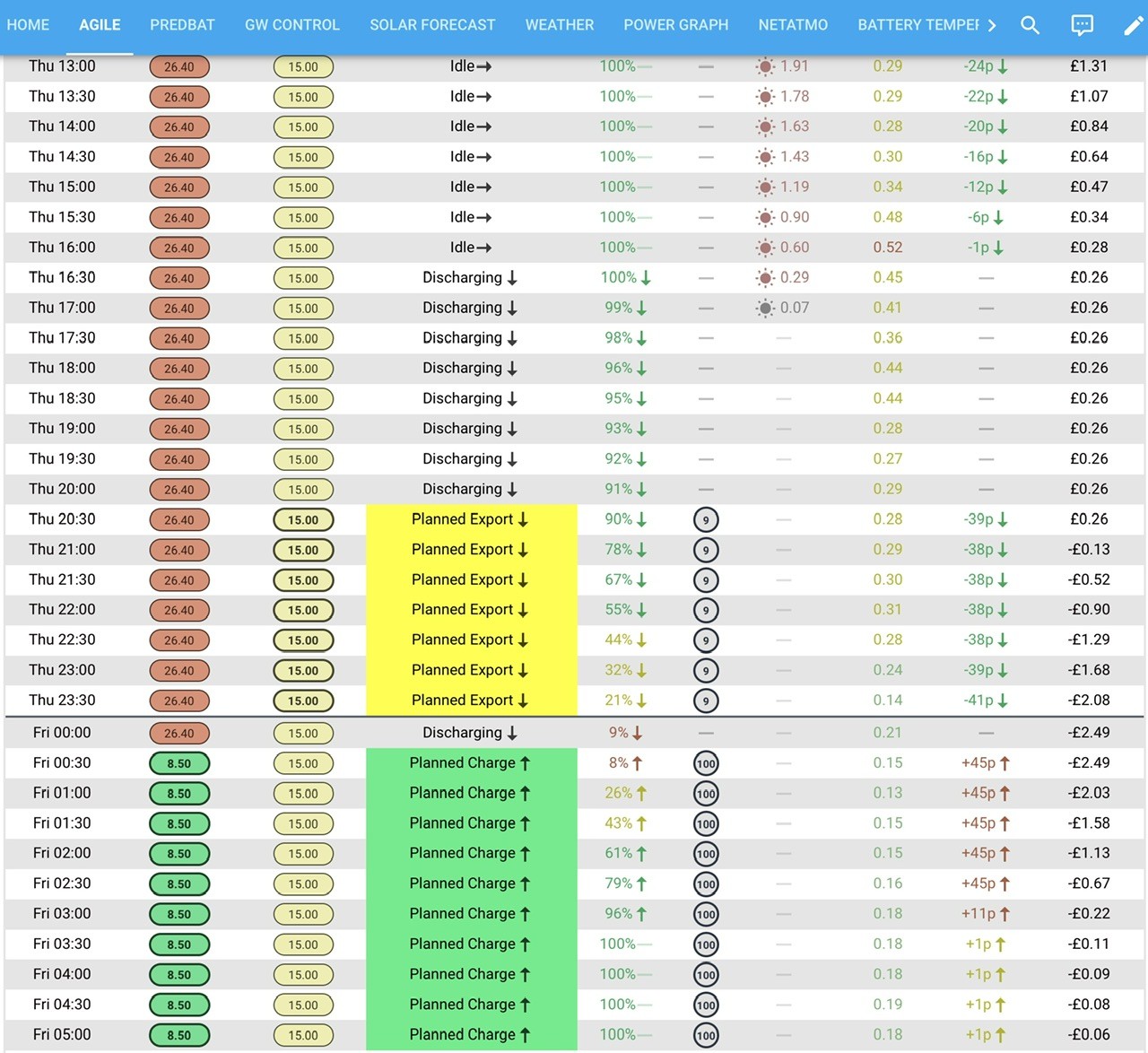
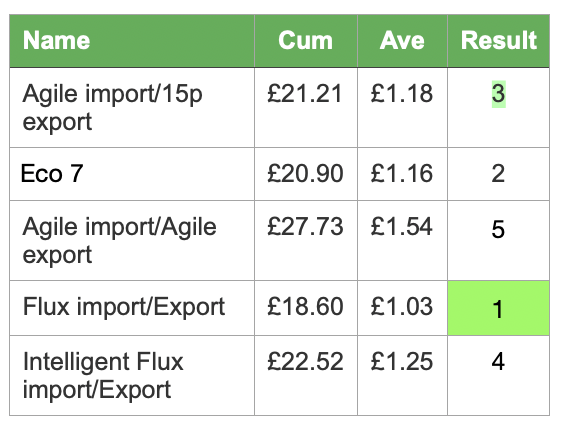
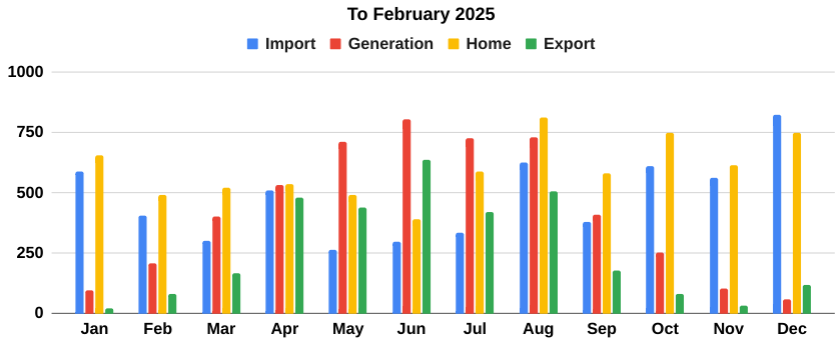
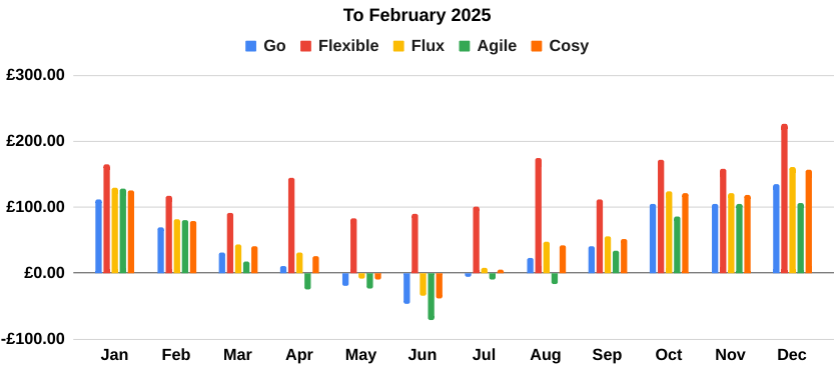
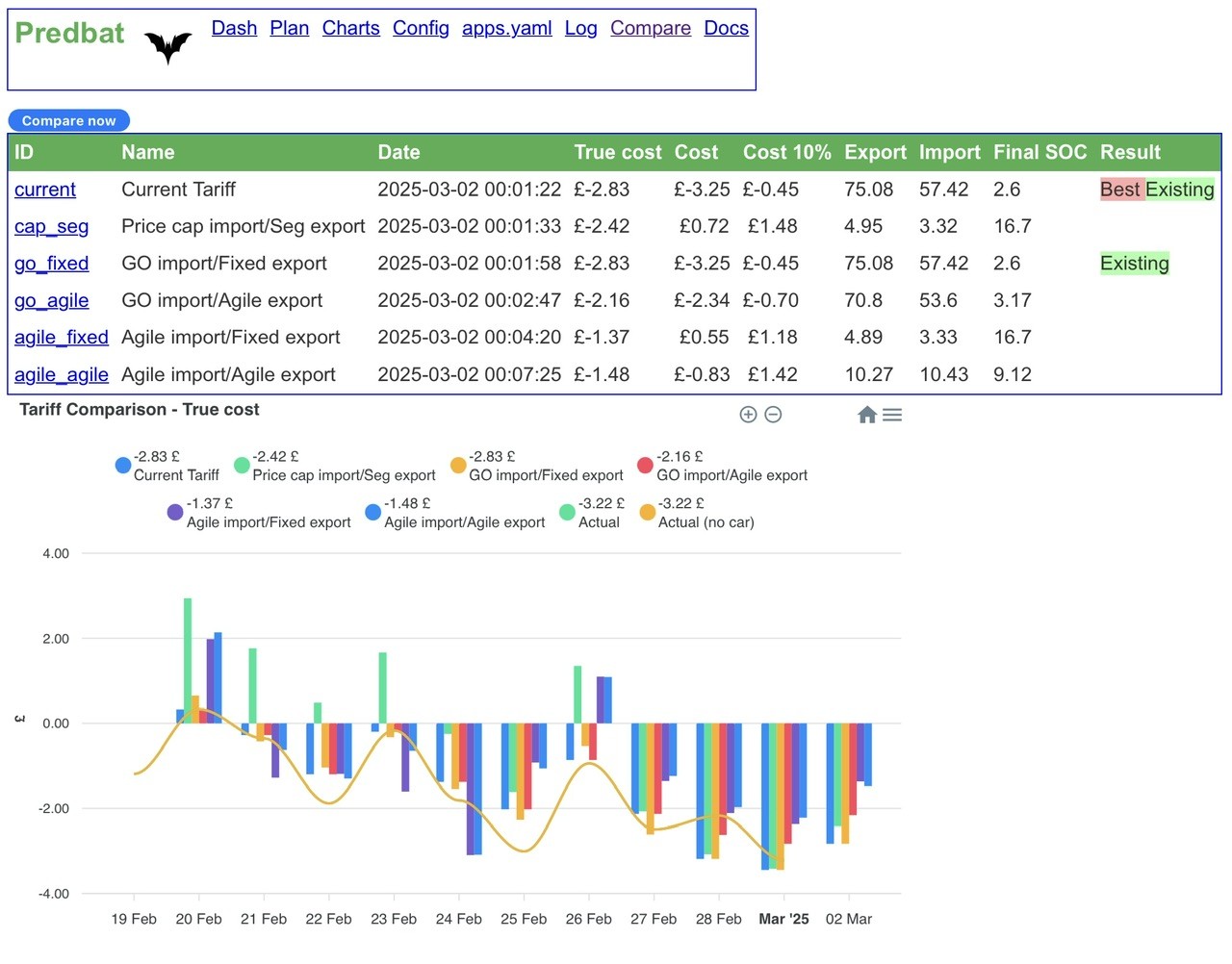
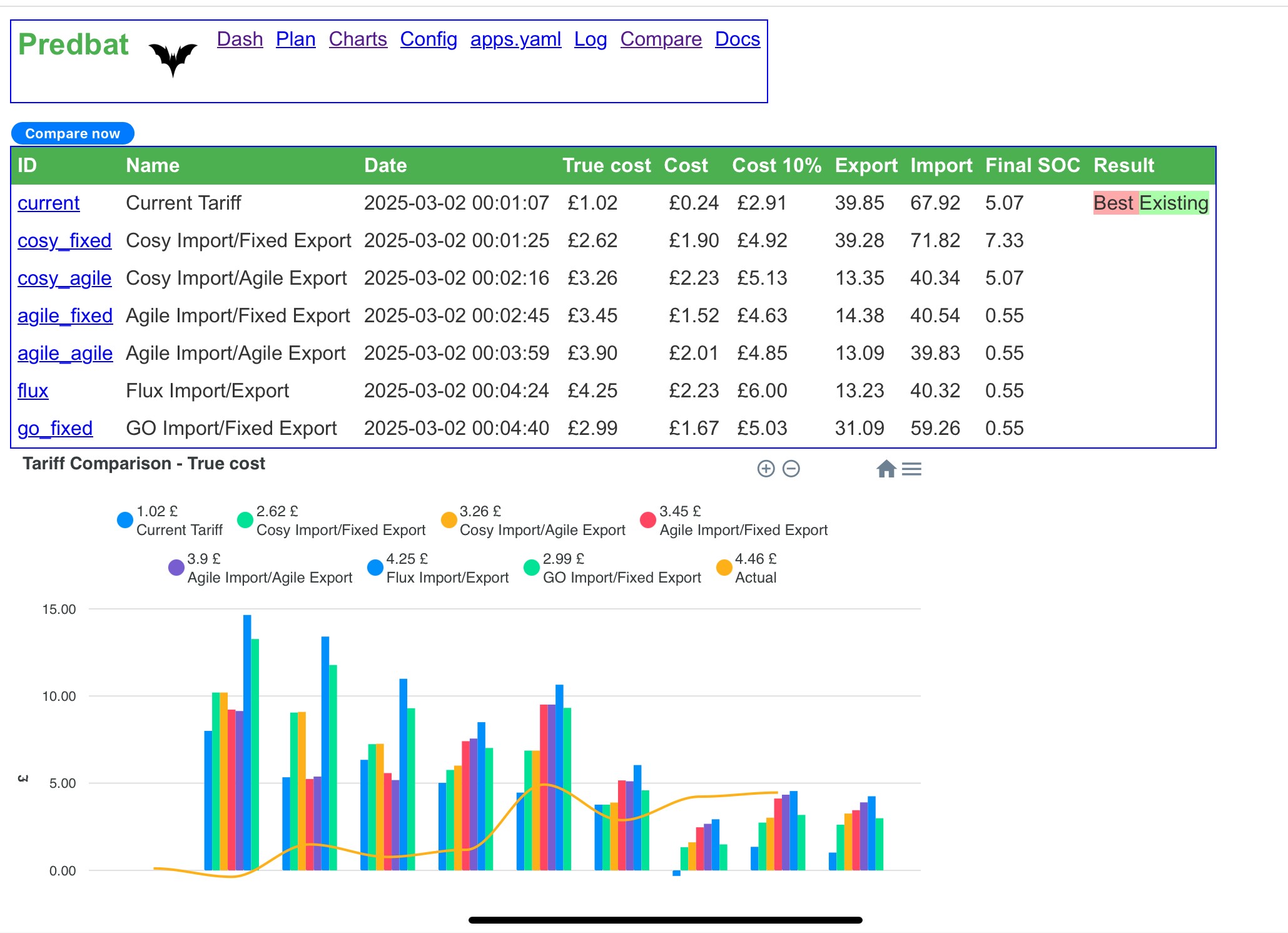
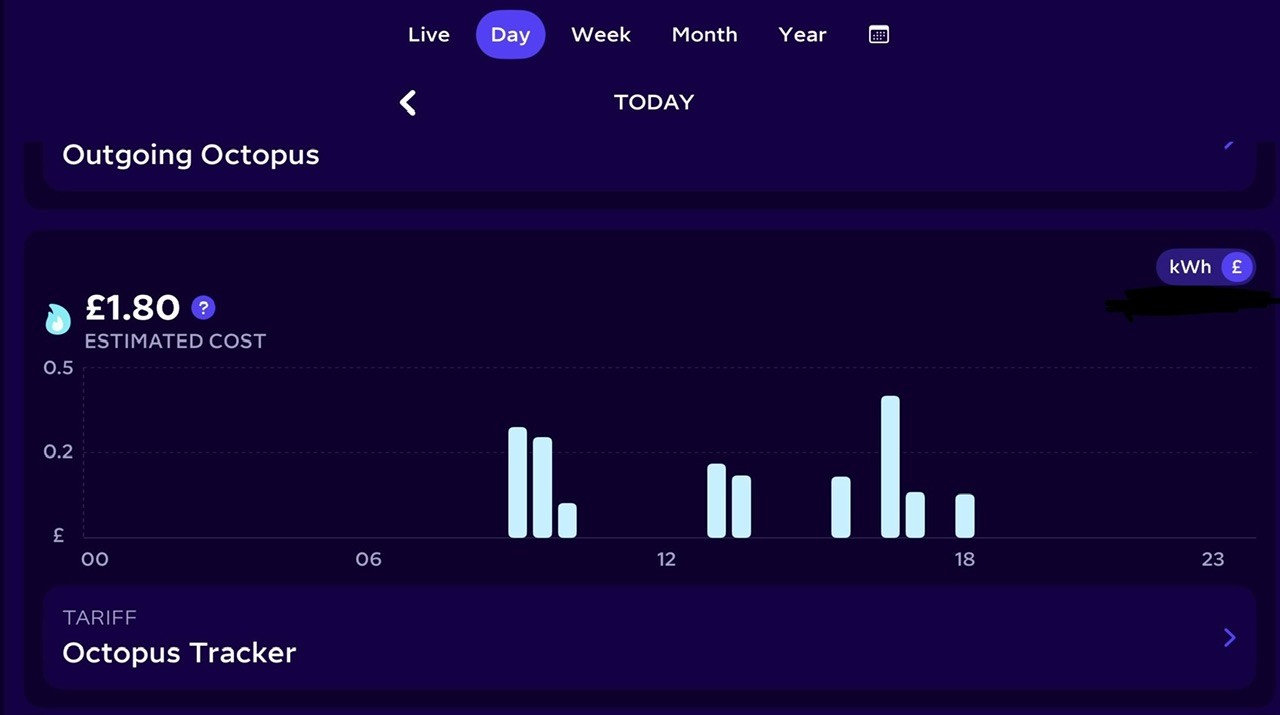
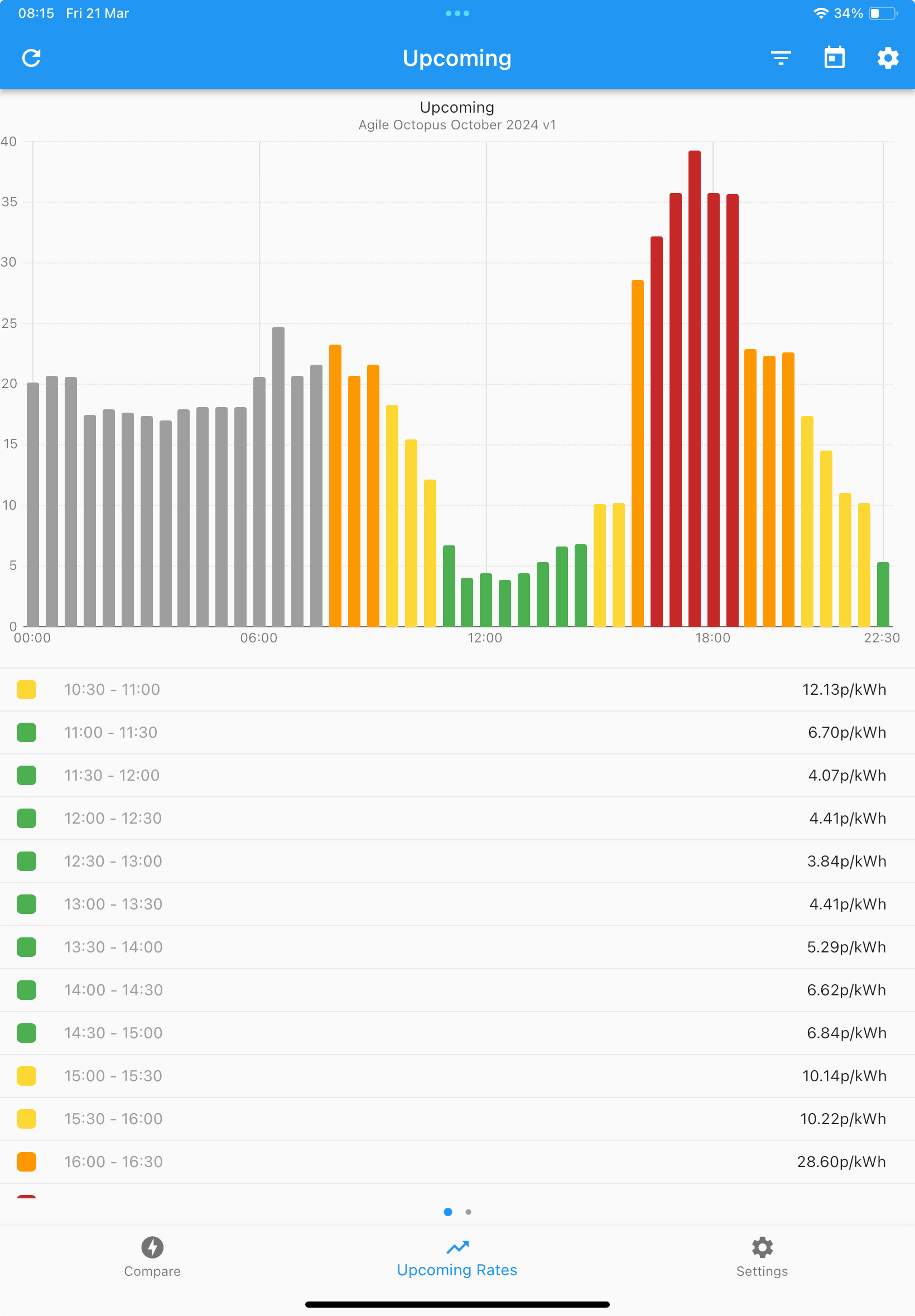
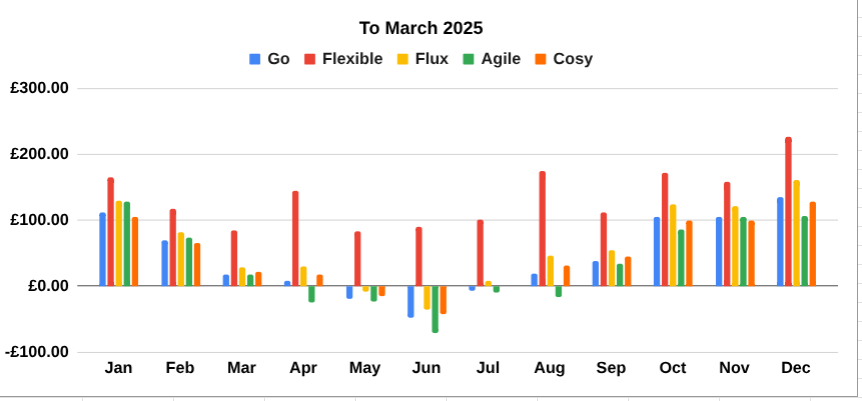
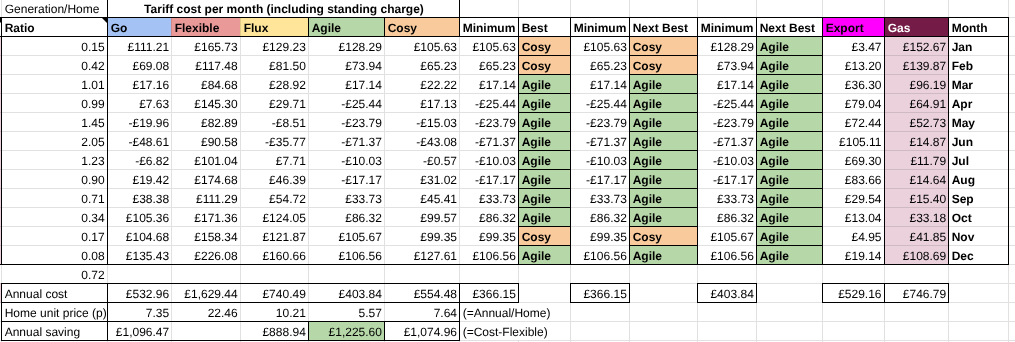
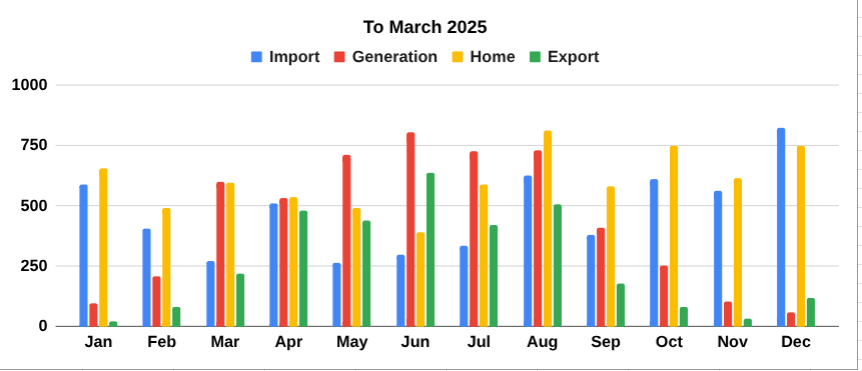
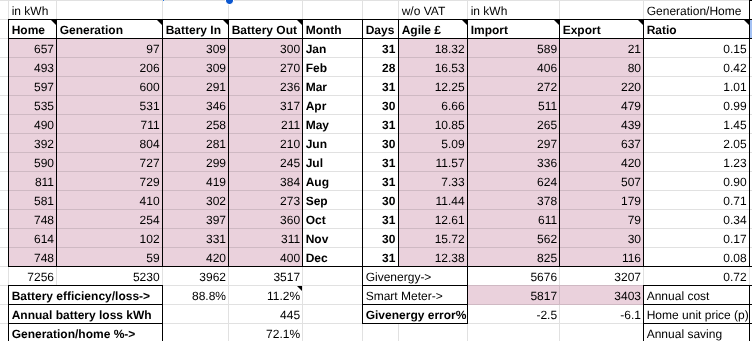
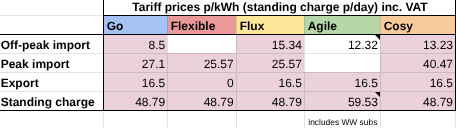
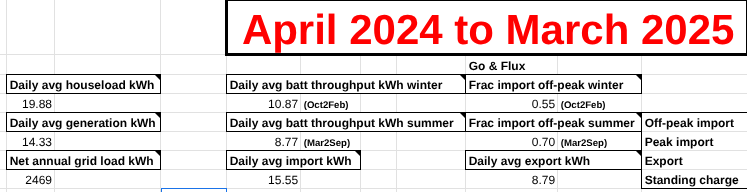
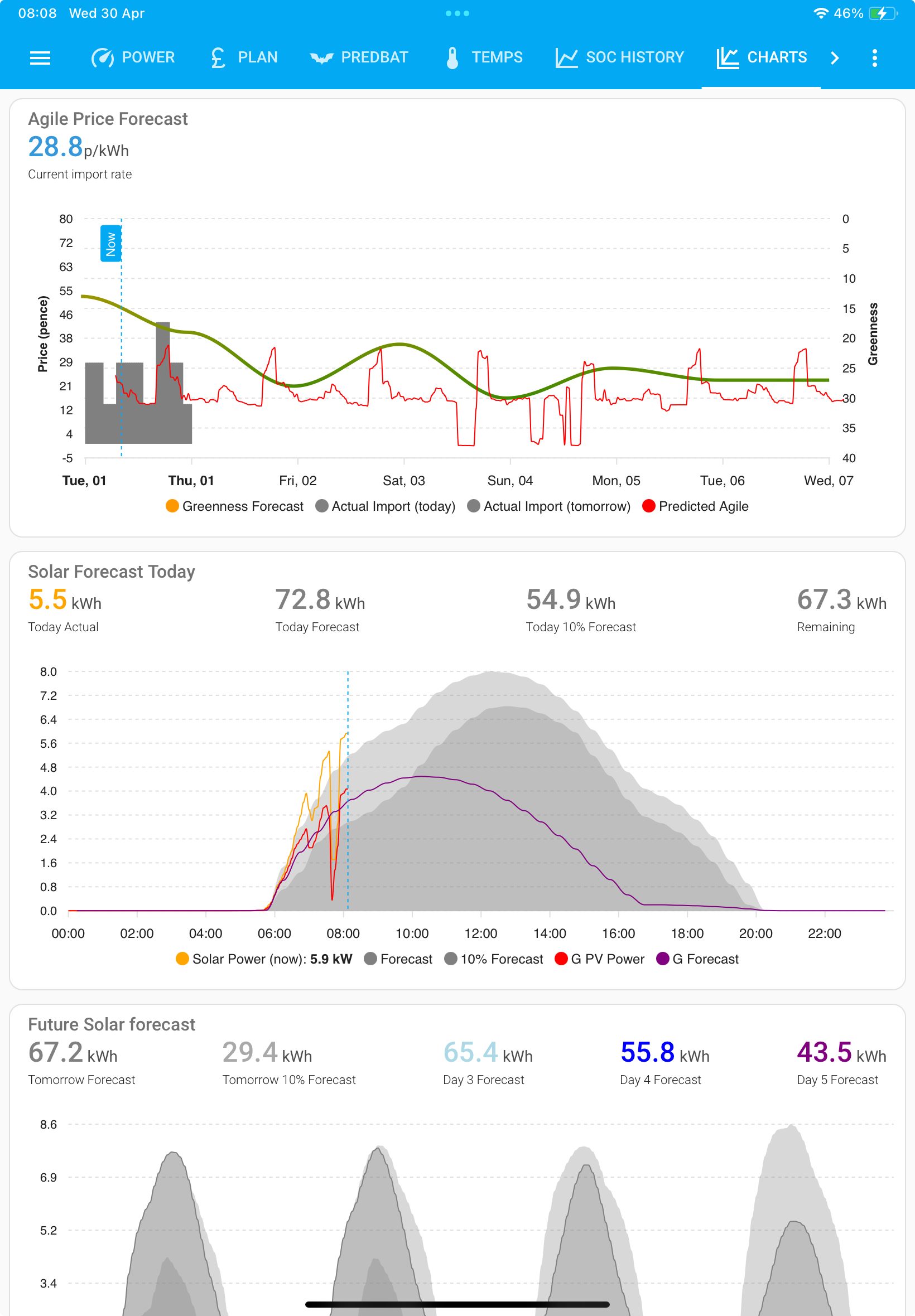
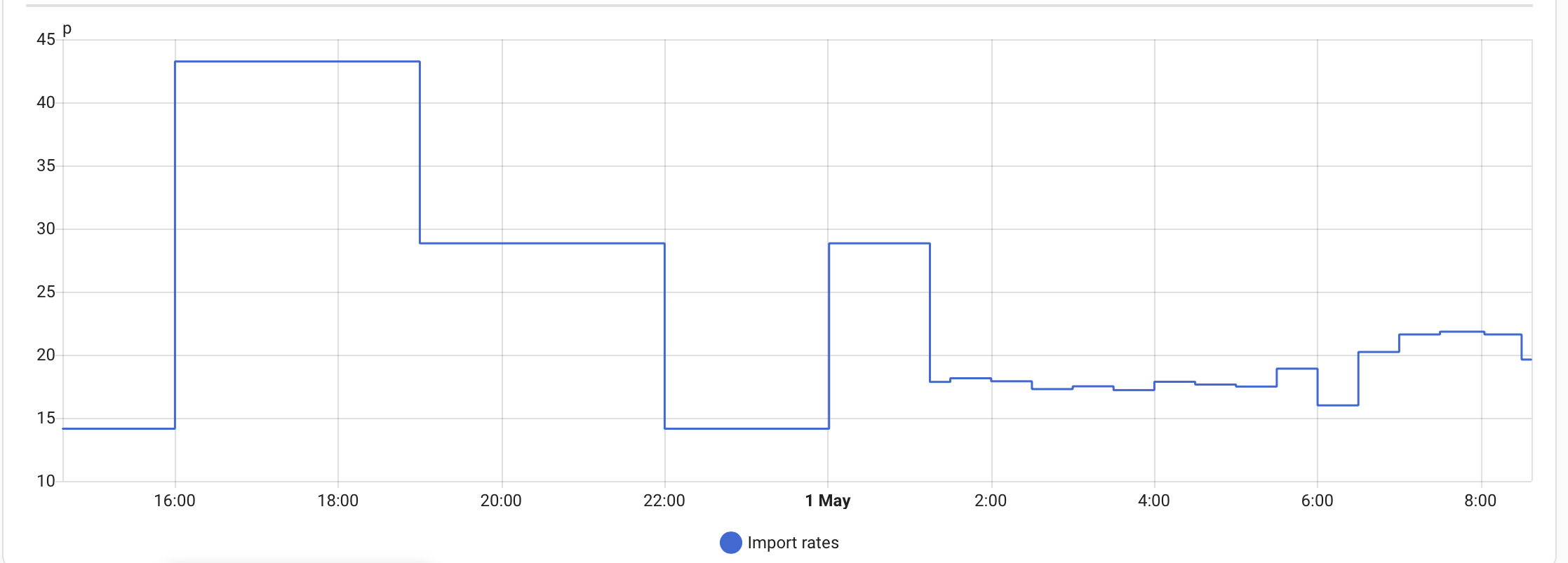
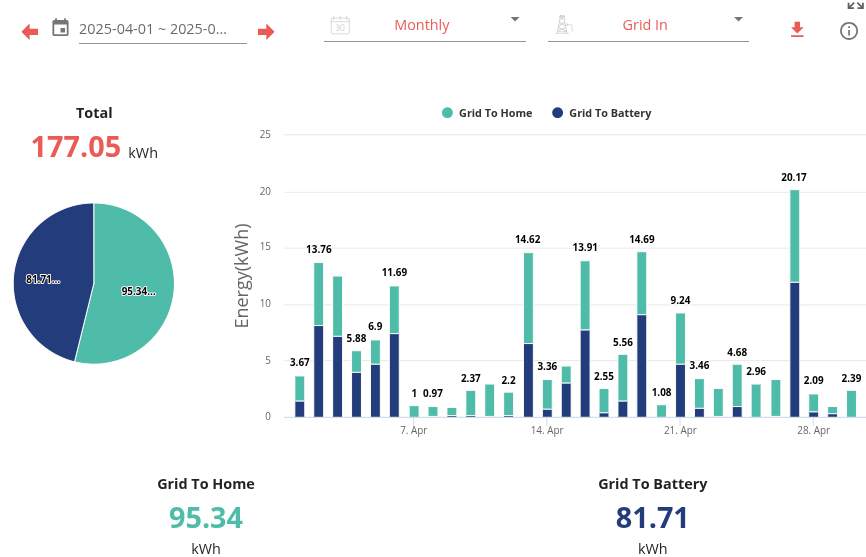
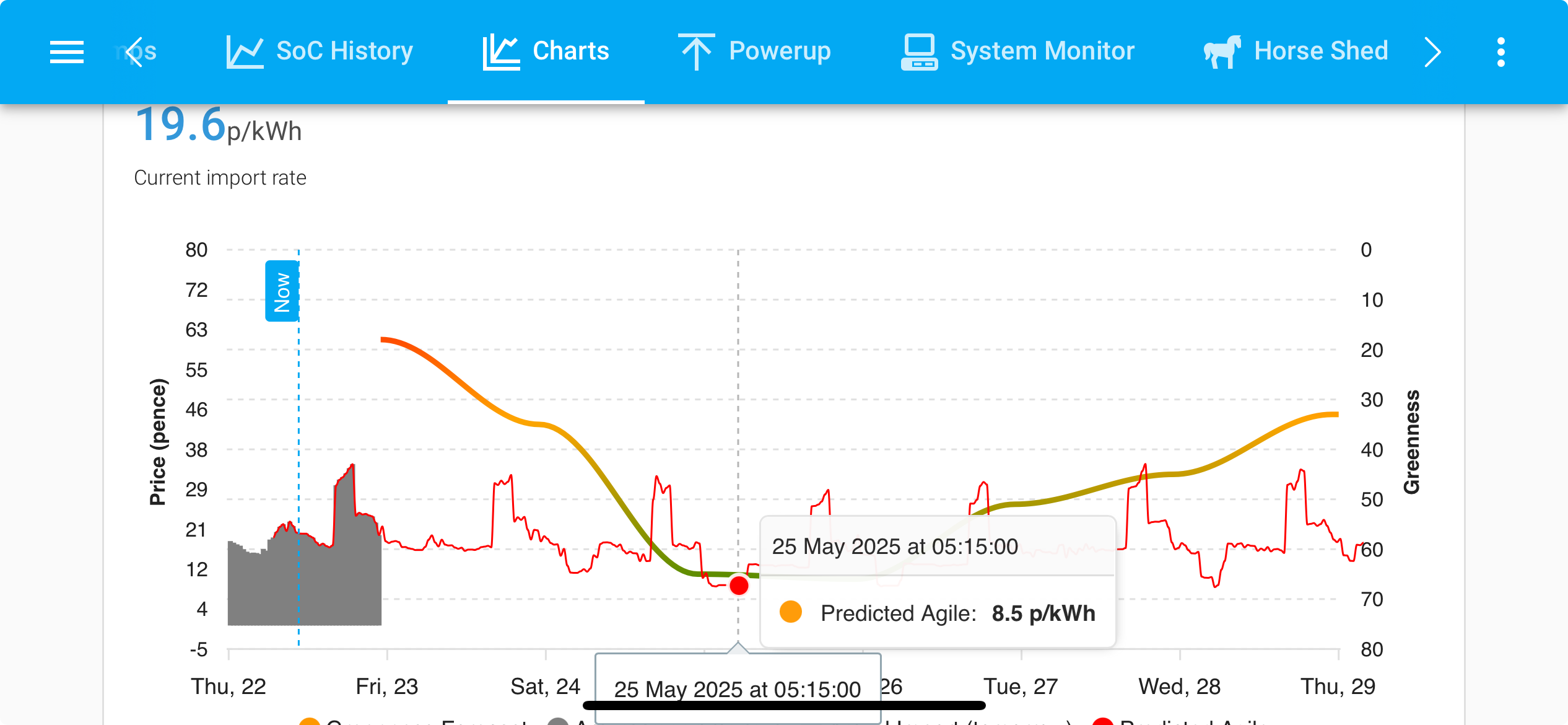
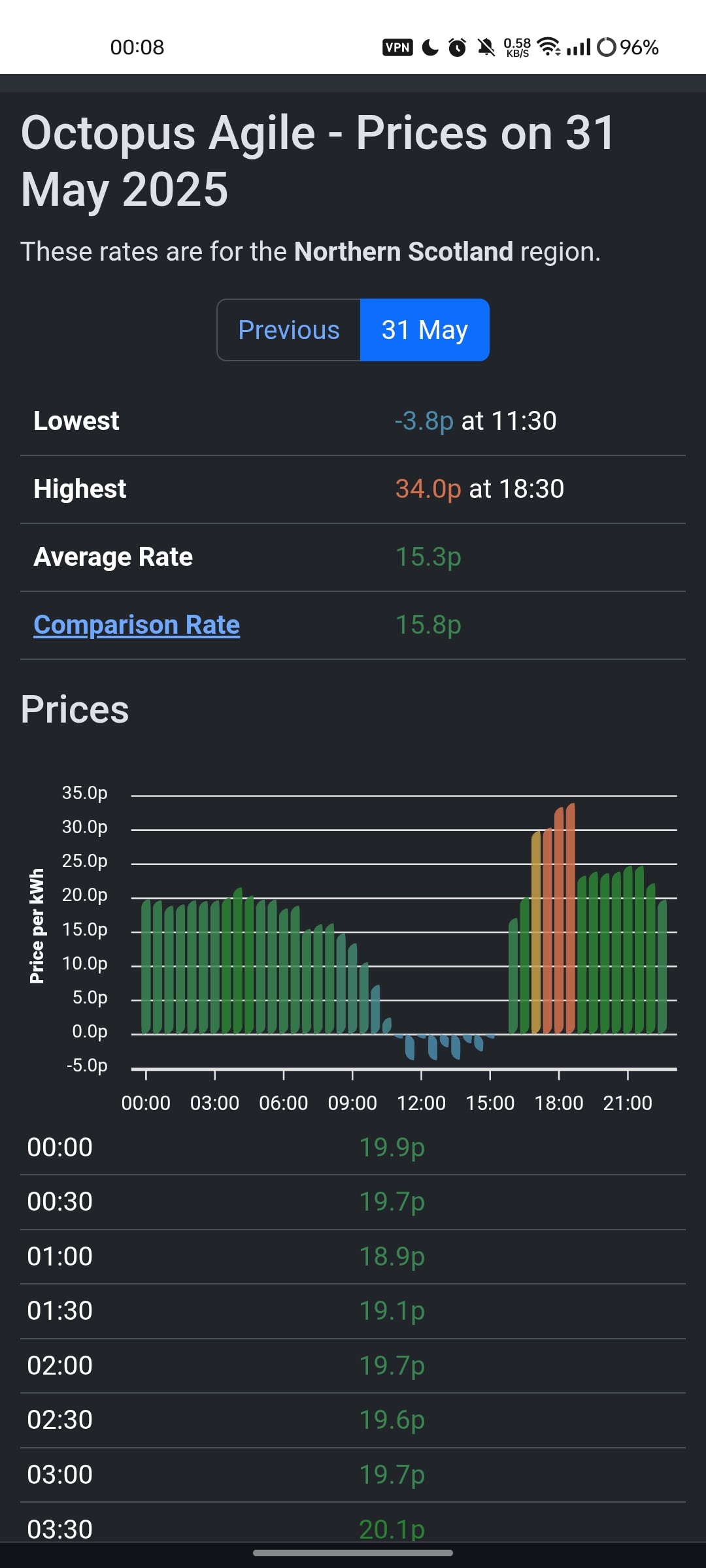
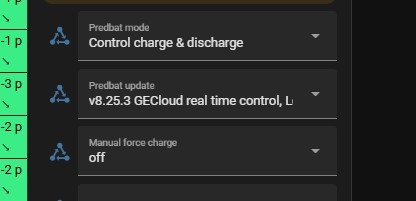
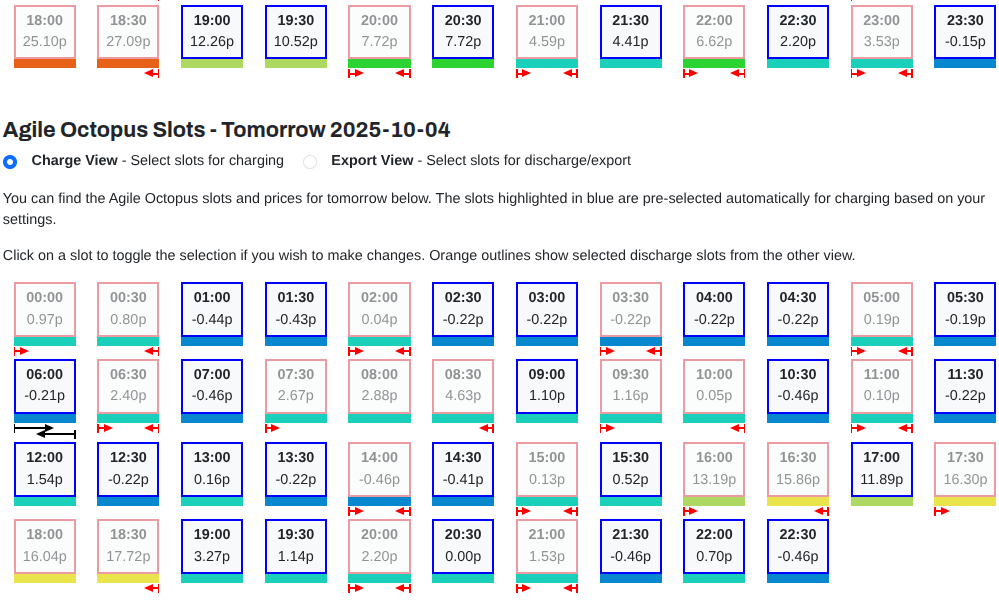
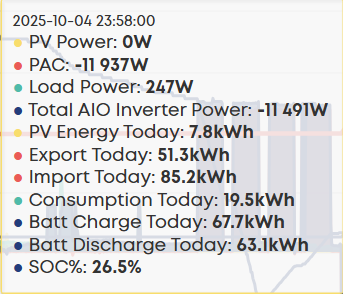
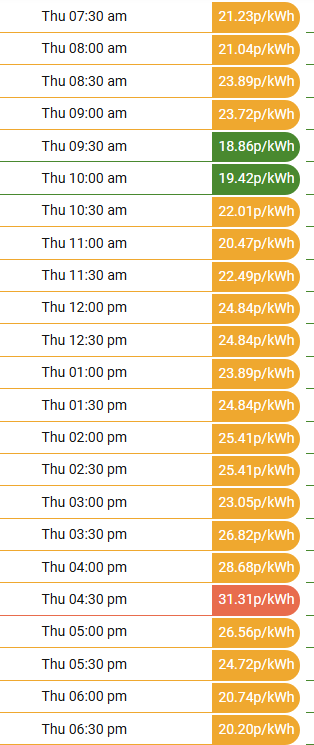
I've just switched from Flux to Agile for import (staying on Flux for any Export) but am not sure how best to make sure I'm set up to maximise the benefits during winter when solar is limited.
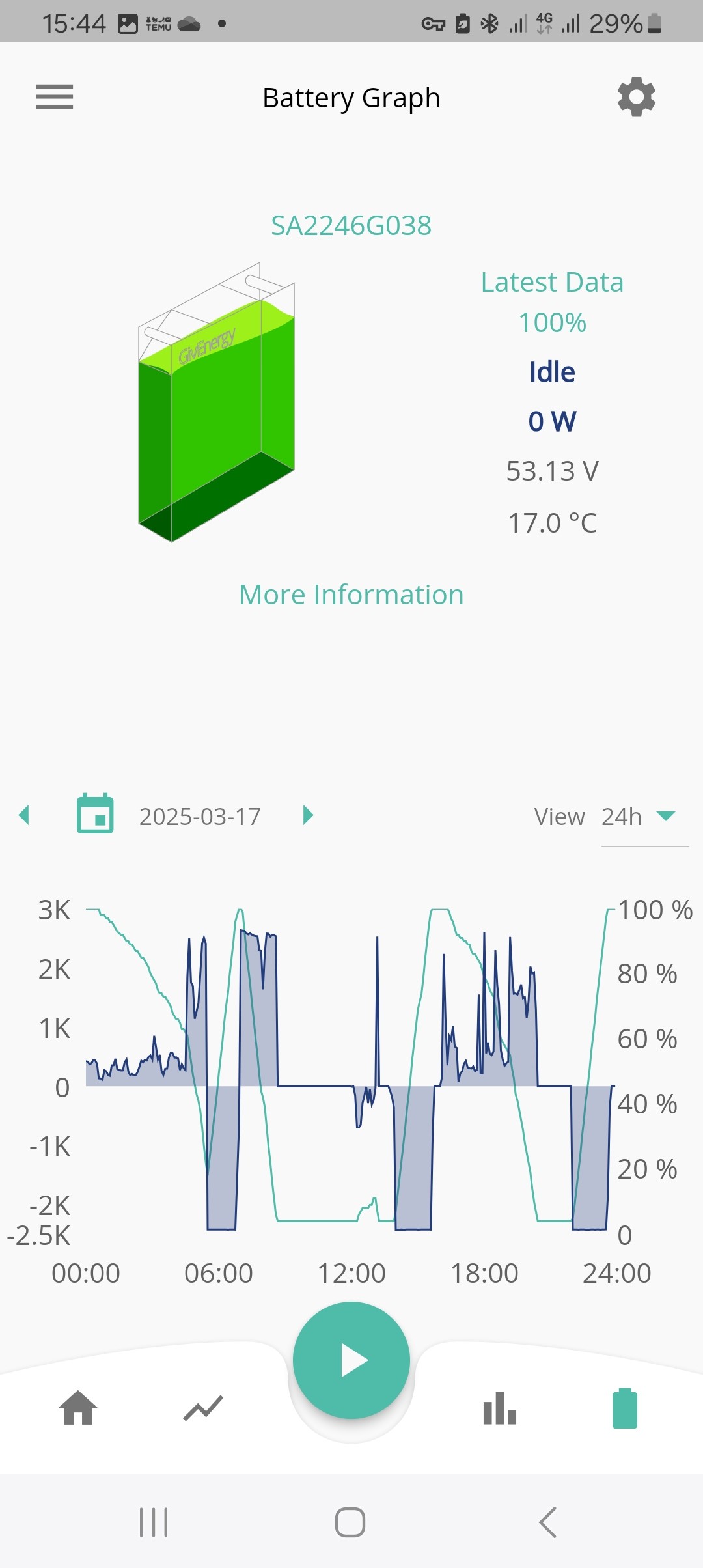
Currently my 8.2 GE battery is set to charge from 0200 (takes 3 hours) and come on from 1600 (high tariff/cost) and usually lasts 3-4 hours.
This means I draw from the grid all day until 1600.
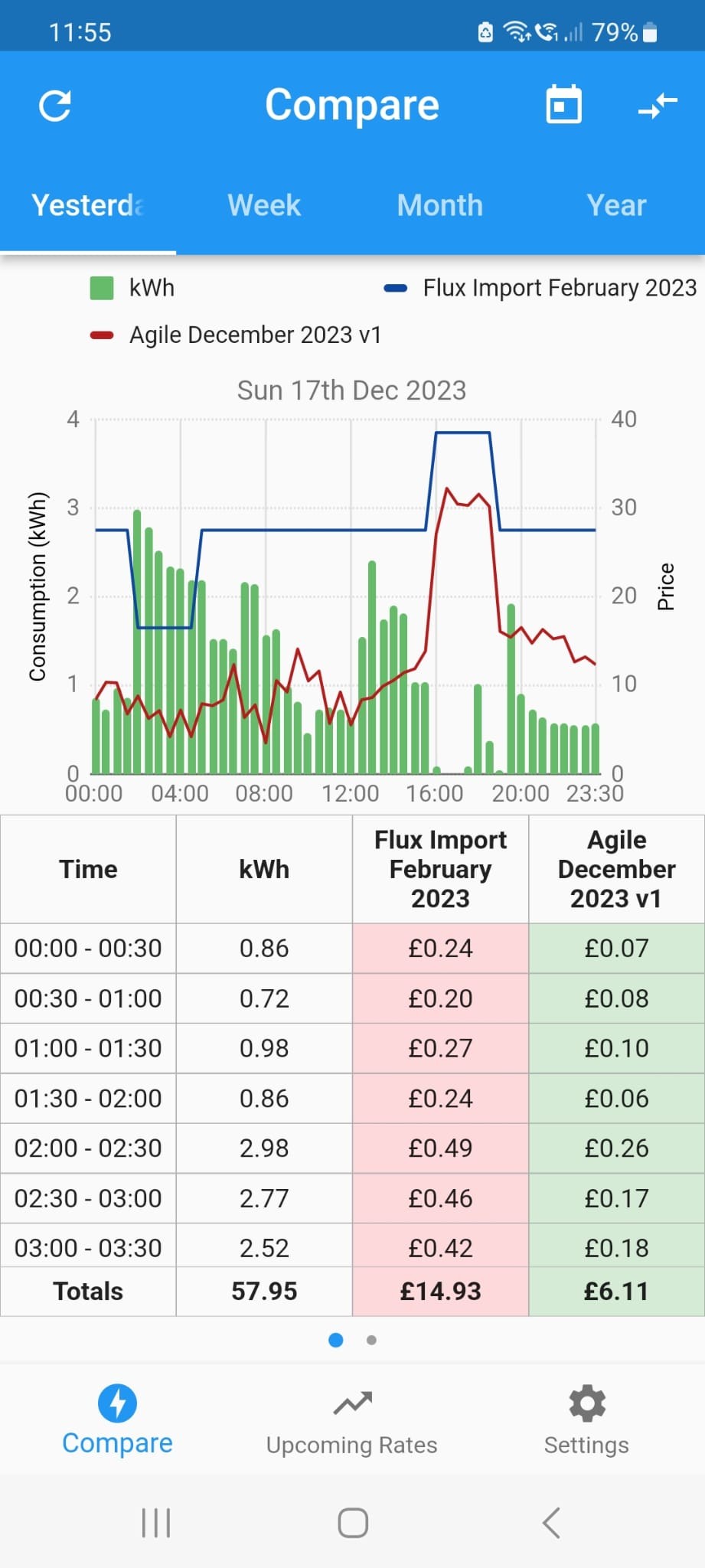
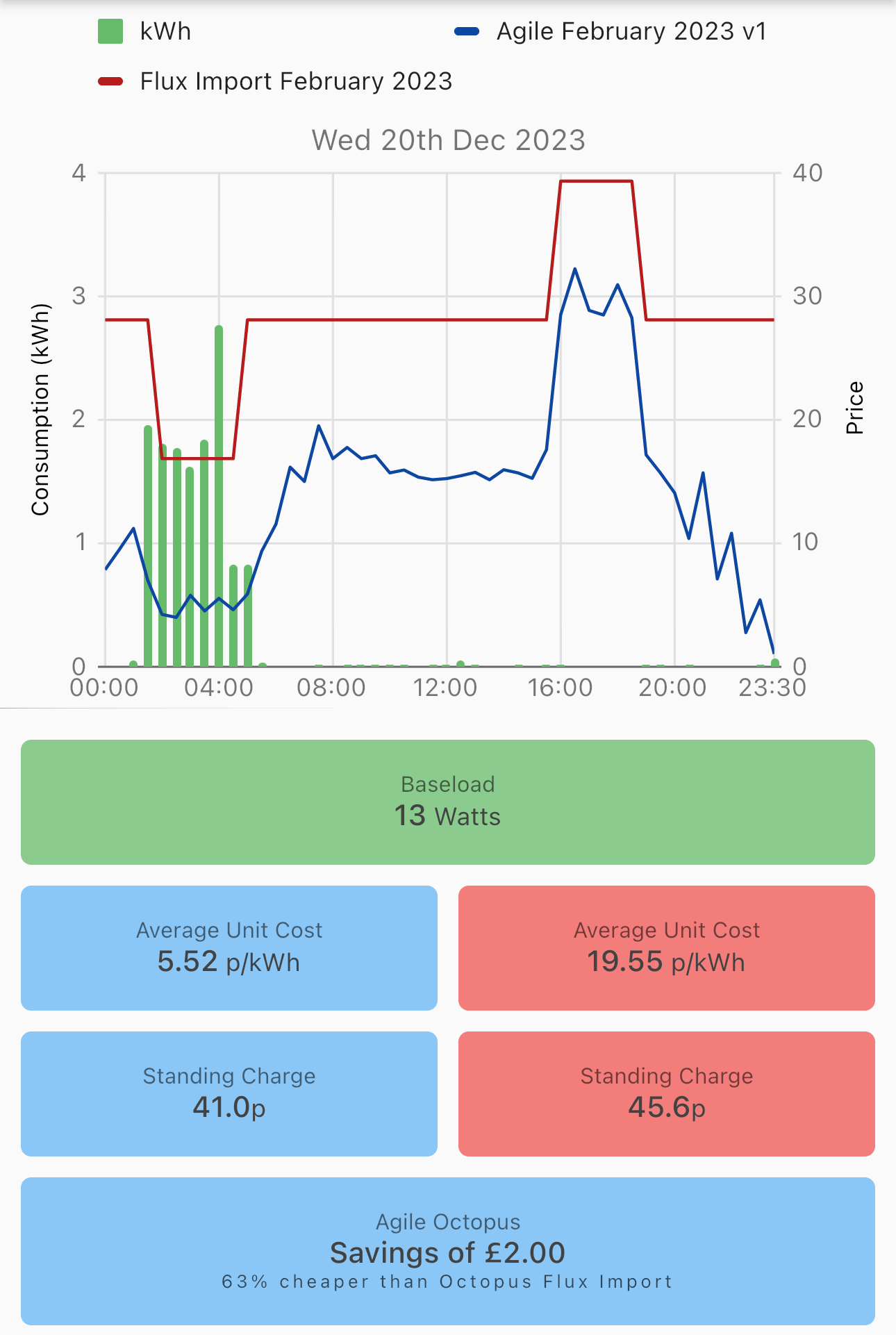
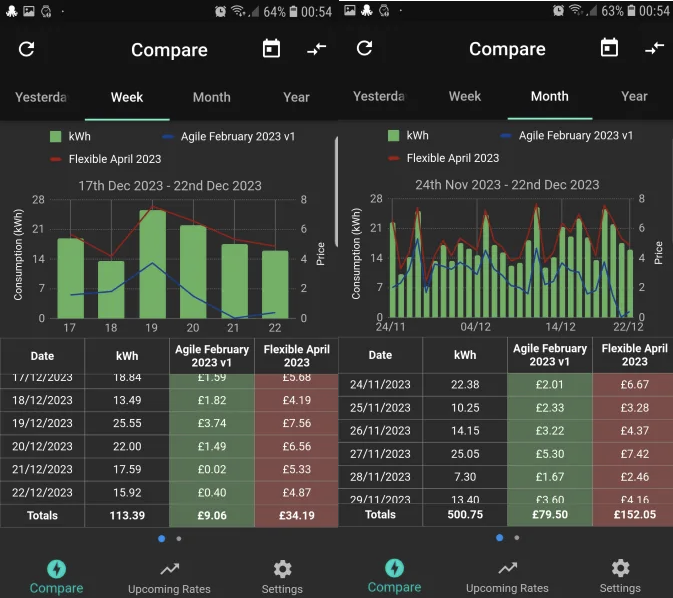
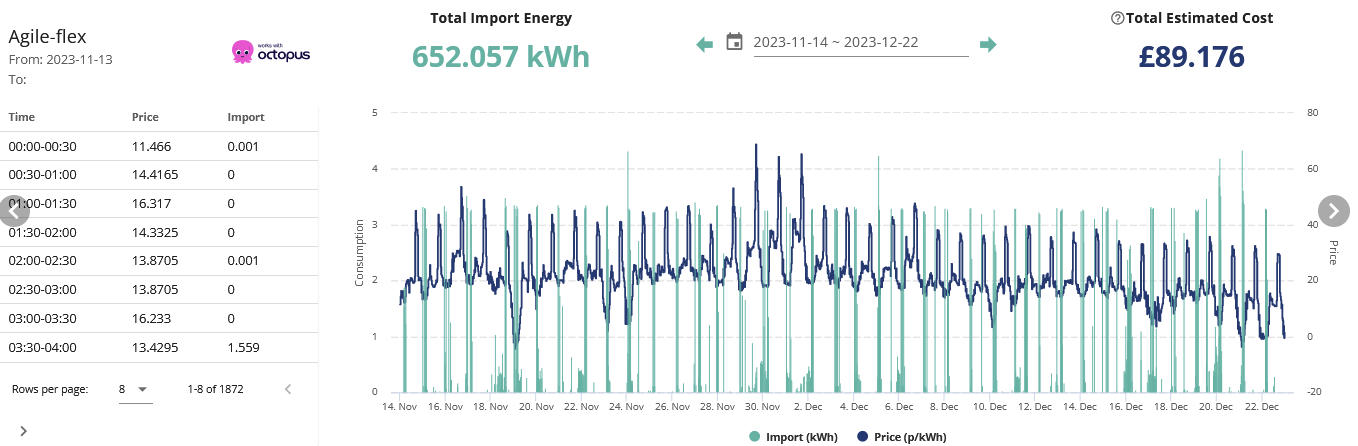
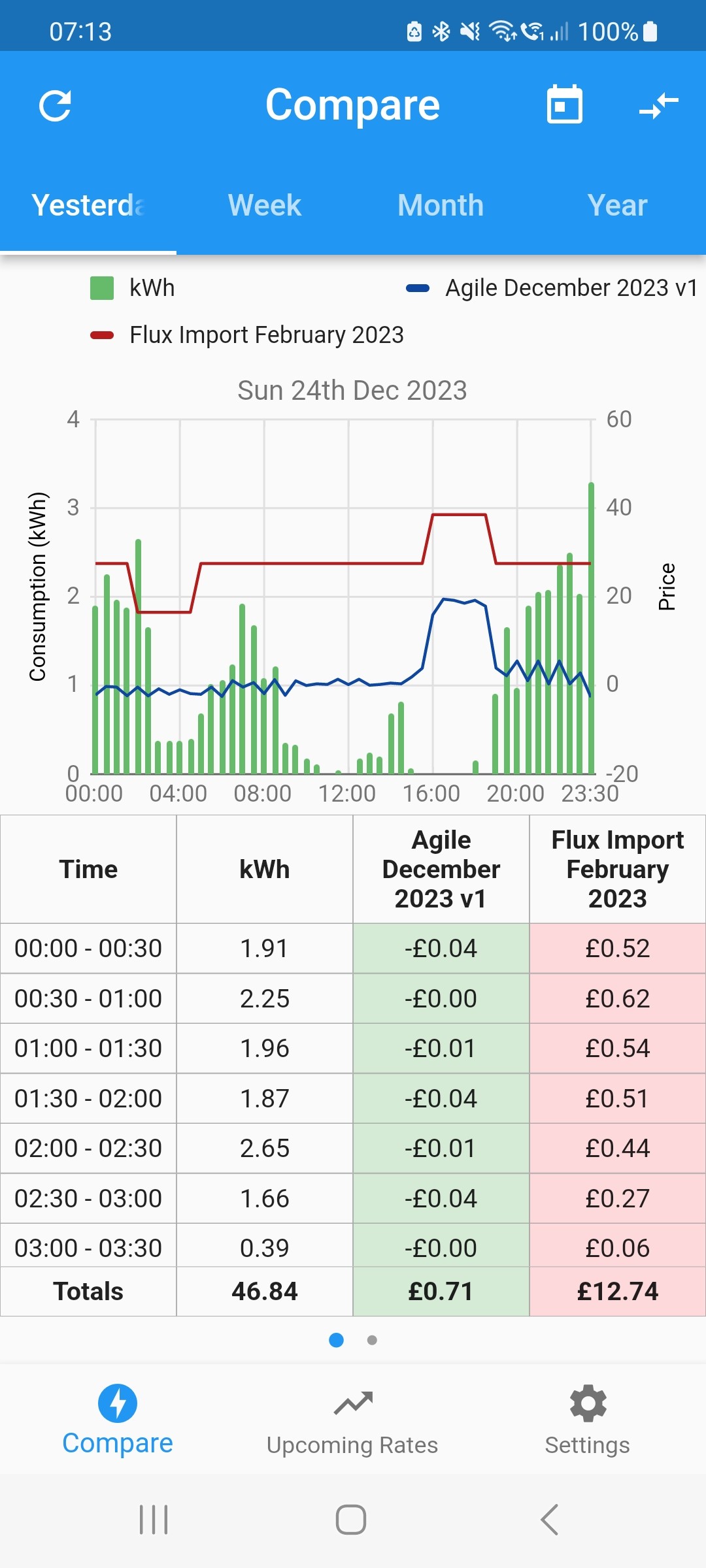
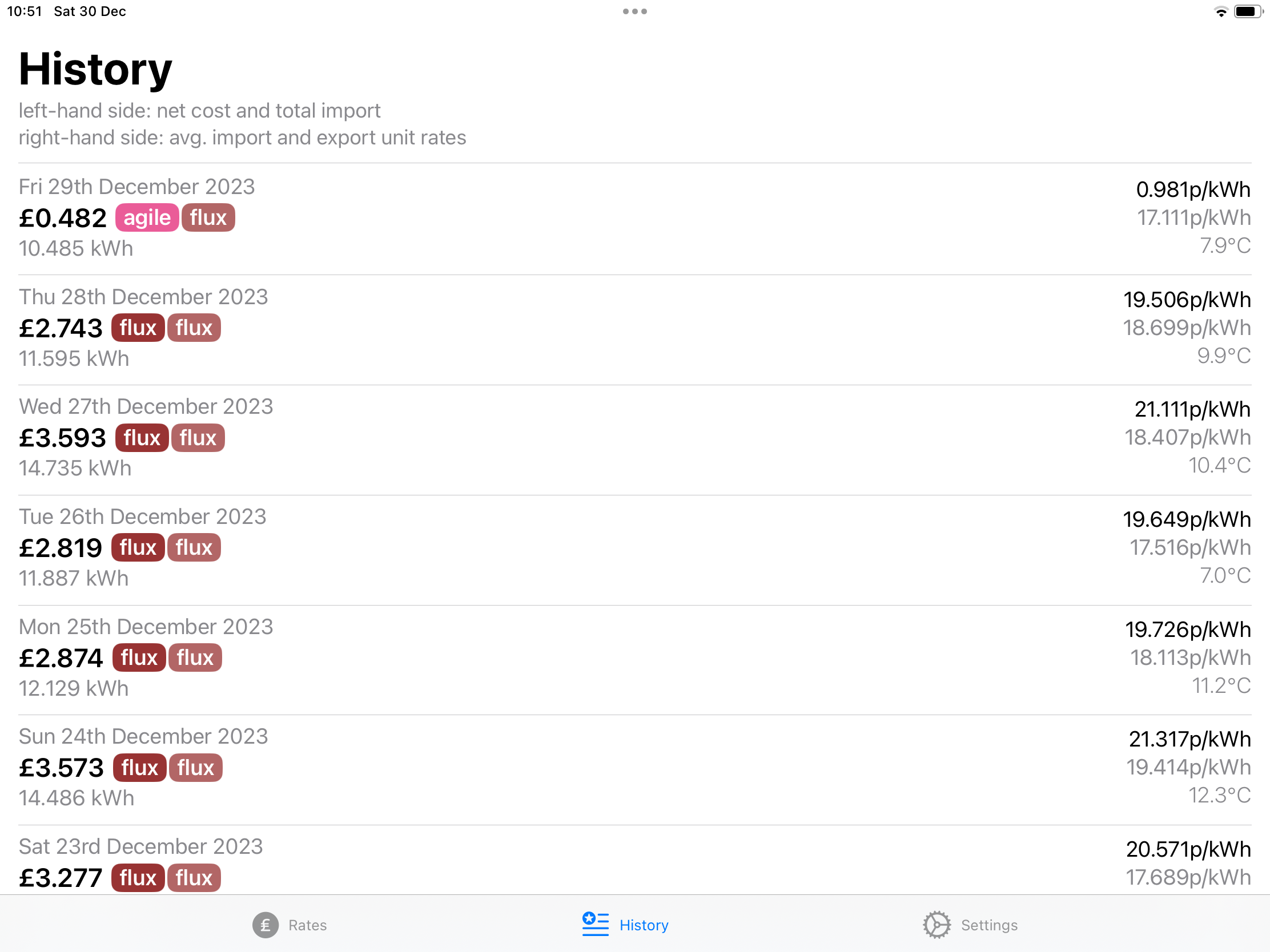
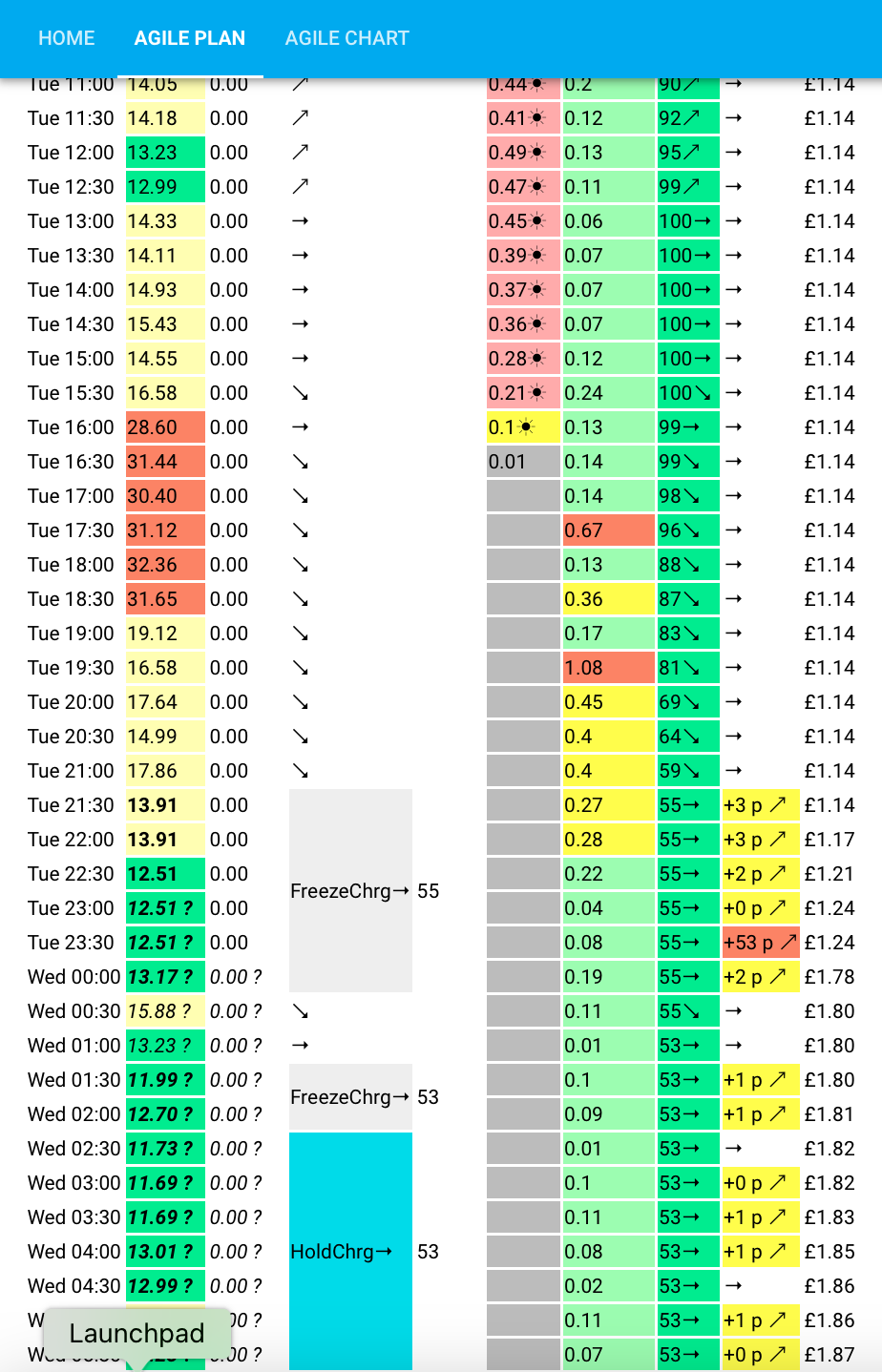
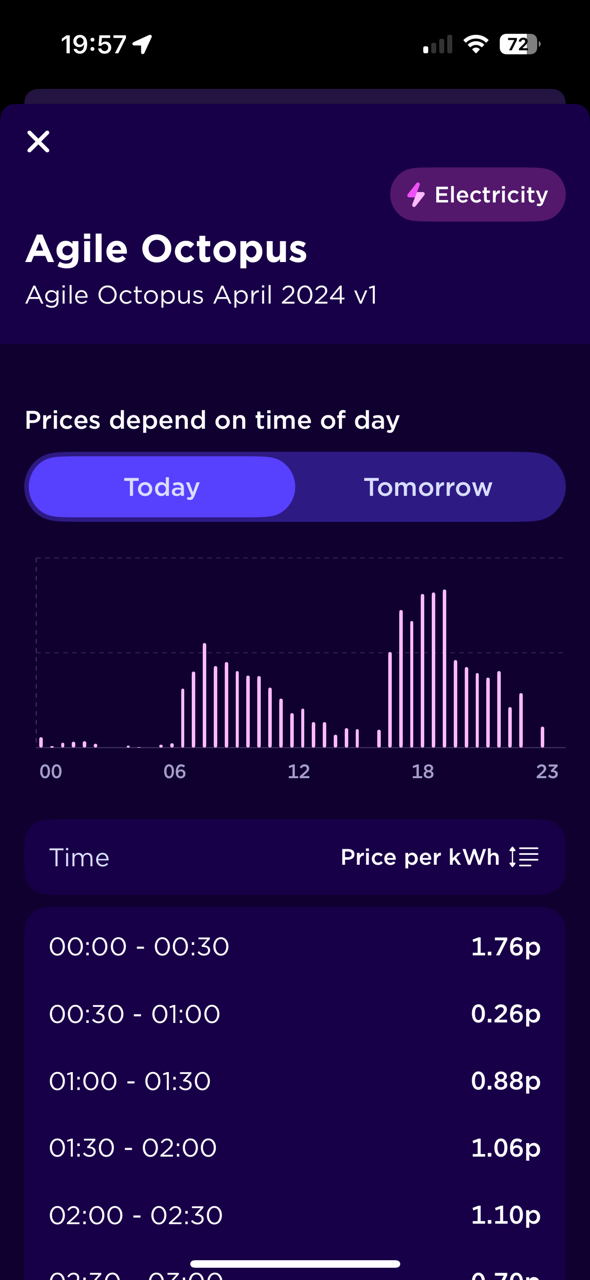
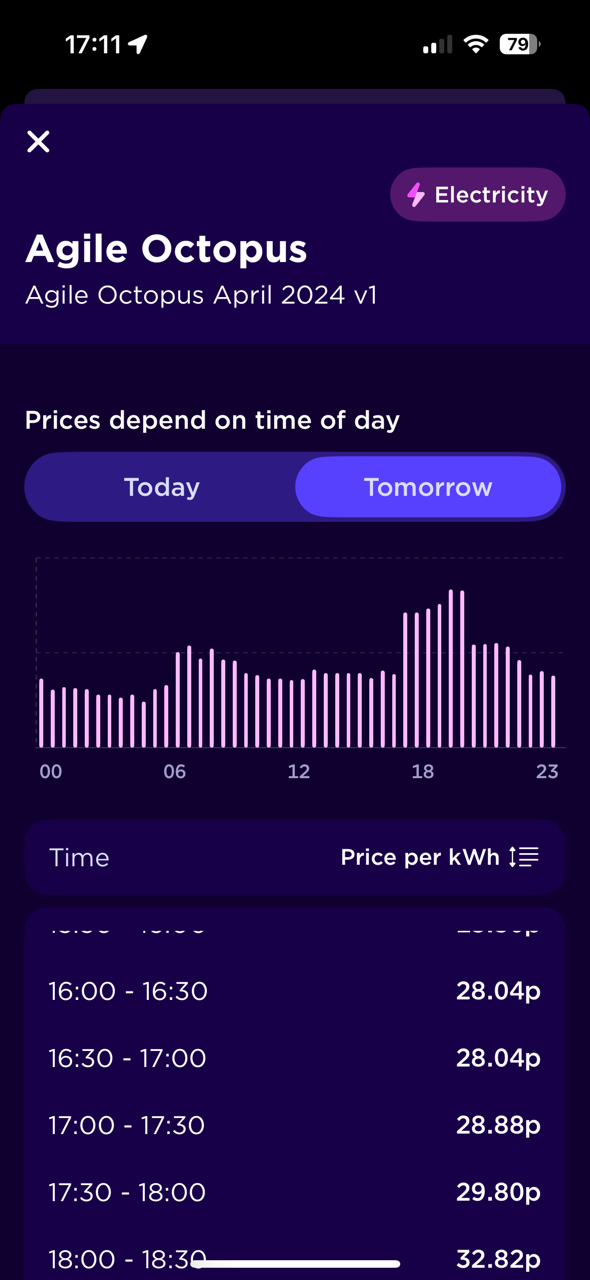
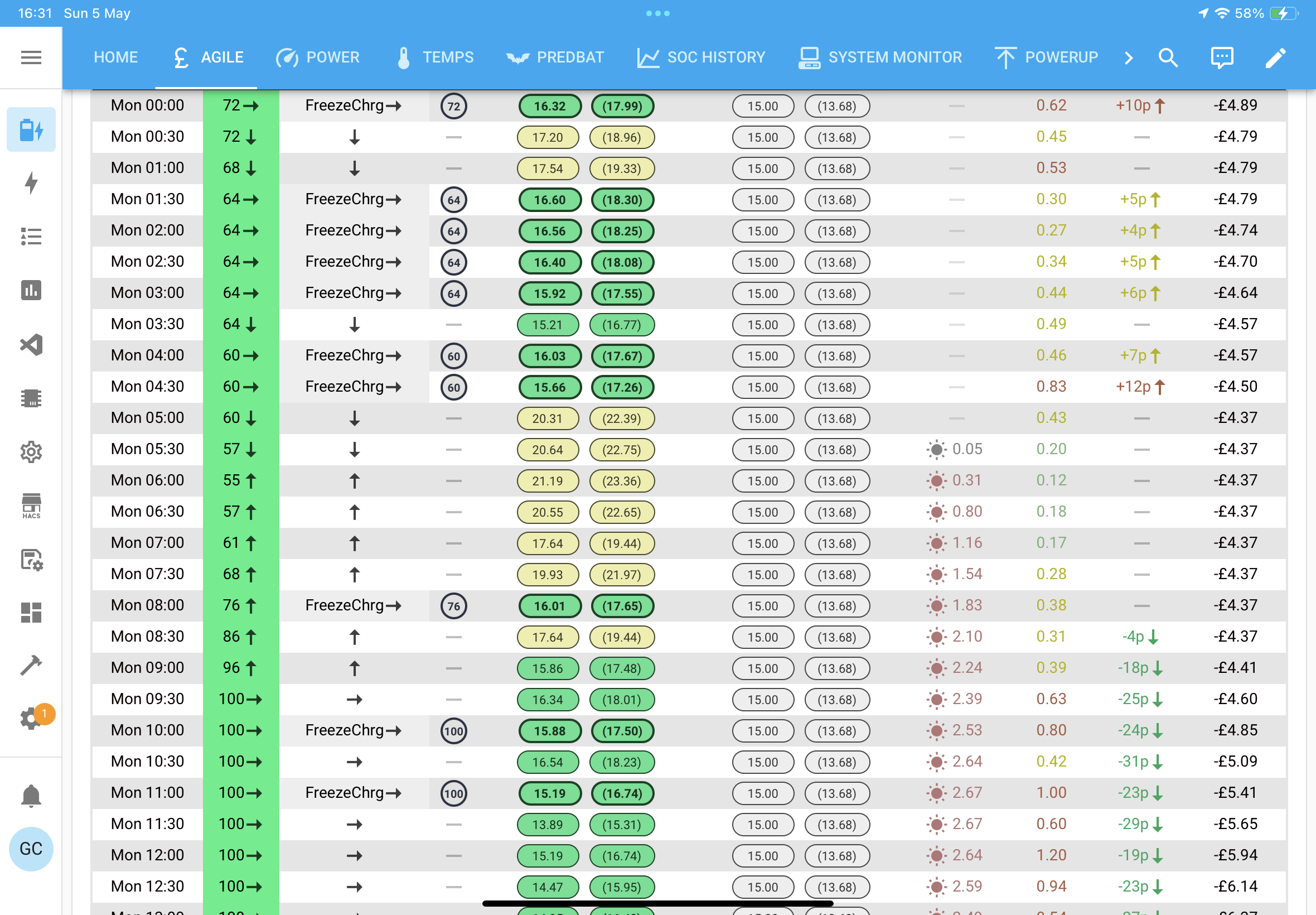
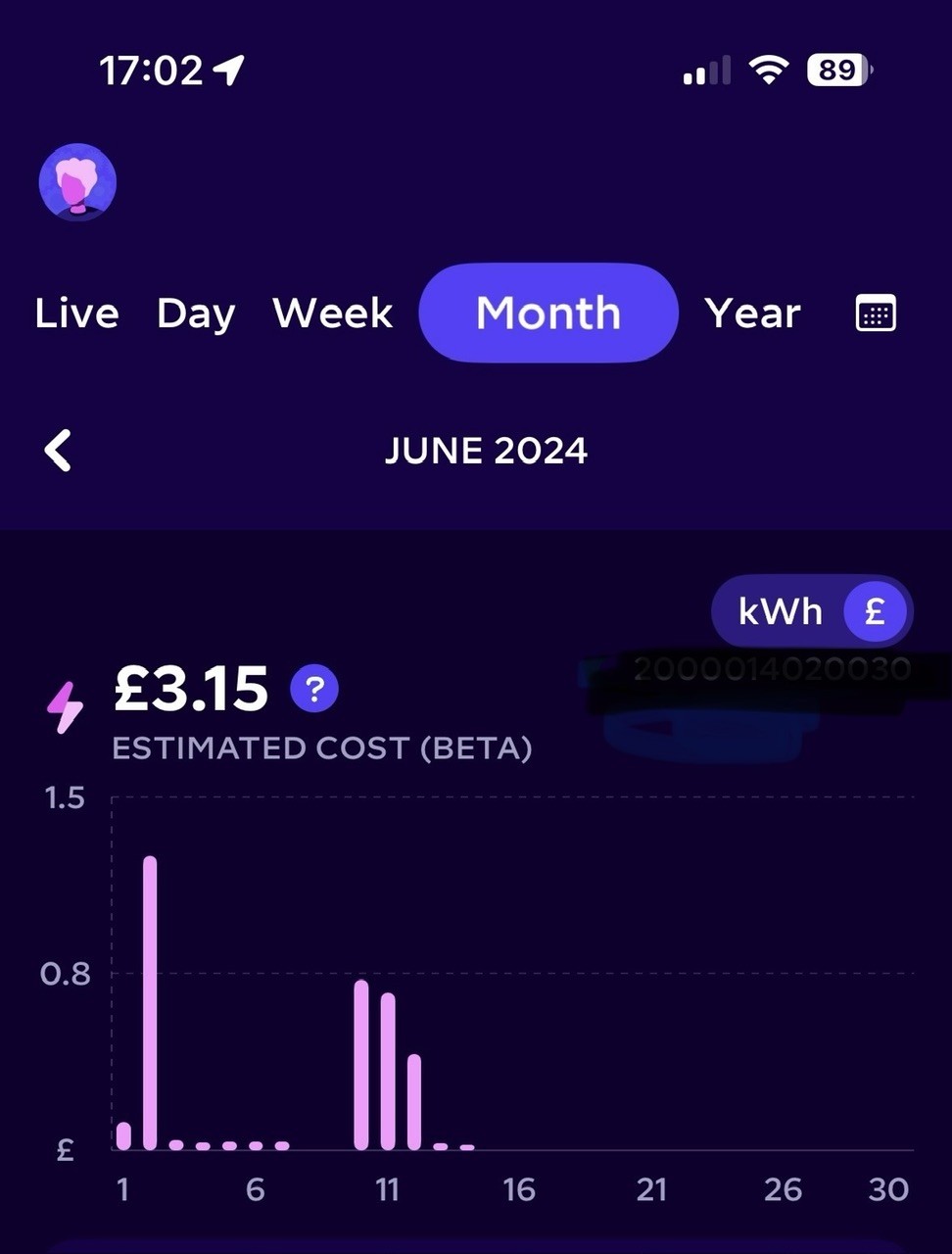
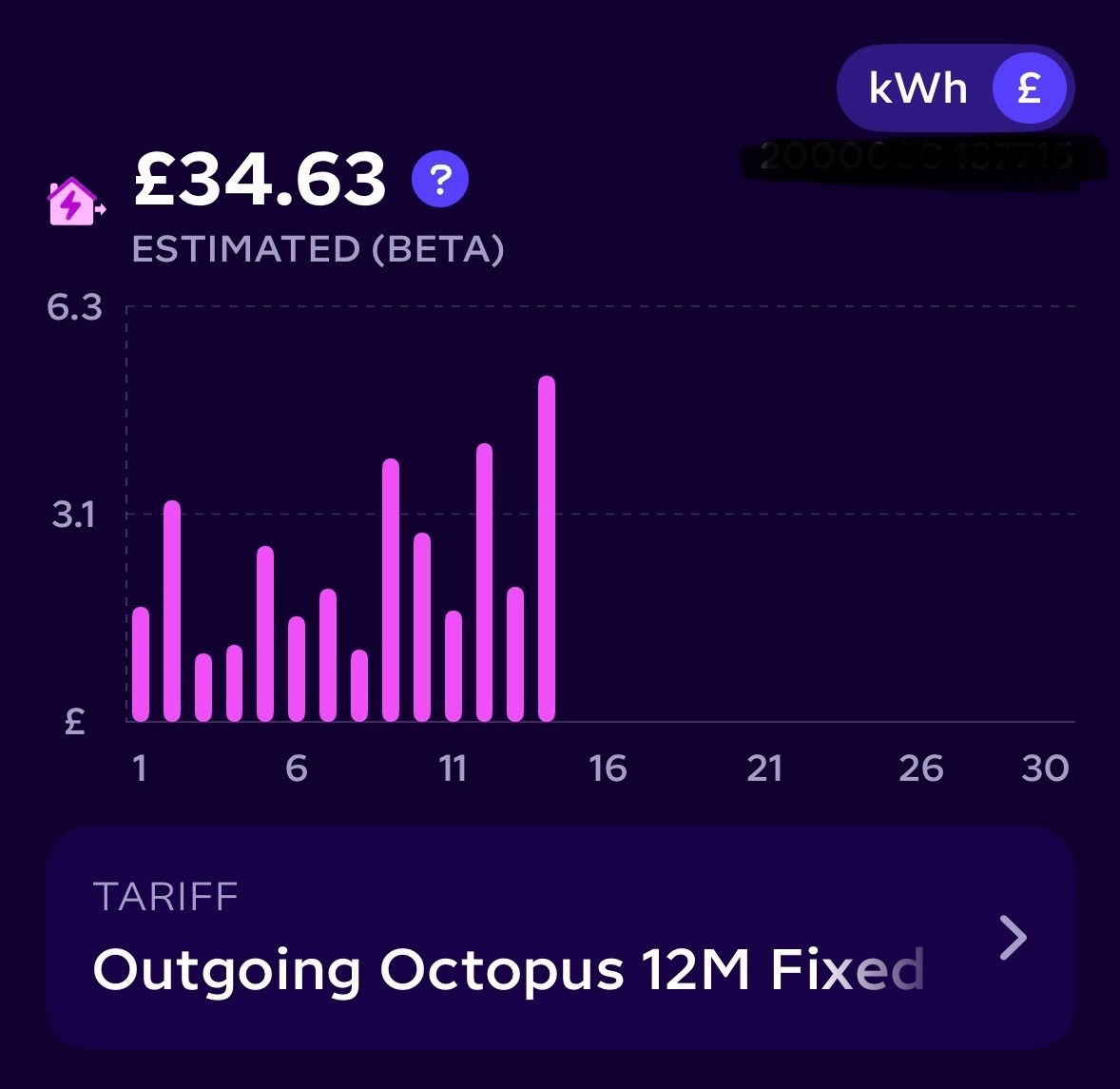
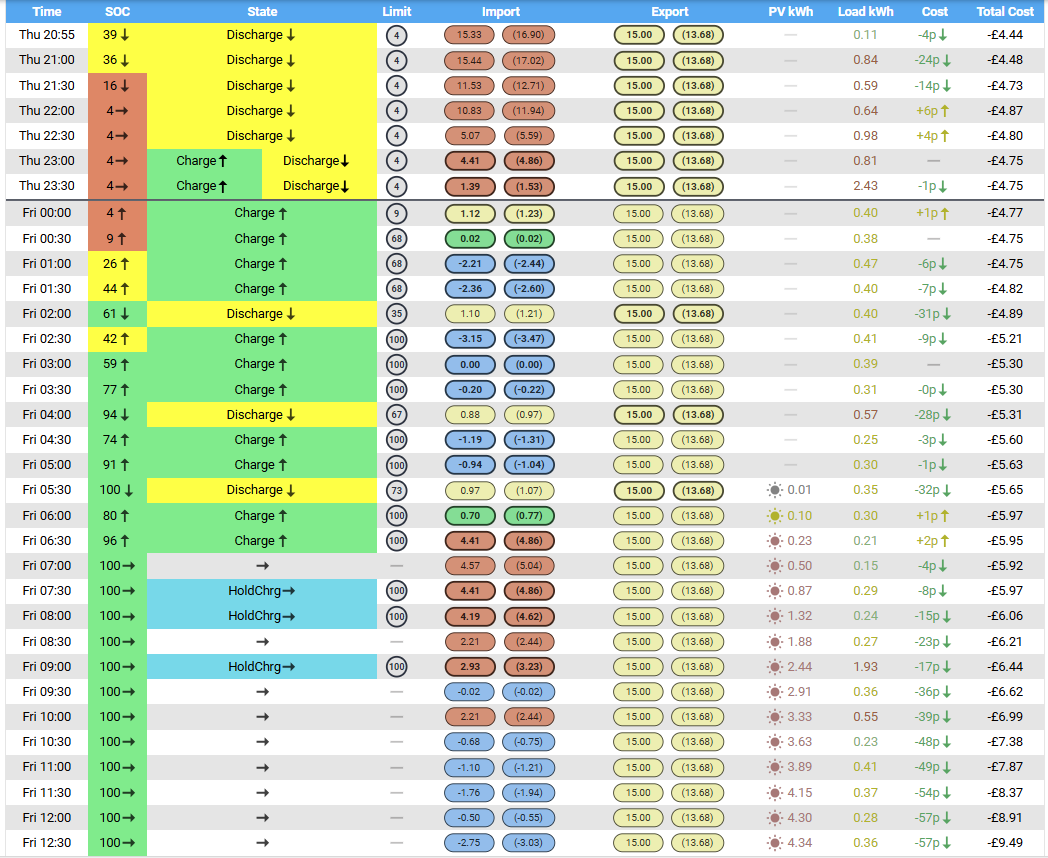
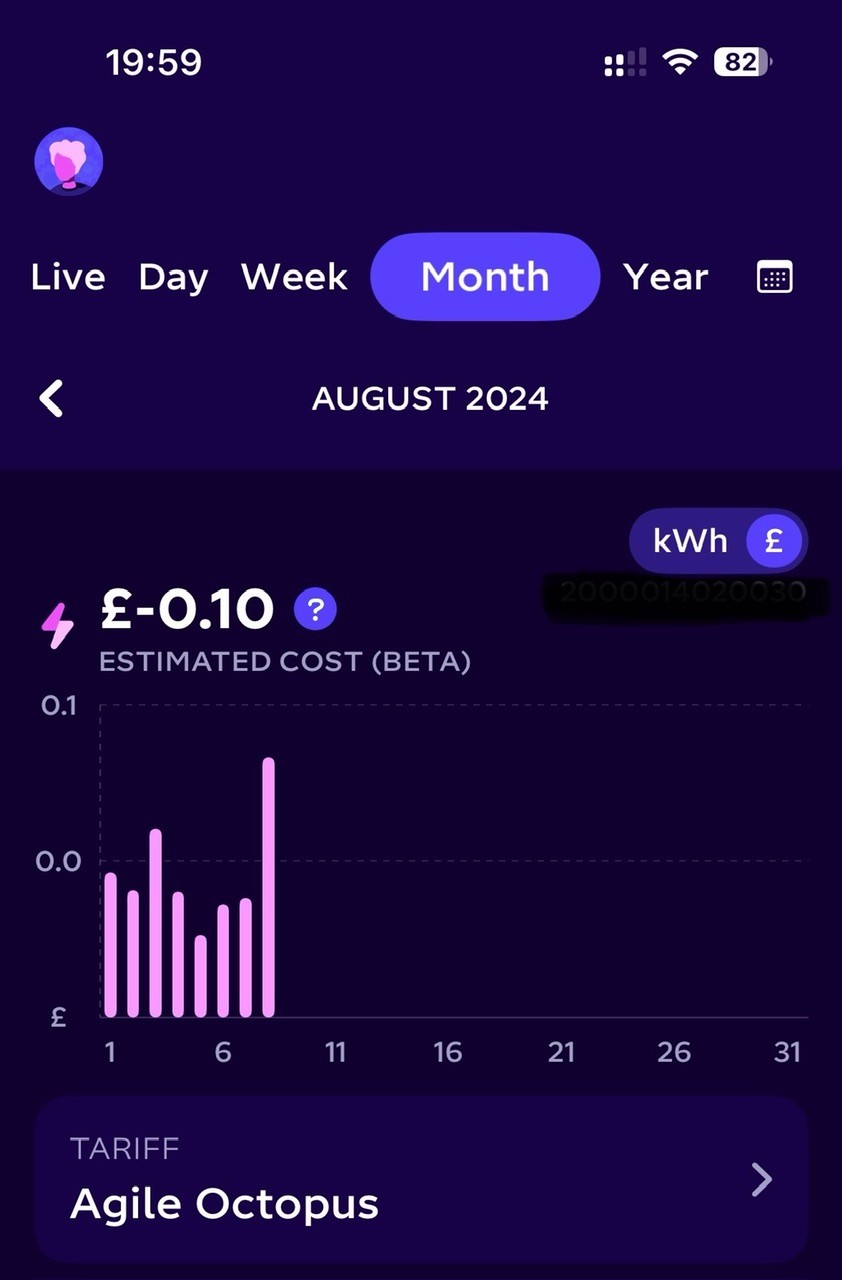
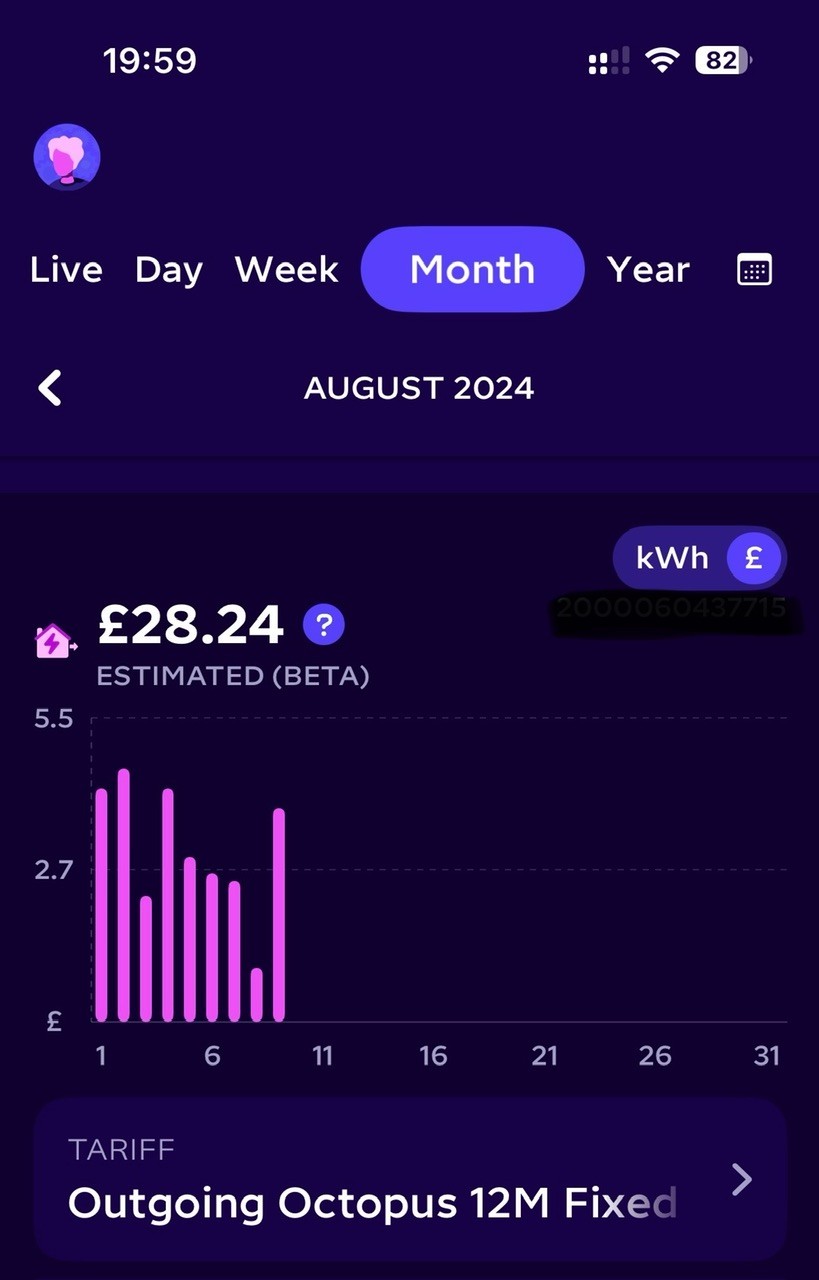
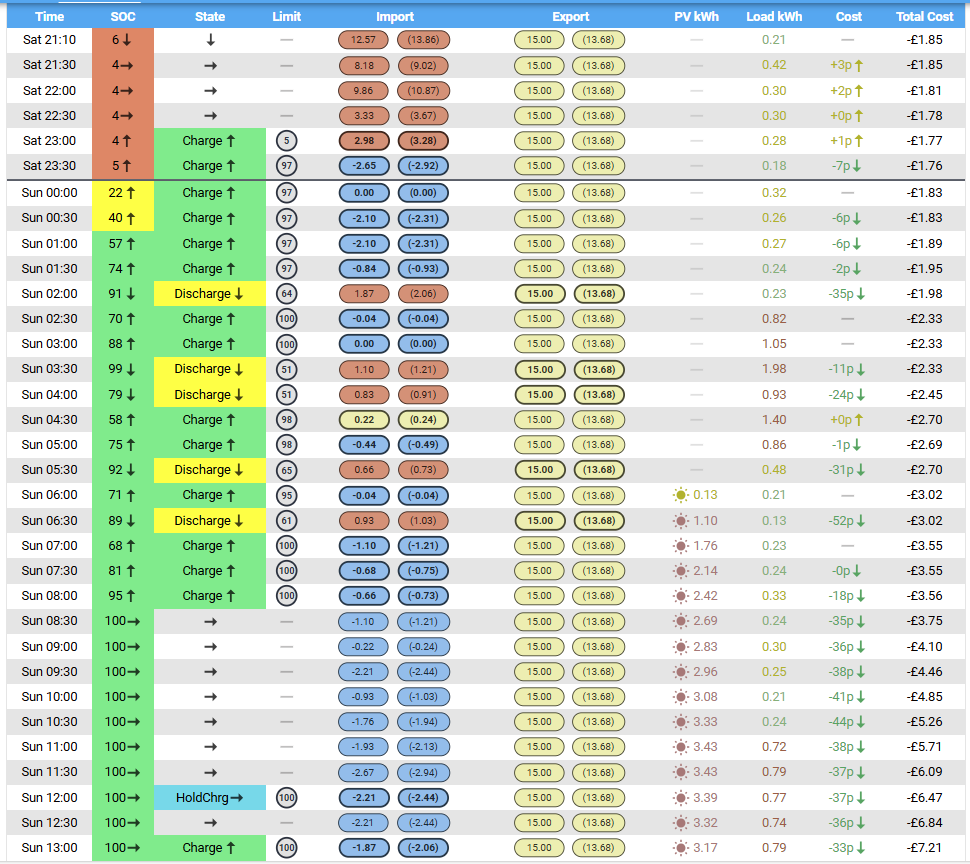
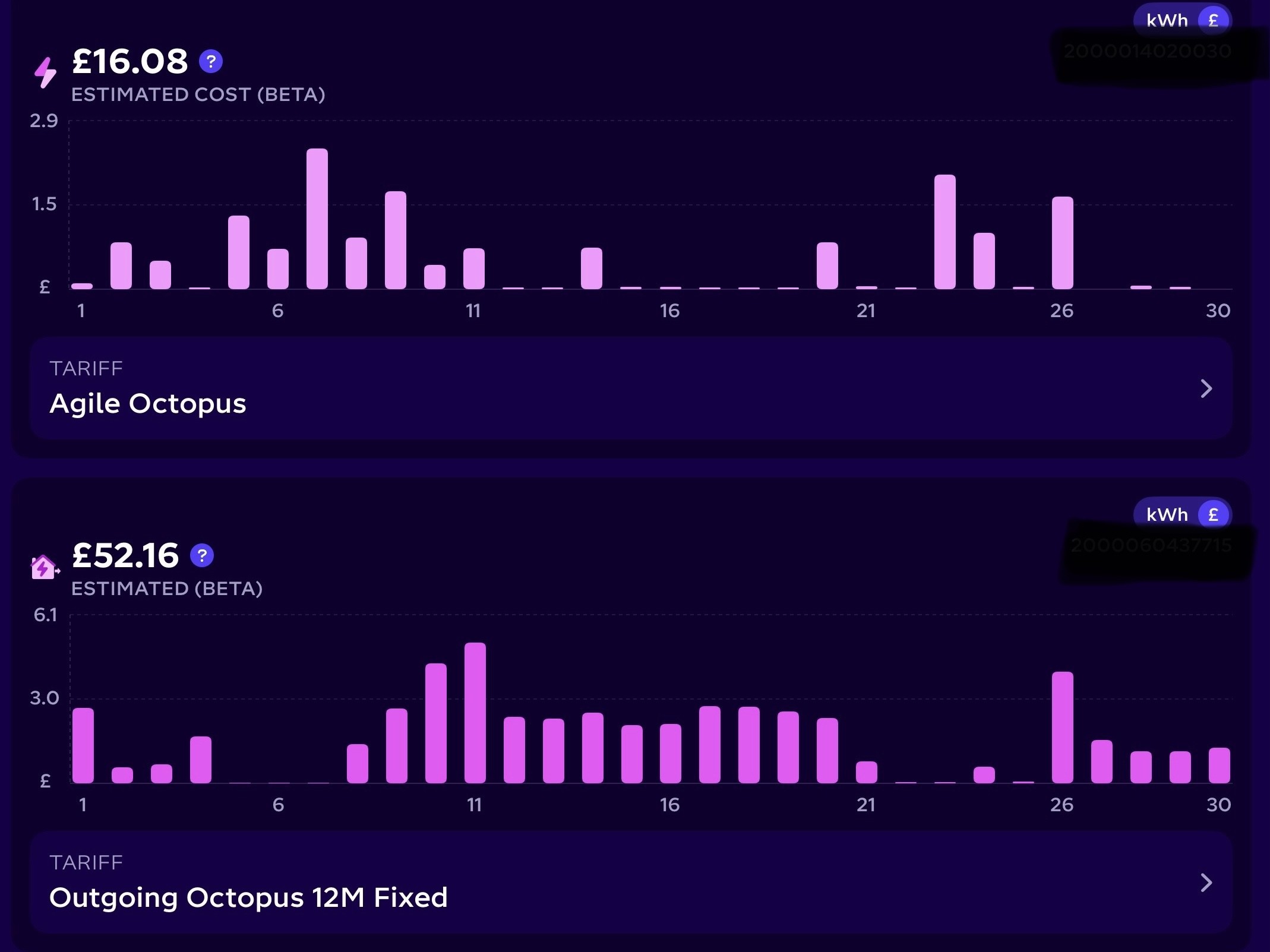
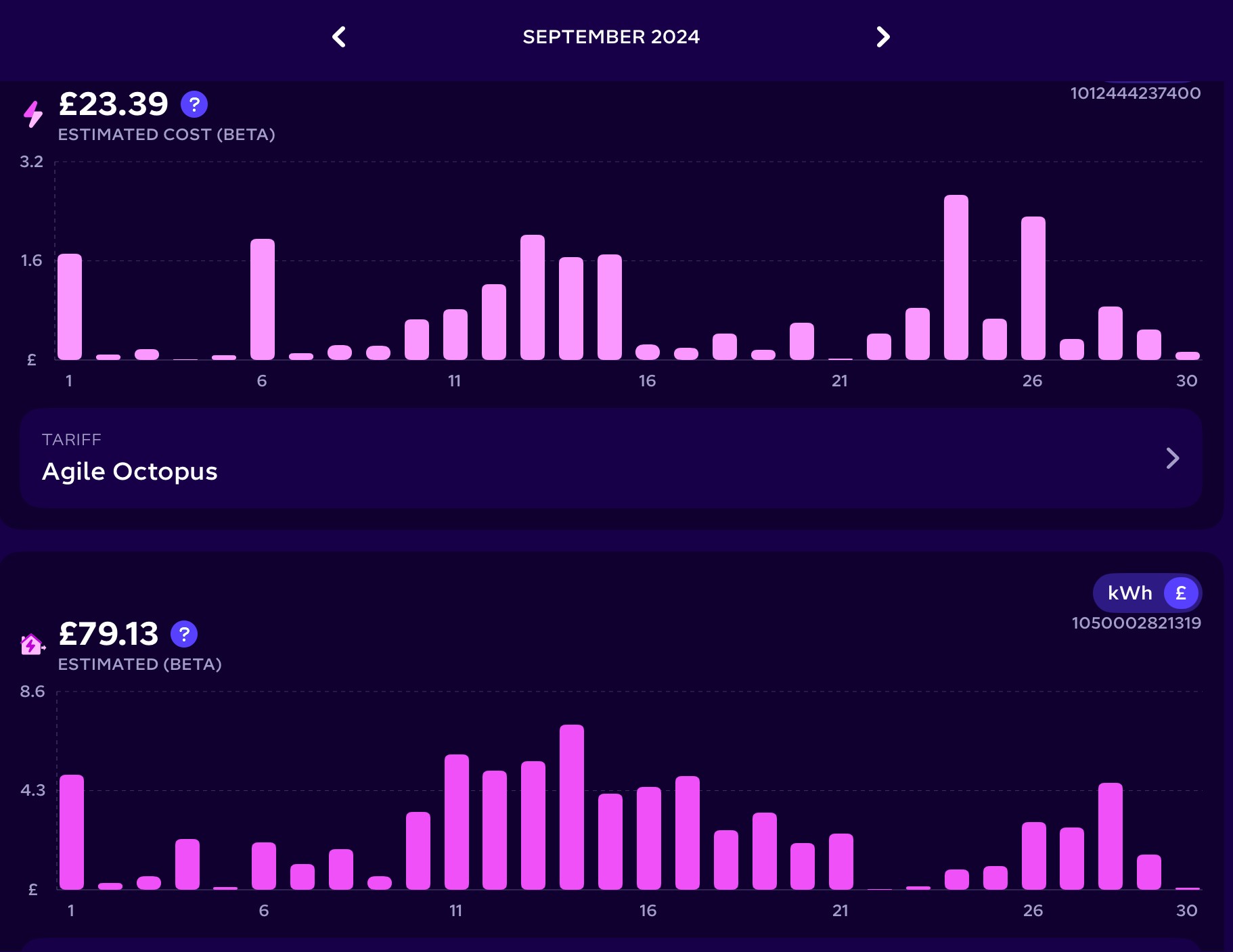
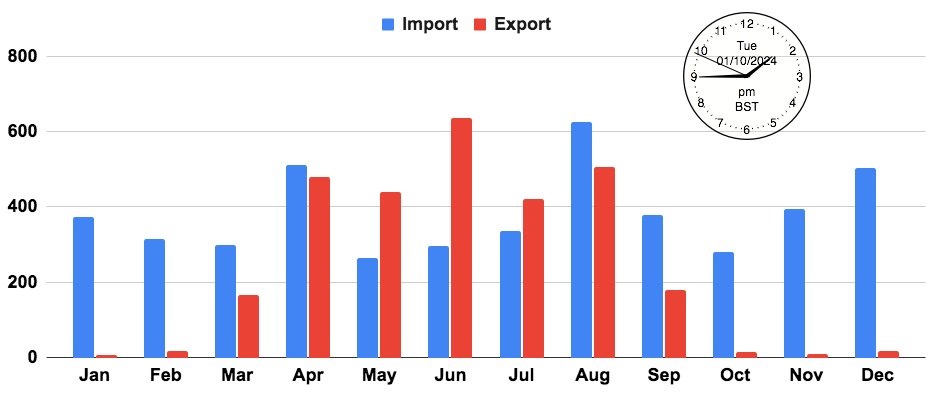
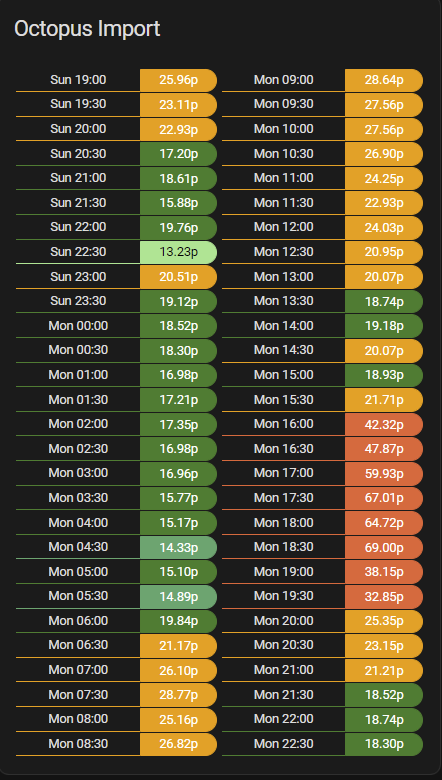
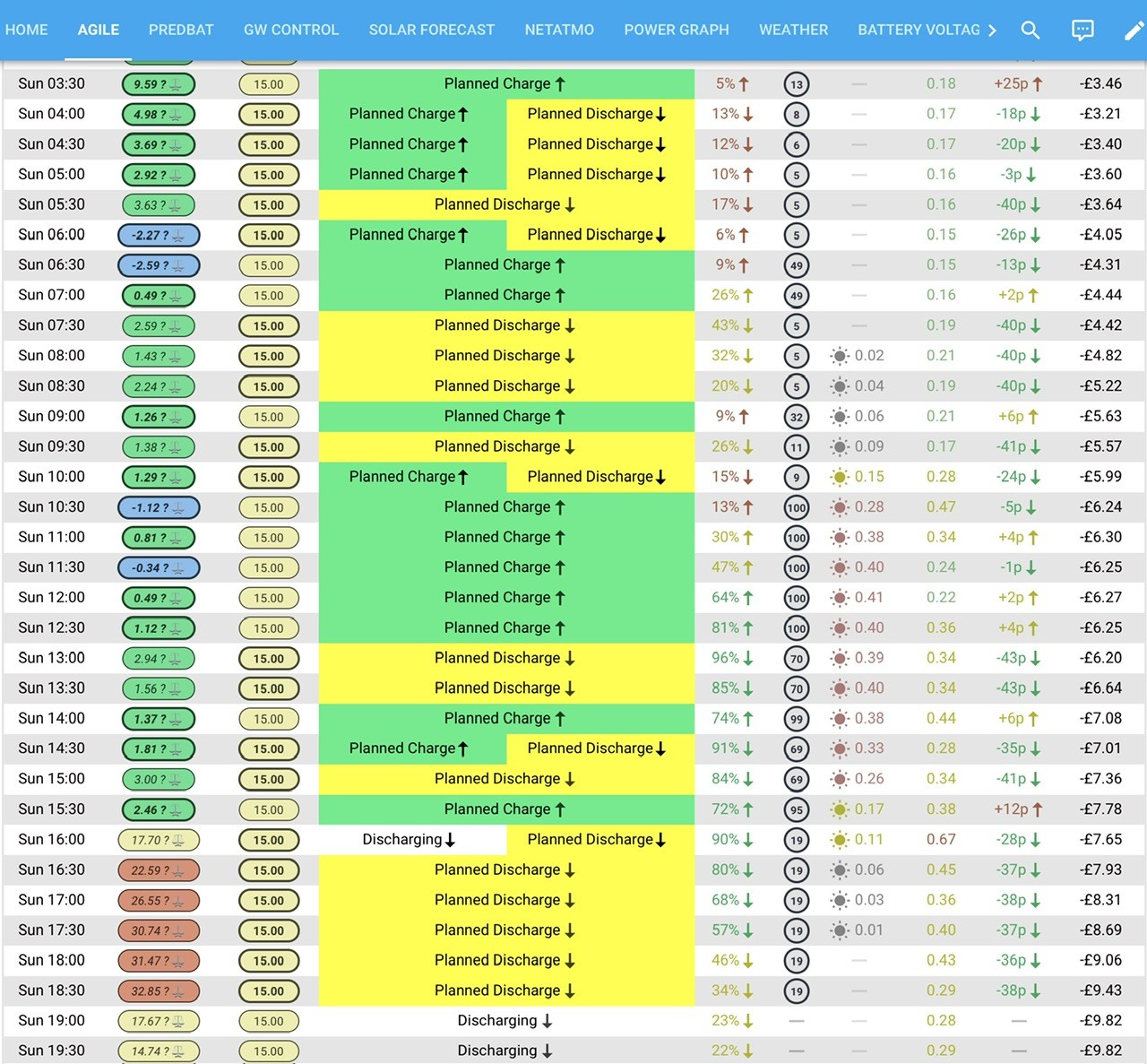
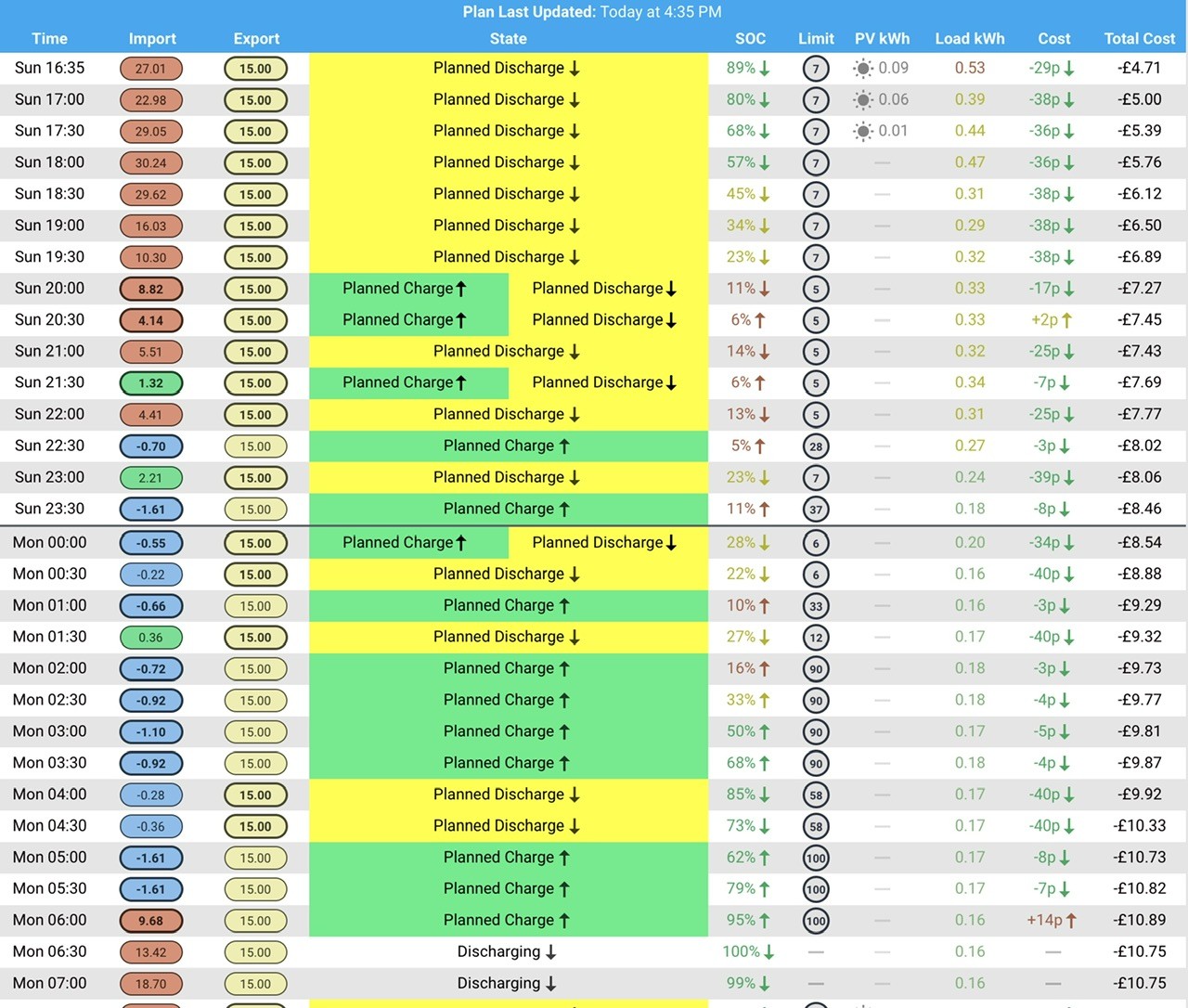
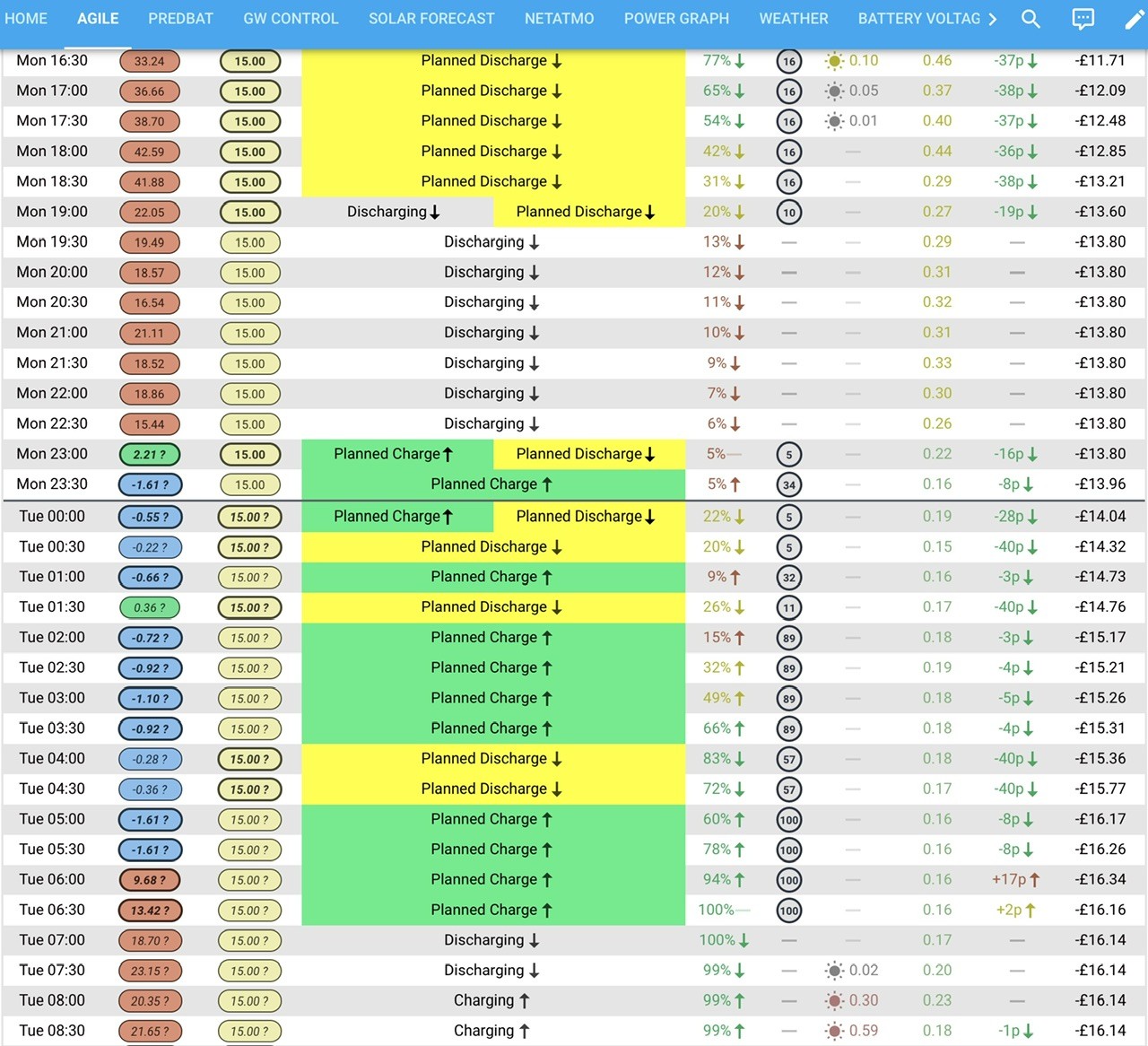
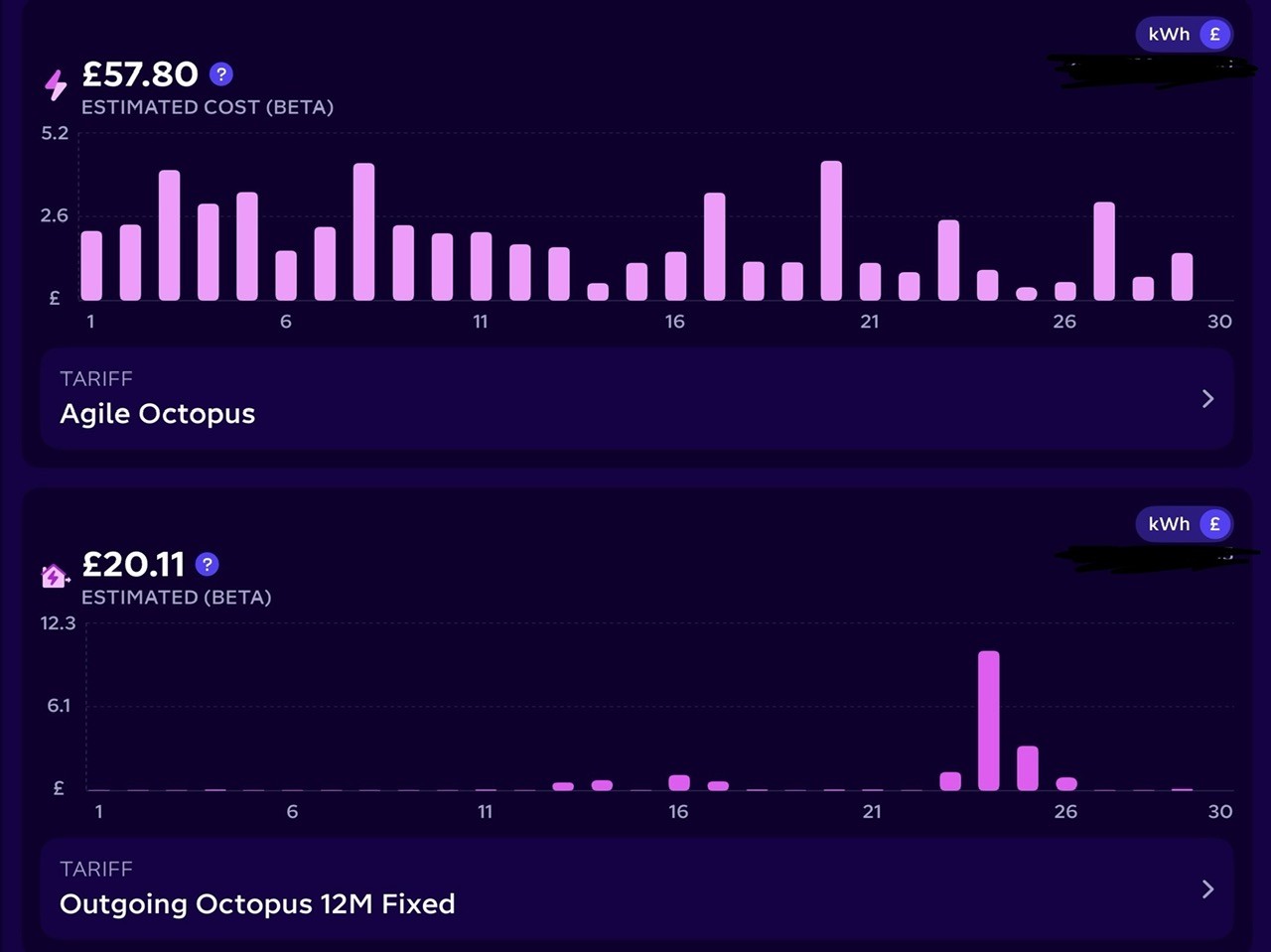
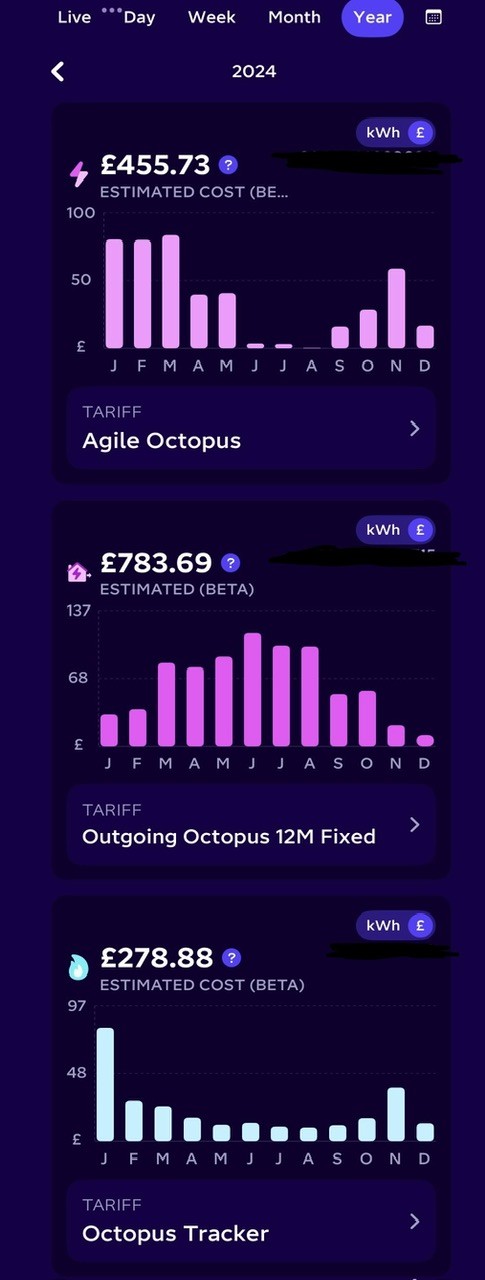
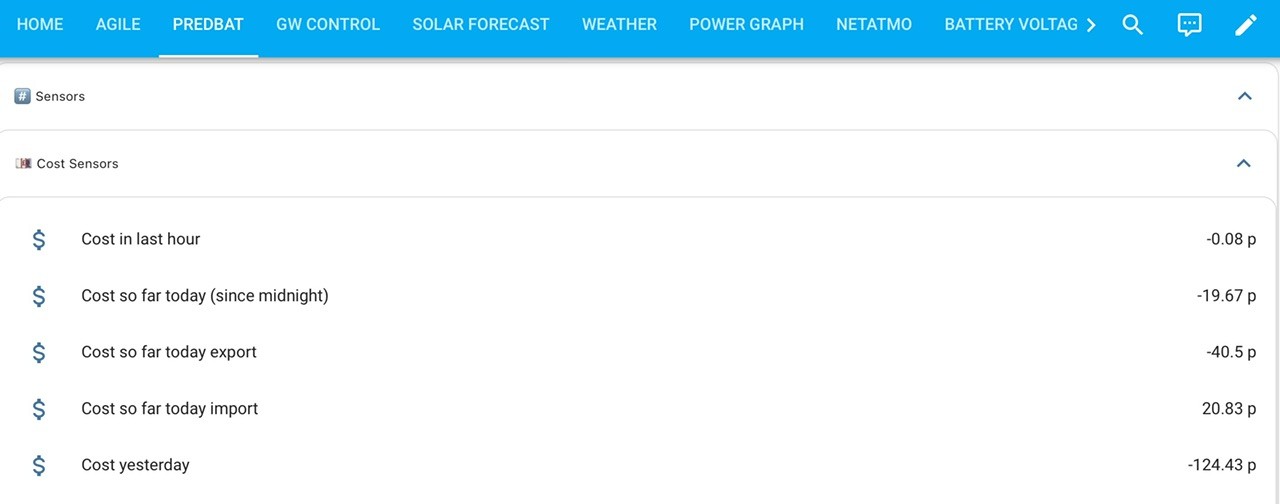
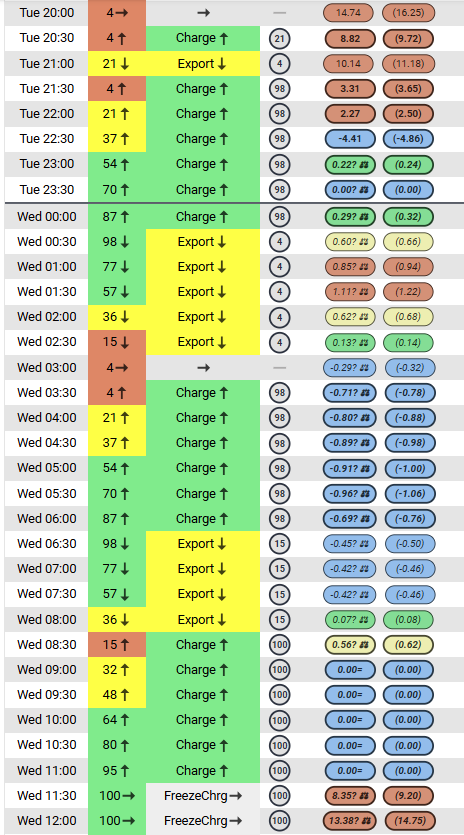
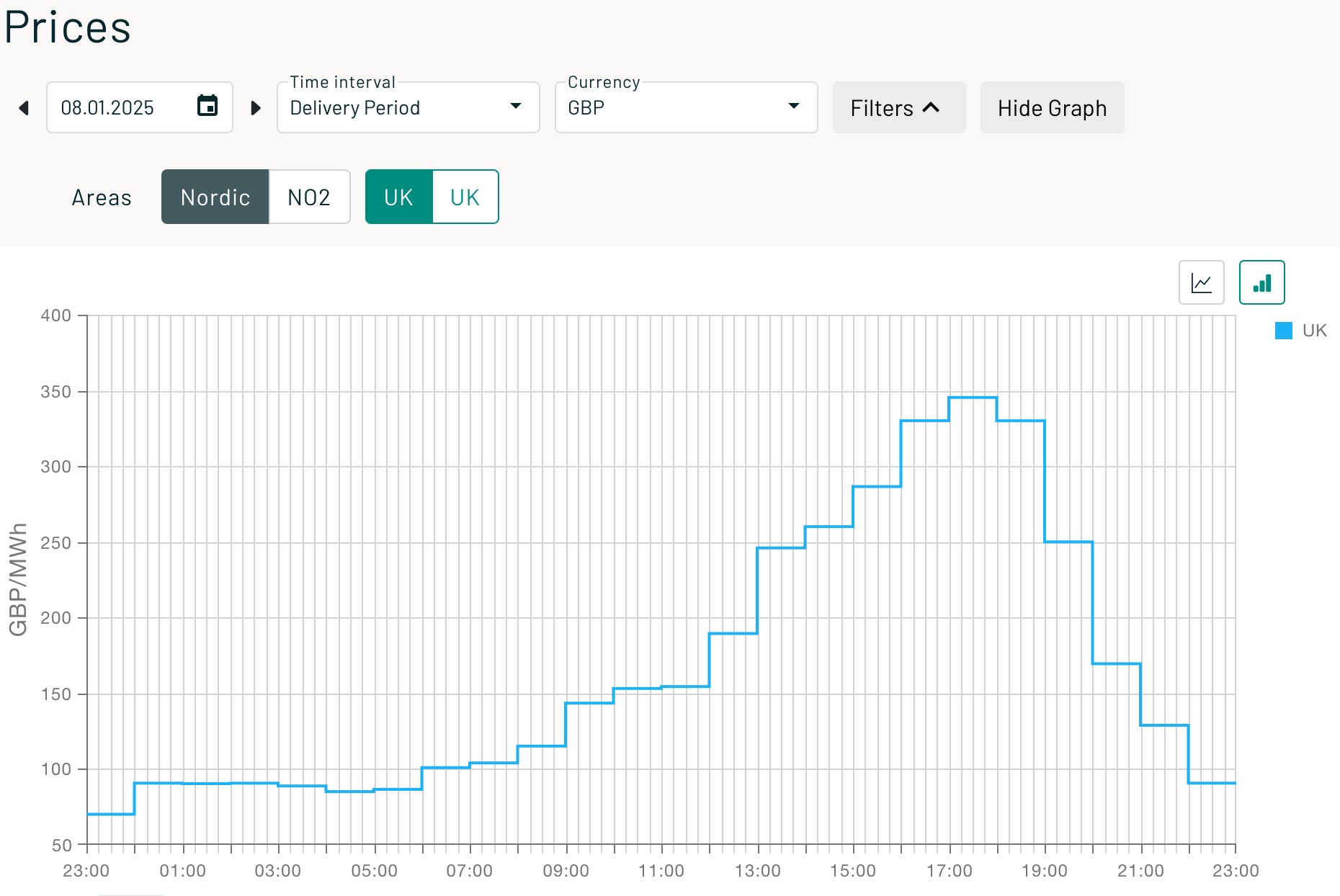
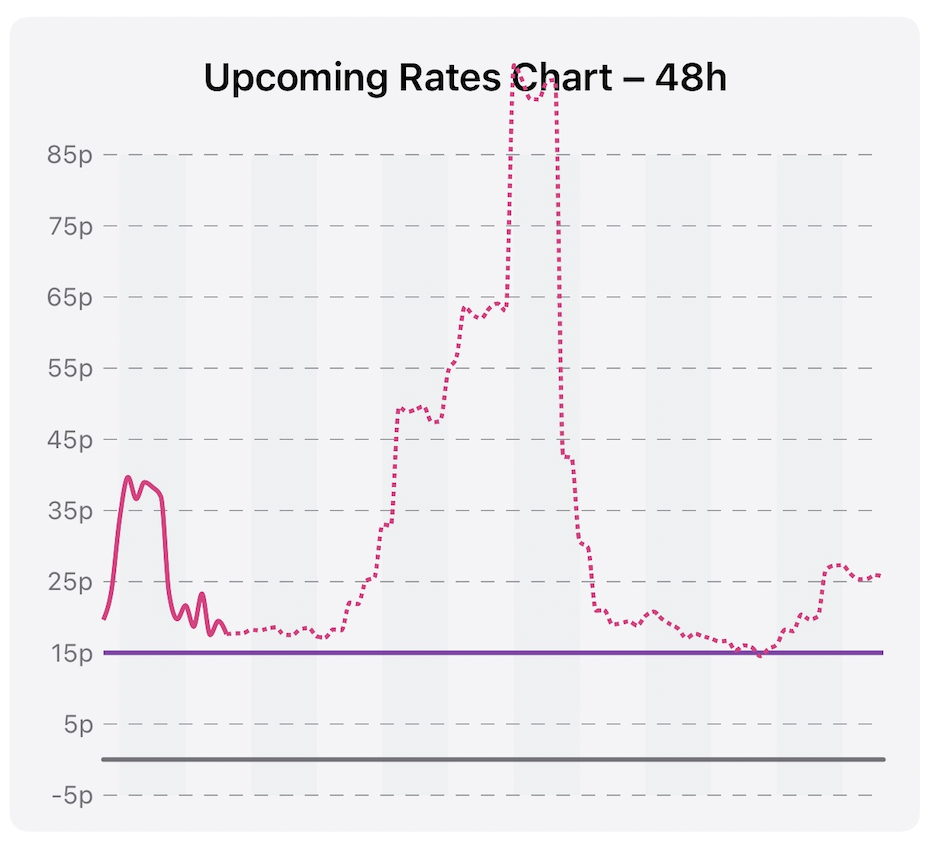
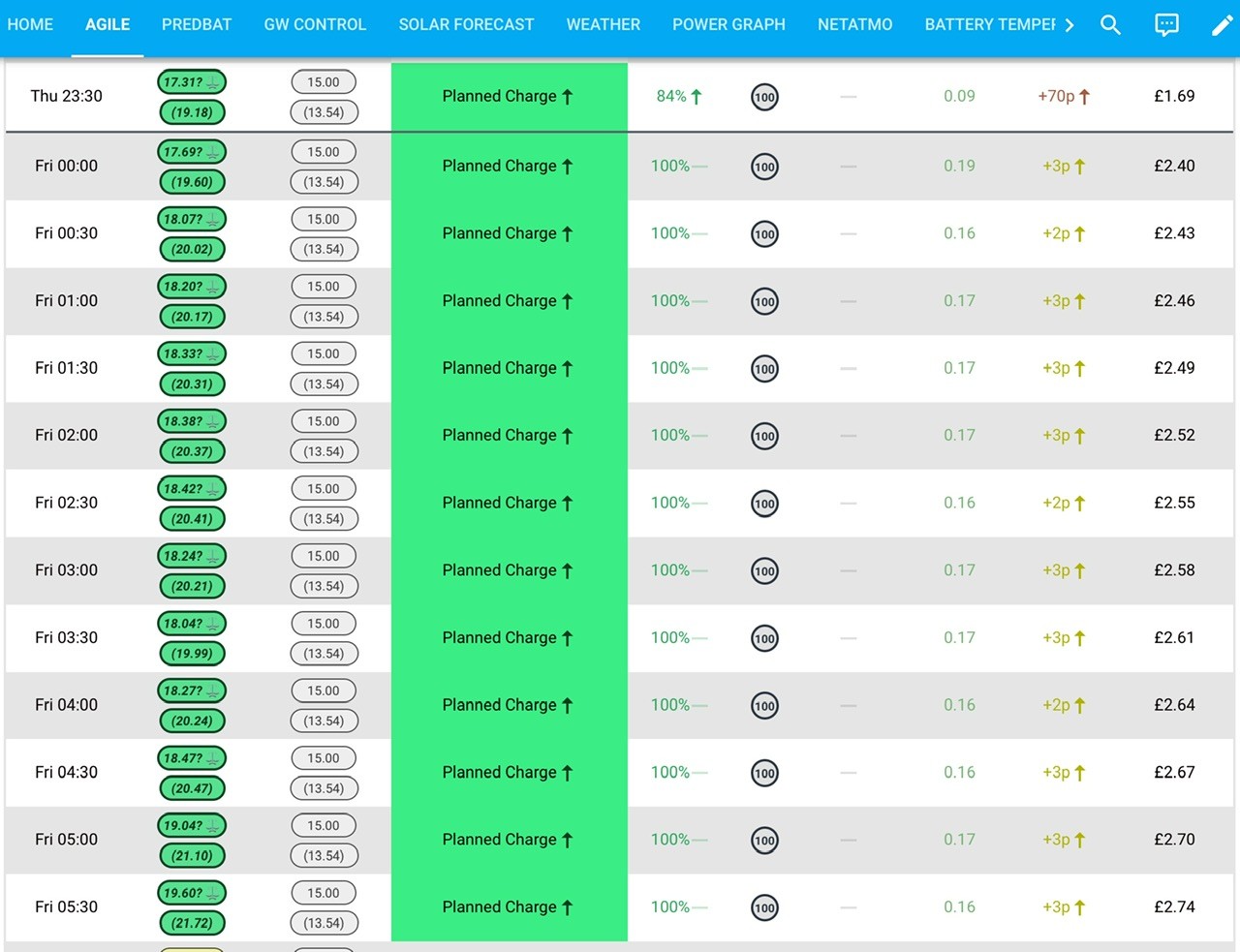
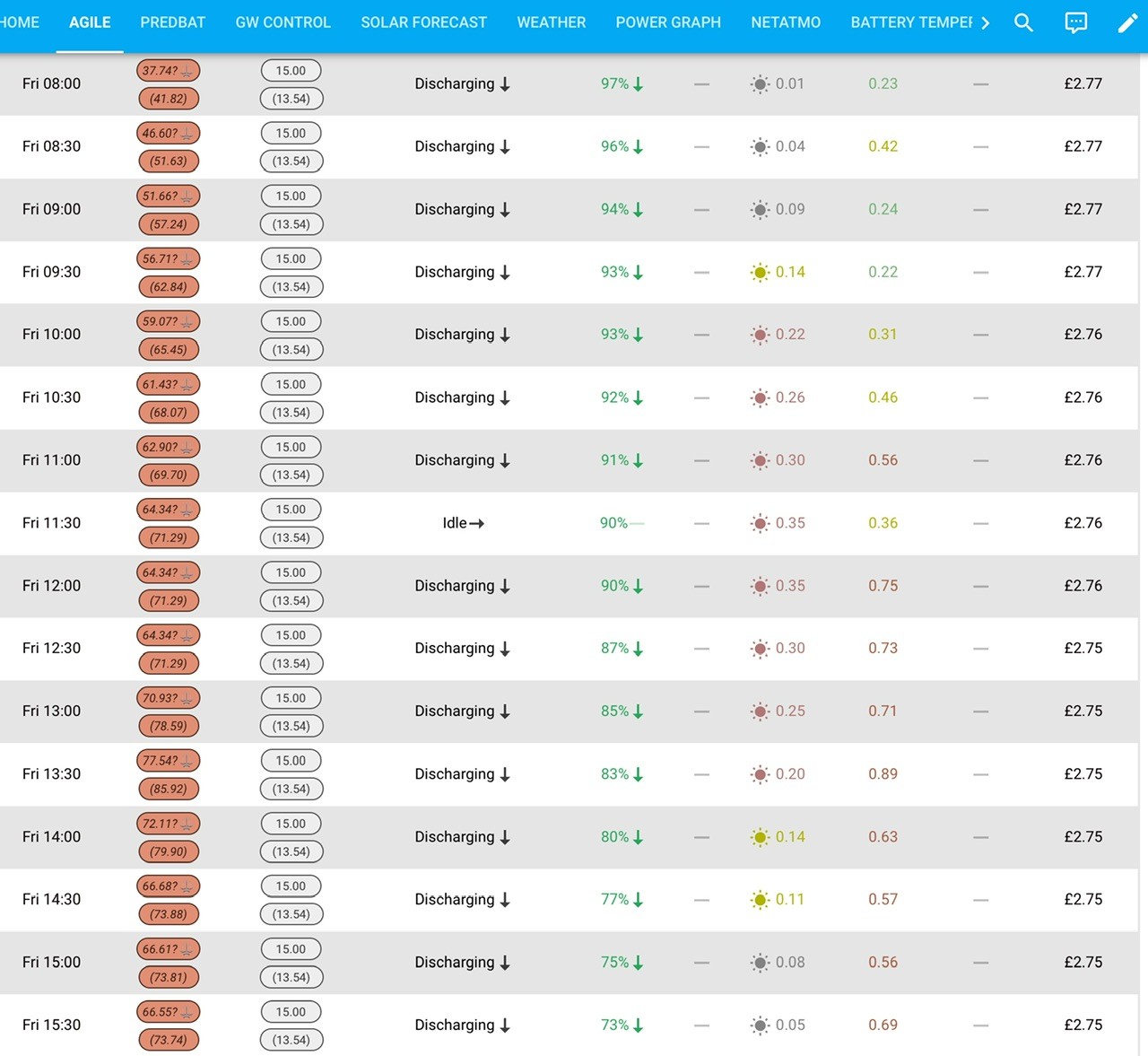
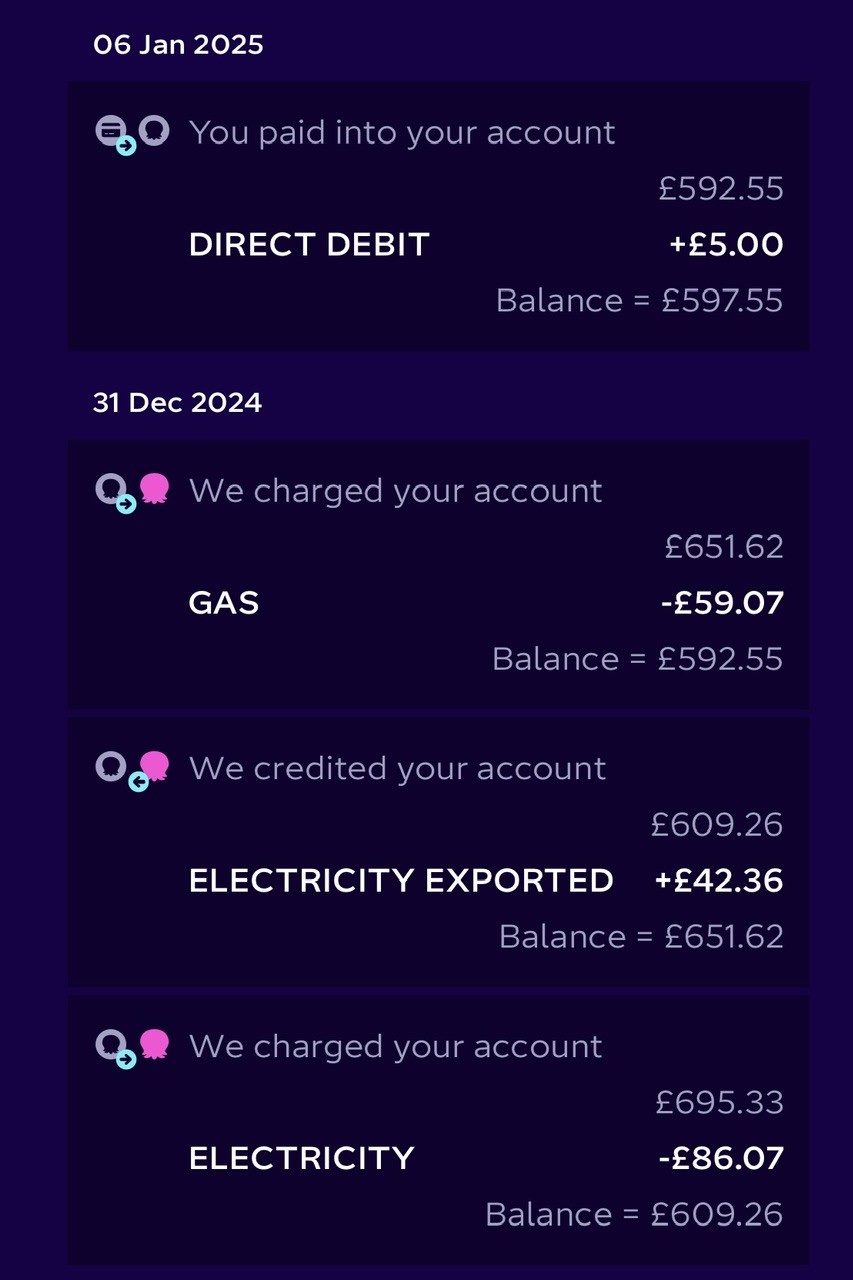
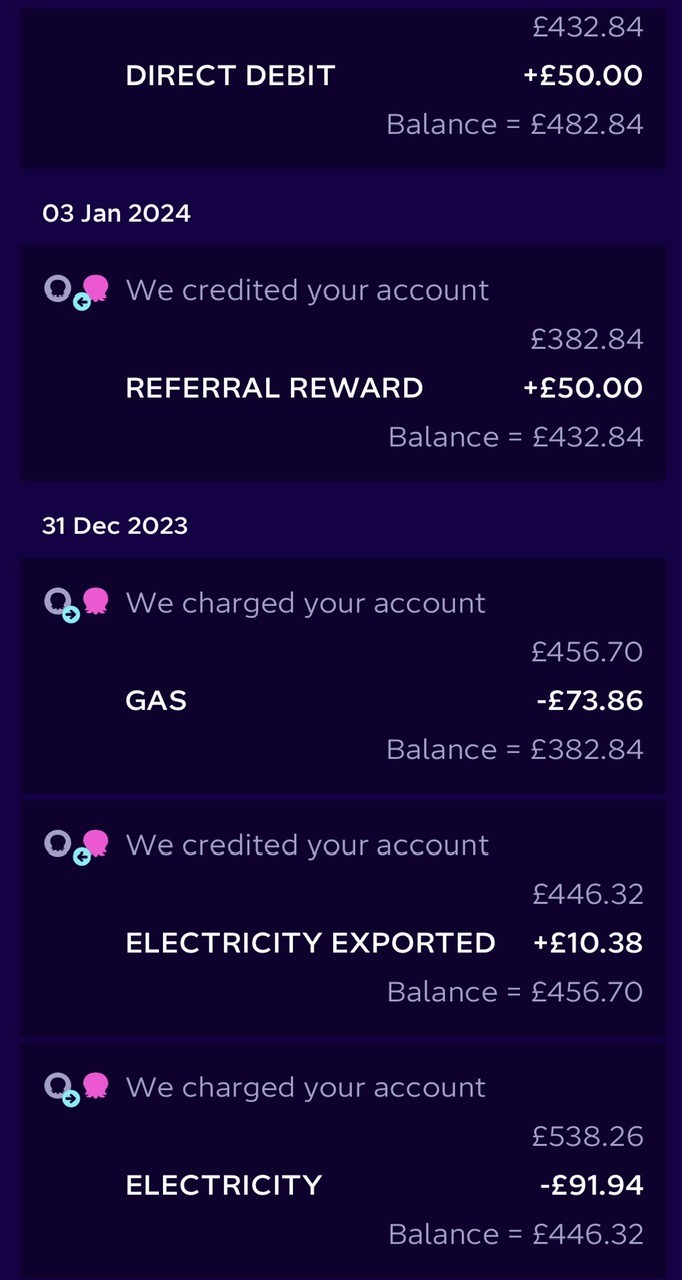
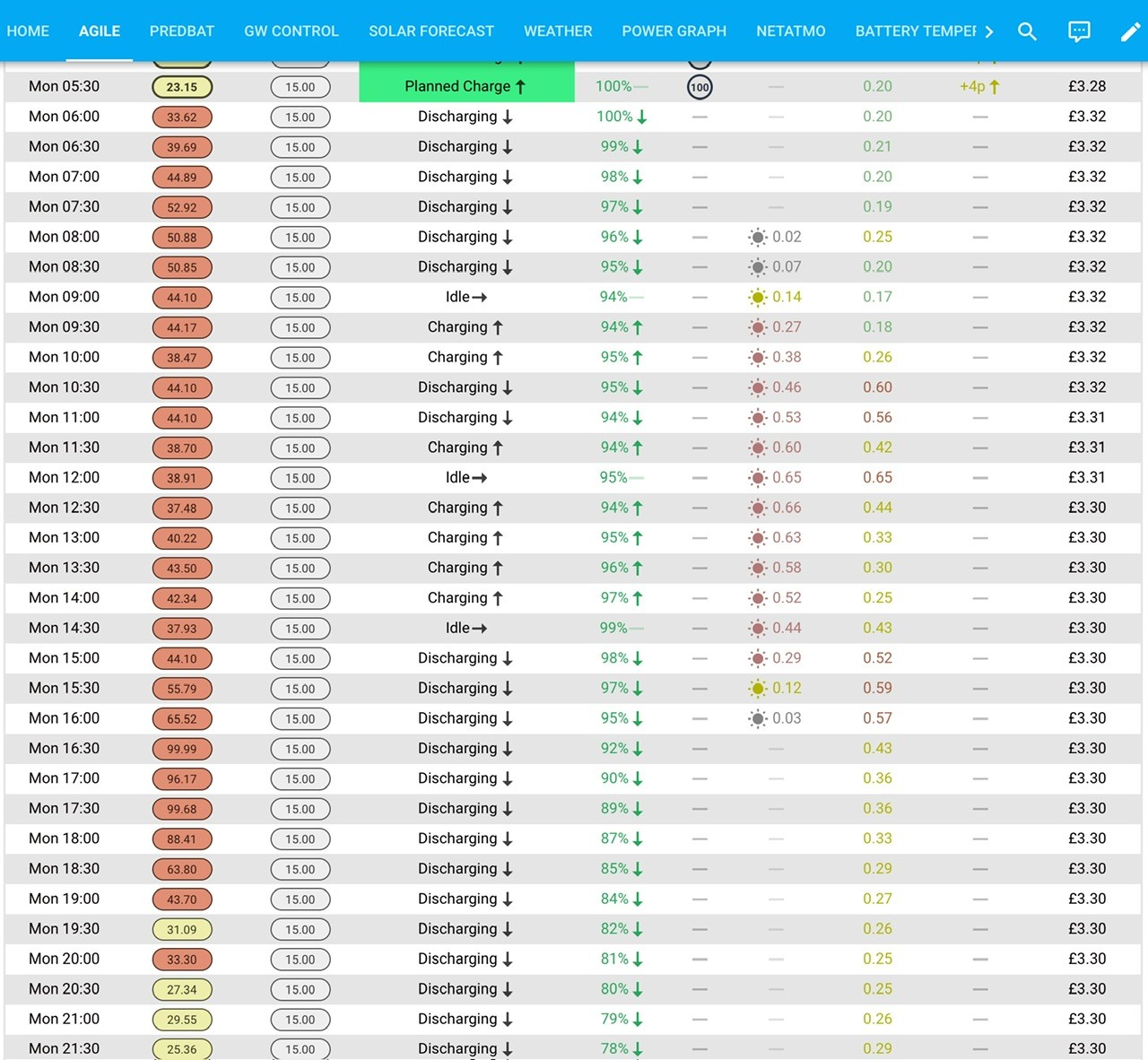
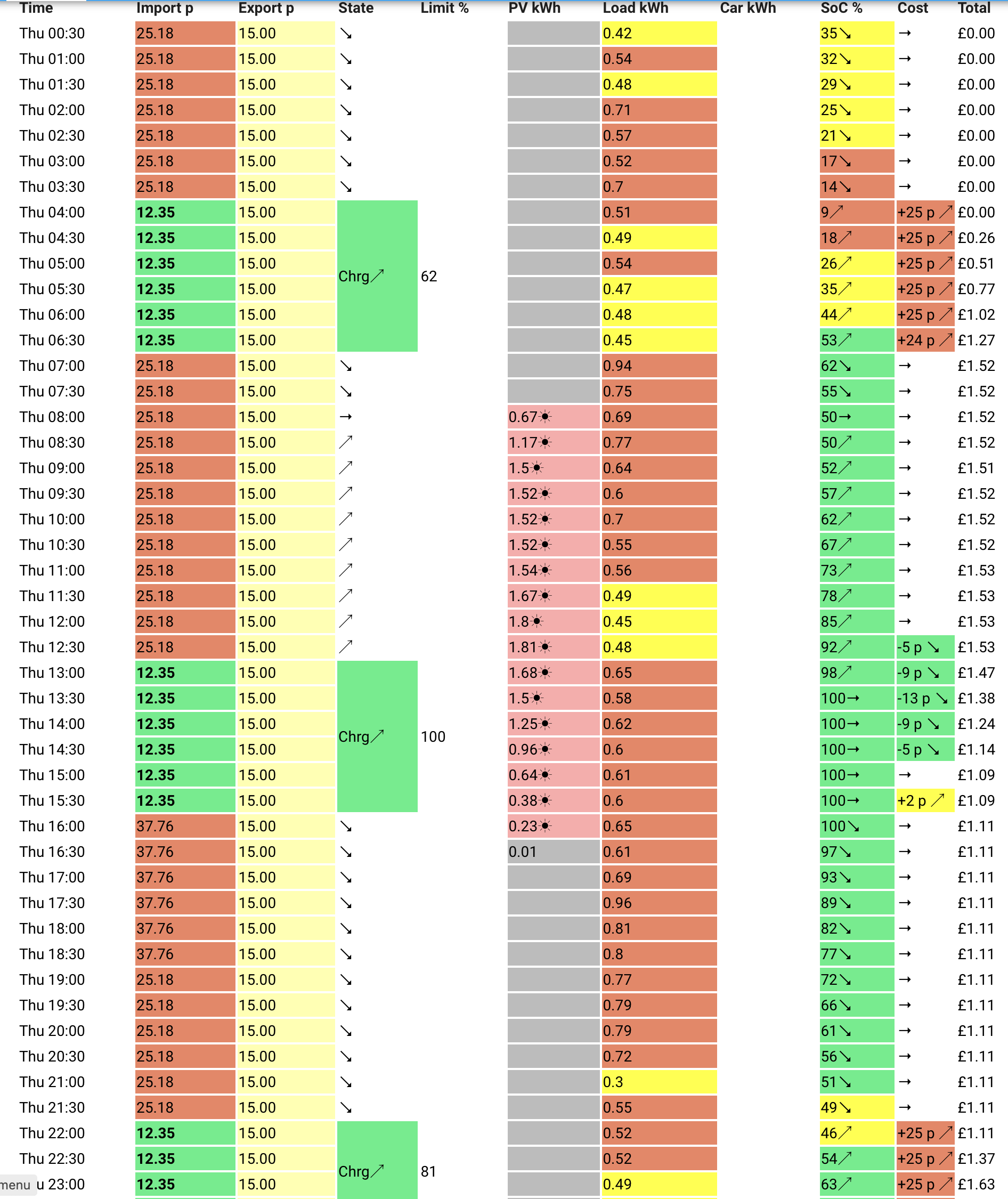
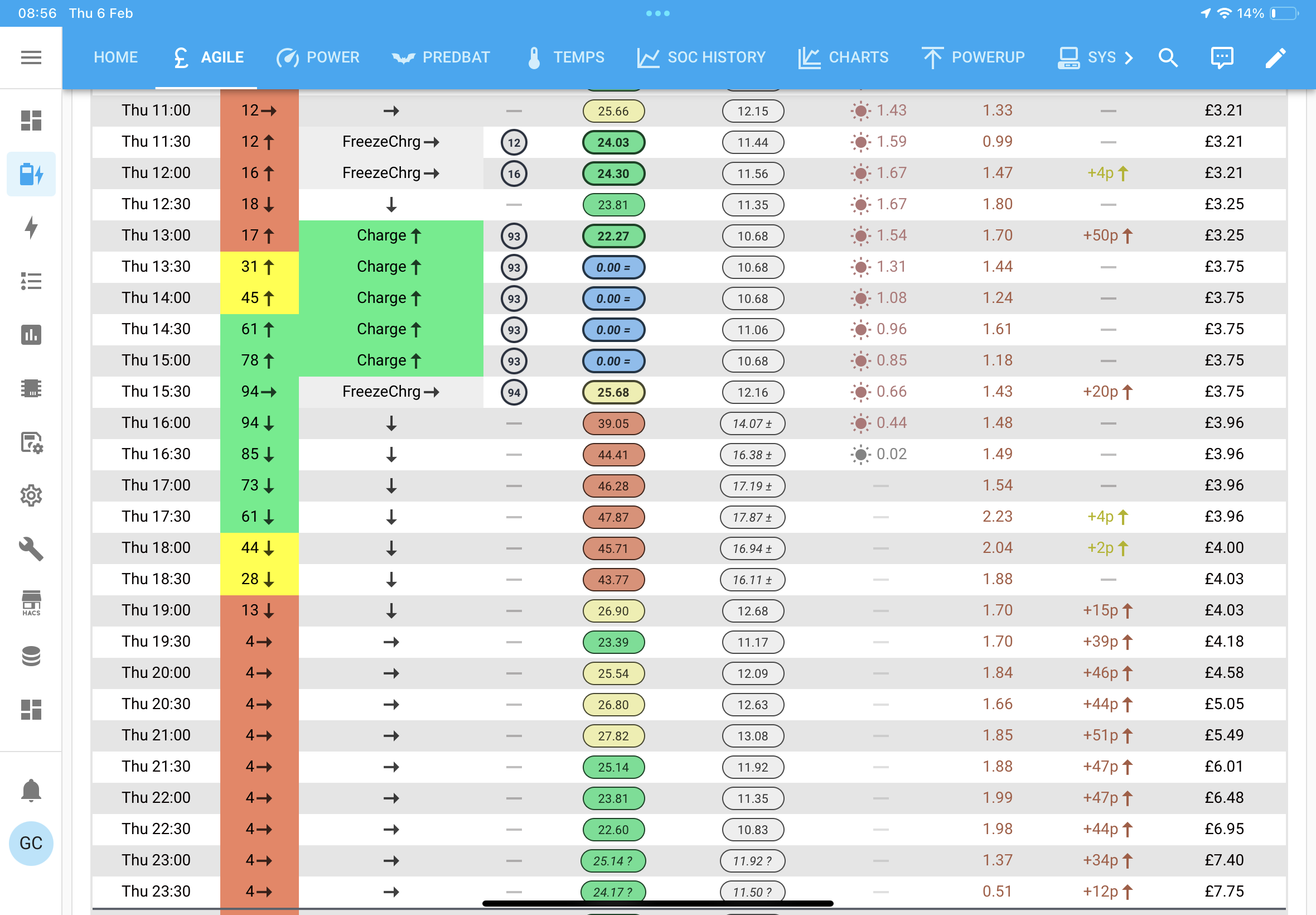
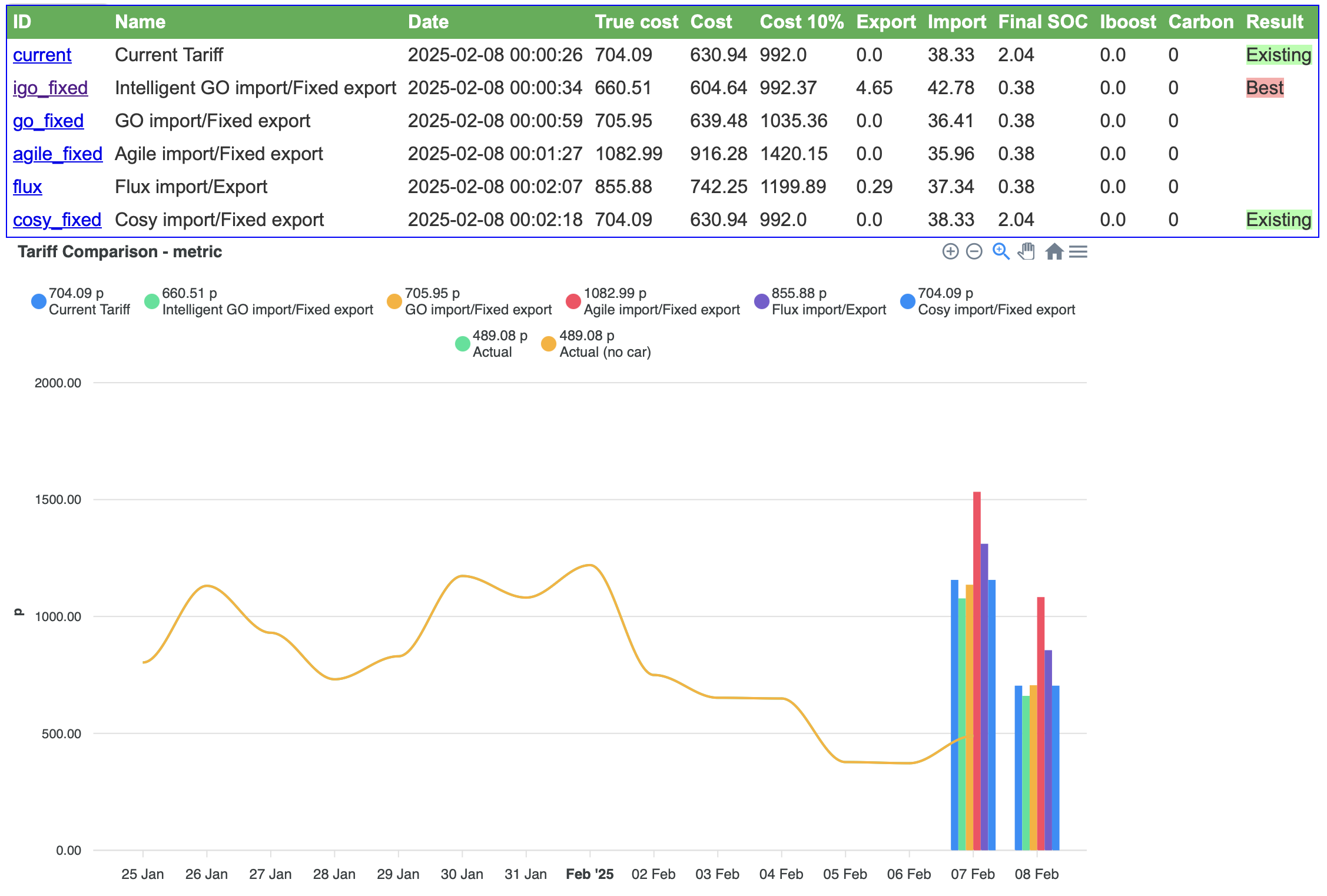
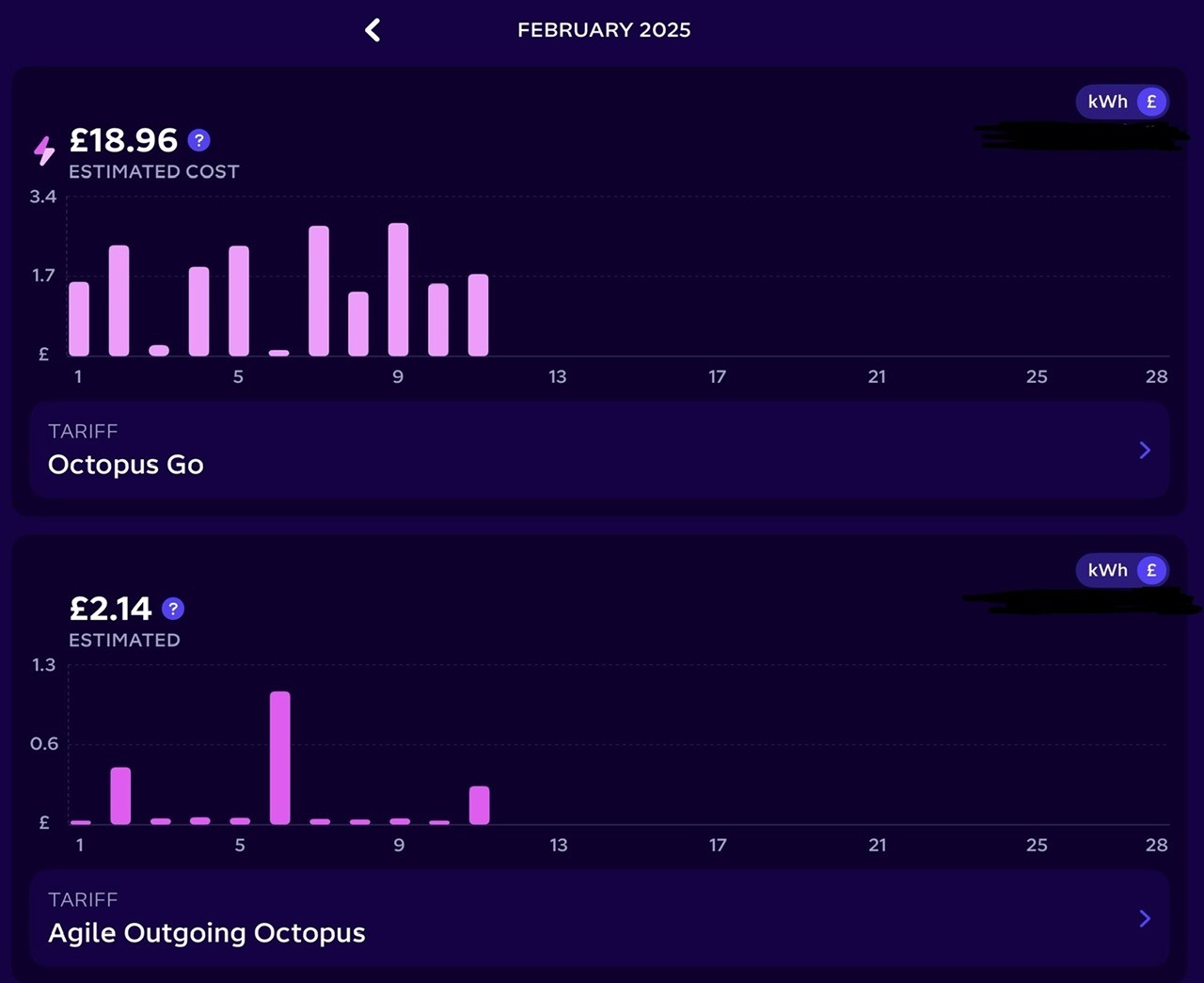
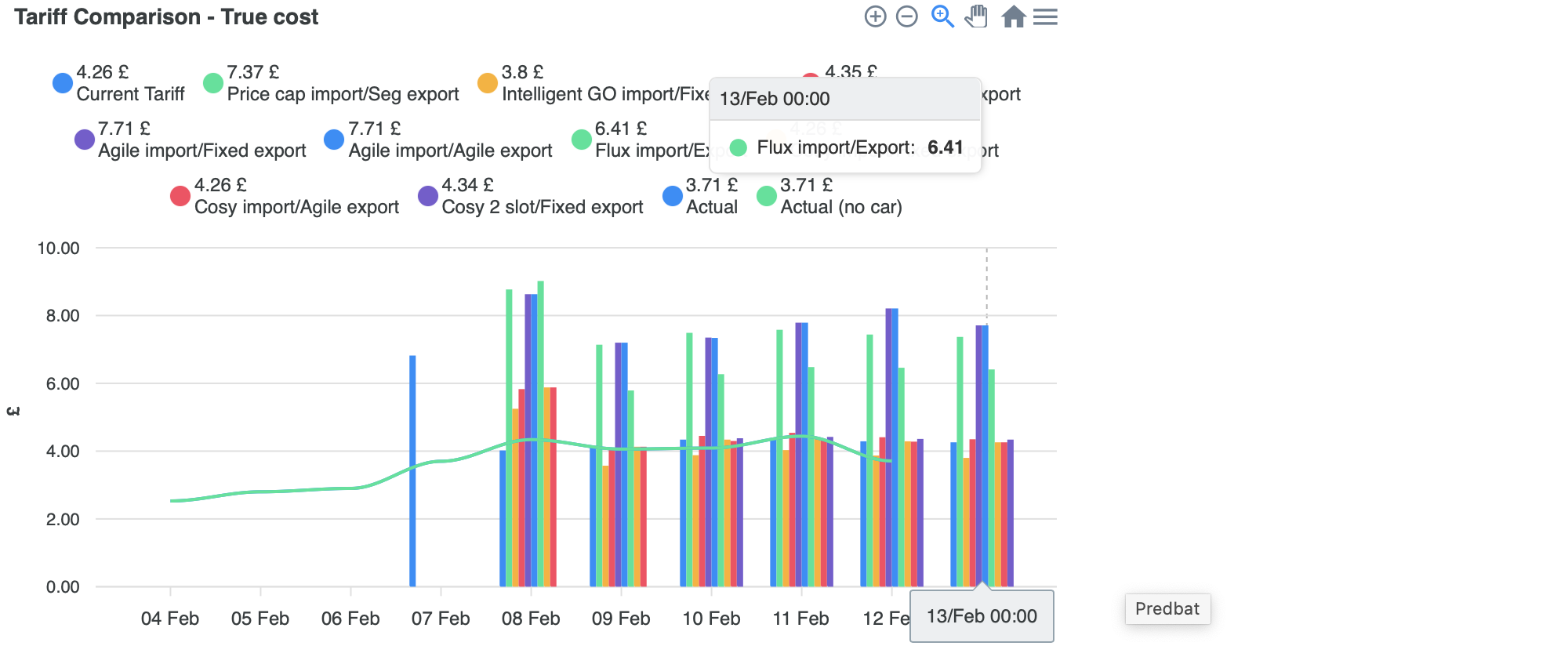
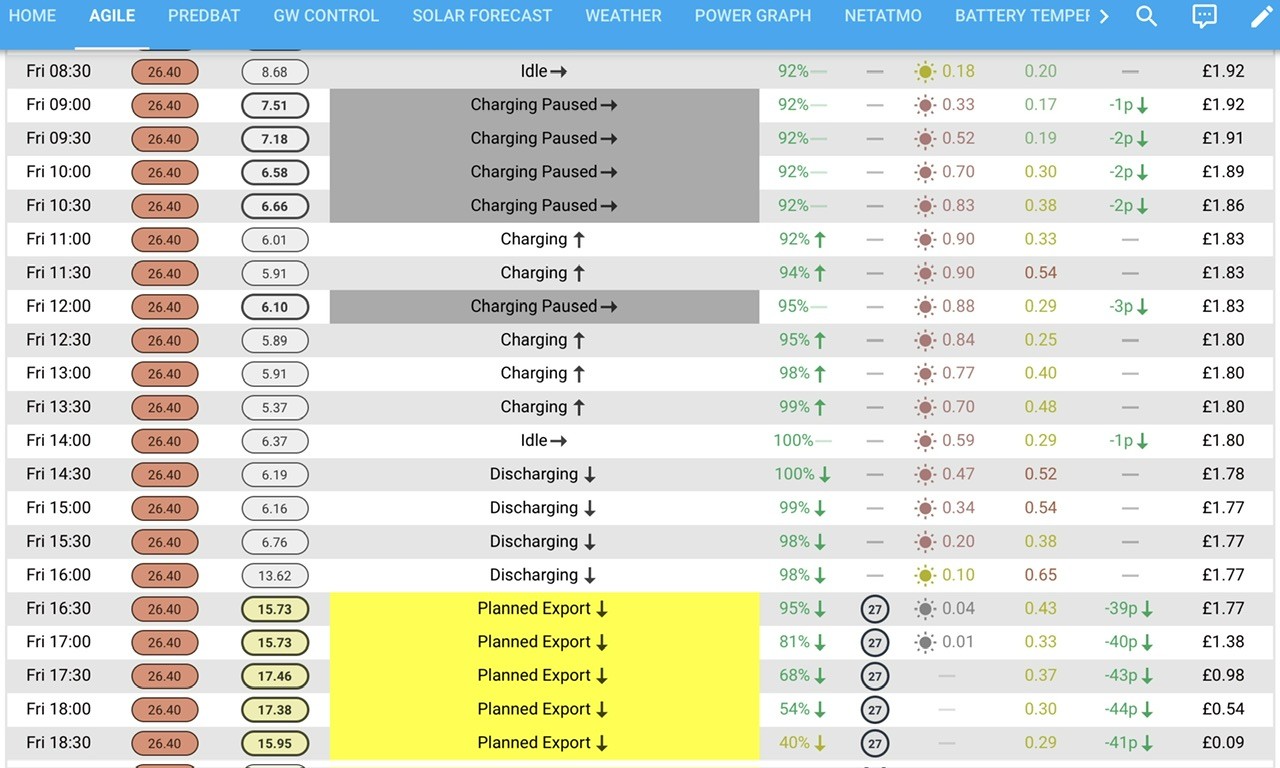
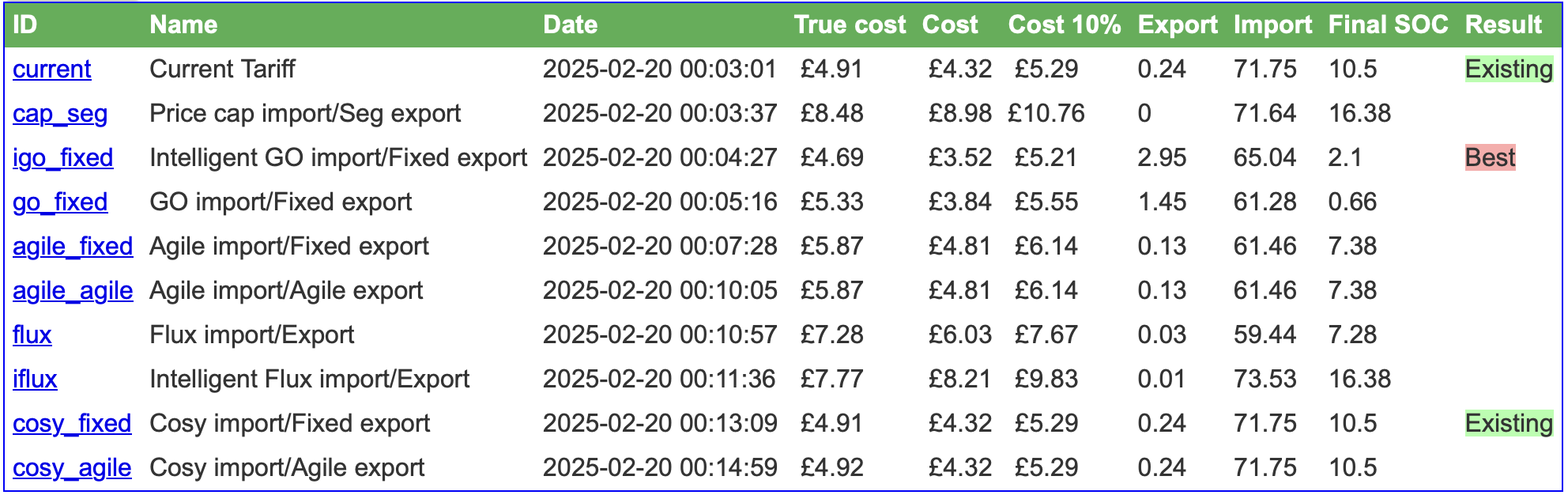
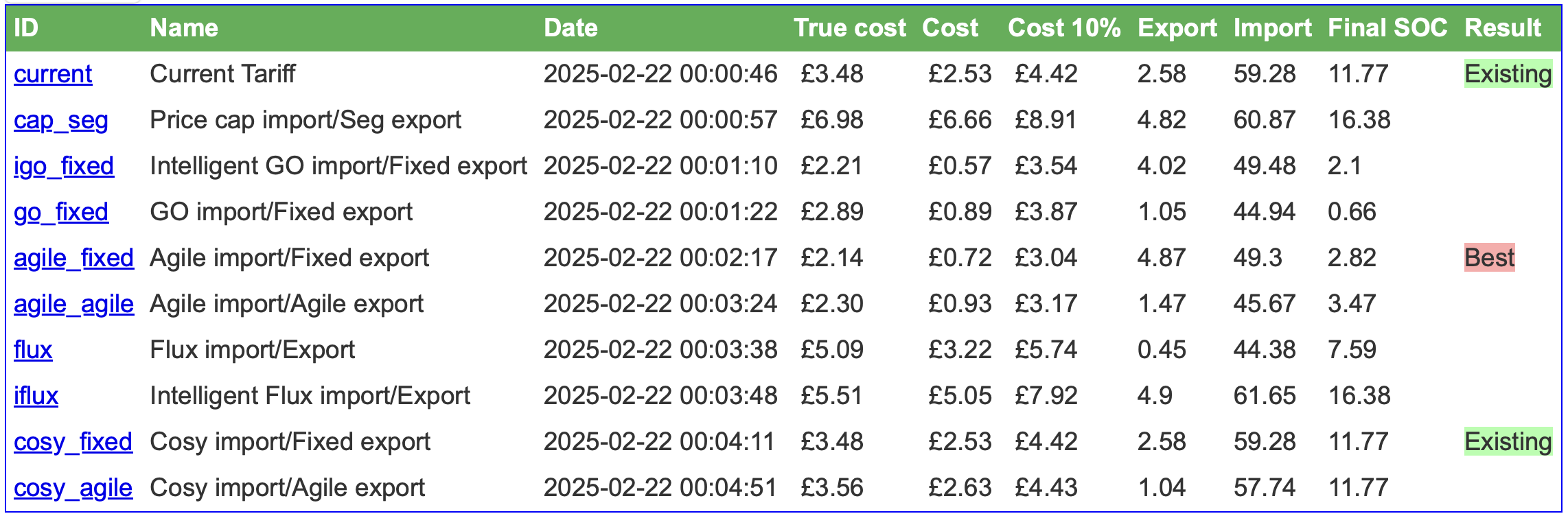
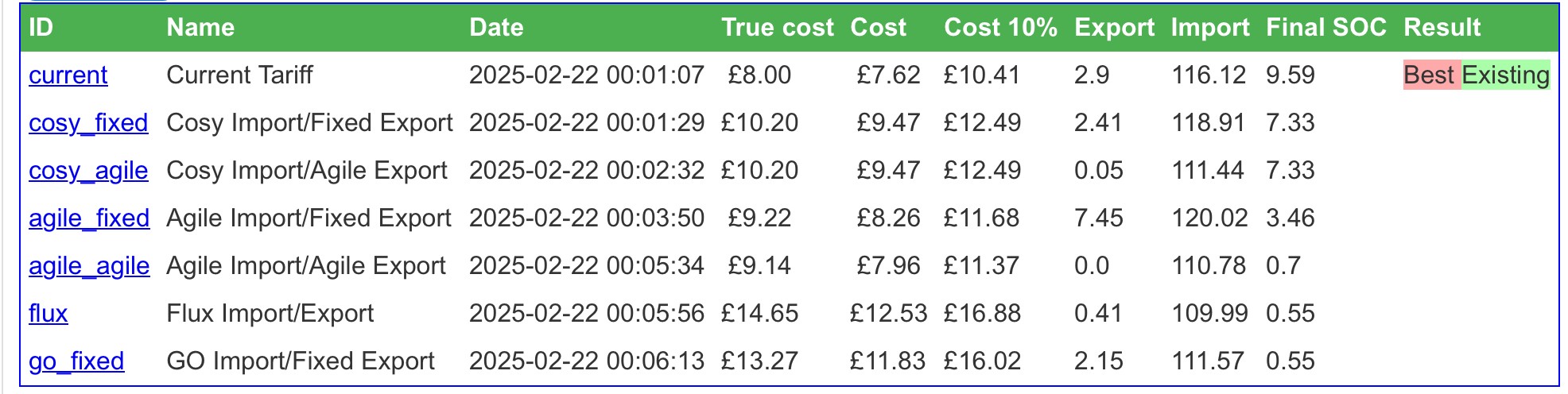
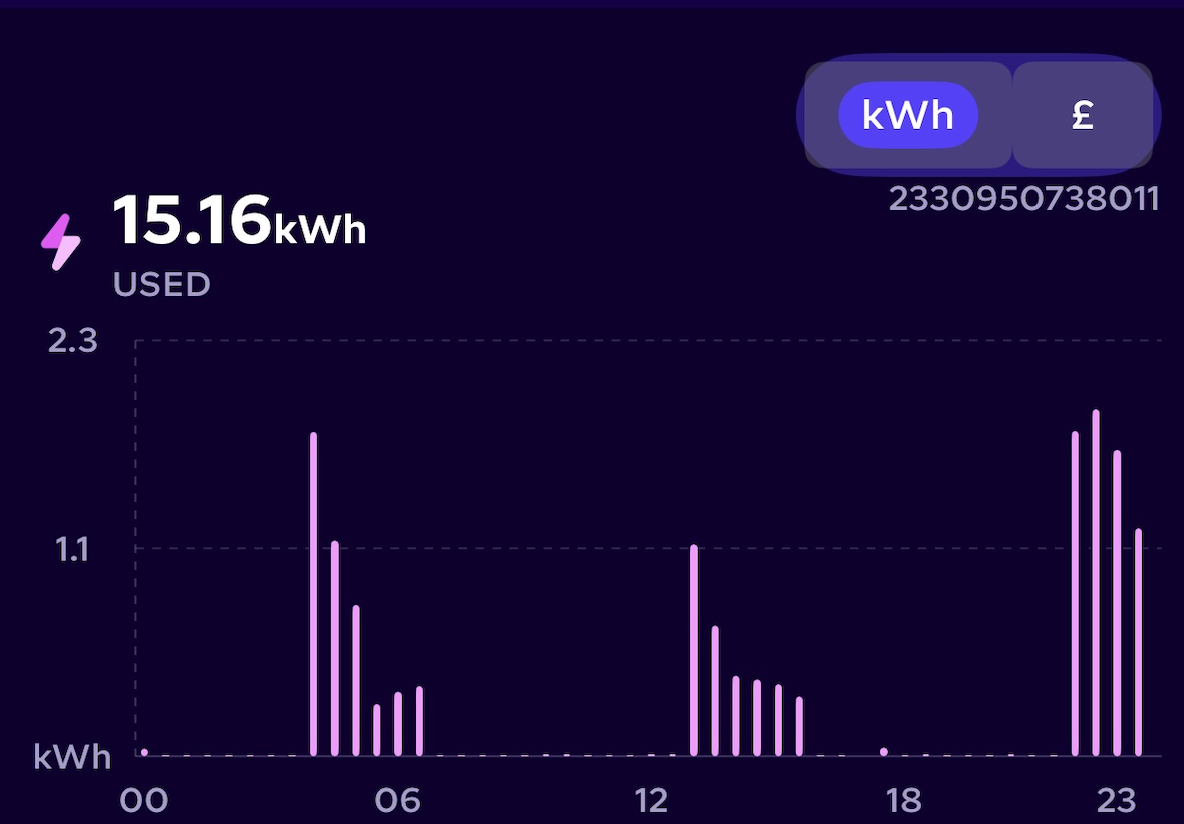
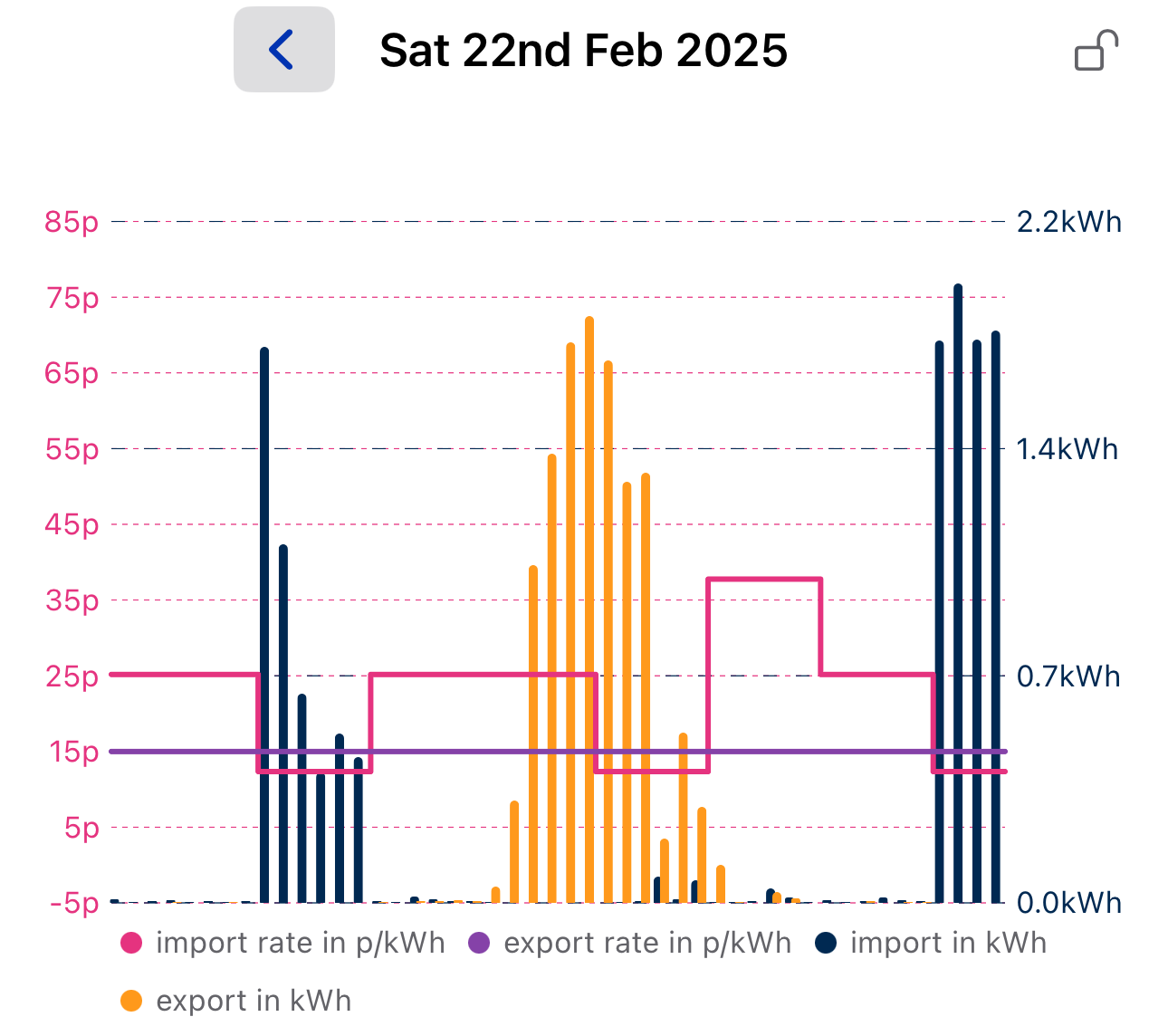
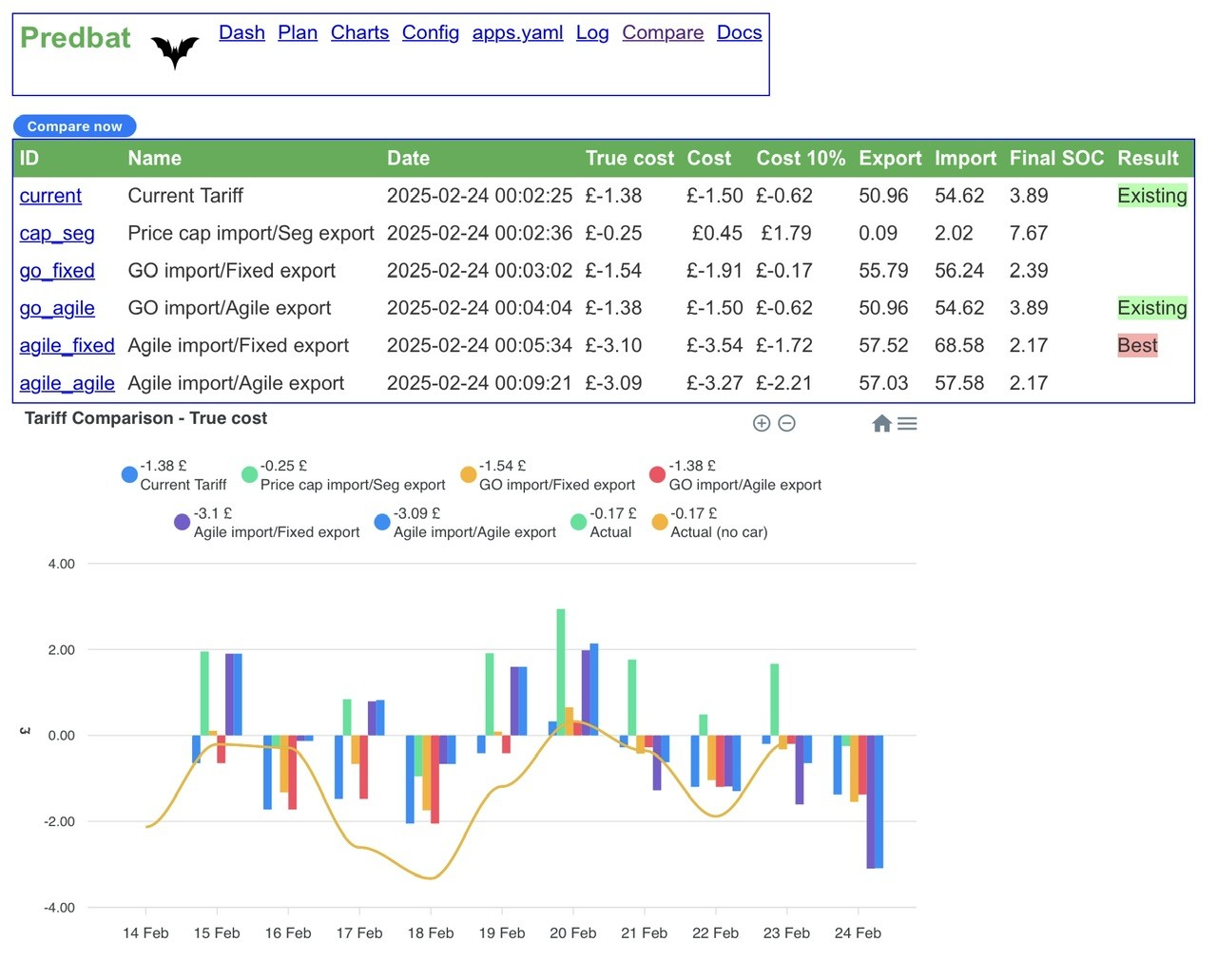
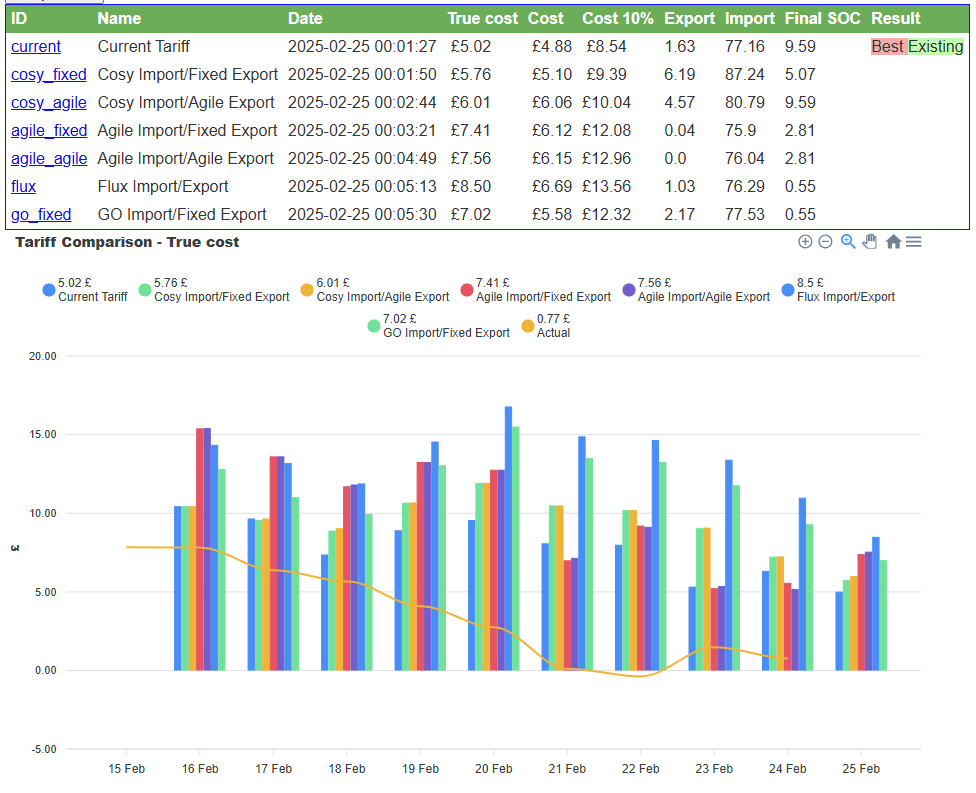
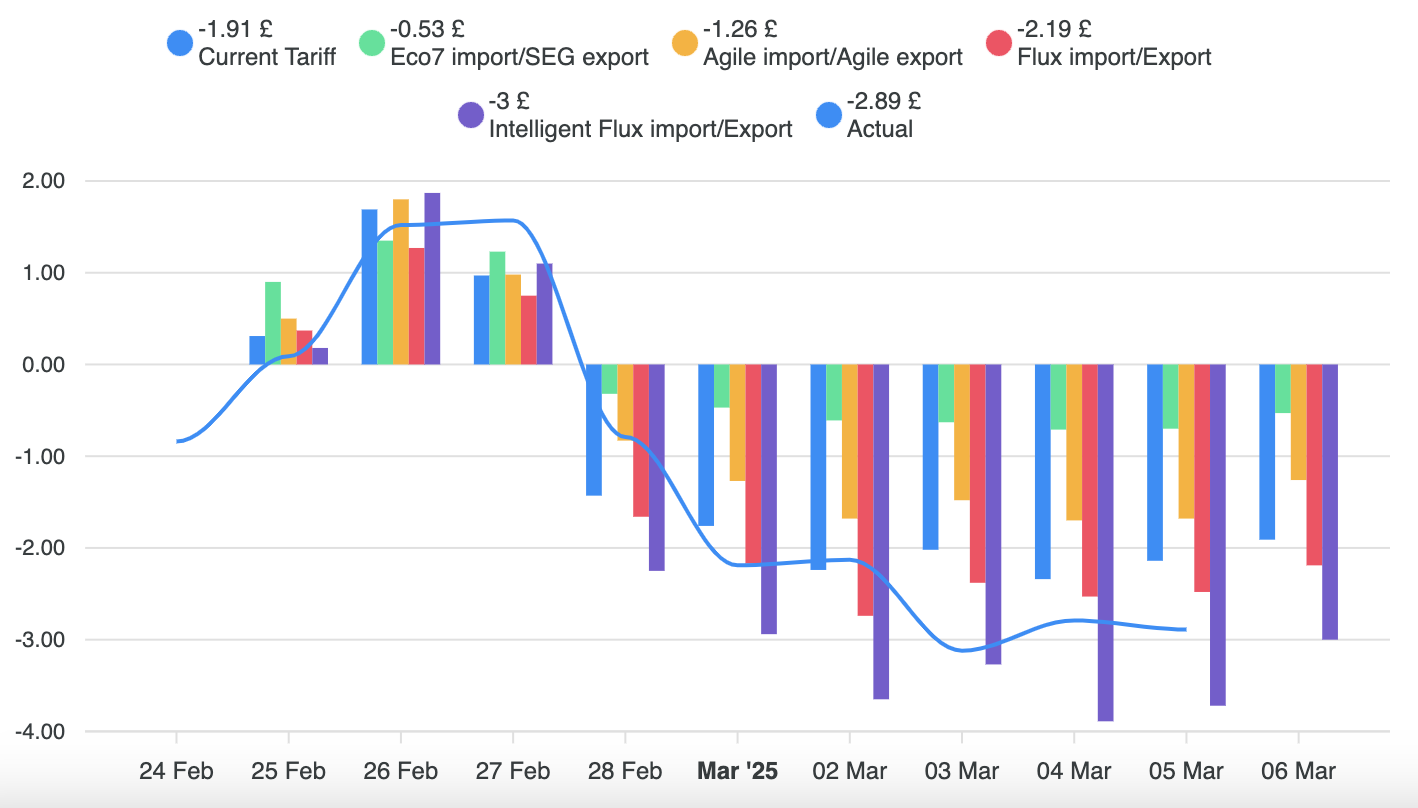
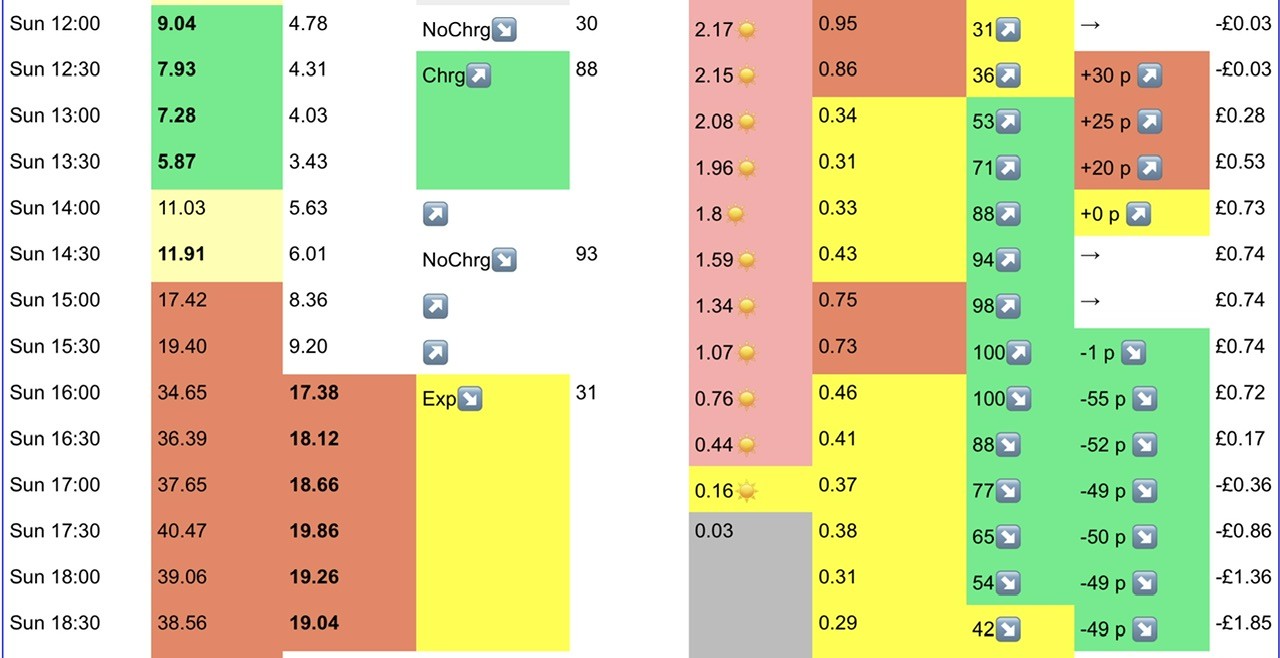
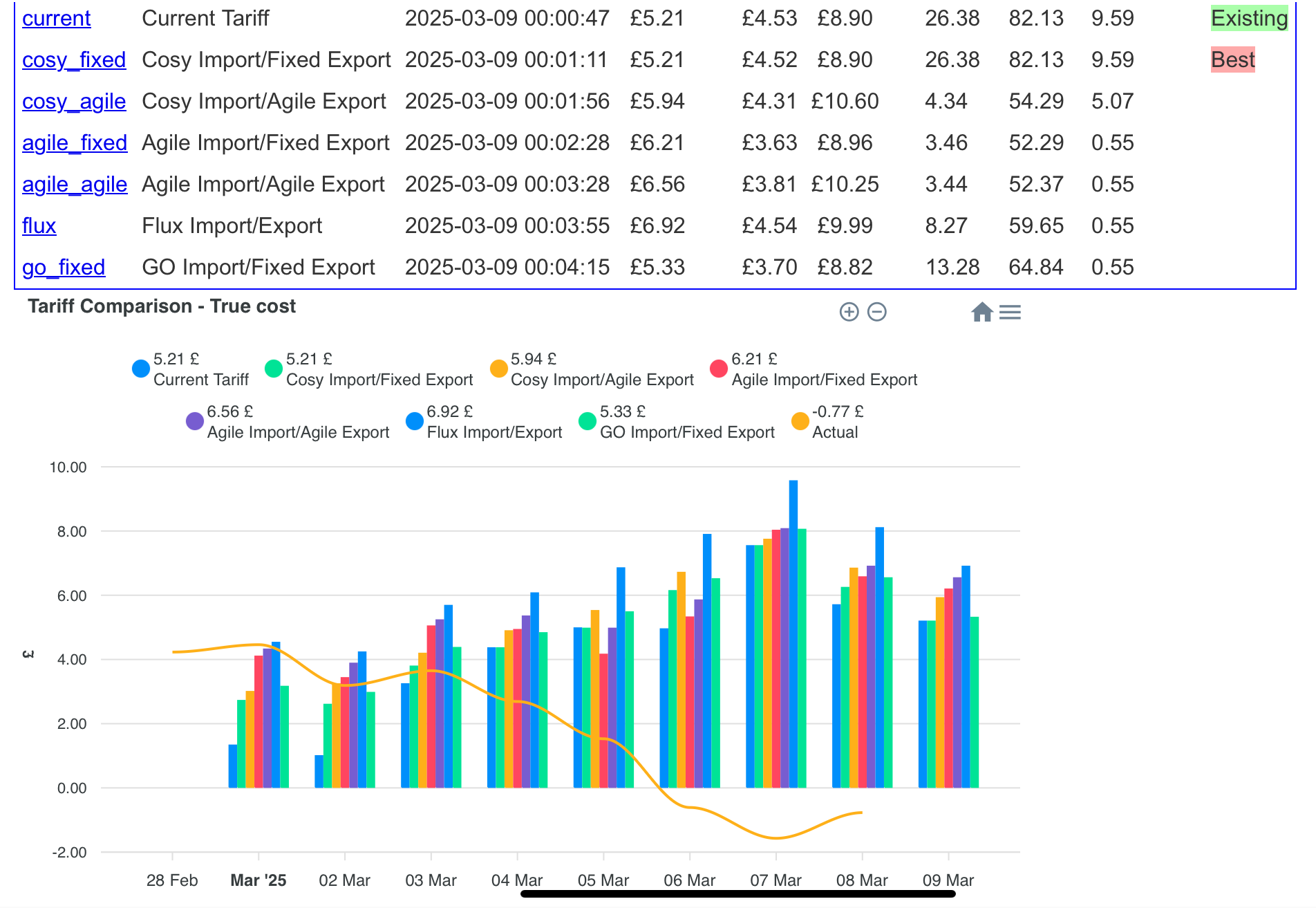
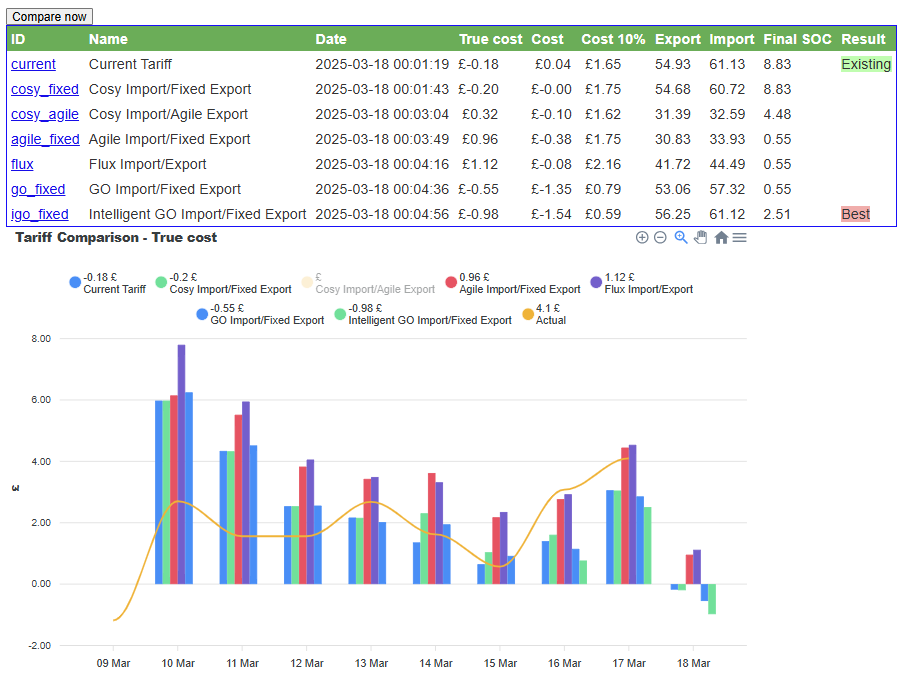
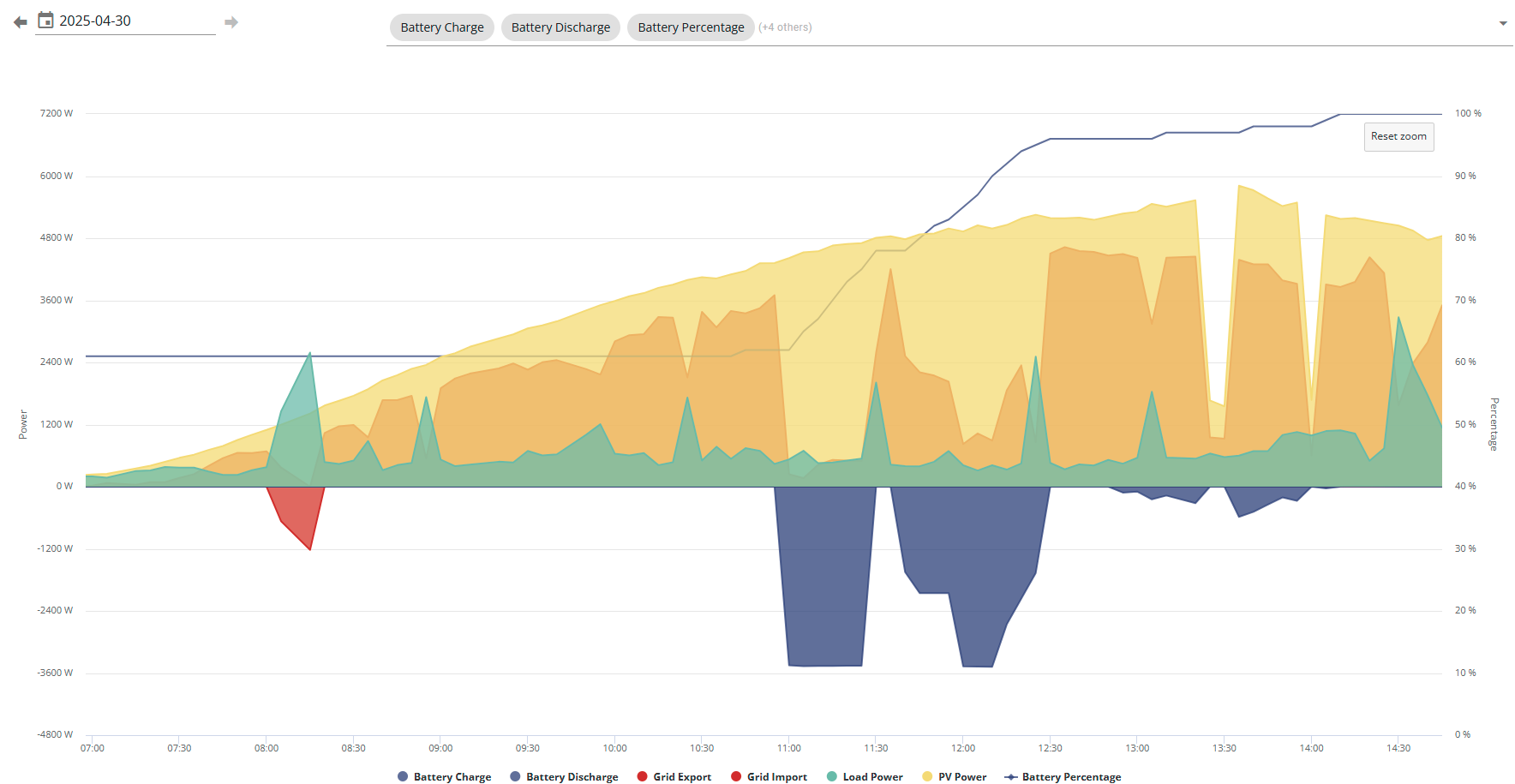
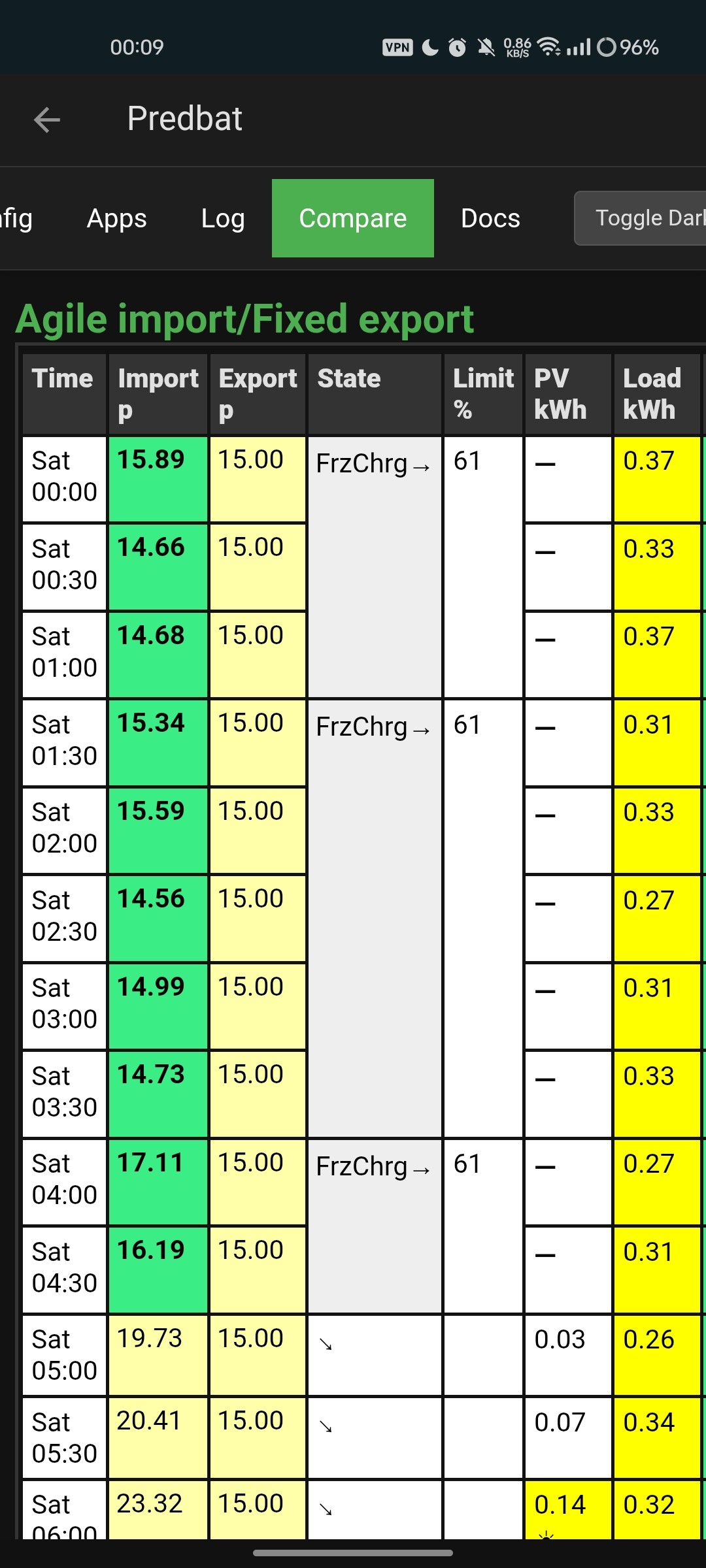
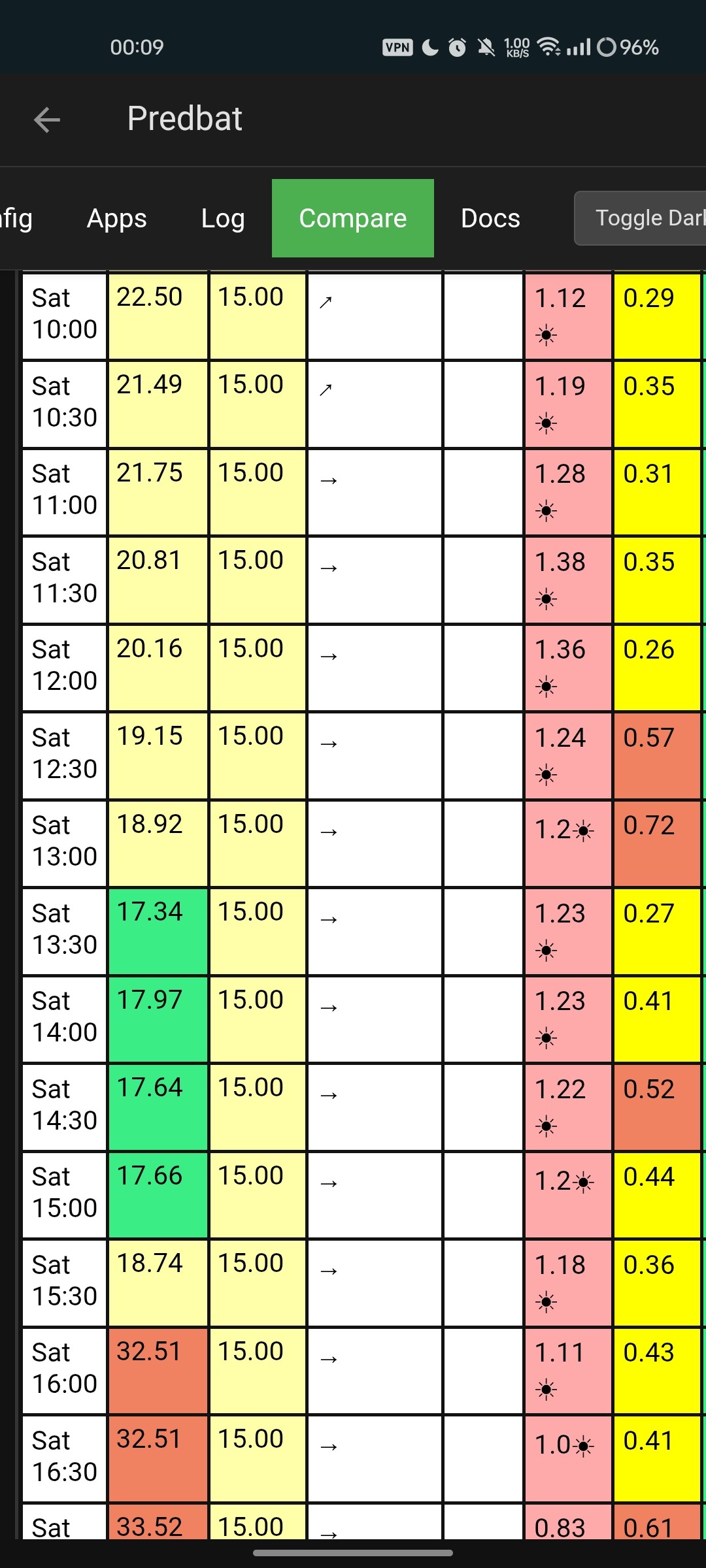
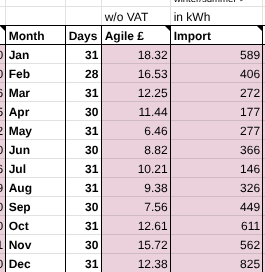
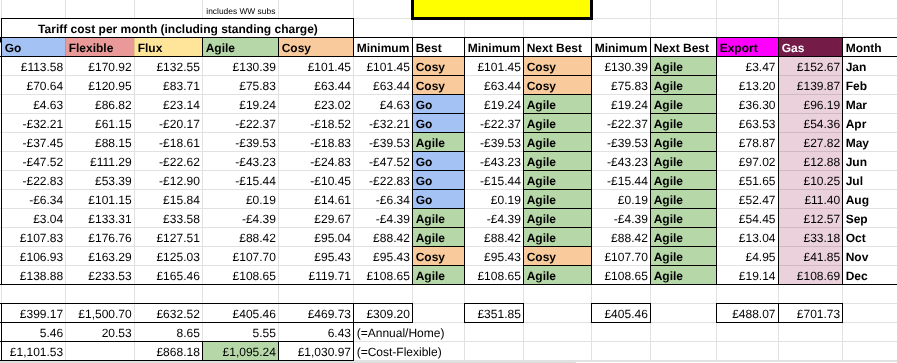
Attached is a Flux-Agile comparison for my usage yesterday. Note the screen shot doesn't show past 0330, except the day total costs.
Thoughts welcome please? Thanks.

Making the most of Octopus Agile
johnsherman are you sure you’re staying on flux for export? Thought you had to be on flux import to use the flux export tariff
https://octopus.energy/help-and-faqs/articles/which-export-tariff-can-i-combine-with-my-import-tariff/
Avenir
I did wonder about that but it's showing in my Octo account....


Nice, don’t change it in summer!
Flux will stay but you shouldn't be on it, ive heard on another forum some folks getting bills adjusted, I switched to agile outgoing just incase it did cause a problem for me, only time I export is during saving session and daylight goes way before 4pm hits.
Id love to get it sorted in Home Assistant to automate charge slots but I tried for days to get something working but im not sure if im just confusing myself on some stages or just doing something plain wrong I just gave up.
you should use octopus R&D to charge it at the best times.
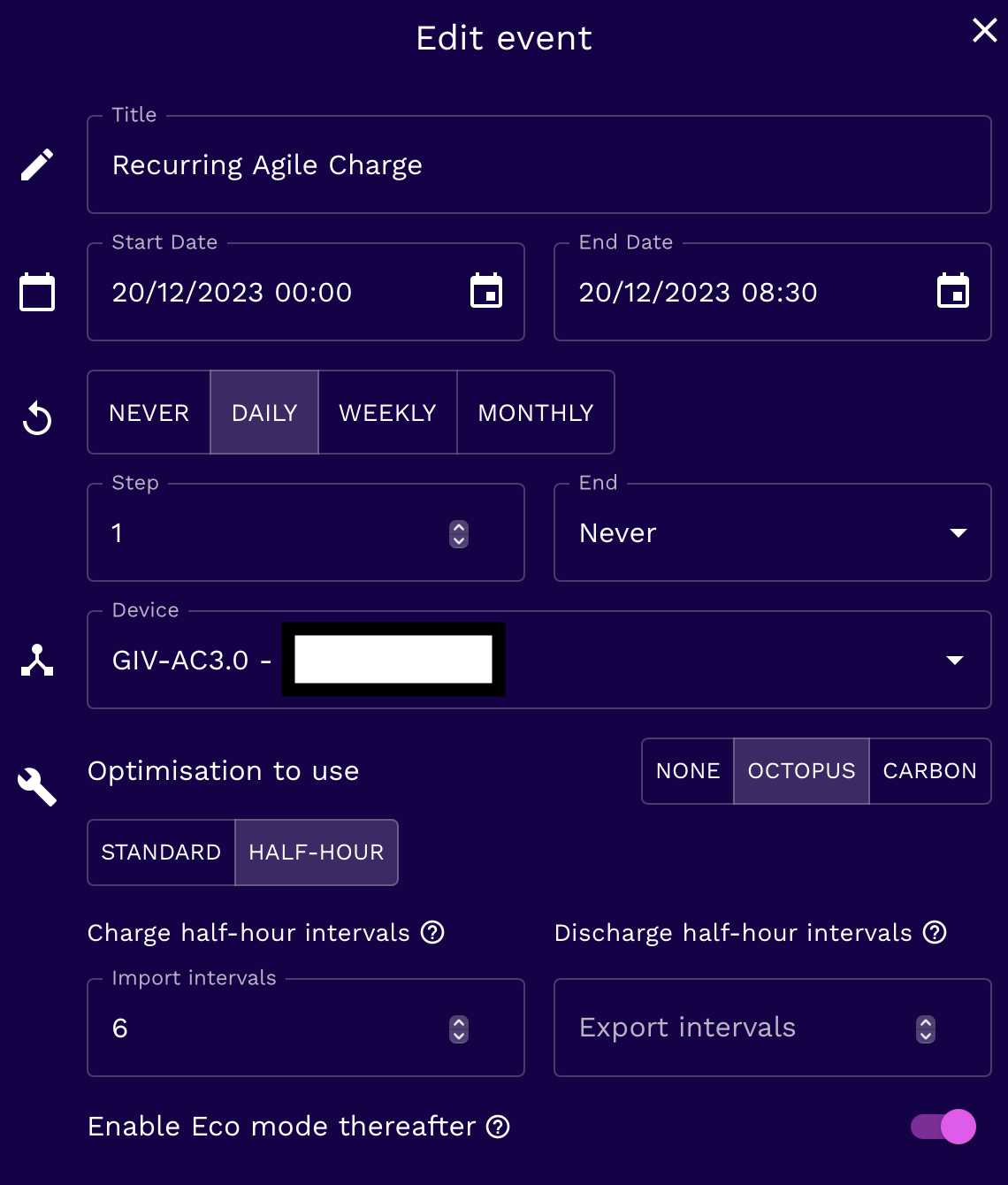
I have a recurring schedule setup in R&D from 00:00 to 08:30 each day (it seems they are mostly the best times, the 22:30-00:00 window is also sometimes good but Octopus won't let you set up a schedule over 2 days so it can't be used as automatically as you want). I have 9.5 battery so I set it up to choose the 6 best half hour slots within that time window I just mentioned. So far, bar 1 slot on 1 day, it charges the battery at the best-priced time from 00:00-06:30.
Your usage is pretty high though generally so not sure how much of a dent it'll make. My flux average was £0.21/kWh, so far on Agile since 24/11/23 my average is £0.16/kWh - but I am only really charging the battery from grid, not all day usage like you. A decent 20% saving for me though moving to agile for winter. Should have done it earlier...
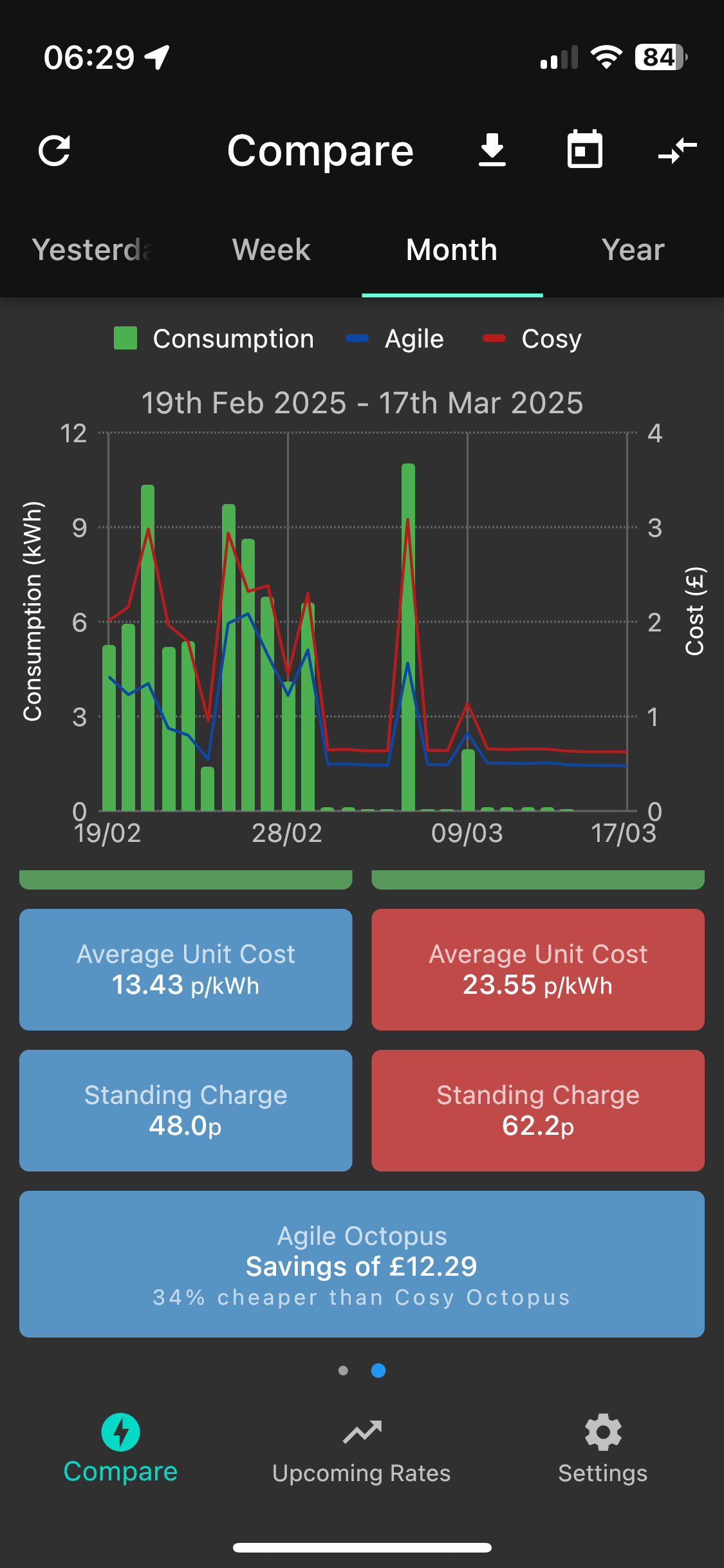
Obviously though you're seeing a huge win generally... £14.93 in a day down to £6.11 is HUGE. You've selected a pretty good price day to compare here though, your lowest prices were about £0.05 which in my experience is rare. Sometimes the lowest price is £0.18. Check the week and month tabs to see if generally you are still saving.
Thanks all.
Rather than use R&D, or HA I'm giving https://myenergyoptimiser.co.uk/ a try. So far really good.
Saw it on Gary does Solar - https://youtu.be/Nmk7M156_PE?si=QyW3e7fnzMD-Q7Nw
johnsherman it will show up but they will mess up your billing and give you a bare minimum for export and at worst case can even charge your export as your import and bill you accordingly (happened to me so i know, had to get a refund of 9.** and get a -9.** added to my bill, huge hassle... avoid the confusion and email to seg@octopus.energy to get your tariff adjusted, don't leave it to them.
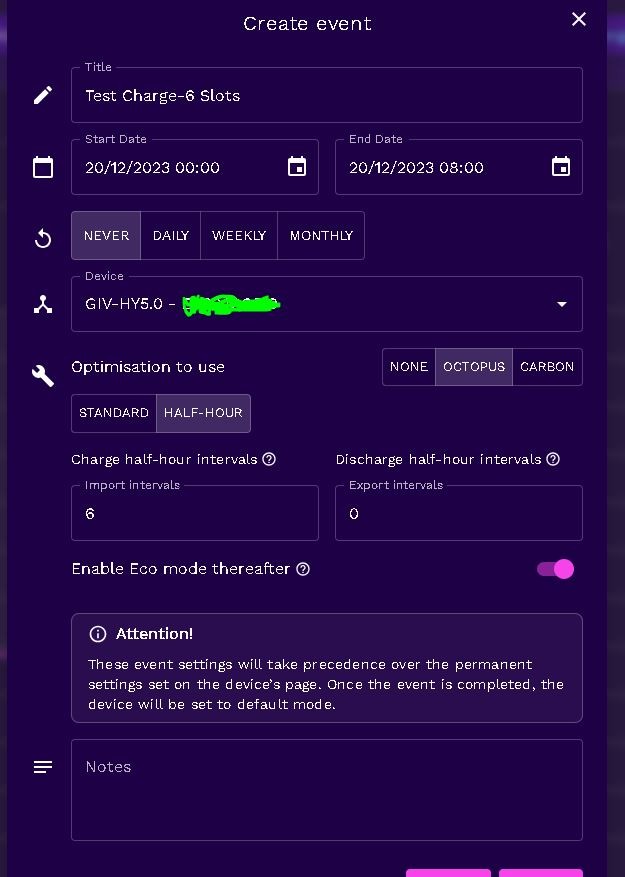
pacemaker Tried that on 2 occasions and it just doesn't work for me for some reason. It doesn't even attempt to change any settings or anything and there is nothing in History either. Set it up for charging at the 6 cheapest slots between 00:00 and 23:00 for a day and simply didn't do anything. Any hints and tips on how to make this work? All information (GiveE API and Octopus API) are already in the Octopus R&D website in my account. I will set it up again from 00:00 to 08:00 as attached to see what happens...does this look correct?
Avenir I am on IO for import and Agile for export. So I import at 7.5p 11:30 - 05:30 and export 16 - 25p 16:00 to 19:00.
Rogerbu Good for you 👍
hmm that's odd, it looks like mine as far as I can tell, just not recurring. In Octopus R&D, go into the devices list, into your givenergy system, check the History option, it might give you a clue... Edit see you've already checked that.
Here's mine (that's been working for a couple of weeks)

dorosde one thing I will say... when I had an internet outage last week, my recurring stuff didn't fire the next morning, even though my Internet was up and running at the time. I mention this because even though it tried to do it (I think), the history showed nothing, no errors, but also no attempts either.
Other thing you can check is that the device page is actually showing you information about your system - then you can be at least sure it's able to connect.
pacemaker yeah, i can see the system and the graphs and everything is connected... its just the schedule that doesn't kick in. I will give it another go as per the previous post and see how it goes. Do you have the givE portal charge timers on as well or you fully disabled that? which takes action first if there is conflict? If that doesn't work again I will generate a fresh API from GivE and give it another go...
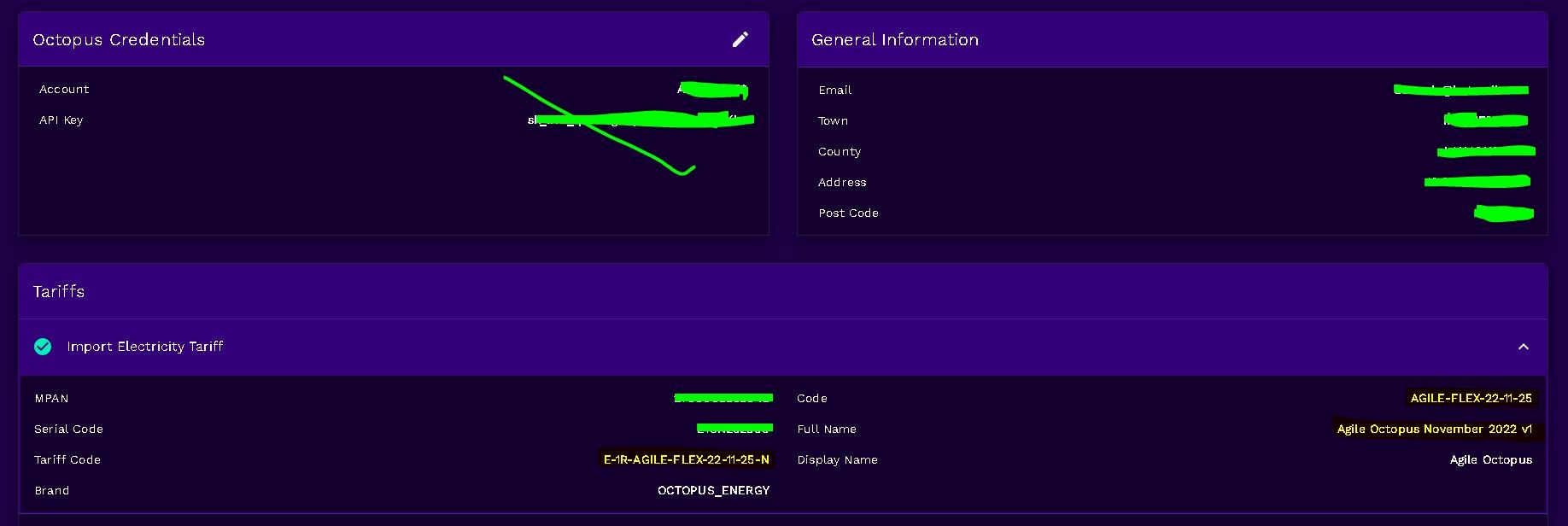
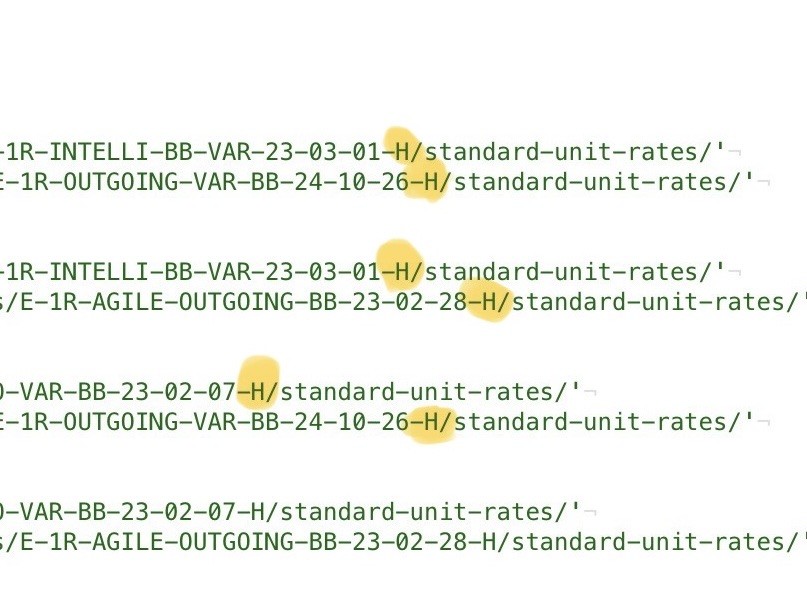
pacemaker I think i found the problem: As i setup R&D before going to Agile it was still thinking that i was on fixed tarrif, so that's why it wasn't doing anything. I regenerated a new API from Octopus and now it updated correctly! The highlighted in yellow wasn't updated after moved to Agile!
dorosde ah that'll do it!
Hope it works for you, tonight is super cheap!
To answer your Q, my settings are ECO mode on, everything else is disabled.
pacemaker will do the same! Will just leave ECO on! Yeah it’s super cheap when it’s windy!
pacemaker And voila! Everything worked as expected! Set it to select the 6 cheapest slots from 00:00 to 23:00, it did exactly that. It had chosen 5 slots in the morning and there is another one for 22:30 at 2p/kwh, so I am expecting that to be the 6th slot for the day and will be repeating that for the next few days. As solar is getting a bit better over the next few months or so I will be reducing the no of charge slots to suit!
dorosde nice!! yeah the only downside of having a recurring "all day" window to choose from means you can't add any other events (like additional timed charge or discharge) over the top, which is kind of annoying. So I've opted to chop the window at 08:30 and I'll manually add any one-off good slots late at night
What kind of prices are you getting on agile? I'm on flux at the moment. Wondering if I should change for the next few months.
pacemaker but i can still do that manually from GivE portal isn't if needed?

deepanshus
Can you elaborate? Did " Myenenergy optimiser" mess up your tariff data after you'd set everything up with your API etc?
dorosde yeah you can
I'm currently seeing 22% saving on agile compared to Flux, based on how I import. On flux I was charging 2-5am on the cheapest rate, on agile I charge whenever its cheapest within the 00:00-08:30 window (my choice on that timing, it just seems to be when the cheapest agile rates are other than sometimes at 22:30-23:30). On both tariffs I am charging for 3 hours in the night and seeing significant savings. Last night the average price was 4.7p/kWh which is waaaay below flux prices (my average for 2023 on flux was 21p/kWh)
That said there are times agile is at or slightly over the flux prices, even at its cheapest. I've been on it since 24/11 and seeing 22% saving compared to Flux, my only regret is not moving to it a month or so earlier
you can compare your costs on the Octopus Compare app with agile and see how your usage might benefit.
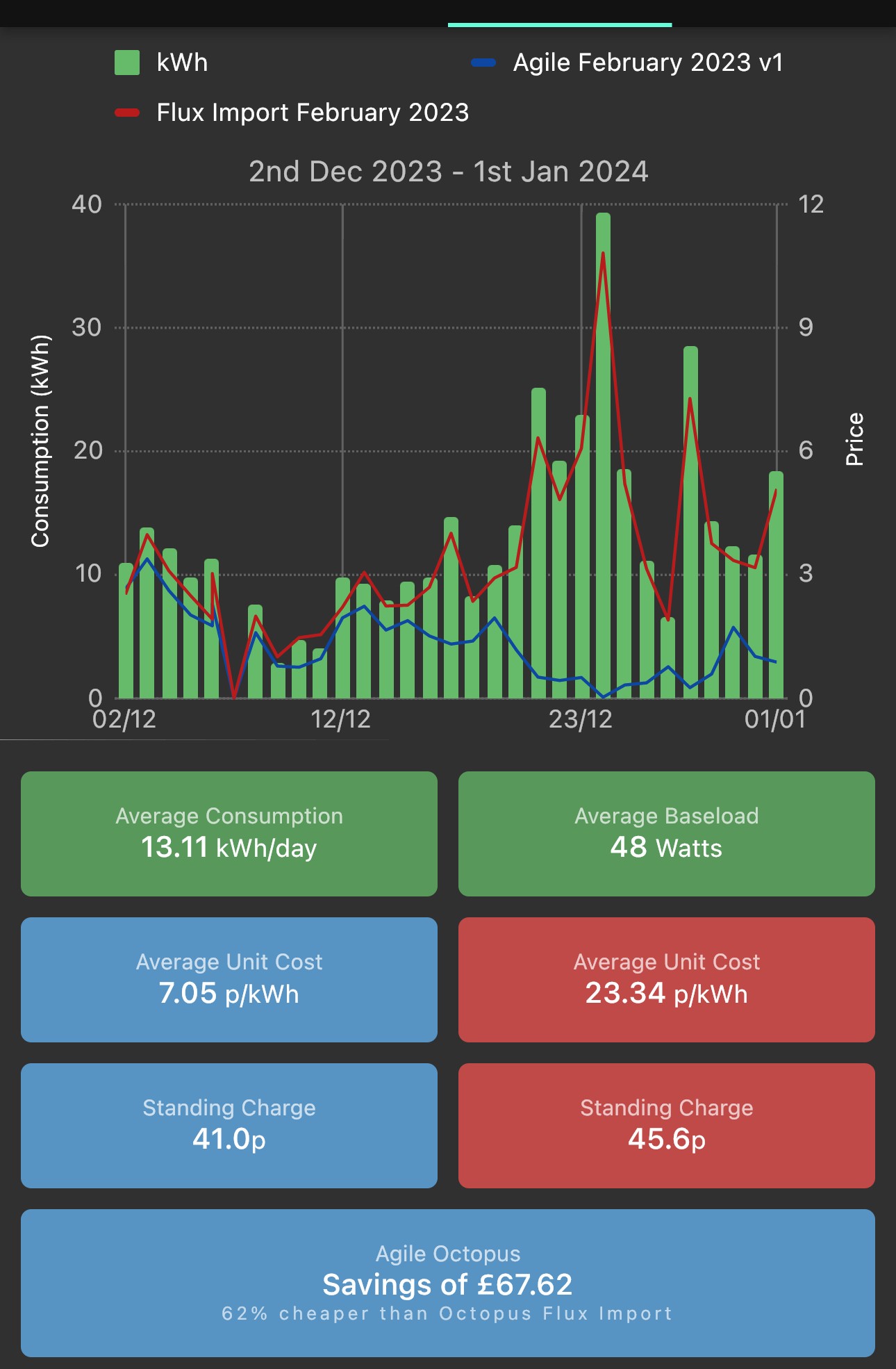
Here'a snapshot of yesterday on agile vs flux... 63% cheaper! Granted it was a cheap day, but for import only (without EV/ASHP, but with battery) it's a no brainer. Last night (this morning actually), it was negative pricing, they're paying me to use their kWh!

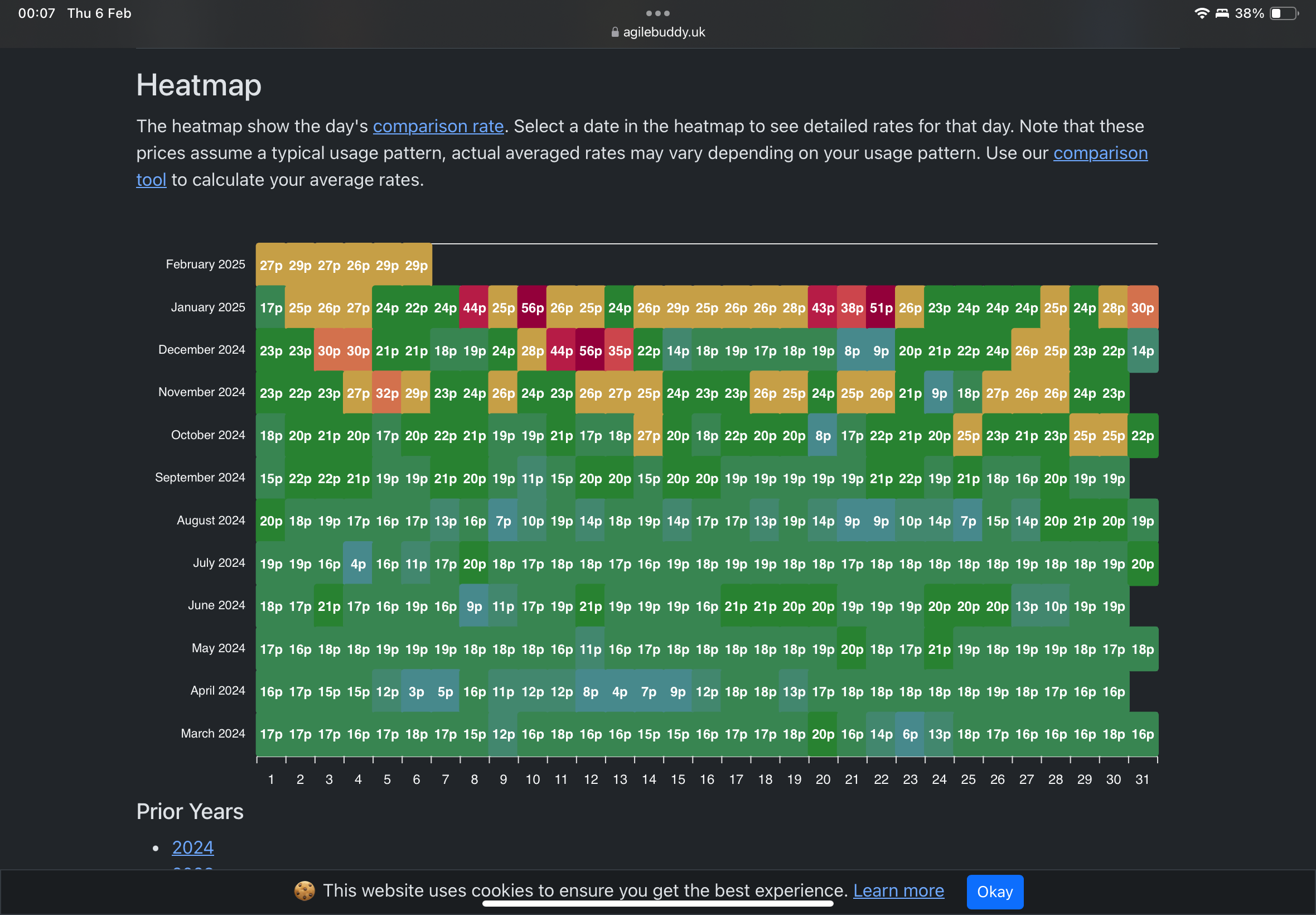
Perhaps a fairer test is to look over a longer period, rather than cherry-picking.
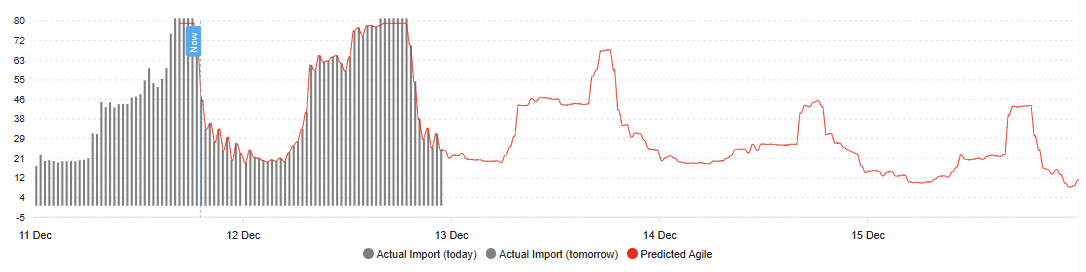
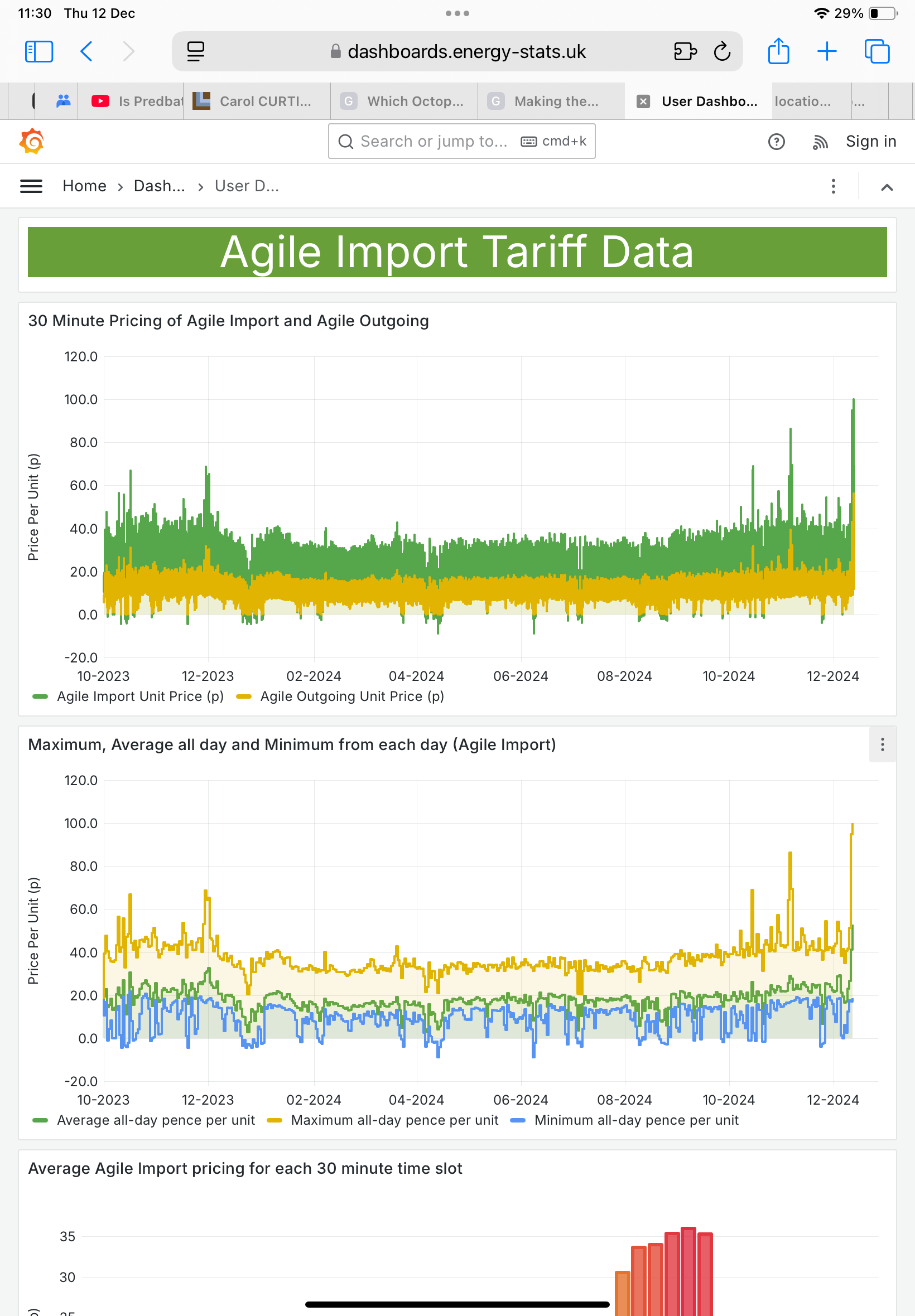
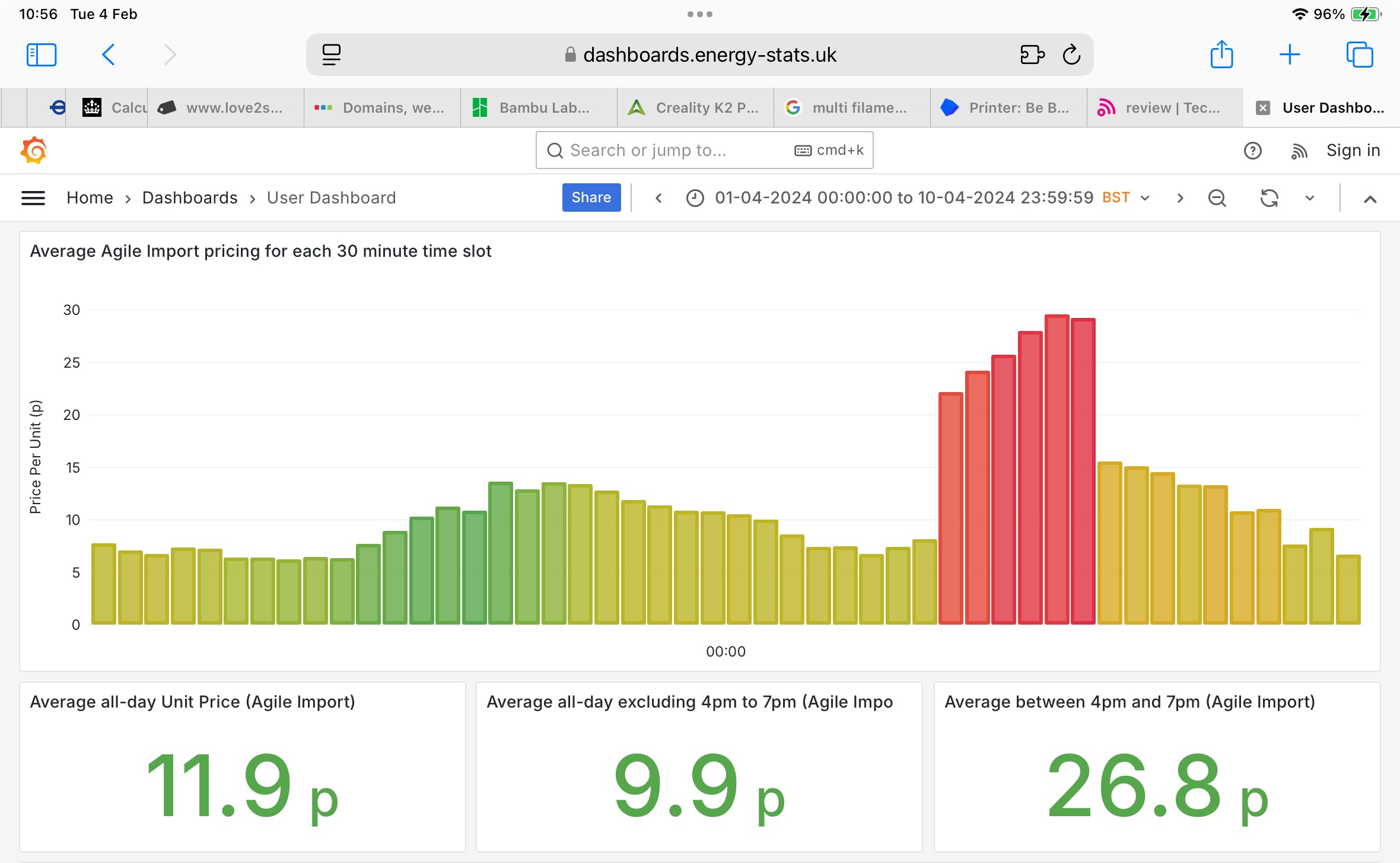
https://energy-stats.uk/octopus-agile-southern-england/
shows a lot of useful historical stats.
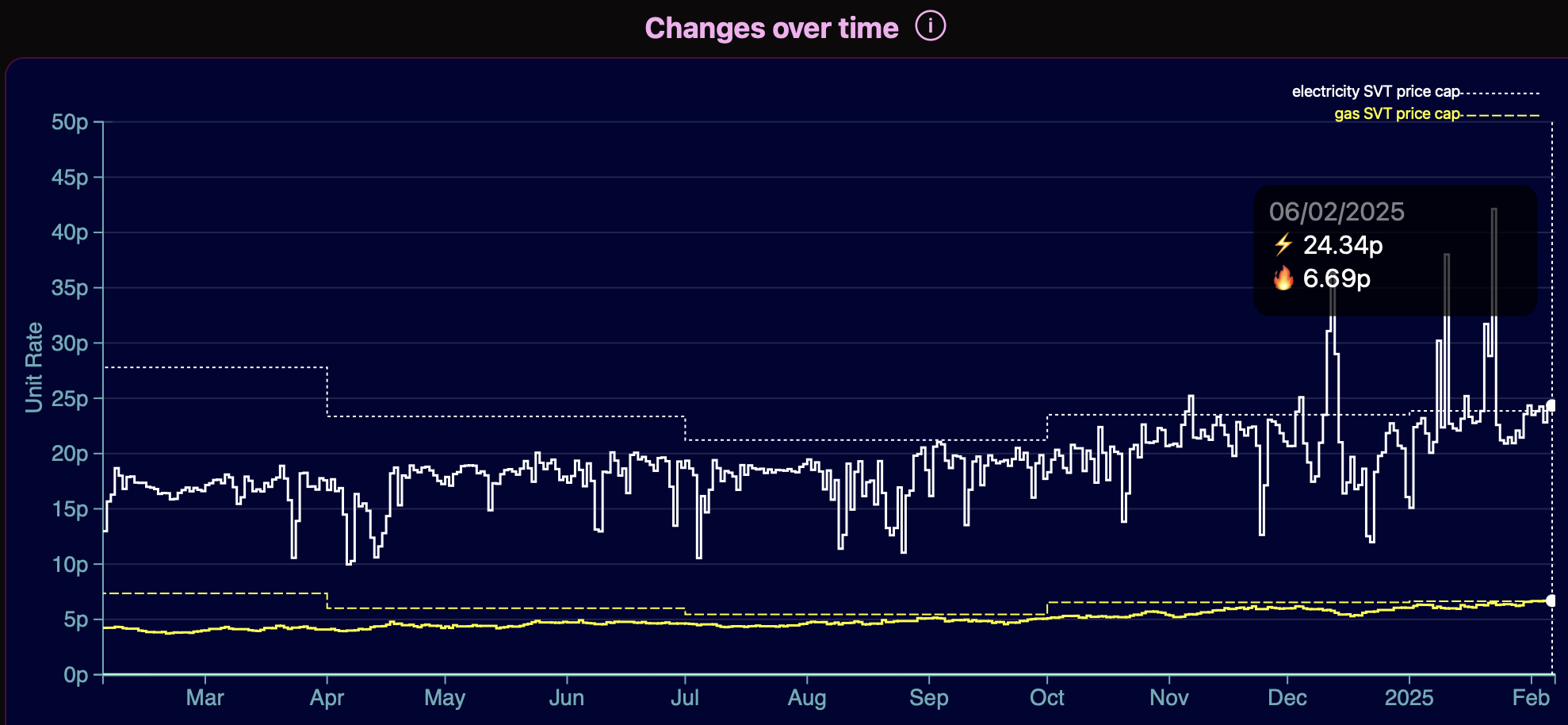
Note that different price caps have applied to different versions of the tariff. When the govt. were subsiding, I think it was 35p, hence the flat green line on the max/min chart. That will, in turn, have reduced the average unit price on the previous graph.
(IIRC, it wasn't strictly a cap - a few times, the true price went so high that the subsididy wasn't quite enough to bring it down to 35p.) Is the cap currently £1/kWh or something along those lines ?
Perhaps a useful chart they could add would be something like the average price of the cheapest 6/8/10 slots per day, for those charging EV / house battery.
- ah - the dashboards section lets you customise time periods, etc.
I wasn't trying to cherry pick, just showing a most recent example. Have been careful above many times to say that it's not always like this, and that Agile is sometimes more than flux.
As with everything, it depends. It depends on your usage, your solar capability, your import and exports times, seasonality etc. The best thing anyone wondering can do is use something like Octopus Compare app that actually shows you hard data based on your historic usage. Even that can trick you because with Agile you may change your charging behaviour to get the most benefit out of it (like I now charge best 6 or 8 slots within an 8.5 hour window, vs Flux I was 3 hours only in the super off peak 3 hr window only - so the comparison is based on that).
But based on my personal circumstance at this point in the year, I am averaging 20-25% less on cost if I look purely at my average cost per kWh on Flux (21p/kWh) Vs now on Agile (16p/kWh). That is comparing the two time periods I had the two tariffs, Jan-Nov (21p/kWh), and Nov-Now (16p/kWh). (that cost also includes standing charge)
pacemaker having looked at the numbers, Agile might work out cheaper than Go for me. Unfortunately, EV charging is currently dumb, and I can only change the charging timer from within the car, so the hassle of having to update the timers manually just isn't worth it..

I have just switched from Flux to Agile. Put in the request last night and went live at noon today. Looking at the details my info shows that I'm on the Agile tariff for import but still on Flux for Export.
Tenkaykev a few people have seen that - would recommend pinging them (I find their twitter DM replies are quick) to get them to sort it out. Some mentioned here that leaving it wrong like that has caused problems for others

pacemaker
I don't have a Twitter / Facebook account so I've dropped them an email.
Fingers crossed it's all sorted soon.

pacemaker The best thing anyone wondering can do is use something like Octopus Compare app
Does that app actually compare historic usage in 30 min increments vs the various OE tariffs? The Agile Octopus portal appears to make calculations based on average price x kWh per day which is utterly useless to anyone who can charge batteries at the cheapest times and so consumption shifts...
26Left I've just had a quick play...looks like it does use actual 30-min slot data. But yesterday, for example, cheapest agile was roughly 2:30am to 5:30am. I did everything during Go hours. It calculated everything correctly, but obviously I would have shifted my usage to the cheapest agile hours (and would have been able to condense it down to 3 hours rather than 4).
Of course it would have been asking a lot to expect it to retrospectively adjust usage. So it's illustrative, but slightly pessimistic for other tariffs.

DD I switched off Agile on to Go for the winter on October 25th
I've just done the spreadsheet work manually: I downloaded my import and export readings from Octopus in 30 mins increments and compared the prices for Agile Import / Export and Go Import / Export x my figures.
My results FWIW - I'll try and compare these later on their app - for Oct 25th to Dec 20th:

So I'm definitely better off on Go for the time being.
yeah I think Agile works in winter for people that are just Solar + battery only. I don't think it's good for regular high EV and/or ASHP needs. As @DD rightly states, the comparison app is comparing 30 min increments, but it's based on your historic charge behaviour, which you would absolutely change when using Agile.
For example, yesterday I racked up my usage from 00:00-08:30 as it was negative pricing, using 24 kWh. That would have been about £6 on Flux vs £0.10p on Agile, a huge difference. That said, if I was still on Flux I wouldn't have used all that electricity and just charged my battery in the super cheap window as normal 🙂

Tenkaykev
Update to add I'm now on Agile for both import and export.

My second night on Agile and there were several slots were the energy prices were zero or negative. I set the battery to charge over several slots and, having an Immersion heater backup in our hot water tank I thought I'd take advantage of the free electricity and heat the water using the immersion heater. I noticed that the battery would start discharging to the house to meet demand from the immersion heater. I suppose one option would be to set the wireless controlled immersion heater schedule to heat the water first and then have the battery charge in the later slots, unless I'm missing a more obvious solution?
Tenkaykev I think battery should only discharging during a charging timeslot if it starts with SoC higher than the charge target.
Simple fix is to ensure charging period encompasses the full time you want to run immersion.Though that doesn't quite work if you want to charge battery in non-contiguous cheapest slots.
Or use pause timer on the portal to pause discharge during cheap periods, if supported by your system. Or set discharge power to 0. (May still discharge a few hundred watts, for reasons.)
Tenkaykev I am doing literally the same thing. I have the immersion running at the same time the battery is charging. Then grid is powering both recharge and immersion and house. As @DD states, its not exact as when you use agile you are sometimes using odd slots, but its been fine for me last 3 nights. Alternatively run the immersion earlier, let the battery "power" it, then you'll recharge later anyway.

pacemaker
Thanks guys, I will set the immersion to charge in parallel but finish earlier than the last couple of slots. Of course if it's on earlier then the immersion may well have reached its target temperature anyway.
pacemaker yeah I think Agile works in winter for people that are just Solar + battery only. I don't think it's good for regular high EV and/or ASHP needs
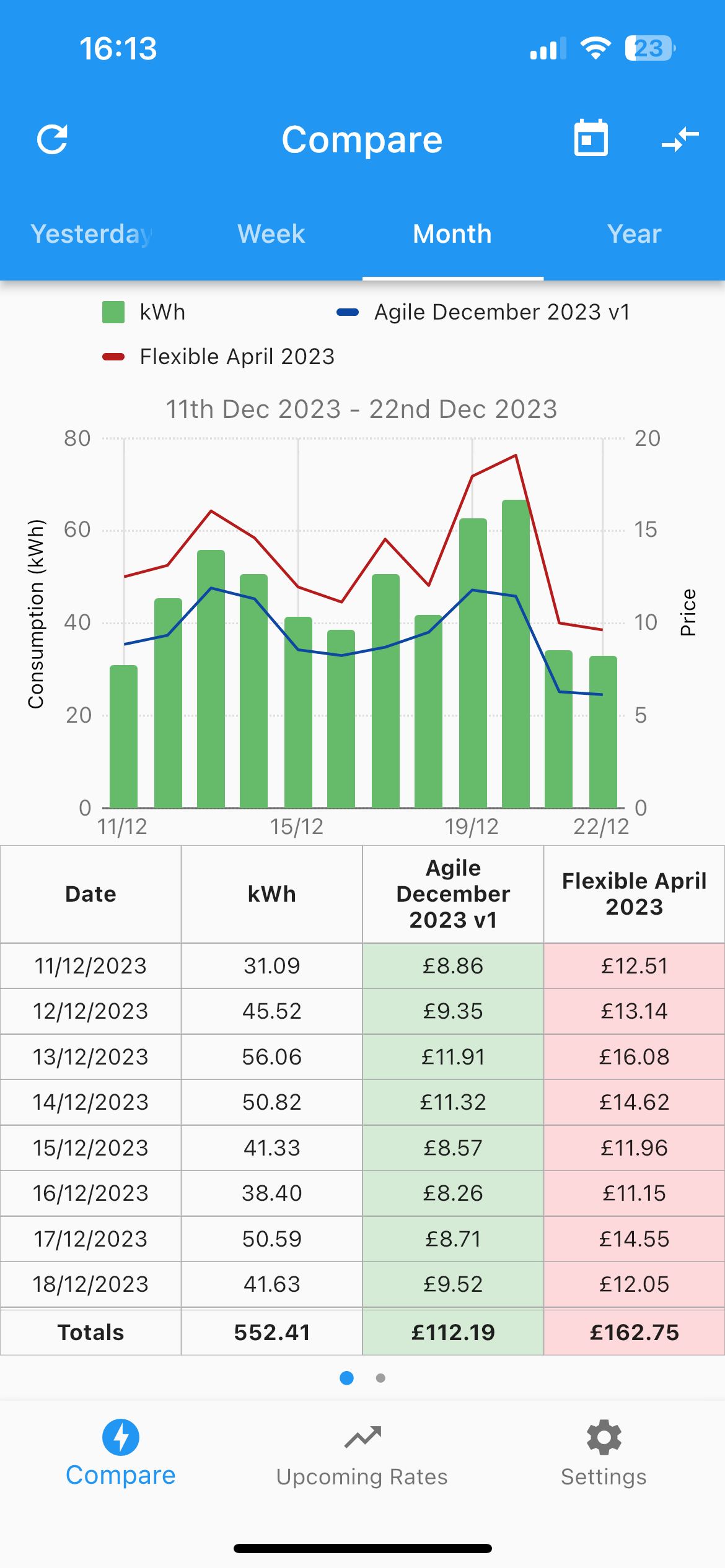
I'm not so sure - I've just run the Octo Compare app for the last month which shows this:
which shows a healthy saving if we had been on Agile over the Flex tariff.
We have a 14kW Mitsi ASHP and EV, so quite high usage. We also have solar and 19.5kWh of batteries, but I haven't been charging them much as waiting to decide on the best tariff.
But now defn going to try MyEO and switch to Agile which looks beneficial if I can get the batts charging in cheap periods.
Russ Honestly I am loving Agile atm, Thursday cost me 3p, Friday I got paid 37p for leccie use and Saturday I got paid to use leccie as well and it looks to be the same for sunday, sure its not huge amounts but im topping up a 13kwh battery and this has been my agile for past couple days.

As mentioned above download the "Octopus Compare" app it will allow you to compare two tariffs but best thing is to check the energy-stats.uk website and select your dno region which you can double check you got the right one here

When sun starts coming out more I will probably change back to flux.
For some reason the app seems a little off when you are owed money but this has been the general savings so far for past week and month compared to tariff I was on when I was on V7 AIO battery firmware.

EDIT
Since I joined on Nov 14th

downfield that's really interesting - thanks for sharing! I presumed because ASHP is less flexible when you can use it (as you want the home heated when you want it) it might mean more high cost usage! Vs battery, and I suppose EV which you can time charge at the cheapest possible times.
But looking at that the average cost of agile is a good 20p less every day for the last (almost month)
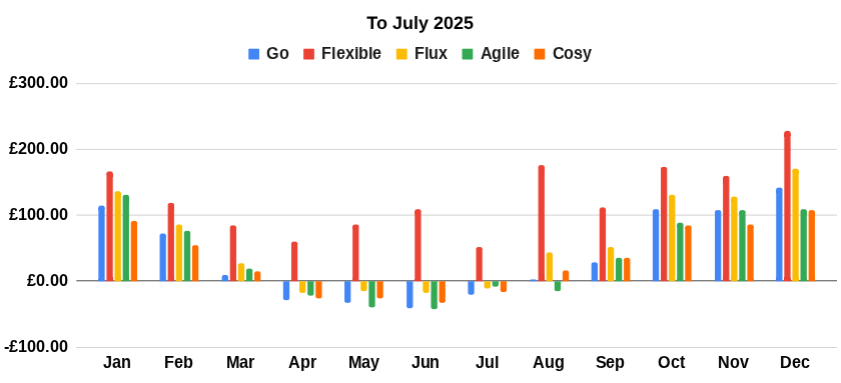
Wonder what the cosy tariff looks like on your data
Jellybaby I'll definitely move off to flux or higher export when the time is right.
I'm tracking my data in excel (boring I know!), looking at the right times to switch. I wasn't doing this before and came onto Agile too late. I should have switched earlier in October (I joined late Nov).

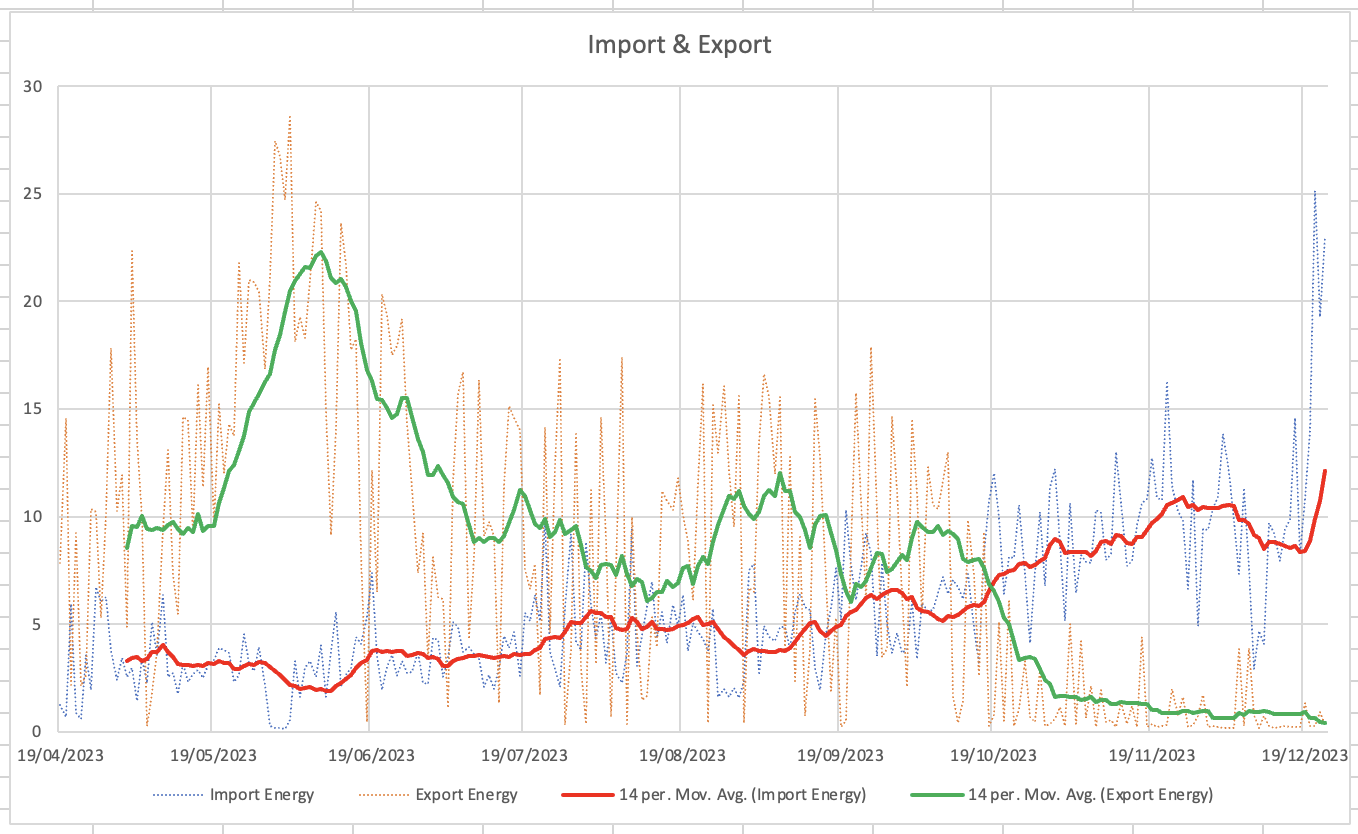
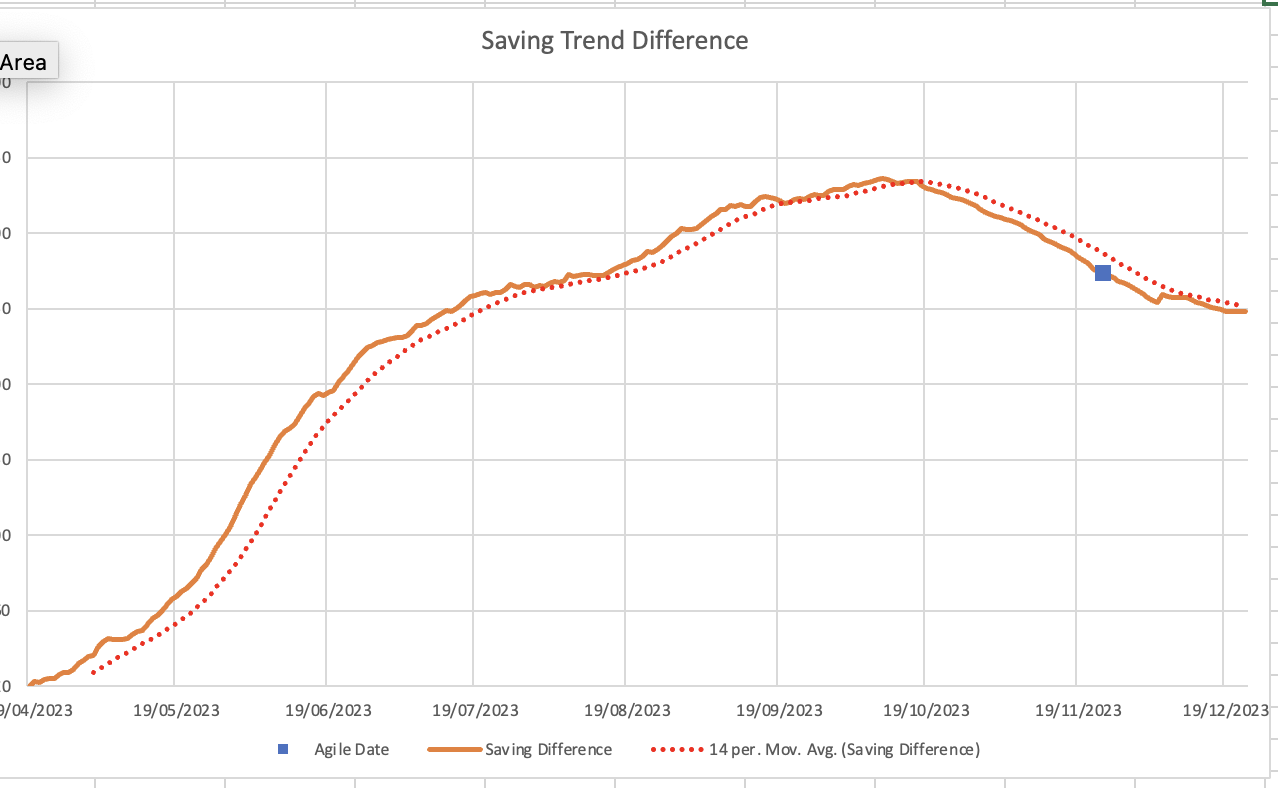
My plan is to use the 14 day moving average cross over to determine when I should switch. Both mu usage and cost saving trends marry up at around mid Oct so looking for those crossovers again in 2024 to switch back to Flux.

The blue dot on this last chart is when I switched to Agile. You can see my savings trend is flattening rather than shooting down as it was on Flux.
Note: you can see I am abusing the import in the last 3-4 days, it's basically free electricity so ramped up my import. Its messing up my charts but will sort out once this extreme cheap period is over.
Its messing up my charts but will sort out once this extreme cheap period is over.
You bite your tongue, it should never end 😃
Jellybaby I thought last night was it but its rolling into tomorrow too!

3 days in a row (so far) of 4 hour Power-ups for us lucky ones.

One important thing to note is that Agile now requires a 12 month tie up. Agile export rates, as far as I can see means losing out on the 15p export rate so in the summer months you lose out with Solar export.
Tenkaykev I've not heard of that. When I signed up on 24th Nov they said I can change after 30 days. Is that a new change? Their's T&Cs don't mention 12m for export
https://octopus.energy/policies/smart-tariffs-terms-and-condition/#agileoctopus
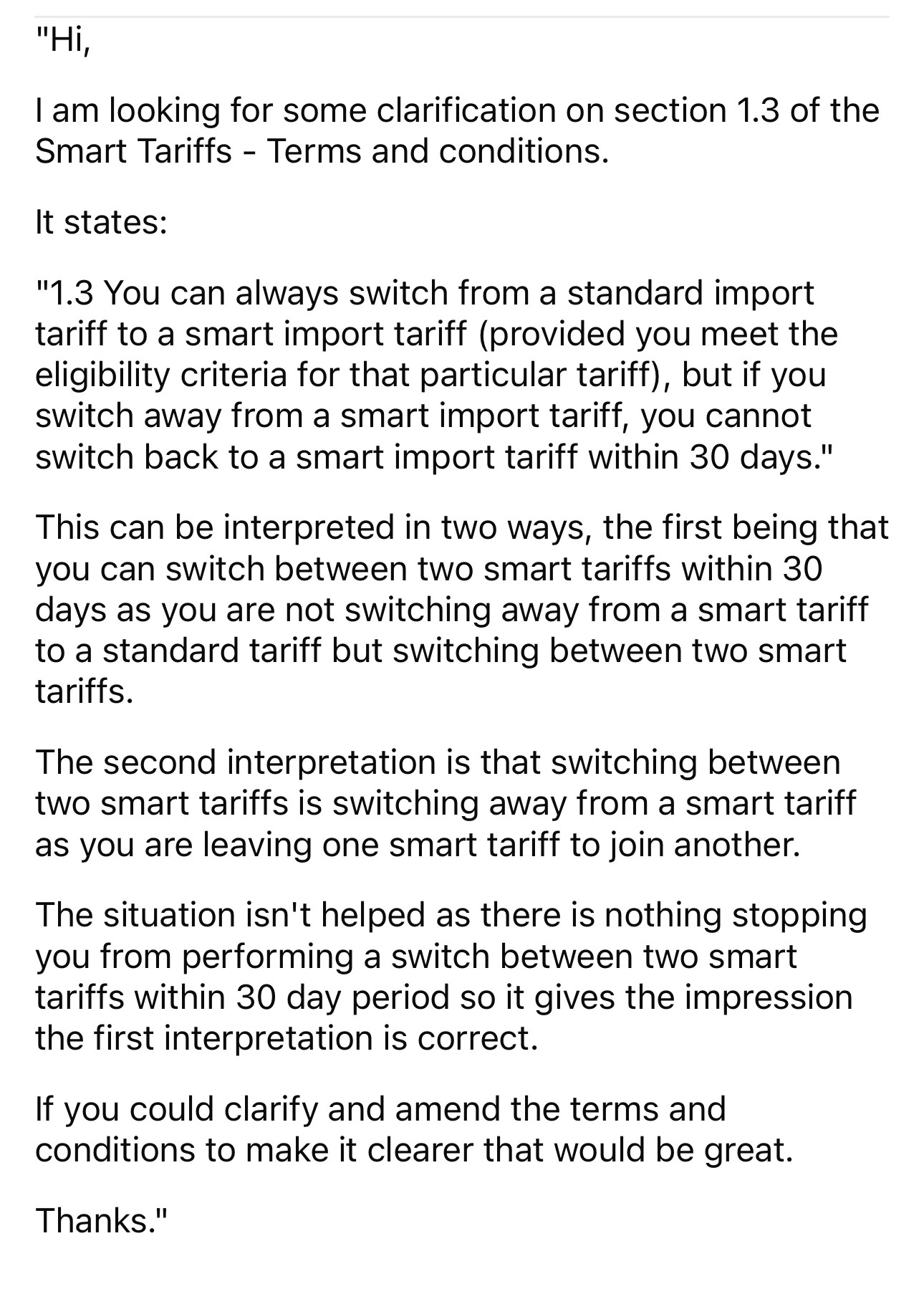
1.3 You can always switch from a standard import tariff to a smart import tariff (provided you meet the eligibility criteria for that particular tariff), but if you switch away from a smart import tariff, you cannot switch back to a smart import tariff within 30 days.
2.3 These terms apply to the Agile Octopus tariff - Last updated on 22 March 2023 (Version C)
2.3.1 Prices for the Agile Octopus tariff are calculated based on a formula related to wholesale costs, and are usually published between 16:00-22:00 (normally, but not always, nearer 16:00), for the following day, with a different price for every 30 minutes of every day.
2.3.2 Agile Octopus is a Variable Rate Tariff, and your daily standing charge and the unit rate pricing formula is variable and subject to change. We will give you reasonable notice of any changes.
2.3.3 Prices can rise as well as fall, though the unit rate is capped at the amount specified at the time of switching. We will give you reasonable notice of any changes to the cap.
2.3.4 The variable nature of Agile Octopus means any prediction of future costs will be inaccurate and historical data will not predict future performance. Agile Octopus is a smart import tariff that allows you to unlock the cheaper and greener benefits of using energy according to wholesale costs. Sometimes peaks may be higher, sometimes lower. You will always be able to switch to one of our fairly priced standard tariffs at any time.
johnsherman
On Agile I've disconnected from the 3rd party now and just set the Inverted to Eco and forced charge from 0100-1600.
In my all-electric house this resulted in my paying 71p for 46kWh of electric on Christmas Eve. That's 1.5p/kWh. Might be a 'cherry pick' but I like it 😊

yeah Christmas Eve was same for me too, whole day including VAT and standing charge cost me £0.02 and I imported 40 kWh!! Shame its not like that every day in winter 🙂
Cooked xmas dinner for -2.8p.....
pacemaker yeah I think Agile works in winter for people that are just Solar + battery only. I don't think it's good for regular high EV and/or ASHP needs
I have an ASHP and am on agile.
We swapped from Flux to Agile import in mid October, around the same time we turned the ASHP on for heating as I knew I wouldn't be able to run the house and ASHP from the cheap Flux period electricity once the ASHP was on for heating.
Spent ages looking at the options, considering all the tariffs before eventually settling on agile. Although Cosy offered two cheap periods for charging the battery, the peak periods were more expensive.
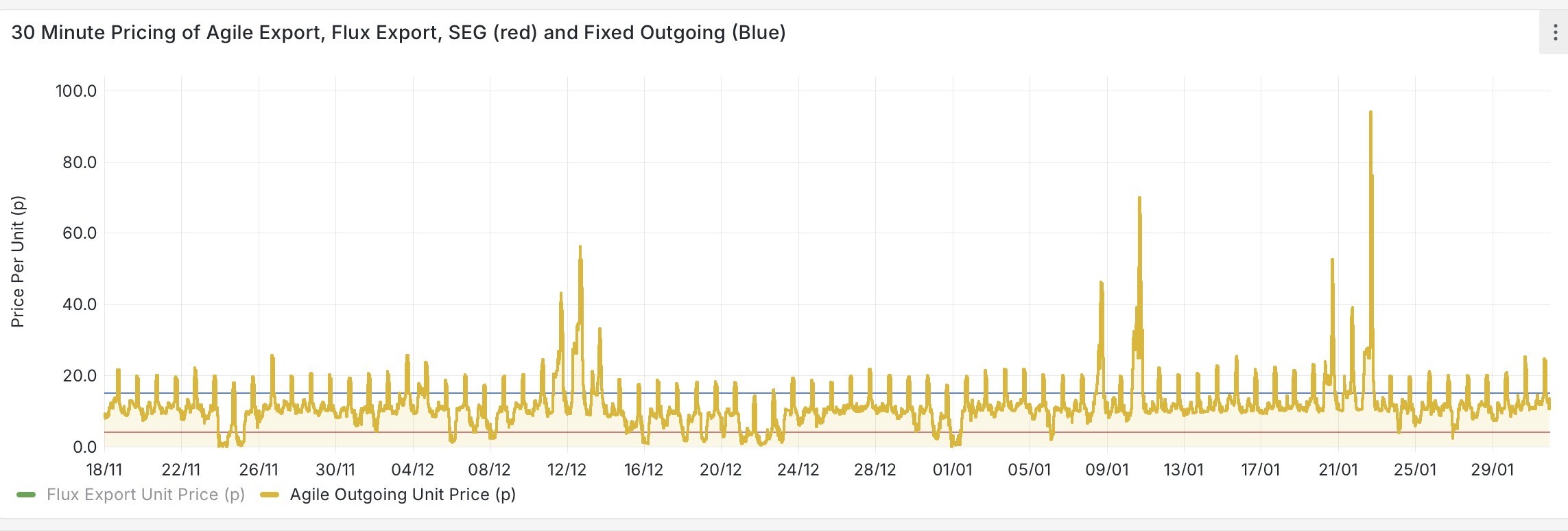
So far very happy with the choice made. It was a bit eye watering in early December when the peak rates hit 60p in the evening peak, but overall I'm paying less on agile than I would have been with Flux.
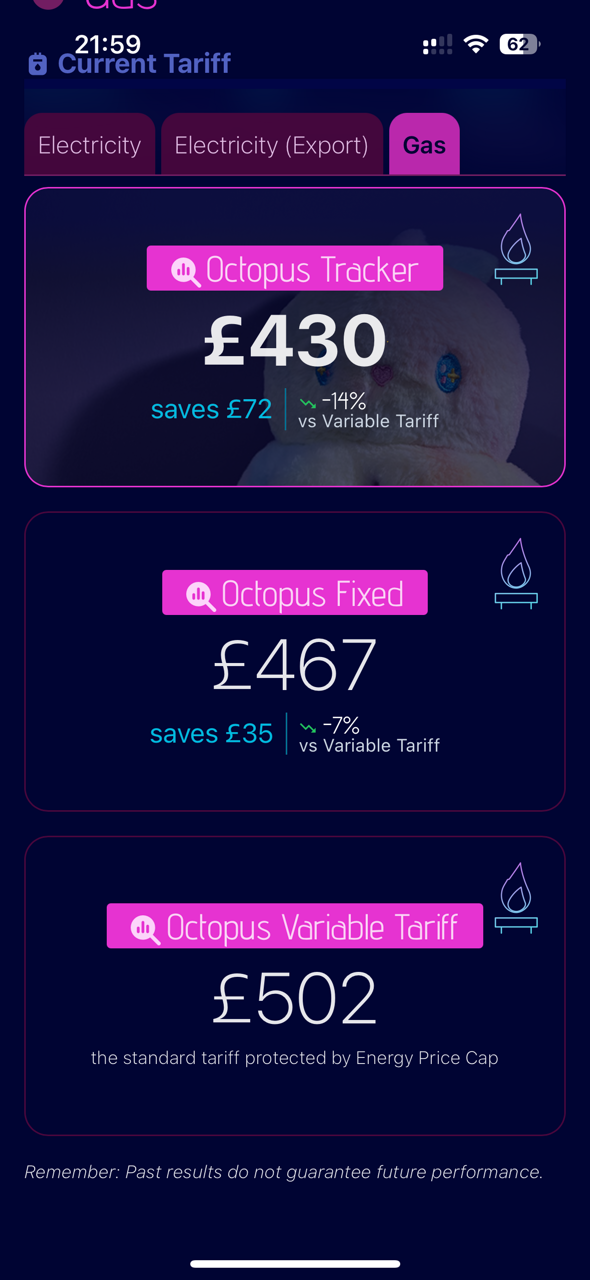
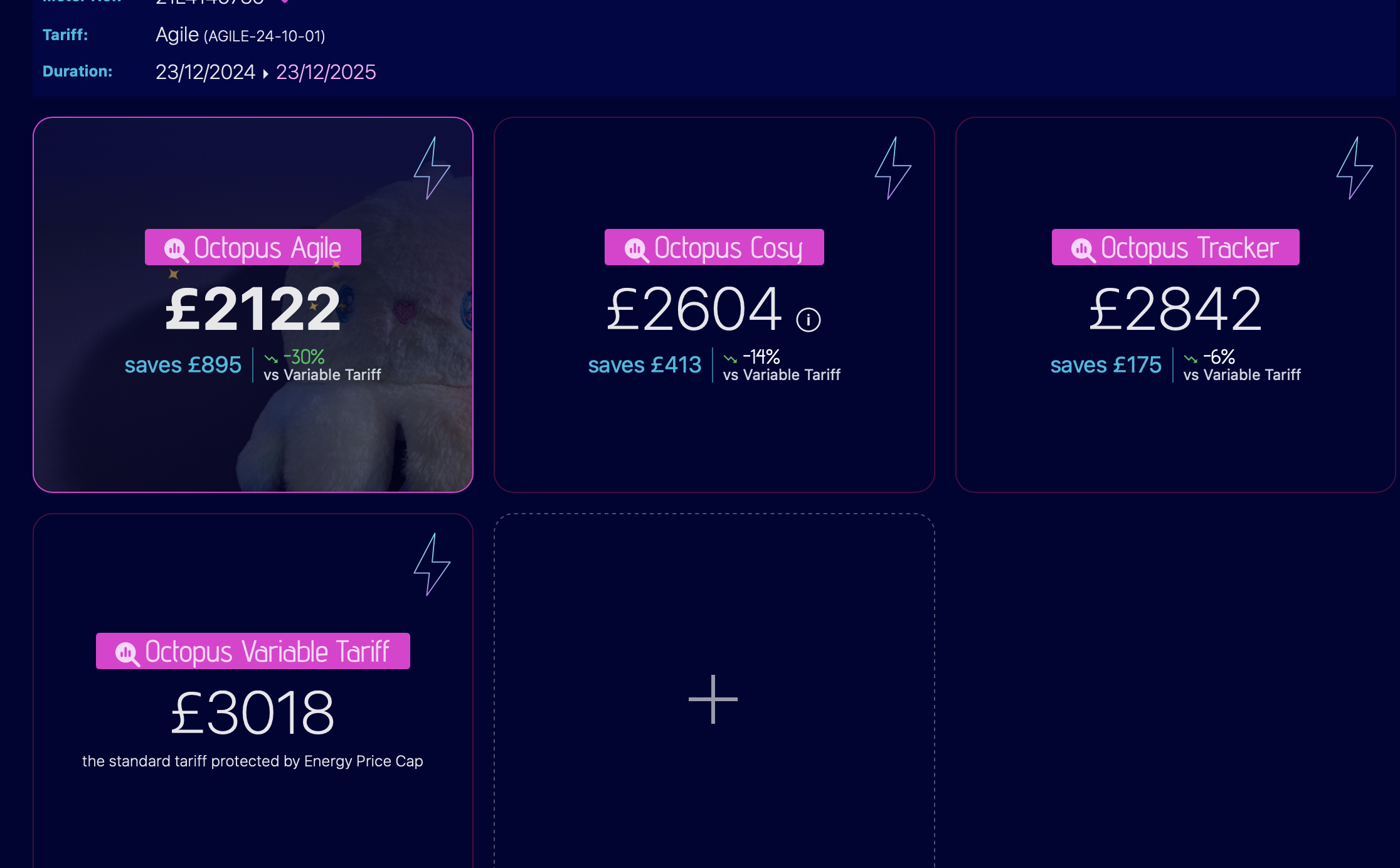
In the Octopus Compare app, comparison of 1670kW consumed 26/11-25/12/23:
- Agile £307
- Tracker £312
- Cosy £452
- Flux £455
- Standard variable £479
There have been days when tracker has been cheaper and I did consider that, only really being put off by the lock-out that you can't rejoin for 9 months afterwards.
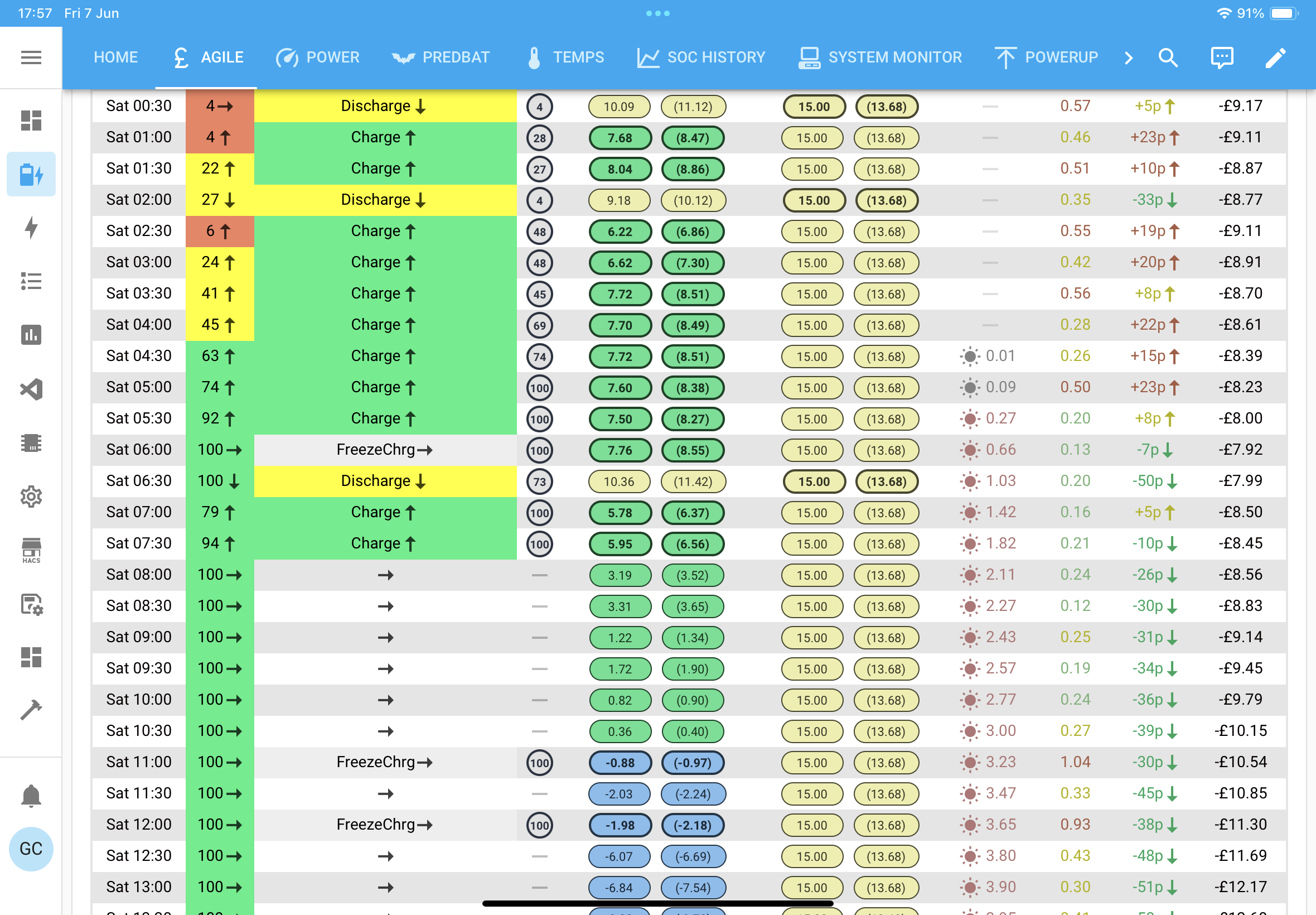
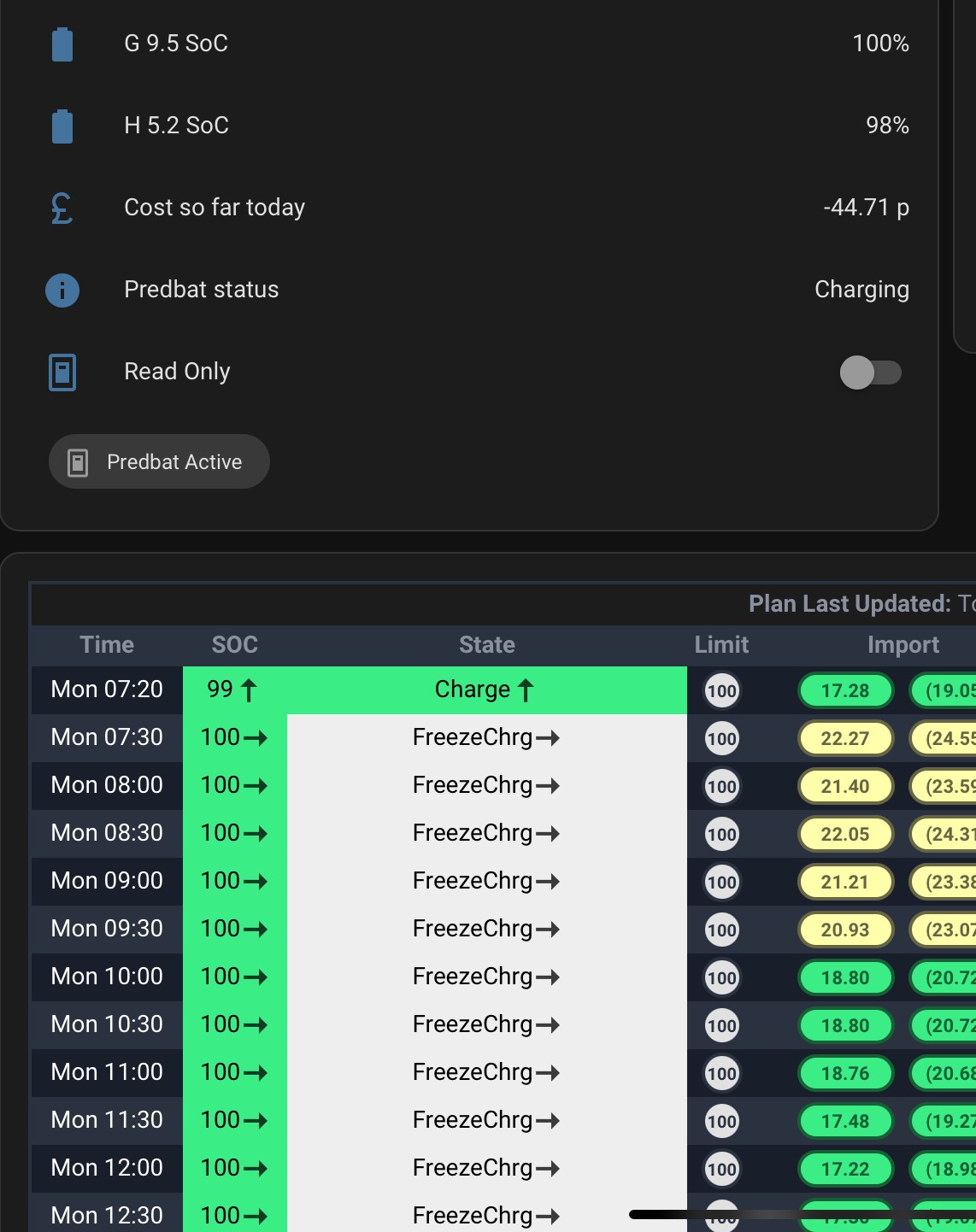
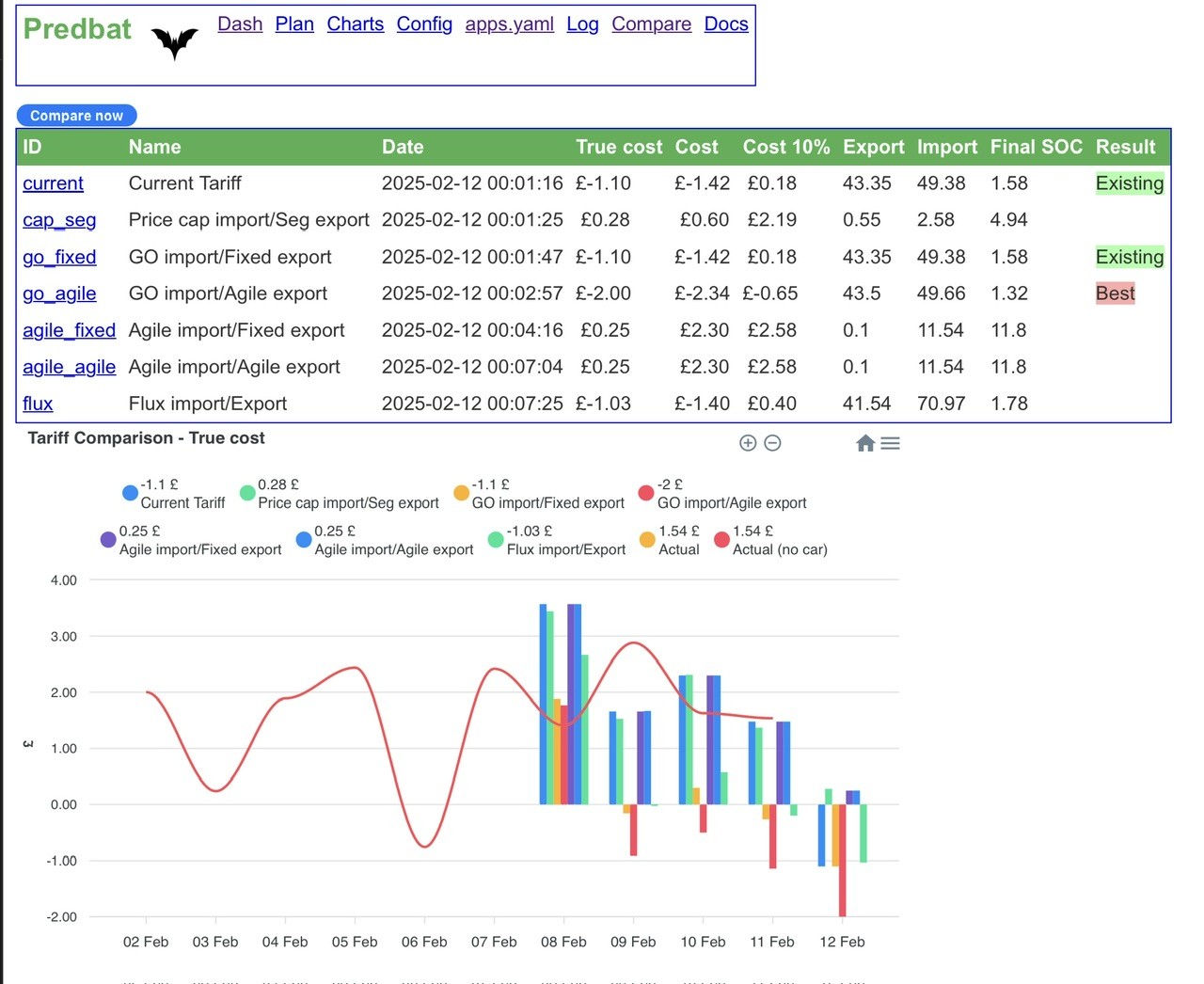
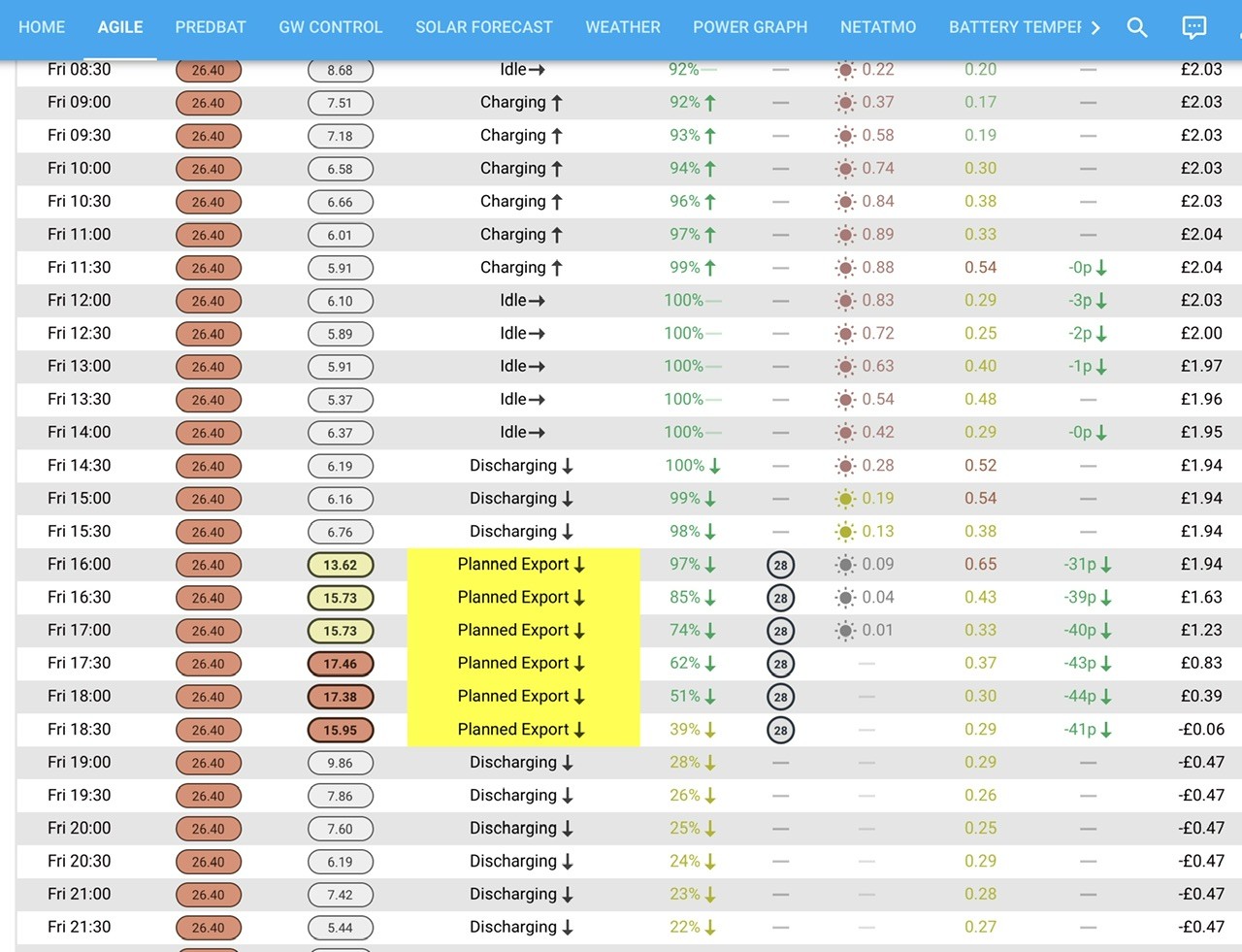
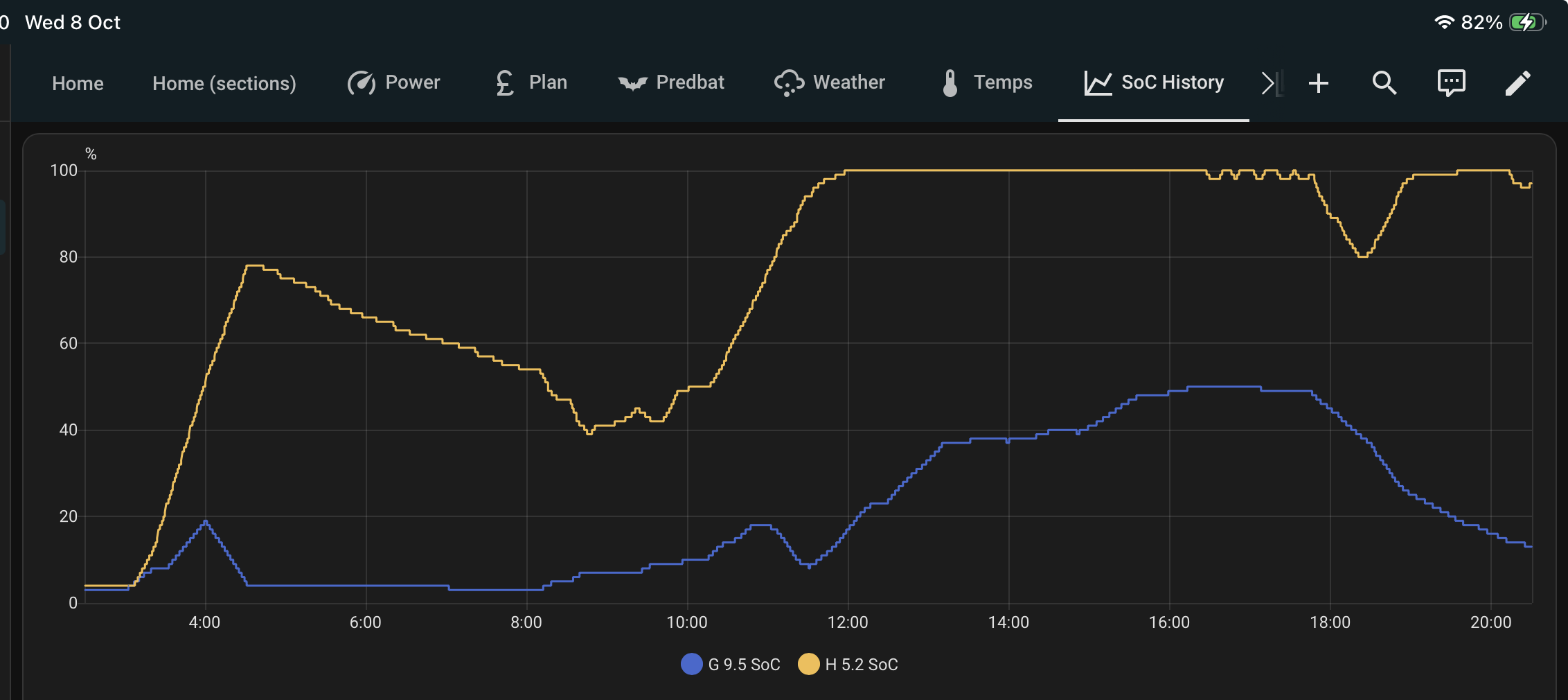
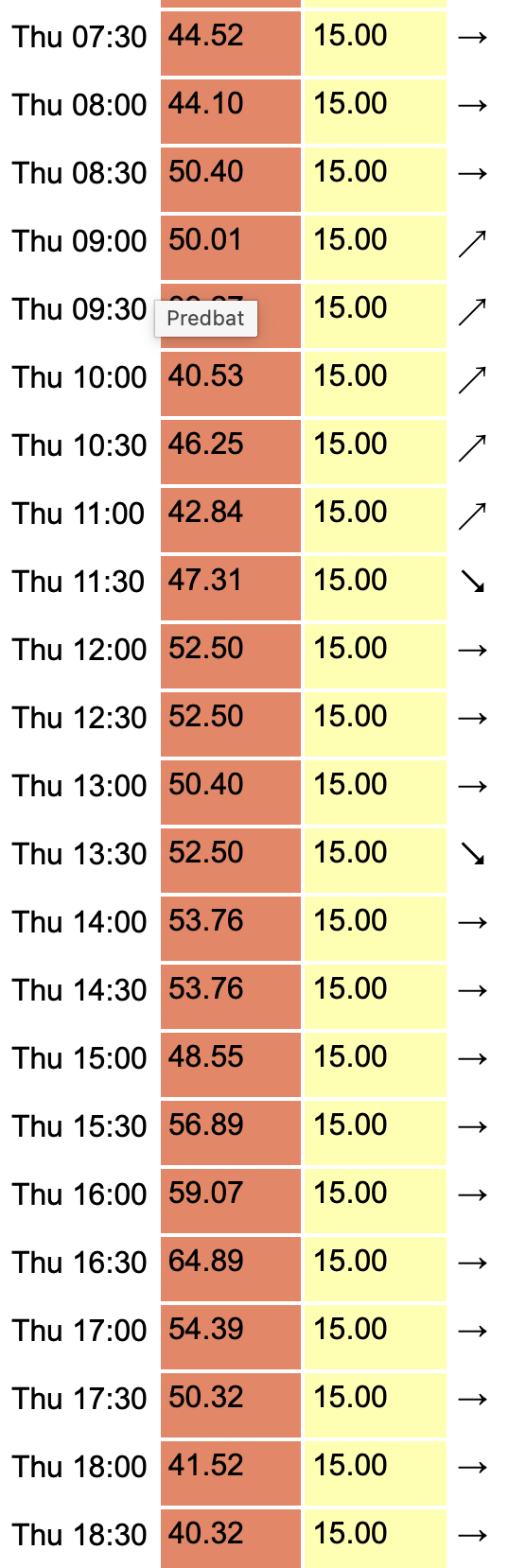
Am using Predbat in Home Assistant to automate my battery charging and discharging.
geoffreycoan if predbat is optimising for agile it’s not really a fair comparison though… it would do very different things if you were on cosy or almost nothing if you were tracker! You’d have some efficiency advantages if you were using directly from the grid on tracker rather than the battery on a time of use tariff…
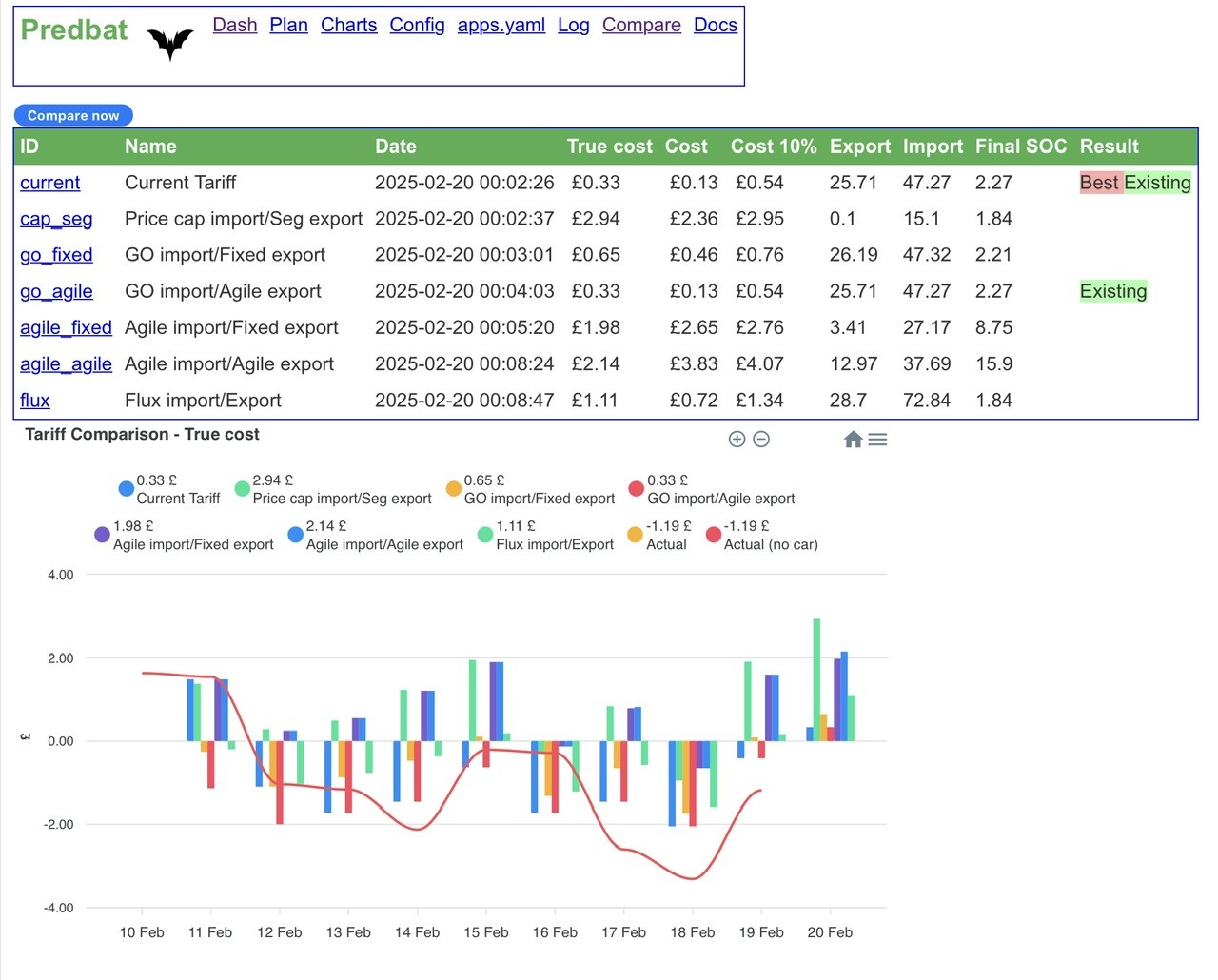
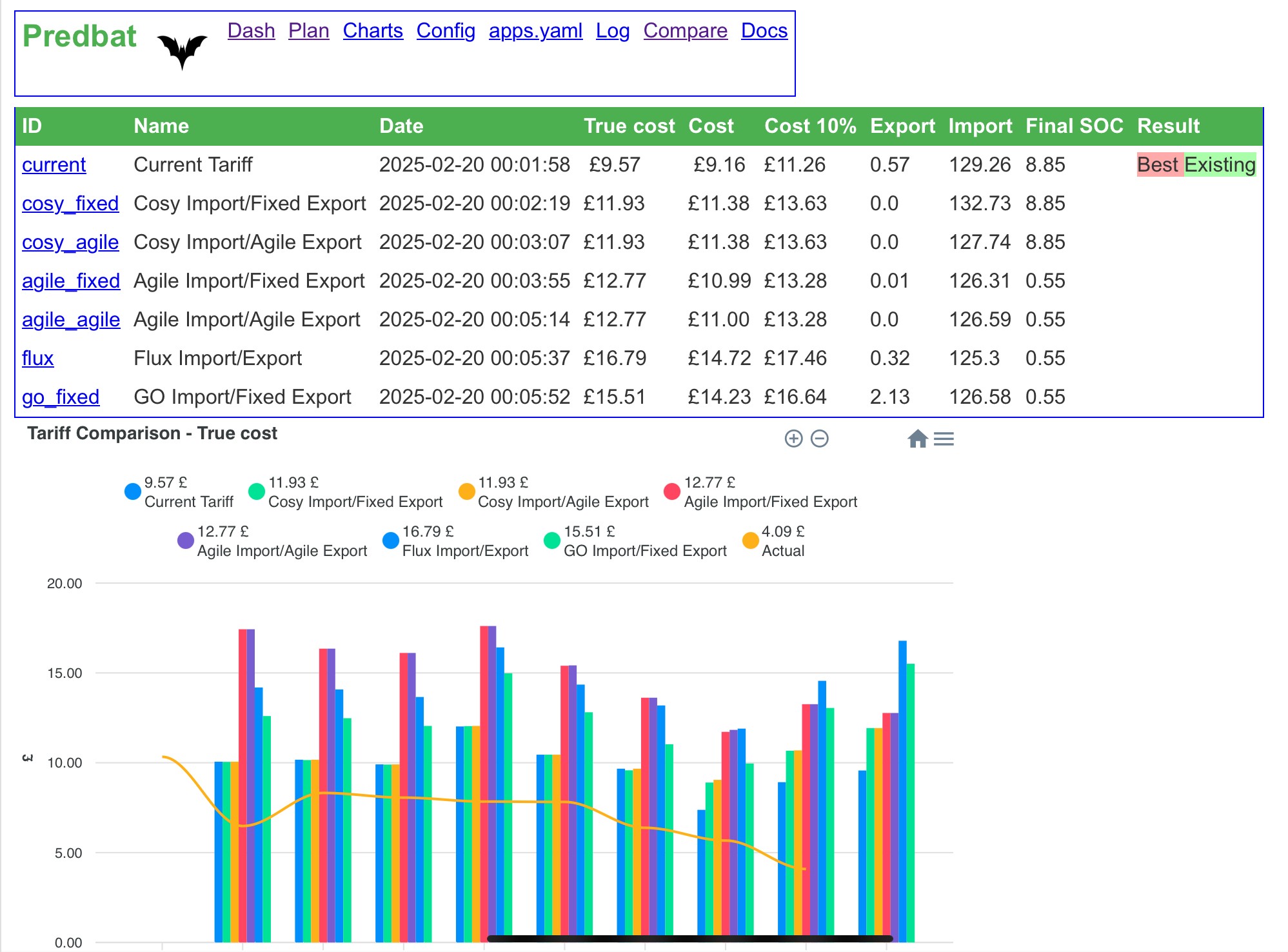
Need to run predbat in a kind of monitor mode for all tariffs and let it tell you how cheap it could have made each one!
geoffreycoan cool. I moved to agile the other day and setup PredBat. Amazing program!
geoffreycoan yeah I guess it also depends on size of battery. I was assuming with ASHP you really want to use that when its cold (usually mornings and evenings), which doesn't give you choice (you can't load shift it like a battery as you want the heat when you want the heat). But I suppose, if you have a big charged battery that can handle the ASHP load you can run it off battery too... I hadn't thought of that
Also now thinking more... I don't actually know the heating pattern using ASHP, assuming its same as central heating but maybe its different (like on all day vs blasts in AM/PM), which might change the agile outlook
pacemaker Also now thinking more... I don't actually know the heating pattern using ASHP, assuming its same as central heating but maybe its different (like on all day vs blasts in AM/PM), which might change the agile outlook
A heat pump is most efficient when you run it low and long, i.e. with as low a flow temperature as you can manage to warm the house (and balance heat loss), and run it continually/near continually so that it is constantly replenishing lost heat on a gradual basis. I didn't believe this at first and ran the heat pump more like a conventional (oil) boiler we had before, which meant that the heat pump had to do a lot of work every day to warm the pipes and radiators up from cold, and it meant a higher flow temperature was required to get the house warm enough.
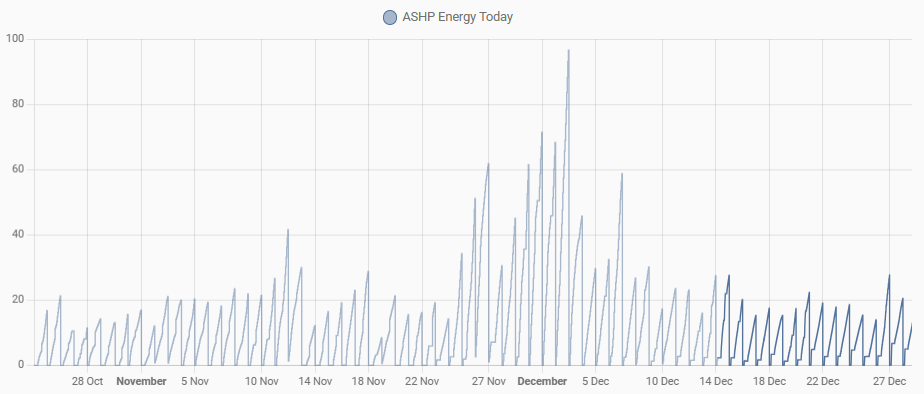
Here FYI is my daily heat pump consumption from mid October:

Typical consumption is 15-25kW a day, but as you can see on really cold periods it can be very large. Up to 96kW on 2nd December ! Ouch.
I knew I wouldn't ever have a big enough battery to run my heat pump every day in the winter, or if I tried I'd hit limits of overnight charging throughput rate and it would probably never payback for the battery installation cost either.
@naltsta At the moment I only have a single 5.2kW battery so the optimisation predbat is doing is actually quite limited. The general pattern is charge overnight, release in the morning when the rates go up, then charge around lunchtime and early afternoon, then release in the peak period. During the evenings and middle of the day I am pretty much always running off grid import.
Before I chose agile I did a lot of spreadsheet modelling of what my current consumption was, what the heat pump usage was likely to be (based on last year's winter figures), then modelled what the monthly costs could be, taking advantage of the load shifting and battery charging appropriate to each time of day tariff:

There are different figures for agile based on different battery strategies.
I believe with the Pro version of the Octopus Compare app you can model load shifting. Anyway I did it all manually in a very complex spreadsheet
96 kWh in a day! Ouch! I assume you mean kWh and not kW
How are you finding the cost of elec consumption vs oil? I am in the same boat wanting to switch from oil to ASHP, but financially I am just not sure the numbers are there yet when spending about £1200 a year on oil.

After reading of people moving to the Agile tariff and retaining the Flux export tariff I emailed customer support for clarification. As of December the Agile tariff is a 12 month contract and you are supposed to be on Agile export too.
This will obviously make a difference especially during the summer if you are exporting a lot of surplus.
Tenkaykev yeah I don't think that's right I'm afraid. I just spoke to them on twitter on it and this is what they say:
Thanks for getting back in touch.
Agile is still on a variable tariff with no end date, however Tracker has been updated to a fixed tariff for new sign ups however you can still choose to leave the tariff at any point during that 12 months.
pacemaker I signed up for Agile on 23/12 and have double checked the T&Cs they sent me by email and there was no mention of a fixed period of 12 months. So I have saved these in case of future dispute when I switch in the summer.
my agile outgoing is fixed but that just means that if there is a price change I won't get the changed price but I am still free to leave at any point.
Not sure how they can fix the tracker tariff as that changes day to day, maybe the outgoing is fixed?
I queried the fixed nature with Octo support and they said:
This means that the caps you have in placed are fixed for that duration.
So I guess it refers to the £1 cap being fixed.

I may well be misinterpreting the information that I've been given. When I enquired with Octopus customer services I received this reply earlier today:
Thank you for reaching out to us. I hope you're doing well.
_I can confirm that it is not possible to be on the Agile tariff for import and the Flux tariff for export. However, please see our webpage below which confirms the tariff compatibility for both import and export. I hope this helps.
_Please let me know what option you would like to go with and I will arrange that for you. I can also confirm that the Agile and Agile Outgoing are compatible with each other.
If you have any further questions or concerns, please don't hesitate to get in touch._
Kind regards,_
When I look at the tariff page I see this:


Loking at the page linked in the reply from customer service I now see that Agile import is compatible with the outgoing fixed rate of 15p
yup, that is what im on atm
Tenkaykev That weblink is really useful - thanks for posting.
I am currently on Agile Import only, because my solar installer is waiting for MCIS certification so that he can issue my MCIS certificate(!).
I know that Octo is supposed not to need MCIS but when I applied for an export MPAN the support desk said it was a beta programme and most folks will still need the MCIS cert in order to get the export MPAN. Does anyone know different? perhaps I am out of date and I should ask again.
downfield They still want the MCS certificate as part of the signup for an export MPAN. Also the letter from the DNO confirming their consent.
I have just switched from Flux to Agile.
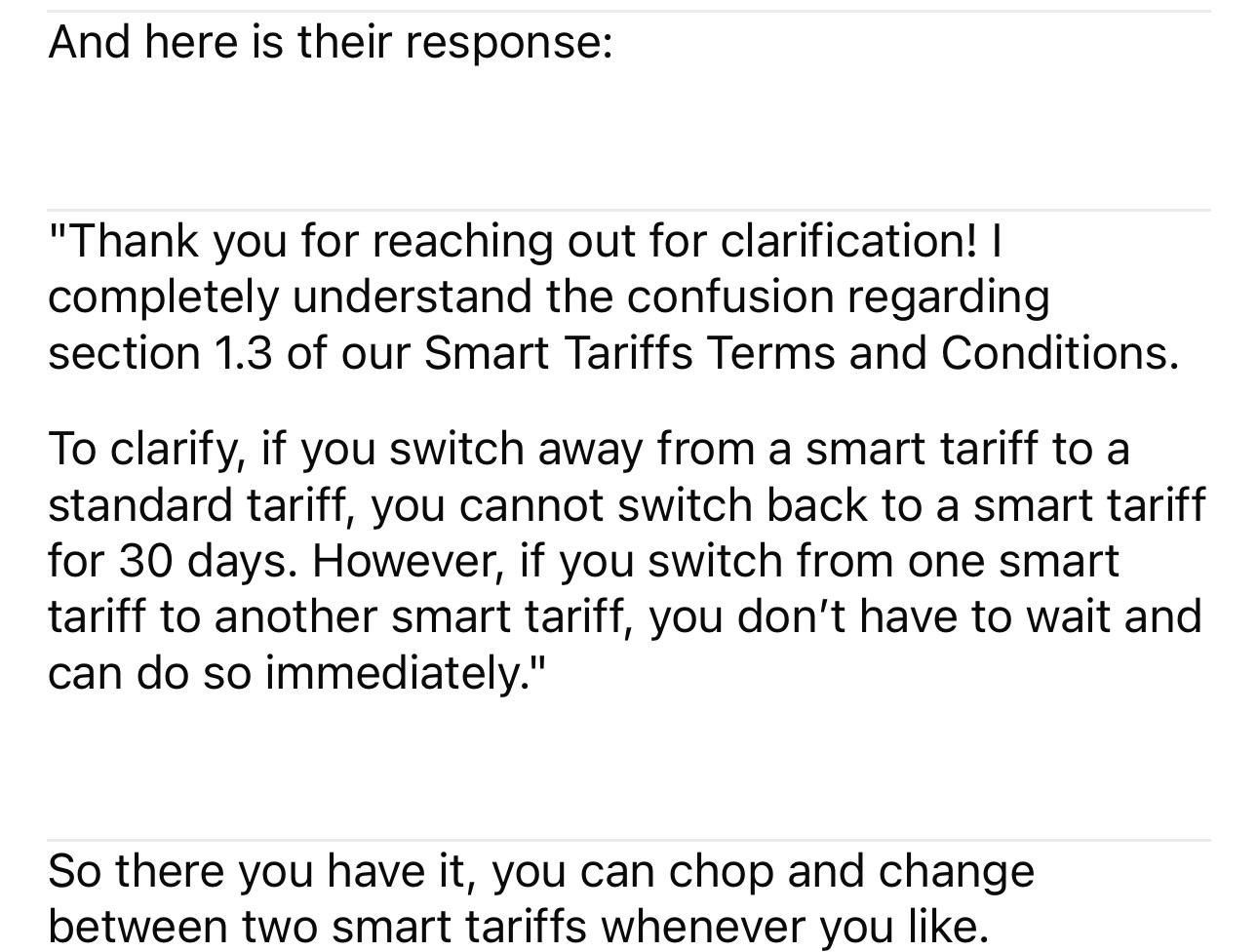
The 12 month bit is the maximum length of time the plan runs for. I can switch to another smart tariff (or flexible tariff) whenever. The only restriction is if switching back to a flexible tariff I have to stay on that for at least 30 days before switching to another tariff.
My import switched to Agile immediately but the export stayed at Flux. I raised a support ticket who said the export should switch automatically in a few days. If not, let them know.
It was the same when I switched to Flux. The Import was immediate but Export took a few days to register on my account.
pacemaker 96 kWh in a day! Ouch! I assume you mean kWh and not kW
How are you finding the cost of elec consumption vs oil? I am in the same boat wanting to switch from oil to ASHP, but financially I am just not sure the numbers are there yet when spending about £1200 a year on oil.
Yeah, I did mean kWh ...
It was an ouch that day and for a few surrounding, but it mirrors what happened last year that on really really cold days where the temperature stays below freezing, the heat pump can chew through £20 or £30 of electricity. I did have an installation engineer in last year (one of my pumps had jammed) and he confirmed that this was quite common with other customers. If its only a few days a year I can live with that as the rest of the time my daily bill is less than £10.
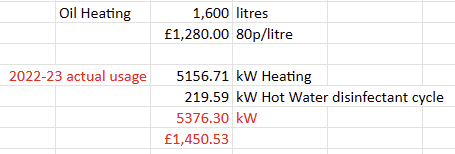
In terms of comparison to oil, here's the figures I put together at the end of year 1:

For me I was kind of forced into making a decision. The oil tank failed and I found out that the current regulations for oil tank siting meant a replacement couldn't be in the same position as it has to be 1.5m from buildings/outbuildings and 750mm from boundaries/hedges. Mine was in the back garden next to the boundary fence and beside a wooden shed.
Finding a place to site a new tank that complied with the regs was going to be difficult. At the time the RHI grants were available so I calculated that the heat pump cost after RHI grant would roughly be the same as it'd have cost me for the new oil tank.
Plus of course I've then invested in more solar and battery storage. Can't make my own heating oil!

When I switched to Flux it was an immediate switch to import but a 14 day wait for export meaning I lost out on the first few grid export sessions.
Thanks a lot for this insight, it's really useful and sounds very similar to my usage (oil wise anyway). The cost isn't that much more which is surprising. Interesting about the tank positioning, mine is close to my garage and would have to move for a new one. Maybe when either that goes or the boiler does, it really does make sense to switch...
Last Q as I don't want to derail this thread - what COP are you getting out of your ASHP? Make / model etc?

Jaw drop moment this morning!

pacemaker Last Q as I don't want to derail this thread - what COP are you getting out of your ASHP? Make / model etc?
I honestly don't know what COP I am getting. I've got two LG Therma V 9kW monoblock ASHP's. The control panel was definitely designed by an engineer not a user and the instruction manual was probably written by an engineer who didn't have English as his first language!
I don't think the LG displays what the COP is, or even what the energy output is from which I could work out the COP. I get the consumption figures from the meters that are connected to the ASHP (and I've now got a Shelly EM CT clamp over the feed to the ASHP to read the consumption in Home Assistant). I think the only way I can get the heat output is to put an energy flow meter into the ASHP pipework and that's not something I am contemplating, even as an enthusiastic DIYer!
What I have done is to turn the flow temperature down as low as I can and turned weather compensation on so the flow temp is set based on the outside temperature. Most of our radiators were upgraded in size as part of the ASHP install, the living room one we didn't go with their recommended size and have had to get that changed to a bigger earlier this year.
Watcher yeah, agile is very good at the moment. Have to be prepared for the prices to rise when its very cold, we had 65p a kWh in early December, but overall its worth the risk I feel if you've got batteries. Don't even need lots of batteries, just enough to run you through the majority of the peak period. We're running at about £5-10 a day for 40-60kW consumption.
Christmas Day -£0.15 72kWh
26th £5.82 46kWh
27th £3.35 49kWh
28th £1.04 41kWh
29th £4.82 47kWh
But to show how the rates can vary:
1st Dec £21.80 81kWh
2nd £29.68 119kWh
3rd £12.91 58kWh
4th £9.97 46kWh
5th £9.29 43kWh
6th £18.26 58kWh
Swings and roundabouts

geoffreycoan
As you say, I have to watch it but with an absolute max of less than 20k per day and usual 12-15 with a useable 9k of battery (which covers the top rate period) it looks pretty good at the moment.
Hi all, first post but been reading for a while now. I swapped to agile just before Christmas and so far so good but I seem to be missing all comparison data from yesterday... is it just me??
Janed9388 I am missing 29th and 31st on the octopus compare app but all available via octopus website, first two days its had trouble with.
EDIT
Just checked and I got the 29th in portal but 31st is not in portal and checking Octopus site I get this

BUT it shows my export for yesterday.
EDIT
Yesterday now showing up for me lol.
Shown up here too, very late today. The Octopus team must have been all out partying last night!
December's great rates coming to an end tonight it looks like, but last 30 days been a stormer! So glad I switched late Nov to Agile...
Can you spot where I might have turned everything on? 😆


pacemaker
That's an excellent summary screen. Is it Octopus generated or an App that you are using ?
Octopus Compare app on iOS

pacemaker
Thank you. I have the App, I never thought to flip across from the previous display page 🤔
Tenkaykev if you don't use HA then its not efficient, if you do have HA then check the below https://github.com/BottlecapDave/HomeAssistant-OctopusEnergy

deepanshus
Thanks for the link. I have been looking at HA, I subscribe to " Speak to the Geek " and it's certainly interesting. I had Raspberry Pi 4 that I passed on to my Grandson to see if it would kickstart an interest. I'm comfortable with Tech, having dabbled from the days of ZX81 via a couple of OU computing/ Technology units. I took a quick look at " Home Assistant Green " as a turnkey solution but in all honesty I'm not sure I have the patience anymore which is almost certainly an age thing.
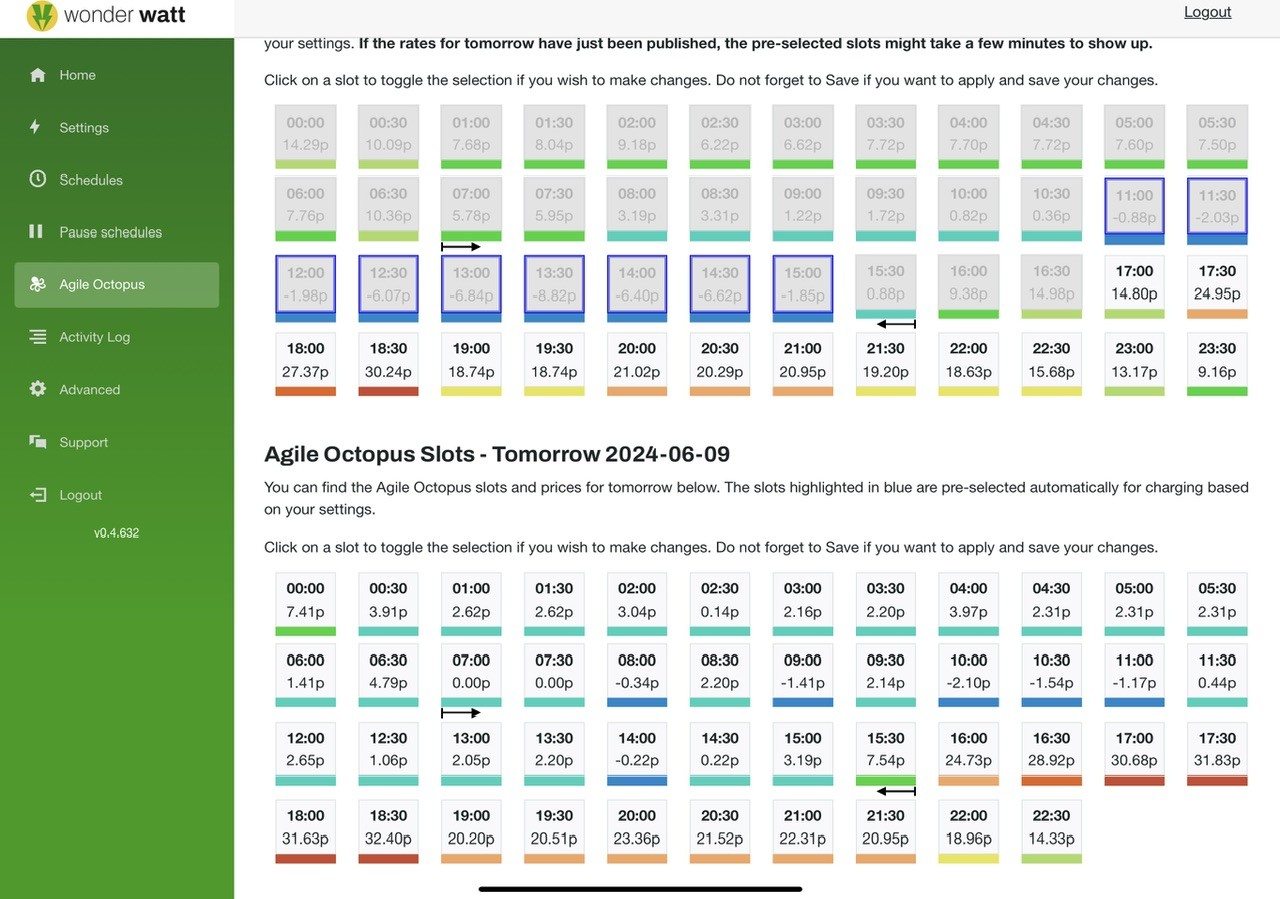
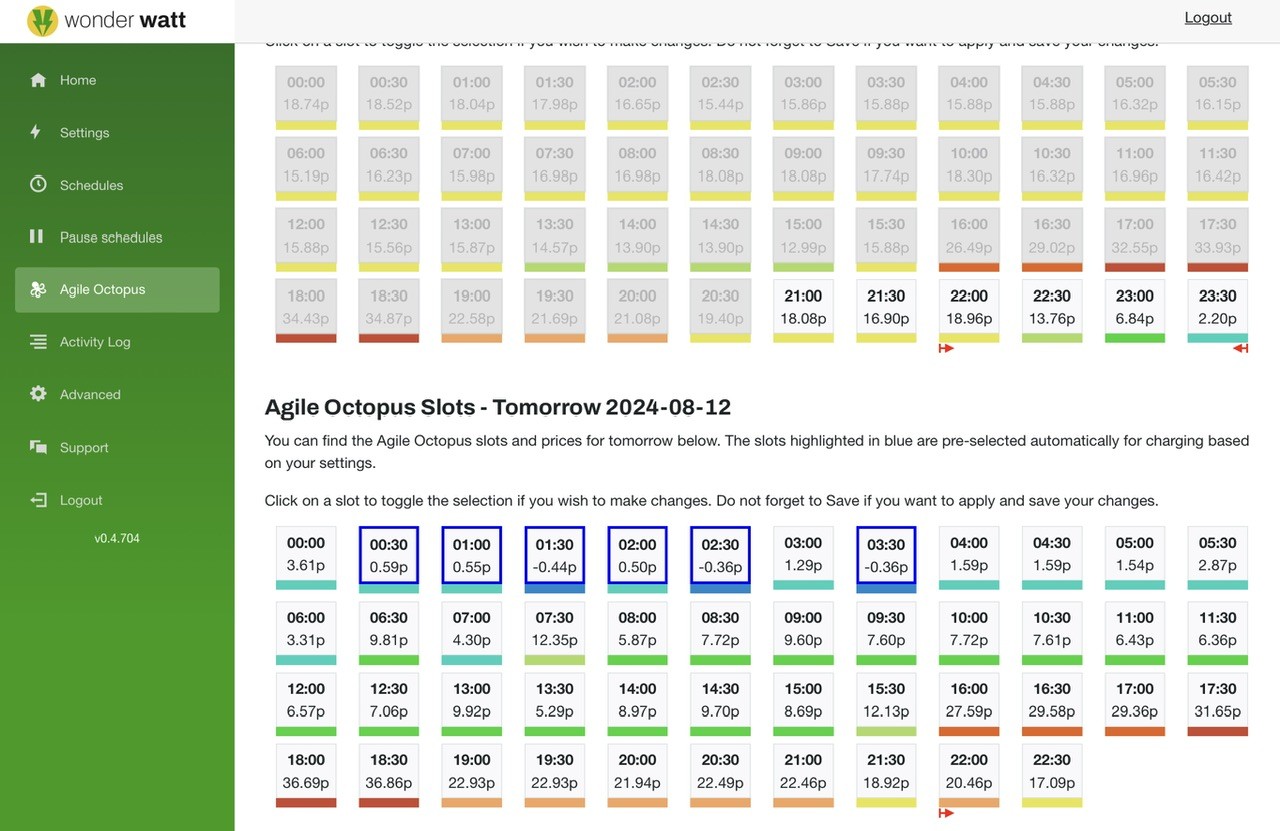
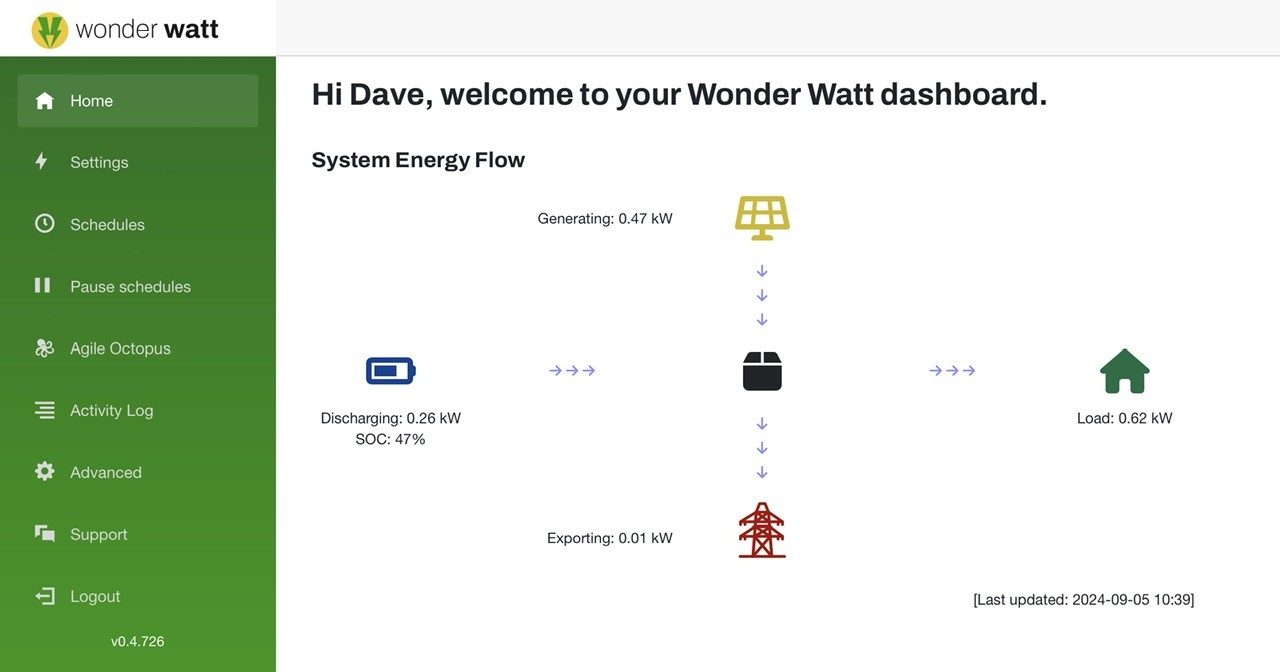
Currently I am having a play with " Wonder Watt " and am very happy with the way it is developing, and the feedback from their developers and support is frankly outstanding.
As I understand it there's no native way to run HA on my M1 MacBook without running in a VM via Fusion or VirtualBox which at the moment I no longer have the appetite for.
Tenkaykev As I understand it there's no native way to run HA on my M1 MacBook without running in a VM via Fusion or VirtualBox which at the moment I no longer have the appetite for.
suffering the exact same thing. Have tried multiple ways to get it to work on my M1 iMac and gave up. Just too long, complicated and broken, and I have an engineering background! I attempt every 3 months with the same outcome.
Hi All,
I have just switched to Agile after having my array and battery commissioned, I have signed into Octopus via the GivEnergy App and it has downloaded the Agile rates.

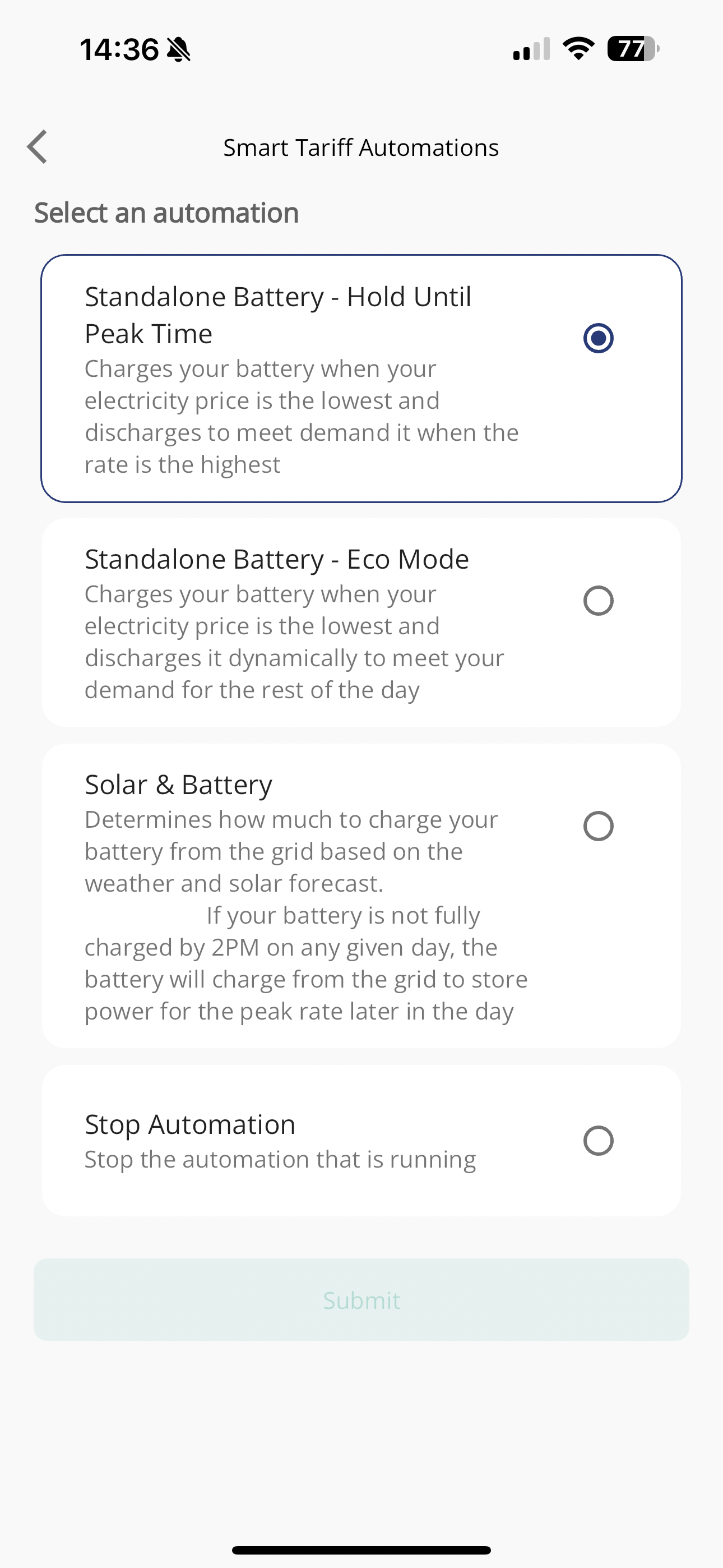
I have set the automation to Standalone Battery Hold Charge (initially Eco mode), this is because I didn't want to hit peak rates between 4pm and 7pm.
However I am wondering if moving forward I should be using Solar + Battery? However it doesn't really explain when it will charge the battery, I am guessing between 2pm and 4pm?
Thanks,
Matt

matttheotter when I was on that automation it charged overnight on the cheapest rates and then tried to let solar top it up to 100%. Mine usually got to around 60-70%, even when there were grey skies forecast so it wouldn't last me. It would then charge up 2pm till 4pm on (higher than night rates) electricity to 100%.
I now use Predbat on Home Assistant and it does a much better job.
Cdent thanks for the advice, I am totally confused, it has just gone 4pm and the battery still hasn't started to discharge yet the unit rate has gone up to 27p which is double the rate earlier.
What does it class as peak time?

matttheotter should be 4pm to 7pm, did you check live (home) or away which is delayed up to 5 mins?
problem here is that it all depends on the cloud and if the signal can't reach your inverter nothing happens - another reason I went with Home Assistant for local control.
Did it end up discharging?
pacemaker Hi Tenkaykev / pacemaker, I run HA on an M1 Mac Mini and bought "Server for Home Assistant" through the App Store.
It was a while ago so not sure how much it cost but it certainly made the set-up of HA much easier than without it.
Good luck.
ThePalfs thank you of the hint/tip! Here's the link for anyone interested: https://apps.apple.com/gb/app/server-for-home-assistant/id6447077874?mt=12
Cdent Set it to "Eco Mode" and it started to discharge, I am wondering if this because the automation scripts become effect from midnight, I had a look at remote control and if you initiate the change during the day then there is no automation push.
I have installed Solcast and Predbat on my HASS, I'll look into configuring it locally, I already have GivTCP and Octopus (plus Home Mini) so I should be good to go.
Surely that means you have to run your main PC/Mac 24/7.
My solution was to I buy a Dell Quad Core 8GB Ram, 120GB SSD, WIFI, Win 10, PSU, Stand display port adapter for £45. on EBay
Cheap to run and works really well and was easy to install HA on. About the size of a largish paperback.
Wavy Davy my Mac is always on anyway, so no issue for me.

pacemaker
M1 MacBook Air here. It's always powered on, I just close it when not using it. Would HA be happy with that or does it need a constant connection? Got an old ( 2012 ) Mac Mini at the back of a cupboard, I could dig that out but have no display.
Tenkaykev that old Intel Mac mini would be ideal as you can install HAOS on it directly instead of MacOS
matttheotter Cdent I configured Predbat, wow that is a lot of sensors!
My HASS may need to be upgrade to deal with all this moving forward as its getting laggy.

matttheotter mine's running on a HP T520 thin client, but that's only got HASS running on it, works fine but yeah it can take a bit of processing power
Cdent erm mines running in Proxmox.....just a few other servers running along side 😆
@Cdent - Predbat is still in monitor mode, I have noticed it doesn't always seem to select the cheapest charge rates on Agile, wondering what is misconfigured?

matttheotter it could be a combination of things - usually the losses and min improvements make the biggest difference to mine
matttheotter @Cdent - Predbat is still in monitor mode, I have noticed it doesn't always seem to select the cheapest charge rates on Agile, wondering what is misconfigured?
If you have Predbat in Monitor mode then it is monitoring the existing house load, solar generation and existing charge and discharge slots you have setup on the inverter - it is NOT planning anything.
Try setting mode to Charge and Discharge or Charge and turn read_only on which means Predbat will plan your battery activity but not make any changes.
I have updated the predbat docs to make this clearer
geoffreycoan thanks for the info, I have enabled read only and charge as I am not planning on exporting atm as my export mpan isn't setup yet after that I will be on the Fixed 15p/kWh.
It updated the plan which makes way more sense to me now, assuming it is not charging as the rates are low, solar prediction will keep the battery above 50% for the next day and the rates are cheap to run the house?

matttheotter It updated the plan which makes way more sense to me now, assuming it is not charging as the rates are low, solar prediction will keep the battery above 50% for the next day and the rates are cheap to run the house?
Great, glad to see it’s making sense now.
Yes that looks to be correct, you’ve got low house load and so its not choosing to do any charging at the moment and letting your battery fully charge and the house run off excess solar/battery in the evening. You can see this by the last two columns (cost) being flat, not increasing.
Then in the late evening from 9:30 it is planning to hold the battery charge and let the house run off grid when the rates are lowest. When the agile prices for tomorrow are released at 4pm the plan may change. You might want to set the norddata config up in apps.yaml to get the market rate predictions for tomorrow which will give a reasonable prediction of tomorrow’s prices and will get a more accurate longer term plan
geoffreycoan Aye I have a 9.5kW battery, maximised the system on the first install, the system has only been online 3 weeks and only switched to Agile last week so I am getting used to the process and want to ensure I have capacity on the battery for when I cook between 6 and 7pm.
Was a bit cautious about using the norddata given the warning attached to it in the apps.yaml.
I'd be grateful for advice on how best to manage my move to Agile (import). I need better scheduling and management - preferably automated. Without being unduly techie or complex!
Staying with Fixed 15p export
Was previously on Tracker import but feel the re-jigged Tracker pricing and the fact I have solar & batteries should mean Agile is better.
Background (not all important to the question!)
Listed Grade 2 building with large modern extension.
LG Therma V 16kw ASHP
Underfloor heating + Rads
8kw pv solar
3 x 8.2kw GivEnergy batteries
1 x GivEnergy Gen1 hybrid 5.0kw inverter (important to note max charge/discharge rate is 2.6kwh)
Manual changeover EPS - but with infrequent outages probably no need to maintain large reserve
EV - say 8000 miles pa. Night charging normally possible.
Solar produces around 6000kwh but of course majority is Mar - Oct
We use around 8000kwh - majority Nov - Mar
On the simple Givenergy app I am planning to:
- hold reserve at say 15% (increasing during bad weather events if outage risks increase)
- charge batteries say 23.30 to 07.00 daily
- dynamic usage of batteries
But wondering if I can do better. I feel Home Assistant maybe beyond me! Especially as the heat pump does not seem to have an easy integration.
The 3rd party Givenergy Monitor App probably will do the main scheduling I need better than the native app?
Any other comments or suggestions - that might suit someone who is not overly technical - but willing to try and learn!

Tim Adams WonderWatt might be able to this for you, and Octopus R&D. Both can be a "hands off" approach, just plug your details into their site and tell it what you want to do. Does need a constant internet connection.
Tim Adams As Cdent says, Octopus R&D, WonderWatt and also MyEnergy Optimiser are all cloud based solutions that can do at least the GivEnergy inverter charging & discharging.
Octopus R&D was most people’s solution originally but I think there’s been issues of late and seemed to be doubt that Octopus were actively fixing bugs in it or not.
There’s quite a few people on here using WonderWatt and it seems to work well for simple agile planning and battery management. I don’t know whether it handles EV charging or not.
My Energy Optimiser is being used by at least one YouTube user “Gary does solar” to manage agile. £5 monthly cost I believe.
For the most flexibility and local control, Predbat with Home Assistant. There is like everything a learning curve but there’s a number of people on this forum using it and have got to grips with it recently, so it can’t be too hard!
Predbat will manage your battery, inverter and car charging. It learns from historical load and predicts battery use and solar charging.
On your LG Therma V, as I think you know I have this heat pump as well. Integration to Home Assistant is possible but requires a physical modbus connection and modbus adapter. Not something I have done yet. I monitor consumption of my heat pump in Home Assistant via a Shelly EM energy clamp but manage it via the thermostat and LG’s awful control panel. With Predbat you can tell it to adjust the load predictions for today based on today’s load so far, so if its a cold day and the heat pump is consuming more than normal, Predbat will take account of this
Tim Adams
geoffreycoan I would back up everything that Geoffrey has written in his reply.
I tried Octopus R&D. It usually worked but did sometimes miss slots.
I watched the My Energy Optimiser video from "Gary does Solar".
There is a cost but it looks like it could be a ready made solution.
I then started to look at WonderWatt and PredBat.
After a couple of days installing Predbat, I went live with Predbat at the end of January on a Raspberry pi4).
Predbat works with many tariffs but is almost made for Agile and the GE system.
The documentation is extremely thorough and takes you through the whole installation process. Initially, I didn't understand many of the setting but I quickly learnt which settings to tweak (and why).
The thread 'First Night Live on Predbat' has almost become the Predbat help thread, with over 600 replies from recent Predbat 'devotees'. We have learnt a lot from each other (and from the documentation).
Rob
Many thanks all @Cdent @geoffreycoan @Rbor
input is very helpful. I think I'll make a start with WonderWatt as first step but will try and get to grips with Predbat over the summer.
You can install Predbat to see what it is capable of doing in 'Read mode'. It won’t do anything until you 'Go live' but you will be able to see its capabilities.
Oh, and watch the supporting videos to help with the install.
There is nothing lost by going with WonderWatt but looking at Predbat.
That is exactly what I did but I plumped for Predbat.
Rob
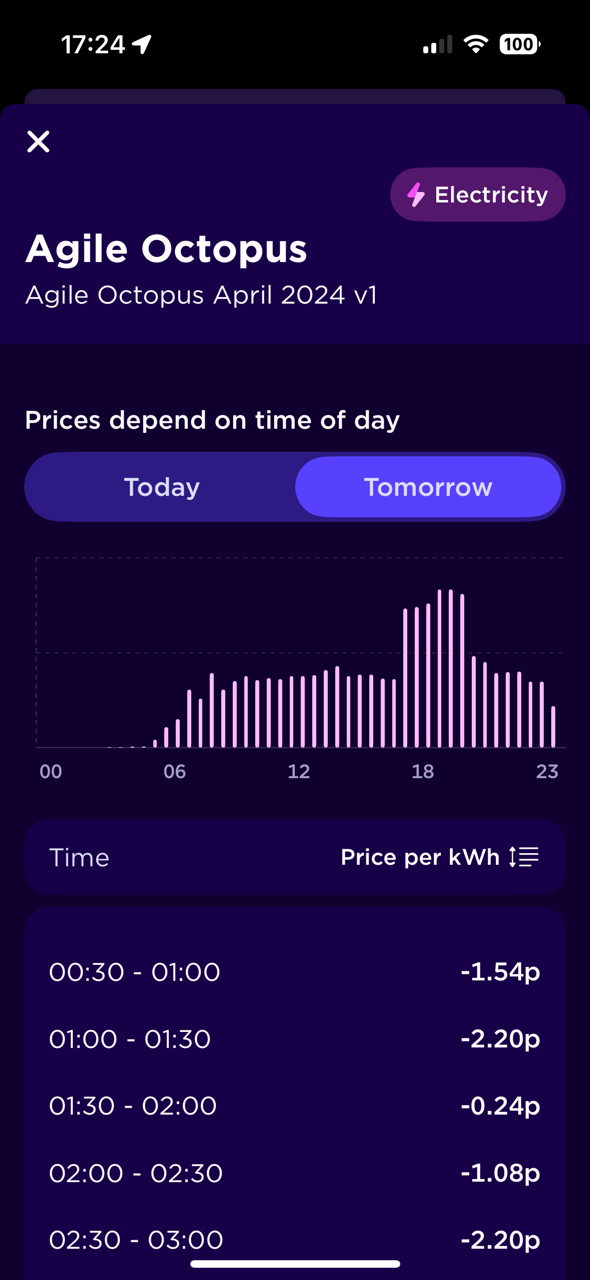
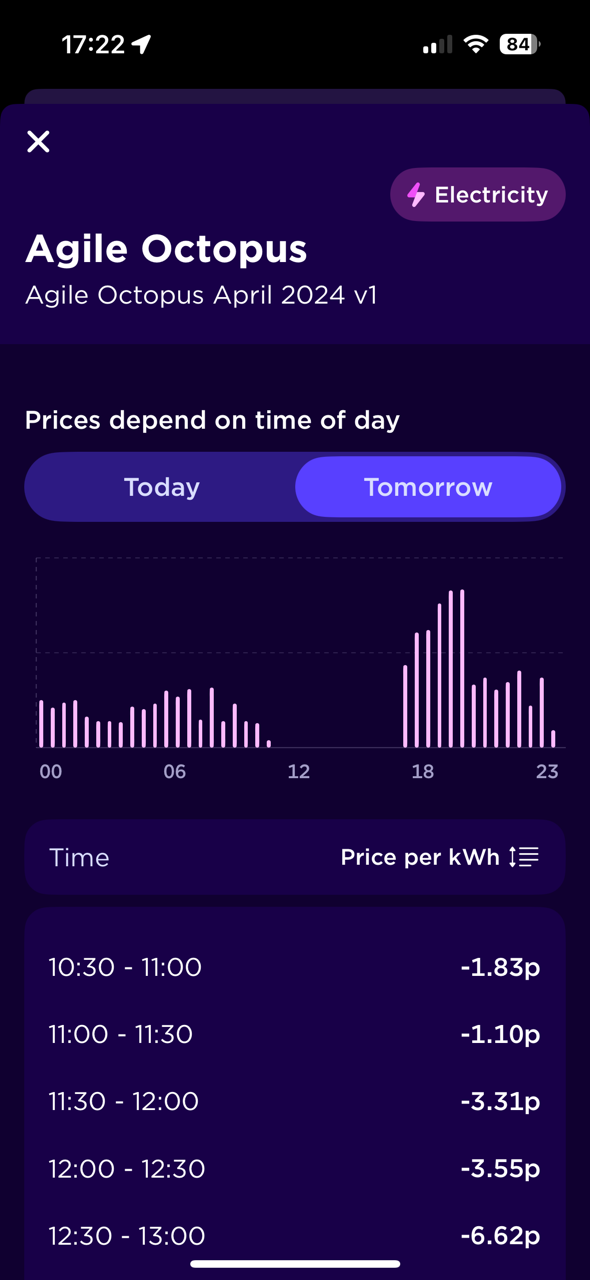
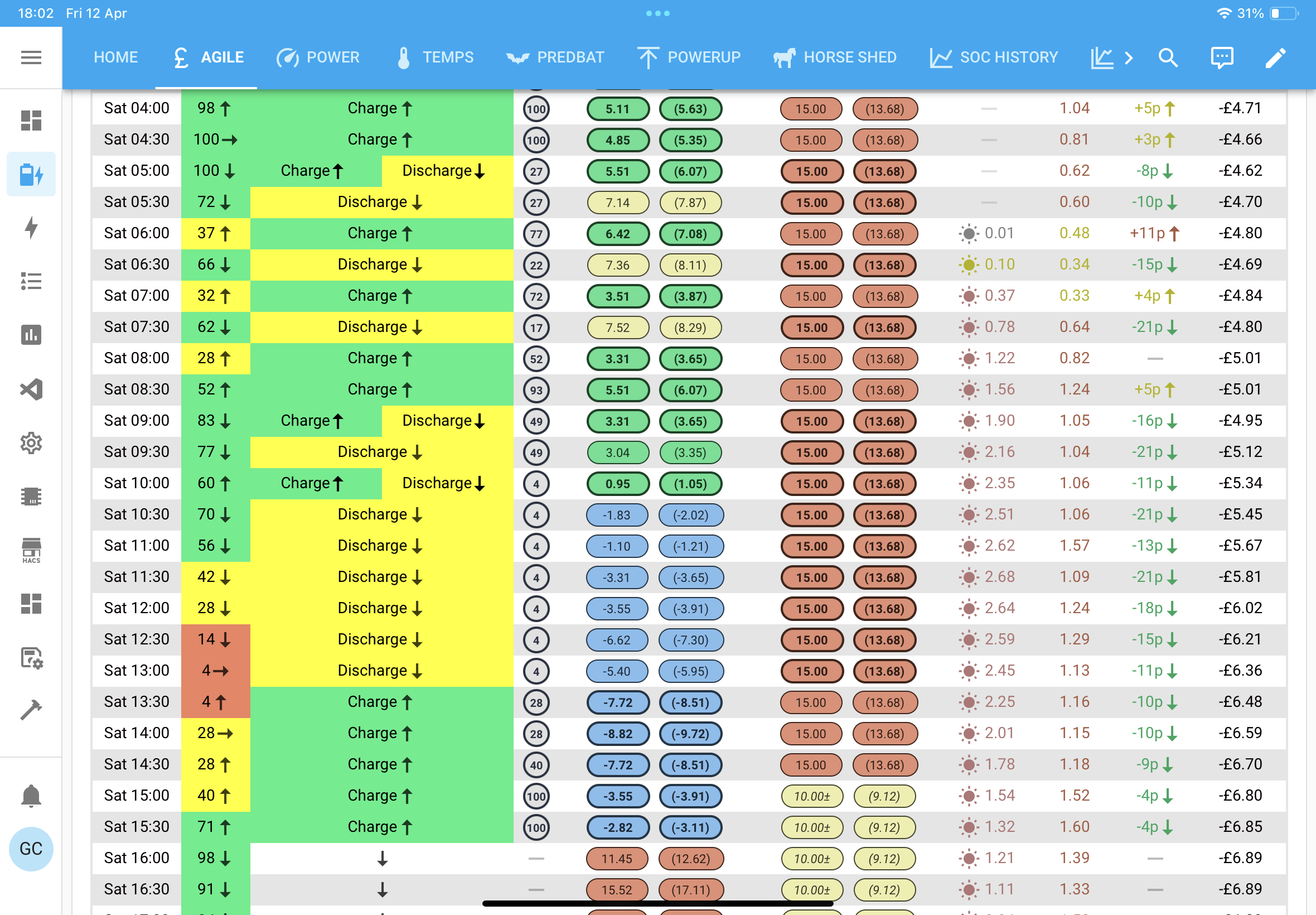
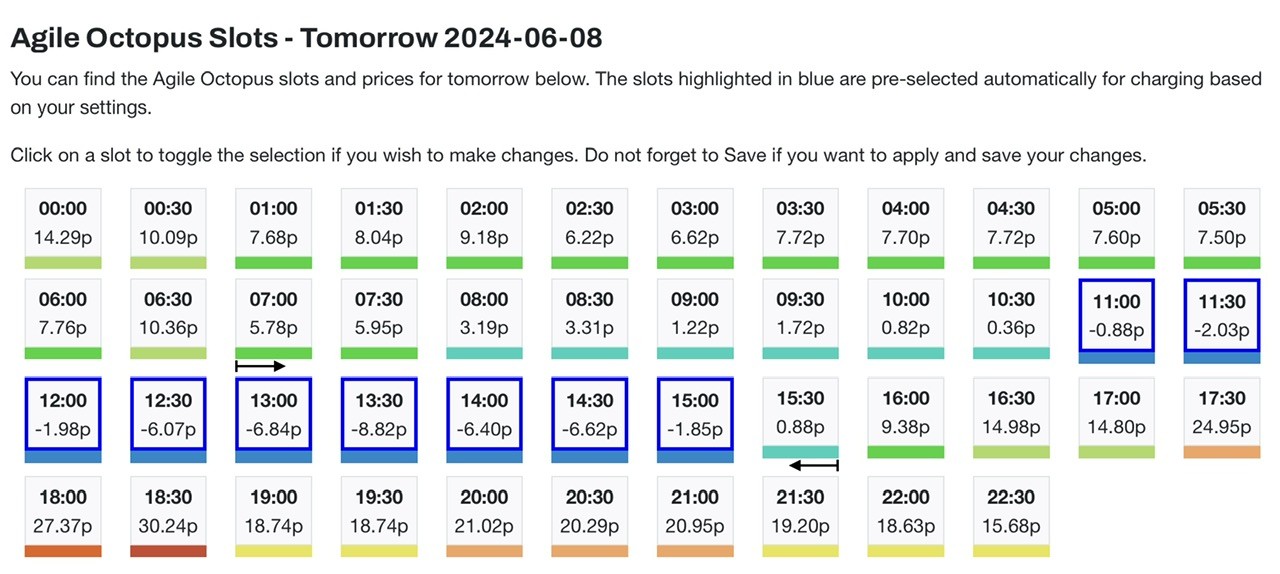
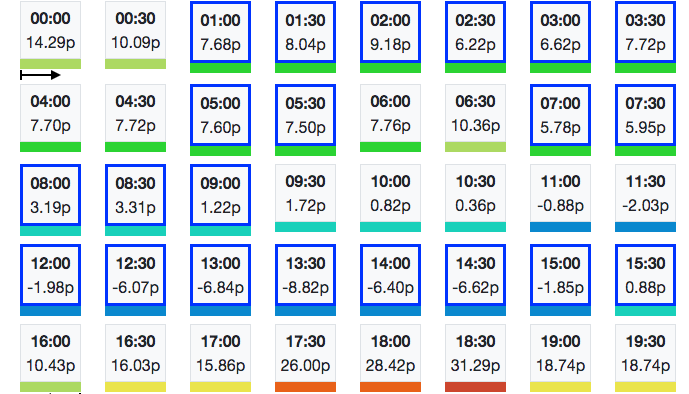
Wow a good charge window on Agile tonight between 12am - 3am, all minus

Daveb01 Yep, far more useful than the negative slot we got in the daytime the other day. It was so sunny there was no way I could consume all the solar generation let alone import a bit more.
Had to make do with exporting at 15p/kWh instead.
Its times like this that at the moment reinforces my view to remain on Agile +15p fixed export rather than Flux as the import is so much cheaper. Even ignoring the low rates when its been windy the OctoPrice app says that over the last week I’d have been £2 better off on Flux export, but even if I’d prioritised more export in the peak period I’d still not have balanced out that Agile import was £24 cheaper than Flux import.
I have never seen such a big minus import, during the day as well 👍🍺
Looks like 11 slots.

Looks like a double charge/export day even without PV input....
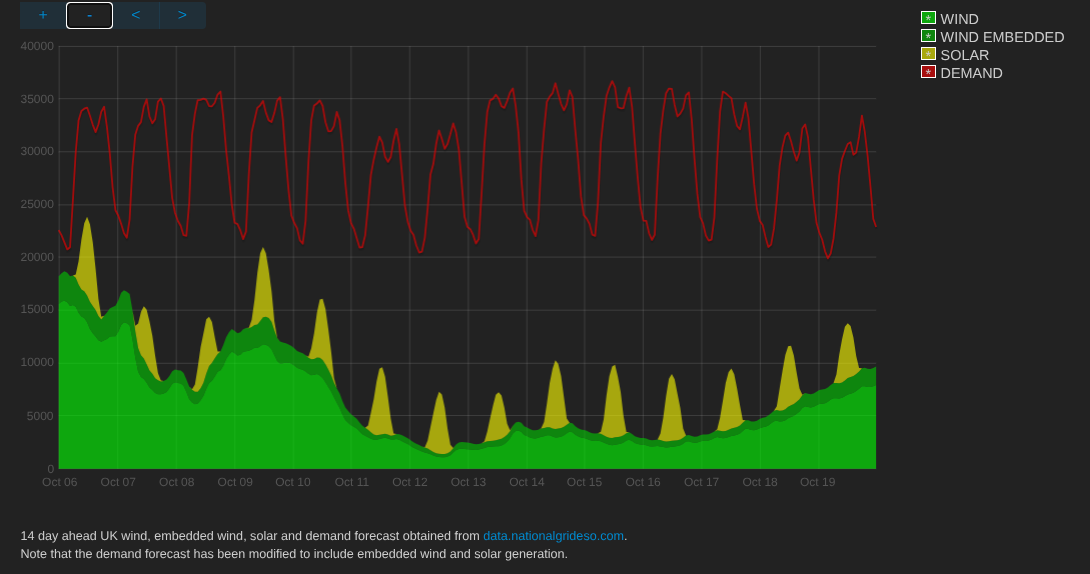
Its so super-sunny tomorrow it looks like I’ll be exporting for most of the negative period. I guess that’s part of why the rates are so low.

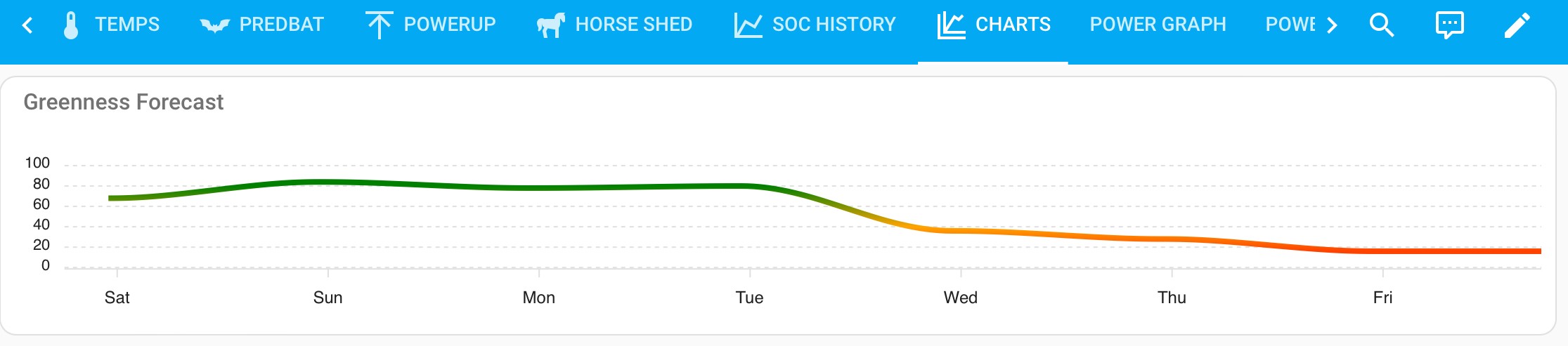
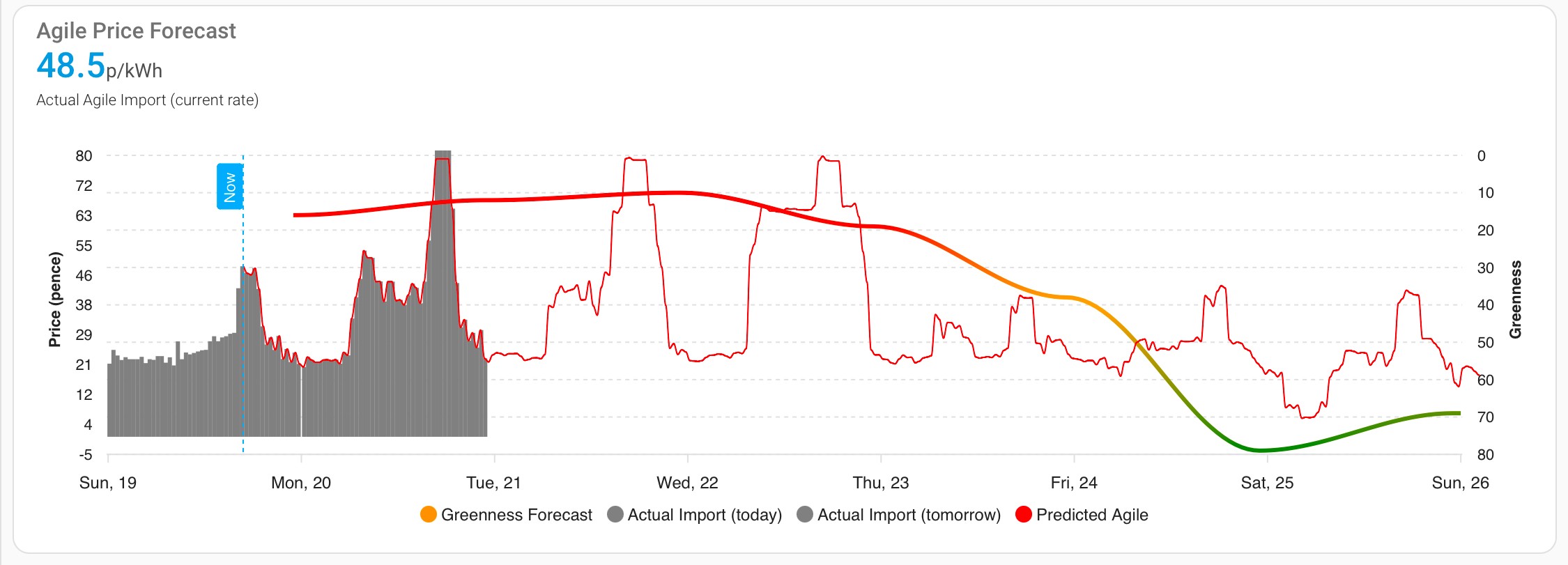
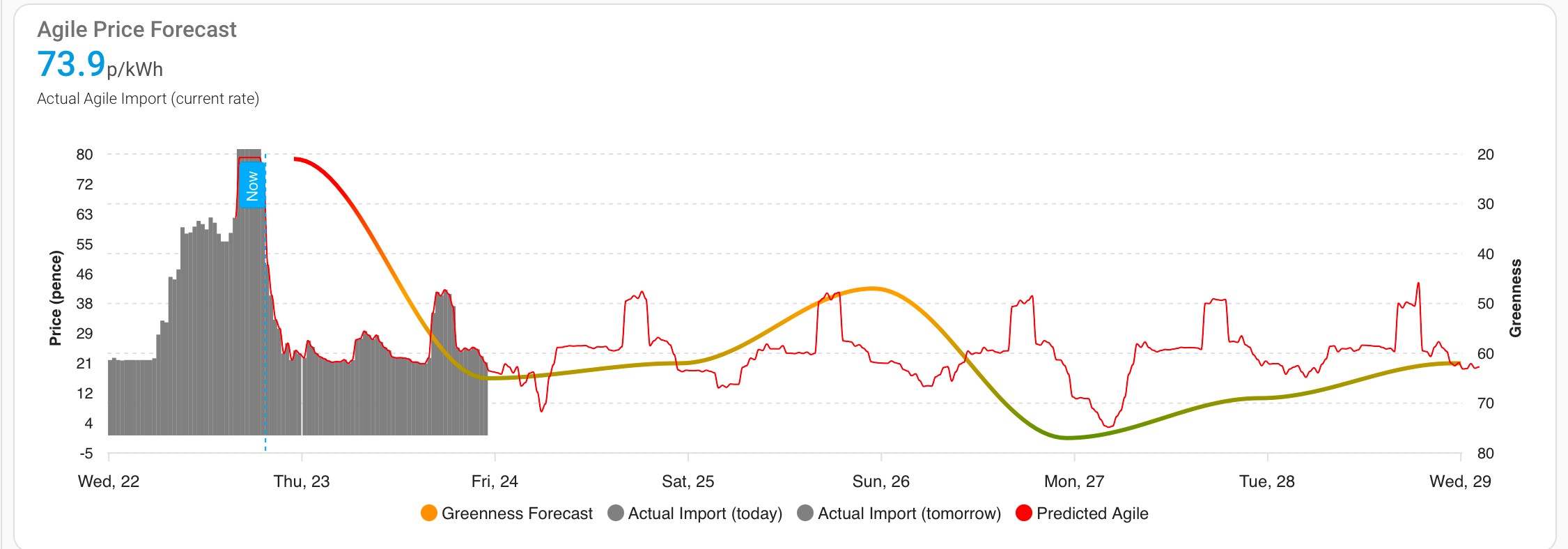
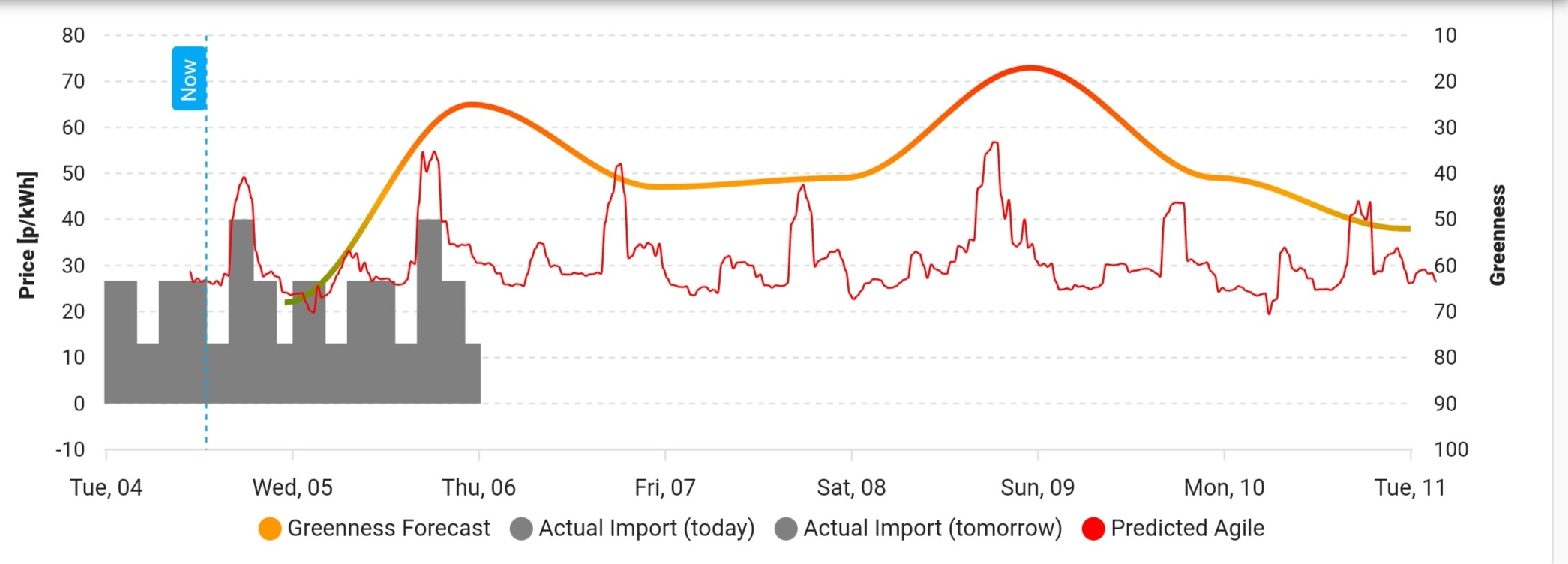
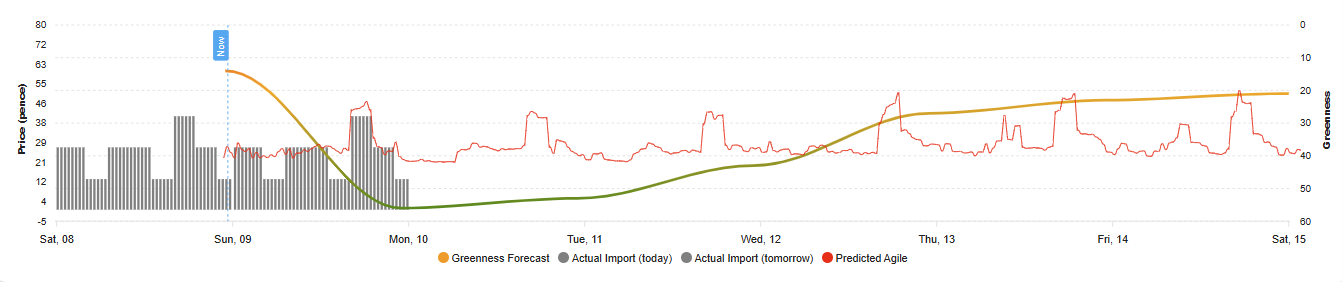
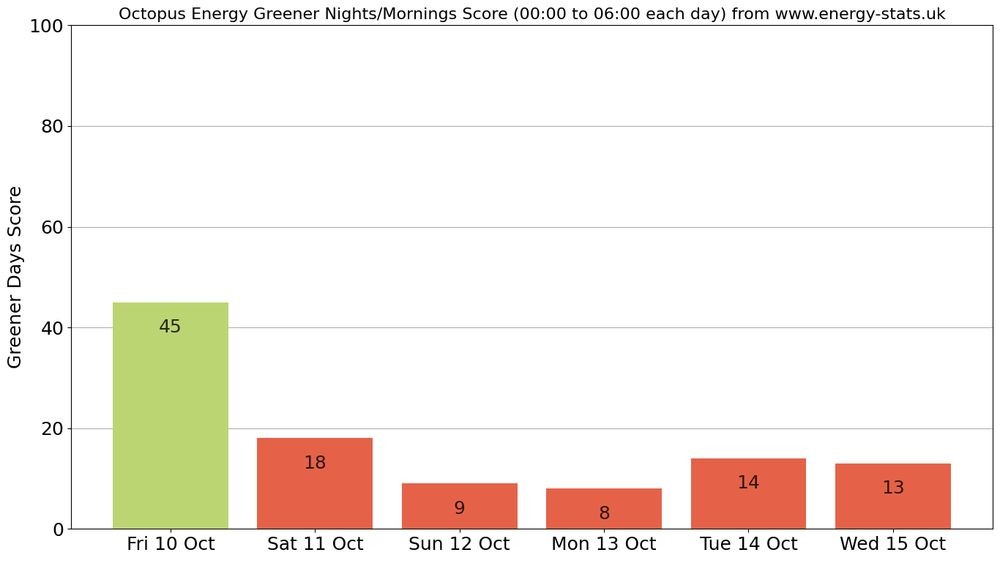
I’ve been looking at the Octopus Greenness forecast which suggests we are likely to get a similar pattern of low rates for Sunday, Monday and Tuesday

Energy-stats.uk have done some interesting correlation of the greenness score to agile prices, and I’ve seen a similar link to the Power up events (yesterday was a power up event from 3pm-6pm)
https://x.com/energystatsuk/status/1777622448516616342?s=46&t=pKwuqfyabC3I5aJJKpHExw

Prices are low all across Europe and gas prices are lower as well. I crumbled today and moved over from IOG.
Change was instant and predbat immediately started discharging.

Hook
Decisions, decisions. Sticking with IOG for a bit longer, I think.
But today I did get Octopus to agree to extend the end date of my outgoing Fixed from Dec this year to April next year. Hold on to that sweet 15p for a bit longer.
geoffreycoan Does make me think I should shift to agile import and fixed outgoing at 15p! This is what agile import and export look like with PredBat.

James L that’s interesting to see. I had heard that when import rates were negative the export rate bottomed out at zero pence.
Tomorrow is an exceptional day, but how high in practice do the agile export rates go - evening peak and say durinig the day?
Fixed 15p export is pretty much the same as Flux export rate, and so durng the day I’m making a pretty steady income. I get the feeling that it’d be much more hit and miss with Agile Export
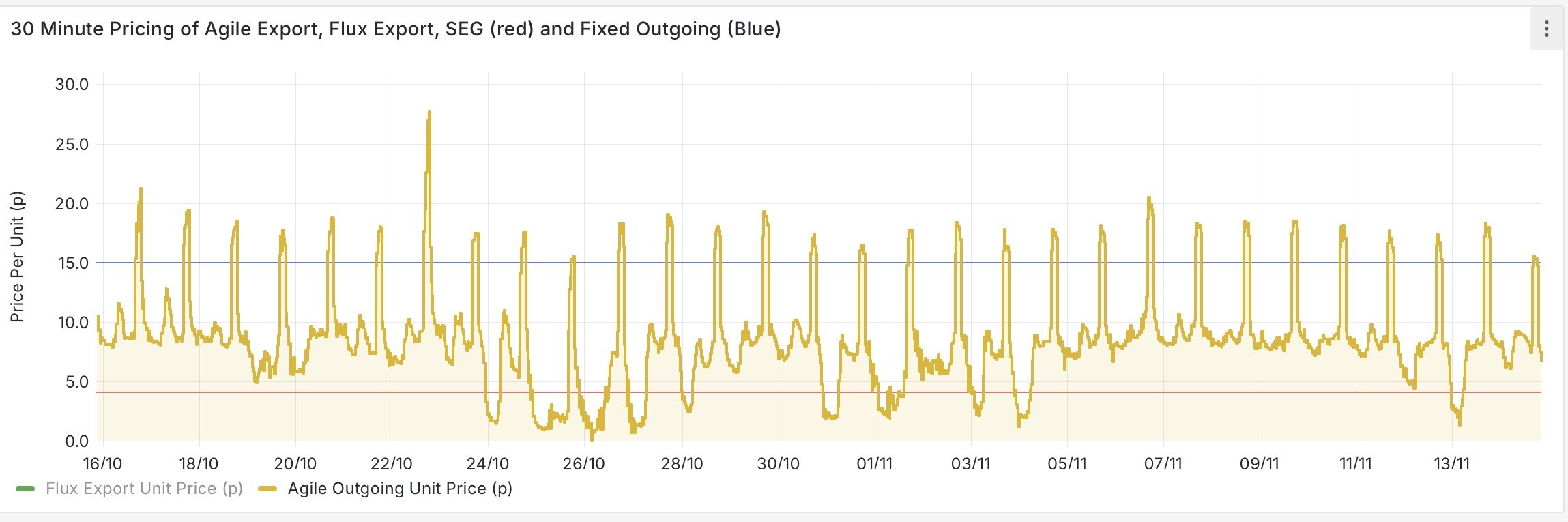
geoffreycoan Agile Outgoing in the East Mids has only been above 15p two percent of the time so far this year. That works out at an average of less than 30 minutes per day.......
Edit - its an utterly pointless tariff and its only a matter of time until someone with half a brain at Octopus works it out. My prediction is that Agile imports will soon be tied to Agile exports much like Flux.
Although octoprice.co.uk seems to show that with my historic usage (the house is empty most of the time May-September while we are sailing), Agile import and Export is better. Unless I'm misinterpreting or missing something.
Of course, it depends on what Agile rates will be this coming summer - the graph below is, obviously, using historic rates.

Vestas Thanks. Just been looking at the energy stats graphs for my area (Eastern) and whilst there are. daily evening peaks of around 20p and there have been some better winter peaks of 30p (when you’re unlikely to have excess to export), the average is pretty much firmly around 8-10p.
https://energy-stats.uk/octopus-agile-outgoing-export-eastern-england/
So for most people its not a good tariff to be on.
With Octopus there’s no single tariff that’s right for everyone. You’d logically think that the cheap 7.5p overnight import on IOG and export at 15p would be another candidate to get phased out. The artificial peak rate supplement of 7p/kWh is another thing and just move to pure market rates.
James L I get a similar result for myself

I think it is valuing all my export at the best agile export rate of the day, so in effect assuming I can store all the solar generation and then discharge it in the peak periods. Which of course is unlikely
geoffreycoan Dunno about last year but this year I could have unlimited excess to export and there's simply no way that Agile Outgoing would produce more income than Outgoing Fixed - not with a G98 installation anyway.
It may work for large G99 installs but not G98 as I could only export a max of 1.8kWh in the 30 minute slot where (on average) its above 15p/kWh.
Edit - also the energy stats figures for East Mids aren't accurate for me. Not sure how he does it but I've looked at some of the Agile Outgoing spikes on the graph and they don't correlate with actual pricing. I noticed this before on Agile imports - they seem to be higher on that graph than they really are.

As it is so rare that we get a day with so many negative price periods I decided to turn off my solar inverter at 10.30am and import as much as I can whilst it negative - batteries, water heating, dishwasher, washing machine, hob and oven. I can do this as I have separate inverters but I must remember to put it back on once the rates go positive.
I thought the same, however using electric is between -1p & -8p.
Export for me on fixed is 15p so best to export excess solar?
I have planned a double export today:
Charged battery cheap rate over night 3p
Exported before 10:30 @ 15p
Charged battery via solar back up to 100%
Will export at 16:00 - 19:00 at 15p
Daveb01 Much the same plan as predbat produced for me, except its then charging and discharging through the evening as the rates are so low.
Its frustrating seeing the -8p import rate and not taking advantage of it, but when I’m generating 3-5kW an hour it makes more sense to export it at 15p instead.
Overall not as sunny as yesterday, we generated 49kWh yesterday.
It also seems counter-intuitive to do the washing etc overnight, as long as its less than 15p/kWh to import, I’ll be making more to consume grid overnight and export solar during the day.

Daveb01 Did a check back. I've used 18 KWHr between 10.30 and 4pm today at roughly -5p average per KWHr. So 90p. The solar would have created 15KWHr but all would have been consumed by the house on a wash day when charging the batteries and heating the water. So I'm 90p up. Normally, however, I would charge the batteries and heat the water when there wasn't much solar (usually overnight) and would have exported perhaps 10KWHr excess solar at 16.5p. So was it worth it? Probably not but at least I now know.
Windy Miller Are you up on the day in terms of money paid to supplier? If so it was definitely worth it, even if its 1p.
Another good day tomorrow 😎🍾

Daveb01 Max of 3.15p/kWh between midnight and 4pm.
My daughter cut her bills (gas & electric) by over 50% just by moving to Tracker from flexible on my recommendation. No inverter, no battery, no PV panels.
Makes you wonder really in terms of people paying 25p or whatever on a fixed-rate tariff.....
Edit - this may come after the "likes" but I'm also opposed to standing charges for the simple reason it has a massively adverse effect on households with lower incomes. "Vimes boots" for those of you who read the Discworld books...
geoffreycoan A thought. I assume these predictions don't take automation like PredBat into account.
I think your previous assessment (in a different thread), that Agile import and fixed export would be better with PredBat control, still holds.
James L I assume these predictions don't take automation like PredBat into account.
Most of these re-pricing prediction tools just take your current consumption pattern over the time period and price it up with a different tariff. So if you are filling a battery on Cosy/Go in an overnight cheap period or exporting in Flux peak, the pattern of behaviour won’t necessarily be right for a different tariff as the high/low price hours are different.
And of course for agile it can be different hours every day.
The pro (subscription) version of the Octo Compare app and the Octo Price have a load shift simulator that you can play around with. I did something simple with a spreadsheet in October last year to evaluate myself what tariff to go to for the Winter. Modelling what the demand was and how I could take advantage of cheaper periods ot charge the battery and as I knew the ASHP demand would exceed the battery, what this meant for more expensive import periods
For the past 7 days ive not paid including standing charge over £1 on each day for electricity, standing charge is a large chunk of it and I run off grid when its basically free rather than use battery which is essentially 15ppkwh.

Vestas It worked out I was actually owed £1.20 for the 10.30am to 4pm period. The whole day comes out at -68p so even with the standing charge the supplier owes me. For £1.20 I could have exported 8 units and may have done 10 so it's pretty close. With Eon SEG I don't get to see the export money to the end of the 12 month period (May) when they are supposed to send me a cheque.
Oh no not a “cheques in the post” pun 👍😀
How come it's so cheap at the moment? I've seen a few days of negative pricing in the past with storms, but nothing like this.

danerf windy sunny warm
After tomorrow (Monday) I think we’ll see a return to much more normal pricing. The Octopus Greenness index falls through the floor for the week:

Looks like another double export tomorrow 👍

Back to normal from tomorrow 🙁

Daveb01 pretty rubbish today/tonight, as you say, back to more normal.
Still, I’m £4.42 in profit today after exporting 33kWh, so its not all bad.
Looks like (from the Octopus Greenness score) that it’ll be much the same Wednesday, Thursday, then cheaper on Friday
The free leccie is over 🙁
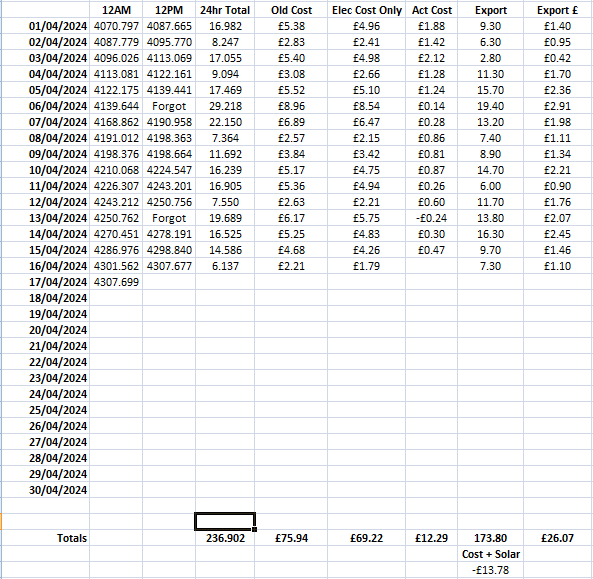
This is my position currently this month.

Seeing the old cost vs new cost is quite the eye opener.
Act Cost = Actual cost from Octopus Compare app which includes standing charges.
Jellybaby Do you manually read the import and export meter for the above spreadsheet?
MickWheater You should be able to use the inverter meter readings from the portal (or Home Assistant). Mine are very close to my Octopus meter readings so I use them to track my consumption & export.
But I personally only update my tracking spreadsheet monthly
geoffreycoan I have found the meter data in the inverter screen on the GE portal but it shows entries for every 5 minutes, it is not easy to obtain the information from without scrolling through many entries.
I think the best way I have found so far is to connect my tariff to the GE portal and use the 'Smart Tariff' tile on the dashboard. I don't see meter readings but I can see my import and export KWh figures.
MickWheater yup, in home display makes it easy
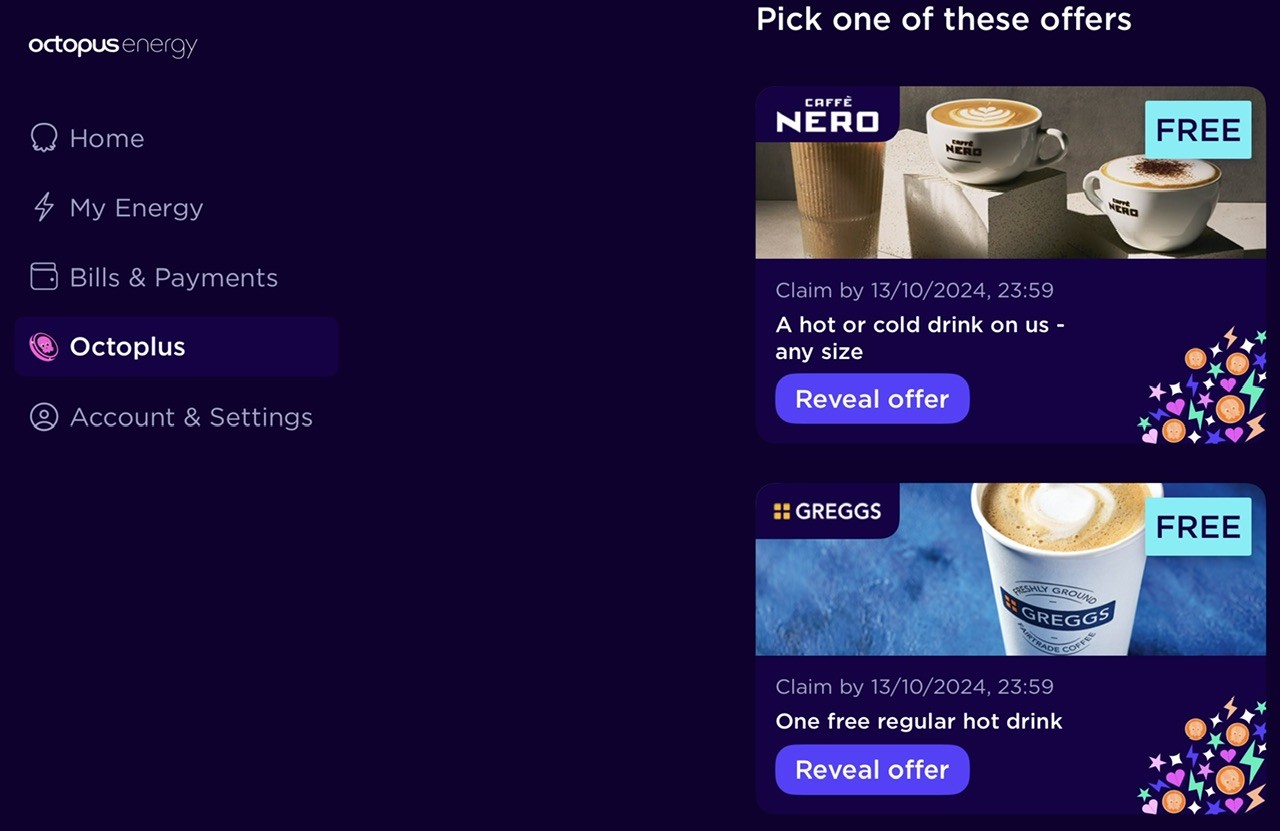
New Octopoints coffee offers 😀. Still no sausage rolls though.

Just noticed a new Octo offer today

I am liking Octopus Agile with fixed export and it is doing better than Flux, so sticking with it during the summer.
April
Import - £39.62 (410 kWh)
Export - £106.69 (514 kWh)
Octopus Gas Tracker
Import - £17.79 (414 kWh)

Daveb01
Over 20p/kWh Fixed export? Nice. How did you manage that - I'm on 15p?
Your Agile price of 9.6p (that excludes standing charge, right?) is less attractive than my IOG though. Last month I paid a headline cost of 7.5p, which reduced to about 5p for a full battery after doing a nightly Predbat charge/discharge/charge cycle.
Hi all, I have a question please. I am new to automation & keeping it very simple to start.
I have an AIO & 6 kw Solar
Background
I have been on Flux since Aug 2023 and it’s worked well, however my mind set has been on import at cheep rate and export during peak rate.
Thought’s
Moved to Agile as import was much cheaper on average, however export is rubbish.
I am now on Agile import & fixed 15p export.
Now export is fixed, I can export anytime.
Question
What’s the best strategy now please (add any thoughts on what you guys do please)
- Set import to cheapest times night and day (as long as under 15p).
Export for 2 hrs in morning
Top up with solar (if any) or slots below 15p
Export again for a couple of hours during day
Save a bit of battery % when import periods are above 15p (especially between 4-7)
Export again if battery above 40% for say an hour
But no need to export between 4-7 any more?
Worries
Battery SOC may well be screwed
Battery drops
A bit of planning needed if no sun the next day
Will have to change this from say October.
Daveb01 Hi Dave
I’m on agile import and fixed 15p export. I use predbat to automate my battery management, but basically the strategy is to import when its less than about 13p not 15p as you have to allow for conversion losses.
Only perform forced export/discharges when the rate is due to drop substantially and you want to gain more SoC space for a cheap rate fill up. Just let the inverter export excess solar otherwise when the battery is full.
Never import in the peak 4-7pm period. No benefit to force export during that period either, I only export then if the battery is full and its just excess solar.
If its been a particularly grey day and depending on your battery capacity, consider an afternoon chargeup/hold charge to ensure you have sufficient battery soc to see you through the evening peak. Sometimes agile can be 20p well into the evening if its cold/not windy. Still cheaper than std variable but not as good as agile can be.
Run any high load appliances such as washing machine, dishwasher, tumble dryer overnight. Usually cheaper agile rates than you’ll get by importing rather than during the day when using up generated solar.
I think you put the mockers on it as there are no slots below 13p tomorrow 🙁

Had my bill come through for April which coincided with me moving from iog to agile.
IOG average was 7.62p v Agile average of 6.03p both controlled by predbat.
Although there were some negative slots when I first moved. Not been great for the last couple of weeks though. At least it’s sunny now.
I’ll probably move back to iog when I can. I think I prefer the predictability of it.
If you can access IOG I think it makes sense rather than Agile.
I am experimenting with Agile and I had just the standard go which doesn't allow the 15p export. But IOG does and you don't have to keep a constant look out for cheap slots.
I don't have a car or EV Charger that can use IOG so Agile or Flux gives me the 15p export rate.
Jury out on Agile for me so far...
M_J just in case you weren't aware, eon next drive is slightly better than IOG - 6.9p overnight for 7 hours, and 16.5p export. (Or something along those lines.)
Just got my April Agile bill.
£51 import, £144 export but then £19 of credit from the Power Up (zero rate electricity events), making a total credit of £112 for the month
My average import price (excluding the effects of the power up events) was 7.64p/kWh. March was 11.49p and I paid a tiny bit for the electricity consumption.
I don’t have an EV so quite happy with that.
Just doing some quick comparisons to Flux for the summer …
My man maths goes like this:
Day time export (15.51p) is almost the same as my fixed 15p export. Peak rate export (25.85p) is 10p better, and overnight import (15.15p) is (compared to April average) about 8p more expensive.
So roughly I need to export as much in the peak rate as I import overnight to counterbalance the rate differences. At the moment we are importing between 2 and 10kWh a day on agile, but that’s only because of the agile rates being lower than the export rate.
Apart from Friday when it was overcast and raining all day we are exporting more than we are importing every day so that suggests I could run on solar only on Flux with minimal import. Since any overnight import needs an equivalent amount of peak rate export to balance the rates, there’s no real benefit to force discharge in the peak and I’m better to retain the battery through the night to avoid evening and overnight import.
Upside is any excess solar exported in the peak is earning 10p/kWh more. Looking over the last week, I’m exporting 6-7kWh in that period. Slight additional upside of daytime export being 1/2p/kWh better.
Downside is any import at all is going to be more expensive than Agile.
The standing charge is 7p/day more expensive on Flux as well.
On balance I think I will stay on Agile. Whilst the export might be up to £20 a month more profitable on Flux, that gets eaten away as soon as I have to import, e.g. running the hot tub. And staying on Agile means I’m ready for the winter.
geoffreycoan Great in depth analysis Geoffrey! Agile obviously works a bit better for you particularly since you are still importing. Personally Flux is still working for me as I'm a low user and haven't imported now for a couple of weeks, making over £40 net, after gas, imported electric and standing charges in the last month.
Not very good tomorrow, not seen it like this before.

Daveb01 This weekend was surprisingly expensive as well, given weekend demand is usually lower, it was quite sunny (I generated 56kWh on Saturday and 49kWh so far on Sunday), the rates were in a similar range to what they are tomorrow.
Predbat is letting the battery run the house for most of the night with a few bits of freezing the soc and running off grid import where its not worth charging the battery up

Have to take some of the rough with the smooth with Agile.
TimHutchings if I had moved back to Flux then I’d probably not be importing much either. I’m only importing at the moment when Agile rates are lower than my export rate (or its a free electricity power up event when we charge the batteries, do the washing, etc). Last July I imported only 26kWh for the whole month.
It was just for me there wasn’t enough upside with Flux to make it worth the risk of paying for expensive import. Last year I was quite happy on Flux and was delighted by the export rate, but since then I’ve got better battery automation so can make the most of Agile. Things like Wonderwatt weren’t around either

Daveb01 Well I did have to ask for it three times but I eventually received £250 from Eon for the first years export at 16.5p per unit. I hope to improve on this next year now I'm on the Agile tariff so can also export from overnight cheap charging as well as excess solar.
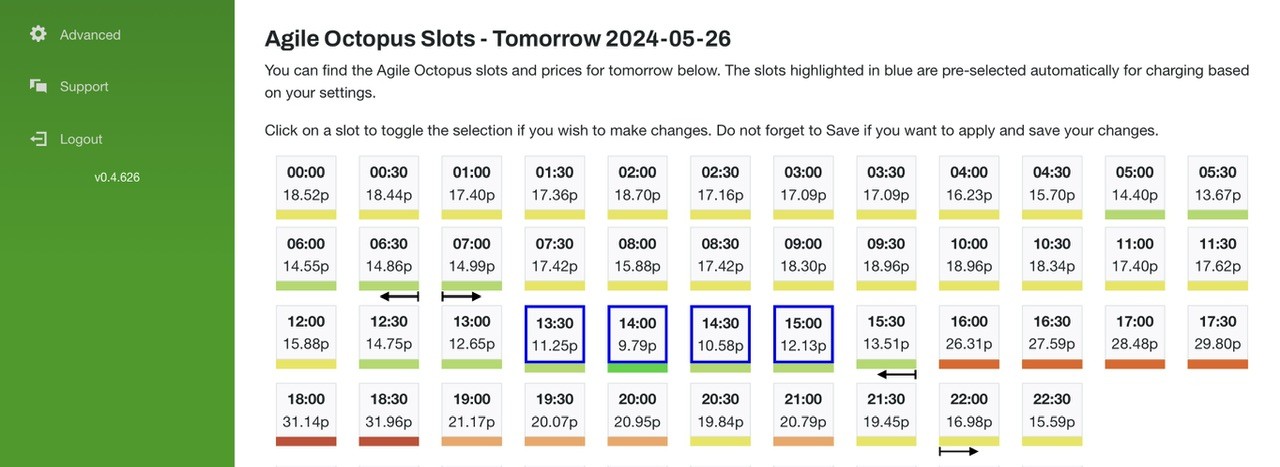
As Wonder Watt lets you change the amount of slots it picks when the Agile slots are released at 16:00, I have changed mine now the sun is out more during the day as an experiment. (I am sorry if this jinks the weather and it now rains for a week)
I was charging at night on slots below 15p, exporting any Solar during the day at 15p. Exporting the battery between 19:00 - 21:00.
I am now trying not to import anything, if there is sun. so have charged the battery up to 100% via Solar during the day, export a little between 19:00 - 21:00, leaving enough t to last the night, ready to charge the battery up the next day.
Wonder Watt allows me to auto select slots during the day at very cheap rate to charge the battery if not enough sun, and auto cancels the charging slots if battery is full.


Going back a bit, these are the "allowed" tariff permutations apprently
iain
Good day tomorrow 👍
I am discharging 6-8am & 7-10pm


Trying an experiment tomorrow to see how much I can export (at 16.5p) and also how much I can import when negative. Starting with a discharged battery I can charge in these slots and discharge in the gaps. Then use the 12 to 15:30pm period to heat the water, run the washing machine and dishwasher and possibly do some cooking too to maximise the payback. (I did just watch GaryDoesSolar on YouTube when he said hammer the battery :-O )

It’s interesting seeing how predbat has planned for tomorrow’s agile rates for me.

Its force discharging the battery down to empty up to 1am, then filling it up again with grid import overnight so that by the time the solar starts the battery is full. There’s a couple of small discharges and recharging along the way when rates make it favourable, but through the afternoon when its negative prices, I will be exporting not importing.
This seems counter-intuitive, but I think the rationale is as follows:
The forecast is ~ 3.5kW of solar every 30 minute slot.
I have 2x Gen 1 hybrid inverters so they can only charge the battery a total of 2.6kW in the slot (1.3kW each inverter for 30 minutes).
I’m therefore generating more than I can charge into the battery and so I couldn’t import anyway.
Also it’s more beneficial to export that power at 15p/kWh than be paid the -6p/kWh for import.

geoffreycoan Yes that's where I may come a cropper. If the sun is good I'll simply use it all without exporting. I'm banking on an overcast early afternoon (currently forecast here). I might even turn my Solar inverter off for the negative hours.
I did not charge up over night, discharged the full battery at 6-8 this morning ready for them paying me to charge from 11am. Then as it’s sunny full solar export, so should make a few pennies today 😀👍
So today
I have cancelled the export tonight between 7-10pm, have done an adhok tomorrow morning from 4-7am. Then see what we get tomorrow, for the next export.
So at the moment:- Battery charged at minus, cooking and Washing at minus, plus exporting solar as sun has now come out, not a bad day really. And it took 30 seconds to change all this on Wonder Watt.


Windy Miller My results are in....
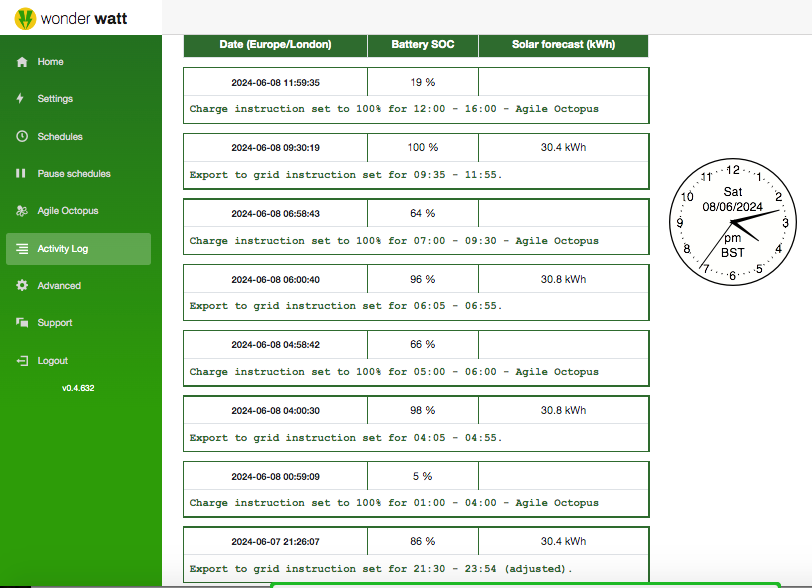
Hopefully there are 4 screenshots after this text.
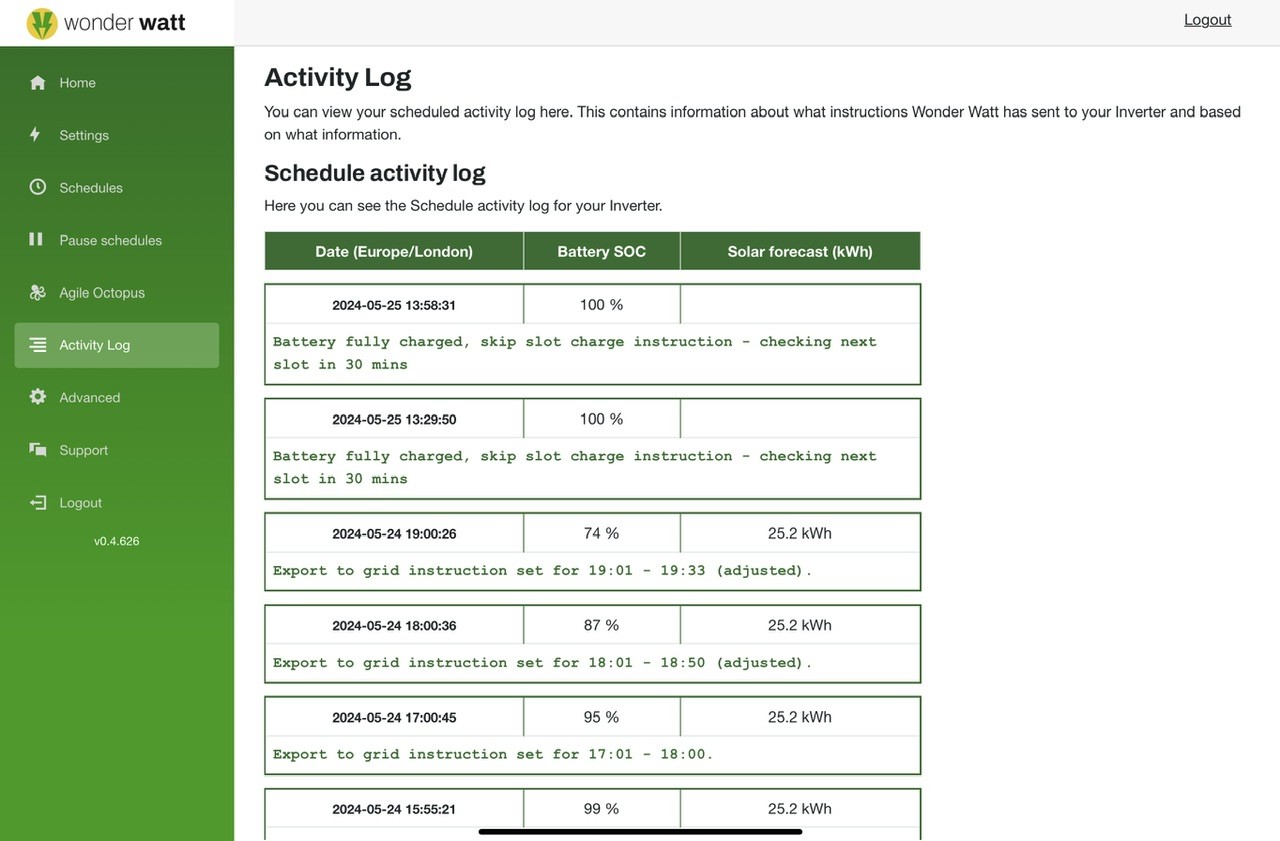
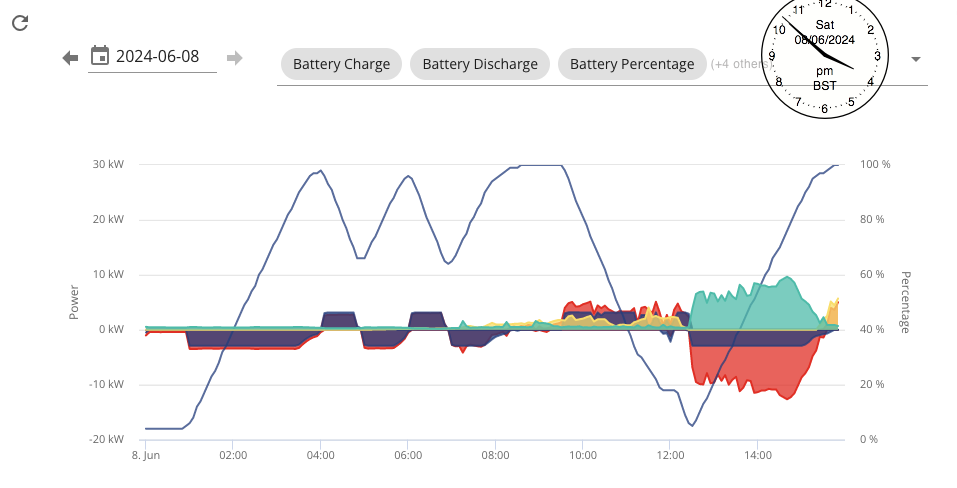
The Givenergy charge/discharge profile (shown below with the WonderWatt Activity Log following) yielded 17 KWHr of export overnight and into the morning which at 16.5p/unit netted £2.80.
Solar export up to 12.30pm was 4 KWHr so another 66p.
But the cost of the overnight charges accumulated to £1.17 so the net gain of hammering the battery was £2.29.
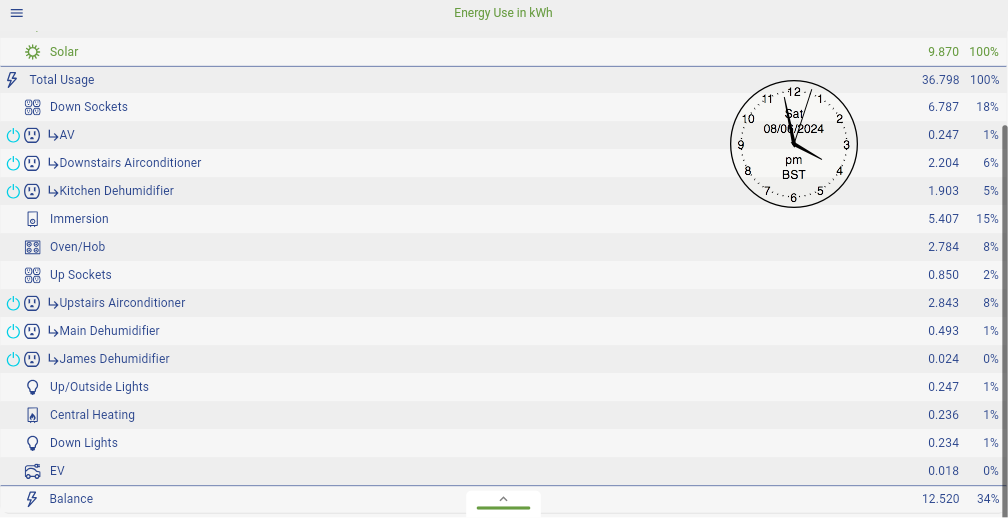
During the plunge session I turned off the Solar inverter so that I could maximise the electricity import. I managed to import some 35 units - the 3rd screenshot shows roughly where it went (balance is what went into the battery). I did an oven cleaning cycle, heated the hot water tank from cold, 3 washing machine cycles and a dishwasher cycle as well as running all my aircon and dehumidifiers.
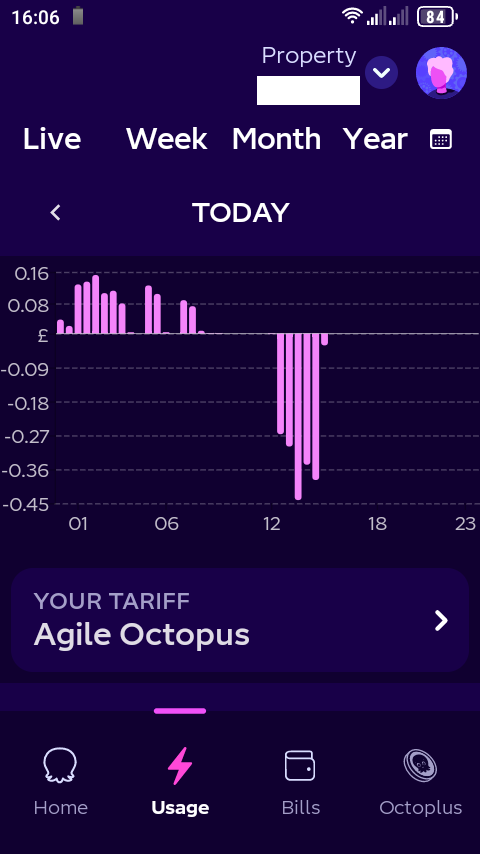
The 4th screenshot from the Octopus app shows I gained £1.80 in the 3 hour plunge session. But I forwent probably about 9 solar units which I could have exported - a loss of £1.49. So the net gain of all that effort was 31p!
So Geoffrey was right in his explanation of why PREDBAT didn't bother with charging during the daytime due to the expected solar units.
This is the 2nd time I've tried not running solar during plunge sessions and it has confirmed to me that it isn't worth doing in the summer.


It can become too complex trying to work out the optimum approach with Agile, especially in summer when there’s loads of solar predicted which may or may not happen.
I increased the Solcast 10% weighting in predbat from 30% to 40% in case it was going to be a duller day than predicted, but couldn’t see any obvious change to the planned battery activity.
As it was negative for the afternoon we had the washing on, tumble dryer, dishwasher and I turned the hot tub on to start heating it up for the first time this year. There were periods where we were net importing, and others where we were net exporting.
61kWh generated, 33 exported, 21 imported with a total house usage of 39kWh (half of which was the hot tub 😦). -£3.86 so far today.
Good to see that we’re back to a more ‘normal’ agile pattern with cheap overnight rates that predbat is filling the battery with, and then will be holding the charge tomorrow through the negative periods.

geoffreycoan Yes I quite agree. That's why I like to run experiments to understand how things might possibly work before I hand control over to one of the "intelligent" tariffs from Octopus or even to a control algorithm like PREDBAT.
I have learnt a lot in the last 2 months since I moved to the Agile tariff and in the last month of using WonderWatt. The latter I currently prefer as I retain control over exactly when to charge and discharge the batteries for maximum gain. Looking at my results over the last 2 months I have managed 85% days making a profit with my system with the maximum in one day of £5 (lots of solar, no import and 31 units exported) but a loss one day of £5 (little solar and needing to charge my son's car when he visited.)
Overall I'm making around £40 a month with the solar levels we are currently experiencing (possibly a little more as I sometimes heat the water from Electric rather than Gas). I hope this continues through to August but I expect things to be quite different once the solar levels drop in the Autumn. BUT this time last year, just before I had the panels fitted, I was paying £125 a month so the swing is £165 of which I am delighted.
geoffreycoan You can insulate the hot tub/install a heat pump for it and get some significant savings.
https://www.revk.uk/2024/05/hot-tubs-are-expensive-again.html
I found the "Pause Discharge" option on the "G1 fast response f/w" very helpful yesterday - also the Solar iBoost water heater earned some cash 🙂
17.6kWh imported between 1130-1530 despite the PV array being maxed out (3-3.4kW) for most of that period.
"Pause Discharge" is on today as well, no point in doing anything else when import is under a penny/negative....
Every 30 mins tomorrow is over 15p export rate, so ho[e there is a bit of sun down south tomorrow to keep me from importing 50/50.

Daveb01 Much the same in East Anglia. Predbat hasn’t scheduled any overnight charging for me, I’m running entirely on batteries overnight and they’re predicted to get down to 19% - phew, just enough!
Then lots of solar forecast so I’ll be at 100% by 10:30. And then I’ve got an Octopus Power Up event from 12-2pm, free electricity, but currently forecasting so much solar that able to take advantage of it. Such struggles!

Pft. You lot have your odd negative slot weekend every month which suckered me in once, but I’m far better off on iog!
Hook No EV for me so IOG not an option. The negative slots on Agile are quite rare actually and generally the Agile rates are above the 7.5p you get on IOG, so if I did have an EV it would be something I’d definitely look at.
I have succumbed to the better export rate of IOF though and applied to move to it last night. The enrolment failed so waiting to hear back from Octopus.

Be interesting to see how you get on.

geoffreycoan I have succumbed to the better export rate of IOF though and applied to move to it last night
We’ll miss you on the informal Predbat Users Society. (Assuming you can get registered 🤞)
PianSom Well I’ve still not heard back from Octopus so no change in my use of Predbat at the moment.
Assuming I can get enrolled I believe Octopus can only control 1 inverter on IOF and per the FAQ’s I will have to control the second myself - for which I will use predbat so that’ll be an interesting experiment. If I get a choice over it I’d prefer Octopus to control the inverter with the smaller 5.2 battery on it and I control the 9.5. Am hoping this’ll give me the best result from IOF, the superior export rates and a higher degree of control over what grid import occurs.
I ran the numbers several times and it was the circa £100 a month extra from export income that made me change in the end. It’ll only be a summer switch, I’ll be back to Agile and full use of predbat when I turn the heat pump back on.

geoffreycoan I ran the numbers several times and it was the circa £100 a month extra from export income that made me change
I'm not surprised - intuitively your large array of PVs should make the summer export rate of IOF very attractive.
Did you ever find out what happens with Power-ups + IOF - will you still be able to get them?
geoffreycoan Did you turn off 2FA on GivEnergy account on dashboard?
Good luck on the new Tariff Geoffrey.
I have had a think about it and I have only had my system since August 23, so 25 years to experiment 😀👍.
I have done Flux, now trying Agile, I will let you guys + Tim & Gary report if it is worth it.
If a new tariff comes out or no change next year I will prob do Agile till April/May, then IOF, then back to Agile in October.
As long as my bill for 12 months is close to zero as possible I will be happy. Any extra is a bonus but I am not worried. 👍🍺
PianSom My assumption is that I will still get the power up events, but will be something I’ll check when I get a response back from the Octopus smart tariffs team.
Leeshore I have never turned 2FA on on my GivEnergy account. But yes I did check this as I have heard it causes problems. The strange thing is that an authentication token was created for Octopus during the enrolment process, so not sure what the actual problem is. I suspect its my two inverters that are confusing Octopus 🤷♂️

Error message is a bit generic

geoffreycoan I had the same issue. Octopus told me to contact GivEnergy who tweaked my settings which sorted the issue. See https://community.givenergy.cloud/d/4267-intelligent-flux-sign-up-issues/7

geoffreycoan
IIRC they were originally scheduled to last a year - until August. So maybe there’ll be a change anyway then. No way of knowing.
So not to bad on the new thought process on Agile (see above).


Not bad yesterday sun wise, but we are very near the equinox. Long may it last.

My June month to date is £22.24 imported (of which some will have been power up events) and £100.12 exported, so doing all right still. Its funny how your solar expectations get changed though, in May my best solar day was just under 70kWh, in June I’ve had a couple around 73kWh, but the solar forecast has me wanting to see 100kWh in a day!

Still no update on IOF. GivEnergy reset my inverters as Leeshore suggested, and broke them for the weekend as a result, but I still can’t get through the enrolment process. Am waiting a reply back from 🐙

I’m 31% down on generation so far this June compared to last June. It’s been very dull in comparison.
Fortunately predbat is doing well with iog to maximise my returns.
Not even 2 month into my journey yet, but working hard to get everything I can from the solar, no clipping losses, high rate exports etc..
£200 of export over the last 5 weeks (36 days) from a 6kWp system and 9.5 battery.
I think this month is going to be a good one. Good sun makes a difference, but NOT charging at all from grid seems to be working. Battery just needs a top up in the morning then solar is exporting much earlier, til about 20:30.
Month-kWh-£-Import/Export (Octopus readings)
April-410-£39/514-£84
May-318-£41/604-££90
June(so far)-51-£3.56/572-£85.86

Final result


Daveb01 I’m waiting for today’s export data to appear in the Octopus app tomorrow, but looks like a bumper month for me as well

I'm on the same tariffs and my June is very similar. We have a 5.25 kWh array and AIO. I have been using WW to do a bit of manipulating with importing from the grid when prices are super low and then exporting back. Nothing as structured as HA/ Predbat ( which I follow assiduously, but still haven't pulled the trigger on Pi5 / HA Green ) ( not sure which is the best option).
I was thinking all the same things, however my other half has said you have only had it 11 months and you have a further 24 years to play with it. You have dont the manual thing in the app only, you are trying WW for 12 months, then you can decide if you want to go down the HA route in a year or so.

Daveb01
That sounds eminently sensible, I can see the logic in it and It's the road that I plan to go down. Give WW time to evolve and mature.... but then I won't have a new toy to play with as the nights draw in...
Wow a good day tomorrow

Daveb01 Its not really a good day tomorrow.
The overnight rates are good, Predbat is already starting to discharge my battery ready to fill it up later on tonight and in the early hours at cheap/negative rate.
But the rates during the day tomorrow are worthless if you have solar unless you can shift an awful lot of load into those time periods. My solar forecast from around 9:30 is 4kW of solar generation every half hour, so there’s no way I’ll be able to consume all that and import a bit to earn from the negative rates. Should be loads of export income though, circa £11 income tomorrow.
First world problems …
May was my best month so far since having the export tariff, £30 import, -£194 export

geoffreycoan My solar forecast from around 9:30 is 4kW of solar generation every half hour, so there’s no way I’ll be able to consume all that and import a bit to earn from the negative rates.
Turn off the PV inverters??

PianSom I tried that. Was a lot of effort and managed to increase export revenue by 31p! I need to see negative pricing of 50p per half hour.
PianSom Turn off the PV inverters??
The lowest price tomorrow is -2.38p/kWh at 13:30 when my forecast solar generation is 3.85kWh and house load of 1.05kWh.
So I’ll earn 3.85-1.05=2.80 * 15p /2 (half hour slot) = roughly 20p for the half hour
[Predbat thinks I will earn 39p for the slot so I’ve messed up something in this man maths, but carrying on anyway…]
So to earn 20p from the negative import rate, I’d need to import about 9kW. Do-able but challenging.
Even Predbat thinks it’s not worth discharging the battery during the day. I’ll keep an eye on it in case it changes its mind but so far, its just not worth it

geoffreycoan Even Predbat thinks it’s not worth discharging the battery during the day ... its just not worth it
Not with that attitude!
😉
Is predbat smart enough to schedule multiple consecutive charge/discharge cycles when the price is this low? Our solar doesn't really kick in until 11AM so there's almost 12 hours of when we could be doing this.
So I am discharging now till midnight @ 15p
Charging from 1am - 4am on negative
Discharging from 6am - 9am @ 15p
Charging from 09:30 - 16:00 + cooking + washing bedding on negative
Solar export at 15p once battery charged and house load met.
All the charging and discharging done via Wonder Watt. 😀👍
rjp yes Predbat works out the most cost effective charging and discharging based on historic house load and projected solar. My plan tonight is discharging tonight, then a bit of charging up, then discharging again before the negative slots, then charging in the negative, a bit of discharging and then recharging at the end, leaving the battery pretty full so it will start exporting as soon as possible in the morning

I see a people in this thread with absolute loads of export, I assume that's a lot of solar?
I have 10 x 390w solar panels and 14.75kWh battery (ish) so I assume that's why I'm not seeing over £100 export?
This is my current plan

Im not sure how to use my Agile tariff to link with my Zappi and get the best charging for the car (Phev so only small battery) as I need it ready by 7am and not back until 6pm to maximise, so currently only set charging on the zappi app to coincide with the cheapest period overnight.
shawry I see a people in this thread with absolute loads of export, I assume that's a lot of solar?
I have 10 x 390w solar panels and 14.75kWh battery (ish) so I assume that's why I'm not seeing over £100 export?
I have a lot of solar. 16x 250W panels in an older FIT array, then a further 28x 390W panels in two GivEnergy arrays, totalling 14kW.
This is my current plan
Looks like Predbat is doing a good job of maximising your income from charging on negative rates and then discharging.
The rates for tomorrow are just a projection of today’s rates. You can get a more accurate estimate by turning on the norddata feed in apps.yaml https://springfall2008.github.io/batpred/energy-rates/#future-agile-energy-rates
Im not sure how to use my Agile tariff to link with my Zappi and get the best charging for the car (Phev so only small battery) as I need it ready by 7am and not back until 6pm to maximise, so currently only set charging on the zappi app to coincide with the cheapest period overnight.
Predbat can control your zappi to charge the battery on the cheapest rates and manage the home battery so it doesn’t discharge into the car. I have recently been rewriting the car charging instructions to pull all the information together, draft of it is here: https://github.com/gcoan/batpred/blob/main/docs/car-charging.md
Had a math chat with her in doors and she said:
Let assume the import rate is 2p all day 13 slots, the battery will be charged by Solar at 1030, why would you turn off the Solar and import during the 13 slots when you can export at 15p a kWh?
It turns out she was right and the battery was charged by 10:30, it had discharged as per my post above, so let everything as is and will see what Octopus say I made tomorrow.
I may now have to face the day with her walking around with a T-shirt saying “I Told You So”
Daveb01 I’d agree. I won’t even try to get my Mrs to do the man maths.
Only thing to suggest you might do differently is if your solar panels exceed your inverter size then as soon as the battery is full you are going to start clipping the solar generation.
Potentially different strategies to deal with this, either periodically discharge some of the battery to give some room for DC to flow direct into the battery, or reduce the battery charge rate so the solar takes longer to fill the battery up and you export more earlier in the day. I’ve been doing the latter when its really sunny as otherwise my battery fills up by 9am
geoffreycoan I suspect you've taken your 3.85 solar and 1.05 house load values from the predbat plan? in which case they are already half hour values so the divide by 2 you add in your cost (income) calculation is unnecessary and why you are getting half the predbat value.
Doesn't change anything obviously, but just in case it was bothering you.
Phil_H I suspect you've taken your 3.85 solar and 1.05 house load values from the predbat plan? in which case they are already half hour values
Thanks, it’s obvious really. It also helps explain why when Predbat says 3.85kWh then that’s a per-half hour energy estimate, so I could see a power output of 7.7kW across that hour, which is what I do often see. Stupid how I had never quite worked this out in my head!
Looks like everyone is watching the Olympics during the day as the rate on Agile is quite high 🙁
No sign of a negative import anytime soon, even with great Solar. I will stick to 15p export ££££
This months results on my no charge battery from grid plan.
No sun one day, plus upgraded AIO firmware, as you can see.

A good days tomorrow (it’s about time)
Wonder Watt auto picked my charge slots 👍😎
Nice sunny day tomorrow at the moment so full 15p export all day as well.

Daveb01 Wonderwatt is managing the charging of your battery, and its a super cheap rate overnight tonight, but out of interest, is it discharging your battery this evening so as to maximise the charging opportunity overnight?
(Predbat is doing this for me, but I've never used Wonderwatt so don't know as much about it).
I'd doubt that you'll be able to charge tomorrow during the day, most likely your solar panels will be busy exporting more than your house load.
My predbat plan:

Yup, I discharged from 22:00 - 23:59, charged up, then discharged between 6 - 8, it’s now charging on Solar and any minus slots till full, should be exporting at 15p by 10:30 ish.
Also WW has a handy switch that you can switch on to hold the battery if there are any slots between your charging schedule so as above I could hold the battery at slots 02:00, 03:00 & 04:00.

geoffreycoan WW doesn't choose discharge slots automatically, only charge slots. You use a timed scheduler for discharging. You can have up to 20 schedules so last night I set an evening one to dump the charge to the grid then 5 more to fill in the gaps in the charge slots with exports. The battery alternated between charge and discharge all night ending with full charge by 9.30am thus maximising solar export today. Only down side of this is I have to manually set the discharge times (and the hold charge) which can be quite error prone. I've just made a feature request to WW to do all the charge/discharge/hold on the one screen.
Yup this is what I did as well.
Another good day, exporting now as it’s cloudy here till, 10:30, then charging.
geoffreycoan liking the design of your plan
Well this is a first, it is only the 10th and this is what octopus says in the app.
A minus for import. I know it will be different at the end of the month 👍😀 but it’s looking good so far.


Nice one Daveb01 I've never seen that myself
Well today is my 1st anniversary of having an export tariff, starting off with Octopus Flux on 10th August 2023, then adding Predbat for automation, then in October moving to Octopus Agile + 15p fixed outgoing which is where I've remained through all of 2024.
Scores on the doors, drumroll, annual consumption bill including VAT (but not standing charge as I feel I have to pay that regardless) is -£11. Smiley face!
10,734kWh generated, 6,861kWh exported, 12,395kWh consumed (of which the ASHP was 4,531kWh) and 8,690kWh imported.
And if I didn't have the solar panels and battery and was therefore on the standard variable rate then I estimate my annual consumption bill would have been £3,468.
geoffreycoan Up to the end of July from 1st Jan, I am £51 in clear profit so far, after taking out all import electric, all gas and all standing charges for gas and electric. It does however include £72 extra from saving sessions taken from Octopoints this year (but not an extra £150 I've had in three service gestures from Octopus for messing up my accounts). Export on std Flux is still just about worthwhile since March (Cosy from Jan to March) albeit the numbers are smaller, with price per Kws being lower and std charges being higher and the weather being particularly poor in spring.
Still hopeful that by 31st Dec I'll be financially energy neutral or slightly ahead. Time will tell!
I had my system commissioned on the 17th August 2023 so this will be my anniversary. I will have a look and post my results so we can see who wins the beer 😀. I started on Flux then moved to Agile. If Agile works out to be OK (for me) in the summer as well I will be sticking with it all year.
TimHutchings I've had in three service gestures from Octopus for messing up my accounts).
Is that all?
They've got 2 bills right in the last 13 months for us and have (once again) broken the smartmeter - this time by trying to backdate a security certificate on the electricity meter and bolloxing it up by putting the wrong dates in. No doubt they'll break the gas meter by doing the same in a month or two - security cert on that is 2 months out of date.
More stuff for the ombudsman.....
If only someone else had a similar tariff I'd be gone like a shot.
I wouldn't wish Octopus on my worst enemy.
Vestas Their accounting system clearly isn't up to scratch. Always very pleasant on the phone, but you would think that it wouldn't be too difficult for a big company like Octopus to produce one bill at the beginning of each month for the whole of the previous month, showing export electric, import electric, gas and standing charges. You would think that, but you would be wrong! You would also think it wouldn't be necessary to have at least two 8 page monthly bills showing plus and minus signs together against practically every figure on the 8 page sheet.
I'm sure they know what they're doing!! Not!!!
I forgot the figures above don’t include the £88 of DFS saving session credit. That would more than cover the service charge.
Personally I find Octopus not too bad. I had a service credit for delays on getting me onboarded to Flux, and there might have been another one from when I went off Flux to Agile but they forgot to cancel the Flux outgoing 😁. They are super-pleasant on the phone and via twitter and when I’ve needed things doing they have pretty much done it correctly first time.
Compared to Eon they are in my experience much better. I was forever getting adjusted bills with massive pluses and minuses that you couldn’t work out what the actual bill is. My monthly direct debit is now £1 a month and I’m £900+ in credit which’ll see me through the next winter
A surprise low costing tonight, so set discharge for 22:00 - 23:59, then a charge.
For anyone on WW I have just noticed some red arrows. This is indicating when I am discharging. Blue boxes charging from grid.
I will turn off the discharge starting at 22:00 tomorrow in the morning.


Daveb01 Those red arrows are so good for checking my scheduled discharges are aligned for my complex charging pattern to dump the charge first then end around 9.30am with a full battery.
Every discharge 30 minute slot earns me about 20p export (16.5p/KWh with Eon) so should get about £2.60 from tonights exports on top of the 17 exported solar units today (£2.70).


I set an export down to 10% scheduled to finish at 23:55 last night then WW charging slots overnight to top it back up. I notice that the percentage was down to 9% by the time the first slot kicked in, and the Inverter app reports 13.8kWh of charge to 100%.
I'm on version 9 of the battery software and think I will leave well alone as all seems to be working well 🤞
Looks like there are some interesting features planned for WW to bring scheduled discharge/ Agile automation into one page.
A good couple of days in a row on Agile, as it’s so windy. I still think Agile is better than IOF (for me anyway)


Yeah it’s different for everyone. I much prefer the certainty of iog.
I tried agile for a month and was more akin to feast and famine.
Hook You definitely need a decent battery automation system to make the most of Agile. Trying to manage it to best effect manually would be a nightmare.
If you’ve got an EV then Go or IOG is, at least for the summer, the best choice for most solar owners. Charge up overnight and sell pretty much all the solar generation during the day.
I don’t have an EV though, and given the relatively low mileage I do now and I’m not bothered about driving a newish car, I’ll be sticking with ICE for some time.
For me Agile is the best option. Particularly for winter where our ASHP consumes a lot, far more than our battery storage. Agile vs Flux in the summer but I ended up staying with Agile this year as the benefit of the better export over the more expensive import rates was marginal.
Even when Agile isn’t particularly cheap there’s usually some 12-13p slots overnight that I charge the battery in ahead of exporting the solar during the day. It’s not often that Predbat decides not to charge overnight at all. And I never pay the peak agile rates as the batteries take care of that load.
Last couple of days though, lots of negative rates overnight and during the day. Most of today was negative and it coincided with a grey low solar day which made a pleasant change that I could take advantage of it. We had an Octopus Power up event today and there’s another one tomorrow but no point in opting in for free electricity when the import rates are negative.
geoffreycoan If you’ve got an EV then Go or IOG is, at least for the summer, the best choice for most solar owners.
Go isn't great, since export rate is only 8p iirc. Might be better off with Eon NextDrive if you don't qualify for IOG (and perhaps even if you do).

It’s definitely horses for courses depending on your consumption. I basically live my life consuming electricity at 7p and living off my battery.
An ashp would definitely throw a spanner in the works. I’d like to get one, but it’s currently cheaper for me to stay with my 21 yr old inefficient non condensing gas boiler.
Looks like we are doing a similar thing at the moment. I just hope my current plan can last until the end of September. Just had a look at Octopus facts and it’s still in the minus for import. I have also screen shot the year estimate. Like you I have over £600 in credit for the winter just incase. My DD is £5 but may increase that to £10 as the increase coming is 10% and there maybe another one.
Month


Year


Another thing I am going to look at in September (ready for winter) is set the overnight charge to slots at 7p or below (this is to mimic the Go tariff as I don’t have an EV either. Then hope for some sun and may use a slot or two during the day if there are any.
If that does not work, I will go back to our post on doing slots below say 12p, and export a bit more at 15p.

Daveb01 @geoffreycoan Again, very similarly to you both. Been enjoying Agile controlled by PredBat since April, IOG before that which was OK for the winter. Replacement EV arriving October just as ASHP gets busy. Going to stay on Agile for this winter see how that goes. This will be my first winter with Under Floor Heating to the whole ground floor. Will be employing a low and slow heating strategy but try to avoid the high agile peaks when possible, I cannot automate my ASHP, too old - the heat pump not me, so will programme to set back further from 4 to 7pm. I work in wind power and this year has been, so far, the strongest for 10 years in terms of wind energy so for anyone following Elexon wind predictor and agile rates movements relationship will know it’s a good time to be on agile. As more and more wind power comes on stream month by month price plunges should be here to stay.
Daveb01 Another thing I am going to look at in September (ready for winter) is set the overnight charge to slots at 7p or below
Any import prices less than about 12 or 13p will cover the losses from battery charging and discharging and result in you making money by charging at those rates and exporting any solar. Roughly that’s what Predbat does so I’d suggest not limiting yourself to 7p charging and push it up a bit higher.
Nice set of graphs though, really showing the benefits of Agile pricing and solar panels. The weather has taken a change and we’re getting some quite varied agile prices now, fairly high last night, almost no solar today but cheapish import so my battery is hovering around 10% before its charged up later on. Quite scary to see it that low.
Today’s Predbat prediction is -72p for the day, whereas tomorrow is predicting -£6.
Our own figures for August month to date are £14 import, £125 export and year to date £705 import, £936 export and just £1 a month direct debit 😁
Jase1703 I cannot automate my ASHP, too old - the heat pump not me, so will programme to set back further from 4 to 7pm
I’d suggest you do some tests on the most efficient way of running your heat pump with UFH. In general the advice is to run the heat pump all the time so that it balances heat lost in the house with heat input from the heat pump and you avoid large temperature swings which cause the heat pump to have to push loads of energy into the house and consume more electricity at the time.
That’s the way we ran our heat pump last winter. That and other optimisations to the settings cut about 25% off the electricity consumption compared to the winter before, but just as beneficial was that the house was warm and comfortable all the time. The only setback we did was overnight.
And for most of the winter we only had a single 5.2kWh (4.2kWh usable) GivEnergy battery which was sufficient to last most of the peak period - for both the heating and the rest of the house, cooking, etc. The only time we did turn the heat pump down in peak was the super-peak of 60p for a few days in early December ‘23 and when the DFS sessions were on.
But we have radiators throughout. UFH has a much higher thermal mass so this may mean that turning the heat pump down has less immediate impact.
Just looked at tomorrow’s slots, not sure where the best places to export will be.
So the easy one export to empty before 23:30, then charge back up.
Do I turn off a few slots and export first thing in the morning and charge back up again, of just export at 15p, what does Bradpit (😀) say?


Jase1703
I'm very interested to hear that you think/thought Agile was better over the Summer than IOG. I don't follow it religiously, but almost every time I checked (perhaps apart from the last week or so) IOG looked far superior, assuming a reasonable size battery. So I have stuck with IOG so far.
I'm even more interested to hear that you think Agile will be better over the coming Winter. I'd be very interested to see any analysis that you've done to reach that decision.
PS I use the iOS OctopusCompare app to keep an eye on the differential in outcome between IOG and Agile given my (Prebat optimised for IOG) consumption. The last month shows Agile would have cost me £108, IOG £69.
This is what I am thinking

Daveb01 Here's my Predbat plan for tonight/tomorrow. The batteries are currently empty and I'm running off grid at the moment.
In essence it is charge up in the cheap and negative periods, interleaved with a few discharges when the rates are slightly positive, and end up with the batteries full by the morning.
All the negative periods from 8:30 onwards I'm just exporting whatever isn't used by the house load.
If you're not familiar with the predbat plan, the PV kWh column gives my predicted (solcast) generation for each 30 minute slot, and the load kWh is the predicted house load based on historical averages. The last column is total cost from now forwards (continuing through midnight), so right now I'm on -£1.85, by mid-day tomorrow, -£7.21 (i.e. about £5 by tomorrow lunchtime).

The reason for this plan? Once the sun gets up I am predicted to generate 3+ kWh per 30 minute slot; my inverters can only charge 2,6kWh per slot, so unless I can add a massive amount of load I am not going to be able to consume any import.
Two days ago it was a different picture, it was very grey and overcast, hardly generated anything so I did the washing, tumble dryer, turned the ASHP on and heated up the hot tub all on negative rate electricity. But when the solar is good I might as well export for 15p than try to chase -2p of import.

Daveb01 I've done something very similar. It's currently charging on all negative slots and discharging on all 0 and positive slots. I've emptied the battery before it started at 9.30pm and am aiming for empty at 7am before a 3 hour charge to full before the solar kicks in properly.

Thank you 🍺
Thank you 🍺
My issue is the GE AIO does not like 30 min slots that charge then discharge, I will get a big SOC drop, so will stick with my plan as above

PianSom short answer, I knew my EV lease would finish start of June and next EV arriving in October, octopus compare app also indicated, back in April that I would be better off on Agile so I switched to see how it would perform.. we are electric only large 70’s 4 bed house. Using AIO and PredBat to manage Agile. I agree that in low wind periods such as July rates can be boring, but August has been bonkers. I get the feeling winter and the U.K. energy mix could favour agile IF you can manage it well and IF you have a big battery. I’m happy to experiment on agile for this winter as others with ASHP have faired well in winter. Equally happy to admit it was a mistake and switch back to IOG with an EV.
Blast, I should have exported longer as my AIO only got down to 40% (needed another 30 mins)

As I have now had my system for a year this August I thought I would share my Solar production & prove North facing panels do work (down south at least)
I originally had 12 x 430w panels on south facing roof (200 deg) and 6 x 430w panels on North facing roof (020). However because I have a SolarEdge Inverter & Optimisers, these were split into 2 x strings 9 and 9. The north string was bringing down the few panels on the south side, so I had them swapped to just north and south. This increased the south facing string but the north facing string was having an issue, my installer contacted SolarEdge and they said there is a minimum panel string of 8, so this is why the 6 panels were not working as expected. My installed and I agree to add 3 more panels to the north facing string (total 9). So now have 21 panels (9 Kwh)
Total for year = 7.26 mwh
2023 = 1.78 mwh (Aug - Dec)
2024 = 5.48 mwh (Jan -Aug)


I will be sticking to Agile for the winter this year as well. I will make a decision on what to try next or stick with an Agile for another 12 months in May 2025.
Let’s all keep in touch and keep the stats going and thoughts about what’s good and what’s not.
Having had a 16kw ASHP from 2020 and 8kw solar + 3x 8.2kw Gen1 batteries from 2021 (Gen1 Hy5.0 inverter) we have gradually improved our efficiency and usage.
2020 & 2021 Octopus Fixed import and export
2022 & 2023 Octopus Tracker import & Fixed export
2024 (from Feb) Octopus Agile import & Fixed export
Everyone will have different usage but thought I would comment on my experience.
E/V added in Jun 2023
With a large 16kw ashp I stayed with Tracker initially as the batteries can only supply 2.6kwh via Gen1 inverter so I was concerned at amount of peak import I might have to make.
Installer setup ashp with fixed flow temps (55 deg I think). Moved to weather compensation and low temp 24x7 from Dec 2022 saving approx 25-30%
ASHP is LG with older controls and afaik not suited to integration with Home Automation etc.
Target temps are just 43deg for hot water and heating flow temps normally 30-45deg (typical flow in winter is say 37 - 42deg)
Batteries enabled excellent SavingSessions last 2 winters (2023/4 = about £180)
Usage (approx) - so many variables with forced import/export as well as solar, ashp, e/v etc making analysis tricky
2021 14k kwh pa
2022 13k kwh
2023 10k kwh
2024 expect circa 10k kwh but that includes near 2k kwh for e/v. ASHP is now circa 5.5k kwh per annum vs 8k+ in first year or 2
Solar prod is circa 6k kwh per annum (from 8k nominal pv, in SW Eng, not optimal pitch or orientation)
solar export is circa 2k kwh pa
Forced battery export varies sub 0.5k kwh pa
My average Agile import rate this year is sub 12p for say 2.5k kwh since change from Tracker. Key will be the ave I can maintain over winter - target is to be under Tracker rate of course.
Using WonderWatt to help manage imports. I manually tweak imports to maximise cheap imports. Probably could do a bit more forced exports but don't bother usually as inverter max 2.6kwh. Batteries can supply about 9 hours usage at max draw.
solar prod in winter is very low relative to usage. So filling batteries from grid at cheap rates is vital!
Key this winter will be to minimise peak imports and wonder if anyone has any comments/suggestions?
My thoughts:
- Previously been running ashp with weather compensation and 1 degree setback at night 9pm to 4am (on Tracker)
- Thinking that on Agile I should not use setback and indeed, when cold, might even try and heat +1 degree (especially overnight) to take advantage of cheaper rates
- will have to see usage during peak periods and consider options e.g.
a) setback 1 deg 4pm to say 7pm during peak rates
b) increase heat setting +1 deg noon - 4pm to try and ensure less demand from peak time evening
c) increase heat setting +1 deg midnight - 6am to try and ensure less demand from peak time morning
So I'd really appreciate some thoughts as to how I can evaluate agile v.s. flux. I'm currently on flux and using predbat to help manage on a 6KW array with 5KW inverter and 8.5 battery.
My own calculations say that (for example) on the 20th - I paid 17p per kwh for import v.s. 19p export - and predbat's been doing a good job - we were recently on holiday and it ensured we made a good £4-5 profit every day, importing avg 14p and exporting avg 18-19p.
If I try the calculators - those say to me "if you used the same energy in the same timeslots ..." and while I get that's all they can calculate on because that's the information they have - that's not what would happen - if I switch to agile, predbat will rethink it's plan and off it goes meaning different import in different slots.
I've had a go at eyeballing the lowest rates on a given day and comparing to my average. If I can charge at 5p and export at 15p - that's a bigger win than 14p import 18p export. The problem being that, sometimes, those low rates are at 11am when the array is already charging the battery at full capacity - and others they are at 3am when it's ideal.
So I'm a bit stuck - part of me thinks 'hey - you're doing ok on flux with predbat - don't break it' and part of me is wondering if there's a better option out there. I just don't know how to evaluate it.
(And appreciate there might be an answer somewhere up thread - so apologies if I've missed it)
MikeyHaz have you tried
https://www.octopriceuk.app/compare
It uses your own actual data
May help ... but as you indicate its hard to be absolute as it depends on soooo many factors
- extra time shifting usage?
- winter/summer import/export
Etc
MikeyHaz Could you run a second instance of predbat in readonly mode, and ask it to assume the other tariff. And then just compare the two after a few weeks. Possibly not quite fair since the actual battery would finish each day at a level other than the readonly instance would have chosen.
Another good month on Agile
Electric import £0.27
Electric export £100.84
Gas £9.44
So electric & Gas plus Standing charge all £0 and extra in credit ready for winter 😎🍾

Daveb01
Happy to see ave import cost 8.08p in Aug for 331kwh
Ashp for hot water and EV
Export 438kwh @ 15p


Tim Adams
Interesting to see that imports so far in 2024 5326kwh @ ave 13.98p
Agile from about 20th Feb I think (tracker prior)
Exports 2432 @ 15p
Hopefully coming winter can keep under Tracker rates by good use of batteries as well as a bit of setback in peak periods
2023 imports were 8304kwh @ 22.2p on Tracker (not bad vs standard rates


Tim Adams I like your thoughts on strategy this winter. I’m also looking forward to sticking with Agile through this winter, I switched in April. I also have a large old ASHP, this will be first full winter with wet UFH so will be lowering flow temps and running 24/7 with set back 4pm to 7pm. I’ve got no smart functions on ASHP but will manually boost temps if I know/see price plunges. Contemplating upgrading room stats to smart wifi stats that I can control from HA.
Jase1703 i moved to using full "weather compensation" after about 2 years using original setup with fixed flow temps. My normal flow temps are lower with WC than I would've set and works great. But maybe your controls and HA can't mimic that?
If I was setting manually I think I would try as low as 40 deg for the heating and hot water just 43deg. Depending on your heat loss or other factors you might need to tweak higher or lower.
Nothing under 16p tomorrow 😞🙁☔️
What does Bradpit say Geoffrey?
Just done the 2 x free Octopus spins. Has anyone ever got more than 8 points per spin?
Daveb01 I win 8 points every time 🙂
Daveb01 Yes. I got 800 points on my very first spin back in November 🙂.

Daveb01
Ah, for the heady days of March ...

Wellllll, my strategy of not charging the battery until the end of September has failed on day 5. Battery is down to 47% and it’s only 10:43, so have had to do a top up during the day. I have now set a schedule to pick 4 slots during the day.


Welcome to the famine.
Although it should be sunnier tomorrow.
Daveb01
I auto select to charge at everything under 13.5p both day and night. With occasional manual changes if prices are super low. Slots higher than that I take a bit case by case depending on weather (solar) etc and likely needs. Tend to keep a decent reserve for eps - even though rarely needed.
13.5p limit used partly to aim for full battery and export as much as possible from solar
So far I very rarely charge at rates much over 16 or 17p. But with ashp its likely winter charging will need to do whatever necessary and likely will raise that to say 20p as a general limit.

Daveb01 Have a look at the smart charge schedule to decide how much to charge based on SOC, expected usage and expected solar the following day. I have 2 smart charge schedules for 2-5am* and 1-4pm* I am experimenting with which are only doing a charge if it calculates the battery may run out before the next solar period. It's easy to switch them off if Agile pricing is good or Solar is good.
*Those times tend to be the cheapest Agile 3 hour periods which would allow my system to go from 4% to 96% if necessary.
Is there an easy way to set this up in Prebat? I would like to compare how Predbat would work on Agile compared to my current Flux tariff.
The Black Cat There isn’t really, other than as was suggested earlier to create a second home assistance instance and load predbat in that with a different tariff configuration and it set to read only.
What I did last year (and will refresh for this winter) is to create a spreadsheet where I compared the different tariff options. I knew my daily average consumption for the home and the ASHP and so I modelled different scenarios as to consumption and battery charging on different tariffs. For agile I took the average rates off energy-stats.uk, comparing agile all-day average, agile all bar peak average, etc. This gave me a range of possible agile options.
I created it for my own comparison but happy to share if it helps others out
FWIW - I did make the switch based on some rough calculation and am regretting it right at this second. I was buying at an average of 15p and selling at 18p on Flux.
I switched late August and in September I've bought at an average of 15p and selling at 15p - that's with Predbat doing the management. September has cost me £17 so far (including standing charge). I think it would have been a few £ less with Flux - but that's a bit of guesswork.
I've had SOME days where I've bought at 3p and 5p - but others where it's been as high as 21p.
But I also appreciate that the agile pricing is running a little hot at the moment and we don't have a huge amount of wind which impacts the pricing more than solar.
So I'm going to give it a good run (6 months or more) before I jump back to Flux and I'm hoping I won't want to jump in a few months.
September results not to bad, still zero cost to me inc standing charge 👍😀🍺

The Octopus app doesn’t show the effect of refunds from Power Up or Free Electricity events, but still comfortably in profit for me as well

Big drop on the export income though, June £194.96, July £175.91, August £174.31. Winter is coming

My September import is 378 units £47.27, export is 179 units £29.53 so now paying £30.34 for my electric for the month including standing charge (has been negative since March). Agile is better than all the other Octopus (non intelligent) tariffs except Go which I can't get. (Go would have been £17.23, Cosy £32.92, Flux £42.29, Flexible £112.73).
The problem is my average unit charge for import for September on Agile is now 11.91p where I was paying 5.09p in June when Octopus had lots of spare electric.
Keeping an eye to see if better to switch over the winter.

Windy Miller The problem is my average unit charge for import for September on Agile is now 11.91p where I was paying 5.09p in June when Octopus had lots of spare electric.
Yeah that’s what happens.
My average monthly agile rates through the last winter were:
Oct 23 18.5p
Nov 23 19.87p
Dec 23 14.88p
Jan 24 16.95p
Feb 24 13.89p
Mar 24 11.17p
Apr 24 7.64p
And that was with high ASHP consumption and for most of the winter was only with a single 5.2kWh (4.2kWh usable) battery
I’ll re-run my maths soon but expect will stay on Agile. The average unit rate is still substantially below the standard variable rate

geoffreycoan With those rates Cosy might be better for October to February but all your import would need to be in the three lower priced windows (with enough battery to cover the in-between) otherwise it depends! ASHP will flatten batteries quickly unless you can also time their usage to the lower priced windows but that might mean the house goes cold in-between. Might be too much of a compromise.
I'm waiting to see what my usage yields for the winter having started on Agile in March this year.
Windy Miller With those rates Cosy might be better for October to February but all your import would need to be in the three lower priced windows (with enough battery to cover the in-between) otherwise it depends!
I've got a very similar decision to make - currently on IOG, and my 9.5kWh battery (plus a little daytime solar) is now only just enough to get through the day with my shiny new ASHP. (Sept. saw 430kWh import at 7p, and 475kWh export at 15p, so happy with that. I'm ignoring some daytime import when a visitor plugged in EV, but paid for it.)
EV mileage is very low, so not too worried about increase for that. But Tomato is so very tempting - 5p overnight plus a couple of discounted hours during the day, and no 4pm-7pm peak rate.
geoffreycoan I think my average monthly rates show the difference the ASHP causes:
Oct 23 12.48p
Nov 23 16.48p
Dec 23 8.8p
Jan 24 9.04p
Feb 24 10.36p
Mar 24 8.36p*
*to be taken with a large pinch of salt as Octopus were meddling with the account (to the extent its nonsensical) so a sort of bill turned up in mid-April.

Vestas That's better. I would stay on Agile with those monthly rates even though Nov might be a bit high.
Windy Miller The difference will be @geoffreycoan 's ASHP which "adds" an average of 3p/unit from Oct-Mar apart from Dec/Jan which presumably were a lot colder.
I'm obviously paying for gas to heat house/water.
Windy Miller With those rates Cosy might be better for October to February but all your import would need to be in the three lower priced windows (with enough battery to cover the in-between) otherwise it depends! ASHP will flatten batteries quickly unless you can also time their usage to the lower priced windows but that might mean the house goes cold in-between. Might be too much of a compromise.
My calculations last year were that with the kWh of battery storage I had (which then ended up unexpectedly lower) I was always going to have to do a substantial amount of peak rate import. The overnight discounts on the smart tariffs didn’t offset the peak rate premium, and so would overall cost more. So hence Agile or Tracker as being the best way to buy generally cheaper electricity.
Cosy now having 3 periods might now be worthwhile, got to run the numbers to find out.
The general advice for the ASHP is to run it low and slow all the time as that uses the least electricity to just replace the heat loss from the house. Relying on the thermal inertia in the house when it’s up to temperature and trying to avoid having to heat it up from cold too much. There’s a heat geek video on YouTube that explores different smart electricity and on/off strategies and he concludes that just keeping the heating on is the cheapest approach. Strategies such as boosting the heating in cheaper periods so the house then ‘coasts through’ the more expensive periods actually use more electricity as the boost consumes more than you save in the coasts.
Looking at my Home Assistant data for last winter the heat pump uses around 20kWh a day as an average figure, but there are some cold day peaks of just over 90kWh (in December and January) so there’s a huge variation in consumption depending on the outside temperature.
Plus if it gets windy Agile goes negative.
67p peak import tomorrow peeps....

Vestas
Yes, after last nights very low prices tonights are a bit of a shock. I have just put the gas CH on for the first time this season.
Tenkaykev Swings and roundabouts. I have to remind myself that getting irritated with import rates which (worst case average these days) are maybe 15p isn't that bad 🙂
Vestas 67p peak import tomorrow peeps....
67p at 5:30pm then 69p at 6:30pm for me (Eastern region)
Wow. It hit 50p the other week, but winter is definitely coming.
The batteries will see me through that so not especially worried, and as you say, average import price is considerably lower than this. So far this month I’ve exported more (202kWh) than I have imported (172kWh) and my total import is only £17 so I’m still in profit; plus a huge balance with Octopus from all the summer export
Vestas Cheaper than me on Dec 23 tariff still, I am Eastern England

Got a charge set up for the 3 slots at max 6kw charge rate.
I'm on Agile and love the 15p / kWh on export, especially when there's wind and I can import and export and make a bit of money as well as ensuring to turn on a few things also.
One thing I've noticed so far in October is that we've not had much wind and only had a couple of negative times, which when matched against lots of cloud my battery is not getting charged for free.
I always feel really comfortable charging if the price is below 15p import, but things are just so expensive at the moment, SW tonight at 72p / kWh at peak price😱, but at 81% battery I've enough juice for tonight to avoid the silly prices, but will just have to schedule a charge at around 23p overnight and just take some deep breaths 😁
I like it when the wind turbines kick in. Very good prices at the moment, I think we are beating the guys over on IOF, not sure about the average with IOG though.


Just done my October stats. High import month due to Son's EV 1.5x full charge (115 units) one weekend. Low export to be expected in October. Comparing Agile with the other tariffs for October and my usage pattern puts Cosy at the same price. Still no incentive to move away from Agile (as I can't get Octopus Go).


Nice stats.
If we gets edgy about current Agile prices, the winds will return:
Remember: 'When the winds blow, Agile rates are low.'
And even when there is no wind (and hardly any sun, just murk), Flexible rates are significantly higher (but keep away from 4pm-7pm).
October will be my first month since March where I won't have made a profit.
My Octopus October bill will be about £14 with standing charge (-£2 without).
I have no gas and I do have a heat pump (+ PV + batteries).
I also use Predbat which controls everything for me, hunting out the low slots to get the most efficient cost outcome.
It's brilliant but does take some time to set up with an associated learning curve.
R&D labs have worked well for many but it sounds like it is going through a flaky spell at the moment. Worth looking at – it is capable for hunting out low Agile rates.
Rob

Windy Miller Keep forgetting to add (so others can compare their systems)
17 SW facing panels, 6KW Solaredge inverter, AC 3.0 inverter, 2x 5.2KW batteries, gas used for heating, Agile slots managed by WonderWatt (£15.99 for 3 months)
Windy Miller Keep forgetting to add (so others can compare their systems)
Speaking of which - has probably been mentioned, but there is a 'givenergy' team on pvoutput.org
https://pvoutput.org/listteam.jsp?tid=1694
(Do givenergy provide a means to upload ? Something they could do from their side to save everyone having to manage their own scripts.)

DD I guess those are the panels fitted to the Givenergy offices? Been running since April '23
Windy Miller no - "A team for owners of GivEnergy inverters to share their solar PV generation."
The map shows coverage across the country:
https://pvoutput.org/map.jsp?tid=1694
DD Ha, fame and fortune is mine, I top the givenergy team with having the largest array!
So GivEnergy themselves don’t feed their data through to the givenergy team on pvoutput.
Some other inverters have the facility in their management systems to feed pvoutput directly. GivEnergy don’t appear to have this so I use an automation in Home Assistant to upload my generation data every 10 minutes
geoffreycoan I’m starting to consider IOG or Next Drive now that I have an EV.
Maximising off peak would be beneficial.
IOG if you can get it on a high usage EV makes more sense than Agile.
Agile can work if you can shift and delay energy usage to match the excess periods.
I can't currently get IOG and we have a single low usage EV so Agile has worked so far. Currently in doldrums so Agile is not good...
I think I've just had the worst Agile month so far in terms of average import cost/kWh. Looks like 17-18p which is ridiculously high compared to last year.
Maybe time to find another tariff/supplier as Agile has been pretty poor for a few months now. Edit - as has Tracker, so its probably Octopus I need to change.....
Vestas still cheaper than Intelligent Octopus Flux's off peak rate of circa 21p.
Obviously the benefit with that is selling electric when you have surplus, but as we head towards the winter, not so much!
Hopefully the wind will come back!
TX200 We don't export more than 25% of our annual generation (small array) so none of the Flux products would work.
There's a few tariffs ostensibly for EVs around 7-10p off-peak but they're fine with batteries.
I'll have to do the maths but one of the issues with Agile over the last few months is that the usual afternoon "dip" in pricing just isn't there anymore. That in turn means you might head into the (recently very expensive) peak 3 hour period with insufficient power.
Swings & roundabouts but Agile isn't what it was, even with wind. Nor is Tracker which makes me wonder if Octopus need those customers to suck up their excess power as much as they did.
Vestas I think I've just had the worst Agile month so far in terms of average import cost/kWh. Looks like 17-18p which is ridiculously high compared to last year.
Maybe time to find another tariff/supplier as Agile has been pretty poor for a few months now. Edit - as has Tracker, so its probably Octopus I need to change.....
I only moved to Agile on 26th October last year so don’t have all that much comparative data, but my average for 26th-31st October 2023 was 18.50p, and 19.87p for November 2023.
So for me it looks broadly similar rates to last year.
Tomato energy do an Agile rate as well but no information on their website as to what current or historical agile rates are (so can’t compare to Octopus), and no information on how you get the daily agile prices (app, email, API?) so a leap in the dark.
For me as a high consumption (ASHP) user with consumption bigger than my battery size I think Agile is still probably the best bet. I need to do the numbers of Octopus Cosy with their 3 charge up periods but until I do I will stay where I am. I console myself that whilst the agile prices are high they are at least cheaper than the standard variable rate that I’d have been on otherwise. October my net bill was -£3, without batteries and solar on SVT it’d have been £160.
geoffreycoan I'm not sure there's a lot in it one way or another for us as we both work from home (usually) but the Agile rates are definitely a lot "flatter" than last year. Any 30 minute dips are minimal. Tracker has been pretty poor as well, still cheaper than SVR but not by much. Saving grace for tracker is the gas price.
Edit - 12.48p/kWh for Oct 5 - Nov 4 2023.
Vestas my generation for the year was 1.4 x my consumption.
Hard to work out how much I exported as the system imports to export. But yeah, need to be exporting more than you import for IOF to be with it and I guess similar for flux.
I switched to Agile on 18th Jan 2024 with 15p fixed export.
My average import rate since January has been 9.15 p/kWh
My total electricity import cost has been £445 (without SC) and export savings of £972.06
My view is that Agile is a long term game. We are just stuck in the doldrums at the moments. A couple of weeks ago, I had a whole day with average of 0.72 p/kWh.
And the average current flexible rate is 24.5 p/kWh. Against which 18 p/kWh doesn't seem that bad.
I will be sticking with Agile but will monitor .......
Rob

With the low solar from the array (2-5 units where I need 15) I have been trying to find the right Agile slots to charge the battery between 7pm and 4pm the following day. Started with best 12 30 minute slots but found that many of them were overnight and I got to 4pm without enough to run through the evening. So I split the schedule into 7pm to 7am and 7am to 4pm with 6 slots in each. This worked better and with some tuning I have ended up with 8 overnight and 4 during the day as a good balance as recently the overnight slots have been cheaper than the day slots. Generally I have above 90% in the battery at 7am and 90% at 4pm which is typically good enough. There's also some room for any solar that does occur during the day. Earliest I run out now is about 10.30pm when the cheapest night rates are later in the night. This means a little bit of grid use occasionally (1-2 hours) without charging. But if I don't let the battery run out sometimes I get the SOC drift problem so it's not so bad.
I hear what you're all saying about Agile but something has changed between last year and this year in terms of Octopus supply/demand/profit margin which has increased average kWh pricing.
Rbor And the average current flexible rate is 24.5 p/kWh. Against which 18 p/kWh doesn't seem that bad.
Yes and last year flexible rate was 25p+ IIRC and I got 12.4p average out of Agile. With the exception of the last week of October which was still and grey, weather (wind/solar) conditions have been broadly similar to the same period in 2023. My consumption pattern is much the same and yet it looks like I'll be paying nearly 50% more.
I can't help wondering if its Octopus dumping excess energy into batteries they've installed/EVs on one of their "intelligent" tariffs? Especially in the 1430-1600 period.
Thankfully its not quite like last year where Octopus was the only game in town.
Windy Miller Pretty much the same situation as you and the difference over the last few months has been that there's very little drop in either mid-morning or afternoon prices. There used to be at least a couple of 30 minute slots with at least a couple of pence drop so where's the power going other than some form of ESS - or Octopus have a better deal for 2024 with another energy broker to take some of their excess energy.

Vestas I would need double the capacity of batteries to be able to use all the best slots in the 21 hours off peak period. The difference between the overnight and day cheap slots is maybe 3p. So it's costing me perhaps an extra 18p a day because my batteries run out. Even if you multiply that by 365 and 10 for a 10 year battery life can you find any battery system giving me another 10KWh cheaper than £657? (Really we are only in this situation between late October and late February). So maybe I already have the best balance with 8.4KWh usable battery and shouldn't worry too much about finding the absolute best slots.
I agree with you that Agile is now getting progressively less advantageous compared to the other tariffs especially with the extra effort of managing Agile (and also the extra subs. cost). I will go through the winter to see how it pans out but for me Agile was definitely a winner from March through to September and pretty much matched Cosy in October.
Windy Miller Last year I could pretty much set and forget charging on the following slots and come up with a close to optimal outcome on a G1 inverter (so 2.4kW charge) -
2230-2300
0200-0500
1030-1100
1430-1500
Total charge time 4.5 hours. Battery discharged at around 9pm.
2230 slot is still usually there but the others not so much.

Thinking on this a bit more. Octopus are probably just using Agile to balance out supply and demand between their tariffs. With the supply capacity available across all tariffs last year when perhaps not so many were using the 'Intelligent' tariffs they could price Agile to use up the energy they had left. Perhaps this winter a significant proportion of their 'Smart' customers are now using the 'Intelligent' tariffs allowing Octopus to balance things out a bit more. Net result is poorer Agile rates unless they really do have a surplus (windy days). So we need more Octopus supply or less 'Intelligent' demand to keep the slot prices down.
Perhaps my trick/treat should have been to run round the neighbourhood unplugging all the EV's charging on people's drives. 😮
Windy Miller Ultimately that's what all the "intelligent" tariffs are designed to lead to - a more balanced grid, which with an elegant inevitability leads to more balanced tariffs.
I mean there's times to get a reality check, and remembering that we are effectively day-traders on an electricity tariff which changes every 30 minutes is probably one of them 😃
Ten years ago pretty much everyone who participated in this thread would have though the idea ludicrous. I'm pretty sure 10 years from now (probably a lot less) the same viewpoint will be the norm again.
We live in interesting times. And digress. Again 🙂
Vestas I also think that as time goes on, the prices will flatten out more and more - overnight will become less cheap as more EV charging takes place thereby increasing the demand overnight. During the daytime I would think more grid-level solar will be deployed, this making daytime cheaper, which will encourage more daytime demand, which in turn will take some of the load away from overnight (think IOG). It will be very interesting to see how this pans out over the next 10 years or so
I’m not convinced that the flattening out of Agile rates is entirely Octopus’ doing.
It would be interesting to compare the UK power network battery storage, interconnect, solar and wind GWh capacity is last year and this. I get the impression (no facts behind this) that as a country we have far more in-built stability in our energy supply than we had a couple of years ago. Partly as a response to the Russian invasion of Ukraine and our moving away from Russian energy dependence, and also partly just the general growth of these technologies at scale.
One additional data point: I use Predbat to manage my battery activity, as part of the logic it downloads UK next-day energy market prices at around 10am from Nord Data and uses that to predict tomorrow’s agile prices ahead of them being officially released by Octopus at 4pm. Its a prediction and there is of course some variation in prices per slot, but its pretty close and shows its the market rates that are driving a lot of the prices we experience.
geoffreycoan I’m not convinced that the flattening out of Agile rates is entirely Octopus’ doing.
They're not by any means. I just think Octopus at this point in time are probably ahead of the pack in terms of where we're going.
Intelligent octopus flux definitely got more clever as the months went on. It was fairly plain and simple when I first joined it, it pretty much always did the same thing, adjusted for the seasons, but generally the same each day in the season.
But now as I move away from it, it seems to be more aligned to their needs, the grid's needs (or perhaps the prices!). For someone with more solar than they need it's still a good tariff because of the high export rates, but you have to live with some of the minor annoyances like it occasionally charging and discharging in the same off peak period (lossy on the battery!).
I think one problem in the future will be too much solar generation and not enough consumption during the day. So will export rates drop? Will people be charged if they export rather than paid? Will we be encouraged to put on our heavy appliances during the day? Time will tell.
TX200 I think one problem in the future will be too much solar generation and not enough consumption during the day. So will export rates drop? Will people be charged if they export rather than paid? Will we be encouraged to put on our heavy appliances during the day? Time will tell.
That is what I think will happen. Gary Does Solar did a piece on this very topic
TX200 South Australia faced/faces the same issue regarding solar export. IIRC they have the ability to remotely limit export dynamically - well on or off is sort of dynamic 😉
Their local grid around Adelaide had pole transformers catching fire back in the 00s. A friend I payed an online game with (Eve) got disconnected and lost a very expensive internet spaceship when his local transformer went pop 😃
Its unlikely to be an issue in the UK due to latitude is the tl;dr really.

TX200 Will we be encouraged to put on our heavy appliances during the day?
Oh I hope so. I am reluctant to use heating appliances e.g. dishwashers, washing machine and the oven whilst we are in bed and not around in case something goes wrong (I don't mind putting them on if we're out). Nothing has ever happened to us directly but I do personally remember two incidents (fires) which happened to other people wrecking their kitchen. At least one was the tumble drier.
Well off topic now - sorry!
Windy Miller Thinking on this a bit more. Octopus are probably just using Agile to balance out supply and demand between their tariffs
Can they do that? I thought agile rates were fully documented in terms of wholesale rates - can they just adjust them on a whim?
geoffreycoan It would be interesting to compare the UK power network battery storage, interconnect, solar and wind GWh capacity is last year and this.
Yeah, I was wondering whether the interconnects were having an effect on flattening supply/demand.
DD I was wondering whether the interconnects were having an effect on flattening supply/demand.
I have a vague recollection of a 1.4GW link with Norway going down a few weeks ago.
The Norway link is back up, but apparently we are down a couple of Nuke plants due to maintenance and the weather is pants, well partially as at least it's not cold, the agile rates would be diabolical if it was cold as well...
The interconnects seem to be used more as time goes on. Remember it is a two way process with us both importing and exporting. With so many wind turbines going into the North Sea, all the surrounding countries are working collaboratively and this is part of Europe that we are working with.
I use an app called Gridwatch which gives live energy demand metrics for the UK and shows the sources of electricity that supply the grid, including each interconnect. You can see current and historical consumption levels.
This is a snapshot from the app as on 22:32 pm on 2nd Nov. On the app, there are several views that you can dip into.

Don't worry, Solar does feature (but not when it's dark!)
The 'Bio' input from burning wood chips at Drax is significant. We do count this as 'good' but perhaps contentious.
Rob
There are several Agile price predictors available, and they show the real difference that wind makes to the price charged. This week is fairly calm weather wise, and days are shortening, so prices will be higher than they have been for a while, but I view Agile as a long term tariff and will try it over the winter to see how things go overall.

As long as I can charge at below the 23p equivalent for a standard fixed tariff then I figure I'm winning... but I must admit it's been a bit of a mental journey: my system went live in May so I had a summer of exporting more than I used and the transition back to importing a bit has been something I've had to get used to again.
Pete.J You need to take into account losses which at full rate charge/discharge will be 15-20%. I use 20% as its easier to do the maths in my head.
That means that anything at or around 20p/kWh and its not worth charging the battery given the SVT on Octopus is 24.5p or so.
Pete.J Interesting looking at the forecast demand graph, can see the weekend demand is slightly lower than in the week = lower agile prices, which we generally do see.
The other thing that jumps out to me is just how limited the mid-afternoon dip in demand is, its only a GW or so; leading to us not seeing much opportunity for pre-peak battery charging

Vestas Even at 20p it is worth charging if you can't get through the evening peak. Rather than use 24.5p I use the following slot prices as an indicator to see if I need to tweak the number of charging slots that should occur before the peak. But I agree 20% losses is roughly what I use too.
Windy Miller If I have to pay 20p/unit to avoid peak rates then I've screwed up 🙂
There's various automations I run to avoid this - eg if we have less than 60% SoC on the 9.5kWh battery at 1300 during winter then one automation will pause discharge from the battery until 1555.
Rbor I am posting this (linked to myself!) to supplement my 'Gridwatch' app snapshot from last night.
This snapshot is for 11:42 on Sun 3 Nov.
- You can see just how pitiful the wind (2.8%) and solar generation (2.9%) is (and this is near to mid-day when we have potential max solar). The wind has dropped further from last night.
- There have been days of this so it isn't surprising that Agile rates have struggled.
- A couple of months back, I remember seeing 55% wind and 20% solar.
- French nukes are doing us proud. And our nuclear provides a near constant backhaul of energy for us.

I just need to ensure that I have enough in my batteries to get me through 4pm-7pm peak. Batteries currently on 6% with 222W solar. I may need to help out predbat this afternoon to force charge 2pm 17.75p slot (Predbat has already grabbed 2:30pm 16.80p slot).
Rob

Vestas Yes I would do the same if I could. WonderWatt can't do scheduled pauses (well it can do hold but that isn't very easy to control) and it isn't applying any intelligence other than to find the the cheapest periods so I haven't found a better solution than having to charge one or two slots between 12pm and 4pm even if above 20p.
Rbor French nukes are doing us proud.
Most of their nuclear power stations are in a worse state than ours in terms of reactor faults/cracking. Whenever they go offline (which is more and more often now) you can see the effect on European grid prices. Edit - I also have a vague recollection that some of the plants have to be shut down during summer in recent years as the water used for cooling is at too high a temperature for the design.
I don't think France has a plan A, never mind a plan B for what to do when they can't be operated (which is going to happen inside the next decade for a large portion of their nuclear plants, never mind what EdF claim).....
Edit2 - they do have massive PV generation compared to the UK, hardly surprising given the latitude in Southern France.
Windy Miller GivTCP/HA is easy enough to setup & you don't have to go down any complex paths like predbat or writing your own code.
There's a graphical automation editor which is easy enough to use & if you're not worried about fancy dashboards then all the info & controls are on the default Overview page.
Vestas Edit2 - they do have massive PV generation compared to the UK, hardly surprising given the latitude in Southern France.
Good point. The interconnect info in Gridwatch states the country linking to the UK, not the type of power generating the energy. I remember reading that the French nukes were having issues with some being offline and requiring work.
Rob
Rbor There was also something about algae or seaweed growth around the water vents shutting down reactors but that might have been in the UK rather than France.
I can't help wondering why the UK is building reactors in areas which are pretty much guaranteed to have issues with sea level rises (which are already baked in) during the next few decades. Ironically they're building one where there isn't currently enough water supply to run it and is also almost certainly going to be one of the first to flood.
I digress, again 🙂

Vestas Might do that eventually but it still wouldn't help tomorrow. Agile is so high at the moment it is only offering 19.82p at 5.30am then the next best is 19.6p at 9.30pm. My battery cannot carry the house through that so WonderWatt is planning 5 slots above 20p to carry me through. Hope it gets me through the highest at 64.2p!
Windy Miller Regional price variations, wow
Predbat is charging my battery up tonight from 1:30 at 17.xxp all the way through to stopping at 5:00. My 5:30am is 19.82p.
Another day of absolutely appalling solar forecasted but what little there is just about keeps pace with the house demand so I’m not predicted to run out of SoC tomorrow until 21:30.
I only generated 7kWh today and the solar forecast for the next few days is much the same.

geoffreycoan Bah - mine generated 2KWh. See why I'm so reliant on the grid over the winter. Without any day charge I would probably get to 3pm - just in time for those high rates. Or I could hold charge all day but I'm trying to let WonderWatt do it all rather than me keep fiddling.
PS We're both in Bedfordshire so should see the same prices.
geoffreycoan Windy Miller
Think both of you as being lucky in sunny Bedfordshire.
Here's my Yorkshire effort for today from my 9.75 kWp array.
Solcast PV forecast way out with Predbat struggling to correct matters during the day.

And tomorrow's Solcast PV forecast is 2.5 kWh lower at 5.9 kWh.
My only saving grace is that Yorkshire rates are lower (to balance the 67p daily SC).
My 1:30am rate is 16.64 p/kWh
My 5:30 am rate is 18.88 p/kWh
Like you, Predbat is charging from 1:30 am to 5:00 am.
What a truly dreadful run of weather!: endless days of grey murk with periods of fine drizzle with no wind.
Rob
1.0kWh generation on Sunday. Better than Wed-Fri though which was 0.7, 0.8 & 0.9kWh.
I guess I win the low generation prize.....
Rbor Remember this time last year in Yorkshire though when it was continuously raining and when taking my dog for a walk it was muddy everywhere. At least it’s dry…😎
Don't forget it's warm and dry which is a bonus as cold would send Agile prices into really silly territory...
My solar yesterday .07 & .45 on Saturday.
You think you have it ard... We lived in a hole and eating dirt if we were lucky...
On the other side of the fence, it looks like Predbat will be selling some of my energy to the grid this evening at 28-29p per kWh.
M_J We lived in a hole
Ground was frozen solid where we were, couldn't dig holes, had to lie in the open. Soft southerners..... 😉

Vestas
" Soft Southern Jessies " was the name I chose for our pub quiz team when visiting our daughter's local in inner city Leeds. It did raise a laugh.
Tenkaykev You're probably all "southerners" to me. I come from a part of the UK that's on the same latitude as Moscow 😉
Edit and just to prove this is all over the UK, my daughter went to a uni on the south coast and was told "you come from the north". She was born in Leicester. Not entirely sure chissits consider themselves "Northerners" 😃
Edit2 - sorry, going OT again but its better than looking at Agile rates....

86.19p at 4.30pm 🤯
Windy Miller 83.17p in East Mids.
Someone posted some tariff at 4.7p for 6 hours during the night and 23p the rest of the time. Looking tempting given that'd be like 15 hours (with battery) on 4.7p and 9 hours on 23p.....
Windy Miller 82.74p in Yorkshire at 4:30 pm
Rbor Ouch!
85.14 in the west midlands region.
I think I'll be exporting again, 38.2p per kWh on export for that slot.
Windy Miller 86.19p at 4.30pm 🤯
Crazy day tomorrow, probably the most expensive Agile price I’ve ever seen, but a few hours earlier from 11:30am-1:30pm we’ve got an Octopus Power up event, 2 hours of free electricity.
Have to admit I don’t follow the logic of some of these power up events, yes when its really windy or sunny it makes sense, but tomorrow, my Solcast forecast is 9.4kWh for the day at PV50, 1.9kWh at PV10, the base Agile price is around 22-23p in that period 🤷♂️

geoffreycoan a few hours earlier from 11:30am-1:30pm we’ve got an Octopus Power up event, 2 hours of free electricity.
Notable that - even though we are not so far apart - our Power-up experience seems to diverging. I had exactly one in October (3rd). I also had one on 1 Nov.
Back on topic- be interesting to hear the experience of anyone on IOF tomorrow.
Vestas Someone posted some tariff at 4.7p for 6 hours during the night and 23p the rest of the time. Looking tempting given that'd be like 15 hours (with battery) on 4.7p and 9 hours on 23p.....
Tomato Energy
Just doing the back of the envelope sums, comparing yesterday:
7KWh solar generated, 20.8kWh grid imported, 24.2kWh home consumed (of which 11.7kWh was the ASHP)
Funnily enough no grid export.
Octopus agile cost me £3.64 for the 20.8kWh imported.
Tomato overnight 4.7 x 13.5 (charge both batteries overnight) + 4.7 x 2.2 (overnight house load) = 74p
Tomato daytime 23 x (20.8 - (13.5 x 0.85 [adjusting for battery losses)) = £2.14
Total £2.88
A saving to be had therefore, but not massive
geoffreycoan A good bit more in terms of savings for me given I only have a 3kW array and no heat pump.
Edit - at 4.7p it'd make sense to heat the hot water tank via the electric element for the morning then gas for evening (usually two 30 min gas heating schedules).
Given what happened to similar ventures (Bulb etc) in the past I'll hold fire for now.
Hi all, very interesting topic tonight. To make any sense of things I have committed to 1 year on a specific tariff, last year it was Flux, this year it is Agile. I don’t have a heat pump or EV (yet). I have also thought about Swapping summer and winter tariffs.
Predbat has been doing a great job (for me on Agile), I am nearly at £800 in credit & my DD is £5. This should last me thought the winter.
The weather is a bit unpredictable and this period is a bit strange, I have not seen any sun for about a week and it’s not been windy either.
At the moment it’s cost me £10.85 and it’s only the 4th of November, so it will eat into my credit a bit.
Import £8.54
Export £0.13
Gas £2.44
In a nut shell I am happy with Octopus Agile at the moment and if it only costs me £5 a month (year on year) I am happy.
Good luck everyone 👍🍺🤞😎
91p / kWh tomorrow at 4:30 pm for Agile import in the South West 😱
Got about 900w from the sun today, but with a 9.5kw battery, I'm able to get to 1am ish every night, where I'm recharging for 4hrs to fill battery up at around 19p to 21p on average and able to make it till the next 1am, so missing the really expensive charging times.
Some wind and sun would be nice at some point though 😁
Daveb01 To make any sense of things I have committed to 1 year on a specific tariff, last year it was Flux, this year it is Agile. …
The weather is a bit unpredictable and this period is a bit strange, I have not seen any sun for about a week and it’s not been windy either.
At the moment it’s cost me £10.85 and it’s only the 4th of November, so it will eat into my credit a bit.
Import £8.54
Export £0.13
Gas £2.44In a nut shell I am happy with Octopus Agile at the moment and if it only costs me £5 a month (year on year) I am happy.
Wise words Dave, you have to take the longer view with any of these tariffs, there will be good and less good periods. Christmas last year was super cheap for example, had all the heating and cooked Christmas dinner on free and negative electricity. Grey windless days are not good for Agile but we don’t get these all the time.
My costs so far for November:
Import £12.28
Export £0.16
no gas
So not dissimilar to your own.
I moved from Octopus Flux to Agile in late October 2023, so now have a full year of data, 1st November to 31st October. My total net electricity cost (excluding standing charge) was £10. I can live with that.
Comparative cost of the consumed electricity for “payback” purposes if I was on standard variable tariff was £3108, giving a solar and battery payback of just under 5 years. Also quite happy with that 😃
Not sure if it has already been mentioned in this long conversation but I use the OCTOPUS R&D APP to charge my 9.5kw battery using Agile tariff.
You can set the app to charge for a given number of 30min slots per day or set a rate where the battery will charge when Electricity is below a certain price.
For example, in this sun free environment we find ourselves this week, I have the app set to charge for 6 half hour periods which is enough to keep reasonably topped up with prices at about 16p per kW.
I very rarely use any electricity at peak times at my 3kw Inverter manages to supply the load during these periods.
I know there are other apps around that appear a little complex but this Freeby works fine for me.
The other app I have and find very useful is the OCTOPUS WATCH one which gives a very friendly display of prices for the following day.
Cheers
This morning, I looked in horror at the Nordpool predicted rates and I looked back at the title for this thread:
'Making the most of Octopus Agile'.
My conclusion was that I need a battery to get me through peak rates (or any rates in excess of the Flexible rate).
With little or no wind of solar, I need to load my battery whenever the rates drop.
Luckily, Predbat does that for me.
Having seen the Nordpool rates, I checked that my setup was working, only to find that my inverter had disconnected at 4:29 am and my batteries were heavy paperweights!
I tried the usual 'solutions':
- Restarting my inverter from the portal but my inverter refused to connect. I have an AC3.0 inverter.
- Checking inverter and batteries. The switch connecting my batteries to the inverter was still in the on position.
But my dongle was flashing blue, so it is trying to connect (Solid blue shows connectivity). - Switching off the main breaker in my consumer unit for my inverter and batteries but that didn't work.
.... and switching off my heat pump to conserve energy.
My next course of action was to phone Givenergy. I then discovered the delights of the new GE chat support.
This was not a good morning ....
Having used the GE Chat weblink, I was greeted by 'Tom' after only 30 seconds.
Tom was knowledgable and suggested what I needed to do:
- Reset the dongle by holding down a near inaccessible reset button for 15 seconds. Then wait for 30 minutes.
- If the dongle's blue flashing light became solid, I was connected.
30 minutes later and the blue light is still flashing. - Then log into the dongle's local wifi and work through the steps in GE's 'How to fix wifi dongle connection'.
- I was working through the this document when there was a quiet click from the inverter and the blue light became solid.
- I was now connected to the inverter but meanwhile my router had changed the IP address of my inverter.
Anyway, I sorted the IP address and made it static (which I should have done before). I also needed to scan for the new IP address on the GE app.
I was back up after 2 hours and I switched my heat pump back on. I still have 70%SOC in batteries.
My good news was that the GE Chat support worked and was far better than the useless chat support that I had previously encountered on other sites. The Chat can work if the support staff are knowledgable.
Notwithstanding this, my view is that Chat support is a retrograde step for GE. It looks as if installers get voice support but us users get the Chat.
My conclusion after a strange morning is:
To make the most of Octopus Agile, you need a working inverter and batteries to get you through high rates and a way for topping up the battery during low(er) rates.
I console myself that my system was mended quickly and I was not to be waiting for an installer visit to repair things. I can also ride through 4pm-7pm tonight.
I have no idea what caused the inverter to stop working so that is still a niggle. Such a pity that the older inverter rely on wifi and not an ethernet cable for connectivity.
Rob
Rbor Good job you were on the ball and spotted the issue Rob.
Did you try manually totally shutting the inverter down and starting it back up again to force a reconnect?
Agile rates are not as bad tomorrow as they were today, but still pretty exciting. I can’t imagine being on Agile and not having a battery to take out the peaks.
In a bit of good news, I beat my Solcast PV50 forecast today. Admittedly the forecast was 5.1kWh and I only achieved 6kWh, but it’s still a win and I’ll take it!
Mega foggy here in Brittany France today, I had to drive to St Brieuc to buy a new staircase, at times crawling along at 30mph. When I got to St Brieuc it was brilliant sunshine. Weather, bhah

geoffreycoan Mega foggy here in Brittany
Dammitt! Off to Bergerac on Friday and I was assuming a bit of sun that I could bottle and bring back.
Woohoo, 67.8p here tomorrow. Same weather....
geoffreycoan Did you try manually totally shutting the inverter down and starting it back up again to force a reconnect?
Yes. I tried everything that I could think of.
My solar generation was up today, getting above 2 kWh to a heady 3.04 kWh from 5.3 predicted.
The sun hasn't appeared here since last Tuesday, a full 7 days.
I have checked back and there hasn't been such a sunless and windless period over the whole of the last year.
To make matters worse, most of our part of Europe and the North Sea has suffered the same fate, causing prices to rise.
Still, tomorrow, Solcast is predicting 10.3 kWh for me. Time to get the shades out.
Despite the Agile rates, the tariff is still more cost effective for me (with a battery) than other tariffs, provided that I keep off the grid 4pm-7pm.
My average Agile import rates for November so far have been:
1st: 15.48p/kWh
2nd: 16.35p/kWh
3rd: 17.74p/kWh
4th: 17.15p/kWh
All courtesy of the excellent Octopus Watch app, also mentioned by JOHN_ELEY
Just look at the Flexible rates, typically about 25p/kWh depending on region.
Well worth contemplating before abandoning Agile based on 4pm-7pm rates.
Rob
I managed 18.85p average yesterday. So far cheaper than my flux off peak rate.
Ended the day at +91p after export earnings deducted and SC

Rbor Not quite so good as yours
1st: 17.24p/kWh for 15.64kW
2nd: 17.91p/kWh for 18.21kW
3rd: 17.95p/kWh for 23.33kW
4th: 18.52p/kWh for 15.31kW
5th 18.57p/kWh for 13.81kW
(Data from Android Octopus Compare)
Highest slot I needed to charge in is currently 24.34p/kWh (the cheapest one between 7am and 8.30pm which is just too long for my battery to cover without help).
All these are below the standard flexible rate of 25.95p/kWh.
Windy Miller I have checked back at my costs between 4pm and 7 pm yesterday when Agile rates looked horrific.
In total, I used 0.06 kWh which cost me 3.53p.
Agile + Battery 👍
On forums, some are switching from Agile based on these 4-7pm rates.
But where is the sun? I last saw the sun last Tuesday, 8 days back.
My average solar generation after first 6 days of November is 2.2 kWh/day.
Today, I am above my Nov average with 2.65 kWh.
Solcast predicted 10.6 kWh and I am not even hitting the PV10% mark.
For Thursday and Fri, Solcast predicts 4.5 and 5 kWh for me.
Last year my Nov generation was 230 kWh, average of 7.7 kWh/day.
At least the temperature is stuck at 9-10C so heat pump doesn't need to work that hard.
Rob
While rates are terrible 4 to 7 pm predbat is still keeping my costs below 17p/kWh which is cheaper than standard. ATM there is a high pressure stuck over us. You can’t chop and change just for one weather system. Agile is a long term thing - Just need to wait for the wind.
PS. A lot of the time we are talking about saving less than a round of drinks at the pub…..

Leeshore LOL, yeah in 2004!
Leeshore Agile is a long term thing - Just need to wait for the wind.
Agreed
I’m paying around £4 a day for all my electricity and home heating (except 4th November which was £5.72), I’ve £1100 credit in my Octopus account from a summer of great export and last winter’s DFS, my monthly direct is just £1, so its not really much to get stressed about.
It was a bit of a shock last month when I changed from being a daily net exporter to being a net importer, but after a bit of red wine based therapy I’m over it now 🍷
For folk in credit with their energy supplier at the moment you should only be in credit for two months of direct debits. Much more than this you can ask for that money back. Martin Lewis explained it on his TV show you can watch on ITV x.
Don’t think Martin Lewis has Solar, Batteries, HP or EV. The way I think about it is my DD is £5. I am trying to get it to £1.
I build it up in the summer and spend some of it in the winter. The weather can change in the blink of an eye. So if it’s cold this winter then more of my credit will be used. When the bills come in at £200 or £300 for the month I don’t have to change my DD and I don’t have to worry.
Everyone is different but for me not having to worry or Octopus putting up my DD is a bonus 👍😎
Daveb01 I build it up in the summer and spend some of it in the winter.
Bear in mind that you could be earning (a little) interest if you have that money in a savings account.
You could even put it in an interest-bearing current account, dedicated to your energy account, and get Octopus to set up a variable direct debit - that way, they will take exactly what they owe, and you get to earn interest on the rest.
DD
I understand, however I have taken ML advice and have emergency cash in an account, plus savings = max interest £1000. Don’t want to pay the tax man any more 👍😀
Rbor
Last year

vs this year so far


My credit that builds up covers my winter usage, when my gas usage shoots up a lot!
I'm scheduled a heat pump install next week, so will be interesting to see the difference once gas free.
Hook My credit that builds up covers my winter usage, when my gas usage shoots up a lot!
I'm scheduled a heat pump install next week, so will be interesting to see the difference once gas free
Yeah that’s my view as well, my summer export will pay for the winter heating. Yes I know I could ask for the money back from Octopus but I quite like seeing it there and knowing that even with £200+ monthly bills in winter I won’t be paying anything. It makes me feel much less stressed about the cost of having the heating on.
After winter this year I will see how the sums balance out and will probably pull some of the credit out

I'm not an Agile user, but just came across this, which some may find interesting. Dated today.
PianSom Lot of good stuff in there about using the Agile API. Although Home Assistant gets a brief mention, there’s nothing about BottleCapDave’s Octopus Integration which is surprising, nor anything about battery management on the Agile tariff such as MyEO, WonderWatt or Predbat.
Agile price predictors (API and on Twitter) could have got a mention too.
But useful collection nevertheless, thanks
PianSom Dated today.
Hmm... I'm sure I've seen that before. Reference to Lockdown near the end makes me think it's recycled to some extent.
Super good weekend agile prices, more storms please!
Saturday 47kWh imported, it was comparatively cold so the heat pump guzzled 22kWh, total bill for the day £4.30
Sunday 57kWh imported (27 exported), heat pump only used 11kWh so total bill for the day -£3.64
And today at the moment I’m still with a negative net bill.
But back to more normal agile prices, 15-20p overnight tonight and the Agile predictor is showing a second peak of prices around 46-48p on Wednesday morning 8-9am which I don’t think I’ve ever seen before

Yeah today surprised me, currently 9p (including accounting for electricity SC) 😀
geoffreycoan Similar weekend for me:
Sat: 40 kWh imported. HP guzzled 28 kWh (colder up North!) Overall cost £3.71
Sun: 52 kWh imported (costing –0.09p!). HP guzzled 18 kWh Overall cost –£2.91
Looks like rates are now 'back to normal' but it was fun while it lasted.
Predbat has done a marvellous job, just being left to get on with things.
I was exhausted having tried to slurp up as many of the negative rates as possible.
Rob

Just done my November stats.
We have had such a poor set of circumstances with the weather causing Agile pricing to be quite a bit higher than expected and, sure enough, every other tariff other than flexible would have been cheaper in November with my usage pattern. I could have saved £25 moving to Cosy or £12 moving to Flux (or even £50 moving to Go if I could get it).
However I'm going to stick with Agile through the winter until March when I expect Agile will again be the cheapest tariff so that I get a full year of data. It's starting to look like I would save quite a bit if I switched to Cosy from November to February (even though I don't have a Heat Pump).
By next winter there may be other better tariffs from other suppliers that I might consider too.


17 SW facing panels, 6KW Solaredge inverter, AC 3.0 inverter, 2x 5.2KW batteries, gas used for heating, Agile slots managed by WonderWatt (£15.99 for 3 months)
Windy Miller I have an AC 3.0 inverter with two 8.2 kWh batteries. But I also have a heat pump, which really increases electricity usage. My mean for November is about 21 kWh pre day.
Over November, my mean agile import rate has been 14.9 p/kWh
I could go into Go or IGO but the battery is going to run out before the highly 5-6 hour charging slot.
Last November, I was on 2 slot Cosy but I couldn't get enough into my batteries to see me through the day. The extra late evening slot is attractive and I have done some sums. For me, there is little difference between Agile and Cosy.
My AC3.0 inverter can charge 2.8 kWh in an hour. I am envious of other inverters that can charge at about 5 or 6 kWh per hour. That makes it far easier to fill the batteries.
Since mid January when I transferred from Cosy, Agile has been good to me and I am still nearly £300 in credit (import + export + SC).
If I still had gas, GO or IGO charging would get me through the day.
So it very much depends on individual cases.
Rob
Rbor Cosy actually looks very attractive for those of us with small arrays and a single G1 inverter.
I could put 21.6kWh @ 11.86p/kWh into the battery over the 3 x three-hour slots which would easily cover our usage. Peak rate isn't exactly scary at 35p when compared to Agile pricing in the last 6 months.
Might have to take a hit every now and then to discharge/balance the battery cells but that's do-able.
I think I might switch (supplier).
Vestas Cosy is the tariff that I have been looking at as an alternative to Agile. The 3rd slot makes a lot of potential difference.
(BTW the 3rd Cosy slot of 2 hours so overall there are 8 charging hours).
My modelling showed little difference between Agile and Cosy, partly because when very low Agile rates appear (far too rarely with this weather), I will consume loads of electricity.
Although not ultra-low, Agile rates for tomorrow look healthier. But I am keeping an open mind.
As some people might say: YMMV !
Rob

Agile is certainly losing its shine. Tomorrow, when the grid is very green, all Agile can offer is the best slot at 11.06p and just 7 slots below 13p. (I was expecting another plunge day.) Octopus must be using all their excess to cover the free sessions and their other tariffs making us on Agile pay despite the extra effort of tracking it. I wonder if anyone has enough Agile data over the years to show whether the benefits of using Agile are diminishing with respect to the other Octopus tariffs? I'm pretty sure that is the case even having only been on Agile since March.
I only joined the Agile roller coaster this year but I have tracked how it compared to Go last year and even with the doldrums we recently had I am still better off than last year.
Running total This year 2024 vs Last year 2023
Jul to Aug = 287 kWh used at 9.85p vs the last year of 361 kWh used at 8.78p (Loss of £3.07 & Exported £16.59)
Aug to Sep = 532 kWh used at 4.72p vs the last year of 284 kWh used at 10.22p (Gain of £29.26 & Exported £33.14)
Sep to Oct = 337 kWh used at 7.20p vs the last year of 135 kWh used at 9.59 (Gain of £8.05 & Exported £14.98)
Oct to Nov = 472 kWh used at 8.62p vs the last year of 454 kWh used at 11.79 (Gain of £14.92 & Exported £6.20)

M_J This is my data for the last year. Ignore Dec, Jan and Feb as they pre-date me moving to Agile. How did you manage to get last month to be 8.62p average for 472 units? My 556 units cost an average of 16.79p + VAT.

June was my best month where Agile cost just 5.09p for 297 units (and I generated bucket-loads from my array to export too).
Windy Miller How did you manage to get last month to be 8.62p average for 472 units
We have one EV and a petrol. We can delay charging the EV until it is super cheap.
When I get an EV I will buy that stage get a charger that can use IOG and then we will drop off Agile.
Rbor My modelling showed little difference between Agile and Cosy, partly because when very low Agile rates appear (far too rarely with this weather), I will consume loads of electricity.
For me (and I have recently left Octopus) with a tariff like Cosy is you get the assurance that you know what your costs will be. With Agile it is variable, but obviously more risk = more potential reward.
From my perspective, the Agile rates are similar to the wholesale markets, whereas the other tariffs are likley based on that and will then have an uplift to also ensure a profit for the company
Rbor Over November, my mean agile import rate has been 14.9 p/kWh
I could go into Go or IGO but the battery is going to run out before the highly 5-6 hour charging slot.
I'm on IOG with HP. While battery does run out in the evening, my average unit rate for the month to 20th Nov. was still 8.8p + vat. So I think I''m still better off wrt cosy. But definitely need to keep a close eye on this... Probably depends strongly on how much solar I get - once that drops off, cosy will probably win.
CW more risk = more potential reward
The right hand side of that equation appears (IMHO) to have been modified this year, and not to the favour of subscribers....
I joined Agile in April from Flux. So far it has been better. I don’t see it in terms of kWh in or out, I see it as credit, bills and DD.
My direct debit is now £5 (it was £15 last year)
I am still over £700 in credit and it’s the 1st Dec tomorrow
I am hoping to get my DD down to £3 and hopefully £1 soon.
I have also got time back to do other things using HA & Predbat.
I am happy with Agile at the moment 👍😀🥂
Not as bad as I was expecting this month


November import 551.26 kWh for £93.27, export 7.92 kWh for £1.17
Average import rate 16.92 p/kWh so still doing better than Flux.
Might look at Cosy. Hadn't thought about that one. Didn't know you don't need a heat pump.
alan_johnston You need one now - or an "electric boiler". Can't join if you have gas.
Edit - which is a good plan for Octopus as they reduce the price differential between gas & electricity which when combined with heatpump COP comes close to eliminating the "spark gap". Also goes some way to explaining why Agile rates in the afternoon have been basically flat for most of the last year.
alan_johnston My November is:
November import 624.7 kWh for £93.44, export 41.8 kWh for £6.27
Average import rate 14.96 p/kWh.
Solar 191kWh down from 231 kWh in 2023. Down by 17%.
Cosy could well be better than Agile currently but if I were to switch, my SC increases daily by 15p from 53p to 68p!
Rob
My November 2024 Agile stats:
Import 1212kWh for £218.18 (after powerup event refunds), export 45kWh for £6.82
Net bill £211.36 (excluding standing charge)
Average import rate 18.54p
Solar generation 238kWh
ASHP consumption 753kWh
Comparing to November 2023, also on Agile:
Import 1263kWh for £240.61 (after powerup event refunds), export 120kWh for £19.36
Net bill £221.25
Average import rate 18.50p
Solar generation 316kWh
ASHP consumption 775kWh
It’s interesting how very similar the figures are for this November and last. Solar generation down considerably, not helped by the long overcast high pressure at the start of the month, and doubtless that’s by my export is down as well.
But actual bill and average agile rate paid, almost the same, which goes against the general view we have that Agile is not as good as it used to be.
I did a rough comparison of what it would have cost me on Cosy with assumptions about battery charging and how the batteries meet house and ASHP demand through the day, and I came up with a monthly import cost for November of £193. I probably have erred to optimistic on the use of the battery to cover non-Cosy period demand so actual cost could well be higher than that.
The standing charge would increase from 40.01p to 48.79p, so a further £2.63 a month.
So Cosy potentially gives marginal benefit for November, but last year whilst my consumption peaked even higher in December and January, the average import rates were all lower than November, so assuming a similar pattern this year, any benefits of Cosy are likely to reduce further.
Conclusion that I’ll stay on Agile.
Interesting.
My ASHP for Nov 2024 was 445 kWh, virtually identical to 2013.
3 slot Cosy looks very feasible but I am worried about whether I can fill my batteries in the 3 slots. With my AC3.0, I can get 8.54 kWh into batteries in 3 hours; 5.60 kWh in 2 hours.
Today is hardly a 'cold day', but my batteries (16.4 kWh) have half emptied between 4pm and 10pm. My ASHP at 10pm has used 13 kWh. Last week when it was colder, I was using twice that amount.
I think that Cosy would run Agile close but when/if Agile rates get back to normal, I think Agile will perform better and I am sticking.
Rob
Rbor 3 slot Cosy looks very feasible but I am worried about whether I can fill my batteries in the 3 slots. With my AC3.0, I can get 8.54 kWh into batteries in 3 hours; 5.60 kWh in 2 hours.
Since I have two inverters I can put about 7.2kWh in my 9.5 battery in 3 hours and completely fill my 5.2 (4.2 usable) in that time period, so 11.4 charged in 3 hours.
Today is hardly a 'cold day', but my batteries (16.4 kWh) have half emptied between 4pm and 10pm. My ASHP at 10pm has used 13 kWh. Last week when it was colder, I was using twice that amount.
My batteries generally last from 4pm through to about 8pm so my assumptions were that I could avoid the Cosy peak period but would incur some standard rate costs.
Although I can charge faster than you I’d only really be using the overnight and afternoon Cosy periods for charging, the 10pm to midnight I’d probably do a partial charge to see through to 4am as there’s no benefit to fully charging when there’s a cheap period 4 hours later.
Yesterday at 10pm my heat pump had consumed 20.3kWh and 25 by the end of the day. On cold days it can be double or triple that so some day-rate import would be inevitable for me.
More battery storage would reduce the use of Cosy day-rate, but for 12.3p/kWh saving in a few winter months, the maths wouldn’t add up.
Same conclusion for me on Agile vs Cosy.

geoffreycoan This is interesting. Cosy would be worse for you because you both have Heat Pumps - precisely what Cosy should be designed for. If there were more battery storage on the grid maybe the dynamics of a tariff like cosy might improve but you're right in the economics not standing up for increasing your own battery storage. Agile can be such a faff at times (like last night when I was charging in slots at almost 20p and holding charge today in slots at 25p).
I am waiting to be able to use an EV to power the house before I install heat pumps sticking with gas heating for the time being and I am also concerned at investing any more in the GE eco-system until they improve engineering and support. With my SolarEdge inverter connected to the panels I've not had a single issue in 18 months. No over-volt shutdowns, no unexplained limits to current and no need to restart it because it's stuck at idle or taken itself offline. I think it's pretty efficient too as it certainly runs cooler than the GE inverter even when converting 6Kw. Similarly I don't have continual battery worries with my Prius hybrid which is now 10 years old and still shows the usage and economy it did when new.

Windy Miller precisely what Cosy should be designed for
I made that point because of the comparison to Gas. Gas units cost me 6.2p with a system efficiency of around 80%. If you're mostly using Cosy day rate for your heating of just under 26p then you need the heat pump seasonal COP* to be better than 3.3 not to pay more for your heating. So either Cosy day rates need to come down (unlikely) or gas rates need to go up (very likely over the next decade).
*For hot water as well as space heating.
Windy Miller If you're mostly using Cosy day rate for your heating of just under 26p then you need the heat pump seasonal COP* to be better than 3.3 not to pay more for your heating.
Hmm - if you assume HP runs at constant power for 24 hours, then 8 of the 24 hours are at the off-peak rate. So average unit price (in my area) is 0.33 * 12.32p + 0.67 * 25.15p = 20.87p
Though you might set-back between 00:00 and 04:00, which will shift a little more usage to the off-peak either side.
I guess the early afternoon off-peak is a good time to heat water - less chance of defrost cycles if it's warmer outside when you're drawing more power, and solar gain will offset lull in room heating.
DD I run my ASHP heating from 10:00-23:30 every day with a setback overnight so it will come on if it gets too cold, but usually the house has retained enough heat that it doesn’t start until the scheduled 10am.
Last time (admittedly 2 years ago) that I tried running the heating 24x7 I found it was too hot overnight, plus too expensive!, but I’ve changed a lot including the flow temperatures since then so I was thinking about doing a test of running it overnight to see whether the overall consumption was better or worse. I’m expecting it will be quite similar as I’ll avoid the big power draw at 10am when starting up but have a gentler draw spread for longer.
If you don’t have batteries then I don’t understand how Cosy makes sense for most home owners.
I think Octopus assume you will boost your heat pump temperature during the Cosy periods, heating the house fabric up so you then can coast through the peak. In practice this is flawed logic as a heat pump is most efficient if you run it low and slow all the time; boosting the flow temperature to increase the house temperature uses quite a bit more electricity - there’s a HeatGeek video on this that works through the modelling and shows it doesn’t pay for itself.
Also I don’t think it’s practical to coast through the 4pm-7pm peak rate, it’s too long a period of time. Last year turning the heating off for an hour of the DFS sessions was OK but I wouldn’t want it off for 3 hours to avoid the 37.42p peak rate cost.
geoffreycoan Last time (admittedly 2 years ago) that I tried running the heating 24x7 I found it was too hot overnight, plus too expensive!, but I’ve changed a lot including the flow temperatures since then so I was thinking about doing a test of running it overnight to see whether the overall consumption was better or worse. I’m expecting it will be quite similar as I’ll avoid the big power draw at 10am when starting up but have a gentler draw spread for longer.
Because IOG is stupidly cheap overnight, I was definitely looking to optimise for cost rather than energy consumption. And my heat pump does seem to consume a lot of power trying to get back up to temperature after it's been off, and I was trying to avoid that. Esp. if that happens when running from battery rather than grid.
DD Hmm - if you assume HP runs at constant power for 24 hours, then 8 of the 24 hours are at the off-peak rate. So average unit price (in my area) is 0.33 * 12.32p + 0.67 * 25.15p = 20.87p
Sorry - forgot the expensive bit!
So it's (8 * 12.32 + 3 * 36.46 + 13 * 25.15) / 24 = 22.28
But hopefully with a battery you can mitigate the peak.

DD Plugging in your new number means the sCOP needs to be above 2.8. This is more likely as the MCS limit for an install (below which they won't certify it) is, I think 2.8.
Still makes getting a heat pump an expensive and disruptive exercise with so little economic gain.
Sorry we are off topic again.
Windy Miller I don’t think anyone would get a heat pump for economic gain, either get it because the old one is end of life or for environmental reasons.
I got mine because the oil tank failed and the regulations meant that I couldn’t site a replacement in the same place. Has to be 750mm from any boundary and 1.5m from any buildings including sheds. Would have ended up with an oil tank in the front garden!
Annual running costs are about the same/slightly less than the oil boiler except of course I can generate my own electricity and sell the excess. Something I can’t do with oil (or gas)!
Purchase cost was horrible but after the RHI grant repaid over 7 years, it’ll be about the same as the cost of a new boiler.
And yes off topic.
Windy Miller This SCOP 2.8 from MCS is well out of date for modern HPs.
I think that Heat Geek guarantees a minimum HP SCOP of 4.
Rob

Rbor Of course it depends on the flow temperature so if the installer doesn't fit large radiators you might still get a low sCOP if you want a nice warm house.
Windy Miller Very much so. Half of my rads were upgraded and I have some K3s.
The design flow temperature was 40C at –3C.
The highest flow temperature I have seen is just over 35C. I live in a 1920s detached, no underfloor heating and minimal cavities. Lots of insulation in loft. My installer was a Heat Geek Elite and he knew exactly what to do to squeeze the maximum out of my setup. My SCOP is just over 5.
To get the best out of a HP system, you need a good installer.
Of course it is costly but I am glad I had it done 16 months ago.
The house is so comfortable and it is good getting rid of gas. At least I save £100 on gas standing charge, a small contribution to the cost.
Rob
Rbor In comparison I don’t think I had an optimal install. At the time (2 years ago) Heat Geek wasn’t a thing and I struggled to even find anyone to give me a quote.
The company that did my install did a fair job, they did a proper heat loss survey and concluded I needed a 15kW system and so sold me 2x 9kWh ASHP’s working in parallel as there wasn’t an MCS certified 15kW ASHP available.
Most of the radiators were replaced with K2’s or larger units but the system still had a design flow temperature of 55 degrees and a SCOP of 2.85.
How I wish I had understood this more at the outset. I have optimised it quite a bit in the past 2 years, turned on weather compensation, changed the settings, etc and reduced the electricity consumption by about 30% from the initial setup. I still don’t think mine is plumbed in in an optimal way, but it is what it is now.
But yes, agree with Rob, get a decent installer.
geoffreycoan I needed a 15kW system and so sold me 2x 9kWh ASHP’s working in parallel
Does that mean you only need to run one in autumn/spring? That would probably work quite well. (Perhaps even better if they were asymmetrical, like 6 and 9.) Or do they run half the house each?
Rbor heat geek will even put insulation in at their expense if it doesn't hit 4.
DD Does that mean you only need to run one in autumn/spring? That would probably work quite well. (Perhaps even better if they were asymmetrical, like 6 and 9.) Or do they run half the house each?
The two heat pumps feed a buffer tank which then in turns feeds the house so basically they work together to run the house. Both heat pumps do the heating and one does hot water as well.
When it’s not too cold then I do see only one heat pump operating and the other goes into a standby mode, but most of the time they are both running. I did try one experiment of turning the second one off completely but electric consumption was very similar and the house wasn’t quite as warm.
geoffreycoan My old house has a more modern extension with good cavity insulation. The extension had K2s and they were fine 🙂
The 1920s part of the house had a mixture of K2s and K1s. These were mostly changed to K3s. I wanted a system that worked at as low a temperature as possible. My installer first worked on 45C, then 40C (and that was when more K3s appeared). In practice, my flow temp is mainly about 30C rising to 35C on really cold days.
I run entirely on weather compensation via a sensor on a NW wall. All the TRVs are full on.
I work on 20C 6am-9pm with 17C standby overnight. Most nights, the temp doesn't drop below 19C.
My installer knew so much and taught me loads (along with Heat Geek videos). Like @geoffreycoan, I wish I knew them what I know now. I have a 10 kWh HP.
The HP arrangement of geoffreycoan with two HPs is a 'Cascade' system (See Urban plumbers video: https://www.youtube.com/watch?v=MYgMhJcNAqs&t=129s)
I also do not have a buffer.
The energy pull from HP is a bit of a shock but you have to remember that you have no gas heating or DHW costs.
With the ridiculous difference between unit rate costs, you need a COP of about 3.3 for parity (assuming that gas boiler is 90% efficient). In winter, I am looking at 10-25 kWh just for HP, typically 14-23 kWh. And you need your base input also.
Low temperature is key in getting an efficient SCOP.
Now to Agile, title of this thread.
This time last year I was on 2 slot Cosy. I couldn't charge my two 8.2 kWh batteries enough to get me through the day from 4pm to 4am. The 3 slot Cosy should help.
HPs work best if on all the time but Cosy seems have been designed to assume that you would heat the house more during the cheaper slots. With batteries, you can get a cheaper tariff when you charge batteries and use the battery's energy to run HP. (Any minimal solar will help but you can say goodbye to export!)
I shifted to Agile from 2 slot Cosy mid January 2024 and Agile was far more cost effective than Cosy. Agile rates were then 'sensible'. In current weather pattern, Cosy would probably win out but is does depend on whether you can get enough charge into the battery.
An EV tariff is also a possibility if you qualify. Attractive prices but your batteries will run out and you will finish up using SVRs for a good part of a winter's day.
So that is how I make the most of Agile with an ASHP.
But I am keeping an eye on Cosy, but not when temps rise and solar reappears.
Rob
Rbor Post-install I have replaced the lounge K2 radiator with an even bigger one (partly my own fault I didn’t believe the heat loss report of the radiator size, and we elected for a smaller one than recommended), and replaced the towel rail radiators in the utility room and kitchen with conventional radiators. Not convinced the heat loss report got the figures right for the towel rails and both rooms were never hot.
As you say, it’s all down to the size of your emitters. Fnar fnar
Back to agile, looks like the rates will be improving, strong winds forecast for the weekend and both the Agile price forecast and the Greenness index are going in the right direction.

geoffreycoan Back to agile, looks like the rates will be improving, strong winds forecast for the weekend and both the Agile price forecast and the Greenness index are going in the right direction.
About time. I use Octopus Compare on Android and set a threshold of 28p for Red bars. Today (6am to 7pm) was all red! First time I'd seen that.
geoffreycoan I forgot to say that all my radiator upgrades to K3 were able to use the same pipework. At least that saved some hassle and cost as just involved removing old rad and adding K3.
We really need that wind to blow. At least we have some of our nuclear capacity back with more scheduled to return during this month. Looks like our nuclear reactors hare having an extension of their life which is good news.
Rob
Let’s hope Mr Bat is on his toes for Wednesday as I have never seen a 30 min slot at 88p before?
I am going to keep an eye 0n it as don’t want to be at less than 30% from 16:00

Daveb01 Just told my wife not to use washing machine and tumble dryer tomorrow. That went down well........
Daveb01 this is horrific. HP may get tweaked down. We will know the worst come 4 pm
Rob
Rbor They're taking the proverbial.
Cheapest rate from 0730-1930 is 40p? Peak is 92p?
Where's the justification for that? They're overcommitted on supply (cosy/EV's/etc) and we're picking up the tab.
Time to move.
I just mentioned it to the other half and she said the same thing, email them and say you need us when theres not enough electricity but punishing us when it suits you.
Yeah that’s pretty horrible Agile rates tomorrow, what are normally peak rates for pretty much all the day.
Very little solar forecasted so Predbat is planning to charge overnight on the 19p rates and then hold the charge during the day at the 50p+ rates until the true peak rates from 4pm. My peak is 94.77p at 4:30 with 88p rates either side.
The only slightly good news is that its forecast to be “only” 6 or 7 degrees C tomorrow so at least the heat pump won’t be working too much in overdrive.
Octopus tracker is 35.45p tomorrow, expensive but not stupidly so.
Leeshore My wife says the washing machine and tumble dryer are all setup ready, we’ve just been discussing whether to put them on tonight at the 19p rates. I might just do so, show willing and all that…
Mr Bat has just updated and I am OK with the results as high battery ready for the high prices.


Daveb01 Advantage you have of 2x AIO and no heat pump. Most of my half hour slots from 10:30am onwards are predicting 1.5kWh of house load so the batteries will only really cover me from 15:30-19:30.
geoffreycoan Likewise. Going to give it till the weekend's greener-looking days and then decide whether to jump ship or not.
geoffreycoan Provided that I get lower Agile rates in the night slots, my two 8.2 kWh batteries can just get me through the daytime Agile rates and I shouldn't be using any of the high rate slots. My solar generation is down to a few crumbs of 1–3 kWh per day.
Oh, for those halcyon days of May and June.
I am in trouble if the lower rate slots don't materialise overnight.
On weather front, it looks like we will have similar conditions until Fri/Sat followed by a succession of depressions with winds. We should also be getting a good proportion of our nuclear fleet back in action, having been refuelled. So fingers crossed.
Rob
Just thought I would have a look on Octopus, this is 2023 and 2024. Not to bad so far.
I have changed tariffs, and got Solar etc in aug 2023, so not comparing Apples to Apples


Josephiah You have to look at Agile over the longer term, and for me, other than Cosy where its about the same, I don’t think I could find a cheaper tariff for my high winter consumption.
My average import rate so far for December is 17.3p/kWh. November was 18.54p and last December was 14.88p but there was a load of really cheap electricity over Christmas so maybe the average will get pulled down again this year.
Yes it’s bad at the moment but it will come good again I’m sure. Last weekend we had negative and zero price electricity
geoffreycoan Yes, I had a look at modelling what we could manage with Cosy last night - I think I could beat Agile in Nov/Dec so far by a few p/kWh, but only at the expense of hammering the battery through three full cycles every day instead of one or two. Every other month this year Agile wins hands down.
Josephiah have you looked at IOG-like rates (also available from EON without the need of an EV). I'm all electric, and Octopus Compare is putting me well ahead of agile. (I do currently try to save some battery for early evening, but I am still using some import then, which would unfairly penalise agile in the comparison).
My average import rate for Nov was something like 10.8p I think, and includes a big chunk of daytime import when a visitor charged their EV all afternoon. If I adjust for that, it's more like 10.3p. And that's just one battery cycle per pay, so fairly gentle.
If you want, I could subtract off EV usage, but I think it's a relatively small element of it.
DD thank you, yes, I did, when I was looking at the economics of a second battery the other day: https://community.givenergy.cloud/d/5318/40
Because we're fairly heavy users (heat pump), I couldn't get IOG(-like) tariffs to come out favourably without a much larger battery, i.e. bidirectional charging EV- level, which just isn't there yet (and we don't have an EV at present anyway).
DD have you looked at IOG-like rates (also available from EON without the need of an EV). I'm all electric, and Octopus Compare is putting me well ahead of agile
As ever, no single answer for everyone. I just ran the numbers for Octopus Agile vs Eon Drive v5 for two typical consumption days for me this month, a ‘low’ consumption and a ‘high’ consumption:
1st December 33kWh
Agile £5.96
Eon Drive £5.93
7th December 62kWh
Agile £7.05
Eon Drive £13.29
So Eon Drive more expensive. I then looked for a couple of days when Agile has been expensive, and Eon Drive is cheaper:
3rd December 47kWh
Agile £12.24
Eon Drive £9.48
10th December 46kWh
Agile £20.71
Eon Drive £9.23
And if I look at my total import of 439kWh over the 10 days of December from 1st to 10th:
Agile £82.32
Eon Drive £86.97
And for all of November 1-30th 1208kWh:
Agile £216.63
Eon Drive £233.23
So no material savings. Eon Drive is cheaper when Agile prices are high, but when taken over any time period its generally slightly more expensive for me. Plus the standing charge is 10p a day more expensive on Eon Drive.
I have 13.1kWh usable battery capacity. If I had more battery capacity then the sums would tip more towards Eon Drive, but the economics of more battery storage doesn’t stack up.
(18.7p/kWh saving of low vs high rate thus £1.70 a day saving on a 9.5kWh battery, £3,500 install cost, somewhere around 10-12 year payback on just the winter import saving, a bit shorter if you continue charging overnight and export for 10p profit in the summer)
It was certainly worth looking at, thanks for the suggestion

geoffreycoan
What are Eons’s export prices like?
As you may recall, I do a charge/discharge/charge overnight on IOG/15p, which nets me over £1/day. This may swing it?
That said, for a marginal benefit I’d probs stay with Octopus - better the devil you know/solid API.
PianSom it's 16.5p export rate on Eon drive I believe so slightly better than Octopus Fixed export.
My Gen 1 inverters can only charge at 2.4kWh and discharge at 2.7 so I wouldn't be able to get a full charge discharge cycle in in the overnight cheap period. Would be able to do a partial one which would bring in a bit more income, yes.
The other thing with Octopus is the Free Electricity and Power Up events which help reduce the average import rate
99.99p tomorrow.
Its a complete piss-take. That's more than they charged in 2022 when gas prices went mental.
I have two 8.2 kWh batteries, so 16.4 kWh total, and a Gen 1 AC3 inverter. Luckily for me, the inverter is 2nd half of 2022, and I can charge at 2.8 kWh and export at 3.0 kWh. But nothing like AIO and hybrid inverters.
I have sometimes wished that I had purchased just one battery, but the two batteries have been a godsend in current conditions. Overnight, my batteries have been able to fully charge on about 18-20 kW import rate. And this can get me through the whole of the next day until the next 'low' nightly rates appear. I am relying on them.
I do have a heat pump as well and that is consuming 16-20 kWh daily at temperatures of about 4-5C.
Usually, my solar panels help out, even in December but with days like today with 0.9 kWh total, solar is a write-off.
On 'making the most of Octopus Agile', my advice is to have battery storage.
But with normal weather conditions, a single battery should suffice (batteries are expensive).
And use something like Predbat to grab the lowest night-time rates.
With a saving session 6pm-7pm this evening, I need to work out how much I can afford to export without running out before rates drop.
Having seen the official rates for the next day, I have set my hot water heating for tomorrow 2:30am-3:30am to grab the 'cheapest rates' while my batteries are charging.
Rob
Vestas 99.99p tomorrow.
It is an ouch, but I don't so much mind the 99.99p in the peak period because my batteries will take me through that, what I don't like is the 60-78p rates for all the day beforehand. The heating will be on and with the high peak period rates Predbat is Freeze Charging for the day so I'm going to be running the house and the ASHP on those high rates during the day.
Bhah
Rbor Having seen the official rates for the next day, I have set my hot water heating for tomorrow 2:30am-3:30am to grab the 'cheapest rates' while my batteries are charging.
I have been heating my water all year at around 3am. We only heat the water once a day and that's enough for a day of typical showers, baths, washing, etc. I heat it (with the ASHP) at 3am because that's usually a cheapish Agile rate. I know the COP/SCOP and efficiency will be lower overnight when the temperatures are low but I figured the import will be cheapest then
I have asked ChatGPT.
The high Agile Octopus price of 99p per kWh is due to a combination of factors related to wholesale market dynamics and the structure of the Agile tariff. Here’s a breakdown of the main reasons:
1. Wholesale Price Volatility: Agile Octopus links its electricity prices directly to wholesale market prices, which can change every 30 minutes. Recently, global energy markets have been volatile due to factors like increased winter demand, geopolitical events, and supply issues. This volatility has pushed wholesale electricity prices to extreme highs, which in turn drives Agile prices up .
2. Peak Pricing Uplift: To discourage energy use during peak demand periods (usually 4-7 pm), Octopus adds an artificial price increase of 10-12p/kWh during these hours. This not only reflects higher wholesale procurement costs but also aims to reduce grid strain by encouraging users to shift usage to cheaper times .
3. Price Cap and Limits: While Agile Octopus caps its maximum rate at 100p/kWh, it does not fall under the Ofgem price cap because it is a dynamic, time-of-use tariff. This means it isn’t bound by the same price limits as standard variable tariffs .
4. Winter Demand Spike: Energy demand typically increases during winter, driving up wholesale electricity prices. Since Agile prices follow wholesale trends, users are exposed to these increases. This differs from fixed or standard tariffs, which may offer more price stability .
If you’re on the Agile tariff, it may be beneficial to reduce energy usage during peak hours (4-7 pm) and shift consumption to cheaper periods. If price stability is important, you may want to consider switching to a fixed or standard variable tariff.
The high Agile Octopus electricity prices during the day (not just during peak hours) are primarily driven by the following factors:
1. Wholesale Market Prices: Agile prices are directly linked to the wholesale electricity market, which can experience sustained high prices throughout the day. Unlike traditional tariffs, which average out energy costs, Agile reflects real-time wholesale costs. Current global energy issues, such as high gas prices and supply constraints, have kept wholesale electricity prices elevated throughout the day, not just during peak times  .
2. Limited Price Protections: Agile Octopus is not bound by Ofgem’s price cap because it is a dynamic, time-of-use tariff. While there is a maximum cap of 100p/kWh on any half-hourly rate, this cap only limits the extreme highs. It doesn’t prevent rates from being consistently high throughout the day if wholesale prices remain elevated .
3. Increased Winter Demand: Electricity demand is naturally higher during winter, not only during peak hours but throughout the day, as people use more heating and lighting. Since Agile follows wholesale price trends, sustained higher demand during colder months results in persistently higher daytime rates .
These factors make Agile more suitable for users who can shift a significant portion of their electricity usage to off-peak, lower-cost hours, usually late at night or very early in the morning. If you’re unable to avoid using energy during the day, it might be worth considering a fixed or standard variable tariff for more price stability.
Daveb01 This suggests that perhaps high Agile prices may become a norm, albeit in the short term. Although I have benefited greatly from Agile for the past 18 months, I am not convinced that I can stick around with my fingers crossed when it is so easy to jump across to say Flux, which offers a degree of stability and a chance to make good use my limited battery capacity (under 5kwh).
I suspect I am not alone having these thoughts.
This maybe the case, I have committed to Agile for a year April to April. I have also planned for increased payments and have £700 in credit in my account from a good summer. My DD is £5 a month.
So at the moment I see it as, it’s winter and my bill will go up, if I use all the £700 in credit, my net will be zero and I will have the summer to build up credit again.
I will make a decision in April if I think it’s worth sticking or moving.
Although we berate Octopus for these high prices, it looks as if its market rates that are doing this.
Here's the Octopus price predictor for the next week, it gets its prediction from weather forecast, market data and previous price history:

We all knew Agile could spike, its part of the risk of the tariff. As long as these are not too often (and who knows), I think I'll just have to continue living with it
It’s also the lack of Sun and Wind in the UK, so Geoffrey can you bring some sun back from France please. 😀😎
KevinH I am still on december agile 2023 so cheaper standing charge and im still able to fill up battery under standard rate tariff atm.
Daveb01 You don't have to wait til April to switch.
Jellybaby Yes, the standing charge is a tad cheaper on the older Agile tariffs, which is one blessing I guess.
Sorry to ask, but if you are on Agile how do you top up at the SVR?

By judicious use of the battery I have managed to get through today's peak slots above 40p (7.30am-7.30pm) with just 20% left. (2x 5.2KWh 80% DoD batteries). The dehumidifiers are off (gas heating) and no washing or dishwasher use but otherwise have managed OK. Will have to do the same tomorrow (only using one hob for cooking; not the oven).
Having enough batteries is what makes the Agile tariff bearable. I know we are having slots up to 99.99p but my average cost for today will actually be around 19p + VAT as I used 7 slots to charge last night. When you compare that to the flexible tariff or even the Flux day rate that is still a significant saving. I'm so pleased I chose 2 batteries when I placed my original order with Eon in April 22 before I understood all of the ramifications that I know now.
Windy Miller I'm so pleased I chose 2 batteries when I placed my original order with Eon in April 22
ooh nice export rate with them then 😃

CW On track to have exported 3000 units in the year earning me £500. Not exporting much this month (30 in Nov.). Managed to export 637 units in June - best month so far.
Edit - just checked the original estimates from Eon - was 900 export units at 5.5p = £50. So reality is far far better.
KevinH SVR? and what do you mean by "top up"?
Jellybaby SVR
I think it should be SVT for Standard Variable Tariff. i.e. the norm if you don't do anything.
RR
Rbor ah, in that case for the person that asked I don't top up at the SVR I top up at the cheapest agile rates which so far have still been below the standard rate.
Windy Miller I got Solar installed in mid April this year. The export that I actually generated and before I moved to EON was £540. Assuming I send nothing back to the grid until next April, I will end the year basically flat i.e. no charge at all for electric (including standing charge). So I have to say I am pretty happy with my set-up and am looking forward to getting a full year's worth of data (rather than projecting what the next few months will be like)
Took me a bit to find this, r/e the discussion about Agile prices and how high they are at the moment and whether this will last or not
https://community.givenergy.cloud/d/2772-which-octopus-tariff/15
Discussion from September 23 with helpful links by @Tim Adams to the Dutch Gas futures market data https://www.ice.com/products/27996665/Dutch-TTF-Gas-Futures/data?marketId=5600523&span=3
Worth re-reading the discussion we had a year ago when I was trying to decide on which tariff to go to, ultimately deciding on Agile, and looking at the futures market rate for Winter 23 vs Winter 24. The futures rates for this winter are actually slightly less than they were for last winter, suggesting to me that this period of intense Agile rates is temporary and won’t be sustained.
Also worth looking back at the history of Agile pricing over the last year https://dashboards.energy-stats.uk/d/5cZqqmf4z/user-dashboard?orgId=1&var-area_name=Eastern_England&from=1696114800000&to=1735257599000
We forget we had peaks of 60p in December last year. This year definitely higher at the peaks but the shape of having a few large peaks before Christmas is not dissimilar, and if anything I’d say the max Agile prices for this winter are slightly lower than last year’s max prices

So slightly lower max and average Agile prices in December but the peak prices are higher. More peaky if that is a thing
Helps explain current pricing. The wind will return... one day!
_Power from Britain’s gas-fired plants surged to a record-high after a slump in wind speeds hit generation from renewables.
Gas-fired generation covered 70pc of Britain’s power demand, according to data from the National Energy System Operator (Neso).
By contrast, wind is producing just 5pc of power as the so-called “dunkelflaute” weather phenomenon leaves wind farms idle across Europe.
Prices for power in the window of 5pm to 6pm on the country’s day ahead market leapt to more than €900 per megawatt hour on Wednesday, according to data published by Epex Spot. That was the highest level recorded in 18 years.
While wind output at this time of year is normally about 19 gigawatts, actual output on Wednesday was just three gigawatts, according to Montel Analytics._
Also nuclear plants have been shut for planned maintenance and slowly coming back online.
For myself I'm filling batteries overnight... warming house & hot water with ashp overnight... charging ev overnight
Using woodburner in the day...
Batteries pretty much carry us through the day as ashp demand reduced.
On good news front. 'Ofgem wants suppliers to have to offer ‘zero standing charge’ tariffs by next winter as part of plans to address ballooning household energy debt.'
I assume this will benefit solar/ battery system savings.
Henry3rd For those interested, this is the link to the Ofgem press release:
https://www.ofgem.gov.uk/press-release/ofgem-proposes-introducing-zero-standing-charge-tariffs
Rob
Henry3rd n good news front. 'Ofgem wants suppliers to have to offer ‘zero standing charge’ tariffs by next winter as part of plans to address ballooning household energy debt.'
OTOH unit rates will increase to compensate!
FYI, I saw the program with Guy Martin about energy. (Worth a watch)
He was (and I) discussed with the way we are forced to pay for energy. Without going into to much detail (it’s better to watch it), Solar, wind and nuclear are all very very cheap. Coal, gas and some import electric from other counties are expensive (e.g Europe). But we are charged the price for whatever is the highest, instead of the price it could be.
E.g Solar 5p, wind 6p, nuclear 7p, Coal 21p, gas 22p, everything is charged at 22p. So 10% at 5p, 30% at 6p, 30% at 7p then the 30% only at the higher rate. (Hope that makes sense).
I was also interested in what one of the nordics had done and all nuclear produced electric was free, because they made the money from all the other sources by selling it to the market at 21p, so no one paid for Electricity. (I hope I heard that right)
Well we got through the worst Agile rates seen so far, 99.99p yesterday 12th December for the entire peak period, and 50-70p during the day when Predbat was ‘freeze charging’, preserving the SoC for the peak period.
I did knock the central thermostat down a degree during the day, but looking at the heat pump power it doesn’t look like the heat pump was off for any meaningful period of time. But we got through and still had some SoC left with the batteries only running out at 8:30pm.
So I had a look at what it cost me this week on those super-high rates, and whilst the average import rates were the highest I’ve seen, the actual daily bill wasn’t the biggest, helped by the fact that it wasn’t all that cold:
Date: Thursday 12th
Total import: 42kWh for £16.68
Average import rate: 39.7p
ASHP consumption: 29.6kWh
Average outside air temperature: 7.4 degrees C
Date: Wednesday 11th
Total import: 42.2kWh for £14.00
Average import rate: 33.2p
ASHP consumption: 23kWh
Average temperature: 7
Date: Tuesday 10th
Total import: 45.8kWh for £10.86
Average import rate: 23.7p
ASHP consumption: 29kWh
Average temperature: 7.6
Date: Monday 9th
Total import: 46.2kWh for £9.32
Average import rate: 20.2p
ASHP consumption: 26.8kWh
Average temperature: 7.5
Date: Sunday 8th
Total import: 58.1kWh for £7.36
Average import rate: 12.7p
ASHP consumption: 32.2kWh
Average temperature: 8.1
For comparison, much higher import costs on the colder days in late November:
Date: 28th November
Total import: 74.4kWh for £17.59
Average import rate: 23.6p
ASHP consumption: 59.9kWh
Average temperature: 4.2
Date: 21st November
Total import: 78.2kWh for £17.86
Average import rate: 22.8p
ASHP consumption: 65.4kWh
Average temperature: 1.5
So, not great but the batteries prevented me from incurring the worst of the import costs, and as long as its not too often, think I can live with it (as long as its not bitterly cold at the same time 😉)
Nice to wake up to find I’ve got full batteries and am slightly in profit
Predbat imported at negative rates and exported when rates were low

The Agile price forecast is back to more normal this week

I heard mention that some people on Agile have been swapping between Agile and Cosy on a daily basis recently. Has anyone done the maths of how much this would have saved on the expensive rate days? It would have increased my standing charge as I’m still on the December 23 Agile rates before the SC went up.
Based on what I spent geoffreycoan it maybe saved a bit, but hardly worth it?
Mine is the same chart, but I can not get cosy so can not answer your question.
I have just watched Martin Lewis YouTube video on removing the standing charge. It is not exactly what he wanted, as if you choose a tariff without it, it maybe very high charges. He did say who would benefit with and without it. He did not mention anything about those on Solar and batteries etc.
I was thinking how this could affect us with Solar and Batteries etc. If the rate without a standing charge went up quite a bit, with the new Predbat changes would we see a big difference on charging and discharging? Would it be better to just charge the battery on cheap periods and only use it to power the house? Not sure where my brain is going with this at the moment. But worth a think?
Daveb01 My basic logic on this is as follows.
- The standing charge will be applied on the KWh, either as a fixed amount or as a proportion of the tariff. This benefits us as we import less KWh due to our solar input. Definite win.
- The additional tariff will create a higher delta between agile prices, which enables Predbat to go to town. Definite win.
- There is some suggestion that the removal of the standing charge will be a customer by customer decision. Which means any net benefit may be slight. Posible slight win.
Daveb01 I was thinking how this could affect us with Solar and Batteries etc.
Its worth bearing in mind that the standing charge has had a fairly linear relationship with the export value of the average* PV array since FIT for new installs was ended.
By that I mean if you exported 100% of generation that would be a pretty close approximation to the annual standing charge. That assumes something standard like Octopus Outgoing Fixed (15p/kWh) which is available across pretty much all the import tariffs.
I'm not convinced its a coincidence 😉
I suspect that a zero standing charge tariff will impact export rates a lot more than import rates so things like Flux will be significantly less attractive during summer. Question is will the average punter who stays on the same tariff year round notice that much difference? Probably not.
*the size which is recommended in every EPC & that's 2.5kW, however average array size is actually reducing now (from low 3-4kW) due to housebuilders fitting minimum possible to comply with regs/SAP assessment.
Henry3rd There is some suggestion that the removal of the standing charge will be a customer by customer decision
My understanding from what I heard of the news is that Ofgem are consulting with industry on options, and the initial proposal was that suppliers would be obliged to offer tariffs with and without standing charges.
I would guess that Ofgem will set the price cap for the non-SC tariff based on it being equivalent for those who have typical home consumption. So low consumption users will find these tariffs beneficial and those of us with heat pumps and high consumption will not. I personally doubt that there would be a choice on every tariff as to whether to have standing charges or not, most likely it will be a limited range of tariffs such as SVR and Economy 7, but who knows what might get innovated?
Update: quick look on Ofgem website https://www.ofgem.gov.uk/press-release/ofgem-proposes-introducing-zero-standing-charge-tariffs
“Ofgem will publish a consultation on the standing charges proposals in the new year. This will include mandating a zero standing charge tariffs alongside existing tariffs, offering consumers the ability to choose what is right for them”
I had a look at my costs in the card you helped me with and it looks like a good day like you.
The $ sign is still in the left hand column, did Trevor fix this so we could choose or is it still had coded?

Daveb01 The $ sign is still in the left hand column, did Trevor fix this so we could choose or is it still had coded?
Trefor brought out a fix to this whilst I was away in France. I’ve not upgraded to that release or looked at what it does, so don’t know.
Looking at this is also on my to-do list !
Hhhmmmm will now have to see if I can change it as I have installed the upgrade. I thought it was going to be auto changed to £.
Anyone else managed to update the $ symbol.
I have this setting in apps.yaml

Henry3rd Agreed.
It has always peeved me that I could have days where my bill to Octopus is mostly SC.
Rob
I was wondering whether it would be beneficial to move over to Agile Outgoing in winter (there is so little solar) and then to export 4-7pm when Agile outgoing rates are higher. Predbat should pick this up.
I then checked out typical Agile outgoing rates and it isn't worth it. They are too low!
See https://energy-stats.uk/octopus-agile-outgoing-export-yorkshire/
You can change the data to fit your region
Rob
Rbor I then checked out typical Agile outgoing rates and it isn't worth it. They are too low!
Apart from last week in the super-expensive period, Agile outgoing is almost always lower than Fixed outgoing apart from in the peak period when its usually slightly higher.
Paired with Agile import I don’t think Agile outgoing makes sense, no opportunity to charge and discharge when Agile rates are low. If you’re on another smart tariff such as Cosy or IOG and have the spare battery capacity then there could be benefits discharging in the peak winter period.
I think someone did the analysis and concluded that Agile outgoing was only better than Fixed outgoing in 8% of the slots across the year
Rbor since the 1st Nov, my average agile export price has been 14.18p
Close to 15p, but not quite!
Plus predbat might have decided to export more overnight if it was 15p export. Conversely it might have exported less during peak times.
So, are we more likely to see cheap overnight power vs. Expensive peak export opportunities.
I'd lean towards fixed 15p. Although it's no longer guaranteed to be 15p.
TX200 Although it's no longer guaranteed to be 15p.
My 15p fixed ran out at end of November so I renewed and have snapped up another year fixed at 15p 😃
Rob
I'm not sure if this is of interest?
Power and gas markets yesterday fell by a large amount, continuing the theme over the past few weeks of a sustained downwards trajectory. Today, we are seeing the curves stop and change direction, with a 0-2.5% percentage point increase being seen across all time frames to 2027; gas is rising quicker than power.
Renewable generation is moderate again today, supporting around 36% of UK domestic generation, whilst overall UK demand steadies in the low forties (40.7GW today). Gas and nuclear are adding to the support, providing 14.22GW and 4.53GW respectively, with some increase in transfers (now 5.1GW).
A large amount of price suppression could also be explained by 4 nuclear facility extensions in the UK, most notably Heysham 1 and Hartlepool being extended until 2027, with Heysham 2 and Torness extended all the way into March 2030, proving ample power supply for the UK.
Henry3rd Thanks of the update.
The nukes are recovering well during their current refuelling. About a month ago, they were down to approx 2.6GW so an increase of nearly 2 GW is very welcome. Hartlepool 1 and Heysham 2 are due to be back before Xmas which should see all the nukes back in action.
Rob
Can anyone beat this (not better but lower) 😀😛
⚡ You reduced power by 0.079 kWh compared to normal, earning you 40 octopoints. (That's £0.05)
Daveb01 sorry no I can’t, I was stupidly much higher than that
⚡ You reduced power by 3.704 kWh compared to normal, earning you 1784 octopoints. (That's £2.23)
Yes - but only narrowly:
⚡ You reduced power by 0.074 kWh compared to normal, earning you 40 octopoints. (That's £0.05)
Here's mine:
⚡ You reduced power by 1.98 kWh compared to normal, earning you 952 octopoints. (That's £1.19)
HP heating switched off during saving session.
Rob
You reduced power by 0.007 kWh in half of the session, but not overall compared to what you'd normally use. That means you earned 8 Octopoints (that's £0.01).🤣🤣
PS Didn’t get notified of the session which didn’t help…
Looks like you win 🏆


I wasn't notified of the savings session and this dropped into my inbox.
I was on last years sessions but got no email about this year's and on the day I clicked the sign up link again but got no confirmation that I was signed up for that session.
All a bit naff really.
Anyway hopefully will get notified about the next one when it happens...

This is when the Agile tariff really comes into its own...

Using Wonderwatt, which by the way I'm finding very versatile, the Blue boxes are the charges and the Red arrows are the exports. All done at 3Kw.
There are 21 charge slots and 22 export slots configured. The exports should get me around 28 KWHr at 16.5p = £4.60. I will import around 30 KWhr at an average of around 4p = £1.20. Net gain £3.40 and the days house usage will hardly have cost me anything.
If only every day was like this!
PS To set this up, all slots below 13p are pre-selected to charge. I simply went through turning off the ones where I wanted to export (generally the more expensive slots) until I could maximise all the charge slots. Then put these export slots into the scheduler (which then show up as the Red Arrows for confirmation I've set them correctly). Then I set my immersion heater to heat the water in the cheapest 6 slots. Took me about 15 minutes to set up.
Windy Miller Nice result
My Predbat plan for tonight and tomorrow looks much the same, overall will probably be a free day of electricity


geoffreycoan Amazing - your 10 discharge slots match mine so I must be doing what Predbat does with its algorithm. I have 2 more during the day which Predbat has selected as charge - with freeze charge in 3 slots instead.
Windy Miller 👍. For me Predbat is building the battery up to full or near-full before the Agile peak period as I will need all the stored energy to see me through the peak with the ASHP running. The 3rd column from the right is the projected half-hour load

I’ve decided to make a guest appearance back on Agile from IOG. Hoping this continues over the Xmas week.
BTW, it’s been confirmed there is no minimum waiting period jumping between smart tariffs. A few of the agile boys jumped to IOG for 4/5 days and then back and confirmed.
Hook BTW, it’s been confirmed there is no minimum waiting period jumping between smart tariffs. A few of the agile boys jumped to IOG for 4/5 days and then back and confirmed
Just because the software allows it, has it been confirmed by Octopus?
I am nervous about just jumping back and forth as it feels like a software loop hole and it might have negative consequences..
M_J It feels like a software loop hole and it might have negative consequences.
I agree.
Octopus offers us a lot of flexibility but I don't think the intention is for folk to hop backwards and forwards between tariffs on a daily basis.
Agile has its very good days (as now) and also bad days. My view is that I need to take the rough with the smooth.
Others may disagree.
The danger is that Octopus will tighten up on moving between tariffs.
Rob

M_J yes it was confirmed by customer services.
I can’t copy and paste from Reddit so I’ve attached screenshots.


Ok I stand corrected and thank you very much for that.
I will bear that in mind and it is a game changer between Agile and Go when we get becalmed.
I think if enough people play that game they will introduce restrictions but hey we will cross that bridge when they do..
Thanks...
Hook useful to know. I'm still on the December 23 Agile tariff so if I switch away say to Cosy and then back again, my standing charge will increase by 5p on the Agile April 24 tariff
geoffreycoan My Agile import tariff runs out on January 18th when I have agreed to pick up the 'same tariff' for the next 12 months (Octopus have emailed me about this already). The downside for me is that my SO will increase from 53p/unit to 68p/unit.
If I were to flip to another smart tariff now, i would pick up the increased SO now, 15p a day.
Hook Thanks for clarification.
Personally, I don't like daily swapping between tariffs and don't consider that it is the spirit of smart tariffs. I would be happier with say a 30 day rule but Octopus write the rules.
Rob
geoffreycoan useful to know. I'm still on the December 23 Agile tariff so if I switch away say to Cosy and then back again, my standing charge will increase by 5p on the Agile April 24 tariff
Edit, sorry, turns out the latest is now Agile October 24 so it’s a 7p/day standing order increase over my current December 23 tariff. Guess I will be faced with that at renewal time next year.
Looking at my consumption over the last month I could have saved between £3 and £6 a day by being on Cosy on those cold high-consumption days when Agile prices were high, but would have taken at least 2 changes to Cosy and back to Agile again (4 tariff changes in total) to take advantage of the best rates on each tariff. Most days Agile is about £3-£4 cheaper than Cosy for me.
Seems a lot of hassle for £20-30 saving, and doesn’t entirely feel in the spirit of things as @Rbor says
M_J I think if enough people play that game they will introduce restrictions but hey we will cross that bridge when they do..
I was under the impression that the 30 day rule had been introduced precisely because people were jumping in and out of agile on a daily basis based on the next days prices.
Yep and I am surprised it seems to have been relaxed if the person from Octopus got it correct.
Certainly the software allows you to jump from Go to Agile in a day without checking if you have waited 30 days.
I am betting the bean counters will notice once folk in considerable numbers start playing that game...
M_J When the bean counters spot this, we must hope that switching between tariffs doesn't become more stringent that 30 days (which I judge as being fair). Perhaps questions will get asked when very strange multi-tariff monthly bills are generated.
I lurk on an Agile thread on facebook and several have been discussing their switching dates. One was earmarking Boxing day for 'switching back' from Agile to Go.
Still, I have stuck with Agile import since January this year and my last 7 days have cost me £4.19p (average 60p/day with an average import rate of 5.24p/unit).
Even over the last 28 days, containing many bad Agile days, my total import cost is £64.29p with an average import rate of 10.71p/unit.
Rob
I agree with you Rob, sticking with Agile till April, where I can see one years worth of data compared to Flux.
It sounds like there are two types of themes, switch as much as possible. Not sure if this is money making or saving. (Would this also mean changing HA every time)?
Stick with it and you get an average bill. I am with Geoffrey on this, get credit in the summer, use it in the winter. Annual bill zero.
I wonder if those swapping have a DD of £1-£3?
Daveb01 It sounds like there are two types of themes, switch as much as possible. Not sure if this is money making or saving. (Would this also mean changing HA every time)?
There is you’ll be pleased to know no change required to HA/Predbat if you pick a new Octopus tariff, the new tariff rates and times come through automatically on the Octopus integration via the Octopus API’s and Predbat will adjust/plan automatically. I saw this when I moved from Flux to Agile in October 2023.
There is another pattern, those that have one summer tariff (often Flux or occasionally Intelligent Octopus Flux) and a winter tariff (Cosy/Go/Agile). Often people change tariff when the clocks change.
When I moved to Agile in winter last year it was with the intent of moving back to Flux for the summer to gain more from the summer export rates, but in the end I calculated that whilst Flux had a better summer export rate, the overnight import wasn’t as cheap as Agile and so the benefits would be marginal either way. So I stuck to Agile and will do through this winter. Maybe change next Spring but probably not.
Daveb01 I'm in the latter camp - stick with it. I've yet to go a full year, but currently from Mid April to end Nov I am well into credit, so am expecting after a full 12 months no nett bill for electric and a contribution towards the gas heatings costs - that works for me and keeps it all fairly simple
I came across one character who was monitoring the rates during the day.
I they didn't like the rates, they changed there and then to a more favourable tariff.
Octopus action any changes from the start of the same day.
They would repeat the exercise the following day ............
That way, they always had the best rates.
Rather like placing a bet, being able to see if your bet was correct, and being able to change your bet to the correct one.
Rob
Rbor Seems to me a waste of my time to do this. Changing and monitoring tariffs takes effort for a few pence gained. Actually using predbat and HA takes up most of my time as it is 🤣
Rbor I came across one character who was monitoring the rates during the day.
I they didn't like the rates, they changed there and then to a more favourable tariff.
Just came across a video on youtube advocating the same thing:
https://www.youtube.com/watch?v=bL4j34c1t30
DD Just watched this video.
Personally, I am speechless.
This isn't 'load shifting' but 'tariff shifting'.
I judge this as not being in the spirit of these smart tariffs.
If I was doing this, I certainly wouldn't publicise it.
I can see Octopus stamping on this practice and any tightening may be at the detriment of us all.
Rob
Rbor Personally I'm astonished that Octopus can keep track of the tariff changes and produce an accurate bill given they have a hard enough time doing that on our Agile bill 😉
I am not going to watch it as I don't want the person to benefit from my engagement.
There are always some folk that are going to take the piss and it's personally not for me.
Octopus will take action as it's not a business model that can be supported if everyone did it ..
M_J I was thinking exactly the same, its not within the spirit of the smart tariffs and the more people do it, Octopus will respond by restricting the practice to the detriment of all of us.
With Agile you have to accept that there will be some bad days and some good days, that is the nature of the tariff and you have to be eyes open to the max £1 per kWh charge that could apply.
Until a few weeks ago I thought this was low risk as the highest I’d seen it before on the history graphs was soon after the Russian invasion of Ukraine - and I took the view that a similar event was quite unlikely. In a year of being on Agile the highest I’d personally experienced was 66p I think so the recent high price days were quite a surprise, but the batteries took the sting out of it completely. Wouldn’t want to be on Agile without batteries mind.
Quite different Agile prices this Christmas compared to last year.
December 24th 2023, 4 hour power-up event 12-4pm, imported 25kWh in the free period (out of 69 for the day), total bill £0.62
December 25th 2023, another 4 hour power-up event 12-4pm, imported 31kWh free period (out of 76), total bill £0.69
More back to normal for the 26th onwards.
Looks like it will be just normal Agile pricing this year
geoffreycoan The ethos behind Agile is to encourage people to use electricity when in excess of demand resulting in less usage of electricity when in high demand.
The carrot is low prices when electricity was abundant (especially in the early hours) with a stick for higher prices during busy times (especially 4pm-7pm).
The video explains to people how they can exploit this money-making scheme.
To be fair, I did look at Cosy in early December but if I were to shift I would have stayed on Cosy for a month or two to see how it compared to Agile. I would be happy with a 30 day window within which you couldn't change tariff, but not a 1 day retrospective window.
Rob
Looking good for tonight into Tomorrow, New Year's day, this is what we live for on Agile:

I have a powerup event as well from 9-11:30 :-)

This is my data for the whole of 2024. I have been on Agile from 20th March before which I was on the flexible tariff with Shell Energy.
You can see that December turned out to be far better than November with Agile again being the best tariff if you don't have an EV or Heat Pumps. There were 6 plunge sessions in December as opposed to 2 in November which was largely grey and still. General unit pricing was better too. My costs now also include the subscription for WonderWatt. As in August and October, the December home usage was inflated by charging my son's Kia EV6 on his visits (costs around £15 for 250 miles).
My annual electricity costs for 2024 had I been on Agile for the whole year are £411 after taking off the £507 export. If I didn't have panels or batteries and were on the flexible tariff my costs would have been £1538. So the annual savings for me are £1127. My system cost £14800 (in 2022) giving me a payback period of 13 years.
Hopefully, those who have similar arrays can judge from this data the merits of the various non-intelligent smart tariffs from Octopus.


17 SW facing panels, 6KW Solaredge inverter, AC 3.0 inverter, 2x 5.2KW batteries, gas used for heating, Agile slots managed by WonderWatt (£15.99 for 3 months)
Windy Miller Great data, thanks for sharing. I’ve been updating my own spreadsheet and adding year to year comparisons, some quite interesting and very pleasing results.
I’m going to wait for my Octopus bill to arrive in the next few days to get the final figures and cost per kWh then I’ll share mine.


Daveb01 Nice summary.
Here's mine in similar format.
All energy costs electricity with PV, ASHP, low mileage EV in 1928 Detached. No gas.
Of note, Dec 2024 was £20 less than Nov 2024
Dec 2024 was £64.56 less than Dec 2023


Import: 6,745.69 kWh £ 678.26 @10.05p/unit (average)
Export: 6,637.76 kWh –£ 995.26 @15p/unit
Standing charges £ 197.45 @53.95p/day
Overall – £ 119.25
..... so a net profit for the year 🙂
Cosy: 1st Jan–17th Jan
Agile: 18th Jan–31st Dec
Predbat: 30th Jan–31st Dec
I think it will be harder to hit 'net zero' energy costs for 2025.
All tariff import rates will increase (in fact, they have already started).
Check out the new Jan 1st rates here: https://energy-stats.uk
My renewed Agile import tariff from 18th January increases SO from 53.95p to 66.26p/day 😕
I have 15p Agile Outgoing until mid November 2025.
Rob
Goodbye ice cap!
"On more general news; it was evident on Trump’s social media platform that his opinion on the UK’s investment into renewables to replace oil and gas in the North Sea is mostly negative. A recent post put out by the President-elect stated that the UK was ‘making a very big mistake’ – solidifying his position in general on gas and oil expansion projects."

Windy Miller
A little bit off topic but this follows on from my yearly analysis published a couple of days ago.
I generated 5058KWh from Solar, imported 5397KWh from the grid, put 3369KWh through the battery losing 10.7% in the process, exported 3076KWh and used 7018KWh in the house.
It is this last figure that I can expand upon especially as it has increased from 4500KWh since I fitted the panels.


The data comes from an Emporia system using 11 current clamps in the distribution board plus 13 smart plugs. I generated the data using the export CSV option, summed it up and combined it into groups for easier view. The data from the Emporia system is within 0.7% of that calculated by the Givenergy system (adjustment of just 52KWh) which I find quite astonishing for 2 independent systems to be so close to each other. However it doesn't get the totals for In and Out to the Grid correct and the Solar total is wrong as, mid year, I upgraded the Emporia software for bi-directional sensors which made the Solar energy to July look like it was spent energy rather than generated energy!


I don't use the Smart plugs on the high power appliances having seen some worrying pictures of burn-outs on this forum earlier this year (Givenergy Plugs likely from the same China source as the Emporia ones). Similarly I wasn't prepared to risk a few hundred quid of food going off in the Freezer should the smart plug fail/get turned off and I not notice.
So where did the extra 2500KWh usage come from? Well since I got the panels I started using Dehumidifiers, Aircons and EV's with some Immersion heating for the hot water. All enabled by the panels reducing my effective unit price down to just 6p. 😃
PS Thanks for all the likes/comments
Windy Miller I’d be interested to know how you modified your Emporia. I installed mine about 3 years ago to get an idea of my usage before embarking on the solar and battery journey but I’ve never modified it to read solar input or export. I also find it’s reading extremely close to Givenergy or Octopus metering so it does give confidence.

Goshiki2 Mine is a Vue2 model and it just needed a software update to be able to read bi-directionally. The clamps, cabling and inputs remained unchanged. When I updated the software I had to turn round the clamps for Solar and Battery to their 'new' standard but this means data stored on their servers from before this date shows as expended energy rather than generated energy for the solar and the battery now displays properly. I have to adjust the data in the CSV by changing the sign of the data for before that date.
I'd like a new Vue3 model but Amazon seems to have stopped stocking them.
Windy Miller Mine is a Vue 2. Did you add additional 50A CT’s for solar and battery ?

Goshiki2 I did yes. I had used the spare 200A clamps originally but found the software would only add them to the grid usage thus giving an incorrect reading.. I then purchased some 3.5mm to 2.5mm adapters and connected the 200A clamps to spare 50A channels with a gain of 4.0. This worked fine for the solar as the original software could be configured to recognise a solar input and invert the data in software as long as the clamp was fitted backwards. There was no solution for the battery so this remained disconnected. When they updated the software I turned both clamps round to make it work correctly. Since then I have purchased 2 new 50A clamps so no longer need to use the adapters, gain of 4.0 or the 200A clamps.
Windy Miller Excellent. Thanks for the info. Where did you buy the 50A clamps?

Goshiki2 Ebay!. I managed to get 8 extra clamps from someone who was selling them with the wrong hub. I recognised the box and the clamps. I think they found them in a cupboard a long time after they had installed their Vue2 only using the 200A clamps and thought they'd shift them on Ebay. £4 each so was well pleased.
My GivEnergy Solar inverters, batteries and panels were installed on 7th January 2023 so I’m almost at the 2 year anniversary.
I track my monthly and now annual figures in a spreadsheet as there’s different data sources, and I’m a spreadsheet guy so no graphs sorry.
Looking at 2024 and comparing it to 2023 I am in turn pleased, surprised and annoyed:

Looking at the annual figures gives better insight:

Some highlights:
- Solar generation in 2024 was almost the same as 2023
- House consumption down by about 15%
- Heat pump consumption 1/3 down, a dramatic improvement following my fiddling and tweaking the settings
- 2023 I was on a fixed tariff until June, then Flux, then Agile from October, giving an average import rate of 25.19p
- 2024 I have remained on Agile all year with an average import rate of 12.63p
- The Solar and batteries are giving me a saving on the house consumption of about £3,000 per year compared to the standard variable tariff, giving a total system payback of just under 7 years. It would be about 6 years but I had to replace the 9.5 battery (a sorry tale that I have yet to share)
And the low-light that I am annoyed about:
- Total consumption bill for the year (excluding standing charge), £10 🤬. Was expecting it to be zero or slightly negative

geoffreycoan Total consumption bill for the year (excluding standing charge), £10 🤬. Was expecting it to be zero or slightly negative
I would be pleased with this but of course there's that magic threshold of net zero. If I had used the 4500KWh I originally put into the calculator for sizing my system I might have spent just £80 on electric. I still have a £750 gas bill for the year though. Need to double the array. I suppose I could have put another 17 panels on the NE side of the house as it would work just as well in the winter months with the diffused light.
Just over two months on agile, averaging 10.4p/kWh, definitely worth switching away from intelligent flux even with a small battery.
Bit expensive at times, but the cheap moments so far have balanced it out.
Gas central heating though, so the main thing is to avoid heavy electric loads during the evening peak. I have used the oven, which means circa 400W import as the battery doesn't quite cover it, but the cost is minimal.
16 months on Agile, average actual import rate is 13.96p/kWh (inc 5% VAT).
Still missing the lower rate afternoon slots on Agile though, but they're never coming back 🙁
Vestas well, maybe they will, if the amount of solar continues to increase, then there'll be daytime surplus?
TX200 ...and following that train of thought to extremes (California) then nobody will be getting paid for exported energy in summer 😉
I've said it before - as EV and heatpump uptake increases then we'll end up seeing more uniformity in prices regardless of time. There's not much spare capacity to play with so tariffs like this are likely to become a historical curiosity in the next few years....
Vestas i can see EVs causing an increase in overnight prices
But will heat pumps make much of a difference? Thinking more sun in summer, presumably less heat pump usage on average then? Etc?
geoffreycoan Why have you got £2480 listed for a replacement 9.5kWh battery & fitting? I thought GE replaced it under warranty?
Vestas he's hinted before about the replacement battery story being for another day, it's almost like an author leaving a cliffhanger for the next episode 😄
Might be some cheap rates in the early hours of monday?
Robgy You are quite right, the replacement 9.5 is a story I have yet to tell…

More 99.99p slots tomorrow. Make sure you have plenty of charge to cope.
Windy Miller Yeah not nice tomorrow, I’m sure that wasn’t on the agile price predict.
I’ve only got two 99.9p slots, so not as bad as the last peak in prices we had, but looking at the Met Office its saying -3 at 8am rising to 2 degrees around lunchtime and then back to zero at 8pm so the heat pump is going to be chewing through the electricity.
And nack all solar generation forecast as well.
Wear an extra Wooly jumper tomorrow then
Looks like I have got off lightly!

But of course the trick is to use battery during this time.
My max temp today was 0.1C. And the 3rd day on the trot where I woke up to see all panels covered with snow again and helped out to clear the road (again!)
Rob
Rbor Interesting comparing, my rates seem to be between 2.5 and 4p/kWh more expensive in each slot.
Not a consistent difference though.

Have discussed with the wifey, told her to limit cooking tomorrow and I have relented for the tumble dryer on overnight tonight. We’re going to have the wood burner on all day tomorrow and hopefully that will cut the heat pump usage. Got plenty of wood, we should use it.
Slightly different topic, Tomato Energy’s “Agile” tariff called Tomato Smile. I mentioned it before but also that I couldn’t find any details of historic prices or future prices on their website so without more idea of how it compared to Octopus it wouldn’t be for me (and they don’t yet have an export tariff either).
But other conversation on here https://community.givenergy.cloud/d/5134-tomato-energy-tou-data-issues-mywatts-data-is-30mins-out/5 about Tomato getting publicly named and shamed for failure to settle half hour and non-half hour energy data in a timely manner, got me searching to see if I could find any more, and I came across the Tomato domestic tariff information https://www.tomato.energy/assets/documents/Tariff_Information.pdf
Turns out they highlight Elexon for historic rate tracking (Elexon are the ones naming them for having too high an error rate on energy settlement), and they also point to our old Agile friend Nord pool for future rates, in particular linking to https://data.nordpoolgroup.com/auction/n2ex/prices?deliveryDate=latest¤cy=GBP&aggregation=Hourly&deliveryAreas=UK
Tomorrow’s prices:

The Tomato tariff says its priced in MWh and £10MWh = £0.01p/kWh
So my read of this is that tomorrow’s peak on Tomato would be 34p/kWh.
Lowest slot is tonight 11pm at 7p/kWh. Octopus are 17.99p for me.
Have I read this wrong? It seems so incredibly different to the Octopus prices.
geoffreycoan How long are they going to be around?
Looking at Nordpool wholesale prices for tomorrow, even at £99.99, Octopus are subsiding us!
Rob
geoffreycoan I just realised from the above plan that Predbat is doing its stuff correctly, charging in the cheap rate at 15:00 tomorrow ahead of the peak rate prices
But ulp, that cheap rate charging is 48.51p. That’s normal peak-time discharge rate ☹️

Still sitting on 84% charge from overnight push to 100% by 9am. And, blow me down with a feather, the panels are currently covering the 600W house load with a small charge to the batteries. 9 hours to go.

Looks like they are so busy trying to stop the grid from collapsing they haven't issued tomorrow's Agile rates.
Windy Miller Yes I have noticed that as well.
On the Octopus Agile signup page https://octopus.energy/smart/agile/ it says “between 4 and 8pm, usually nearer 4pm we issue the prices”. I’m sure I read in the FAQ’s/ Ts and Cs when I renewed my Agile contract that it was up to 10pm, but can’t find it.
I remain confused by the Nord data future market pricing linked above from Tomato’s Agile tariff info, tomorrow is showing the morning peak around 7am will be £130MWh = £0.13p/kWh and the evening peak at £120MWh = £0.12p/kWh. We know Octopus apply a price premium in the evening peak, but bit mad that market rates are actually cheaper than the morning. I still can’t shake the calculation that Tomato (assuming they continue as a business) are significantly cheaper than Octopus
I don't understand the logic of Tomato's price conversion.
The SVT is 24.84 p/kWh https://www.ofgem.gov.uk/energy-price-cap
All other provides have rates in this ball park.
Tomato's peak at £130MWh = £0.13p/kWh.
Nordpool must just be looking at wholesale costs. This chart shows uk breakdown. There are other similar charts available. This was from a quick Google search.
So Wholesale cost is about one-third of total. And Octopus has a formula for peak rates.

Either way, how is Tomato operating with such customer rates?
Rob
Rbor it's not so much "how is" but more "how long can they..." 🤣
Rbor The link to that specific page on nord data came from the Tomato tariff information document.
They also link https://bmrs.elexon.co.uk/system-prices for giving historical prices. Yesterday for example was 12p/kWh for most of the day, no noticeable peak, and 8p in the evening.
Agree that wholesale is only part of the equation. But the Tomato tariff document linked above gives these links and says:
“ You’ll pay a fixed rate daily standing charge. The unit rates will change every 30 minutes based on
real-time wholesale prices. This can mean that your prices will rise and fall frequently. Prices may
surge during times of peak demand. During these periods, prices will be capped at the amount
specified at the time of switching. You will receive reasonable notice of any changes to this
capped price. You can track past wholesale electricity prices at Elexon and future estimated
prices at Nord. Prices displayed on these sites are in MWh – for reference, £10/MWh =
£0.01p/kWh”
It does say “based on wholesale prices” which isn’t specific, I assumed it was the prices on the linked websites, but there could be an unspecified uplift or formulae.
Likewise standing charge isn’t detailed either so that might be even worse than Octopus in Yorkshire.
I think I will fire Tomato an email and ask for clarity as to how they price this tariff

Tomorrow's tracker price is the highest I've ever seen. Looking like high prices tomorrow.
I presume there will be another saving session.
Hook Agile projections for tomorrow (Friday) from Octopus Watch.
Above 25p from 07:30 until 20:30.

Definitely need a DFS session tomorrow
At least I have had proper sun today which has finally melted snow from my sun-facing panels. But I still have 1/3rd of my panels snow-covered. Useful 8.7 kWh of PV though 😎
At 3:30 pm, temperature had risen to –1C from –5C last night.
Projected to go down close to –10C tonight. 🥶
Rob
Wow just looked and mine says 99p from 16:00 - 19:00, not seen that before either.
Let’s see what Predbat does after the update at 16:00 today. At the moment it’s says charge the battery before 08:00, even thought it says it’s going to be at 100% 😛


I am glad there is a cap at 100p at the moment as who knows what it could get to. Also glad the boss upstairs has given us some sun and batteries at 100% now.
Ouch!
I finally found how Octopus price Agile, knew I’d seen it somewhere

Be interesting to see what Tomato say as to their pricing. Looking at tomorrow’s norddata https://data.nordpoolgroup.com/auction/n2ex/prices?deliveryDate=2025-01-10¤cy=GBP&aggregation=DeliveryPeriod&deliveryAreas=UK wholesale peaks at £600MWh / 60p/kWh so the £1 cap is coming into effect
Tomorrow’s prices delayed again I see. Going to be another turn the heat pump off methinks

Is this the worst ever?
New rates are out and plan back to normal phew.
I also had a look at Octopus app again and did a compare, looks good going forward and DD from £50 to £5. Also credit on account is higher and will cover winter. Still on track for a zero cost and reducing the DD to £1.
(I did get another AIO and 3 more panels on the roof in September)


Wow just been out with the dog, and the Moon is very very bright, it’s a shame the solar energy is not reflected and picked up by the Solar panels at night 🥴✅. Even if it a little bit.
Daveb01
I just need snow to disappear from the third of my panels that don't receive much direct sun this time of year. I did managed to get nearly 9 kWh from the remainder of my panels today, despite them taking 2-3 hours of sun to release their snow.
Temperature rose to –1C today and currently down to –4C.
I am trying to wean myself onto lower heating curve settings on my ASHP in preparation for tomorrow's rates.
I thought you had an ASHP but have just noticed gas in your cost breakdown.
I have just had my Octopus bill through.
Import –£118
Export +£14.
But, as I have no gas, that's it: £104 for the month.
And the import includes a month's worth of running my ASHP.
I still have £460 in my Octopus kitty from last summer.
Rob
I have just looked at what predbat has in mind for me tomorrow and I am impressed with how he has avoided any slots greater than 25 kWh, relying on PV to bale me out.
A lot can change of course but it looks promising.
Rob
i seem to be on FrzExp for most of the day. I am not entirely sure if I understand what that means, but in Predbat I trust.
Henry3rd To answer my own question and from another post.
"Predbat freeze holds the battery level and bypass charging the battery up, exporting solar generation if it’s not worth charging the battery up (freeze export)" All courtesy of @geoffreycoan
Henry3rd Interestng to see freeze export happening. I’m on a mixture of Freeze Charging, Charging and Demand for today. 10kW of solar forecast but the heat pump of course consumes far more than I can generate or store. £15 cost so far already today 😢
At least tomorrow (Saturday) looks to be lower and Monday the greenness index is much improved so should be a lot cheaper
An interesting update on gas storage, which seems to suggest we have a bumpy ride ahead. https://www.centrica.com/media-centre/news/2025/perfect-storm-reduces-uk-winter-gas-storage-to-concerningly-low-levels/
Henry3rd
I have set Predbat to hold 50% in my 9.5 battery just in case the juice goes off over the next few days until the weather gets warmer. EPS will then keep the lights and TV on
Just had the savings session email from Octopus for the 8th Jan.
We are sorry you did not manage to reduce your usage (as it was zero), you were not able to save energy below zero.
This is why I don’t bother trying any more, it’s all changed from last year.
Daveb01 I earned a whopping £2.02 🙄
Daveb01 Do you normally export in the peak period? You could have done a forced export to earn a bit
With the 99.99p Agile peak rates I turned the heat pump off for the afternoon so had plenty in the battery to export.
My result:
⚡ You reduced power by 5.283 kWh compared to normal, earning you 3048 octopoints. (That's £3.81)
Nowhere near as good as last year but helps offset some of the crazy import prices
£2.27 Woop woop
And £1.95 for me
Rob
I know we keep saying about how DFS isn’t as good this year as it was last year, but actually looking at the points awarded its very similar to the back end of the saving sessions last winter. The first few sessions I earnt about 6-7000 points but after that it dropped back.
Was far more sessions though, we’d had 8 by this time last year, vs 2 this year


Generally use nothing so dumped 2.5k for £1.82.
Is 20p overnight the new normal?
Will we get anything cheaper soon?
Not necessarily a plunge or negative, but something a bit cheaper would be nice?!!!
I ditched Agile this week it doesn't seem to be as good as the Octopus Go rates...
I am monitoring to see if I should return but this next week doesn't seem to bode well.
Hi yah, don’t forget to have a think about what I mentioned in the post about it’s not really how much Agile goes up and down, for me it’s about my yearly cost. I go April to April.
As of Jan25 I am still over £500 in credit and on course to still have some left by the end of March. If this is the case I would have paid nothing in energy for a year including the Standing Charge). I will reduce my DD from £5 to £1 (which is the lowest Octopus accept)
I understand things can change and it is best to keep an eye on it just incase. Good luck with your swap.
I have been re-looking at my envelope calculations about whether to remain with Agile or move to Cosy. Cosy would exercise my batteries much more than Agile is, I’m typically on one maybe 1.5 full cycles a day, with Cosy it would be 2 or 3 a day so that is a consideration.
Anyway, money-wise,
November Agile £211 / Cosy estimate £188
December Agile £218 / Cosy estimate £265
January month to date Agile £228 / Cosy estimate £139
Looking at individual daily consumption:
9/1 Cosy £3 cheaper
10/1 Cosy £10 cheaper
11/1 Agile and Cosy the same
12/1 Cosy £3 cheaper
13/1 Cosy £1 cheaper
14/1 Cosy £3 cheaper
So at the moment with Agile prices remaining high, it does look like I would save a bit being on Cosy. But the question then becomes, for how long would I still save?
January is my highest monthly heat pump consumption, but by February the consumption almost halves. Compared to January 2024 I’ve used about 1/3 more electricity in the heat pump than last year (the cold snap did that), but if I reprice January 2024 under Cosy, it’d have cost £30 more than Agile.
So whilst there is an immediate saving now, its probably not going to be worth swapping for me, the weather will soon start getting warmer and my consumption will drop, and Agile prices should reduce anyway.
geoffreycoan Think it's getting windy week after next as well.........
geoffreycoan January 2015 to date has been my most costly month since I moved to Agile on 18th January 2024. Cold weather and running heat pump to keep warm.
My costs ignoring SC show that Jan 2025 up to 14th January has cost me more than the whole of Dec 2014!
Nov 2014: Import cost £93
Export gain £6 Mean Agile rate 15p/kWh
Total cost £87.
Dec 2014: Import cost £85
Export gain £16 Mean Agile rate 10.9p/kWh
Total cost £69.
Jan 2015: Import cost £76
Export gain £3 Mean Agile rate 17p/kWh
Total cost £73.
I have considered switching to Cosy but I suspect the overall change in cost won't be great. My new Agile 12 months starts on 18th January when my SC will increase from £53 to £67 a day, over £4 monthly!
I will stick with Agile for now which has been good to me over the whole year.
At least we are getting into longer days, higher sun and increasing temperatures taking pressure of heating costs.
I do wonder what will happen to tariff rates in April as gas prices will inevitably continue to rise.
With Agile rates are based on wholesale prices, so we are being affected by rising gas prices now.
Rob
This week so far, average import 20.9p/kWh
Intelligent Flux I think is 21.77p/kWh off peak in my region
So just about still saving!
Overall average 11.7p/kWh since switching away from IOF.
TX200 As we all consider our tariff options, how did you find IOF?
When I have modelled, it looked to be the best performing over summer.
Rob
Rbor As we all consider our tariff options, how did you find IOF?
When I have modelled, it looked to be the best performing over summer
That was the conclusion of Tim in his YT video comparing different tariffs. I didn’t agree with all of his assumptions but it was a way to get a level comparison that was easy to understand rather than be too complex to explain.
What you gain with IOF is the better day-time export rate (23.02p for me). The peak rate export (30.69p) after charging losses isn’t much of an uplift and wasn’t much better than Flux. What you lose on is the higher 23.02p import rate - often twice what you could pay on Agile. So it all comes down to your export generation vs daily consumption as to whether its worthwhile or not.
I tried to go onto IOF last year to see how it operated for real for me, but after lots of onboarding failures and support tickets, Octopus concluded that they couldn’t cope with me having two inverters on my account. The FAQ’s said that they would only be able to control one inverter and I as fine with that and would have used Predbat or HA to control the second, but Octopus’s onboarding falls over when it sees two inverters on the same account.
My plan when I went to Agile (from Flux) in October 2023 was to go back to Flux around about the start of DST in March, but crunching the numbers I found the benefit was limited. Looking again now Flux seems even less attractive - peak rate export is a nice 27.44p but day-rate export at 13.64p is less than I’m getting now.
Night rate import 15.34p is similar to an ordinary Agile day, but only 3 hours long, not enough to fill the batteries.
Suspect I will still be on Agile for the summer
Rbor was very happy with IOF except when strange things happened (like charging and then discharging off peak - round trip losses). But it's tough luck - you give control, you'll sometimes see things like that.
It was deffo better than normal flux because of the generation to consumption and the higher export rates.
I liked the super long off peak even if it was circa 20p/kWh. Just had to avoid the three hour peak.
Ultimately a year on IOF got me two beers down the pub. Electricity usage and electricity standing charge covered by export payments.
Just had to pay the gas and gas SC myself.
Obviously this winter I've moved to agile, and that's better for the winter months given lack of generation and export opportunities. But plan to move back to IOF if they'll have me in March!
No EV (yet) so can't do an EV tariff. I'm tempted by an EV just worry about range anxiety for the long occasional journeys. 🤣
geoffreycoan I'll probably switch back to ordinary flux in March/April. I won't need to import then and the benefit of the peak export rate seems to outweigh the benefit of the 15p fixed export for me. I'd be about £46 better off in May/Jun/July on Flux compared to Agile - which is about the same as the benefit that moving to Agile has given me since September (currently £46.68 and falling 🙁).
Whether or not I move back to Agile in Sept/Oct will depend on whether or not my wife will agree to it. She is fed up of asking when electricity can be used to maximise savings and doesn't think it's worth the hassle.
SJB you need a wall mounted screen with the prices on it. 🤣
SJB The ‘can the Mrs live with the tariff’ is definitely part of the selection criteria, hard to model in a spreadsheet though. We have the division of labour worked out now, she loads the appliances and leaves it to me to work out when is cheapest to run them overnight. Whilst I may cringe inside at running the tumble dryer at 20p/kWh I don’t let on my feelings and harmony prevails !
I just did a couple of quick checks of Flux vs Agile which leave me to conclude that Agile will probably still be my tariff for 2025.
June is my best month for exporting so if Flux is going to be beneficial for me then during June is a must-have.
June 1st 2024
Generated 35kWh, house load 15, imported 8 (overnight battery charge), exported 27kWh.
Agile: £1.05 import, £4.10 export, net -£3.05
On Flux assume wouldn’t do any overnight grid battery charge as the 15p rate is more expensive than the solar export rate. Instead fill the batteries from solar so export would be 35 - 15 (house load) - 13 (battery charge) = 7kWh
At best if all 7kWh of excess solar was exported in the peak, 7 * 0.27 = -£1.89 income for the day.
In reality I wouldn’t be able to export all the 7kWh in the peak as would need to keep enough battery charge to last through the evening to the next day’s solar generation, so this is very much a best case.
June 29th (an excellent solar generation day)
Generated 75kWh, house load 12, imported 0, exported 61kWh.
Agile: £0 import, £9.15 export, net -£9.15
Assume export the same 61kWh. From HA I can see I exported 12.8kWh in the Flux peak period.
Flux export income would be (61-12.8)0.1364 + 12.80.2744 =6.574 + 3.512 = -£10.09
So swings and roundabouts. On super good sunny days I’d make a bit more on Flux, on less sunny days I would probably be better off on Agile. Doesn’t seem worth it
TX200 Don't think I haven't thought of it but I think that would be more annoying 🙂
Wow that’s a lot of work to get to the answer that may or may not be pennies really.
I am sticking with the big picture, on Flux I did not get to over £700 in credit ready for the winter. If I was on IOF, I would have to hand it all over and hope I got to £700 in credit.
With HA/Predbat etc I can really do the same, and I have help from you guys if there any issues. Agile on average over the year has been better so sticking with it.
If there is a new tariff/I get an EV or Agile stays to high more often then I will look again and do the maths. As long as I am paying nothing for Electric/gas and standing order then i am happy.
geoffreycoan I tried to go onto IOF last year to see how it operated for real for me, but after lots of onboarding failures and support tickets, Octopus concluded that they couldn’t cope with me having two inverters on my account.
In Autumn 2023, I was attracted to the idea of IOF and tried the onboarding procedure. It always broke down at the final stage. I contacted Octopus and the folk on X really tried to help over a couple of months. Eventually, I gave up – I was on 2 slot Cosy at the time.
As you know, I have a single inverter with 2 batteries so IOF should have worked (unless the 2 batteries were an issue?)
I will probably stick with Agile – I like the 'fun' of it (as long as Predbat does the hard work for me and gets me through 4pm-7pm).
Agile rates are not good at the moment but they are wholesale prices anyway. I may save on a different tariff or may save with Agile, but difference isn't going to be great anyway.
Rob
In other news!
"Octopus Energy has overtook British Gas and has been crowned the UK’s largest energy supplier. Given that this firm is so new, it may be surprising to here this! The current market share figures for Octopus and British Gas are 23.7% and 23.1% respectively."
This is a direct quote from Zernergi's market watch. What is more shocking than Octopus being UK's largest energy supplier is the appalling grammar!
Henry3rd Octopus buying power should hopefully deliver some cheap slots (eventually!) and a decent payback for savings sessions.
Henry3rd I saw this on twitter along with news that for the 8th year running Octopus has been awarded a Which? recommendation and they were also voted Best place to work in some awards.
Greg Jackson sharing messages of thanks to the staff for these triple celebrations.
Of course no energy provider perfect but is an impressive growth from what was a challenger provider a few years ago. Greg highlighted their technology and customer service as being key facets of the achievements.
I do feel they’re not being as innovative as they used to be, but I guess some of that comes from now being as big as they are.
British gas do seem to have some customer service issues (poor ratings) so I guess it's not surprising they've been overtaken.
I know octopus has it's issues too, growing pains maybe, but in general I'm far happier here than with BG or SP!
Make the most of Octopus Agile (Tonight)
Just seen the rates for tomorrow, get everything done before 06:00.
Breakfast, washing, tea/coffee, charging the EV if you have one etc etc.

Daveb01 If you had a heat pump, with these temps you could add £5+ onto the daily cost. But of course, you will be covering this with a hefty gas cost.
In its initial plan for me, predbat seems to have done well, diverting as much as possible away from the high rates.
With similar days ahead, I nearly bottled out of Agile today and modelled against Cosy and Go. Surprisingly, there wasn't that much difference! And we are promised return to rain and wind from next weekend.
So I have stayed faithful to Agile and will be sensible. HP will be turned down again from tomorrow.
Rob
🤬
And the Agile forecast is for more of the same on Tuesday and Wednesday probably consistently higher all day

It is on days like this I wish I had far more battery storage even though I know it wouldn’t pay for itself, and/or the heat pump didn’t consume as much. Just looked at the Met Office forecast and its for temperatures to be around 2-4 degrees until late Thursday so gonna be continued high consumption for me. I’ll turn the heat pump curve down tomorrow and probably turn it off entirely for big chunks of these expensive periods.
We are watching Trators on the BBC for the first time in many years live, so we don’t hear of any spoilers.
With your comments above you could be banished at the round table from posting in this topic again if you move tariffs 😜😀🍺
I am still with you all on Agile so please don't banish me.
After my 'success' with my iPhone notification, I upgraded to HA v2025.1.2.
As before when I tried, I get perpetual 'Loading state history' across my history charts. Even after leaving for an hour, I get same issue. HA logs don't really help me (partly cos I don't understand error comments).
So I have restored back to v2024.12.5 but this has not resolved the error.
On HA community forums, this is coming up as a common problem.
So at least I have HA back but partly broken now.
Rob
Rbor if you have restored back and its still not working then it doesn’t sound like a HA issue
Have you tried clearing the browser cache, fully restarting HA, using a different browser/device. Possibly a local device issue?
So I think you have two options:-
Stay on the old version and fix the issues (this then has a further impact that you still need to upgrade at some point)
Upgrade and fix the issues in this version (this is what I would do)
If option 1 had put you back with everything working then that could have been the better option, but not if you have the issues on both versions.
Have you been into Developer Tools/Statistics and deleted all the entities with issues recently?
geoffreycoan Thanks yet again oh wise one.
I tried in Chrome and history charts all showed. I quit safari and tried again and history charts again reappear.
Now to go for it and try HA v2025.1.2 again (Yes I have just done a backup)
Rob
Daveb01 part of an ongoing process!
Going to sort out some food while I wait for HA v2025.1.2 to do its damage.
Rob
geoffreycoan Daveb01
Right, I'm back and now on HA 2025.1.2, complete with history charts.
Phew.
Rob
Here comes the wind!

I just hope it does not get to windy or they get turned off as we have seen before.
Well, that's a strange one. Battery at 48% and it's going to start charging from the grid at 1430.
The weird consequence of very high prices recently which are now dropping again.
TX200 a good example of Predbat doing what Predbat does best – picking out the 'lowest' rates split between the middle of the night and early afternoon.
We all now hope for proper lower rates from Friday and into next week when the winds return and temperatures rise (with more sun).
Rob
2025 resolution I have reduced my DD from £5 to £1.
Daveb01 Its a pity you can’t reduce it any further, a negative DD would be my goal !
January has been expensive on Agile; £320 import bill so far vs £280 for the whole of January 2024. Mind you it was £423 for January 2023 when I was on an Eon fixed rate that had saved me a bunch when the rates first started spiking.
At least I still have £700 credit from last year in my account which should be more than enough to see me through to April when my export credit exceeds my import bill.
Not seen this pattern for a while, plus much more solar today and tomorrow.

Daveb01 Same pattern for me. Screenshot shows same time range as yours.
But with my little AC3.0, I can import and export far less than your mega powered dual AIO.

Rob
Decent solar day today, generated 14kWh, exceeding my Solcast forecast. Was running the heating, topping the batteries up and exporting today.
First time this year I have had any meaningful export, exporting a total of 4.4kWh for 49p on my Agile outgoing rate.
Would have been 66p on the 15p fixed, so not a difference I’m worrying about.
Nice cheap day today, only £2.84. Makes a change.
geoffreycoan had a rubbish PV morning but recovered from midday for 9 kWh total.
Predbat predicts £2.20 cost for me today so things looking up.
I haven’t exported any today with all the PV going to house load and charging batteries.
Tomorrow, I hope to export quite a bit.
Nice to see the sun noticeably higher in the sky.
Rob
Unusual plan for tonight, norddata is predicting high agile rates overnight so Predbat isn’t charging the battery at all overnight and leaving it empty until tomorrow morning:

Sunny again today, the batteries have already been topped back up by solar and since my day-time export is 10.5-12p today (and it won’t be cheap overnight) I’ve turned the tumble dryer on which should please the Mrs. Its quite weird deliberately using the solar generation during the day, having been on Agile for so long we’re used to only using high load appliances overnight
Interesting.
Mine is managing to freewheel through the night on batteries until the rates drop late night and early morning.

My cost for yesterday was £2.39 and looks like similar for today.
Glorious day. I am up to 7.26 kWh so far today and exporting, as you can see.
Maximum sun altitude today at 19 degrees, up from 13 on 21st Dec. If you haven't used it, I like: https://www.timeanddate.com/sun/uk/sheffield?month=1&year=2025
You can set it up for any place on earth and disappear into all the information, and bore people (as I do) reciting length of days, sun altitudes, etc.
Rob

Rbor You can set it up for any place on earth and disappear into all the information
For a more graphical view, also take a look at:
https://www.suncalc.org/#/51.5029,0.0032,15/2025.01.25/13:58/1/0
Icarus fascinating, looking at the different solar coverage at different times of the year. It confirms what I see in practice that by having an almost true North/South ridgeline and thus panels on the East and West of the house, I get a very long solar day
thanks for sharing
A combination of the two sources is really good.
I've got a similar app on my iPhone called 'Sun's path'.
This one shows summer winter and hours of the day.

I don't know whether it is available on Android.
Rob
It's amazing what you can find on the internet that is actually well designed and interesting
Rbor After a false start (there are a lot of these sun tracking apps on the app store, all with different subscription models), I found the one you use.
Its called ‘Sun position and path’ https://apps.apple.com/gb/app/sun-position-and-path/id1502500167
Ad’s not intrusive
geoffreycoan Yes, this is a good app to refer to.
The different tracks of the sun across the seasons is really interesting. You will be able to see the contribution that your E and W panels make and just how long your solar day is extended by the E/W alignment of your roof.
My E/slightly S panel are great as it is often sunnier in morning than later in the day.
I live on a steep hill and I am much higher that the house to the E. So my E panels get a clear view right from 'sun up'.
My W panel then suffer as the house to my W is higher and partly shades the panels.
I have hip roofs and an extension and my split is:
E 11 panels
S 5 panels
W 9 panels
So 25 panels and all 390 W giving 9.75 kWp.
My PV inverter is 5 kW SolarEdge and I do get some clipping on the really sunny summer days.
It really needs to be upgraded but £££. The 5 kW does help at times when sun produces < 5 kW (after 'sun losses' of about 0.8!)
On my screenshot, you can pick out my assortment of panels.
I Have really maxed out my roof and am tempted to get some on my large shed beneath '13' at the bottom of my long garden. No horses though. Lots of trees which lead to some shading Nov-Jan. Luckily few conifers.
Rob
Rbor Do you have your PV's arranged in two strings?
Henry3rd Do you have your PV's arranged in two strings?
I do have 2 strings but not in the conventional way and not a model for others to emulate!
I got my first installation in August 2022. I didn't know much as the time and just wanted 'solar and batteries' so that I could become less energy dependent on rising energy costs. Solar gear with hard to come by at the time. I wanted a Powerwall because I had heard that 'it was the best' but was told that there was a waiting period of nearly a year.
My main hip roof has 3 orientations and a Solar Edge PV inverter with optimisers was recommended. A Solar Edge battery was not get available and the recommendation was a GivEnergy AC inverter and battery. 9.5 kWh batteries wire not available yet so I got an 8.2 kWh battery. At the time, I didn't know what an AC inverter was.
For installation, my main roofs were maxed out with 15 panels, 6 E, 6 W and 3 S. The installers put all these on one string allowing the optimisers to control everything.
The following year, I thought about a heat pump and asked my installer to max out my extension with further panels, 5 E, 3 W 2 S and to supply a 2nd 8.2 kWh battery (preparation for the heat pump).
My installer lumped the extension panels (also with optimisers) on a 2nd string!
So I do have 2 strings but not the way they are supposed to be set up!
Starting afresh now, I would want a 3 MPPT setup, probably a Powerwall 3 or the next GE AIO, with gateway. I then would need no optimisers (cost and flexibility) and no separate PV inverter.
Notwithstanding my 'choices', credit to my Solar Edge 5kW inverter which has worked admirably from day 1. Solar Edge claim that their inverter will support 200% oversizing so my panel upgrade to 9.75 kW total was still just supported by my 5kW inverter.
For the future, I feel that the optimisers limit any flexibility that I might have had by upgrading to a hybrid inverter with 3 MPPTs for my 3 roofing orientations. It looks like Solar Edge are planning on new kit later this year with LFP modular batteries replacing their current Li-Co-Mn batteries.
As an 'early' adopter, I do feel rather abandoned, especially as GE have never upgraded their AC3.0 to AC5.0 (or AC6.0). Such is the life of a recent renewables pioneer from 2022. Luckily my AC inverter is post week 10 2022, meaning that it is receiving firmware updates.
Rob
Rbor I then would need no optimisers (cost and flexibility)
One thing I would say, with optimisers you do get the rapid shutdown capability, which was the main reason I got them fitted. But if you go Solar Edge then I think you have no option other than to fit them with their kit. I would always fit them regardless of any shading issues, and I suspect, they will eventually become mandatory here (or at least rapid shutdown capability) as in the US
CW One thing I would say, with optimisers you do get the rapid shutdown capability.
I hadn't heard of rapid 'shutdown capability' and found an article about this capability on Solar Edge knowledge base.
https://knowledge-center.solaredge.com/sites/kc/files/rapid_shutdown_in_solaredge_systems_row.pdf
Interesting stuff.
I also found that Solar Edge currently has a 'home hub inverter' with backup capacity and it has a road map for modular LPF batteries (with all requiring optimisers) later this year (at least in the US).
https://www.businesswire.com/news/home/20240910131332/en/
Looks attractive and will bring Solar Edge alongside the new systems being introduced by the likes of Tesla.
Rob
Rbor There are other suppliers - I use TIGO optimsers solely for the shutdown capability. It basically means that the power from the roof is "stopped" - I think you get 1 Volt per panel so safe voltages. As I understand it, this is mandatory in the US, and I suspect it will go this way over here. Take a look at The Renewables Podcast on YouTube where they also discuss this (quite interesting)
I can see another option as you already have SolarEdge and Optimisers. I did a similar thing and it did not cost much.
I have 18 panels (12 South, 6 North), however to meet the SolarEdge requirements I had to have 9 x 2 strings. This was because the minimum string size was 8. I added another 3 panels and my installer was able to go into the roof and change the wiring so I had 12 South & 9 North, going to the 2 strings.
You could rewire onto 3 strings in the future (keeping the optimisers & just changing the Inverter to a SE8000H which has 3 x MPPT’s and 8000 output. This could also allow a SolarEdge EVC bi-directional in the near future. (You won’t need to get a new battery just an EV 85-100 kWh.
This would have a spread of risk incase GE go out of business. SolarEdge have a warranty of up to 25 years.


Thanks for this summary of SolarEdge possibilities.
I hadn't picked up that the SE8000H has 3 MPPT, which I assume is this line in their specification.
DC input: 3 x MC4 pairs for PV input; 1 x MC4 pair for battery input
It looks like a backup unit costs a further £369 but it is there.
I will certainly be looking at SolarEdge for the future, once they have modular LFP batteries.
My experience of having SolarEdge and GivEnergy equipment since mid 2022 is very different.
My Optimisers coupled with my 5 kW SolarEdge inverter have just worked. When I moved to a new Mesh network, the SolarEdge inverter picked up its new IP address without a murmur. The GE inverter didn't connect and I was into Dongle wars. Over the last 2.5 years, I have had repeated dropouts from the GE inverter and problems interfacing with two 8.2 kWh GE batteries, including two switch breakers that have tripped requiring replacement and 4 unexpected calibrations that emptied my batteries. GE support staff have been very helpful but these are now gone (for us).
I have 25 panels and, although they are connected to the SolarEdge as two strings, the app shows all 25 on the same string. From what you have said, I could request these to be changed but I am unsure whether this would make any difference. My installer gave the impression that the optimisers would look after my 3 different orientations. But you had yours changed?
Anyway, at the moment my system is working efficiently, although I feel it could be doing better.
I am in the position where I contemplate investing in more GE kit: a 2nd AC3.0 inverter or wait to see what SolarEdge has to offer with its next generation equipment in the future.
Rob
Rbor My rooftop view and solar tracks (you have a better aerial photo than mine is)

My roof ridgeline is almost perfectly North/South. On the rear (West) were my first 16 panels in a 4kW FIT array that we’ve had since 2016. Didn’t get the absolutely fabulous FIT payments for the early adopters but they’re not bad, about £500-600 a year so by the end this year the FIT payments will fully cover the original installation costs. Installation at the time done by two blokes on ladders, no scaffolding or anything.
We then had a further 28 panels installed in January 2023 with 16 on the front East as two strings 10 and 6 into one 5kW hybrid inverter and the other 12 split as a string of 6 on the garage roof (also on the front but nearer to my neighbours house) and 6 on the rear West inbetween the FIT panels.
This arrangement of strings has worked well. No optimisers but I don’t think I really need them. The front main roof is completely unshaded as is the rear, its only the front garage roof that gets shaded by my neighbours house in winter and those 6 panels are on their own string so don’t affect anything else.
I put as many panels as I thought I could fit on the roof. In hindsight I could have got 2 more on the garage roof, possibly 4 horizontally on the first floor front where we have a bit of extra roof, and if I’d have got the installers to shuffle the FIT panels a bit (which they probably wouldn’t have wanted to do) then maybe 2 more on the back.
At some point I may fit these extra panels at the front myself as the roof is easily accessible, but there is the thought that I can’t be bothered as I generate a lot as it stands!
The sun track really shows how long a solar day I get in the summer, and being East West I capture the benefits for a long duration
geoffreycoan The sun's track really shows how long a solar day I get in the summer, and being East West I capture the benefits for a long duration
Yes, that is a great feature of this app and the difference between 'winter' (21st Dec) and 'summer' (21th June) is massive. It is good to see that 'Now' shows that we have more daylight (over an hour) than at winter solstice.
The other interesting statistic is the sun's altitude:
For me, at midday on 21st December, it is 13 degrees.
On 21st June, it is 60 degrees. (See for your house: https://www.timeanddate.com/sun/uk/sheffield?month=1&year=2025)
You will have greater sun altitudes than me from your more southerly aspect.
But from 21st March-21st September, my days are longer.
As fascinating stuff (to me!)
- Solstice and equinox dates ±2 days year by year.
*'Midday' also wanders across the months, sometimes ± 20 minutes!. This shows up in winter when the earliest sunset is at about 14th December and the latest sunrise about 31st December
Rob
Rbor The GE inverter didn't connect and I was into Dongle wars.
After making the statement above several posts ago, the dongle on my GE inverter decided to get back at me, dropping connectivity (yet again). This was at 9 pm and it has taken me 3 hours to get the inverter back on line.
The interface on the dongle software is terrible, even when the local SSID appears, the dongle often drops out part was through the process. How many of us have complained about the damn dongle on some GE inverters?
Anyway, I am now back and my batteries are thankfully charging overnight (unless the dongle decides to go on strike again).
It wasn't going to be a late night ...... but it is .....
I have just noticed that Trefor has pushed another update our way up to v8.12.0 but that can wait for another day. I couldn't face more IT issues after tonight.
😥
Rob
CW I think you get 1 Volt per panel so safe voltages. As I understand it, this is mandatory in the US, and I suspect it will go this way over here. Take a look at The Renewables Podcast on YouTube where they also discuss this (quite interesting)
I am halfway through the relevant Renewables podcast:
https://www.youtube.com/watch?v=LP-0EN17pA8&t=2366s
The discussion on the safety bonus of using optimisers starts at about 18 min with a preamble from about 16 min. It had me thinking about the voltages being carried by non-optimised arrays and potential shorts resulting from nicks, pigeon pecks, rodent bites, etc on the cables .........
Rob
Rbor Indeed - I'm not an electrician, but I do have a basic understanding of the difference between AC and DC and the thought of DC coming from the roof/array and there being a problem is....interesting. That's why I went the optimser route. It's all very well having a cut-off point at the inverter, but what if the problem is before the cut-off?
CW thanks for alerting me, and others about rapid shutdown capability.
From my bedroom, I can see under the panels on my extension and I can see all the bare cables, albeit connected to optimisers and protected by bird mesh.
There is a comment in the video where the two installers state that they are not installing Powerall 3s because Tesla recommends not to use optimisers or other means so that there is a rapid shutdown capability.
I am now catching up on the second half of the Renewables video podcast.
Rob
Rbor Gary does solar looks at optimisers in great detail, worth a watch
Personally I think they can be over-sold. They have a place if you have diverse roof orientations or suffer from significant shading (there are some interesting videos on real world shading tests, in most cases panels are impacted from shading much less than some people would make out).
But for a lot of people without these special requirements I don’t think they are really necessary. Plus they are another piece of electronic equipment out there on the roof, that if it goes wrong could be an expensive repair.
I’m pretty sure its in Gary’s video he highlights that whilst that optimisers may come with a 20 year warranty, that only covers the optimiser cost, not the cost of scaffolding to get to the optimiser, and the installer’s time to do the actual swap out.
IIRC he is more positive about the benefits of micro inverters because of removing the single point of failure of a single inverter and in many cases you can put those in the loft.
Anyway, that’s my uninformed biased view based on what little I remember from a youtube video ….
geoffreycoan It is an interesting topic and one for which I don't really know enough about potential risks for transmission between panels and inverters.
The original premise in the Renewables Podcast focussed on transmission of dc via underground cables to ground-mounted solar, potential risks from machinery (mowers, rotavators and the like) and whether steel coated cables or earthed cables should be required.
The conversation then switched to transmission between panels and inverters and potential benefits of using optimisers and micro-inverters to reduce high voltage risks.
But is this overkill? Is any risk from cable damage already minimised by inverter circuitry and firmware or by the cut out switches themselves? Is the need for a rapid shutdown capacity really an issue? It is current rather than voltage that kills.
I had initially commented that I felt that my optimisers were restricting any future changes to my setup and whether more that 2 MPPTs could solve issues with my panels installed on 3 or more orientations (mine is S, E and W). For me, would a hybrid inverter with 3 MPPTs remove the need for separate PV and AC coupled inverters which would also reduced the number of DC-> AC-> DC energy losses when using batteries?
Lots of questions – few answers!
Rob
geoffreycoan There is an interesting YouTube video from Solartime with Martyna who runs a Solar company in the States - she takes a differing view of micro inverters - well worth a watch to get a different perspective.
You are right with the extra electronics on the roof, something else to go wrong, whereas panels themselves are relatively straight forward. In my case I put panels on the garage roof so was prepared to take the hit for some remedial work if an optimiser went down (I use TIGO) as I reckoned the cost to fix would be relatively small (probably do off a ladder!!) but I did want the rapid shutdown capability.
TBH I don't know what decision I would make if the panels were on the house roof!
CW but I did want the rapid shutdown capability.
I was also phased by the extra electronics on my roof from use of optimisers. My panels all have optimisers which are on my main roof and single floor extension roof. Tigo optimisers can be connected to a different makes of inverters but SolarEdge optimisers are for SolarEdge only (as far as I know).
.... and do inverters (such as Powerwall 3) have rapid shutdown capability built in anyway?
My installer used optimisers because of my 4 different roof orientations, having rejected the N-facing roof which would only fit 3 panels anyway. I would have had a SolarEdge battery but they weren't yet on the market! So I have finished up with a 'bitty' set up with 2 inverters. But this is how GE AIO v1 s and Powerwall 2s function as well. My real problem is the old AC3.0 inverter that will not be updated by GE and having 2 expensive low voltage batteries when new offerings are now using high voltage batteries. After 2.5 years, I have about £10,000 (then) of 'old tech', albeit still doing a good job.
Now, I would probably go with reduced roof electronics with no optimisers or micro-inverters and a PV inverter option with at least 3 MPPTs.
Us 'early' pioneers!
PS We seem to have drifted off topic here from 'Making the most of Octopus Agile' but perhaps we have aired a potential issue already here.
Rob
Rbor We all have what we have and have to make the most of it. For me the diverse roof arrays are split across different inverter strings so I don’t think optimisers would add much, and then there is even the more broader question about payback period for the extra cost.
I’m overall pretty happy with what I have, especially since the 191/193 “fast response” firmware that introduced AC charging (from my FIT array) and battery pause functionality, these knocked the rough edges off my also end of life Gen 1 hybrid inverters. The solar setup is saving me £3,500 a year vs being on SVT and will pay back its installation costs in about 7 years so again happy with that.
I suspect that in 10 years time home storage batteries will be largely redundant as V2G and V2H come on stream in volume. But given I never buy a new car it’ll be more like 20 years before I get that technology in my home!
Back to Agile though, after 2 days of sunshine we’re back to grey skies, high agile prices during the day and forecast overnight. Sunday and Tuesday look to be better but its all pants at the moment. Eventually we’ll get towards summer and can be more self sufficient but it feels like a long slog right now.
geoffreycoan Yes, Agile's been really bad this month (£3.40 down compared to being on Flux) and PV generation has been worse than last year (about 50kWh lower - about 25%). At least the sun has been out the last few days and Predbat is being suitable frugal in AC charging the battery on these higher priced days.
I spend way too much time wondering about switching back to Flux sooner rather than later than a possible 10 or 11p a day saving is worth :-). The promise of more wind is a temptation to stay and it's only a month until I planned to switch back.
geoffreycoan We all have what we have and have to make the most of it.
Never truer words spoken!
We all have our won combination of roof orientations, number of panels, optimisers/no optimisers, inverters, batteries, etc.
You can bet that next year's available kit will always be greener.
Things change in this game so quickly.
I agree about the future of batteries and I think that future tariffs will make us all stop and think. As a country, if our energy needs exceed our energy supply I, we are in deep trouble.
I can see a DFS type tariffs (Intelligent type) being imposed with mandatory smart meters (but a lot will need to be done so that all properties get reliable smart meters).
Anyway, was are on Agile and what we want to make more of it.
I would first use Predbat, Wonderwatt, etc to automate the selection of lower slots.
I would of course compare Agile with other tariffs.
You swapped from fixed 15p to outgoing Agile, I think, on 21st January.
Although a small snapshot of time, are you able to compare your outgoing costs with what they would have been on 15p?
I realise that Predbat would have behaved rather differently – looking at the outgoing export tariffs, the obvious tactic is to export 4-7pm and to import on lower rates. But you need then to make it through the evening after 7pm until what would hopefully be favourable nighttime rates.
What has Predbat done 4-7pm and in the evening?
SJB Yes, Agile's been really bad this month
Agreed! Despite all this, at 31st Jan, my Jan costs will be lower than in Jan 2024 despite this Jan being significantly colder. My PV generation is about 10% up, rescued by recent sunny very days (until today!)
So what about me for the summer. Agile has been brilliant (overall) for me over the past year and I finished up about £50 in profit (even after SC) for the 12 months.
In Summer 2023, I was on Flux but rates were far higher. I made £300 in June 2023 alone!
Flux rates are much, much less favourable now.
Do I look at Intelligent Flux? The juries out.
Or do I stay with Agile – most probably.
Rob

Here's another month of Agile data - this is now 10 full months worth (April to January). January has been the worst month costing me £20 more than if I had been on Flux. Would I swap then swap back for £20? Not sure it's worth the hassle especially as you lose the 12 month fixed standing charge when you leave Agile. Over the whole year Agile is currently £110 cheaper than flux for my usage pattern and I can't get Cosy nor Go without the required appliances. Aiming for 12 months data before I make any decisions.


17 SW facing panels, 6KW Solaredge inverter, AC 3.0 inverter, 2x 5.2KW batteries, gas used for heating, Agile slots managed by WonderWatt (£15.99 for 3 months)
It’s quite interesting seeing other people’s results. I have not completed a year yet on Agile. But here is my Solar.

[unknown] You swapped from fixed 15p to outgoing Agile, I think, on 21st January.
Although a small snapshot of time, are you able to compare your outgoing costs with what they would have been on 15p?
I realise that Predbat would have behaved rather differently – looking at the outgoing export tariffs, the obvious tactic is to export 4-7pm and to import on lower rates. But you need then to make it through the evening after 7pm until what would hopefully be favourable nighttime rates.
What has Predbat done 4-7pm and in the evening?
With the heat pump on its consumption swamps my battery capacity, and the batteries pretty much last 4-7pm. If its a bit milder they sometimes last to 8 or 9pm, but not much beyond that so Predbat isn’t planning any exporting in the peak.
The only time Predbat has planned any exporting has been just before the power up days we had earlier this week. Predbat still gets confused about managing my multiple inverters with dissimilar battery sizes, it assumes that I have the same charge and discharge capacity on both so I have been putting it into read only in the morning before the power up, fully discharging the 5.2 and generally letting the 9.5 charge on solar to about 50%. This then gives 4.5ish capacity in both batteries which can be filled up in a 2 hour power up.
Anyway, answering your question, it was actually the 22nd I swapped to Agile outgoing - I should have swapped on the 21st DFS day. Since 22nd I have exported 28.47kWh which has earnt me £6.75. On 15p fixed export I would have earnt £4.27 so I am slightly ahead, but when you consider that on the 22nd I earnt £4.45 from 7.7kWh of export, I’m actually loosing slightly on each day I export.
So what to do? I will go back to fixed export not least because when we get more solar and the heating is used less I will be exporting more during the day. Am trying to judge whether we will have any more really cold windless days where we might get a DFS session or at least get high Agile import prices that makes exporting worthwhile.
From the Agile price predictor in the week I thought today might be one of those such days, but its turned out to be a bit more expensive in the peak but not 60p expensive during the day so not worthwhile changing my behaviours for.
Looking at the Met Office long range forecast:
5th to 14th Feb: Likely to become much more settled, plenty of clear and sunny spells. Winds will generally be lighter and this will bring risk of overnight fog and frost to many central and southern parts. Unsettled towards the end of this period. Temperatures close to normal. Brief colder spells likely between weather systems.
14th to 28th Feb: North and NE wet and windy. South and SE drier and more settled. Temperatures close to average, milder spells are likely, brief colder spells likely between weather systems with the South at greatest risk of overnight frost and fog.
None of which suggests that its going to be particularly advantageous to stay on Agile Outgoing
Jellybaby Yup, I'm one of those folks whose bill was adjusted almost three months later when their billing system caught up and figured I shouldn't have been on the Flux export while on Agile. I tried to wriggle my way out of it but apparently they're allowed to adjust up to a year after the initial bill.
There’s an article on the BBC news today about so called back billing where the electricity companies rebill you for historic usage.
Turns out that under Ofgem rules they are not allowed to bill you for consumption more than 12 months ago. I didn’t know that, worth having in your back pocket
geoffreycoan Its a slightly disingenuous report.
They can't back-bill more than 12 months in most cases but there are (quite a lot of) cases when they can. eg - they aren't billing at all and you don't tell them.
Also the rules don't apply to export AFAIK, only import.
Well, January results in, average import rate 16.6p / kWh (better than my old IOF rate anyway).
And the last three months 12.9p / kWh.
geoffreycoan None of which suggests that its going to be particularly advantageous to stay on Agile Outgoing
When you changed from Fixed 15p to Agile outgoing, how long did it take for predbat to pick up the change and tweak your plan. Is there a delay in processing my API?
Context:
This morning, I tried hopping over to Cosy for a while as an experiment. Cosy showed up as my new tariff on Octopus App immediately but nothing on predbat, even after half an hour.
I then swapped back to Agile import as I didn't think that Cosy was being used by predbat. Octopus app shows Agile import now again. Did it all through Octopus portal.
Agile rates are terrible today!
Thanks
Rob
Rbor make your mind up Rob!
Predbat should pick up the new rates via the Octopus integration within an hour but when I moved over it didn't recognise the change even after several hours.
I captured debug logs and raised it as a bug with the Octopus integration. The source of the issue is apparently known but I don't think it has been fixed yet.
To pick up the new rates I had to reload the integration, or restart HA would have worked as well.
My bill usually doesn't arrive for a couple of days but it looks like it will be £100 more than last January due to the higher Agile rates. Monthly consumption within 1% of last year.
Cosy would have saved me roughly £55
geoffreycoan Rbor make your mind up Rob!
I'm trying to. I was phased this morning when predbat rates didn't change.
Everything is stuck together with different types of glue and string:
For predbat rates, we depend on our regions, the octopus integration and then Octopus (for our APIs).
I use the Agile Watch app which looks up my Octopus API and that also didn't change rates either this morning.
Thinking positively, we will soon see more PV generation, higher temperatures with lower energy demand from our heat pumps. Rates will then be less important as I eyes are drawn towards exports. 3.47 kWh PV so far today after 3.91 yesterday under constant leaden grey skies ........
🤕
From my Octopus app:
Jan 2025
Import 807.8 kWh £144.19p, Average: 17.85p/kWh
Export 48.47 kWh (£7.27p)
Jan 2024
Import 814.57 kWh £125.69p, Average: 15.4p/kWh
Export 35.35 kWh (£5.30p)
The effect of high 2015 rates
Rob
The last couple of months for me on Agile to complete one year. This is to compare the states but mainly the credit on my account left. Currently £600.
Jan 2025
Electric
Import - £56
Export - £11
Gas - £72
Jan 2024
Import - £81
Export - £20
Gas - 80
Energy Dashboard (today)

Rbor I think you'll find that Agile isn't going to get much better - sure it'll have its moments when its windy but the rest of the time (even when we used to get pricing dips) is pretty much flat and not really worth using the battery when losses are considered.
Octopus are now the UK's largest energy supplier and hence have to buy shedloads of electricity generated from gas like everyone else. Note that they no longer promise/claim their electricity is "green".
Agile is where that shows up pretty clearly now. The carrot has gone and all that's left is the stick.
Daveb01 That energy dashboard is excellent.
The link is: https://www.energydashboard.co.uk/live
What is happening to Agile now will transfer to other tariffs in the future.
Looking across Octopus tariffs, the EV related tariffs seem to have been protected, perhaps in wake of competition from other utilities.
If energy costs are increasing, why hasn't the 15p fixed Octopus outgoing increased?
Rob
[unknown] If energy costs are increasing, why hasn't the 15p fixed Octopus outgoing increased?
....ermmm because its fixed, same as the EV tariffs 😉
Vestas Except that 15p outgoing is for Agile and Cosy also.
Question may be why GO and IGO haven't increased (unless it is competition from likes of EON)?
Rob
Rbor
Its not really in Octopus interests (or any other supplier) to have spare capacity getting sold off ultra cheap (or even negative).
EV's - especially EV's they manage - are great for using up spare capacity at night, and in that period just before the school run where prices used to dip. They're the #1 target for any electricity supplier because with V2H nearly sorted out then that's a 50kWh battery sitting on a drive doing nothing for 90% of its life - even if its their next PCP EV car which has V2H. Nobody wants to lose EV drivers from their customer base.
Ultimately the people at Octopus have the same job as the people at NESO - make sure there's enough power available but not too much. Now they have gas in the mix in a BIG way due to an influx of customers and we're also seeing the effects of that on Agile.
Incredible, words almost fail me
https://github.com/eelmafia/octopus-minmax is a bot to check your consumption and swap tariff between Go and Agile at 11pm depending on which is cheapest.
I really don’t like such things. Yes I see the advantage but it seems very selfish behaviour that will doubtless get clamped down on by Octopus. And that’s before you even ask whether Octopus can bill such things correctly!
Has been requested as an addition to Predbat https://github.com/springfall2008/batpred/issues/1948
[unknown] yeah I wouldn't trust octopus to get the billing right with something like this. They updated some october billing for me in January!
Admittedly it was in my favour, they got a credit wrong previously.
[unknown] Wow! and here I am wondering when Octopus will process the tariff change I requested yesterday (stuck on 'We need to book your smart meter exchange next.'). Although I admire the idea of automating it, like you I wouldn't be keen on doing it for the same reasons.
Also given the number of times I end up contacting Octopus Customer Services about my account, doing a tariff change more than twice a year would mean almost daily contact and nothing is worth doing that.
I suspect Trefor will decide such functionality is outside the remit of Predbat and a liability to support.
[unknown] Predbat should pick up the new rates via the Octopus integration within an hour but when I moved over it didn't recognise the change even after several hours.
Thanks for your explanation for Predbat not picking up tariff changes. I seemed to remember you reacting this issue previously.
I have just found your Github post to bottlecapdave, which contains more information:
https://github.com/BottlecapDave/HomeAssistant-OctopusEnergy/issues/1184
Rob
geoffreycoan Predbat should pick up the new rates via the Octopus integration within an hour but when I moved over it didn't recognise the change even after several hours.
Thanks for your explanation for Predbat not picking up tariff changes. I seemed to remember you reacting this issue previously.
I have just found your Github post to bottlecapdave, which contains more information:
https://github.com/BottlecapDave/HomeAssistant-OctopusEnergy/issues/1184
Rob
Got my January Agile bill in today, including both Agile import and Agile export.
Can definitely see the effects of the higher import rates when comparing to 2023/4, particularly in January:
Jan 25 import 1851kWh at average 21.1p, for £363 (after powerup event refunds)
Jan 24 import 1865kWh at average 16.95p for £280
Solar generation down slightly on last year (224kWh vs 269kWh) but export down considerably due to the high import rates (49kWh vs 122kWh).
This is the highest average import rate I have paid since I moved to Agile 15+ months ago and is similar to what I was paying when first on Flux without Predbat. Its still cheaper than the Octopus SVR (currently 25.57p) but not a lot.
If I were on Cosy and excluding the Powerup events then I estimate it would have been about £60 cheaper, but for December Cosy would have been more expensive and over November/December/January Cosy would have saved £50 over Agile - so its only December I would have made a saving by switching.
Its hard to know what to do. February 2024 my average import rate was 12.7p, I can’t imagine that we will see those kind of rates in 2025, but whether its worth swapping when February and March my consumption (particularly heating) will drop month on month. I feel at the moment I might as well stay on Agile import and see what happens.
I think I will give it one more week on Agile export. Apart from the DFS export day where my average export rate was 57.7p, all subsequent export has been in the range 10-13p so unless we get a load of high price days, swapping back to 15p fixed export will be more profitable.
Vestas An interesting observation. Oddly, I found that the search result summaries (AI or otherwise) still tend to say "100% green", but the pages they link to a lot more circumspect, as you suggest. E.g. compare this:
[Weird, my image upload seems broken. Was supposed to be a screengrab of Google result snippet from octopus with wording: "Green Power For All
At Octopus, we primarily purchase your electricity from wind, solar and hydro (water) to power our 100% green electricity. Non-green energy, such as coal or ..."]
To this: https://octopus.energy/green/
I've also noticed on several occasions in the last few weeks forecast estimates which have promised more sensible lows (say a decent block of 15p overnight) which are never lived up to when the actual prices come through. This is particularly noticeable at the point the OctopusWatch app updates (see that line jump upwards!) or if you catch @geoffreycoan 's 7-day chart after the new prices have come in but before the forecast estimates update.
I too am a bit torn on whether to switch - from last year, we should expect the prices to get better as we move into spring, but if, as @Vestas suggests, this is the new normal, well, 25p lows ain't good enough. For me however, the only obvious candidate is Cosy, which means hammering the battery 3 times a day... Hmm.
I always thought there was a "no switch within 30 days" rule, but is that only from smart to fixed rather than between smart tariffs...?
Josephiah I don't have a heat pump or an EV so none of the other Octopus smart tariffs are available to me apart from Flux and we don't export enough even in summer for those to be viable.
Doesn't seem to be a lot of viable options for me elsewhere at the moment either.
I guess I'll have to pay more attention to tariff offers because Agile is done. Take tomorrow night at 2130 for example - 59g CO2/kWh and 22.43p. We're subsidising other tariffs like Cosy.
Josephiah I always thought there was a "no switch within 30 days" rule, but is that only from smart to fixed rather than between smart tariffs...?
someone has pasted in a customer service response from Octopus in another thread, the “no switch within 30 days” is only from smart to non-smart. Swapping between smart is allowed with no notice and because Octopus apply the rates from midnight on the day you swap there is a loophole that enables swapping tariff at 11pm and get the benefits of the new rate retrospectively for the whole day - hence the bot linked above.
Vestas I don't have a heat pump or an EV so none of the other Octopus smart tariffs are available to me apart from Flux and
Tracker is the other option, but again a tale of woe on historic rates https://energy-stats.uk/octopus-tracker-eastern-england/
Looking at the 365 trend, a year ago tracker daily rates were around 15-20p a day, but the trend over the last year is clearly upwards and for the last month the daily rates has been around 25p daily rates which is pretty much the same as SVR.
Tomorrow’s Agile Outgoing peaks at 16.67p at 7:30am, drops back to 10-11p during the daytime, then is 16.52p in the evening peak. Not loving it
geoffreycoan someone has pasted in a customer service response from Octopus in another thread, the “no switch within 30 days” is only from smart to non-smart. Swapping between smart is allowed with no notice and because Octopus apply the rates from midnight on the day you swap there is a loophole that enables swapping tariff at 11pm and get the benefits of the new rate retrospectively for the whole day - hence the bot linked above.
Good to know, thanks.
But yes, I don't see that bot/behaviour surviving many more billing cycles! I'm not averse to considering switching before/after a particularly bad week now that I know that's an option, but for me the daily retrospective version is getting into uncomfortable territory...

[unknown] Following on from my usage pictures I have now had the renewal email from Octopus as to whether to continue with Agile or revert to Flexible.
I have updated my data to assume February usage will be the same as last year but with the same (poor) Agile rates as January just gone. I have also updated the Agile standing charge to the new rate. Data is below if you would like to see it.
Agile annual cost less export is £441. Flexible without any export would have been £1613 so the annual savings I've made with my system and the Agile tariff is £1172 giving me a 12 year pay back on my system. Had I been on Flux it would have been £529 so I have saved £88 from the only other Octopus smart tariff I'm eligible for. What is interesting is that I could have saved another £55 if I transferred to Flux on 1st November and back to Agile on 1st March.
So I'm going to continue with Agile for the Spring/Summer and switch to Flux next November (assuming the tariffs remain proportionately the same).


Windy Miller Following on from my usage pictures I have now had the renewal email from Octopus as to whether to continue with Agile or revert to Flexible.
I have updated my data to assume February usage will be the same as last year but with the same (poor) Agile rates as January just gone. I have also updated the Agile standing charge to the new rate. Data is below if you would like to see it.
Agile annual cost less export is £441. Flexible without any export would have been £1613 so the annual savings I've made with my system and the Agile tariff is £1172 giving me a 12 year pay back on my system. Had I been on Flux it would have been £529 so I have saved £88 from the only other Octopus smart tariff I'm eligible for. What is interesting is that I could have saved another £55 if I transferred to Flux on 1st November and back to Agile on 1st March.
So I'm going to continue with Agile for the Spring/Summer and switch to Flux next November (assuming the tariffs remain proportionately the same).


Windy Miller shows my usage pattern.
And as they say with all investments - the past is not necessarily an accurate predictor of the future.
Edit: I hate this double posting that the Forum now seems to be doing!!
[unknown]
I am in the same position, I can only have Agile or Flux at the moment. Sticking with Agile as still got £451 left in credit until April. I got my system with savings so not worried about payback just how much I don’t have to pay. I am now down to £1 DD, so £12 a year.
It will be interesting to see if I can take some credit out as well in the future, however if Agile stays the same going up and down I will leave credit where it is for the foreseeable future.
I'm thinking of moving back to intelligent flux mid March
The export rate is better than the 15p on outgoing. I generate more electricity than I consume, therefore IOF is likely to be the best tariff for me for spring/summer.
If however IOF doesn't work properly e.g. I've seen some reports of it not exporting at all, then normal flux with PredBat will be my alternative.
TX200 I can't honestly see how the Octopus algorithm in IOF is going to beat the predbat algorithm you'd use for Flux - not in March anyway.
In addition if IOF goes tits-up then best of luck with Octopus support. If predbat goes tits-up then you can just ask @geoffreycoan 😃

Windy Miller What is interesting is that I could have saved another £55 if I transferred to Flux on 1st November and back to Agile on 1st March.
Actually I think this is wrong. It assumes that I can charge during the cheap rate and not consume anything from the Grid for the rest of the day. My average daily import for November to February is 19KWh. My battery has 8KWh usable. Best I could do is to import 11KWh at 25.57p and 8KWh at 15.34p = £4/day or £120 a month. This makes Agile cheaper in all months except possibly January. Plus there is a possibility I would lose the 16.5p export from Eon which is very lucrative in the Summer during the long Solar day.
So it looks like Agile is best for me all year round. (I'm keeping a close eye though as it does feel as if Agile users are paying increasingly higher prices for energy so that Octopus can offer it elsewhere.)
Windy Miller So it looks like Agile is best for me all year round. (I'm keeping a close eye though as it does feel as if Agile users are paying increasingly higher prices for energy so that Octopus can offer it elsewhere.)
I'm in the same situation and other than Tomato (which seems guaranteed to go bust) I really can't find any other tariffs which don't require an EV or heatpump.
It is increasingly getting to the stage on Agile that its simply not worth using the battery once round-trip losses and battery degredation is taken into account. At that point Agile = Tracker, well worse than Tracker really if you have gas.
Vestas its difficult to tell in advance what Agile would be like in April. Hopefully a bit cheaper than now!
As for IOF, last March my generation to consumption ratio was 1.27. If I look at the second half of March it was 1.54
Tim and Kat say 1.4 is the sweet spot. You benefit from the higher export rate as you start to export more than you import.

Do we know if the recent poor Agile prices are purely a result of the poor market rates? Or has the calculation formula changed at all recently? Any other contributing factors...?
Windy Miller Actually I think this is wrong. It assumes that I can charge during the cheap rate and not consume anything from the Grid for the rest of the day. My average daily import for November to February is 19KWh. My battery has 8KWh usable
Its a similar pattern for me, my batteries are just not big enough to see me through from cheap overnight charging (and we already load shift washing, the hot water heating, etc). Agile or (less risky) Tracker were thus my tariffs of choice as being the cheapest way to buy the electricity volume we need.
Still musing over changing back to Fixed Outgoing. The long range weather forecast is now saying that there will be a high pressure system to the North East next week, leading to colder weather and the possibility of snow for the week with temperatures below average. Quite a change from the long range forecast of back end of last week. Low temperatures might lead to DFS days and better export rates.
I said I’d give Agile Outgoing another week so I must stop thinking about this….
Windy Miller Keep the battery topped up with cheap rates overnight so that you can export everything from solar. Works well if the cheapest overnight Agile rates are lower than around 13p (to allow for the battery losses) predicted to be from mid March onwards.
Good advice except for solar/grid clipping. If your solar capacity exceeds your inverter size or your DNO export limit then its worth keeping some room in the battery to part-charge during the day. I don’t have a DNO limit but my solar arrays are so big that in full summer export the inverters drive the grid voltage up and I get inverters shutting down. By leaving some room in the battery, not letting it charge on solar in the morning but only during the peak of the day I get more output than I would otherwise achieve
Daveb01 If my experience from last year is still the way is works, you will find the website never gives a refund and you have to go through Octopus support to get the refund.

geoffreycoan I have an AC3.0 inverter so I can't do anything about clipping which for me happens at 6KW from a 7.8KWp array. This only really happens on a few sunny days around the summer solstice so I don't lose too much. I do get the problem with the AC3.0 inverter shutting down with voltage but the Solaredge 6KW never shuts itself off so it just means I can't charge at the brightest parts of the day but it all gets exported so no problem.

Josephiah When you follow the links in the renewal email it still says the formula is the same but the values for D and W could be different now.

Decided to make the jump to Cosy for a while and see how that goes. Should have done this sooner, I reckon, but hey ho. Will keep an eye on Agile and the Greener Days/Nights and see how things change over the next few weeks.
Incidentally, not sure how that bot thing would work for Cosy (and I note it isn't offered as an option at present) - it took several manual steps to change to Cosy in my Octopus app/account, and it's giving me all the "you might need to send your MCS cert" / "we'll get round to it within 14 days" stuff, which is different to how I remember. (When I switched from Cosy to Agile around this time last year, I remember being taken aback at how easy it was - like "I wonder what happens if I press this... oh, I seem to have switched to this risky new thing I'm not sure about" fast.)
Windy Miller Yes, so that's the question then: is it just that W has remained high? Or has there also been some reshuffling of D...?
Josephiah I will have to let us all how your switch compares with Agile.
Rob
I’ve been on agile import and fixed export since September. No heat pump or EV for me leaves me with flux/IF as the only options. Had IF in summer and then changed to flux. Am enjoying messing around with Predbat and agile and I anticipate it will be more cost effective in the long term. I’ll sit on my hands for now.
Leeshore Just to highlight that Economy 7 and Octopus Tracker are of course available to everyone, and E7 doesn’t need a smart meter either.
Tracker doesn’t look to be particularly good value at the moment with daily rates similar to the SVR, but if your battery capacity matches your home consumption then E7 is a good simple solution for the winter and there’s a few forum users on it.
I would guess that as E7 isn’t a smart tariff you are limited to the 30 day switch rule.
Flux doesn’t look particularly attractive any more, for me the day export rate is 13.5p so unless you have enough battery capacity to export plenty in the peak to make up for the lower export rate, AND enough battery capacity to see you through to the next solar day (so no overnight import), it doesn’t make financial sense.
As you have a big array is it not worth considering getting a new inverter with a much bigger output? My SolarEdge inverter 6kw was £1400. Because all the cables are already there it would just be a quick swap?
https://midsummerwholesale.co.uk/buy/giv-energy/givenergy-gen3-8
You guys are very good with the math and explaining things, thank you. If Agile stays high and ends up not worth it I will consider moving, but that will depend on how much change that will be for me to consider it. E.g if it is say £1-£4 a month more and I am still in credit at the end of the year I will stay, if it is higher I will move. We can not predict the future.
Daveb01 As you have a big array is it not worth considering getting a new inverter with a much bigger output? My SolarEdge inverter 6kw was £1400. Because all the cables are already there it would just be a quick swap?
My issue isn’t solar clipping, its grid voltage clipping.
I have 3 arrays:
- Growatt 4kW inverter with West 4kW FIT array
- GivEnergy 5kW inverter with 6.24kW East array
- GivEnergy 5kW inverter with 4.68kW East/West split array
The front East array is slightly oversized for the inverter but its only on really sunny days this becomes a problem and if I leave a bit of room in the battery then I can charge the battery at 2.6kW alongside exporting 5kW of AC so that’s not a problem and TBH I don’t see much sign of inverter clipping occurring when I look at the graphs.
The problem is what I am calling grid voltage clipping. In the middle of the day when both the East and West arrays are receiving full sun I can be generating around 8kW and this pushes the grid voltage up so much that the inverters switch off, the voltage drops back, the inverter starts again and the whole cycle repeats.
Here’s a graph of power output and voltage from mid to end August last year, and as this data comes from long term statistics it only gives the average over each hour, the actual voltage peaks can get to 270V!

The “fix” is to leave some room in the battery or even leave the batteries empty so some of the DC off the arrays goes straight into the batteries and doesn’t get exported. Unfortunately Predbat is not very good at managing this so I tend to have to switch it to read only and use my own daytime automations in summer.
Daveb01 You guys are very good with the math and explaining things, thank you. If Agile stays high and ends up not worth it I will consider moving, but that will depend on how much change that will be for me to consider it
As we come out of winter and my heat pump consumption drops, the case for changing becomes less compelling for me. Unless things go crazy I will probably ride it out now. The strategy of turning the heating off when Agile is expensive works well enough, we just have to use the log burner more
Daveb01 It is worth looking at a link that @geoffreycoan often refers to:
https://www.octopriceuk.app
There is a wealth of information within the webpage, including comparing different apps.
You need to supply your octopus number and api and you are away.
It takes a bit of exploring to discover all that is there.
Rob
geoffreycoan As we come out of winter and my heat pump consumption drops, the case for changing becomes less compelling for me. Unless things go crazy I will probably ride it out now. The strategy of turning the heating off when Agile is expensive works well enough, we just have to use the log burner more
I agree. I do wonder whether Cosy as compelling when we consider increased PV generation during the day.
There are 3 hours of cheap Cosy 1pm-4pm when there will hopefully be some decent PV.
My battery is getting filled with this PV (a lot from in the morning). So come the Cosy 1pm-4pm period, how much cheaper energy can be added to the battery? (especially when there may be excess PV to be exported).
A lot depends on just how high the Agile rates go overnight.
If it gets really cold again, I should be OK provided that I get a reasonable amount go PV.
The 'problem' days when Cosy should do better and cold and dull.
Heat pump is thirsty anyway but when it is really cold, Cosy will have problems using just Cheap rates.
As always, feel free to pull my logic to bits! Just part of a rabbit's learning process.
Rob
Rbor Your musing about Cosy got me thinking about whether it would be a viable summer tariff.
Ignore the afternoon slot, as you say, on most days there will be more than enough PV to not need to charge the batteries up before the peak, but consider instead the night-time periods.
My region Cosy is 12.65p in the cheap periods, so an alternative to Agile, if the prices remain high, would be to fill the batteries overnight on Cosy.
Historic Agile prices, e.g. for the first two weeks of April 2024, suggest that Agile will be cheaper https://dashboards.energy-stats.uk/d/5cZqqmf4z/user-dashboard?orgId=1&var-area_name=Eastern_England&from=1711926000000&to=1712789999000
But does feel that the old maxim that the past is only an indication of the future and things can and will change could hold especially true

[unknown] It depends on whether this move to higher Agile rates is permanent and also whether other tariffs will catch up. I know that Cosy went up by about 1.5p/unit in January and there are hints for more increases coming in April. Agile, on wholesale prices, should be ahead of this curve.
I have been playing with options in my new toy: https://www.octopriceuk.app, which seems capable of some marvellous modelling. I have been experimenting using 'Load Shifting' to compare different tariffs and charging with different patterns during the day..
The one thing it doesn't and can't include is PV generation. It is amazing how much PV power has increases since over mid December. Today, I have hit 4 kW with hazy sun when it could have struggled to reach 2 kW on the very sunniest December day.
My batteries have already filled today, having well beaten my Solcast prediction by 11:30 am!
It is an interesting thought that Cosy could be a good summer tariff but will we need the overnight charging at all then? Flux used to be a good Summer tariff but the stock daytime rate is <15p and overnight rates are not as attractive as they were.
I wonder what will happen to the EV tariffs. Competition between utilities seem to be keeping them down but I wonder when they will crack. I notice that Eon next is now demanding an EV now.
And the big question of the year: 'How much longer will Tomato stay alive?'.
Rob
geoffreycoan It depends on whether this move to higher Agile rates is permanent and also whether other tariffs will catch up. I know that Cosy went up by about 1.5p/unit in January and there are hints for more increases coming in April. Agile, on wholesale prices, should be ahead of this curve.
I have been playing with options in my new toy: https://www.octopriceuk.app, which seems capable of some marvellous modelling. I have been experimenting using 'Load Shifting' to compare different tariffs and charging with different patterns during the day..
The one thing it doesn't and can't include is PV generation. It is amazing how much PV power has increases since over mid December. Today, I have hit 4 kW with hazy sun when it could have struggled to reach 2 kW on the very sunniest December day.
My batteries have already filled today, having well beaten my Solcast prediction by 11:30 am!
It is an interesting thought that Cosy could be a good summer tariff but will we need the overnight charging at all then? Flux used to be a good Summer tariff but the stock daytime rate is <15p and overnight rates are not as attractive as they were.
I wonder what will happen to the EV tariffs. Competition between utilities seem to be keeping them down but I wonder when they will crack. I notice that Eon next is now demanding an EV now.
And the big question of the year: 'How much longer will Tomato stay alive?'.
Rob
Energy dashboard says wind is doing a good job today?

Daveb01 If you view it on computer screen, you can really experiment .....
Will keep you busy for ages ......
Rob
Daveb01 Energy dashboard says wind is doing a good job today?
Yep, 2 hours of Octopus Power Up today, imported 16.2kWh
And another 2 hour session for tomorrow as well 😁
All these power ups are doing wonders for your hp usage.
Meanwhile, in non-power-up-land ………….
Rob
Post code lottery 🙂
How much would it cost to run a cable to Geoffrey house, so we get Power ups 🥴😛
Or to the nearest lamp post
Looking at the 25p new normal (maybe, who knows, how long, etc...) I got to the point where the numbers were just overruling my devotional hope for a swing back in the immediate term. @geoffreycoan 's Agile forecast chart from this morning (post-switch to Cosy) is as good a place as any to see this:

In my analysis a few weeks ago, I had also come up with this chart, which is the price that the average Agile unit cost on a given day has to beat for a given daily consumption in my setup (5kW inverter, 9.5kWh battery, 12kW HP) for it to be cheaper than Cosy. As the weather gets milder, heat pump consumption drops considerably, bringing us into the left portion of the chart, i.e. the target for Agile to beat is even harder.
The last few weeks have averaged around 25-28p/kWh, with a few outliers either way.

Rbor I do wonder whether Cosy as compelling when we consider increased PV generation during the day.
There are 3 hours of cheap Cosy 1pm-4pm when there will hopefully be some decent PV.
My battery is getting filled with this PV (a lot from in the morning). So come the Cosy 1pm-4pm period, how much cheaper energy can be added to the battery? (especially when there may be excess PV to be exported).
In my case I'm kinda hoping/expecting that Predbat will do a reasonable job of managing that; day 1 looks very plausible.
[unknown] @geoffreycoan 's Agile forecast chart from this morning (post-switch to Cosy) is as good a place as any to see this:
Ugh, that is pretty compelling. OK ignore the peaks because they are covered by the battery, but pretty much all of the rest of the time Cosy is cheaper than Agile.
Here’s another view, looking backwards for the last 10 days at Agile vs Cosy rates, they are getting progressively worse https://dashboards.energy-stats.uk/d/5cZqqmf4z/user-dashboard?orgId=1&var-area_name=Eastern_England&from=now-10d&to=now

My average agile import rate over those 10 days was 21.41p/kWh, costing £85. Cosy would have been approximately £63.
Similar picture for yesterday’s data, would have saved £3.
[unknown] In my analysis a few weeks ago, I had also come up with this chart, which is the price that the average Agile unit cost on a given day has to beat for a given daily consumption in my setup (5kW inverter, 9.5kWh battery, 12kW HP) for it to be cheaper than Cosy.
Can you explain how to arrived at this a bit more please?
geoffreycoan Can you explain how to arrived at this a bit more please?
It came out of my various bits of modelling attempting to look at 2nd battery economics (see also here). It is definitely setup-specific, but hopefully helps someone in some way. The process/logic is something like:
- Work out max amount of energy I can cram into the battery if I charged fully in all cheap slots. In my case, this is roughly 3.3kW x 8 hours = 26.4kWh (assuming no accounting for temperature-based throttling!). This becomes a handy threshold for the next part.
- Set up vector of daily import values. If import is less than the threshold, apply the cheap rate (I also added a 15% uplift for round trip losses).
- If import > threshold, apply cheap rate (+15%) to the amount up to the threshold, then the basic rate (no uplift) to the remainder, and sum up.
- Assume we can always bridge the teatime peak, so never pay the peak rate (a realistic assumption on our case for almost every day last year, with a "pre-warm slightly then set back a degree 4-7pm" strategy on the heat pump).
It's a little rough and ready, but I think gets me 90-something% of the way there. The table of numbers below is the description above in spreadsheet form, with the final column giving the blue curve above. Going as far as 90kWh per day may seem a little extreme, but our current record stands at 86.3kWh during the -8°C cold snap on 11th January this year!

Just now I've taken it a step further and applied this to each month. A bit of averaging in there, but broadly tallies with what I could see in my day-by-day analysis. If the bars are below the pink threshold, Agile was better. (Note that this chart is specific to my usage amount and pattern. Also, Jan '24 should probably be ignored - I was actually on Cosy then, but with no PV/battery until late in the month. As others have noted, Cosy isn't actually that great for a heat pump-only setup - the battery is what makes it work.)

[unknown] If import > threshold, apply cheap rate (+15%) to the amount up to the threshold, then the basic rate (no uplift) to the remainder, and sum up.
One observation... Consider daily import of 48kWh, and assume uniform usage (2kW). So 16kWh happen during the cheap 8 hours anyway (with no uplift needed), then 26 more come from battery. So it's only 6 that need to be imported at day rate.
But if are actively shifting usage into cheap slots, you can do slightly better than that.
[unknown] One observation... Consider daily import of 48kWh, and assume uniform usage (2kW). So 16kWh happen during the cheap 8 hours anyway (with no uplift needed), then 26 more come from battery. So it's only 6 that need to be imported at day rate.
Yes that was going to be my comment to [unknown] and I was going to work up an updated spreadsheet
The logic was very similar to the way I had calculated potential costs of Cosy:
- assume battery will see me through the peak (a few bits of import when oven and ASHP are both on, but minimal and similar to what happens on agile)
- maximise battery charging in the afternoon and overnight Cosy slots
- however I only assume a 50% charging in the late evening Cosy slot as the heating goes off at 23:00ish and there just isn’t enough house load before the 4am Cosy slot to need the batteries being fully charged
- the heat pump is on to 19 degrees from approx 10am-11pm (13 hours) and at 17 degrees setback for the rest, so 4/13 of the heat pump load is at the cheap rate. My calculations included the daily heat pump consumption separately from the daily import so I could work out this 4/13 figure. I was thinking I could simplify and work out the average daily house load so I could then work out the heat pump figure rather than needing two input numbers
- we load shift the washing machine, tumble dryer, dishwasher to overnight with Agile so would do the same for Cosy. Ought to work out that figure as a daily average as well to further subtract from the house load that has to come off the battery
I had similar logic, just hadn’t extended it then to daily kWh inputs and an average p/kWh output. That bit is neat, I will try to do the same
DD yep, good thinking, will mull that one over.
geoffreycoan but pretty much all of the rest of the time Cosy is cheaper than Agile.
Agile is being used to subsidise heatpump and EV tariffs, simple as that. I no longer believe Octopus' price formula for Agile or Tracker.
This is like Trators, are we going to have a round table at the end of the day and banish the Agiles 😀
[unknown] the heat pump is on to 19 degrees from approx 10am-11pm (13 hours) and at 17 degrees setback for the rest, so 4/13 of the heat pump load is at the cheap rate. My calculations included the daily heat pump consumption separately from the daily import so I could work out this 4/13 figure.
Would you change that strategy for Cosy? Presumably at the moment hp has to work a little harder at 10am to get temp back up. Would you give it a boost 4am to 7am on Cosy ? Or is it noisy? OTOH air temperature is of course cooler overnight - perhaps you've found it to use less energy overall to extract more heat from warmer air than to run longer with cooler air?
DD Would you change that strategy for Cosy? Presumably at the moment hp has to work a little harder at 10am to get temp back up. Would you give it a boost 4am to 7am on Cosy ? Or is it noisy? OTOH air temperature is of course cooler overnight - perhaps you've found it to use less energy overall to extract more heat from warmer air than to run longer with cooler air?
Yes you can see the ASHP spikes at 4.5-5kW power draw in the morning when it starts up, whereas runs more at the 2-3kW when it’s trickling along although power draw very much does vary depending on outside air temperature as it has to work harder to extract the heat and of course with weather compensation the target temperature for when its cold is higher.
Is it noisy? Not particularly. You can hear it, its a thrumming sound of the fan going and you’re aware of when its running because it’s outside our lounge window immediately below our bedroom, but its not disturbing us and our neighbours haven’t ever even mentioned it.
At the moment we heat the hot water at 3am, timed then to get a hopefully cheaper agile price. I would shift that to the Cosy cheap period and I would change the heat pump startup to 5:30 probably. The current 10-11am is to try to get a cheaper Agile period so I’d follow the same strategy on Cosy.
Josephiah Here’s my version of the Cosy pricing spreadsheet:

Tried to explain how I derived the different figures in the spreadsheet (so opportunity for critical feedback). Quite probably spurious accuracy in all of this maths …
I split out base house load which is around 20kWh for me, 3kWh of washing/tumbe/dishwasher that we load shift to the cheap period, and calculated max battery kWh based on my charge rates.
The ‘non battery cheap kWh’ is the load shifted kWh and 5/13 of running the heat pump (hour in the morning, 3 hours afternoon, hour in the evening).
I took a different approach to conversion losses. I charge the battery to max battery capacity which is all charged at the cheap rate, but I only get 85% of the battery capacity out (with the balance being charged at day rate)
Conclusion I take is that with average Agile being around 20-22p for me, Cosy still looks cheaper, and only going to be more cheaper the less I use and the milder it gets. Forecast is for a cold snap so could be fairly balanced.
Welcome critical thoughts on mistakes I’ve made, and if its useful I can share this spreadsheet for others to customise to their own circumstances

geoffreycoan I think Agile also has the risk of needing grid power during a high priced slot. Once or twice the SOC on my battery was indicating wrongly (16% but actually flat) such that I ran out of battery at 6.30pm drawing the whole house power (including cooking) at 50+p/KWh. Cost me an extra £1 or £2 so I now try to go into the evening peak with at least 50% battery aiming to come out with 20%. I do this by pausing the inverter (holding charge in WW speak) during the 11am-3pm slot. If it were Cosy the peak rate is not so high as it can be on Agile (99.99p). This makes Agile worse than Cosy when the prices are similar.
PS I can see your analysis. It seems right as your daily load moves up and down the Y axis on your chart. Do you use 120KWh on very cold days?
Windy Miller I think Agile also has the risk of needing grid power during a high priced slot. Once or twice the SOC on my battery was indicating wrongly (16% but actually flat) such that I ran out of battery at 6.30pm drawing the whole house power (including cooking) at 50+p/KWh.
I do this by pausing the inverter (holding charge in WW speak) during the 11am-3pm slot
Much the same happens in Predbat, my 13.4kWh of battery is enough to take me through the peak period with heating and cooking, and sometimes an hour or so afterwards, so Predbat holds the battery charge until 4pm, means I am usually importing during the day at whatever the day import rate is.
Windy Miller PS I can see your analysis. It seems right as your daily load moves up and down the Y axis on your chart. Do you use 120KWh on very cold days?
120kWh is a bit extreme, its typically 40-60kWh a day import, so 20-40kWh for the heat pump and about 20kWh base load. In January I have however had 3 days where import was 100kWh
geoffreycoan B4 says 24.8kWh of battery, but on row 24 you are charging 3hr * 2.4kW * 2 + 2kWh = 16.4kWh ?
Not immediately obvious what D5 and E5 are ..?
- ah, sorry, unit prices...
I think you're assuming HP is on for 13 hours. Once you get up to the higher daily loads, what are you assuming about overnight usage (during setback) ? Still just the baseload between midnight and 4am, or also some proportion of HP usage ?
I assume base load is 20kWh / 24 hours = 0.83kW. Or does that include the 3 hours load-shifted, so it's 3kWh + 17kWh/24hr or 0.7kW ? Anyway... consider an 80kWh import day : the HP is using about 60kWh per day - are you assuming that's 60kWh / 13 hours = 4.6kW ? If so, I'm guessing you can't get enough into battery between 1pm and 4pm to cover the peak period 4pm to 7pm :-( Perhaps the crossover is around HP power of around 2kW (since battery also has to cover base load during that period). So HP daily usage of 26kW, or total daily import of around 50kWh.
- but I guess agile has the same peak issue, and so safe to ignore the issue as it applies equally
- ah - I think you said you have a small setback on HP from 4pm to 7pm, so that probably reduces that effect
DD B4 says 24.8kWh of battery, but on row 24 you are charging 3hr * 2.4kW * 2 + 2kWh = 16.4kWh ?
B4 is the most I can get in the battery in the Cosy periods. I have two inverters, one with a 9.5 and the other with a 5.2 (4.2 usable), so the calculation is actually (3x2.4 for the 9.5 + 4.2 for the 5.2) x2 Cosy periods + 2kWh in the 22:00 slot to see me through from 00:00-04:00.
The 3 hour Cosy cheap period isn’t actually long enough to fully charge the 9.5 with my gen 1 inverter, but thinking about it now I should make use of the entire 2 hour Cosy period to get extra charge into the 9.5 ahead of the 04:00-07:00 charge period and then Predbat would hold the charge until the afternoon topup and then full discharge in the peak.
DD I assume base load is 20kWh / 24 hours = 0.83kW. Or does that include the 3 hours load-shifted, so it's 3kWh + 17kWh/24hr or 0.7kW
Good spot, the 20kWh was taken from looking at Home Assistant daily consumption less the heat pump, and would include the 3 hour of load shifting. I have double counted the cheap rate saving from that.
I setback the heating overnight from 19 to 17. On non-cold days that’s sufficient to keep the house at 17 degrees, but on cold nights the heating will come on if the temperature drops below 17 degrees. I know it’ll be an expensive day when I check HA in the morning and see that I have already used 10kWh on the heat pump 😥

[unknown]
Have you read the IOG T+Cs?
The payback period on a compatible charger looks pretty great for you, depending on what you think they say (and will say in the future).
geoffreycoan Adjusted spreadsheet.
Added 2.3kWh of extra charge of the 9.5 in the 22:00-00:00 period so that with the 04:00-07:00 cheap rate charge it will be filled up.
Adjusted the cheap rate kWh. I didn’t include a proportion of the base load that is incurred in the cheap rate so have added 6/24 of the base load to the cheap kWh - choosing 6/24 rather than 8/24 (proportion of the 24 period in Cosy cheap rates) as the cooking is all done in the peak rate so the average hourly base load needs to be weighted slightly to adjust for that.
Makes Cosy slightly more attractive

(Grr this portal, it took me 6 attempts to upload that image, can’t face having to do it again so pasting the savings in as text)
Daily import kWh Saving vs Agile at 21.41p/kWh
0 0
10 £0.81
20 £1.63
25 £2.03
30 £2.44
35 £2.06
40 £1.89
45 £1.88
50 £1.86
60 £1.83
70 £1.80
80 £1.77
90 £1.74
100 £1.71
110 £1.68
120 £1.65
PianSom Have you read the IOG T+Cs?
I don’t have an EV or an EV charger. The problem with EV tariffs is my high consumption vs battery size. I have 13.4kWh of battery storage that I could fill up on an overnight cheap rate charge, could do load shifting and some of the heat pump in that period, but if I’m consuming 60kWh overall (40kWh in the heat pump) then most of that consumption is going to be at the comparatively expensive day-time rates.
I did do a rough evaluation of Eon Next Drive for Nov 24-Jan 25 and it was surprisingly similar to Agile
geoffreycoan based on the average Cosy unit rate cost per kWh I was thinking that Cosy was going to be a no-brainer as the average Agile rate is at the moment in the 20-22p range with a forecast of the same for the next week.
But then when I did the saving per day, its like, why bother. A couple of pounds is a couple of pounds and it all adds up over the week, but its not going to make a massive difference.
An another thought, when it’s sunny or windy I can often get a power up event, and its usually in the early afternoon. Yesterday’s was 2-4pm, today is 1:30-3:30pm. On Agile these are periods I am often not charging the battery so its a noticeable upside for me, but on Cosy I would need to be charging anyway so less benefit.
Conflicted !

geoffreycoan The Octopus secret police are monitoring this forum and adjusting the Agile rates so that none of us can decide!
Have you also done the math for any increase in April and possibly June?
I always thought it went down in the summer but the latest stat’s say it might go up for both April and June. 6%?
If you based it on a 6% increase in April and June, then possibly October. This may sway the move to Cosy now?
[unknown] The Octopus secret police are monitoring this forum and adjusting the Agile rates so that none of us can decide!
We know the GivEnergy secret police don’t monitor this forum….
[unknown] Have you also done the math for any increase in April and possibly June?
No because I don’t think Cosy is the optimal tariff to be on for the summer and pretty soon PV generation will increase and milder temperatures will reduce overall grid demand.
Around Christmas we were saying that the higher Agile rates were due to nuclear reactors being offline, but looking at the average rate I paid, it wasn’t that different:
November 2023 18.50p
December 2023 14.88p
November 2024 18.54p
December 2024 15.44p
Its really January that the prices have picked up, likely as others have said due to Ukraine not allowing Russian gas down the pipeline through their country now that the original contract has lapsed.
January 2024 16.95p
January 2025 21.10p
By the time I get to March or early April I will be generating more than I consume, the heating demand will be more than halved and I think Agile rates will have tumbled in line with reduced demand across the country.
Even if the current 5p premium on last year’s rates continues I’ll still only be paying around 13p/kWh (April 2024 7.64p), but predictions are around 6% so Agile will still be cheaper.
To change would be for a month or so.
Windy Miller The Octopus secret police are monitoring this forum and adjusting the Agile rates so that none of us can decide!
We know the GivEnergy secret police don’t monitor this forum….
Daveb01 Have you also done the math for any increase in April and possibly June?
No because I don’t think Cosy is the optimal tariff to be on for the summer and pretty soon PV generation will increase and milder temperatures will reduce overall grid demand.
Around Christmas we were saying that the higher Agile rates were due to nuclear reactors being offline, but looking at the average rate I paid, it wasn’t that different:
November 2023 18.50p
December 2023 14.88p
November 2024 18.54p
December 2024 15.44p
Its really January that the prices have picked up, likely as others have said due to Ukraine not allowing Russian gas down the pipeline through their country now that the original contract has lapsed.
January 2024 16.95p
January 2025 21.10p
By the time I get to March or early April I will be generating more than I consume, the heating demand will be more than halved and I think Agile rates will have tumbled in line with reduced demand across the country.
Even if the current 5p premium on last year’s rates continues I’ll still only be paying around 13p/kWh (April 2024 7.64p), but predictions are around 6% so Agile will still be cheaper.
To change would be for a month or so.
Wow!
I have had a busy morning and have come back to this!
I have read through the various posts, looked at the spreadsheet and mulled and mulled and mulled .....
To make full use of a Cosy 3 hour low rate, I need to get my two 8.2 kWh batteries at 50% SOC at the start (my AC3.0 inverter can charge 8.4 kW in 3 hours).
So if I got the batteries full at 7 am, I would have to get them half empty for 1 pm (discharging away), exporting and PV. I am unsure whether this can be done.
My overall energy usage, including HP and baseload, as it gets colder over next week is likely to be 30-40 kWh.
This would need to come from Cosy (21.6 kWh max), PV and grid outside of cheap Cosy slots.
On balance, I wonder whether a shift from Agile to Cosy will be marginal (and less so with move PV and eventually higher temperatures.)
Still a lot of mulling to do. When I started this post, I was sure that I was going to shift from Agile to Cosy at 1 min after midnight. I still need to see the 4 pm rates but borderline now. The way Agile is going, it will be the same as SVT and then it will be curtains ...........
It would be good to see feedback from @Josephiah on his switch.
In April, I predict that all rates will increase 1.5p - 2p but Agile and Tracker will follow wholesale prices – they have already got there.
All for now. mull, mull, mull ....
Rob
Rbor
Initial indications suggest switching was favourable in my circumstances, I'd say, though the switch happened mid-morning, so will need to wait till tomorrow to get today's data:


[unknown] Its really January that the prices have picked up, likely as others have said due to Ukraine not allowing Russian gas down the pipeline through their country now that the original contract has lapsed.
You may be out of practise in seeing how tracker gas prices are going. See https://agilebuddy.uk/historic/tracker/gas - no sign of a decline trend on the chart
Mr Smug here - I decided to do a 12m fix at 5.7p on 5 Nov. I still don't understand how Octopus allow for exit from the fix at no penalty.
PianSom Mr Smug here - I decided to do a 12m fix at 5.7p on 5 Nov. I still don't understand how Octopus allow for exit from the fix at no penalty.
How many units below that price did you consume? It's always a conundrum on when best to fix or jump tariff...

@M_J
If you scroll down a bit on that page (to Heatmap) and put in my area (East of England) then you can see there has only been 3 days since my fix that I have been wrong - so not too many units, proportionally. I was Dec 23 Tracker before.
Wish I could claim a deep insight, but the reality is I just got the gamble right this time. I spent too much of my life doing contracts-for-difference (though in a rather different product), and know all too well that one can't predict the markets.
Here's a different view. Data is from Octopus app via Home Mini.
- I have gone back through my energy (kWh) and Cost (££) for each day Jan and 1st-4th Feb.
- I have two 8.2 kWh batteries. My AC3.0 inverter will charge 2.7 kWh in an hour
So 8 hours @ Cosy low rate of 12.35p, gives me 2.7 x 8 = 21.6 kWh of low rate battery.
I have costed any capacity > 21.6 kWh @ 25.18p. None costed at peak rate. - My spreadsheet should be self-explanatory. 1st Jan was an Agile big Plunge day.
- Yorkshire region Cosy rates.
I am experimenting with Cosy from tomorrow and I hope that Agile rates come down again.
I aim to switch just after midnight so that I get a clean day's start. If predbat doesn't pick up the rates, I will reload the Octopus Energy add-on and possibly HA also.
I am interested to see how predbat chooses its plan and how it tries to optimise the cheaper Cosy slots. Tomorrow is forecast as really sunny so batteries would need emptying during morning to leave space for 1pm-4pm, with virtually all PV being exported @ 15p/kWh. But will predbat do this?

Please alert me to any glitches in my logic as I intend to 'light the Cosy touchpaper' in just over two hours.
And if it doesn't work, I can always bail out!
Rob
Josephiah Thanks for this breakdown from Octopus Watch. Compared with you, I have much lower usage. My conclusion was that Agile rates averaging around 20p result in £1/day more expensive than Cosy for me.
Rob
PianSom This is Octopus Tracker over time from https://www.octopriceuk.app
A year ago, Tracker electricity was about 8p/kWh less than SVR.
Similar trend, if not worse, for gas.
Tracker rates virtually match SVR currently.

The wholesale tariffs are being hammered.
There could be some big shocks coming to other tariffs in April, June and October when they start to catch up. Let's hope for some good PV generation so that we can escape this madness for a few months.
Rob
Rbor FWIW, my Predbat coped well today. Was sunny all day here, so the battery was full from solar before 1300, after which it just exported any excess, as you'd expect. Tomorrow's plan also looks normal, charging in the cheap slots where solar isn't enough, exporting excess solar when the battery's full. All good.
Rbor I have two 8.2 kWh batteries. My AC3.0 inverter will charge 2.7 kWh in an hour
So 8 hours @ Cosy low rate of 12.35p, gives me 2.7 x 8 = 21.6 kWh of low rate battery.
I have costed any capacity > 21.6 kWh @ 25.18p. None costed at peak rate.
Couple of observations on this, firstly you haven’t made any adjustment for battery conversion losses. So you charge 2.7kW but only get 2.7x0.85 out of the battery after 15% round trip losses (it’s actually more complicated than this, with needing to charge 2.71.05 to get 2.7 into the battery and 2.70.9 out)
And secondly you’ve over-priced the “capacity > 21.6” as some of your house load and heat pump will be consumed at the Cosy rate, particularly in the afternoon and evening slots, and any overnight load shifting you do. I had called this ‘non-battery cheap kWh’ in my spreadsheet.
So swings and roundabouts and depends on how accurate you want to try to get this.
Your extremely well designed heat geek installation really shows up the benefits when compared to mine. Some of your import figures are amazing.
e.g. my import on 28/1 32kWh, 29/1 54kWh, 30/1 55kWh
Your lower consumption and better battery storage size (albeit with slower overall charge rate) means a better balance for Cosy than for me although overall £ a day at £1-2 is not dissimilar to where I concluded.
I am impressed at your perseverance in comparing 2015 consumption data though …
Average import for Feb so far 21.3p/kWh
Which I guess is fairly similar to my old tariff's off peak rate (IOF).
I guess more solar will actually make the import average worse - as my electric shower will use a combination of grid and battery, rather than 100% battery. So I might end up importing just for that and nothing else some days.
But it is probably still the best tariff for me for now. Just got to hope for a few cheap days here and there.
[unknown] I am impressed at your perseverance in comparing 2015 consumption data though …
You meant 'stupidity', not perseverance .....
Thanks for pointing out issues with my Cosy estimates (not just datas). It may be swings and roundabouts that largely cancel out.
The problem with constructing spreadsheets is that incidental information can get lost.
It makes sense for me to run through tomorrow and see what happens!
I was certainly lucky to get the HP installer that I did. I am still getting a COP close to 5, except when temperature drops below 2/3C.
I find that the defrosts are a whammy, expending energy and not heating the house during the process.
Yesterday my HP used 14.5 kWh to make 78.4 kW of heat with COP of 5.42 (average temp 6C with no defrosts).
Today (so far), average temperature 3C, 3 defrosts and COP down to 4.62 with 18.5 kWh used.
From the forecast, I think my HP will be getting a lot more exercise.
I like using Agile and hope to return after over 12 months on the tariff.
Looking on Octopus Watch, last February by average Agile import rate was 10.13p/kWh.
And 18th Jan to 31st (when I was with Agile), average rate was 10.43 p/kWh.
So our Agile rate has doubled in a year!
Rob
geoffreycoan I am impressed at your perseverance in comparing 2015 consumption data though …
You meant 'stupidity', not perseverance .....
Thanks for pointing out issues with my Cosy estimates (not just datas). It may be swings and roundabouts that largely cancel out.
The problem with constructing spreadsheets is that incidental information can get lost.
It makes sense for me to run through tomorrow and see what happens!
I was certainly lucky to get the HP installer that I did. I am still getting a COP close to 5, except when temperature drops below 2/3C.
I find that the defrosts are a whammy, expending energy and not heating the house during the process.
Yesterday my HP used 14.5 kWh to make 78.4 kW of heat with COP of 5.42 (average temp 6C with no defrosts).
Today (so far), average temperature 3C, 3 defrosts and COP down to 4.62 with 18.5 kWh used.
From the forecast, I think my HP will be getting a lot more exercise.
I like using Agile and hope to return after over 12 months on the tariff.
Looking on Octopus Watch, last February by average Agile import rate was 10.13p/kWh.
And 18th Jan to 31st (when I was with Agile), average rate was 10.43 p/kWh.
So our Agile rate has doubled in a year!
Rob
Rbor I’ve been looking at the Agile Buddy website linked above https://agilebuddy.uk/historic/agile which gives some interesting stats, including this view of weighted average Agile import rate. It assumes an energy distribution over the day loaded to the peak period, so gives an artificially high view for those of us with batteries, but nevertheless its still a useful visualisation of how rates change over time.
In January and February 2024 the comparison rates were around 15p per day, peaking at 20p. This year a different story:

(5 attempts to upload that screenshot. Wish GivEnergy would fix whatever is wrong with the forum)
geoffreycoan Thanks.
Interesting and Agilebuddy shows just how much Agile has been hammered since November.
I think I am now on Cosy!
This is my new plan:

Before I switched my Agile plan had end of day cost projection at £4.65.
.... so I will experiment and see what happens. Comparing with Agile the predbat plan is boring!
My rates are certainly less than yours but you don't have my 66p SC.
Thanks for your advice on getting the new tariff to appear on Predbat.
I tried reloading the Octopus Energy add-in but no luck. So I restarted HA and, after the initial usual delay for the plan to appear, Cosy was there.
Rob
Rbor In response to the feature requests for adding the tarrif switch automation bot to Predbat, Trefor has said that he’s working on a tariff comparison option within Predbat but will probably stop short at automating the switch.
In the past he has said that he didn’t feel this was a function of Predbat so I guess with all the tariff talk he’s changed his mind.
For those that can’t wait for Trefor, here’s how to trick Predbat into thinking you are on Cosy right now:
In apps.yaml, comment out metric_octoput_import and and add in the line rates_import_octopus_url, replacing the ‘-A’ with your own region code:
# metric_octopus_import: 're:(sensor.(octopus_energy_|)electricity_[0-9a-z]+_[0-9a-z]+_current_rate)'
rates_import_octopus_url : "https://api.octopus.energy/v1/products/COSY-22-12-08/electricity-tariffs/E-1R-COSY-22-12-08-A/standard-unit-rates/"
My comparison, on Agile:


or Cosy:


The Friday export wouldn’t happen but the plan doesn’t currently extend to include the Friday evening peak load. So adding that 65p back in means the comparable Cosy cost to end of plan would be £9.12 vs Agile at £11.60.
So about £1-2 a day cheaper on Cosy as our spreadsheets predicted
geoffreycoan In response to the feature requests for adding the tarrif switch automation bot to Predbat, Trefor has said that he’s working on a tariff comparison option within Predbat but will probably stop short at automating the switch.
Thanks.
This is brilliant and just what I needed before taking the plunge!
This looks like a great feature but one that I would definitely not want automated. This is one area where I want control. Swapping tariffs isn't as easy as predbat tweaking slots, with Octopus being involved and T&C having to be agreed.
I am going to continue my spreadsheet, with some minor repairs and enhancements, and I will continue to post here over the next few days. I will then have a comparison for Feb 1st-5th running on Agile with Cosy predicted, followed by Cosy running from Feb 6th.
Today looks like the last of the sunny days so Friday onwards are likely to be typical for cold February days.
On our modelling spreadsheets, perhaps we should include a factor for degradation. Mine are 2-3 years old now.
For charging from grid, I guess that GE uses a CT clamp measuring the AC input from grid to battery so inbound losses to DC will not be picked up – the start of the 'round trip losses'.
One lesson I have already learnt: I have my HP set to rev up from standby (17C) to daytime (20C) at 7 am. This coincides with the end of the Cosy cheap night shift. My system always gets an 'electrical boost' then and today Predbat allowed a further 10 min on 'hold charging' when I expected 'default'. I am shifting my daytime start time back 15 min so that the 'electrical boost' takes place during the cheap slot.
It is 9:30 am and my panels are supplying 3 kW already! I great portent for what is (hopefully) to come.
Rob
Rbor Its very foggy here today, I can see the houses on the opposite side of the road, but can’t see the far side of the field behind us. The solar panels are generating 1.3kW which is impressive considering how foggy it is, but as its cold everything I generate is being soaked up by the heat pump when it cycles on and off.
Current agile import rate is around 25p, Cosy would be 27p. The forecast is for cold and similar agile prices for the rest of the week.
After more indecision I have bit the bullet and asked Octopus to swap me to Cosy. At least for the next few weeks with the Agile prices being so dire. The extra battery cycles are a concern we haven’t mentioned, but the batteries are there to be used so I’m using it.
My heat pump has a definite delay to getting going, even when you change the flow temperature it takes a while to start acting upon it. I will probably program the HP to start at 5am or so to pre-warm the house on the cheaper rate rather than letting the batteries take that load.

geoffreycoan After more indecision I have bit the bullet and asked Octopus to swap me to Cosy.
Is that the end of your posts in this thread? I hope not.
Windy Miller I certainly won't be abandoning this forum. We have learnt a lot from each other and recent posts have been comparing how Agile rates perform against other tariffs with differing energy demand during the day.
This thread is called 'Making the most of Octopus Agile' and that is exactly what we are discussing. I am concerned that the current Octopus rates are making the tariff unstustainable against Cosy. There is an informative post from Josephiah, Post 712, just 2 days ago, comparing the average Agile rate required to make it more attractive than Cosy. I hope that my shot to Cosy is temporary as my heart is with Agile – it is a great tariff which is doing all the right things and one to which I want to return. We need Octopus to help Agile out or perhaps a new 'renewables tariff' that combines the PV, HPs and batteries. EV owners have been well-protected.
The real crunch for tariffs will start in April, then July, then October.
Most Tariffs will all go up but Agile should have already have weathered that storm. It is just as well that we will be heading into Summer then.
Rob
Windy Miller Is that the end of your posts in this thread? I hope not.
The switch process to Cosy seems less immediate than I hoped it would be, perhaps because I have never been on Cosy and so not sent them my MCS certificate there is more hoops to jump through ?

I still have Agile Outgoing so hope I can still post on here !
And I do plan to return back to Agile for the summer, once the Agile rates drop a bit
geoffreycoan After more indecision I have bit the bullet and asked Octopus to swap me to Cosy.
And you said to me:
'Make up your mind, Rob'
... but it is a really big decision ......
With the likely weather during the next week, it will be a good time to see how Cosy copes.
Have you bailed out of Agile Outgoing as well?
I now have a boring, predictable plan is now boring with no Nordpool (although I can get an idea from Nordpool web site).
With Cosy, it is makes deciding when to use the washing machine and dishwasher a lot easier as I was always searching for the lowest possible Agile rates.
Rob
geoffreycoan The switch process to Cosy seems less immediate than I hoped it would be, perhaps because I have never been on Cosy and so not sent them my MCS certificate there is more hoops to jump through ?
I was with Cosy before I switched to Agile on 18th January 2024. So I guess that Octopus had all my documentation attached to the Cosy tariff. But shouldn't Octopus have your MCS documents anyway from when you were with Flux?
Just after midnight, there was a delay for me receiving Octopus paperwork, despite the Cosy showing up on my app and in Octopus Watch.
Rob
[unknown] Just after midnight, there was a delay for me receiving Octopus paperwork, despite the Cosy showing up on my app and in Octopus Watch.
No email yet. I suspect I will have to go through the whole (probably manual) approval process. Octopus had my MCS certificate for my solar panels before they gave me the export MPAN, but I’ve never sent them anything to do with the heat pump so I think that’s why its not changing over quickly.
The app still shows me as being on Octopus Agile. At least the fog has lifted slightly, I can now dimly see the hedge on the opposite side of the field behind me and (when the heat pump isn’t on) the 2kW I am generating is going into the batteries. Trying to get my 9.5 to half full before the start of the power up event this afternoon - which lies right over the top of the cheaper Cosy period.
Agree programming the washing machine, dishwasher and tumble dryer will be easier on Cosy. I suspect that our consumption will go up as a result once the Mrs learns that we have 3 periods of cheap rate every day….
geoffreycoan I will probably program the HP to start at 5am or so to pre-warm the house on the cheaper rate rather than letting the batteries take that load.
My initial 'energy burst' going from Stand-by (17C) to Normal (20C) lasts about 45 minutes.
So I have tweaked the start of 'Normal' back to 6:10 am start to catch the end of the Cosy overnight cheap slot. DHW set for 1 pm when air should be warmer.
I couldn't believe the layer of ice that had built up on the back of my heat pump just now. Still one defrost later and it is all gone (until about 5 hours time). It's going to be a thirsty day for the HP today with coming days getting thirstier – a good test for Cosy.
Rob

geoffreycoan
“Need to know basis!”
Rbor
Agreed - I like Agile a lot, and hope to be back as soon as it makes sense!
geoffreycoan The switch process to Cosy seems less immediate than I hoped it would be, perhaps because I have never been on Cosy and so not sent them my MCS certificate there is more hoops to jump through ?
Mine said similar, but then happened pretty quick once we were into office hours - presumably it just took someone to look at my file and see I'd uploaded the MCS cert in the past before approving. That should just be a one-off which you shouldn't have to repeat for any future switches.

I'm going to have no one to talk to....
Windy Miller I'm going to have no one to talk to....
I’m still on Agile Outgoing (at least for now whilst its cold)
And still on Agile incoming until Octopus get their finger out and progress my application. Had an email from them advising me of 623% more electricity in the last 4 power up events, saving £12.28, but nothing more about the Cosy switch 😴
geoffreycoan might be heading towards time to drop a message to X.
…… Power ups….. Power ups …… Power ups …….
Rob
Rbor I initially tried to initiate the transfer by messaging on X as I did for the change from Fixed to Agile Outgoing, but they messaged me back to fill in the request via their website, which I did. I then messaged back to say that I was surprised how long it was taking for the transfer given I already had a smart meter.
Just got a reply back on X saying that the email with the terms and conditions apparently couldn’t be delivered so could I confirm my email address which I did. This is despite having received an email earlier from Octopus with my powerup results ! (and I pointed this out to them …)
Anyway, now waiting for the email again
[unknown] This was my response on X when I tried to switch back to fixed outgoing this morning. I queried it and she assured me “it can take up to 30 days” for the switch to happen. 
Goshiki2 That’s interesting, it sounds as if they are treating Outgoing Agile as being a smart tarrif and Outgoing fixed as a non-smart tariff and applying the “can’t change between smart and non-smart within 30 days” rule?
I looked at the Export terms and conditions https://octopus.energy/policies/export-tariffs-terms-conditions/#:~:text=3%20Our%20Prices%20and%20Charges,automatically%20from%20a%20Smart%20Meter.&text=bill%20you;%20and-,3.5.,using%20manual%20export%20meter%20readings.
and section 3.3 says you can change at any time but it might take 30 days for it to apply - which is not quite the same thing. Might be worth highlighting the T’s & C’s and see what they say.
Interested to hear what what happens because as you know I am also on Outgoing Agile. I changed on 22nd Jan so maybe I will be stuck here for 30 days as well.
geoffreycoan well my switch to Cosy is complete, the twitter agent resent the terms and conditions by email, I accepted them, and straight away I was moved onto Cosy and it was showing in my account. Didn’t have to give any proof of having a heat pump.
I took the opportunity to install the HAOS 14.2 upgrade that was pending so this caused a reboot of HA, Predbat and GivTCP, so the new Cosy rates got pulled through. As you say Rob, a boring and repeatable plan, but should be cheaper than Agile at the moment.
Looking at the Predbat prediction my batteries look to be sufficient to enable me to run on the cheaper Cosy stored electricity through the night, from 7am to 1pm, and then 4pm to about 7:30pm.
Its only 7:30-22:00 where I will be running off Cosy day-rate grid import at 26.98p - by comparison Agile today is 23.4p at 19:30, 25.5, 26.8, 27.8 and 25.1p at 21:30 so Cosy is marginally more expensive for today, but Saturday’s Agile prediction is 35p in the same period.
[unknown] “and section 3.3 says you can change at any time but it might take 30 days for it to apply - which is not quite the same thing. Might be worth highlighting the T’s & C’s and see what they say”.
Already done. Just waiting on the reply
Windy Miller I'm going to have no one to talk to ….
I don’t anticipate you being lonely for long.
I doubt that Agile rates will come down. More like other tariffs will overtake Agile as energy prices catch up. Then the Agile refugees, sheltering in their temporary cosy homes, will come scampering back.
Rob
Average import 19.74p/kWh in January. Add on 20% losses and that's 23.7p/kWh
Totally and utterly pointless using the battery for anything other than peak time and "Octo ripoff time" in the runup to peak time.
Roll on Solar Boost from EON is all I can say because Octopus no longer have a competitive tariff for anyone other than EV & heatpump owners in winter.
Vestas Eon next drive v5 is available now for solar/battery non-EV owners
Be interesting to see what Solar Boost looks like from Eon when it comes out.
I’m hoping that this “agile uplift” we are seeing is temporary and as grid demand comes down we will get back to more normal agile prices. November 24 was 18.54p for me (very comparable to November 23 at 18.50p), and December 24 was 15.44p (14.88 in December 23), so it’s only really the last month its gone so high.
Powerup’s still remain a powerful additional reason for me to stay with Octopus. So far this year about 11% of my entire import has been free in a power up event. Similar percentage over the whole of 2024.
geoffreycoan Power ups might swing it but they're not happening in the Midlands as there's bugger all renewables here.
I think the high Agile prices are here to stay - Cosy and EV prevent any afternoon dips like we used to see & overnight is a waste of time - EVs eat that up and we subsidise them.
Octopus should at least be honest with people and tell them that if they use gas then they don't want them as customers (unless they have an EV) because that's the truth of the matter.
Edit - solar boost AFAICT is 5 hours at night and 2 in the afternoon at 12p and the rest of the time is the same as Octopus SVR (give or take a few tenths of a penny). I could live with that - at least I wouldn't have to deal with Octopus abysmal customer "service". Eon was OK when we had them - they at least reply to emails, unlike Octopus.
Vestas Edit - solar boost AFAICT is 5 hours at night and 2 in the afternoon at 12p
Hi Vestas - do you have a source for this as this is of interest to me
CW It was something I saw on their forums but as the tariff isn't released yet then could be totally wrong.
It'd make sense - before Octopus went "all in" on capturing the EV/heatpump market (and making their other customers subsidise that) then there was usually a couple of hours in the afternoon when Agile dropped. As we see with Eon Drive, they don't much care what sort of battery you charge during the night, unlike Octopus who only want EVs using their cheap electricity.
[unknown] I think the high Agile prices are here to stay
I imagine the uncertainty around tariffs will be hiking up prices for a while yet.
[unknown] The gas price decides other prices.
The gas tracker, is priced like Agile, based on current wholesale prices.
This is now higher than SVT and compared with 1 year ago, gas tracker price has increased by 60%!
This helps to explain what has happened to Agile prices. We have waited a long time for wind but it doesn't seem to change the price much any more. Today 40% of our energy has come from wind which should have been good sign.
'Other tariffs' have a lot of catching up to do and shocks could be coming along soon ....... unless political pressures impose a hidden subsidy (which doesn't help tariffs based on actual wholesale prices).
Rob
Rbor We have waited a long time for wind but it doesn't seem to change the price much any more.
Got lots of heatpumps/EVs to soak up that "excess" energy plus a lot of new customers so lots of gas generation they previously didn't utilise to offset/REGO away - at more cost.
From Octopus perspective they are probably a lot more "balanced" than this time last year so no need to give away/pay customers to deal with excess. Not across their customer base anyway - some areas get power ups. Beancounters will be happier than last year...
So, currently, the more people move from gas to heat pumps, the more gas we need to power them.
Feels like we're kicking a tin can along a road?
Yes, obviously we're aiming to increase renewables and make it easier to get there, but it's still a little ironic.
TX200 Its a lot worse than that - hence the SMR (small modular reactor) insanity from the govt and them burning £25bn on the totally discredited carbon capture & storage nonsense.
Makes me so fecking angry, it really does but that's well off-topic.
[unknown] I had heard that the efficiencies are such that less gas is burnt overall if it's done in a gas power station and then used to power a heat pump, than if it's burnt directly in a domestic gas boiler.
https://www.carbonbrief.org/factcheck-18-misleading-myths-about-heat-pumps/?s=04#11
It will always be chicken-and-egg - install heat pumps now and wait for the grid to clean up, or wait for the grid to clean up before starting to install heat pumps ?
Starting to think I might be better moving onto normal flux for February and early March.
Looks like it'll remain cold for the next two weeks at least. Thus guessing electricity on agile will remain high due to gas prices. There's some wind but possibly not enough to make much of a difference.
Flux export during the day isn't far off the 15p rate and flux export in the evening peak is higher.
TX200 Flux export during the day isn't far off the 15p rate and flux export in the evening peak is higher.
depends on your battery capacity as to whether its worth exporting in the evening peak because you’ve got to retain enough SoC to not run out until the overnight cheap rate otherwise any benefits of the peak export will be lost.
For me that pretty much rules Flux out, and with the worse day-time export it doesn’t make it good for summer either. Better to stick to something with a 15p fixed export I think (notwithstanding I’m on Agile export at the moment!)
And agree that we are likely to see high Agile and Tracker rates at least for a while whilst country-wide gas demand is high. Hopefully by March as we start generating and exporting more the prices will fall
Thats the reason I have not gone onto flux yet but im awfully tempted, only thing really stopping me atm is the crap GE battery being totally unreliable.
I am in the middle yet again of trying to get back capacity its holding hostage but at 15p and the cost of agile atm any daytime rate I hit should still even it out to less than agile its just the short 3 hour window means I would have to charge at nearly full rate again and if any voltage problems arise id be kinda screwed cause I normally take an hour to charge then more than that to discharge then full charge again lol.
Edit
Having to open another tab when I get error posting to see if it actually went through is getting as old as the reliability issues.
[unknown] good point re rates of export Vs post 7pm import.
I'd effectively be borrowing from the grid in reverse. 25.42p export - 24.19p import if I run out (minus losses), not really worth it for a small battery.
New Predbat comparison tool is [providing a nice complement to / rendering pointless all of] (delete as appropriate) our spreadsheet modelling:

Lacking an EV so far, Cosy was the right choice for me at present.
I'm a little intrigued by the difference between the estimate columns and the 'Actual' line yesterday, but I guess that may just be down to differences between forecast solar and load compared to actual values on the day.
Josephiah Shows how much Agile is subsidising the EV/HP tariffs.
Does anyone know where I can get the other tariff codes from for the comparison ? Was going to add standard variable and maybe economy 7
Josephiah I'm not sure you can rely on these comparison figures for the first day until a full 24 hours have gone by because of battery charging/SOC at midnight.
Northwarks I added Eco7 rates this way
- id: 'eco7_seg'
name: 'Eco7 import/SEG export'
rates_import:
- start: "00:30:00"
end: "07:30:00"
rate: 13.52
- start: "07:30:00"
end: "00:30:00"
rate: 32.24
rates_export:
- rate: 4.1godfreym I added this tariff, and it is now my best option. What a roller coaster ride!
Hi all, can I just check I have changed the correct area code and in the correct place (for the South of England - H)

Daveb01 Looks ok to me.
A – Eastern England
B – East Midlands
C – London
D – Merseyside and Northern Wales
E – West Midlands
F – North Eastern England
G – North Western England
H – Southern England
J – South Eastern England
K – Southern Wales
L – South Western England
M – Yorkshire
N – Southern Scotland
P – Northern Scotland
Northwarks Here if you are interested is the full list of Octopus Product codes https://api.octopus.energy/v1/products/ and details of how to interrogate the API is in the documentation https://developer.octopus.energy/rest/guides/endpoints
Tracker and Economy 7 don’t appear in the product list, perhaps because they are not ‘smart’ ?
Josephiah I'm a little intrigued by the difference between the estimate columns and the 'Actual' line yesterday, but I guess that may just be down to differences between forecast solar and load compared to actual values on the day.
If you run the comparison manually yesterday then the comparison figure included all of yesterday’s “to date” consumption plus 24 hours of forecast which is why the projection is so much higher. I pointed this out to Trefor and it’s fixed in 8.14.2
geoffreycoan
Re there any non octopus tariffs that we could be throwing into the mix?
So to tie this back to your MPAN (Distributer ID)
A – Eastern England (10)
B – East Midlands (11)
C – London (12)
D – Merseyside and Northern Wales (13)
E – West Midlands (14)
F – North Eastern England (15)
G – North Western England (16)
H – Southern England (20)
J – South Eastern England (19)
K – Southern Wales (21)
L – South Western England (22)
M – Yorkshire (23)
N – Southern Scotland (18)
P – Northern Scotland (17)
geoffreycoan Yay thanks for this, I'll have a dig through the json.
[unknown] I believe EON next drive is currently accepting battery owners until such point their specific battery tariff is available.
I guess Tomato should be mentioned too, although I've heard bad things about their smart meter data access/billing issues on MSE forums (and problems with the company itself maybe - is it viable long term? If it failed, would you end up with a big billing mess?).
I personally wouldn't touch BG or SP. EDF have annoyed me in the past too.
geoffreycoan If you run the comparison manually yesterday then the comparison figure included all of yesterday’s “to date” consumption plus 24 hours of forecast which is why the projection is so much higher. I pointed this out to Trefor and it’s fixed in 8.14.2
Good shout - yes, I'd planned to give it a few days to see if that first (partial) day turned out to be an outlier.
I don't have an ev or heat pump. I am tempted to return to Flux. It's slightly cheaper at the moment. But the main point would be stopping myself becoming irrational about agile rates and stop looking at Predbat as often. I have worked out at the moment Flux will save me 40p/day compared to agile. So that means if I go onto Flux for a month at current rates I will save enough for a round of Guinness with my two sons and save a lot of time pouring over charts of energy rates as part of the bargain......
Leeshore Flux is coming out at about £1.50 a day cheaper for me than Agile and Cosy is a further £3.50 cheaper than that.
It has certainly felt a lot easier being on Cosy than Agile, the three cheap (13p) charging periods a day makes a huge difference to being able to put the washing, tumble, etc on. I still have my dashboard that works out the cheapest slots, but we get 3 goes now.
The batteries are getting a bit more exercised mind ...
I was surprised that Octopus didn't ask for any proof of me having a heat pump when I went onto Cosy. They verified the connection to my smart meter which should have been automatic I'd have thought, and then sent me the terms and conditions to accept which I didn't get because of some random email problem. The agent on twitter re-sent them and once I accepted them I was straight onto Cosy.
If you do go onto Flux make sure you tell them explicitly to change the import AND the export. When I left Flux they only swapped the import over, leaving me 6 months later being re-billed for all the export I'd done at 15p rate rather than Flux export which is what had shown on my bills.
The Agile forecast for the next week doesn't look at all inspiring

Bye Agile! 👋
After checking the midnight run of PredBat compare, I pressed the button at 4am.
I'm now on normal flux import and PredBat plan updated to match. Took about five hours end to end.
Waiting for export to update, I might drop them an email to give it a prod if it's not updated soon.
They say it could take six weeks, but I think that's unlikely when moving from one smart export tariff to another.
geoffreycoan yes, the battery exercise is the main potential drawback here, but I did notice that on days that were just a couple of degrees warmer, the reduced HP usage meant that the battery was tending to fluctuate within the 20-80% range, which probably isn't a bad thing. Also, the more frequent use is keeping them a bit more consistently warm, so haven't seen any temperature throttling.
TX200 It took 3 days for my export to update last week (requested Sunday, sorted by Wednesday). As it gets back dated to the switch date I just put the rates in Predbat to cover the waiting time for the update.
That's as long as octopus actually backdate it. Fingers crossed!
For completeness, 13.4p/kWh was my average import during my time on agile.
21.97p/kWh average for February.
geoffreycoan I wonder if they looked at your monthly spend and thought "yep he's either got a heat pump or a car" 🤣
I now have my first 'Clean Compare' run at midnight and I will not interfere now so that I accrue a true day to day comparison.
I have ASHP and panels (although effectively zero PV generation currently from dreadful weather). It will be good to see the difference when the sun returns.

In his video, Trefor suggests that 'True cost' gives the best comparison.
My comparison is similar to @geoffreycoan 's
Taking Agile as the baseline
- Cosy is £3.07/day less
- Flux is £1.41/day less
That is a lot of difference over a month based on minimal PV.
The EV tariffs are less than Cosy but not by much – batteries would be empty at 6 pm.
The true overall energy saving from an EV tariff will depend on the amount of car charging.
3 slot Cosy works much better than 2 slot Cosy from a year ago. I was on it and my batteries wouldn't get me through the day.
Switching to Cosy from Agile was correct for me now.
Flux would have been the next best.
I do miss the 'excitement' of Agile but it has now crept above the SVT.
It will be good to return to Agile once rates become more competitive, when other tariffs catch up and energy demand reduces in Summer (if we ever get there this year)!
Rob
[unknown] Here’a my comparison table, and like @[deleted] Cosy has been the right decision for now, but hope to return back when Agile returns back to more normal for the time of year.

I added Go to give a comparison of an EV tariff, not adding IGO as I definitely won’t qualify for that. Its surprisingly not bad given my consumption exceeds the battery capacity. Has anyone done the manual configuration for Eon Next Drive? When I spreadsheeted it out it looked to be similar to Agile.
Agile is priced based on wholesale market rates, and at the moment around 50% of our country’s electricity consumption is coming from gas generation and imports (https://www.energydashboard.co.uk/historical) both of which are expensive due to supply and demand. So whilst we are paying a premium over what we would normally pay on Agile, it does mean that Octopus is having to swallow the cost increase on all their other tariffs.
Cosy at 13p in the afternoon, Go/IOG at 7-8p overnight; the wholesale rates are either significantly reducing Octopus’ profit margin or its actually costing Octopus money every time we import.
A lot of the base load will have predicted in advance and bought as energy futures, but day to day there’s variation that has to be bought on spot or short-term futures and having to pay more.
Sound a reasonable hypothesis ?
Be interesting to see what happens with future smart tariff revisions which Octopus can do at any time, doesn’t have to wait to the quarterly SVR review.

geoffreycoan Octopus keep it a bit hidden away but they own a fleet of Biomass plants (about 200MW worth) that run 24/7 - given I know what they pay them £/MWh (which I won't be divulging) I highly suspect they use these to balance these innovative tariffs - so they might not be suffering such a hit.
hoggy Agreed, Octopus is not just a consumer supplier of electricity they have generation capacity as well. There’s a few community wind turbines and I thought they had some battery storage farms all of which makes it more complex a P&L figure!
Eon of course have generation capability as well although possibly a different part of the Eon Group as the home supply is Eon Next now. And Scottish Power?
All more complex but I think the principles still apply
TX200 How long did it take for your tariff to switch over? I have tried to switch from Agile to Flux just now. The link on the portal took me to a sigon page where I confirmed I was an existing customer. It then asked me to upload my export MPAN number, MCS certificate and DNO letter, which I thought was odd as they must already know this since I am on Agile already.
Is this the same process as the website made you follow? It's not feeling like an automated/same day process at the moment...
Thanks
Ben.
geoffreycoan
Where does British Gas fit in to all this?
Or is the answer in their name?
How exactly is Centrica and British Gas different?
Rob
BenS 5 hours as I said above!
Yes filled in the same form and about 4 hours later had the email to accept the terms and then onto flux and hour after that.
Still waiting for export but that can take longer.
BenS My instinct would be to request the switch through X.
The 'problem' with flux is that the export has to be changed.
Switching to other tariffs is easier as it is just import that changes.
But if I had to upload the documentation again, I would just do it.
Rob
geoffreycoan and in your comparisons, fixed export and Agile export come out the same.
Rob
BenS It then asked me to upload my export MPAN number, MCS certificate and DNO letter, which I thought was odd as they must already know this since I am on Agile already.
I suspect it may be because Flux is a combined import/export tariff and they need to confirm you have the appropriate approvals for the export part. When I first moved to Flux the import was done straight away, the export took longer.
They probably have a single process for all tariff switches; the one I did for Cosy looked like that as it said they were first checking connection to my smart meter which again they already had.
Like Rbor I’ve had good results communicating with Octopus customer service through twitter/X, they sorted out my blocked Cosy switch last week and have resolved other issues, usually within an hour. I guess because they are “social media” they respond quicker
Still not sure about swapping. When I used flux previously I was averaging 20p per kWh. In January on agile I still averaged 18p. So far this month I'm averaging 21.6p but the weather has been poor. We only average 14kWh a day of load. I'm going wait a few weeks to see. I can understand when you are running an heat pump or ev why you would change.
Leeshore Take a look at the results from the comparison feature in https://community.givenergy.cloud/d/5411-second-year-live-on-predbat/740, Post #730 from @Daveb01. No HP or EV and a negative value for Flux, even in this gloom.
Have you tried Trefor's comparison tool yet?
Rob
I've found the email smart@octopus.energy to be better than X recently.
Last time I used X I was left without a response for several days mid conversation.
I'm not sure why export should take so long IF the customer is already on an octopus SEG or smart export tariff.
I get that they need to do checks to make sure FIT isn't in play, but if they checked that to move to SEG then to IOF export then to agile outgoing then to outgoing, then they shouldn't need to check for flux outgoing! 🤣
[unknown] Yeah i've tried it. But if you have to take into account @[deleted] final SOC as well which I think is 18.81 kWh for agile and 1.69 kWh for Flux. Mine is 3.5 and 1.04
Rbor Also it doesn't account for my wife having on two ovens, the dishwasher, the tumble dryer, the washing machine, the extractor fan on full, the plate warmer drawer, the heating notched up, the hot water on full.........
Leeshore Flux is still showing up 80p less than Agile.
For me, it is £1.71 less.
From the forecast, this weather isn't shifting for the next week and Agile could even creep up even further.
Have you tried unplugging the wife? 🤣
Rob
Thank you all again. The email has come through asking me to accept the terms, which I have done.
Flux is now showing as my import tariff. Like you the export has not yet updated, but I am exporting little or nothing at the moment.
Good to know the process works. (Why did I ever doubt it! )
I just wish it was a little quicker. 🤣
BenS Like you the export has not yet updated,
But it doesn't matter - they will be getting your half-hourly readings (assuming you signed up to that) so will know how much you have earned and will credit you accordingly
the final SoC is a good point. Really it should be included in the valuation, maybe not true cost/cost (not sure why there are two and they are slightly different), but maybe a final ‘value’ column. Think I will suggest this
I've been sticking with Agile but feel enough is enough now.
I've been comparing tariff prices in Octopus Compare and that suggested there wasn't much benefit to moving but Predbat compare says otherwise.

I don't have an EV or HP but I'm tempted to apply for cosy rather than Eon in the hope that Agile drops in the summer, also less hassle given you have to manually submit a claim for export with Eon
Paul H Paul, suspect you have a typo in the currency config in apps.yaml which is causing the A with an O above it appearing in the comparison table
I don’t have this behaviour in mine and apps.yaml is set to:
# Currency, symbol for main currency second symbol for 1/100s e.g. $ c or £ p or e c
currency_symbols:
- '£'
- 'p'
Predbat will give a different comparison to Octopus compare because it will try to optimise your battery over the period whereas most of the compare tools just compare current import on a different charging rate
I don't know what's going on with that A symbol, there's no obvious issue in apps.yaml and on my work laptop the symbol doesn't appear but on my personal laptop it does.
I've been looking into my options more and it looks like moving to cosy without a HP would be a risk, albeit a small risk.
And for Eon I'd be taking another risk as I have a SMETS 1 meter 🙁
[unknown] OK I've gone for Flux today. The compare tool showed Flux was even going to export today. Looking back I realised I didn't use Predbat the last time on Flux and so should get additional savings than what I quoted.
Rbor OK I've gone for Flux today. The compare tool showed Flux was even going to export today. Looking back I realised I didn't use Predbat the last time on Flux and so should get additional savings than what I quoted.
Well, there was no point emailing them to ask why export hadn't updated to flux.
They say it's in progress. All the right forms sorted, just have to wait.

Here is a different set of data that might be useful to compare Agile with the other non-intelligent tariffs - particularly Go.
This comes from my son's system. He has a large EV (Kia EV6), does about 12,000 miles a year and more than half of this comes from charging at home. He fills the house battery during the off peak and dumps it during the evening peak. All his solar is exported on the EON tariff (16.5p). In just 2 months last year was Agile better than Go.
He actually saved even more as he's on the Intelligent Go tariff which is 7p off peak but it's too difficult to work that out suffice to say he thinks he paid nothing for Electricity last year.
Recent Agile performance probably only goes to show that if you can get Go and have a usage pattern like this then don't bother with Agile.


If I switch to Agile export, how long does it take to switch please. Did you have to phone Octopus or did it just happen once you applied to switch online?
I am now looking at this as well, if I export during peak time I get more, so just need to look at What to do for charging the battery. I will look at Go again and perhaps move until end April.
Daveb01 If I switch to Agile export, how long does it take to switch please. Did you have to phone Octopus or did it just happen once you applied to switch online?
You can’t switch online, the online switch is only for import.
I messaged Octopus on Twitter giving my address and account number and the change was made within the hour.
geoffreycoan I have tried to switch to Agile Outgoing also via X.
X asked me to agree to the T&C using a supplied link.
When I went to the Outgoing Octopus link, I was asked to upload all the documentation that Octopus already have for Outgoing: DNO letter, MCS number, etc. I have done this, accepted the T&C but just now, tumbleweed. I have asked X to sort out what is happening!
No great shakes if it isn't processed, just frustrating......
Rob
I sent an email to octopus and they sorted out my export in a couple of days
[unknown] I didn’t have any of that shenanigans, just messaged them as I said and they changed it for me.
I did say I wanted to change from Outgoing Fixed to Agile Outgoing so maybe they realised they already had all the MCS stuff.
Likewise I didn’t have to give any of that stuff when I moved off Flux to Fixed Outgoing (or rather I moved off Flux for incoming to Agile and then 6 months later they realised and changed my export tariff off of Flux export)
Seems random as to what Octopus do
Why you thinking of going to Agile Outgoing Rob, its only in these DFS sessions that there is any benefit, the rest of the time the export rate is slightly less than 15p so I will change back. Depends on how many DFS sessions and when we finally get back to exporting. Despite yesterday’s prediction of lots of solar, today’s prediction was for overcast and yes it was, 5.3kWh generated, 0klWh exported.
geoffreycoan I have a vague recollection of some link which wanted MCS stuff etc when we swapped from Outgoing Agile to Outgoing Fixed last year. I didn't bother completing that again online.
We just told them via email that they had all that stuff already and it eventually got sorted out. Took several billing cycles but got there in the end....
Meanwhile I'm still waiting (since Sunday) for my export to be changed. Despite emailing them to give it a prod.
geoffreycoan Why you thinking of going to Agile Outgoing Rob,
This is what 6 whole days without seeing the sun does.
My only plus is that today, the sky has been slightly less grey and the drizzle hasn't been as intense. I managed 2.06 kWh – that's more than the previous 3 days combined.
I reckon my hour's DFS earned me about 40p after taking into account energy losses and the cost of charging the batteries beforehand.
I have got so fed up with waiting over my request for a minor tariff tweak with that I have asked for it to be cancelled. I just don't like the uncertainty.
😠
Rob
Thank you
Sent them an email, said I was on Outgoing already and wanted to move from Fixed to Agile, they did it within the hour ✅
Now looking at Gas Tracker
[unknown] Looks like a better option than X this time round. I have been round the houses and have now given up
😤
Rob
Daveb01 Email looked like a better option than X this time round. I have been round the houses and have now given up.
Something doesn't like me today.
😤
Rob
Rbor its just you Rob. They did mine straight away and they resolved my Cosy switch problem straight away as well 😆
Hi all, I am a bit miffed. Also worried I have switched tariff & should have stayed where I was?
I have moved to Go - import
I have moved to Outgoing Agile - export
Predbat see this and has updated the plan, however the comparison tab does not see the export tariff update (I have rebooted HA plus apps & Octopus)


I did a Quick Look on octoprice and it says what I was on is better 🥴
What’s you opinions please?


Your comparison data is from 00:00 on 12th Feb (start of 12th).
Wait till you see the new comparison data from 00:00 on 13th Feb.
Rob
You were right, Doh for me. Think I will do what you guys are doing. Keep an eye on things, possibly move back to Agile and fixed export (if they let me and still offer fixed)
Thank you as always for the advice.

Daveb01 You’re getting a good set of results. No sign of daily negative figures for me yet, £10 a day is still in my “its OK for winter” ballpark.

Ignoring the figures for 7th February when the cost to date was added erroneously to the projected cost, Cosy has been consistently projected to be around £5 cheaper which is great. Negligible difference between Fixed and Agile Outgoing due to almost zero exporting.
Figures for the 10th February disappeared, I don’t know why, couldn’t see an issue, but as it rolls forward the gap will disappear.
Projection for the next week is much the same flat rates. Greenness index improves dramatically by mid next week but all that does is take the top off the predicted Agle rates so I’m staying put
This is the new Mr Bat plan. Charge up at cheap rate discharge during peak.
Not sure the battery will last plus I might see SoC crashes again. We shall see.

Daveb01 You were right, Doh for me. Think I will do what you guys are doing. Keep an eye on things, possibly move back to Agile and fixed export (if they let me and still offer fixed)
Your plan looks good for me.
geoffreycoan Here is my Compare chart. Current is Cosy and fixed export.


Our compare charts look pretty similar.
You definitely need a few days all run from midnight to see that a repeating pattern has been established. My first day was out of the pattern but I started this in late morning.
This current drab weather is helping to see the pattern!
Key features are:
- Cosy is coming out much cheaper than Agile, on current rates.
- Cosy and Go are very similar, with Cosy just cheaper currently.
- Projected Go plan leaves empty batteries at 17:00 pm. Evening is where Cosy catches up.
- IOG is cheapest but not by much.
- Very little difference between Agile Outgoing and Fixed outgoing.
I will need to consider what to do in the summer but much will depend on how rates change.
Rob
Some good news it seems
"Yesterday saw the market wholesale prices reduce for both for gas and power for most tradeable periods – with power seeing a slightly larger reduction than power. Today, we are seeing month ahead gas prices reduce substantially, with some downwards pull on gas and power prices for Summer 2025."
@"Henry3rd"#p76154Yesterday saw the market wholesale prices reduce for both for gas and power for most tradeable periods – with power seeing a slightly larger reduction than power.
Yes, we need some good news.
I am baffled though by the clause of the sentence above
'– with power seeing a slightly larger reduction than power'
Rob
Henry3rd Do you think that is because of Trump talking about Ukraine peace??
Rbor – with power seeing a slightly larger reduction than power'
Yes, I have no idea what they mean either 🙂 Zenergi reports seem riddled with errors. Hopefully, when they say 'reduce', that's what they mean.
Leeshore Do you think that is because of Trump talking about Ukraine peace??
It seems to be a factor
The latest news overnight has brought some confidence around peace talks to the table, which will see Russia and Ukraine undertake negotiations about the ongoing conflict and attempt to find a more reasonable solution going forward. Trump is a lead figure in aiding the peace talks and trying to calm the situation, which works in his best interest in keeping Global oil and gas markets competitive, whilst lifting stock market indices in the US. Markets have quickly adjusted to mirror these effects.
Henry3rd Which crappy AI churned that nonsense out?
Henry3rd I think I’d agree with market confidence improving with talks on Ukraine and Russia taking a step towards happening, but then conversely I’d take a massive confidence drop with the thought of Trump being involved.
Good job I’m not a stock market trader
Finally got the export tariff for flux showing this afternoon! (From Sunday).

For the first time on Wednesday (12th Feb) since I moved to the Agile tariff last March, with my usage pattern, Agile actually exceeded the standard Flexible tariff with an average unit charge of 26.07.
Imported 15 units with Agile costing 7p more than the standard Flexible tariff for the day. If you factor in the battery losses (20%) for 8 of these units Agile cost me an extra 50p for one day.
It's the first time the box has gone Red when comparing the two tariffs in the Android Octopus Compare app.
Looking forward to some improvement as we go into next week.
Windy Miller The Predbat compare is putting Cosy at £9.90 for me, Agile at £16.11 and Flux and Go in the middle. So continuing to be happy with my move to Cosy, the 8 hours of 13p charging makes such a difference to the dismal Agile rates.
Agile predict suggests Agile won’t get any lower than about 22p for all of next week. Crazy
Am wondering about my summer tariff, I’m pretty confident Agile will improve once the winter demand for gas drops, but maybe I’ll try Go. Dunno, no decision yet

geoffreycoan I've been updating my spreadsheet to reflect the fact that my battery isn't big enough to take the whole days load through it which is why I have some import at high rates. This is now showing me that Go is best in 4 months of the year but I can't get Go. It is also showing me that Flux is best in January and February. I think I knew this anyway but my original spreadsheet wasn't correct. I'll publish the data again at the end of the month.
geoffreycoan
On Octopus Compare for the last week, Agile is £57.90 and Cosy £34.50. So Cosy nearly £5 a day less.
Trefor Compare would be a better guide as it compares what actual charging slots would be, and that shows Cosy to be about £3.50 cheaper per day. Up until recently, Agile was nearly always cheaper than Cosy.
'Trefor Compare' shows Flux about £1 cheaper per day with Go very close to Cosy.
For me, 3 slot Cosy works well. In Dec 2023 and 1st half of Jan 2024, I was on the former 2 slot Cosy and that didn't get me through the day on cheaper slots (which 3 slot Cosy does). I then switched to Agile and got rates close to 10p/kWh!
Similarly on Trefor Compare, Go runs batteries dry about 5 pm daily.
As soon as we get some solar generation again, that situation should change as the 'Go' could top up batteries during the day.
I wonder about Cosy during the summer but Go does look good – with PV charging, batteries should last through the day.
There is IOG but this tariff is controlled by Octopus. I do like being in control.
Flux daytime outgoing rates are <15p (very disappointing) so any boost comes from exporting during 4pm-7pm.
IOF would do better than Flux but again losing control.
But I do want to see Agile rates coming down again and then I would be back with Agile.
Trefor's Compare feature will be closely analysed over the next few months.
Rob

Rbor There is IOG but this tariff is controlled by Octopus. I do like being in control.
I think you have misunderstood. IOG has fixed timings and costs. However it also offers additional bonus slots for EV (so-called Smart Control) - but these are optional and can be opted out of with a switch on the app to turn off the feature.
That said, Eon Next Drive is better (lower rates though slightly higher fixed charge, with a killer feature of a longer low rate period) than IOG - so maybe look at that instead. They are explicit atm the moment that no EV or charger is required - unlike Octopus and Go/IOG.
This is a very interesting topic. We have not had this level of compare before, Predbat. Apps, websites etc.
As we all have different systems and settings, it will be very interesting to see when Predbat Compare suggests Agile is the best one again. I am guessing all at different points? But not putting any beers on it.
The next issue is if it says Agile is better do we press the button or wait incase it says Agile then the next week the weather changes and says something else again? I am looking at April at the moment to swap back.
I will also do a Octopus math check 2023-2024 for how much credit is left in my account on the 1st April (no it’s nothing to do with April fools day either, as I don’t think I will be a millionaire)
I'd probably give it a week - if agile is better for a whole week, or maybe even two, consider switching. Obviously with an eye on the weather for the ten days ahead - including how sunny it might be, how warm it might be and how windy it might be.
If you do move back to agile, and if you need to move your export too (for people on flux for example), you might be best to move to another export tariff that is also based on the half hourly slots
It seems switching from a tariff that uses the daily register to a tariff that uses the 48 half hourly registers (or vice versa) can take a few days due to meter profile changes I think.
So flux export to agile export is a good quick switch. Flux export to outgoing export won't be.

I saw this quoted from an email, over on the Octopus forum:
"Introducing Cosy Boost credits
From the 1st February til the end of 2025, we’ll apply a £1 Cosy Boost credit to your Octopus account any evening the temperature drops below zero degrees in your area (based on the average temperature between 12pm and 6pm).
The Cosy credit helps you to warm up sooner by covering the cost of turning up your heating for around 30 minutes before your super cheap rate period starts."
Just to make your planning a bit more fun!
PianSom do they realise that 12pm is noon?
So average between noon and 6pm is 'warmest' part of cold days. What are hours for 'Any evening'?
The problem over the last few weeks has been perpetual low temperatures with cloud cover. So on many days, the temp hasn’t dropped below zero but also hasn’t risen above 1-2C.
I doubt that many days will qualify but better than nothing, I guess.
Rob
Rbor but better than nothing, I guess
Nah!! 😃
BBC news article about Ofgem’s 30 day consultation into proposals to offer a no-standing charge tariff option https://www.bbc.co.uk/news/articles/c3vwxyq33k0o
The article says charities and energy providers have criticised the proposals because they don’t eliminate the standing charge, just move it from one part of the bill to another - i.e. part of the unit rate; possibly with tiered unit rates depending on consumption.
Personally I’m not sure what more Ofgem could do, like it or not, the standing charge income is part of the overall cost of supplying our electricity, you can’t just eliminate it, it has to be paid somehow.
Anyway, 30 day consultation starts now.
Link to Ofgem press release and consultation https://www.ofgem.gov.uk/press-release/ofgem-drives-forward-plans-introduce-zero-standing-charge-tariffs
geoffreycoan People like yourself (heat pumps/big PV array) will simply switch tariffs twice a year if they charge in "blocks".
You use loads of energy in winter and export loads in summer so you can see how that'll go. Fine when its just a few people like those in this forum, not so fine if its hundreds of thousands.
That's just one example, not having a pop at you 🙂
In addition, trying to do this with a price cap in place is just going to end up with a(nother) bodge which doesn't work.
The answer is to simply drop the current requirement for energy suppliers to impose a standing charge on domestic customers. Then its entirely up to the supplier how they fund the money National Grid/DNOs get from them now.
Some may choose to offer products with no standing charge. Some may not.
Ofgem are the root cause of WHY standing charges are so high - their totally inept regulation (Bulb, etc) - so they should be taking a back seat on this because they're institutionally incompetent.
Vestas I hadn’t thought of that option of gaming the system by swapping between tariffs to avoid triggering a block charging level. In summer would want a no-standing charge tariff and in winter a standing charge tariff.
As ever, depends on what the actual deals are and to what extent the suppliers offer dual versions of the tariffs, e.g. Agile with and without standing charge?
geoffreycoan Absolutely. You'd effectively halve your annual standing charge.
There is a fairly long-standing opinion that an element of the increase in standing charge is to ensure PV owners (especially FIT) "pay their way" in terms of maintaining the grid. Apocryphal but entirely probable IMHO after the price cap came into effect.
Get rid of the standing charge by allowing the removal of it from domestic bills. Stop Ofgem trying to micromanage because that'll fail - it always has.
There's a start.
Suppliers still have to pay the grid/dno and nothing changes there.
Price cap is still there but would have 2 cap levels. It needs to go entirely but that's a different story.
Now you could offer tariffs aimed at low-income families/pensioners/people at home. Or not.
You could offer tariffs to high energy users. Or not.
It'd certainly be interesting to see what Octopus would do given their well-publicised opposition to standing charges.
Compelling suppliers to offer two variable rates (one of which might be stepped) won't help because it'll scare people off.
YMMV.
I have spent some time looking at the options that Ofgem have in mind.
Could they have made this any more complicated? How could a normal person negotiate this consultation?
I hope that smart tariffs will be offered some flexibility rather than Ofgem trying to micromanage everything. The models all seemed to concentrate on dual electricity + gas tariffs. What about those with no gas?
Rob
Getting back to topic, good news for those who have stuck with Agile.
It may turn out cheaper than Cosy tomorrow.
Rob
It’s getting close to moving back to Outgoing Fixed. Not sure about Agile yet perhaps the end of the month.
It’s quite difficult with the new comparison feature, before I just stick with it for 12 months then compared, but we are all looking at it all the time and possibly making short term decisions (is that a good idea)


Daveb01 I would be quite happy with those results. Still be about another month before I see a negative daily bill
Predbat’s comparison for today is a bit weird, it has ‘current’ as notably cheaper than Cosy_agile which I’m on, but it did put Agile at even cheaper.
Reality today has been considerably better than predicted, the weather has been much milder and the heat pump has been much less stressed as a result, no powerup or export today and currently on £1.49 with a forecast of £3.90 at midnight.

But one swallow doesn’t make a spring and all that, there’s lower predicted Agile prices for the next few days but after that they rise again
Fridays export just changed hhhmmm not long now, two slots left above 15p. As you say let’s see what next week brings. I may press the button next week so, I can export at any time.

Suppliers only have to offer one tariff with no SC. They could of course offer more.
I suspect if there is a no SC tariff option with a good export combo, the export rates will be lower to account for the cost of pushing electricity into the grid!
After all, you have to pay for the "wires" no matter which direction you use them in.
geoffreycoan Predbat’s comparison for today is a bit weird, it has ‘current’ as notably cheaper than Cosy_agile which I’m on, but it did put Agile at even cheaper.
Yes, your compare table does look strange with Current being lower than Cosy.
Mine are the same with Agile starting to look more competitive in preparation for tomorrow:

I wonder whether predbat has factored one of your Power ups into your current?
With milder temperatures, I suspect that Agile outgoing will become less and less competitive compared with Fixed, certainly as soon as we get some daytime PV.
Rob
Daveb01 It’s getting close to moving back to Outgoing Fixed. Not sure about Agile yet perhaps the end of the month.
I would be pretty happy with this!
Not having an ASHP makes a big difference.
With milder temperatures today, my total cost is likely to be just over £2, including 10 kWh from ASHP. Without the ASHP, mine would be close to 50p.
From your next post, it could well be time to switch back to Fixed 15p outgoing.
And good signals that a move back to Agile Import may start to look viable in the coming weeks.
Rob
Rbor I wonder whether predbat has factored one of your Power ups into your current?
maybe, I had a zero rate override in my apps.yaml as I'm running a version of predbat that has a bug with the manual API so I have to edit apps.yaml. I took the override out later on so maybe that's what was happening?
No power up today but another one tomorrow from 2:30-4:30pm. Third one this week :-)
I do notice from your above screenshot that the comparison took a good 15 minutes to run for you, mine was all done in 6 minutes and I didn't think I had a particularly fast PC running HA (Pi5 is still on the future project list).
Rbor With milder temperatures today, my total cost is likely to be just over £2, including 10 kWh from ASHP. Without the ASHP, mine would be close to 50p.
My current forecast is now £2.99 at midnight, very nice, and a similar 10kWh on the ASHP.
Flow temperature 32 degrees at the moment, its really sipping the power today:

The 5am and 3pm peaks were I think hot water heating. Yesterday is was running more in the 3-5kW range. Love the milder weather !
Got an interesting chart here:
https://emoncms.org/ukgrid

If you can open the link, you should be able to explore.
Apparently, you can predict low Agile rates by looking for when a high supply of energy is close to dip in demand.
Rob
geoffreycoan the comparison took a good 15 minutes to run for you, mine was all done in 6 minutes and I didn't think I had a particularly fast PC running HA (Pi5 is still on the future project list).
I am still running predbat on my pi4 connected to a large ssd by USB A port. It has run predbat faultlessly (except when brought down by HA updates) for over a year.
My pi5 with NMVe has been sat there for a while waiting anxiously to take over the predbat mantle.
But I am nervous ..... I do take a full backup and go for it!
PS Can you share your YAML for your Apex chart for ASHP against flow temperature?
It's #927 in '2nd year live on Predbat: geoffreycoan
Thanks
Rob
Rbor I am considering getting a pi5 and setting it up in case my pi4 bites the dust.
But then I talk myself out of it because the cost of getting one far outweighs any predbat savings.
But then again, if I lost predbat for any reason, I would suffer severe withdrawal symptoms.
Henry3rd My pi4 has been a great workhorse.
Make sure you have an offsite backup of predbat.
I use the 'Home Assistant Google Drive Backup' addon.
When I do move up to Predbat on my pi5, I will let you all know how I get on.
Rob
Rbor I wonder whether predbat has factored one of your Power ups into your current?
Ok looking at today’s comparison I see what’s happened; predbat is using the rate override for the power up in the current prediction, but ignoring it for all the other tariffs.
I think this isn’t correct.
Some much more reasonable agile rates tomorrow and agile coming out the best, despite not using the power up.
Import and export figures look wildly wrong

I removed current from the list of tariffs. Seemed simpler to just have the four tariffs I was interested in listed explicitly especially if I swap around between them.
Agile and fixed export is cheaper than flux for me today. Although I'm not sure for how long. Might just be a couple of days, as the wind drops again on Saturday.
Agile/Agile also cheaper than flux, but agile/fixed is the one in the lead.
Rbor I've got that chart in home assistant. There was some detail about it in the octopus forums.
type: custom:plotly-graph
title: Long Range UK Generation Forecast
time_offset: 300h
layout:
yaxis:
title: GW
range:
- 0
- null
defaults:
entity:
unit_of_measurement: GW
filters:
- resample: 1m
- multiply: 0.001
line:
width: 0
yaxes:
fixedrange: true
entities:
- entity: sensor.national_grid_grid_demand_fourteen_day_forecast
name: |
$ex `Demand (now) ${(ys.at(-1) / 1000).toFixed(2)} GW`
yaxis: y1
line:
color: red
width: 1
- entity: sensor.national_grid_grid_demand_fourteen_day_forecast
name: Fcst
yaxis: y1
showlegend: false
line:
color: red
width: 1
dash: 2
filters:
- fn: |-
({ meta }) => ({
xs: [...meta.forecast.map(({ start_time }) => new Date(start_time))],
ys: [...meta.forecast.map(({ national_demand }) => national_demand)],
})
- entity: sensor.national_grid_grid_generation_nuclear_mw
showlegend: true
fillcolor: orange
stackgroup: 1
name: |
$ex `Nuclear (now) ${(ys.at(-1) / 1000).toFixed(2)} GW`
- entity: sensor.national_grid_grid_generation_solar_mw
showlegend: true
fillcolor: yellow
stackgroup: 1
name: |
$ex 'Solar (now) ' + (ys.at(-1)/1000).toFixed(2) + ' GW'
- entity: sensor.national_grid_grid_generation_wind_mw
line:
color: green
dash: dot
fillcolor: none
stackgroup: 1
name: |
$ex 'Wind (now) ' + (ys.at(-1)/1000).toFixed(2) + ' GW'
- entity: sensor.national_grid_wind_forecast_fourteen_day
name: Nuclear projected from generation_nuclear_mw
showlegend: false
fillcolor: gold
stackgroup: 1
filters:
- fn: |-
({ meta, hass }) => ({
xs: meta.forecast.map(({ start_time }) => new Date(start_time)),
ys: meta.forecast.map(() => hass.states["sensor.national_grid_grid_generation_nuclear_mw"].state),
})
- entity: sensor.national_grid_embedded_solar_forecast_fourteen_day
showlegend: false
fillcolor: lightgoldenrodyellow
stackgroup: 1
filters:
- fn: |-
({ meta }) => ({
xs: [...meta.forecast.map(({ start_time }) => new Date(start_time))],
ys: [...meta.forecast.map(({ generation }) => generation)],
})
- entity: sensor.national_grid_wind_forecast_fourteen_day
showlegend: false
fillcolor: lightgreen
stackgroup: 1
filters:
- fn: |-
({ meta }) => ({
xs: [...meta.forecast.map(({ start_time }) => new Date(start_time))],
ys: [...meta.forecast.map(({ generation }) => generation)],
})
hours_to_show: 330
refresh_interval: 10
Need plotly installed and this integration
@geoffreycoan #p76901
After midnight this is what it looks like today flipped back to Agile. I am sticking with the plan till the end of February. I may go back to Fixed Export sooner though.

Daveb01 its only really pence difference either way. Looking at the Agile price prediction it suggests cheaper rates until about Monday/Tuesday, when the wind drops, and then its back to the 20p overnight rates.
The solar forecast is looking much more promising though, lots of sun for the next week

Export rates during the day currently 6-7p, no doubt suppressed by the wind as well as the sun. Am thinking of swapping back to fixed export as well
geoffreycoan Am thinking of swapping back to fixed export as well
Well I stopped thinking and acted, the solar forecast is picking up and its only going to improve day on day as we come out of winter. Today I was exporting at 6, 7p and decided that was rubbish.
Messaged Octopus on twitter to get them to swap me over from Agile to Fixed export.
They pretty quickly sent me a link to sign up for outgoing, requiring my export MPAN, whether I was on FIT or not, MCS certificate, etc, in short the new customer signup process.
I replied back and said that I was hoping they could just swap me over as they already had all that as I was on an export tariff with them already and when I went from Fixed to Agile it didn’t require all this information.
Next message back to say that they had changed me over straight away and the new tariff is effective from midnight today.
An hour or so later the Octopus integration picked up the change
Lovely to see some negative costs in my bill. Not seen those for a while! Admittedly not at the end of the day, but still, within day negative is a start.
I think I’ll earn about £1 more today from being on fixed than agile. Have exported 12kWh already today

geoffreycoan I can't believe your PV generation today.
Look at my pathetic offering, and this is at 16:22 pm.
I have no chance of getting to my 'Today forecast'.

Pah ☹️
At least my ASHP isn't slurping up so many kW now.
PS It was biting the bullet for me also today.
Sent via my super-snappy HA armed with an NVMe drive on my pi5 with HAT (eventually).
You are now able to do the whole HA installation from the wider network and restoring from backup. No need to burn SSD drives any more.
My pi4 is switched off! I will keep it as a spare unless anyone wants it!
Now to see how it performs but certainly slick.
Rob

Rbor My pi4 is switched off! I will keep it as a spare unless anyone wants it!
If you want to donate to science. Sure
Rbor My forecast dropped during the day from 16 to 12.6kWh as I guess Solcast got more accurate understanding of cloud coverage, but I beat it with 14.5kWh generated and 12.6 exported - part of which was draining down the batteries before the power up event.
And yes, another 2 hour power up event tomorrow 🤑

The Pi project is further down the list, am focussing on resolving all my Home Assistant historical data issues first which is getting there slowly.

[unknown] And yes, another 2 hour power up event tomorrow 🤑
There really ought to be a "dislike" button on this forum ...
🤮
geoffreycoan And with you being back in the land of 15p fixed export, you will be rolling in it.
Rob
TX200 I did generate apex charts based on https://github.com/JRascagneres/HA-NationalGrid
But I am now drawn to the proposed link between high energy supply and low demand.
I will see what your YAML code generates for my first plotly chart.
And it's worked without any changes from me.

🙂
Rob
[unknown]
I did the same, but as I don’t have social media it may take a bit longer for mine to swap.
Rbor Is there any notable difference between drawing the chart in Apex vs Plotly?
I’d like to try to not add even more stuff to my HA so if Apex can do a good enough job, that’s enough for me
Would imagine that this is probably a key part of the input to the Agile price predictor API we’re using although insightful to see the breakdown.
Rbor Apparently, you can predict low Agile rates by looking for when a high supply of energy is close to dip in demand.
I’d suggest its when there is a high supply of green energy (wind and solar), from your chart above that certainly correlates with the Agile price predictor API that’s giving an Agile price drop for early next week, then going back up again for the rest of the week.
Got a glut of wind, and then after that demand has to be met from comparatively expensive gas
geoffreycoan Is there any notable difference between drawing the chart in Apex vs Plotly?
Plotly looks more complicated but it looks like it can do more.
I like Apex charts and have learnt how to generate them. However, I do so rarely so I have to learn again for the next chart!
I have too many charts and could do with trimming them down.
I like the Plotly chart that I posted above (Big thanks to @TX200 for providing it).
I plan to keep the chart and build upon it to learn more about Plotly.
Rob
I have also posted this message in a new discussion for ease of access
https://community.givenergy.cloud/d/5732-installing-home-assistant-on-a-raspberry-pi5
Henry3rd This afternoon, I transferred my HA installation from my pi4 to my pi5 with NVMe drive.
The installation went smoothly but I made sure that I was well-prepared doing the following:
1. Backup
First update HA and any other applications that need updating.
Then generate a full up-to-date HA backup using the 'Home Assistant Google Drive Backup' addon. I copied the backup from my Google Drive to the desktop on a computer.
2. Installation of HA on the pi5.
I connected the pi5 to an old keyboard and mouse and an HDMI port on a TV. You need the pi5 hardwired to a network cable and you can install HA directly from the network with no need to mess around with burning an image to an SD card. This also works with a pi4.
I recommend this video from 'Explaining Computers' which goes over preparation of the NVMe and how to install HA:
https://www.youtube.com/watch?v=Ll9Tmp3tppU&list=PL2m2YvnrOYxIruF90iAnw3LDym1FeNQ2c&index=6&t=846s
Not only is the video very informative, it is entertaining.
3. Accessing HA from a computer.
Using the network, HA is installed on the pi5 as a CLI.
The CLI displays the IP address. Mine is 192.168.68.83.
I checked that I could access the pi5 on Mac terminal or PC command line using:
ping 192.168.68.83 (for me)
You now need to 'complete' the installation and you do this using a web browser from your computer with the backup on the desktop.
In the browser, I input 192.168.68.83:8123, logged on with a username and password and restored from my earlier HA backup.
Before I did this, I completely shutdown my pi4! I used the IP address rather than homeassistant.local in case my computer got confused.
4. Checked that predbat works!
I then checked any other devices that I use to access HA and changed the server setting to 192.168.68.83:8123.
I finally sighed with relief.
The pi5 with NVMe is certainly a lot faster.
If you do go the pi5 route, I hope these steps help and that I haven't made any mistakes.
Do get back to me if you need further advice.
Be very careful!!
Rob
Expected Predbat compare to show Cosy losing out to Agile yesterday/today, with prices below 10p for the first time in ages. But no, cheap overnight block wasn't enough to make up for Cosy's triple charging blocks.
Josephiah
I switched from Agile to Cosy 2 weeks ago.
On Compare, Agile has been about £3.35 cheaper per day than Agile.
In today's Compare, Cosy shows as 70p cheaper than Agile.
Three slot Cosy is certainly a good winter tariff for Heat Pump users.
......... but Agile is getting there.
Rob
Rbor My compare has Cosy Fixed at £10.20 and Agile Fixed at £9.22.
Yesterday for the first time since I went onto Cosy the batteries lasted all the way through the evening to the start of the 10pm charging period. It was helped by cranking the heating up in the 2 hour power up, but I still only used 8.6kWh in the ASHP. Amazing, the milder weather is most welcome.
I’ll wait for the Octopus figures to arrive to confirm, but Predbat calculates I spent 11p on electricity. Starting to feel like summer!
Don’t think this will last with Agile, the outlook is for increased prices once the winds blow through
Compare has been interesting for me,
- First few days - flux cheapest
- Two days in a row - intelligent flux cheapest
- Next two days in a row - flux cheapest
- Yesterday and Today - agile/fixed export cheapest
I think I'll ride out flux until the time is right to switch to IOF. I know it has it's problems, but it is the best option for me for spring summer based on the export rate and the size of my battery (5.2). Using the grid as a battery instead.
geoffreycoan I remember you asking about the time for Compare to generate its data on my pi4. I can't find your original post.
Here's the breakdown today after my 'First night on a pi5':

So the pi5 needs 4:51 minutes for 10 tariffs, so much snappier. I need to trim down and rearrange my list of tariffs here!
I notice that Agile is now the cheapest, which will hopefully continue for a few days.
My total cost is very dependent on solar.
- Yesterday, my import was £1.80 but I only had 3 kWh of solar.
- Today I am on 7.3 kWh at midday with 4 kW power. I suspect that Cosy won't need to take any energy from the grid this afternoon and I should be exporting some PV energy back
Rob
Rbor Its interesting that not only every comparison has different £ and kWh values, but the order is different, you have agile/fixed as cheapest, mine is agile/agile

I’m on track to generate about 15kWh today and have exported 12kWh already - quite a bit of it solar, but I’m just emptying the batteries ahead of the 2pm power up event 😺
I have BTW raised a github issue on few things I have found wrong with the comparison, the non-inclusion of rate overrides (power up events) and the import and export figures are I am sure screwed
https://github.com/springfall2008/batpred/issues/2033
Looks like your pi5 is about twice as fast as the pi4, and is now slightly faster than my tiny PC, which TBH I don’t think is all that fast.
geoffreycoan Interesting comparing our two 'Trefor Compares' for 22nd Feb.
Some observations based on True Costs
I compared 10 tariffs in 4:15 min
You compared 7 tariffs in 6:13 min
Is the time solely spent within our own local device or is some spent over the internet?'Agile' tariffs take longer to process than fixed tariffs (sometimes x2).
I compared 3 'Agile' type tariffs, including IOF
You compared 3 'Agile' tariffs.Sometimes there is little of no correlation between out Compare charts.
e.g. My Cosy fixed is 59p more expensive than my Go fixed
Your Cosy fixed is £3.07p less expensive than your Go fixedOur imports are very different. Is this the result of your Power up?
Does the power up go some way in explaining the differences in 3 above?You have already identified a difference between our Agile/fixed and Agile/Agile lines. Why??
Finally, does Compare work, or is it a 'work in progress'? (You have dropped a strong hint to this effect in your Github issue)
On load, yesterday my ASHP used 9.9 kWh. Today, I have used 6.8 kWh so far. My mean temperature today is 3C lower.
As we are both on Cosy import, I would expect that our imports 'should' look very similar but power ups change things!
This was my Octopus import for yesterday.

When it is colder, the 3 lower rate periods are all full.
Today will be similar except but I won't be importing (except from scraps) 1pm-4pm because of solar. I am finding that the 10pm-midnight slots are fully used.
At the end of today, I will be very close to a final cost of £0 ! (ignoring my SC of 0.66p.)
Rob
Rbor I compared 10 tariffs in 4:15 min
You compared 7 tariffs in 6:13 min
Is the time solely spent within our own local device or is some spent over the internet?
Good point, I was just looking at the duration, you compared more tariffs than I did, so your Pi 5 is probably twice as fast as mine.
The only internet activity needed I believe in the comparison is to get the tariff price details, which is a couple of API calls to Octopus, so that shouldn’t slow things down much. Its down to the data crunching in predbat producing and optimising the plan.
As well as the CPU speed you have an NVMe drive whereas I think mine is a spinny disk which will be a bit slower.
- Our imports are very different. Is this the result of your Power up?
Does the power up go some way in explaining the differences in 3 above?
I don’t think so as when I look at the detailed plans for each tariff, its only the current tariff that includes the power up, the other tariff comparisons are of the ‘straight’ Octopus tariff.
- Finally, does Compare work, or is it a 'work in progress'? (You have dropped a strong hint to this effect in your Github issue)
I think it does work, the plans look like what I would expect them to be for each tariff. Its just the import and export figures on mine (and yours) look wrong, and as I explain in the issue, at least for the export, impossible.
As we are both on Cosy import, I would expect that our imports 'should' look very similar but power ups change things!
When it is colder, the 3 lower rate periods are all full.Today will be similar except but I won't be importing (except from scraps) 1pm-4pm because of solar. I am finding that the 10pm-midnight slots are fully used.
I’ve had a lot of powerups this week, and before then it was colder, but generally Predbat was fully charging the battery in the afternoon period and the morning period, but was quite often not filling the 10pm-midnight slot. There was more than one occasion I had to put a force charge or two in to ensure that the battery was fully filled up - if it was cold overnight I wanted to be able to run off the battery rather than grid import, unlikely, but more, I didn’t want to be left with not being able to fill the 9.5 in the morning period so by part filling at 10pm I would reduce this risk.
As we’re getting sun now and milder its all changing. Am glad I am on fixed outgoing now, currently in profit today that I wouldn’t have been if I was still on Agile outgoing.
Agile outgoing was an interesting experiment, I was on the tariff from 22nd January to 20th February inclusive.
According to the Octopus app I exported 47.97kWh in almost a month for £9.64 of export income, which gives an average of 20.1p/kWh. So £2.44 better off than being on Octopus Fixed Outgoing.
17.05kWh of that export was forced export in DFS sessions, another 20 or so looks to be forced export to drain the batteries ahead of power up events, with the remaining 10kWh being solar export, increasing through February.
Would I do it again? Possibly, but only for November, December and January. The export rate on DFS sessions is notably better which is the majority of my winter export.
The compare tool is really powerful. It got me thinking about what other 'what if' scenarios it could be used for. From my previous investigation of whether it was worth getting a second battery, that seems like a very easy and useful case to add in. Essentially it's just another compare scenario, just with a tweak to the battery capacity input instead of the tariff. But I imagine it wouldn't be too hard to add an optional full set of secondary inputs to let people describe a hypothetical upgraded system to the yaml file, to be run as a second scenario. @geoffreycoan what do you think? Worth a suggestion?
Edit: Or might this already be possible by running a second instance of Predbat in read-only mode...? Is there a way to do that?

I've just read that all those who recently switched tariff will not be allowed to switch back for 10 years...
Is it 1st April yet?
Mentioned this before but overnight is a classic example of how EVs affect Agile rates.
Low rates but its cheaper to charge a battery from 08:00-15:00 than 03:00-08:00.
Loads of people clearly heading out at 0800 on a Sunday in their EVs 😉
Rob

geoffreycoan
Out of curiosity - did you make any changes to your Predbat config when you changed tarrif?
PianSom Out of curiosity - did you make any changes to your Predbat config when you changed tarrif?
No, when I moved from Fixed Outgoing to Agile Outgoing and from Agile to Cosy there was a bug in the Octopus integration that didn’t pickup the change, but that is fixed now and when I moved from Agile Outgoing to Agile it changed and reflected in Predbat within the hour. Predbat re=planned on the new tariff automatically
What I have had to do is to write an automation to sit alongside Cosy, principally to change the ‘tumble dryer auto off time’ for the end of each Cosy period so we can put the tumble on in a cheap period and it will be turned off automatically at the end (simple automation to turn off the smart plug, wait 10 seconds, turn it back on).
The other thing the automation does is to put Predbat into read only mode at 9:30 AM so I can set the battery reserve in the morning to stop the 9.5 draining below 27% - at about a 1/4 full I can do a full charge in the afternoon Cosy period.
But in terms of Predbat I have changed none of my configuration at all.
[Another 2 hour Power up tomorrow, 11-1pm. I thought we weren’t going to get one, but then we did]

geoffreycoan [Another 2 hour Power up tomorrow, 11-1pm. I thought we weren’t going to get one, but then we did]
My only consolation is that you presumably will soon be deaf from living next door to a wind farm
geoffreycoan I think we should all be invited down/across/up to your mansion, with our wet washing, for use of your free tumble dryer.
Rob
That’s a good idea Rob, you do the washing, I will go flying with the master of the Mansion 👍😀

Slightly scary day today - for the first time Compare is saying that Agile/Fixed is cheaper than IOG/Fixed.
The world truly has gone mad.
Looking at compare it suggests that last two days savings with agile/agile fixed would have made up for all its losses compared to flux when I changed to flux two weeks ago! Might change back soon.
The winds about to drop though? Will it still be cheaper on agile?

TX200 Thanks mate🙄. Think best thing for my sanity is to stay on flux, remove compare feature from predbat, stop looking at agile rates, delete home assistant installation and go back to setting up three hour import slot in GivEnergy app. 😎
And delete any bookmarks to this forum…
Leeshore With current Agile rates, it is tempting to switch but looking at Feb 25–Mar 2nd, no.
It will be good to see how good the predictions from this chart are.
Besides that, I have been on Cosy now for over 2 weeks and it has treated me well.
Much as I like Agile, there is a lot to be said for choosing time to use dishwasher, washing machine, etc from a 3 hour slot, rather than chasing the Agile lowest slots.
Rob
I've looked at the last 11 days of tariff comparison data - agile+15p, flux and IOF.
Flux is cheaper than agile/15p by 29p
Flux is cheaper than IOF by £1.46
Then looking at the last 6 days (after I added agile/agile export tariff)
Cheapest tariff would have been agile/15p (71p cheaper than flux).
Agile/Agile was 9p more expensive than Flux over those 6 days.
IOF 92p more than Flux. Not sunny enough yet!
So for simplicity I think flux wins for now. When I have more data re agile/agile maybe I'll reconsider, but I suspect I'll stay with flux until IOF is worth it for me.
TX200 Actually looking closer over last 9 days Flux beats Agile on compare by £1 and actually my actual cost with Flux was £2.50 less......
Big day for me yesterday on Cosy. Middle Cosy slot not needed with the solar.
Cost was –0.22p (without SC ☹️)
First negative of the year helped by 20kWh solar and mild temperature to reduce ASHP energy drain.

Rob
Rbor Nice chart Rob, easy to see everything on one view. What’s it done in?
Yesterday after the power up was my first negative day of the year, -81p.
I don’t know why I am getting so many power up events (had 2 hour events on 18th, 19th, 21st, 22nd and 23rd February). There are 10 wind turbines at Biggleswade about 8 miles away and a solar farm at Sandy a different 8 miles way, but we’ve not had so many in such a run for quite a while - December 2023 was really good but I think that was much more across the region.
Leeshore Looking at compare it suggests that last two days savings with agile/agile fixed would have made up for all its losses compared to flux when I changed to flux two weeks ago! Might change back soon.
Agile buddy https://agilebuddy.uk/historic/agile is interesting for seeing the average agile rate, we’re back to a normal 15/16p these last few days

but
TX200 The winds about to drop though? Will it still be cheaper on agile?
Agree, the Agile price predictor suggests that tomorrow will be cheap, negative even, but this is just a weekend blip and then back to high prices:

geoffreycoan Nice chart Rob, easy to see everything on one view. What’s it done in?
The chart is from the excellent Octopus Watch app. From Apple App Store or Google Play Store.
It cost £1.99 as a one-off payment.
I take a subscription for £8.99 annually. This contains extra features. See link below for details.
For info, check out:
https://wiki.smarthound.uk/octopus-watch/?campaign=app
The developer is very proactive and has responded immediately to any email queries I have sent him.
I use the app many times daily.
The stats are brilliant. I can display graphs for any period, showing energy use, etc.
I can also download 30 min stats as csv file
I have iPhone and iPad and use on both under the £8.99 annual cost.
Rob
Rbor Yeah, definitely second Octopus Watch - it's great.
(My only tiny gripe is the chart y-axis markers not centring on zero - have asked the dev, but in his view this is a niche concern, whereas to me that's just basic data presentation etiquette... but hey ho, I'll live!)
Wow a massive shift to Agile. 🥴£££

Daveb01 Let's see what tomorrow brings when the winds drop. Could well be back to "winter normal" and I might not get a power up event...
geoffreycoan Let's see what tomorrow brings when the winds drop. Could well be back to "winter normal" and I might not get a power up event...
Well I was 50% right and 50% wrong.
Tomorrow’s agile rates are back to “winter normal”, 15.44p is the cheapest slots overnight in my area, and 17/18/20p in the afternoon when I would have had a pre-peak charge-up if I was on Agile. Cosy of course is 13.2p in these periods for me.
And yes, another power-up event for tomorrow, 2-4pm. Apart from 20th February I’ve had them every single day now since the 18th 😝

geoffreycoan
Is that a Giv back event, I am signed up
But no alerts as yet!
Duk No the Giv Back events are DFS saving session events run by Axle energy to help the grid out when there is a shortage of electricity by exporting from your battery.
There hasn’t been very many events this year and the payback has been awful, so low that Axle haven’t participated in many of them. https://community.givenergy.cloud/d/5364-dfs-sessions/197
The Power Up events are the opposite, run by Octopus Energy and the DNO (currently only Scotland and East Anglia) whereby if there is an excess of electricity in the grid you can sign up for the event and receive all the electricity in that period for free. So our washing, tumble dryer, battery charging, etc gets done in those sessions which have been quite frequent for me of late

[unknown]
Thanks for the response I am a complete newbie so every day is a school day, lots to learn!
Thanks for your time and patience, do you have any other links, training or links?
😳
@"Duk"#p77334 No problem, happy to help.
There unfortunately isn't a great deal of documentation, so just keep reading the forum and ask any questions you may have
There is this app user guide https://givenergy.co.uk/wp-content/uploads/2023/08/GivEnergy-App-User-Guide-FULL.pdf
The GivEnergy resource hub https://givenergy.co.uk/resource-hub/ with manuals
Daveb01 Wow a massive shift to Agile. 🥴£££
As I anticipated, back to more "winter normal" Agile rates, Cosy once again coming out cheaper for me in today's predictions:

Note the most agreeable downward slope on my daily actual costs as the weather has turned milder and that yellow thing has reappeared again in the sky
Mine looks the same, sticking with it as we said for at least another week.
Octopus have still not changed me back to fixed export, as I don’t have social media I had to fill in the form on Friday, I have emailed them three times, a phone call is next.
Energy bills to rise by more than expected in April
https://www.bbc.co.uk/news/articles/cgl0k772lwpo
“Ofgem director general of markets, Tim Jarvis, told the BBC that the latest price rises were being driven by the international price of gas, which he said had gone up "significantly" in the early months of this year“ - yup, we’ve noticed
I decided I had had enough of Agile last week and moved to Flux. 3 days later of course it got cheaper than it'd been in months, then I regretted it. Oh well, I guess Flux is cheaper than I was paying for the last couple of months.
I'll be looking to see how it goes once my 30-day wait period is coming to an end.
gbleeds I'll be looking to see how it goes once my 30-day wait period is coming to an end.
There isn’t actually a 30 day wait period to swap between smart tariffs (other than Tracker), you can change any time and at will. Some people have been using this ‘feature’ to change on an almost daily basis to whatever is cheapest for that day which seems extreme to me.
Anyway, Agile was cheap over the weekend due to all the wind we had. I expect it’ll start coming down as more solar is generated in the UK, but it can still be cold overnight so gas prices will keep the overnight rates high.
The agile price predictor suggests rates won’t improve much for the next week, maybe in a weeks time they will as the Octopus greenness index is predicted to increase, but that’s a week away and anything can change with the weather.
Plenty of sun forecast though 😎

Daveb01
I am starting to think about my next tariff!
Dave, I think you are on Go.
Any thoughts?
After switching from a year on Agile, Cosy has been good for me, the 3 'cheap' periods getting me through the day. It is a good winter tariff for the heat pump owner.
I have a low mileage EV and have looked at Go.
However, with recent temperatures, I would have emptied the battery by about 6pm, well before the cheap nighttime period.
With longer days coming, with more PV and higher temperatures, Go could be my best option as soon as my battery can get through till the end of the day.
There is Intelligent Go but I don't need to charge the car that often. I don't want to leave the car plugged into the charger for long periods to justify being on IGo.
I will also be looking at Agile, of course.
With decreased demand I would hope that the rates come down. I like Agile
So what has your experience been of Go?
Thanks
Rob
[unknown] There is Intelligent Go but I don't need to charge the car that often. I don't want to leave the car plugged into the charger for long periods to justify being on IGo.
You don't need to. I think they used to say that one smart charge a month was sufficient.
I've stuck to IGo over the winter - with HP, the battery usually runs out by early evening, but my average unit price has still been around 12/13p, which is the cosy cheap rate. I have had several bonus car-charging slots, which of course helps.
Latest bill to Feb 20th showed average of 12.03p/kWh + VAT, but that includes a daytime car-charging session from a visitor - if I correct for that, I get 11.7p/kWh + VAT = 12.3p
Rbor Don’t forget for iGo you need either a compatible charger or a compatible car and Octopus have to confirm they can control the charging as part of the enrolment process.
Might be worth looking at Tim & Kat’s Green Walk video on tariff comparison, the rules of thumb he devised to work out what was best based on solar generation to consumption ratio. Intelligent Flux was pretty much the best in summer but I wouldn’t like giving up control and for me the enrolment process fails as I have two inverters on the same account (I tried to join last year and failed).
I will most likely go back to Agile for the summer, that’s assuming the rates drop. Or might give Go a go if Agile doesn’t drop. We’d probably get enough solar most days to run entirely off solar & batteries but to build up a winter account credit I’d want to be charging overnight on something less than 10p. Cosy in that respect doesn’t make it worthwhile although based on my loss figures Predbat still thinks there’s about 1/2p benefit and tries planning occasional charge and export periods. Might have to set a metric battery cycle cost to stop this happening
I am liking Go and have tried both Outgoing Agile and fixed. I prefer fixed, but Agile gets you more £ if the rate is good at peak time.
With Outgoing Agile Mr Bat discharges the battery between 4-7, it has been a close call on my battery lasting till 00:30. It has gone to my reserve a few times and cost me 26p.
What I like about Outgoing fixed is Mr bat discharges the battery last thing at night just before 00:30, so depending on how much battery is left he can pick 2 x 30 mins, (3 or 4 or 5 etc) Today he as even added a 30 min slot earlier on.


DD Thanks for this.
More food for my thoughts!
So how often have you been charging your car with iGo?
Rob
geoffreycoan I would qualify for iGo.
I do like the extra control that Go gives but iGo isn't out of Rob's picture.
I may give Go a spin and see if the batteries do last through the day with the solar we are now picking up.
The 8.5p rate is attractive and in summer all my solar would be excess and heading to the grid, to build up a cash buffer for next winter. But a 7p rate and possible extra slots is better.
Coincidentally, I watched Tim and Kat's Green Walk video again yesterday and populated Tim's 'Rule of Thumb' spreadsheet with my data from last year.
For me, the rule of thumb breaks down in winter because my batteries will not last throughout the day charged on the EV tariffs whilst servicing a heat pump. Tim has identified this limitation but I do have 16.4 kWh of battery space, hardly a small space as my energy store.
Using Tim's rule of thumb spreadsheet and Tim's export model, iGo comes out best for me with iOF best in summer. Not a great fan though of handing complete control over, and the thought of switching of iOF for the winter!
We need to see what happens to our tariff rates come April. I wonder whether Octopus will continue to protect the EV tariffs, especially with competition from Eon next.
Rob
Daveb01 I am liking Go
Thanks for this breakdown alongside the other suggestions that you have all posted for me.
Much appreciated. 👍
My 'thinking hat' will be working overtime.
Rob
Rbor For me, the rule of thumb breaks down in winter because my batteries will not last throughout the day charged on the EV tariffs whilst servicing a heat pump. Tim has identified this limitation but I do have 16.4 kWh of battery space, hardly a small space as my energy store.
there were a number of assumptions made in the model, which I understood why he made them, but didn't necessarily agree with all of them. But for the purposes of simplicity they were needed.
Anyway we have Predbat now to do the hard work for us
geoffreycoan That’s interesting. I read that you can’t re-join Agile for 30 days after leaving.
Rbor probably charge twice a week - but it's only a 30kWh leaf, so it doesn't drink much.
[unknown]
A quick question I had not thought of until you expand your thought above, if you move to iOG or iOF, what happens to Mr Bat, does it just monitor, do you have to turn things off etc?
[unknown] iOF put it in monitor mode. IOG I guess leave it on - as it can control the home battery and hopefully charge it during extra car charging slots if all the right bits are in place.
Daveb01 iGo is no issue with Predbat as iGo only controls your car not your inverter. There are some additional settings to be made in Predbat so that it knows Octopus is charging the car up (especially the extra charging slots that you can be allocated), and Predbat will automatically take account of these, charging/freeze charging the battery at the time.
IOF you’d have to set Predbat to monitor mode or read only as the two would conflict with both Octopus and Predbat wanting to control your inverter.
gbleeds geoffreycoan That’s interesting. I read that you can’t re-join Agile for 30 days after leaving.
The limitation is that you can’t swap between a smart and a non-smart tariff without waiting 30 days and vice versa. So couldn’t go from Agile to Standard Variable or back again without waiting, but there is no restriction between changing smart tariffs as often as you want to. Octopus have confirmed this in the past.
Debateable whether Economy 7 is a smart tariff or not, I’d say probably not as it doesn’t need a smart meter, so if we assume that is the case then its only an issue if you are on Standard Variable Rate, Economy 7 or a Fixed rate (which will have its own lock-in clauses anyway)
geoffreycoan Thanks for that, that's really useful info. next time there's a storm I shall certinally be switching back for a couple of days to make use of the free electric.
HA!
10 days of tariff comparisons, total cost calculated, I'd have been better staying on agile+15p export rather than switching to flux. Would have gained £2 extra in credit. 🤣
What price for sanity and stability though?
Looking at the full 15 days (I don't have agile/agile export prices for the first five days), agile+15p export was still better than flux in total.
[unknown] Flux has cost me and extra £10 over the last 5 days! I should have moved to Flux before Christmas and been moving back to Agile/fixed in February.
Agile has basically been cheaper than Flux all day, every day since I moved ( except for peak 4pm-7pm, when I run off my battery any way). My export is negligible.
Oh the benefit of hindsight!
Interesting how we all get different figures. Out of interest, how are you working out the comparison over 10 days, manually adding up the values?
I’ve tried looking at the compare entity data in HA, I can see the current value and a state graph of the last 12 hours or so, but when I try to look at a longer term history graph it just sits forever before finally deciding it can’t find any data 🤷♂️
I’ll bug this with Trefor
My comparison has Cosy consistently cheaper, Agile next then Flux. Today for example cheapest overnight rate was 16.98p (1 slot), 17.42/17.64/17.80p (5 slots). Flux overnight is 15.34p, Cosy is 13.23p so any battery charging is going to be cheapest on Cosy and whilst there are sunny days that reduce the import kWh and windy days that temporarily push the Agile price down, the general trend is still the same.
I'm just adding the figures from the bar chart (which I think/hope?) is true cost onto a spreadsheet. Then total that.
There's a feature request on to see if we can have the table show a true cost last 7 days value - would be useful. Obviously it's not a true cost, but a true estimated cost!
Last 12 days: Flux £19.13, Agile + Fixed £19.36, Actual £25.95
geoffreycoan I'm just using Octopus compare.
This shows what I actually spent on Flux against what I would have spent with the same usage profile on Agile.
I had a marginal saving when i first moved, but this has flipped this week, wiping out the earlier savings. Plus back from holiday so my consumption has increased.
If I had stayed on Agile I would likely have optimised and saved even more.

Looks like they finally got me back to fixed export phew. So exporting extra PV at 15p as well now.
Now looks like this:-

This is my to date scores on the doors.

My tariff - agile import / fixed exp is coming up on the rails.
I have added to my existing feature request/bug report https://github.com/springfall2008/batpred/issues/2033 that you can’t interrogate the compare entity in HA, from which you would ordinarily be able to draw graphs etc.
Was trying to work out how you would sum the compare output over time, almost the opposite of a utility meter.
Think its a statistics helper https://www.home-assistant.io/integrations/statistics which I’ve never used before?
Daveb01 now you are back on fixed export, worth you putting a rate_export_override for the peak period of -5 in to encourage Predbat to not export then and thus reduce your base load for any future DFS sessions
Can I just confirm I should change this to -5, it is currently set to -10?
I don’t use this very often so not sure when it will be tested next.
Daveb01 Can I just confirm I should change this to -5, it is currently set to -10?
I don’t use this very often so not sure when it will be tested next.
Any number you like, you choose. Your birthday, cat’s name in ASCII, whatever you want.
It doesn’t matter. By having a different export rate for the peak period it means Predbat will prefer not to use it for force exporting and you should see this in the plan as a rate override
[unknown]
Ok you win, good luck 👍✅🍺
1234 5678 9123 4567
Exp 3030
csv 123
[unknown] So will a DFS session which I auto enrol for override this rate_export_override for the peak period?
[unknown] So will this rate_export_override at peak period be over written by the DFS session?
@[deleted] So will this rate_export_override at peak period be over written by DFS session?
@geoffreycoan So will this rate_export_override at peak period be over written by DFS session?
FFS this forum needs sorting to stop duplications
Keep trying Lee! I find if I get the dreaded red error message then I click back on the givenergy logo, navigate to the thread again, and 9 times out of 10 the post has already been posted, but with @unknown for the names.
I click Edit to edit the post, confirm that yes I am happy to cancel the draft (as its already posted once), and change the unknowns back to the people's names. Its a pain
To answer your question, the rate_export_override isn't over written by the DFS session, but it doesn't materially affect the predbat calculation.
e.g. if your export rate is 15p, you put a -5p export override in, predbat will treat the rate as 10p so won't export in the peak
A DFS session, lets say at the fabulous 13p rate, Predbat will treat this as being +13p on the 10p rate, so 23p.
https://springfall2008.github.io/batpred/energy-rates/#manually-over-riding-energy-rates

Status after February...
At the end of March I will have a complete year of data on Agile so will do a fuller analysis of how being on Agile varies through the months and seasons.


You can see not much in it for Agile, Cosy and Flux in February. Go beats all.
I've returned to agile after two weeks of flux. I missed the jeopardy......

[unknown]
…..me too!
I've just been notified by Octopus that in April my export tariff - which is presently Agile fixed (15p) - will be changed to the new variable export tariff. Not sure what to expect.
Has anyone else encountered this?
Vimar I've just been notified by Octopus that in April my export tariff - which is presently Agile fixed (15p) - will be changed to the new variable export tariff. Not sure what to expect.
Has anyone else encountered this?
I think in between all the power up session emails I get from Octopus (yes, have had one yesterday, today and another one tomorrow) I had a similar email, but can’t find it. All it means is that Octopus can vary the Agile outgoing rate now rather than it fixed for a year.
Maybe it’ll go up with the general increase in electricity rates and the better prices Eon are offering. Somehow I am not holding my breath
Vimar I renewed my Outgoing Octopus 12M Fixed (15p) on 28 Oct 2024 and the end date is given as 289 Oct 2025.
I presume that I am locked into this fixed tariff until 28/10/2025 and that Octopus would then renew as a variable tariff.
Rob
[unknown] me too
Everything below the zero line today 👍

Daveb01 get a heat pump Dave, everything will be nice and orderly above the line like it should be

Cold nights are still making Cosy favourable for me.
geoffreycoan Cosy is good for heat pumps. 👍
@"Daveb01 should also include what his gas cost is for the day.
Rob
[unknown]
As requested Sir
Plus the grid has the smallest portion of Solar. Hhhhmmm. Glad I am using it to my advantage then


I have considered a heat pump, but no where to put it, sorry to be a bit of a disappointment (not a mansion) but I live in a three bed semi, so don’t want it at the front, not where at the back, the side is the only place, but then I will not be able to get the bins out 🥴🙁

[unknown]
I'm in a similar situation. We live in a mid terrace. There's an extension at the back of the house with Patio doors that open onto a large patio area. Not enough width either side of the patio doors to site a heat pump. Back gate opens onto a paved are with back door immediately to the left, and brick built outhouse that houses the Battery to immediate right, and the side wall of the extension facing the gate with enough room for the wheelie bins. Lots of space on the other side of the outhouse but the pipes would then need to turn 90 degrees to follow the line of the wall to the back wall of the house and up to the existing boiler cupboard. Only there's the soil pipe in the way. And the cabling for the AIO and solar string, and the toilet extract fan. So we have loads of space, but nowhere obvious to put a heat pump.
Generally you want a heat pump to have clear and unobstructed airflow into and out of it, so down the side of a house isn’t ideal as air the heat pump exhausts will get trapped in the passageway and sucked back into the heat pump where it tries to re-extract heat from the air. Fresh air is obviously better for this.
My heat pumps are at the back underneath one of the lounge windows (directly below our bedroom). The pipes go up the wall and enter the loft above our ensuite where the buffer tank, controls, meters and pumps are. This is where our cold water tank was so the installers had ready made pipes to run to and flow the hot water cylinder.
The connection into the radiators is more of a compromise that has been niggling me, so is a summer job I intend to address.
I am slightly concerned about airflow into my heat pumps as the garden wall is about half the height of the heat pumps, about a foot in front of them. Have been thinking about air deflectors to improve the airflow or moving the wall back, but its a lot of work for uncertain benefits.
It is entirely possible to mount the heat pump on the side of the house, I see that increasingly on houses with limited access. Of course airconditioning units have been wall mounted for years on office buildings
Well Mr Bat has a funny plan today, guess it will change later, but would never expect it to discharge during the cheap period?

Daveb01 Well Mr Bat has a funny plan today, guess it will change later, but would never expect it to discharge during the cheap period?
that’s quite a normal plan for an AIO or similar high charge/discharge inverter
in the cheap rate period you can part charge, then discharge at a profit of 15-8.5p-losses/kWh, then fully charge before the morning so you then export all your solar during the day (minus the bit you use first thing before the sun coming up)
Rbor Cosy is good for heat pumps
Weeeell, sort of... I find it's the battery that brings Cosy into its own, rather than the HP per se. Without a battery to smooth out the tariff peaks and troughs, it isn't really that well suited to the constant operation the HP really wants.
For most days since we switched from Agile to Cosy, the battery has tided us over such that we're only buying in the cheap blocks at 13.x p/kWh (barring the odd short instance where a few high power appliances had coincided).
Josephiah Agreed, without the battery I don’t think Cosy is a particularly good tariff. There’s a heat geek video on this where he explores different tariff strategies and shows that you’ll actually consume more electricity trying to boost the heat pump in the cheaper periods to ‘coast’ through the day rates.
Before the sun came out, my batteries would last me from the 4-7am cheap period to about 12pm, so I’d pay about an hour of day rate import, then the 1-4pm cheap period would give me enough battery kWh to last through to about 7 or 8pm, so a few evening hours of day rate.
Not got my February bill from Octopus yet but I think I’ll be on about 14.1p/kWh average price paid which is only just a touch above the 13.23p Cosy cheap rate for me (and from 1st-5th Feb I was on Agile).
It seems that intelligent Octopus Flux is consistently cheaper than my current agile tariff with fixed export. I don't have an EV or heat pump, so some tariffs are unavailable to me.
What's everyone's view on whether I should hold out for better times on agile or switch to intelligent flux?

[unknown] bear in mind it's been an unusually (?) sunny week, which favours flux. Fingers crossed that it continues so...
There's also eon next, if you're prepared to leave octopus. (Read that Tomato are not currently taking new customers at the moment.)
Henry3rd What's everyone's view on whether I should hold out for better times on agile or switch to intelligent flux?
I would be sceptical about Predbat’s projected benefits of Octopus Intelligent Flux.
The difficulty with OIF is that its entirely up to Octopus as to how they use your battery, generally it freeze charges during the solar day and does a peak rate export, but this can change on Octopus’ whim.
Predbat projects the OIF plan as if it were in charge of the battery charging, and so its optimisation isn’t going to be the same. There is a discussion item on whether Predbat can model something more accurately to Octopus’s behaviour https://github.com/springfall2008/batpred/discussions/2068
OIF is a good tariff once we get consistently good solar. Tim & Kat’s green walk suggested the breakeven point was solar generation is 1.4x home demand, so I’d suggest watching their video and looking at your own metric.
Octopus don’t seem to ask for proof of you having an EV or an ASHP if you are on one of those tariffs. I didn’t have to provide anything to go onto Cosy and I have heard the same on Go
Henry3rd which export tariff did you use on the eco7 comparison ?
geoffreycoan yeah, that was what I wanted to double-check - seems a bit discriminatory.
DD I left the eco7 as per the default setting.
Henry3rd you probably could get 15p export with Economy 7. Might be worth configuring that in predbat apps.yaml to see how that compares.
To be fair to PredBat the plan for IOF when I've looked is probably about right or not enough.
E.g. it seems to charge in off peak or hold and discharge or export in peak. It doesn't seem to export below 20%. So that feels similar to what octopus would do. Obvs no guarantees.
NB the weather is about to change in my area and perhaps wider across the UK.
It may be best to join IOflux after the clock change? Longer days as we head through spring into summer and more chance of sunny days hopefully!
Agile is getting closer 😎✅


Daveb01
Has Agile export in particular taken a step up? Starting to look competitive against Fixed
Daveb01 Interesting, I see quite different results!
I am consistently beating the Predbat forecast cost, probably due to the milder weather meaning I’m consuming less electricity than my historical average. BBC news said we’re about 5-7 degrees above seasonal average at the moment but in a couple of days (probably when Predbat works out that I need less electricity), we’ll be at 2-3 degrees below seasonal average.
Price-wise, Agile is still nowhere near as competitive as Cosy:

And my Agile rates today are nowhere near as cheap as yours today Daveb01

-
Still not seeing any sign of Agile prices consistently dropping. There's the odd day like Friday this week where the prediction is suggesting Agile prices will drop to 10p and lower, but most of the time they're still 18-21p overnight so Cosy is continually cheaper than Agile:

Now we're getting more sun (first day this year exceeded 50kWh generation) I'm seeing Go and iGo both coming out slightly cheaper. Although my batteries won't last a full evening and so I grid import for a bit at the full day rate, the cheaper overnight charge is compensates:

I’m on flux atm and that is also consistently beating agile
I’m on flux ATM and that is consistently beating agile.

Usage patterns make a difference. According to Octopus Compare app I'm still better off on Agile compared to Cosy. ( AIO, gas CH/W )


Battery capacity makes a difference too. I've modified my spreadsheet to include the fact that my battery cannot carry me through the day in the winter and sometimes not through the whole night either which means I can't just use only the cheap Cosy, Flux or Go rates. Before it showed all three were better than Agile in January and February. Now it shows that only Go would beat Agile and only by about £5 each month. It's not worth me switching for that. I'll publish my results for the whole year at the end of the month.
I am using Cosy. I have an effective 2.9kW array and a Gen 1 5.2kW battery. I am using MyEnergy Optimiser to allow me to schedule battery charging. The battery is close to optimum and while I would now like more panels I think the cost/benefit would not be worthwhile.
I have an effective 2.9kW array and a 5.2kW Gen 1 battery. The Cosy tariff works well.

Re the above, MyEnergy Optimiser allows me to minimise the time charging to 100% (or whatever I chose) Octopus usefully provides a breakdown of my consumption:

Under 3% is at top rate and the average price is less than 16p/kW. Given the saving of Gas standard charge and a gas rate of 8.8p/kW I am very happy. Comparing my previous February bill, solar and gas the Cosy tariff and the ASHP is £140 or half less than previously.
Roy124 That’s a very reasonable bill for a month of winter heating and electric. Making excellent use of what is a quite small battery.
Mine is 1064kWh at 15.12p, and 6p/day cheaper standing charge, very similar pattern, 85% of mine is the Cosy cheap rate, and a tiny bit at the peak rate.
You mentioned not getting more panels wouldn’t be cost effective. If you could fit them without the scaffolding cost then they would probably pay back in 5-7 years as you’d be able to export more in the summer and build up an account credit
Roy124 I suggest you can do slightly better than that... consider the period from midnight to 6am, and assume that all your battery energy was imported at the cheap rate. From what looks like 4am to 6am, you were running from battery rather than grid. Then you refilled the battery from 5am to 6am. Therefore you incurred round trip losses by discharging then recharging the battery. If instead you had run the house from grid for the whole 4am to 7am period, the unit cost is the same, but you've suffered less round-trip losses.
Would also let you charge the battery more slowly, which might be beneficial. (Just speculating.)
Or maybe there's a benefit in allowing it to idle a low SoC at the start of the cheap period, to allow rebalancing. As (it looks like) happened at around noon.
@[deleted] two factors come in to play. We would need scaffolding to add two or 3 panels on the main roof. The garage could accept more but suffers masking from the next house. The other factor is I am 82..
@DD, I understand what you are saying about battery versus grid in the 0400-0700 period. It was initially set up than way but I received contrary advice. I would be interested in others thoughts. I am not deliberately "allowing it to idle a low SoC at the start of the cheap period"
@geoffreycoan two factors come in to play. We would need scaffolding to add two or 3 panels on the main roof. The garage could accept more but suffers masking from the next house. The other factor is I am 82..
@DD, I understand what you are saying about battery versus grid in the 0400-0700 period. It was initially set up than way but I received contrary advice. I would be interested in others thoughts. I am not deliberately "allowing it to idle a low SoC at the start of the cheap period"
@DD ran some figures through my head. If I recharged as soon as the rate dropped I would reduce my battery discharge by 2kW. The saving would be the difference between 100% grid or a lower percentage battery. Say battery loss was equivalent of 2p/kW.
If everything remained constant it could save £14/Yr.
As there are so many variables chosing the best tariff, appropriate schedules, and exploiting appliance features is as much an intellectual one as scientific.

Roy124 82 get up the ladder! 😂😂😂😂
I probably should have stayed on agile and 15p export. It's been performing better than flux according to PredBat compare for 22 days.
Only IOF is better than agile+15p, but can't 100% guarantee what you get with IOF automation.
I'll probably switch to IOF soon. Perhaps 1st April if standing charges are coming down.
TX200 Flux has also been the most expensive for me according to the Predbat compare, beating Agile even though the Agile rates have been rubbish of late
Roy124 If you just set your battery to charge in all of the Cosy periods (4-7am, 1-4pm, 10-midnight) then all your house load will run off grid import during the cheaper period. I set my heat pump to heat the hot water in that period and to heat the house up a bit, and then drop the temperature down until 10:30am so I save the battery and ensure it doesn’t discharge so much that I can’t fully recharge it in the 1-4pm slot.
Duk wrong thread. This should be in the birds nest thread.
@geoffreycoan we are running much warmer than many. Overnight, 2300-0400 the system drops to 18. It then fires up at 0400 to 23. By 0730 I have about 21. On a grey day the various rooms are at 22-'23.. Upstairs, most of the time it is set to 18 with heating to 20 0700-1000 and 2130-2300.
On sunny days, even at 5 degs outside solar can give 24 in the living room so I switch the ASHP off.
Roy124 good results, you have definitely got good sized radiators. Our setback is 17 degrees overnight and 19 during the day/night.
But you are 82 as you said !
geoffreycoan no radiators, UFH upstairs and down. Hot water is 30 minutes 1530-1600 and 2300-2400 every day except Tuesday when it is off and we use residual heat from the disinfection cycle on Monday.so
Roy124 If everything remained constant it could save £14/Yr.
It also reduces the cycle count on the battery, which may improve its longevity. Hard to put a number on that, though.
[unknown] doesn't the warranty of 10 years and unlimited cycle cover that?
deepanshus Roy has a 5.2 battery which isn’t unlimited cycles
deepanshus sure. But if it doesn't fall as far as 70%, you'd rather have 80% than 75%
Cheap Agile today, first significant drop for ages

Big day today (21st March) with my March 2025 solar generation now exceeding that in March 2024 .......... with another 10 days to go.
I have had three 40+ kWh days recently. In 2024, my first 40+ kWh day was on 20th April.
This year has really picked up following the grey skies of February 5th - 15th, when I had generation < 3 kWh daily.
Let's hope this trend continues, although the forecast for the next few days suggests that daily generation is going to fall.
Rob
Octopus price rises from April 2025:
Cosy https://octopus.energy/blog/cosy/cosy-rates-april-2025/
Flux https://octopus.energy/octopus-smart-tariffs/flux-rates-apr-2025/
Intelligent Flux https://octopus.energy/intelligent-flux-faqs/io-flux-rates-april-2025/
intelligent go https://octopus.energy/blog/intelligent-go-faqs/io-go-rates-april-2025/
Go https://octopus.energy/go/octopus-go-rates-april-2025/
In short, all bar the overnight EV charging rates are going up, standing charges generally dropping a little.
Flux doesn’t look at all good for solar owners; for my region (East England) the Flux day export rate is slashed from the current (already bad) 13.64p to 10.1p with peak export 27.44p increased to 29.3p. Night import increased from 15.34 to 16.4p.
Intelligent flux for west mids - standing charge hasn't changed. 61.561p on that table and 61.56p currently.
From the stuff I'd seen previously I thought the standing charge might drop by 10p/day but I guess there's no obligation to lower prices on IOF and similar.
Personally its looking like EON (drive v6) for summer/autumn and Octopus (Agile) for winter/spring is the lowest cost option.
Not sure I want to go through that though.
[unknown] Flux even worse for Yorkshire. Looks like return to agile or IOF. Can we still get agile export at 15p fixed?
Leeshore Can we still get agile export at 15p fixed?
It is Outgoing Octopus that you want.
I renewed my Outgoing tariff in November 2024 and got fixed 15p.
Looks like it is now a variable tariff.
See https://octopus.energy/blog/outgoing-faqs/
Rob

Standing charge dropping by 10p is welcome in the West Midlands.
Well the new Flux daytime export rate is very disappointing, but I'll still be better off on Flux than I would be on any other tariff. In the Southern England region the Standing Charge is down 18p to 44p - that's very welcome 🙂
SJB you might be better off getting economy 7, charge the battery overnight and then export all solar at 15p
geoffreycoan Leeshore SJB
It is almost as if Octopus have killed off Flux.
What a pity. It served me really well in Summer 2023.
Rob
Rbor Likewise, I was late getting my export MPAN in summer 2023 but started Flux with daytime export of 19.782p that dropped to 16.93p in October 2023. So Flux export rates have almost halved in less than 2 years
geoffreycoan Certainly worth considering for the winter when I do my importing but in the summer I'll do better than 15p on exports (only a penny or two). Of course I could consider Intelligent Flux which we know will pay more, but it looks like they won't be reducing the standing charge in my region. I think the tariff information on https://octopus.energy/intelligent-flux-faqs/io-flux-rates-april-2025/ is unchanged which may be a mistake, so I'll see what the situation is in April.
geoffreycoan I have looked back at my energy bill from June 2023 when I was on Flux.
For 23 days export, Octopus paid me £233.99 and I was averaging more than £10 a day.
I exported 908 kWh (we even have sun in Yorkshire but June 2023 was exceptional)
Peak export rate was 34.31p/kWh
Day export rate was 21.36 p/kWh
Day import rate was 20.13p/kWh (including VAT)
My import bill was £39.36p (excluding SC)
So a different Flux world then , allowing me to build up a huge kitty to get me through the forthcoming winter.
And Agile 2014 treated me very well with an average rate of 10p/kWh.
Rob
Thinking about it a bit more I still think Flux might be OK for me with Predbat. Predbat will not charge the battery overnight but leave me to charge the battery with solar and export at the higher rate of 27.167p compared with 24.76p at the moment. We rarely import at the day rate and use mainly off peak anyway. Looking at our usage on days with solar excess we still tend to have plenty to export at peak times. We are also good at using the washing machine etc during the day. I can see why octopus have done it though: they are wanting us to export at peak times when the grid needs electricity. But agile is still there. Maybe i need an ev😄
Leeshore I think it all depends on the size of your batteries vs your solar generation capacity.
I have 13.5kWh of batteries but I generate a minimum of 40kWh/day and up to 80kWh/day from my solar panels in the summer so a decent export day-rate is a must-have for me. The problem with peak rate export is I will get some at the end of the solar day but I can't export a lot in the peak as I need sufficient stored in the batteries to see me through to the next solar generation.
Intelligent Octopus Flux would be better for me but Octopus can't handle me having two inverters on the same account and adding more battery storage isn't cost effective.
No one size fits everyone.

In keeping with the title of this thread I now have 12 complete months of Agile data (April '24 to March '25) for my system and can report which tariffs might have been best for me during each month of the year. Included below are screenshots from my spreadsheet.
My system is a 17 panel 6.7kWp array, SolarEdge 6kW inverter, 2x 5.2kW batteries (8.2 kWh usable), Givenergy AC3
3kW inverter, gas heating with occasional EV charging during visits of relatives. The system is managed by WonderWatt (subscription included in figures).
I do not have enough battery storage to run the house for 24 hours so have adjusted the peak to off -peak proportions to better reflect the difference between summer (mostly solar charged) and winter (mostly grid charged) and how long I could make it last.
In the first image are the monthly results for each of the five non-intelligent tariffs available from Octopus, followed by the actual data. During all months except November, January and February, Agile was the best tariff. During November, January and February, Cosy beat Agile and I could have saved £37 by switching. Note that Go did not turn out to be cheaper as the single off-peak charging period will not carry me through the day unlike Cosy with 3 off-peak charging periods. I cannot get the Cosy tariff myself but am quite content with the £1225 annual saving compared to the variable Flexible tariff.


.
.
Next up we have my pattern of usage followed by the data obtained from the GivEnergy counters. You can see at the bottom of the table the difference between the smart meter readings and the GivEnergy counters. Note also that October to February months are considered the winter months where generation provides less energy to the house than the import from the grid.


.
.
Here is the tariff table I have used (now old after the Octopus April tariff update). The WonderWatt subscription has been included in the daily standing charge but only for the Agile tariff.

.
.
Finally here are the statistics for my system. I'm not net neutral as I need 2469 kWh of grid energy to balance my home usage.

.
.
I hope you find the above informative as a real world example of how the combination of panels, batteries and tariffs can be put to good use to save £1225 annually (which gives me a payback period of 12 years).
Would I switch tariff during the year? - I'm still not sure it's worth the hassle but might consider it next January for a couple of months.
Enjoy.
Windy Miller I do much the same myself although I always wonder about comparing against the Flexible tariff.
Basically I was peripherally aware of Agile because of posts on another forum and had been since 2019 or so. I had briefly looked at Agile and decided I didn't like the looks of the peak rates. However I recently went back and read the posts again and they were written by someone with no PV or battery. To summarise if he didn't heat/eat between 1600-1900 then his bill went down by almost 50% compared to Flexible.
Now while a battery is obviously a requirement to get over the peak rate time if you have kids, it isn't that much of a problem if you don't and normally eat later anyway.
Hence I wonder if I'm "cheating" a bit 😉
Great stats BTW.

Vestas Thanks.
Including the flexible tariff in my stats gives me a comparison had I done nothing. No panels, batteries nor clever tariffs. But as my electricity is considerably cheaper I do use quite a lot more than before we had the array. My daily average house load has gone up from 13kWh to 20kWh. Most of this is down to having dehumidifiers, summer aircon and now the charging of Son's Kia several times a year plus a fan heater during Agile plunge sessions.
Oh and there's some grey exports in the data where I import during low priced slots to export later.
All gone quiet on the Agile front.
I am thinking about moving back to Agile from Cosy and wondered if anyone else has gone back to Agile? The rates are still a bit rubbish, they’re nowhere near where they were last year.
But now the sun has come out I am hardly importing anything, usually one or two kWh a day when predbat decides to do a charge freeze in the morning or evening Cosy slots, holding the battery and running off grid rather than running the battery down.
The Predbat compare shows that my predicted net bill is similar to a few pence on either Cosy or Agile.
But there are some agile price plunge events projected as coming, and no such events on Cosy.

Upside is being able to take advantage of the price plunge events. Downside is if the weather turns grey then it’ll be more marginal to be on Agile.
All gone quiet on the Agile front.
I am thinking about moving back to Agile from Cosy and wondered if anyone else has gone back to Agile? The rates are still a bit rubbish, they’re nowhere near where they were last year.
But now the sun has come out I am hardly importing anything, usually one or two kWh a day when predbat decides to do a charge freeze in the morning or evening Cosy slots, holding the battery and running off grid rather than running the battery down.
The Predbat compare shows that my predicted net bill is similar to a few pence on either Cosy or Agile.
But there are some agile price plunge events projected as coming, and no such events on Cosy.

Upside is being able to take advantage of the price plunge events. Downside is if the weather turns grey then it’ll be more marginal to be on Agile.

Currently my April import is 176 kWh. Most of this is on 8 days when the Agile costs were very low. Other days I import roughly 2 kWh (overnight as battery runs out). My average unit price for the month is currently 10.29p. Cost £18 offset by 400 exported units = £66. Net gain £48.
I would expect that even grey days would produce reasonable amounts of solar energy. Worst April day was the 15th with 7 kWh from the panels - I needed another 5 kWh for the house which cost me 16p each = 76p.
Graphs tomorrow.
[unknown] forecast here is that next week will be grey and cooler - might have to put the heating back on...
I've moved to IOF for the moment and it seems to be going well. Always best in compare feature on predbat. Much less stressful/time-consuming as well......
[unknown] Always best in compare feature on predbat.
I always wonder how close Octopus's usage comes to models such as by predbat under IOF. They presumably don't export the maximum possible during peak rate ?
[unknown]
I'm on IOF, they only export at peak rate down to 20%, well usually 19 or 18, they are also reluctant to charge to 100% at the cheaper rate, often leaving it at 93%
[unknown] Exporting from 93% down to 20% every day sounds pretty good.
[unknown] That works well for me, as my solar 'clipping' fills the rest.
[unknown] That works well for me, as my solar 'clipping' fills the rest.
[unknown] That works well for me, as my solar 'clipping' fills the rest.
[unknown] That works well for me, as my solar 'clipping' fills the rest.

I pushed the button and accepted the terms and conditions just after midnight so I started the month on Agile.
Octopus integration automatically pulled the new rates through to Home Assistant although I did also get a message about needing to reload the integration as there were new entities created.

The Agile rates are currently higher than Cosy rates, but since I have been emptying the batteries every morning and filling off solar which helps stop clipping, this isn’t an issue for me. Its only on plunge pricing will I import from the grid

Here's my grid import pattern for April...

When the wind blows overnight making Agile cheaper than 13p per unit I charge from the grid - sometimes charging and exporting to exploit the 16.5p Eon export tariff.
But with so much Solar I need just 1 or 2 units a day to cover for the battery size. I could do with adding a 2.6kWh battery if anyone has one going cheap?
Because of these occasional very cheap overnight slots and lots of Solar, Agile will be the best tariff for me until the Autumn.
Windy Miller When the wind blows overnight making Agile cheaper than 13p per unit I charge from the grid - sometimes charging and exporting to exploit the 16.5p Eon export tariff.
You get 16.5p from Eon without being an import customer?

DD Yes - they installed my system in 2023.
Windy Miller Because of these occasional very cheap overnight slots and lots of Solar, Agile will be the best tariff for me until the Autumn.
that was my thinking as well, upside in the cheap overnight slots, otherwise run off solar.
I’ll see what happens to Agile as we move into Autumn, might stay with it if the rates are cheap enough, otherwise I’ll go back to Cosy.
Plunge pricing tomorrow, 5p at 9:30 dropping all the way to 0.02p at 15:30. Even tomorrow’s “peak” is only 28p!
But I’m predicted to be generating so much solar that I’ll need to be consuming more than 7kWh to have any chance of importing at these low rates.
Oh well

geoffreycoan My panels produce under 3kW up to about 11am so I can take advantage of the 9-11am rates.
Dumped the charge in the battery before 9am.
Turned off gas water heating this morning (usually 6-7am)
Charge the battery at 3kW from 9am.
Turned on Hot Water Immersion from 9-11am (2kW).
Washing machine on (2kW).
Cooking a cake (2kW).
Current peak import is 6kW @5p each with another 2kW from the panels (10am).
SW facing 6.7kWp array.
Windy Miller surprisingly predbat managed to get me to import 1.9kW today between 1:30 and 4pm when the rates were all sub 1p.
better tonight, low rates again so will be exporting the battery and fill it up again overnight

geoffreycoan Imported 7.5kWh between 9am and 12pm then another 1.2kWh between 1pm and 4pm mostly when the sun when in.
Have dumped all charge tonight (5kWh) ready to alternate charge and discharge all night importing at around 3p/kWh and exporting at 16.5p/kWh before charging to full in the morning at similar rates. It would be good if this happened every day.

Blue outline are the charge slots, red arrows the discharge slots.
I am on Agile which is consistently bettered by iflux on predbat compare. I know that moving to iflux relinquishes control and that predbat can't predict how Octopus discharges the battery. The difference seems to be worth it though. I am also having a heat pump installed in three weeks time, so it will be interested to see how cosy fairs.
[unknown]
I have a 9.5kw battery, octopus discharge it at 4.30 to 7pm which is the peak rate. Usually goes from 93% to 20%. They charge it when ever they want.
[unknown] do they typically run from battery from 4pm to 4.30, or from grid (peak rate) ?
[unknown] I can't get intelligent flux because Octopus can't cope with me having two inverters on the same account 😞
Am on Agile for the occasional plunge pricing event, only worthwhile for me though if they occur overnight as I'm generating loads during the day and running off stored power overnight.
£9 profit today which is a new high for the year
I'm going to give intelligent flux a go. Which means I will reluctantly have to give Predbat a rest for a while at least.
[unknown] if you've got decent amount of panels then iflux is a good tariff
you can leave predbat in monitor mode to track your SoC and daily profit if you want
Henry3rd I’ve gone onto iflux since beginning of April. Still have predbat on monitor mode. Much more chilled about it as not worrying about 4pm as much 🤣

Plunge session coming this weekend. Sunday is showing that the country will have 4GW of wind and solar energy more than it can use. Expect very low prices as they attempt to dissipate this excess energy somewhere.
Windy Miller looks like the plunge prices will be overnight due to the strong winds which makes a decent surprise. My solar forecast is 71kWh for Sunday


Looking good for tonight and tomorrow


geoffreycoan Interesting. Starting empty at 11pm Predbat has 6 export slots. Manually (using WonderWatt) I have set up 9 export slots. All the rest are charge like yours. Full at 11.30am when Solar takes over the export.

Blue outline are charge, red arrows are export, neither are ECO.
[unknown] I know I am an Agile refugee from earlier this year, sheltering on IOG, but that doesn't stop me from being envious on Agile days such as this.
I miss this .....
Rob
geoffreycoan I know I am an Agile refugee from earlier this year, sheltering on IOG, but that doesn't stop me from being envious on Agile days such as this.
I miss this .....
Rob
Windy Miller The problem with looking at the predbat plan too early is that the plan only goes up to about 24 hours ahead, so won’t have fully forecast the following days load.
Plus predbat changes its mind as well
Here’s the plan at midnight, much more like your wonderwatt plan, discharging in the lowest cost slots

I noticed people talking about a plunge period and thought I'd take a look at Predbat compare, only to discover that the prices it has taken in bear no resemblance at all to those shown in any of my other apps, thus casting my comparisons into doubt.
Agile Buddy is showing a clear plunge period today:

Predbat compare is not:


I don't understand why Predbat's unit prices are so wildly different. I've checked the API URL and it all looks fine to me, as does the region identifier. Any ideas?
EDIT: Here's the apps.yaml lines for the plan in question:
- id: 'agile_fixed'
name: 'Agile import/Fixed export'
rates_import_octopus_url: 'https://api.octopus.energy/v1/products/AGILE-24-10-01/electricity-tariffs/E-1R-AGILE-24-10-01-P/standard-unit-rates/'
rates_export_octopus_url: 'https://api.octopus.energy/v1/products/OUTGOING-VAR-BB-24-10-26/electricity-tariffs/E-1R-OUTGOING-VAR-BB-24-10-26-P/standard-unit-rates/'Josephiah your apps.yaml looks fine as is your region code
Do you run the predbat automatic error detection automations and did they fire when the compare was running and restart predbat half way through? This is a hypothesis as to a potential issue that has been seen...
@Daveb01 @Rbor @PianSom and I have been discussing this very same issue, that randomly predbat compare doesn't pickup the correct rates, it gets the day before rates instead. Of the four of us we've seen it happen to two of us one night and then a different one another night and the others its worked fine so its not a predbat config issue.
There was a plunge event today and there is another one tomorrow. When a plunge event occurs the fact that predbat has the wrong Agile rates is more obvious. Don't know precisely what the cause is, whether it is a predbat being restarted issue or Octopus API issue 🤷
geoffreycoan I don't think I've ever tried those automations - will have a look tomorrow if I get a chance.

Earlier in the year I came to the conclusion that I should switch to Cosy for the winter months but stick with Agile during the summer.
My July stats have just shown that Agile is the most expensive of the 4 smart (non-intelligent) tariffs for the month. Even Flux would have been better in July which is a first.
The competitive advantage of Agile over the other three tariffs is being eroded such that it's barely worth the extra effort of 30 minute control.
Likely will switch to Cosy in early October and may not switch back.


[unknown] I’ve been on Agile since April 2024 and until this July have enjoyed a very good ride. July has been a disaster, apart from today the 31st, I have had zero battery export due to the very stable rates. What’s at play here or is it just the weather pattern?
I was on Agile until April this year. IOF is still winning for me, since April.
I went onto normal flux first, although in hindsight, IOF would have been the best choice.
Back to Agile in Sept I guess.
TX200 I am in the same boat. Although IOF is much less stressful 😎 than agile
[unknown] stressful? YES! 100% agree on that 🤣
I had my main meal most lunchtimes to avoid cooking during the evening peak too. Plus the what time can I have a shower research each morning 🤣
Had been on Agile for 2 years and have now ditched it for Go which works better for me, solar, big battery, EV, no heat pump. It's such a relief not having to worry when things get done anymore.
Overnight Agile has been pants for a while now. So instead of topping up the battery at night to get through the day, I make sure the battery is topped up by 4pm to get through the night. The occasional plunge pricing is handy but as solar drops I would probably be better off on IOG or OG.

[unknown]
My heat pump is being installed as we speak. I have an AIO and 5.25kWp of solar. Gas meter was removed on Tuesday.I have been on Agile for about 18 Months and for a while it was excellent. I was tempted to stick with it for a while but am pondering Cosy as we don't have an electric vehicle. I may hang on for this Month and then reappraise the situation.

Nobody seems to be speaking up for Agile. Conclusion, the tariff has had its day?
For me for July this year Agile averaged at 14.9p per kWh for 146 kWh imported units. Last July Agile averaged 12.1p over 336kWh imported. The month was slightly sunnier but not very windy which is probably why the prices were higher this year. I would have imported more this year if the price had been better but instead I used my solar energy rather than sell it.
However what I think has probably happened at Octopus is...
Another year of customer data with an increase in customers to be supplied so they have a much better understanding of the energy they need for their Flexible, Flux, Cosy and Go tariffs. They balance most of the rest of the energy they have through the 2 intelligent tariffs (Go and Flux) allowing them to consume surpluses at their time of choosing (when it is best for them of course). Then comes the Agile users who get the dregs with the higher unit charges unless there is a real surfeit of energy when the wind blows strong (which we'll see early next week).
I can't see any improvement in the situation until there is much more energy swashing about in the system (mostly more wind energy preferably). There are massive problems bringing new energy sources on stream though. Which means, as a country, we will continue to use gas and expensive European imports to top up our energy.
[unknown] octopus Go never used to check for an EV so might be worth a look as it's half cozy prices.
Intelligent Go does check for an EV.
Windy Miller Another year of customer data with an increase in customers to be supplied so they have a much better understanding of the energy they need for their Flexible, Flux, Cosy and Go tariffs. ... Then comes the Agile users who get the dregs with the higher unit charges
So they've broken the simple link between wholesale prices and agile prices?

DD I have no evidence to say so but, unless the wholesale price has gone up by 25% in a year, it would appear so.
My average Agile prices (without VAT)
Mth '24 '25 increase
Apr 6.66 11.44 72%
May 10.85 6.46 -40%
Jun 5.09 8.82 73%
Jul 11.57 14.16 22%
We've had a sunny Spring so more available solar energy but not significantly less wind energy. But gas and continental import prices (which affect the wholesale price) have increased but not by 25%.
[unknown] For me for July this year Agile averaged at 14.9p per kWh
Mine is 13.87p/kWh for July and the standing charge is 60p/day on Agile (it's less on other tariffs). 🙁
Windy Miller looks like they may have done?
https://www.loveenergysavings.com/business-energy/the-definitive-guide-to-wholesale-energy/
Possibly even doubled Jan'24 to '25?

DD That's an interesting read. So it is entirely possible the Agile price increases year on year are purely down to the increased wholesale price not a change in the formula. It is a surprise that all the other Octopus tariffs don't show the same increase although Octopus did set their prices in March before the period I was comparing. There might be a correction in these tariffs on their next cycle (is that October or next April?)
With the difficulty bringing new energy sources into the mix I don't see much improvement for a while. I will see August out on Agile but probably change tariffs sometime in September. Will I be the last rat to leave the sinking ship (at least on here)?
[unknown] Will I be the last rat to leave the sinking ship
I was an Agile rat. I abandoned ship at the start of February 2025, having been on Agile for about 2 years. Agile treated me very well until winter 2024/2025 when rates were sometimes higher than SVT. I have a heat pump and EV. I went to Cosy in February and finally to IOG on March 1st. As soon as is decent Solar and temperatures start to rise, IOG is very profitable.
It feels a bit of a cheat emptying my batteries in the evening for 15p/kWh and refilling them overnight at 7p/kWh.
I reconcile this partly from higher electricity use in the evenings so I must be helping the grid to some extent.
I still keep an eye on Agile and I do miss the daily 4pm rates. I use Predbat which performed an admirable job of selecting the best Agile slots. Unfortunately in the winter months of 2024-2025, these were few and far between.
The crunch for me will come in late October when PV generation really diminishes and temperatures drop away. Heat pump really kicks in and I am unlikely to have enough juice in my batteries to be able to empty them in the evening (or even to make it through the evening). I will need to review a winter tariff but IOG may still be OK. Cosy now has an extra late evening slot but it would be nice if Agile rates returned to what was normal in 2023 and 2024 so that I can become a 'returning rat'.
Meanwhile I will use IOG for as long as the rates stay as attractive. It is there as an EV tariff but the real bonus is to be able to use the tariff for all uses.
Rob
[unknown] Will I be the last rat to leave the sinking ship
I was an Agile rat. I abandoned ship at the start of February 2025, having been on Agile for about 2 years. Agile treated me very well until winter 2024/2025 when rates were sometimes higher than SVT. I have a heat pump and EV. I went to Cosy in February and finally to IOG on March 1st. As soon as is decent Solar and temperatures start to rise, IOG is very profitable.
It feels a bit of a cheat emptying my batteries in the evening for 15p/kWh and refilling them overnight at 7p/kWh.
I reconcile this partly from higher electricity use in the evenings so I must be helping the grid to some extent.
I still keep an eye on Agile and I do miss the daily 4pm rates. I use Predbat which performed an admirable job of selecting the best Agile slots. Unfortunately in the winter months of 2024-2025, these were few and far between.
The crunch for me will come in late October when PV generation really diminishes and temperatures drop away. Heat pump really kicks in and I am unlikely to have enough juice in my batteries to be able to empty them in the evening (or even to make it through the evening). I will need to review a winter tariff but IOG may still be OK. Cosy now has an extra late evening slot but it would be nice if Agile rates returned to what was normal in 2023 and 2024 so that I can become a 'returning rat'.
Meanwhile I will use IOG for as long as the rates stay as attractive. It is there as an EV tariff but the real bonus is to be able to use the tariff for all uses.
Rob
I've been on Agile since April '23. The first year was really good - especially during the 23 ~ 24 Winter when I still had gas heating. Then came the 2024 Winter with its anti-cyclonic gloom sending rates in my area through the roof - 99.99p on a number of occasions and many times plus 50p.
I kept with Agile because I wanted a full set of data for the Winter period even though I reckon it cost me £400 plus.
I've been thinking abut what to do this Winter and the obvious solution for me is to switch to the Cost tariff - probably around the October equinox. The reason being that I have had an electric boiler since September '24 - the Octopus survey for a heat pump being far too expensive to make it viable. Whilst I have a plug-in car which makes me eligible for Octopus Go, the boiler would not work well with it.
Next year, when it comes time to switch off the boiler, rather than switch back to Agile, I think I will go for Go over the Spring/Summer as I can at least top off the batteries over-night and export a little earlier during the day.
This all depends on whether the tariffs stay the same or new ones become available - especially a gas tariff with no standing charge ( hopefully). It is also dependent on the weather patterns.
One thing is for sure, if a period of anti-cyclonic gloom sets in, then I will bail out of the Agile tariffs.

More strange behaviour on Agile rates today thru tomorrow, August 25-26th, Elexon predicting/expecting very high wind generation 14GW and yet no price plunge overnight! Similar peak expected Tuesday evening. The usual correlation between very high wind energy generation and low prices are killing my returns on Agile this year. I know wholesale prices are also unexpectedly high for the time of year. 2025 is turning into an Agile rate disaster, is this the end for Agile?

More strange behaviour on Agile rates today thru tomorrow, August 25-26th, Elexon predicting/expecting very high wind generation 14GW and yet no price plunge overnight! Similar peak expected Tuesday evening. The usual correlation between very high wind energy generation and low prices are killing my returns on Agile this year. I know wholesale prices are also unexpectedly high for the time of year. 2025 is turning into an Agile rate disaster, is this the end for Agile?

More strange behaviour on Agile rates today thru tomorrow, August 25-26th, Elexon predicting/expecting very high wind generation 14GW and yet no price plunge overnight! Similar peak expected Tuesday evening. The usual correlation between very high wind energy generation and low prices are killing my returns on Agile this year. I know wholesale prices are also unexpectedly high for the time of year. 2025 is turning into an Agile rate disaster, is this the end for Agile?

Jase1703 At the moment it looks like there is just not quite enough wind to keep other electric supplies low as the solar diminishes. At 6pm today (25th) we are increasing the electric supplied by the gas power stations rather than importing more from the continent so the price is staying high.

It seems to be bad this year with the overnight rates being higher than daytime but for me, comparing to last year, it isn't doing that bad. My average p/kWh...
2024 2025
may 6.812 13.584
jun 12.919 8.725
jul 10.742 8.339
aug 11.003 13.135
Windy Miller rather than importing more from the continent
The problem right now is that most of the French nuclear power stations are having problems (jellyfish or river water too hot) and the rest are on annual maintenance. Don't expect anything to change in the next month or two.
Chipping in my experience which is similar to many other comments above. I was on Agile from October 23 through to end January 25. Winter 23/24 was particularly good with free or negative priced electricity on many days including Christmas.
Having a large house, a large heat pump and a base load that is higher than I'd like, Agile suited me very well. It was the cheapest way to buy electricity to run the heat pump through the winter, and my batteries (5.2 and 9.5) would be enough to see me through the evening peak prices.
Winter 24/25 Agile was horrible, I should have bailed earlier but stuck with Agile through all of January, probably incurring £100 more import cost than I needed before I finally went to Cosy. The Cosy triple charging did mean my batteries got a fair usage with 2 or 3 charge/discharge cycles a day, but that's what they are there for.
Average import rates:
Oct 2023 19.46
Nov 2023 19.87
Dec 2023 14.88
Jan 2024 16.95
Feb 2024 13.34
Oct 2024 9.95
Nov 2024 19.47
Dec 2024 16.21
Jan 2025 22.16
Feb 2025 17.15
Mar 2025 15.17
Apr 2025 15.83
I was holding out for the Agile rates to drop for the summer as they had in 2024, so didn't swap back to Agile until 1st May 2025. Since then as others have said the overnight rates have been awful, on most days its been around 15-20p so predbat has just let me run off stored solar every night. This has led to much less grid import through the summer months compared to previous months, only really importing when its windy overnight - daytime cheap rates are of limited use to me (as are free electricity sessions) as I can usually generate more electricity from the panels than I can charge into the batteries so I'm always exporting in the daytime.
May 2025 6.62
Jun 2025 6.82
July 2025 9.47
Aug 2025 2.55
The August 2025 bill I just received was the lowest average unit cost I have ever seen, but was on just 133kWh imported vs 463kWh in August 2024. Pretty much running off solar all month.
I don't have an EV so haven't applied for Go although I could probably have got the tariff with an EV being required. Financially it would probably have been slightly better on Go, charging overnight and exporting fully in the day, although the solar-only strategy I've had all summer has meant that I've trickle charged the batteries all day thus helping to reduce pushing the grid voltage above 258V with high export.
Unless something changes for the better with Agile I plan to swap to Cosy in October when the heating needs to be turned on.
One thing I did do for January 2025 was move onto Agile Outgoing and I may well do the same this year. My rationale was that with low solar generation and a heat pump, everything I did generate would be self-consumed anyway. The only time I would export would be on a DFS saving session, and then as the grid is strained the agile outgoing rates would be higher than the normal 15p. My average export rate for Jan 2025 was 20p as a result.

I was on Agile outgoing to start with on the assumption that my system would mostly be exporting late afternoon so the peak Agile rates were the best. The reality was my average was 7p/kWh each month so I moved to fixed outgoing at 15p/kWh and doubled my export income. YMMV
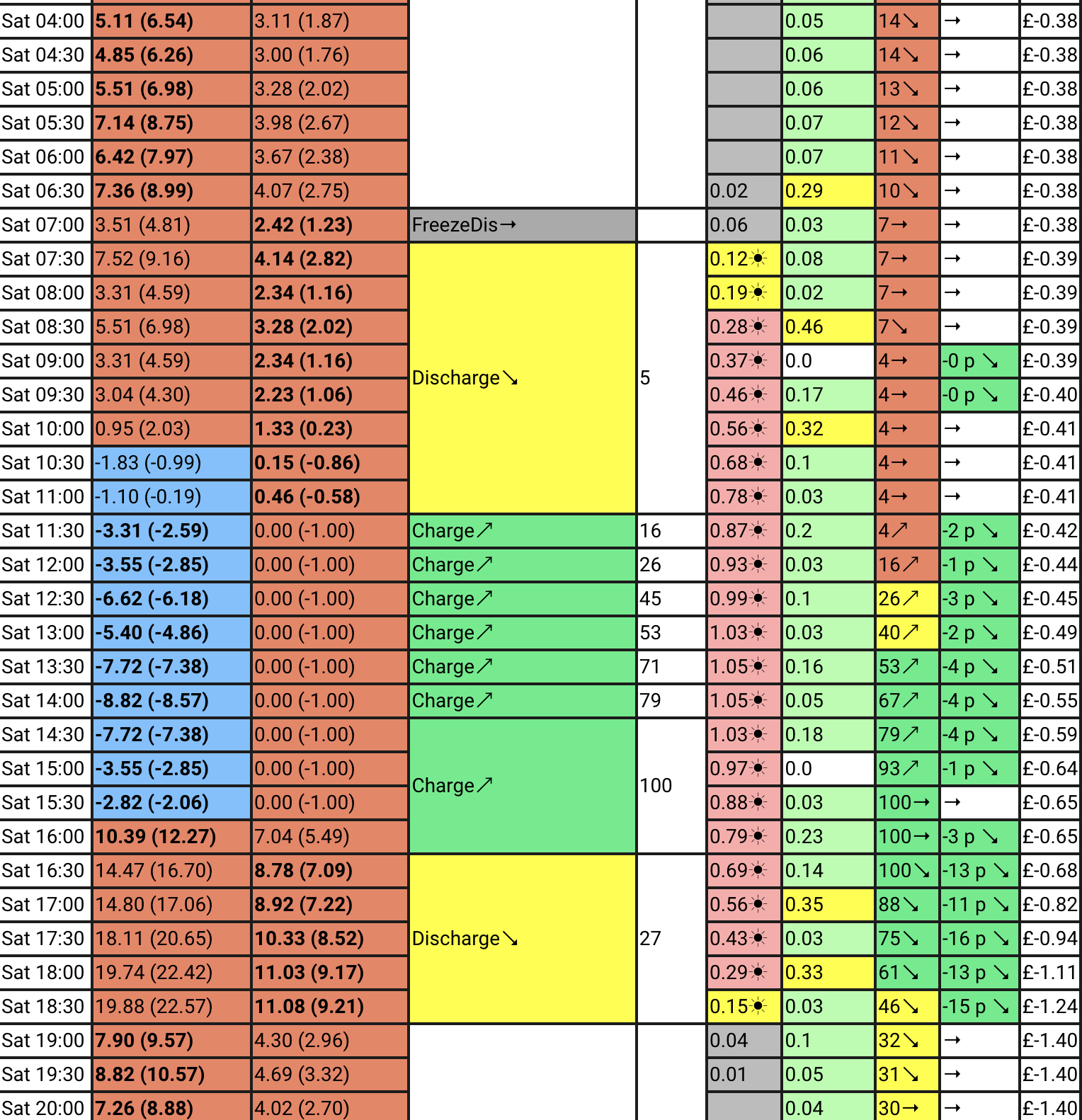
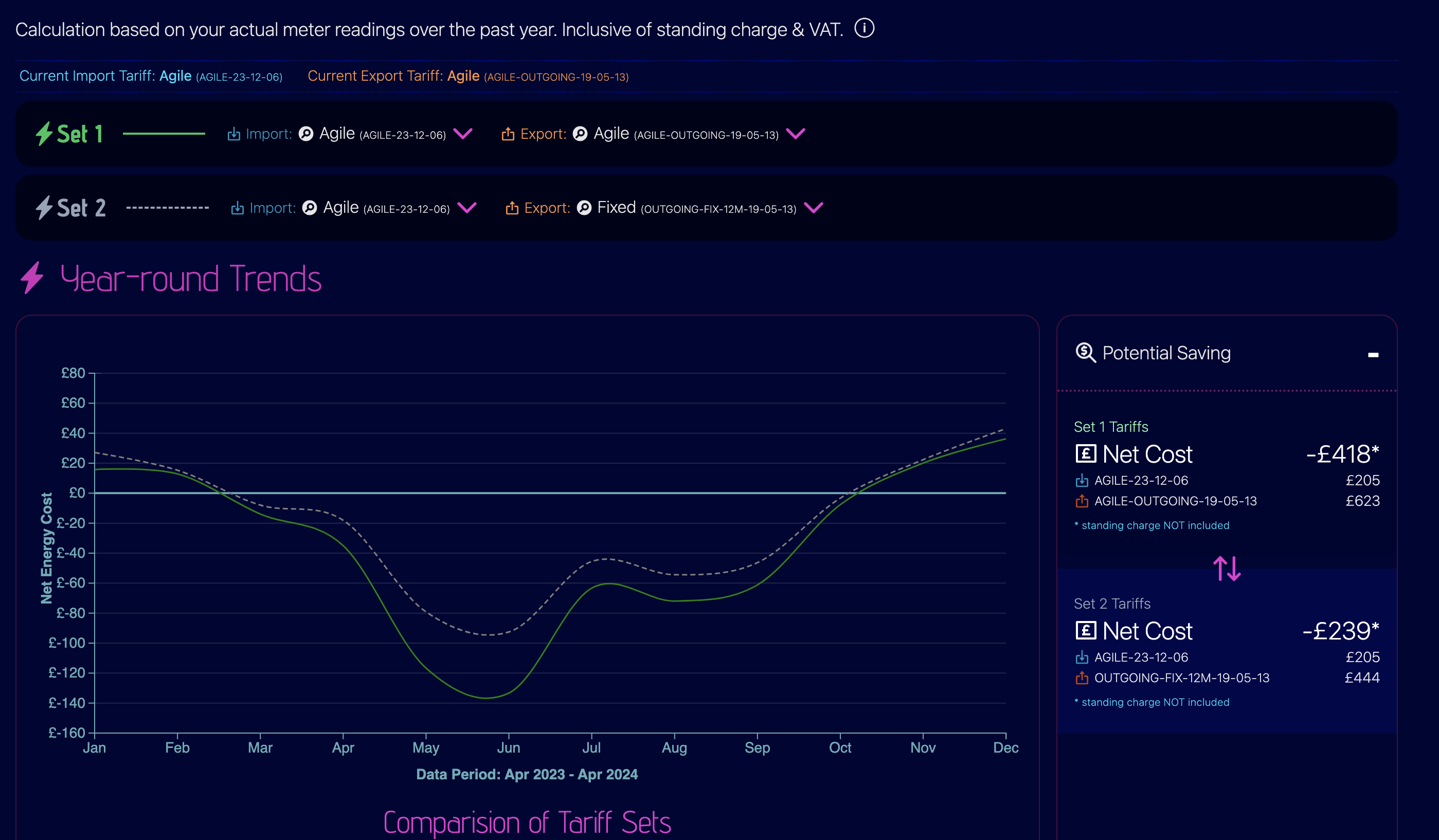
I do wonder if EV charging is another part of the lack of good overnight prices. The original idea of Agile was to shift electricity demand to times when the grid has a high generation capacity and lower load. If I understand it correctly, negative plunge pricing occurs when there is more generation than demand requires.
So, as more people start to drive EVs, and charging overnight at home is currently the cheapest way to charge them, I would expect overnight demand to increase and therefore prices to not drop as low because this is no longer a high-supply-low-demand time.
Pete.J Spot on. I think I predicted much the same about two years ago.
Octopus only care about EV owners and ASHP owners in terms of import tariffs. EVERYONE else on Octopus subsidises them, regardless of tariff. Been like that for well over a year now.
Problem is that none of the major suppliers offer an official tariff for PV/battery users. I'm aware a couple of them (not Octopus) allow PV/battery users to join an "EV tariff" but that's not reflected in the T&Cs so they could boot you anytime - and probably will.
Sadly Agile is about the only game in town for PV/battery owners.
Curious, never had this from Octopus before. Even on bank holidays there have been day-specific agile rates so must have been some unusual reason for this

Just returned to agile after being relaxed all spring and summer with IOF. Now looking at predbat every hour or so with increased anxiety. 😉

Leeshore I know what you mean. I've never been happy handing over control to ANO be it a third party or a piece of software that is very complex and hard to configure (IMHO). WonderWatt struck the middle ground for me by suggesting the charge slots for the next day then allowing me to change the selection of discharge and charge slots through the next 24 hours. With a once a day check it is for me a set and forget system.
To be honest Agile is ‘not what it used to be’, there is little hunting for cheap rates as the import rates rarely drop below the 15p export rate. So during the summer I’ve pretty much been running off stored solar overnight, possibly doing a discharge in the morning to get some room in the battery to avoid clipping in the day, and charging the batteries and exporting solar during the day.
As I said above, it’s only been on windy nights that Predbat has had to do anything. If I were using Wonderwatt then I think I’d balk more at spending the subscription fee for it to do nothing all summer.
As we come out of summer and solar generation drops off I doubt I will remain on Agile. It’ll be cheaper to move to Cosy, where I can get 8 hours at 12.76p which is considerably better than Agile at the moment. Tonight unusually good in that it has four slots at around the 12p mark. Quite possibly only because we’ve got the Sunday night through to Monday morning rates rolled over to Monday night/Tuesday morning and weekend rates are usually a touch cheaper than weekday rates
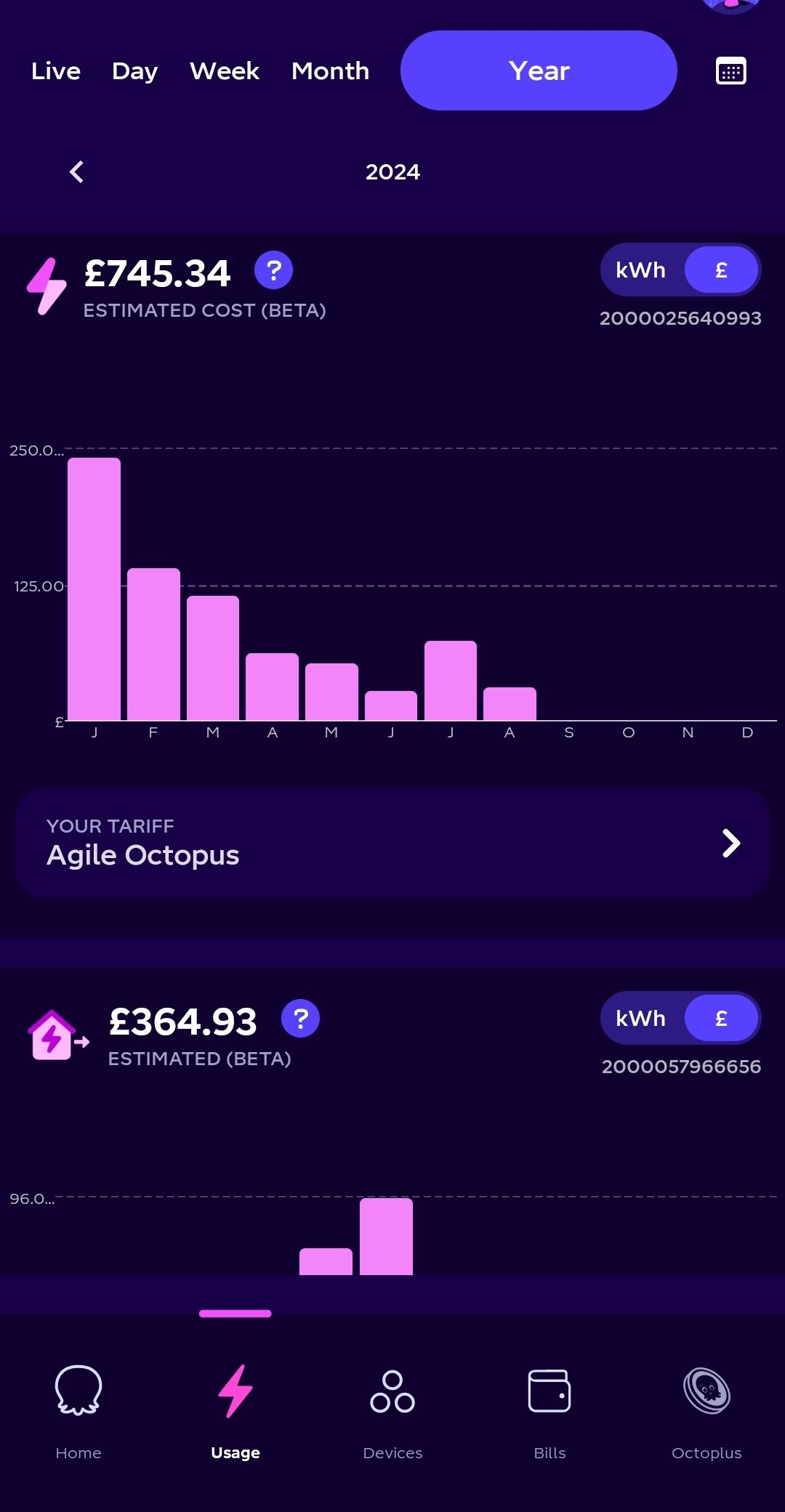
There has been a lot of work going on this year across the B6 grid boundary between Scotland and England. This has at times, meant the maximum it can flow was <3GW (down from 6+) - as Agile is impacted massively by excess wind this has probably not helped.

geoffreycoan Wonderwatt has helped me find the cheapest slots even in the winter when Solar doesn't come near to what I use in the house. But I agree with you that other tariffs appear to be better during the winter months and I too am likely to move to Cosy at the end of the month (Solar is currently matching my daily house usage but is rapidly dropping off even on the sunny days now the angle is lower and the day shorter).
[unknown] I’m lucky that I have a lot of solar panels and am still generating 40-55kWh a day vs 12-18kWh of home demand, so still exporting 20-40kWh a day and remaining solar self-sufficient.
For me it’ll be later in October when the generation is around 10-20kWh that will be the tipping point, usually coinciding with the ASHP being turned back on, so a double whammy of reduced solar and increased home demand.
This year I do have the predbat compare tariff facility which wasn’t available last year to help me better evaluate which is cheaper. I stuck on Agile all the way through to January this year, which was at least a month too late.
[unknown] ASHP
[unknown] ASHP being turned back on,
Do you completely turn it off in the summer?
Robgy [geoffreycoan] ASHP being turned back on,
Do you completely turn it off in the summer?
Sorry, confusing and loose words, but no and yes.
The no answer is that I don’t turn the heat pump off for summer. I turn the timed heating on the thermostat of so the ASHP is still providing hot water. The hot water is set to heat the tank up at midday (so powered by solar generation) and it consumes between 0 and 2kWh a day. So the daily 12-18kWh of summer home electricity consumption includes the hot water.
However I actually have two ASHP’s as the heat loss survey and system design was that I needed a larger heat pump than MCS had certified at the time so I ended up with two 9kWh heat pumps running in parallel. The second one is turned off most of the year, even in winter. Each ASHP can consume a peak of up to 5kWh so by turning one off I can run the heating off my battery storage and not have to grid import at high rates.
I think the system was over-specified and performance-wise I’m able to keep the house at a comfortable 18-19 degrees through the winter on just the one ASHP. Might use the second one for really cold days. Consider it a (very expensive) backup!
Vestas EVERYONE else on Octopus subsidises them, regardless of tariff.
Just to be fair this definitely hasn't been the case in the last couple of weeks.
It won't last but apart from the slate I had to replace which got blown off the roof its been pretty good. I think including leccy & gas (& SC) we've spent about a quid and we're nearly half way through the billing cycle.
Vestas Agreed, this windy weather has been great on Agile. I’ve spent a bit more than you this month; £19 on import (of which £8 is standing charge) for 280kWh, so 3.9p/kWh. Exported 590kWh (£88) from a combination of solar generation and electricity arbitrage.
It has been sunnier this September than last year which has helped, 634kWh so far this month vs 865 last September, but Sept 2023 was 1023kWh so looks like last year was a bad September.
geoffreycoan Our billing cycle started at the beginning of the wilder weather so not apples and oranges.
Octopus look very exposed on windpower - again. Maybe its another Autumn/Winter like 23/24 on Agile 😃

I planned to switch to Cosy at the start of October but, having put the new Octopus tariff rates into my spreadsheet, it is now showing that Agile is still the better tariff for October for my usage pattern. I'll check again next month.

Windy weekend expected.

[unknown]
Same situation here too!
Thanks for the update, keep them coming.
[unknown]
Great info, thanks.
Out of interest have you tried your data against the Octo tool?
https://www.octopriceuk.app/compare

SteveCook No not yet. My spreadsheet has lots of adjustments to allow for the size of my batteries, when I need power and how long the low tariff periods are. It is what makes Go a worse tariff for me in the winter with little solar as my battery size doesn't allow me to coast through the higher charge periods resulting in some peak usage. Cosy, with 8 hours of low tariff, would but at 14p/kWh Agile beats it most months.
This year I have noticed, due to the higher Agile prices and no increase in the Eon 16.5p export rate, that I have used much more of my solar generation than exported it compare to last year.
2024 Generated 5230kWh, used 2023, exported 3207.
2025 Generated 5683kWh, used 2725, exported 2958.
I also note that Tim of Tim and Kat's Green Walk YouTube channel has released his own comparison tool but it doesn't include the Agile tariff so is of no help to me.
PS With Gas at 6p/kWh and Cosy at 14p/kWh replacing a Gas boiler with a Heat pump does not make much economic sense unless you really can realise a CoP above 3. I'm sure that will change in the next 5 years though.
Windy Miller
I have 27 panels, a 9.5 battery, and a Gen1 Hy 5.0
I have just switched back to Eco7 for import (7hrs of off peak charge), and 15p export.
I am near Skipton and I find that during the 5-6 winter months I use any solar generation straight into the house and/or battery and next to zero export , so the low 15p (compared to Flux during summer months) is no loss to me. It also leaves me in control if I want to play with battery % stored if I think/know the grid is going down and I will want to be prepared to run on EPS.
Currently £1,200 in credit on Octo

SteveCook For me that would mean I need to cover 17 hours of use with my 2x5.2kWh batteries which I know I can't do. With Cosy the low tariff periods are split across the day and this could just work for me. I need Octopus to price Cosy the same as the Go tariff but they obviously prefer keeping EV drivers happy over Heat Pump owners.
I just need another 9.5, battery, but am uncertain to lob out another £3k ish on GivEnergy kit (which has been good for 3 years so far) after reading all the negative vibes on here
I’m using the Predbat compare tool to compare different tariffs. At the moment it’s continuing to say that Agile is the better bet

Reducing solar generation is having an impact (although I still produced a very respectable 1.08MWh in September). The big change will be when I turn the heat pump on and my consumption will jump up above the point that I can refill off solar. Agile was 50p the other evening which wasn’t nice to see. Looking like it’ll be about 4-5p overnight tonight as the storm comes in.
When I put the heat pump on I will probably switch to Cosy fixed. The cheaper rates mean that even though I won’t keep it for a year, paying the termination charge will still work out cheaper overall.
SteveCook I am near Skipton and I find that during the 5-6 winter months I use any solar generation straight into the house and/or battery and next to zero export , so the low 15p (compared to Flux during summer months) is no loss to me
You might be worth considering Agile export for the winter. I did that last year. All of my generation was being self-consumed, but on the occasions when there was a DFS saving session the agile export rates made it super-worthwhile to export a bit.
[unknown] Geoffrey. Thanks, I just need to figure out how to setup the Predbat comparison tool.!!
[unknown] Documentation is your friend:
https://springfall2008.github.io/batpred/compare/#configuring-the-tariffs-to-compare
Compare isn't producing a bar chart at the moment in Predbat v8.25.x.
There is a bug which hasn't yet been mended.
The rest all works.
v8.24.x does produce a chart.
Rob
[unknown]
Sorry to seem a complete fool, but where exactly do I put the YAML code, and do i do it in Home Assistant File Editor?
Do I just add it to any code that is already in the file path? Ta
SteveCook Sorry to seem a complete fool, but where exactly do I put the YAML code, and do i do it in Home Assistant File Editor?
Do I just add it to any code that is already in the file path? Ta
edit your apps.yaml file (pathname is in the documentation, apps.yaml section). You can use file editor or Visual Studio, either is fine
Simply copy/paste the compare YAML anywhere in your existing apps.yaml file. I have mine at the end but it doesn’t matter where it is. Just make sure it is indented 2 spaces as everything else is
Then set the region code to your region (my Octopus API paths has them hard coded to A so it looks slightly different to the template)

[unknown] If you don't know your regional code, go here:
https://energy-stats.uk/dno-region-codes-explained/
In my apps.yaml, I have added this line:
octopus_region: "M"
And each API line will pick up 'M' as my 'octopus region'. e.g.
- id: 'igo_fixed'
name: 'Intelligent GO import/Fixed export'
rates_import_octopus_url: 'https://api.octopus.energy/v1/products/INTELLI-VAR-24-10-29/electricity-tariffs/E-1R-INTELLI-VAR-24-10-29-{octopus_region}/standard-unit-rates'
rates_export_octopus_url: 'https://api.octopus.energy/v1/products/OUTGOING-VAR-BB-24-10-26/electricity-tariffs/E-1R-OUTGOING-VAR-BB-24-10-26-{octopus_region}/standard-unit-rates/'
If you don't include the 'octopus_region' line, you will need to replace {octopus_region} each time with your DNO code.
Rob
Thanks. I will give it a go
Free electric Sat 12-2pm.
Wonder if it'll be negative on Agile? 😄
TX200 Free electric Sat 12-2pm.
Wonder if it'll be negative on Agile? 😄
the predicted prices in predbat are for it to be negative from 11:30 to 14:30 tomorrow afternoon and negative or low prices from 22:30 tonight all the way through the night and tomorrow morning. Will be reasonably sunny though so not sure how much benefit I'll see
My latest Octopus bill for September has an average import rate of 4,14p/kWh, up slightly on August. But I'm only importing when the agile rates are low or negative, i.e. windy days
Rbor
Sorry another dumb question.
I have got it running and producing tables, but as you say no charts.
Can i go back predbat versions by using the "Predbat Update" drop down 
[unknown] yes you can. Just select any of the 8.24.x versions from the dropdown and the charts work.
Trefor has acknowledged the charts are not working and said he will fix on the weekend so you could wait

Feels like I'm at the top of the hill about to career down the Rollercoaster.
Charge schedule for next 30 hours...

Blue charge, Red export
PredBat is doing something similar. It seems cheeky, but if it was a problem, they'd stop people having tariffs like agile and flat rate outgoing. It'll probably happen one day. 😢
Managed 21.6 kWh for 6p so far today.

29.25 for 0.0069 according to the Octopus app, here.

25.9kWh exported for £4.27. 53.51kWh imported for 34p. Net gain £3.93 plus the free session payment when it arrives. Best day ever for exporting from the battery (24kWh). Tomorrow looks nearly as good too.
[unknown] Best day ever for exporting from the battery (24kWh). Tomorrow looks nearly as good too.
Well done, these free sessions do add up if you can take advantage of them. I had my best day ever also, and another one hour free session again today, lovely jubbly.


duplada these free sessions do add up if you can take advantage of them
Managed to import 14.5kWh in those 2 hours. Normal usage 0 as would be on Solar.
[unknown] Managed to import 14.5kWh in those 2 hours
Yes very good indeed, I have the tumble dryer, EV charger, air con (I think they call them Heat pumps these days) all ready, the batteries are exporting (Brucie Bonus) to make room for the event, so all set rock and roll.
Windy Miller Managed to import 14.5kWh in those 2 hours. Normal usage 0 as would be on Solar.
Yes very good indeed, I have the tumble dryer, EV charger, air con (I think they call them Heat pumps these days) all ready, the batteries are exporting (Brucie Bonus) to make room for the event, so all set rock and roll.
Rbor
Thanks. I have got it all working , but when I went into the yaml file /addon_configs/6adb4f0d_predbat, i had that one and successfully edited it.
There is however a folder _appdaemon-predbat there. I presume this is some throwback to my original predbat install 2 years ago? Can i just delete it?
I have also tried to # hash out some lines for tariffs I am not interested in ( i want to leave the line text just in case I want to see in future and can then just remove the # hash) , but the data fields and graph entries are still appearing
SteveCook There is however a folder _appdaemon-predbat there. I presume this is some throwback to my original predbat install 2 years ago? Can i just delete it?
Yes appdaemon-predbat is an earlier install method. Make sure you remove the appdaemon-predbat addon from the addon list (and can remove the bespoke directory from the addon store list), and then you can just delete the folder as its doing nothing.
I have also tried to # hash out some lines for tariffs I am not interested in ( i want to leave the line text just in case I want to see in future and can then just remove the # hash) , but the data fields and graph entries are still appearing
Next time you run a compare, either at midnight or manually during the day, the extra compare lines you have commented out will be removed from the compare chart. There were a number of changes to Octopus URL’s from 1st October so make sure you pick up the URL’s from my fork of the documentation https://github.com/gcoan/batpred/blob/main/docs/compare.md
[unknown]
Thanks. I have deleted most of the sub folders in the appdaemon-predbat directory, but they only seem to delete when they are empty (I get a waring about not being empty). Most sub folders only had half a dozen things in them, so no big deal, but the debug folder has pages and pages. Is there a way of selecting multiple files for deleting? (like there is in windows?) . I have looked extensively on the web, but cannot find anything
Thanks as always
First 6 days on agile, average price 3.15p/kWh
That's going to go up though isn't it... Don't really want a storm every week. 😁
SteveCook Is there a way of selecting multiple files for deleting? (like there is in windows?) . I have looked extensively on the web, but cannot find anything
depends how you are deleting the files/folders !
You can use the terminal and SSH addon which will give you a command line method to manipulate the file system. If you're familiar with *nix type commands then this is easy. If windows/dos then there's a bit of learning but its pretty straight forward (cd = change directory, rm = remove file, rm -r = remove files recursively ... be very careful you know what directory you are in when doing this! pwd = print directory name)
Or use the Samba file share addon to enable you to mount your HA drive on any other device. I use this all the time from windows PC and my ipad to copy/remove files
TX200 First 6 days on agile, average price 3.15p/kWh
I've been on Agile all summer. Rates have been around the 15-20p mark all the time so I have only imported when there's been windy weather.
August average import rate 2.55p/kWh inc VAT
September 4.28p
May, June and July were 6, 6 and 9p.
Its been fine for the summer when there's plenty of solar but as that drops off I expect the average rate to rise

TX200 These have been my average Agile rates for the year for the number of imported units. In the winter I can't get through the day with my batteries hence more imported units at a higher rate. Means Agile is really only any good between March and October and even then it needs some high winds to compensate for the 15-20p rates.

Windy Miller very similar pattern to my own except I have a heat pump so not importing in the winter isn't an option!
As long as it averages under 21p kWh, I'll be happy (my old Intelligent Flux off peak rate).
I guess SVR is around 30p/kWh.
Without leaving octopus (which would be a very difficult decision) it's only IOF, Flux or SVR open to me I think (or a fix of course).
Might get an EV in the next year or two, which would change things - although that depends on how often I need to charge.
TX200 As long as it averages under 21p kWh, I'll be happy (my old Intelligent Flux off peak rate).
I guess SVR is around 30p/kWh.
Makes sense.
SVR in my region (A) is 26p/kWh. You can get Octopus’s current SVR rates from https://www.guylipman.com/octopus/generic.html?format=2&key=0&url=https%3A%2F%2Fapi.octopus.energy%2Fv1%2Fproducts%2FVAR-22-11-01%2Felectricity-tariffs%2FE-1R-VAR-22-11-01-A%2Fstandard-unit-rates%2F - replace the “-A” with your DNO region code.
I work out my solar/battery “payback” by comparing my import/export bill to what it would have cost on SVR for the same house load (which includes the heat pump).
January 2025 was the worst for me when average Agile rates got to 22.2p vs SVR at 25.6p. That’s when I swapped to Cosy.
TX200 Without leaving octopus (which would be a very difficult decision) it's only IOF, Flux or SVR open to me I think (or a fix of course).
I’m in a similar position, no EV, and with two inverters I can’t get IOF, although with a heat pump I can get Cosy as well. Don’t forget Tracker and Economy 7.
Eon next drive is worth considering; Eon seem to vacillate as to whether battery owners can get this tariff or not. In practice the power companies don’t seem to check much. I wasn’t checked for Cosy and I’ve heard of others on Go for years without an EV. Risk of course is that they do check and rebill you at SVR
Feels like the shape of things to come. Yesterday I thought I had enough battery to see me through the night so set some freeze exports for Predbat to export my remaining PV, and then of course we had the saving session which predbat exported in, resulting in me running out of battery and grid importing through the night. It was at a slight profit as the import rates were all less than I had force exported at so I did end in profit, but still, grid importing to run the house feels weird.
And today, not a massively sunny day, but not grey and cloudy all day either. Generated 16.6kWh and only exported 1.3, but yet, the batteries have never filled up totally from solar all day and are predicted to run out tonight at about 1am.

Today’s bill after the 4am and 2pm imports is 87p. I’m so used to it being negative every day.
September was pretty good on Agile with a few plunge periods where I was able to easily export cheap imported electricty using the recent Wonderwatt Agile export slots feature. Average price for import was 7.86 p/kWh. The biggest cost was the Agile standing charge. Even with Agile prices averaging 15p/kWh, that is less than on other tariffs (for me at least). However, it we have a repeat of last winter, IOG could be better.

[unknown]

Cosy approaching??

Watcher Yep I think so...


[unknown]
‘Heads Up’ Just looked at rates, now Variable & Fixed options. Fixed has a £25 exit fee that I don’t remember seeing last year.
Watcher ‘Heads Up’ Just looked at rates, now Variable & Fixed options. Fixed has a £25 exit fee that I don’t remember seeing last year.
there wasn’t a fixed Cosy option last year, only the variable. The new fixed cosy tariff has lower rates and an exit fee.
I’ve calculated that for my consumption last year it’d still be worth going onto the fixed tariff and paying the exit fee assuming I break it early for next summer, its still cheaper than Cosy variable.
Am sticking with Agile for now. It’s still coming out marginally cheaper than either fixed or variable Cosy.
geoffreycoan
Geoffrey. Thanks. I managed to install and get Samba working. It did not like @ in my username and kept crashing. Trial and error solved that.
I managed to delete the 215 old files very quickly.
Ta
SteveCook glad you got it sorted. Once installed Samba is very useful for downloading log files, uploading software patches outside of HACS, etc.
I configured my own username and password specifically for Samba.

Well I went through the process of switching to Cosy but have decided that, in all honesty, I can't claim to have a low carbon heating system. I could use my portable Aircons in heat mode but I only have 2 of them so would still have to use the gas boiler to heat the other rooms otherwise the Living Room and Bedroom would be warm but the bathroom and WC would not. I'll never get away with that.
As my gas boiler is still quite serviceable and cheaper to run than a heat pump I'll wait for its failure or for better conditions in the heat pump market (cheaper Cosy rates, cheaper heat pumps, change in Cosy T&C's for example). It's the possibility of having to upgrade my radiators that's a bit prohibitive so I've decided to run my gas boiler like it was a heat pump - low and slow - to see how well my current radiators might work. Means all radiators are left on (including in least used rooms) even at night and I'll set the house to 19oC for the night/day and 20oC for the evening (and include a 1oC boost facility for anyone who's feeling the chill).
Windy Miller I planned to switch to Cosy at the start of October but,
So it's staying with Agile for the winter.
Since I've become quite proficient at setting up Agile slots using WonderWatt and the software has improved considerably since last winter it may turn out to be as good on Agile as if I switched to Cosy.

Windy Miller I've decided to run my gas boiler like it was a heat pump - low and slow - to see how well my current radiators might work. Means all radiators are left on (including in least used rooms) even at night and I'll set the house to 19oC for the night/day and 20oC for the evening
Good strategy, running it similar to a heat pump to keep the house at a constant temperature and only heat the house as required to replace lost energy.
Heat Geek advice is to leave all the radiators on so that you heat all rooms in the house, i.e. you heat to the envelope of the house insulation. If you leave rooms unheated then you waste energy with heat that will leak into them so its a false economy.
I'd suggest you also turn the boiler flow temperature down if you can. Running with a low flow temperature, 30-40 degrees will show whether your radiators are sufficiently sized or not for a heat pump and will better mirror a heat pump flow temp.
And overnight you might find 19 degrees is a bit too warm. We have ours set to 19 degrees in the day and 17 degrees overnight and unless it is really cold outside (less than say 5 degrees) the house will keep warm through the night. When we first started with the heat pump we found it was just too hot in the bedrooms with the heating on overnight, so hence our set-back temperature
Be interested to see what happens to the Agile rates this winter. They're continuing to not look that good and now that solar generation is dropping off I'm finding I'm having to import overnight when the batteries run out. At least Cosy import will be a bit cheaper for that
[unknown] Be interested to see what happens to the Agile rates this winter.
I have noticed lately that when there is a high pressure weather system over the country, Agile prices are high but when we get a low pressure system passing, we get plunge pricing. I guess this is the wind generation kicking in and out?
After mulling it over for the last day or so, I have decided to switch to Cosy

Solar generation is noticeably dropping off, I’m not filling my batteries overnight and am now running out most nights.
Agile rates overnight are still hovering around the 15-17p mark.
We’re in a period of high pressure with high humidity, trapping low overcast clouds, cold conditions and risk of fog in the morning.
Longer term Agile price forecast is for much of the same for the next week or so

And pretty soon we’re going to be putting the heating on which push my consumption up considerably.
So all in all switching to Cosy means I get 6 hours of guaranteed 14p charging which takes the pressure off.
It’ll probably blow a gale for the next fortnight now and Agile will be super cheap
geoffreycoan It’ll probably blow a gale for the next fortnight now and Agile will be super cheap
My tariff swap is complete, accepted the terms and conditions and 10 minutes later the Octopus integration and predbat had picked up the new rates and have planned filling the battery this afternoon before the peak.
Just saw the Agile Price prediction on Twitter for tomorrow https://x.com/agilepredict/status/1977298771903213592?s=61&t=kfHJ60Kt3_BUhevKr8OSsw peak rate of 64p
[unknown] I presume the evening peak doesn't matter for most people - use the battery.
TX200 unless its really really cold and the heat pump is going full trot alongside the cooker etc in the evening, the peak doesn’t bother me, as you say the batteries take care of it.
But there are people on Agile that don’t have batteries. I guess if you work late shifts or can otherwise shift your cooking and other peak draw to outside the peak period it’d be a fair choice. For me it’d be too stressful to be on agile and not have any kind of battery automation
Windy Miller It's the possibility of having to upgrade my radiators that's a bit prohibitive
It might be worth revisiting Heat Geek, they've just launched their 'Zero Disrupt' installations in the last week or so, you might find installation costs have become a bit more accessible: https://www.youtube.com/watch?v=ENt9fJBHINQ
SamM I’ve not watched the heat geek zero disrupt videos yet to understand what the tradeoff is.
Radiators are replaced in a heat pump installation to get more heat into a room to compensate for a lower flow temperature of the heat pump.
So if you don’t change the radiators then that means either a lower house temperature or you have to boost the flow temperature.
Higher flow temperature means higher running costs.
Of course less radiators replaced means lower installation time and cost.
I’m sure Heat Geek will be saying that the zero disruption calculation weighs up the tradeoff of short vs long term cost.
When we had our heat pump installed 3 years ago pretty much every radiator was replaced apart from a couple in our extension. In almost every case the single panel radiator was replaced with a double of the same width, so there wasn’t really that much disruption. Or some people have had doubles replaced with triples. Again limited disruption.
The installation didn’t replace the towel rail style radiators in the kitchen and utility room, they were calculated to be sufficient; but after a couple of years we concluded that they weren’t and we had them replaced with conventional radiators.
Radiators are not that expensive either, a few hundred pounds each at most. If we didn’t have ours replaced it would have saved a bit on the labour as there was a plumber who spent two days just replacing radiators so his cost could have been removed, but overall, maybe a couple of grand for all the radiator replacements (and we have a large house).
Maybe the extra electricity cost from not replacing the radiators and needing a higher flow temperature is not that much when compared to the cost of replacing them. Interesting thought.
Cheers Geoff, we’ve had a heat pump in for about three years now, and I’ve been keeping an eye on its performance using the OEM Heat Pump kit that feeds into their system. All that to say, I’ve spent a decent amount of time with a system and looking at the trade-offs (and imo the vanity of chasing ever-higher COPs - probably spending far too much of my own time chasing the ever higher number! 😀)
As you say, the general wisdom has been that you’ve got to design everything for maximum efficiency so the heat pump definitely beats a gas boiler on running costs. I’m not sure that’s always the right goal, it feels like a bit of a red herring for most homeowners.
From what I can tell, Heat Geek’s “Zero Disrupt” approach is a tacit acceptance of what Octopus have been doing for a while, going for lower upfront cost even if it means a bit less efficiency. For a lot of people, that trade-off just makes more sense. Especially now, when you can offset running costs with a combination of solar, batteries and smart tariffs.
EDIT: What is nice about the Heat Geek approach, is they start from a "Zero Disrupt" baseline and you can modify your installaiton options to get that higher guarenteed COP if that's what you want. Worth having a look at their website just to play around with their online quote system to see what I mean. (That is all just an initial idea of system design and cost, obviously it still requires a compotent individual to come and view the house to see that it will work and make appropriate adjustments).
I wish this is how systems were being spec'd up 3 years ago when we went for our heat pump (installed by Octopus). I realise this post comes across a bit like a shill, just to say I have no skin in the game, just an advocate for heat pumps.
geoffreycoan I’m sure Heat Geek will be saying that the zero disruption calculation weighs up the tradeoff of short vs long term cost.
Yes, I think you can choose your guaranteed COP, and the installation price goes up the higher COP you want. I think Octopus are doing something similar - they offer a "turbo" install which targets a high flow temp, or a more expensive install which will swap out more radiators to give a lower flow temperature.
Thanks [unknown] and [unknown] interesting. Sounds like as I suggested it would be, lower install costs for a lower SCOP guarantee, and higher ongoing running costs as a consequence.
There is more information and awareness now but I’d bet that for most home owners the SCOP will be a fairly meaningless number, what they’ll care about is the up front costs. And even if you do know the SCOP, translating that into what it costs to run isn’t straight forward.
For my own installation I’m not sure I even knew about the design flow temperature of 55 degrees and SCOP of 2.85 until I saw it on the MCS certificate. (we are getting better than that now)
As you say, most people want a cheap install with minimal disruption and this can give them that
First year with a heat pump (Samsung 8K). Looked at all the monitoring & control systems (Homely, OpenEnergy Monitor etc). They only make sense if fitted when the HP is installed. The HP replaced an oil-fired boiler. When costing don't forget the cost of removing the oil tank(s). Most installers will take away the old boiler but not the tank etc. Anyway - I decided to just monitor the actual cost (not SCOP). All electric house with 24kWh of storage - cost last year nearly zero i.e. export just about pays for the HP power. So last year I saved about £700 (no oil). I did add another 9.5k battery (just over £2K). Will report in a years time. In summary - if you are oil -fired - don't think about - just do it!

Warning - well off topic now.
geoffreycoan I'd suggest you also turn the boiler flow temperature down if you can. Running with a low flow temperature, 30-40 degrees will show whether your radiators are sufficiently sized or not for a heat pump and will better mirror a heat pump flow temp.
The gas boiler in question is one I installed myself in 1997 - a Potterton Envoy 30. It has a fixed output of 8.3kW. I chose this size having done my own heat loss calculation using some DOS software. With an outside temperature of -3oC, heat loss for the whole house was around 6.5kW (a 4 bed detached). Over the intervening years I have moved from heating the whole house to just the rooms we use and mostly first thing in the morning and in the evening. Going back to whole house for 24/7 actually automatically results in a lower flow temperature as with 10 radiators to heat 6.5kW could be delivered with a flow temperature well below the 65oC design flow (return of 45oC keeping the boiler in condensing mode). When the outside temperature is milder than -3oC the boiler is really too powerful. I solved this by using a Drayton thermostat that uses a cadenced output to control the heat delivery. In effect it uses a 15 minute cycle and is only on for enough minutes to keep the set point temperature at 20oC. So, for example, at 5oC outside the thermostat could be on for 5 minutes and off for 10 minutes matching say 3kW heat-loss (an example not measured). This keeps the flow temperature as low as that required to keep the inside temperature constant at that particular outside temperature.
So this winter I will log the flow temperature against the outside air temperature and wind speed. The results should tell me what flow temperature I need from a heat pump if I don't change any of the radiators for all weathers/temperatures. (I will need to work out the correlation between outside temperature and wind speed and possibly direction - that will be an interesting project in itself.)
First though I need to re-balance the radiators so that we heat bedrooms to 18oC whilst heating the Living Room, WC and Bathroom to 20oC. I need some colder weather first as the system is barely on at the moment (only used 16kWh of gas in the last 24 hours which is equivalent to a heat loss of 667W when the average outside temperature is 12oC).
I follow what is being said about the Heat Geek approach and after this winter I may know which if any of my radiators I need to upgrade. (I may even do one or two myself.)
Windy Miller well off topic but interesting.
I solved this by using a Drayton thermostat that uses a cadenced output to control the heat delivery
Woah, well technical plumbing! Beyond my knowledge!
Slartibartfast When costing don't forget the cost of removing the oil tank(s). Most installers will take away the old boiler but not the tank etc. Anyway - I decided to just monitor the actual cost (not SCOP). All electric house with 24kWh of storage - cost last year nearly zero i.e. export just about pays for the HP power. So last year I saved about £700 (no oil).
We had an oil boiler and tank in the garden and the oil tank that started leaking was the cause of us ending up with the heat pump and then ultimately the extra solar and batteries. Latest regulations for oil tank siting meant that we couldn't just replace it in situ.
Our experience was similar, the heat pump installers took the oil boiler away but I was left to deal with the tank. I flushed it out with water to get rid of any remaining oil and then cut it up with an angle grinder. Despite the water precaution I still managed to set fire to residual oil in the tank, but more water from the hose solved that. Fire in the hold!
Gave us back a useful bit of extra space in the garden where the tank used to be.
[not recommended that you do this yourself mind]
Our first year of the heat pump it cost about the same to run as the oil boiler it replaced. Two further years of fiddling with the heat pump settings we are now paying about half what we used to, and this is paid for by our solar export, so roughly net zero each year.

geoffreycoan Woah, well technical plumbing! Beyond my knowledge!
A controller that is on 100% when 2oC below set point, 50% when 1oC below set point, 25% when 0.5oC below set point 0% at set point. Result is an un-modulated (fixed output) boiler looking like a modulated (variable output) boiler. The Drayton thermostat is super precise achieving the set point to within 0.5oC and holding it there independent of the heat-loss (almost) with almost no temperature perturbation. Much better than the normal hysteresis type of thermostat. It's 20 years old but I haven't found anything better that suits my system.
geoffreycoan Feeling pleased with my decision to change to Cosy Fixed on Sunday.
We're already enjoying the flexibility of three 14p cheaper charging periods a day, and the charging rate is less than the export rate, so means its far easier to decide when to put the washing machine or dishwasher on.
And looking at the Agile forecast for the week, at no point in the forecast does the Agile rate drop below the Cosy cheap rate

Maybe Monday next week Agile rates might match

This is the down side of Agile. Looking at the fuel mix at the moment renewables are barely registering and we need to maintain the gas power stations to cope with just this sort of scenario. We need more battery banks to be brought on line but even with these they would have to store a weeks worth of energy to cope with this high pressure weather.

We are already seeing 60+p slots with the day minimum tomorrow at 20p. For me even the overnight 16p can't be used to carry me through to tomorrow night.
Not looking so good at the moment. If Agile cheap rates get over 20p then IOG would be cheaper for me even with the IOG 30p daytime rate which will be way lower than Agile peak rates.
Well this is interesting - I just found the octopriceuk.app website and signed in .
Being of lazy disposition, I have been on Agile for 2 years now and wondering whether to swap to something better, but wary of standard rates during the day in winter when my 14kW ASHP gets hungry when its cold outside.
Anyhow, to my amazement, it produced this for the last 12 months

Stepping back month-by-month Agile has been the cheapest tariff for my usage for every month except January 2025, when it was £6 more expensive.
Having said that, the scheduling is optimised for Agile by MyEO, so perhaps things would be closer if I was optimising for another tariff, but I'm really surprised that sticking to Agile wasn't more costly.
downfield The Octoprice app is good. I have experienced some weird results with it though, I did send the details to the developer but never got anything further back.
If I look at my own annual comparison it suggests:
- Octopus fixed £1292 is cheapest
- Agile next £1604
- Cosy next £1740
- Tracker next £2072
- Variable worst £2199
This looks wrong! Fixed is not 55% of the variable rates.
If I look at tariff hopping I get a different set of import figures:
- Agile import £701
- Cosy import £1747
Both with the same £1145 export figure.
On the month by month view it suggests Agile is always cheaper than Cosy, and in January Agile is £174 whereas this January I paid £363 (plus service charge) for Agile.
I love the idea of the app but am not convinced by the figures.
For me whilst I am missing out on the cheap rates whilst its windy this weekend on Agile, I am enjoying the freedom of 3 lots of cheap (14p) charging every day with Cosy. With the cheap import period being very similar to the 15p export rate I don’t worry about charging overnight.
I’m glad I changed to Cosy in February this year for the remainder of the winter, I should have changed earlier in January.
I am considering moving to Agile outgoing for the winter.
I was on Agile outgoing for part of winter last year on the basis that the only time I would be exporting would be on a DFS session, and I might as well make advantage of the extra export rate.
Looking at the Mick Wall’s excellent energy stats website https://dashboards.energy-stats.uk/
Agile outgoing prices for the last month have consistently peaked above 15p every evening:

And winter last year the same pattern, with some really big peaks when the grid was strained:

My own export for the last month has really dropped off once I turned the heat pump on in late October:

Looking at last winter’s export figures I was surprised to see that I had exported a lot through November and December:

But last winter I was on Agile import until the end of January when I swapped to Cosy after a very expensive month of Agile import. If I compare solar generation to export energy I can see the big peaks don’t correspond to lots of solar that day, meaning it must have been cheap Agile prices and I was importing and exporting to take advantage of the price arbitrage

But this year I am on Cosy for the winter so importing at 14.05p in the cheap periods which is pretty much the same as the 15p export rate after battery discharge conversion losses are included. So I’m not doing any force discharging at the moment, and if a particularly sunny day is forecast then I would just do less Cosy period charging and fill the batteries on solar.
geoffreycoan if a particularly sunny day is forecast then I would just do less Cosy period charging and fill the batteries on solar.
Is it not simpler to unconditionally import at 14.5p, and if it happens to be sunny, export that at 15p? Saves problems if the solar prediction turns out to be optimistic.
DD if a particularly sunny day is forecast then I would just do less Cosy period charging and fill the batteries on solar.
Is it not simpler to unconditionally import at 14.5p, and if it happens to be sunny, export that at 15p? Saves problems if the solar prediction turns out to be optimistic.
That is pretty much what Predbat is doing, encouraged by me sometimes to add some extra charging slots to keep the battery fairly full. I don’t want to be grid importing at 28.6p when I could have charged the batteries at 14.05p. The differential between import and export is so small that it’s better to keep the batteries fairly full, covering solar forecast being optimistic or house load projection being pessimistic. The three Cosy charging slots really helps with this.
Yesterday an all-time low solar generation, 0.69kWh, lowest I’ve ever had since the panels were installed in Jan 2023.
It’s whether changing to Agile Outgoing is worthwhile. I’m thinking it probably is.
I do feel a bit naughty when PredBat charges up during windy days and then thirty minutes later exports at 15p.
I don't think we'll be able to do that for much longer!
Agile is still working well for me. 7.5p / kWh average since 1st Oct.

Windy Miller So now the cold weather is here I can see what flow temperature I need to maintain the house temperature at 18oC except the Living Room, Bathroom and WC at 20oC. Even though it is a gas boiler the low and slow approach with all 10 rads balanced results in a flow of around 44oC. I think this is low enough for a heat pump to have a reasonable COP without me having to replace any radiators. Is this right?
Windy Miller When I had my survey done by Octopus they calculated the heat loss in each room rather than the heat required to meet a certain temperature if that makes sense. The issue is that whilst you may be happy with 18deg, a future householder would undoubtably wish for a higher temperature setting. I think this may be a barrier to meeting the grant requirements. But I am not an expert by any means.
Henry3rd I think MCS does specify standard temperatures for various rooms. 18 for bedroom may be correct. Perhaps 21 for living room ?
My MCS heat loss survey was for a target of:
- 21 degrees in Living/Dining rooms
- 20 degrees in Toilets/Bathrooms
- 18 degrees in Hallways, Kitchen, Utility Room, Bedrooms
@Windy Miller A flow temperature of 44 degrees is a bit on the high side for a heat pump, its do-able, but your COP won't be as good if the flow temperature was in the 30's.
My own heat pump curve is set to 52 flow temperature degrees when -2 outside and 26 degrees when 14 outside, so a flow temperature of 44 would be when the OAT is 3 degrees outside. It would be worth you knowing your OAT for yesterday to compare.
In terms of COP/SCOP, these can be found on the heat pump manufacturers details, or on the MCS website. The manufacturer often only quotes a few values whereas MCS test the full temperature range.
At 52 my COP is 3.04, at 44 its 3.55, and at 35 (the lowest the MCS test was done at) its 4.07.

geoffreycoan Thanks Geoffrey that's really helpful.
Yesterday was 1oC at 10am, 3oC at 2pm and -1oC at 9pm so a flow of 44oC seems quite reasonable compared to your heat curve.
We were down to -4oC by 7am this morning and the flow has risen to somewhere around 50oC so I think my radiators are emitting as efficiently as yours (and my house is similarly insulated).
Just for comparison, yesterday I used around 100kWh gas peaking at 6kW in the highest hour implying a heat pump of between 2 and 3 kW input with COP of 3 will probably be sufficient. My 8.3kW gas boiler is still cycling on/off to maintain the 50oC flow temperature with the outside air at -4oC.

geoffreycoan My MCS heat loss survey was for a target of:
21 degrees in Living/Dining rooms
20 degrees in Toilets/Bathrooms
18 degrees in Hallways, Kitchen, Utility Room, Bedrooms
In my household there would be an unpleasant, armed revolution (with one certain casualty) if the bathroom temperature had a "target" of 20 degrees.
If heat pumps are generally installed with that as a standard then I can see electric blow heaters coming back in to fashion. Which would rather defeat the purpose of moving to a heat pump.
Windy Miller Yesterday was 1oC at 10am, 3oC at 2pm and -1oC at 9pm so a flow of 44oC seems quite reasonable compared to your heat curve.
Just for comparison, yesterday I used around 100kWh gas peaking at 6kW in the highest hour implying a heat pump of between 2 and 3 kW input with COP of 3 will probably be sufficient
Yesterday the outside temperature recorded on my front porch at those times were 8 degrees C at 10am, 8 at 2pm, 7 at 9pm but I suspect the thermometer is too sheltered because when I went out in my car it at 5pm and then 9pm it was saying 1 degree and 0.5. The weather station in the next village had 3.5 degrees, 4 and 0.5 which confirms I need to look at my thermometer position….
It’s interesting hearing your gas consumption was 100kWh, we tend to only talk about how much heat pumps use. Mine consumed 38kWh yesterday with peaks up to 5kW. I have a larger house than most and some of the way the heat pump was installed I don’t think is optimal, so on a rough COP of 3.5 would be 133kWh, so adjusting for house size, that feels quite comparable.
So yes, does feel like your radiators are sized reasonably for a good enough COP with a heat pump. The survey might identify a few radiator upgrades but on the whole you should be OK.
With a heat pump consumption of 38kWh plus house load, you’ll never have enough battery storage to support that. I’m on Cosy for the winter (have been on Agile for previous years) so get 3 charging periods to fill the batteries.
I have 13.5kWh of battery storage which is generally OK for the day, but they do run out in the evening, at about 8:30pm, so I was grid importing at the 26p day rate until the 10pm Cosy period. Octopus say my total import was £9.11 for the day

geoffreycoan Thank-you. For comparison yesterday electric was £2.80, Gas was £6.25 so £9.15 for a 4 bed detached. Similar but I had virtually no Solar and I know you still get a reasonable amount of Solar and you can store lots as well in the cheaper Cosy slots.
I'm thinking of dispensing with all the heat loss calcs since I already have accurate measurements of how much I need. No one radiator is significantly hotter than the others and all are maintaining their room temperatures to within 0.5oC. Really I just need to find a local installer of the heat pump bit itself who could plumb into my water circuit in the loft where my boiler currently resides. I know going the MCS route gets me access to grants but if all that goes on unnecessary changes then I won't be better off.
Windy Miller Mine is currently set to 44 at -2. Though that might have to increase slightly, since the house has been losing temperature over the last couple of (cold) days. (I think it does get an extra automatic boost of a degree or two close to 0, but clearly that's not enough.)
(Octopus had designed it for 50 degrees at -2, so I guess they didn't get it too badly wrong...)
I've been meaning to look back to try to guess gas consumption on similar days, but haven't got round to that yet. But we definitely keep the house warmer now than we did when we were using gas.
Windy Miller I wouldn’t rule out the MCS route entirely, yes it follows a formulae so can result in “computer says X” type of results, and there is definitely over inflation of prices to match the available grant, but still, you get a certified install and I think some Electricity suppliers may want the MCS certificate for their heat pump tariffs. I wasn’t asked when I moved to Cosy but I have a feeling the website says you need it. Anyway, something to look at.
I just looked at the MCS certificate, mine was designed for a flow temperature of 55 degrees and a SCOP of 2.85. Of course at the time I didn’t know what I know now. If I had I would have gone and challenged the design more. And no weather compensation on initial setup, it took me 18 months or so to learn that there was weather compensation and how to set it (it’s in the locked installer setup menu on my HP).
With tuning I’ve got the running costs down to half what they were in the first year, and heat pump consumption down by 20%.
Windy Miller Having got a ground source, air source (to water), and air source (to air), I can assuredly say with experience that if you have to have a 44C flow at -2, you're not going to get much above a COP of 3 unless you have a twin fan unit/much bigger heat pump. I've found that to get SCOP's that actually save you money and don't just much through the batteries you need to be targeting a flow of no more than about 36.5C
Windy Miller Remember also that your gas boiler will operate on a 10-20 degree DT (difference between flow and return) and using a mass flow calculation of Q = mass * specific heat capacity of water * DT, if you narrow the DT (heat pumps need 5, ideally 3 for max efficiency), then you need much much more flow rate to acheive the same heat output, you may or may not need significant pipe upgrades.

Al E.Gator then you need much much more flow rate to acheive the same heat output, you may or may not need significant pipe upgrades.
my heat pump buffer tank is connected into the 15mm radiator system at the top of the house rather than the original 22/28mm from where the boiler used to be. I'm sure this isn't the best setup, and trying to change to move the heat pump output on 22 to the first floor 'spine' of the house is on my list, but its not straight forward as you can imagine
anyway, my installers increased the flow rate through the radiators by two pumps in a push/pull configuration
geoffreycoan Hydraulically (if you ignore efficiency), there's nothing wrong with doing that as the resistance over just a 15mm section of pipe can be overcome by most heat pumps' internal water pumps. Of course there's the mixing issue where you lose efficiency but there are actually ways of piping it to where thats minimised. Even if you're able to get say a 28mm plastic pipe to the first floor you'd overcome most of the issues. Not sure if you've heard of John Cantor, but his graphics are worth a look to see the effect of smaller/larger/plastic/copper pipe https://heatpumps.co.uk/technical/flow-rate-and-pressure-drop-simulator/
Copper/steel pipe is generally quoted as Internal Diameter ID
Plastic pipe tends to be quoted as Outside Diameter OD
Because plastic pipe has thicker walls than copper, 15mm copper will be a smaller pressure drop than 15mm plastic even though they can be interchanged onto fittings (with correct adapters)
SteveCook I think plastic has an additional issue that connectors tend to go inside the pipes, hence restricting flow a little further.
DD Yeah this is the big one, the additional pressure drop is huge as an insert in a 15mm hep pipe is only about 8mm internal.

Al E.Gator Having turned my pump up to maximum I now have a 9oC differential and a flow that's dropped a couple of degrees so a flow of 42oC. I'm trying to determine which radiators are the least efficient as it could be I just upgrade those.
Having been away for the weekend when I turned our heating off it is interesting to see which of the rooms attain their set point first (flow currently 56oC). The ones that take the longest may be the ones that need bigger rads. It could require more flow rate but I had adjusted the flow rate of each rad. to attain the right temperature with a common flow temperature to each rad. (Or maybe it's the other way round - I'll have to ponder this).
Windy Miller (all this seems off-topic for this thread ?)
"Efficient" is perhaps the wrong term here. I guess you're looking for a power that matches heat loss.
The radiators should see roughly the same flow temperature, though I assume those furthest from the heat source would see a slight drop-off.
An interesting question is whether the abiitity to raise room temperature from cold is a suitable criteria. I can imagine a room with a very large thermal mass, but a very small heat loss. It takes a great deal of energy to initially raise the temperature, but once it's there, only a small power is sufficient to maintain that temperature. Conversely, a room with low thermal mass but high heat loss could get up to temperature quickly, but still requires a large power to maintain that temperature.
But obviously if you often turn off the heating, the ability to bring it back up to temperature is important. (Supplement with some oil-filled radiators heating during off-peak rates ?)
Also consider using fans to boost the output of underpowered radiators. I have some old (12V sky box) fans blowing air through radiator in the hall which has a very large volume to heat.
Domestic heating radiators is a common misnomer.
Most of the heat output is from convection and the more surface area, the more convective heat output takes place.
That is why greater output radiators go from Single panel, single panel plus fins, double panel, double panel plus single fins etc etc.
Adding fans will pull more air over the convective surface, however I have no experience of these.
SteveCook Adding fans will pull more air over the convective surface, however I have no experience of these.
I have personal experience of adding fans to a radiator, and in short, it works.
The heat loss survey for our house proposed a big double panel radiator for the lounge which we didn't feel was needed, so they fitted a narrower one. And the heat loss was right, we did need a bigger radiator, and of course sitting down in the lounge not moving we felt the lower temperature even more.
As a short term fix I bought 5 PC CPU (63mm?) cooling fans, collected them in parallel and wedged them under the bottom of the radiator between the two panels. Connected up to a 12V power supply on a smart plug and it worked, the temperature of the room was about 2 degrees warmer with the fans than without, all due to increasing the convection air flow.
The PC fans were much cheaper than the commercial radiator fans you can buy,
Eventually we had the radiator replaced and the fans got repurposed as cooling for my inverters.
Well, I’m back on Agile for the winter.
Agile Outgoing that is.
The heat pump is consuming all I can generate so other than odd occasions where house load is less than predicted so the batteries get filled up too much, I am only going to be exporting when its a DFS session and the DFS income is more than I’ll pay for grid importing in the following evening slots.
Bit of a pain switching via the website as the only option is if you are a new customer, so have to upload MCS certificate, DNO approval, etc, and it took about 4 days to switch, but its done now.
I plan to stay on Agile Outgoing until about mid February when my heat pump demand drops off and solar generation picks up to be enough to cover the house load
🤞
geoffreycoan Bit of a pain switching via the website as the only option is if you are a new customer, so have to upload MCS certificate, DNO approval, etc, and it took about 4 days to switch, but its done now.
I had that too when I switched from Agile outgoing to Fixed outgoing. Very strange.

Can anyone explain why the wholesale electricity prices go so high when the country is mostly using gas to generate the electricity. If gas is around 5p a unit how can the electricity generated from that gas push the prices to 50p and above? I wonder if it is just the gas fired power stations profiteering?
Windy Miller I think it is in part down to the way the electricity market works, that all generators get paid the same price nationally based on the last price agreed.
So if in the far end of Cornwall a power station is offline and someone has to start up an older less efficient power station to supply the demand, then that premium price everyone gets paid it regardless of their actual original electricity bid price.
Supply and demand but done badly. Hence the desire by Octopus to move to regional pricing.
Agile export rates have been high all day as well. It was actually worth me exporting a bit in the evening peak tonight, even though this hastened my batteries running out and I'll be importing at 28.6p, it was still worth it


So it is the putting of demand on this expensive provider that sets the exorbitant rate then. Is that because we don't have enough capacity or because the system is somehow biased in their favour?
I support the change proposed by Octopus but won't that just move the problem to the regions with one of them always ending up with these high rates? Wouldn't it be better to pay the providers what they bid (which is more competitive) or is the risk too great for not having enough energy available to meet demand?
Looks like the system favours the big providers being able to supply just under 100% of need who then support a small provider who charges much higher rates to fill the gap which then sets the price.
Windy Miller I don't know the ins and outs of it, this is very much what I picked up from when regional pricing was being discussed a few months back.
Yes as part of regional pricing different regions will pay different rates. But electricity supply and demand isn't even across the country. If its windy in Cornwall then seems fairer that they pay less and if its cold and not windy in Scotland that they pay more. But its dynamic, it would depend on supply and demand per half hour (moving to 15 minute) slot per region, rather than set nationally as it is at the moment.
I understand that there was a lot of lobbying by electricity generators against moving to regional pricing, and companies like British Gas who have both supply and generation were also against it.
As ever there will be winners and losers and its how you manage the messaging and impact of that that will be critical
There is still regional pricing with agile anyway. These were prices in Yorkshire yesterday for agile:

Leeshore pretty spiky rates, and a good demonstration of why I’m on Cosy for this winter not Agile inbound, although I am on Agile outgoing on the basis that the only time I will export is during a DFS or similar event so I might as well maximise the income.
Yesterday I imported 65kWh for £11.24, so average of 17.3p/kWh which looking at those Agile rates I’d have been paying three times as much. Ouch, that makes it really real.
I was on Agile through all of winter 23/24 and whilst there were some spikes they weren’t that bad, but winter 24/25 there were some days where it hit £1/kWh so in late January 25 I moved to Cosy and whilst it doesn’t have the super cheap rates of windy Agile days, it is more consistent and much easier to handle for things like the washing machine etc
I don't think I've seen a day like tomorrow on Agile in the three years I've been on it....
https://agile.octopushome.net/dashboard
Make the most of it peeps....

Vestas It is even worth me putting on an inefficient fan heater to heat the house during those negative slots. Trying not to feel guilty about waste but then the negative prices are because they want you to use energy so that they don't need to turn generators down.
Windy Miller You shouldn't feel guilty - its that low because of Octopus renewables (we both know its not that simple) so fill your boots. Its partially because EV owners are away from home too.
Those of us on Agile get the "stick" more often than the "carrot" these days 😉

What's interesting is that March 24 to February 25 I imported 5817 units at an average of 12.32p/unit. This last year March 25 to February 26 it's 5393 units at average 11.95p/unit.
So using a bit more of my solar and being more selective with my grid import slots has resulted in a better average rate. The brilliant solar Spring last year kept my export return up even though I used more solar units for the house.
While I do miss those agile days, they are not so frequent recently and I have to remind myself that the average monthly unit price I was paying on Agile had crept up to 16p but now on IOG i am on 9p and a lower standing charge.

Miss the days when you could hop around. But I’m on iog fixed now.
Hook yes, I'm not leaving my 3.99 IOG fix!

Imported 40kWh today. Exported 27kWh. Negative pricing on import = £2.50. £4.50 for exports. Made £7 today. 😃

alan_johnston I would probably be on IOG or GO if I had an EV although as my batteries won't carry me through the day in the winter I would have some peak import resulting in an average higher than 9p possibly even higher than the 12p I can manage on Agile.
Windy Miller my batteries won't carry me through the day in the winter I would have some peak import resulting in an average higher than 9p possibly even higher than the 12p I can manage on Agile.
Same for me. Only have an 8.2kWh battery which will run the house baseload for about 14 hours, plus the 6 off peak IOG hours leaves 4 hours importing at daily rate. At the moment there is enough solar, to cover the 4 hours and leave some to export but in winter I am lucky to get enough PV for an hours baseload.
With IOG there are on the fly off peak charge slots during the day but I have Ohme charger so I can't use WonderWatt to charge the battery duing these slots.
I keep trying to enter my Octopus Agile details into my GivEnergy Smart Tariff I keep getting this response
"Your credentials could not be validated. Please try again. This may be caused by an error with the Octopus Energy API."
I have been told by Octopus that my data is correct, and the errors are with GivEnergy.
I have written a few times to the new GivEnergy team with no response.
I even get the Smart Tariff on the app telling me I am on 'Economy 7', which I am not!
Does the GivEnergy app & web support Octopus Agile, if so why can't I connect to it?
Don't bother with Givenergy. Predbat is the way to go; you can either set it up yourself or use the cloud version. Either way, it's infinitely better than whatever Givenergy can come up with.