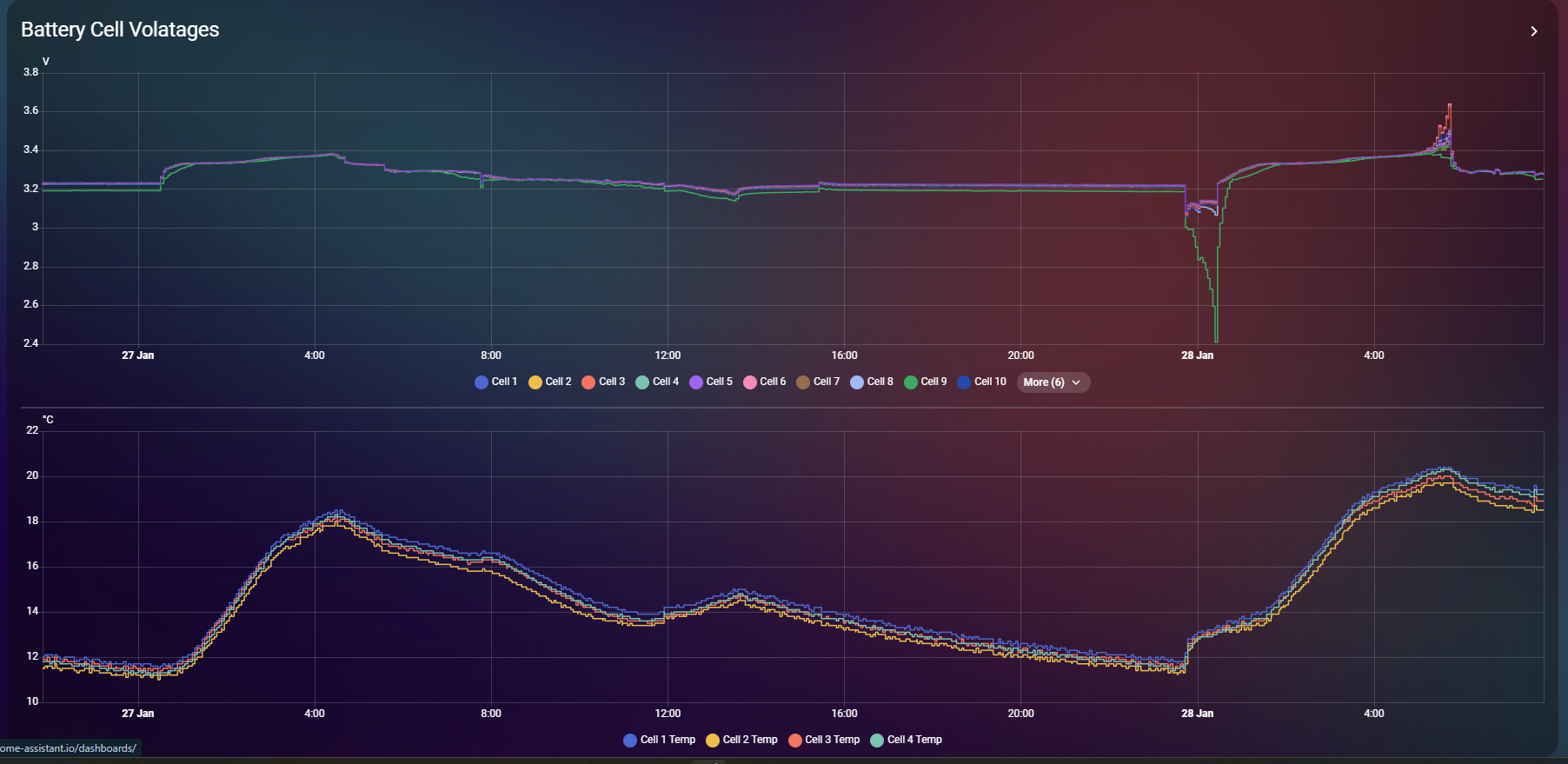
4th battery and still not quite right - what next?

25 comments started 2025-07-29 last 2026-01-28
GivEnergy ProductsHybridBattery
J
#1 Josephiah

Hi all,

After some issues with a cell on battery no.3 (all of these are a single 9.5kWh gen 2, with a 5kW hybrid inverter), GE sent out at engineer last week to have a look at it. I don't know how much troubleshooting was attempted (I was stuck in Teams meetings, otherwise would have hovered annoyingly over his shoulder out of curiosity), but he ended up just swapping out the whole thing for a replacement unit before heading back down the road. He said it didn't need recalibration as it had been done before leaving base.

After sorting out the home assistant entities, I had a bit of a look at it: unlike previous replacements, this one appears to be a refurb, with around 500 cycles to its name. This does not seem unreasonable, as the old one had something like 7-800 cycles under its belt, but would have been nice if he had mentioned this. Capacity was showing as a suspiciously precise 186.0 Ah.

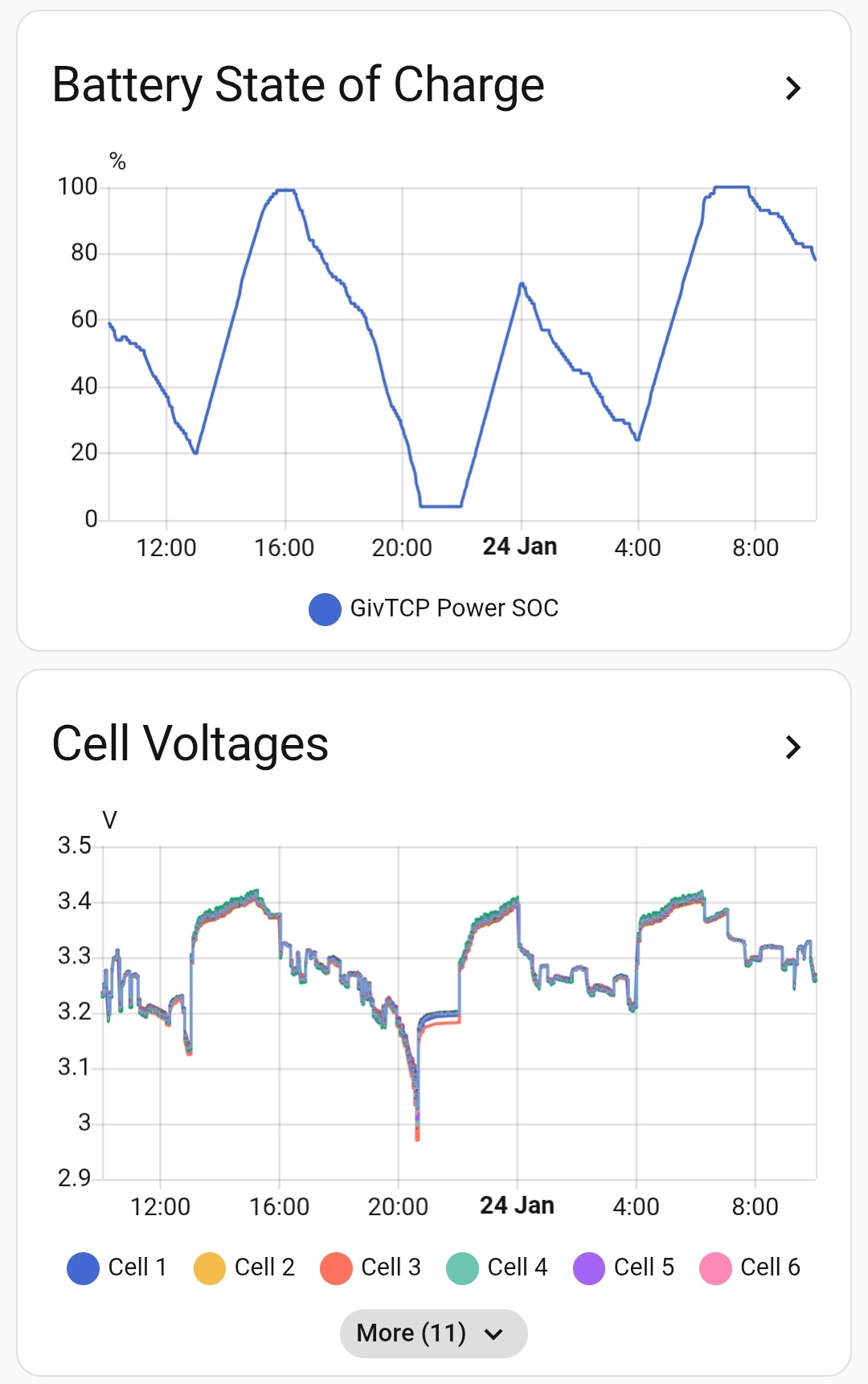
After a couple of days use I checked on the input/output totals, and it looks like I'm only able to put 7.5 - 8 kWh into it. Ran a couple of calibrations, shown below, once at full rate down / half rate up (poor solar day), followed by another at half rate each direction.

New capacity reading: 158.8 kWh, or about 85% nominal capacity.
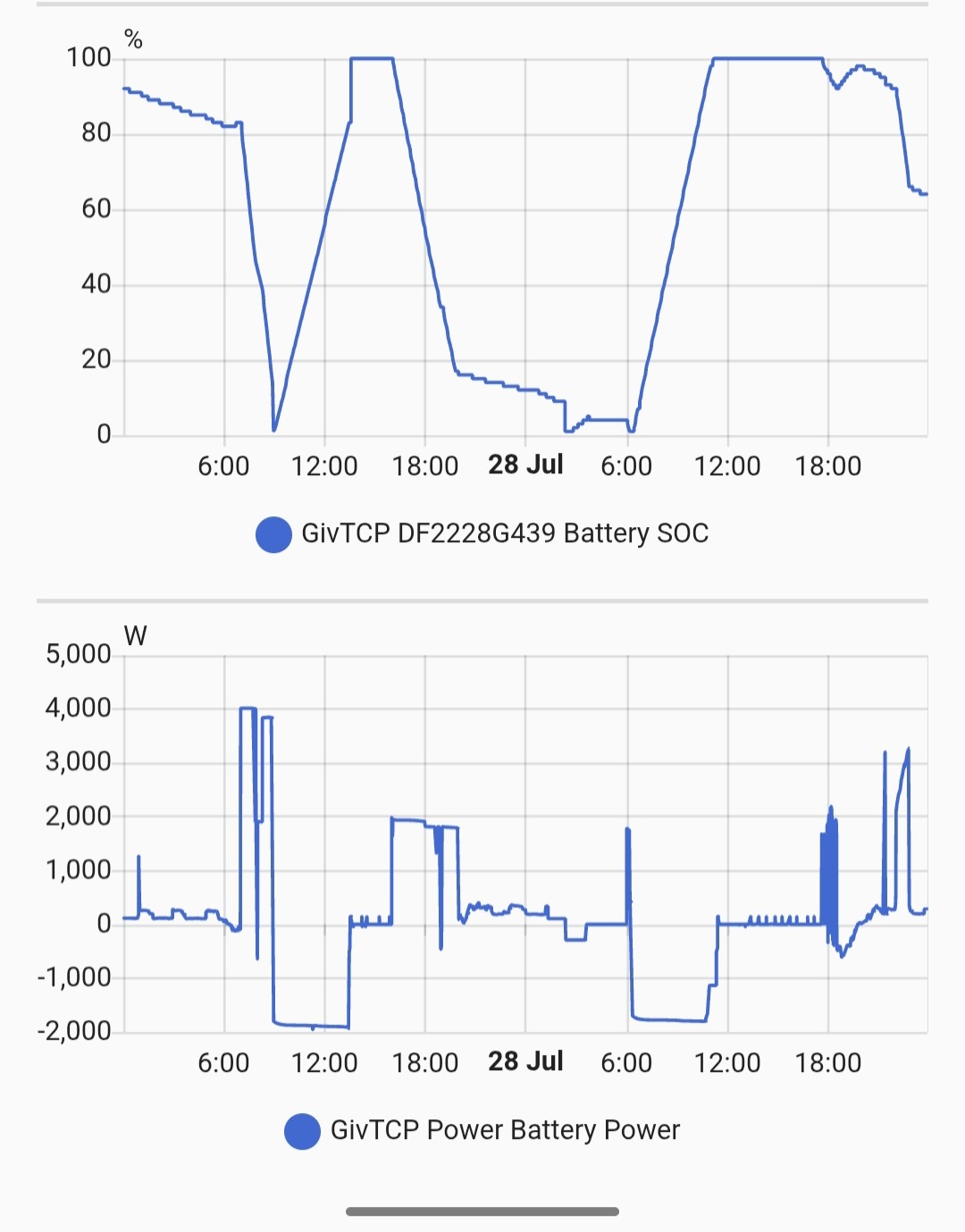
From a look at the cell voltages, battery no.4 is generally looking better than battery no.3, which had one cell deviating from the others even under very low rate charging. Here, all the cells stay together remarkably well, except for that obvious big drop on cell 1 at low voltage. This is obviously restricting the low end of the range.
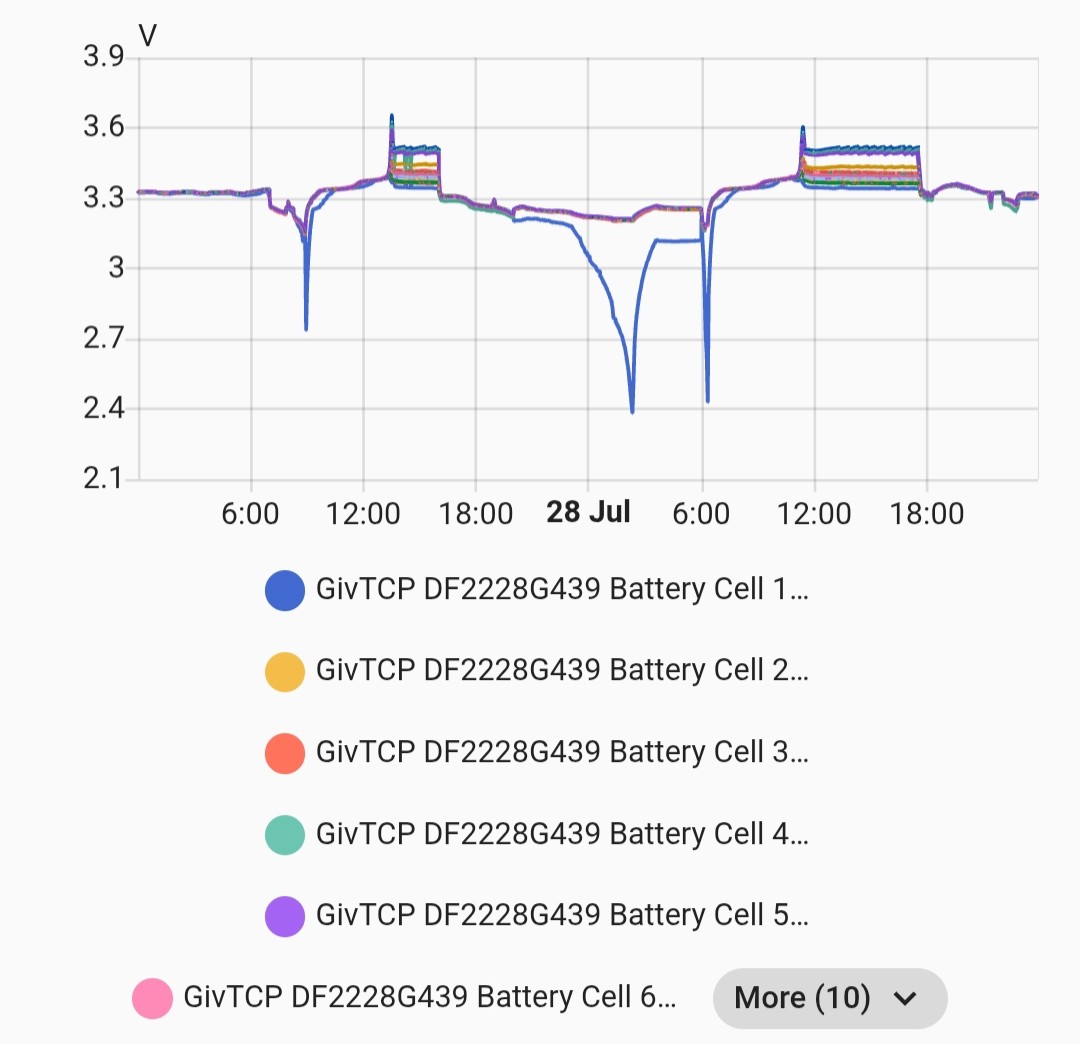
So, what do we think? Back on the phone again? Getting a bit tired of the sheer length of time it takes anything to happen. It's partly just the nature of systems like this which operate on the scale of hours, but the inevitable "problems only identifiable hours/days after the engineer has left" are rather frustrating.


#2 Windy Miller

The recent enhancement added to the Android Inverter Monitor app may prove helpful in monitoring the individual cells. You could get an independent view of cell performance over a few discharge/charge cycles to see whether one cell is holding back the whole battery. The 9.5kWh is supposed to be 100% DOD so 85% shows quite an ageing process. Currently I think my 2x 5.2kWh are showing just below 80% DOD but then that is what they were quoted as when new and mine are 2.5 years old.

J
#3 Josephiah

Windy Miller
Thanks, will give that a try when I'm back on my local network (on holiday currently, and getting proper access for that app is beyond my ability from here!)

I've filled GE in on the situation by email so they've got all the details. Will keep monitoring and chase them in due course.

#4 hoggy

Is the refurb perhaps intentional (I'm unaware of how old your system is) but putting a brand new one in place of one that's done 800 cycles would likely cause more imbalance problems.
Going by the serial numbers DF2228 suggests you've been given a pack from week 28 of 2022 - so you'll have some calendar aging to contend with, although if that's the expected rate for a battery of that age I don't know, perhaps someone with similar vintage and cycles may be able to assist in that aspect?
To me it sounds a little on the low side but perhaps it needs a good long balancing depending on what it's history is/was (perhaps cell 1 was the one that was changed out)

J
#5 Josephiah

Thanks hoggy

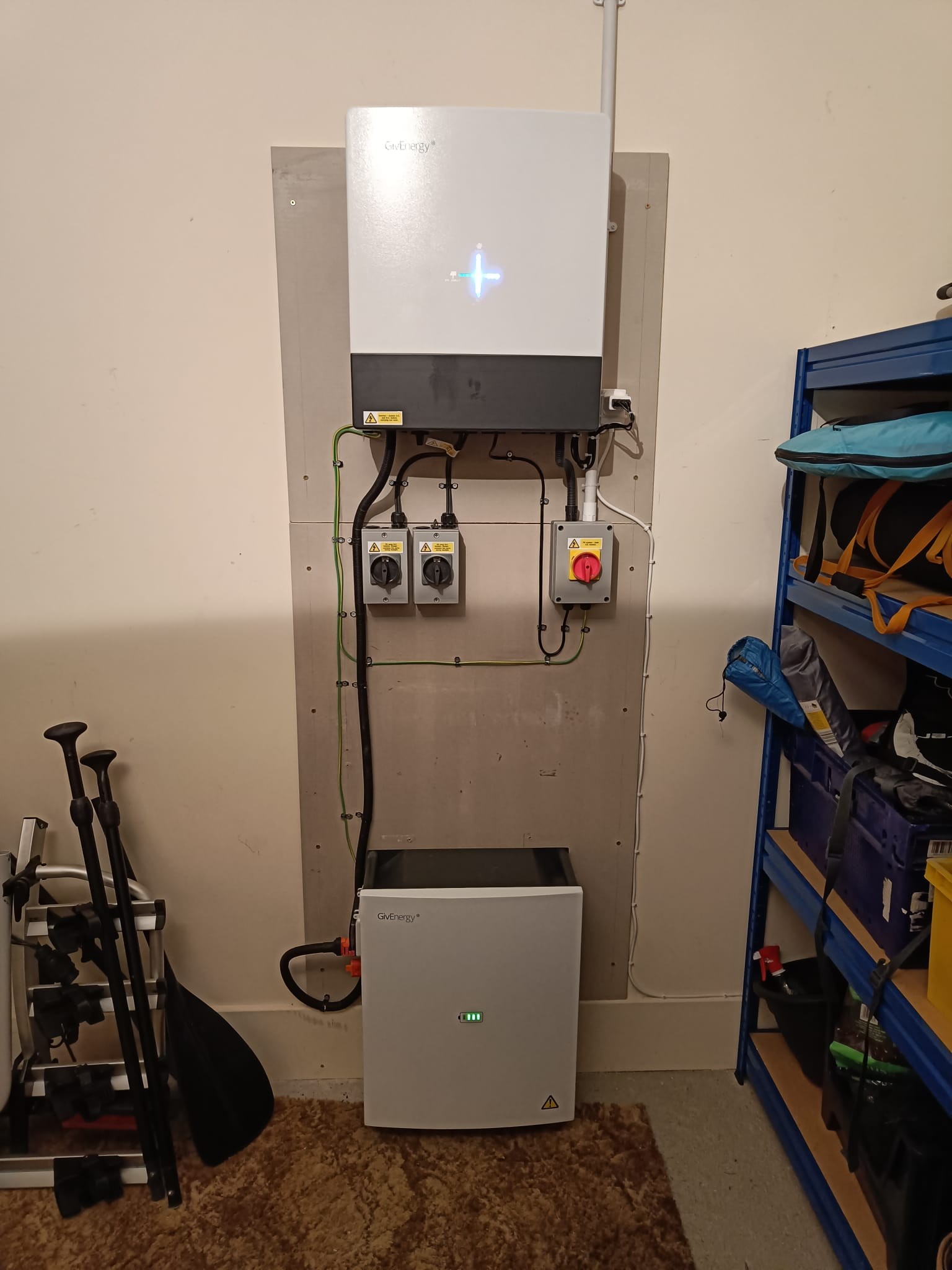
I'm not sure I quite follow your first point. Possibly I've confused things with my numbering: we only have one 9.5kWh battery pack. Each time, GE has replaced the entire thing, and we are now on our fourth one. There isn't another battery unit to balance with, so I don't think replacing with a refurb brings any advantage (except cost saving to GE, presumably).

Interesting on the serial numbers/dates - I hadn't connected the dots there.

1st: 2319...
2nd: 2319...
3rd: 2321...
4th: 2228...

R
#6 Rbor

Josephiah I have two 8.2 kWh batteries from 2022.
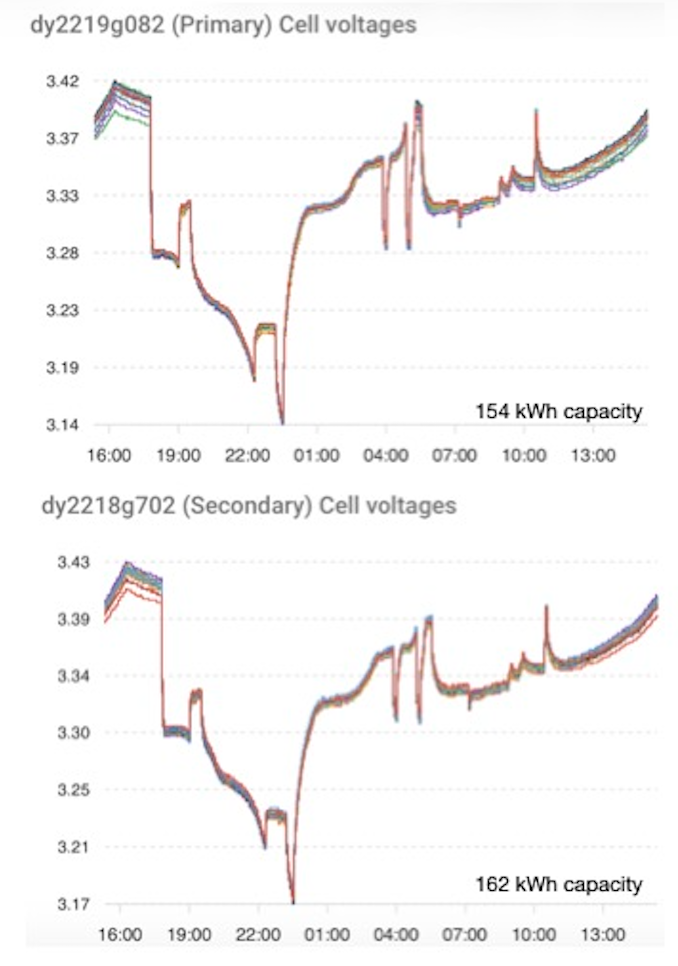
The cells keep together really well. I do find that one cell can wander but only by about 0.02V from the others. But it seems to wander back OK using IOG from one SOC extreme to the other, each day:

One battery has a capacity reading of 162 kWh, the other 154 kWh, against design of 160 kWh for 8.2 kWh. The '162' battery (755 cycles) was purchased after the '153' battery (1030 cycles)
Your cell 1 looks to have a problem.

Rob

J
#7 Josephiah

Well, after several months, and a few more badgering emails, GiveEnergy finally booked in an engineer visit "with a spare in the van" for this week. It took him about 2 minutes to conclude that "yup, cell 1's all over the place; not worth attempting a repair here, I'll just swap it for a new one". And no 500-cycle refurb this time, it's a brand spanking new 9.5 kWh Gen 3. Partly just the lower mounting position, but seems very dinky compared to the Gen 2.

Already looking much better behaved than any of battery nos. 1-4, so hoping for a long and healthy life out of this one.

R
#8 Rubikcube

Josephiah new 9.5 kWh Gen 3.

I have never seen a 9.5kWh Gen3, but that looks rather small. Are you sure it's not a 5.2kWh? What does the label on the side say?

#9 hoggy

I think the new 9.5s are back to 2 rows of 8 rather than the 32 cells in the old ones.

J
#10 Josephiah

Rubikcube Well, it's certainly behaving like a 9.5!

J
#11 Josephiah

hoggy both my Gen 2s and this Gen 3 appear to have 16 cells. Not sure of the physical layout of the Gen 3.

#12 hoggy

Josephiah they show as 16 cells but thats because they had 2 cells in parallel for each "cell" that the BMS reports on the old ones.

R
#13 rio911

I'm sorry to hijack this thread, but I think I have a similar problem with my battery, which was installed in 08/23. I can currently only charge about 7kWh and also discharge about 6.9kWh of what is originally 9.5kWh Gen2 battery. I can also see 186Ah (original) and 148.8Ah. My question is what are the warranty limits? For example at 148.8Ah, I calculate this to be 80% of the original capacity. Is that sufficient for a warranty claim?

D
#14 DD

rio911 My vague recollection was 70%, but that could easily be wrong. Does your battery regularly run a full cycle (up to 100% and down to 4%) ? That tends to help the BMS get its bearings. Have you run a calibration recently ? Might help.

I'd start with the Android inverter app - https://givenergymonitor.wixsite.com/tutorials - which can show the state of individual battery cells - battery charge/discharge would stop when one cell reaches an extreme, so a balance issue, or a weak cell, could manifest in this way.

R
#15 rio911

DD I have the Inverter app. Also, due to recent addition of ASHP, the battery is now flat by lunch time every single day. And then gets a full charge in the cheap OGo slot. I will do another calibration, but this has been a regular occurrence, probably every 3 months. Generally nothing changes in the Ah report. Edit: and yes, you might be right. I might have confused the 80% with my EV battery warranty. Anyway, I will need to dig up my GivE warranty and see the specifics.

D
#16 DD

rio911 slow charging and discharging might be better for the battery. If you know the battery can't last much into the day, limiting the discharge power might be kinder, on dull days at least. (I did that last year, though not so much this year - I think I have heat pump more under control so it doesn't really ask for more than 1.5kW anyway.)
Similarly, reducing charging power so that takes the whole of the cheap periods. (I charge at about 50% which almost all of IOG overnight slot.)

Probably no point in yet another calibration. (I haven't done one in quite a while - perhaps I ought to consider it, though battery seems to be behaving okay.)

J
#17 Josephiah

rio911 hijack away!

I think 70% is right as far as the warranty goes, though dropping to 80% in that timeframe obviously isn't a great sign.

In my case battery no.3 was far worse, managing less than 50% of original capacity (though it then rallied somewhat before they replaced it). Replacement (no.4) was a refurb, with 500 cycles on it, and was at reduced capacity and cell 1 obviously deviating right from the off, so that probably counted in my favour for getting the replacement - I was able to show them that it had never functioned to spec. But obviously by the time I had diagnosed that, the engineer was long gone, so had to wait the usual several months for anything to happen.

No.5 is looking better so far, so I live in hope...

When it comes to monitoring, the inverter app is okay, but getting the time-series multi-cell data from home assistant was by far the most useful tool to communicate the problem.

R
#18 rio911

DD all good on that front. Battery gets charged at only 2kW overnight and the discharge takes anywhere from 5 to 15 hours. I have done this more so that I can eliminate extreme temps in the battery cells (too cold, when idle or too hot, when charging full speed).

R
#19 rio911

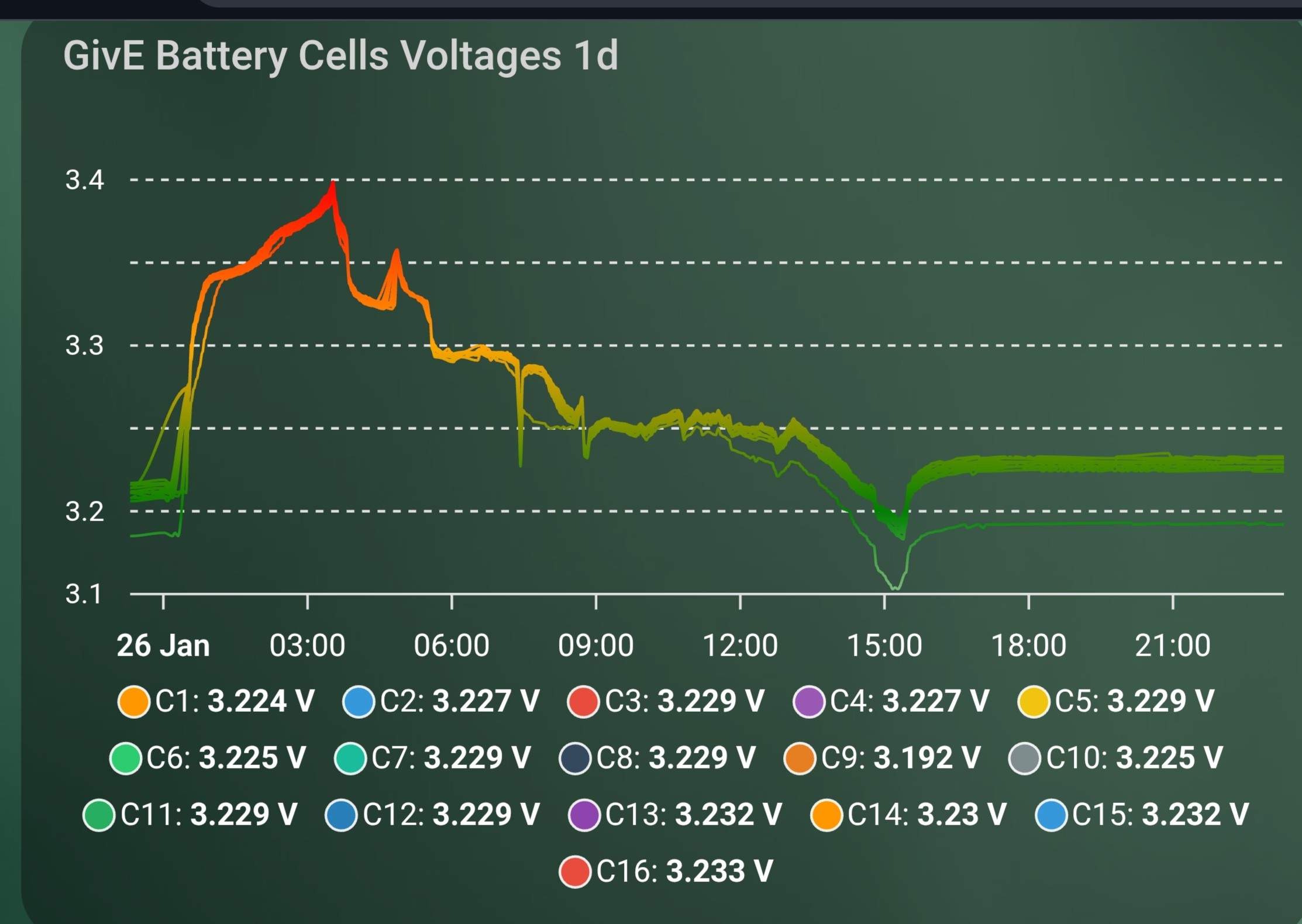
Josephiah yes, I'm recording the battery cell voltages from today and I have to say it doesn't look good:

D
#20 DD

rio911 I think I read somewhere that cell balancing happens above 3.4V, but your cells barely get there before dropping back. Not sure how you actually achieve sustaining 3.4V - perhaps charging at really low power as it approaches 100%

R
#21 rio911

DD That's possible. Lately (last year) the battery gets charged by the set rate, e.g. 2kW to 100%. And then it starts pumping a slow and low: something like 800W for almost an hour (started like that). But yesterday was the first in at least last week where this slow and low did not happen. The battery reached 100%SOC and cut off. But I don't have a record for the other days, I'm afraid.

D
#22 DD

rio911 given that the battery won't last all day anyway, you don't lose anything by extending the charging in the morning, but at the minimum possible rate (300W ?). What was the spread of voltages at the top - it's possible that there's little to be achieved if they are already very close at the top. Mostly depends on what that one weak cell is doing.
(I have no idea if it is beyond saving - outside my experience.)

I'm not sure if there's any balancing at the bottom end - quite often my battery reaches the minimum, but then upon resting for an hour then SoC seems to slowly creep up.

D
#23 DD

rio911 my system is similar - usually charging rate slows right down near 100% but sometimes stops abruptly. This may coincide with the over voltage notifications in the inverter app. I assume that the BMS or inverter had lost track of true SoC and so the full condition catches it unawares.

R
#24 rio911

It looks like I have done a calibration almost every couple of months. So, I did run another one overnight:

Cell 9 hit a low of 2.4V....

#25 hoggy

2.4V is around the trigger point for cell Undervolt Protect - which would signal the end of the discharge cycle of a calibration. (Or the pack Undervolt alarm around 45V, whichever comes first)

All the balancing is done top end, you may find some merit in running "charge only" calibrations at a low wattage to see if it can pull that cell in line. (I don't think you can do them from the portal, I think Givtcp gives that option & I know the BBC Micro inverter app let's you run those.
Rather than doing the full calibration it just does the charge to full part (you need the cells over 3.4V for the balancer to kick in)