Impact of high grid voltage on Gen2 Inverter?

59 comments started 2023-06-17 last 2024-01-31
GivEnergy ProductsHybridBattery
R
#1 rjp

Recent install ( with .909 firmware) and we've noted that grid voltage often goes over 253V - up to 256 on occasion.

We've also seen some bizarre behaviour when the PV output seems to shut down entirely or limit, , and insufficient battery powered is discharged causing grid import. Could this be related to the high grid voltage?

Shutdown seemed to happen when the string voltage hit 500V?

K
#2 killythebid

We certainly see a wide range on the grid voltage similar to what you are. We live in a very rural area in North Wales. On one day last week, it ranged from 243v to 255.5v and today a low of 244.5v to 254.1v.

Our system was installed in April this year and is up to date with the latest firmware on the inverter and batteries.

I have also witnessed the other symptoms of solar production you mention. I have not done anything about it yet and the Givenergy side of things seems to cope OK and soon recover to normal.

The device that gets most upset at the high voltage is usually our Myenergy Zappi car charger which stops with a fault when the voltage is too high.

R
#3 rjp

Thanks. We've contacted our DNO who will come and measure it and install a logger next month. IIRC, they can adjust the transformer taps on the nearby pole to drop it down a notch. I think it's not uncommon in rural areas where you've got very long runs from transformer up to the far end of the line, so big voltage differences.

I suspect because grid voltage should never exceed 253 (230V + 10%) that the inverter starts limiting its output, but would be good to get this confirmed.

K
#4 killythebid

rjp Good idea I might give ours a ring too and see what they say. I think ours is SP

G
#5 geoffreycoan

rjp I suspect because grid voltage should never exceed 253 (230V + 10%) that the inverter starts limiting its output, but would be good to get this confirmed.

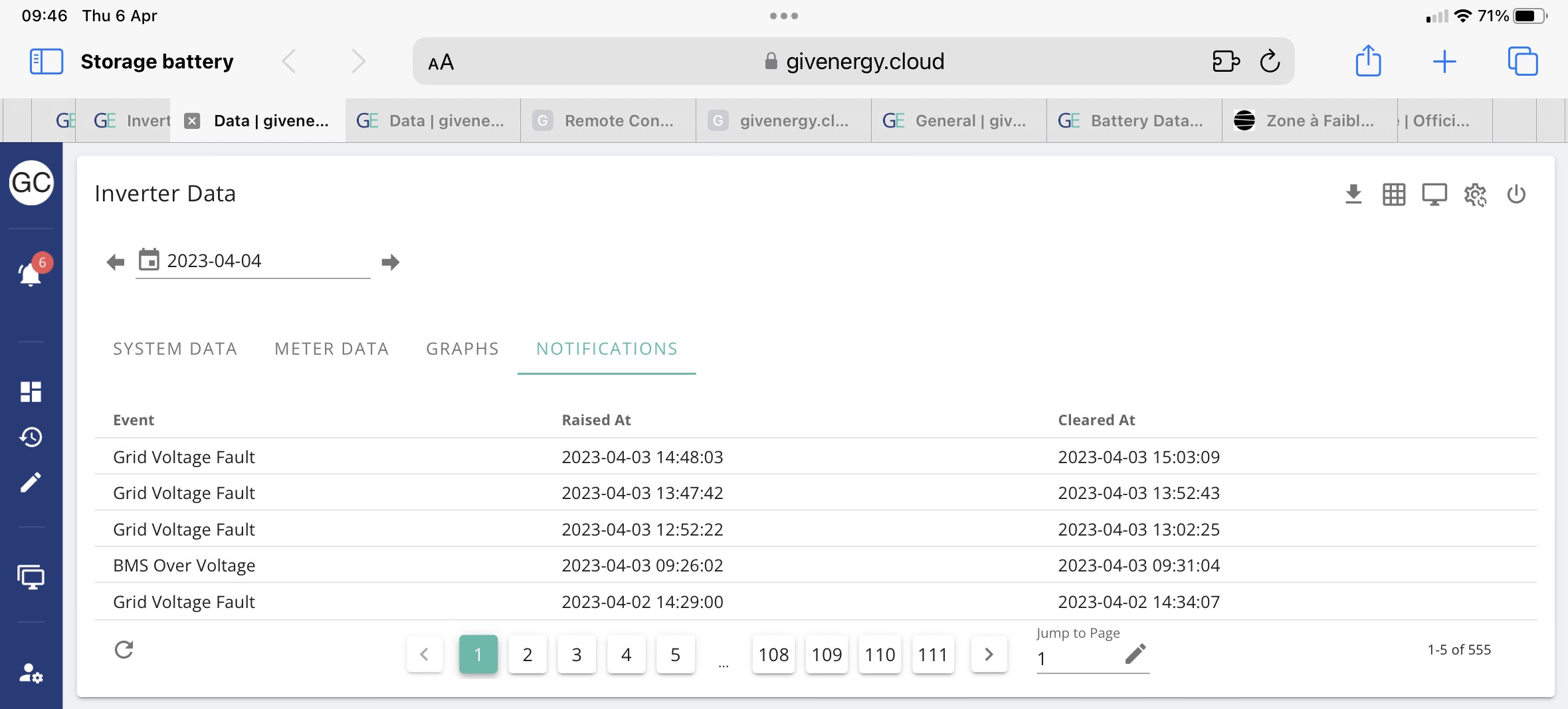
If the voltage is too high the inverter will switch itself off, the light on the front will go red and there will be an ‘over voltage’ error on the inverter log (in the GE portal). The batteries won’t charge and the inverter won’t supply any power to the house when its in this error condition, which only clears when the voltage drops down.

When our system was installed they put both batteries on one inverter and no batteries on the second inverter. So as the weather got warmer and more sunny we increasingly got hundreds of these over-voltage errors and the inverter with the batteries shut itself down. Sometimes for hours on end. Getting one of the batteries moved so there is now one battery on each inverter and getting the DNO to dial things down on the transformer did the trick and we now only get the over voltage errors sporadically and now only for 5 minutes at a time.
In my case the over voltage was caused by the transformer and by the inverter not having anywhere to dump its energy but back into the grid. Neighbouring houses with solar PV will cause the same thing.

R
#6 rjp

Thanks - We're not seeing the error - do you know what voltage it should appears at?

Looking back through the last few days, it seems the odd behaviour always happens mid afternoon when the battery has become fully charged. Once the battery is at 100%, panel power seems to drop off rapidly.

R
#8 rjp

SilverArt Thanks. We're already running .909 firmware.

S
#9 stevelewis

rjp correct. If the grid voltage or frequency is out of limits, any G98/G99 connected generation equipment is required to shut down for safety reasons.

R
#10 rjp

stevelewis Thanks. Odd that there's no notifications in the portal though. The grid data clearly shows voltage reaching 256, but no alerts.

R
#12 rjp

geoffreycoan Thanks. The post by @RHardie is almost exactly what I'm seeing:

I had the same issue with high grid voltage causing problems. What concerns me is the inverter gave no notifications to say it was high. Instead it would just start importing from the grid to supply load instead of discharging battery. It would also throttle back the PV generation when battery was fully charged

.

#13 RHardie

rjp I got it sorted in the end by calling DNO who replaced the local transformer in the village. No idea why the inverter logs didnt throw up an error though as it would have been a log quicker diagnosing the problem.. get in touch with your DNO. They should sort it for you.

C
#14 Compo

I had similar problems and my installer diagnosed grid voltage at 253+. Called out Western Power and they agreed it was at the upper limit so they turned it down at the local distribution box serving our area.

K
#15 killythebid

I have gone through the high grid voltage process with our DNO (SP Energy) and after the initial testing, 7 days monitoring they came out today to tap down the transformer in the field behind us on a pole from the high-voltage line.

We were averaging around 254v during the 7 days but spent quite a lot of time around 256-258v. The Givenergy inverter and batteries all worked OK but at these voltages, the Myenergi Zappi just kept refusing to play with a Bad Voltage error. Some days it became near impossible to charge the car and waste a lot of spare generation.

The upshot of the adjustment the DNO has made so far is that we are now running around 245v which should be just fine. We may see a further reduction in the winter but I don't think it will be huge as only 3 houses including ours are supplied by the transformer and one of them is not occupied but we shall see.

R
#16 rjp

Good result. We've had a DNO logger in the meter cupboard for a few days now. We're not consistently over 253, but it seems to fluctuate lots. How long did it take them to sort it after the monitoring?

Are you seeing any improvements in PV generation?

Related, but do you know where the "Grid Data" voltage is measured? Is it local to the inverter, or from the EM115?

E
#17 Edward

I've been through this with my Gen1 5kW Hybrid.

Lot's of calls / contact with GivEnergy support as I often couldn't get my batteries to export to the grid.

After a year+ of frustration I read on Facebook that grid overvoltage can cause this problem I checked and found I was often over 255v.

A lot of messing with my DNO (ENWL) over 3 months they finally tapped down my supply.

No not excedding 245v and GivEnergy system working as it should.

GivEnergy should train they're support people better and add notifications in the cloud portal - it would have saved me a year of hassle!

R
#18 rjp

... add notifications in the cloud portal - it would have saved me a year of hassle!

Couldn't agree more. Our installer mentioned that grid was high, but was unaware of the potential problems. I suspect there are plenty of customers with underperforming PV systems, blissfully unaware that the inverter is having to throttle the output due to grid voltage.

K
#19 killythebid

rjp It was quite quick to be fair.

From reporting the issue to the 7 days of monitoring it was just under 2 weeks and only 2 days later after the monitor data was collected they came to adjust the transformer.

For once living in a remote area meant only a couple of houses were affected by the transformer adjustment and the power outage so I think it was an easy fix.

it's only been a little over 24 hours but we have now been running between 235 and 245v instead of 250-260v everything seems to be working better, more as expected, particularly the car charger, and yesterday without bad voltage interruptions we managed to put nearly 24kWh into the car. The Givenergy Inverter/battery seems to be happier too without strangling solar production when the batteries are full and exporting when there is spare generation we cannot use. The solar generation is definitely up when the batteries are full or near full without high grid voltage.

The DNO workers did warn that it may drop lower in the winter, we shall see but I can't see it dropping more than another 10volts.

C
#20 Compo

This problem of the grid running at 250+ volts seems fairly common and it is reasonable that the inverter should object in some way (depending on the specific equipment). One thing my engineer said might be due to so many people installing solar and feeding into the grid, that it cannot automatically adjust itself - something has to give - the inverter. But by turning down the grid voltage, it compensates for the extra production. My problems always occurred mid afternoon at the height of the summer when production was at its greatest and demand was at its lowest. Since then (he says touching wood) the problem has gone away. I am no technician but I always thought it was some kind of safety cut-out and this seems to be why. However, I would bow to more knowledgable people than me.

K
#21 killythebid

Compo solar production is part of it, especially in areas where there is a higher density of houses with it running on the same substation and local transformers but we are out on our own with just 3 houses on the transformer. When we were monitored for the 7 days it showed we had 255v and above in the middle of the night sometimes and peaks in the morning and lower in the afternoon.

The guys who came out to do monitoring and transformer adjustment said they are doing this a lot. Mind you its not just solar that affect the grid voltage. Each morning there is some big equipment that switches on like pumps etc. at Llyn Celyn (a reservoir in North Wales) about 15 or so miles away and at about 11:00 it dips the voltage momentarily to under 220v but recovers.

I was told by the grid guys that some substations have automatic adjustment but the transformers on the poles around here are at least 40-50 years old and have no such capability.

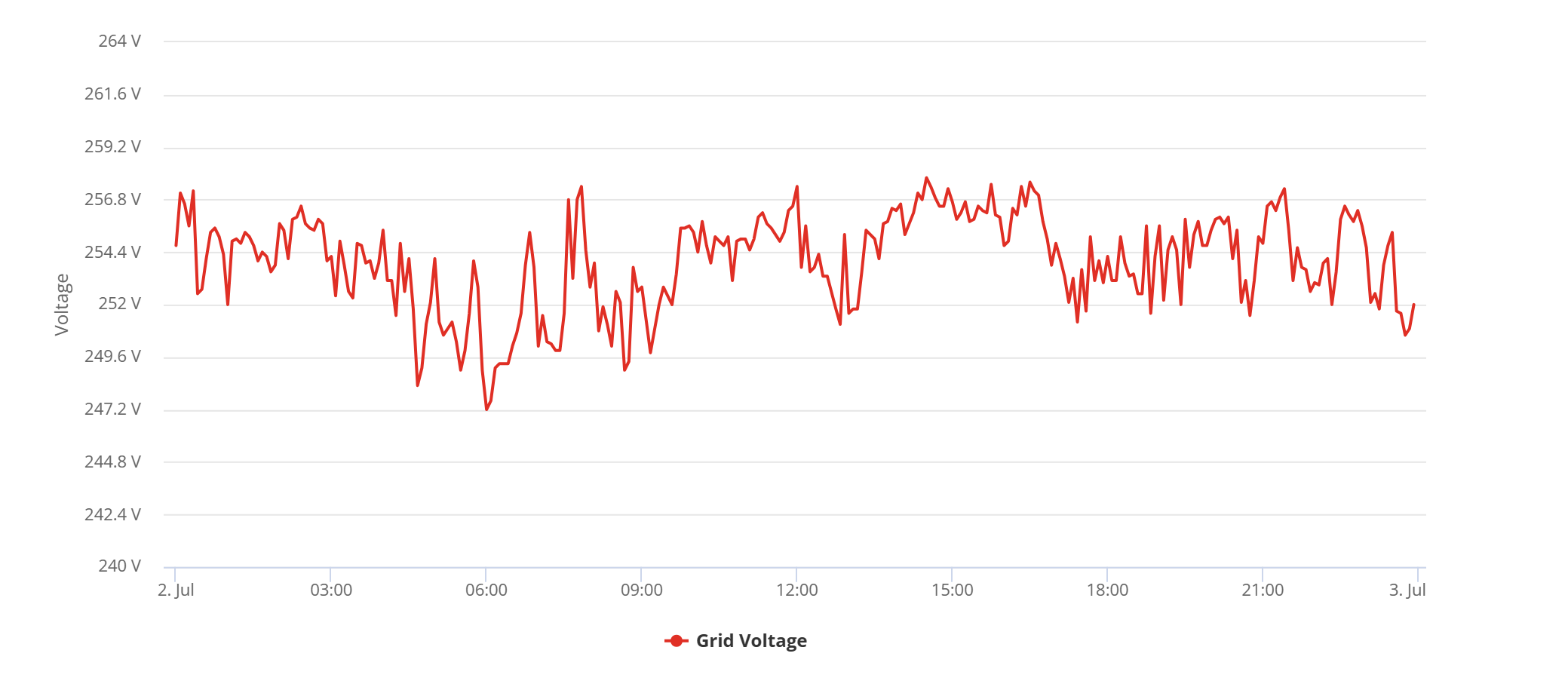
This is a day last week as you can see it was 257v at times in the middle of the night and no solar production. When we were being monitored the engineer asked us to turn off the Solar for 24 hours to be able to compare and it made little difference.

#22 dbt85

I recently had spikes just over 253v and called National Grid (they took over Western Power). Ended up having 3 guys come out on 3 differnt days to do the same thing, pull the fuse and measure there only to see that it was just under 253v at the time of measurement. fortunately I was able to show them the data from 4 properties on the same transformer all showing the same issue even when there was no PV. Turned out there was a problem with the HV in my area and we were being abnormally fed. That was fixed about 10 days after the issue started and its now back down to the 245v range.

Interestingly when I called to tell them I'd seen over 253v I was told to turn off all electrics in my house to save the risk of fire which seemed mild overkill considering had I not been able to monitor it I'd have never known and I can't imagine they pay out a lot of insurance claims due to houses burning down because of 255v on the grid!

The guys that came out were also saying they were getting tons of callouts because car chargers had been chucking errors at 250v which they shouldn't be doing as it should be fine up to 253v.

Mad thing is that I only noticed because the high voltage was really upsetting one of the 4 string inverters on the farm which it turns out had been happening before, but so rarely that I didn't spot it. Any voltage over 246 and it would sit down for a little breather, with the abnormal feed it was basically asleep all day! Still a problem we need to solve, but not actually causing us any issues now that the grid voltage is back to normal.

K
#23 killythebid

I thought after a week or so now I would update on the grid voltage reduction and its effect on my Zappi and Givenergy solar/battery setup.

As reported in the posts above the voltage was tuned down to be in the range of 235 to 245 (from 250-260) and it has stayed in that range ever since. Over the week the inverter and the zappi have been working much more as you would expect and by and large the Zappi has been playing well with the system and taking the excess solar generation but not draining the battery. The Givernergy inverter (Hyb 5.0 2nd gen) has not been choking off the solar generation when the battery has reached 100% and voltage high so we are getting the most out of the system at last.

My experience with reporting the grid voltage issue to SP Energy has been positive and the adjustment has had a significant positive effect on the operation of the system. I would encourage anyone with a similar issue to contact their DNO as it is very likely to be worthwhile.

R
#24 rjp

killythebid

My experience with reporting the grid voltage issue to SP Energy has been positive and the adjustment has had a significant positive effect on the operation of the system. I would encourage anyone with a similar issue to contact their DNO as it is very likely to be worthwhile.

That's really good to hear. We've just had the voltage monitor removed, and (mostly because the weather's been rubbish over the last week, so little solar contribution from neighbours) it only had a few excursions over 253V, with a 248V average over the week. Fingers crossed they'll still decide to drop it a notch, otherwise I'll be pestering them to re-measure when the weather better 🙂

G
#25 geoffreycoan

rjp I think I'm going to call my DNO out again to have another look at our supply voltage.
They've been out once and I think turned down the supply which along with balancing the batteries over the transformers reduced the number of over voltage errors, but I'm still seeing sometimes maybe 5 times a day the inverter switches itself off. And if it's limiting itself if it gets near to max voltage then this is also something I would like to avoid.
12th July : average 250v, min 238.5v, max 259.8v
13th July : average 250.7v, min 242.1v, max 258.8v

Even today which has been grey and rainy most likely the day, av 249v, min 242v, max 253v is towards the top end.

I'll wait for the weather to be though as that's where I see the issue more

Geoffrey

K
#26 killythebid

geoffreycoan The odd thing about our situation was the level of solar generation did not make a hugely significant difference to the grid voltage. We could see peaks of high voltage in the night before dawn and even now with the average being 235-245v, we can see the peak of the day in the early hours some days.

G
#27 geoffreycoan

killythebid We see occasional peaks above 253v in the middle of the night, but the vast majority of peaks are during the solar generation day.
Looking now at yesterday’s full day data from the inverter (14th July) which has been a grey and wet day (although we did generate 12kW so it wasn’t all bad, whilst the average was 248.7v there were actually zero of the 5-minute GE inverter data snapshots where the voltage was over 253v. The previous two more sunny days it was about 20% (55) of the 5-minute snapshots that exceeded 253v. Its likely that most of our voltage overloads are caused by other houses solar generation that are peaking locally. If the average base voltage were nearer 230v I’d think we would be OK so still worth talking to the DNO.

A
#28 Afraid-of-Sunlight

I've just joined the forum as I'm getting the same grid voltage issue. The other day we had a period where it sat at over 259 volts for quite some time. I've been onto my DNO and they are sending a man around to check.

G
#29 geoffreycoan

Afraid-of-Sunlight here's what happened with my excess voltage reporting:

UK power networks sent someone that day who looked at it, said it was a bit high but in limit but they'd do more tests

Next day 2 men with a lift came and checked the supply at my house and at the pole that feeds the house
They said much the same

A week later a man came and installed a voltage monitoring device for a week and said to leave my solar off whilst they monitored.

A week later he took the equipment away

A week later I got a letter saying my supply was outside the limits and they would schedule the work on the transformer to reduce the voltage. I had been told that they have to cut the power to all the homes on the transformer when they do this

R
#30 rjp

geoffreycoan here's what happened with my excess voltage reporting:

Similar here, except they went straight to using a voltage monitor. Our transformer works is scheduled for next week.

They can be reluctant to adjust the transformers and may need a good prod. Don't let them fob you off by suggesting that it's OK because the "average voltage" over the whole monitoring period is under 253V...

G
#31 geoffreycoan

rjp thanks, I’ve got the UK power networks letter confirming that the supply is out of tolerance, so if I've not heard of a date in a few weeks time I'll give them a prid

M
#32 Mike-H

I've had a similar issue, but when SPEN measured the voltage at the substation it was fine. Initially they wanted to blame my solar install and wouldn't accept that it usually happened in the early hours and I'd seen as high as 257.1V and I could send them data from my inverter if they wanted. They didn't want. However, the person I spoke to on the phone did escallate it when I insisted it wasn't the solar system and voltage has been high (250+) in this area for at least the last 40 years (my parent's house has always had voltage at the upper end). They called me back a couple of days later and turns out they were already aware of the issue and had been fitting some sort of dynamic taps on the primary transformer in the next village over which supplies the transformer at the end of my road. Since then it's been a lot better. I guess the grid people are learning that they need to sort this issue out and are looking into it and performing upgrades.

N
#33 NotoriousPyro

The spec for the UK grid is 230 volts -6%, +10%, this gives 253v is the absolute maximum and 216.2v minimum.

If it's out of this range the DNO is at fault.

R
#34 rjp

NotoriousPyro
Well, yes and no... You and your neighbour's solar inverters are all battling to send power to the grid, so we are in some way 'responsible'.

I found this below well worth a read, particularly the section about the configuration that's possible on Fronius inverters to change the over-voltage behaviours and limits. I've no idea if GivEnergy inverters have similar (hidden!) configuration for this.
https://www.mcelectrical.com.au/solar-voltage-rise-explained/#:~:text=When%20your%20solar%20system%20is,higher%20than%20the%20grid%20voltage.

N
#35 NotoriousPyro

rjp You aren't responsible for your neighbours. The DNO is responsible for that connection.

R
#36 rjp

NotoriousPyro You aren't responsible for your neighbours.

Not really what I said. The point is that the local grid can be pootling happily at 250V until a few households add Solar PV, at which point it can jump on sunny days to well over 256V.

Only the DNO can sort it, but I wouldn't say they're necessarily 'at fault'.

Alternatively, a single faulty inverter could be responsible.

K
#37 killythebid

rjp Sure, it can be PV connections helping to raise the grid voltage but anyone who has had to have a G99 form submitted to the DNO has reason I think to consider the DNO at fault. They are the ones giving permission for your level of generation on the roof.

I am not sure in our case it had much to do with the solar installation in any case. Our situation may not be typical though in that only 3 houses are hanging off the same transformer and we are the only one with panels on the roof. When the monitoring kit was installed for the week they asked for the solar to be shut off for a 24-hour period and this showed the voltage behaving the same as when it was active.

We also have several large wind turbines on the hills around us so their generation is likely to swamp any domestic PV installations.

R
#38 rjp

Hopefully they'll be changing pole transformers to this kind of tech, but there's an awful lot of them to do...

https://www.reinhausen.com/vrdt

G
#39 geoffreycoan

killythebid I agree, some of our increase was no doubt due to PV on other houses, and I tended to get the inverter switching itself off on sunnny afternoons, but looking at the voltage on my inverter logs I too saw spikes at 1am in the night.

Must be a big job for the DNO’s to redesign their network from being hub to leaf to a bi-directional generation with a lot more microgeneration going in. A TV programme I was watching was saying that a number of PV and wind schemes were delayed by DNO’s needing to upgrade the network to cope with the new capacity being generated. We’re seeing this at a local level

N
#40 NotoriousPyro

rjp The DNO is definitely at fault. You are not responsible for the grid voltage or the effect multiple solar installations has on grid voltage regardless of what the sun is doing. Everything beyond your property is not your responsibility. You pay the DNO to do that job in your G99.

The DNO take G99 applications and that money is supposed to be set aside to provide the infrastructure to support such installations, whether it be upgrading a transformer or installation of bigger cabling.

If the voltage is regularly exceeding those ranges, then the DNO must take action or they will cause damage to electronics as they move out of spec.

Even though you think the sun shining could be the reason for voltage increases, in fact my area sees spikes at night which then drop off as the DNO adjusts output.

A single faulty inverter is unlikely to alter the grid voltage much, if at all. G99 inverters have multiple safeties and shut down in response to such dangerous events (low/high grid voltage, overheating, frequency, etc). The only situation I can think of a faulty inverter at a residential property would alter the grid voltage would likely be if it was incorrectly installed/not approved G99 equipment.

In fact, it's more likely the faulty inverter would suffer an serious electrical fault if it somehow managed to supply a voltage outside of the spec.

You can see SP Energy's statement on it here, note how they seem to refer to it as their problem throughout the document: https://www.spenergynetworks.co.uk/pages/voltage_changes.aspx

K
#41 killythebid

rjp I think in more densely populated areas they will have to move to more "smart" transformers but I suspect places like where I live will be a long way down the queue. The DNO operative who came out to adjust the local transformer said ours was installed in 1962!

K
#42 killythebid

geoffreycoan Quite, the voltage goes up and down for all sorts of reasons. As an aside the monitoring that the chap from the DNO showed me had a drop of voltage to around 215v (only momentarily) at about 10:00 each day and he said this was due to pumps and other equipment being switched in and out each day at the reservoir at Llyn Celyn just down the road from us.

K
#43 killythebid

NotoriousPyro SP Energy (our DNO) it has to be said, was fine about looking into and fixing the high grid voltage I reported and it all got sorted out quite quickly. There was no suggestion of it not being their problem that I encountered.

T
#44 Tim

NotoriousPyro The DNO is definitely at fault.

Give the guys a break! They have to say yes to any microgeneration up to 3.68kW. The system was designed decades ago with energy flowing from transmission systems to distributions systems and their job was to keep the lights on for "the last mile". The whole system has been turned on its head. The big generators feeding into the transmission system are in decline; everyone wants to jump onto "local" microgeneration into distribution networks (even wind generators). The design isn't applicable any more any there's no money in distribution any more. The best they can do is take a cut from the daily standing charge. All the money goes to energy suppliers who charge per unit but the DNO gets the crumbs under the table. They are funded but can only do what they can given their complete lack of control over planning and developments. They're on the back foot and continually playing catch up. It's a bit like blaming the bus driver for the bus service.

B
#45 billG

Edward explains why I lost two
Induction hobs but SP denied it at the time but the voltage is lower now.

N
#46 NotoriousPyro

Tim SP Energy said yes to my 5.5 kWh install and no voltage issues. Sorry, but it's really the DNO's fault and they should be more proactive...

Again, I'm not trying to point fingers at the DNO and say "you're bad" - I'm saying it's not your responsibility.

N
#47 NotoriousPyro

killythebid Probably because they won't feel the need to explicitly state it if they fixed it. Them fixing it is admittance that they own the fault.

1
#48 1sirjohnbarrow

rjp

Whereabouts is the Average Grid Voltage I cant seem to find it.?

Thanks

#49 Cdent

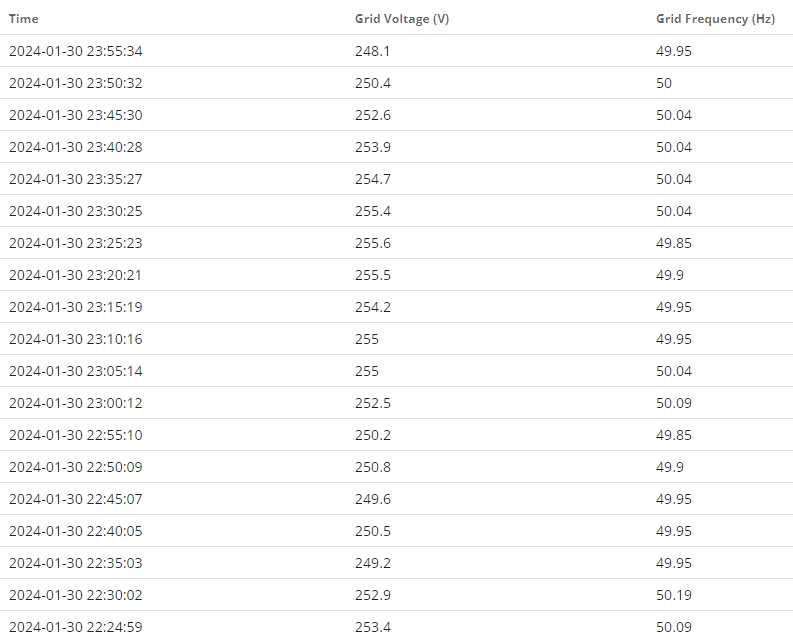
1sirjohnbarrow go to the portal and go to My Inverter, then Grid Data and it shows the grid voltage at each of the 5 minute data points.

1
#50 1sirjohnbarrow

Cdent Thanks

Is it possible to get an average Value for the complete day?

#51 Cdent

1sirjohnbarrow not through the portal, but you could copy the grid data into Excel to get an average of the 5 minute intervals, or if you use Home Assistant I think grid voltage is a sensor in there.

If you have a smart meter some of those can display grid voltage, but it depends on the model

B
#52 bolo

My inverter is under error status since 11pm last night. Grid voltage was 255. Should the inverter correct this error status when the voltage gets to normal levels (currently at 248.2). I find that I have to manually restart the inverter which is a real pain without any notification.

1
#53 1sirjohnbarrow

Cdent Thankyou. Very useful.

G
#54 geoffreycoan

bolo My inverter is under error status since 11pm last night. Grid voltage was 255.

253 is the maximum your grid voltage should be getting to https://www.bing.com/search?pglt=41&q=uk+grid+voltage+levels

so if you are getting 255 and your inverter is shutting down as a result, raise this as a DNO fault. They will come and fit a monitoring device, annoyingly you have to turn off your solar panels whilst the monitoring is in place, and then from the monitoring they should conclude there is a supply issue and fix it.

All this happened to me and they retapped the transformer. I get no grid voltage errors now.

Well, did get one on 3rd January when the voltage dropped to 132V, but that was a genuine supply issue

B
#55 bolo

geoffreycoan Thanks... How do i raise this with my DNO. I'm in Southern England.

Also, I don't know how to turn off my panels! They were installed by the previous owner!

B
#57 bolo

Cdent Thanks!

G
#58 geoffreycoan

bolo put it through as an electrical emergency, they don;’t seem to have anything for non-urgent (we are with UK Power Networks in East Anglia)

In my experience they turn up quite quickly and will measure your supply voltage there and then. So might be worth you waiting until it’s a sunny day and your inverter is complaining (usually from other people’s solar overloading the local grid) before you call them.

To turn off the PV panels there should be an isolator switch in the cable from the panels to the inverter. Mine is black knob on a grey box as opposed to red and yellow for the AC isolators for the inverter

B
#59 bolo

geoffreycoan thanks.

I sent them an email already so will see where it goes from there.