Octopus new tariff: Intelligent Octopus Flux

202 comments started 2023-07-20 last 2025-12-13
GivEnergy Products
L
#1 LordHippos

Looks like initially mainly for GE users like us.

This might be the GE tariff that was found a few months ago.

https://octopus.energy/intelligent-octopus-flux/

The details here are missing, but there is a press link that contains more:

https://octopus.energy/press/smarter-cleaner-cheaper-octopus-launches-new-smart-tariff-to-unlock-solar-and-storage/

Key info:

  • Import and Export rates the same, similar to ex-Tesla plan.
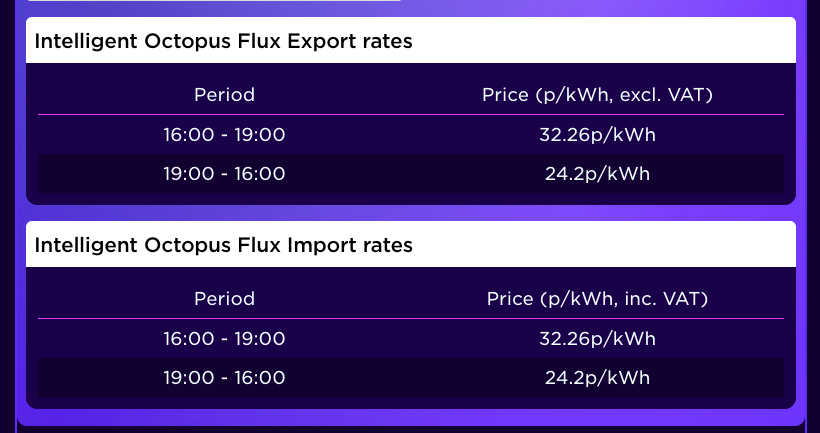
  • 4PM - 7PM peak at roughly 20% above the SVR (£0.36/kWh~)
  • 7PM - 4PM off-peak at roughly 10% below SVR (£0.27/kWh~)

This may slightly out-perform current Flux model on a run of good days in the summer. I fail to see how this will work very well in the winter where export is minimal and something like Go will probably be better for most of us.

Lose some level of control with this, so battery could charge/discharge without you expecting it to.

I await Intelligent Octopus Flux Go!

#2 positor1

@"LordHippos"#
p34411 7PM - 4AM off-peak at roughly 10% below SVR (£0.27/kWh~)

L
#3 LordHippos

positor1 no it's correct as I've laid it out I believe. Peak is just 4pm - 7pm each day and the rest is considered off-peak.

#4 positor1

LordHippos
Apologies you are correct.
I also agree with you that this would be a summertime only tariff , I am unaware of current eco7 rates but this seems much higher than i was paying on that tariff.
I also (having read posts on here of Octopus r&d not setting inverters back to eco) would not want to hand over control to them. But I suppose a routine of checking the batteries have stopped exporting at 7pm may be a solution.
Another point, when the grid is over supplied like a few days ago when the agile import price went negative again- they are not going to want to exasperate the situation by setting your system to discharge meaning you would lose the export value for those times.
I welcome the fact that they are giving serious thought to energy storage though.

T
#5 Tim

positor1 I welcome the fact that they are giving serious thought to energy storage though.

I agree but also think that this is the start of the normalisation process where energy storage will be rewarded (and used) for soaking up off-peak energy and contributing to peak-energy supply. I think it likely in time that the peak demand periods will be more granular 30 minute slots rather than blanket 3 hour "tea time" and the differential between off-peak and peak will also reduce. Octopus is certainly leading the way with innovative tariffs which will adapt as they come to understand better how to drive the behaviours of energy-storage owners to sink or supply when needed. The balancing act will be to make it worthwhile for small battery owners to participate in their energy supply model without the risk of making losses or big profits. I expect it will spark a wider discussion about what is a reasonable profit to make when you've invested £10-20k in a battery/PV system for your home.

H
#6 hamilton

*Import/Export rate:
Off-peak (7pm - 4pm): Below Flexible Octopus: 27.1 p/kWh at Current Flexible prices
Peak (4pm - 7pm): Above Flexible Octopus: 36.1 p/kWh at Current Flexible prices

These figures make it an amazing export tariff, (march - october).
Winter import for 27.1p + 10% losses = 29.81p true cost
Winter export for 36.1p - 10% losses = 32.49p true cost.
Potential arbitrage = 2.68p per kwh.
so in realitly your going to hand over the control of your battery to octopus to give and take from your battery and cycle it for more than the current flux rates.

The current flux is 19p import and export. (21p with losses).

The current numbers work out really well on paper, its a shame that its on Octopus' paper and not those who have invested over £5k

L
#7 LordHippos

With Flux I tend to work on a full battery cycle per day being pretty likely. I import at 20p/kWh and then export in the day + additional export in the 4-7PM window, leaving (hopefully) enough battery to last the remainder of the day.

With this, and without the cheaper import overnight, I would not wish to sign away control at these levels vs Flux with full control.

#8 THALL

While I love my Flux tariff this new one will be a pass from me. I do joined Intelligent in the winter for ev charging but I disable the smart charge because their smart charge system reacts too slowly when you first plug the car in. Constantly took 15 minutes for octopus to stop the smart charge and 15 minutes at 7.4kw soon adds up! So unless you can be on Intelligent Flux and disable the smart side of it I will pass on this. Not worth the extra few quid a month. Great idea but from experience their system response is too slow.

And yes for anyone wondering, if you turn off the smart charge using the app octopus do send repeated emails asking you to turn it back on..... thankfully they do not force you to have that on. Not yet anyway!

S
#9 SimonClarke

THALL I’ve turned my hypervolt off so it doesn’t charge when first plugged in. No issues or emails for the last few months. Used last night with no problems.

L
#10 LordHippos

Whilst it may work without allowing the automation they would probably reserve the right to boot you off it.

Without the automation stuff via Octopus probably better off just using normal Flux.

S
#11 SimonClarke

LordHippos it still sets up random (to me) charge times in half hour blocks usually between 11.30 and 7.30 (when I’ve told it I want the car) so I can’t see the problem? I asked Octopus at the start why it was charging for so long at full price before setting a schedule but I never got a proper reply so I told them what I was going to do. Again no answer or indeed any complaint

L
#12 LordHippos

SimonClarke Flux/Intelligent Flux don't have any bearing on car charging though, I think it's off topic.

Regular Intelligent Octopus is a totally different tariff set to this one I am posting about.

This is for people with GE solar/battery and is more like the current Flux.

S
#13 SimonClarke

Increasingly people will have all three as I do so hopefully future developments will include all

L
#14 LordHippos

I was half joking when I said I wanted to see Intelligent Octopus Flux Go but hell, maybe!

Overnight cheap rate should be added over winter and then this tariff would be reasonably positioned for year round usage.

S
#15 Spike

Just a point, I know most people are looking at the ££££ side of things, however, if we're discharging to the grid between 4pm & 7pm, then our neighbours are benefiting from our green electricity, by helping to smooth the grid, thus using less power station generated electricity at our export time.
Octopus energy is 100% green when we import to fill up the batteries.
Hopefully that makes sense, seeing the wider picture!

H
#16 hamilton

Spike I totally understand the philosophy, everyone with a battery really takes themselves off grid as much as they can. The problem is in the implementation...
Those energy suppliers who can balance the grid get paid handsomely.
Last winter, to stop the lights being turned off across the country they had the turndown/ off events. For that Octopus were being paid £2 per KWh (ish). They handed that out to those who took part without taking too much of a cut which was great.. Morally right and great for everyone.
This time they will be getting paid £2 per Kwh to use your battery and you will be paying more for energy when compared to IO, standard flux etc etc.

To make it a really attractive proposition, removing the standing charge for those who sign up to this tariff would indicate a massive switch from being a consumer to a helper of the grid so investing in batteries has a future return on investment just like installing a huge wind turbine.
I would also say Flux should be a 1 year fixed deal rather than a 30 day switch.

Personally, I am a low user with an oversized array I probably make 90% of my yearly energy.
Last year, my total bill was £70. This year, mainly because of the standing charge I will see a bill of £300-400.
I could reduce this more by discharging during the flux peak but it cycles the battery at the hottest time of the day.

L
#17 LordHippos

Spike Am already sort of doing that as much as I can anyway with Flux, the main difference is I am in control of it, and I can adjust how much I export. The incentive is there to export at peak for any excess I have.

The rates on this tariff aren't that much better than normal Flux, but for that price you lose a lot of control and could wind up adding additional wear on the battery.

To make this really good it needs an element of super cheap overnight import, like on Go, if they had that I'd probably be OK to sit on this all year around and let Octopus control what it does and when, as long as my average price paid per kWh imported is low enough I'm happy.

With this I would probably be paying a lot more than say Go over Winter, with the cheapest import rate being £0.27/kWh.

Ultimately I want best of both worlds, cheap/free energy for me, and to also benefit the grid demand as well, but working towards paying back the initial investment is my priority personally speaking, and if I can do both at the same time, then I'm happy to do so.

N
#18 naltsta

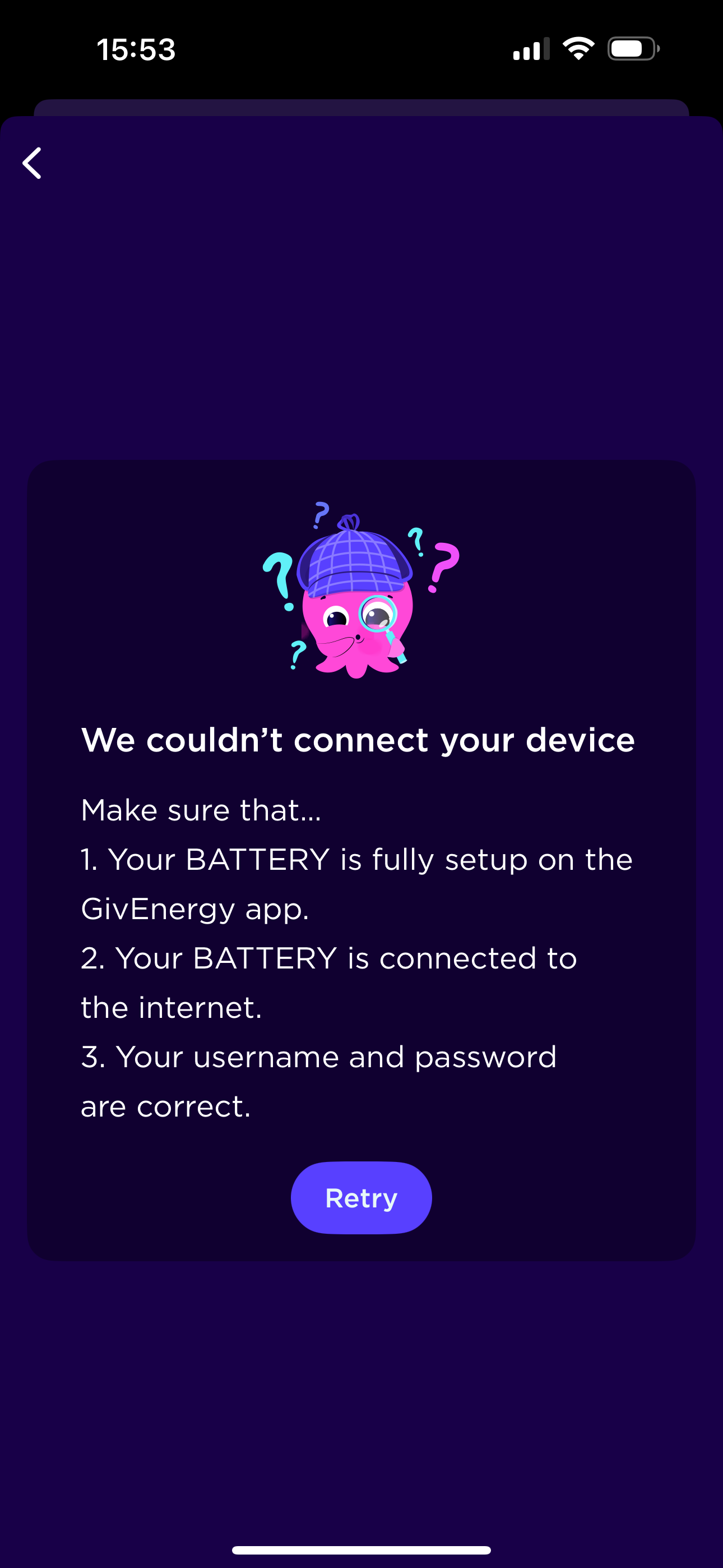
Need to see some proper details.

Is there anything to stop octopus deciding they want your battery to discharge at 3pm instead of 4pm so you get paid less?

Or even charging your battery overnight at a relatively expensive rate even though it’s sunny the next day?

Day export rate is good but as others have said, only a summer option.

A
#19 aniseedvan

hamilton I think the CEO of octopus has been lobbying for standing charge changes given for low volume users (whether through scenarios like yours or others) it’s a disproportionately high amount of the bill.

#20 THALL

naltsta I was wondering this. On the Intelligent EV you get told in advance when you get additional cheap rate hours. Depending how much and when they set the battery to discharge this might be a Summer option.... I am still leaning towards a not kean answer. But the increased export rate would be nice in the Summer. Could do April to September Intelligent Flux and October to March Intelligent EV.

M
#21 MG

I'm on this tariff and can recommend it highly - once it's configured in the GivEnergy app you can even see a realtime calculation for what you're earning/spending.
If you'd like to switch to that tariff this referral link will earn you a free £50 credit.

{Referral link removed}

T
#22 Tim

aniseedvan it’s a disproportionately high amount of the bill.

This is true, but you're paying for the connection to a (usually) reliable utility; the same as the standing charge for the landline; similar concept to Vehicle Excise Duty come to that. I think it would be fairer if everyone paid the same daily rate throughout the whole of the UK. I think it's difficult to expect energy supply companies to create innovative tariffs which drive consumer behaviour to load shift helping balance energy supply and demand with the ongoing need to maintain and develop the distribution network locally and pay for government green initiatives.

It's good to have the discussion about exactly what any standing charge is for and who benefits. Like all public services, they need to be paid for from taxation, but a grown up discussion about what is fair and reasonable for all is better (IMHO) than cherry picking something that definitely is a significant proportion of someone's bill (about 65% in our case).

L
#23 LordHippos

MG No you're not I don't think as it's not really live yet, if you are, then prove it.

Additionally are you allowed to post referral codes here? If so I would be posting my own as would everyone else. So I doubt it's allowed, and if it is, it probably shouldn't be.

T
#24 TX200

And it's recommend a friend not an internet stranger. 🤣

Personally I reckon those that help others on here should be at the top of the list for referral awards. 😀

M
#25 MG

Wow, what a welcome. I'm very sorry, this was a genuine effort to try and be helpful. I can't find a way to edit or delete the comment. But lesson learned: there's no quarter given to newbies who make a mistake.

T
#26 TX200

MG welcome to the forum. 😀

Some of us techies have a way with words. 🤣

We're all friendly, honest. 😁

#27 judgepd

I don't really mind either way but from Octopus T&C:

"7.5.6 We have reason to believe you are sending or advertising your Personalised Link to people who are not known to you or if you are in any way trying to benefit from our referral scheme on a commercial basis rather than for personal use. We may review any account we think might be "taking the mickey" — particularly if we receive complaints from other customers, or if you have referred over 10 people in any 12 month period and we reserve the right to deactivate your Personalised Link or move you to a different scheme."

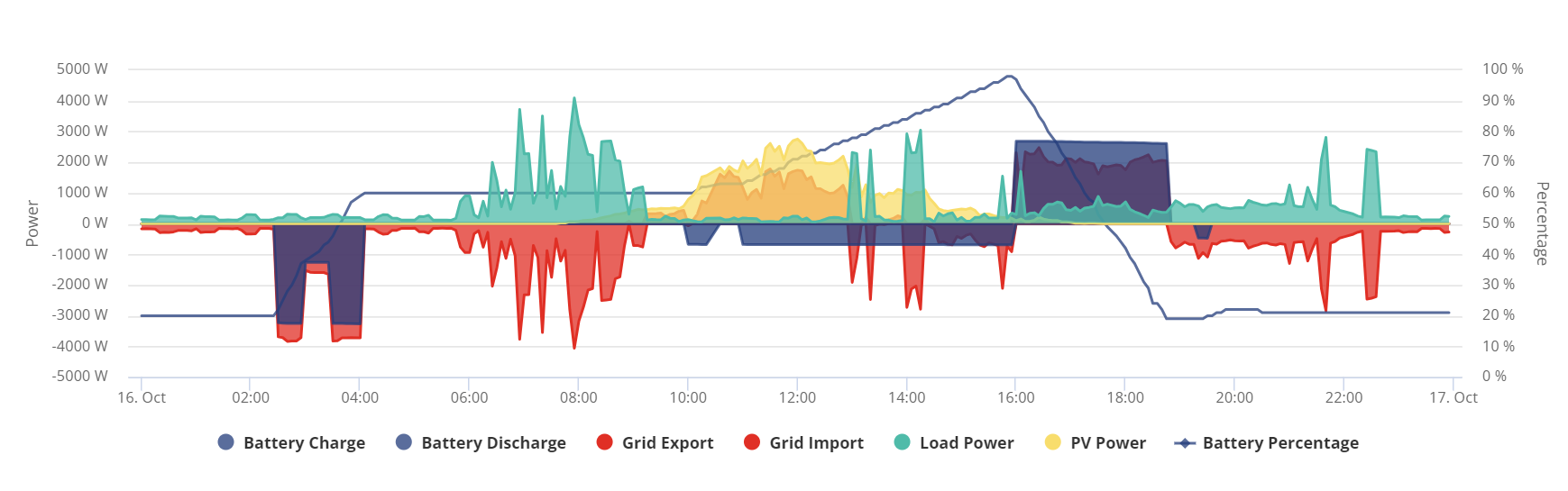
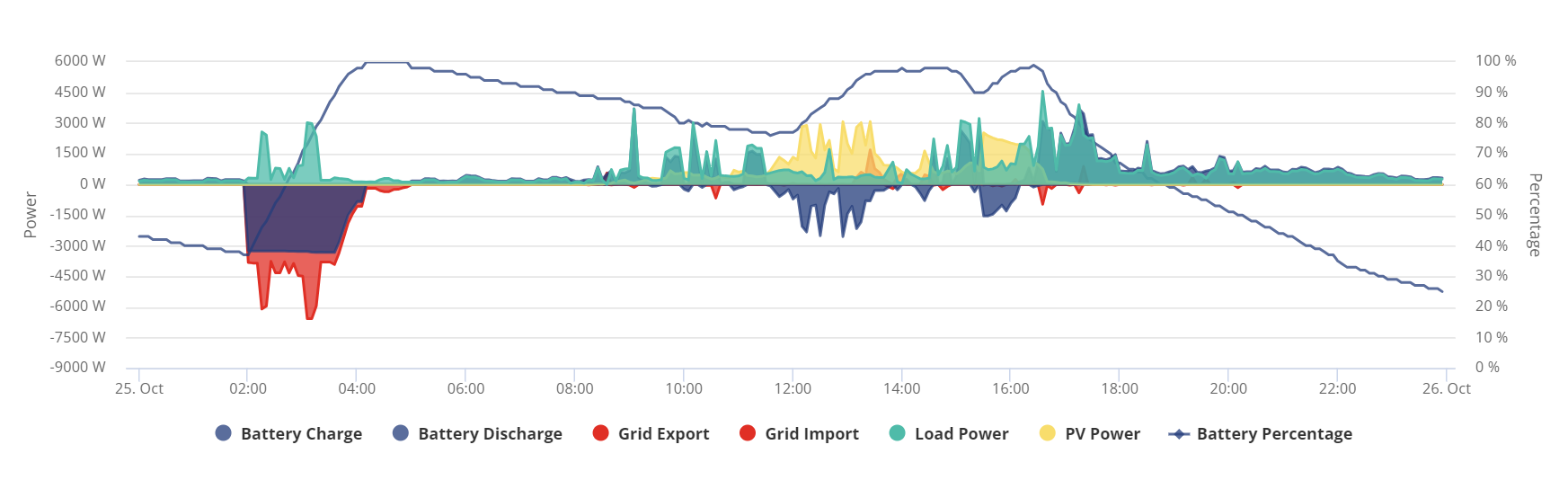
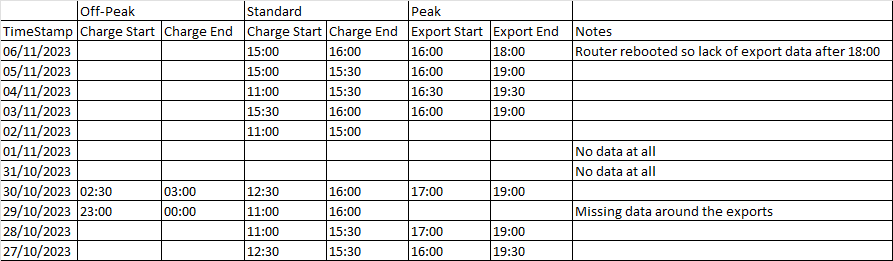
L
#28 LordHippos

MG There is no distinguishing who is new or who isn't, you can't tell by looking at the list of users who are posting here, so you have to treat everyone the same new or not really.

I think allowing people to post links would just lead to messy conversations, it's better if no one does it really.

H
#29 hamilton

MG Octopus launched a new version this week where they take control of the battery for charging and discharging to help the grid. The new one is Octopus Intelligent flux. The fact they charge more for each unit makes it great for summer and terrible for us during the winter means nothing

#30 THALL

judgepd I know a few youtubers who have their referral link in the description of every video and I know 1 of them has 2 - 5 referrals per month. I think this is the classic "we reserve the right" t&c :-)

@LordHippos To be fair if the referral links were posted in every reply I too would take issue, just spamming for freebies. But if signatures were allowed on here I would add my referral link to be honest. I have posted it here way back in the early days of this forum, pretty sure a couple of people used it too. I recall many others linking theirs too.

L
#31 LordHippos

THALL @LordHippos To be fair if the referral links were posted in every reply I too would take issue, just spamming for freebies. But if signatures were allowed on here I would add my referral link to be honest. I have posted it here way back in the early days of this forum, pretty sure a couple of people used it too. I recall many others linking theirs too.

Yeah if it was baked in part of the forum post sign off (so that everyone could do the same thing) then I'd be happy as well to allow that kind of thing, post above reads too much like an ad and is also talking about a different tariff to the one I posted about, so isn't helping anyone to boot.

#32 positor1

LordHippos
Someone on here offered to give his referral cash to charity, after someone posted their referral link on numerous posts (hilarious) . was it clues chris perhaps. a great gesture i thought.

L
#33 LordHippos

positor1 it's not that bad at this point, and I think that most of us here probably use Octopus already (defacto best selection of ToU tariffs), funny solution though!

K
#34 kram

Useless if you have an EV though, because you’ll divert much of the export to the car and pay handsomely to top up.

However Tesla tariff was predictable which will be attractive to many as its essentially a flat rate all day with an expensive bit. As long as octopus don’t dump your battery to empty before the peak and you end up peak drawing it might be ok for many. Oh that or the battery doesn’t do an SoC down correct at 1 minutes to peak and up 1 minute after peak 😂

S
#35 Smk82

kram that would be my worry. say i’m having people over for dinner and need most of battery power for cooking etc that night. Octopus don’t know that and decide to dump the bulk of it to the grid based on previous usage?

T
#36 Terrylawless2023

LordHippos I am a new user of Solar, battery and Octopus Flux, can you tell me what settings you have on your inverter? Please assume that I am a complete idiot and that I don't understand any acronyms or technical jaron.
You seem to be doing exactly what I want to do, but I don't seem to be able to get the battery to discharge to the grid during the teatime period.

L
#37 LordHippos

Terrylawless2023 This would be off-topic for this thread but I have laid out how I do things here if you want to go and check it out: https://community.givenergy.cloud/d/2268-scheduled-discharging/18

G1 hybrid inverter with 8.2kWh battery, if you have a G2/G3 it may act differently and invalidate some of my options.

Crux of the matter is you need a 3rd system to control the discharge/export because basic GE cloud options aren't granular enough, in my case I use Home Assistant running as a docker container on my NAS.

There is a technical barrier to entry on setting this up if you're not that technically minded unfortunately, and there is probably more than one way to achieve what I am doing.

Uses https://github.com/cdpuk/givenergy-local with Home Assistant. If you can get home assistant running on your network 24/7 you're part of the way there with this. Popular options are RPI3/4 or a NAS like what I've done.

#38 positor1

My solution is so easy. set alarms for 4pm and 7pm. export if your brain tells you that you have surplus.

L
#39 LordHippos

positor1 That can work though my method is fairly self-operating, hopefully going to switch back to go in about a month anyway for the winter!

T
#40 Tim

positor1 Maybe you should market this tariff as positor1 Intelligent ☺️

D
#41 deepanshus

LordHippos thank God i found someone who was doing this, i thought i was doing something wrong as no one was else was doing it !! i charge 85% from 2 to 4, ( realised charging upto 85 was quicker so settled for 85 instead of 100) and then discharge upto 40% from 4 to 7.

L
#42 LordHippos

deepanshus I would charge to 100% if I could but 2.6kW max speed, 3 hours isn't quite enough to get there if I run out of juice below about 20% by 02:00.

J
#43 justpassing

LordHippos I'm surprised this tariff is not seen a bit more kindly. Its the only tariff I have seen that offers a net -net deal. If you had a large array and a smallish battery, then you would basically be using the grid as a large battery..... I've always envied friend's in country's that offer deal's where you only pay for the net of your imports - exports 🙂

L
#44 LordHippos

justpassing The problem is the regular Flux tariff exists, and isn't miles apart from this one in terms of pricing, whilst also giving you full control of the system, which further limits battery cycling.

The regular Flux tariff also has a cheaper overnight period of 02:00 - 05:00, which this one lacks, so in winter time this is worse as you can't charge up for cheap(er) than usual.

Whilst net rates sound good in theory, don't forget that you do lose some energy in the transition from grid to battery, so importing energy to export later has a cost in terms of efficiency, you won't get out quite what you put in. If they decide to charge your battery up at 11:00 - 13:00 and then discharge at 14:00 - 16:00 you will be losing out for example.

If this had a cheap overnight rate like standard Flux I think I'd be a little more on-board with it.

Neither Flux nor this version are great in Winter anyway, so might be why I am a little more luke-warm on the concept. If the weather is consistently good/sunny then I think this could out-perform Flux a bit, but weather like we've seen in the UK for the last week or two, I think this would under-perform.

H
#45 hamilton

We all know that the flux and Intelligent flux are not great for winter usage.
For me, my 12 month cycle made me import 420Kwh more than my export or usage.
For standard flux this would be £84, with this new one its £121.
For me to pay more and give control over my system will take some serious consideration.
If they removed the standing charge for those who help the grid would make a £200 difference for me and I am sure that Octopus would make this back as they would become one of the most reactive suppliers of energy. They would not have to have coal power stations on standby etc.

T
#46 Tim Adams

Everyone has different usage...in my case:
Gen1 Hybrid 5kw inverter
3 x 8.2kw batteries
nominal 8kw solar
16kw ashp
EV

Very roughly I expect to import up to 10k kwh per annum and export say 6k kwh
net imports around 4k. Perhaps less now i'm using weather compensation on ashp better.
Most import in winter of course .... and export in summer

Most of the TOU tariffs don't really suit me because I need to use elec pretty much 24x7 during winter and the batteries max load is 2.6kw on Gen1. So I would have to import at peak rates to help balance. Obviously an AIO would potentially be different. and similarly I can only fill the batteries at 2.6kw so cannot typically fill batteries in off-peak windows.

My best option currently:
Octopus Tracker import (Daily rate... typically 18p recently and ave this year around 20p I think)
Octopus Fixed export 15p

Very roughly import cost say £1900 less export £900 = net cost £1000

i cant see how another tariff would help me until I change inverter that can carry bigger load for both import & export. Change of inverter not on agenda in foreseeable future!

btw.... not sure of rules on changing tariff but I think in case of Tracker that if I come off it I cant switch back until 9 month interval? Other tariffs may have other t&c

L
#47 LordHippos

Tim Adams Tracker has been good this year but heading into Winter it could be less good, it could even get punishing (hard to predict). Something like Go gives me better predictable costs majority of the time.

I'm on gas tracker so likely to stay on it and see how that works out, so far it's been good but I've only been on that since around Feb sometime, and using minimal gas at this time of year.

T
#48 Tim Adams

LordHippos definitely some risk. But in reality I think its hardly been above 22p this year inc winter months... with just one day I think at 31p (still under standard) and a handful of days in mid/upper 20s . So barring black swans out of Ukraine/Russia/China etc I think we can expect it to be a good average. Perhaps a few high days when wind does not blow and if very cold? on such days I can reduce import with woodburner and try to maximise battery usage.

Most or all the tariffs (except fixed) have some risk as they can be changed at relatively small notice period? So we all need to be prepared to jump ship!

L
#49 LordHippos

Tim Adams My average cost paid per unit last December - Jan when on Go (off-peak 7.5p, peak 40p) was 12.19p/kWh. I was able to consume 360 units off-peak and only 70 peak, which split the actual cost in £ terms pretty evenly, so around 83% of my load was done in off-peak Go window.

This is in the deepest/darkest time of the year and I only managed a bit over 100 kWh for December/Jan so it's about as bad as it gets.

With your ASHP that will differ of course, not every scenario works well for everyone.

Still on combi for Gas though I don't use tons of that even at the higher pricing. Same time period my Gas usage was 660 kWh of gas, at £0.10/kWh was £66 without SC.

J
#50 justpassing

LordHippos As you say, your mileage may vary.
For me, I am expecting to use 4000-4500 kWh in a year, and generate 6000. So as long as the Octopus control "strategy" means I am running on battery/PV 4 till 7, I win. As time shifting is the point, that is in both our interests
I don't benefit from night charging, the battery just needs to be full enough at 4pm.
It is the flip side of always charging your battery to 100% offpeak with current Flux.
7pm to 4pm the grid is an infinite battery ( sort of).
If I export all my PV offpeak, and import all on peak, then that would be bad indeed.
But assuming octopus play fair, and dont force import at peak unless necessary, nearly all my generation is 6am-4pm, so any excess will get a 27p export.

All this is theoretical, as octopus STILL cant connect to my meter since I joined in February. : -(

L
#51 LordHippos

justpassing My usage is above yours by a bit and my generation will be less, in a year I will use more than I can generate, wish I had a good way of adding a bunch more panels but it's alright 🙂

I'm not sure how the numbers would work but I suspect that the controlled Flux may be better when the weather is great, poor days will wind up costing you more. Between that and extra battery cycles, I think you can do similarly well on standard Flux whilst maintaining control.

#52 Jase1703

LordHippos great analysis and comments from everyone, yes we are all different, our household are electric only, EV, ASHP etc etc, AIO and 20 panels. If I’m giving up control of my battery why am I paying a standing charge? I’d like to see them drop this to use my capital asset.

G
#53 geoffreycoan

Tim Adams Everyone has different usage...in my case:
Gen1 Hybrid 5kw inverter
3 x 8.2kw batteries
nominal 8kw solar
16kw ashp
EV

Very roughly I expect to import up to 10k kwh per annum and export say 6k kwh
net imports around 4k. Perhaps less now i'm using weather compensation on ashp better.
Most import in winter of course .... and export in summer

My setup is very similar to yours Tim, a bit less batteries, bit more solar (and an older FIT array) but I don’t have an EV (so Octopus Go isn’t an option) and I have two 5kW gen 1 hybrid inverters so have more charge and discharge capacity from the batteries. Annual load is about 10mW as well.

At the moment we’re exporting loads and Flux makes a lot of sense. Still waiting for the export MPAN to be issued so currently the grid is getting all that generation for free ☹️

For the first winter of the ASHP we were on a fixed rate tariff which took the edge off the high usage. The fix ended in Feb this year so we were on the standard variable and with 30kW usage it was costing about £10 a day to run the heating. That’s in the same range as the oil boiler that the ASHP replaced and is “liveable with”. Hopefully the usage will be a little less now I have enabled the AI temperature compensation settings.

I too have been thinking about what to do in the winter.

If I charge the batteries in the afternoon ahead of the peak Flux rate I think I’ll avoid any peak usage and if I also charge overnight I can save a little off standard rate usage, so will cost me about £8 a day to run the system which is cheaper than I was paying last winter on the standard tariff.

Wondering whether Octopus Cosy is going to be better. Hadn’t thought about Tracker, it’s definitely more risky.
Interesting to hear what the rates were last winter. 🤔

T
#54 Tim Adams

geoffreycoan I only went onto tracker at start of this year - so its been continuous savings vs standard rates.

Historical prices here: https://energy-stats.uk/octopus-tracker-southern-england/
It includes comparisons of other tariffs - but as we can see it really depends on individual usage to decide best option.

It looks like there have been a couple of periods where tracker prices have been high last year but for the most part I believe that was exceptional - primarily due to Russia. The cold spell in Dec when wind was not blowing also pushed up wholesale prices. So will need watching this winter but I'm optimistic that any periods of high prices can be more than offset with the lengthy savings through the other weeks/months. As well as reducing elec demand if prices are ridiculous!

S
#55 SH

Tim Adams I am planning a new install with solar and ,maybe 2 x AIO primarily to enable me to run my ASHP with as much lower rate electricity as possible. Currently I use almost 10,000 kW pa - what GivEnergy set up would you suggest? (I have DNO approval for 1.5kW solar with 10kW inverter but have but will reapply as this was not GivEnergy.)

G
#56 geoffreycoan

SH I have DNO approval for 1.5kW solar with 10kW inverter but have but will reapply as this was not GivEnergy

Your solar figure seems very small, a typo, should be 15kW?

In considering options for your setup you need to think about max demand, max solar generation, battery capacity, inverter charge/discharge rates and discharge/charge energy losses.

If you have something like 15kW of solar then you’ll need at least two inverters. The GE Gen3 hybrid inverters have a max DC input of 7.5kW and a max output of 5kW (or 3.6kW for the smaller model). However even on the 5kW inverter its a max of 3.3kW charge and 3.6kW discharge from the battery.
So 2x Gen 3 5kW hybrid inverters with at least 1 9.5kW battery on each would give you 7.2kW max battery output and 19kW of storage. You’d only get 6.6kW cheap rate charging per hour, so would need to work out whether you could fill your batteries depending on the tariff you are on and how much storage you have.

Advantage of the hybrid inverters are that you only have less sets of power conversion (and power loss). Solar to home is one (DC to AC). If you charge and discharge from the grid you’d have two sets of conversion/loss (AC to DC and back to AC again when you discharge the battery).

Alternatively if you go down the AIO route, 6kW continuous peak power, 13.5kW capacity. You would need separate inverters and there’d be two power conversions when charging from solar (DC to AC to DC) and a third (DC to AC) when you discharge the AIO.

Power losses can be 3-10% depending on temperature etc.

The big killer for me though at the moment is ability (or not) to have multiple devices. GE say on their website FAQ’s that they don’t support “plant” (multi-inverter) setups because at the moment there is no way for the devices to talk to each other and they operate independently. I have two 5kW hybrid inverters in my setup and whilst it may not be supported, it does seem to work fine for me. Other people have experienced issues with one inverter discharging and the other charging the discharged power - I haven’t seen this.

There are I believe more issues with multiple AC-coupled inverter/battery systems. More prevalence of the system cross-charging between the batteries. In the AIO fact sheet they say “number of parallel operations: 6 (coming soon)” so its clearly on the roadmap for multiple AIO’s to work together, BUT the EMS box that allows multiple AC coupled and hybrid inverters to work together has been in development/test for a long long time. It is coming, but no details of when.

T
#57 Tim Adams

SH i'm not sure I have the answers! but can offer a few questions and thoughts that might help narrow things down.

as @geoffreycoan says is your solar 15kw?
afaik the AIO is currently only available as single installation - but they intend to make it available for multiple installs. Of course vat free as part of solar install so if likely to install another battery later you might make sure you keep a few panels uninstalled until then - so its again vat free? But depends on whether scaffold needed as part of costs too. All depends on own scenario!

Is that right that the DNO permission is specific to particular kit ... or because you are adding batteries to the mix?

It will be interesting to see how the maths stacks up on extra AIO to buy cheaper elec and avoid peak - probably ok I guess as it also helps allow the ashp to run with weather comp for best efficiency - without turning off in peak periods?

I don't know if multiple AIOs will mean there is some sort of master/slave setup and the slaves will be the same kit? or will secondary ones be cheaper?

on my 2021/22 install I have:
16kw ashp
8.5kw pv solar
5kw Gen1 hybrid inverter (downside is the 2.6kw charge/discharge rate for batteries which makes it harder to benefit from cheap rates ....and eps is capped at 2.6kw too)
3 x Gen1 8.2kw batteries
at the time a nice setup but if doing now I would definitely have been looking towards AIO - partly for charge/discharge rates and eps benefits. But costs might mean I would be limited to single?

I'm currently adding solar in another property on a new extension.
9kw ashp
6.5kw pv solar
my plan is probably Givenergy AIO
but struggling to get good price offer - another supplier is suggesting Solaredge system

S
#58 SH

Thanks for your help. A less expensive option is to run 2 x Hybrid inverters which would increase the charge and discharge rates. GivEnergy do not support this arrangement although I've read posts from people who have. I think GivEnergy are working on an EMS that will handle multiple inverters and believe the App already has an option for multiple inverters.
For a new install the AIO also means that I would need to add another inverter for the solar so multiple hybrids would seem to be a better solution.
Adding another inverter would also work for your setup.
All depends of course on when the EMS is released and £££.
Unfortunately nothing is straightforward!

G
#59 geoffreycoan

Tim Adams Is that right that the DNO permission is specific to particular kit ... or because you are adding batteries to the mix?

My DNO appoval states what GE kit is being installed and then I had to get a second DNO approval for when I had a second battery installed. Microgeneration equipment is tested to the G98/99/100 standards so I guess that may be part of the reason why they list the specific equipment on the DNO form?
In practice if you’ve got DNO approval for say 10kW with one manufacturer then another similar equipment should be a straight forward approval, you’d think?

r/e Solaredge. I thought solar equipment was much of a muchness, but have a look at this video https://youtu.be/IKu3H7LKmuw by Anthony Dyer where he covers his solaredge portal and config options. Summary=GE is miles ahead

D
#60 dragon2905

SH With that size of array permissible are you on a single phase or 3 phase supply?

Personally I would punt for a 16kw Sunsynk Inverter and the GE AIO x 1 or x 2.

A
#62 aniseedvan

Had an email invite onto the pilot of this, this morning.
Very little details given, but remembered it was on here.

I’m somewhat reluctant to let octopus’ labs control my set up (relatively modest compared to a few on here!), I have shifted usage around to the daytime for appliances, and utilise the battery at the peak flux time. Dumping my battery during this period will then mean I’m using the grid if the battery is emptied.
No EV at the moment (if it’s relevant)

Anyone else had the email and going for it?

T
#63 TX200

aniseedvan not yet, but in progress of getting export mpan, need to be on an export tariff before you can join (I'm on the waitlist anyway).

T
#64 Tim Adams

in my area prices are:
Night rate (23:30 - 05:30): 7.5p / kWh
Day rate (05:30 - 23:30): 30.6p / kWh

On the face of it quite attractive but I'm inclined to think unlikely to work for me with Gen1 inverter & batteries.

Max I can charge my batteries at cheap rate will be 2.6kwh x 6 hrs = 15.6kwh
but I have capacity for 24.6 kwh

Discharge rate is also 2.6kwh.... and ashp is large 16kw rated (afaik drawing regularly 4kw and with higher demand around 6 or 7kw)

Also exports have to be on SEG 4.1p only. I am currently on Fixed 15p

So for me it will be (far) better to stay on import Tracker (typical day/night rate near 18p) until or unless Tracker spikes significantly higher and even then only if it looks like staying there. With export Fixed 15p

everyone will have different situations according to usage inc PV, EV, ASHP etc etc!

H
#65 hamilton

aniseedvan what rates are you being offered?

A
#66 aniseedvan

hamilton Where do I see this? There’s a “see your day rate and standing charge” line in the app when I hit get started but it’s not a working link!

A
#67 aniseedvan

Tim Adams I thought the export was variable like the current flux tariff? Same for the import?

N
#68 naltsta

aniseedvan import and export are matched at 90% off the variable rate and then there’s a peak 4-7 where both are more expensive.

Good if you’re exporting a lot. Bad for winter or EV owners is my read

N
#69 naltsta

Tim Adams think these are the intelligent rates, not intelligent flux

H
#70 hamilton

aniseedvan I haven't had the invite yet, they normally role out their onboarding process over a couple of weeks.
I was just trying to work out if it was as bad as the original thoughts (for them to be able to charge when energy is close to 0p for them to sell your energy for a profit making it great for them but not the people who have the capital investment.

A
#71 aniseedvan

naltsta Yes I’m already on the standard flux and I definitely wouldn’t be if I had an EV! I’m just not seeing any benefits really for intelligent flux over the standard Flux. I tweeted Octopus and someone emailed me but it’s not really answered my questions!

A
#72 aniseedvan

hamilton This is a big concern! My set up on “normal” flux has worked well over the summer (let’s not talk about last months export with the weather being relatively poor here!) and I’m starting to watch what people with more years under their belt are doing for winter (commissioned in late March).

#73 hoggy

Well it's live (guess heat pumps are next)
let's see what it does overnight:

#74 hoggy

First problem I've got is, just like on the Octo R&D scheduler, it doesn't auto back into eco/dynamic mode after it's finished.
Whether this is how it's supposed to work or some sort of omission we'll have to see.
It won't be staying long on mine if I have to go and flick eco back on constantly.

T
#75 TX200

hoggy is it because they want you to use the grid outside of the peak period?

Although makes more sense to charge the battery if the sun is out than export at the cheaper rate.

#76 hoggy

TX200 it's not really clear how it's intended to operate. I'm half and half on if it's a feature or a bug (given the R&D scheduler also recently started to fail to issue eco commands afterwards and I'm not sure if the code is being reused or not)

T
#77 Tim Adams

naltsta ah yes!
i've had the invite and will try to run some calcs on different tariffs

D
#78 downfield

There's a new YT video on Tim and Kat's Green Walk which is a report on their invitation to GE HQ and half a day talking to senior management and the CEO about current products. They talk to the guy who is working on Intelligent Flux with Octo and report that batteries will only be discharged to the customer's benefit - which I assume means in the peak period. Quite a lot of other interesting details as well.

#79 hoggy

I don’t do YouTubers normally, I generally find them incredibly annoying although I may grit my teeth for that specific part. I was actually there myself in March so I did have a chat with most of them as to what was coming, although this tariff was in its infancy as to how it would actually work.

I wouldn’t personally say it’s particularly doing things for my benefit, it does awkward things like stop battery discharge to the house at all during the day, it modifies the charge power rate to odd values like 500W during high PV periods, slowing battery charge right down when it would be free, similarly during export peak window 4 - 7pm it has decided it only wants to export at 2.2kW instead of 2.6kW to maximise my export rate.

D
#80 downfield

hoggy You do need to be selective re YT, but I personally find that there is a wealth of useful info given freely. But each to their own!
On the IF tariff, provided that the import and export tariffs remain the same - and ignoring losses for the moment - doesn't it represent an easy way to "bank" the overproduction of solar power in summer to be used in the winter?
Leaving the battery out of it, you could just export all surplus power and import it all again later.

#81 hoggy

downfield yes (although the peak periods muddy this a little) I am perhaps over thinking it, and will give it the benefit of the doubt for now as to why its purposely limiting export at peak time. I guess it coming so late in the year and also the weather being generally poor this summer its hard to say how it would shake out stepping back and looking at the year as a whole.

D
#82 DDunn

positor1

Seems to me that GE
Are very slow on sorting home battery storage integration with decent Tariffs?
I agree we need to have intelligent flux the same as intelligent go!
Why should car users have all the benefits?

L
#83 LordHippos

GE just make the inverter/smart controls available for use, the people making the tariffs (in this case Octopus) have all the tools they need to control things, but they need to do the leg work of making it functional really as they are in control of how it operates.

#84 hoggy

To those wondering (which is a very small pool I imagine) - unlike normal Intelligent, there is currently no way to poll the API to get a rough idea of what it's plans are. Although given the symmetry of the tariff means the need to know is somewhat unnecessary.
This is all you can currently get from Octopus:

    "data": {
        "batteryDevice": {
            "krakenflexDeviceId": "00000000_<REDACTED>",
            "deviceType": "BATTERIES",
            "provider": "GIVENERGY",
            "params": {
                "variantId": "11"
            },
            "deviceStatus": {
                "status": "LIVE",
                "suspended": false,
                "maxImportInKw": 2.6,
                "maxExportInKw": 2.6,
                "pluggedIn": true,
                "readings": {
                    "activePowerInKw": {
                        "value": -0.543,
                        "timestamp": "2023-08-29T09:54:17+00:00"
                    },
                    "energyInKwh": {
                        "value": 1.886,
                        "timestamp": "2023-08-29T09:54:17+00:00"
                    },
                    "socPercentage": {
                        "value": 23.0,
                        "timestamp": "2023-08-29T09:54:17+00:00"
                    }
                }
            },
            "chargingPreferences": {
                "minimumSocPercentage": 20,
                "maximumSocPercentage": 100
            }
        }
    }
}
M
#85 mrtnbcky

Has anyone managed to actually sign up for Intelligent Octopus Flux?

Despite receiving an email last week inviting me to 'be one of the first customers to be part of the pilot for this groundbreaking new tariff', I've been unable sign up using the method outlined in the email.

I have contacted Octopus CS, but after an initial flurry of quasi-helpful emails (none of which addressed the issue that there is no options to sign up on the app as per the instructions) I thought I'd revert to this forumn to ask if anyone has had more joy than me!?

R
#86 Rbor

Hi,
I signed up on day 1 but have heard nothing.
I am unconvinced about how much IOF would enhance Flux, which has worked very well for me this year. I would have expected some extra cheaper periods depending on weather conditions (similar to Octopus Intelligent).
And is it worth losing control compared with Flux?
I have not yet decided whether to change from Flux for winter months but I may stick with the tariff.
Last winter, I was on Agile which can be a real roller coaster. I did like Agile but you need to monitor the tariff constantly.
On IOF, I have not seen any feedback on how the tariff is working. Is anyone on it?

Rob


#87 hoggy

I've been on it since 17th Aug (as an experiment) - onboarding was the same as joining IO for the car via the app.
Works alright but you are at the mercy of the weather. Not sure I'll hold onto it much longer over winter but the suns shining still right now so will take a view later in the week.
(Which is kind of the Achilles heel to this tariff, as they need you on it over winter to use you as a Virtual Power Plant but I suspect 90% will jump to normal IO when the weather turns) so I'm not sure how long the tariff will be around for!

Latest Bill hasn't fully landed but the import/export charges have landed in the app:
17th Aug - 21st September (kWh are just guestimates from the Octopus App, they don't seem quite right given the symmetrical nature of the tariff but the actual bill should hopefully show the true values)
Import Cost: £97.27 (375kWh)
Export Credit: £96.89 (393kWh)

So 38p cost for the month.

Side note: Unlike R&D App it has however never failed to do what it's told, nor has it got stuck or done anything weird which is good news.

R
#88 Rbor

hoggy
Thanks for your informative reply.
I am looking at IO for the winter but I am a low energy user. I own an EV that is acceptable for IO but I don't need to charge it often with my low mileage.
Doing the sums, I think I am better off sticking with Flux. The bonus for Flux is the peak rate.
I have recently had a Heat pump installed but this runs of weather compensation, where it is difficult to know when the heat pump requires energy. I can time HW during night but this takes little energy. Heat mainly required for space heating the house during the day.

Octopus need to make Intelligent Flux more attractive than Flux for the user. 3 hours for Flux cheaper import seems stingy (or lower the rate).
Otherwise, I struggle to see any additional benefit for handing my usage hours over to Octopus.

Rob

G
#89 geoffreycoan

I’ve been crunching my utilisation figures to work out what my plan is for winter.

At the moment I’m on Flux and (apart from the last couple of overcast days) I’ve still being turning a profit every day of export>income.

Running my last month’s export and import figures through, in fact, Intelligent Octopus Flux would have been even more profitable for me, -£111 vs -£80 on Flux. This is due to the better export rate on IOF.

In winter with no exporting and having the ASHP on, it’s actually not all that bad either as the non-peak import rate is lower than the Flux day-time rate. Draw back of course being no cheap overnight charging period.
My estimated consumption is £329 per month on IOF vs £313 on Flux.

This estimate is without doing any exporting at all so there’s potential to reduce the bill by a further £55 a month by charging in the day at 25p and peak exporting at 33p although clearly would have to be careful to not export too much and risk peak rate importing. Whether Octopus’s automation would be intelligent enough to manage the battery well enough to get to that figure though …

A
#90 Anomnomnomaly

There's no way I am handing control of my charge/discharge to any company. I'm still pissed that givenergy can decide to do a calibration at anytime without letting me know... Like they did earlier in the year at 4pm.

I've got a 5.2kwh battery... I would need that to cover the house from 4-7 peak rate.

I was going to switch to the flux tariff... but doesn't make any sense over the winter... and without spending a load of money setting up home assistant... I can't have my system charge on the off peak rate (1:30-4:30) which isn't actually that low and then manually have the battery charge up before 4pm if not enough solar to do so.

M
#91 matt-drummer

I was on normal Flux until a couple of days ago.

I would have moved to E7 but I understand (and Octopus confirmed) that can cause issues so I moved to Cosy Octopus.

I had a heat pump installed by Octopus in June this year.

I have 13.6 kW of panels and four GE 9.5 kWh batteries.

My thinking has always been that I want to import and store a cheaply as possible and also get paid as much as possible for exports. Flux is great during the months where I am net exporting. For eight to nine months of the year I export more than I import. On an annual basis I generate more than I consume.

I generate around 12,000 kWh a year, export 9,000 kWh and consume 7,000 kWh. That means I import about 4,000 kWh.

As long as I get paid a reasonable amount for the 9,000 kWh of export I have a surplus of income each year.

All I need to make my system perfect (for me) is for GE to finish their EMS so I can add a second AC Charger, then I would be able to run our house entirely on solar and the cheapest rate imports.

I can't see how Intelligent Flux will work for anybody on days where we are net importing. There are loads of tariffs where batteries can be filled at rates cheaper than the SVR.

The IF import rates are the same as the SVR, or have I missed something?

Even an SVR is better than IF?

G
#92 geoffreycoan

geoffreycoan correction, in the “if I do a peak rate export on IOF” I forgot to include the cost of importing energy at the day rate (doh), so I wouldn’t gain £55 per month by doing this, it’s actually only £15 extra per month which means IOF and Flux are almost identical.

Anomnomnomaly I agree, Flux isn’t a great tariff for winter with low solar pv, and with a 5.2 battery you need to conserve that for the peak period. As you note the cheap rates are not all that cheap. That is certainly part of my conclusion that there’s not actually a lot of difference in all the different rates. The battery helps offset some of the worst but one constraint or another gets in the way - inverter throughput, cheap period duration, etc.

BTW setting up Home Assistant isn’t all that expensive, I paid £75 for a tiny PC that I run HA on, and that is a higher specification than I really needed but I wanted to future proof it.
It is quite time consuming fiddling with it and then when you get the bug and start adding energy monitoring smart plugs, CT clamps, etc. TBH for simple scheduling I’d have probably used wonder watt but they don’t support multiple inverter setups so I went down the HA route.

matt-drummer sounds like you’ve got a decent sized installation there. I think I’ll generate a similar figure of about 11000kW a year but my consumption with the ASHP is about 11000kW. We only had the GivEnergy batteries and inverters in January so I don’t have all the annual figures, but overall I’m hoping to be able to do the same and get the summer exports to pay for the winter grid consumption. Unfortunately we didn’t get our flux export in place until mid August so we will have to be paying for some electricity this winter.

IF rates are better than the SVR, for my (Eastern) region the SVR is 27.93, but IF is 25.14 from 7pm-4pm and 33.52 in the peak so if you’ve got enough battery to last from 4-7 then IF is cheaper.
I think it all depends on your consumption and battery size and how much peak draw you have. The rates with cheaper off peak periods all cost more than the SVR in peak periods.

I don’t have an EV so I didn’t look at Go, and based my projections on 16.7kW/day (September base load inc hot water) + 25.6kW/day (ASHP consumption from last winter - hot water).
Didn’t include any pv generation or export, that’s just upside if any to the monthly figures:

SVR (29.93p/kW) £365

Economy 7 (14.84p / 35.35p) £344

Flux import (16.93 / 27.93 / 39.1p) £314

Intelligent Flux import (25.14 / 33.52p) £329

Cosy (16.76 / 27.93 / 44.69p) £244

Agile (all day average for the last month 19.1p) £250

Agile (average excluding peak 4-7pm, 16.9p) £221

Agile (peak rate average, 37.1p) £486

Tracker (average for the last month, 17.3p) £226

Tracker (higher end rate but not absolute peak in last month, 22p) £288

All of these assuming I maximise the 13.6kW of battery capacity by charging off peak or at least day rate and no peak rate consumption. This matches my current use of Flux where I’m only drawing about 1% of my monthly import at peak rate.

The different agile and tracker rates were to get a sense of what I might pay in different scenarios. I know the long term energy prices are not increasing so the risk is limited, but there is still a potential for volatility.

I had been strongly leaning towards Tracker for December to February and then back to flux as you can’t rejoin tracker for 9 months. Having crunched the numbers I’m now thinking of going to Cosy as the two off peak periods give me enough time to charge the batteries fully and avoid peak import, and it’s just more certain and less exposure than agile or tracker.
I plan to change tariff at the end of October as we’ll increasingly be relying on grid import


N
#93 naltsta

geoffreycoan I’ve just switched to “Go” for the winter. They didn’t even ask if I had an EV.

I don’t really understand intelligent flux. Surely octopus want me to load shift so I’m using electricity when it’s cheapest for them. All the other smart tariffs have an overnight dip! If I moved to intelligent flux it wouldn’t make sense to run my dishwasher/washing machine overnight even though that’s what they want me to do don’t they?..

T
#94 TX200

naltsta they basically want you to avoid the evening peak.

Maybe the tariffs will change over time. Certainly the usage will - the more people that charge their cars overnight, the less cheap it'll be overnight!

Plus as more solar projects get connected, there will be more need to use power in the day.

Ultimately I guess they'd want all EV owners to be using an intelligent tariff, to help smooth out the peaks and perhaps lots of battery users to either not pull from the grid during peak or export to the grid during the peak.

D
#95 deepanshus

geoffreycoan i moved over to Agile from Flux and i would offer a small correction to your numbers.

For agile instead of average, as your battery is 13.6, assuming 3KWH charging (approx) you would be using the average of 5 minimum agile slots. Can you rerun your computation based on this new average value instead of average of all day excluding 4-7.

G
#96 geoffreycoan

deepanshus For agile instead of average, as your battery is 13.6, assuming 3KWH charging (approx) you would be using the average of 5 minimum agile slots. Can you rerun your computation based on this new average value instead of average of all day excluding 4-7.

Mm, that is another angle I hadn't considered. I had looked at the daily agile average and the agile excluding the peak (figuring the battery would see me through that), and the agile peak as a kind of worst case scenario, but what I hadn't thought of is the obvious approach to use the battery aggressively to minimise high rate import and fully charge the batteries in the very much lower agile periods - exactly the approach taken for Cosy and the other TOD tariffs.

I figure I will need to charge the 13.6kW of batteries up twice a day to run me through the day, so I need 12 agile slots rather than 5. I couldn't easily find anywhere that gave me the average of N cheapest slots for the last X days so from the energy-stats website I simply took the average rates from the 12 cheapest periods, which turn out to be very similar to Cosy, a 2-5am period and then a 1-4pm. Over the last 30 days these rates averaged around 5.9-7.9p/kW.

Working that through my spreadsheets, two full battery charges in those periods sees me through most of the daily demand, and anything above that I took at the agile daily average I had earlier.

That comes to a monthly running cost of £107. Wow.

Agile certainly very cheap at the moment and has been for a lot of this year. Whether it will remain at the same level is the big question. I had previously used the Gas futures prices to judge what the longer term price trend is likely to be, and TBH that does look fairly stable through the winter, not massively up on the prices being paid now
https://www.ice.com/products/27996665/Dutch-TTF-Gas-Futures/data?marketId=5667240&span=3

So gonna have to think about this one again, just when I thought I was decided !

D
#97 deepanshus

geoffreycoan perfect analysis !! yes, it's confusing and like they say, hindsight is 20/20 !

J
#98 Jellybaby

geoffreycoan I was tempted with agile but the reliability of my battery stopped me from trying it.

K
#99 KamenMacKay

So I signed up to IOF a few days ago and it's done absolutely nothing. No automated charge or discharge so I had to manually charge it up the other day at 24p per kwh hour so I wouldn't be hitting the grid at peak rates. Emails to Octopus have gone without response so I'll probably have to hop on the phone today as that usually gets things sorted.

R
#100 Rbor

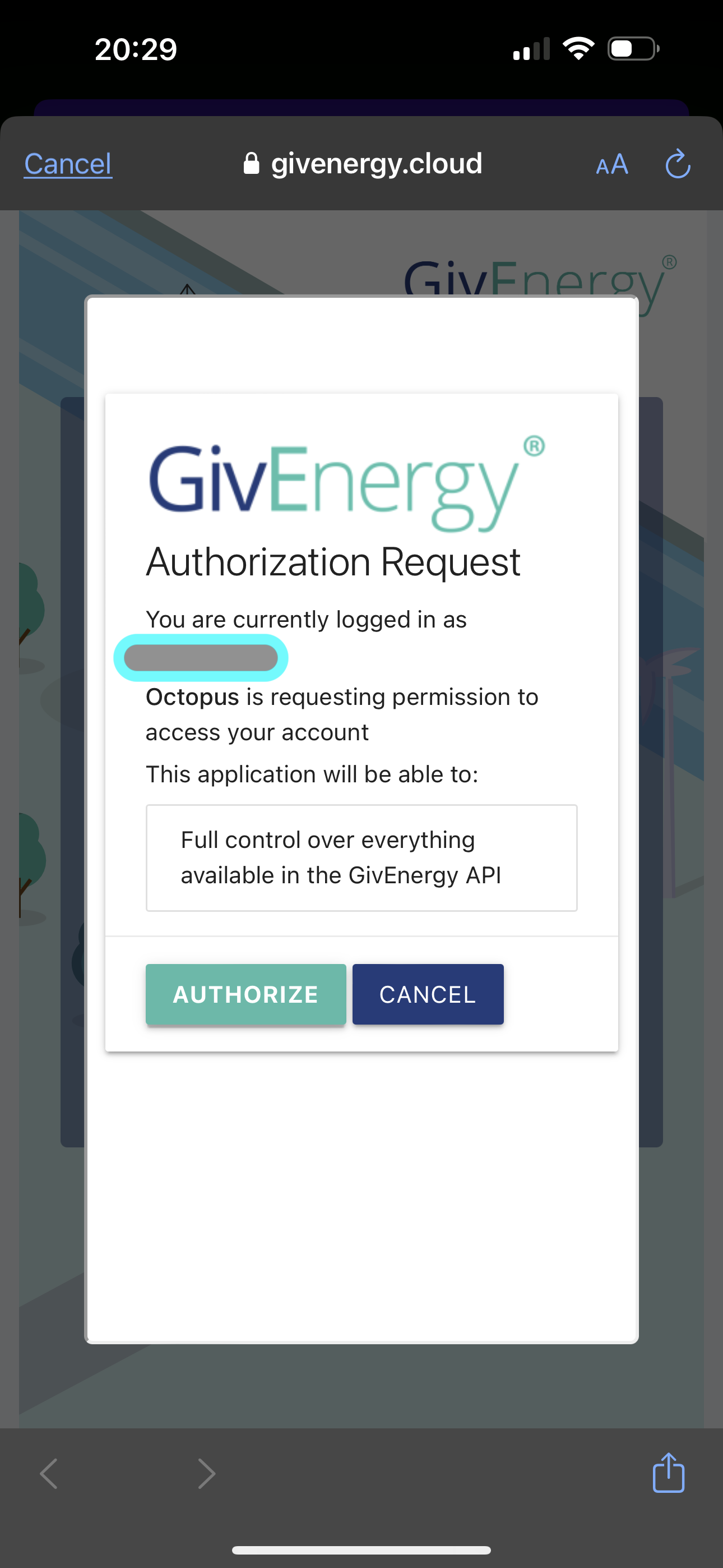
KamenMacKay I have been trying for over 2 weeks now to get onto IOF. Countless emails, phone calls twitter/X messages but no luck. The onboarding process breaks down after I input my GE login details. See attachment from IOS octopus app V4.10. This error message appears straight away with no delay of 5–10 minutes as in the instructions we were sent on 11th October. I have the GE app running successfully on the same iPhone, picking out both home (local) and away (cloud) readings. R&D labs accepts my battery. So where is the problem? Could it be the way that GE has setup my battery? Is my profile with Octopus or GE corrupted. I had a reply from hello@octopus.com yesterday (25th Oct) asking me to video my attempt at onboarding which I generated and sent back yesterday. Onboarding to IOF is certainly 'flaky'. I got Octopus to put me back onto Flux from my 1st failed attempt on 11th Oct. Rob

K
#101 KamenMacKay

@Rbor Sorry to hear about your experience. My battery/inverter are visible but they're not setting the charge/discharge times. Just spoke with them on the phone and they said there might be an issue with my smart meter (there isn't) so once they verified that was working properly they would send me on to the IOF team to take a deeper dive. So far not a very good experience.

R
#102 Rbor

KamenMacKay From forum messages, some of us are experiencing different glitches. After my 1st attempt, the onboarding showed me on Intelligent GO, the Octopus app showed me on IOF export and Flux import and I was unable to get past the login to GE screen successfully, just getting error messages. I have yet to hear anything from the IOF team directly but I will persevere. I have spoken to 3 different folk from CS and none had heard of IOF.
I know that IOF is in beta and we have been warned of potential glitches .......

From my calculations, Flux or IOF are very similar now that we are in the 'UK's solar downtime'.
With any luck the onboarding will be sorted out by next March, when IOF will prove its worth.

I will post again when I have progressed ut will keep an eye of the GE forums .......

Rob

T
#103 TX200

It is a beta product, so such issues are to be expected
However it'd be nice if there was an easy way to report issues with beta products!
One suggestion some people have made is to turn off MFA in GivEnergy if you were using that. Then try the enrollment again.

G
#104 geoffreycoan

deepanshus so, made a decision and we moved to Octopus Agile yesterday.

Pretty seamless experience, filled in the form, confirmed the terms and conditions and I was switched straight away. The Octopus API in home assistant started picking up the new rates and my account changed to saying agile for import.
My export has remained on Flux export 👍. Maybe they’ll notice some time and move me to fixed export ?

In terms of rates, so far I’d summarise it as:

  • not as cheap as flux in the overnight period
  • cheaper than flux during the day
  • more expensive than flux in the evening peak

Overall I expect it to be cheaper as we’re drawing more from the grid

Keeping predbat busy trying to work out the optimal activity. Doesn’t help that my home assistant database do got corrupted on the weekend and I’ve lost all my history

R
#107 Rbor

TX200 Thanks.
I agree with you that we need an easy way of reporting back on beta product issues.
I want to help to make these products work. But it is a real pain trying to find someone at Octopus to take notice.

I don't have 2FA switched on in GE and I can see that 2FA could introduce problems for Octopus to access my battery. When I go through the onboarding process, I get the battery error screen almost instantly after I press the Login button on the GivEnergy log in page. It is almost as if the battery is not being looked for.
I have set up my battery in R&D labs and it took a while for Octopus to find it. But in the IOF onboarding process, it feels as if it is not even trying to find my battery. Is this a clue?

Rob

L
#108 LordHippos

Has anyone been on this tariff and monitored what it actually does in terms of battery control and such?

Interested to hear how it operates.

T
#109 TimI

Another one suffering the broken sign up process... as yet its costing more due to the change of overnight tarrif without any automatic benefit. Doh.

T
#111 TX200

hoggy the one thing that annoys me is...

During peak time, if it's not exporting, it could at least put the system in eco mode!

Don't let me use and pay for peak power!

Mine typically discharges slowly 1600-1630 (500W), then ramps up at 1630 (1.2kW). At 6pm it tends to go to eco paused. At 6.30 it starts discharging again (1.2KW) till the battery gets to 18% ish when it goes back to eco paused.

#112 hoggy

TX200 yeah in my unique case the second DC-DC coupled battery takes over, but its getting upgraded to another Givenergy inverter over the weekend so the approach will change & the Goodwe stuff will be up for grabs.

K
#113 KamenMacKay

LordHippos It's been doing absolutely nothing so I had to set up an automation to charge the battery in the early morning because I thought that was the super-cheap time (7 p/kwh) so imagine my frustration when I saw this on the Octopus portal regarding the rates. The not-so-smart Intelligent Flux was 17p

It seems like quite a few of us are on this half-baked tariff...does anyone have a higher-up contact at Octopus that we can escalate this to?

T
#114 TX200

hoggy thinking more, guess they don't want eco in case someone turns on their cooker and then the battery is empty for when they want to export at 630pm

But if they set a discharge limit say 400W and put it in eco, that'd be ok.

Fully happy for it to be eco paused during off peak, as it doesn't make sense to use the battery at that point.

Those with lots of solar might want to fill the battery, use it, fill the battery, export it, maybe, but could just export the solar if the battery is full anyway. Good export rates even during off peak.

D
#115 dipster

I had IOF for for a week.
This was normal behaviour

I've changed back to OF and I'm happier with this behaviour (dishwasher was also on from 2am to 5am)

Dipster

#116 hoggy

KamenMacKay who are you emailing currently? Hello@.... or agile@....

The 'agile@octopus.energy' one is a bit misnamed now but is actually their 'smart home' team who deal with weird, buggy & new (or innovative to the shareholders) tariffs and are much more switched on and able to help.

There is an Octopus official forum but its invite only and I'm unsure as to how you actually get one (I only ended up with it from all my grid tracking stuff) but I'll put a message in there about onboarding struggles for you.

#117 hoggy

I can but try on behalf of you all:

#118 hoggy

TX200 I've been feeding back similar thoughts for a while, although it has gone into a black hole to date.

G
#119 geoffreycoan

KamenMacKay the tariff above for intelligent octopus flux looks correct. It’s a single tariff for import and export all day and a higher single rate during the evening peak.
Unlike Octopus Flux there’s no cheap rate charging but the day rate is lower than the normal flux day rate. So depends on your usage pattern. I ran the figures for my predicted winter usage and it was about £10 a month more expensive on IOF than Flux for me.
As I said I went to agile a couple of days ago and that has different swings and roundabouts of price rates.

TX200 yes I did have Google drive backup installed and was able to recover back to an earlier HA backup, loosing about a week of history. That ran ok for a couple of days before it too declared that the database was corrupted and it self created a blank db. I tried again with a clean install and partial restore and got the same. I think it doesn’t like my database with 30 days of history, it’s internally corrupted somehow. So I’ve just abandoned it and started again with a clean db. If I can find a way (that’s recommended) of moving the history from the old db I’ll try that but at least it’s stable now. I did consider mariadb but that would put me off the core product and having to self support the database. I don’t want to be a DBA!
I’m using an SSD drive not a memory card so don’t know why, other than the history size and relatively large db (3.5gb) it corrupted

R
#120 Rbor

Following on from my failed attempts to onboard to IOF, I wondered whether my api might be corrupted, I have accessed my api through Guy Lipman's utility at https://www.guylipman.com/octopus/smart_meter_viewer.html
Can anyone tell me what the 'null' means in my api extracts below for what should be my latest tariff?
{
"tariff_code": "E-1R-FLUX-IMPORT-23-02-14-M",
"valid_from": "2023-05-21T00:00:00+01:00",
"valid_to": null
},
{
"tariff_code": "E-1R-FLUX-EXPORT-23-02-14-M",
"valid_from": "2023-05-21T00:00:00+01:00",
"valid_to": null
},
Thanks
Rob

#121 hoggy

If your on IOF then the word intelligent is in there so no your just on vanilla flux in your example.

mine is: https://api.octopus.energy/v1/products/INTELLI-FLUX-IMPORT-23-07-14/electricity-tariffs/E-1R-INTELLI-FLUX-IMPORT-23-07-14-M/standard-unit-rates/
Based on:
INTELLI-FLUX-IMPORT-23-07-14 - https://api.octopus.energy/v1/products/INTELLI-FLUX-IMPORT-23-07-14/
INTELLI-FLUX-EXPORT-23-07-14 - https://api.octopus.energy/v1/products/INTELLI-FLUX-EXPORT-23-07-14/

HOWEVER, there's also the exact same tariffs with a "BB" code to which I have no idea what they are for, which may be where it's getting hung up on? The Export rates are all 0 on that version:
https://api.octopus.energy/v1/products/INTELLI-FLUX-IMPORT-BB-23-07-14/
https://api.octopus.energy/v1/products/INTELLI-FLUX-EXPORT-BB-23-07-14/

K
#122 KamenMacKay

So far, this seems like a badly-planned rollout of this new tariff. I squawked a bit on Twitter to Octopus and they say they're going to look into it. I thought the whole point of IOF was variable rates and basically using us as virtual power plants to help out the grid.

G
#123 geoffreycoan

KamenMacKay it’s symmetrical import and export rates so using us to balance the grid, yes, but it’s not variable with grid capacity like agile or tracker

In summer with lots of export and little import I think it could be a great tariff to be on. Winter less so

R
#124 Rbor

hoggy Thanks. I have copied part of the "agreements" IMPORT section below, starting from when I started in normal Flux back in May. The EXPORT part is the same with EXPORT replacing IMPORT.
You can see the mess on 11th October when I first tried to switch to IOF.
The GE portal shows my current tariff as Flexible Octopus and Octopus outgoing fixed, but shows Flux tariff lines in the graphical view.
Also if I download my smart data from the Octopus dashboard (See below), there is essentially nothing there. Prior to 11th October, all my records were there.
If the smart team ever look at my case, they should be able to spot any inconsistencies (I hope).

Any explanations? Thanks – Rob

"agreements": [
{
"tariff_code": "E-1R-FLUX-IMPORT-23-02-14-M",
"valid_from": "2023-05-21T00:00:00+01:00",
"valid_to": null
},
{
"tariff_code": "E-1R-VAR-22-11-01-M",
"valid_from": "2023-10-10T00:00:00+01:00",
"valid_to": "2023-10-10T00:00:00+01:00"
},
{
"tariff_code": "E-1R-FLUX-IMPORT-23-02-14-M",
"valid_from": "2023-10-11T00:00:00+01:00",
"valid_to": "2023-10-11T00:00:00+01:00"
},
{
"tariff_code": "E-1R-INTELLI-FLUX-IMPORT-23-07-14-M",
"valid_from": "2023-10-11T00:00:00+01:00",
"valid_to": "2023-10-11T00:00:00+01:00"
},
{
"tariff_code": "E-1R-VAR-22-11-01-M",
"valid_from": "2023-10-11T00:00:00+01:00",
"valid_to": "2023-10-11T00:00:00+01:00"
}
],

D
#125 deepanshus

one thing i know for sure, corporation never do anything that doesn't benefit them. So no matter how this is packaged, the end aim is to give OE an edge in terms of supply and demand at the cost of your infrastructure. if you give them the control, you can never make any money that they dont want you to make. and not to mention, battery degradation by frequent discharge/charge.

import/export parity is a good deal but without any control its just a smokescreen.

T
#126 TX200

hoggy good shout on the email address, cheers.

They replied to me within a few hours and apologised for the delay!

T
#127 TX200

Anyone else on this tariff not receiving commands from Octopus today?

Guessing maybe because of the portal outage last night?

Mines not exporting this evening.

R
#128 Rbor

hoggy
Hoggy,
I looked through the api URL for products: https://api.octopus.energy/v1/products/
I searched for BB and I it appears that BB tariffs has been set up for ex-Bulb customers (hence the BB). Each of the tariff products have a label at the end and any with BB are labeled Bulb..
The 'null' seems to indicate that the tariff is active.
Looking at my api, it appears to be correct although I have a load of tariffs set up and then cancelled on 11th October, in random order. This could confuse the onboarding.
I have now learnt quite a lot about api's.

Rob

K
#129 KamenMacKay

geoffreycoan Yes, I do appear to have misunderstood. I kept on seeing the 7.5p cheap rate but it looks like that is just for folks with EV's. So obviously not a good tariff for right now as Flux was cheaper. So figuring out whether it's 'worth it' to go to Agile and use Predbat to figure stuff out or just back to Flux and top up the battery at night (or use Predbat to figure that out as well). I'm leaning toward Agile but need to think on it.

T
#130 TimI

Yeah, I put a support email in to do with the confused messaging about the IOF - some of the information implied the overnight cheap period but only when digging through it carefully you see thats IOG not IOF. With that, IOF doesn't look like as good a deal over winter while we're not generating as much.

K
#131 KamenMacKay

@TimI I switched back to good ol 'dumb' Flux. Agile just seemed like too much risk for too little benefit. Another 'castastrohe' (invasion, etc) and they'll just jack the prices up again.

G
#132 geoffreycoan

KamenMacKay I swapped the other way round, from Flux to Agile for the winter.

We have an ASHP and my move coincided with putting the heating on and obviously grid import going up. I figured I could use the battery like I might with Octopus Cosy, doing a double charge, overnight cheap and afternoon less cheap and this’d see me through the peak periods.
So far it’s working well with predbat, especially on the weekends the rate is super cheap but even in the day it’s less than the flux daytime rate.

It is a risk of unknown future prices but I felt comfortable with doing it

K
#133 KamenMacKay

@geoffreycoan I suppose given enough battery storage to cover a day or so of the ASHP and normal house load I can see taking the risk on Agile as the price would be pretty much below a standard gas tariff.

G
#134 geoffreycoan

KamenMacKay We don't have anywhere near enough battery storage to run the ASHP and daily house load. The ASHP is 10-20kW a day in winter, house load (inc hot water) typically 14-15kW a day.
We have 14.7kW of battery storage (a 9.5 and 5.2) so to run a whole day I'll need either to draw from the grid or do two charges a day.

I had a long and complex spreadsheet that looked at all the options and I was favouring Cosy until I worked out that I could use Agile in a similar way to how Cosy works, doing an overnight and an afternoon pre-peak chargeup. Taking tomorrow as an example, its 6-8p overnight tonight and 15-17p tomorrow afternoon, both of which are below the rates I was paying on Flux, so it works out cheaper. You do need to use something like Home Assistant to monitor the battery and manage the charging though.

R
#135 Rbor

geoffreycoan I have a similar system, an ASHP and 16.4 kWh of battery storage (2 x 8.2) with a GE AC 3.0 inverter. I have a large array (9.75 kWh) across 3 orientations. Despite my large array, the weather has been dreadful recently with many <3 kWh days (with the odd 20+ day thrown in!). I am currently on Flux, still trying to get Octopus to sort out Intelligent Octopus Flux onboarding for me. Recently, I have been downloaded for 6 hours a day but Flux only has the one cheaper slot. I need a bit of solar! I was on Agile last winter and I did well until the prices shot through the roof, at which point, I bailed out.
I still haven't decided my Winter tariff. If Intelligent Flux exports for the whole 3 hour 4-7 slot, it would cost me a bit less than normal flux. Cosy, with its 2 cheaper slots, would cost less. Needing to import 6 hours daily to serve the ASHP, Agile is too risky for me. I might be able to make it work but I would have to 'spot the slots' constantly. I know there is HA, but every time I try setting up automations I get in a muddle.
R&D is also a possibility but some are saying that it can be flaky.
Or do I just see the winter out on normal flux? .... which will repay its way come spring. But intelligent flux will pay even more then.
We are all chasing the same goal for 3-4 months.
Rob

N
#136 naltsta

Rbor I moved from flux to go a couple of weeks ago as it should be a lot cheaper for me while generation is low. Next spring I’ll be looking to move back to Flux or intelligent flux but I’m surprised there isn’t more incentive to join the intelligent version. On flux I comfortably managed to get my average import price lower than my average export price.

With no dip on intelligent flux (even if it was a non guaranteed variable dip when the were choosing to charge your battery) I don’t think it’ll be any better financially.

I’d love to support grid balancing and don’t mind hanging over control but I’m not going to do it if it costs me money!

R
#137 Rbor

There's a good summary of Intelligent Flux on https://terravolt.co.uk/api-integrations/givenergy/intelligent-flux/
Although there is not a cheaper slot 02-05 am, the benefits are from greater export rates and the 4-7 pm slot.

We all have different systems and usages and any decision of the best tariff (especially for winter) needs to be costed on an individual basis. I am still undecided and still on normal Flux (especially as Octopus still hasn't sorted my onboarding issue to Intelligent Flux after 3 weeks of trying).

Rob

L
#138 LordHippos

So I'm on this one "for science" currently, I have some summary tabular data for the last week or so, but I need more data really to draw more thorough conclusions.

For one bit of info here, if my router gets rebooted by my ISP doing updates, then my dongle stops reporting in until I manually turn wifi off and on again on the router. Classic IT fix I know! 🙂

It seems to prefer charging from 11:00 - 16:00 most of the time, the odd "off-peak" charge period is shown but most days this seems idle.

Exporting seems to go from 16:00 - 19:30 but I think it can go a bit later.

Part of the for science bit is that I am undoing things with Home Assistant and seeing how long it takes to change them back, I've put each sequence of changes into a session when there are a few events near each other (within 15 secs of last one).

Some of my data is missing as shown, but I think it's due to the way that Octopus sends one call to change one setting, and WiFi dongle is flaky so sometimes fails to record the event, clearly shown are where data points should probably be but are missing.

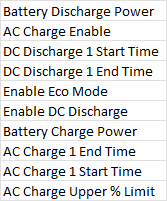
There are 11 settings I've seen it change, but as per the article in the above post, Eco Mode is only ever sent with disabled flag.

Mostly it seems to be trying to add charge or discharge some power, I've not seen it really do any other mode, so it's kind of binary.

For a more raw breakdown on the same example day, 04/11, check the below table out, had to join that into one row per SessionId and each possible property.

R
#139 Rbor

You have put together an interesting summary of your IOF experience. Your 4th Nov tables show 30 minute slots. (R&D also seems to work in 30 min slots). The mystery is what drives all this (algorithms based on overall energy usage?) In time, I think that all tariffs will move this way dependent on the number of suitable smart meters out there.

My onboarding issue with IOF has still not been resolved and communication from Octopus has resembled a black hole. I am disappointed not to be part of this experiment. I have even contacted GivEnergy to see if the problem lies with their part of the tie-up with Octopus, and they have issued me with a ticket number.

I am on the point of giving up and switching from Flux to either Cosy (I have a heat pump) or Agile, with mixed 15p export. Then to revisit IOF in Spring when hopefully issues have been sorted. If IOF is still flaky, I will return to Flux. Meanwhile, I keep trying the IOF onboarding and I see the same error message several times daily.

Rob

#140 hoggy

Rbor sent you a DM on the Octopus Forum which may help.

T
#141 TX200

Rbor likewise, I'm stuck waiting for Octopus to sort my missing inverter! (As in they're not controlling it). I've chased them via the twitter team today. 🤞

D
#142 dshipp

I accidentally moved onto the Intelligent Octopus Flux tariff a couple of weeks ago (I wanted to be on Intelligent Octopus Go but the app confused me). I’ve got it sorted now with Octopus and they’ve move me onto Octopus Go, however in the GivEnergy dashboard the “Smart Tariff” section still says “Intelligent Octopus Flux” and my battery charge and discharge continue to be automated by Octopus. I can’t find anywhere to revoke the API key or turn off the integration. I’ve tried selecting the “Stop automations” button and the “Remove Tariff” option, and then set up my Smart tariff login again, but the automation has continued. Does anyone know how to turn off Intelligent Octopus Flux automating my battery now that I’m not actually on that tariff?

#143 hoggy

dshipp So theres no easy user way other than:

If you go into your Octopus App (not the givenergy one) > settings > Devices > you should (or may) get a list of connected devices.
It will likely be misnamed as "Intelligent Octopus Go" as there isn't a special name for Intelligent flux.
In there you can "Disconnect Device" which severs the link between you Octopus & Givenergy

HOWEVER
This may or may not be your Givenergy Inverter if you are already on Intelligent GO (EV Tariff) now, as the name not being bespoke is a bit of an own goal by Octopus.

Plan B - Speak to Givenergy support and ask them to revoke you Octopus Oauth keys. That will stop them being able to control your inverter.

R
#144 Rbor

hoggy Wow, what a mess.
I hope that Octopus is taking a serious look at the onboarding of Intelligent Flux. They seem to have tried to incorporate this within the process for Intelligent Go and there are a lot of crossed wires. I will see what GE has to say after my request for my Oath key to be revoked (Your plan B above).
Heat pumps seem to have appeared (Daikin) now so there could be more confusion coming down the tracks.

Rob

#145 hoggy

Rbor Yeah it's not ideal
Those that signed up for Axle will find that theirs is done this way and are equally impossible to sever the access without getting a human involved which is a bit mad really.
(don't really see the point of having API Key management if nobody uses them and takes the side entrance)

B
#146 benstat

In case it's of use to anyone, I switched from Flux to Intelligent Flux 7 days ago, and noticed soon after that my battery was sitting idle at 20% all of the time. Nothing happened for several days (no battery activity whatsoever), despite emails and calls to Octopus.

Long story short, it turned out my GivEnergy app still had a battery charging schedule set up (not one I remember adding, but there it was). Resetting to defaults (ie. removing the charge/discharge schedule altogether) seems to have fixed it. Within minutes of doing that, I noticed my battery had started discharging, presumably because it happened to be peak hours at the time. Sure enough, it kept discharging until it got to 5%. I'm optimistic that I'll see it automatically charging at some point in the next few hours now.

T
#147 TX200

benstat fingers crossed for you, but I'm pessimistic about what you've said. 😬

Fyi, Octopus will do stuff like set timed charges (perhaps a bit early hours in the morning and then during the day too), plus timed discharges during the evening peak. They'll also adjust the charge to percentage and the charge and discharge rates, and various other things. Modes too - mine (when it worked) sat in eco paused most of the time, then timed export from circa 4.30 to 6pm, eco paused again until 6.30pm for a little bit more export.

R
#148 Rbor

dshipp Following my problems with onboarding, I got Octopus to switch me back to normal flux. Octopus Usage in my iOS app shows Flux for import and export and my daily usage graphs look to be correct. However, in the GE dashboard, the tariff is listed as VAR and Outgoing fixed 12M. But the graphical display in the same smart tariff card shows the flux rates during the day. A lot of cross wires.
When I tried to onboard originally, the process put me onto to Intelligent Flux import and left me on normal flux export. In the onboarding pages, this was shown as Intelligent Go but I got an error message after I tried to login in using the Givenergy pop up login screen. So Octopus thought I was partly on IOF but was no usage data attached to the tariff. (The opposite of your issue). When I try to onboard (and I have tried this countless times, I see no T&C screen. Octopus (and GE) are on my case which now goes back 4 weeks. Hopefully, improvements will follow to the whole process.

Rob

L
#149 LordHippos

benstat That's interesting, I wonder if a manual setup in Octopus R & D would also override the IOF automations they would normally do.

C
#150 CharlieSays

I managed to get Octopus R&D very successfully to use thier intellegent automation, this had price thresholds that trigger import/export switches, and in the case of export down to a % soc, and have a 2 hour window of forced import to set myself up with a full battery each day no matter what, really impressed so far.
I had one glitch where my outgoing tarrif hadnt automatically switched to the intellegent outgoing rate and i think this was needed for the schedule to behave fully. (a refresh of my from my account page on the R&D website was needed as well here)
I use this and only the R&D portal to control the inverter as i kept reading that multiple systems telling the inverter to start/stop gets it confused.

B
#151 benstat

LordHippos

Well, TX200 was right to be pessimistic. Battery has been idle since it finished discharging during peak hours yesterday. Nothing since.

I called Octopus again, and they asked me to check my GivEnergy app. The charge/discharge schedule was back! I certainly didn't add it, and I confirmed it had been removed yesterday.

I called GivEnergy support about 30 mins ago and explained. They're in the process of resetting my inverter's 'Remote Control' settings. So far I've seen my battery charge for a few minutes, and now it's discharging. I'm assuming the support guy is still on the case (the logs show he's still pretty busy doing stuff). Fingers crossed.

In the meantime, the GE web portal 'Remote Control' settings show that Eco mode is off:

Should I be concerned (assuming the support guy leaves it switched off when he's done)?

Finally, what is Octopus R&D? First I've heard of it. Some comments here talk about it as if it were an app or something (not just the Octopus R&D dept who administer the intelligent tariffs)?

Edit: GE support guy seems to have finished making changes. Battery is currently discharging (as you might expect - it's peak hours atm). Guess I'll just have to keep an eye on it. Will post an update tomorrow.

Edit 2: Eco mode is now on (turned on via the API - maybe Octopus did it?)

R
#152 Rbor

To apply, go to:
https://smart-energy.octopushome.net/dashboard

You need to apply and details are on the website.
It does take some time to be set up.

I use it for scheduling and you can schedule multiple charge and discharge events during the day.
It has worked well for me but I know that some folk have encountered problems such as scheduled slots doing nothing.

Worth a look.

Rob

B
#153 benstat

benstat

Following on from all this, I noticed that the times shown in my GE app, and indeed the logs in the portal, were an hour ahead of the actual time (eg. events that actually occurred at 7pm are logged as 8pm).

Sure enough, my Account Settings (in the portal) show time zone as GMT+1. I've set it to GMT and synced the time.

Maybe that'll fix it? After all, I wouldn't expect the inverter to charge if it's 19:00 and Octopus says "start charging at 19:03"... but my inverter thinks it's already 20:00!

L
#154 LordHippos

benstat That's actually pretty funny, certainly one way to prevent system control, though Octopus does change modes and battery charge limits as well as charge/discharge times.

I'm speaking with GE to try and get the Octopus token revoked so that I can control my system fully again.

B
#155 benstat

benstat

Setting the time zone correctly in the portal account settings seems to have fixed it!

Battery has charged a couple of times overnight, sitting at 40% currently. Log times are correct, and marry up with Octopus API calls.

Will keep an eye on it, but it looks promising...

L
#156 LordHippos

I am seeing if GE can revoke the control and how that impacts the Octopus side/tariff etc.

So far it's been a bit of a mission getting them to look into it, I asked them to revoke the personal access token that Octopus had enabled, but GE wanted me to:

  • Stop Automations within the Tariffs section
  • Check/remove from the API access I can set (Account Settings in portal => Manage Account Security).
  • Speak to Octopus to remove it. Whilst yes I can do this, they should be able to revoke access, and even better, I should be able to see/revoke access that 3rd parties have via this back door API.

Of course both of the above do nothing, as Flux is being controlled by Octopus via a back door API token that I can't see, and apparently basic GE support staff can't either.

Fun side note: If you set the TZ to say GMT + 2 on purpose and sync the time, the charging automation doesn't charge the battery but it does limit the charge rate and makes the system draw from the grid until you override the Eco mode back on again.

This is worse on the standard export time frame of 16:00 - 20:00 because it limits your battery discharge, it means that if you're using the oven or similar it will only discharge at around 600w when the house load is at 2.6kW or similar, means it can draw most (or all) of the power from the grid instead of battery. Whilst this is in progress I am disabling my WiFi from 15:30 - 20:30 or so, to prevent discharge shenanigans.

Changing TZ messes with a few other things as well, such as the tariff automation costs, and any charge periods you have set will be out as well.

Hopefully GE can revoke the access and I can get full control back.

R
#157 Rbor

Interesting.
I have also asked GE to revoke this mysterious token but heard nothing back so far. I am still trying to get Octopus to sort it and apparently my case is now at the top of the smart team. I think my problems with onboarding onto IOF started when I first went through the process, which failed. The presence of this token may be the cause of the problem.
Rob

L
#158 LordHippos

Rbor Did you mention you had used the Kraken/smart control thing Octopus do? I wonder if it conflicts (as they both may use the same thing).

If I was going into super science mode I would also add this and see if it overrides the Flux control, but I suspect it would just confuse matters more on my part, so for now I'll see what GE can do.

GE did say they had revoked it, but at the same time I could see Octopus was still able to make changes, so either a bug or they revoked the wrong thing.

R
#159 Rbor

I have only used the Octopus onboarding process and that is when my problems started (on 11th October, over a month ago). I need to wait to see if the smart team at Octopus can resolve this.
Rob

R
#161 Rbor

Ah, I see what you mean .......

I was setup by Octopus for R&D labs in early June. I then linked my GE inverter/battery using my GE API code that GE set up. I also use this to link to HA.
I hadn't actually setup a schedule within R&D labs until 31st October.

I will try unlinking the GE inverter/battery within R&D labs and then try the Octopus IOF onboarding process. It is easy to relink it and set up my schedules again.
Job for tomorrow .....
Rob


L
#162 LordHippos

I think GE have removed the personal access token now for Octopus Flux control, the "for science" bit of this is that it also seems to have removed the GE inverter from my Octopus app.

Before, on the Octopus app on my phone, I had a section for Devices which popped up, and it had my GE inverter listed.

Now, it's gone, so just keeping an eye on this one.

The next "for science" bit is what, if anything, this does with my tariff as I no longer have any devices listed at all. Hopefully nothing as I want the tariff to stay as it is.

R
#163 Rbor

LordHippos,
I chased GE again today and am still awaiting a response from Octopus.
I haven't heard anything yet but something has happened in my GE Account Security Settings today.
See screenshots showing 12th Nov, 13th Nov and my API token (which has not changed).
Before I do anything, can you offer any advice please?


R
#164 Rbor

hoggy
Any chance at looking at my post 163.
Something has changed in my GE Account Settings and I have posted screenshots. LordHippos is also on the case.

Thanks

Rob

#165 hoggy

Rbor right I can break cover now they've exposed the Oauth side of things as a "service" rather than my dubious hacky way to find those.

So your API Keys are as was - nothing needs to change there.

What you can now do is delete/revoke your Oauth keys such as those linked via Octopus Intelligent Flux or Alexa or Axle energy.

So if your struggling to onboard with IO Flux I'd delete the "Octopus" one under the connected services banner and start again.

As expected a bunch of people asking to manually remove keys from a database didn't take long to become enough of a ballac.... to make this a user service as it should have been.

L
#166 LordHippos

I don't know if it's fair to say I'm on the case as such, my theory that the R & D think was blocking you was just a theory, I haven't used that myself. Will help with anything I can but it will be limited especially in the cases where I haven't used the thing.

One interesting side note is that, for me, this whole section was previously blank and showed nothing, but now I see some keys similar to you. Perhaps they changed it recently? Maybe in response to my ticket or similar ones like it where the api keys weren't showing to end users.

Guessing a little again but I think the API Keys under "My API Keys" are ones you've added to talk to Solcast and Octopus for smart tariff data. I wouldn't change these.

"Connected Services" section might well be for something like the Flux tariff integration, though I am not 100% on this, perhaps it was a bug that this was showing nothing, and the developers have now added it.

If anyone has signed up to Axle for the saving sessions thing, they may be able to see them here, that would be interesting.

R
#167 Rbor

hoggy In my Account Security Settings, I have revoked the Octopus service and that section has disappeared. I have then tried the IOF onboarding and, for the first time, after the adding my username and password to the GE login popup, I get an authorise screen. I have attached this. I selected 'Authorize' but nothing happens.
So I guess there is some progress.
Still awaiting replies from both GE and Octopus smart team.
When I try the onboarding again, I don't see a T&C screen at all.
Rob

R
#168 Rbor

Sorry, here's the authorise screen:

L
#169 LordHippos

It did stuff for a while after hitting authorise when I had this, it then went into a spinning octopus thing that says it could take 10 mins to work.

Make sure you updated the Octopus app as well to the latest version, although you probably have already worth checking.

R
#170 Rbor

Thanks for all your advice. I have now removed my inverter/battery from R&D labs and all API tokens from GE 'manage account security'. All that remains are the APIs that link to my Octopus Smart tariff and Solcast cards. I will now manually set up charging and discharging via the Octopus app.
The smart team at Octopus are continuing to investigate the problems with onboarding to IOF.
During onboarding, I do see the 'Authorize' screen but this does nothing, even if I leave it for 1 hour.
I will try again tomorrow but may just stay on normal flux now, cash in by exporting during saver sessions, and revisit IOF in the spring when I hope the onboarding process issues have been sorted.
Not over yet but ….., until the next suggestions.
Rob

O
#171 Olly

Hey everyone, I thought I'd try this tariff as I hadn't had time (and potentially technical skills) to set up my own automated charge/discharge in home assistant for the battery. Watching the battery activity so far in the app, Octopus don't seem to be doing a huge amount with it in the few days since I switched. A slow charge here, one quick discharge there, but largely I feel like its just letting me eat the cost through peak times. Anyone else had this experience? Increasingly feeling I should switch to Intelligent for the cheap night rate and car charging but will probably see the week out at least out of curiosity. Like some other commenters, I feel the need for a tariff that supports multiple devices, though I understand the complexities of managing that on Octopus' end could get interesting fast.

L
#172 LordHippos

Olly If you have battery storage etc I'd recommend Intelligent or Go over Flux in Winter anyway, you won't have much spare solar generation to export so makes sense to minimise import costs.

O
#173 Olly

LordHippos I sort of assumed they would use the battery to charge when it was cheap and then export that, but it seems not much of that is happening, and my solar has dropped to very little. Intelligent makes sense, thanks for the advice.

R
#174 Rbor

LordHippos After 5 weeks, I have admitted defeat in my attempts to onboard Intelligent Octopus Flux. I have an ASHP and have today switched from Normal Flux to Cosy to make use of the two 3 hour cheaper charging slots. This would have been my course of action before I got diverted into seeing what IOF was all about.
I have also now switched to Octopus Outgoing Fixed (15p. This hasn't come through from Octopus yet, which shows my tariffs as Octopus Cosy and Flux Export. My modelling shows that Cosy should be £1 less than Flux per day.
I will still watch this IOF thread. Once there is sufficient Solar to export in Spring, I will look again at IOF assuming the onboarding has been sorted. Alternatively, I plan to switch back to normal Octopus Flux from Spring until mid October. It is a great tariff when there is solar to export 4-7pm.
Thanks for all your comments and suggestions. Unfortunately nothing has worked for me.
Rob

L
#175 LordHippos

Olly I sort of assumed they would use the battery to charge when it was cheap

In my view that is what this tariff is missing, it would be good if they automated and passed on the cheaper costs, but there is no super-cheap overnight rate to take advantage of here.

Rbor I have also now switched to Octopus Outgoing Fixed (15p. This hasn't come through from Octopus yet, which shows my tariffs as Octopus Cosy and Flux Export. My modelling shows that Cosy should be £1 less than Flux per day.

For now it certainly would be yes, I am not really sure that IOF is even better than regular Flux tbh, if you can control the charge/discharge a little, you can do pretty well on standard Flux, and there is a slightly cheaper 3 hour rate overnight to help balance things out.

IOF is probably good if you export more than you use, which won't really be the case until Summer anyway, but I doubt it's much different to Flux normally.

T
#176 TX200

Does Octopus do an export every day, during peak, or do they sometimes leave the system idle?

Mine didn't do one yesterday. Not sure if it plans to export much tonight either as it only charged to 60% overnight.

T
#178 TX200

It'll be interesting to see what Octopus does tonight on my intelligent flux.

I've opted into the saving sessions - it'll be my first one on this new tariff (the test one I did manual export, as the link to my inverter was broken).

I guess if they don't crank up the discharge rate to max this evening, I could adjust it myself. They might auto adjust it back down I guess. 🤣

I hope they do go for a full speed export for the 1.5 hrs. 😀

R
#179 rjp

Mine just tried running the usual 4-6 discharge. I had to override it to increase the discharge rate and make it discharge only during the session.

It only seems to charge to 90%, and the discharge rate is low at 2.7kW. Any way of configuring these, so we can discharge at 3.6kW

T
#180 TX200

rjp yeah, mine did the same, usual discharge rates and didn’t fully charge to 100% either.

Shame really, given its an octopus controlled tariff and an octopus saving session, you’d think they’d adjust the discharge to suit the DFS requirement.

I
#181 Interik

Hi, sorry to jump on this thread, but any idea how I would revoke Octopus access to my inverter? I have revoked Octopus in the 'connected services' but it keeps reappearing after 10 minutes. I've left IOF yet my battery is still being controlled (and not used).

Thanks.

C
#182 CC

I had the same issue for a while until I went on the Octopus app and found an option to disconnect my battery. Since then, I have full control.

I
#183 Interik

CC Where did you see the option to do that? I can see my battery on the app - it says 'connected - smart control enabled' but there's no option to disconnect it...

I
#184 Interik

C
#185 CC

I don't have that screen any more because I have no connected devices but I think if you press on the down arrow on the top right hand side you will get the option to disconnect your battery.

T
#186 TX200

Yeah, it's within the account settings part (top right of the screen as said above), then devices and so on.

M
#187 Mike-H

I signed up for IOF and my experience with it so far has been terrible. To start with nothing at all worked. They have fixed some of the problems but two big problems still remain. I've emailed Octopus about all of it to try and help them fix the system but have pretty much been banging my head against a brick wall.

The first problem is that when I have excess solar for my house it splits that between charging the battery a little and wasting the rest to the grid at cheap rate. Or wasting all of it to the grid instead of charging my battery. The reply I got to that really peed me off. "I have had the smart tariff team review your tariff on that date at that time and they said that the tariff was following what we had planned to reach the peak and trough of charging. Essentially the IOF control had decided the best thing to do at that point was not to charge the battery and export the 1kWh." That might have been the best thing for Octopus to do but it's not the best thing for me!

The second problem is that they seem to be treating my inverter like a 2.6kW model and not the 3.6kW model that it is, so when my ASHP is on during the ultra peak rate time the battery is only supplying 2.6kW and drawing another 1 kW from the grid costing me a fortune. Before this tariff my inverter could supply 3.6kW to the ASHP and draw nothing from the grid.

So far very dissappointed with IOF and I'm on the verge of going back to the tariff I was on before but that's a miserly 15p/kW export rate. I'm sick and tired of being bent over by power companies.

I've now got a HomeAssistant Green but so far only got my Zigbee smart bulbs in the kitchen connected and working with an Ikea smart switch. Any one got a link to an idiots guide to setting up HA with Octopus tariffs and a GE battery?

Cheers, Mike...

R
#188 Rbor

I tried for 2 months from mid October to onboard onto IOF. I tried phone calls, emails and X/Twitter message (which was the most receptive and knowledgable).
I discovered that IOF clashes with R&D labs and any link in R&D labs to my battery/inverter confused matters. I think this was to do with the linked API within my GivEnergy Account security settings. I was advised to remove any GE API links. I also had Octopus's 'Connected Services' in my security settings. I revoked this but it came back again (until I also revoked my GE API token).
The best summary of IOF I have found is:
https://terravolt.co.uk/api-integrations/givenergy/intelligent-flux/
IOF is clearly 'very beta' and I may try again in the Spring.

Previously, I was on Octopus Flux, a great tariff for spring–autumn. In August, I had an ASHP installed and this needs a change in mindset as electricity is doing the heavy lifting that my old gas boiler managed. Throughout my IOF problems, I remained with Flux but transferred 2 weeks ago to Cosy and Fixed 15p export.
With 2 'cheaper periods', Cosy seems to be the best fix for winter with an ASHP.
I live in the North of England and recently temperatures have remained below zero day and night. The ASHP obviously uses more electricity then but usage drops once temp rises. At the moment, I am charging my battery 4am-7pm and 1pm-4pm with 2 hours extra in the evening to get me through to the following morning (I have two GE 8.2 kWh batteries serves with a GE AC 3.0 coupled inverter. I am still experimenting but hope that the 2 extra hours will not be needed as temperatures increase.

I try HA from time to time but I have never got to grips with automations (and I am pretty IT proficient).
I will try again as I need to set up 2 charging slots manually and, if I export, I set alarms to warm me initiate and finish the export, and switch ECO back on.

There are folk far more knowledgable than me with HA ......

Rob

M
#190 Mike-H

Rbor Thank you for the links :-)
Cheers, Mike...

T
#191 TX200

I'm not too fussed if generation goes to the grid, as I can buy it back later at the same price.

Although noted there's a bit of efficiency lost (thus I have to buy slightly more) given AC grid to DC battery, rather than DC panels to DC battery.

What does annoy me is using peak rate electric between 4-7 rather than the battery. I try to minimise my use whilst it's not discharging, to minimise my import.

And if I need to use a power hungry appliance during peak rate, I might sneak up the discharge rate a bit. 😉🤣

T
#192 TX200

I know IOF can import and export when it wants, but seems strange for it to be exporting at lunchtime on what appears to be a sunny day. 😄

S
#193 SulaBear

TX200 Mine has also had Eco Mode disabled. I've been trying to get Octopus to tell me if this is how it should work but get conflicting answers. In your experience, when on IOF should the inverter be in Eco mode or not? Honestly can't see the point of a battery sitting there at 100% all day.

D
#194 DD

SulaBear I've not been on IOF, but from what I've heard, eco is off. While import and export are priced the same, there's no point using your battery when the grid is like a perfect, lossless virtual battery. However, you don't want to import during the expensive early evening - Octopus really ought to discharge battery then, but I don't think they always do.

L
#195 Leeshore

IOF is great when your solar production is greater than your house load but less so when not. I’m on it from April through to October and change to Agile during winter. It also means that you can forget about your battery and solar and just let Octopus do its business so when you are on holiday you don’t have to worry. They usually dump the battery back to the grid between 4 to 7 pm.

D
#196 DD

Leeshore They usually dump the battery back to the grid between 4 to 7 pm.

I wonder harm there would be if they were to turn on eco 4 to 7, along with with pause-charge, perhaps, even if they usually override it to export. I think some were reporting export didn't typically start until 4.30 ?

S
#197 SJB

IOF is quite frustrating - ECO mode being off is one of the most frustrating things.
I've foolishly stayed on it this winter (because the savings of changing tariff weren't worth the hassle of contacting Customer Services to sort out the tariff change and giving me back control of the system).
Recently IOF's behaviour has become rather odd:

  1. It doesn't always fully charge the battery in preparation for peak time. Meaning they discharge for less time during the peak time,
  2. They've recently started setting the charge/discharge rates to 0 which stops the battery from charging from solar (if there is any).
  3. They don't always charge/discharge at the most efficent rate.
  4. They often discharge the battery during free electricity sessions.

Currently my battery is on 18% if they don't charge it before today's peak slot my level of frustration might convince me to attempt a tariff change regardless.

D
#198 DD

SJB They've recently started setting the charge/discharge rates to 0 which stops the battery from charging from solar (if there is any).

In principle there's no point putting solar into the battery - it would suffer round-trip losses compared to exporting directly. The problem really is not charging the battery (from any source) during off-peak to use it export during peak

L
#199 Leeshore

I think you’ve just got to appreciate on IOF that the grid is your virtual battery and it’s better to use that than your own battery due to the inverter losses in charging and discharging your battery. If you want more control Flux could be an option for you. Octopus are using your battery to dump cheaper electricity and then reuse it to balance the grid during peak times. For that you get paid great rates during the summer.

H
#200 Hopeful

SJB Like you, I stayed on IOF last winter but it was a bit frustrating. My battery isnt big enough to survive the flux expensive charge slots so I went to E7 this year. Its working out quite well except my meters idea of day and night counting doesnt seem to tie up with the 30 minute slot day for the day window, giving me a larger day bill than expected. Octopus have yet to explain why. that aside the 17hr day rate slot has been pretty manageable with the battery and solar so thats worth considering.

G
#201 geoffreycoan

SJB IOF is quite frustrating - ECO mode being off is one of the most frustrating things.

As DD and Leeshore say below, Eco mode being off is not a problem with IOF, it is the right thing to do and will give you the cheapest electricity by not using your battery to support your home.

The reason for this is all due to inverter and battery conversion losses.

Let’s use a silly example of 50% conversion loss in each direction in and out of your battery.

If you charge the battery 10kWh then you only get 5kWh into the battery for the 10kWh of grid consumption.
You then use that stored battery power to run 2.5kWh of home load. You again incur 50% conversion losses on discharging so the 5kWh of stored charge results in 2.5kWh going into your home - but you paid for 10kWh to charge the battery in the first place.

Alternatively, you use 2.5kWh of direct grid import, so only pay for the 2.5kWh used to run the home.

The only time you want to use the battery is during the peak period to avoid the higher import costs that occur during the peak period. Otherwise you want to run directly off the grid, viewing the grid as an infinite battery.

At the end of the day you have handed control over to Octopus to run the battery as they see fit even if what they do doesn’t seem like what you would expect. In terms of fire and forget, it’s the best tariff. In summer when you are generating loads of electricity you get a great export rate in return. In winter, not so much.

J
#202 jonhd

A propos of nothing in particular(!), as a long-time (3 years) monitor of IOF messaging, via the Inverter log, there was obviously some kind of (major?) change with the IOF algorithms. The pesky "Enable Eco Mode" OFF, and "Battery Reserve % Limit" messages have completely disappeared from the log.
For 2025, up to 14th Nov., I had received:

  • 14,151 (failed) "Enable Eco Mode" OFF messages
  • 11,188 (failed) "Battery Reserve % Limit" messages

Since the 14th not a single one of either message - so a LOT fewer failed messages per day, now.