Octopus Intelligent Flux

261 comments started 2024-05-11 last 2024-08-17
GivEnergy Products
R
#1 RobRoy594

Hello Everyone. Im very new to this whole new game!
What do people think about Intelligent Flux. I don't really want to be spending all my time tinkering with Tariffs!
Interested in your comments or words of advice!!

Long Live Solar!!

#2 Watcher

See this here @RobRoy594 ? This is a can of worms and you have just opened it, it is now yours to own! 🤣

There is no simple answer to your question, it is the best or the worst tariff depending on your solar array, battery availability, potential electric vehicle, financial objectives and desire to control your kit.

OIF is probably one of the easiest tariffs to live with as Octopus runs your system for you.
If you want minimal input as it is new to you let it run for 6 months and see how you feel?
Like a lot of life the more you put in the more you get out. Ā£!šŸ˜‰

Enjoy.

G
#3 geoffreycoan

RobRoy594 have a look forā€˜Tim and kat’s green walk’ YouTube channel.
Tim did a video about a month ago on An easy way to choose what’s the best tariff for your circumstances

D
#4 Daveb01

Gary does Solar has just done a video as well and switched to IOF, however he has done it to test it out and do a video on it to compare IOF and Agile.

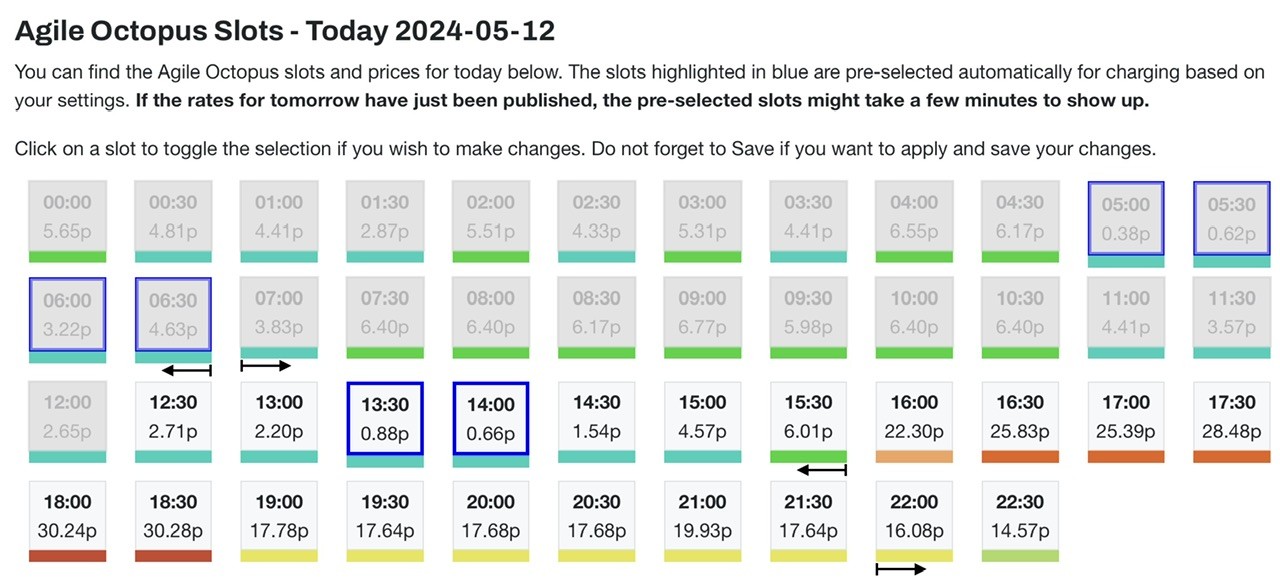
FYI - agile prices to day were on the low pennies.

#5 Tenkaykev

Daveb01
After a run of ( comparatively ) higher Agile prices I noticed last night's very low slots. I dumped the battery to grid at 15p and then filled it back up at the lowest price slots. As soon as the panels started generating it was all going to grid ā˜€ļøā˜€ļø

R
#6 RobRoy594

Thanks Everyone!! Got lots to learn and think about!

D
#7 Daveb01

RobRoy594

Think you only have a few options

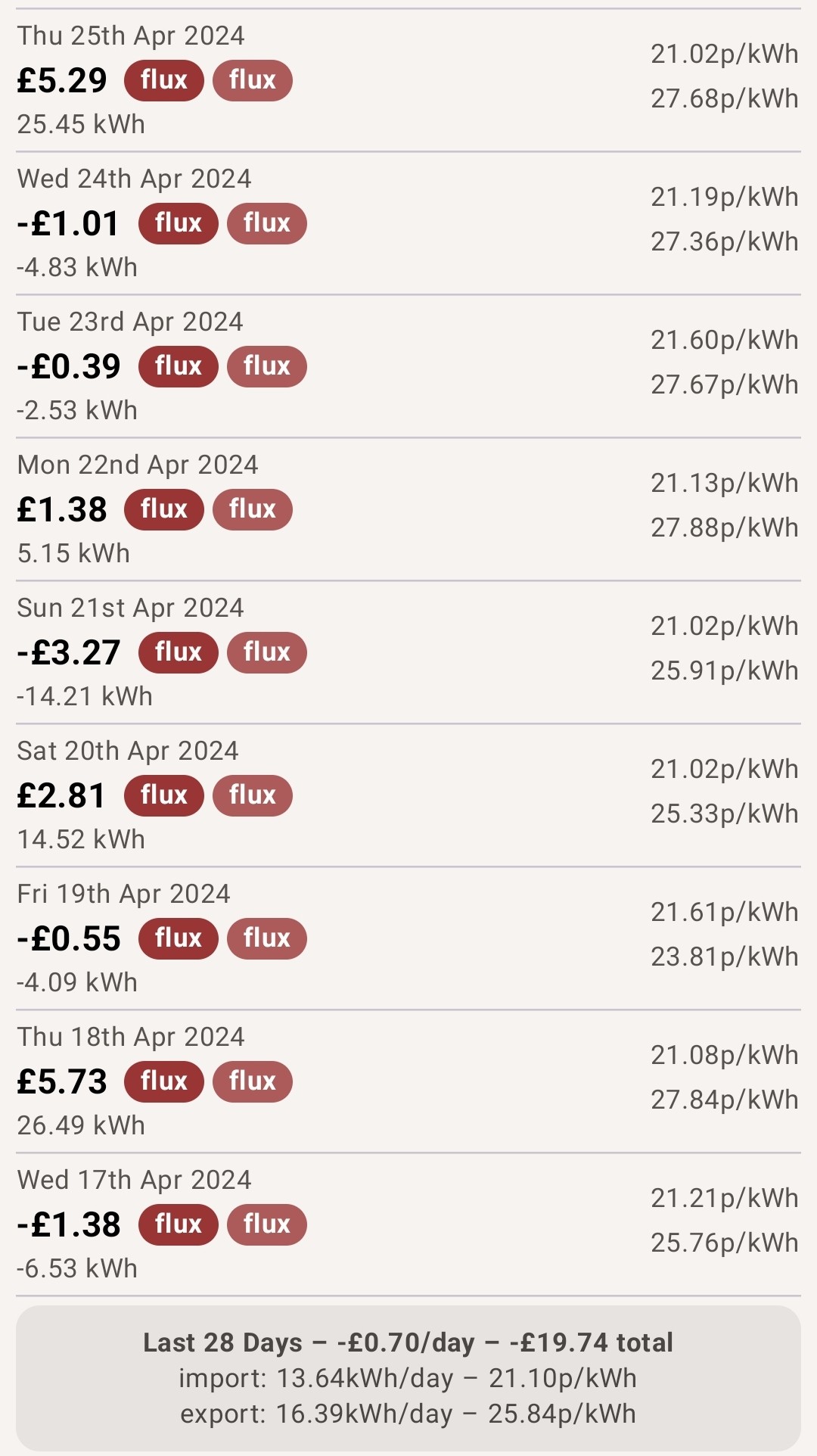
  1. You can let Octopus do its stuff on IOF
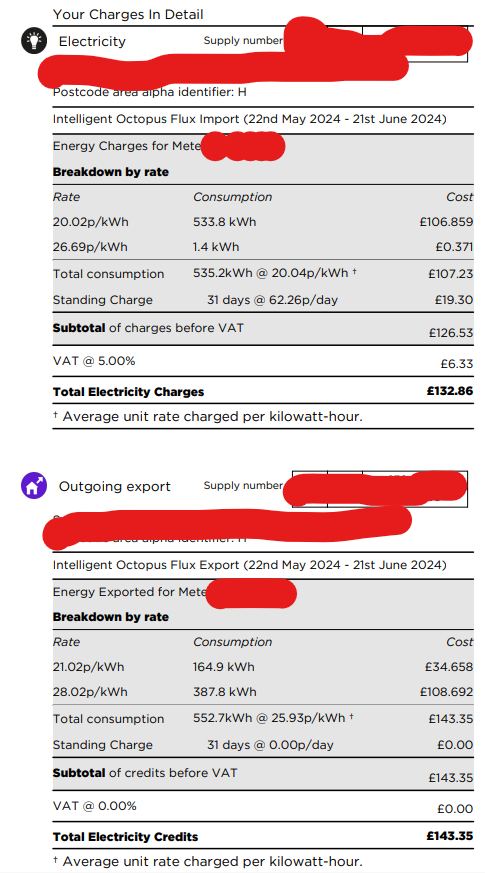
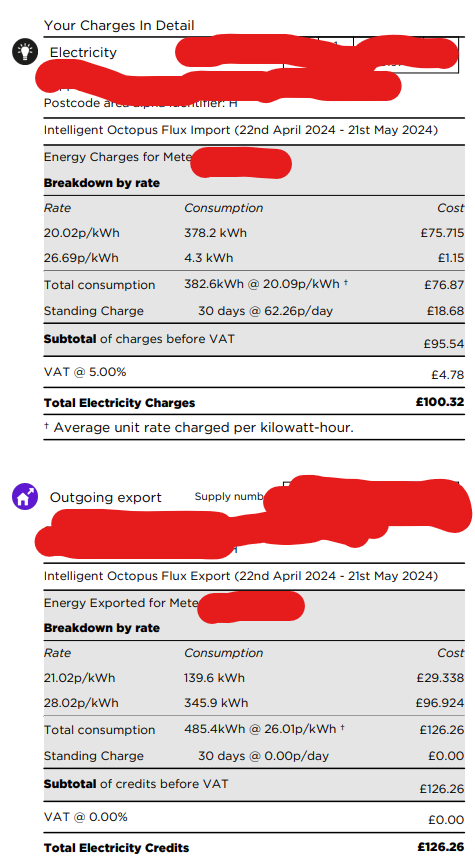
  2. Have a look at Wonder Watt (this is what I use) plus Agile with fixed price 15p (don’t use Agile export)
  3. Set up Home Assistant
  4. Pay for automation e.g £5 at my energy optimiser.
W
#8 wrighar

I've just switched to IOF too, only thing I'm not keen on so far is it turns ECO off so I'm pulling from grid rather than battery.
I'd rather flatten battery in evening/night had hope to solar charge in the morning... unless they've looked at the weather forecast....

D
#9 DD

wrighar I've just switched to IOF too, only thing I'm not keen on so far is it turns ECO off so I'm pulling from grid rather than battery.
I'd rather flatten battery in evening/night had hope to solar charge in the morning...

But... But.. for you the grid has become a perfect, lossless, infinite virtual battery. Why would you could choose to use your own inferior lossy one ?
Because of matched import/export prices, all that matters is that avoids importing during peak rate.

T
#10 TX200

I agree with DD

I did wonder if solar filled the battery, then discharging it to the house in the evening doesn't really cost anything

However there is a risk that the battery will then be topped up again the next day by the grid (it it's not sunny enough when the charge starts) which introduces some loss.

Plus it's extra cycles on the battery too.

I just let Octopus do their thing. As long as it doesn't import or charge during the 4-7pm peak I'm happy.

It leaves 20% in the battery, when it's done, which could be useful for powercuts.

Some might want that 20% exported too, but again I just let it do it's thing. Plus I sometimes see the 20% drop down to 8% after it's rested due to SoC recalibrations.

W
#11 wrighar

Yes, it's just a mental thought thing... as long as it does export 4pm-7pm from solar gen then it's quids in...

T
#12 TimHutchings

Although import and export are the same price, aren't you losing money with conversion losses? Just trying to understand! Maybe that's made up by the higher export price over Flux apart from peak?

W
#13 wrighar

TimHutchings

Only if you charge battery from grid and export back at rhe same rate. It prioritises an export between 4-7pm at 30.31p while all other times are 22.73p (my area).

In effect i'm selling 8kW at 30.3p, another 20-30kW @22.7p, any maybe buying same back at 22.7p to fulfill my homes 12kW daily need if the battery was full and a load got exported, but I then need more than the batteries size before sunrise.

T
#14 TimHutchings

wrighar Solar will still need to be converted from dc to ac to export, incurring losses. Maybe this year I'll stick with Std Flux and hopefully make an overall profit again on all energy costs like last year, then next year take the plunge and try IOF to see how they compare with my usage, which is low. It would be nice if Octopus paid me even more than the Ā£125 profit on all my energy costs they paid me last year using IOF, but I just have a sneaky suspicion that if they totally controlled my system, there would be a little algorithm popped in there to make sure that didn't happen. šŸ¤” šŸ˜‚
Just my suspicious mind!

D
#15 DD

TimHutchings Although import and export are the same price, aren't you losing money with conversion losses? Just trying to understand! Maybe that's made up by the higher export price over Flux apart from peak?

There are conversion losses for DC to AC conversion. You get those whether you convert solar directly to AC, or store solar in battery and then take it back out of the battery and convert to AC. But you get additional chemical losses from storing energy in the battery. So there are fewer losses overall if you go directly from solar to AC, rather than solar to battery to AC.

(The losses from DC to AC conversion may be slightly different for solar vs battery for a hybrid inverter since the solar is already around the 200V mark, whereas battery is down at around 50V. So I guess solar to AC is more efficient than battery to AC ??? I don't know the details.)

T
#16 TimHutchings

DD Thanks DD for the input. It was really a case of arguing on IOF where imports and exports are the same price, but with losses obviously aren't, and to what extent it would affect profitability of the two Flux tariffs comparatively.
I guess it's got to depend on an individuals usage to a great extent.

W
#17 wrighar

I'm estimating that on agile import and 15p export I'll be about £4.00 a day in credit.
With IOF about £6.00 a day in credit.

For May-Sept at least, when I'll look to jump back to another tariff.

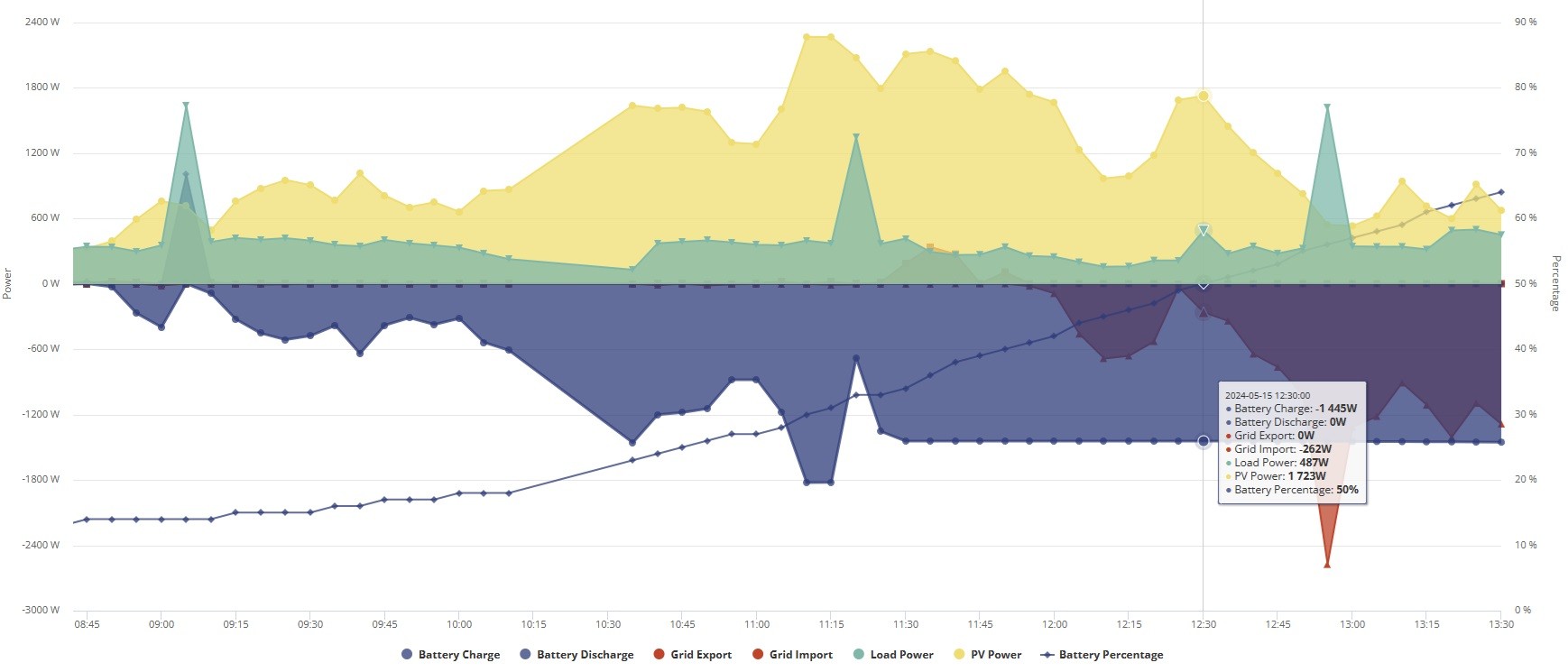
At about 11:30 today it decided my battery needed to be charged at 1400W rate to be full by 4pm for discharge at 30.3p. (grid assisted at 22.7p if solar doesn't cover.

W
#18 wrighar

If nothing else, it will be an interesting experiment,,

D
#19 DD

Daveb01 Think you only have a few options
You can let Octopus do its stuff on IOF
Have a look at Wonder Watt (this is what I use) plus Agile with fixed price 15p (don’t use Agile export)
Set up Home Assistant
Pay for automation e.g £5 at my energy optimiser.

One other option, I guess, is standard Flux with simple static overnight-charge / peak-rate-discharge timers configured on the inverter.

G
#20 geoffreycoan

DD One other option, I guess, is standard Flux with simple static overnight-charge / peak-rate-discharge timers configured on the inverter.

There's no point in charging the battery overnight on Flux IMHO unless the next day is going to be so awful solar that you won't generate enough to see you through the evening peak.
Reason for this is that the overnight import is much the same as the day-time export, so you don't save anything by charging the battery overnight, and once losses included, its not worth it

D
#21 DD

geoffreycoan Hmm... fair point. But if you can't be bothered messing with solar forecasts, it's a form of insurance - the conversion losses are far smaller than the risk of running out. And you're trying to make sure you have plenty to export during the peak rate...

G
#22 geoffreycoan

I've been watching the Gary Does Solar video on his experiment on moving to IOF, so thought I'd (literally back of an envelope) put some quick figures together.

Choosing two sample days, 12th May was good solar and 14th May poor solar.

12/5: 30kWh generated, 17kWh consumed, 9kWh imported.
21kWh thus net generation, (solar-import) and after house consumption, 4kWh net export
Assume all that net export is during the peak period @ 28.61p/kWh = £1.10 income

14/5: 70kWh generated, 18kWh consumed, 13kWh imported.
57kWh net generation, and after house consumption, 39kWh net export

I have a 9.5 and a 5.2 (4.2 usable battery), IOF retains 20% of your battery capacity therefore 7.5+3.2=10.7kWh battery capacity available for peak rate export.

However, my peak rate home consumption in the 4-7pm period was 2.8kWh on 14/5 (and 2,7 on 12/5), therefore best peak rate export is 10.7 - 2.8 = 7.9Kwh.

IOF export income for 14/5 would be 7.928.61 + (39-7.9)21.45 = £8.93 profit

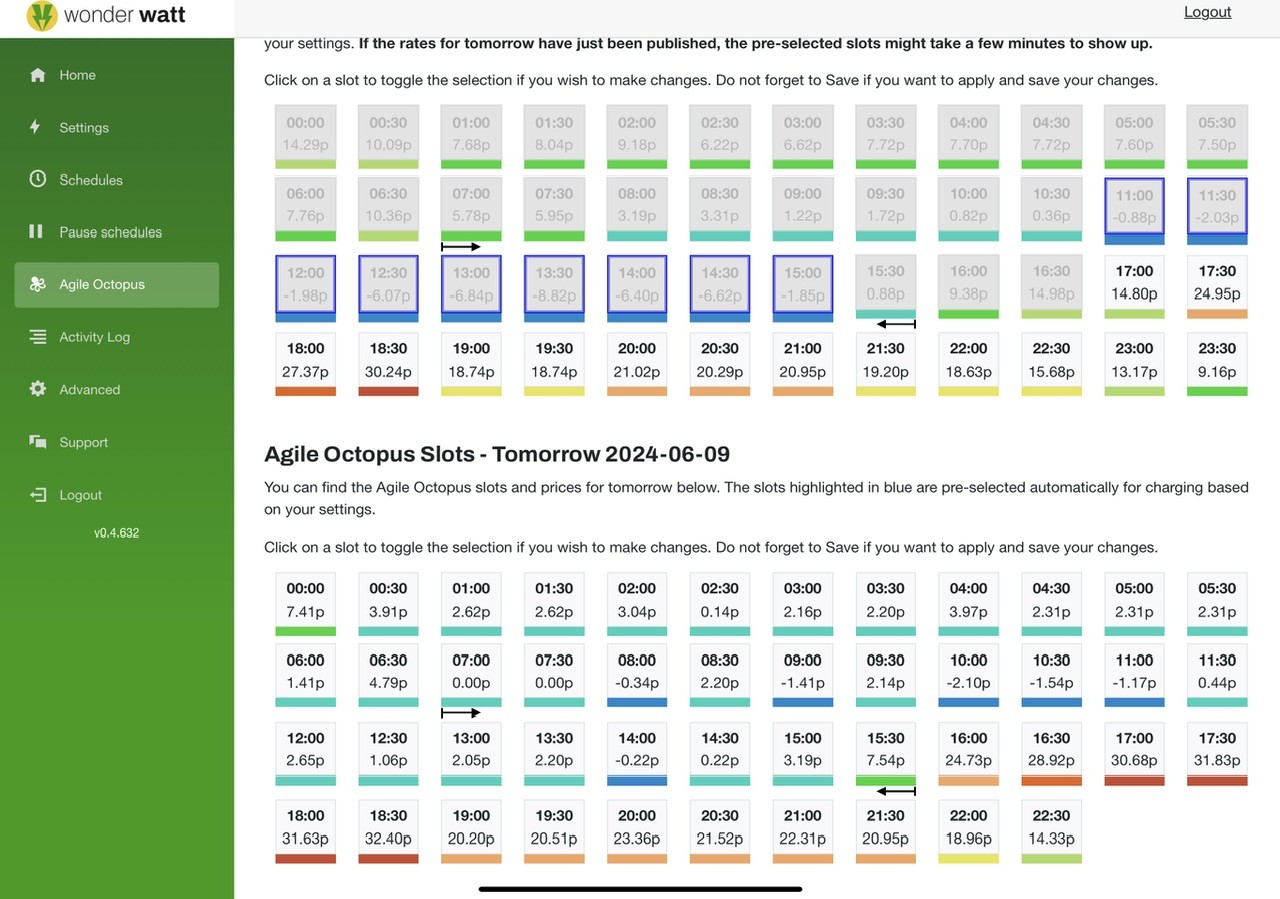
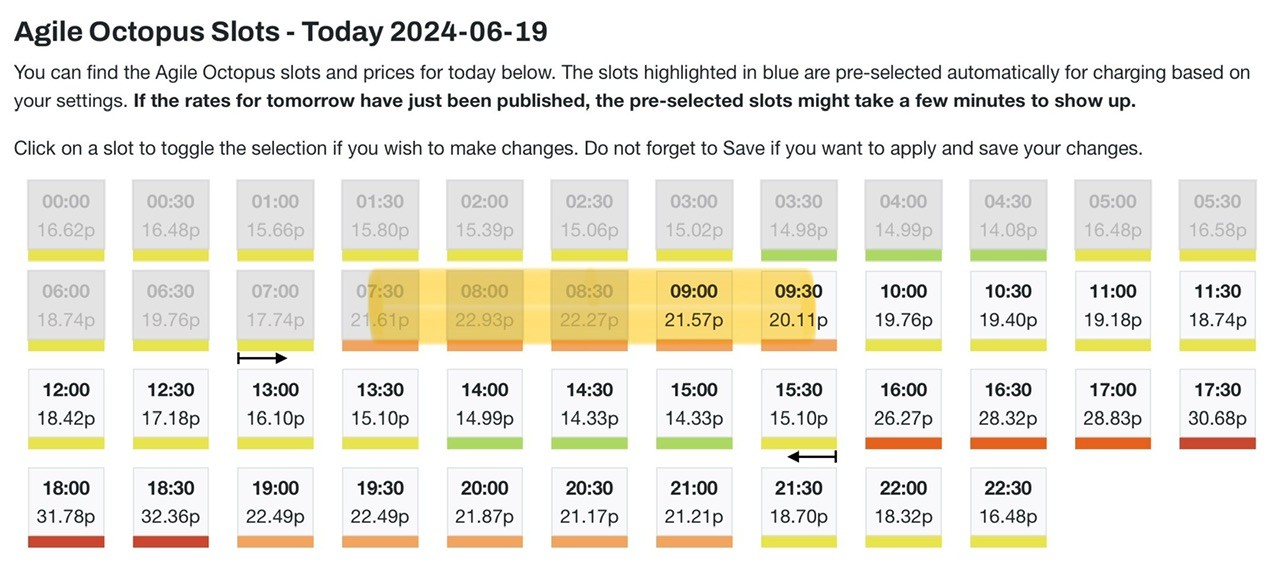
By comparison my income for 12/5 on Agile+Fixed export is £2 and on 14/5, £8.25.

So IOF is slightly better than Agile on good sunny days and not so good on poorer solar days. There should be more good than not good days in the summer, so overall IOF is slightly better for me,

BUT the daily standing charge is about 25p higher on IOF so the profit potential is reduced, AND the above depends on IOF getting the absolute best out of my inverters and batteries, which isn't guaranteed.

Anyway, that's my calculation logic; with marginal at best benefits I don't think IOF is worth it for me.

D
#23 DD

geoffreycoan Choosing two sample days, 12th May was good solar and 14th May poor solar.

12/5: 30kWh generated
14/5: 70kWh generated

Interesting definitions of "good" and "poor" solar ;-)

57kWh net generation, and after house consumption, 39kWh net export

However, my peak rate home consumption in the 4-7pm period was 2.8kWh on 14/5 (and 2,7 on 12/5), therefore best peak rate export is 10.7 - 2.8 = 7.9Kwh.

IOF export income for 14/5 would be 7.9 x 28.61 + (39-7.9) x 21.45 = £8.93 profit

Have you subtracted the 2.8kWh twice ? You've already subtracted it from 57kW net generation to get the 39kWh.

On Tim & Kat's video, his assumption was that half export would be day-rate, half peak-rate. I added a comment to say that this seemed optimistic since hardware limited how much could be exported during peak rate. Clearly in this case you're getting much less than half at the peak rate.

I need to do the same sum, but unfortunately usage varies quite a lot day to day depending on whether I charge the car overnight (which givenergy doesn't see), and/or how much power we use to make evening meal (sometimes a lot, sometimes a little).

T
#24 TX200

It depends on how much spare solar you have.

If you can export more than you import on IOF, you win.

I'm typically importing 3.45kWh a day at the moment (based on last 45 days) and exporting 9.34 kWh a day

Net electric cost before SC is -Ā£69.86 for those 45 days. Or -Ā£42.55 after removing electric standing charge.

W
#25 wrighar

I've just seen/found out, that (obviously really...) that the 4-7pm export of battery, also has your 4-7pm solar export on top of it as well., so for me 3.6kW battery at the worst, and 1kW battery and 4kW solar at best this afternoon.

It does seem to like setting multiple export slots in the 3hr window though, with varying wattage export rates, rather than 3hrs of continuous max export rate.

T
#26 TimHutchings

TX200 As always I guess, it depends on your setup and usage. In the last 30 days on std Flux according to the app, I've imported 31.52 kWh at £5.75 and exported 426.6 kWh with an income of £81.97, no standing charge Inc which is £14.36 for the 30 days.
That's a net of £76.22, less standing charge, £61.86 on the last 30 days. Maybe I could have made more on IOF? I just don't know, but happy with what I've made.

T
#27 TX200

TimHutchings I think Tim and Kat did a video (YouTube) that suggested IOF was better than flux. Something like if generation was 1.4x usage or more, better on IOF.

#28 Jase1703

This is a tricky one, definitely horses for courses. When April came around I decided to give Agile with fixed export a go leaving IOG behind knowing my EV was going in June and wouldn’t be replaced until late September. Since watching Gary’s recent YouTube on IOF and eventually getting my head around the ā€˜infinite battery’ principles I’m seriously considering another switch to IOF for just the summer. However, I need to go back to IOG or Agile when winter arrives and the new EV arrives.
At the end of the day it’s all a game to me, as long as I think I’m winning that’s OK. Just trying not to let it consume me, opps too late…..

How many tariff switches can you reasonably make in a year? I would prefer IOF if you could allow it to go lower than 20% soc. for ref, AIO with 8,8kw PV, electric only house.

D
#29 Daveb01

TX200

Both Tim and Gary have moved to IOF. Gary said he would stay on Agile but felt he had to try it for his channel and report back.

So I think I will stay on Agile and 15p fixed, and wait for a report from Gary to see if it worth it next year.

Last year I did Flux, this year I am doing Agile. It’s a shame we can not pick our own Import from the list and Export from the list, but I think most would go for Agile import and Flux export.

G
#30 geoffreycoan

DD Interesting definitions of "good" and "poor" solar ;-)

Yeah OK, I didn't look too hard to find a bad day's solar. Looking a bit further back, 3rd May was the worst day so far this month at 11kWh and 3rd April was also the lowest that month at 14kWh - must be something cosmic like the 3rd being an unlucky number?

I do have a lot of solar panels, 44 in total, 14.5kWh over 3 arrays.

However, my peak rate home consumption in the 4-7pm period was 2.8kWh on 14/5 (and 2,7 on 12/5), therefore best peak rate export is 10.7 - 2.8 = 7.9Kwh.

Have you subtracted the 2.8kWh twice ? You've already subtracted it from 57kW net generation to get the 39kWh.

Yes I think I probably have. I subtracted it from the peak rate export because we'd be wanting to use the battery storage in the peak rate period, and so I was working out the most that could be exported from my batteries at peak rate, but I'd need to add it back on to the non-peak export to get the figures to balance out. So adds another 59p of export income on IOF.

TX200 I think Tim and Kat did a video (YouTube) that suggested IOF was better than flux. Something like if generation was 1.4x usage or more, better on IOF.

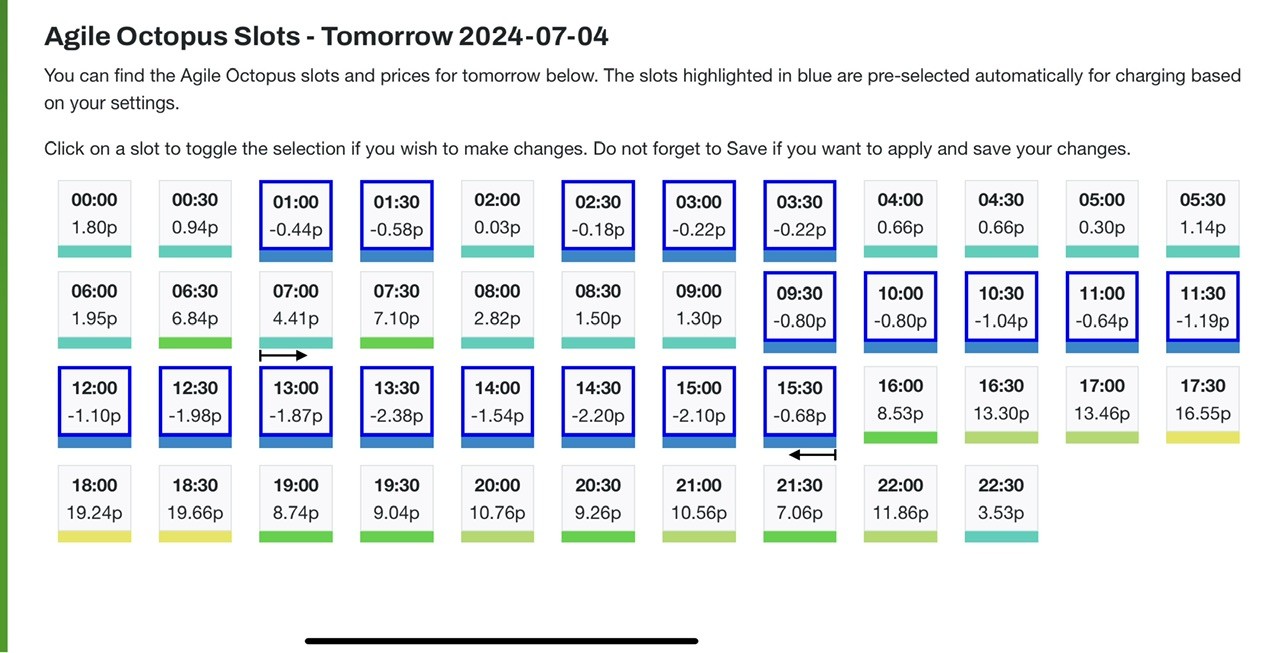
I did comment on that video that seeing a comparison to Agile (even average rates excluding peak) would have been worthwhile but Tim robustly didn't want to do that as he said the rates were too volatile for his rule of thumb approach so there we are.

It'll be interesting to see how real world experience of IOF pans out. As wrighar and comments on Gary's video say, it doesn't appear that IOF does the max output it can do as after all its about balancing grid demand. So I think the real world experience is that it'll be a lot closer financially.
If you want a fire and forget tariff though, its attractive

D
#31 Daveb01

Sorry guys, you have said the same things above, I did not read all the comments my bad šŸ˜ž

D
#32 Daveb01

geoffreycoan

I think it’s difficult to do a comparison over a day or a few days as Agile is up and down. If we were going to compare we should do it over a month or April - September especially if Agile is down below 9p or -2p then the margin between Agile + fixed and IOF may be different ?

D
#33 Daveb01

I have reduced my monthly bill to Octopus from £50 to £20 on Agile, this included the winter period and the summer so far.

#34 hoggy

It has good days and bad days. Its certainly a tariff to step back and view month by month rather than daily.
If you have a bad week of solar it can look pretty bad but it does tend to even itself out. If you spend all day looking at stats and trying to fathom out why it's not doing X then it'll just do your head in. My systems getting on a fair bit now so I just leave it to it these days (I'm up £19 over the last 28 days and that's included EV charging and some pretty rubbish weather)

D
#35 Daveb01

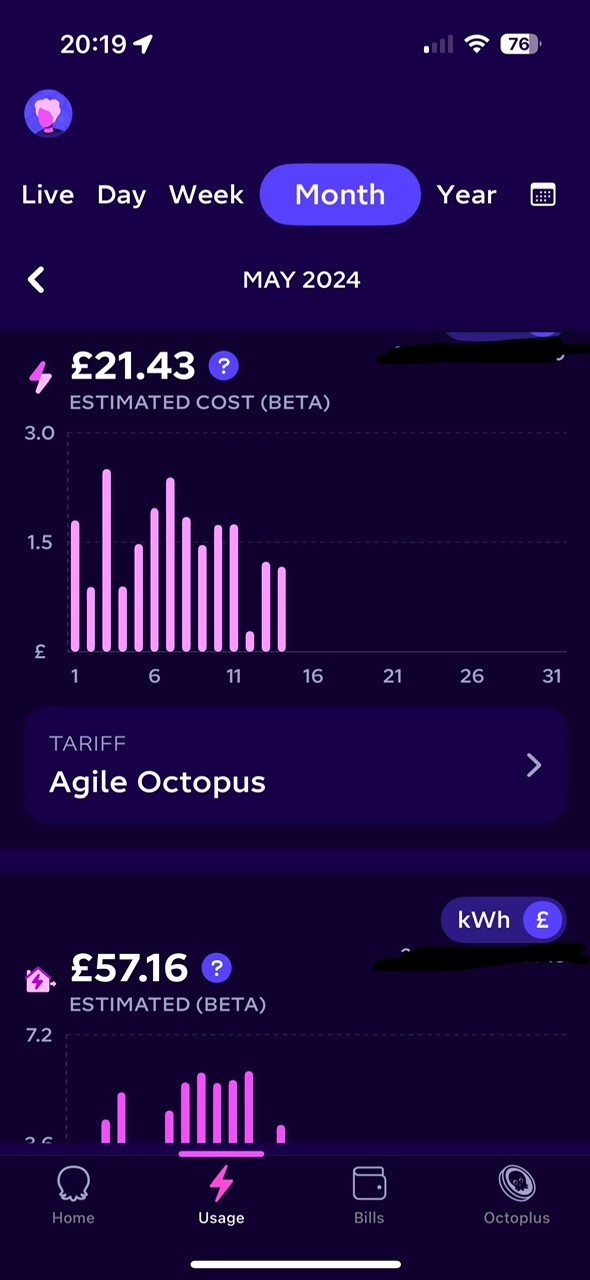
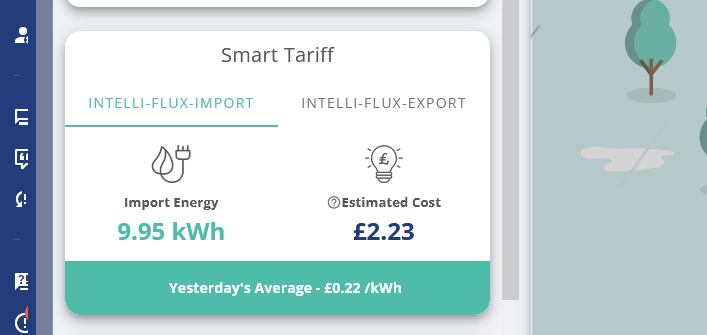
This is mine this month so far

D
#36 Daveb01

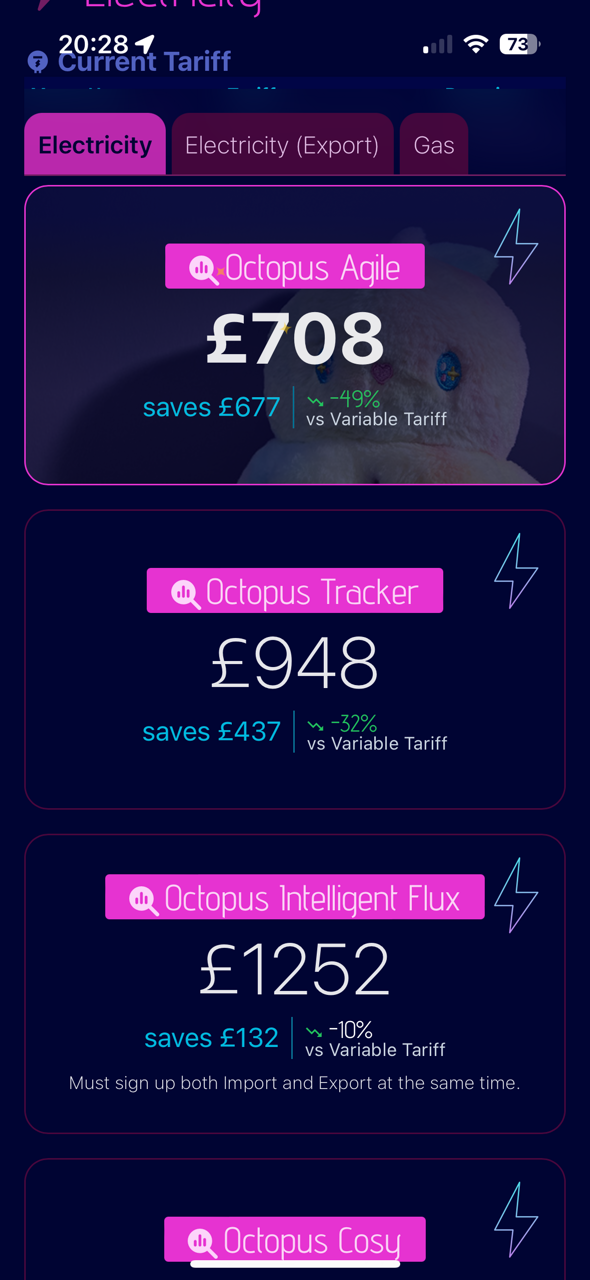
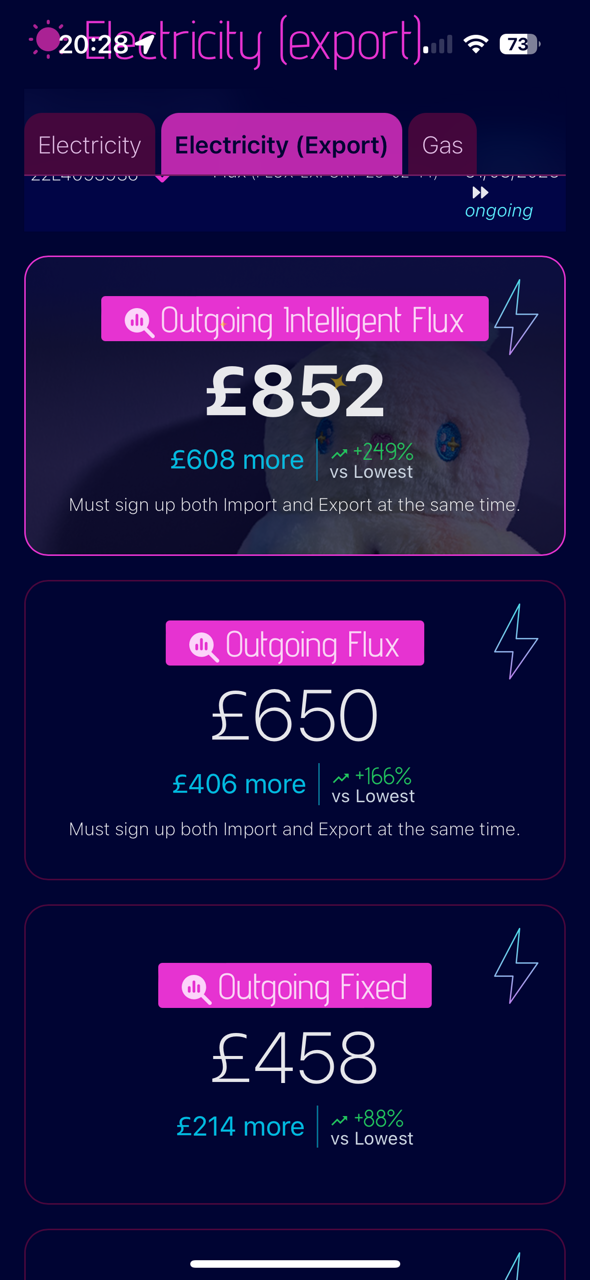
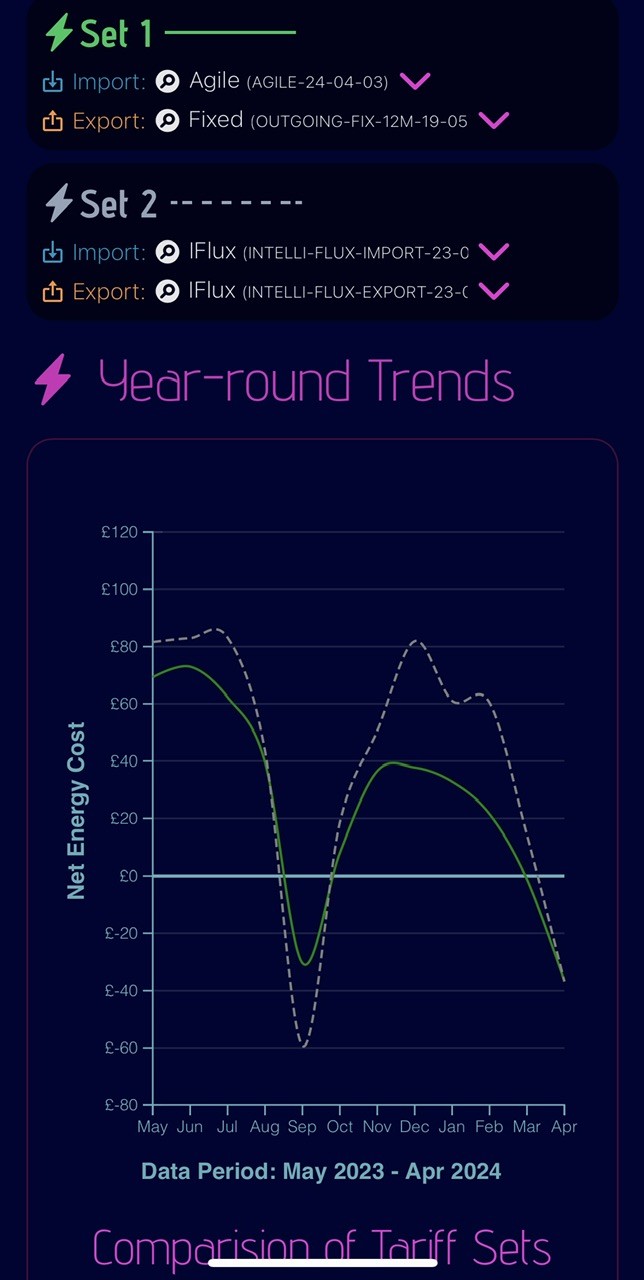
Octoprice ā€œcompare tariffsā€ is interesting šŸ‘šŸ˜€šŸŗ


#37 hoggy

But your usage patterns would be different depending on what tariff you start on VS the rest? IoF would certainly change this quite a lot for most people as it generally doesn't do much if any charging overnight as an example.

D
#38 Daveb01

Something else to consider on Agile:- ( if it is a sunny day and the sunset is now 20:48)

I charge the battery up at the cheapest rate over night, if there is solar the next day it is exporting all day at 15p up to about 19:00, I then export the battery for 3 hrs from 19:00-22:00.

T
#39 TX200

geoffreycoan in terms of max output, mine doesn't discharge at full speed. But it does go from 100% to 20% full every day.

So it discharges slower, but that's to make sure it's empty (or at 20%) just before 7pm

I guess different batteries and different inverters will have different outcomes though.

T
#40 TX200

hoggy yeah fully agree on that.

Plus my inverter wont cover the electricity for my shower in full (and same with oven if it's not sunny).

So with IOF having the peak between 4-7pm I haven't got to worry about having a shower and using some peak rate grid (as long as I avoid 4pm showers!).

Oven not quite as ideal, especially in winter. I either have to suffer some peak rate electric, or have a main meal at lunchtime where practical.

G
#41 geoffreycoan

TX200 thanks, its good that IOF discharges down to 20% by 7pm every night, but thinking about it further, the discharge slower could be a real problem:

Say Octopus want to discharge 6kW from your battery over a 3 hour period so sets 2kW discharge rate an hour.

You turn the kettle or oven on that draws 3kW, you'll only get 2kW from the battery and 1kW will have to be grid imported at peak rate.

EDIT: you just commented making a similar point to mine

#42 hoggy

TX200 yes I'm in a similar mindset. I fully get that I could potentially save slightly more by playing the Agile game but I'd expend a lot of time doing so that would just get in the way of life.
Young family and both of us working means if I put the washer on then...I want the washer on, not sat waiting for a cheap slot to roll around. IOF allows more flexibility in that regard as unless it happens to be 4pm_7pm then it makes no real odds to my costs.

As is life, everyone's use case is different so what suits me likely won't suit others.

T
#43 TX200

geoffreycoan what would be good is if they could set a 2kW export not discharge

So if house demand goes up, discharge goes up.

Perhaps eco mode with charge set to Zero during 4-7pm

Then when actively exporting, balance to 2kW export rather than balance to zero. Like an offset.

I guess home assistant could tweak the discharge rate, up and down, if need be, not instant though.

Ultimately I've handed over my battery to octopus, so it is there call. In return I get simplicity, as mentioned above, plus a pretty good export rate (and an infinite grid battery as they say!)

D
#44 DD

TX200 I tried that suggestion just over a year ago. (I remember it because it was my first thread.)

D
#45 Daveb01

D
#46 Daveb01

To be honest, I think you guys are right, everyone is different and the cost difference will be a few £.

I am using Wonder Watt, once set up it is easy, to leave it and keep an eye on it every now and then. I will be looking forward to the report from Gary and Tim.

It’s good there both doing it as well, because Gary does not have an EV so does Agile & IOF, Tim does and is looking at OG and IOF šŸ˜€.

It’s a shame Octopus takes so long to validate Cars and EV chargers that are compatible for the Intelligent schemes. As the GE charger is not yet accepted. Oh forgot its ā€œcoming soonā€

ā€œComing soonā€ = months/years 😔

P
#47 philipclark

I fitted solar in February and have been trying to transfer from Flux to Intelligent, with no success, and I know some others are having issues too. After getting a bit shirty about why it was taking so long to try and fix the issue, they are now saying that certain battery capacity and inverter capacities are not recognised by the app and so I won't be able to transfer.
FYI I have a 5.6kw battery and 3kw inverter.

T
#48 Toki

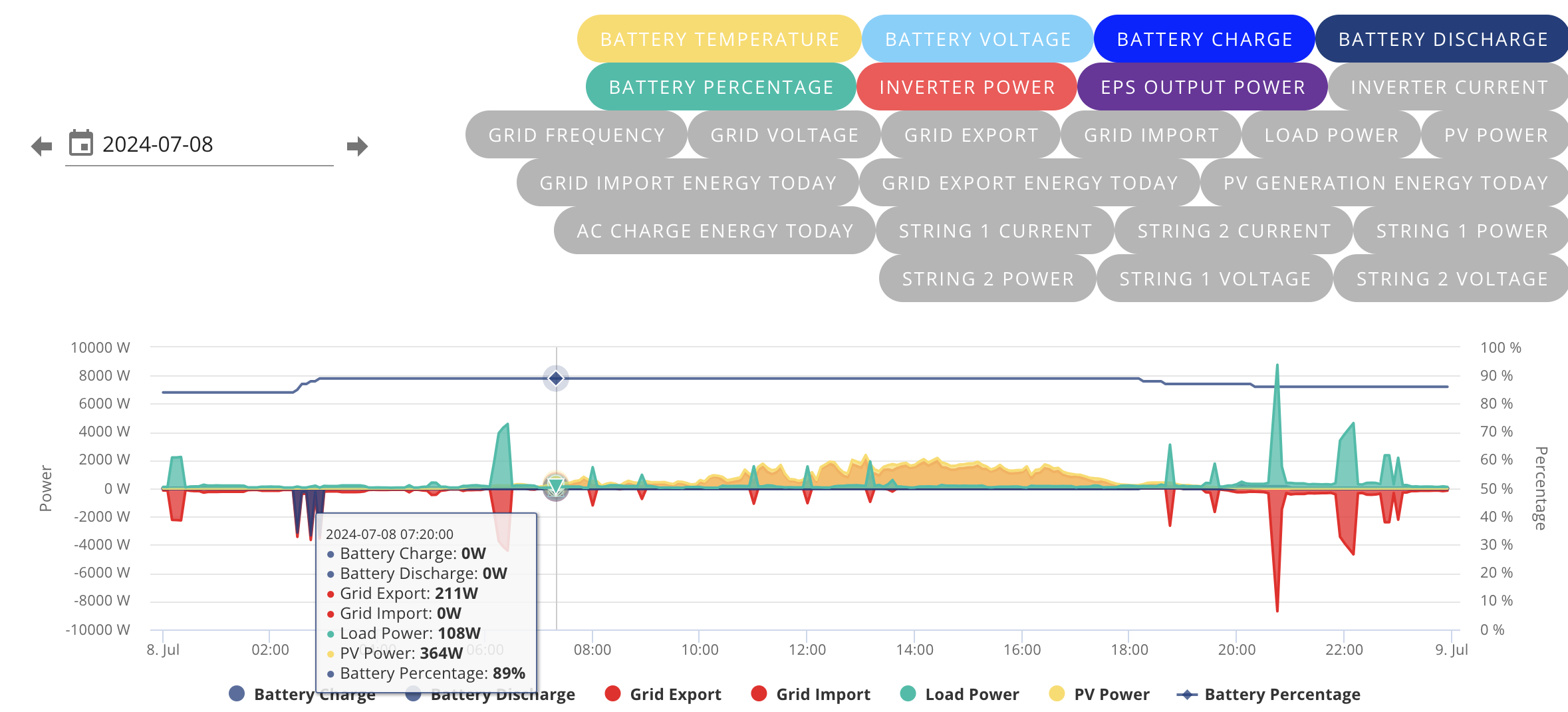
I've been on IOF since the start of April. Up until a few days ago, it would rarely charge the battery overnight. The default has been to start charging from 10 or 10:30am via solar or grid.

A few days ago, it's been charging to 90+% overnight. Despite the forecast yesterday and today of lots of sun. Has anyone else experienced this? Looking at the settings, it was 1-4am last night and 2-5am this morning.

This means suffering the small AC-DC-AC losses compared to solar charging which is only DC-AC, probably around 10%.

I know we give up control when signing up, but don't understand the rationale of this, apart from possibly benefitting Octopus to balance the grid and payments to and from them?

It does say in the FAQs, extract below but never seen it fully charge overnight. The last sentence isn't strictly true either due to additional losses.

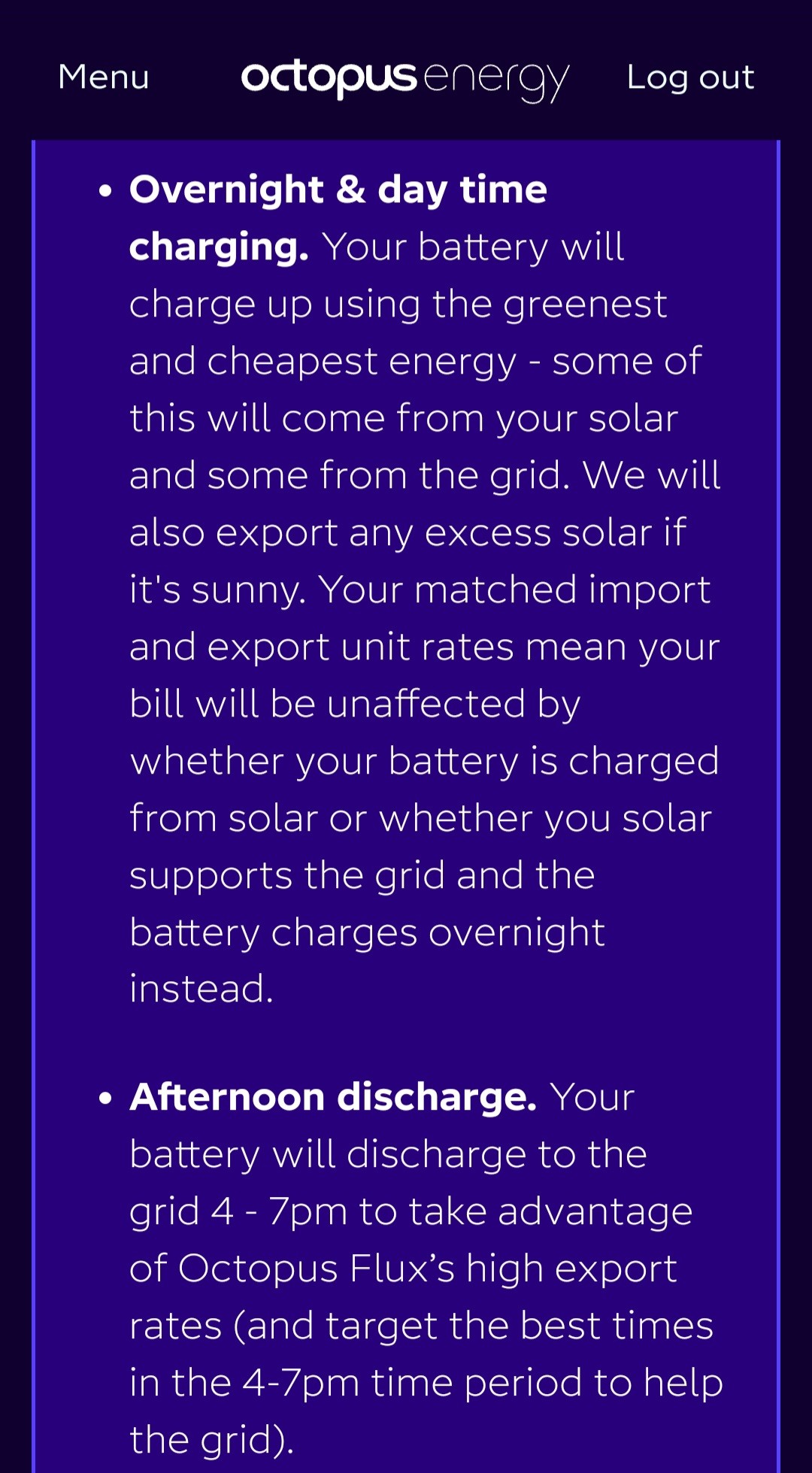
"Overnight & day time charging. Your battery will charge up using the greenest and cheapest energy - some of this will come from your solar and some from the grid. We will also export any excess solar if it's sunny. Your matched import and export unit rates mean your bill will be unaffected by whether your battery is charged from solar or whether you solar supports the grid and the battery charges overnight instead."

T
#49 TX200

Toki no, mine hasn't done that.

Have you accidentally turned something else on, like adding a tariff card (tariff automation), or some third party thing like home assistant etc?

T
#50 Toki

TX200

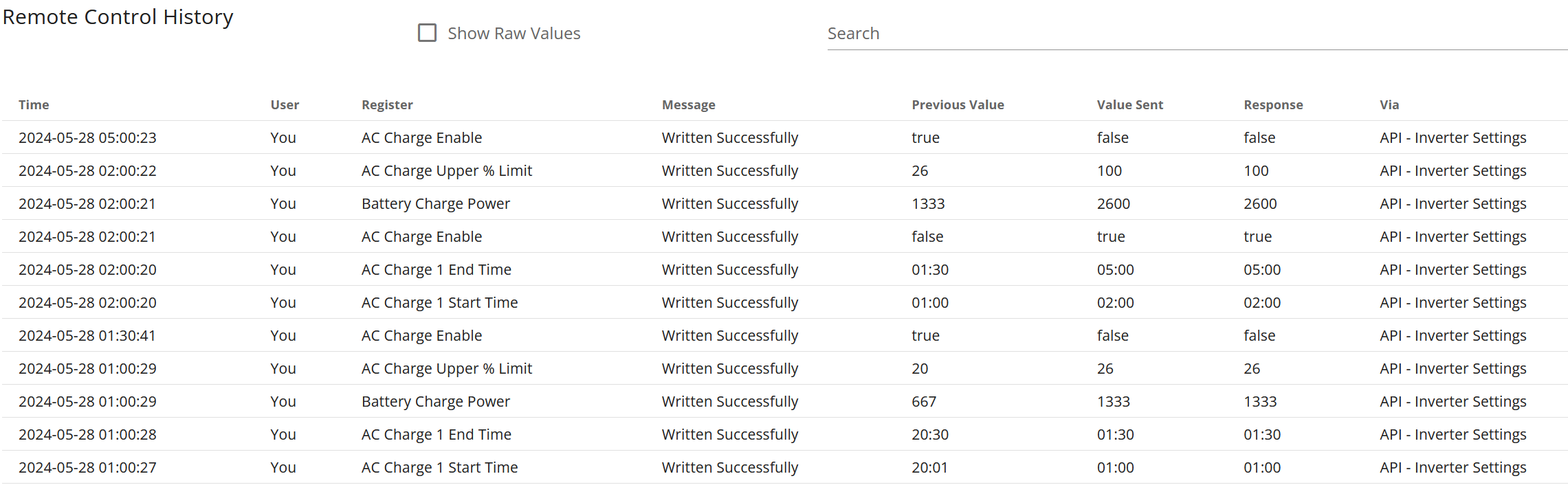
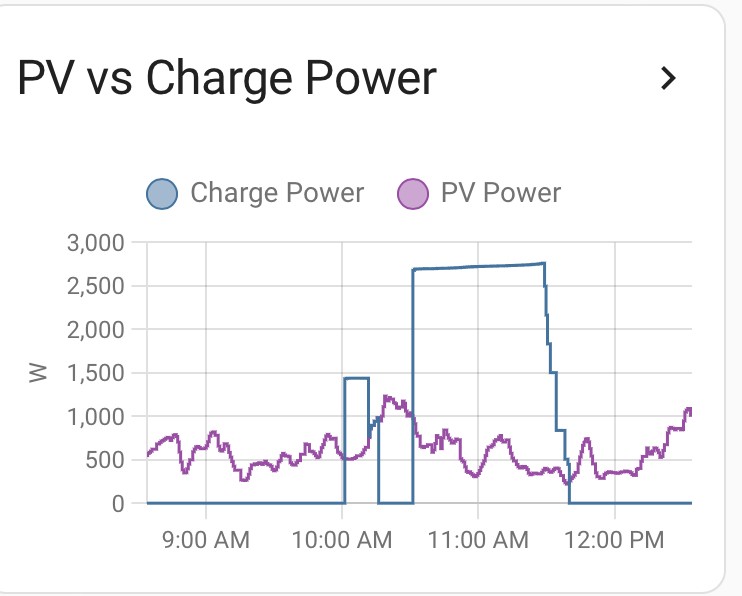
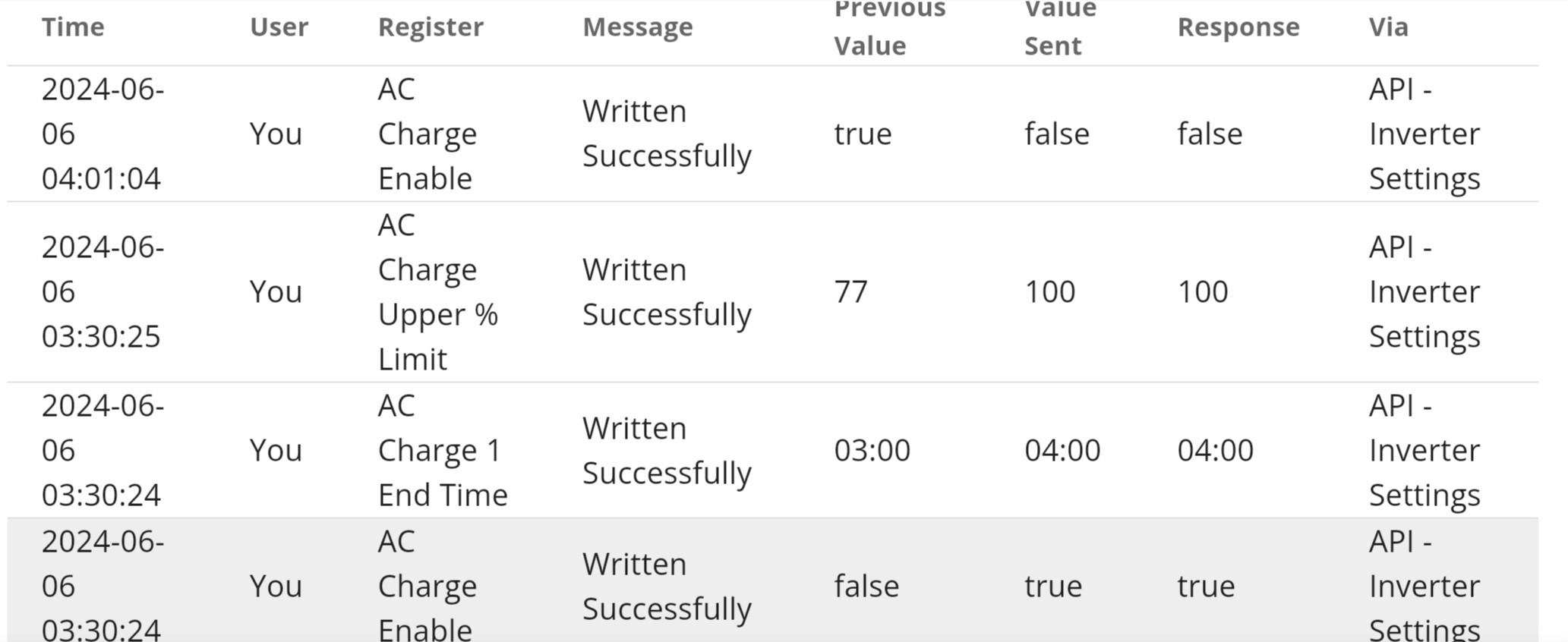
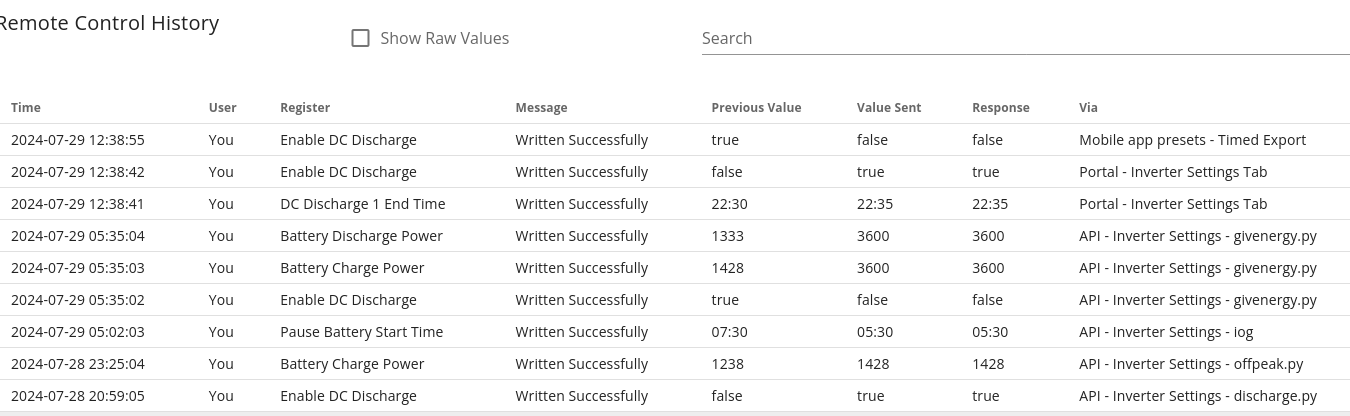
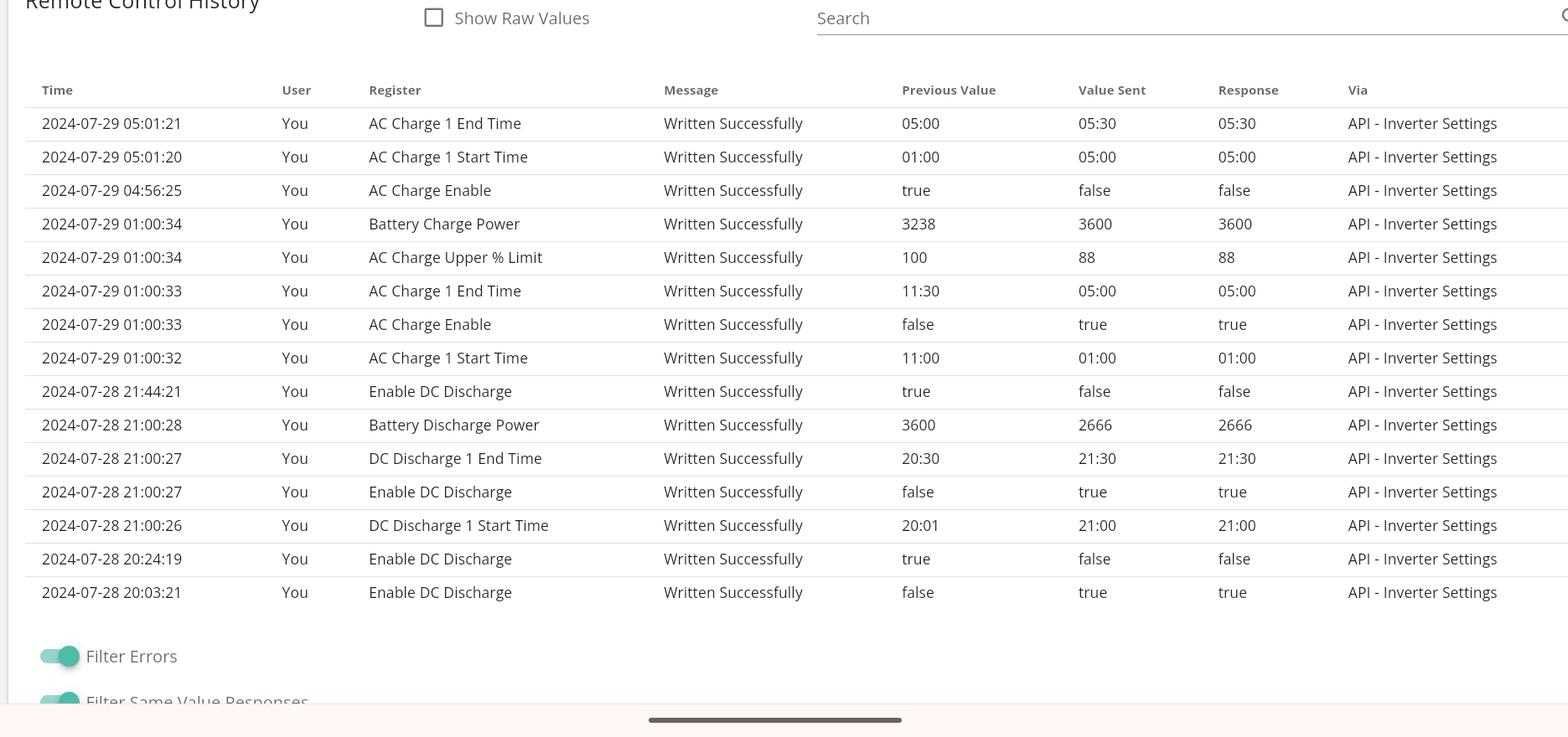
Not that I know of. I don't have any third party devices, not sure where to find tariff card TBH. Looking at the logs, here is what I have when I was asleep. So must be Octopus driven?

S
#51 Stuart57

I switched to this tariff on 8th of this month.

At first the results seemed a bit odd but after a few days it made more sense.

Looking at the Octopus app for the 18 days it has been in use the estimated (by the app) cost has been £13.33 and Octopus have credited me with £77.10, Seems like a pretty good deal.

To put this into context, I have ten solar panels and an 8.2 kWh battery and only use 5 to 6 kWh per day.

It might be less attractive over winter when less solar power is being generated.

T
#52 TX200

Toki time zone correct? Should be GMT if you are in UK? Account settings area for that.

Tariff cards are on the homepage of the web portal.

S
#53 Stuart57

Following on from my post 5 hours ago where I mentioned winter, I think that it may well still be a good option, but it depends on how Octopus handles it.

It is possible that during the day, if Octopus predicts that the battery will not be charged very much by 4pm they may decide to charge it from the grid (at 21p per kWh) and then between 4 and 7 discharge to the grid (at 28p).

Another win for me!

T
#54 Toki

TX200

Thanks, yes set at GMT.

In regards to Tariff card, looks set correctly if this is the right area?

T
#55 TX200

Toki yeah that's the one. You can expand it I think by pressing on it and then there should be an option to stop automation if something is already on.

T
#56 TX200

Mine charged to 100% overnight!
First time it's done that since Spring started.

H
#57 Hopeful

Yes Mine did that too! Never seen it do that before. All very weird

H
#58 Hopeful

Anyone elses solcast blank on the web and GE card not logging in? Maybe thats whats confused the IOF

T
#59 TX200

Hopeful yes, mine is blank too. Tried resubmitting credentials direct from solcast site (in case they'd changed since I last used them) but no joy so far.

Although I would have expected Octopus to have their own weather and/or solar prediction tools rather than leave the user to register for solcast and link it in.

H
#60 Hopeful

Yea I just wondered if there was a major problem with solar forecasting affecting all feeds

T
#61 Toki

My weather forecast is live and has been during the overnight charges past few nights.

Yesterday evening, I selected "Pause discharge" in the remote control tab. It did try and charge again overnight as per logs but was blocked. I wonder if it done depending on region. I am North Scotland for reference.

D
#62 DD

Toki note that "pause discharge" is only active during the time window you specify. So if you left pause start and stop as 00:00 then it wouldn't have any effect

#63 PianSom

I am struggling to reconcile the errors showing in he HA log with the reported status of Solcast. Problem their end it seems. Though none reported at https://status.solcast.com

G
#64 geoffreycoan

PianSom I've had lots of errors with solcast recently, my automation kept failing with the 429 error, yet I could run the automation manually and it worked fine.

It seems solcast have rate limited the personal accounts and if lots of people retrieve at the same time, eg 10:00:00 then you get the error. After a bit of trial and error on the times I've now got solcast working much more reliably again. You need truly random times when others are hopefully not polling

#65 PianSom

geoffreycoan
I had hoped that 2 min 19 sec past the hour was sufficiently random - but no! But then neither is 51 mins and 6 secs apparently, which I just tried.

Who knows?!

L
#66 Leeshore

Hopeful Mine did as well.

#67 Jase1703

Just lost my solcast data from PredBat, was there all morning!

T
#68 TX200

My system isn't discharging/exporting so far this evening.

Maybe octopus is a bit knackered, or the grid doesn't need help just now.

As it was mostly filled from grid, not sure I'm too bothered about it discharging as it is probably only 3p profit per kWh after losses.

H
#69 Hopeful

TX200 I find a little bit of HA automation keeps theirs on its toes šŸ™‚

T
#70 TX200

Mine started to discharge at 5.33pm, but at full whack.

So maybe the grid is tight this evening?

Usually it discharges around 50% discharge rate.

#71 PianSom

Lots of the Solcast error reported on Github here. Let's hope the Aussies sort it overnight.

T
#72 TX200

My solcast card is working this morning. 🄳

#73 PianSom

There’s an update from Solcast on the link above.

After a reload, mine is working again this morning too.

#74 Jase1703

PianSom required a HA restart in my case, but all working now.

G
#75 geoffreycoan

No intervention required on my part, the 1am solcast poll automation worked fine, most of yesterday and when I tried running it manually it just failed

H
#76 Hopeful

My solcast is back too. Octopus still charged my battery overnight so I have flagged it to them to investigate. In the grand scheme of things it doesnt make any difference when it charges but not leaving any room in the battery does leave me open to clipping as I am export limited šŸ™

T
#77 Toki

Hopeful

Yes, mine charged overnight too. The downside as you say is clipping during the day and also the additional losses from AC-DC-AC. If charging from the solar, you only get DC-AC losses.

I had the additional issue that my battery did not charge overnight the previous night or during the day yesterday. Any time I turned off automation and Eco on, it was changed within minutes. Meaning I had to use power at the expensive peak time rate.

I contacted Octopus via email and phone yesterday, never got anywhere. Reply below following my call, despite me saying battery is controlled by Octopus.

I appreciate your concern regarding the charging of your battery on the Intelligent Octopus Flux tariff.

Typically, the Intelligent Octopus Flux tariff works by optimizing the use of solar energy and saving any excess energy for times when there is a lack of sunlight. However, it's worth checking with GivEnergy to ensure that your battery is working correctly.

I recommend contacting GivEnergy to discuss the charging behavior you have observed and to verify if there are any incorrect settings in your system. They will be able to provide you with more specific information and assistance.

H
#78 Hopeful

Toki Lol I got run round the houses too but did get a suggestion to "De-authenticate and re-authenticate your battery - this will make sure the battery is on the latest firmware."
I am yet to try this as I thought I would wait another night to see if solcast was an influence, and I'm a little sceptical this would help the particular behaviour. Its more likely it could take me back down the path of authentication failure again!

T
#79 TX200

GE Support have advised

As far as im aware Solcast have gotten rid of Free accounts and i think they just have accounts that you need to pay for now to use this service.

T
#81 TX200

PianSom yeah, spotted that too.

I'm not sure how fussed I am about solcast. Got solar.forecast on HA. It's not perfect but it'll do.

If I move off Intelligent Octopus onto agile for the winter, then maybe I'll need something to work alongside predbat.

Oh and my battery fully charged again overnight, 2nd night in a row. Will see what tomorrow brings. Although it might just be a coincidence and the weather...

T
#82 TX200

Third day of 100% overnight charge.

M
#83 MrNCFC

Mine did as well, been having inverter timeout and inverter offline errors on my remote control log for a few days now.

T
#84 Toki

Same here. Annoying. This seems delibarate by Octopus, logs show different times, 2-5am, then 3-6am so not an error. Days when my forecast is good amd plenty of generation.

#85 Tenkaykev

I'm currently on Agile with fixed 15p export. I watched the " Gary does Solar " video on the Intelligent tariff and have been considering it but not sure about surrendering control of my battery. I have a simple strategy of letting the battery do its thing of charging from solar and exporting all excess to the grid. The only exception is when the Agile prices go below 8p overnight when I dump the battery down to 10% between 21:30 and 23:30 and refill on the cheap overnight rates so my solar generation starts exporting to the grid earlier in the day. I use WonderWatt which makes this extremely easy. It will be interesting to see what the " Gary does Solar " conclusions are after he has been on the Intelligent tariff for a while, I'll take another look at it then.

#86 hoggy

You are entirely at the mercy of the weather on IOF (I'm on it since March and was on it last August-Nov)
Should the sun actually make an appearance this year things will improve however I was hoping to be doing more than breaking even by end of May. (<insert old man yells at cloud image>)

H
#87 Hopeful

Yup another full charge overnight {sigh}. I feel the need for a bit more defensive HA automation! I would probably say today is a pretty poor solar day but I see no need for 100% other than Octopus must be buying cheap and piling high as there is no benefit to us consumers.
I do note the FAQ no longer describes the tariff with "dont worry we will leave some room in your battery for solar"

D
#88 DD

Hopeful must

Hopeful Octopus must be buying cheap and piling high as there is no benefit to us consumers.

But isn't the point of the tariff that you get the benefit of good rates, and they get to use the battery however they want

H
#89 Hopeful

DD Well thats how they descibe it, but the reality is that there are 2 rates, approx 23p from 7pm until 4pm the next day and 30p peak for the 4-7pm slot. Charging overnight is only a benefit to OE who are probably paying for their energy at the lowest price of the day but still charging the standard rate.
Previously IOF was charging gradually throughout the day, giving me some protection against clipping. That being said clipping seems to be highly unlikely today so the point might be moot but that hasnt been the case for the previous couple of days

T
#90 Toki

Hopeful

Unfortunately for me, I am getting clipping today as nice in sunny in Aberdeen. I appreciate you give up control of the battery to OE but some allowances have to be made in peak generation season to top the battery up during the day.

Much better before they made this change allowing generation during the day and taking from the grid if short. As you say only benefit of this is to OE as we are taking the additional conversion losses from taking from the grid.

#91 hoggy

I doubt it's a permanent change of tactics from Ocotpus. The Octopus API and Solcast has been a bit all over the place reliability wise last few days (coinciding with when this overnight charge started) so it feels likes it's in some sort of failsafe mode & it's not making decisions based on planned PV properly.

H
#92 Hopeful

hoggy I think you are probably right although the chose not to acknowledge that when I reported it

#93 hoggy

Hopeful I can try and ask in an Octopus developer forum I'm in - although equally they aren't great at answering in there either.

T
#94 TheHowards

wrighar
I am finding IOF doesn't always export between 4 and 7. I am over riding it to do a scheduled export but every few minutes it changes it back to dynamic mode and stops the export.
I guess octopus are seeing less demand so don't want to buy power they don't need.
Before I hand it all over to Home Assistant (a lot of learning to do before I can do that) did anyone figure out why IOF does this and how to stop it?

D
#95 DD

TheHowards why IOF does this and how to stop it?

Presumably as you say, it suits their goals. Stop it by switching to a different tariff so you can take back control of the battery ?

#96 Jase1703

You guess right, if they can’t use it they don’t need it. You can’t store electricity, you can store energy in a battery or lake and use it when demanded but they won’t take what they can’t sell on. Their traders buy and sell up to 3 months ahead and then need to close positions every 30 minutes, might be less, having access to hundreds if not thousands of domestic batteries helps them close out positions if they are short or long. Trying to be simplistic here but basically that’s how it works for octopus.

G
#97 geoffreycoan

It'll be interesting to see the results from Tim and Kat and Gary does Solar on their use of IOF, especially whether it is more profitable than straight Flux or Agile+15p export. As a set and forget tariff it certainly ticks the box, I remain doubtful of whether it actually is the best value for money. Tim's first video on his experience using it showed some anomalies, some peak import and exporting wasn't at max output rate - ie as said its meeting Octopus's needs not necessarily the best for the consumer

T
#98 TX200

Different pattern tonight. Charged a bit, stopped at 43%, charged a bit more, stopped at 78%, charging again now at 98%

Maybe it is starting to get back to normal. šŸ¤ž

Previous three days it was just one long overnight charge, rather than start stop.

T
#99 Toki

TX200

Same here. Let's hope so. Alternatively, this is the best time for OE to sell to us, and they are adapting each night to suit them. Let's hope you are right and I' wrong.

H
#100 Hopeful

Well that was a new one last night. Half past midnight charge at full pelt for 30 mins followed by a discharge at full pelt for 30 mins! Whats that all about!

T
#101 TX200

Hopeful yes mine did that too. Given it is off peak import followed by off peak export that makes a loss after considering round trip efficiency. 🤬

T
#102 TX200

Octopus faq

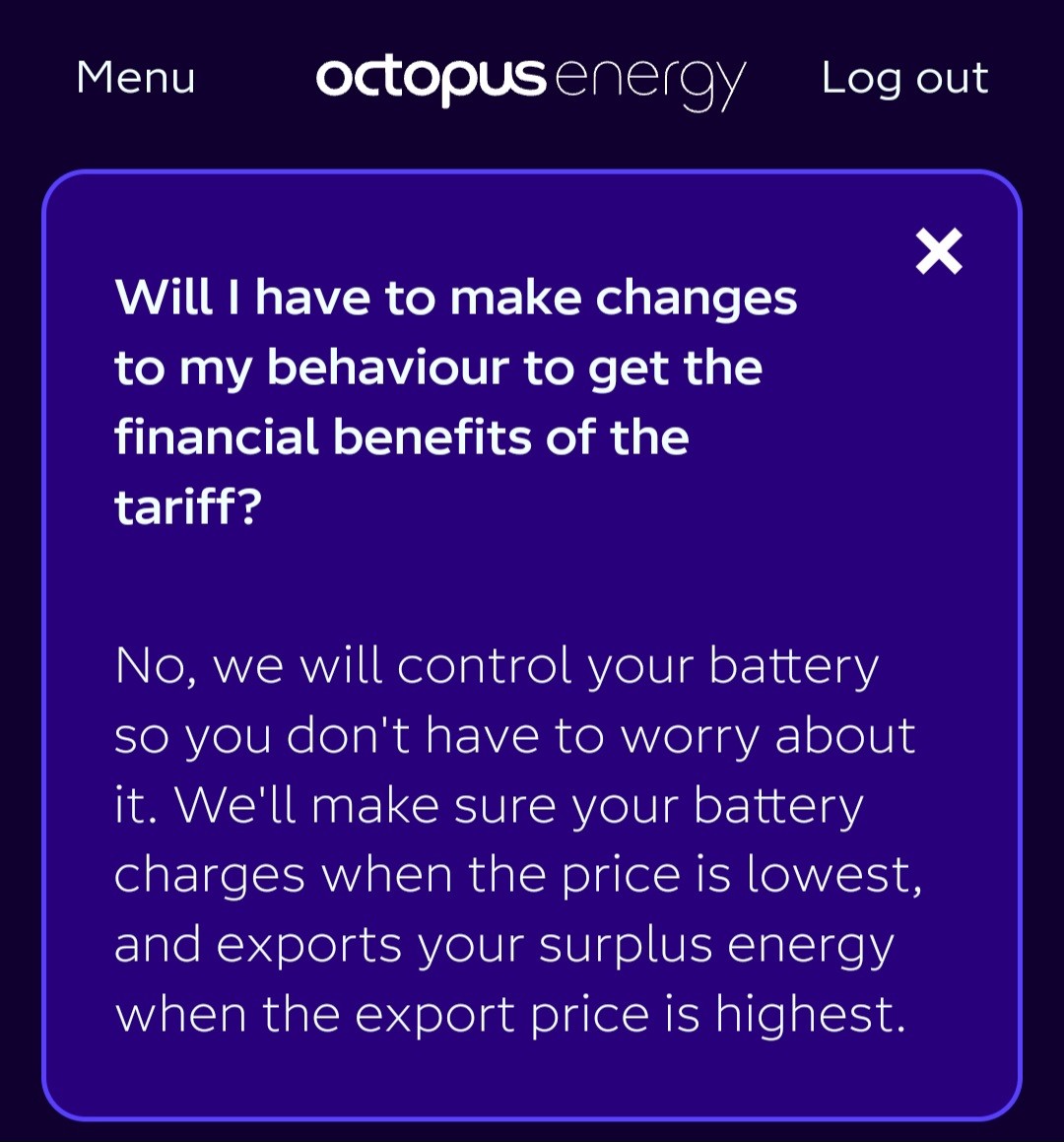
"No, we will control your battery so you don't have to worry about it. We'll make sure your battery charges when the price is lowest, and exports your surplus energy when the export price is highest."

So they were half right. They charged during cheap rate. But exported during cheap rate too.

G
#103 geoffreycoan

TX200 Given it is off peak import followed by off peak export that makes a loss after considering round trip efficiency. 🤬

This is one of the things that puts me off IOF. The headline "matched import and export rates so use the grid as an infinite battery" isn't really true, with round trip losses in the 10-20% range, it's really costing you about 3p per kWh cycled through the battery. And as others have said the IOF peak discharge isn't the full period at full rate so you're not maximising income there either

Be interesting to see a full month comparison against other tariffs

T
#104 Toki

Hopeful
Same. As has been said, means a loss financially for us doing this. OE must have installed some software to maximise their returns based on their buy and sell prices but not to the benefit of consumers.

D
#105 DD

geoffreycoan use the grid as an infinite battery" isn't really true,

I think's referring to exporting power to the grid, and then later reimporting from the grid - in that sense, the grid is a perfect, lossless battery

T
#106 TX200

DD correct, that's how I interpret it.

I can use my electric shower in the morning from the grid, then export lots in the afternoon to make up for that import. Same price either way. Like net metering almost.

T
#107 TimHutchings

Guess with all systems and tariffs it's you win some then you lose some, but it all very much depends on each individuals own type and time of usage. I suppose with IOF, for those who fully want a fully fit and forget system, IOF works pretty well as long as you fully trust Octopus, but for those that want to be more involved, maybe bog std Flux may be a better bet in the summer.

T
#108 TX200

TimHutchings I looked at normal flux, not beneficial to me - but as you say everyone's experience will be different based on their usage etc

I think it's the high export rate that helps for me - as I'm generating a lot more than I'm consuming.

The normal flux might be more appealing if the overnight charge was cheaper. But I think it's the export where I'm winning not the import.

T
#109 TimHutchings

TX200 You definitely win on the export rate over Flux, but I import virtually nothing from Octopus in the summertime as solar provides it all and gives me a pretty good export rate 4-7pm as well as a decent daytime export at nearly 16p in my area. From what some are saying, Octopus are obviously working the system for their benefit, and the 20% losses on importing to fill the batteries to export again makes the import/export matched prices rather shaded in Octopus's favour.
Octoprice, on their comparison section, actually have Flux slightly ahead in the summer against IOF with my usage and export times over the summer months. Not so good in winter but then I change in October anyway to Cosy last year, though that was beaten by Agile.
Anyway, different strokes foe different folks!

H
#110 Hopeful

geoffreycoan The gains from selling your solar do seem to beat other tariffs unless its a crap weather day but their logic for driving the automation seems to have gone to pot. The 30 min load/dump may have been a test for something but the constant charging up overnight seems a complete break from the behaviour I have seen since going on IOF. I am having to apply countermeasures to make it act like it was previously.
The FAQ's said you have the option to pause the "intelligence" but I have never seen that option

D
#111 DD

Hopeful The FAQ's said you have the option to pause the "intelligence" but I have never seen that option

For IOG, on the octopus app you can press the icon in the top right, then devices, and (for me) choosing IOG it offers "enable smart charging" at the bottom.

H
#112 Hopeful

DD Thanks but for IOF you just get Support, Feedback (now there's a thought!!), Legal Stuff and finally Accounts where I can disconnect the device but nothing more

T
#113 TX200

Yay, my battery is at 24% 🄳🤣

L
#114 Leeshore

TX200 So is mine. Wonder if it is to do with the grid using a lot of gas/import over the last few days?

T
#115 Toki

Not quite as good as you guys, up to 49% but an improvement at least. Let's hope it charges during the day to 100% via solar. Currently exporting to grid.

G
#116 geoffreycoan

Toki market rate prices (ie agile) are very low today, around 9p from 12-4pm so I expect your IOF will charge up then

T
#117 Toki

geoffreycoan

Your theory sounded entirely plausible. However, OE have decided to charge to 100% from 10-12 on my system at least.

G
#118 geoffreycoan

Toki very strange. you would think it would follow roughly the agile rates which follow supply and demand
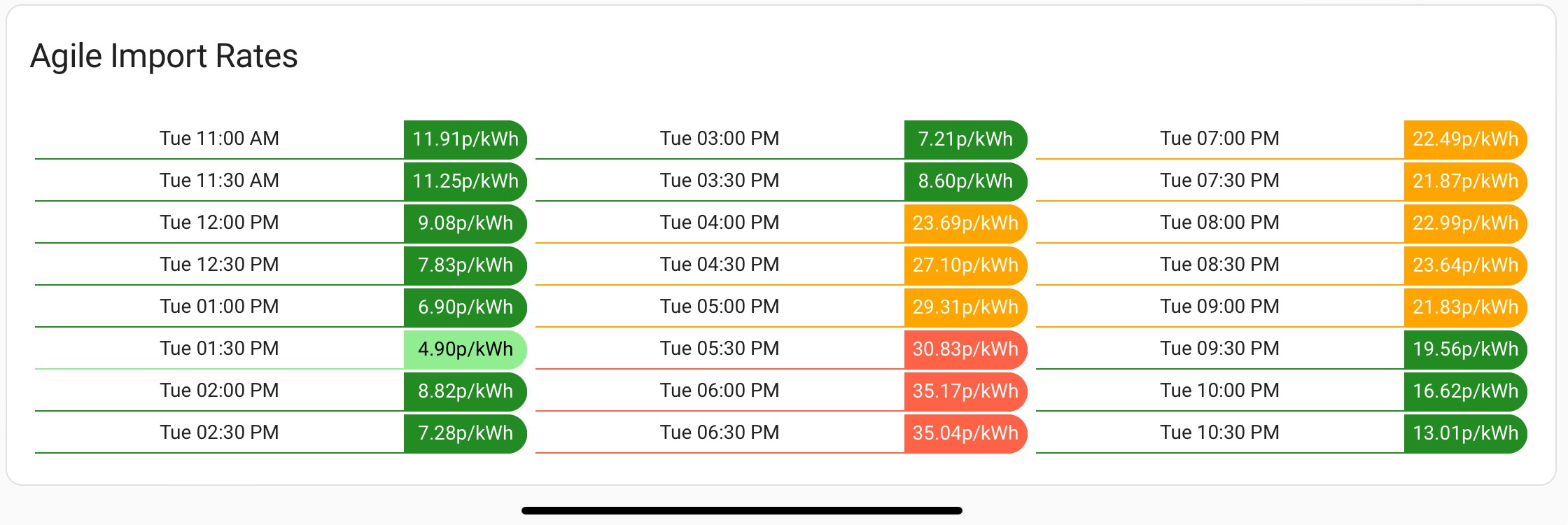
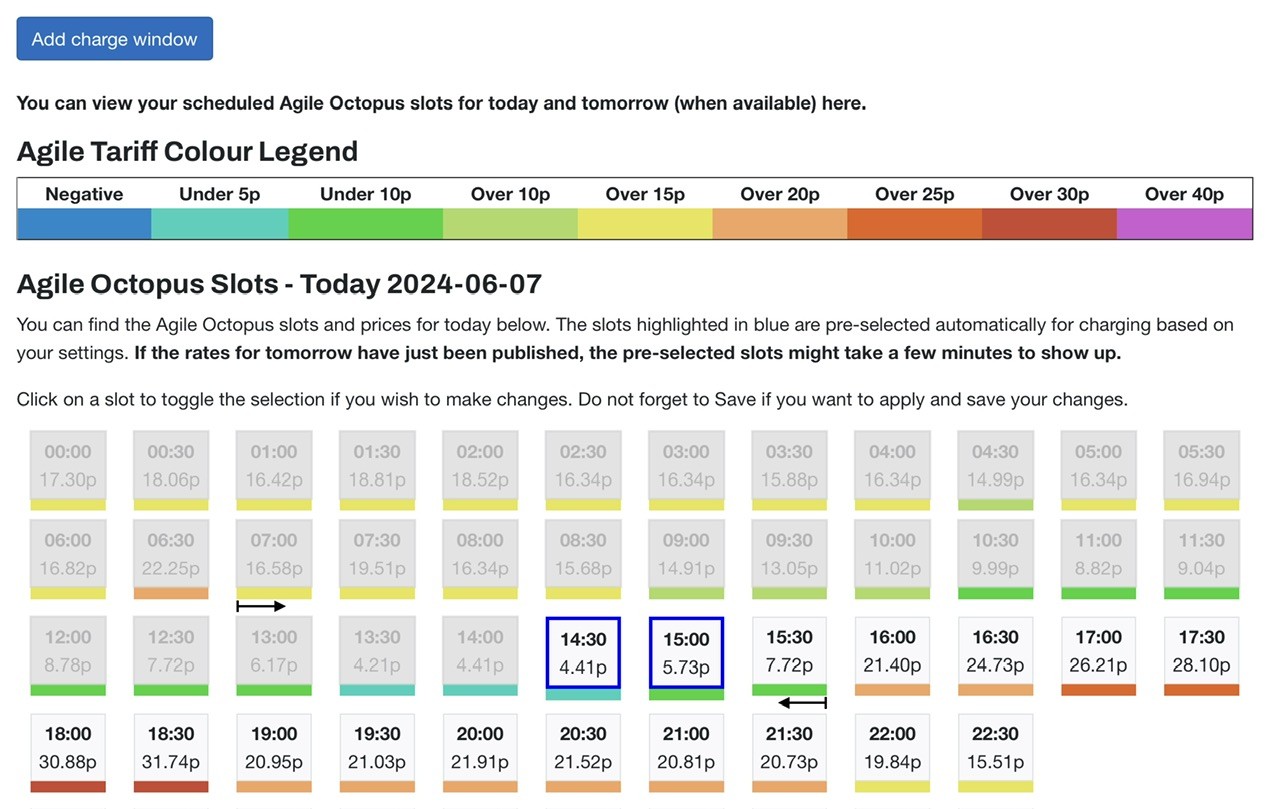
here’s today’s rates, 1:30 being exceptionally cheap

T
#119 TX200

Charged at full pelt 1000-1140hrs for me. Now 100%

Wasn’t much sun (raining now too)

H
#120 Hopeful

TX200 Yes I have a full pelt charge then too, all rather unnecessary. I'd like to think there is some logic to it but if there is it looks to me like it can only be OE testing out strategies for grid management

T
#121 TX200

And we're back to 100% overnight charge?

H
#122 Hopeful

TX200 Yup! 2-4am full pelt

T
#123 TX200

I like the idea of charging when the grid is quiet, good for the country

However I'm not keen on full rate charges, would prefer it to be a bit slower. That said I'm not sure if it's more efficient at a higher rate?

And if it's going to be sunny, I'd prefer at least half of the charge to come from solar.

As a DC system it's less lossy that way.

Plus if it's sunny, surely they don't need what I'm generating, or at least don't need all of it?

T
#125 TimHutchings

TX200 It would be nice to think that Octopus have their customers best interests at heart, but it's a business looking to maximise profit wherever it can. Of course, they need to keep their customers onside and they give a good return with competitive pricing on IOF overall, but I expect they rather hope that as you've decided to hand control of your system to them, you won't look too closely at their methods and operation, as it's a set and forget tariff!
It's very difficult to know the intricacies of trading in the Energy market, the movement and timing of money flows in and out of their business and the servicing and payment of debt interest. All these things may require selling of energy into the market to generate income which might explain why batteries get charged at odd times to satisfy those requirements.
I wouldn't worry too much about the whys and wherefores if you've given up control, but just be happy that overall you're probably on one of the best tariffs.
You'll find out in 6-12 months! šŸ˜‚

H
#126 Hopeful

TimHutchings I'd like to think its that clever, but reality seems a little more sledgehammer. I agree with TX200 that full charge isnt my preferred option as it stresses everything and generates extra heat in the AIO. If I wasnt export capped I would probably care less about when the charging is done but not leaving some room for daytime charging, which was its original approach and described in the FAQ at the time, is less than ideal for my needs. Whether capping vs less pennies for export is worse I doubt I would ever be able to work out though!

G
#127 geoffreycoan

Tim and Kat’s green walk has just published a video on their May performance on IOF and whether it was the best choice https://youtu.be/jMa4SF5Ukls

Spoiler alert, yes, by about £10

I have a much higher generation:consumption ratio than Tim so his model and some load shift fiddling in OctoPrice indicates it could be a lot better for me. Oh decisions, decisions.

D
#128 DD

geoffreycoan I did have a quick look through - did he actually produce a breakdown of daytime and peak-rate imports and exports ? I didn't immediately see those anywhere, just total generation, consumption, import and export.

#129 PianSom

geoffreycoan
Interesting. As someone with a relatively large battery (AIO) who works it hard (Predbat) his conclusion would seem to be - what I am best doing is what I do on IOG. Nice to have that confirmed.

Of course, his analysis excludes something you and I both make heavy use of - Power-ups. Do you know how they interact with IOF? They should figure in your decision making, no?

T
#130 TX200

PianSom if IOF logic includes power ups, would make sense for it to adjust it's plans.

After all, they want that energy used if it's spare.

I'd guess that perhaps it's not integrated yet. Just a guess though. I'm not lucky enough to live in a power up area.

H
#131 Hopeful

DD I think the difficulty with comparisons of actual usage and export can be difficult as your behaviour will change depending on tariff and the pros/cons of how and when. For IOF it makes little sense to use your battery other than for exporting or using in the 4-7pm peak. Any other time its cheaper to use the grid as no losses. Of course IOF doesnt quite work like that and seems to have a "post 7pm you should have 20%". It will either export more or charge your battery post 7pm until its 20%. And just lately, during 4-7pm, it appears to have forgotten about switching to ECO when it stops discharging. It definitely seems to have got less intelligent!

D
#132 DD

Hopeful I think the difficulty with comparisons of actual usage and export can be difficult as your behaviour will change depending on tariff and the pros/cons of how and when.

Agreed. Which was why it would be useful to see a more detailed breakdown of Tim's figures, to see where the numbers came from

For IOF it makes little sense to use your battery other than for exporting or using in the 4-7pm peak.

Err... that might be the consumer's optimal strategy, but it's Octopus that gets to choose how the battery is used, and their optimal strategy might be entirely different.

H
#133 Hopeful

DD IOF spends most of its time with your battery paused and I only ever saw ECO during 4-7 which was logical. Until the overnight charging started I was pretty happy with how it performed, this month not so much!

G
#134 geoffreycoan

Been trying to do some rough figures to work out the benefits of IOF for me. My Generation:Consumption ratio for May was 2.64 which by Tim’s rough estimator would firmly put me on the side of IOF being the best tariff.

In May we imported 230kWh, exported 1049 for a total consumption (inv VAT, excluding standing charge) of -Ā£135.

Looking at my predbat prediction we use about 8kWh a day from when the sun goes down to when solar exceeds load in the morning. This would be all imported @ 22p, so (8x0.22x30) = £53 for the month
The rest of the daily consumption would be met from solar generation.

Assuming 2 hours of peak rate export, 30p at 2.4kWh = 2x2.4-0.3030 = -Ā£44
(deliberately chosen 2 hours to allow for some peak rate discharge being used in the home and Octopus not always doing a full peak period discharge)
The remaining solar generation would be exported at the 22p rate, so 1049-(2x2.4*30)=905x-0.22 = -Ā£199

Standing charge is 10p higher on IOF than my Agile Feb 23 rate so £3 a month different, but even taking that into account the total is around -£187 for May which is a decent improvement over -£135.

Not sure how VAT changes things as VAT is charged on import but not export?

PianSom you made the point about Power up events. I suspect IOF doesn’t know about these and so unless there is the ability to turn off IOF that the FAQ’s say you can do (in the app), you can’t take benefit of them.
In the winter I was doing about 15% of my total monthly import for free with the power up events. In May it was about half that.

Minor point that if I did change to IOF and then back to Agile for next winter I’d be on the new agile tariff which has a 10p daily higher standing charge than the one I’m currently on (fixed to Feb ā€˜25).

The other wrinkle I can see is that I have two inverters. In the IOF FAQ’s it says that they can only control one battery (I think they mean inverter) and I’d have to control the other myself. Potentially this could be an opportunity as I could control the other battery to do what I want whilst still getting the IOF tariff.

Based on these envelope calculations I am feeling as if I should make the IOF leap. Interested in others’ thoughts

D
#135 Daveb01

geoffreycoan

As you know this is a huge debate at the moment and it is different for everyone.

The current thought at the moment is Agile, GO etc during the winter and flux etc in the summer. Which is a good assumption when these tariffs came out but it is hard to dispute that thought once it is out there. I was thinking the exact same as you (as above).

BTW - Gary does a solar is hinting on Intelligent Agile maybe coming soon?

However I was also thinking about a year not per month. And where to start with that thought. Do I go with minimum import try to cover the standing charge as well (would that make me happy - zero electricity charge). Or would I like to see if I can pay of the outlay for the installation quicker. The money I paid for the install was from savings so don’t really need to get it back, NO bill for a year seems the best option (anything extra is a bonus but not worth doing a math degree to see 9f it working in the future)

I am letting Gary and Tim do the work and see what they say.

I got my system installed in August 2023 and have been on Flux since then, I have recently moved to Agile and fixed 15p export. So will be sticking with that until next summer. I can then do a compare from my own experience of Flux v Agile.

Something else I have noticed is that no one is considering, is the facts being shown on the Octopus app. E.g I had a credit of Ā£500 before my install last year, I was paying Ā£173 a month, I am now paying Ā£5 a month and my credit is now Ā£585, I get free coffee’s, days out at the National Trust, cinema tickets etc etc. so in other words free electricity plus extras. šŸ˜€šŸ‘šŸ˜€šŸ‘

If one tariff works then I would like to stick with it rather than swapping twice a year.

D
#136 DD

Daveb01 BTW - Gary does a solar is hinting on Intelligent Agile maybe coming soon?

I saw that, but didn't really know what he was getting at. AFAIK it was pure speculation, and it would surely require that Octopus take control over some hardware, but what hardware would that be? IOF already controls a battery system.

Unless it be able to control multiple devices under one tariff (home battery + car + heat pump - whatever you have).

T
#137 TX200

Hopeful I don't think I've ever seen mine change to eco during 4-7 even when it's not exporting.

The get back to 20% could be useful for those with EPS. Although maybe that could be a user decision (or even if EPS enabled, do X, else do Y).

The octopus faqs state it'll charge when cheap and discharge when the rates are high. Of course they could change those faqs.

T
#138 TX200

DD yeah, complete speculation I believe.

That said, maybe there is an opportunity for it.

IOF could be as it is now, two rates, equal prices aka almost net metering

Intelligent Agile could be automated charging and automated exporting at live "market rates" (e.g. agile import and agile export)?

D
#139 Daveb01

TX200

Tim said that’s already not happening as his experience is it stops at 18:30 - 19:00 in his video, then exports again later in the evening. He asked Octopus to export for the whole 4-7 and export later if there was any battery left. Think it’s about the grid and possibly Money to Octopus. Don’t think they would like it if they just paid anyone on IOF, how would they make any money? (Conspiracy theory I can here myself saying now) šŸ˜€

D
#140 Daveb01

DD

I agree (did not think of that). Once everyone has a heat pump &/or EV then these tariffs where Octopus take charge may not work, it was only designed for Solar and Battery?

D
#141 DD

TX200 Intelligent Agile could be automated charging and automated exporting at live "market rates" (e.g. agile import and agile export)?

The agile rates get published 24 hours in advance. But I guess if they are controlling the system, they can actually based it on the live prices. Which might give them a little bit of leverage, but if you are paying/paid the published agile prices, it's still possible that any deviation they exploit is to their advantage, not yours.

T
#142 TimHutchings

Can I ask someone on IOF how often the battery gets filled by the grid compared to being filled by solar.
The reason I ask is the hidden costs. IOF has a matched import/export price supposedly, but obviously Octopus are looking to fill your battery to export at a later time. I know my inverter and battery, with the old firmware, lost just shy of 20% on conversions in and out using the grid, and as someone mentioned earlier, of course you pay VAT at 5% on grid imports, so that would add another 2.5% to those losses. Matched import/export prices on IOF therefore really aren't matched are they, unless I'm reading it all wrong, and the 5% VAT on grid imports for house use when the battery is paused and there's no solar or at night, also leads to unmatched imports and exports.
Just thinking out loud really!

G
#143 geoffreycoan

Daveb01 The current thought at the moment is Agile, GO etc during the winter and flux etc in the summer. Which is a good assumption when these tariffs came out but it is hard to dispute that thought once it is out there. I was thinking the exact same as you (as above).

I moved to Octopus and Flux last summer and was happy with the income and negative bills but moved to Agile+fixed export in October as we have a heat pump and Agile was going to be the cheapest way of buying the high consumption from the heat pump. Through the winter this proved to be the right choice, cost about half what it would have done on Flux.
In the summer though the question was whether to go back to Flux again. The 15p fixed export is almost the same as the Flux daytime export so the upside would be the higher peak export rates, the downside the higher overnight import (and the higher standing charge on Flux). Did some man-maths calculations and estimated Flux would be marginal benefit so decided to stick to Agile for this summer.

Looking more deeply at IOF though I am wondering whether I should change or not. I have Home Assistant and predbat automation so I am already getting really good battery optimisation on Agile, its whether handing over to Octopus will give me a better outcome.
Like you I’ve paid for the solar out of savings, so there’s an interest in working out what the notional payback period is, but I’m not looking to make money out of it. My aim is to get to a net zero Ā£ annual consumption bill. At the moment I’m Ā£600 in credit with Octopus and have dropped the direct debit from Ā£100 to Ā£1 a month. In the winter with the heat pump on I use Ā£200-250 a month so need good summer generation to balance the books.

T
#144 TX200

TimHutchings I think the price is including vat for import matched to excluding vat for export, but agree with the losses.

Before spring kicked in, my battery charged to 60% overnight and then during the day it did a slow timed charge - so if it was sunny it was all from solar, sun goes in, all from grid, no sun, all from grid. Think it was around 500W charge rate.

Post spring no overnight charge and an 800 W timed charge in the day again mix of grid and solar depending on the conditions.

These times charges start and stop through the day.

More recently I've seen the timed charge back off if the sun goes in. Not always, but sometimes I see the times charge rate step down closely matching the PV rate's step down.

And even more recently, mostly back to overnight grid charge to 100% 🫤 (as mentioned by many above!)

#145 hoggy

TimHutchings up until about a week ago it didn't ac charge at all overnight (although it did do it on and off when I was on it last year)
Overnight now it seems to keep charging to 100% however I'm now wondering if this is related to the app changes in regards 'modes' now working differently. Maybe the API now works differently (although the app does use a secret 'mobile api' that has extra features like quick settings etc...)

T
#146 TX200

TX200 "times charge" above should have said "timed charge"!

T
#147 TX200

hoggy I don't reckon the GE changes and Octopus 100% charge is related

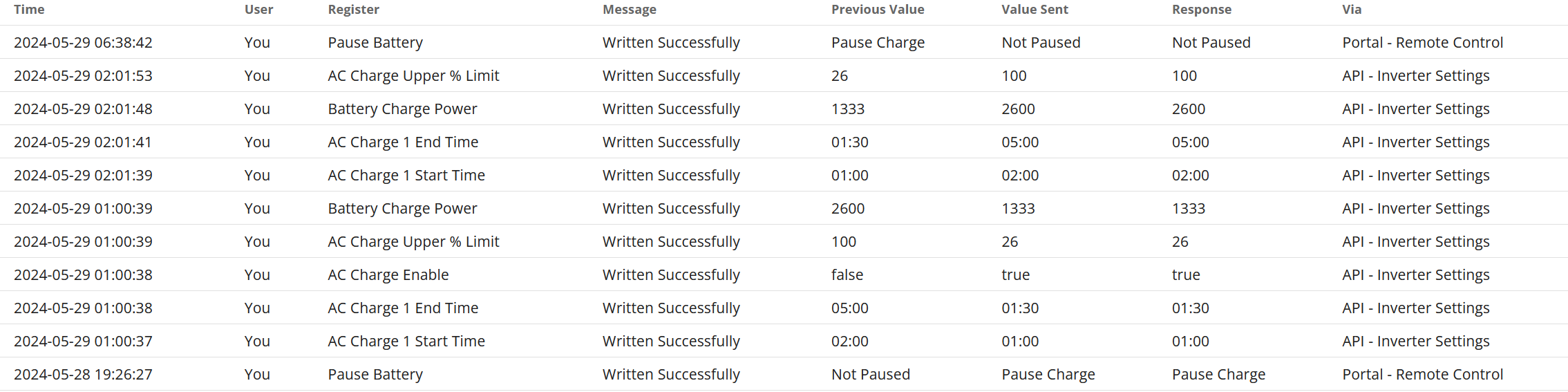
It just uses a timed charge overnight, and to me it looks pretty deliberate in the logs.

Okay so if they used a two digit code to say what mode what rate what etc (and the codes had changed), maybe, but then I'd expect to not see the full set of commands (e.g. start and stop times, rate, percentage target, enabled)

#148 hoggy

TX200 yeah ill be honest I barely look at the system anymore (contrary to what people think the novelty does eventually wear off on nannying it constantly after nearly 4 years) but yes from your screenshot that does appear pretty much intentional.

T
#149 TX200

hoggy I rarely look at the portal or GE app these days too. Whenever I go into the portal there's usually a red dot, oh look a few over voltage alerts over the last month or so!

The only way I know things are happening is home assistant notifications. I've got one when the temperature gets a bit high (must be a full rate charge or discharge!), plus 4pm and 7pm notifications that tell me the SoC, the generation so far and the export so far. Plus another at sunset which tells me the day's generation total.

D
#150 DD

TX200 Okay so if they used a two digit code to say what mode what rate what etc (and the codes had changed), maybe, but then I'd expect to not see the full set of commands (e.g. start and stop times, rate, percentage target, enabled)

The API has a command set called "presets" which I've never used, but I think they're sort of macros for changing groups of related settings. (Perhaps these are used for the app quick settings?). Maybe if there's a preset for timed-discharge, that might have changed, but the usual API settings just address individual inverter registers, and those probably haven't changed behaviour.
The changes to the modes seems to be entirely at the UI presentation layer.

T
#151 TimHutchings

TX200 Thanks for your reply. Having now checked, you're right that the IOF import prices do include VAT. Hadn't noticed that before. Thanks again.

Import	Export

Off-peak rate 22.73p / kWh 22.73p / kWh
Peak rate 30.31p / kWh 30.31p / kWh
Standing charge 47.85p / day
Import prices include VAT.

I'll stick with Flux this year, but I may well give IOF a try next year.

G
#152 geoffreycoan

TimHutchings Thanks, that’s good to see it confirmed, I couldn’t see it explicit on the Octopus website.

So import and export prices you pay/receive are matched, its only the ā€˜effective price’ including losses that’s got a 10-20% spread

It seems there a few people on here now using IOF and whilst there is some weird behaviour at times, no-one is saying that it’s absolutely awful. So like Agile you have to accept some rough with the smooth on how the battery is managed and what you pay. It’s just a pity you can’t turn IOF off for limited periods as it says in the FAQ’s you can do.

T
#153 TimHutchings

geoffreycoan So what are you going to do Geoffrey? šŸ¤”
Are you going to stick with Agile or move to IOF? I've debated with myself the pros and cons, but it's never a simple choice as there's so many variables. Last year on Flux, I covered all electric import, gas, standing charges and VAT, plus £125 profit (without saving sessions), and I was really pleased with that! This year with reduced prices and higher standing charges, I was still hoping to at least be energy cost neutral, and so far it all looks positive.
But reading what others say and the fact that my solar generation divided by my consumption for May is 4.21 (657kw:156kw), IOF may well be be a lot better for me financially with Octopus pouring money into my account, with the added advantage that I can forget all about my solar, checking the weather etc and get my life back. šŸ˜‚šŸ˜‚

G
#154 geoffreycoan

TimHutchings my solar generation divided by my consumption for May is 4.21 (657kw:156kw), IOF may well be be a lot better for me financially

Cor that is super-low consumption Tim. I thought I was doing all right with a 2.64 ratio of generation to consumption (1391kWh : 479kWh), but your 5kWh a day blows mine out of the park. I guess if you have gas for cooking and hot water/heating, it’ll be lower than my electricity-only figures. [I had to go and look; we used 49kWh for the ASHP hot water and 30kWh for the cooker, so adjusting those off we’re more like 400kWh for fridge, lights, sockets, etc; still an order of magnitude higher than yours].

I’m still sitting on the fence although leaning to IOF. Modelling of load shifting I did in OctoPrice suggests it’d be much more profitable on IOF. I’d like to see a Gary does Solar update on his IOF experience, but if I don’t get any negative vibes from there or this forum I think I’ll be jumping in - I suspect it’ll be a challenge to enrol given I have two inverters on my account and IOF can only control one.

M
#155 MrNCFC71

TX200 Just curious have you checked with the filter errors option off? I checked mine and it looked the same as yours but as soon as i flicked the filter errors option to off I have had lots of inverter timeout messages....

T
#156 TX200

MrNCFC71 yeah, lots of inverter timeouts for battery reserve % (might be something GE removed, cut off defo removed if I remember correctly, but not sure if that is cut off or just reserve).

Some errors against set eco mode, set DC discharge mode. But everything else including timed charge is working fine. So they are deliberately doing a timed charge (including changing the percentage and start/end times), but can't control eco/DC modes as far as I can see.

T
#157 TX200

MrNCFC71 and I've just looked at page 1000, 1500 and 2000 in the logs - similar errors seen. So the timeouts have been there for months. Maybe HA getting in the way sometimes (it's on a 30 second loop).

T
#158 TimHutchings

geoffreycoan It was a mild spring, so we hardly used the A2A heat pump in May. Plus we were away for 4 days. It's only a 1994, 2 bed linked detached bungalow (connected by a garage) and open plan which is why the A2A works so well, especially with 15 inches of loft insulation. We moved back in covid times to Essex from Wales three years ago (after 15 years) from a modern 5 bed place in the country that had oil heating. Miss the countryside, and the property size but have got used to the downsizing now. It's all we need really, and actually in truth it's probably about the size of the space we did actually use in the bigger property.
We spent a lot doing the bungalow up, and replaced the old combi boiler with a new condensing one before I thought about solar. We cook with an induction hob and air fryer mainly using the electric oven occasionally and bought a 2.2kw kettle to keep from importing with the gen1 inverter when we had solar fitted. So the gas combi is now only used for hot water and showers, and average around 6-7kwh of gas per day throughout the year. Electric consumption is usually around 6 kwh per day in the summer, with around a further 8 ish kwh in the depths of winter using the A2A heating set to 20c. Overall electric consumption (including heating) according to GE for 2023 was 2754kwh which surprised me to be honest.
Anyhow, I'll probably give IOF a go from next March to see how it compares with std Flux through the summer. Last winter Cosy way easy to use but I might try Agile like you, if I can be bothered to get even more involved, though Wonderwatt may be the answer there.

T
#159 TX200

So, last few days,
Didn't charge overnight
Charged to 100% overnight
Didn't charge overnight

H
#160 Hopeful

Charged to 36% last night, maybe all the exporting I have been doing during the day has reminded them I have solar!

T
#161 Toki

Same as you Hopeful 36% last night. I've emailed OE and awaiting technical people reviewing and coming back to me to see what's going on. It all seems a deliberate action due to the changes of timings to charge overnight.

C
#162 CW

TX200 I think the price is including vat for import matched to excluding vat for export, but agree with the losses.

That would make sense - only VAT registered business can charge VAT and then only for services they provide for that business (i.e. even if you as a sole trader were VAT registered you wouldn't be able to charge VAT on electricity export unless that was your business!)

D
#163 Daveb01

geoffreycoan

I am sitting on the fence as well, but it’s not 50/50 so will prob stick with Agile. A few reasons really. Last year I was on Flux this on Agile, so a good compare as I was controlling everything. I have also switched to not charging overnight even if the next day is raining. This is because on agile there is normally a good rate during the day if I need it plus lower rate than over night. Charge slots get auto cancelled if not needed. I then export after 20:00 down to 50/60% ish depending on rain the next day. So far no import cost, plus battery is normally full by 10 ish, so exporting Solar till 20:00 ish on a good day.

I will look at the intelligent tariffs next year after Tim & Gary have there say, plus comments from you guys. I am not in it for the money just to say I am happy plus no cost for energy is good šŸ‘šŸ˜€šŸŗ, this would also include if most say Octopus intelligent are doing a good job and I don’t have to look at my system at 5pm ish to check the Agile rate (not a negative slot) most days.

T
#164 TX200

As much as it annoys me (overnight charge and fast charge), it's still making me money

June, so far, electric bill is -Ā£10

G
#165 geoffreycoan

TX200 June, so far, electric bill is -Ā£10

By comparison, my June consumption and export so far (ex VAT and standing charge) on Agile+15p export is -Ā£35, but I do have 14.4kW of panels so that will be a chunk of the difference.

@Daveb01 I’m using predbat and it’s only charging overnight when import rates are below about 13p. During the day there’s so much solar that it’s almost all solar charging, even when the rates go very low, I’m still generating enough to fill the batteries up at near full whack. Tomorrow for instance the agile rate prediction is -3 or -4p in the morning but I’ll be generating 3kW every half hour across the 3 arrays so I can’t take advantage of the negative import rate ā˜¹ļø.

It’s my high export capability in summer that makes me reconsider IOF, to take advantage of the better export rates it offers.

Flux day-time export is near the same as 15p fixed export. Flux peak time export is good but its only 10p better than the day-time export. Its not worth discharging the battery for that as for every kWh I discharge in peak I would have to replace that either with overnight Flux import (@15p), or day-time solar recharge (which loses out on the 15p export I would otherwise get). So the only upside of Flux over Agile is the 10p export premium of excess solar in the peak period and the downside being the import rates.

S
#166 SJB

TX200 overnight charge

That's the compelling reason for me not to move to OIF. I can believe that I would be better off on OIF (even losing 5-6kWh as day from clipping that I mitigate through battery charging) but the frustration of seeing it import unnecessarily or not export at the peak rate would drive me mad.

Total import this month 0.33kWh export 144.5kWh, cost -Ā£23.64.

L
#167 Leeshore

One of the things about IOF is that (eventually) I hope I will stop looking at my GivEnergy/HA graphs etc as much. If you think about what your time costs even if agile saves £30 in a month compared with IOF I think IOF would be worth it.

T
#168 TimHutchings

TX200 Acording to the Octopus app, the first 6 days of June I've exported £21.32 and imported 17p on std Flux. That's 98.4 kwh export and 0.67 kwh import.
Maybe I've had more sun! 😊

T
#169 TX200

My battery is currently on a timed export 10am to 10.30am after doing a charge this morning.

Goes against the FAQ entry re we'll charge your battery when the rate is low and discharge it when the rate is high. 🫤

G
#170 geoffreycoan

TX200 The Octopus FAQ’s are vague though as to ā€˜which rate’ they are referring to. Some of the behaviours people are reporting here show me that Octopus are looking more broadly at the underlying energy rates, not their IOF rates. Agile (and hence market rates) are low today, 0.36p at 10:30, dropping to negative for most of the day so I bet Octopus are emptying your battery to refill it later on when there is excess solar in the grid.

T
#171 TX200

Who's price! Mine or theirs?

This one is more clear though! Very much sounds like they shouldn't be discharging outside of 4-7pm based on that faq item.

G
#172 geoffreycoan

TX200 I dunno, I think the second is just as unclear.

ā€œYour battery will charge up using the greenest and cheapest energy - some of this will come from solar and some from the gridā€ - suggests that as long as it’s green and cheap, it can be any time they charge.

And unless Octopus is using a solar forecast for your address and monitoring the power output and house load of your inverter, they won’t know for sure whether there is excess solar.

And finally, the ā€œmatched import and export rates means your bill will be unaffectedā€ is as previously mentioned loose wording, it ignores battery charge and discharges losses.

All in all, words written by the marketing department not with an eye for precision and total accuracy ….

T
#173 TX200

geoffreycoan I don’t mind it charging from a mix of off peak grid and solar.

It’s the off peak discharging I want them to stop.

They can monitor the export, as I have seen charging rate step up when solar generation steps up, both matching each other, step by step (and same with step down). Doesn’t always do that, but have seen it.,

D
#174 Daveb01

Perhaps this explains why they may do it. Looking at the price after 7pm still seems high, so they may export 4-6:30 say then for 30 mins later? Say at 21:30. All theory šŸ‘šŸ˜€

These are my Agile prices so you guys can compare?

S
#175 Socdoc

I’ve been trying to get a better idea of what IOF should be doing but getting very little real information. My system is now charging overnight from the grid to 73% (although set to 100% it never gets there as it’s turned off too soon) where it sit all day, exporting all Solar to the grid rather than filling up the battery so when we get to peak it’s only exporting 53% of the battery capacity (of 9.5KWh) so significantly reducing the potential earning power daily. My numerous emails to the OE team to get an explanation / provide feedback on their beta system remain ineffective.

S
#176 Socdoc

geoffreycoan mine isn’t charging from solar at all currently, the API turns off battery charging at 5am and then doesn’t allow it to use solar even though it’s only getting yo 73%

G
#177 geoffreycoan

Socdoc Interesting. I guess if you get paid the same for export as you pay for non-peak import, then as long as the battery is charged enough to see you through the peak, its actually more beneficial to export than charge then discharge the battery (exporting only incurs DC to AC losses whereas using the battery incurs charging loss, discharging loss and DC to AC loss).

I have bitten the bullet and applied to join IOF a week ago. Stuck at the moment in the enrolment process. I get the Octopus security token created in my GivEnergy account OK but then Octopus says ā€˜an error has occurred’.
I don’t have 2FA turned on.
GivEnergy have tried resetting my inverter (https://community.givenergy.cloud/d/4267-intelligent-flux-sign-up-issues/7) which didn’t solve the issue. A day and a half later I realised that they have turned off my meters (https://community.givenergy.cloud/d/4604-no-grid-import-or-export-inverter-ct-clamp-config-issue) so the inverters can’t detect whether there is any import or export going on. Eco mode doesn’t work very well like this … 😔

For me the high export rates with IOF make it worthwhile using it for the summer, even regardless of what use Octopus make of my battery or not.

T
#178 TX200

I spotted two other occurrences of the inverter discharging during off peak
E.g. overnight charge, followed by 30 minutes discharge overnight, followed by more charging.

Obviously this goes against their FAQs (unless you read it as being "when the rate is high" for octopus Vs the customer!

Octopus have assigned my ticket to a specialist to have a look. I sent in the report via the octopus app, think it's the smart team.

T
#179 Toki

TX200

I've done the same and after chasing up, I got a reply yesterday "technical experts are actively investigating this issue and working towards a resolution." but can't give a timeframe.

D
#180 Daveb01

Did you guys have an export this morning as the rate was quite high from 07:00 on Agile, so guessing the grid supply may have been high?

G
#181 GeeCee

Wow! What a knowledgeable forum. Very happy that I've joined it. I've been pursuing Octopus with what I thought were relatively straightforward questions. I can see from the above that nothing is straightforward, and that particularly Octopus T&C are written to allow them to do what they like with my All-In-One Battery and GivEnergy Gateway. However ... here's my latest message to them, and my follow-up to their reply (which said nothing). I'd be grateful for any thoughts any of you might have

_Hi Octopus team, re. Intelligent Octopus Flux,

I’m wondering why my battery is being charged from the grid at c6:00am, rather than using generation from the solar through the day in the summer months.

Also why the battery only seems to be operating in a limited range between c.55% and c.75% when before on Flux Import I was setting the Battery to discharge down to 4% in the high import tariff period and charge to 100% in the low tariff period.

It would appear that my battery is not being used at all to supply electricity to the house - only as a source of power for the grid in the high export tariff period, which I could partly understand if it was being charged up to 100%.

I would be really grateful for an explanation of how the algorithm works, and also some insight into whether it is better to use this tariff only in the ā€œsummerā€ months and revert to Flux Import/Export in the winter months and manage the battery as referred to above._

My follow-up ...

_Thanks for your reply. I feel it hasn’t however answered the specific questions I was asking:

1) why is the battery being charged from the grid, when it could be being charged from solar? Currently sun is shining, battery stuck on 77% after being charged from the grid at c.5:00am.

2) why 77% max, when if charged to 100% it could discharge more to the grid during the high export tariff period?

3) linked to above - why only discharging to 55%? As the import and export tariffs are the same there is no requirement to keep battery capacity at 55% after 7:00pm?

Currently my battery seems to be doing very little apart from discharging a relatively small amount to the grid during the peak tariff period.

I’d be grateful if you could forward this on to Technical Support, as your reply suggested._

I know there's a lot of text above, but any input for a "newbie" would be welcome.

D
#182 DD

GeeCee Welcome to the forum.

I wonder if it's related to the fact that we are near the longest (daylight) day. If there's plenty of energy around in the late afternoon, perhaps they don't really need your energy at the moment.

Looking at https://www.carbonintensity.org.uk/#graphs the peak in carbon intensity isn't until about 9pm. (Perhaps the peak rate ought to move around from season to season, rather than always being 4-7 ?)

It would be interesting to know if there are regional differences to the way Octopus use batteries. Different regions tend to have different carbon intensities. Perhaps Octopus make more use of domestic batteries in the less green regions.

G
#183 geoffreycoan

GeeCee It would appear that my battery is not being used at all to supply electricity to the house - only as a source of power for the grid in the high export tariff period, which I could partly understand if it was being charged up to 100%.

Welcome to the forum GeeCee. I can’t give any thoughts on why IOF is operating in such a narrow range, but I think I can answer why the battery is not being used to supply electricity to the house - its because that’s actually cheaper and more efficient for you to do so (slightly).

It’s all due to conversion losses. There’s losses in the inverter when DC current is changed to AC and vice versa, and there’s losses in the battery when charging or discharging. Estimates as to those losses in this forum vary but are generally in the range 10-20% round trip.

As IOF has the same rate for import for export the extent to which the battery now depends on these losses.

To keep the math simple lets assume 5% for each of these losses and its a hybrid inverter. An AC coupled inverter will incur more losses when charging the battery as the Solar inverter converts DC to AC and then its converted back again to charge the battery.

If you charge 1kW of solar into the battery it will incur the 5% battery charging loss so 1kW of solar results in 950W of battery storage. If you then use that to power the house you will incur battery discharge loss (5%) and DC to AC loss (5%) so your 950W of stored power will result in 950-45-45=860W of home electricity.
So to achieve 1kW of home demand from the battery you’ll actually need to have generated 1/0.860 = 1.16kW of solar

If instead you export the 1.16kW of solar you will get 1.16*0.95 = 1.1kW of export payment after DC to AC 5% conversion loss. Later on you import 1kW for home demand (no losses) but as you’ve already exported 1.1kW at the same rate you’ll not pay anything for the 1kW of import AND you’ll be in credit (i.e. profit) to the tune of 0.1kW.

[Hope this makes sense, I’ve read it twice and think I have explained it correctly šŸ¤”]

G
#184 GeeCee

geoffreycoan Yes, I can see the argument re. conversion issue. The advice just given from Octopus is to de-authorise, then authorise the battery in the app as they stated they were having some difficulty in connecting to the battery.

I couldn’t find any facility to do this but did see Disconnect device, so assumed that was what was required. I now can’t Add the device (the battery) as it requires a QR code, but I’m not sure where that might be - any suggestions.

I’m really wishing I hadn’t done anything and continued in my semi-ignorance.

T
#185 TX200

GeeCee you need to use the original email to sign up I think. There's a link in it.

Alternatively if disconnecting has kicked you off the tariff, try switching back to intelligent flux and hopefully it'll send you the right email again.

R
#186 Rogerbu

I might be a bit nieve, but I am finding IOF does exactly want I want during the summer months.

Accepting that the grid is an infinite battery that has no losses (unlike my 19kWh AC battery's 20%).

IOF charges upto about 80% overnight using imports that are cheap to Octopus, then charges to 100% using solar during the day.

During the 16:00 to 19:00 it discharges to grid down to a limit of 54% that I have set.
The 54% limit is so that Octopus cannot continue to export after 19:00

Apart from ensuring that I limit energy usage during the 16-19:00 period, I have to do nothing.

Around October I expect to switch back to Intelligent Octopus Go as that is better for me.

T
#187 TX200

It mostly does what I want. It sometimes sits on eco paused between 4-4.30pm and a few other small slots. But in the summer that doesn't matter as I'm not drawing from the grid when it is sunny.

I'd prefer the battery to charge mostly from solar as having a DC hybrid it seems more efficient in my eyes.

L
#188 Leeshore

Rogerbu How do you set the battery limit?

G
#189 GeeCee

Some interesting suggestions. I still haven't been able to reconnect/authorise as I haven't received a response from Octopus yet. However ...

My understanding - and when experimenting with settings in the iOS app - is that on IOF you cede all settings to Octopus. I tried to change the battery options but they were changed back - presumably by Octopus. Eco is disabled - by Octopus. I can't change a charging time - but that doesn't make any difference I realise on the tariff as long as it's not 16:00 to 19:00, AND the charge of the battery NEVER goes above 77% and I NEVER get the battery charged from solar - only the grid.

So I await the response from Octopus Technical; and will let you know.

T
#190 TX200

Yep, that's what the deal is - octopus are in full control and you'll hopefully make a profit too!

Although if you're not generating enough to cover your consumption, then maybe not the best tariff. Think Tim (and Kat's Green walk) said 1.4x (generation Vs consumption) makes it worth him being on IOF.

R
#191 Rogerbu

Leeshore
In the GE App
Home Dashboard
Top settings gearwheel
Battery Options
Reserve- I watched octopus export from battery in the GE App and noted battery % at 19:00 - this was 54%. So I set the reserve at 54%. Forced export stops at 54% whatever Octopus does.

R
#192 Rogerbu

GeeCee
Octopus have the power to change the Reserve %, but so far (3 months) they have not done so.
All other battery options are regularly changed by Octopus, but not Reserve % (so far)

G
#193 GeeCee

I have received an incomplete reply, where they assure me they are connected to the battery and I’m on IOF. However Eco is still set on the GivEnergy app, and the battery charge option I set to 20% is unchanged. Will update as I have sought further explanation.

#194 Maxwell

GeeCee Not directly related to Octopus. But, i found recenlty when i started using timed export etc on the app and portal that there were times when there was a delay between me setting a value using the portal and then that change being visible in the app. Restarting the app mostly fixed that.

G
#195 geoffreycoan

GeeCee How long did your signup take you?

I've been waiting 2 and a half weeks now, get stuck at the authentication step, the GivEnergy security token gets created but then the Octopus app complains that something isn't right and stops. Last communication was almost a week ago, I gave them all my serial numbers and they said they were going to "force through the registration manually"

T
#196 TX200

For the first time in ages no overnight charge.

So I'm now wondering if there was an error overnight 😁

Will be interesting to see if it charges from solar instead.

D
#197 DD

TX200 So I'm now wondering if there was an error overnight

I was a little surprised to see that my car isn't due to charge until 10am. Looking at agile prices (and carbon intensity), it's been relatively expensive overnight, and prices tumbling over the day.

T
#198 TX200

DD maybe that's it. Intentional.

I prefer solar charge anyway.

Still at 25% SoC here so will see if it's charged at all by lunchtime.

T
#199 TX200

Aha just got an alert my inverter is getting warm. Yup, it's full pelt charging by octopus. At 90% soc.

V
#200 Vestas

TX200 Agile import rates are down to 1.6p soon so it makes sense for them to dump energy into your battery regardless of SoC.

D
#201 Daveb01

This is the Agile pricing for tomorrow, so look out for some weird charging discharging if it happens.

T
#202 TX200

Mine just charged overnight as usual.

Although it did do a little discharge to 79% at 0430hrs (from 91% at 0355hrs)

G
#203 GeeCee

Still no acceptable response. We’ve now got to the point where Octopus are telling me to do something with a Button in the App which doesn’t exist on my very recent iPhone. I’ve tried uninstalling and re-installing the app, but still the Button ā€œIntelligent Flexā€ doesn’t appear in my Account / Settings. They have offered compensation; they have assured me I’m still on the IOF tariff, but …

A
#204 Ange

GeeCee Hi GeeCee, another newbie here. And it seems like I've had a similar situation to yours. Our PV system was installed in April and it took about a month to get Octopus to switch me to IOF. I thought I understood how it was working and then around 6th June it started behaving very differently. Eventually after a few emails and a couple of phone calls I spoke to someone in the technical team (as opposed to the Customer Happiness team). They said they'd been having issues with IOF and advised me to disconnect and reconnect their connection with the battery. They walked me through this on the phone. Reconnection is well hidden in the app, but with their help it was easy.

A
#205 Ange

I've enjoyed reading the pros and cons and views here of IOF. My installers were really interested in how it works too, albeit a little bit sceptical! I'm happy to hand over control and by the looks of it the ££s should work in my favour. I was up £57 in May and £140 in June.
However we now also have an ASHP and I think we will probably need to switch tariffs for the Winter - more research to do!

G
#206 GeeCee

Ange Good to know you got a satisfactory resolution. I want to let members know that I’m very happy with our decision to switch to Octopus - after BG anything would be better, but I’m genuinely impressed by their willingness to engage with customers and overall the App and Dashboard are very good. But … this problem which started over a month ago is taking an awful long time to resolve. I’m going to follow up your suggestion of talking in person with someone today if I don’t get satisfaction from the email reply I’m hoping to get this morning - there appears to be a 48hr turnaround on emails even for open calls, that could be improved.

G
#207 GeeCee

Ange It becomes an obsession! The data driven home. I spent the winter monitoring usage and determined that Octopus Flux in the winter and IOF in the summer seemed the best strategy, and that a Heat Pump was not going to be the way forward for us, but that gradual replacement of rads with IR panels probably was. However … I have to get IOF working first!

D
#208 DD

I wonder if anyone is ready to report their results on how Octopus have been managing their battery, relative to what they would have done themselves on Flux. Has it had been as profitable as they'd hoped/predicted ?

D
#209 David Drage

DD That's what I'm trying to find out, do octopus actually take over the full operation of the battery.

#210 hoggy

I did my initial rundown of it here
Joined again in March but wasn't full month so discounted that one. April - May & May - June below.
Not as lucrative as had hoped but equally the weather here has been utterly appalling the entire time - very frustrating in an "old man yells at cloud" kind of way...

D
#211 David Drage

It is just paying for itself. Which is better than costing you money, but it would be nice to be enough to pay for any gas you use as well.

R
#212 Rbor

hoggy Interesting data.
I am on Agile and Outgoing fixed. I have solar panels, batteries and ASHP.
I have attached my import/export data for the same period 22nd April–21st June (from Octopus Watch reports).
My profit is £155.


Your overall export bonus is about £270 against my Agile bonus of about £250 so surprisingly similar. I am based in Yorkshire, so not the sunny south.
It is the import rates that are very different with my average about 10p per unit against over 20p per unit for IOF.

But our use cases will be different.
In the last year, I have been on Flux for 5 months, Cosy for 2 months (I have a ASHP) and Agile for 5 months.
So we are all chasing the Holy Grail of the best tariff. for each of us.
Agile is really good ... until it decides to go haywire.

Rob

G
#213 geoffreycoan

I applied to join IOF on 10th June so in 2 days time its the 1 month anniversary.

I go through the enrolment process, when it gets to connecting to my GivEnergy account it creates the security token OK but then says it fails with a generic ā€˜make sure your batteries are registered in the givenergy app and connected to the internet’ [Octopus terminology, they call the inverter and battery just ā€˜battery’]

Been in correspondence with Octopus via X since then, short version is they still have failed to onboard me. I only wanted the tariff for the better export rate, particularly in the day-time, and would go back to Agile for the winter.

Several things have been tried, upgrading the iPad/iPhone app, removing my Octopus R&D token, GivEnergy resetting the inverters from G99 to G98 and back again (resulted in them forgetting to turn the meters back on again so a weekend of the inverters not being able to detect house load properly), me giving them the inverter and battery serial numbers so they can manually onboard me, all to no avail.

The last response was on 29th June and pointed to me having multiple batteries (i.e. inverters) on my GivEnergy account:

Thanks so much for continuing to bear with us. We've had some updated information from our devs on two battery x two inverter set ups:

"Customers would need to "choose" which battery they would want to onboard and ensure each battery has it's own GivEnergy account + corresponding credentials."

Is this a conversation thats already occurred Giv Energy side? It does sound like we'll require for the system to be set onto separate accounts to be able to action the request, turns out its fairly uncommon in the products infancy to have multiple inverters in the same household set up. This is how to overcome this hurdle to get you onboarded.

In have pushed back on this, that having to have two accounts would be extremely difficult for me to monitor or control the inverters, reminding them about the previous offer from the developers to manually onboard me, and highlighting that in the IOF FAQ’s https://octopus.energy/intelligent-flux-faqs/ it states:

ā€œCan I connect more than one battery?

No, not yet. You can only have one battery connected to Intelligent Octopus Flux. If you have a second battery that isn’t linked with the other, then you will need to manually control it yourself.ā€

I highlighted that Octopus have identified multi inverter and battery installations as being a setup that users have and that I will need to manually control the second inverter and battery myself. Have repeatedly said I am fine with that.

So waiting for another reply back from Octopus but it looks like at the moment the twin inverters on one account is not something they can handle

#214 hoggy

Rbor I do run 2x EVs on it so I'm not complaining, I'm more mad about the weather to be honest as that 1 good week in May proved how good it can be if all things go well.
But yes it's a very hard tariff to compare to, as the mindset/profile of this tariff does take some getting used to.

Probably should point out for clarity:
6.1kW PV
1x Hy5 G1 Inverter with 6.5kWh usable (IOF control this one)
1x Hy5 G1 Inverter with 8.2kWh usable (self automated control)

The manual one does not force charge, merely hoovers up any PV and then dumps from 4pm-7pm until empty or time window ends, whichever is sooner.

G
#215 geoffreycoan

hoggy 1x Hy5 G1 Inverter with 6.5kWh usable (IOF control this one)
1x Hy5 G1 Inverter with 8.2kWh usable (self automated control)

Are you two inverters on the same GivEnergy account? Would help my argument with Octopus if they are and you have successfully onboarded just one of your inverters

#216 hoggy

geoffreycoan no sadly not, both seperate accounts and independent of one another (seperate meters etc)
I guess over at Octopus land they haven't got around the API deep enough to select just one inverter (or control more than one) - Similar to Intelligent Octopus, where they are still yet to be able to interface more than 1 vehicle.

G
#217 geoffreycoan

hoggy Thanks for clarifying. I’ve said that splitting my inverters across accounts isn’t an acceptable solution for me.
Adding ā€˜FOR x in INVERTER’ loops in the Octopus automations you wouldn’t think would be difficult. But if they can’t handle it I can live with it, as the FAQ’s say, I will have to control the second inverter myself. What’s frustrating is that the onboarding process barfs apparently when it finds the second inverter on the account, rather than just onboarding the first it finds.
Grr

#218 hoggy

Yes it is a bit of a weird oversight. I'm unsure how owners with an AIO and gateway on the same account fare. That too "appears" as two inverters even though the gateway doesn't do anything.
Those aspiring for multi AIO where the gateway does actually do something (and therefore it'll see 3 things on the account) are another avenue of mystery....

A
#219 Ange

Grrr, just when I thought my IOF was behaving as it should, I notice that yesterday it didn't export anything at all at the peak time and my battery is still sitting at 87% and not being used for either my consumption or to export. Anyone else had the same issue last couple of days?

G
#220 GeeCee

So ... I've just had a reply, but not a resolution, from Octopus who have done an examination of our account and determined that a) the connection to the battery is sound and working; b) there is no reason from their side that the battery shouldn't be being topped up beyond 77% from Solar - which currently it isn't, it stays frozen at 77% until it starts discharging at 16:00; c) that they don't discharge the battery below 20% with IOF - but it appears that export for us stops at c.50%; d) they charge the battery overnight to get it to c.75% (my 77%) - to allow for solar gain; so therefore they have advised me to contact GivEnergy to determine what's going wrong which I will do shortly when I have received an email from Octopus detailing what I've reported above.

G
#221 GeeCee

My final input to this topic/thread. I've decided after talking to our installer that Intelligent Octopus Flux is not for us. It appears to us that IOF whilst a "convenient" one-stop shop for both customer and energy provider, it does not allow the "intelligent" consumer to have any control of their battery. So ... I've asked Octopus to transfer us to Agile Octopus for Import, and Flexible Octopus for Export. This will enable us to maximise the use of the battery we have purchased to minimise the cost of the energy we consume, with a fixed price for the energy we export. Whether we change to Octopus Flux in the winter is a question for another day, but we're signing-off as far as IOF is concerned.

G
#222 geoffreycoan

GeeCee I've asked Octopus to transfer us to Agile Octopus for Import, and Flexible Octopus for Export

I’m still stuck waiting for Octopus to work out whether they can onboard me to IOF. I was only going for the improved export rate, but you’re right, it seems that you have to hand over complete control to Octopus and they do what they want to with your battery.

Good choice on going to Agile, I’ve been on it since last October and am very happy with it. Are you going to use something like Wonderwatt or Predbat to manage the schedule of charging your battery?

But, maybe it was a typo, but ā€œFlexible Octopus for Exportā€ - is this Agile Export or Octopus Fixed Export you are going to?
For most people the Agile Export tariff is not a great choice, whilst you can get a better export rate in the peak, for most of the time the export rate isn’t good and you would be better off on the Fixed Export 15p tariff. That’s what I’m on and most other Agile users are on.

G
#223 GeeCee

geoffreycoan Yes ... a mistype Octopus Fixed Export, and thanks for the suggestion of Wonderwatt and Predbat - I'll look into them, but I have to give a huge thumbs up to our installer who called in to see me today when I cc'd him into an email to GivEnergy on the issue. It was him that suggested what we are now going to do.

A
#224 Ange

GeeCee

What a coincidence. My installer also called in today. I've taken back control of the battery from Octopus and they've helped me set up my own discharging schedule. I'm still on IOF at the moment but I'll take a look at those other options you suggested.

G
#225 GeeCee

A very final, final contribution, but rather an important one ...

I was still having a few hiccoughs with Octopus/Givenergy on Tuesday and yesterday.

I discovered this morning - after some strange happenings with the inverter over the past couple of days when I changed the settings on the inverter only to find that they’d been either cancelled or changed to settings which hadn’t originated from me - that you need to Disconnect from Intelligent Octopus Flux personally, on the app, in my case on my iPhone/iPad.

I had assumed that this would happen when Octopus switched the tariffs over.

I was trying to setup charge periods, Eco mode, etc and they were continually being reset to weird settings … by IOF still having control of the battery.

So this morning decided to take the bull by the horns and do a software upgrade to the battery and inverter which I knew would recalibrate battery, and then (in passing whilst reviewing whether the tariffs were properly set) I discovered the IOF setting in the Octopus app on my iPhone was still on. This I’ve now disconnected, the battery ran down to 0% and is now re-charging and behaving exactly as I thought it should.

O
#226 Ortwin

My Gen2 5Kw and 2x 9.5Kw system is on IOF and I've noticed that the max charge for the batteries keeps reverting to 95% overnight. Both GE and OE blame the other for changing it from 100%. Anyone else had this issue?

D
#227 DD

Ortwin in the activity log at the bottom of the remote control page on the portal, does it record who made the change? (The API allows the agent to identify itself.)

O
#228 Ortwin

I've not delved into the API so can't tell. That would be a whole now ball game for me.

D
#229 DD

Ortwin but GE and octopus would be using the API, so changes should still get logged

G
#230 GeeCee

My experience of IOF is that the tariff is setup to be environmentally friendly, not customer friendly. That's a bit unkind, but true. You need to accept that in signing-up for IOF you are giving over total control of your battery to Octopus, so that they will manage it to store surplus energy - you become an extension of the National Grid effectively. Hence, no changes you ever make to your battery in the GivEnergy app or dashboard will be permanent. They will always be overwritten by Octopus if they sense they need to make use of your battery for storage.

This confused me for a long-time but it only made sense when I came off the tariff and moved to Agile, and my battery settings were still being overwritten. Hence my post above.

I'm certainly not against the idea of an environmentally friendly tariff, but I am against the idea that I can't set ALL the parameters on my battery. Hence my move to Agile Import - Fixed 12m Export, which by the way seems on a couple of weeks use, to make sense for the winter especially. I want to make maximum use of the solar for the house and the fixed (and lower) price for export is not so great a concern.

O
#231 Ortwin

DD I found the activity log and all the changes say you. Which must be because octopus are logged in to my account. Is it possible to give them a separate login so changes they make can be logged separately to me?

D
#232 DD

Ortwin one of the columns in the log records agent info. IIRC it records whether you used portal or app. When using the API, there's an optional field you can supply, and that gets recorded. I think wonderwatt use that, for example. I don't know whether octopus do.

eg
where the rightmost column is what made the change. I have various py scripts that use the api, and they supply their name as part of the request, for logging.

O
#233 Ortwin

Here is a screenshot of my remote control and it clearly shows the API - Inverter settings as making the change (no mention of who they were). I did get a reply from OE saying they would change my charge level to 100%, however I checked at 17:00 and it was back to ot 95%.

O
#235 Ortwin

Hi DD,
Many thanks for the suggestion, I will pass it on to OE and see if they will take it on board.

J
#236 JWsol

Hello, I have just tried intelligent flux, but after 1 month I switched back to the standard flux tariff.

Yes it increases your export, but it does this by disabling eco mode, so importing to charge the battery and run the house, with solar going directly to the grid, and discharging your battery to 20% every evening.

I currently run in eco mode, with my battery set charge to 40% at 0200. Doing this I draw nothing from the grid, as at 0200 in the morning the battery is aways above 40%. The charge limit may need adjusting in the winter. As you can not set an export dischzrge limit, I export for 30min in the peak time.

D
#237 DD

JWsol but it does this by disabling eco mode, so importing to charge the battery and run the house, with solar going directly to the grid

Which is a good thing: because import and export prices are matched, it's better for you to use the grid than to use your battery, which suffers round-trip losses. Except during peak rate, of course, when exporting from battery is still beneficial.

I'm on IOG rather than flux, but choose to import quite a lot overnight at cheap rate, then run with eco mode turned off on sunny days, so that solar is exported directly.

O
#238 Ortwin

I have sent the details of how to add a name to the Vai section to OE with the link provided by DD. Lets see what OE come up with.

T
#239 TX200

From Octopus:

"Regarding your Octopus Intelligent Flux battery, I understand your concern about it charging and discharging during the same off-peak period. Our Intelligent Flux tariff is designed to discharge your battery during peak times when electricity rates are high, helping you save money. However, there may be instances where the battery charges and discharges during the same off-peak period due to various factors such as energy demand and grid conditions."

I've suggested it that is the case they should update their FAQ entries to make it clearer!

This wasn't just a small 30 minute discharge either.

It charged to 100% off peak just before midnight (that's fine, it's off peak).

Then discharged to 40% just after midnight. Thus round trip loss due to the price to purchase and sell being the same.

Then charged back up to 70% and later 100%.

T
#240 Toki

TX200

I'm having similar issues. I've raised a complaint last night after getting nowhere since end of May with customer services who have acknowledged there's an issue and said it's with the technical team. I'll update on here when I get a response.

G
#241 geoffreycoan

I finally after about 2 months of waiting got a final reply from Octopus about the enrolment failure I was having with IOF.

In short, they don't support multiple inverters on the same GivEnergy account. I knew that from the FAQ's that say that they can only control one battery and I'd have to manually control the other, but it seems that this isn't the full story, their systems are setup to only expect a single inverter on the GivEnergy account and "its a high technical lift for a system to know which inverter to talk to and optimise them effectively. (Multi inverter accounts) aren't currently on our roadmap right now, (but) we'll aim to support this eventually"

Then blah blah about I could remain on Agile+Fixed Outgoing or I could change to Flux and IOF is a "product of our labs which is growing all the time"

The extra export income would have been nice but unless I split my two inverters onto two separate GivEnergy accounts, I can't go onto IOF.

D
#242 Daveb01

geoffreycoan

Thanks for the update, I was just about to say would it not be easier to get GE to split your accounts, this way you can have the array & inverter you want on the tariff you want.

So what would happen to the other array & inverter within Octopus?

G
#243 geoffreycoan

Daveb01 Thanks for the update, I was just about to say would it not be easier to get GE to split your accounts, this way you can have the array & inverter you want on the tariff you want.

The trouble with splitting the inverters across accounts would be that I’d have to logout and login to the two accounts on the app/portal to see the inverter status so it’d be a right pain to use. I suspect that splitting one inverter onto another account would lose all the generation history as well.
If I did it the non-IOF inverter I’d just manage myself manually or via predbat

Not worth it now given this was to be a summer tariff and I’d probably go back to Agile in September/October for the winter heat pump use.

D
#244 Daveb01

geoffreycoan

I agree it would be a pain. I have stuck with Agile and as you can see in my other post during the summer and not paid anything to Octopus since June this includes Electric, Gas and standing charge (they have paid me on average £100 a month). It make me feel much better.

It’s a shame the PW3 was not out when you got your system as that would have fitted very well. 3 strings, different options for import and export on the one inverter, 3.6 to 11 kWh.

I have seen a few grumbles about IOF, and don’t think it would be for me even if I got more than Ā£100 in profit. Good luck for the future and thank you for all the advice and help you have given people in this community.

#245 hoggy

geoffreycoan if it helps you can flick between accounts in the app without having to log in/out each time no bother. I have 3.

Y
#246 yuliascanlon

Daveb01 hi there, also new and currently on agile import and export. Why wouldn't you use Agile export please? still tinkering with my energy optimiser and Richard has been brilliant but not quite there yet with all my settings tbh.

D
#247 Daveb01

yuliascanlon

I looked into it and the average per day for Agile export is about 9p, so going for 15p fixed is a better option. Also you know where you are with regard to import and export. If you take into account the loss when charging and discharging the battery.

If on Agile export (9p) you need to charge below about 8p or 7p

If your on fixed (15p) I look at anything at about 12p or below (if I need to charge), at the moment I am using Solar. Except on days when it is negative or below 2p.

https://community.givenergy.cloud/d/3678-making-the-most-of-octopus-agile/228

O
#249 Ortwin

I keep emailing OE to try and get an answer as to why they don't charge my batteries to 100%. They claim external influences rather than their API. The other day it was randomly charging and discharging the batteries. A couple of days ago the batteries discharged during the peak period but did not start charging until 08:00 the next day. If I try and force a charge, the API changes it 5 minutes later.

D
#250 DD

For those on IOF: are Octopus continuing to cycle batteries normally, or is it generally the case that they aren't currently using batteries much (if they don't need to do much to balance the grid).
Eg with the glut of power the other day (when they were giving it away), did IOF batteries charge up during that hour ?

(In thread https://community.givenergy.cloud/d/4854-compatibility-app-issues-between-octopus-intell-flux-and-givenergy-app it would be good to establish whether it's a problem with the battery or a problem with Octopus.)

T
#251 TX200

DD most of the time mine charges to 100% overnight (maybe 4-5 days a week). It sometimes discharges a bit overnight too then charges back up again.

Mine always seems to export at a high rate from 5.30pm these days. It might export slowly before that too, either from 4 or 4.30.

It didn't charge up during the free 1-2pm slot which I thought was strange. It instead charged up during daylight hours that morning.

T
#252 TX200

I wouldn't be surprised if Octopus hasn't got a method to delay the charge to all the batteries until the free electric sessions.

When I first joined, IOF was quite simple from what it seemed, always charging up half way overnight and topping up during the day either from solar or grid. Always discharging to the same pattern too. As the spring approached it started to charge during the day only again either from solar or grid or a mix.

Now I see it do strange things which might be reacting to electricity dips - I suspect octopus have developed extra code to allow the batteries to be used either to charge or discharge when the grid needs it. Perhaps as an instruction from the grid (last minute demand) or as an instruction from price information (tomorrow looks cheap, we'll charge here instead of here).

Maybe linking into free electric sessions is the next bit of development work they'll do.

It didn't really take advantage of saving sessions either, although perhaps they didn't want to pay us too much. Then again it was the DFS's money.

T
#253 TimHutchings

I suppose this the problem with IOF if you're into watching your system closely. You never really know why they're doing the things they're doing. You can bet your bottom dollar that having given total control to Octopus, they will make as much profit out of your system as they can, albeit giving you a slightly better return than on other tariffs.
I think that's why I've stayed clear so far! I like to keep control of the things I own.
I guess IOF is bit like putting money in an investment fund where the managers make the financial decisions with your money or alternatively using Flux which is like playing the stockmarket yourself.
Having looked at the Octoprice app, I would apparently be better off with my usage by £180 in a full year using IOF over Flux, but since I used Cosy over the winter months which for me works better financially than IOF, at the end of the day I doubt there's much in it.
I also guess it's a case of trust. Do I trust big business, or myself?

#254 hoggy

Mines still acting broadly the same. Last few days it has backed off a little bit on the AC charge overnight (allowing PV to fill it) but still dumps 4pm to 7pm down to 20%.
Those nosy can watch what it's upto: https://terravolt.co.uk/live-home/

D
#255 DD

TX200 Maybe linking into free electric sessions is the next bit of development work they'll do.

I was thinking more in terms of free electricity being a symptom of a glut, which is the sort of thing O would want to exploit anyway, rather than as a benefit to consumer

D
#256 DD

TimHutchings having given total control to Octopus, they will make as much profit out of your system as they can, albeit giving you a slightly better return than on other tariffs.

That was my thinking - there are some comparison videos on YouTube which assume Octopus will drive your battery exactly as you would do, to maximise your return, but i wasn't entirely convinced about that.

O
#257 Ortwin

My system charged up to 95% just before 13:00 so did not take advantage of the free electricity. It does say in the OE blurb that it is not intended for those with solar systems and you only get free electricity over and above your average use for the past 10 days. If I was manually controlling my system I would have set it to charge during the free period but OIF is not that Intelligent. Still can't get an answer from OE why IOF will not charge the batteries up to 100%

#258 hoggy

The grid at the time was still importing over 4GW over interconnectors at the time of the free power thing, so these may have been more of a testing phase/fact finding thing, hence IOF thought differently. Nobody knows what the Kraken algorithm that essentially runs IOF is aiming for but its inputs may not align with whatever Octopus use to determine a "Glut" elsewhere.

T
#259 TX200

hoggy another one tomorrow. I suspect it’ll be a sunny day for me though.

T
#260 TX200

DD probably a bit of both, we get a good export rate for handing over control.

But it needs to be good enough to account for occasions where octopus charge and discharge and charge again in the same off peak period. E.g. a round trip loss there.

If octopus can earn some money from the grid, e.g. bulk discharge all our batteries at short notice for 30 minutes to make up a shortfall that’s good for them. Also good for the environment if it means less gas needed.

Other than that, I’d prefer my system to charge mostly from solar, but I’ve handed control to Octopus so have no right to complain about that.

This tariff is the best financially for me for April-ish to October-ish. I might try agile and predbat for the winter.

O
#261 Ortwin

I was thinking about disconnecting my system from the external network and force a charge during the free period to see if I could take advantage of this.

O
#262 Ortwin

Just got this to my request to import during the power ups. Thank you for reaching out to us. I understand that you're looking to set up the Octopus API to charge your batteries during the free one-hour electricity window today. Unfortunately, I don't think we are able to do that for you at this time.